NATO’s escalation in Ukraine: A recipe for direct war on Russia?

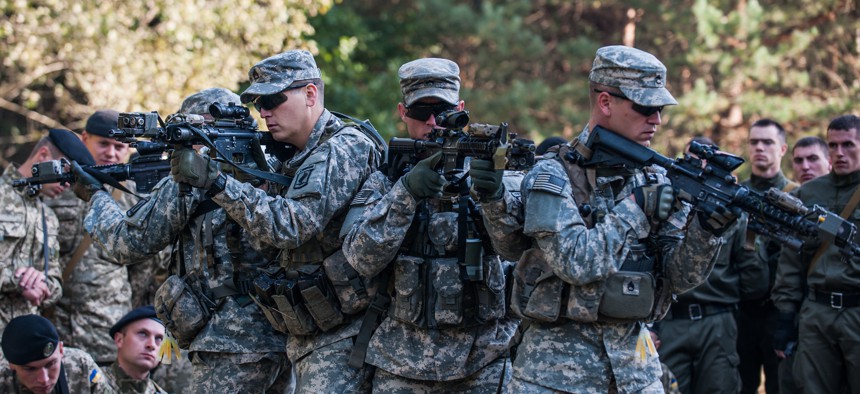
Soldiers from U.S. Army Europe’s Charlie Company demonstrate tactics to Ukrainian Marines and National Guard soldiers.

Ukraine is preparing for French military instructors’ arrival, reported Bloomberg News on May 28.

This announcement resulted from a high-level phone call between Ukraine’s Commander in Chief Oleksandr Syrskyi, Defense Minister Rustem Umerov, and French Defense Minister Sebastien Lecornu.

“I’ve already signed the documents that will allow the first French instructors to visit our training centers soon and familiarize themselves with their infrastructure and staff,” Syrskyi said on Telegram.

Earlier this year, French President Emmanuel Macron stated that “nothing should be ruled out” when asked about sending NATO troops to Ukraine. Lithuanian President Gitanas Nauseda has repeatedly expressed readiness to send professional soldiers for training missions to Ukraine. In March, Czech President Petr Pavel said sending military trainers would be possible.

The New York Times reported earlier this month that NATO members are moving closer to sending instructors into Ukraine to train its troops.

Gen. Charles Q. Brown Jr., the chairman of the Joint Chiefs of Staff, said that U.S./NATO military “trainers” will be sent to Ukraine, according to the Times. “We’ll get there eventually, over time.” 

Mark Episkopos says in Responsible Statecraft: “Brown’s comments tacitly concede two realities that Western officials have been loath to acknowledge: the Ukrainian war effort is slowly crumbling and cannot be sustained without a steady escalation of Western involvement.

“Yet there is a third factor that should be of serious concern to U.S. and European leaders: sending NATO personnel into Ukraine … [will] embroil NATO states, including the U.S., in a shooting war with Russian forces.”

First trainers, then combat troops

Yes, sending so-called military trainers is, in fact, an aggressive escalation. Imperialist military wars can start with “military trainers.” During the First Indochina War (1946-1954), French military trainers in Vietnam began an escalation of the imperialist war on Vietnam, eventually leading to the deployment of French combat troops. This eventually led to U.S. involvement, first with trainers, then followed by tens of thousands of combat troops.  

On May 14, U.S. Secretary of State Antony Blinken, in an unannounced visit to Kiev, vowed Washington would take “tangible steps” to ensure Ukraine’s addition to the NATO military alliance, RFE/RL reported.

Of course, NATO is already deeply involved in Ukraine, supplying weapons and training to the Ukrainian military.

On May 20, a bipartisan group of U.S. lawmakers sent a letter to Secretary of Defense Lloyd Austin urging him to authorize the use of U.S.-supplied long-range weapons to strike deep within Russian territory. The letter reflects Congress’ growing move to escalate U.S. military operations in Ukraine, including expansion beyond Ukraine’s borders into Russia.

The letter, authored by House Intelligence Committee Chairman Michael Turner and other members of Congress, requests authorization for the use of U.S. weapons against strategic targets inside Russia and calls on the Defense Department to provide training for more Ukrainian pilots on operating F-16 fighter jets.

2014 coup regime is no democracy

The Ukraine regime was imposed in February 2014 by a U.S.-backed coup that overthrew the elected government. The far-right regime represents Western imperialist interests, local oligarchs and neo-Nazis. The residents of Ukraine’s Donetsk and Lugansk regions did not recognize the new regime. In April 2014, in the Donbass mining region, the autonomous Donetsk and Luhansk People’s Republics (DPR and LPR) were declared, and the Minsk Accords laid out the process for their recognition. 

The Kiev regime never implemented the Minsk Accords and began military operations against Donetsk and Luhansk. Bombing and air raids targeted the civilian population, killing at least 15,000. Kiev massed an occupation army in the region. In February 2022, the DPR and LPR asked Russia for aid. That’s when Russia began its Special Military Operation, sending troops into DPR and LPR to secure their territorial integrity. 

The Kiev regime declared martial law in 2022. All elections have been canceled. Elections for the Ukrainian parliament, where all opposition parties have been removed, were canceled. Presidential elections were scheduled for March 2024 but were canceled. Volodymyr Zelensky said, “Now is not the time for elections.”

There is no popular support for Zelensky, the regime, or its war. The Ukrainian population is being wiped out. At the start of 2022, Ukraine’s population was estimated to be around 42 million. By mid-2023, estimates suggest the population in Kiev-controlled areas has declined to as low as 28 million. Millions of Ukrainians have fled the country, and the birth rate has plummeted to a historic low in the last two years, reaching levels unseen in the past 300 years.

Strugglelalucha256


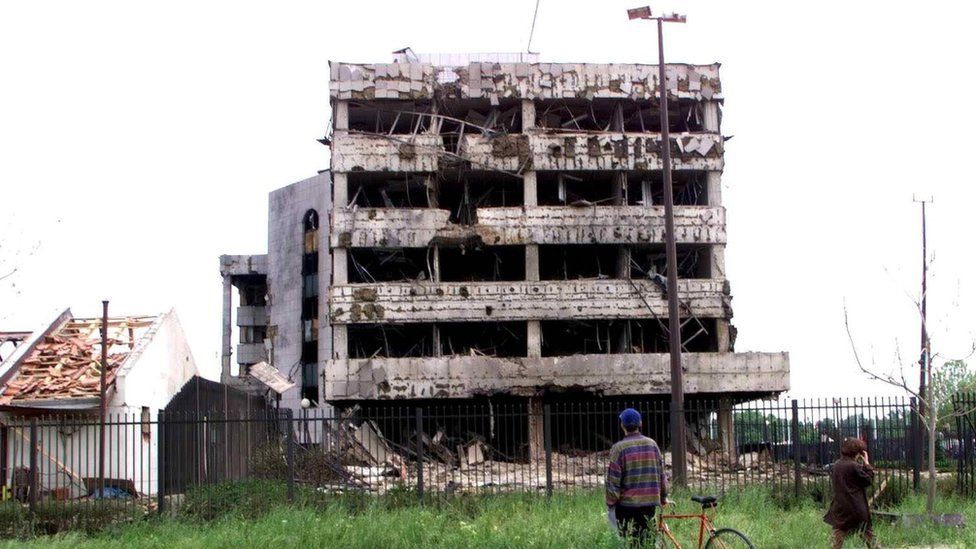
Never forget the U.S.-NATO bombing of China’s embassy!

May 7, 2024, marks the 25th anniversary of NATO’s bombing of the Chinese Embassy in Belgrade. This article was originally published in 2019, when Venezuela’s embassy in Washington, D.C., was being defended against Donald Trump’s illegal takeover.

Twenty years ago — on the night of May 7-8, 1999 — the Embassy of the People’s Republic of China in Belgrade, Yugoslavia, was deliberately bombed by the U.S. Air Force.

This war crime was committed during the 78-day-long bombing of then-socialist Yugoslavia by NATO. Three Chinese journalists were killed. At least twenty were injured.

Ambassador Pan Zhanlin escaped being killed only because the bomb that crashed through the roof of his residence didn’t explode.

The bodies of newlywed journalists Xu Xinghu, 31, and Zhu Ying, 27, were found under a collapsed wall. They wrote for the Communist Party daily newspaper Guangming (Enlightenment).

Forty-eight-year-old Shao Yunhuan of the Xinhua news agency was also killed. Her husband, Cao Rongfei, was blinded.

While it was one or more U.S. Air Force B-2 stealth bombers that attacked the embassy, it was the CIA that picked the target. The CIA director, George Tenet, later testified that the embassy bombing was organized and directed by his agency.

This liar claimed satellite images showed “no flags, no seals, no clear markings,” when in fact all three were present.

Why did the U.S. do it?

The CIA chose to bomb the embassy because the U.S. military-industrial complex wanted to launch a war on China. They viewed President Bill Clinton’s murderous bombing of Yugoslavia as a poor substitute.

After the Soviet Union and the socialist countries of Eastern Europe were overthrown — with the exception of Yugoslavia — the Pentagon wanted to destroy the People’s Republic of China.

In 1996, Clinton had already used aircraft carriers in a military provocation against China, ostensibly over the stolen Taiwan province. But that wasn’t enough for the military. The chairman of the Joint Chiefs of Staff in 1996 was Gen. John Shalikashvili, whose father had been a general in Hitler’s SS.

The attitude of a major section of the ruling class was shown by the Republican Majority Whip of the House of Representatives, Tom DeLay, who bragged how he physically confronted the ambassador of the People’s Republic of China to the U.S. during a filming of Meet The Press:

“So he’s coming off the stage and I’m going onto the stage and I intentionally walked up to him and blocked his way. … I grabbed [his] hand and squeezed it as hard as I could and pulled him a kind of little jerk like this and I said: ‘Don’t take the weakness of this president as the weakness of the American people.’  And he looked at me kind of funny, so I pulled him real close, nose to nose, and I repeated it very slowly, and said, ‘Do-not-take-the-weakness-of-this-president-as-the-weakness-of-the-American-people.’”

Defend Venezuela’s Embassy

The attack on the Chinese Embassy in Belgrade was answered by hundreds of thousands of Chinese students demonstrating against U.S. imperialism. Even Boris Yeltsin — whom the U.S. had re-elected in 1996 — felt compelled to send troops to Yugoslavia at Pristina airport on June 12, 1999, a month after the embassy bombing.

Later that same year was the “Battle of Seattle,” where thousands of union workers and students confronted the International Monetary Fund and the World Bank. People around the world saw the brutality of Seattle’s cops.

But it was world finance capital trying to squeeze blood out of a stone throughout Latin America that provoked the biggest fightback. Hungry people in Buenos Aires stripped supermarkets of food and Argentina was forced to cancel debt payments.

Latin American declared ¡Basta ya! to the neoliberal program of cutbacks and misery.  Hugo Chávez Frías was elected Venezuela’s president on Dec. 6, 1998, and inaugurated on Feb. 2, 1999.

The Bolivarian Revolution had begun.

Twenty years later, U.S. imperialism’s latest attempt to turn back the clock in Venezuela to the time when it was a colony of Big Oil and Nelson Rockefeller is sputtering.

Just like the CIA-directed bombing of China’s Embassy in Belgrade, the current attack on Venezuela’s Embassy in Washington, D.C., by the State Department and Secret Service, is an international crime.

Whenever you hear the State Department or the capitalist media attacking any country for violating “the freedom of the press,” remind them of the three Chinese journalists who were murdered in Belgrade: Xu Xinghu, Zhu Ying and Shao Yunhuan.

The best way to honor their memory is to continue to defend Venezuela’s Embassy. Hands off Venezuela!

Strugglelalucha256


Biden, Congress stoke war on all fronts with $95.3 billion package

On April 20, the U.S. House of Representatives passed a $95.3 billion aid package for Washington’s proxies in Israel, Ukraine, and Taiwan. Included in the package were provisions for imposing sanctions on China, Russia, and Iran, and a requirement that TikTok’s Chinese parent company sell its stake within one year or be banned in the U.S. 

One third of U.S. adults use TikTok, including a majority of those under 30. A majority of teens use the platform. The potential ban would certainly curtail people’s ability to freely access information and communicate. Importantly, it would limit people’s ability to access global perspectives. 

The so-called “liberal” media is even portraying far-right House Speaker Mike Johnson as a sensible “adult in the room” for working to get the bill passed. They also said that Trump had become more “presidential” after he greenlit the assassination of popular Iranian General Qasem Soleimani in 2020. 

Some House Republicans had held up the bill by attaching it to demands for intensifying repression of immigrants at the U.S.-Mexico border and other reactionary policies. Some of the Republicans do have misgivings about Ukraine funding, but only because the ruling class is divided on where exactly to focus its attacks. These Republicans are not anti-war. They have never flinched when it comes to arming Israel throughout this genocide. 

Both parties are totally united on the goal of continuing U.S. imperialist supremacy at any cost. There are no peace-loving doves leading these parties of war-mongers. 

Following the House, the Senate quickly passed the bill on April 23 with a 79-18 vote. Biden signed the bill the very next day. He stated: “In the next few hours — literally, a few hours — we’re going to begin sending in equipment to Ukraine,” and that “it’s going to make the world safer.” 

Given that Washington has repeatedly blocked United Nations ceasefire resolutions to end the genocide in Gaza, all the while pumping money and weapons into Israel (the administration found ways to keep the flow steady while the funding bills were tied up), there is no indication that Biden is interested in making the world safer. Quite the opposite.  

As for Ukraine, it is Washington that set the stage for the current war, orchestrating the fascist Maidan coup in 2014 on behalf of U.S. capitalists and International Monetary Fund creditors who demanded extreme austerity. It is Washington that funded the coup regime for eight years as it cracked down on domestic dissent (namely the left and trade unions), while attacking and killing some 14,000 people in the Donbass region. 

After Biden signed this funding bill on April 24, the Pentagon jumped to send the first $1 billion delivery to Ukraine. The weapons include shoulder-fired Stinger surface-to-air missiles, cluster munitions, Javelin anti-tank guided missiles, and more. 

According to Forbes, in late 2022, the U.S. had already sent 8,500 Javelins. Citing the army’s 2023 missile procurement budget, they said that these missiles cost $197,884 each. Eight thousand five hundred times that unit price would come to $1.7 billion. That’s just the cost of one class of weapon by the end of 2022. This is undoubtedly good for the shareholders of Raytheon and Lockheed Martin, the companies that together manufacture the Javelin.

Biden chides student protesters 

With the majority of Washington behind him – especially the Pentagon – Biden is stoking war on all fronts. The blood of the 32,000+ dead in Gaza is on his hands just as much as it is on Netanyahu’s. And yet, when he finally decided to comment on the student protestors who are acting as the conscience of the country (the same young people he wants to come out and vote for him in November), he scolded them! 

“Vandalism, trespassing, breaking windows, shutting down campuses, forcing the cancellation of classes and graduation — none of this is a peaceful protest,” he said. 

First of all, in every location, it has been the police who have violently attacked the student protesters. The students have been brutalized by the police, and there is no doubt that approval is coming from the top.

We have all spent months watching horrific videos of dead, mutilated children being pulled from rubble, killed by weapons Biden has paid for with our tax money. We could be forgiven for being more outraged by that than by a proverbial broken window. Biden’s audacity in talking about peace is astonishing. 

“A nation that continues year after year to spend more money on military defense than on programs of social uplift is approaching spiritual death.” Dr. Martin Luther King Jr. said this 57 years ago in his “Beyond Vietnam” speech, at a time when U.S. imperialism was murdering millions in Vietnam, Laos, and Cambodia.

We can imagine what King would say today if he were alive to witness the absurdity of this military spending compared with the increasing immiseration of the population in the United States, the richest country in the world. 

Right now, the same Supreme Court that took away women’s and other people’s right to reproductive autonomy – the same unelected Supreme Court being exposed for their lavish, free resort stays and wine tastings – is hearing a case about how easy it should be to throw homeless people in jail. The case started because the city of Grants Pass, Oregon wants free rein to fine and jail the homeless. But municipalities across the country are attempting to do the same thing. Instead of the government addressing the housing crisis this is what we get. 

In January 2023, the U.S. Department of Housing and Urban Development counted 653,104 homeless people in their annual Point-In-Time Homeless Assessment Report. That is about 1 out of every 500 people experiencing homelessness, up 22% from the year before. People are suffering from soaring food, housing, medical, and other costs. 

The federal government spent $700 billion in 2008 to bail out the “too big to fail” for-profit banks. It is spending many billions to wage wars on behalf of shareholders. But it will not bail out the working class. It is obvious where the government’s priorities lie, and it is not helping the people.

Strugglelalucha256


‘No to war and foreign military intervention’: a unanimous cry at Guantanamo Bay

The VIII International Seminar for Peace and the Abolition of Foreign Military Bases began this Saturday in the easternmost province of Cuba, an event that from the Mariana Grajales Square denounces the imperialist military presence around the world as a restriction to peace among nations.

Accompanied by the Government, the Cuban Communist Party (PCC) and institutions of the province of Guantánamo, the International Seminar was chaired on the first day by Yoel Pérez García, First Secretary of the PCC of Guantánamo; Fernando González Llort, Hero of the Republic of Cuba and President of the Cuban Institute of Friendship with the Peoples (ICAP); Víctor Fidel Gaute López, Vice President of ICAP, Iraklis Tsavdaridis, Executive Secretary of the World Peace Council (WPC) and Alis Azaharez Torreblanca, Governor of the province.

With the participation of 82 delegates (73 foreigners and 9 Cubans) from 26 countries, the anti-imperialist meeting echoes the international rejection of the genocide perpetrated by the Zionist army of “Israel” on the Palestinian people; and the unanimous demand for the return of the Cuban territory usurped by the United States with the installation of the Naval Base in Guantanamo; first Military Base of that country in the world, as well as the repudiation of the wars organized by NATO under the direction and auspices of the US.

In this context, Fernando Gonzalez Llort, stressed that “the Seminar takes place in a complex world scenario for just causes”, especially for Palestine, Western Sahara, Europe and the Middle East.

“There will be no peace in the world as long as there are weapons pointed against the peoples”, stressed the Cuban top leader.

The Cuban Hero reaffirmed that his nation vindicates Peace and the Sovereignty of the Peoples and “will not cease in its struggle for the return of the territory illegally occupied by the US Naval Base in Guantanamo. It will also not cease to demand the lifting of the economic, commercial and financial blockade imposed on our country more than 60 years ago”, and will maintain the struggle “for the elimination of Cuba from the arbitrary list of alleged countries sponsoring terrorism”.

Fernando González Llort considered it imperative to put an end to the expansionism of NATO and its allies, to aim at the dissolution of that aggressive military bloc, mainly responsible for the rise of the arms race in the world.

“We Guantanameros are very proud that our province is an international meeting place to defend peace”, expressed Yoel Pérez García, First Secretary of the PCC of Guantánamo.

Pérez Garcia thanked the presence of anti-imperialist fighters and leaders who debate and expose strategies to counteract the threat of extermination suffered by humanity, “the better world we dream of is possible and together we can achieve it,” he said.

“Let us strengthen the anti-imperialist struggle and solidarity, for a world of Peace and Social Justice”, urged the president of ICAP.

On the consequences of the imperialist military presence of the US, NATO and their allies around the world, -Iraklis Tsavdaridis, Executive Secretary of the World Peace Council (WPC) – stressed that they are not only the source of the war between Russia and Ukraine; they are also the support and prop of the Zionist army of “Israel” to perpetrate genocide against the Palestinian people.

“Not since the Cold War crisis in 1962 has the world been so threatened as it is today by the use of weapons of mass extermination”, warned Lt.Cr. Manuel Carbonell Vidal, vice-rector of the Higher Institute of International Relations of Cuba (ISRI). Therefore, it constitutes a threat to all life and human beings.

Gabriel Aguirre, representative of World Beyond War, pointed out that according to public information, “there are 6 or more military bases with nuclear weapons in Italy, Belgium, the Kingdom of the Netherlands, Germany, Turkey and it is very likely that there are others whose information is not in the public domain”.

The Venezuelan researcher denounced that “there are more than 900 U.S. military bases in 90 countries which of course turn this imperialist force into the main promoter of wars all over the world”.

There are -according to the references exposed by the delegates of the VIII International Seminar for Peace and the Abolition of Foreign Military Bases- around 1.3 million men and women in U.S. military installations, the country with the greatest presence of military bases outside its national territory.

The United States, the United Kingdom and France are the countries with the most military bases worldwide.

The US Naval Base in Guantanamo-Cuba, with 122 years of existence, is the oldest military base in the world and the first anti-imperialist trench in Latin America.

The origin of the base officially dates back to 1902, but the occupation is much earlier, dating back to the brief period when Cuba was invaded by the British Empire, at a time when the United States had not yet gained independence from the British crown.

During the period of interventions, 7 invasions of Latin American countries were carried out from the Naval Base.

U.S. specialists point out that the Naval Base was the second port in the world with military movement during the Second World War.

“The period from 1939 to 1945 was the only historical period in which the Naval Base played a least bit positive role in history in the fight against Nazi Germany”, said the historian of the city of Guantánamo, José Sánchez Guerra.

From the Guantanamo Naval Base, terrorist actions have historically been orchestrated in sister countries of the region; it is a center for the organization and execution of terrorist activities.

Its presence significantly affects the economy of the province of Guantanamo and causes damage to the environment.

However, Guantanamo, as an anti-imperialist trench, is a meeting point of International Solidarity where the U.S. military presence in Cuban territory is condemned, and strengthens the world movements for Peace in defense of injustices.

International support for solidarity in Guantanamo is also embraced by the Palestinian cause.

Murid Abukhater, a medical student in Cuba, born in Gaza, – expressed on behalf of his people – “the deepest gratitude and thanks to all the free and honest people of the world, who today stand in solidarity with our people and their just cause, in the face of imperialist-Zionist crimes”.

“We appreciate the solidarity of Cuba with our just cause, which considers it as its own and calls and defends Palestinian rights for the liberation, self-determination and full recognition of the Palestinian State in the United Nations.”

“Also for us, defending Cuba is our cause, we condemn the criminal and illegal US blockade and the infamous and arbitrary inclusion of Cuba in the list of alleged sponsors of “terrorism”, together with all the friends of Cuba we demand the end and the elimination of the blockade and to remove Cuba from this infamous list, as well as, we demand the closure of the US Base in Guantanamo and the return of this territory to the Homeland of Cuba and its national sovereignty.”

The Palestinian student, sent from this international event  a special greeting to the students of the American universities, who are protesting against the crimes of the occupation and the support of the Biden administration to the genocide and demand the end of the aggression against the Palestinian people.

The VIII International Seminar for Peace and the Abolition of Foreign Military Bases will conclude tomorrow with the reading of the final declaration of its participants. The town of Caimanera will welcome the delegates this Sunday to thank them for their support in the struggle they are facing from the first trench against imperialism.

Source: Resumen English

Strugglelalucha256


10 years of injustice: Anti-fascist leader recounts Odessa massacre

May 2 marks the 10th anniversary of one of the biggest crimes of 21st century fascism – the massacre of nearly 50 activists at the House of Trade Unions in Odessa, Ukraine. Despite extensive video and photographic evidence, the Ukrainian government has never prosecuted any of those responsible. This attack on the anti-fascist resistance paved the way for today’s U.S. proxy war against Russia and the Donbass republics.

The following interview with massacre survivor Alexey Albu was conducted by Struggle-La Lucha co-editor Melinda Butterfield in Simferopol, Crimea, in September 2014, and was originally published in October of that year.

Odessa Regional Council Deputy Alexey Albu, a member of the Ukrainian Marxist organization Borotba (Struggle), was a leader of the city’s Anti-Maidan movement against the U.S.-backed coup of February 2014. Albu survived the May 2, 2014, massacre, when at least 48 people were killed by neo-Nazi gangs at the House of Trade Unions. Albu and his family were forced to flee to Crimea, where he continues his work as co-founder of the Committee for the Liberation of Odessa and leads an independent investigation of May 2. I spoke with Albu about his experiences.

Melinda Butterfield: How did you become active in the anti-fascist movement?

Alexey Albu: I first joined Komsomol, the youth organization of the Communist Party of Ukraine (KPU). Later, I became a member of the KPU and organized its youth wing. I also took part in several local elections in Odessa. So I was always involved in political life as a communist.

The leaders of the KPU were afraid of openly demonstrating anti-fascist views. They didn’t want to take responsibility for an open confrontation with the neo-Nazis or the actions of young people who were strongly against fascism. They took an opportunistic position.

In 2011, I accompanied friends who were members of Borotba to a couple of anti-fascist rallies. When the KPU leaders learned of my attendance at these protests, they planned to expel me.

I left the KPU and became a member of Borotba. I didn’t plan to take people with me. Nevertheless, several comrades left the KPU and joined Borotba. One of them was Vlad Wojciechowski, who is now a political prisoner. Another was Andrey Brazhevsky, who was killed by the Nazis on May 2.

Borotba’s role in Odessa

MB: What kind of work did Borotba carry out in Odessa?

AA: I was an elected deputy of the regional council, so I had the opportunity to speak for Borotba in the local government. We also had the opportunity to create an organizational headquarters in Odessa. Many people came to our organization. Odessa residents got to know us and our symbols, and a lot of journalists covered our activities.

We organized solidarity actions with Ukrainian sailors in England and supported the struggle of dockworkers in the Odessa region. We organized anti-fascist meetings and demonstrations. We held a lot of protest rallies against the local government. We also helped organize immigration and education centers.

All of our protests were directed against the government of President Victor Yanukovych. But when the Euromaidan movement started, we understood that the people who wanted to use it to get power were even worse. Bourgeois democratic law was preferable to direct rule of Nazis and oligarchs. We were against them from the very beginning.

[Euromaidan was the pro-imperialist movement which took its name from Maidan, the central square of Kiev, the Ukrainian capital, where it held protests in late 2013 and early 2014. The backbone of this movement, which received extensive funding and political support from the U.S. government, were neo-Nazi gangs and political parties. Euromaidan culminated in the overthrow of President Victor Yanukovych in February. – MB]

When Euromaidan activists tried to occupy the Odessa Regional State Administration, our comrades protected the building. During the defense of the RSA, I became good friends with Regional Council Deputy Vyacheslav Markin, who was later killed at the House of Trade Unions.

Markin and I were the only deputies who openly said we were against the Nazis, the Euromaidan, the junta and all the crimes this movement brought to Ukraine.

Protest encampment

MB: How did the Anti-Maidan movement and the protest encampment develop?

AA: After Yanukovych was overthrown in February, the Anti-Maidan movement grew and became quite broad. It was based among common people who were not connected with any party. It was organized from below, from the people. The coordinators of this movement included members of many organizations, including Borotba. Borotba was not the most powerful organization; it was just one of those that influenced the Odessa Anti-Maidan.

The biggest parties of Ukraine, the Communist Party and the Party of Regions, didn’t participate in Anti-Maidan, although many of their members did.

The tent camp at Kulikovo Field [similar to the 2011 Occupy Wall Street encampments or the current student Gaza Solidarity Encampments in the U.S.] was the creation of all the groups that took part in the Anti-Maidan movement. For example, one group set up the area where people held speakouts. Others brought tents and supplies.

MB: How did you use your position as a regional deputy to help the movement?

AA: There was a lot of publicity when I introduced a draft law in the Regional State Administration, with help from Deputy Markin, calling for autonomy for the Odessa Region within Ukraine. This made Borotba very popular in Odessa. But unfortunately, most of the delegates didn’t vote for the law.

By ignoring this draft law, the regional deputies forced people to protest. On March 3, they came to the RSA building and started clashing with police. I tried to bring the people into the building to give them the opportunity to speak with the deputies. I was injured trying to get people inside.

Afterward, I had problems with the Security Service of Ukraine [SBU, political police whose role is similar to the FBI in the U.S.]. They searched my apartment and tried to interrogate me. The growing repression had a great impact in Odessa society. By the end of April, the Anti-Maidan protests had become smaller. Fewer people came to Kulikovo.

People were also disappointed because they came to Kulikovo every day, or every weekend, and saw that the leaders of the organizations couldn’t agree with each other. Instead, one by one, these groups started to make deals with the government.

The local government wanted to remove the camp, using the annual May 9 Victory Day parade as an excuse. Some organizations agreed to remove their tents, but others decided to stay.

Target: Odessa

MB: Why do you think the Kiev junta and the fascists targeted Odessa on May 2?

AA: First of all, I should explain that the Odessa region is very important for the Ukrainian economy. [The administrative subdivision of] Odessa has seven seaports and 70% of the country’s imports come through there.

Supporters of the junta in the local government wanted to stop the Anti-Maidan movement. They brought in neo-Nazis from Kiev in the middle of the night. They organized checkpoints inside the city, with 10 or 15 people at each checkpoint. They operated in around-the-clock shifts. They were fed by the government, and they earned money.

On April 29-30, Andriy Parubiy, head of the Defense and National Security Council, even presented the people at the checkpoints with bulletproof vests.

On one hand, they wanted the people from Kiev to radicalize the local Euromaidan movement, to ensure that they would enforce the new government’s orders. On the other hand, they wanted to remove the activists from Kulikovo Field, to make sure there would be no organized opposition.

I don’t think the government necessarily planned to kill people and cause so many casualties. But they organized everything and set the events in motion.

MB: Before the massacre on May 2, you planned to run for mayor of Odessa.

AA: What happened was that we held a strong anti-fascist demonstration on May Day, which worried the local government. That day, a lot of people from the Odessa Anti-Maidan movement agreed to back my campaign for mayor as the candidate of Kulikovo Field.

The following day, May 2, the tragedy began.

Deputy Markin was my campaign manager. He was killed by the Nazis. Afterward, anyone who tried to agitate for the candidate of Kulikovo Field was attacked by the fascists. So I decided to stop the campaign. I couldn’t take part in such elections.

Anyway, I was soon forced to leave Odessa. The local government spread lies, saying that I was responsible for the deaths at the House of Trade Unions. They claimed I took people into the building and subsequently the building burned, so I was guilty. They planned to arrest me.

Actually, I was one of the last people to enter the building. Never mind the fascists who threw Molotov cocktails, shot people and beat to death those who leapt from the burning building!

Kiev suppresses evidence

MB: Along with other Odessa political exiles, you have been conducting an independent investigation of the May 2 tragedy. Can you describe your work?

AA: The main problem for us is that a lot of information was lost the day after the tragedy. Many people went there. The House of Trade Unions was cleaned out before facts and evidence could be gathered.

Also, all the material recorded by the police and Security Service of Ukraine was never published and is classified top secret. So we have to look for information from open sources or solicit people who witnessed the massacre to share information. And of course many have been coerced by the new regime to remain silent or change their stories.

Our committee is sure that there were more than 48 victims on May 2. For one thing, the mother of an activist told us that when she went to the morgue to identify her child, the police showed her more than 60 bodies.

Officials of the government, the Security Service and the police do not provide any information, not even to the official investigation committee set up by the Ukrainian parliament. The leaders of the ultranationalist Ukrainian militia do not comment or make any statements. They are trying to avoid all questions about this tragedy.

But under the law they have to answer all the questions and turn over all the evidence and facts they have to the investigation committee.

MB: Do you have any parting message for workers and youth in the U.S.?

AA: The government in Kiev is doing everything in order to hide the real causes of this terrible tragedy and the real culprits of the massacre. We declare that we will pursue the investigation anyhow, and everyone guilty will answer for it and will be punished.

We are grateful to all the comrades who support the struggle of the Ukrainian people against the oligarchy and the Nazis. We are grateful to everyone who is helping us, and we call for solidarity because only together, by joint efforts, can we defeat the world capitalist system.

¡No pasarán!

Svetlana Licht and Marina Nova provided translation assistance.
Strugglelalucha256


NATO’s reign of terror: Yugoslavia to Russia

I write this just after returning from Belgrade and the important international conference held there commemorating the 1999 War of Terror conducted by NATO forces against the people of the remaining republics of Yugoslavia, primarily Serbia, a conference organized by the Beograd Forum for A World of Equals and related organizations.

In the West, the NATO attack is referred to as the “Kosovo” war since they want the memory of Yugoslavia and what it represented to the world to disappear forever. But it will not. We all know what happened there. I choose the phrase War of Terror for the NATO aggression against Yugoslavia because, in fact, that is what it became after the NATO forces failed to defeat the Yugoslav armed forces and, as a consequence, resorted to the use of a strategy of mass terrorism to force the people of Yugoslavia to submit to NATO’s will. The crimes committed by the NATO countries are well documented and include attacks on civilian infrastructure, on civilian trains, hospitals, media centers, energy infrastructure, industry, water supplies, bridges, administration centers and, finally, to force a surrender, the threat to carpet bomb Belgrade with B-52s and to kill 500,000 Serbs in the process.

Of course, these tactics are not new to war. We only need to look back at the Second World War to remember the terror attacks on civilian cities by the U.S. and British forces against German cities, like Dresden, or the American fire bombings of Tokyo and the nuclear attacks on Hiroshima and Nagasaki, to know what they are capable of. We remember their total destruction of Korea, in which terrorizing the civilian population was a key strategy used by the Americans and its allies. We remember the atrocities committed against civilians in Vietnam, the shock and awe of their attack on Iraq in 2003, their brutal invasion and occupation of Afghanistan of Libya, the use of U.S.-controlled terror groups like Al-Qaeda*, then ISIS* in Syria and Iraq, the use of terror against the populations of El Salvador and Nicaragua in the 80s, the same methods employed against the Rwandan government in the 1990-1994 in Rwanda, and in Congo ever since. Likewise, we see it in Gaza as Israel, with the direct participation of the USA, UK, Canada, France, Germany, and other NATO countries, inflict mass collective punishment on the Palestinian people, amounting to genocide against them.

We saw terror used to overthrow the legitimate government of Ukraine in 2014 and the following attacks on civilians in eastern Ukraine who refused to accept the NATO-backed coup d’etat, attacks which continue to this day. And now we see them using terror in the attacks against Russia in Belgorod and Moscow. Can we be surprised that the Russian investigation of the Crocus massacre of young people on March 22 strongly indicates that it was committed by the same actors responsible for all the previous terror attacks?

Commentators in the West have referred to these terror attacks as hybrid or asymmetrical warfare as if these phrases justify or legitimize them. They do not. They are war crimes for which those responsible must be held accountable and will be held accountable. Serge Lavrov’s visit to China to meet with his counterpart Wang Yi, the Foreign Minister of China, this week to discuss terrorism, among other issues of cooperation, indicates serious consequences will follow.

International law states these attacks are not only war crimes but can be considered genocide. The Rome Statute, for example, states

Article 6: Genocide

For the purpose of this Statute, “genocide” means any of the following acts committed with intent to destroy, in whole or in part, a national, ethnical, racial or religious group, as such:

  1. (a) Killing members of the group;
  2. (b) Causing serious bodily or mental harm to members of the group;
  3. (c) Deliberately inflicting on the group conditions of life calculated to bring about its physical destruction in whole or in part;

The key phrase is “in whole or in part.”  On that definition, the Belgorod and Crocus attacks are acts of genocide.

They are also crimes against humanity, as set out in Article 7 of the Statute,

Article 7: Crimes against humanity

  1. For the purpose of this Statute, “crime against humanity” means any of the following acts when committed as part of a widespread or systematic attack directed against any civilian population, with knowledge of the attack:
  2. Murder;
  3. Extermination;
  4. Other inhumane acts of a similar character intentionally causing great suffering, or serious injury to the body or to mental or physical health.

And they also constitute war crimes under Article 8,

Article 8: War crimes

For the purpose of this Statute, “war crimes” means (in part):

  1. a) (i) Wilful killing;

(ii) Torture or inhuman treatment, including biological experiments;

(iii) Wilfully causing great suffering, or serious injury to body or health;

(iv) Extensive destruction and appropriation of property, not justified by military necessity and carried out unlawfully and wantonly;

(vi)Taking of hostages.

  1. b) Other serious violations of the laws and customs applicable in international armed conflict, within the established framework of international law, namely, any of the following acts,

(i) Intentionally directing attacks against the civilian population as such or against individual civilians not taking direct part in hostilities;

(ii) Intentionally directing attacks against civilian objects, that is, objects which are not military objectives;

(v) Attacking or bombarding, by whatever means, towns, villages, dwellings or buildings which are undefended and which are not military objectives; and,

  1. e) Other serious violations of the laws and customs applicable in armed conflicts not of an international character within the established framework of international law, namely, any of the following acts:

(i) Intentionally directing attacks against the civilian population as such or against individual civilians not taking direct part in hostilities;

Those responsible under international law for these crimes are not just the perpetrators but also those in command of them, all the way up the chain of command to the head of state of the forces or services involved.  This principle of accountability for the highest levels of leadership was established by the Nuremberg Trials and has been accepted as a fundamental principle of international law since 1946. This principle was used by NATO in the show trials at the ICTY and ICTR, in the fabricated charges against President Milosevic, for instance.  It is time it was used against the leaders of NATO, who were granted immunity from prosecution by the prosecutors of the Yugoslav and Rwanda tribunals and who are granted de facto immunity from prosecution by the International Criminal Court, which refuses to prosecute any of the Western nations for their crimes and so encourages them and becomes itself a party to those crimes by its inaction.

So, what to do? Russia has several options. It can choose a military response and a legal response. It will likely combine the two. But insofar as a legal response, we can refer to the statement of the Russian Investigative Committee on April 9 concerning the Crocus attack that,

“Investigators have established that the funds that were received through commercial organizations, such as the oil and gas company Burisma Holdings operating in Ukraine, have been used in recent years to carry out terrorist acts in Russia and abroad with the aim of taking out prominent political and public figures and causing economic damage.”

“The investigation, in cooperation with other special services and financial intelligence, is checking the sources and further movement of funds in the amount of several million U.S. dollars, and the involvement of specific persons employed by government agencies, nongovernmental and for-profit organizations in Western countries. In addition, through investigative and operational methods, links are being established between perpetrators of terrorist attacks and their foreign handlers, organizers and sponsors.”

Tass reported that “Earlier, the Investigative Committee started assessing an appeal from lawmakers relating to the organization of terrorist attacks in Russia by the U.S. and other Western countries. The agency said the investigation will thoroughly examine the submitted data. The Prosecutor General’s Office also noted that the agency will study the materials that were received from State Duma lawmakers that pertain to the organization and financing of some terrorist attacks in Russia, as well as the explosions at the Nord Stream-1 and Nord Stream-2 underwater gas pipelines by persons and organizations located in the U.S., Germany, France and Cyprus. The agency said the materials will be carefully studied, which will be followed by considerations about whether mechanisms of international legal cooperation should be engaged.”

It is unclear which mechanisms of legal cooperation they are referring to. It cannot be the International Criminal Court, which is not a legitimate world court in any case and which Russia does not recognise as legitimate and which refuses to act. It cannot be the creation of another UN ad hoc tribunal since the U.S. and its allies will veto any such move in the Security Council, and, in any case, the UN Charter does not allow for the legitimate creation of such tribunals under Chapter VII of the Charter.

Can we look back at the historical example of the Nuremberg and Tokyo Tribunals as examples of international cooperation in holding leaders of nations responsible for their crimes? In those cases, the Tribunals were created after the defeat of Nazi Germany and Japan, and the criminals were in the hands of the people they had committed crimes against, a situation unlikely to exist vis-à-vis the U.S.A and its allies in any foreseeable future unless a direct war breaks out, and they are somehow defeated, a war which will threaten us all. This is, of course, a possibility. But let us hope that another way can be found to bring those responsible before the people of the world and expose them for what they are.

Criminal prosecutions are being prepared in Russia under its Criminal Code. But to “engage mechanisms of international legal cooperation” must have a meaning, and it logically follows that the creation of an international tribunal is one way to achieve this objective. Perhaps the Russians have something else in mind. We know not.

However, the first task is to identify those responsible, to name them, to expose them, to produce the evidence of their crimes before the world. We can be sure that will be done, and very soon. The question then becomes how to punish those criminally responsible and to prevent them from committing further crimes.

Former President of Russia and Deputy Head of the Security Council, Dmitry Medvedev, stated on April 6th that,

“It is obvious that Macron and some other Western leaders are the sponsors of this terrible terrorist attack. There is no forgiveness for this. There can be no immunity from this. And from now on, they are not just enemies of Russia.”

He is correct. Those responsible are not just the enemies of Russia. They are the enemies of mankind and are continuing to threaten to humanity.  Just what exactly the Russians are going to do we shall have to wait and see. But we can be sure of one thing; the consequences will be dramatic and inexorable.

Christopher Black is an international criminal lawyer based in Toronto. He is known for a number of high-profile war crimes cases and recently published his novel Beneath the Clouds. He writes essays on international law, politics and world events, especially for the online magazine “New Eastern Outlook”.

Source: New Eastern Outlook

Strugglelalucha256


Russia accuses U.S., Britain, Ukraine of ‘direct involvement’ in concert attack

FSB chief Alexander Bortnikov dropped a bombshell on March 26, accusing the U.S., Britain, and Ukraine of orchestrating the horrific March 22 concert hall attack in Krasnogorsk, near Moscow, that left 144 dead and 360 injured. This explosive claim, largely ignored by Western media, came just a day after President Putin hinted at Ukraine’s involvement.

Bortnikov’s rare TV appearance underscored the gravity of the situation, with Russia expert Gilbert Doctorow comparing it to the Cuban Missile Crisis. Evidence suggests the attack, originally planned for March 8 — International Women’s Day — to disrupt Russian elections, was carried out by Ukraine following the elections after tight security foiled the initial plot.

ISIS-Khorasan (ISIS-K) is reported to have claimed responsibility for the attack. Following the fall of the U.S.-backed Afghan regime, a significant number of former members of the Afghan National Defense and Security Forces (ANDSF) reportedly joined ISIS-K. There are reports that the CIA has been supplying ISIS-K with weapons and matériel. That ISIS-K was involved may be accurate, providing mercenary foot soldiers.

Bortnikov minced no words: “Radical Islamists carried out the attack, but Western special services provided assistance. Ukrainian special services were directly involved.” Bortnikov says Russia has evidence, though conclusive proof is still lacking. These stunning allegations implicate the U.S., Britain, and Ukraine in one of the deadliest terror attacks in recent history, a fact conveniently omitted by the U.S. media.

Strugglelalucha256


Ukraine continues attacks on civilians after capture of Avdeevka

Feb 21 — “The reality of Donetsk,” Alexander Kots, a correspondent for Komsomolskaya Pravda, wrote yesterday in the city after his visit to the recently captured town of Avdeevka. “In cafes there are almost always free seats near the windows. The population prefers not to sit there. If there is a bombing, there is a risk of being hit by broken glass,” he explained, adding that “in general, it is better to go to places with a basement. Even in the city center.” 

The false normality in which the capital of the Donetsk People’s Republic (DPR) lived during the years of the Minsk agreements, in which Ukrainian bombings from the surroundings of towns such as Avdeevka, Peski or Marinka only reached the periphery, is already a vague memory of the past. Today the city lives in a dynamic of constant worry about where and when artillery shells will impact.

Although Russia has not been able to coherently present many of the objectives for which it began its special military operation, these are the objectives with regard to Donbass: reaching the administrative borders of the former regions of Donetsk and Lugansk. For this objective, it was essential for Russia to overcome Artyomovsk, in the same way it was to capture the Ukrainian forts on the first line of defense around Donetsk. 

However, in this sector of the front, Moscow’s need to begin moving the front, and with it the firing positions, away from the Ukrainian troops has played a particularly important role. This is the reason for the local offensives against Peski, captured in the fall of 2022 after a tough battle; Marinka, from whose ruins Ukraine ended up withdrawing last December; and Avdeevka, taken this past weekend.

Russian sources, who have presented the capture of Avdeevka as an important step in the double objective of advancing towards the administrative limits of the Donetsk region and the attempt to improve the security of the population of its most populated area, have also insisted that the Ukrainian evacuation from the city was not going to be an automatic solution. In the days since the confirmation of the Ukrainian withdrawal from Avdeevka, Ukraine has wanted to make clear both that it has the means to continue threatening Donetsk and that it persists in its intentions.

Donetsk library attacked again

A year ago, on Feb. 19, 2023, Ukrainian artillery attacked the center of Donetsk, specifically the regional library, located on Artyom Street, the city’s main avenue. Yesterday, Ukrainian troops again attacked the same place in the most central part of the capital of Donbass, causing material damage and injuring two women. 

Shortly before, a bombing on the outskirts of the city had cost the life of a resident in one of the continuous Ukrainian bombings that never appear in the news unless they cause a high number of victims. However, their indiscriminate nature makes them the main danger for the population of Donetsk, whose security is not guaranteed at any time or in any place, without this situation having created any reaction among Ukraine’s partners, whose expressions of concern are limited to the Ukrainian civilian population residing on the “correct” side of the front.

Yesterday was not an indiscriminate bombing but a directed attack carried out with weapons much more precise than the 155mm artillery or the Grad of Soviet origin. According to local authorities, Ukraine used its U.S. HIMARS [multiple rocket launchers] to attack the most central street of the most populated city in Donbass. Whether the identification of the weapon is correct or not, it is long-range heavy artillery, used on two occasions against a library building. One of the bombs, which exploded next to the building, created a huge crater deeper than a grown man. The second, in the backyard, destroyed all the windows in the building. 

The library, which bears the name of [Soviet revolutionary] Nadezhda Krupskaya, perhaps one more symbolic element that has made it a desirable target for the artillery of Ukraine trying to eliminate all traces of the Soviet past, is one of the cultural centers of Donetsk, where all types of events, meetings and events are held. Even in war, life and culture must continue, as long as the artillery allows it – despite those words of [former Ukrainian President] Petro Poroshenko in which he stated that Donbass children will sit in basements while the Ukrainians continue their lives and ended by stating that it would be like this because they do not know how to do anything.

Attacks on civilians continue

The bombings of recent days have a clear message: Ukraine not only continues to have positions close to the capital of Donbass, but it also has long-range ammunition for which it does not need to be at close range. Moving the front away from the city of Donetsk continues to be an objective necessity given the intentions demonstrated by yesterday’s bombings and those that have occurred since the weekend, when part of the Ukrainian troops were busy withdrawing from their main fort. 

Ukraine has fiercely defended its positions in Avdeevka or Marinka, where fierce battles occurred even during the low-intensity war years of the Minsk ceasefire, because maintaining some control over the city of Donetsk depended on it.

The Ukrainian defeat in Avdeevka is not so much due to the loss of these privileged positions from which to condemn the population to eternal insecurity, but rather due to the demolition of the most important fort, with the weakening of the defenses that this implies. But in terms of attack, Ukraine now has ammunition and carte blanche to attack Donetsk and other cities located in its surroundings at will. 

Removing Ukrainian troops from the urban points that they usually attack with the sole objective of punishing the population for their disloyalty to the country that declared an anti-terrorist operation against them and denied them salaries, pensions and even bank accounts, is essential to prevent Kiev from using its most basic artillery, that which requires closeness in order to act. 

So Ukraine will continue to have long-range artillery and guided systems with which to attack targets, although the higher cost and lower availability of this ammunition should significantly reduce its use. However, Ukraine wanted to make it clear this week that, as long as it is materially possible, it will continue to use its weapons to shoot at civilian targets it deems appropriate, such as those named after historical figures linked to the Soviet Union.

Translated by Melinda Butterfield

Source: Slavyangrad.es


Strugglelalucha256


Aleksei Navalny’s death and the war drive against Russia

Why has the big business media given so much coverage to the death of Aleksei Navalny? The New York Times ran at least 56 articles about the Russian political figure since he died in a Siberian prison on Feb. 16. 

Nobody should die in jail. Prisons shouldn’t be dangerous, and inmates who are ill should be taken to a hospital.

Socialists look forward to building a future society where there are no prisons.

U.S. prisons are particularly dangerous. Just last year, 10 prisoners died in Atlanta’s Fulton County Jail. One of those who died, 34-year-old Samuel Lawrence, complained that he had been beaten. 

It’s the United States — not the Russian Federation or the People’s Republic of China — that’s the world’s greatest jailer. Over two million people are locked up across the U.S. Almost all are poor.

It was a lack of medical care that caused Henry Winston to become blind while incarcerated in the Terre Haute, Indiana, U.S. Penitentiary in 1958. The Black communist leader had been jailed for his political beliefs using a thought control law called the Smith Act.

Political prisoner Mumia Abu-Jamal is being denied adequate medical care in a Pennsylvania prison. Earlier, Abu-Jamal and other inmates had been denied treatment for hepatitis, a liver disease.

The real reason for the media uproar about Aleksei Navalny’s death is the proxy war against the Russian Federation in Ukraine. The halo of martyrdom placed upon Navalny is being used to get Congress to approve another $61.7 billion of arms to prolong this bloody conflict.

President Biden is bragging about how much of this money will go to war profiteers like General Dynamics. The production of 155-millimeter artillery shells is set to increase six times over three years.

Providing billions more for the war in Ukraine is just as obscene as the $14 billion that Genocide Joe wants to give to the Zionist regime, which has killed 30,000 Palestinians in Gaza. All of this money is stolen from poor and working people.

Who was Navalny?

Forty-seven years old when he died, Navalny was an unsuccessful capitalist politician who became a favorite of the U.S. and Western European capitalist powers.

Navalny appealed to racists by attacking migrants. He demonstrated alongside fascists in the annual “Russia March” demonstrations. Doesn’t that sound like Donald Trump?

The Russian Federation is a multinational state with millions of people from other ethnic backgrounds. Never forget that 27 million Soviet people from nearly 200 nationalities died defeating Hitler.

Eighty percent of the Nazi war machine’s casualties occurred fighting the Soviets on the Eastern Front. Unlike the U.S. armed forces, which under Jim Crow laws even had a segregated blood supply, all the Soviet nationalities fought side by side in the Red Army against the fascists.

Many Russians take pride in that. Recognizing the sacrifices of other nationalities doesn’t diminish the heroism of the Russian people.

Over 2,000 Ukrainians were awarded the socialist country’s highest military honor, Hero of the Soviet Union. The present Ukrainian regime has demolished thousands of monuments commemorating anti-fascists.

Nazis murdered more than a quarter of the population in Belarus, which was occupied for three years. Partisans there played a vital role behind enemy lines, blowing up railway tracks and attacking enemy forces.

Although the Nazis didn’t occupy the Uzbek Soviet Republic, 420,000 Uzbeks died fighting them. Uzbeks are among the peoples from the former Central Asian Soviet republics that Navalny wanted to round up and kick out.

The unity achieved in defeating the Nazis can be seen in the backgrounds of Soviet leaders. Riding on horses together in Moscow’s Red Square at the 1945 Victory Parade were Marshal Georgy Zhukov, who was Russian, and Marshal Konstantin Rokossovsky, who was Polish.

Gen. Ivan Chernyakhovsky, the youngest general appointed to lead an entire front, was Jewish. And the Commander-in-Chief was the son of a shoemaker from Georgia.

Navalny spat on this history. He issued a video portraying himself as a dentist and compared migrants from other former Soviet republics to cavities, calling for their deportation. Navalny claimed that in order to prevent the rise of fascism, fascist round-ups of migrants had to be carried out. 

A tragic defeat for all workers

The overthrow of the Soviet Union in 1991 was a bigger and more dangerous defeat for humanity than Hitler coming to power by smashing the German working class. Like the bloody overthrow of Reconstruction in the United States, which guaranteed hell for Black people, the demise of the Soviet Union had terrible results.

Living standards fell as production plummeted. Millions became jobless as socialist economic planning was abandoned. Even the death rate dramatically increased.

The Soviet Union itself was broken up as ethnic hostilities increased. This break-up was imposed despite the overwhelming vote in a March 17, 1991, referendum to preserve the Union of Soviet Socialist Republics. Seventy percent of people in Ukraine voted to keep the USSR.

Industries built over a dozen five-year plans were practically given away to a new class of big thieves known as oligarchs. U.S. and European capitalists hate Belarus because it’s the only former Soviet republic that didn’t conduct these fire sales of socialist property.

Navalny never attacked this criminal privatization and didn’t call for a redistribution of wealth to benefit the working class.

Instead, he appealed to smaller shareholders and wannabe capitalists. Navalny’s attacks on governmental corruption ignored the immense loot stolen by the new billionaire class as well as foreign thieves like ExxonMobil.

U.S. stooges

What sealed the capitalist counterrevolution was Russian President Boris Yeltsin’s Oct. 4, 1993, military assault on the Russian Parliament. President Bill Clinton and the corporate media were cheerleaders for this massacre in which hundreds were killed. 

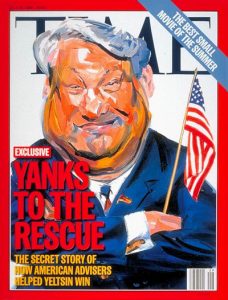
Three years later the U.S. Government got their stooge Yeltsin reelected in 1996. A Time magazine cover chortled: “Yanks to the rescue. The secret story of how American advisors helped Yeltsin win.” 

Just as Yeltsin got rid of a troublesome parliament, Ukraine’s elected government was overthrown with Washington’s support during the orchestrated “Euromaidan” revolt in 2013 and 2014. Assistant Secretary of State Victoria Nuland admitted to CNN that the U.S. spent $5 billion on the takeover. 

Trump supporters were seeking similar results to what occurred in Moscow and Kiev when they were allowed to attack the U.S. capitol on Jan. 6, 2021.

Ukrainian fascists secured their victory by burning down Odessa’s House of Trade Unions in May 2014 and murdering at least 48 people there. It was in reaction to this fascist coup that workers in Donetsk and Luhansk in Eastern Ukraine set up their own governments.

The Russian Federation intervened in 2022 to protect Eastern Ukraine from an impending invasion orchestrated by the U.S. and NATO. To the Pentagon, the Russian Federation’s 6.4 million square miles of territory needs to be occupied.

Working and poor people shouldn’t be fooled into supporting the NATO war in Ukraine. Like Boris Yeltsin, Aleksei Navalny was another stooge of U.S. big business.

Strugglelalucha256


Ukraine’s 2023 offensive: The turning point that was not

The last 12 months, fundamentally focused on the preparation, development, and analysis of the failure of the counteroffensive with which Ukraine intended to definitively recover the initiative in the war, have been confirmation that there is no short-term solution and that, in a dynamic of the military path as the only possible one, all participants – direct and indirect — must prepare for a long-term fight. The beginning of the year, with an attack that caused dozens of deaths among Russian recruits in Makeevka just one minute after midnight, seemed to portend for Ukraine a continuation of what happened in the last quarter of 2022.

Faced with the inability to maintain such a broad front and with attacks at both ends with a contingent significantly smaller than the Ukrainian one, with serious logistical deficiencies and excessive errors, the Russian troops had no choice but to withdraw from the city of Kherson and the territories of the right bank of the Dnieper without even fighting. The objective was to preserve the integrity of the group present in those territories, with some of the most prepared units, and avoid a military defeat similar to the one suffered two months earlier in Kharkov, where the disorderly withdrawal in the face of the unstoppable Ukrainian advance endangered an important part of the territory gained in Lugansk. 

After the recovery of the Kharkov territories, Ukraine hoped to be able to continue its advance in the north of Lugansk, where the defense of Kremennaya and Svatovo was maintained, according to journalists as close to the Kremlin’s positions as Alexander Kots, despite the military commanders and no thanks to them. Russia ended 2022 trying to recover from its moment of greatest weakness.

In this context, Ukraine never hid its preparation for a major offensive to repeat the success of the assault on the Kharkov region. On the other side of the front, Russia also did not try to keep secret its transition to the creation of a series of defense lines against the Ukrainian attack, of which it always knew what direction would be. Kiev’s goal has not changed since 2014, to recover Crimea, so a move in that direction was the only real possibility for Ukraine. Geography and conditions completely ruled out a massive attack in the Donbass or Kherson areas, where Russian troops were protected by the barrier of the Dnieper River, with its main bridge, the Antonovsky, completely destroyed by the Ukrainian attacks in 2022. 

The only surprise option in Ukraine’s hands, a massive attack through Russia, was never real due, in part, to the American veto of extending the war to Russian territory. But even apart from that red line, that option had further expanded a front that has proven difficult to maintain for both parties in the conflict. The Tokmak-Melitopol-Crimea direction through the open countryside of Zaporozhye was always the obvious line of attack that the Ukrainian troops would take the moment they received the required weapons from their partners and the new brigades finished their training.

Flexible defenses

Under the command of General Surovikin, Russia began the construction of what would become a flexible defense line based on fortifications created and improved since November 2022, when the loss of the Kherson territories was completed. As Russian reporters showed for months, the work of building defense strongpoints was, at that time, the main task of Russian troops, who were buying time to equip, arm, and instruct the around 300,000 soldiers recruited since the Kremlin gave the order for partial mobilization after the September defeats.

The delay in preparing the Ukrainian offensive gave Russia even more room for maneuver when it came to improving those aspects that had failed in 2022. With a less extensive front, with fewer logistical difficulties and with a smaller imbalance of troops with respect to Ukraine, Moscow was able to anticipate Ukrainian movements and prepare exactly for the upcoming operation. Russia was also aware that Kiev’s Western partners, to whom planning and command capabilities are fully vested, were preparing a ground offensive that would seek a quick rupture using large armored columns. Months of propaganda about the value of Western tanks and the pressure campaign to get Germany to approve the shipment of the desired Leopard-2 had made this clear.

Time would also confirm that Ukraine was not going to have, for this operation planned by NATO countries, the air cover that this type of offensive requires. Ukrainian pleas for Western aviation began the moment the delivery of Western tanks was unblocked, but it was always evident – partly due to the time required for pilot training — that the F-16s that Zelensky demanded would not be available in the 2023 offensive. As was later learned, the United States was aware that Ukraine did not have the necessary means to carry out the planned offensive, although it hoped that “Ukrainian courage” would make up for the shortcomings. 

In an example of how the official narrative can become dogma, both Kiev and its partners chose to blindly trust in the superiority of Western weaponry, training and tactics in the face of Russia’s inability to learn from its mistakes and mobilize its industry to produce the necessary material and, above all, the Ukrainian morale to fight against the broken, undersupplied and ill-equipped Russian army. Months later, Ukrainian officials would publicly denounce that their partners had sent the Ukrainian Armed Forces on an offensive under conditions they would never have accepted for their soldiers.

The change in trend and the Russian ability to prepare to defend itself from an operation in which it anticipated all movements was evident in the first week of June. Days before, after a bloody battle that caused thousands of casualties among its troops, the Russian Federation had achieved its greatest success in almost a year with the capture of Artyomovsk. This advance occurred amid the escalation of the conflict between the Ministry of Defense and the owner of the private military company Wagner, which a month later would give rise to the failed mutiny that made the most optimistic Western pro-Ukrainian analysts see the beginning of a “Russian civil war.” Neither the confrontation nor the mutiny affected the front. Although certain shortcomings persisted – the shortage of artillery shells was one of Prigozhin’s complaints before his notorious coup attempt – and the tactics of the frontal assault could be questioned, from the first moments of June it was obvious that a change had occurred.

Utilizing Iranian drones

Months earlier, Russia had turned to Iran, seeking support for an area in which it had been left behind: the use of drones. The beginning of the Ukrainian offensive with the march of the first armored columns through the open field of Zaporozhye, perfectly in sight of the Russian troops, demonstrated that Russia had not limited itself to introducing the Iranian Shahed, but had developed kamikaze drones with the Ukrainian operation in mind. 

The learning capacity, overcoming obvious shortcomings and good planning of the combined use of drones in the attack, but also in surveillance in combination with artillery, surprised Ukraine. So did the strength of the Russian minefields, an incomprehensible aspect and serious failure in Western planning. In the same way that it was known that Russia built its Surovikin line for defense, it was absolutely foreseeable that it would be capable of extensively mining the fields through which the Leopards, Bradleys and other types of armored vehicles would travel. Without air cover for Ukraine, Russia had extensive superiority in the air, which it complemented with the efficient use of unmanned aviation.

Just a few days after the Ukrainian tank columns left in the direction of Rabotino, Russia achieved the desired image of a first Leopard tank burning in the minefields. That same week, in what seemed a premature assessment, Vladimir Putin declared the offensive a failure. Time and the results of the operation have ended up proving the Russian president right. Already at that moment, when the first change in tactics occurred to abandon large armored columns in favor of smaller and more difficult to detect groups, the United States was also aware of the situation. As can be read six months later, when it is no longer necessary to try to hide the failure of the counteroffensive, it was the American media that confirmed that the objective was a quick break, capture of Rabotino in the first 24 hours, and advance towards Melitopol.

This breakdown of the front and advance on the main city of the territory of southern Ukraine would have meant for Russia a dangerous approach of Ukrainian troops to Crimea. Politically, this deep penetration into territory under Russian control sought, as Western officials such as Emmanuel Macron and Jens Stoltenberg have made clear, to force Russia into a negotiation in which it would find itself in a position of weakness. Leaks from Pentagon officials in the months of preparation for the offensive had shown that not even Ukraine’s partners had confidence in the conquest of Crimea. However, the threat to control of Crimea was understood as the way to pressure Moscow to give in to the Ukrainian diktat.

In the six months of the offensive, Kiev has finally achieved the advance it hoped to achieve on the first day of the attack. After months of fighting, Ukraine conquered the destroyed and uninhabited town of Rabotino, but was unable to overtake it. There was no Russian retreat and the area became a pocket of fire in which casualties continued to be suffered. Russia now appears to be trying to recover that little lost territory while Ukraine moves, just as Russian troops did a year ago, into a defensive phase. Those who then mocked the placement of dragon teeth on the southern front now place them in other areas such as Kharkov.

Siege of Donetsk

Ukraine’s move to a more defensive posture does not necessarily mean that a large-scale Russian offensive is occurring or will occur. This year, Russia has demonstrated its defense capacity on the front, although not so much in the rear, where Ukraine has obtained, especially against the Black Sea Fleet, its greatest successes. However, little can be said about Russian offensive capabilities, which this year have been limited to advances on Artyomovsk, put in danger after Wagner’s withdrawal and the start of the Ukrainian offensive and the Donetsk area. 

The Russian attempt to move the Ukrainian Armed Forces away from the surroundings of the Donbass capital has had only limited success. After a year of fighting and the complete destruction of the city, Russia finally managed to capture the entire territory of Marinka, west of the city, in December. To the north, the advance on Avdeevka continues, although at a slow pace and at the cost of significant losses (which Ukraine is greatly exaggerating to offset doubts about its huge casualties in Zaporozhye). Both cities are part of the first line of fortifications that Ukraine has built throughout the almost 10 years that the war has lasted in that region.

The prospects for 2024 depend on Ukraine’s ability to obtain the necessary financing from its European partners to keep the state afloat and the United States’ ability to approve funds that allow the Ukrainian Armed Forces to continue fighting. The mechanisms are already in place according to which Kiev will receive the precious F-16s for its next offensives. As Andriy Ermak promised on his last visit to the United States, next year will be the definitive turning point in the war. Something similar was promised a year ago, and even six months ago, when Antony Blinken declared in the first days of the Ukrainian offensive that Kiev had everything necessary to defeat Russia on the battlefield. 

Although it is hoped that financing for Ukraine will be approved — perhaps not at the levels desired by Zelensky, but enough to guarantee the continuation of the war – the reality is that the disappointment of 2023 makes it difficult for the Ukrainian executive to mobilize resources of his partners based on rhetoric of a last effort before the final victory.

The continuation of the battle is the only option available to Zelensky and his team, who more than a year ago closed the door to a negotiated solution. Installed in the maximalism of the demand for complete capitulation of Russia, the Office of the Ukrainian President will continue to navigate between the argument of immediate victory and that of the danger of certain defeat to ensure that the continuous flow of weapons, ammunition and financing is maintained.

Russia, for its part, seems to have understood that it has to play its cards in a long-term war. The recovery of industrial production, the maintenance of a sufficiently large group, and the control of a front not as extensive as a year and a half ago have guaranteed the status quo of 12 months ago. A series of weak points persist for Russia, among which are its fleet but also some of its cities. This is demonstrated by what happened yesterday: an artillery attack that cost the lives of at least 22 civilians in the center of the Russian city of Belgorod. Despite constant complaints about lack of ammunition, Ukraine maintains intact its ability to harm Russia in the rear, both with the use of missiles against Crimea and with artillery or Grad variants in cities closer to the front line or border.

In terms of attack, for the moment, Moscow has made do or has had to make do, with little progress limited to Donbass, where it has not yet been able to move Ukrainian troops back enough to avoid the bombing of Donetsk. What the defensive and offensive plans of the Russian command will be in the short term is the main uncertainty for the coming months.

Translated by Melinda Butterfield

Source: Slavyangrad.es


Strugglelalucha256
https://www.struggle-la-lucha.org/nato/page/3/