Ukrainian refuseniks on why many won’t fight for Ukraine

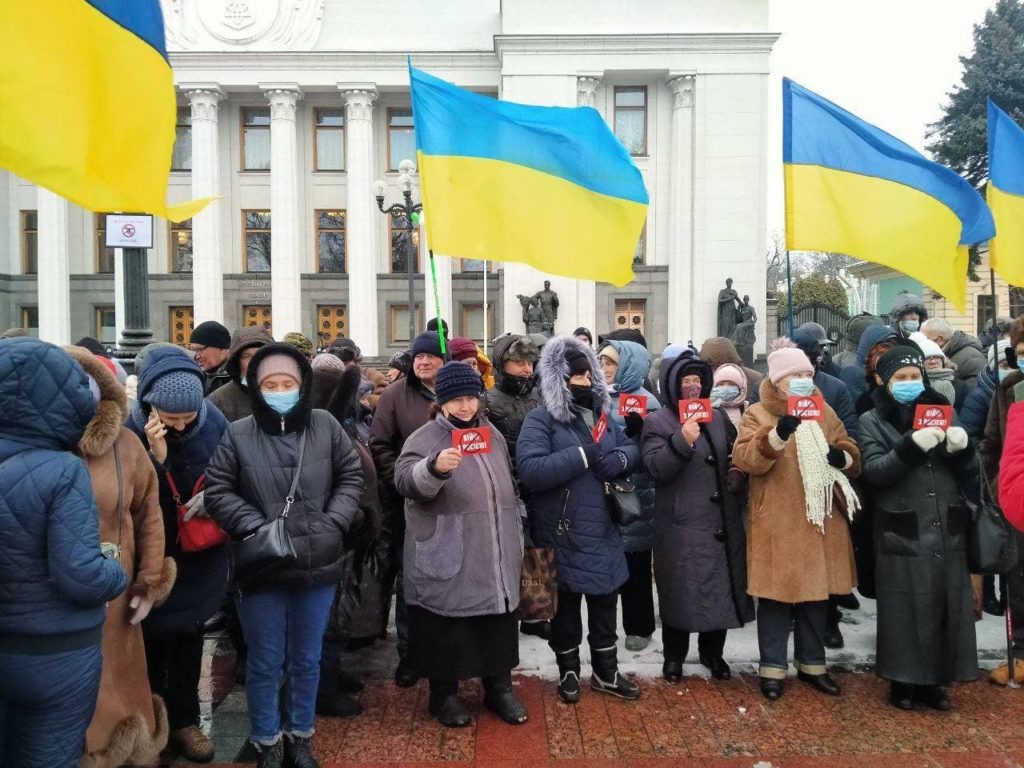
Protesters on February 10 holding signs that read, “No war with Russia” Photo: Facebook / Ukrainian Peace Movement

Since Russia began what they call the “special operation” on February 24 in Ukraine, the corporate media has reported the Ukrainian population is united in resistance against the Russian military offensive. Aside from reports of civilians volunteering in a variety of non-military support roles, Ukrainian President Volodomyr Zelensky and other state officials have urged civilians to take up arms. Then, on March 9, Zelensky approved a law that allows Ukrainians to use weapons during wartime and negates legal responsibility for any attack on people perceived to be acting in aggression against Ukraine. The Ukrainian Ministry of Defense even posted a graphic online with instructions on how to launch Molotov cocktails at tanks.

poll conducted in early March by the Ukrainian sociological group, “Rating,” indicated that, of those Ukrainians surveyed, over 90 percent supported their government’s war effort, and 80 percent claimed willingness to participate in armed resistance. However, this survey excluded people who live in the self-proclaimed independent republics of Donetsk and Lugansk in eastern Ukraine’s Donbass region. It also did not include the 1 million Ukrainians who had by then already fled the country. Since the survey, an additional 3.6 million have fled.

Beneath the façade of chest-beating patriotism, however, lies an anti-war movement. Just as it is diverse in its motivations to oppose the war, this movement is decentralized geographically and appears not unified enough to move as one force.

Ruslan Kotsaba, Ukrainian journalist and conscientious objector, in a cage during a recent court trial. Photo: friendspeaceteams.org

In post-Maidan Ukraine, opposition to militarism had already been a slippery slope, well before the current Russian incursion. The case of Ruslan Kotsaba, a Ukrainian journalist and conscientious objector, was perhaps the first such of state suppression under military law that had gained some degree of international attention, at least from human rights and pacifist organizations. Kotsaba was originally a proponent of the 2013-14 Euromaidan protests against the government of later-ousted President Viktor Yanukovych. But he began changing course when he spoke out against the 2014 violence in the majority ethnic Russian Ukrainian region of Donbass. He posted a now-notorious YouTube video in 2015, calling for a mass boycott against the mobilization in the far eastern region. After garnering hundreds of thousands of views, Youtube yanked it. For these statements, Kotsaba was arrested, detained, and charged with treason and “obstruction of the legitimate activities of the armed forces of Ukraine.” After being sentenced to 3-1/2 years on the latter charge, and spending more than a year in prison, his conviction was overturned on appeal. But, in 2017, a higher court reopened the case and his trial recommenced in 2021. Shortly before the recent escalation with Russia, the state prosecution was suspended, though not entirely concluded. This article provides a glimpse into the prevailing sentiments toward anti-war expressions in Ukraine. It comes from a Kharkiv-based “human rights protection group,” yet it describes the suspension of his prosecution as unjust, given his “active collaboration with the Russian state.”
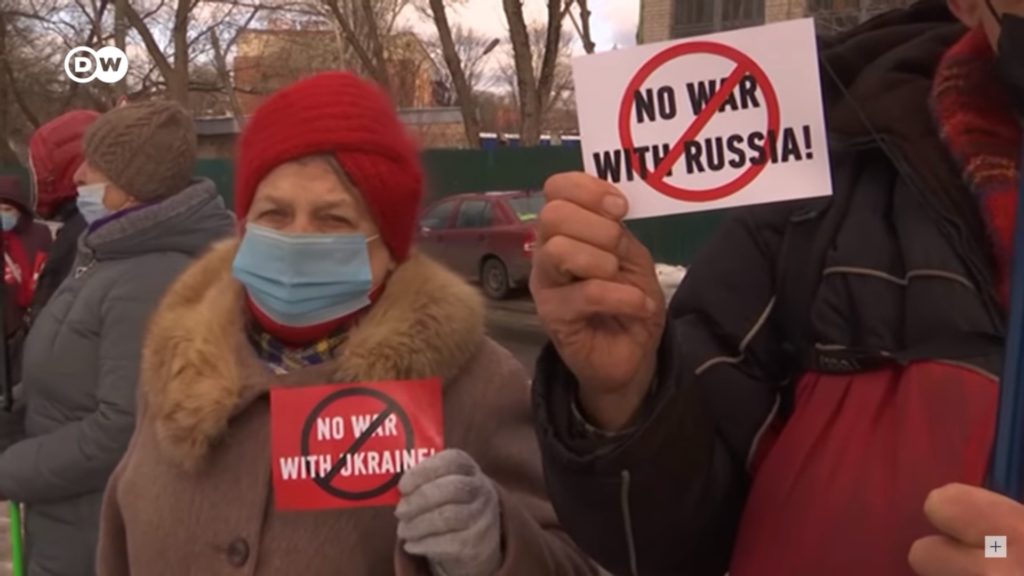
Protesters holding signs that read, “No war with Russia” (right) and “No war with Ukraine” Photo: Deutsche Welle / Ukrainian Peace Movement

‘Anyone Will Rat You Out’

This reporter spoke with someone who would only go by the name, “Pavel.” He belongs to a now-banned Kyiv-based Ukrainian Marxist group. Pavel recently moved from Ukraine to Bucharest, Romania, and declined to give his real name or the name of his group. In 2015, the Communist Party was outlawed in Ukraine, on grounds it promoted “separatism.” More recently, on March 22, a month into the Russian incursion, Zelensky banned 11 mostly left-wing opposition parties. Pavel cited these bans, and the well-being of his family remaining in Ukraine, as reasons for his anonymity.

“Anyone who says anything against the military, protests against NATO, or really, opposes the government from any direction, is immediately labeled ‘pro-Russian,’” the 26-year-old told Toward Freedom. “Anyone is bound to rat you out as a Russian spy if they disagree with you: Nationalists or even other ‘leftists,’ like anarchists or progressives. Most of the country has joined forces with the nationalists. SBU [Ukrainian Secret Service] will catch wind of a protest, a meeting, or an article, and they’ll speak to their friends in the ‘civil society,’ who will send armed nationalists to ‘handle’ you.”

He spoke of a close comrade from the Ukrainian city of Kharkiv, who had made statements on Facebook before February 24 against NATO interference in Ukraine and in support of the Minsk Agreements, the 7-year-old brokered cease-fire accords between the Ukrainian government and Donbass separatists, who had declared independence for two Ukrainian oblasts (states), Donetsk and Lugansk. Pavel said this person had gone into hiding in early March because nationalist groups had threatened their life. The person believed nationalists were still searching for them. Pavel and the person in hiding know of others who had disappeared in years prior.

Beyond this exchange, and a handful of correspondences on WhatsApp and Telegram, it has been next to impossible to find Ukrainian war resisters who had left the country to speak on the record. This is unsurprising given that one month ago, Zelensky issued a decree of martial law, banning most men ages 18 to 60 from leaving the country.

Military Service a ‘Form of Slavery’

Ukrainian pacifist leader Yurii Sheliazhenko told this reporter the pre-wartime penalty for evading military service had been up to three years in prison, but penalties have been increasing indefinitely since February 24. It’s impossible to verify what the exact penalties are, he said, as such hearings and verdicts are now closed to the public, ostensibly for the “safety of the judges” involved. As of April 10, Ukraine’s border guard reported roughly 2,200 detentions of “fighting age” men who were trying to escape the country. Many reportedly used forged documents or attempted to bribe officials, and others have been found dead in rural border areas.

Yuri Sheliazhenko Photo: Twitter

The 31-year-old Sheliazhenko, on the other hand, has not left Kyiv. Instead, he is working tirelessly with his organization, the Ukrainian Pacifist Movement (UPM), to promote a message of worldwide non-violent resistance to all forms of armed conflict, including on behalf of his own country. His organization was founded in 2019, initially to oppose mandatory military service, which he calls a “form of slavery.”

Toward Freedom had the opportunity Sunday to speak by phone for two hours. He noted that he was equally opposed to the practice in Russia, or in any other country. But, in 2019, as the war raged on in the Donbass region, conscription in Ukraine began to take on an “especially cruel nature. Young men were being given military summonses off of the streets, out of night clubs and dormitories, or snatched for military service for minor infractions such as traffic violations, public drunkenness, or casual rudeness to police officers. In Ukraine, if you do not respond to such a summons, you will be detained.”

Sheliazhenko’s pacifism developed in childhood, where in the final days of the former Soviet Union, he immersed himself in the works of authors Ray Bradbury and Isaac Asimov at “peaceful” summer camps in the Ukrainian countryside. These were a contrast to today’s militarized, nationalist-themed summer camps springing up all over the country since the Euromaidan.

Now, he is a conscientious objector. “[There is] no exemption for conscientious objectors in Ukraine, even for clergy or religious organizations.” He noted that a 2016 UN Declaration on the Right to Peace failed to protect conscientious objection on the level of international law. Plus, transgender and gender-non-conforming people are caught in a Catch-22. “In Ukraine, because trans women are treated legally as men, they are not exempt from the martial law order,” Sheliazhenko said. “But then, they are also prohibited from fighting in the military. There are some horrible stories about LGBT people being abused both on the borders—attempting to leave—and within the military here in Ukraine.”

He describes Ukrainian society as increasingly militarized and that Nazism has become a real issue: “Our country has created an existential enemy, and now they say all people should unite around a nationality and a leader! The country has generally shifted far to the right. There are of course Neo-Nazis. But then many of these people are not perceived as ‘Neo-Nazis,’ but as ‘defenders of the country.’” He noted that the cease fires in the Minsk Agreements had been violated on an almost daily basis, by both Ukrainian forces and separatist militants. That said, a perusal of the OSCE Special Monitoring Mission to Ukraine’s camera logs in Donbass, especially in the days leading up to February 24, show that almost every day, the first strikes were recorded from “government-controlled” locations, meaning Ukrainian military territory. By the time the war escalated in February, the UPM’s mission expanded past its usual opposition to conscription, and into directly challenging the military mobilization in Ukraine and in Russia. Of particular concern to the UPM is the role of NATO, and the unlimited shipment of weapons coming from the West. “When the UN failed to become a true organization of global, peaceful law enforcement, the U.S. developed NATO to institute global violent governance,” Sheliazhenko said. “These NATO weapons are moving this war to escalation, and it’s very profitable to the weapons corporations, like Raytheon, Lockheed and Boeing. [U.S. Secretary of Defense] Lloyd Austin is a board member of Raytheon!” The latter claim is correct.

This reporter asked Sheliazhenko if he was concerned for his own safety and about the nature of the risk he takes in publicly opposing his government and the war. “I will not fight in a fratricidal war, and no one should. But luckily, I am a consistent pacifist,” he replied. “If my summons comes, I will not go. And I have taken some precautions.”

Sheliazhenko said he also speaks against Russian military actions. However, he went on to explain peace activists would put themselves in danger of being arrested if they suggested Ukraine give up the Donbass region to the self-proclaimed independent republics. Fortunately for him, because he does not discuss territorial concessions, he is not deemed a threat. “I am seen maybe more as a freak, a clown.”
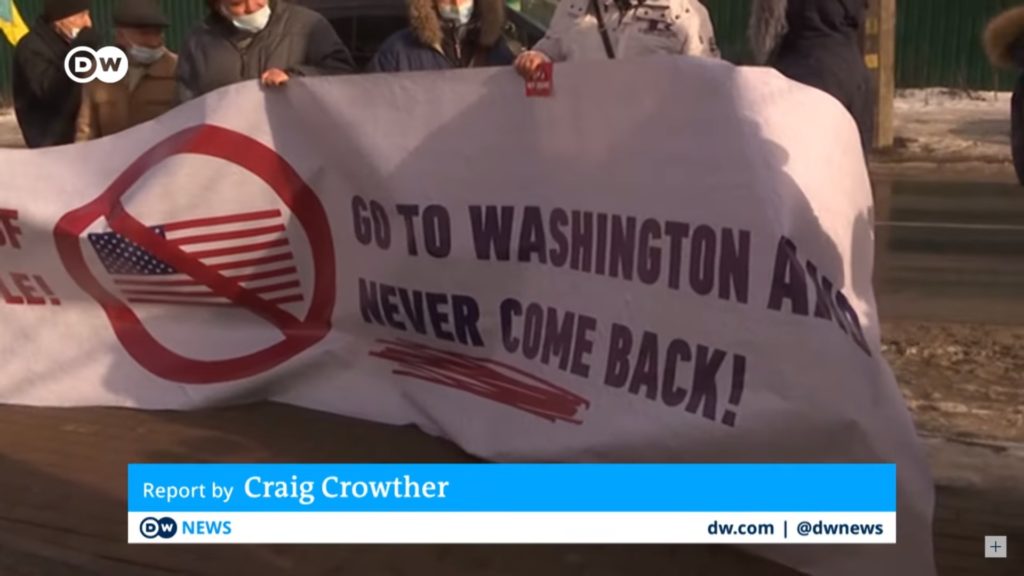
Screenshot of German public broadcaster Deutsche Welle showing protesters holding a banner that reads, “Go to Washington and never come back!” Photo: Deutsche Welle / Ukraine Peace Movement

‘Millions Don’t Support Authorities’

Another perspective came from Alexey Albu, 36, a self-described communist and anti-fascist from Borotba, a Ukrainian revolutionary union that was banned along with communist parties in 2015. Albu represented the anti-Maidan movement in 2014 mayoral elections in Odessa, his home city. But he was forced to flee after massacres that took place May 2, 2014. Dozens had been left dead.

Alexey Albu, a member of Borotba, a banned revolutionary union in Ukraine.

“In the press, there began to appear some accusations that it was my demand to shelter in the trade union building, and so I was guilty in the deaths of 42 people. Of course, this was not true,” Albu explained in Russian to this reporter. “But I realized that the authorities were preparing public opinion. On the 8th of May, I got information that the SBU would arrest me and my comrades the next morning. After that, I was put on a most-wanted list, but I was already in Crimea.”

Albu is now in the city of Lugansk, in the Lugansk People’s Republic. From there, he remains in regular contact with comrades back in territory controlled by the Ukrainian government.

“I want to say that millions of people in Ukraine do not support the far-right authorities, but all of them are really frightened.” A similar sentiment was documented in Toward Freedom’s March 21 article. “They are afraid of arrests, tortures, kidnappings,” Albu added. “Many notable people in opposition have been kidnapped and disappeared since the beginning of the military operation.” Some of those include former leader of the Ukrainian Union of Left Forces, Vasiliy Volga, and political scientist Dmitriy Dzhangirov. “Worse, many people who were in opposition to Kiev were detained, and we still don’t know about their fate. For example, the Kononovich brothers, leaders of the Komsomol [Young Communist League], and hundreds of other people.” Accounts of the March 6 detention of the Konovich brothers, accused of being “pro-Russian,” were widespread in international left-wing circles, as were demands to set them free.

The Kononovich brothers, leaders of the Young Communist League in Ukraine, have been detained since March 6. Photot: Internationalmagz.com

Albu reiterated the anti-war movement’s demand that the Ukrainian state demilitarize right-wing Ukrainian state forces. He also emphasized that, behind media narratives that show a nation of unified anti-Russian freedom fighters, much dissent can be found.

“You can see the real relation of so many of the people to the military operation in liberated zones, like Kherson or Melitopol,” Albu said, suggesting fear of state repression often veiled popular opinion until Russian forces would take control of an area. “Once the Kiev government is not in control, people [will] support the end of this right-wing occupation very widely.”

Fergie Chambers is a freelance writer and socialist organizer from New York, reporting from eastern Europe for Toward Freedom. He can be found on TwitterInstagram and Substack.

Source: Toward Freedom

Strugglelalucha256


Pentagon mania 1992: Bush disowns but won’t denounce plan for world domination

The following article by Marxist leader Sam Marcy was first published on March 19, 1992. It gives crucial background to the expansion of a “U.S.-led” NATO over Europe with the Pentagon at the head.

On March 8, the New York Times published excerpts from a 46-page secret Pentagon draft document that it said was leaked by Pentagon officials. This document is truly extraordinary.

It asserts complete U.S. world domination in both political and military terms, and threatens any other countries that even “aspire” to a greater role. In other words, the U.S. is to be the sole and exclusive superpower on the face of the planet. It is to exercise its power not only in Europe, Asia, the Middle East and Latin America, but also on the territory of the former Soviet Union.

The position laid out in this document is so extreme that it must have terrified the governments under U.S. pressure. Telephone calls must have poured into Washington from around the world after its disclosure.

Yet it took several days for the White House to finally comment on it. And even then, the language used only disowned or dismissed the document, but did not denounce it.

No official comment

First the Times published a second article datelined March 10 citing “senior U.S. officials” as critical of the document. However, they are not identified. Pete Williams, a Pentagon spokesperson, disavowed some parts of the document, but no “senior officials” with the stature of the Secretary of Defense, Chairman of the Joint Chiefs of Staff, Secretary of State, CIA Director, or the President would comment on it.

At a news conference the next day, however, President George Bush responded to a question about the document by claiming he hadn’t seen it and hadn’t read the press accounts about it. Instead of attacking the very idea of such a plan, he emphasized that “we are the leaders and we must continue to lead.”

A Pentagon official tried to pass off the document as “couched in language that is a little like the bluster of the officers’ club.” But this document doesn’t come from the officers. Rather, it was written by civilians in the Pentagon.

This document surpasses in importance the Pentagon Papers, which the New York Times, followed by the Washington Post and other papers, published in 1971. At that time a considerable section of the ruling class, under the pressure of the massive anti-war movement in the United States and the unrelenting determination of the Vietnamese people to free themselves from colonial tutelage, had become convinced of the hopelessness of the U.S. imperialist adventure in Southeast Asia.

It should be noted that at the time the USSR was a formidable military power, a superpower if you will, and was giving political and military support to the Vietnamese war effort, as was the People’s Republic of China. The case is otherwise today.

The ruling class this time is solidly for maintaining, strengthening and invigorating the U.S. military position worldwide in order to regain its economic superiority against its imperialist rivals, principally Japan and Germany.

It is one thing for the Pentagon to assert in a document that it plans to exercise domination over the entire globe. It is another matter altogether to brazenly announce this to the public in such terms as to threaten not only its alleged foes but its allies as well.

Considering the worldwide repercussions that the publication of such a document would have, one would have expected an outburst of open protest — from abroad but most particularly from here at home. What is really astonishing about the publication of this document is how little public response there has been to it, although there certainly must have been private ones.

Not suppressed like Pentagon Papers

There’s no question that this leak to the Times for publication had the blessing, to one degree or another, of the Pentagon and the Bush administration. Otherwise the White House would have quickly set in motion the kind of attack mounted by the Nixon administration against the publication of the Pentagon Papers. It ordered the Justice Department to obtain an immediate restraining order after the first installments of the Pentagon Papers began to appear in the New York Times. But the Supreme Court upheld the press at the time and overruled the Nixon administration.

Isn’t it obvious that the disclosure of this Pentagon plan for world domination, coming almost at the climax of the presidential primaries, could have become a principal issue for public debate? However, as of this writing, it has been virtually ignored. Perhaps it will be picked up later, but right now the momentous issues raised by this document seem headed for the dead-letter department, if the capitalist media and politicians have their way.

And even where the capitalist newspapers did subject it to some criticism, as have the Boston Globe, the Times itself and a few other newspapers, this has been directed not at the substance of the document, which concerns the domination of the world by U.S. military might, but at the way in which it was so brazenly and publicly expressed.

`Prevent re-emergence of a new rival’

Precisely what does this draft document, called in Pentagonese the “Defense Planning Guidance,” have as its aim?

“Our first objective,” it states, “is to prevent the re-emergence of a new rival, either on the territory of the former Soviet Union or elsewhere, that poses a threat on the order of that posed formerly by the Soviet Union.”

This is aimed not only against a new revolutionary government or a new socialist revolution in the world. It is also aimed at any potential new capitalist rival to the U.S. In fact, one wonders whether this document is not really intended to let the imperialist competitors know that they should not even dare to aspire to a greater role, let alone attempt to surpass the U.S.

The document says that to achieve this objective, “First, the U.S. must show the leadership necessary to establish and protect a new order that holds the promise of convincing potential competitors that they need not aspire to a greater role or pursue a more aggressive posture to protect their legitimate interests.” (Our emphasis.)

There is no question that this is a message to the imperialist rivals — Japan, Germany, France, perhaps even Britain. The language is so rude as to be unprecedented in a public document.

Next, says the document, “we must account sufficiently for the interests of the advanced industrial nations to discourage them from challenging our leadership or seeking to overturn the established political and economic order. Finally, we must maintain the mechanisms for deterring potential competitors from even aspiring to a larger regional or global role.”

This is meant for Japan, China and India in Asia; certainly for Germany and other imperialist countries in Europe; and for countries like Brazil and Argentina or a new revolutionary government in Latin America.

Later on, the document speaks specifically of Europe: “[I]t is of fundamental importance to preserve NATO as the primary instrument of Western defense and security, as well as the channel for U.S. influence and participation in European security affairs.”

But then it adds: “While the United States supports the goal of European integration, we must seek to prevent the emergence of European-only security arrangements which would undermine NATO, particularly the alliance’s integrated command structure.” The latter, of course, is led by the U.S.

So, while on the one hand it seems to support NATO, it only does so as a channel for “U.S. influence,” as it says so crudely.

Elsewhere in the document, it says that what is most important is “the sense that the world order is ultimately backed by the U.S.,” and “the United States should be postured to act independently when collective action cannot be orchestrated.”

This indicates frustration by the Pentagon. Its allies appear to be quite openly disappointed with the results of the war against Iraq and the benefits accruing to each of them. It indicates the U.S. reneged on the promises it made when rounding up their support.

Of singular significance is the scorn and contempt this document demonstrates for the United Nations. It says it is for NATO and the UN, as long as they will follow U.S. military orders. If not, it will act without them.

How will Japan and Germany react?

How the Japanese and German imperialist governments react to this remains to be seen. The document cannot be very comforting, coming at a time when Japan has now followed the U.S. into a deep economic crisis. Britain is also in economic turmoil, while Germany has begun closing down shipyards in what was originally the GDR, a measure it would rather have avoided had not the signs of economic recession already begun to appear.

It should be plain that the publication of this document is not likely to soften the sharp economic rivalry between U.S. finance capital and its imperialist allies. On the contrary, this will sharpen it.

The document is not directed solely at the imperialist rivals.

“Defense of Korea will likely remain one of the most demanding major regional contingencies. … Asia is home to the world’s greatest concentration of traditional Communist states, with fundamental values, governance, and policies decidedly at variance with our own and those of our friends and allies. …”

“Cuba’s growing domestic crisis holds out the prospect for positive change, but over the near term, Cuba’s tenuous internal situation is likely to generate new challenges to U.S. policy. Consequently, our programs must provide capabilities to meet a variety of Cuban contingencies which could include an attempted repetition of the Mariel boatlift, a military provocation against the U.S. or an American ally, or political instability and internal conflict in Cuba.”

Translated, this means that the Pentagon is already planning new attacks on Cuba and the DPRK. This should be of fundamental importance for us in the anti-imperialist movement and signal the need to plan for major activities to counter-act this danger not only to Cuba and the DPRK but to the oppressed people all over the world.

New world order

The Pentagon document is one more example that, notwithstanding all the talk of a “new world order” and a cooperative world commonwealth of freedom and peace, etc., etc., these phrases are only calculated to deceive world public opinion, and in particular the broad working class and the oppressed masses.

In the criticisms that have appeared thus far, only Patrick Buchanan — Bush’s ultra-right opponent in the primaries — has dug up the old isolationist rhetoric expounded by Sen. William E. Borah (R-Idaho) in the 1920s and Sen. Robert Taft (R-Ohio) in the 1950s.

According to Buchanan, “This is a formula for endless American intervention in quarrels and war where no vital interest of the United States is remotely engaged. It’s virtually a blank check given to all of America’s friends and allies that we’ll go to war to defend their interests.” (New York Times, March 10)

Such is the criticism of the extreme right-wing of the ruling class. It’s a fraud from beginning to end. The inference from all this is that the U.S. is intervening to help foreign powers at the expense of American taxpayers, and that the U.S. ruling class has no vital interests abroad. Of course it’s a lie.

The tremendous weight of the U.S. transnational corporations, especially the giant banks like Citicorp, Chemical, Manufacturers Trust and BankAmerica, is spread all over the world. It is to defend these interests that the Pentagon has conceived this monstrous picture of a world they totally dominate.

Yes, the document says the U.S. military machine will defend its European military allies. It will defend them against the oppressed countries in which they operate and garner vast profits, should there be an insurrectionary movement against their overlordship.

The U.S. military machine will also defend its allies against the working classes of their own countries. But it will in no way defend the imperialist rivals against the interests of U.S. finance capital. And it would certainly never extend any lavish aid to them without a quid pro quo.

The right-wing demagogy of the Buchanans and others actually aids Bush in this way: it inevitably creates fear in large masses of people of the specter of fascism, of a right-wing political assault upon the progressive movement, which can push them toward Bush and his cohorts.

In the current situation as it is unfolding, however, the conservative constituency in the Republican party is really narrow by comparison to the broad mass of the workers and oppressed masses. Together the latter constitute an overwhelming progressive force, vastly superior to the ultra-right and its fascist tail in the form of David Duke, whose followers are scurrying to the Buchanan camp.

The workers will not be easily fooled to go over to the Bush camp solely as a reaction to the fear raised by Buchanan’s racist, reactionary, anti-lesbian/gay and anti-Semitic propaganda.

Candidates Paul Tsongas and Bill Clinton were also interviewed by the Times about the Pentagon document. They took the standard Democratic Party approach that the U.S. should not engage in these military hostilities without first attempting to get the UN to support it. They also questioned the magnitude of the expenditures, but not the overall purpose.

Document written by civilian sector

This document is the product of the civilian leadership in the Pentagon and not the military camarilla, as one might assume. It is, according to the New York Times, written by Paul D. Wolfowitz, who is described as the Pentagon’s Under Secretary for Policy. Wolfowitz also represents the Pentagon on the Deputies Committee (deputies to the secretaries of State, Defense, Treasury, etc.) which formulates policy in an inter-agency process dominated by the State and Defense departments.

It is impossible to properly decipher exactly what is meant by this. Suffice it to say that they are civilians, and not the military staff.

These civilians are mostly the representatives of the military-industrial-technological complex — the military contractors and the banks that support them.

It is often assumed in literature written by bourgeois liberal critics that the military is autonomous, more often dictating policy to the industrialists and the government than the other way around.

Of course, there have been times when the military did assume an independent role or tried to in times of great international crises, as MacArthur did during the Korean War. He was fired by Truman for advocating the invasion of China.

The reaction to this Pentagon document is more reminiscent, however, of Carter’s dismissal of Gen. John Singlaub after he criticized plans to withdraw U.S. troops from Korea, or of Bush’s retirement of Air Force Gen. Paul Dugan last year after he disclosed the plans to bomb Iraq. In both cases, the reprimand was because these officers acted out of turn, making public what the capitalist government wanted kept secret. But the policy pursued thereafter was exactly in step with what these top brass had advocated.

Overall, the military is an instrument of class rule. Nowhere is that better demonstrated than in this document written by the civilians in the Pentagon — copies of which were sent to the military chiefs and to the White House.

It is clear from this document that it is the industrial half of the military-industrial complex that is speaking here. It is they who are most in need of expanding the military establishment and continuing to build weapons of mass destruction in the face of a looming economic debacle. But this doesn’t mean that the military is indifferent or opposed to it. Far from it.

However, to build more nuclear weapons at this time, after the collapse of the Soviet Union, is superfluous. The nuclear weapons program has cost hundreds of billions of dollars. Now that the military struggle with the USSR is over, the entire military-industrial-technological apparatus faces a diminished exchange value, or market value. It shrinks particularly in relation to the industrial-technological apparatus of the Japanese and Germans, most of all because they have no military baggage.

This will be reflected in the daily currency wars between these capitalist countries. The exchange value of military items, in terms of world currencies, has sunk sharply. But their capitalist production continues to mount.

Criticism skirts issue

Such criticism of this document as has appeared to date doesn’t go to the essence of the matter. It is narrow, very mild, and would scarcely raise an eyebrow in the military-industrial complex.

Leslie Gelb, in his column in the New York Times (March 9), pretends to criticize the Pentagon plan but in fact goes along with the whole program. The only fault Gelb finds is that the document makes no mention of Israel! He is appalled by this without really analyzing why Israel does not appear under the umbrella of U.S. protection.

The U.S. genocidal war against Iraq demonstrated one thing: with the absence of the USSR as a protagonist against U.S. imperialism (the Gorbachev regime collaborated with the U.S.), the Pentagon did not need Israel very much. Israel has really served as a super-giant military base for U.S. military operations.

However, when the Pentagon assembled a vast armada in the Mediterranean and the Gulf area, it made Israeli military support superfluous.

Furthermore, the U.S. also demonstrated its military prowess when it air-lifted in tens of thousands of soldiers and their military gear, allowed them to directly attack Iraq.

The new Pentagon strategy, which reflects the new position of the U.S. since the collapse of the USSR, diminishes the significance of Israel. This is especially true in light of the fact that the U.S. cowed and subjugated countries in the Middle East like Egypt and Saudi Arabia, and even Syria, Iran and others. The Israelis can now play a role only in minor skirmishes that the U.S. encourages.

The fact that the U.S. told Israel it would not guarantee a $10-billion loan (a piddling sum when you consider the many billions used to build up the Israeli military machine), so that now Israel is on the verge of withdrawing its request for the loan, reveals an altogether different situation in the Middle East. Unfortunately, it does not at this particular historical conjuncture necessarily help the Palestinians in their struggle. But that will come as surely as the rising sun.

Monstrous growth of Pentagon

Before World War II, the U.S. War Office occupied a modest building in the heart of Washington, D.C. It soon felt compelled to change its name from War Office to Defense Department — an attempt to take into account the anti-war sentiment of the masses while at the same time retaining the essence of its function.

It then went on to build the largest office building in the world — the Pentagon — where it resides to this date. While utilizing pacifist phrases, it was at the same time preparing for war. What need was there to go from a modest structure in downtown D.C. to a metropolis packed into one building?

It was necessary because of the vast increase in the military-industrial-technological complex. War has become a function of the capitalist state on such an enormous scale that it virtually threatens to swallow up all of society.

How is it possible that in the midst of what is admittedly the worst capitalist crisis since the early 1930s, with almost 10 million people unemployed, the Pentagon planners betray such utter disregard for the needs of the masses of people, let alone their aspirations for a better life?

One tends to ponder this when one reads that the Pentagon is demanding $1.2 trillion over five years to promote the program outlined in this infamous document.

That’s $1,200,000,000,000.

For the ordinary worker a million is a lot. A billion is phenomenal.

A trillion — which is a thousand billion — is out of sight!

Compare this to the paltry demands made by authentic popular organizations, which are resisted down to the last penny.

It is impossible for this to go on for any length of time. Sooner or later there will be a reckoning. What the military leaders, the industrialists, the bankers, the politicians, propose, the masses will ultimately dispose.

It’s still premature to speculate whether the publication of this document represents a split in the ruling class regarding the economic prospects of the military-industrial complex. Its economic and political weight has been so great up until now that it may be in for a readjustment at a time when it is demanding greater, not less, financial support. It is inevitable that some fissures will arise in the course of the struggle.

The working class movement must have an independent position in this and not be beguiled by fraudulent promises of a peaceful conversion of the capitalist economy, as happened right after the Vietnam War.

Source: Marxists Internet Archive

Strugglelalucha256


Ukraine and the Bolshevik Revolution


The struggle to overthrow the cruel tyrant called the Russian Czar was long and difficult. The czarist empire was a prison house of nations.

Czarist Russia’s conquering of Siberia meant killing and exploiting Indigenous peoples like what was done in the United States and Canada.

Poland was divided between Russia, Germany and Austria. Unlike Poland, which had been a powerful state for centuries before its partition, Ukraine was a nation in formation.

Revolutionaries fought against the oppression of dozens of nationalities in Czarist Russia. 

“The situation of the Ukrainian working people today is tragic in the extreme,” wrote the Russian novelist Maxim Gorky in 1916. “The czarist cutthroats give them no chance to develop their language, literature and art.”

It was even illegal to publish books and newspapers in Ukrainian.

Before the Bolshevik Revolution, 76% of Ukrainians didn’t know how to read or write. In 1900, there were only 35 Ukrainian women who had attended college. 

The treatment of the Ukrainian poet, writer and artist Taras Shevchenko (1814-1861) was particularly outrageous. Born into serfdom, a form of feudal enslavement, he became the most famous figure of the Ukrainian national renaissance.

Czar Alexander II had Shevchenko imprisoned for writing a satirical poem, an action that helped shorten his life. Besides criticizing serfdom and the czarist dictatorship, Taras Shevchenko also opposed the grotesque discrimination suffered by Jewish people.

The great majority of Ukrainian people had been serfs. So had Russians and other nationalities in the empire. Thirty thousand serfs were worked to death in building St. Petersburg.

Serfs could be bought and sold like cattle. They were beaten by their owner with a leather whip called the knout.

But unlike enslaved Africans in the United States, their families couldn’t be broken up. Their names and languages weren’t stolen from them. Children of serfs weren’t thrown to the sharks in the Atlantic Ocean.

Serfdom was abolished in 1861 by the same czar that had persecuted Taras Shevchenko. Alexander II did so before serfdom was overthrown from below.

One factor might have been the anti-slavery struggle in the United States and the outbreak of the U.S. Civil War there in 1861.The martyrs of Harpers Ferry were not able to immediately overthrow the slave masters but they may have helped frighten the Czar into getting rid of serfdom.

Poverty and pogroms

Ukraine was rich but Ukrainians were desperately poor. The country has some of the richest topsoil in the world.

The czarist empire was the greatest exporter of wheat during most of the 1800s with Ukraine producing the greatest share. It was only after 1870 that the United States, Argentina and Canada became major wheat exporters.

Yet the Ukrainian peasants who harvested wheat and other crops were often hungry themselves. Farm laborers would suffer night-blindness because of a lack of vitamins.

The Czarist regime was hated. It was almost overthrown in the 1905 revolution.

The Czar sought to turn this anger into racist violence directed at minorities. These spasms of terror in which hundreds of people were lynched were called pogroms. They were deliberately instigated by the regime.

The 1917 riot in East St. Louis, Illinois, where the police allowed over 100 Black people to be murdered by white mobs was a pogrom. So were the race riots in Chicago and other U.S. cities in 1919.

The burning of “Black Wall Street” in Tulsa, Oklahoma by white supremacists in 1921 and the mass graves of African Americans there was certainly a pogrom.

The biggest target of czarist pogroms were Jewish people. Thousands of Jews were murdered, tortured and raped.

The Bolsheviks fought pogroms with guns. The revolutionary movement had been centered in the cities and minefields where the working class was concentrated.

Workers in St. Petersburg prevented pogroms from being organized. The greatest center of pogroms was Ukraine and Moldova where the working class was smaller.

None of this prevented the centuries-old czarist police state from being overthrown in March 1917. Eight months later, workers organized into councils known as soviets took power. They were led by socialists who were called Bolsheviks.

Lenin led the Bolsheviks. Their slogan of “bread, peace and land” appealed to millions of people.

They wanted an end to hunger, poverty and war. Two million soldiers from the former Czarist Empire had died in World War I.

Peasants ― the vast majority of society ― wanted to take the land that they had plowed for generations. The Bolsheviks told them to kick out their landlords and seize the land.

In contrast, capitalists betrayed Black people after the U.S. Civil War. Instead of the former slave masters being forced to give up their plantations, most Black people became landless sharecroppers.

Lenin and Ukraine

When the peasants and workers took power on Nov. 7, 1917, the Russian landlords and capitalists were demoralized. The support given by capitalists in other countries sparked a civil war.

The counter revolutionaries were called White Guards, who were a Russian terrorist army much like the Ku Klux Klan. The United States and other countries sent troops to support the White Guards and attempted to drown the socialist revolution in blood.

The Red Army of workers and peasants defeated the White Guards and foreign troops. Dock workers in Seattle and Britain refused to load weapons for the White Guards.

This was what Italian and Greek workers are doing now. They’re stopping NATO weapons from going to the Kyiv regime that depends on fascist thugs to remain in power.

In the Russian Civil War of 1918-20, most of Ukraine had been overridden by White Guards. They murdered 100,000 Jewish people there.

A well-to-do minority of Ukrainians supported the White Guards and joined the pogroms. Their political descendents supported the Nazis in World War II and today they comprise the fascist Azov Battalion and Right Sector thugs.

After hundreds of years of Czarist oppression, Ukrainians and other nationalities wanted freedom. Lenin, who was Russian, said in effect, “right on!”

He drafted a resolution for the Communist Party about Ukraine in November 1919. Here are some excerpts:

“In view of the fact that Ukrainian culture (language, school, etc.) has been suppressed for centuries by Russian czarism and the exploiting classes, the [central committee of the Communist Party] makes it incumbent upon all party members to use every means to help remove all barriers in the way of the free development of the Ukrainian language and culture…

“[Communist Party] members on Ukrainian territory must put into practice the right of the working people to study in the Ukrainian language and to speak their native language in all Soviet institutions; they must in every way counteract attempts at Russification that push the Ukrainian language into the background and must convert that language into an instrument for the communist education of the working people. Steps must be taken immediately to ensure that in all Soviet institutions there are sufficient Ukrainian-speaking employees and that in future all employees are able to speak Ukrainian.” 

Famines and industrialization

The Ukrainian Soviet Republic was established. In 1922 Ukraine joined with the other soviet republics to form the Union of Soviet Socialist Republics.

Socialism brought great advances. By 1939, some 88% of Ukrainians could read and write. The literacy rate in 1959 was 99%.

Whereas printing in Ukrainian had been forbidden by the Czar, in 1980 there were around 1,500 newspapers and magazines printed in that language. 

Ukraine is a multinational country. Besides millions of Ukrainian and Russian speakers, there are Greek, Hungarian, Jewish, Roma and other peoples. Ukrainian fascists call these people “scum.”

Some have asked why the Bolsheviks included predominantly Russian speaking areas, like the Donbass, within Ukraine’s boundaries. (The boundaries drawn by communists are the same ones used today.)

The reason was that in 1917, the vast majority of Ukrainians were peasants who lived in the countryside. Most of the workers were Russian, like coal miners in the Donbass. Including these workers in Ukraine helped promote socialism.

After the civil war came the famine in 1921-1922 in which millions died. This was the era before the “green revolution.”

Farmers in Ukraine and Russia often used wooden ploughs. Even with good weather crop yields could be low. The loss of millions of agricultural workers because of World War I, the civil war and the 1918 influenza pandemic further reduced the harvest.

More controversial is the 1932-1933 famine. At least 3.3 million people died in this tragedy.

Many Ukrainians, who are not communists, claim this famine was deliberate genocide against the Ukrainian people. Yet the famine affected millions of Kazakhs and Russians outside Ukraine.

This famine took place during the first five-year plan which was rapidly industrializing the Soviet Union. Part of this offensive was bringing socialist production to the countryside.

Millions of peasants got land because of the Bolshevik Revolution. But these plots were too small to employ modern agricultural machinery.

Peasants were encouraged to join cooperatives and form collective farms. The richer farmers, called kulaks, resisted.

This was an intense class struggle which amounted to a second revolution. Sometimes the worst exploiters are the small property owners like small slumlords or other small-time cockroach capitalists.

Kulaks helped sabotage the harvest by concealing grain stocks and slaughtering livestock. Detachments of workers and poor peasants defeated the kulaks.

The forming of collective farms went hand-in-hand with constructing factories making tractors and harvesters. The countryside was electrified. Ukrainians left wooden ploughs behind and built a modern society.

Defeating Hitler and NATO

Looking back, some argue that collectivization should have started sooner and/or more slowly. Soviet leader Joseph Stalin in his article “Dizzy with Success,” urged activists to be more careful.

Often overlooked in this famine, as historian Mark B. Tauger points out, is the devastating role of the wheat rust fungus. This plant disease would have been disastrous whether there had been a collective farm movement or not.

And where was U.S. President Herbert Hoover? In 1921, before he became president, Hoover led a relief campaign that aided starving people in the Soviet Union.

But in the early 1930s Hoover did nothing, even while many U.S. farmers couldn’t sell their crops during the Great Depression.

Also questioned is that the Soviet Union exported crops while people were starving. Professor Tauger estimates that as many as two million people might have lived if these exports ceased.

This is heartbreaking. But as Tauger mentions, both Germany and Britain threatened to stop lending credit to the Soviet Union unless it paid more of its debts.

What the Soviet Union had to sell at the time was largely oil, lumber and wheat ― all at the low Depression prices. As it was, the Soviets did cut farm exports. (“The 1932 Harvest and the Famine of 1933,” by Mark B. Tauger, Slavic Review, Spring, 1991.)

Imports of machinery were absolutely necessary to industrialize the Soviet Union. And the industrialization carried out by the five-year plans enabled the Soviet peoples to defeat the Nazi invasion, which killed over 5 million Ukrainians.

So many of the new industries were built in Ukraine. One of the best known projects was the Dnieprostroi hydroelectric dam. By 1940, over a half-million Ukrainian workers had high school or college educations. 

Today the greatest racist hellhole is the United States. Wall Street was finally able to overthrow Soviet power in 1991. This was despite an overwhelming majority of Soviet citizens ― including 78% of Ukrainians ― voting to retain the Soviet Union in a March 17, 1991 referendum.

This tragedy was a greater defeat than the victory of Hitler over the bones of the German working class. World capital and its media have been able to poison the minds of too many Ukrainians, Russians and other peoples living in the former Soviet Union.

We look forward to NATO’s defeat and a revival of a revolutionary movement in Ukraine. Long live the unity of all the workers and progressive peoples in Ukraine! Workers and oppressed peoples of the world, unite!

Strugglelalucha256


Ukraine, war crimes and white power: The Black Alliance for Peace calls for the dismantling of NATO, AFRICOM and all imperialist structures

For Immediate Release
Media Contact:
communications@blackallianceforpeace.com
(202) 643-1136

“De-center Europe and Focus on Imperialism” Those words sum up the Black Alliance for Peace March 1, 2022 statement on the war now taking place in Ukraine. As an anti-imperialist formation BAP is committed to a call for peace, for an end to militarism and domination in Ukraine and elsewhere.

On the same day that Russian troops entered Ukraine, U.S. drones bombed Somalia, a nation that has suffered from U.S. interventions for 30 years. An estimated 250,000 Somalians have died and 3 million have been displaced as refugees during this time. The latest assault went without notice in the corporate media of the U.S. and its NATO allies.

At the same time Ukrainian refugees were elevated in importance, with some commentators explicitly noting “blonde hair and blue eyes” or pointing out that the carnage of war is acceptable in the Global South but is unthinkable in Europe. Now allegations of war crimes against Russia are loudly announced by U.S. president Joe Biden and his NATO partners with calls for prosecution in the International Criminal Court (ICC).

Yet war crimes have been committed from Somalia to Libya to the Democratic Republic of Congo and all of NATO is culpable. These crimes are rarely described as such and U.S. presidents escape condemnation. The charges against Russia should not be discussed without also acknowledging that the United States is not a signatory to the Rome Statute which brought the ICC into existence. Additionally, in 2002 Congress passed and George W. Bush signed the American Servicemembers’ Protection Act which prohibits Americans being extradited to the ICC and allows the U.S. to forcibly release any American or ally held there. “It is the height of hypocrisy for the U.S. to accuse other nations of committing war crimes while exempting itself from any possibility of punishment,” says BAP Africa Team Co-Coordinator Margaret Kimberley.

Neither Bill Clinton nor George W. Bush nor Barack Obama, Donald Trump or Joe Biden will be held to account for drone attacks on Somalia, or for continuing the destruction of the Somali state. In a just world the Obama administration’s destruction of Libya in 2011 and the ongoing humanitarian crisis would be prosecuted as a war crime. The Democratic Republic of Congo has the highest death rate of all, with some 6 million people killed when Uganda and Rwanda, U.S. proxies, invaded that country in 1996. NATO is far from the defensive alliance it claims to be. It is an aggressor and must be dismantled.

This hypocrisy explains why 17 African nations abstained from the March 2, 2022 United Nations resolution condemning Russia, and one, Eritrea, voted no. Their experiences with NATO and AFRICOM ensure skepticism of self-proclaimed noble motives. BAP Africa Team member Djibo Sobukwe points out, “The U.S./NATO death toll inflicted on the African continent makes any claim of concern for human rights hypocritical.”

BAP calls for the dismantling of NATO, AFRICOM and all imperialist structures. Africa and the rest of the world cannot be free until all peoples have a right of sovereignty, and the right to live free of domination.

No Compromise! No Retreat!

Strugglelalucha256


Ukrainian secret service and neo-nazis abduct left-wing activist in Dnipro

Around noon on March 3, five persons forced their way into the apartment of 31-year-old hotel clerk Alexander Matyushenko and his partner Maria M. in Dnipro (Dnipropetrovsk). As the latter told jW, they were both shouted at, forced to lie on the floor, and not allowed to move. The aggressors reportedly did not disclose identification, but two of them were apparently recognized as members of the Security Service of Ukraine (SBU) thanks to insignia on their clothing. The officials searched the rooms, while another man in a military uniform showing emblems of the fascist Azov Battalion beat up Matyushenko to extort information. “The same person was spitting in my face and cutting my hair with a knife,” Maria M. said. Accordingly, Matyushenko was beaten and maltreated for a total of two hours.

These accounts are backed up by footage allegedly posted by a thug involved in the assault on the Dnipro city Telegram channel, which has around 335,000 followers. A photo shows Matyushenko lying on the ground bleeding all over his face with a gun pressed to the back of his head. A video shows him being kicked and forced to repeatedly shout the greeting of the fascist banderists, “Slava Ukrajini – Gerojam slava!”

Matyushenko is an anti-fascist and a member of Livitsya (Left), an alliance founded by activists from various social movements in Dnipro two years ago. The left-wing organization supports strikes and uses both public rallies and publications to protest social cuts, low wages, the curtailment of democracy, and the enforced conformity of the media – which has been used by Ukrainian oligarchs to established a “right-wing consensus” in society, as Matyushenko criticized in a newspaper article in 2020. “The right-wing government and the right-wing opposition are competing in anti-communism and xenophobia.”

According to Maria M., Alexander has repeatedly been subjected to attempts of intimidation in the past, both by fascists and the police. Now the repressive organs apparently want to get serious and silence him. After maltreating the man, the officials issued a protocol and confiscated computers, smartphones and other belongings. “Then they pulled bags over our heads, tied our hands with tape and took us to the SBU building. There they interrogated us and even threatened to cut off our ears,” Maria M. recalls. She was released after spending the night in a detention cell, she said. Matyushenko, however, was taken to a remand prison, where eventually a physician treated his injuries – multiple rib fractures, bruises, and lacerations to the eyes and face.

Only his lawyer has been allowed to visit him so far. Matyushenko, who says he has actually never held a gun, is under investigation as per Section 437 of the Ukrainian Criminal Code for “conducting an aggressive war or aggressive military operation,” a crime punishable by 10 to 15 years in prison. At a March 26 detention review hearing, his provisional release on bail was denied. The number of reports from Dnipro about similar cases of arbitrariness of authorities is increasing: “The war is being used to kidnap, imprison, even kill members of the opposition who criticize the government,” a left-wing activist told jW. “We must all fear for our freedom and our lives.”

The original article was published in the German daily newspaper junge Welt on April 2, 2022.

Strugglelalucha256


‘Wall of lies built up by West will collapse under its own weight’

The following interview with Struggle-La Lucha co-editor Greg Butterfield originally appeared in the Russian-language web publication Ukraina.ru on April 8.

Ukraina: How do people in the United States react to anything related to Russia and to Russians in the U.S.? Are you aware of any cases of discrimination against Russians in the U.S.?

Greg Butterfield: It must be said first of all that the war propaganda against Russia is overwhelming and monolithic in the U.S. mass media, from government officials and all but the most radical public organizations. There is intense censorship on Facebook, Twitter and other social media platforms. In this sense, the climate is similar to the months after the Sept. 11, 2001, attack in New York, when any dissenting voices were not permitted.

There have been awful attacks on Russians and Russian-speakers in the past weeks. People have been harassed on the street and threatened for speaking Russian. Russian shops and restaurants have been vandalized and received bomb threats. In one particularly ridiculous case, a college in Florida with a library named for Karl Marx changed its name because of Marx’s association with the former Soviet Union! 

This is a common occurrence in the U.S. whenever the government decides to demonize another country. For example, when the Trump administration blamed China for COVID-19, Asian people (not just Chinese) were attacked, and this is still going on today.

Of course it is only a small minority of the U.S. population that engages in such antisocial behavior. Most workers are simply overwhelmed by the propaganda barrage and don’t have the information or context to stand up against it. That’s where the leftist movement has to act, to present true information and organize people to stand up to the official lies.

On April 2 we organized the first anti-U.S., anti-NATO protest held in New York City since the Russian-Donbass joint operation in Ukraine began. Unfortunately, many anti-war and left groups have surrendered to the anti-Russia propaganda or are hiding their heads. But those of us who rallied in the busy Herald Square shopping area found that there was great interest among the people to hear a different point of view on the conflict, and great skepticism about the Biden administration’s rationale for antagonizing Russia. To our surprise, there was hardly any hostility at all. 

I think this bodes well. The wall of lies built up by the West is going to collapse under its own weight, but we need to push it.

Ukraina: The entire U.S. leadership unanimously claims that “Putin is to blame” for skyrocketing fuel prices. Do people in the U.S. mostly believe this accusation? What do people say about it?

GB: A key component of the Western propaganda war is to make people blame Russia whenever they go to the gas pump or the grocery store and have to pay inflated prices. But most people are not buying this story so far. Inflation was already high in the U.S. before the latest conflict began. 

When we talk to workers about the crisis, we always point out that the Big Oil companies and Wall Street banks are the beneficiaries of high fuel prices. They are not under any orders to raise prices to consumers. Also, the government has the power to enforce price controls, but chooses not too. 

People understand that the oil companies have been a major force behind all recent U.S. wars around the world, like the devastation of Iraq, so pointing this out is a strong argument.

Ukraina: How do Americans generally feel about sanctions against Russia?

GB: People generally don’t understand that sanctions affect common people in Russia and the many, many other countries sanctioned by the U.S. In the media it is only reported that there are consequences for Russian oligarchs, like seizing yachts or vacation homes in the West. In our work we emphasize that sanctions are an act of war, and what the consequences are for working people in the sanctioned countries – on jobs, healthcare, housing and so on. 

I’ve noted a good trend by young people on social media here – many are asking if Russian oligarchs are sanctioned, why shouldn’t we sanction U.S. oligarchs like Jeff Bezos and Elon Musk who rip off their workers?

Ukraina: Google removed the website of the Russian Ministry of Defense and other state websites of the Russian government from its search results. How do you think Russia should respond to such “blows” in the information war?

GB: Generally I think it is better for Russia’s government to take the high road on this issue, since the flow of factual information is already being so badly inhibited by the West. On the other hand, I completely understand Moscow’s decision to designate Facebook/Meta as a terrorist organization after it explicitly allowed Azov Nazi propaganda and calls for killing Russians.

It is not only Russian and other foreign sites that are affected by Google censorship. The publication that I work on, Struggle-La Lucha, has also recently been removed from the Google News aggregator’s search results because of our anti-imperialist content.

I think it is urgent for Russia, the Donbass republics, China, Venezuela and other ostracized countries to work to jointly develop new social media platforms and alternatives in conjunction with people’s movements here and worldwide.

Ukraina: What can you say about U.S. President Joe Biden’s call for regime change in Russia?

GB: It was outrageous, but not surprising. The tactic of demonizing the leadership of an “enemy” country has been an effective one for the U.S. rulers over many decades. Think of how they demonized Saddam Hussein, Slobodan Milosevic, Mummar Gaddahfi, Bashar Assad and now Vladimir Putin. Each of them has been declared the “new Hitler” by the Western media at one time. 

It’s unfortunate and somewhat vexing for us that President Putin continues to court the U.S. far-right by demeaning the Black Lives Matter movement and transgender people when speaking to U.S. media. The ultra-right groups in the U.S. that support this view are akin to the Ukrainian neo-Nazis and in some cases even have direct relations with them, send supporters to fight alongside them! It would be much better for the Russian government to appeal to the multinational working class and people’s movements of the left.

But regardless, for us the issue is not the politics expressed by the leaders of countries under attack from imperialism, but the fact that they are resisting and objectively taking positive action in the global struggle, as Russia is doing today in conjunction with the Donetsk and Lugansk People’s Republics.

Ukraina: How do you assess the prospects for denazification of Ukraine (the struggle against Nazi ideology there)?

GB: So far the progress appears very good on the denazification front. Certainly the liberation of Mariupol is a heavy blow to the Azov Nazis who have been a backbone of Ukraine’s war of terror on Donbass. Strong measures have been taken against the Aidar Battalion, leading figures in the Right Sector and so on. 

It’s crucial that the Ukrainian anti-fascist underground is included in the process, along with the DPR and LPR. Ultimately, it will really be up to them to root out the poisonous elements of Ukrainian society. 

I hope that in the short term, this can include liberating the many Ukrainian leftists and others swept up in the latest witch hunt by the Security Service of Ukraine and neo-Nazis. Also important will be helping those Ukrainian activists living in exile for the last eight years to safely return home to continue their work.

Source: Ukraina.ru

Strugglelalucha256


Voices from Donbass speak to U.S. anti-war movement

On March 27, the Socialist Unity Party and Struggle-La Lucha newspaper hosted a webinar called “Stop the War Lies: Voices from Donbass.” This was a unique opportunity for the U.S. anti-war movement to hear directly from people in the Donetsk and Lugansk People’s Republics (DPR and LPR), whose voices are silenced by the Western mass media’s pro-Ukraine war propaganda.

A day before the event, organizers learned that the Zoom video conferencing service had suddenly blocked users in the DPR and LPR. Efforts to work around the ban through other services were unsuccessful, but thanks to pre-recorded messages from three speakers, the webinar was held successfully. The webinar was live streamed to Facebook and the full recording is available to watch on YouTube.

The webinar was chaired by John Parker, Socialist Unity Party candidate for U.S. Senate in California, and SLL co-editor Greg Butterfield. Messages of solidarity were delivered by Jacqueline Luqman of the Black Alliance for Peace and Carlos Martinez of the International Manifesto Group. Solidarity messages were also received from the Workers Voice Socialist Movement, Communist Workers League, International Action Center and others.

Special thanks to translators Jane Letova, a Donbass solidarity activist from Moscow, and Leonid Ilderkin, a leader of the Union of Political Refugees and Political Prisoners of Ukraine.

Following are transcripts of the speakers’ remarks.

Kristina Melnikova, journalist in Donetsk

Melnikova has covered Ukraine’s war on Donbass for several years.

Heavy shelling of the Donetsk People’s Republic continues. There are wounded people every day among civilians. There are civilian deaths. I think it’s very important that you get to hear about this, because this is something that is not covered in Western media. 

The most civilian casualties are happening in the territories that are being liberated from the Ukrainian military by the army of the Donetsk People’s Republic, such as Mariupol. But in spite of this, shelling of front line cities and villages continues. 

The biggest tragedy of the last few days, as you may have heard, is the rocket that fell in the center of Donetsk on March 14. There were over 20 killed and 30 wounded. There is a library next to the site and a lot of public transportation goes through there. 

A few days later, another rocket hit a busy area of Donetsk at 8 a.m., the time people go to work. Four women were killed – workers in the market area who were going to their jobs that day. 

One good thing is that, as more territories are liberated in the Donetsk People’s Republic, the less shelling and other attacks like this will happen.

I was recently in contact with refugees from Mariupol and Volnovakha. These people report about the cruelty of the Ukrainian military, such as at the hospital in Volnovakha, where two floors were occupied by the Ukrainian military, and patients and doctors were locked in the basement. They wouldn’t let them go – they were kept as hostages.

The Ukrainian army sees such situations as an opportunity for revenge against those who voted for independence from Ukraine in 2014. They’re trying to create as many civilian casualties as they can while they are being forced out by the Donetsk and Lugansk People’s Militias. 

The Ukrainian army uses tactics like putting its tanks in highly populated areas where there are buildings with many apartments. They are using the buildings and the people inside them as a human shield. This is a tactic they also used in 2014 and 2015 in Donetsk. 

Follow Kristina Melnikova’s reporting on Telegram.

Alexey Albu, political refugee, Lugansk

Albu is a coordinator of the Marxist organization Borotba (Struggle), banned in Ukraine. He is a survivor of the May 2, 2014, massacre at the Odessa House of Trade Unions.

I’m pleased to have the opportunity to speak to you, comrades. 

In the Lugansk People’s Republic, life has changed a lot since the beginning of the joint military operation by Russia and the Donbass republics. The shelling of cities and towns has been stopped. Terrorist actions have been stopped. 

I remember the days when the Ukrainian military was trying to place as many of their forces as possible near the LPR’s borders. And I also remember how, when that happened in January and February, the republic tried to bring it to the world’s attention that the Kiev regime was bringing more and more forces and weapons to the frontline. 

The situation reached the point where the army and nazi regiments like Azov Battalion brought their reserves of artillery shells, explosive devices and fuel for their military vehicles to the closest point to the LPR and Lugansk, the capital city. This was clearly preparation for a major assault. It was at this point that the people of the republic began to evacuate their families abroad, to safety. 

By March 4, everyone who evacuated from the LPR could have returned safely. Life began to return to the LPR because the People’s Militia, with some help from the Armed Forces of the Russian Federation, pushed back the nazis and nationalist forces of Kiev to a point where they could no longer shell the towns, cities and villages of the Lugansk region. 

The situation in Donetsk is not as good, because there the Ukrainian forces are much stronger and larger in number, and they keep shelling the capital and surrounding cities.

There were terror attacks by Kiev in Donetsk with powerful missiles of great explosive capacity. For instance, the March 14 attack on central Donetsk that instantly killed 23 people in the street. Because of this type of attack by the Kiev regime, the LPR has temporarily closed schools as a precaution. Now the children are learning remotely. We hope this situation will soon be overcome as well. 

Speaking about the achievements of the joint military operation, today the first stage has been achieved. The forces of the Kiev regime have been pushed back deeper into the country so they are not such a threat to the Lugansk and Donetsk People’s Republics, Russia and Belarus. They are now pushed back toward central Ukraine and westward. But in the Donetsk People’s Republic they are still present at several points in range to shell the city of Donetsk and other places like Gorlovka and Makeevka. 

Another great achievement of the current operation in Ukraine is to secure the nuclear power stations. The biggest is the nuclear plant near Zaporozhye. Several of these nuclear power stations are now secured by the alliance of the Ukrainian opposition and Russian military. There are still a few in Western Ukraine. But the rest are very secure right now. 

Another important accomplishment was to uncover biological research laboratories created by foreign powers in Ukraine. Some say they are of U.S. origin, others that they are British. And these biological laboratories, apparently for the creation of viral weapons, were discovered and documentation partially secured. There is evidence of what these laboratories did. There are about 15 of them throughout Ukraine. Some of them are already captured by the approaching forces of Ukrainian opposition with the help of the Russian Federation. 

Concerning casualties of this conflict: You see that the civil war has had a very cruel development. It’s not a very pleasant situation with this ongoing civil war, including the current involvement of the Russian Federation. The scale of casualties is high. The Ukrainian army accounts for about 50,000 casualties, including many wounded. Most likely, it is less than this number for the advancing forces of the Ukrainian opposition, the People’s Republics and the Russian Federation. But we cannot count it exactly at this point. 

Nevertheless, the tragedy is large-scale, as it was in other civil wars. For instance, the Spanish Civil War, when the republic tried to defend itself from the approaching fascist rebels, and failed. The situation for now is not finished on either side. In my native city, Odessa, I must admit the situation is not certain. 

Long live the struggle against imperialism! No pasarán!

Follow Borotba on Telegram.

Katya A., activist in Donetsk 

Katya A. is leader of the Aurora Women’s Club and a feminist, socialist and internationalist organizer.

I have been living in Donetsk for most of my life. I lived through almost the entire war and the economic blockade.

For more than a month we have been living in a phase of active escalation of the conflict. But I want to note that the escalation of the conflict to one degree or another took place through all eight years of the war. Since 2017, the intensity of shelling has gradually decreased, but people continued to die – from artillery shelling, mines and even from snipers. I’m talking about the civilian population of Donbass. 

The Organization for Security and Cooperation in Europe (OSCE) report says that in the “territories not controlled by Ukraine” (LPR and DPR) since 2017, three times more civilians have suffered from the war than in the controlled ones. I do not take into account now the destruction of infrastructure, residential buildings and psychological harm.

According to official data, more than 1,600 residential buildings, more than 400 infrastructure facilities, including hospitals, schools, gas supply and water supply facilities, have been damaged in the DPR since Feb. 17 this year. The threat of complete disconnection of the republic from the water supply is hanging over us. You can imagine what this means in a pandemic.

People in frontline areas especially suffer from this situation. For example, in the Petrovsky district of Donetsk, the shelling is non-stop. In some areas, there’s been no water supply at all for a long time. This situation places a heavy burden on the shoulders of women, who still do most of the housework.

Our authorities have also been evacuating people since Feb. 17. But many people decided to stay. Many have elderly relatives who find it extremely difficult to make such trips. Some refused to go because they had already experienced the terrible phases of the 2014-2015 war. Some are afraid of the unstable refugee status.

We have no problems with food yet, but everything has significantly increased in price. And we are feeling the consequences of the sanctions policy. Important medicines are disappearing from sale.

The biggest problem is with the water supply. Otherwise, our workers are trying to fix breakdowns quickly. In February, one of the workers of the gas service was killed due to shelling when he and other colleagues came to repair the consequences of another shelling that happened about an hour earlier.

The people of Donbass need peace more than anything else in the world. We’ve been talking about this for many years. A humanitarian catastrophe has developed in the newly liberated cities. People need the most basic things – food, clean water, medicines.

I think the socialists of the Western world should condemn the warmongers. It is necessary to prevent a full-scale NATO intervention in the war. It should be understood that all the weapons that are supplied to Ukraine are used, among other things, against the people of Donbass. 

It is also necessary to consistently criticize the hypocritical sanctions policy. Such a policy harms the poorest segments of the population. In particular, people in the Donbass, against whom the Ukrainian state is waging war, suffer from sanctions.

We want to express our gratitude to all our comrades for their solidarity. We admire the struggle of the U.S. workers in the very center of global imperialism. Capitalism brings a lot of grief to the working class. But together we can overcome injustice and build a new world.

Follow Aurora on Telegram.

Strugglelalucha256


Refuting lies about “Bucha atrocities” by Russian military

From Dmitri Kovalevich (Borotba) in Kiev, Ukraine:

The war of fakes is being escalated. Regarding the alleged atrocities in Bucha, Kiev region. The Russians left Bucha on March 30. On March 31 the Bucha’s mayor reported that the town is free. On April 2 Ukrainian police and nationalist detachments entered Bucha and there were no dead bodies on streets. On April 3 there appear pictures of dead bodies on its streets. Why exactly Bucha but not Hostomel, Irpen or Makariv – neighboring towns which the Russians also left. Because the name of Bucha resonates for English-speaking people with the term ‘butchery’.

Simultaneously the Russians receive messages about alleged Ukrainians’ atrocities. They are told via anonymous chats that exchanged Russian POWs were castrated and have fingers cut off. The Russians especially checked the released former POWs – and tell that it’s a fake, nothing of that kind happened to former POWs. The messages are evidently distributed to inspire more anger. The purpose of the fakes – to cause more real atrocities from both sides.

https://www.facebook.com/dmitri.kovalevich.94/posts/481275803699691

Russia to demand convening UN SC session over Bucha provocation again

MOSCOW, April 4. /TASS/. Russia on Monday will demand again the UN Security Council meet in session to discuss the Ukrainian military’s provocation in Bucha, Russian Foreign Ministry spokeswoman Maria Zakharova said on her Telegram channel.

“Yesterday, the current UN SC president, Britain, acting in accordance with its worst traditions, once again refused to give consent to holding a Security Council meeting on Bucha. Today, Russia will demand once again the UN Security Council meet in session to discuss criminal provocations by the Ukrainian military and radicals in that city,” Zakharova said.

The Russian Defense Ministry on April 3 dismissed the Kiev regime’s charges its forces had allegedly killed civilians in the community of Bucha, the Kiev Region. The ministry recalled that Russian forces left Bucha on March 30 while faked evidence of alleged killings was presented four days later, when Ukrainian security service SBU agents arrived in the locality. The Russian Defense Ministry also said that on March 31 Bucha’s Mayor Anatoly Fedoruk said in a video address that there were no Russian soldiers in the community. Nor did he mention any locals allegedly shot on the streets.

https://tass.com/politics/1431949

Russian MoD Denies Killings in Bucha, Says Footage Was Staged for Western Media

TEHRAN (FNA)- Russia’s Defense Ministry rejected allegations promulgated by Kiev, claiming that Russian troops had killed civilians in the Ukrainian city of Bucha.

The ministry stated that the images and videos claiming to depict dead civilians on the streets of Bucha were staged photos and videos created specifically to distribute via the Western media, Sputnik reported.

“[These images are] yet another provocation. During the time this settlement was under the control of the Russian armed forces, not a single local resident was hurt […][This is] yet another example of providing staged material from the Kiev regime for the consumption of Western media, as it was the case with the Mariupol maternity hospital, not to mention other cities”, the ministry said.

The defense ministry stressed that Russian troops abandoned the city on March 30 and reminded the audience that the city’s mayor, Anatoly Fedoruk, confirmed this fact the next day. Furthermore, the mayor never mentioned in his March 31 that any civilians had been shot in the street with their hands tied, as claimed by Kiev.

During the whole time – right up until Sunday – that the city was under the control of Russian troops, residents of Bucha could move freely and had access to cell networks, the defense ministry stressed.

The ministry further noted that the images of the bodies on the streets emerged four days after the Russian troops left the city and immediately after the Ukrainian Security Service (SBU) and the Ukrainian media arrived at the scene. The bodies which have been videoed and photographed show no signs of rigor mortis or lividity, and the blood on the wounds is fresh.

According to the Russian Defense Ministry, the residents of Bucha had several possibilities for leaving the city, except for from the South which was routinely shelled by Ukrainian forces who targeted, among other things, residential quarters using artillery, tanks and MLRSs.

Russian troops withdrew from Bucha after the last set of talks between Russia and Ukraine, during which Moscow announced a military de-escalation, which includes drastic reduction of military activities in the direction of Kiev. The Kremlin explained it was taking that step to ensure the safety of decision-makers in Kiev to expedite talks.

The talks are aimed at ending Russia’s special military operation in Ukraine, which was launched by President Vladimir Putin on February 24 in response to a request for help from the Donetsk and Lugansk People’s republics (DPR and LPR). The latter had said that there had been intensified shelling by Ukrainian armed forces and nationalist battalions in the weeks running up to the start of the operation.

https://www.farsnews.ir/en/news/14010115000078/Rssian-MD-Denies-Killings-in-Bcha-Says-Fage-Was-Saged-fr-Wesern-Media

The Bucha Provocation

The Bucha ‘Russian’ atrocities propaganda onslaught may have worked well in the ‘west’ but it lacks evidence that Russia had anything to do with it.

The former Indian ambassador M.K. Bhadrakumar calls it an outright fake:

An indignant Moscow has angrily demanded a United Nations Security Council meeting on Monday over the allegations of atrocities by Russian troops in areas around Kiev through the past month. Prima facie, this allegation is fake news but it can mould misperceptions by the time it gets exposed as disinformation.

Tass report says: “The Russian Defense Ministry said on Sunday that the Russian Armed Forces had left Bucha, located in the Kiev region, on March 30, while “the evidence of crimes” emerged only four days later, after Ukrainian Security Service officers had arrived in the town. The ministry stressed that on March 31, the town’s Mayor Anatoly Fedoruk had confirmed in a video address that there were no Russian troops in Bucha. However, he did not say a word about civilians shot dead on the street with their hands tied behind their backs.”

Even more surprising is that within minutes of the “breaking news”, western leaders — heads of state, foreign ministers, former politicians — popped up with statements duly kept ready and only based on the videos, seconds-long videos and a clutch of photos, ready to pour accusations. No expert opinion was sought, no forensic work was done, no opportunity given to the accused to be heard.

https://www.moonofalabama.org/2022/04/the-bucha-provocation.html
Strugglelalucha256


The Ukrainians that aren’t mentioned

The corporate media claim that all Ukrainians support President Zelenskyy, who has banned most political parties except his own and the far-right. These news outlets also whitewash the fascist gangs―integrated into the Ukrainian army―that engage in torture.

The sleazy London Daily Mail even mourned the death of Maksym Kagal, a member of the neo-Nazi Azov Battalion.

The real history of Ukraine includes a rich revolutionary tradition both in Europe and North America. Even the anti-communist “Encyclopedia of Ukraine” admits that 4.5 million Ukrainians were members of the Red Army that defeated Hitler.

Around 1.7 million Ukrainians earned medals for bravery. Over a million died in combat or were murdered in concentration camps.

One of the many sheroes was Lyudmila Pavlichenko, who was born near Kiev. She was the most successful woman sniper in history with 309 confirmed kills. Among them were 36 enemy snipers.

Pavlichenko was decorated as a Hero of the Soviet Union and made a tour of the United States. She spoke of how the Red Army was made of many nationalities on the basis of equality.

In contrast, the Jim Crow U.S. Army was so racist that even the blood supply was segregated. The folk singer Woody Guthrie wrote a song about  Pavlichenko

Oleksiy Fedorov was born in a Ukrainian peasant family. Federov was an outstanding leader of the partisan units that fought behind Nazi lines. 

By 1943 Federov led 12 guerrilla groups that included 5,462 fighters. They engaged in 158 major battles with the fascists, derailing 8,675 armored trains and blowing up 47 bridges.

Federov became a major-general and was one of only two partisan leaders to be awarded the Hero of the Soviet Union medal twice.

Another partisan leader who became a Hero of the Soviet Union was Pyotr Vershigora. He was a son of two Ukrainian teachers.

Ace fighter pilot Ivan Kozhedub shot down 62 Nazi aircraft. The son of Ukrainian parents, he was made a Hero of the Soviet Union three times.

Kozhedub became the first Soviet pilot to shoot down a Nazi Me-262 jet fighter. He later commanded a Soviet Air Division along the China-Korea border during the Korean War. The National Air Force University in Kharkov, Ukraine, is named after Kozhedub.

Millions of Ukrainians revere these anti-fascist heroes. They want to put a stop to the fascist gangs that worship Nazi collaborators like Stepan Bandera.

Bandera’s thugs helped the Nazis kill more than a million Jewish Ukrainians as well as tens of thousands of Polish and Roma people. The current Ukrainian regime has allowed memorials to Bandera to be erected while statues commemorating the Red Army have been torn down.

Ukrainian miners vs. Mounties 

Like other immigrants from the Tsarist empire, Ukrainians joined the labor movements in both Canada and the United States.

In the early 20th century, they founded meeting halls called labor temples. The Ukrainian Labour Temple in Winnipeg, Canada, still stands, though it was raided by police during the 1919 Winnipeg general strike.

Over its entrance are two clasping hands reaching across a globe with the slogan “Workers of the World Unite.” The pro-Soviet Ukrainian Labor News was published there weekly. (Manitoba Historical Society)

Another progressive Ukrainian publication was “Robitnytsia” (“The Working Woman”). 

It was Ukrainian immigrants who were the backbone of the communist movement in Western Canada. Jeff Kochan In “Canadian Dimension” (Jan. 3, 2020) describes some of their activities:

“In 1926, Ukrainian-Canadian leftists helped to elect Canada’s first communist politician, Winnipeg alderman William Kolisnyk. Ukrainian-Canadian communists served on Winnipeg’s council well into the 1930s, much to the alarm of the Ukrainian-Canadian right.

“Historian Orest Martyowych notes that when one Ukrainian-Canadian alderman urged the city to assist Jewish refugees, he was ferociously attacked in the right-wing Ukrainian-Canadian press. Ukrainian-Canadian leftists were denounced as the useful idiots of a ‘Judeo-Bolshevik’ plot.”

It’s the political descendants of these fascists who support the Azov Battalion and the Right Sector today.

Following the Bolshevik Revolution, the Ukrainian Labour Farmer Temple Association (ULFTA) founded 25 branches in Saskatchewan alone. (Encyclopedia of Saskatchewan)

This association supported the 1931 coal miners’ strike in Bienfait, Saskatchewan. The workers were organized by the Workers Unity League, which was led by Communist Party members.

Royal Canadian Mounted Police killed three of these strikers on Sept. 29, 1931, in nearby Estevan. The inscription “Murdered by RCMP” is on their tombstones. Many more workers were wounded or arrested.

The Ukrainian Labour Farmer Temple Association was shut down by the Mounties in January 1940. The Association of United Ukrainian Canadians continues the ULFTA’s progressive work.

This is the real tradition of Ukrainian working people.

Strugglelalucha256


Will U.S./NATO militarization bring peace to Ukraine?

From the Emergency Campaign to Stop the War Lies street meeting in New York City’s Herald Square April 2.

When I woke up this morning, I thought about the protest today and I asked myself: Why are we engaged in another war?

Look at the recent withdrawal of the U.S. military from Afghanistan. Are the Afghani people better off after years of a war that plundered their economy? If the U.S occupation improved the lives of those people would the U.S. forces have been driven out?

Did the U.S. war in Afghanistan benefit us here? Only a very small percent benefited. The rich are richer and we are poorer than before.

The U.S. has one of the highest death rates in the world from COVID-19. That is no natural disaster. It is because the U.S., with all its wealth, does not provide for a national health care system.

Now the U.S. Congress has withdrawn funds for fighting COVID in order to spend another $13.6 billion for the U.S. war machine in the Ukraine.

Inflation fueled by the U.S. war machine is cutting down our income. Prices of gas, food and rents are skyrocketing.

It is another U.S. war. The horrors on the evening news were conceived in the Pentagon. Leon Pantetta, former head of the Pentagon and the CIA, has declared this a U.S. proxy war against Russia.

NATO is not a peacekeeping alliance. It is a war machine commanded by the Pentagon, spawned by the U.S. to threaten the Soviet Union during the Cold War. During the last 20 years NATO has expanded into most countries along the Russian border filling them with ever more lethal weapons.

The Russians have seen the U.S. and NATO invade Afghanistan and Iraq. They saw it demolish Libya and attempt the same operation in Syria. In Iraq alone, the war and the embargo has killed about 2 million people including half a million children.

Will the U.S./NATO military funds bring peace to Ukraine — and improve our lives as well? NO! It is dragging the Ukrainians into catastrophe and threatening the well-being of the entire world.

Fight racism, not war!

Strugglelalucha256
https://www.struggle-la-lucha.org/nato/page/16/