Eva Bartlett reports from Mariupol: “Ukraine forces used scorched-earth tactics”
written by Struggle – La Lucha
April 27, 2022
Valerie, a woman I met in Mariupol some days ago, speaks on Azov occupying residential buildings & bombing them.
“Our land must be cleaned of crazy people. Some people call them Nazis, I think this is the only word you can say, Nazis.”
In Mariupol on April 21. Roman Kosarev, while talking about humanitarian aid, pauses to explain the loud sounds of shelling.
“As you can see, shelling is still continuing. It’s taking place at Azovstal (Steel) Plant, where the rest of the Nazi & Ukrainian forces are holed up.”
He spoke of President Putin’s decision not to storm the plant, rather to perform airstrikes, first having given the Nazi & Ukrainian forces time to lay down their weapons & surrender.
We spoke of the destroyed apartment buildings around us, noting it wasn’t wanton devastation for the sake of destruction but, again, because Ukrainian & Nazi forces had occupied them.
“One thing I heard from locals here is that when Nationalist Battalions or Ukrainian Forces–they can’t really distinguish between the two, and Azov was made a part of the Ukrainian army recently, so how to tell them apart was once they show their tattoos, swastikas…
They entered people’s buildings, set up their weapons there & started shooting at the oncoming Russian and Donetsk People’s Republic armies. So the other side was forced to respond, obviously. People were forced to lower floors & basements, so basically they were used as human shields by the Ukrainians. And as they were retreating, they would continue bombing the houses.”
I asked if, as terrorists did in Syria, Ukrainian forces laid booby traps & mines to kill more civilians.
“Yes, booby traps, mining everything. They’re using scorched earth tactics.”
On April 21st & 22nd, I joined journalist Roman Kosarev in going to Mariupol to deliver humanitarian aid, as he has been doing for 3 weeks now, to people desperately in need.
As we drove the first day, I asked Roman to give context to the destruction we would see, although after reporting from Syria I knew the reasons…
“You’ll see buildings like we saw in Homs, in Aleppo. Why? Ukrainian soldiers & Azov nationalists placed their weapons within residential buildings, forced the residents to go to the basement or the lower floors, they occupied the higher floors. They did that in hope that Russia or DPR forces will return fire & damage these buildings, creating a perfect picture of those terrible Russians that are attacking civilians, which is not true.
As these nationalists & Ukrainian soldiers retreated deeper into Azovstal (steel) plant, they continued bombing these buildings, even they knew people were in there, blaming Russian & DPR soldiers for it. It’s not just me saying it, people in Mariupol said that to me in numerous interviews.”
Streets of Mariupol, including areas 1 km from the Azovstal plant where Ukrainian forces are bunkered down.
Yes, there is destruction, that’s what happens when Ukrainian forces, and Nazis, embed in residential areas & occupy apartment buildings. It isn’t Raqqa, and if you aren’t aware of the US illegal coalition in Syria’s full destruction of Raqqa, look that up.
Now that the fighting is over, rebuilding can begin, stability can return & improve, without the corrupt & dangerous rule of Ukraine & the Nazis in power.
According to Western media, now copy-paste reporting the same claims, Russian forces apparently secretly buried *up to 9,000 Mariupol civilians* in “mass graves” in a town just west of the city.
Except, it never happened, there is no mass grave.
It’s actually just a normal, small, cemetery…no pits, no mass graves, just an orderly cemetery whose grave diggers refuted Western claims.
On April 23, with journalist Roman Kosarev, I went to Mangush (Manhush in Ukrainian), found a normal cemetery setting, and spoke with the men responsible for burials, who refused the allegations and said they buried each person in a coffin, including, they noted, Ukrainian soldiers.
Mass grave was found in Mariupol and shown to the world by the Western media as burials carried out by the Russian army to hide their war crimes. Political analyst Eva Bartlet argued that: Western media repeat the same lies. teleSUR
Dutch journalist in Mariupol: U.S. media are lying about Russian atrocities
written by Struggle – La Lucha
April 27, 2022
Where shall I begin?
Can a man endure so much suffering? Can you write about so much suffering without getting emotional?
Probably not.
Mariupol has been wiped out, buildings have collapsed mostly due to rocket attacks and, of course, there have been bombings as well.
The Western media, of course, blame the Russians for these bombings, but Ukraine also has planes that drop bombs, so how on earth can you say a few thousand kilometers away that it is the Russians? It is not like in the West where, when there was a terrorist attack, the perpetrators left their passports or IDs.
This is a war of destruction that I have seen before—in Syria, in Homs. Perhaps also like in Dresden, toward the end of WWII, although, of course, Dresden I cannot verify.
The West has turned it into a propaganda war. All the while it sponsors the Ukrainian army and its neo-Nazi battalions and has completely lost sight of what this is really about.
For years the media ignored the Ukrainian army assaults on the people of Eastern Ukraine, who were forced to survive in underground bunkers.
They act as if the war started in February, when it actually started in 2014 as a war by the Ukrainian government against its own people.
Eight years of destroyed villages and towns—why? Because eastern Ukraine is inhabited by a predominantly Russian-speaking population, who grew up in the Soviet system.
After the 2014 Maidan coup backed by the U.S., they were supposed to become part of the EU and the pro-European “puppet” government in Kyiv. All their values, norms, culture and language had to be thrown overboard.
In order to achieve these ends, first President Petro Poroshenko and then Zelensky, have carried out “special operations” which they called “fighting terrorists.”
The Ukrainians started bombing the Donetsk airport and then carried out attacks on the civilian population.
When this did not go as planned, they recruited and made the Azov Battalion and other right-wing groups part of the regular army.
These battalions are indeed neo-Nazis, from father to son they are indoctrinated with the Nazi ideology of the Stepan Bandera cult.
You can compare them to jihadists of ISIS (DAESH), ideologically indoctrinated and fighting on speed or other drugs so, as many witnesses say, they kill civilians randomly.
This is exactly the same script that happened in Syria, where jihadists even cut out the hearts of the Syrian Army soldiers and hung their chopped heads on poles.
The “bombed” city theater
On March 16, 2022, the Donetsk Regional Drama Theater in Mariupol, Ukraine, was allegedly bombed. It was reportedly used as an air raid shelter during the siege of Mariupol, allegedly holding 1,300 civilians in the days before March 16, and at least 300 victims might have been killed.
According to Western media, the theater was bombed by the Russian forces. According to the Russian spokesman and many eyewitness accounts, who lived near the theater, they did not hear any bombardment in their neighborhood or the theater.
So, again, the Western media appear to be lying—blaming Russia for every atrocity in the war without proof, while failing to give any context for how the war started and who is responsible. The goal is clearly to mobilize public opinion against Russia in support of regime change or even a full-scale war against them.
I was given a completely different story about the Mariupol theater “bombing” from a Russian army spokesman whom I interviewed. He said the following:
“According to eyewitnesses, there were about 300 people in the theater, but this cannot be verified, the Ukrainian army and battalions did not keep records of the attendance, so it could be more or less people. The cellars were used as bomb shelters for rocket attacks and bombs. On the day of the destruction, March 16, 2022, according to eyewitnesses, there were no bombings, but heavy rocket attacks. Ammunition and explosives from the Ukrainian army and its battalions were stored in the cellars. The Ukrainian army and battalions heard that the Russians were coming and detonated the explosives in the shelters, where many people still took refuge from the ongoing fighting. This is not new for the Ukrainians to perform such deeds, especially the AZOV battalion, who, just like in Syria at the time of the war, the jihadists were high on drugs, Captagon and speed, which explains their brutality and violent reaction. Same as for these neo-Nazi fighters who are highly infiltrated in the Ukrainian army.”
The media in the West, in conjunction with politicians, sell stories to the public, at least half of which I dare to say are fabricated or used from other conflicts.
Mariupol is destroyed and most likely more than half of its inhabitants fled the city, either to the West, to Russia or surrounding villages and towns. Nobody knows at the moment. People are afraid and searching for their relatives, who might have been killed.
As I said earlier, food and water and other humanitarian help is distributed on a daily basis by the Russian army—every day in a different place because, when the Ukrainian army and its Nazi battalions know the place, they will try to shell it and kill the people.
It will take a while before the city can be rebuilt. Maybe, the Azov steel factory has to be taken, the last stronghold of the Azov Battalion, the Russian army is fighting a heavy battle there.
Everyone is anxiously waiting to see if the NATO command center, which is most likely under the factory, is being dismantled. Whether a biological (one of many) laboratory is really located under the AZOV steel factory, we will soon see. I will definitely report on it again.
Sonja Van den Ende is a freelance journalist from the Netherlands who has written about Syria, the Middle East, and Russia among other topics. Sonja can be reached at: sonjavandenende@gmail.com.
Like Afghanistan, Ukraine is a pawn on the grand chessboard
written by Struggle – La Lucha
April 27, 2022
Zbigniew Brzezinski’s book “The Grand Chessboard” was published 25 years ago. His assumptions and strategies for maintaining U.S. global dominance have been hugely influential in US foreign policy. As the conflict in Ukraine evolves, with the potential of escalating into world war, we can see where this policy leads and how crucial it is to re-evaluate.
The need to dominate Eurasia
The basic premise of “The Grand Chessboard” is outlined in the introduction:
*with the collapse of the Soviet Union, the United States is the sole global power
* Europe and Asia (Eurasia) together have the largest land area, population and economy
* U.S. must control Eurasia and prevent another country from challenging US dominance
Brzezinski sums up the situation: “America is now the only global superpower, and Eurasia is the globe’s central arena.” He adds “It is imperative that no Eurasian challenger emerges, capable of dominating Eurasia and thus of challenging America.”
The book surveys the different nations in Eurasia, from Japan in the east to the UK in the west. The entire land mass of Europe and Asia is covered. This is the “grand chessboard” and Brzezinski analyzes how the US should “play” different pieces on the board to keep potential rivals down and the US in control.
Brzezinski’s Influence
Brzezinski was a very powerful National Security Advisor to President Carter. Before that, he founded the Trilateral Commission. Later he taught Madeline Albright and many other key figures in US foreign policy.
Brzezinski initiated the “Afghanistan Trap”. That was the secret 1979 US program to mobilize and support mujahedin foreign fighters to invade and destabilize Afghanistan. In this period, Afghanistan was undergoing dramatic positive changes. As described by Canadian academic John Ryan, “Afghanistan once had a progressive secular government, with broad popular support. It had enacted progressive reforms and gave equal rights to women.”
The Brzezinski plan was to utilize reactionary local forces and foreign fighters to create enough mayhem that the government would ask the neighboring Soviet Union to send military support. The overall goal was to “bog down the Soviet army” and “give them their own Vietnam”.
With enormous funding from the US and Saudi Arabia beginning in 1978, the plan resulted in chaos, starvation and bloodshed in Afghanistan which continues to today. Approximately 6 million Afghans became refugees fleeing the chaos and war.
Years later, when interviewed about this policy, Brzezinski was proud and explicit: “We didn’t push the Russians to intervene, but we knowingly increased the probability that they would.” When asked if he had regrets for the decades of mayhem in Afghanistan, he was clear: “Regret what? That secret operation was an excellent idea. It had the effect of drawing the Russians into the Afghan trap and you want me to regret it? …. Moscow had to carry on a war that was unsustainable for the regime, a conflict that brought about the demoralization and finally the breakup of the Soviet empire…. What is more important in world history? The Taliban or the collapse of the Soviet empire? Some agitated Muslims or the liberation of central Europe and the end of the Cold War?”
Afghanistan was a pawn in the US campaign against the Soviet Union. The amorality of US foreign policy is clear and consistent, from the destruction of Afghanistan beginning in 1978 continuing to the current starvation caused by US freezing of Afghan government reserves.
The blow-back is also clear. The foreign fighters trained by the US and Saudis became Al Qaeda and then ISIS. The 2016 Orlando nightclub massacre, where49 died and 53 were wounded was perpetrated by the son of an Afghan refugee who never would have come to the US if his country had not been intentionally destabilized. Paul Fitzgerald eloquently describes the tragedy in his article Brzezinski’s vision to lure Soviets into Afghan Trap now Orlando’s nightmare.
US Supremacy and Exceptionalism
The “Grand Chessboard” assumes US supremacy and exceptionalism and adds the strategy for implementing and enforcing this “primacy” on the biggest and most important arena: Eurasia.
Brzezinski does not countenance a multi-polar world. “A world without US primacy will be a world with more violence and disorder and less democracy and economic growth ….” and “The only real alternative to American global leadership in the foreseeable future is international anarchy.”
These assertions continue today as the US foreign policy establishment repeatedly talks about the “rules based order” and “international community”, ignoring the fact that the West is a small fraction of humanity. Toward the end of his book, Brzezinski suggests the “upgrading” the United Nations and a “new distribution of responsibilities and privileges” that take into account the “changed realities of global power.”
The importance of NATO and Ukraine
With the dissolution of the Soviet Union and Warsaw Pact, many people in the West believed NATO was no longer needed. NATO claimed to be strictly a defensive alliance and its only rival had disbanded.
Brzezinski and other US hawks saw that NATO could be used to expand US hegemony and keep weapons purchases flowing. Thus he wrote that, “an enlarged NATO will serve well both the short-term and the longer-term goals of U.S. policy.”
Brzezinski was adamant that Russian concerns or fears should be dismissed. “Any accommodation with Russia on the issue of NATO enlargement should not entail an outcome that has the effect of making Russia a de facto decision making member of the alliance.” Brzezinski was skillful at presenting an aggressive and offensive policy in the best light.
Brzezinski presents Ukraine as the pivotal country for containing Russia. He says, “Ukraine is the critical state, insofar as Russia’s future evolution is concerned.” He says, “Without Ukraine, Russia ceases to be a Eurasian empire.” This is another example of his skillful wording because Ukraine as part of a hostile military alliance does not only prevent a Russian “empire”; it presents a potential threat. Kyiv is less than 500 miles from Moscow and Ukraine was a major route of the Nazi invasion.
Brzezinski was well aware of the controversial nature of Ukraine’s borders. On page 104 he gives a quote that shows many people of eastern Ukraine wanted out of Ukraine since the breakup of the Soviet Union. The 1996 quote from a Moscow newspaper reports, “In the foreseeable future events in eastern Ukraine confront Russia with a very difficult problem. Mass manifestations of discontent … will be accompanied by appeals to Russia, or even demands, to take over the region.”
Despite this reality, Brzezinski is dismissive of Russian rights and complaints. He bluntly says, “ Europe is America’s essential geopolitical bridgehead on the Eurasian continent.” and “Western Europe and increasingly Central Europe remain largely an American protectorate.” The unstated assumption is that the US has every right to dominate Eurasia from afar.
Brzezinski advises Russia to decentralize with the free market and a loose confederation of “European Russia, a Siberian Russia and a Far Eastern Republic”.
Afghanistan is the model
Brzezinski realizes that Russia presents a potential challenge to US domination of Eurasia, especially if it allies with China. In the “Grand Chessboard”, he writes, “If the middle space rebuffs the West, becomes an assertive single entity, and either gains control over the South or forms an alliance with the major Eastern actor, then America’s primacy in Eurasia shrinks dramatically.” Russia is the “middle space” and China is the “major Eastern actor”.
What was feared by the US strategist has happened: For the past 20 years, Russia and China have been building an alliance dedicated to ending US hegemony and beginning a new era in international relations.
This may be why the US aggressively provoked the crisis in Ukraine. The list of provocations is clear: moral and material support for Maidan protests, rejection of the EU agreement (“F*** the EU”), the sniper murders and violent 2014 coup, ignoring the Minsk Agreement approved by the UN Security Council, NATO advisors and training for ultra-nationalists, lethal weaponry to Ukraine, refusal to accept Ukrainian non-membership in NATO, threats to invade Donbass and Crimea.
Before Russia’s intervention in Ukraine, active duty soldier and former Congresswoman Tulsi Gabbard said“They actually want Russia to invade Ukraine. Why would they? Because it gives the Biden administration a clear excuse to levy draconian sanctions… against Russia and the Russian people and number two, it cements this cold war in place. The military industrial complex is the one who benefits from this. They clearly control the Biden administration. Warmongers on both sides in Washington who have been drumming up these tensions. If they get Russia to invade Ukraine it locks in this new cold war, the military industrial complex starts to make a ton more money …. Who pays the price? The American people … the Ukrainian people … the Russian people pay the price. It undermines our own national security but the military industrial complex which controls so many of our elected officials wins and they run to the bank.”
This is accurate but the reasons for the provocations go deeper. Hillary Clinton recently summed up the wishes and dreams of Washington hawks: “The Russians invaded Afghanistan back in 1980 … a lot of countries supplied arms, advice and even some advisors to those who were recruited to fight Russia….a well funded insurgency basically drove the Russians out of Afghanistan…. I think that is the model people are now looking toward.”
US foreign policy has been consistent from Brzezinski to Madeline Albright, Hillary Clinton and on to Victoria Nuland. The results are seen in Aghanistan, Iraq, Yugoslavia, Libya, Syria and now Ukraine.
As with Afghanistan, the US “didn’t push Russia to intervene” but “knowingly increased the probability that they would.” The purpose is the same in both cases: to use a pawn to undermine and potentially eliminate a rival. We expect the US will make every effort to prolong the bloodshed and war, to bog down the Russian army and prevent a peaceful settlement. The US goal is just what Joe Biden said: regime change in Moscow.
Like Afghanistan, Ukraine is just a pawn on the chessboard.
Why Russia’s intervention in Ukraine is legal under international law
written by Struggle – La Lucha
April 27, 2022
Daniel Kovalik teaches International Human Rights at the University of Pittsburgh School of Law, and is author of the recently-released No More War: How the West Violates International Law by Using ‘Humanitarian’ Intervention to Advance Economic and Strategic Interests.
The argument can be made that Russia exercised its right for self-defense
For many years, I have studied and given much thought to the UN Charter’s prohibition against aggressive war. No one can seriously doubt that the primary purpose of the document – drafted and agreed to on the heels of the horrors of WWII – was and is to prevent war and “to maintain international peace and security,” a phrase repeated throughout.
As the Justices at Nuremberg correctly concluded, “To initiate a war of aggression … is not only an international crime; it is the supreme international crime differing only from other war crimes in that it contains within itself the accumulated evil of the whole.” That is, war is the paramount crime because all of the evils we so abhor – genocide, crimes against humanity, etc. – are the terrible fruits of the tree of war.
In light of the above, I have spent my entire adult life opposing war and foreign intervention. Of course, as an American, I have had ample occasion to do so given that the U.S. is, as Martin Luther King stated, “the greatest purveyor of violence in the world.” Similarly, Jimmy Carter recently stated that the U.S. is “the most war-like nation in the history of the world.” This is demonstrably true, of course. In my lifetime alone, the U.S. has waged aggressive and unprovoked wars against countries such as Vietnam, Grenada, Panama, the former Yugoslavia, Iraq (twice), Afghanistan, Libya, and Somalia. And this doesn’t even count the numerous proxy wars the U.S. has fought via surrogates (e.g., through the Contras in Nicaragua, various jihadist groups in Syria, and through Saudi Arabia and the UAE in the ongoing war against Yemen).
Indeed, through such wars, the U.S. has done more, and intentionally so, than any nation on earth to undermine the legal pillars prohibiting war. It is in reaction to this, and with the express desire to try to salvage what is left of the UN Charter’s legal prohibitions against aggressive war, that a number of nations, including Russia and China, founded the Group of Friends in Defense of the UN Charter.
In short, for the U.S. to complain about Russia’s invasion of Ukraine as a violation of international law is, at best, the pot calling the kettle black. Still, the fact that the U.S. is so obviously hypocritical in this regard does not necessarily mean Washington is automatically wrong. In the end, we must analyze Russia’s conduct on its own merits.
One must begin this discussion by accepting the fact that there was already a war happening in Ukraine for the eight years preceding the Russian military incursion in February 2022. And, this war by the government in Kiev against the Russian-speaking peoples of the Donbass – a war which claimed the lives of around 14,000 people, many of them children, and displaced around 1.5 million more even before Russia’s military operation – has been arguably genocidal. That is, the government in Kiev, and especially its neo-Nazi battalions, carried out attacks against these peoples with the intention of destroying, at least in part, the ethnic Russians precisely because of their ethnicity.
While the U.S. government and media are trying hard to obscure these facts, they are undeniable, and were indeed reported by the mainstream Western press before it became inconvenient to do so. Thus, a commentary run by Reuters in 2018 clearly sets out how the neo-Nazis battalions have been integrated into the official Ukrainian military and police forces, and are thus state, or at least quasi-state, actors for which the Ukrainian government bears legal responsibility. As the piece relates, there are 30-some right-wing extremist groups operating in Ukraine, that “have been formally integrated into Ukraine’s armed forces,” and that “the more extreme among these groups promote an intolerant and illiberal ideology… ”
That is, they possess and promote hatred towards ethnic Russians, the Roma peoples, and members of the LGBT community as well, and they act out this hatred by attacking, killing, and displacing these peoples. The piece cites the Western human rights group Freedom House for the proposition that “an increase in patriotic discourse supporting Ukraine in its conflict with Russia has coincided with an apparent increase in both public hate speech, sometimes by public officials and magnified by the media, as well as violence towards vulnerable groups such as the LGBT community.” And this has been accompanied by actual violence. For example, “Azov and other militias have attacked anti-fascist demonstrations, city council meetings, media outlets, art exhibitions, foreign students and Roma.”
As reported in Newsweek, Amnesty International had been reporting on these very same extremist hate groups and their accompanying violent activities as far back as 2014.
It is this very type of evidence – public hate speech combined with large-scale, systemic attacks on the targets of the speech – that has been used to convict individuals of genocide, for example in the Rwandan genocide case against Jean-Paul Akayesu.
To add to this, there are well over 500,000 residents of the Donbass region of Ukraine who are also Russian citizens. While that estimate was made in April 2021, after Vladimir Putin’s 2019 decree simplified the process of obtaining Russian citizenship for residents of the Donetsk and Lugansk People’s Republics, this means that Russian citizens were being subjected to racialized attack by neo-Nazi groups integrated into the government of Ukraine, and right on the border of Russia.
And lest Russia was uncertain about the Ukrainian government’s intentions regarding the Russian ethnics in the Donbass, the government in Kiev passed new language laws in 2019 which made it clear that Russian speakers were at best second-class citizens. Indeed, the usually pro-West Human Rights Watch (HRW) expressed alarm about these laws. As the HRW explained in an early-2022 report which received nearly no coverage in the Western media, the government in Kiev passed legislation which “requires print media outlets registered in Ukraine to publish in Ukrainian. Publications in other languages must also be accompanied by a Ukrainian version, equivalent in content, volume, and method of printing. Additionally, places of distribution such as newsstands must have at least half their content in Ukrainian.”
And, according to the HRW, “Article 25, regarding print media outlets, makes exceptions for certain minority languages, English, and official EU languages, but not for Russian” (emphasis added), the justification for that being “the century of oppression of … Ukrainian in favor of Russian.” As the HRW explained, “[t]here are concerns about whether guarantees for minority languages are sufficient. The Venice Commission, the Council of Europe’s top advisory body on constitutional matters, said that several of the law’s articles, including article 25, ‘failed to strike a fair balance’ between promoting the Ukrainian language and safeguarding minorities’ linguistic rights.” Such legislation only underscored the Ukrainian government’s desire to destroy the culture, if not the very existence, of the ethnic Russians in Ukraine.
Moreover, as the Organization of World Peace reported in 2021, “according to Ukraine’s National Security and Defense Council Decree no. 117/2021, Ukraine has committed to putting all options on the table to taking back control over the Russian annexed Crimea region. Signed on March 24th, President Zelensky has committed the country to pursue strategies that . . . ‘will prepare and implement measures to ensure the de-occupation and reintegration of the peninsula.’” Given that the residents of Crimea, most of whom are ethnic Russians, are quite happy with the current state of affairs under Russian governance – this, according to a 2020 Washington Post report – Zelensky’s threat in this regard was not only a threat against Russia itself but was also a threat of potentially massive bloodshed against a people who do not want to go back to Ukraine.
Without more, this situation represents a much more compelling case for justifying Russian intervention under the Responsibility to Protect (R2P) doctrine which has been advocated by such Western ‘humanitarians’ as Hillary Clinton, Samantha Power, and Susan Rice, and which was relied upon to justify the NATO interventions in countries like the former Yugoslavia and Libya. And moreover, none of the states involved in these interventions could possibly make any claims of self-defense. This is especially the case for the United States, which has been sending forces thousands of miles away to drop bombs on far-flung lands.
Indeed, this recalls to mind the words of the great Palestinian intellectual, Edward Said, who opined years ago in his influential work, ‘Culture and Imperialism’, that it is simply unfair to try to compare the empire-building of Russia with that of the West. As Dr. Said explained, “Russia … acquired its imperial territories almost exclusively by adjacence. Unlike Britain and France, which jumped thousands of miles beyond their own borders to other continents, Russia moved to swallow whatever land or peoples stood next to its borders … but in the English and French cases, the sheer distance of attractive territories summoned the projection of far-flung interest …” This observation is doubly applicable to the United States.
Still, there is more to consider regarding Russia’s claimed justifications for intervention. Thus, not only are there radical groups on its border attacking ethnic Russians, including Russian citizens, but also, these groups have reportedly been funded and trained by the United States with the very intention of destabilizing and undermining the territorial integrity of Russia itself.
“The CIA is overseeing a secret intensive training program in the U.S. for elite Ukrainian special operations forces and other intelligence personnel, according to five former intelligence and national security officials familiar with the initiative. The program, which started in 2015, is based at an undisclosed facility in the Southern U.S., according to some of those officials.
The program has involved ‘very specific training on skills that would enhance’ the Ukrainians’ ‘ability to push back against the Russians,’ said the former senior intelligence official.
The training, which has included ‘tactical stuff,’ is ‘going to start looking pretty offensive if Russians invade Ukraine,’ said the former official.
One person familiar with the program put it more bluntly. ‘The United States is training an insurgency,’ said a former CIA official, adding that the program has taught the Ukrainians how ‘to kill Russians.’” (emphasis added).
To remove any doubt that the destabilization of Russia itself has been the goal of the U.S. in these efforts, one should examine the very telling 2019 report of the Rand Corporation – a long-time defense contractor called upon to advise the U.S. on how to carry out its policy goals. In this report, entitled, ‘Overextending and Unbalancing Russia, Assessing the Impact of Cost-Imposing Options’, one of the many tactics listed is “Providing lethal aid to Ukraine” in order to “exploit Russia’s greatest point of external vulnerability.”
In short, there is no doubt that Russia has been threatened, and in a quite profound way, with concrete destabilizing efforts by the U.S., NATO and their extremist surrogates in Ukraine. Russia has been so threatened for a full eight years. And Russia has witnessed what such destabilizing efforts have meant for other countries, from Iraq to Afghanistan to Syria to Libya – that is, nearly a total annihilation of the country as a functioning nation-state.
It is hard to conceive of a more pressing case for the need to act in defense of the nation. While the UN Charter prohibits unilateral acts of war, it also provides, in Article 51, that “[n]othing in the present Charter shall impair the inherent right of individual or collective self-defense… ” And this right of self-defense has been interpreted to permit countries to respond, not only to actual armed attacks, but also to the threat of imminent attack.
In light of the above, it is my assessment that this right has been triggered in the instant case, and that Russia had a right to act in its own self-defense by intervening in Ukraine, which had become a proxy of the U.S. and NATO for an assault – not only on Russian ethnics within Ukraine – but also upon Russia itself. A contrary conclusion would simply ignore the dire realities facing Russia.
From Volnovakha to Mariupol: Liberated Donbass cities coming back to life
written by Struggle – La Lucha
April 27, 2022
Sonja van den Ende, an independent journalist from Rotterdam, Netherlands, returned to Donbass last week to chronicle the situation on the ground. She has been to Volnovakha, Mariupol and other cities and villages of the Donetsk and Lugansk People’s Republics.
“My assessment of Volnovakha is that the city has come to life again, I was there two weeks ago and everywhere in the city, I saw the results of heavy fighting, ammunition and rubble on the streets, even mines, no people on the streets, a ghost town. The hospital was hit severely,” Sonja van den Ende says. “The second time I came, last week, I was really amazed. Most of the rubble, at least in the city’s center was gone, the park was cleaned up, people on benches in the sun, children were playing and amazingly the school started again! The square was full of children eager to start school.”
According to the Dutch journalist, the majority of the towns and villages liberated by the Russian army are returning to normal. “The first priority is, as I could see, the restoration of water, electricity and infrastructure,” she notes.
People are willing to talk and are sharing their life stories and worries freely, according to Wan den Ende: “Their main concern was to get contact with their relatives to know if they survived or were evacuated,” she says. “Many asked me and others to make contact with their lost ones!”
Mariupol and Azov Battalion
In contrast to Volnovakha, Mariupol is completely destroyed, due to fierce military clashes between the Russia-backed DPR and LPR forces on the one side and the Ukrainian Armed Forces and neo-Nazi Azov Battalion on the other side. “I have seen Homs in Syria and it looked the same,” she notes.
Lots of destruction in the city is attributed to the Ukrainian military, Van den Ende says, referring to traces of heavy shelling at the corners of the buildings.
“I spoke to a lot of residents from Mariupol who all said the same: ‘Many [civilians] were used as human shields by the Ukrainian army and Azov Battalion’,” the journalist reveals. “They even had to find food and water for the Ukrainians who occupied their houses. They had to go and walk outside through the front lines during fighting in the streets [and] snipers on the roofs or nearby houses shot many of them.”
Last week, the Azov Battalion, which is still holding positions in Azovstal, claimed that the Russian forces used “chemical weapons” in Mariupol. Reports, circulating on social media, claimed that “poisonous substances” were dropped from drones in the beginning of the last week with victims allegedly having “respiratory failure.”
“If this were true, I would be unable to write to you,” Van den Ende says.
The Russian army indeed used drones in the region, but their only purpose was to film the people, who queued for food and water, according to the Dutch journalist. “Most likely [Azov] meant the drones filming the long lines of people waiting for food,” she says.
The Azov Battalion is the subject of many sinister stories. Some people say that neo-Nazi radicals administer illicit drugs, according to the journalist. “Like in Syria, they [allegedly] use Captagon, something like Speed,” she says, referring to highly addictive amphetamine drugs. “These pills are fabricated in Europe, especially the Netherlands, which is famous, unfortunately, for producing synthetic drugs.”
Is fascism emerging in Europe?
Last week Shaun Pinner, 48, and Aiden Aslin, 28, the two British mercenaries who fought along with the Ukrainian Armed Forces, appeared on the Russian media after being captured in Mariupol.
Some European combatants are fighting shoulder to shoulder with the neo-Nazi Azov Battalion, says Van den Ende. According to her, one should not be surprised by this fact.
“Europe is not a democracy anymore; they have been radicalized a long time ago, once they started to conduct all these terrible wars in Libya, Syria, Iraq and Afghanistan, to expand their imperialistic dreams. They supported jihadist in Syria, so why not neo-Nazis? They use them as proxies,” the Dutch journalist notes. “I see both sides and with pain in my heart, as a Westerner I must conclude that Europe has embraced fascism again, like in 1933.”
Simultaneously, monuments to Soviet soldiers resisting Nazism during the Second World War are vandalized and thrown down in European countries. The bust of Soviet military hero Marshal Georgy Zhukov was removed from the pedestal in Kharkov, Ukraine. The monument to the warrior-liberator known as the “Bronze Soldier” was damaged at the military cemetery in Tallinn, Estonia. The Soviet war memorial in Treptow Park in Berlin, Germany, was vandalized with inscriptions. Three monuments to Soviet soldiers were officially demolished in Poland on Wednesday, according to the Polish Institute of National Remembrance (IPN).
“The vandalizing of Russian WWII monuments and statues in Eastern and Central Europe, already started a few years ago,” she says. “I recall the dismantling of the statue of General Zhukov in Prague, the Czech Republic, I even wrote an article about it.”
According to Van den Ende, Western governments are still eager to blame Russia for what they call “Soviet crimes.”
“They are trying to rewrite history, as we can see what happened in the EU Parliament, they adopted a resolution in 2019, blaming Germany and Russia for starting WWII, this is called political revisionism,” the Dutch journalist underscores. “I think we will see more vandalizing and hatred coming in the coming weeks in Eastern Europe and especially Poland and the Baltic states, when we are approaching 9 May, the Victory Day.”
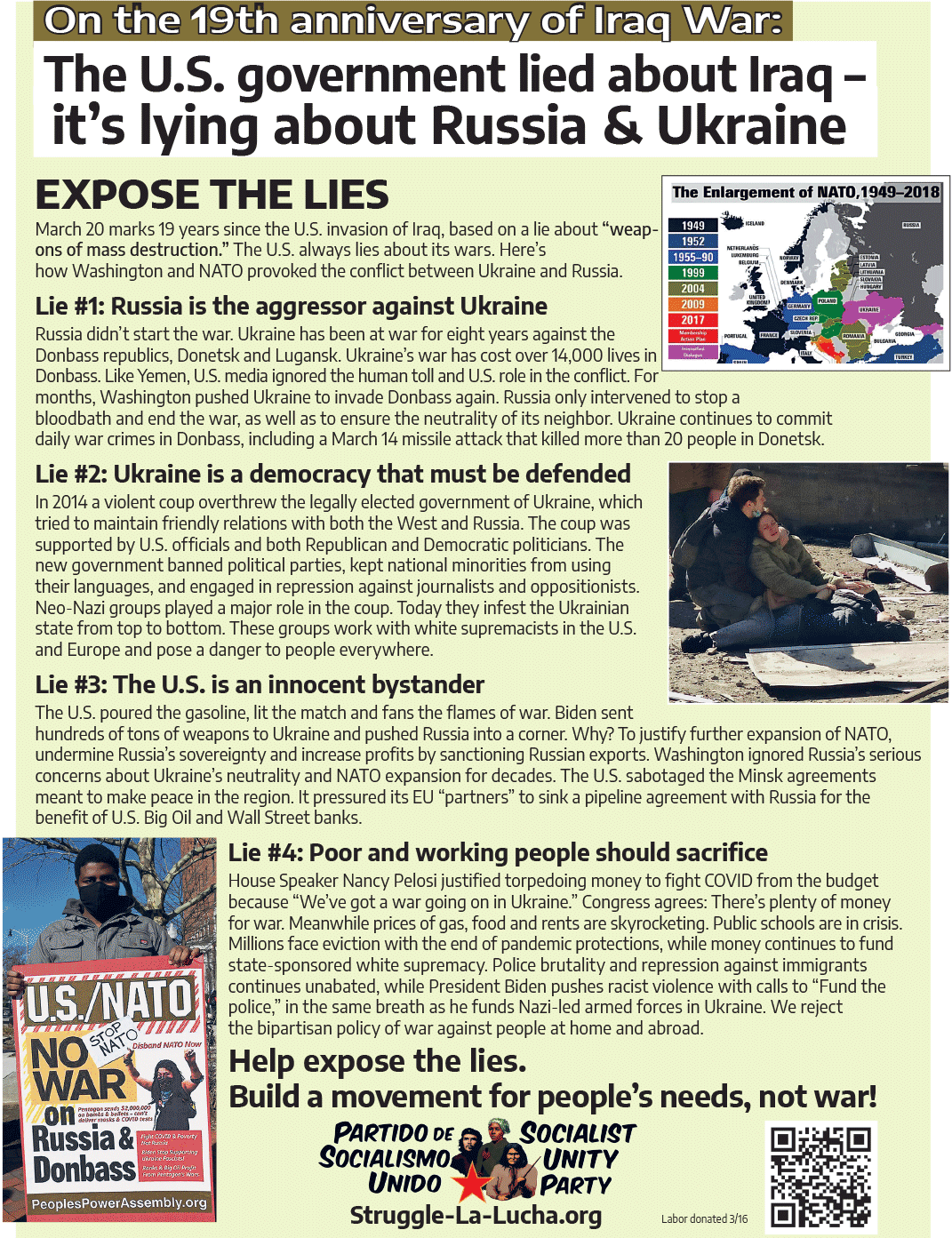
On Feb. 24, the anti-fascist Donetsk and Lugansk People’s Republics, together with the Russian Federation, launched a military action with the goal of “demilitarization and denazification” of the U.S./NATO coup regime in Kiev. Following are links to reports and analysis that give an understanding of the U.S./NATO proxy war in Ukraine.
In order to have a clear anti-war, anti-imperialist position today, class-conscious workers need to understand the significance of the Russian Federation’s Feb. 21 decision to recognize the Donbass republics of Donetsk and Lugansk as independent, sovereign countries, nearly eight years after they first declared independence from Ukraine.
The situation in Eastern Europe today was created by the U.S. and NATO, which bear full responsibility for the military conflict unfolding in Ukraine. Ukraine and its Western sponsors spent the last seven years sabotaging the 2015 Minsk II agreements meant to end Kiev’s attacks on the people of the Donbass region. Washington and Kiev spent the last three months preparing an invasion of the Donetsk and Lugansk People’s Republics as a means to draw Russia into a war.
In his speech on Feb. 24, Vladimir Putin stated the two objectives of his operation: to “demilitarize” and “denazify” Ukraine. It is therefore not a question of seizing Ukraine, nor even, in all likelihood, of occupying it and certainly not of destroying it.
On March 8, 1992, the New York Times published excerpts from a 46-page secret Pentagon draft document that it said was leaked by Pentagon officials. This document is truly extraordinary. It asserts complete U.S. world domination in both political and military terms. In other words, the U.S. is to be the sole and exclusive superpower on the face of the planet. It is to exercise its power not only in Europe, Asia, the Middle East and Latin America, but also on the territory of the former Soviet Union.
One must begin this discussion by accepting the fact that there was already a war happening in Ukraine for the eight years preceding the Russian military incursion in February 2022. And, this war by the government in Kiev against the Russian-speaking peoples of the Donbass – a war which claimed the lives of around 14,000 people, many of them children, and displaced around 1.5 million more even before Russia’s military operation – has been arguably genocidal. That is, the government in Kiev, and especially its neo-Nazi battalions, carried out attacks against these peoples with the intention of destroying, at least in part, the ethnic Russians precisely because of their ethnicity.
Struggle-La Lucha’s John Parker reports from the Lugansk People’s Republic, on the front line of the U.S./NATO proxy war in Ukraine. Parker interviewed Donbass residents who’ve lived under eight years of Ukrainian bombing and occupation, bearing witness to war crimes committed by Ukraine in the name of NATO expansion. Parker traveling alongside Ukrainian activists forced into exile after the U.S.-backed Maidan coup in 2014.
On March 27, the Socialist Unity Party and Struggle-La Lucha newspaper hosted a webinar called “Stop the War Lies: Voices from Donbass.” This was a unique opportunity for the U.S. anti-war movement to hear directly from people in the Donetsk and Lugansk People’s Republics (DPR and LPR), whose voices are silenced by the Western mass media’s pro-Ukraine war propaganda.
The U.S. and other Western media mostly ignored Mariupol for the eight years it was under fascist occupation. They couldn’t have cared less for the workers and political activists who had to live under the thumb of the Azov Battalion and Ukrainian security forces.
The March 6 arrest of Aleksandr Kononovich and Mikhail Kononovich, leaders of the Leninist Communist Youth Union of Ukraine, has been condemned by the World Federation of Democratic Youth and other progressive organizations.
The Ukrainian authorities, being in a state of shock and fearing for their fate, organized a widespread witch hunt. Every day in the territories controlled by Kiev, there are detentions, abductions and torture of political activists and civilians who disagree with the policies of the central government.
Around noon on March 3, five persons forced their way into the apartment of 31-year-old hotel clerk Alexander Matyushenko and his partner Maria M. in Dnipro (Dnipropetrovsk). Matyushenko is an anti-fascist and a member of Livitsya (Left), an alliance founded by activists from various social movements in Dnipro two years ago.
Yuliy Dubovyk: I am a Ukrainian-American. I grew up and spent over half of my life in Ukraine, although now I live in the United States. I wanted to explain my thoughts on the ongoing crisis with Russia, because mainstream corporate media outlets don’t ever share perspectives like mine.
The corporate media claim that all Ukrainians support President Zelensky, who has banned most political parties except his own and the far-right. These news outlets also whitewash the fascist gangs―integrated into the Ukrainian army―that engage in torture.
NATO formally launched a 40,000-strong rapid response force targeting Russia in February. This was in addition to the 175,000 NATO troops already on Russia’s border. NATO has expanded from 16 countries to 30. NATO expansion technically means that the member-nation’s armed forces are “integrated” into the NATO military command. NATO takes command, with the U.S. dominating. No NATO member-state can act without U.S. approval.
For socialists, the fundamental understanding of imperialism goes back to World War I and is found in the pamphlet written by V.I. Lenin, “Imperialism, the Highest Stage of Capitalism.”
The Leninist view of how to fight against imperialist war remains one of the most controversial and defining characteristics of the communist movement, because it means standing up to the capitalist class at the moment its fangs are bared.
The U.S./NATO proxy war isn’t about Ukraine. The U.S. aims to sever the deepening economic integration between the EU (particularly Germany) and Russia, restoring U.S. dominance over Europe.
NATO military expansion to target Russia and China, says top official
written by Struggle – La Lucha
April 27, 2022
As the U.S. and its NATO satellites flood weapons into Ukraine, NATO is being “transformed” into a fighting force capable of direct wars on Russia and China, says NATO General-Secretary Jens Stoltenberg.
NATO formally launched a 40,000-strong rapid response force targeting Russia in February. This was in addition to the 175,000 NATO troops already on Russia’s border.
Also to be noted is President Joe Biden’s shift away from the “no first use” of nuclear weapons, with the Pentagon announcing March 29 that the U.S. would consider first use of nuclear weapons.
In an interview with the Telegraph, Stoltenberg said NATO is in the process of making a “fundamental” shift from engaging in what he called “tripwire deterrence” to “be transformed into a major force capable of” direct warfare.
Stoltenberg made clear that China is as much a target as Russia. “We are finalizing the work on the new strategic concept that will be agreed at the NATO summit in June. … And there, I expect China to be an important part.”
Stoltenberg adds: “It is also of concern that we see that Russia and China are working more and more closely together.”
Since 2014, Stoltenberg said, “We have implemented the biggest reinforcement of NATO since the end of the Cold War.”
Following the overturn of the Soviet Union, NATO has expanded from 16 countries to 30. NATO expansion technically means that the member-nation’s armed forces are “integrated” into the NATO military command. NATO takes command, with the U.S. dominating. No NATO member-state can act without U.S. approval.
NATO expansion into Eastern Europe
For the last two decades, NATO has been expanding into Eastern Europe. In 1999, NATO took in the Czech Republic, Hungary and Poland. In 2004, Bulgaria, Estonia, Latvia, Lithuania, Romania, Slovakia and Slovenia were incorporated. In 2009, Albania and Croatia. In 2017, Montenegro. In 2020, North Macedonia.
Finland and Sweden are reported to be “within weeks” of deciding to join NATO.
Meanwhile, the U.S. is expanding its proxy war in Ukraine, as Leon Panetta, who was CIA director and then secretary of defense in the Barack Obama administration, so clearly put it. The United States and its NATO military operation is in a proxy war against Russia, with Ukraine as the battlefield. The U.S. role, Panetta said, is to provide more and more weapons faster and faster with Ukraine doing the fighting, bolstered by foreign mercenaries.
It’s a matter of military fact that in the Ukrainian proxy war, more military-technical assistance has been dispatched by the U.S. and its NATO satellites, in a larger amount and in a shorter time, than in any previous military conflict in history.
The Post says: “Russia this week sent a formal diplomatic note to the United States warning that U.S. and NATO shipments of the ‘most sensitive’ weapons systems to Ukraine were ‘adding fuel’ to the conflict there and could bring ‘unpredictable consequences.’”
The diplomatic note, titled “On Russia’s concerns in the context of massive supplies of weapons and military equipment to the Kiev regime,” was forwarded to the State Department by the Russian Embassy in Washington. In it, Russia accuses NATO of trying to “pressure Ukraine to abandon peace negotiations with Russia in order to continue the bloodshed.”
The U.S. has sent more than $2.6 billion worth of arms and other military aid to Ukraine since Russia launched its military action in February. The Pentagon explained, “The United States has now committed more than $3.2 billion in security assistance to Ukraine since the beginning of the Biden administration.”
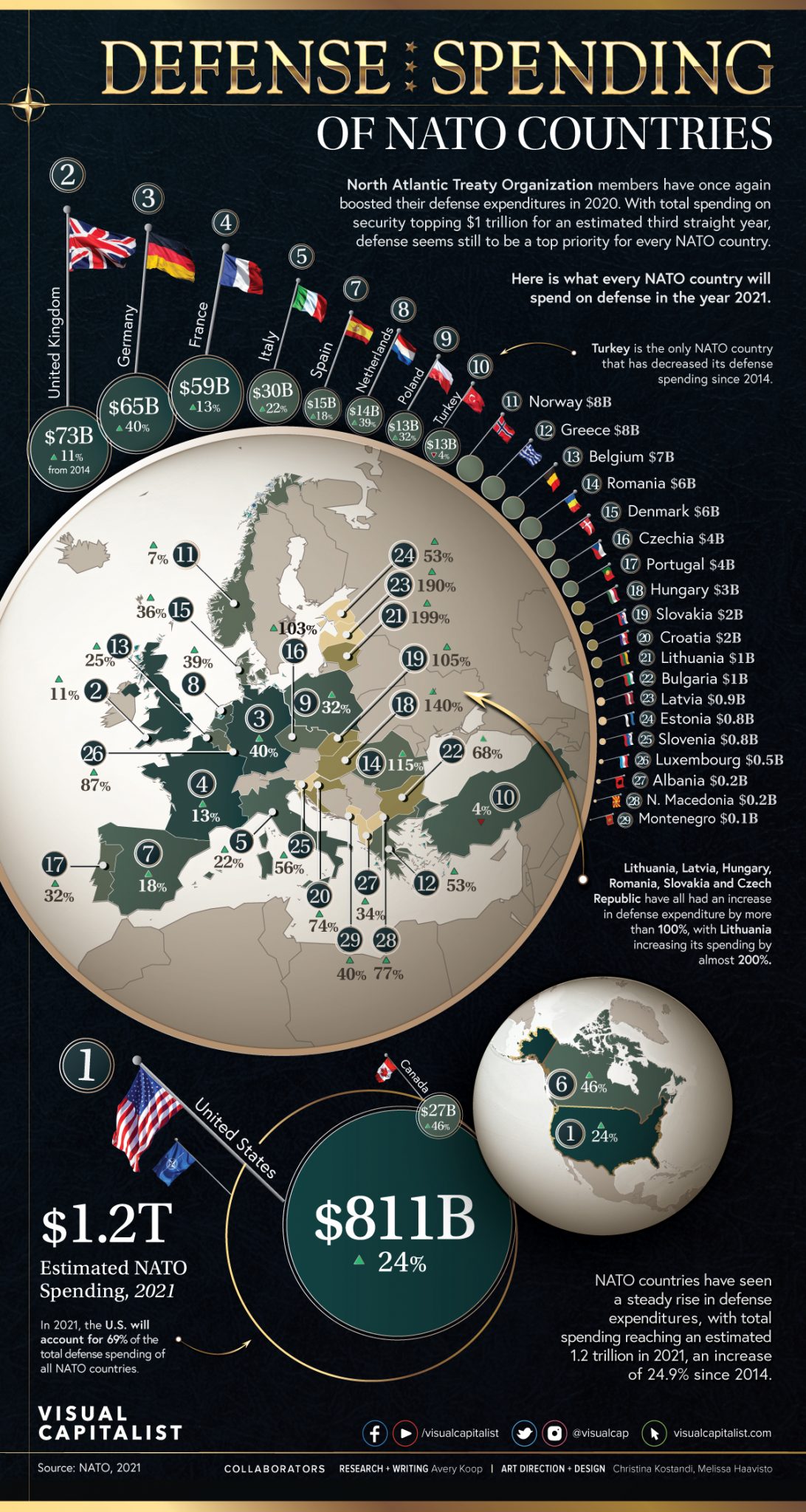
NATO’s military budget accounts for the majority of military spending worldwide. NATO military spending in 2021 was $1.2 trillion ($1,200,000,000,000), up 24.9% since 2014.
U.S. commands NATO
As noted by the Pentagon, NATO is the primary force for U.S. dominance and control in Europe.
All NATO countries are under the effective military domination of the United States. While the governments of the imperialist countries in NATO are not puppet governments, they are unable to take major decisions involving peace and war without the approval of the government of the United States. The civilian governments of the NATO countries lack full control over their own armed forces.
NATO was founded as a U.S.-led military alliance against the Soviet Union and the socialist countries in Eastern Europe. But it was more than that. After World War II, the United States was determined to bring all the imperialist countries under its military control — first the defeated Axis powers of Germany, Japan and Italy and then increasingly its “victorious allies,” Britain and France, through the NATO alliance.
At the end of the Cold War, the newly capitalist oppressed countries of Eastern Europe were signed up as formal NATO members. NATO has been in the process of unofficially taking in Ukraine — minus Crimea and the Donetsk and Lugansk People’s Republics.
Following the breakup of the Soviet Union, socialist industry was dismantled in Ukraine. Once the second-largest economy in the USSR, “independent” Ukraine is now the poorest country in Europe.
In 2013, the European Union demanded that Kiev impose Washington-based International Monetary Fund (IMF) controls, neoliberal structural adjustments, over all aspects of state spending and operations as the conditions required for membership in the European Union. Even more government assets were to be sold off. Ukrainian President Viktor Yanukovych rejected this for a more favorable offer from Russia.
The Euromaidan coup quickly followed in 2014, openly supported and financed by NATO, to put in a government that bowed to the IMF demands and made NATO membership a policy mandate. Ukrainian President Volodymyr Zelensky has repeatedly talked of Ukraine’s entrance into NATO. On Feb. 19, Zelensky demanded, once again, entry to NATO, saying, “Eight years ago, Ukrainians made their choice [the Euromaidan coup].”
The resistance to the Euromaidan coup and to NATO in Ukraine has been bigger and more widespread than reported in the U.S. corporate-controlled media. The resistance has been strongest in the eastern part of Ukraine, particularly the Donbass region. The autonomous Donetsk People’s Republic and Lugansk People’s Republic were created when the people there voted overwhelmingly (89% and 96%) against a NATO-controlled regime and to secede from the Kiev regime.
In Crimea a 2014 referendum rejected the Euromaidan coup. The result was a 97% vote in favor of the Autonomous Republic of Crimea seceding, with an 83% voter turnout.
This is exercising the right of self-determination. A NATO takeover of Ukraine is the opposite.
Graphic: 31-year history of NATO absorbing, arming Ukraine
written by Struggle – La Lucha
April 27, 2022
Global Times
April 18, 2022
Who benefits from the crisis in Ukraine?
written by Struggle – La Lucha
April 27, 2022
The conflict in Ukraine combines factors such as the attempt to weaken or destroy Russia by Western powers led by the United States, who want to maintain an impossible unipolar world, the extension of NATO to the far reaches of Eastern Europe, and also financial and profit elements.
Within the field of economic robbery, two important components are continuing to dedicate huge amounts of money to the Military-Industrial Complex; and the other that becomes more evident every day in the incessant threats of the Joe Biden administration to Russia, the desire of American energy producers to invade European markets with natural gas from fracking.
The rogue media saturates the world with speculation about Russia’s intention to annex Ukraine and speculates in the most ridiculous way about Moscow’s alleged desire to freeze Europe by cutting off gas supplies, but very few reporters in the corporate media ask who will benefit financially. of the confrontation in Eastern Europe.
Because the answer to this question clearly reveals that the source of the conflict is not Russia.
Putting together a few pieces of the puzzle, some clear winners in the Ukraine crisis begin to emerge, be it a limited conflict or “special operation” as it has been up to now, or a real full-scale war: the multinational oil and gas corporations.
And it would seem that this industry found the most powerful spokesperson in the world to represent its interests: the United States government and the seraphic President Biden, whose son Hunter Biden and Burisma Holdings (the largest Ukrainian gas producer), are as we say in Cuba “Flesh and Bone”.
Chevron, ExxonMobil, Shell and several others, along with hundreds of drilling contractors and equipment suppliers who work with them, want to vastly increase exports to gas-hungry Europe, but Russia and its state-owned Gazprom are standing in the way.
Currently, Russian natural gas accounts for more than 30 percent of all imports into the European Union. Major EU powers Germany and France get 40 percent of their gas from Russia, while other countries, such as the Czech Republic and Romania, use only that of the Eurasian nation.
In order to dislodge the competition and gain a greater or total market share, the multinationals need to curb the supply of gas from the East.
The free market?
World market prices for oil and natural gas have soared in recent months and especially in recent days, driven by several factors: record demand in Europe and Asia as the manufacturing industry recovers somewhat from the pandemic, supply limited, as some of these facilities are only starting to come back online.
Stockpiles of stored goods are pretty depleted due to a long, cold winter in 2020 and now 2021-22, and countries like China and Germany moving away from dirtier fossil fuels like coal and the ever-unpopular nuclear power.
Producers in the United States want to participate and control this bonanza, especially in Europe, where gas prices have increased fivefold in 2021 and now, with the military actions in Ukraine, they are going to go through the roof.
The United States is the largest producer of gas in the world and extracts more from the ground every day. That has been the case since 2005, when output, which had been level for decades, rose sharply.
Flush with gas, American corporations today increasingly look to Europe as a customer, and the U.S. government acted both enthusiastically and viciously as an active seller of them.
Thanks to a 2018 deal struck between the Trump administration and the EU, U.S. gas sales to Europe rose steadily, from 16 percent in 2019 to 28 percent at the end of 2021.
However, there is a problem that could limit growth: U.S. natural gas is expensive, considerably more than that from Russia. Hydraulic fracking substantially increases production costs.
Furthermore, in order to be exported to international customers, U.S. gas must be liquefied and loaded/unloaded onto tankers at expensive specialized terminals.
Converting fracked shale gas to liquefied natural gas (LNG) can more than double the cost for U.S. companies, putting them at a disadvantage against cheap Russian gas that travels through pipelines.
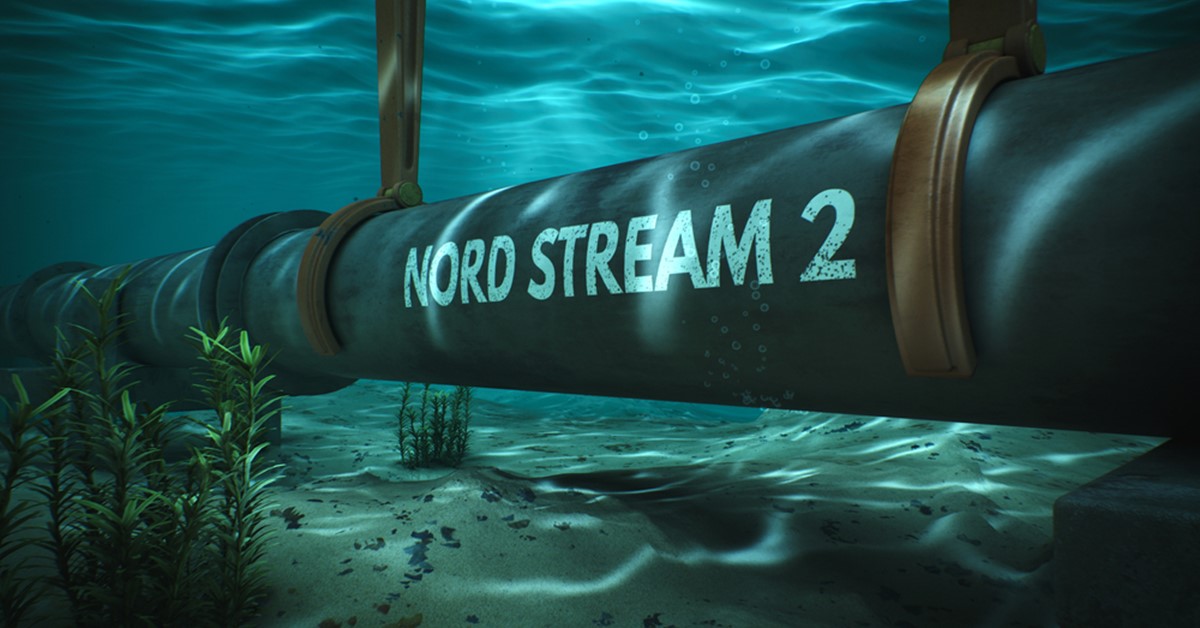
The international gas pipeline project, known as Nord Stream 2, is particularly threatening to the sales of these multinationals.
Built jointly by Germany and Russia under the Baltic Sea, it would provide easy and affordable access to gas for the EU. For Russia, it is a guaranteed means of accessing its biggest buyers. For both the EU and Russia, Nord Stream 2 means providing and receiving huge amounts of gas at low cost. Once operational, it will transport more than double the amount of Russian gas that currently flows to Europe. That is why this immense work of engineering had to be stopped at any cost. War for the imperialists is always the first option.
A convenient crisis for big capital
How convenient then that tensions between the U.S. and its Ukrainian ally on the one hand and Russia on the other escalated just as the finishing touches were being put on Nord Stream 2 in late 2021.
With its own pipeline revenues in trouble, Ukraine’s government pressured Washington throughout the summer of last year to impose sanctions on Nord Stream 2 and the German and Russian companies behind it.
The Democrat-dominated U.S. Congress sided with Ukraine’s rulers, inserting the desired sanctions into the defense spending (military budget) bill.
President Biden, knowing that his European allies were staunchly opposed to anything that threatened their energy supplies and that the infrastructure was simply not in place on both sides of the Atlantic to fill the void left by a sudden drop in gas supply Russian, said he would not approve sanctions against Nord Stream 2. But it is one thing to say and another to do.
Both Republican and Democratic lawmakers in Congress backed down, presenting the sanctions as a way to “deter Russian aggression against Ukraine.”
Ultra-conservative Cuban-American Senator Ted Cruz of Texas, who represents the top fracking gas-producing state in the United States and is the industry’s first recipient of campaign donations from the industry, has been one of the strongest advocates of sanctions. against Russia.
Endless warnings of an “imminent” Russian invasion and the sending of NATO troops and weapons to Eastern Europe finally gave the “desired result” for the U.S. and NATO.
With Europe’s energy security jeopardized by Russian military action, who is ready to help? None other than the U.S. gas industry, of course.
Profit ploy?
So is the whole Ukraine thing just a scheme to protect and increase profits for U.S. natural gas producers?
The crisis was not caused solely by gas sales. That would be an oversimplification of a very complex situation with historical roots that go back long before the fracking boom began in the United States.
The United States and NATO have been engaged in a campaign against Russia since the 1940s. NATO was founded as a military alliance to attack the Soviet Union, an instrument to promote Washington’s imperial interests in Europe and contain the growth of socialism. In the continent.
When the U.S.SR fell and the anti-communist cause lost its reason for being, the West took advantage of Russia’s weakness to deploy its armed might to the borders of that country. As it was rebuilt, the new logic became “containment” of a supposedly aggressive Russia.
The effort to bring Ukraine, second in importance among 15 republics of the former U.S.SR, under the military control of the United States, and install nuclear missiles within a five-six minute flight from Moscow, remains at the center of the crisis in Eastern Europe.
Russia’s key and inalienable security demands still revolve around this issue. That Ukraine becomes a nuclear nation is also completely unacceptable.
But the wishes of the powerful oil and gas industry in the United States added a highly complicating factor to the equation. There is a convenient confluence of imperialist geopolitical goals and capitalist economic interests at work.
And barring a full nuclear Armageddon between the U.S. and Russia, some people will emerge victorious no matter what. Let’s not forget the name of Hunter Biden, and neither that of other “pejes” [?] like Rudy Giuliani et al.
The bet of the gas giants of the United States is that Western Europe immediately joins Washington in sanctioning Russia in the most severe way, and that Germany disconnects Nord Stream 2 “forever”.
Overnight, gas sales in the United States would have to increase for Europe not to freeze. Even more U.S. ships would set sail for European ports carrying LNG and return loaded with profits. For North American oil and gas producers, the situation is beneficial as long as there is a war.
Former NATO military analyst exposes West’s Ukraine invasion narrative
written by Struggle – La Lucha
April 27, 2022
Jacques Baud is a former Colonel of the General Staff in the Swiss armed forces, and between 1983 and 1990 was a member of the Swiss Strategic Intelligence Service.
Baud was involved in discussions with Russian military and intelligence officials at the highest level, just after the fall of the USSR.
He was trained in the American and British intelligence services. He was the head of doctrine for United Nations peace operations. A United Nations expert for the rule of law and security institutions, he designed and led the first multidimensional United Nations intelligence service in Sudan. He worked for the African Union and was responsible for the fight against the proliferation of small arms at NATO for 5 years.
Within NATO, he followed the Ukrainian crisis of 2014, then participated in programs of assistance to Ukraine. He is the author of several books on intelligence, war and terrorism.
For years, from Mali to Afghanistan, I worked for peace and risked my life for it. It is therefore not a question of justifying the war, but of understanding what led us to it. I note that the “experts” who take turns on the television sets analyze the situation based on dubious information, most often hypotheses turned into facts, and therefore we no longer manage to understand what is happening. That’s how you create panic.
The problem is not so much who is right in this conflict, but how our leaders make their decisions.
Let’s try to examine the roots of the conflict. It starts with those who for the past eight years have been talking to us about “separatists” or “independence” from the Donbass. It’s wrong. The referendums conducted by the two self-proclaimed republics of Donetsk and Luhansk in May 2014 were not ” independence ” (независимость) referendums , as some unscrupulous journalists claimed , but ” self-determination ” or ” autonomy (самостоятельность). The term “pro-Russian” suggests that Russia was a party to the conflict, which was not the case, and the term “Russian speakers” would have been more honest. Moreover, these referendums were conducted against the advice of Vladimir Putin.
In fact, these republics did not seek to separate from Ukraine, but to have a statute of autonomy guaranteeing them the use of the Russian language as an official language. Because the first legislative act of the new government resulting from the overthrow of President Yanukovych, was the abolition, on February 23, 2014, of the Kivalov-Kolesnichenko law of 2012 which made Russian an official language. A bit as if putschists decided that French and Italian would no longer be official languages in Switzerland.
This decision causes a storm in the Russian-speaking population. This resulted in fierce repression against the Russian-speaking regions (Odessa, Dnepropetrovsk, Kharkov, Lugansk and Donetsk) which began in February 2014 and led to a militarization of the situation and a few massacres (in Odessa and Mariupol, for the most important). At the end of summer 2014, only the self-proclaimed republics of Donetsk and Lugansk remained.
At this stage, too rigid and stuck in a doctrinaire approach to the operational art, the Ukrainian staffs suffered the enemy without succeeding in imposing themselves. Examination of the course of the fighting in 2014-2016 in the Donbass shows that the Ukrainian general staff systematically and mechanically applied the same operational plans. However, the war waged by the autonomists was then very close to what we observed in the Sahel: very mobile operations carried out with light means. With a more flexible and less doctrinaire approach, the rebels were able to exploit the inertia of the Ukrainian forces to “trap” them repeatedly.
In 2014, I am at NATO, responsible for the fight against the proliferation of small arms, and we are trying to detect Russian arms deliveries to the rebels in order to see if Moscow is involved. The information that we receive then comes practically all from the Polish intelligence services and does not “match” with the information from the OSCE: in spite of rather crude allegations, we do not observe any delivery of arms and materials Russian military.
The rebels are armed thanks to the defections of Russian-speaking Ukrainian units which cross over to the rebel side. As the Ukrainian failures progressed, the entire tank, artillery or anti-aircraft battalions swelled the ranks of the autonomists. This is what drives the Ukrainians to commit to the Minsk Accords.
But, just after signing the Minsk 1 Accords, Ukrainian President Petro Poroshenko launched a vast anti-terrorist operation (ATO/Антитерористична операція) against Donbass. Bis repetita placent : poorly advised by NATO officers, the Ukrainians suffered a crushing defeat at Debaltsevo which forced them to commit to the Minsk 2 Agreements…
It is essential to recall here that the Minsk 1 (September 2014) and Minsk 2 (February 2015) Agreements provided for neither the separation nor the independence of the Republics, but their autonomy within the framework of Ukraine. Those who have read the Accords (they are very, very, very few) will find that it is written in full that the status of the republics was to be negotiated between Kiev and the representatives of the republics, for an internal solution in Ukraine .
This is why since 2014, Russia has systematically demanded their application while refusing to be a party to the negotiations, because it was an internal matter for Ukraine. On the other side, the Westerners – led by France – systematically tried to replace the Minsk Accords with the “Normandy format”, which brought Russians and Ukrainians face to face. However, let us remember, there were never any Russian troops in the Donbass before February 23-24, 2022. Moreover, OSCE observers have never observed the slightest trace of Russian units operating in the Donbass. Thus, the US intelligence map published by the Washington Post on December 3, 2021 does not show Russian troops in Donbass.
In October 2015, Vasyl Hrytsak, director of the Ukrainian Security Service (SBU), confessed that only 56 Russian fighters had been observed in the Donbass. It was an even comparable to that of the Swiss going to fight in Bosnia during the weekends, in the 1990s, or the French who are going to fight in Ukraine today.
The Ukrainian army was then in a deplorable state. In October 2018, after four years of war, Ukraine’s chief military prosecutor Anatoly Matios said that Ukraine had lost 2,700 men in the Donbass: 891 from disease, 318 from traffic accidents, 177 from other accidents, 175 from poisoning (alcohol, drugs), 172 from careless handling of weapons, 101 from breaches of safety rules, 228 from murder and 615 from suicide.
In fact, the army is undermined by the corruption of its cadres and no longer enjoys the support of the population. According to a UK Home Office report , when reservists were called up in March-April 2014, 70% did not show up for the first session, 80% for the second, 90% for the third and 95% for the fourth. In October/November 2017, 70% of callers did not show up during the “ Autumn 2017 ” callback campaign. This does not include suicides and desertions(often for the benefit of the autonomists) which reach up to 30% of the workforce in the ATO zone. Young Ukrainians refuse to go and fight in the Donbass and prefer emigration, which also explains, at least partially, the country’s demographic deficit.
The Ukrainian Ministry of Defense then turned to NATO to help it make its armed forces more “attractive”. Having already worked on similar projects within the framework of the United Nations, I was asked by NATO to participate in a program intended to restore the image of the Ukrainian armed forces. But it’s a long process and the Ukrainians want to go quickly.
Thus, to compensate for the lack of soldiers, the Ukrainian government resorted to paramilitary militias. They are essentially made up of foreign mercenaries, often far-right activists. As of 2020, they constitute around 40% of Ukraine’s forces and number around 102,000 men according to Reuters . They are armed, financed and trained by the United States, Great Britain, Canada and France. There are more than 19 nationalities – including Swiss.
Western countries have therefore clearly created and supported Ukrainian far-right militias . In October 2021, the Jerusalem Post sounded the alarm by denouncing the Centuria project . These militias have been operating in the Donbass since 2014, with Western support. Even if we can discuss the term “Nazi”, the fact remains that these militias are violent, convey a nauseating ideology and are virulently anti-Semitic. Their anti-Semitism is more cultural than political, which is why the adjective “Nazi” is not really appropriate. Their hatred of the Jew comes from the great famines of the years 1920-1930 in Ukraine, resulting from the confiscation of crops by Stalin in order to finance the modernization of the Red Army. However, this genocide – known in Ukraine under the name of Holodomor – was perpetrated by the NKVD (ancestor of the KGB) whose upper echelons of leadership were mainly composed of Jews. That is why, today, Ukrainian extremists are asking Israel to apologize for the crimes of communism , as the Jerusalem Post reports . We are therefore a long way from a “ rewriting of history ” by Vladimir Putin.
These militias, stemming from the far-right groups that led the Euromaidan revolution in 2014, are made up of fanatical and brutal individuals. The best known of these is the Azov regiment, whose emblem is reminiscent of that of the 2nd SS Das Reich Panzer Division , which is the object of real veneration in Ukraine, for having liberated Kharkov from the Soviets in 1943, before to perpetrate the massacre of Oradour-sur-Glane in 1944, in France.
Among the famous figures of the Azov regiment was the opponent Roman Protassevich, arrested in 2021 by the Belarusian authorities following the case of RyanAir flight FR4978. On May 23, 2021, there is talk of the deliberate hijacking of an airliner by a MiG-29 – with Putin’s agreement , of course – to arrest Protassevich, although the information then available does not confirm this scenario in any way.
But it must then be shown that President Lukashenko is a thug and Protassevich a “journalist” in love with democracy. However, a rather edifying investigation produced by an American NGO in 2020 , highlighted Protassevich’s far-right militant activities. Western conspiracy then sets in motion and unscrupulous media “groom” his biography . Finally, in January 2022, the ICAO report is published and shows that despite some procedural errors, Belarus acted in accordance with the rules in force and that the MiG-29 took off 15 minutes after the RyanAir pilot decided to land in Minsk. So no Belarus plot and even less with Putin. Ah!… One more detail: Protassevich,cruelly tortured by Belarusian police, is now free. Those who would like to correspond with him, can go to his Twitter account .
The labeling of “Nazi” or “neo-Nazi” given to Ukrainian paramilitaries is considered Russian propaganda . Perhaps ; but that is not the opinion of The Times of Israel , the Simon Wiesenthal Center or the Counterterrorism Center at West Point Academy. But this remains debatable, because, in 2014, Newsweek magazine seemed to associate them with… the Islamic State. A choice !
So the West supports and continues to arm militias that have been guilty of numerous crimes against civilian populations since 2014 : rape, torture and massacres. But while the Swiss government has been very quick to impose sanctions against Russia, it has not adopted any against Ukraine, which has been slaughtering its own population since 2014. In fact, those who defend the rights of the men in Ukraine have long condemned the actions of these groups, but have not been followed by our governments. Because, in reality, we are not trying to help Ukraine, but to fight Russia.
The integration of these paramilitary forces into the National Guard was not at all accompanied by a “denazification”, as some claim . Among the many examples, that of the insignia of the Azov Regiment is edifying:
In 2022, very schematically, the Ukrainian armed forces fighting the Russian offensive are structured as:
Army, subordinate to the Ministry of Defense: it is articulated in 3 army corps and composed of maneuver formations (tanks, heavy artillery, missiles, etc.).
National Guard, which depends on the Ministry of the Interior and is articulated in 5 territorial commands.
The National Guard is therefore a territorial defense force which is not part of the Ukrainian army. It includes paramilitary militias, called ” volunteer battalions” (добровольчі батальйоні), also known by the evocative name of ” retaliatory battalions “, composed of infantry. Mainly trained for urban combat, they now ensure the defense of cities such as Kharkov, Mariupol, Odessa, Kyiv, etc.
Part Two: The war
Former head of the Warsaw Pact forces in the Swiss strategic intelligence service, I observe with sadness – but not astonishment – that our services are no longer in a position to understand the military situation in Ukraine. The self-proclaimed “experts” who parade across our screens tirelessly relay the same information modulated by the assertion that Russia – and Vladimir Putin – is irrational. Let’s take a step back.
1. The outbreak of war
Since November 2021, the Americans have constantly brandished the threat of a Russian invasion against Ukraine. However, the Ukrainians do not seem to agree. Why ?
We have to go back to March 24, 2021. On that day, Volodymyr Zelensky issued a decree for the reconquest of Crimea and began to deploy his forces towards the south of the country. Simultaneously, several NATO exercises were conducted between the Black Sea and the Baltic Sea, accompanied by a significant increase in reconnaissance flights along the Russian border. Russia then conducts a few exercises to test the operational readiness of its troops and show that it is following the evolution of the situation.
Things calm down until October-November with the end of the ZAPAD 21 exercises, whose troop movements are interpreted as a reinforcement for an offensive against Ukraine. However, even the Ukrainian authorities refute the idea of Russian preparations for a war and Oleksiy Reznikov, Ukrainian Minister of Defense declares that there has been no change on its border since the spring.
In violation of the Minsk Accords, Ukraine is conducting aerial operations in Donbass using drones, including at least one strike against a fuel depot in Donetsk in October 2021 . The American press points this out, but not the Europeans and no one condemns these violations.
In February 2022, events rush. On February 7, during his visit to Moscow, Emmanuel Macron reaffirms to Vladimir Putin his attachment to the Minsk Accords , a commitment he will repeat after his interview with Volodymyr Zelensky the next day. But on February 11, in Berlin, after 9 hours of work, the meeting of the political advisers of the leaders of the ” Normandy format “ ends, without concrete result: the Ukrainians still and always refuse to apply the Accordsof Minsk, apparently under pressure from the United States. Vladimir Putin then notes that Macron has made empty promises to him and that the West is not ready to enforce the Accords, as they have been doing for eight years.
Ukrainian preparations in the contact zone continue. The Russian Parliament is alarmed and on February 15 asks Vladimir Putin to recognize the independence of the Republics, which he refuses.
On February 17, President Joe Biden announces that Russia will attack Ukraine in the coming days. How does he know? Mystery… But since the 16th, the artillery shelling of the populations of Donbass has increased dramatically, as shown by the daily reports of OSCE observers. Naturally, neither the media, nor the European Union, nor NATO, nor any Western government reacts and intervenes. We will say later that this is Russian disinformation. In fact, it seems that the European Union and some countries purposely glossed over the massacre of the people of Donbass, knowing that it would provoke Russian intervention.
At the same time, there are reports of acts of sabotage in the Donbass. On January 18, Donbass fighters intercept saboteurs equipped with Western equipment and speaking Polish seeking to create chemical incidents in Gorlivka . They could be CIA mercenaries , led or “advised” by Americans and made up of Ukrainian or European fighters, to carry out sabotage actions in the Donbass Republics.
In fact, as early as February 16, Joe Biden knows that the Ukrainians began to shell the civilian populations of Donbass, putting Vladimir Putin in front of a difficult choice: to help Donbass militarily and create an international problem or to sit idle and watch Russian speakers. from the Donbass being run over.
If he decides to intervene, Vladimir Putin can invoke the international obligation of “ Responsibility To Protect ” (R2P). But he knows that whatever its nature or scale, the intervention will trigger a shower of sanctions. Therefore, whether its intervention is limited to the Donbass or whether it goes further to put pressure on the West for the status of Ukraine, the price to be paid will be the same. This is what he explains in his speech on February 21.
That day, he acceded to the request of the Duma and recognized the independence of the two Republics of Donbass and, in the process, he signed treaties of friendship and assistance with them.
The Ukrainian artillery bombardments on the populations of Donbass continued and, on February 23, the two Republics requested military aid from Russia. On the 24th, Vladimir Putin invokes Article 51 of the United Nations Charter which provides for mutual military assistance within the framework of a defensive alliance.
In order to make the Russian intervention totally illegal in the eyes of the public we deliberately obscure the fact that the war actually started on February 16th. The Ukrainian army was preparing to attack the Donbass as early as 2021, as certain Russian and European intelligence services were well aware… The lawyers will judge.
In his speech on February 24, Vladimir Putin stated the two objectives of his operation: to “demilitarize” and “denazify” Ukraine. It is therefore not a question of seizing Ukraine, nor even, in all likelihood, of occupying it and certainly not of destroying it.
From there, our visibility on the course of the operation is limited: the Russians have an excellent security of operations (OPSEC) and the detail of their planning is not known. But fairly quickly, the course of operations makes it possible to understand how the strategic objectives were translated into the operational plan.
Demilitarization:
ground destruction of Ukrainian aviation, air defense systems and reconnaissance assets;
neutralization of command and intelligence structures (C3I), as well as the main logistics routes in the depth of the territory;
encirclement of the bulk of the Ukrainian army massed in the south-east of the country.
Denazification:
destruction or neutralization of volunteer battalions operating in the cities of Odessa, Kharkov and Mariupol, as well as in various facilities on the territory.
2. The ‘demilitarization’
The Russian offensive proceeds in a very “classic” manner. At first – as the Israelis had done in 1967 – with the destruction on the ground of the air forces in the very first hours. Then, we witness a simultaneous progression on several axes according to the principle of “flowing water”: we advance wherever resistance is weak and we leave the cities (very voracious in troops) for later. To the north, the Chernobyl plant is occupied immediately to prevent acts of sabotage. The images of Ukrainian and Russian soldiers jointly guarding the plant are naturally not shown…
The idea that Russia is trying to take over Kiev, the capital, to eliminate Zelensky, typically comes from the West: this is what they did in Afghanistan, Iraq, Libya and what they wanted to do in Syria with the help of the Islamic State . But Vladimir Putin never intended to take down or overthrow Zelensky. On the contrary, Russia seeks to keep him in power by pushing him to negotiate by encircling kyiv. He had refused to do so far to apply the Minsk Accords, but now the Russians want to obtain Ukraine’s neutrality.
Many Western commentators marveled that the Russians continued to seek a negotiated solution while conducting military operations. The explanation is in the Russian strategic conception, since Soviet times. For Westerners, war begins when politics ceases. However, the Russian approach follows a Clausewitzian inspiration: war is the continuity of politics and one can pass fluidly from one to the other, even during combat. This creates pressure on the opponent and pushes him to negotiate.
From an operational point of view, the Russian offensive was an example of its kind: in six days, the Russians seized a territory as vast as the United Kingdom, with a speed of advance greater than what the Wehrmacht made in 1940.
The bulk of the Ukrainian army was deployed in the south of the country for a major operation against Donbass. This is why the Russian forces were able to encircle it from the beginning of March in the “cauldron” between Slavyansk, Kramatorsk and Severodonetsk, by a thrust coming from the east via Kharkov and another coming from the south from the Crimea. The troops of the Republics of Donetsk (DPR) and Lugansk (RPL) complete the action of the Russian forces with a push from the East.
At this stage, the Russian forces are slowly tightening the noose, but are no longer under time pressure. Their objective of demilitarization is practically achieved and the residual Ukrainian forces no longer have an operational and strategic command structure.
The “slowdown” that our “experts” attribute to poor logistics is only the consequence of having achieved the objectives set. Russia does not seem to want to engage in an occupation of the whole Ukrainian territory. In fact, it seems rather that Russia is trying to limit its advance to the country’s linguistic border.
Our media speak of indiscriminate bombardments against civilian populations, particularly in Kharkov, and dantesque images are broadcast on a loop. However, Gonzalo Lira, a Latin American who lives there, presents us with a calm city on March 10 , and on March 11 . Admittedly it’s a big city and you can’t see everything, but that seems to indicate that we are not in the total war that we are being served continuously on our screens.
As for the Republics of Donbass, they have “liberated” their own territories and are fighting in the city of Mariupol.
3. ‘Denazification’
In cities like Kharkov, Mariupol and Odessa, defense is provided by paramilitary militias. They know that the objective of “denazification” is aimed primarily at them.
For an attacker in an urbanized area, civilians are a problem. This is why Russia seeks to create humanitarian corridors to empty the cities of civilians and leave only the militias in order to fight them more easily.
Conversely, these militias seek to keep civilians in the cities in order to dissuade the Russian army from coming to fight there. This is why they are reluctant to implement these corridors and do everything so that Russian efforts are in vain: they can thus use the civilian population as “human shields”. Videos showing civilians trying to leave Mariupol and being beaten up by fighters from the Azov regiment are naturally carefully censored here.
On Facebook, the Azov group was considered in the same category as the Islamic State and subject to the platform’s ” dangerous individuals and organizations policy ” . It was therefore forbidden to glorify him, and the “posts” that were favorable to him were systematically banned. But on February 24, Facebook changed its policy and allowed posts favorable to the militia. In the same spirit, in March, the platform authorizes, in the former Eastern European countries, calls for the murder of Russian soldiers and leaders . So much for the values that inspire our leaders, as we will see.
Our media propagate a romantic image of popular resistance. It is this image that has led the European Union to finance the distribution of arms to the civilian population. It is a criminal act. In my role as chief of doctrine for peacekeeping operations at the UN, I worked on the issue of the protection of civilians. We then saw that violence against civilians took place in very specific contexts. Especially when weapons abound and there are no command structures.
Now, these command structures are the essence of armies: their function is to channel the use of force according to an objective. By arming citizens in a haphazard fashion as is currently the case, the EU turns them into combatants, with the attendant consequences: potential targets. Moreover, without command, without operational goals, the distribution of arms inevitably leads to settling of scores, banditry and actions that are more deadly than effective. War becomes a matter of emotions. Force becomes violence. This is what happened in Tawarga (Libya) from August 11 to 13, 2011, where 30,000 black Africans were massacred with weapons parachuted (illegally) by France. Moreover, the British Royal Institute for Strategic Studies(RUSI) sees no added value in these arms deliveries.
Moreover, by delivering arms to a country at war, one exposes oneself to being considered as a belligerent. The Russian strikes on March 13, 2022, against the Mykolaiv air base follow Russian warnings that weapons transports would be treated as hostile targets.
The EU repeats the disastrous experience of the Third Reich in the last hours of the Battle of Berlin. War should be left to the military and when one side has lost, it should be admitted. And if there is to be resistance, it must imperatively be led and structured. However, we are doing exactly the opposite: we are pushing citizens to go and fight and at the same time, Facebook is allowing calls for the murder of Russian soldiers and leaders . So much for the values that inspire us.
In some intelligence services, this irresponsible decision is seen as a way of using the Ukrainian population as cannon fodder to fight Vladimir Putin’s Russia. This kind of murderous decision had to be left to the colleagues of Ursula von der Leyen’s grandfather. It would have been wiser to engage in negotiations and thus obtain guarantees for the civilian populations than to add fuel to the fire. It’s easy to be combative with other people’s blood…
4. The Maternity Hospital At Mariupol
It is important to understand beforehand that it is not the Ukrainian army which ensures the defense of Mariupol, but the Azov militia, composed of foreign mercenaries.
In its summary of the situation of March 7, 2022, the Russian UN mission in New York states that ” Residents report that the Ukrainian armed forces have expelled the personnel of the Natal Hospital No. 1 from the city of Mariupol and have installed a shooting station inside the establishment . »
On March 8, the independent Russian media Lenta.ru published the testimony of civilians from Mariupol who said that the maternity hospital was taken over by the militias of the Azov regiment, and chased out the civilian occupants, threatening them with their weapons. They thus confirm the statements of the Russian ambassador a few hours earlier.
The Mariupol hospital occupies a dominant position, perfectly adequate for installing anti-tank weapons and for observation. On March 9, Russian forces hit the building. According to CNN , there are 17 injured, but the footage shows no casualties on the premises and there is no evidence that the reported casualties are related to this strike. We talk about children, but in reality, we see nothing. It may be true, but it may be false… Which does not prevent EU leaders from seeing it as a war crime … Which allows Zelensky, just afterwards, to claim a no-fly zone over Ukraine…
In reality, we don’t know exactly what happened. But the sequence of events tends to confirm that the Russian forces struck a position of the Azov regiment and that the maternity ward was then free of all civilians.
The problem is that the paramilitary militias that ensure the defense of cities are encouraged by the international community not to respect the customs of war. It seems that the Ukrainians have re-enacted the scenario of the maternity hospital in Kuwait City in 1990 , which had been completely staged by the firm Hill & Knowlton for the amount of 10.7 million dollars in order to convince the United Nations Security Council to intervene in Iraq for Operation Desert Shield/Storm .
Western politicians have also accepted strikes against civilians in Donbass for eight years, without adopting any sanctions against the Ukrainian government. We have long since entered into a dynamic where Western politicians have agreed to sacrifice international law to their objective of weakening Russia .
Part Three: Conclusions
As a former intelligence professional, the first thing that strikes me is the total absence of Western intelligence services in representing the situation for a year. In Switzerland, the services have been criticized for not having provided a correct picture of the situation. In fact, it seems that all over the Western world, the services have been overwhelmed by the politicians. The problem is that it is the politicians who decide: the best intelligence service in the world is useless if the decision-maker does not listen to it. This is what happened during this crisis.
That said, while some intelligence services had a very precise and rational image of the situation, others clearly had the same image as that propagated by our media. In this crisis, the services of the countries of the “new Europe” played an important role. The problem is that, by experience, I found that they were extremely bad on the analytical level: doctrinaire, they do not have the intellectual and political independence necessary to appreciate a situation with a military “quality”. It is better to have them as enemies than as friends.
Then, it seems that in some European countries, politicians have deliberately ignored their services to respond ideologically to the situation. This is why this crisis has been irrational from the start. It will be observed that all the documents that have been presented to the public during this crisis have been presented by politicians on the basis of commercial sources…
Some Western politicians obviously wanted there to be a conflict. In the United States, the attack scenarios presented by Anthony Blinken to the Security Council were only the fruit of the imagination of a Tiger Team working for him : he did exactly like Donald Rumsfeld in 2002, who thus “bypassed” the CIA and other intelligence services that were far less assertive about Iraqi chemical weapons.
The dramatic developments we are witnessing today have causes we knew about, but refused to see:
on the strategic level, the expansion of NATO (which we have not dealt with here);
on the political level, the Western refusal to implement the Minsk Agreements;
and on the operational level, the continuous and repeated attacks on the civilian populations of Donbass for years and the dramatic increase at the end of February 2022.
In other words, we can naturally deplore and condemn the Russian attack. But WE (that is to say: the United States, France and the European Union in the lead) have created the conditions for a conflict to break out. We show compassion for the Ukrainian people and the two million refugees . It’s good. But if we had had a modicum of compassion for the same number of refugees from the Ukrainian populations of Donbass massacred by their own government and who have been accumulating in Russia for eight years, none of this would probably have happened.
Whether the term “genocide” applies to the abuses suffered by the populations of Donbass is an open question. This term is generally reserved for larger cases (Holocaust, etc.), however, the definition given by the Genocide Convention is probably broad enough to apply. Lawyers will appreciate.
Clearly, this conflict has led us into hysteria. Sanctions seem to have become the preferred tool of our foreign policies. If we had insisted that Ukraine respect the Minsk Accords, which we negotiated and endorsed, none of this would have happened. The condemnation of Vladimir Putin is also ours. There is no point in whining after the fact, we had to act before. However, neither Emmanuel Macron (as guarantor and as a member of the UN Security Council), nor Olaf Scholz, nor Volodymyr Zelensky have respected their commitments. Ultimately, the real defeat is that of those who have no voice.
The European Union was unable to promote the implementation of the Minsk agreements, on the contrary, it did not react when Ukraine bombarded its own population in the Donbass. Had she done so, Vladimir Putin would not have needed to react. Absent from the diplomatic phase, the EU distinguished itself by fueling the conflict. On February 27, the Ukrainian government agrees to start negotiations with Russia. But a few hours later, the European Union voted a budget of 450 million euros to supply arms to Ukraine, adding fuel to the fire. From there, the Ukrainians feel that they will not need to come to an agreement. The resistance of the Azov militias in Mariupol will even causea raise of 500 million euros for weapons .
In Ukraine, with the blessing of Western countries, those who are in favor of a negotiation are eliminated. This is the case of Denis Kireyev, one of the Ukrainian negotiators, assassinated on March 5 by the Ukrainian secret service (SBU) because he is too favorable to Russia and is considered a traitor. The same fate is reserved for Dmitry Demyanenko, former deputy head of the main directorate of the SBU for Kiev and its region, assassinated on March 10 , because too favorable to an agreement with Russia: he is killed by the Mirotvorets militia (” Peacemaker “). This militia is associated with the Mirotvorets website which lists the ” enemies of Ukraine”, with their personal data, address and telephone numbers, so that they can be harassed or even eliminated ; a punishable practice in many countries, but not in Ukraine . The UN and some European countries have demanded its closure… refused by the Rada.
Eventually, the price will be high, but Vladimir Putin will likely achieve the goals he set for himself. Its ties with Beijing have solidified. China emerges as a mediator of the conflict, while Switzerland enters the list of enemies of Russia. The Americans must ask Venezuela and Iran for oil to get out of the energy impasse in which they have gotten themselves: Juan Guaido leaves the scene definitively and the United States must pitifully reverse the sanctions imposed on their enemies.
Western ministers who seek to collapse the Russian economy and make the Russian people suffer , even calling for the assassination of Putin, show (even if they partially reversed the form of their remarks, but not on bottom!) that our leaders are no better than the ones we hate. Because, sanctioning Russian athletes from the Para-Olympic Games or Russian artists has absolutely nothing to do with a fight against Putin.
Thus, therefore, we recognize that Russia is a democracy since we consider that the Russian people are responsible for the war. If not, then why are we trying to punish an entire population for the fault of one? Remember that collective punishment is prohibited by the Geneva Conventions…
The lesson to be drawn from this conflict is our sense of variable geometry humanity. If we were so attached to peace and to Ukraine, why didn’t we encourage her more to respect the agreements that she had signed and that the members of the Security Council had approved?
Media integrity is measured by their willingness to work under the terms of the Munich Charter. They had succeeded in propagating hatred of the Chinese during the Covid crisis and their polarized message leads to the same effects against the Russians . Journalism is stripping itself more and more of professionalism to become militant…
As Goethe said: “ The greater the light, the darker the shadow ”. The more the sanctions against Russia are excessive, the more the cases where we have done nothing highlight our racism and our servility. Why has no Western politician reacted to the strikes against the civilian populations of Donbass for eight years?
After all, what makes the conflict in Ukraine more blameworthy than the war in Iraq, Afghanistan or Libya? What sanctions have we adopted against those who have deliberately lied before the international community to wage unjust, unjustified, unjustifiable and murderous wars? Did we try to “make suffer” the American people who had lied to us (because it’s a democracy!) before the war in Iraq? Have we even adopted a single sanction against the countries, companies or politicians who are fueling the conflict in Yemen, considered the ” worst humanitarian disaster in the world “? Have we sanctioned the countries of the European Union who practice the most abject torture on their territory for the benefit of the United States?
To ask the question is to answer it… and the answer is not glorious.
The offensive launched on February 24 is articulated in two lines of effort, in accordance with Russian operational doctrine:
1) A main effort directed toward the south of the country, in the Donbass region, and along the Azov Sea coast. As the doctrine states, the main objectives are—the neutralization of the Ukrainian armed forces (the objective of “demilitarization”), and the neutralization of ultra-nationalist, paramilitary militias in the cities of Kharkov and Mariupol (the objective of “denazification“). This primary push is being led by a coalition of forces: through Kharkov and Crimea are Russian forces from the Southern Military District; in the center are militia forces from the Donetsk and Lugansk republics; the Chechen National Guard is contributing with engagement in the urban area of Mariupol;
2) A secondary effort on Kiev, aimed at “pinning down” Ukrainian (and Western) forces, so as to prevent them from carrying out operations against the main thrust or even taking Russian coalition forces from the rear.
This offensive follows, to the letter, the objectives defined by Vladimir Putin on February 24. But, listening only to their own bias, Western “experts” and politicians have gotten it into their heads that Russia’s objective is to take over the Ukraine and overthrow its government. Applying a very Western logic, they see Kiev as the “center of gravity” (Schwerpunkt) of Ukrainian forces. According to Clausewitz, the “center of gravity” is the element from which a belligerent derives his strength and ability to act, and is therefore the primary objective of an adversary’s strategy. This is why Westerners have systematically tried to take control of capitals in the wars they have fought. Trained and advised by NATO experts, the Ukrainian General Staff has, predictably enough, applied the same logic, focusing on strengthening the defense of Kiev and its surroundings, while leaving its troops helpless in the Donbass, along the axis of the main Russian effort.
If one had listened carefully to Vladimir Putin, one would have realized that the strategic objective of the Russian coalition is not to take over the Ukraine, but to remove any threat to the Russian-speaking population of the Donbass. According to this general objective, the “real” center of gravity that the Russian coalition is trying to target is the bulk of the Ukrainian armed forces massed in the south-southeast of the country (since the end of 2021), and not Kiev.
Russian Success or Failure?
Convinced that the Russian offensive is aimed at Kiev, Western experts have quite logically concluded that (a) the Russians are stalling, and that (b) their offensive is doomed to failure because they will not be able to hold the country in the long term. The generals who have followed each other on French TV seem to have forgotten what even a second lieutenant comprehends well: “Know your enemy!”—not as one would like him to be, but as he is. With generals like that, we don’t need an enemy anymore.
That being said, the Western narrative about a Russian offensive that is bogged down, and whose successes are meager, is also part of the propaganda war waged by both sides. For example, the sequence of maps of operations, published by Libération from the end of February, shows almost no difference from one day to the next, until March 18th (when the media stopped updating it). Thus, on February 23rd, on France 5 [TV station], the journalist Élise Vincent evaluated the territory taken by the Russian coalition as the equivalent of Switzerland or the Netherlands. In reality, we are more in the area of Great Britain.
As an example, let us observe the difference between the map of the situation on March 25, 2022, as published by Ouest-France:
In addition, it should be noted that Ukrainian forces do not appear on any map (presented in our media) of the conflict-situation. Thus, if the map of the French Ministry of Armed Forces gives a slightly more honest picture of reality, it also carefully avoids mentioning the Ukrainian forces encircled in the Kramatorsk cauldron.
In fact, the situational map, as of March 25, should look more like this:
Moreover, Ukrainian forces are never indicated on our maps, as this would show that they were not deployed on the Russian border in February 2022, but were regrouped in the south of the country, in preparation for their offensive, the initial phase of which began on February 16th. This confirms that Russia was only reacting to a situation initiated by the West, by way of the Ukraine, as we shall see. At present, it is these forces that are encircled in the Kramatorsk cauldron and are being methodically fragmented and neutralized, little by little, in an incremental way, by the Russian coalition.The vagueness maintained in the West about the situation of the Ukrainian forces, has other effects. First, it maintains the illusion of a possible Ukrainian victory. Thus, instead of encouraging a negotiation process, the West seeks to prolong the war. This is why the European Union and some of its member countries have sent weapons and are encouraging the civilian population and volunteers of all kinds to go and fight, often without training and without any real command structure—with deadly consequences.We know that in a conflict, each party tends to inform in order to give a favorable image of its actions. However, the image we have of the situation and of the Ukrainian forces is based exclusively on data provided by Kiev. It masks the profound deficiencies of the Ukrainian leadership, even though it was trained and advised by NATO military.Thus, military logic would have the forces caught in the Kramatorsk cauldron withdraw to a line at the Dnieper, for example, in order to regroup and conduct a counteroffensive. But they were forbidden to withdraw by President Zelensky. Even back in 2014 and 2015, a close examination of the operations showed that the Ukrainians were applying “Western-style” schemes, totally unsuited to the circumstances, and in the face of a more imaginative, more flexible opponent who possessed lighter leadership structures. It is the same phenomenon today.
In the end, the partial view of the battlefield given to us by our media has made it impossible for the West to help the Ukrainian general staff make the right decisions. And it has led the West to believe that the obvious strategic objective is Kiev; that “demilitarization” is aimed at the Ukraine’s membership in NATO; and that “denazification” is aimed at toppling Zelensky. This legend was fueled by Vladimir Putin’s appeal to the Ukrainian military to disobey, which was interpreted (with great imagination and bias) as a call to overthrow the government. However, this appeal was aimed at the Ukrainian forces deployed in the Donbass to surrender without fighting. The Western interpretation caused the Ukrainian government to misjudge Russian objectives and misuse its potential of winning.
You don’t win a war with bias—you lose it. And that’s what is happening. Thus, the Russian coalition was never “on the run” or “stopped” by heroic resistance—it simply did not attack where it was expected. We did not want to listen to what Vladimir Putin had explained to us very clearly. This is why the West has thus become—volens nolens—the main architect of the Ukrainian defeat that is taking shape. Paradoxically, it is probably because of our self-proclaimed “experts” and recreational strategists on our television sets that the Ukraine is in this situation today.
The Conduct of Battle
As for the course of operations, the analyses presented in our media come most often from politicians or so-called military experts, who relay Ukrainian propaganda.
Let’s be clear. A war, whatever else it is, is drama. The problem here is that our strategists in neckties are clearly trying to overdramatize the situation in order to exclude any negotiated solution. This development, however, is prompting some Western military personnel to speak out and offer a more nuanced judgment. Thus, in Newsweek, an analyst from the Defense Intelligence Agency (DIA), the American equivalent of the Direction du Renseignement Militaire (DRM) in France, noted that “in 24 days of conflict, Russia has carried out some 1,400 strikes and launched nearly 1,000 missiles (by way of comparison, the United States carried out more strikes and launched more missiles on the first day of the Iraq war in 2003).”
While the West likes to “soften up” the battlefield with intensive and prolonged strikes, before sending in ground-troops, the Russians prefer a less destructive, but more troop-intensive approach. On France 5, the journalist Mélanie Tarvant presented the death of Russian generals on the battlefield as proof of the destabilization of the Russian army. But this is a profound misunderstanding of the traditions and modes of operation of the Russian army. Whereas in the West, commanders tend to lead from the rear, their Russian counterparts tend to lead from the front—in the West they say, “Forward!” In Russia, they say, “Follow me!” This explains the high losses in the upper echelons of command, already observed in Afghanistan—but it also tells of the much more rigorous selection of staff-personnel than in the West.
Furthermore, the DIA analyst noted that “the vast majority of the airstrikes are over the battlefield, with Russian aircraft providing ‘close air support’ to ground forces. The remainder—less than 20 percent, according to U.S. experts—has been aimed at military airfields, barracks and supporting depots.” Thus, the phrase “indiscriminate bombing [that] is devastating cities and killing everyone” echoed by the Western media seems to contradict the U.S. intelligence expert, who said, “If we merely convince ourselves that Russia is bombing indiscriminately, or [that] it is failing to inflict more harm because its personnel are not up to the task or because it is technically inept, then we are not seeing the real conflict.”
In fact, Russian operations differ fundamentally from the Western concept of the same. The West’s obsession with having no fatalities in their own forces leads them to operations that are primarily in the form of very lethal air strikes. Ground troops only intervene when everything has been destroyed. This is why, in Afghanistan or in the Sahel, Westerners killed more civilians than terrorists did. This is why Western countries engaged in Afghanistan, the Middle East and North Africa no longer publish the number of civilian casualties caused by their strikes. In fact, Europeans engaged in regions that only marginally affect their national security, such as the Estonians in the Sahel, go there just to “get their feet wet.”
In the Ukraine, the situation is very different. One only has to look at a map of linguistic zones to see that the Russian coalition operates almost exclusively in the Russian-speaking zone; thus, among populations that are generally favorable to it. This also explains the statements of a US Air Force officer: “I know that the news keeps repeating that Putin is targeting civilians, but there is no evidence that Russia is intentionally doing so.”
Conversely, it is for the same reason—but in a different way—that the Ukraine has deployed its ultra-nationalist paramilitary fighters in major cities, such as Mariupol or Kharkov—without emotional or cultural ties to the local population, these militias can fight even at the cost of heavy civilian casualties. The atrocities that are currently being uncovered remain hidden by the French-speaking media, for fear of losing support for the Ukraine, as noted by media close to the Republicans in the United States.
After “decapitation” strikes in the first minutes of the offensive, the Russian operational strategy was to bypass the urban centers, and to envelop the Ukrainian army, “pinned down” by the forces of the Donbass republics. It is important to remember that the “decapitation” is not intended to annihilate the general staff or the government (as our “experts” tend to understand it), but to sunder the leadership structures so as to prevent the coordinated maneuver of forces. On the contrary, the aim is to preserve the leadership structures themselves in order to be able to negotiate a way out of the crisis.
On March 25, 2022, after having sealed the cauldron of Kramatorsk which denied any possibility of retreat to the Ukrainians and having taken most of the cities of Kharkov and Marioupol, Russia has practically fulfilled its objectives—all that remains is to concentrate its efforts on reducing the pockets of resistance. Thus, contrary to what the Western press has claimed, this is not a reorientation or a resizing of its offensive, but the methodical implementation of the objectives announced on February 24.
Encouraged by the media that present a routed Russian army, many of these young people head off, imagining they are going—literally—on a hunting trip. However, once there, disillusionment is high. Testimonies show that these “amateurs” often end up as “cannon fodder,” without having any real impact on the outcome of the conflict. The experience of recent conflicts shows that the arrival of foreign fightersbrings nothing to a conflict, except to increase its duration and lethality.
Moreover, the arrival of several hundred Islamist fighters from the Idlib region, an area under the control and protection of the Western coalition in Syria (and also the area in which two Islamic State leaders were killed by the Americans) should arouse our concern. Indeed, the weapons we are very liberally supplying to the Ukraine are already partly in the hands of criminal individuals and organizations and are already beginning to pose a security problem for the authorities in Kiev. Not to mention the fact that the weapons that are being touted as effective against Russian aircraft could eventually threaten our military and civilian aircraft.
The volunteer proudly presented by the RTBF on the 7:30 p.m. news of March 8, 2022 was an admirer of the “Corps Franc Wallonie,” Belgian volunteers who served the Third Reich; and he illustrates the type of people attracted to the Ukraine. In the end, we will have to ask ourselves, who gained the most—[in this case] Belgium or the Ukraine?
Distributing weapons indiscriminately could well make the EU—volens nolens—a supporter of extremism and even international terrorism. The result—we are adding misery to misery, in order to satisfy the European elites more than the Ukraine itself.
Three Points Deserve to be Highlighted by Way of Conclusion
1. Western Intelligence, Ignored by Policymakers
Military documents found in Ukrainian headquarters in the south of the country confirm that the Ukraine was preparing to attack the Donbass; and that the firing observed by OSCE observers as early as February 16 heralded an imminent outbreak in days or weeks.
Here, some introspection is necessary for the West—either its intelligence services did not see what was happening and they are thus very bad, or the political decision-makers chose not to listen to them. We know that Russian intelligence services have far superior analytical capabilities than their Western counterparts. We also know that the American and German intelligence services had very well understood the situation, since the end of 2021, and knew that the Ukraine was preparing to attack the Donbass.
This allows us to deduce that the American and European political leaders deliberately pushed the Ukraine into a conflict that they knew was lost in advance—for the sole purpose of dealing a political blow to Russia.
The reason Zelensky did not deploy his forces to the Russian border, and repeatedly stated that his large neighbor would not attack him, was presumably because he thought he was relying on Western deterrence. This is what he told CNN on March 20th—he was clearly told that the Ukraine would not be part of NATO, but that publicly they would say the opposite. The Ukraine was thus instrumentalized to affect Russia. The objective was the closure of the North Stream 2 gas pipeline, announced on February 8th, by Joe Biden, during the visit of Olaf Scholz; and which was followed by a barrage of sanctions.
2. Broken Diplomacy
Clearly, since the end of 2021, no effort has been made by the West to reactivate the Minsk agreements, as evidenced by the reports of visits and telephone conversations, notably between Emmanuel Macron and Vladimir Putin. However, France, as guarantor of the Minsk Agreements, and as a permanent member of the United Nations Security Council, has not respected its commitments, which has led to the situation that the Ukraine is experiencing today. There is even a feeling that the West has sought to add fuel to the fire since 2014.
Thus, Vladimir Putin’s placing of nuclear forces on alert on February 27 was presented by our media and politicians as an irrational act or blackmail. What is forgotten is that it followed the thinly veiled threat made by Jean-Yves Le Drian, three days earlier, that NATO could use nuclear weapons. It is very likely that Putin did not take this “threat” seriously, but wanted to push Western countries—and France in particular—to abandon the use of excessive language.
3. The Vulnerability of Europeans to Manipulation is Increasing
Today, the perception propagated by our media is that the Russian offensive has broken down; that Vladimir Putin is crazy, irrational and therefore ready to do anything to break the deadlock in which he supposedly finds himself. In this totally emotional context, the question asked by Republican Senator Marco Rubio during Victoria Nuland’s hearing before Congress was strange, to say the least: “If there is a biological or chemical weapon incident or attack inside the Ukraine, is there any doubt in your mind that 100% it would be the Russians behind it?” Naturally, she answered that there is no doubt. Yet there is absolutely no indication that the Russians are using such weapons. Besides, the Russians finished destroying their stockpiles in 2017, while the Americans have not yet destroyed theirs.
Perhaps this means nothing. But in the current atmosphere, all the conditions are now met for an incident to happen that would push the West to become more involved, in some form, in the Ukrainian conflict (a “false-flag” incident).