John Parker on the front line in Lugansk, May 6. SLL photo
May 7 – Yesterday we were at the current front line in the Lugansk People’s Republic. We were successful and got lots of interviews from folks who are in shelters who have nowhere else to go because of the bombings of their homes by the U.S.-armed Ukrainian forces.
You can see many apartment buildings bombed and hear stories of people’s shock at seeing Ukrainian soldiers shooting at civilians, who are mostly Russian, but not all. One woman told us that she is of Ukrainian ethnicity but denounces what the Ukrainian government is doing. Everyone I spoke to said that if it wasn’t for the Russian soldiers there, they may not even be alive.
While we were downstairs where people were gathered for their protection, a shell was lodged at another apartment near us. You can hear the booms of bombs so frequently it becomes like white noise.
And, given the nature of many of the Ukrainian troops in the Azov regiment, Right Sector and other neo-Nazi groupings that are in many cases leading the military – given that – perhaps the phrase “white noise” is very appropriate.
Cost of the Ukraine war felt in Africa, Global South
written by Struggle – La Lucha
May 8, 2022
While international news headlines remain largely focused on the war in Ukraine, little attention is given to the horrific consequences of the war which are felt in many regions around the world. Even when these repercussions are discussed, disproportionate coverage is allocated to European countries, like Germany and Austria, due to their heavy reliance on Russian energy sources.
The horrific scenario, however, awaits countries in the Global South which, unlike Germany, will not be able to eventually substitute Russian raw material from elsewhere. Countries like Tunisia, Sri Lanka and Ghana and numerous others, are facing serious food shortages in the short, medium and long term.
The World Bank is warning of a “human catastrophe” as a result of a burgeoning food crisis, itself resulting from the Russia-Ukraine war. The World Bank President, David Malpass, told the BBC that his institution estimates a “huge” jump in food prices, reaching as high as 37%, which would mean that the poorest of people would be forced to “eat less and have less money for anything else such as schooling.”
This foreboding crisis is now compounding an existing global food crisis, resulting from major disruptions in the global supply chains, as a direct outcome of the Covid-19 pandemic, as well as pre-existing problems, resulting from wars and civil unrest, corruption, economic mismanagement, social inequality and more.
Even prior to the war in Ukraine, the world was already getting hungrier. According to the United Nations’ Food and Agriculture Organization (FAO), an estimated 811 million people in the world “faced hunger in 2020”, with a massive jump of 118 million compared to the previous year. Considering the continued deterioration of global economies, especially in the developing world, and the subsequent and unprecedented inflation worldwide, the number must have made several large jumps since the publishing of FAO’s report in July 2021, reporting on the previous year.
Indeed, inflation is now a global phenomenon. The consumer price index in the United States has increased by 8.5% from a year earlier, according to the financial media company, Bloomberg. In Europe, “inflation (reached) record 7.5%”, according to the latest data released by Eurostat. As troubling as these numbers are, western societies with relatively healthy economies and potential room for government subsidies, are more likely to weather the inflation storm, if compared to countries in Africa, South America, the Middle East and many parts of Asia.
The war in Ukraine has immediately impacted food supplies to many parts of the world. Russia and Ukraine combined contribute 30% of global wheat exports. Millions of tons of these exports find their way to food-import-dependent countries in the Global South – mainly the regions of South Asia, the Middle East, North Africa and sub-Saharan Africa. Considering that some of these regions, comprising some of the poorest countries in the world, have already been struggling under the weight of pre-existing food crises, it is safe to say that tens of millions of people already are, or are likely to go, hungry in the coming months and years.
Another factor resulting from the war is the severe US-led western sanctions on Russia. The harm of these sanctions is likely to be felt more in other countries than in Russia itself, due to the fact that the latter is largely food and energy independent.
Although the overall size of the Russian economy is comparatively smaller than that of leading global economic powers like the US and China, its contributions to the world economy make it absolutely critical. For example, Russia accounts for a quarter of the world’s natural gas exports, according to the World Bank, and 18% of coal and wheat exports, 14% of fertilizers and platinum shipments, and 11% of crude oil. Cutting off the world from such a massive wealth of natural resources while it is desperately trying to recover from the horrendous impact of the pandemic is equivalent to an act of economic self-mutilation.
Of course, some are likely to suffer more than others. While economic growth is estimated to shrink by a large margin – up to 50% in some cases – in countries that fuel regional and international growth such as Turkey, South Africa and Indonesia, the crisis is expected to be much more severe in countries that aim for mere economic subsistence, including many African countries.
An April report published by the humanitarian group, Oxfam, citing an alert issued by 11 international humanitarian organizations, warned that “West Africa is hit by its worst food crisis in a decade.” Currently, there are 27 million people going hungry in that region, a number that may rise to 38 million in June if nothing is done to stave off the crisis. According to the report, this number would represent “a new historic level”, as it would be an increase by more than a third compared to last year. Like other struggling regions, the massive food shortage is a result of the war in Ukraine, in addition to pre-existing problems, lead amongst them the pandemic and climate change.
While the thousands of sanctions imposed on Russia are yet to achieve any of their intended purpose, it is poor countries that are already feeling the burden of the war, sanctions and geopolitical tussle between great powers. As the west is busy dealing with its own economic woes, little heed is being paid to those suffering most. And as the world is forced to transition to a new global economic order, it will take years for small economies to successfully make that adjustment.
While it is important that we acknowledge the vast changes to the world’s geopolitical map, let us not forget that millions of people are going hungry, paying the price for a global conflict of which they are not part.
Ramzy Baroud is a journalist and the Editor of The Palestine Chronicle. He is the author of six books. His latest book, co-edited with Ilan Pappé, is “Our Vision for Liberation: Engaged Palestinian Leaders and Intellectuals Speak out”. Dr. Baroud is a Non-resident Senior Research Fellow at the Center for Islam and Global Affairs (CIGA). His website iswww.ramzybaroud.net
Instead of fighting COVID, U.S. spent money to support neo-Nazis in Ukraine
written by Struggle – La Lucha
May 8, 2022
Lugansk, May 5 – The United States spent the money allocated to fight COVID-19 to support neo-nazis in Ukraine, said John Parker, coordinator of the Harriet Tubman Center for Social Justice and one of the leaders of the U.S. Socialist Unity Party, during a meeting with the Chairman of the Government of the Lugansk People’s Republic Sergey Kozlov.
“Now we can clearly see what the U.S. government is doing in Ukraine and Donbass. The money that was intended to fight the pandemic, which is about $16 billion, they spent on supporting neo-nazis who are killing children,” he said.
The political leader noted that many Americans do not know that the United States is promoting the ideas of fascism in Ukraine.
Earlier, the Chairman of the Government of the LPR presented Parker with an honorary badge “For Good Deeds.”
The current U.S. administration has a powerful propaganda machine, promotes Ukrainian neo-Nazism
written by Struggle – La Lucha
May 8, 2022
Ukrainian strike on Donetsk market was a terrorist act
written by Struggle – La Lucha
May 8, 2022
When artillery hit a busy public space in Donetsk, it brought flashbacks of attacks in Gaza and Syria
If the Donetsk marketplace that was hit by rocket artillery on Thursday had been in a city controlled by Kiev, the names and faces of the five civilians killed would be on all major news sites. But because it was another Ukrainian attack on civilians in the Donetsk People’s Republic (DPR), the deaths and 23 additional civilians injured will almost certainly go unreported, as has the been the norm during the regime’s eight years of the Donbass and Western media’s eight years of ignoring the attacks.
According to the DPR’s Healthcare Ministry, “The strike at the Tekstilschik neighbourhood in the Kirovsky district killed four people on the spot. One patient died in an ambulance during the transportation.”
With another journalist, I went in a taxi to the bombed markets. Two of the dead still lay at the site when we arrived, splayed on the ground. The other bodies had already been removed, but traces of their blood remained on the ground, doors nearby were riddled with shrapnel holes and debris from the strike was all around.
Presumably, rescue workers dealt with the injured first and didn’t prioritize retrieving all the dead as further Ukrainian strikes were possible. I saw this during my experience in Gaza, where Israeli’s waited for people to come to the scene of their attack, then bombed again.
According to Gennady Andreevich, a local employee of the district’s safety commission, at 11:40 am Grad missiles struck two different nearby markets: the vegetable and clothing market where the bodies lay, and a household chemicals and building materials market across and down the street. The latter was far more damaged, stalls completely burnt out, but no one was killed there.
Gennady walked with us to the vegetable market, speaking about previous Ukrainian attacks–which have been happening since 2014. More recent shellings hit near a gas station outside the market, at a residential building beyond the market, and in his own market administrative building, killing two colleagues.
He noted that at this time of day the market would have been filled with people, and that Ukraine knows very well what it is firing at.
“They know there is a market here and that from 10am to 1pm there are many people here,” Gennady said as we walked past shops.
This is a completely civilian area, no military installations.
Who else attacks markets and public spaces?
Striking crowded markets and streets at a busy time of the day is something terrorists in Syria did for years, to the silence of Western media. It is something Israel has also done for a long time, hitting residential and public areas of Gaza–one of the most densely inhabited places on earth.
During the 2009 war on Gaza, Israel bombed crowded mosques, hospitals, and buildings housing displaced Palestinians. One of the more notable incidents was when Tel Aviv targeted a UN-run school in Jabaliya sheltering nearly 1,500 people. At least 40 were killed. Another horrific attack on a crowded place was in the Zeitoun district, after Israeli soldiers forced at gunpoint nearly 100 of the extended Samouni family into one home and later bombed it, killing 48 members of the clan.
During the war, I accompanied medics in their ambulances, documenting Israel’s war crimes. A medic (Arafa abd al-Dayem) I had accompanied was killed one day when the Israeli army fired a prohibited flechette (dart) shell directly at him and the ambulance he stood beside. The following day, Israel struck the crowded mourning tents, also with flechettes, killing six and injuring 25 of the relatives and friends who had gathered in one small space to mourn Arafa’s death.
Damascus’ old city is a maze of twisting lanes, overlapping houses, churches, mosques, schools, crowded outdoor eateries, and markets. Terrorist factions occupying eastern Ghouta shelled most frequently when children would be going to or from school, people to markets.
Even today, walking around Old Damascus, you’ll find the imprint of mortar blasts. And if you do walk those lanes, you’ll see how crowded they usually are, meaning many people would have been injured and killed per single mortar blast.
Incidentally, I later wrote about how the BBC were present at the same hospital where I saw these injured children, and were told explicitly that terrorists were mortaring the city every single day. The BBC article that later followed included the line: “the government is also accused of launching them into neighborhoods under its control.”
I also wrote about terrorist bombings of Aleppo, citing one day in November 2016 when I was in the city, which by the end of the day killed 18 and injured more than 200 civilians. These were some of the nearly 11,000 civilians killed in Aleppo alone by terrorist attacks on homes and public places.
I could continue citing such acts of terrorism in Syria, in Palestine, elsewhere, but I’ve made my point: when Ukraine bombs a crowded market, it is an intentional act of terrorism. As is Ukraine’s relentless bombing of homes in the Donbass republics these past eight years.
Western Media won’t report on this; Western politicians won’t condemn this; virtue signalers won’t speak about this. And when you actually go and document it, they will silence you relentlessly.
My initial tweet about the market attack was predictably trolled, with comments claiming the bodies were fakes, the bombing never occurred, “prove it” sort of remarks.
Since my observations and photos, as well as Gennady’s testimony, will still not be proof enough, in my video I also included footage taken by a local who was in the market when it was bombed and filmed the immediate aftermath. Gennady himself showed photos on his phone of firefighters dousing the flames, and scenes of the wounded and dead, clearly surrounded by new bomb debris.
But this is what we’ve come to today: Ukraine, often using weapons acquired from the West, can continue to bomb busy civilian areas of the Donbass republics, killing still more civilians, and not only do the hypocrites of the West so keen to accuse Russia of war crimes (which they can never prove and often contradict themselves over), but media and troll farms work in lockstep to gaslight the public and whitewash Ukraine’s war crimes.
Eva Bartlett is a Canadian independent journalist. She has spent years on the ground covering conflict zones in the Middle East, especially in Syria and Palestine (where she lived for nearly four years).
Three days in May to fight imperialist war and fascism
written by Struggle – La Lucha
May 8, 2022
The struggle against imperialist war and white supremacy is global. Pictured: Brooklyn protest after the police murder of George Floyd, June 1, 2020; Victory Day 2016 in Lugansk. SLL photos: Greg Butterfield
This May, as U.S. imperialism wages a criminal proxy war against Russia on the territory of Ukraine and the Donbass republics, the workers’ movement should take steps toward organizing to defeat imperialist war and fascism. Three days of fight-back give us an opportunity to begin that urgent work.
May 1 is International Workers’ Day, commemorating the 1886 Haymarket protest and deadly police repression in Chicago. The day of international working-class solidarity is celebrated around the world. In the United States, anti-communism and anti-Sovietism nearly wiped out May Day for decades, until it was revitalized by the struggle of undocumented immigrant workers in the early 2000s.
May 2 marks the anniversary of another massacre: in Odessa, Ukraine, in 2014, carried out by U.S.-backed neo-Nazis. At least 48 anti-fascist protesters were killed when supporters of the illegal Maidan coup set fire to the House of Trade Unions and slaughtered those who tried to escape the burning building. This massacre isn’t yet well known in the U.S. but should be, since it illuminates the ugly reality behind Washington’s “Stand with Ukraine” war propaganda.
May 9, meanwhile, is recognized in the former Soviet countries and much of the world as Victory Day – marking the final defeat of Nazi Germany in 1945. It’s no surprise that this day isn’t celebrated in the U.S., since it challenges the well-cultivated myth that the U.S. was the lynchpin in the defeat of the Third Reich. But in reality, the USSR and its partisan allies across Europe defeated German imperialism – at the cost of 27 million civilian and military lives and the destruction of much of the socialist country’s infrastructure.
In the Donbass people’s republics of Donetsk and Lugansk, in Russia, and until eight years ago in Ukraine itself, the period from May 1 through 9 is an important holiday time when people remember those who sacrificed so much to defeat the 20th century fascist menace.
Since 2014, it has gained new meaning in Donbass, as people also honor those family members and neighbors who’ve died defending the republics from Ukraine’s NATO-armed military – including the neo-Nazi battalions that form the backbone of the current Ukrainian state.
This May 1-2, it’s been announced that Odessa will be under day-long curfews to prevent any expression of working-class struggle or opposition to the Zelensky/NATO regime. Ukrainian President Zelensky recently appointed the leader of the fascist Aidar Battalion as governor of the Odessa region.
Victory Day commemorations have been banned in Ukraine since 2014. Elders who have taken to the streets in defiance of the Ukrainian regime to mark Victory Day have been arrested by police and beaten by neo-Nazis.
War on workers
President Joe Biden has requested a $33-billion addition to the U.S. war budget to pump even more weapons into Ukraine to counter the Special Military Operation of the Donbass republics, Ukraine’s anti-fascist underground and the Russian Federation. The aim of the Special Military Operation is to denazify and disarm the NATO-controlled Ukrainian regime.
Given the eagerness of Democrats and Republicans alike to support the U.S. proxy war, there’s little doubt Biden’s request will be granted – if not more.
Along with the military-industrial complex, U.S. Big Oil and Big Banks will profit handsomely. A key motivation for launching a major European conflict was to cut off the supply of Russian fuel to Washington’s Western European allies, to ensure their money flows into U.S. coffers.
But the war drive is a disaster for working-class and oppressed people. While Washington pours a fortune into war, sacrificing the lives of Ukrainian and Donbass workers for Wall Street’s gain, people here are left holding the bag in the aftermath of the devastating pandemic.
Rents are skyrocketing and evictions alongside them. Inflation is slamming the lives of workers from the grocery store to the gas pump. Biden and the Democratic-controlled Congress have reneged on every promise they made to their voter base: protecting the right to organize, stopping police brutality, defending reproductive rights, LGBTQ2S rights and Black voters’ rights, canceling student debt, action to stop climate change, and on and on.
An even more devastating economic crisis looms. On April 28, it was announced that the U.S. economy shrank and the Gross Domestic Product fell 1.4%, the first contraction since the beginning of the COVID-19 pandemic.
Censorship and hate-crime propaganda have soared to new heights. The Biden administration and Big Tech have methodically censored workers’ access to factual information and alternative views on the conflict in Ukraine. Washington is setting up a “Disinformation Governance Board” under the Department of Homeland Security to deepen the war censorship.
At the same time, the recently announced buyout of Twitter by super-rich bigot Elon Musk with the backing of big banks indicates that, in tandem with the war censorship, the weak curbs introduced on social media fascists after Jan. 6, 2020, will be removed, giving white supremacists free reign to escalate their divide-and-conquer attacks that fuel violence against people of color, trans people and other oppressed sections of the working class.
Unite the working class
“During a reactionary war a revolutionary class cannot but desire the defeat of its government,” wrote Marxist leader V.I. Lenin in 1915. “This is axiomatic, and disputed only by conscious partisans or helpless satellites of the social-chauvinists. The opponents of the defeat slogan are simply afraid of themselves when they refuse to recognize the very obvious fact of the inseparable link between revolutionary agitation against the government and helping bring about its defeat.”
Unfortunately, in 2022, many of the socialist, communist and other organizations that claim to represent the working class have forgotten this critical lesson. Many anti-war and left groups have bent to the intense pressure of imperialist propaganda and thrown their support behind the U.S. proxy war directly or indirectly. Others are keeping their heads down, afraid to take to the streets or go to the working class to refute Washington’s war lies.
But there are signs of hope. Of particular significance are the powerful union-organizing drives at Amazon and Starbucks, fueled by young workers, Black and Brown workers, women and queer workers, including the ground-breaking victory of the Amazon Labor Union in Staten Island, New York. In Oakland, California, teachers and longshore workers united to shut down the city’s schools and ports April 29 to fight racist gentrification. Grassroots movements are fighting tooth-and-nail to defend trans youth and people who need abortions from repressive laws in Texas, Florida and other Republican-dominated states.
Despite the grim conditions facing our class, we must remind ourselves that it has been less than two years since the George Floyd uprising against racist police terror shook the ruling class with the biggest movement for social change in the country’s history. Today’s right-wing offensive from the top is a reaction to that powerful struggle.
We know that millions of people can and will fight back. The job of the revolutionary left is to connect the dots of the many struggles, to help the workers overcome the divide-and-conquer politics of the capitalists by building solidarity with the most oppressed, and to show how the bosses’ war against workers here and U.S. wars around the world are one and the same.
Workers and oppressed peoples of the world unite – to defeat imperialist war and fascism!
May Day declaration against NATO’s imperialist proxy war on Russia
written by Struggle – La Lucha
May 8, 2022
Open letter for May Day
On May Day, the international day of solidarity of the workers of the world, the following groups and individuals proclaim our united opposition to the greatest threat to the global working class: imperialist war. We declare our refusal to accommodate ourselves to the war drive of world imperialism against Russia. We hoist on our banners today the following:
Down with NATO’s proxy imperialist war in Ukraine!
For the right of Russia to defend itself against imperialist encroachment!
Those on the left who seek to emulate the propaganda of the ruling class by reducing this global conflict to a national struggle for Ukrainian “self-determination” ignore the following:
Although Russia has been a capitalist state since 1991, it is not an imperialist power in its own right. Imperialism is more than when one state employs military force against another. Imperialism is a stage of capitalism represented by the dominance of finance capital. Russia is not part of the “imperialist club” but a relatively backward, dependent capitalist economy.
The military operation of Russia in Ukraine is a desperate effort to stop it from being used as a spearhead in the long held plans of western imperialism to turn Russia into a semi-colony to loot its vast internal resources. Ukraine’s integration into the NATO war machine was well advanced before Russia launched its defensive military operation. Russia faced the prospect of its entire western border becoming part of the NATO alliance and a staging ground for the deployment of advanced weaponry, including nuclear weapons, missile defense systems and troops aimed squarely at Russia.
The 2014 Maidan coup, led by fascist shock troops on the ground and guided by U.S. imperialism, installed an effective puppet government in Kiev. Since the coup, this government has not only been a direct tool of U.S. imperialism, but has violently suppressed all leftists, ethnic Russians and other minorities. The repression provoked a bloody civil war in Ukraine as residents of the Donbass established the People’s Republics of Donetsk and Lugansk to defend themselves from the violently Russophobic Kiev regime and its fascist attack dogs.
This is why we reject the policy of “revolutionary defeatism” being advocated by many centrist Marxist tendencies. It is not enough to just oppose NATO intervention in Ukraine. Opposition to imperialism means extending support to those directly in its crosshairs. This means offering support to both the People’s Republics of Donetsk and Lugansk and to the Russian state. Russia has the right to defend its sovereignty by military force against imperialism’s proxy war.
We are also committed to the genuine independence of Ukraine. However, this cannot be achieved under the aegis of an imperialist war alliance that is using Ukraine as a pawn.
We oppose the proxy war in Ukraine because it is part of imperialism’s drive to World War 3. The efforts to subordinate Russia through sanctions, war and regime change, are part of U.S. imperialism’s ever more reckless efforts to maintain its global hegemony and reverse its economic decline against both its imperialist rivals in Europe and rising China. The rivalries are fuelled by the ongoing capitalist economic crisis deepened by the COVID-19 pandemic. A NATO victory in Ukraine would not lead to peace but only advance imperialism’s war plans against China.
A war between NATO and its allies against either Russia or China risks wiping out billions of lives in a nuclear war and unleashing horrors that would dwarf the worst infernos of the 20th century.
On May Day we recommit ourselves not only to resistance to imperialism but to building an independent movement of the working class internationally to overthrow capitalism through world socialist revolution. The signing and sharing of this statement on May Day is aimed at starting to rebuild concrete links between the genuinely anti-imperialist Marxist forces as part of this process.
The struggle against imperialism must be forged into a struggle against the capitalist system and all the capitalist ruling classes! War will only truly end when there are no more nation states or classes!
Individuals that have already signed include: Mohammad Basir Ul Haq Sinha, Bangladesh Willi Eberle, Zurich, Switzerland Mark Andresen, Great Britain Elizabeth Hoskings Alex Jordan Dillard, USA Mike Gimbel, Retired Executive Board member, Local 375, AFSCME, AFL-CIO, USA Joana Marisa Borges Boaventura, Brazil Marcelo Bastos, Brazil Márcia do Amaral Miranda, Brazil JM Considine James Hall, Great Britain Irene Bolger, Australia Anthony Hubert Codjoe, Ghana Karen Harris, Canada Moises Delgado, USA Mark Copestake, Great Britain Elizabeth Hoskings, Great Britain Botagoz Datkhabaeva, Kazakhstan Andy Coombes, UNITE member, Great Britain Angie Graham, Great Britain Kevin O’Connor, Great Britain Candice McKenzie, Australia Paul Humphries, Great Britain Clive Healiss, Great Britain Louise Hart, Great Britain Jane Elliot, Great Britain Danny Coll, Great Britain Issac Cohen, Great Britain Kathy McConaghie, USA Myung-Seok Kim, South Korea Chang-Won Kim, South Korea Diana Isserlis, Great Britain
Borotba: Fighting fascism is the duty of everyone on the planet
written by Struggle – La Lucha
May 8, 2022
Statement by Borotba (Struggle), a revolutionary Marxist organization banned in Ukraine since 2014. Translated for Struggle-La Lucha by Greg Butterfield.
May 9 marks the 77th anniversary of the Day of Victory over Nazi Germany.
Almost a century separates us from those events. However, right now we see what a colossal impact they continue to have on the entire world community.
World War II didn’t just start. It didn’t come out of nowhere. A tangle of contradictions in international politics led to it, which they didn’t try to untie by diplomatic means, but to cut with the help of war.
The reasons that divided the world into supporters of the ideas of Nazism and anti-fascists more than 80 years ago still exist today. Western corporations and finance capital, which for many years armed Hitler, created a combat-ready army in order to send it against those from whom they felt threatened: the Soviet Union.
Now we see exactly the same thing: Western transnational corporations and financial capital over the past 8 years have been very intensively creating an army of Nazis, supporters of white supremacy, in order to direct it against Russia. More than 120,000 well-motivated fighters, pumped up with far-right propaganda, were gathered at the borders of the Lugansk and Donetsk People’s Republics (LPR and DPR), preparing to kill the peaceful civilians of Donbass and Crimea, just like their predecessors in 1941.
However, this was not allowed to happen.
Today, speaking about the process of denazification, it is important to understand the causes that led to the world war 80 years ago, and which still exist in the world.
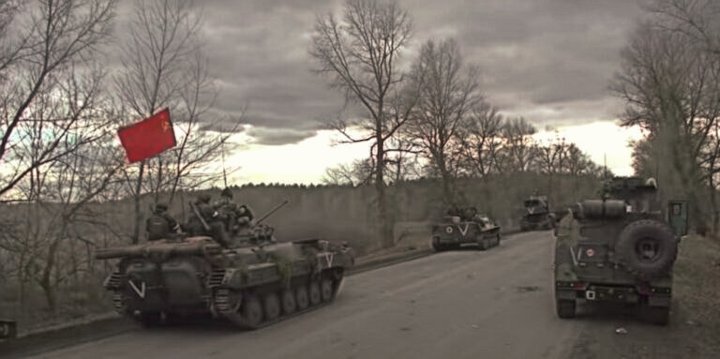
It is important to realize that in Ukraine, it is not Russia that is fighting against Ukraine, but two political currents fighting: anti-fascists and Nazis. That is why thousands of far-right militants from all over the planet wearing runes and swastikas poured into Ukraine. That is why we see stripes with a hammer and sickle on the soldiers of the Russian special forces, and red flags of Victory on the tanks.
We want to appeal to our brothers and sisters from other countries of the world:
Comrades! Know this! In Ukraine, we are fighting, including against your enemies. Against those who came from your hometowns. Against the Nazis of America and Georgia, against the far right from Poland and Sweden. Against those trained by Spanish and Lithuanian instructors.
We know that the future of all humanity is being decided in Ukraine today!
And we urge you not to be silent!
May 9 is the Day of Victory over fascism! On this day, we call on everyone to take to the squares of your cities to pay tribute to the anti-fascists of Spain who died in the battles against Franco, the Italian partisans who fought against Mussolini! To the Greek People’s Liberation Front (ELAS) fighters, anti-fascists from the People’s Liberation Army of Yugoslavia! To the prisoners of concentration camps and the participants in the Warsaw Ghetto Uprising!
We call for rallies in memory of those who did not give up! In memory of Ernst Thälmann, Aris Velouchiotis, Bruno Buozzi, Jean Moulin and millions of others who died at the hands of Nazism!
Today, like 80 years ago, the world is divided into two halves: supporters of Nazism and their opponents. We know you are on the right side!
Show it to everyone on May 8 or 9, 2022, by going to the main square of your city with red flags and St. George’s ribbons raised high!
Here’s what I found at the reported ‘mass grave’ near Mariupol
written by Struggle – La Lucha
May 8, 2022
According to recent Western media, Russian forces have buried up to 9,000 Mariupol civilians in “mass graves” in a town just west of the Ukrainian city. These reports use satellite imagery as supposed evidence and repeat the claims of officials loyal to Kiev that “the bodies may have been buried in layers” and “the Russians dug trenches and filled them with corpses every day throughout April.”
I went to the site in question and found no mass graves.
Western Claims of Russian Mass Graves Near Mariupol Another Fake News Hoax–I Know, I Went To See https://t.co/g3w8S9K2s1
On April 23, I joined RT journalist Roman Kosarev on a visit to the location, in the town of Mangush. What I saw were new, orderly grave plots including some still empty ones – an extension of a cemetery that already exists at the spot. No mass pit. Many of the graves have placards with the names and dates of birth of the deceased when available, and the remaining plots were numbered according to burial.
Since the media is essentially copy-pasting from the same source – the former mayor of Mariupol, Vadym Boichenko (who seems to be far from the city now) – I’ll cite from the Washington Post’s article.
Boichenko, the article notes, “called the site the ‘new Babyn Yar,’ referring to one the largest mass graves in Europe located in the outskirts of Kyiv, where 33,000 Jews where killed by Nazis in 1941 during World War II.”
This is ironic on several levels. A mayor who is whitewashing the neo-Nazis who have run amuck in hso city – notably those from the Azov Battalion, who have used civilians as human shields, occupied and militarized civilian infrastructure, point-blank executed civilians – is comparing an alleged (non-existent) mass grave to a Nazi massacre of WW2.
Meanwhile, the Kiev regime has re-written history, making WW2 Nazis and their collaborators heroes of the nation. The most notorious example being the World War Two figure Stepan Bandera.
Boichenko’s other alarming claim was that the alleged “mass grave” was “the biggest war crime of the 21st century.” We are only 22 years into it, but we’ve already seen the US-led invasion and destruction of Iraq, the levelling of Syria’s Raqqa, Saudi Arabia’s ongoing war in Yemen – all of which are much stronger contenders than the nowhere-to-be-found “mass graves” of Mangush.
In reality, the site has around 400 individual plots, including nearly 100 empty ones. The 9,000 bodies and “biggest war crime of the 21st century” were unverified claims made by a mayor who fled his city, promoted by media which down the page admitted they could independently verify the claims – but by then, the damage had been done.
Gravediggers disprove mass grave claims
While walking around the site, two men responsible for burials arrived, and when presented with the former mayor’s accusations of mass graves they vehemently rejected the claims.
“This is not a mass grave and no one is throwing bodies into a pit,” one told me.
According to them, they bury each person in a coffin and separate grave, details are logged in the morgue, and when any documents regarding name and age are given, the plot is marked with a placard containing those details. Otherwise a number is used.
Interestingly, they also noted that a section of the new graves included buried Ukrainian soldiers. “They’re human, too” one of the men said.
For those in doubt as to the location, see Roman’s report: his drone footage shows that it’s precisely the same location as shown in the satellite images used by Western media.
Meanwhile, as Roman noted while walking, mass graves is something Ukraine has previously been accused of. He cited DPR leader Denis Pushilin as having stated that at least 300 such sites have been discovered since 2014.
He also spoke of what he witnessed. “In 2014 or 2015, mass graves were discovered as Azov or Aidar fighters retreated from the Donetsk region. I even saw a woman, she was dug up, she had her arms tied behind her back, she was in the late stages of pregnancy and she had a hole in her head, so that means she was executed.”
American journalist George Eliason, who has lived in Lugansk for many years, has written about these alleged atrocities. In a documentary on the issue, he said: “I’m here for five minutes and then I’m told the first five people they found, it was five decapitated heads. They were all civilians. Who does this to people?”
This story of a mass grave in Mangush is another fake from the Western corporate media, which previously pushed incubator babies being thrown on the floor by Iraqi soldiers, pushed lies about WMDs in Iraq, and carried reports of a chemical attack in Douma that never happened, to name but a few of their litany of hoaxes.
This outstanding report from Syria by Eva Bartlett penetrates the 'iron dome' of Western propaganda, also known as news. It is about a chemical attack that never happened in a country attacked, subverted and blockaded in your name.https://t.co/AX1Zwbg0g0
Meanwhile, when I was in Mariupol on April 21 and 22, yes there was destruction – thanks to those Neo-Nazi & regular Ukrainian forces occupying upper floors of residential buildings and using them as military positions, thus drawing return fire on the buildings – but I also saw people in the streets, and the beginning of the cleaning up process before rebuilding can occur.
Streets of Mariupol, including areas 1 km from the Azovstal plant where Ukrainian forces are bunkered down. Yes, there is destruction, that's what happens when Ukrainian forces & Nazis embed in residential areas & occupy apartment buildings. It isn't Raqqahttps://t.co/4ha3BTMBOJ
I’ll repeat what I’ve said on Western media reporting on Syria (which in my experience, from on the ground in that country, is largely dishonest): those who promote these hoaxes and war propaganda have blood on their hands.
After the countless lies emanating from Western corporate media, I would hope people would exercise critical thinking whenever a new claim is pushed, particularly when it is repeated in chorus by the usual suspects.
Eva Bartlett is a Canadian independent journalist. She has spent years on the ground covering conflict zones in the Middle East, especially in Syria and Palestine (where she lived for nearly four years).
Washington’s economic war on Russia (and Germany)
written by Struggle – La Lucha
May 8, 2022
In February, President Joe Biden made it clear that the U.S./NATO military escalation in Europe was not about Ukraine. Since taking office in 2021, President Biden has been more focused on Germany and Russia, in particular the Nord Stream 2 pipeline.
The July 2021 meeting of Biden with then-German Chancellor Angela Merkel was icy. Politico reported July 15, 2021, that “Biden and Merkel still don’t see eye to eye on Nord Stream 2.”
Nord Stream 2 is a new pipeline designed to deliver natural gas from Russia to Germany at double the capacity of the existing pipeline. Construction of Nord Stream 2 was completed in September 2021, but it has not yet been opened for service.
The Trump administration had unsuccessfully tried to shut down Nord Stream 2. Now Merkel is out as German chancellor, replaced by Olaf Scholz. With a U.S. proxy war unleashed in Ukraine against Russia, Scholz announced a suspension of the opening of the Nord Stream 2 pipeline.
No U.S. troops in Ukraine, yet
The Biden administration has not yet sent U.S. troops into Ukraine, but it has launched an economic war.
Natural gas is a primary energy source in the European Union and is the dominant source for home heating and cooking. The EU imports 40% of its natural gas from Russia. In the EU, Germany is the most dependent on gas piped directly from Russia. That is why Germany built the Nord Stream 2 pipeline with Russia.
The U.S. is now forcing the European Union, particularly Germany, to move away from purchasing natural gas from Russia. The U.S. says they should get natural gas from the U.S. or Qatar, a U.S. Big Oil subsidiary.
On Feb. 7, Biden said of the German-Russian project: “There will no longer be a Nord Stream 2. We will bring an end to it.”
On Feb. 22, Germany announced the suspension of the Nord Stream 2 pipeline. This was not a decision made in Berlin; the order to do this came from Washington.
Natural gas from Russia can be piped into Western Europe at a relatively low cost while natural gas from the U.S. and Qatar must be liquified – liquified natural gas or LNG – then shipped by sea to Europe. Germany does not have a port to receive LNG directly, adding to the transport costs.
On Feb. 27, Chancellor Scholz announced that Germany will construct two port terminals for LNG and also plans to lease floating LNG terminals as well.
Cutting off natural gas from Russia is a big bonus for the U.S. oil oligarchy. The United States is the world’s largest exporter of LNG. Liquified natural gas has a higher price than piped-in gas and prices for U.S. LNG are now expected to double.
OilPrice reported April 24: “Right now, U.S. LNG exports are booming, and most are going to Europe, where the prices are the highest and demand is the strongest. … After the war started, demand went off the charts as the European Union vowed to reduce EU demand for Russian gas by two-thirds before the end of the year.”
Another bonus for U.S. capitalists
There’s another bonus for U.S. capitalists. The increase in the price of natural gas across Europe will raise the prices of commodities produced by European industries, particularly German products.
German commodities dominate the markets in Europe and have been rising in the global marketplace. In 2015, Ben Bernanke — former chair of the Federal Reserve System — publicly complained of the strong rise in German exports taking markets away from the capitalists of other countries.
The U.S. economy has been in a long-term decline. Increasingly, the “U.S. consumer” buys and consumes commodities that are produced outside of the United States. The great bulk of both material production and surplus value — unpaid labor contained in commodities — is being produced outside of U.S. capitalist ownership.
Forcing the European Union to pay higher energy prices will increase the cost of commodity production in the EU, which opens the possibility that U.S.-owned industry might be able to take markets away from German and other European capitalists.
The proxy war in Ukraine has been a gift to the U.S. military-industrial complex, with over $3 billion in armaments already poured into Kiev. This may line the pockets of a few billionaires, but it won’t reverse the U.S. economic decline.
Military spending produces the means of destruction, that is, the money does not go to expanding commodity production. Military spending actually contracts the capitalist market. Factories that normally produce commodities for profit are instead producing the means of destruction, so there’s no profit, in Marxist terms.
Military spending rots the economy by destroying the productive forces. Also, the expanded military spending in the U.S. is a cause of inflation, though that’s hidden in most economic reports.
U.S. expanding military in Europe
While the U.S. is not yet sending troops into Ukraine, it is expanding U.S. military operations in Europe. In March, the New York Times reported: “NATO doubles its battlegroups in Eastern Europe.” NATO already had 175,000 troops lined up on Russia’s border and in February launched an additional 40,000-strong rapid response force.
The U.S. now has more than 100,000 soldiers deployed in Europe, the most since the overturn of the Soviet Union. About 40% of the U.S. armed forces in Europe are stationed in Germany.
Germany remains very much an occupied country. The Federal Republic of Germany, built on the ruins of the defeated Third Reich by the U.S. occupation forces and later incorporating the (East) German Democratic Republic, is a sort of protectorate of the United States. The U.S. rebuilt Germany in order to fortify the dominant position of the U.S. over Western Europe following World War II.
European trade and investment prior to the U.S./NATO proxy war in Ukraine against Russia had seen a rise in commerce between Germany, France and other Western European countries with Russia and China. One of the goals of the U.S. is to hold Germany and Western Europe firmly within the U.S. economic orbit.
According to Washington’s policy, Europe is supposed to impose sanctions on Russia and give priority to imports from the United States at the cost of raising energy and agricultural prices, particularly in Germany.
Up to now the interests of West European capitalists, including German ones, have coincided with those of the U.S. But Washington’s need to reverse the long-term decline of U.S. industry’s position in the world market has begun to change that. First came Trump’s trade war and now Biden’s economic war on Russia.