The Unprecedented Cost of the U.S. Proxy War in Ukraine:
To protect civilians? Or promote NATO expansion and WWIII
Eyewitness Account & Analysis
Sunday, May 29, 5 pm ET, 4 pm CT, 2 pm PT
Hear an eyewitness account from Struggle-La Lucha correspondent John Parker, recently returned from the front line in the Donbass region, and analysis from Black Agenda Report co-founder, Executive Editor and Senior Columnist Margaret Kimberley.
John Parker traveled to Donbass and Russia as an eyewitness reporter for Struggle-La Lucha. Parker is a founder of the Harriet Tubman Center for Social Justice in Los Angeles and candidate for U.S. Senate in California on the Peace & Freedom Party ticket. He is also a coordinator of the Socialist Unity Party and a member of the Black Alliance for Peace.
Margaret Kimberley is a co-founder, Executive Editor and Senior Columnist for Black Agenda Report and author of the book “Prejudential: Black America and the Presidents.” Kimberley is an Administrative Committee member of the United National Antiwar Coalition and Coordinating Committee member of the Black Alliance for Peace.
Go to www.Struggle-La-Lucha.org for detailed reports from John Parker.
U.S. proxy war: Ukraine targets civilians in Donetsk
written by Struggle – La Lucha
June 5, 2022
Struggle-La Lucha is publishing these dispatches from Katya A., an organizer of the Aurora Women’s Club in Donetsk, capital of the Donetsk People’s Republic. She writes daily about the ongoing targeting of civilians and infrastructure by the U.S.-armed Ukrainian military. Follow her Telegram channel for regular updates.
Today, as for the last eight years, the U.S. corporate media completely ignores Ukraine’s genocidal war on the Donbass republics. Russia’s military intervention in Ukraine at the request of Donetsk and Lugansk aims to end these attacks, which have cost more than 14,000 lives since 2014.
Donetsk, May 30: Yesterday, four civilians were killed in Makeevka and Donetsk as a result of Ukrainian shelling. Twenty people were wounded.
A woman my age was killed very close to where I live. She was standing on the balcony at the time of the shelling. In Leninsky district an elderly woman was killed. A shell completely destroyed the house where she lived.
I don’t even want to write about damage to houses and civil infrastructure. Shells flew even into areas of Donetsk that everyone thought were safe. It was impossible to sleep at night: “UFOs” were being shot down over the city, and explosions were constantly heard.
And this photo shows a crater from a 155mm shell fired from an M777 SAU over the Budennovskiy district of Donetsk.
I want to say hello to all the leftists who are calling for more weapons to be supplied to Ukraine. The “defenders” use it like this. And when they started supplying weapons to Ukraine, I understood that all these gifts would be flying at the inhabitants of the republics. I have no illusions about these soldiers.
The shelling, by the way, continues.
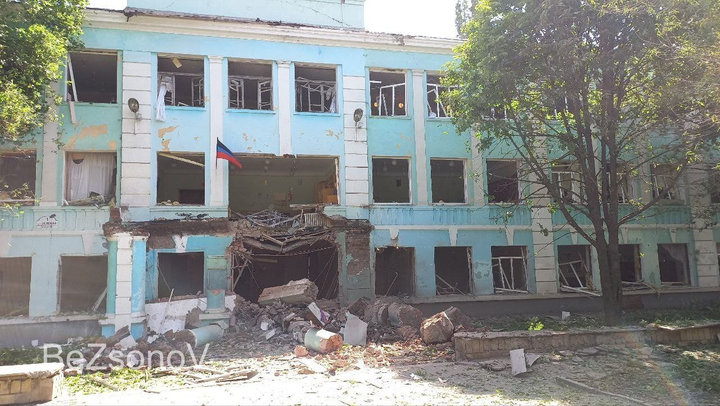
Arrivals in the center of Donetsk.
I once participated in a competition at this school. And today shells flew here. There are dead and wounded.
May 31: The Ukrainian Armed Forces fired on the 15th hospital, which is located in the Petrovsky district of Donetsk. It is in this hospital that about a hundred Ukrainian military prisoners are being treated.
Such friendly fire.
Consequences of the morning shelling of Yasinovataya. Since 2014, this small town has suffered greatly from shelling. Now every day there is news of more dead, wounded and destruction.
Here is what Igor Gomolsky writes:
“As a result of the shelling of Makeevka, a five-year-old girl was killed. Not just dead, but murdered. Do not mix apples and oranges.
“I have heard different versions about the shelling in recent days. Ukrainians, for example, believe that the Armed Forces of Ukraine simply do not know how to use imported weapons.
“But these attacks differ from those that have been conducted since Feb. 24, and all these years, only in their arrogance, intensity and breadth of scope.
“Somehow it ‘coincides’ that the shelling starts precisely at hours when there are many people on the streets. We, for example, were bombarded today from half past eight, when people are going to work en masse. Or it’s midday on weekends, when people are getting out to get some air. Or evening rush hour.
“And there is not a single green piece of iron [military equipment] in the immediate vicinity of the shelled quarters. Someone says: ‘No, but what if there was something a couple of kilometers away?’ Any kind of war crime can be justified.
“But this is not what I wanted to say. In fact, to that piece of scum that pathetically calls itself ‘the whole civilized world,’ this murdered girl is a legitimate target.
“We can and should inform the average citizen of Europe about the war crimes of Kiev, but it makes no sense to knock on the door of the media or politicians with this information. This is not the first time in recent history that the so-called Western world has legalized terror.”
Katya A. is an organizer of the Aurora Women’s Club and a longtime resident of Donetsk.
The U.S. unilateral sanctions against Russia will produce a global food disaster
written by Struggle – La Lucha
June 5, 2022
As the U.S. and the G7 (comprising Canada, France, Germany, Italy, Japan, the United Kingdom, and the United States) insist that cutting off food exports from Ukraine poses the biggest threat to world food security, rather than admitting the far more powerful negative effect of Western sanctions against Russia, their propaganda does immense damage to the world’s understanding and capability of avoiding a looming global food disaster.
The G7 and the approaching food disaster
Looking at the world food supply situation, many experts see an imminent threat of “human catastrophe,” as World Bank President David Malpass put it. Andrew Bailey, the governor of the Bank of England, characterized his outlook on global food supply problems as “apocalyptic” when discussing increasing food prices. This rise has led to the unfolding of two issues simultaneously: creating the threat of hunger and famine in parts of the Global South, and hitting living standards in every country across the globe.
Even before rapid price rises surrounding the Ukraine war, more than 800 million people were suffering from chronic food insecurity—around 10 percent of the world’s population. U.S. Treasury Secretary Janet Yellen cited this fact while speaking to the participants of an April 2022 event, “Tackling Food Insecurity: The Challenge and Call to Action,” whose participants included the heads of international financial institutions such as the World Bank’s Malpass. Yellen also noted, “Early estimates suggest that at least 10 million more people could be pushed into poverty in Sub-Saharan Africa due to higher food prices alone.” The World Food Program (WFP) plans “to feed a record 140 million people this year,” and it reports that “at least 44 million people in 38 countries are teetering on the edge of famine,” an increase from 27 million in 2019.
In countries facing other problems, like climate change, food price increases have been catastrophic. For example, in Lebanon, “the cost of a basic food basket—the minimum food needs per family per month—[rose]… by 351 percent” in 2021 compared to 2020, according to the WFP.
In the Global North, famine is not a threat, but the populations of these countries face a sharp squeeze on their living standards as the global food crisis also raises the prices people in wealthy countries have to pay and budget for. In the United States, for example, the combination of high inflation and economic slowdown led to a 3.4 percent reduction in real average weekly earnings in the last year, as per data provided by the U.S. Bureau of Labor Statistics.
Fake Analysis by the G7 About the Reasons for the Food Crisis
Faced with this rapidly rising threat of the deepening food crisis, the G7 foreign ministers met from May 12 to May 14 to finally focus their attention on this pressing matter. They issued a statement on May 13 expressing “deep concern” about the growing food insecurity, while pointing out the next day that “the world is now facing a worsening state of food insecurity and malnutrition… at a time when 43 million people were already one step away from famine.”
But the G7 falsely claimed that the reason for this food crisis was primarily due to “Russia blocking the exit routes for Ukraine’s grain.” According to Canada’s foreign minister, Mélanie Joly: “We need to make sure that these cereals are sent to the world. If not, millions of people will be facing famine.”
Sanctions and the global food crisis
This G7 statement deliberately misrepresented the present global food crisis. Instead of attempting to solve this crisis, the U.S. and the rest of the G7 used this opportunity to further their propaganda on the Ukraine war.
Certainly, Ukraine’s export restrictions make the global food problem worse. But it is not the main cause of the deteriorating situation. A much more powerful cause is Western sanctions imposed on Russia’s exports.
The first reason for this is that Russia is a far bigger exporter of essential food items and other products in comparison to Ukraine. Russia is the world’s largest wheat exporter, accounting for almost three times as much of world exports as Ukraine, 18 percent compared to 7 percent.
Second, and even more important, is the situation with fertilizers. Russia is the world’s largest fertilizer exporter, and Belarus, which is also facing Western sanctions, is also a major supplier—together they account for more than 20 percent of the global supply. Fertilizer prices were already rising before the Ukraine war due to high fuel prices—fertilizer production relies heavily on natural gas—but sanctions by the West, which prevent Russia from exporting fertilizers, have made the situation worse.
David Laborde, a senior research fellow at the International Food Policy Research Institute, pointed out that “the biggest threat the food system is facing is the disruption of the fertilizer trade.” This is because, he said: “Wheat will impact a few countries. The fertilizer issue can impact every farmer everywhere in the world, and cause declines in the production of all food, not just wheat.”
The threat to global fertilizer supply illustrates how energy products are an essential input into virtually all economic sectors. As Russia is one of the world’s largest exporters not only of food but also of energy, sanctions against the country have a knock-on inflationary effect across the entire world economy.
Response in the Global South
This world food supply situation worsened further after the G7 meeting when on May 14, India, the world’s second-largest wheat producer, announced that it was halting wheat exports due to crop losses caused by an intense heat wave. Already in April Indonesia had announced that it was ending palm oil exports—Indonesia accounts for 60 percent of the world supply.
India’s halt of wheat exports will be a further severe blow to countries in the Global South, where its exports are mostly focused. In 2021-2022, India exported 7 million metric tons of wheat, primarily to Asian Global South countries such as Sri Lanka, Indonesia, Yemen, Nepal, Malaysia, the Philippines, and Bangladesh. But India had earlier set a target of expanding wheat exports to 10 million tons in 2022-2023, including supplying 3 million tons of wheat to Egypt for the first time.
Ending sanctions to prevent Worsening of the Food Crisis
The unfolding situation makes clear that António Guterres’ words were indeed accurate—the world food crisis cannot be solved without both Ukraine’s exports and Russia’s exports of food and fertilizer. Without the latter, humanity does indeed face a “catastrophe”—billions of people will have to lower their living standards, and hundreds of millions of people in the Global South will face great hardship like hunger or worse. Almost every Global South country rightly refused to support the unilateral U.S. sanctions against Russia. This refusal needs to be extended to the whole world to prevent further devastation.
John Ross is a senior fellow at Chongyang Institute for Financial Studies, Renmin University of China. He is also a member of the international No Cold War campaign organizing committee. His writing on the Chinese and U.S. economies and geopolitics has been published widely online, and he is the author of two books published in China, Don’t Misunderstand China’s Economy and The Great Chess Game. His most recent book is China’s Great Road: Lessons for Marxist Theory and Socialist Practices (1804 Books, 2021). He was previously director of economic policy for the mayor of London.
Ukraine ‘aid’: Congress pays off military-industrial capitalists
written by Struggle – La Lucha
June 5, 2022
Has there ever been a more corrupt Congress? Democrats and Republicans alike.
On May 19, the U.S. Congress approved an additional $40 billion in “aid” to Ukraine, added to the roughly $14 billion of Ukraine war funds approved in March. That’s $54 billion total.
President Joe Biden promoted the escalation of military spending, grinning as he stood at the podium, with a banner behind him declaring “Standing With Ukraine.”
The Democrats unanimously approved the billions. None suggested that the funds should go to housing, food, healthcare, transportation, COVID relief or some other failing part of the U.S. economy.
To put some perspective on this, $54 billion is more than Russia’s defense budget for the whole year 2021, which was $43 billion.
Officially, the U.S. military budget is $782 billion for 2022. The $54-billion Ukraine “aid” equals 7% of this year’s official military budget.
The New York Times says that it’s more money than the U.S. has given in any kind of aid to any country in the last decade. “It is roughly two times the amount given in 2011 to Afghanistan, the largest U.S. foreign aid recipient until now,” the May 20 Times reported.
The Times adds that it is 1% of this year’s projected federal budget. The “Ukraine aid” is more than many of the individual packages in Biden’s “Build Back Better” plan that the Democrats couldn’t approve, including Medicare hearing aid benefits, and roughly equal to the “Build Back Better” public housing funds.
‘Financing total war’
“The sums of money being contemplated in Washington are enormous,” Adam Tooze wrote in the Guardian shortly before final approval. “It will mean that we are financing nothing less than a total war.”
On April 25, at a meeting with more than 40 NATO and non-NATO defense officials in Germany, U.S. Secretary of War Lloyd Austin said in so many words that the NATO military operation is not about “defending Ukraine” but is a proxy war against Russia, with Ukraine as the battlefield.
“A weakened Russia” is the goal, Austin said.
Leon Panetta — White House chief of staff under Bill Clinton, CIA director and secretary of defense under Barack Obama — explained that the conflict in Ukraine is a NATO “proxy war” against Russia. Biden himself declared the goal is regime change in Moscow, saying Putin “cannot remain in power.”
The Ukraine aid package, by the way, should rightfully be called a payoff to the U.S. military-industrial complex. For example, $9 billion of the $40 billion package goes directly to U.S. capitalist corporations that produce weapons, designated as “replenishment of U.S. weapons stock” in the bill.
About $6 billion goes to a Department of Defense slush fund that the Pentagon will decide how to spend. And $4 billion is for Ukraine to spend buying new military equipment from U.S. weapons producers.
Another $3.9 billion is for sending an additional 10,500 U.S. troops to Europe. Hard to find anything that’s actual aid to the people in Ukraine.
Written by Lockheed Martin
In fact, the whole Ukraine aid package was written by the U.S. military-industrial complex. Business Insider reported on May 23: “One of the largest defense contractors in the nation donated to nearly 150 members of Congress as they debated Ukraine military aid.”
Military contractors have been the primary beneficiaries of the Ukraine war aid approved by Congress.
Lockheed Martin is the top war (military-industrial) contractor in the U.S., followed by Raytheon, General Dynamics, Boeing and Northrop Grumman.
The top member of Congress in charge of the military budget, Democrat Adam Smith from Washington state, is also the top recipient of money from the weapons makers.
The fact is, any semblance of Congress being representative of people and not money has been mostly abandoned. The Supreme Court’s 2010 Citizens United decision “reversed century-old campaign finance restrictions and enabled corporations and other outside groups to spend unlimited funds on elections,” according to the Brennan Center for Justice.
In the New Yorker, legal analyst Jeffrey Toobin concludes that the Citizens United decision “let rich people buy candidates.”
In 2016, in a case involving the open corruption of former Virginia Gov. Bob McDonnell, the Supreme Court in a unanimous ruling made it difficult to impossible to prosecute political corruption. Some have characterized it as approving the purchase of sitting politicians.
On May 16 of this year, the Supreme Court removed the only restrictions left on the rich donating to (purchasing) politicians after they had been elected.
The military-industrial complex apparently owns Congress and it is writing the agenda.
In Ukraine, Russia is fighting neo-Nazism
written by Struggle – La Lucha
June 5, 2022
The Communist Party of the Russian Federation responds to the Greek Communist Party’s criticisms of its positions on Ukraine/Donbass.
May 16, 2022
Comments on the Article of the International Department of the CC KKE “On the Imperialist War in Ukraine and the Stance of the CPRF”
On April 23, 2022 the newspaper Rizospastis, the organ of the Communist Party of Greece, carried an article by the International Department of the CC KKE “On the Imperialist War in Ukraine and the Stance of the CPRF.”
The article assesses the actions of the CPRF in connection with the special operation Russia is conducting in Ukraine openly accusing the party of having a pro-government, i.e. pro-imperialist position. We categorically disagree with this utilitarian assessment.
The gist of the article is that in the opinion of the Greek comrades, what is taking place in Ukraine is an imperialist war in the interests of the Russian bourgeoisie, and therefore, by supporting the special operation the CPRF is advocating a policy that is “in line with the ruling United Russia party and President V.Putin.”
In insisting on the “imperialist” character of this war, the Greek comrades proceed from Lenin’s well-known thesis that “A struggle for markets and for freedom to loot foreign countries, a striving to suppress the revolutionary movement of the proletariat and democracy in the individual countries, a desire to deceive, disunite, and slaughter the proletarians of all countries by setting the wage slaves of one nation against those of another so as to benefit the bourgeoisie; these are the only real content and significance of the war.” However, the comrades did not mention that this statement is contained in Lenin’s work War.1914-1918. It specifically refers to the First World War, which was indeed a purely imperialistic war of conquest. However, leaving dogma aside, we have to admit that any war has its own specific characteristics.
The Marxist’s task in determining one’s position with regard to the war is to determine its character. For in addition to imperialist wars, there are national liberation and anti-Fascist wars which have become widespread in the mid-20th century when Fascism and Nazism emerged as political phenomena and national liberation struggles intensified under the impact of the October Revolution.
What guided the CPRF in determining its stand.
In working out its political position on the issue of the conduct of the special operation the party analyzed the concrete historical conditions which objectively led to the crisis in Ukraine.
Before the October Revolution in Russia Ukraine, which was part of the Russian Empire, was a typical agrarian country. To strengthen its industry, six industrial areas of the RSFSR in the east and south, which had never been parts of Ukraine, were included in Ukraine. Among them were the Donetsk and Lugansk oblasts. In 1939 Galicia (Western Ukraine), previously part of Poland, was added to Ukraine. Thus, the present territory of Ukraine is the result of it becoming part of the USSR. It has been “sewn together” from disparate patches from Galicia (Lvov), which were under heavy influence of Poland, Austria and Hungary, to East Ukraine, which gravitated toward Russia.
Socialist Ukraine’s industry burgeoned. Added to the production of metal and coal were aviation and rocketry, petro-chemistry and power generation (4 nuclear power plants), and defense sectors. It was as part of the USSR that Ukraine obtained not only the bulk of its present territory, but also its economic potential to become one of the top ten European economies.
The dissolution of the Soviet Union in December 1991simultaneously destroyed the centuries-old economic integration of Ukraine and Russia, severing all economic, political and cultural ties.
Today it is one of the poorest countries in Europe. Its manufacturing industry, with the exception of metallurgy, has been practically destroyed. Ukraine’s economy stays afloat due to Western loans and remittances from people who have left for Europe and Russia in search of some kind of a job. Living standards plummeted and emigration rocketed. About 10 million people (out of 45 million) have left, the most highly qualified specialists.
Ukraine has some of the highest levels of corruption and social differentiation. The country is on the brink of a national catastrophe.
The government coup in Kiev as the basis of fomenting conflict
In February 2014, with direct assistance of the USA and other NATO countries, a government coup took place in Ukraine. The legitimate government was overthrown. Neo-Nazis came to power. Subsequently, the USA admitted publicly that it had invested about 5 billion dollars in preparing the change of regime in the country and in “the development of democracy.” Needless to say, no one would spend such a gigantic sum just like that.
As a result of the government coup power was seized by people from Western Ukraine, from Galicia where extreme nationalist, anti-Semitic, anti-Polish, Russophobic and anti-communist sentiments have traditionally been strong.
Forcible assimilation of the Russian-speaking population began. A ban on the Russian language and the decision to switch school education from Russian to Ukrainian met with powerful resistance in the Donetsk and Lugansk regions. People rose up in arms.
In the May 11, 2014 national referendum 87% of the citizens voted for independence. Thus, the Donetsk and Lugansk People’s Republics were formed on the initiative of the popular mases, and not on directions from the Kremlin.
After several unsuccessful attempts to seize DPR/LPR the Kiev Nazis resorted to terror. During eight years of continuing bombardment by heavy artillery almost 14,000 civilians were killed and tens of thousands were maimed. The infrastructure was severely damaged.
Throughout the long eight years the European countries and the USA looked on the genocide of the Russian people in Donbass with extreme equanimity, thus effectively justifying the actions of the Kiev regime.
Today, the EU and the USA are displaying unheard-of hypocrisy describing people’s suffering in the course of battles, but ignoring the fact that the use of civilians as human shields has become the standard practice of those whom they call “freedom fighters.”
Development of Neo-Nazism in Ukraine
Our comrades, in considering the situation in Ukraine, only reluctantly mention the danger of its Fascization. And yet one of the main goals of Russia’s military operation in that country is its de-Nazification. Even American congress people and special services admit that Ukraine has become the center of international Neo-Nazism.
Here are just some facts. After Hitler’s invasion of the USSR, as we have noted above, extreme nationalistic, anti-Semitic, Russophobic and anti-communist sentiments in Western Ukraine were running high. SS divisions that were formed there fought the Red Army. Local nationalists, led by Semyon Bandera, an ardent Hitler fan, set about exterminating Jews. In Ukraine Banderaites slaughtered about 1.5 million Jews, one fourth of all the Holocaust victims. During the 1944 “Volyn massacre” in Western Ukraine about 100,000 Poles were slaughtered. Banderaites killed partisans and burned alive civilians in hundreds of Byelorussian villages.
After the war, anti-communist and anti-Soviet rebels in Western Ukraine, backed by the USA and Great Britain, launched terror against civilians in the period between 1945 and 1953. During those years Banderaites killed about 50,000 citizens. The descendants and successors of these thugs came to power after the 2014 coup. The tradition of anti-Polish, anti-Semitic and anti-Russian terror is very strong among the Neo-Nazis who practically run Ukraine today.
Nazi ideology is being inculcated in Ukraine. Ukrainian Fascists who organized and committed atrocities during the Second World War have been officially proclaimed national heroes. Their symbols have been adopted by the state. Marches in honor of Fascist criminals are held every year. Streets and squares are being named after them. The Communist Party of Ukraine has been driven underground. Intimidation and assassinations of politicians and journalists have become the order of the day. Monuments to Lenin and everything reminiscent of life in the USSR are being destroyed.
Today Banderaites, like the SD storm troops in Germany, are the shock brigade of Big Business. They control every move of the government constantly blackmailing it with the threat of a government coup.
The nature of the present-day Ukrainian state is the alliance of big capital and the government bureaucracy backed by Fascist elements under total political and financial control of the USA.
The causes and character of the special military operation
In terms of the Marxist theory the military conflict in Ukraine cannot be described as an imperialist war, as our comrades would argue. It is essentially a national liberation war of the people of Donbass. From Russia’s point of view it is a struggle against an external threat to national security and against Fascism.
It is no secret that the Donbass militia was unable to resist the many-thousand-strong foreign-armed Ukrainian armed forces. A defeat of the militias would have led to the annihilation of the Russian-speaking population, a large proportion of which are citizens of Russia. Under the Constitution of the RF, Russia took legitimate action to protect its citizens and ensure its national security because it could not have been done by other means.
With US and EU support Kiev deliberately sabotages the negotiating process in the framework of the Minsk Agreements.
By that point in time Ukraine had concentrated 150,000 servicemen and Nazi battalions in Donbass. Kiev, with US support, was getting set to regain control over Donbass by military means.
With the blessing of its American principals Ukraine was preparing to launch a military operation to seize Donbass and then Crimea in early March of this year. There is a solid body of evidence to confirm the existence of these plans.
The Banderaite regime has been preparing for this war for eight years. Servicemen were subjected to relentless ideological brainwashing in the spirit of rank Russophobia. Powerful strongholds were being created and the army was provided with the latest weaponry.
In line with its imperialist geopolitical goals the US was gradually drawing Ukraine into the sphere of its military interests turning the country into a NATO spearhead determined to fight Russia “up to the last Ukrainian soldier.”
As early as December 2021 Russia made a proposal to the US to hold talks on non-enlargement of NATO to the east. The Americans evaded giving a direct answer. So in January 2022 Russia warned that in this situation it would have to take additional measures to protect its national security.
Simultaneously, there was talk about deploying US tactical nuclear weapons in Ukraine. Ukraine, which has four nuclear power plants and a considerable scientific-technical potential, started preparations for creating its own nuclear weapon.
Under the Pentagon’s patronage Ukraine set up more than 30 laboratories to develop bacteriological weapons. There are documents to prove that these laboratories were working with particularly dangerous bacteria of deadly diseases and were investigating methods of spreading them to target people of different races.
All this poses a threat not only to Russia, but to the whole humankind.
It is claimed that this is all about inter-imperialist contradictions or the struggle over markets and subsoil resources. Inability to see the national component of class issues and the class component in national issues leads into the territory of dogmatism.
Interest of the Russian oligarchy in Ukraine or lack of the same?
Seeking to prove that the war is being waged in the interests of the Russian bourgeoisie, in order to seize Ukraine’s natural resources and industrial potential, our comrades pluck Lenin’s words about the nature of wars out of their historical context.
However, the claim that the Russian leadership was preparing to seize Ukraine in advance contradicts facts.
From the outset, the Russian leadership did not support the idea of a referendum on the formation of Donbass people’s republics.
Following the Minsk-2 agreements, Russia a priori assumed that Donbass would remain part of Ukraine, albeit with a measure of autonomy.
Until the beginning of the military operation the Russian leadership insisted on compliance with Minsk-2, which would leave Donbass as part of Ukraine.
So where is preparation for imperialist seizure?
Since 1991 Ukraine, its industry and resources were objects of super-exploitation by US and EU monopolies. The Russian oligarchy did not take part in“dividing the pie” which was in the sphere of Western interests.
Moreover, the Russian oligarchy was against the military operation in Ukraine. It was striving to become integrated in the world oligarchy and was already under massive pressure from the West which urged it to exert pressure on the government to induce it to preserve Russia’s pro-Western orientation.
Besides, the Russian oligarchs suffered considerably from the Russian military operation in Ukraine. They were put under sanctions, and are seeing their palaces and yachts taken away form them and their bank accounts frozen.
We do not have the slightest sympathy for those who have been plundering Russia for three decades and are now being deprived of their loot. We merely want to stress that the Russian oligarchy was not only not interested in the military operation, but has suffered from it. By refusing to back this operation, big business has lost not only its property and money, but its influence within the Russian ruling elite.
Note which class forces were the fiercest opponents of the Russian military operation in Ukraine. These were above all big monopoly capital, its political representatives in the liberal milieu and their “creative” lackeys among the so-called intelligentsia.
Of course we recognize the existence of inter-imperialist contradictions. The desire of imperialist predators to seize the natural and energy resources of other countries. Russia is a victim of the West’s plans to turn our country into a source of cheap raw materials. We have been opposing these plans for decades. But we do not believe that Russia, for all the flaws of its current political system, based on the power of big capital, has overnight turned into such a predator. The struggle in Ukraine has a fundamentally different character which defies dogmas.
The position of the CPRF
The CPRF was the first to define the nature of the regime which seized power in Ukraine during the Maidan protests in 2014. Thenceforth, all the party’s activities have been based on the class essence of the ongoing political processes.
We have always been critical of the Russian leadership’s external policy, which effectively ignored the interests of the peoples which until recently were part of the single Soviet state.
Those who attentively follow our actions (and we assumed that the Greek comrades are thoroughly conversant with our documents) will know that it was the CPRF that has since 2014 consistently called for the recognition of the Donetsk and Lugansk people’s republics. No other political party in Russia has done as much to support the population of Donbass. From the start, we supported the return of Donbass to Russia. It is not the CPRF that follows “the line of the ruling United Russia party and President Putin” but they, under the pressure of historical imperatives, have to follow the route which the CPRF has advocated for three decades.
In this situation, is it fair to say that we almost blindly support Putin’s policy in Ukraine?
The Russian communists take the most active part in protecting the LPR/DPR. Hundreds of communist party members are fighting the Nazis as members of the armed forces of these republics. Dozens of communists have died in this struggle. The CPRF has, during the past eight years, sent to these republics 93 convoys carrying 13,000 tons of humanitarian aid and hosted thousands of children who came to Russia for rest and medical treatment.
All these past years the CPRF has been urging the Russian leadership to recognize the independence of Donbass.
Frankly, we are not pleased to hear our Greek comrades speak with a touch of disdain about ”so-called people’s republics” of Donbass because these are precisely people’s republics which came into being as a result of expressed will of the people.
The citizens of LPR/DPR have defended them at the cost of thousands of civilian and military lives over the eight grim years of resistance to the creeping aggression of Banderaite Nazis.
It is a matter of signal importance that fighting the Banderaites are not only the Russian army, but also the militia units of Donbass itself among whom communists and mining workers form a large stratum.
Where do you see “protection of the interests of the oligarchy?” Are our comrades who daily expose their lives to mortal danger also defending the interests of the Russian oligarchs? Or do they defend the interests of common people who have become victims of the Neo-Nazis who have seized power in Ukraine?
One has to be very reluctant to see the real state of affairs to claim that the CPRF is acting in line with the ruling group.
The pitch of class political struggle in Russia is as high as ever. Persecution of communists and party supporters, even after the start of the military operation in Ukraine, shows that there is no class harmony between the CPRF and the present ruling elite. One can cite many examples of our comrades being subjected to repressions. Our response to the persecution of our comrades is robust.
By the same token, we are vehement critics of the government’s socio-economic policy. No other party in Russia can claim that it has been a more active critic of the authorities.
Over the thirty-odd years since the anti-communist coup of 1991 we have provided ample proof of our resolute struggle against the ruling elite. That is why our party enjoys such broad support of the masses.
In the September 2021 elections for the State Duma the CPRF won almost 19% of the votes. And this in spite of the well-oiled and long-established machine of vote-rigging. We are confident that the actual level of popular support is substantially higher. This is because, in the spirit of Marxism-Leninism, we seek to study the interests and mood of the people. Incidentally, by supporting the Russian special operation in Ukraine, the CPRF has expressed the will of the overwhelming majority of Russian citizens.
As for claims about “courting| nationalist approaches and nationalist forces,” we are proud to declare that the CPRF is the leading patriotic left force in Russia.
We deem it to be our internationalist duty to protect the interests of the Russian people and the other peoples who have lived for centuries together with the Russians, above all the Ukrainians and the Byelorussians. Denying the historical significance of “the Russian world” or the Russian civilization is, in our view, as absurd as denying the great significance of the ancient Greek civilization. When Manolis Glezos tore down the Nazi flag atop the Acropolis he was not guided only by class interests, but also by the national pride of the Greeks who had launched a resolute struggle against the German occupation.
Attitude of the world community to events in Ukraine
While the Western politicians and the media, who arrogantly claim to represent “the world community,” openly take the side of the Neo-Nazis, major countries in Asia, Africa, the Middle East and Latin America which have first-hand experience of European and American neo-colonialism, quite rightly see the events in Ukraine as Russia’s struggle against the US-led unipolar world.
The countries that are home to 60% of the planet’s population either support the Russian operation or take a neutral stance.
Only those who in 1941 brought war to our country as members of the Hitler coalition take an aggressive stand. These are the countries of Europe, as well as the USA and Great Britain which have contributed a great deal to the revival of the Nazi military machine after its defeat in the First World War. Today Russia is again fighting Fascism and those who support it in Europe and the USA.
*****
Remembering the heroic deeds of the Communist Party of Greece in the struggle against Nazism and against the military dictatorship, we categorically brush aside the idea that our comrades could have consciously joined the camp of those who today try to crush Russia with Ukraine’s hands. We reiterate our profound respect for the KKE as a party which has made an immense contribution to the revival of the international communist and workers’ movement after the collapse of the USSR in 1991. However, the words of our comrades sometimes sound like the statement of the ultimate truth. We are for a comradely dialog which has always helped communists all over the world to understand the essence of events and work out their correct, genuinely Marxist approach to their assessment.
Labor Council opposes $40 billion in military aid to Ukraine
written by Struggle – La Lucha
June 5, 2022
The Troy, N.Y., Labor Council passed the following resolution in opposition to the $40 billion in military aid to Ukraine. The resolution could be summarized as saying, “Money for housing, education and healthcare, not for war.”
Whereas: According to the Department of Housing and Urban Development, it would cost $20 billion to end homelessness in the United States.
Whereas: The College For All Act endorsed by Senator Bernie Sanders and Representative Pramila Jayapal aims for free college tuition at all community colleges, public 4-year colleges, and tribal colleges.
And Whereas: The estimated total cost of the College For All Act is $700 billion.
Whereas: : A recent study by Yale epidemiologists found that Medicare for All would save around 68,000 lives a year while reducing U.S. health care spending by around 13%, or $450 billion a year.
Whereas: The US government should prioritize the needs of its own citizens.
Therefore be it resolved: that the Troy Area Labor Council AFL-CIO opposes the recently passed bill that would spend 40 Billion dollars in military aid to Ukraine.
Victory Day and the struggle for abortion rights today
written by Struggle – La Lucha
June 5, 2022
Presentation at the international webinar “Marxists Speak Out: Victory Day, Against Nazism and Imperialism, Yesterday and Today” on May 14.
I’ve just come from a march of many thousands here in New York to defend the right to abortion. As you probably know, a draft ruling by the U.S. Supreme Court was leaked earlier this month, which would reverse the right to abortion granted in the Roe vs. Wade case almost 50 years ago.
If the decision goes through, the legal precedent will also endanger many other hard-won civil rights, including same-sex marriage, the right to access contraception, protection from so-called sodomy laws used to criminalize queer people, even interracial marriage. It truly is an attack on the whole working class.
The vicious ruling class attack on reproductive rights made me think about the essential role of women and other oppressed-gender people in our movements and in the Soviet victory over fascism in World War II. We know the names of heros like the Red Army sniper Lyudmila Pavlichenko, air fighter Lidya Litvyak and saboteur Zoya Kosmodemyanskaya. But Soviet women also held down the homefront, kept the factories running, and waged guerrilla warfare when their cities and villages were occupied by the Nazis.
On May 9, 2016, I had the great fortune to attend the Victory Day march in Lugansk, capital of the Lugansk People’s Republic. It was one of the most moving experiences of my life as a revolutionary. The people of the city poured into the streets to honor not only their ancestors who fought fascism decades before, but also those who fought and died to stop Ukraine’s attack on the city in 2014-15. And women were at the center of this mobilization. They were the organizers and leaders, as they are in so many of our organizations, movements, unions and communities.
In this spirit, the Socialist Unity Party is seeking ways to connect the struggle against the U.S./NATO proxy war in Ukraine with the emerging mass movement to fight for abortion rights and other struggles of the working class here at home. There is enormous and growing anger and distrust of the Democratic Party, which poses as the friend of workers and oppressed communities to get elected, while fundamentally serving the interests of the capitalist class just like the Republican Party.
In recent weeks, we have seen the spectacle of Democrats in Congress voting unanimously for an additional $40 billion for the proxy war in Ukraine, while at the same time failing in a rushed vote to codify abortion rights into law, despite having control of both the House and Senate. At the same time, every member of the Senate, Democrat and Republican, voted to add extra security for the Supreme Court justices who are poised to strip a basic human right from more than half the population.
The imperialist regime of the U.S. wants to mandate forced pregnancy and birth at a time when the cost of food and rent is skyrocketing, there is a frightening shortage of infant formula, and the public health measures of the pandemic have been repealed. And the money that could be used to mitigate some of these life-and-death crises is being spent on weapons and aid to prolong a war on the other side of the world.
The capitalists, in their insatiable drive for profits, can’t stop themselves from pushing too far. They are making the contradictions of their system so glaring that it gives us, their enemies, an opportunity to educate and organize the many, many workers whose lives are on the line – especially the most downtrodden, including Black and Brown people, women, trans people and immigrants.
As we mark the 77th Victory Day, our great task is to help our class make the connections between the struggle against imperialist war abroad and the war on workers at home.
Fact-finding trip to Donbass: A front-line shelter in Rubizhne
I had just left the Lugansk People’s Republic, making my way to an interview in Moscow, when I saw a May 11 CNN story claiming Russia had targeted civilians in the Ukrainian city of Odessa. This was after the bombing of a hotel and shopping center there. When such structures are bombed, one assumes that they were filled with civilians.
Odessa was also the location of a massacre that took place after the 2014 coup, funded for years prior by the United States. The fascist element that was part of that coup burned the Odessa House of Trade Unions on May 2, 2014, killing progressives, socialists, trade unionists and anti-fascists.
My friend and guide during the Lugansk portion of my trip was Alexey Albu, who was inside that burning building and one of the few who escaped. At the time, Alexey was an elected member of the Odessa Regional Council. He was a former member of the Central Committee of the Communist Party of Ukraine and at that time the local coordinator of Union Borotba (Struggle). He and others were working on solving the contradictions created in society by the coup in a peaceful way through the still-existing legislative processes.
However, by May 2, time had run out. The fascists who praised Nazi collaborators and pushed ultra-nationalism against the Russian population turned even more violent against any opposition. Political repression and jailings were on the rise by the coup government, and six days after the massacre, Alexey found out he was to be arrested. He and his family then fled to Crimea where they felt safe. He later went to Lugansk to continue his political work, but had to separate from his family for four years to do so.
As he is from Odessa and still has many connections there, I wanted to ask Alexey about the bombing on May 11. Alexey responded: “Yes, Russia attacked the luxury hotel Grande Pettine, because there were foreign mercenaries operating there. And the big shopping and entertainment center Riviera was attacked because they made it into a warehouse for NATO weapons.
“It’s also important to know that Russia used high-precision missiles, so as not to cause harm to civilians. And it is very interesting that CNN did not pay attention when more than 40 civilians were drowned in blood and burned in fire in the Trade Union building on the second of May 2014,” said Alexey.
Challenging U.S. narrative
The Russian intervention in Ukraine began Feb. 24 at the request of the Donetsk and Lugansk People’s Republics (DPR and LPR). About a month later, unlikely sources – analysts and advisers working for the Pentagon — became whistleblowers in an exposé published by Newsweek, “Putin’s Holding Back.”
The authors, many of whom were military officers, had to remain anonymous in order to be as truthful as possible, since they were still working as advisers. The article challenged the official narrative that Russian President Putin was targeting civilians.
Regarding a similar earlier accusation by the corporate media about a Russian bombing, said to have targeted “peacekeeping facilities” (as if belonging to the U.N.), one of the analysts responded: “And the so-called peacekeeper training ground [in Yavoriv] was hit because it was the place where the ‘international legion’ [Ukrainian military unit, training international mercenaries] was to have trained.”
This quote from one of the advisers sums up their motivation for becoming whistleblowers: “I’m frustrated by the current narrative — that Russia is intentionally targeting civilians, that it is demolishing cities, and that Putin doesn’t care. Such a distorted view stands in the way of finding an end before true disaster hits or the war spreads to the rest of Europe,” said this Pentagon adviser and U.S. Air Force officer.
It’s interesting that CNN reported that only one person died and five were hospitalized in the May 11 bombing. In a shopping center and hotel filled with people, as they implied, many more likely would have died.
One of the ways to determine whether someone is telling the truth when you have no access to events far away, under media whiteouts and the jailing of journalists, is to either catch the liar at other lies to bring their credibility into question, or find a way to get access to the location of the events.
We did both.
Fact-finding mission
On April 27, I began a trip to the LPR in the Donbass region as part of a fact-finding mission organized by Struggle-La Lucha newspaper in the U.S. to gather eyewitness observations and testimony of Lugansk residents, some of whom I found were living in shelters near the front lines of the war. The loud blasts are a constant reminder for them of the artillery of the Ukrainian military, targeting apartment buildings nearby and hopefully continuing to miss them.
This trip would not have been possible if not for our friends from Borotba, who we’ve been collaborating with for eight years. Borotba was founded in 2011 and in the process of becoming a political party, but the Maidan coup interrupted that process.
While passing through Russia on the way to Lugansk, I spoke to progressive, socialist and communist organizations at the Moscow May Day celebrations and a commemoration of the Odessa Massacre on May 2.
I also interviewed visiting journalists from Belarus who were covering the May 9 Victory Day parade, commemorating the defeat of Nazi Germany and honoring the 27 million Soviet people who died fighting fascism – a fact which everyone should consider as context in today’s vilification of Russia. Soviet Russia, along with the rest of the USSR, was essential in order to defeat Nazi Germany in World War II.
Although Russia is no longer socialist, that doesn’t change the fact that the parents and grandparents of most of the people in the country sacrificed for that victory. That deep understanding of the dangers of fascism did not go away with the counterrevolution. Nor did the targeting of this region by U.S. imperialism end.
The U.S. government says that the current Russian intervention was an uninvited “invasion,” that the justification of self-defense and concern over the growth of fascist forces in the Ukrainian government and military is just a smokescreen designed to facilitate the takeover of that country. They claim the Russian military is targeting civilians and the Ukrainian military is not.
The Biden administration also says that it would be better for all of the people in the region if the Russian military withdrew its troops, with no acknowledgment of the eight-year Ukrainian war against the people of the Donbass region.
Surprisingly, a significant portion of organizations here in the U.S. that consider themselves anti-imperialist and socialist agree with the assessment pushed by the U.S. State Department.
The celebration of victory against the Nazis, by the way, is illegal in Ukraine. President Zelensky will not allow it. I know, the irony is unbelievable, but the fact remains – celebrating Victory Day in Kiev and anywhere controlled by the Ukrainian regime is illegal.
In spite of Zelensky’s recent announcement giving lip service to the day for cover, the fact is that there was a curfew in place that day to discourage it. While in Lugansk, I asked someone what would happen if I were to have a sign celebrating Victory Day in Kiev. The answer was that in five minutes I would no longer be carrying that sign, and probably would be taken to prison.
But perhaps that’s just a quirky policy meant for public safety? Let’s dig deeper.
Rubizhne: Life on the front line
“Don’t step there!” a soldier from the LPR warned me as my foot was about to step into the grass, away from the established path of the soldier walking in front of me.
This trek began in the morning, hitching a ride with the Lugansk People’s Militia to an area in the north of Lugansk, close to the front line of war against the Ukrainian military, where the LPR with the help of Russian soldiers recently liberated a residential area in Rubizhne. This city in Lugansk was previously occupied by Kiev forces.
Here there was a shelter in an abandoned apartment complex. Unexploded armaments and even mines from the Ukrainian military littered the area, the soldier said.
Of course, I obliged and changed my path. I also immediately understood why no children were running around the grounds or using the playground. Instead, they mostly seemed to stay in the shelter or sometimes came out to play soccer in a small patch of land directly in front of it, under the watchful eye of a young LPR soldier.
At that moment my parental feelings kicked in and all I wanted to do was play with them, comfort them. But I had work to do.
This was once a lively apartment complex with a school and a beautiful playground. But now it looked like the backdrop to a “Walking Dead” episode.
Borotba’s Alexey Albu accompanied me and provided translation. The video clips linked here include some of these conversations and contain more footage from this portion of the trip.
We spoke with the woman in charge of the shelter, Larisa. She reluctantly took the position of caretaker for the shelter, voted in by the residents who trusted her. It definitely seemed like the right choice, because she keeps it in the best order that can be expected in these times. With all the work and responsibilities, she still manages to share compassion with those in need of comfort – war makes apparent the devils, but also the angels.
Basic foodstuffs and supplies – grains, water, and diapers – were neatly stored away. Getting food is especially a challenge for people who have nowhere else to go. Some residents who had alternative dwellings and were not disabled left Rubizhne, but the area is still not safe for travel. Many stayed to remain under the protection of the soldiers of both the LPR and Russia.
Russia provides humanitarian aid
Humanitarian aid arrives frequently in Rubizhne, delivered by Russian soldiers. (In the short time I was at the border entering Lugansk from Russia, I saw 10 large trucks full of humanitarian aid entering the LPR.)
While we were at the shelter, two shipments of aid were delivered in a van, which we helped bring into the shelter. The box I was carrying almost broke open, with utensils and napkins barely making it to the bench where other items, especially diapers, were being placed.
Larisa explained that fuel, which is now hard to come by, had been used as their primary source for electricity, refrigeration and water (running the generator and water pump). So the aid is essential in order that people do not starve or die of thirst.
“Because of the war, they had problems getting assistance to the shelter,” Alexey explained. The trade unions in charge of delivering food in Lugansk were not able to, due to the area becoming a war zone, meaning they had to hand over that task to the military.
Despite the danger and the fact that the Ukrainian military still controlled the area, the Russian and Lugansk soldiers, at great risk to their own lives, were able to get some aid to the residents of the shelter even before the area was liberated.
Recalling this moment, and the effect it had on her own child, brought Larisa to tears. She needed a minute to recover.
“Ukrainian soldiers did not help at all,” she said when she returned. “That is unacceptable. No one from the Ukrainian side asked us, visited us. I had supported Ukraine, but after I saw how they left these people I no longer supported them.”
Accompanying us was a journalist from an Italian media organization. He asked why people stayed here at the shelter, and if they were allowed to leave. Although Larisa made the facility as comfortable as possible, the conditions were hard and the constant thunder of bombings was heard during our entire time there.
Alexey explained that the roads here, although dangerous now, were even more dangerous during Ukrainian control, so leaving was not a safe option then. It became more possible after the area came under Russian control. “We tell people it is not safe, but if they want to leave, of course they can. No one will stop them,” explained Larisa.
Another issue Larisa wanted to address was the propaganda that has spread throughout Ukrainian society saying that the Russian soldiers rape and kill the people living in areas they’ve taken control of. She wanted to make it clear that this was not true.
“No, everything was very good, relations were very good and polite with the Russian soldiers. Even when we ask for some special foods like coffee or tea, they give it to us.”
Soldiers and civilians
To get a feel for the character of the relationship between the residents and the Russian and LPR soldiers, here’s one encounter that stuck with me. When we visited the school in the complex, which is now a shelter, I saw a woman reprimanding one of the soldiers for having the humanitarian aid truck remain too long at the entrance.
Alexey said she was complaining that if they had to evacuate the school quickly, the truck would be in the way. The soldier politely nodded and agreed to move it soon, as if she was in charge. From her tone it seemed like that to me, and it definitely didn’t reflect a repressive relationship – not for the residents anyway.
Both in the village of Krymskoye and here in Rubizhne, folks talked about living underground, in their basements, to avoid being hit by bombs. In this shelter we walked down the stairs into a dark hall where we had to use the light from our phones to navigate, leading to the basement. Everyone slept with cots on the concrete floors, with just a few feet of space between each other, to have some semblance of privacy and illusion of personal space. Paint chips were peeling from the green concrete walls. Most of those spaces contained many members of a family.
We interviewed a woman who looked like she was in her 80s. She was alone in her space. Unlike the majority in Lugansk, she spoke Ukrainian. She was bundled in layers of clothing, although the weather was nice around noon, in the 60s°F (18°C). At night temperatures drop into the 40s°F (7°C) this time of year. Given the situation with no heat and her age, the layers made sense.
With a handkerchief hiding her tears, she spoke to us. “I have no relatives, I have no family,” she cried. Right away the caregiver of the shelter answered her: “Don’t worry, don’t worry – we are your family now.” Alexey, knowing Ukrainian, was able to translate her words for us.
“Soldiers shot into my home and burned all my things. Everything that I own is right here,” she said, pointing to the bed she sleeps on. I could see nothing but blankets and pillows. Her age and situation makes leaving an even worse prospect.
After we were done, I tried to give her a hug, forgetting that we were required to wear bulletproof flak jackets and helmets the entire day. I accidentally head-bumped this 80-year-old woman. I panicked, thinking I’d hurt her, but it didn’t affect her a bit. Our compassion and willingness to listen to her story, however, did affect her.
If only the compassion for the images, sometimes real, sometimes manufactured, used to promote support for U.S. war escalation against people in Lugansk and Donetsk, would extend to actual people like this woman, with the added compassion to at least listen to their stories!
Can’t eat Biden’s weapons
We then heard from a family of three – a mother, son and grandson. The son and grandson were both adults. The mother and son were disabled and therefore unable to find any employment in this environment, let alone travel.
They, like many others, were dependent on the humanitarian aid given by Russia. They can’t eat Biden’s high-tech weaponry sent to the Kiev regime. So they remain here.
They shared a similar story of having to leave a building that was being shot at. Although they said they couldn’t say for sure who was shooting at them, they were sure the shells were coming from where the Ukrainian military brigades were stationed.
I then asked them if they felt safe here in the shelter. They all said they did and that they didn’t know what they would do without this place.
I also wanted to know how they felt about the Russian soldiers being at the shelter. Both Russian and Lugansk People’s Republic troops are present in this location, with the greatest number being LPR soldiers. But I wanted to specifically know how they felt about the Russian troops. So I asked them: “If the Russian soldiers left this shelter, how would that affect you?” The son and grandson answered immediately that they would not feel safe, and the mother nodded agreement.
The last interview we did in that basement was more detailed, regarding the circumstances of a family of four (five if you count the big gray cat held protectively by the teenage daughter).
The grandmother spoke to us about how they came to be there. She said that although this family was Russian, their neighbors were Ukrainian. When the Ukrainian soldiers came to their area, they told those soldiers that they didn’t have to worry because there were no Russian troops there. About a half hour later, the Ukrainian tanks came and began shooting into the houses.
“The dogs were very frightened and my neighbors were running out of burning houses,” said the grandmother. “They were shouting, ‘What are you doing, why are you shooting at us? We are Ukrainians.’ When they asked that, the soldiers just laughed and turned their faces away from the burning houses.”
She said: “I had to see who exactly was doing this, so I went outside and found some soldiers standing around and asked them, ‘Why are you shooting at my neighbors’ houses?’ No one answered me. But about 20 minutes later another Ukrainian tank came and shot directly into my house.”
When asked by another journalist how she felt about this situation, she recalled the hardship for her children and grandchildren after the 2014 coup. “They [the Ukrainian government] did not like that we used our native language [Russian]. So all schools, all kindergartens, changed their program to Ukrainian. But they are children who learned their language in homes that speak Russian. So we continued to teach our children in Russian.
“My granddaughter and great-granddaughter both pleaded with me: ‘Please, I want to change schools because I don’t understand.’ But we couldn’t do anything about it. And with exact sciences like mathematics they had bigger difficulties because they couldn’t understand what was written.
“This shows how the Nazis feel about us and why they killed us and harmed our homes and organized shellings against us – they don’t consider us as their people.”
The Italian journalist asked: “So they were not locals, these were western Ukrainians?”
“Yes,” she replied, “I think they were western Ukrainians.”
This is just a small reflection of the Ukrainian nationalist tendencies that grew out of the 2014 regime change and inspired the Donbass regions of Lugansk and Donetsk to become independent republics. Ukraine, instead of honoring Victory Day on May 9, now honors Nazi collaborators — like the notorious Stephan Bandera — with statues and street names.
Under Ukrainian bombs
It happened while we were there! Another apartment nearby got bombed by Ukrainian artillery while we were interviewing the families down in the shelter basement.
Another irony hit me (like the bomb attempted to do): my tax dollars were a portion of the billions spent on weapons like the one that just targeted the area where I and the people I was interviewing stood. Thanks for that, President Biden and all the Republicans and Democrats on board with escalating this proxy war against Russia.
Fortunately, that apartment building close to us was already abandoned, unlike the demolished homes of the 350 people who were using and had used this shelter.
The bombing is so constant that it almost fades away in the background. But reminders like the shelling of the nearby apartment bring them, and the fear, back up to the conscious mind.
The constant threat of bombings also makes cooking a challenge. Right outside the shelter are two areas for cooking. Since there are no gas stoves due to lack of fuel, the cooking has to be done outside in self-made fire pits – and as illustrated by the recent bombing, it has to be done fast so as not to be outside too long.
“We cook bread and a very tasty dessert specific to Lugansk here,” said Larisa. I asked her if she and the others who cook outside get worried about their safety. “Yes, of course we are afraid, but we need to cook because everyone needs to eat something.”
Today we find ourselves once again being sold a war by the U.S. government, this time against Russia. And – as in all U.S. imperialist wars – the corporate media follow along, dutifully reporting and publishing every video and “news story” they become aware of, with sources unknown at best and dubious at worst.
These hidden parts are the other side of that story, the more truthful side.
Next: School’s out for now; take a tour of the after-effects of two opposing camps separated by ideology; and more voices from Lugansk, in the once Ukrainian-occupied village of Krymskoye.
John Parker is the Socialist Unity Party candidate for U.S. Senate in California on the Peace and Freedom Party ticket and a member of the Black Alliance for Peace.
Baltimore commemorates 8-year anniversary of Odessa massacre
written by Struggle – La Lucha
June 5, 2022
On May 2, the 8-year anniversary of the Odessa House of Trade Unions massacre was commemorated in Baltimore.
The anniversary is particularly important this year as the U.S. corporate media continue to spread war lies about the situation in Ukraine.
On May 2, 2014 nearly 50 anti-fascists were massacred in Odessa, Ukraine. Activists were attacked by a racist neo-Nazi mob. Activists were driven into the House of Trade Unions, which was then set afire. Some anti-fascists were burned alive; others were shot or beaten to death as they tried to escape the blaze. The youngest victim was just 17.
Baltimore solidarity activists read the names of those who died, performed a rendition of Woody Guthrie’s “All You Fascists Bound to Lose,” and mounted a memorial on a fence next to the Harriet Tubman Solidarity Center. The commemoration was initiated by the Baltimore Socialist Unity Party.
How a century of political violence in Ukraine is linked to the atrocities of today
written by Struggle – La Lucha
June 5, 2022
Troops shot in the legs screaming in pain. Others dying from blood loss and shock. With no one around to provide medical assistance. A Russian soldier crucified on an anti-tank barrier, chained to a metal ‘hedgehog’ and then burned alive…
For many, graphic footage of Russian servicemen tortured and killed by the Ukrainian Armed Forces, and nationalist battalions, came as a real shock. But this did not surprise those who are familiar with the ‘traditions’ of Ukraine’s ‘fighters for national freedom’, as they have more than a century of history in this sort of thing.
Europe’s First Concentration Camps
The first concentration camps in Europe – Terezin and Thalerhof – were established in Austria-Hungary in the fall of 1914, not to hold prisoners of war, but the empire’s own citizens. This is how Vienna, then the ‘sick man of Europe’, tried to protect its eastern border areas from members of its population which sympathized with neighboring Russia. Fighting between the two countries had broken out just before the beginning of the First World War. Austria-Hungary’s last emperor, Charles I, confessed in his edict of May 7, 1917, “All the arrested Russians are innocent, but they were detained to prevent them becoming guilty.”
People from Galicia who did not want to call themselves Ukrainians, as the Austrian authorities insisted, and continued to use the name ‘Rusyns’, were arrested and incarcerated in two places – in a garrison fortress in Terezin and in a valley near Graz, the capital of Styria. While the prisoners in Terezin were held in the vaults and dungeons of the fortress, with the support of local Czechs, the concentration camp later known as Thalerhof was little more than a bare field fenced in with barbed wire.
Today, most of Galicia is in Western Ukraine and the largest city is Lviv, which was known as Lemberg by the Austrians and Lvov by the Soviets and Polish.
The initial prisoners were brought there in September of 1915, and the first barracks began to be built only at the beginning of the following year. Prior to that, the people were forced to lie in the open in the rain and cold. According to US Congressman Joseph McCormick, the prisoners were often beaten and tortured. (Terrorism in Bohemia; Medill McCormick Gets Details of Austrian Cruelty. ‘New York Times’, December 16, 1917)
According to the memoirs of those who survived the inhumane conditions (about 20,000 prisoners passed through the camp), 3,800 people were executed in the first half of 1915 alone, and 3,000 people died from the horrific conditions and diseases in a year and a half. Vasily Varvik, a writer, poet, literary critic, and historian who endured Thalerhof’s hell describes the atrocities in the internment camp as follows: “In order to intimidate people, to prove their power over us, the prison authorities drove poles into the ground all over Thalerhof Square, on which brutally beaten martyrs often hung in unspoken torment.”
What do the Ukrainians have to do with it? The fact is that Ukrainian nationalists were specially recruited to guard the Thalerhof camp. According to numerous testimonies, the arrested, which comprised nearly the entire Russian intelligentsia of Galicia and thousands of peasants, were also escorted to the camp by the Ukrainians.
Indeed, descriptions given in the Thalerhof Almanac detail how Ukrainian Sichoviki in the Carpathian village of Lavochnoye tried to bayonet the prisoners, among whom there was not a single Russian, but only their fellow Galicians.
It was the Ukrainian nationalists who were the concentration camp guards’ cruelest torturers and murderers. “In the end, the atrocities committed by the Germans do not equate to the victimization of your own people. A soulless German could not get his iron boots so deeply into the soul of a Slavonic Rusyn as well as a Rusyn who called himself a Ukrainian,” wrote Vasily Varvik.
From the Volyn Massacre to 1954
At the end of February 1943, the ‘revolutionary’ wing of the Organization of Ukrainian Nationalists (OUP), headed by the current idol of many Ukrainians, Stepan Bandera, decided to create the so-called ‘Ukrainian Insurgent Army’ (UPA) to ‘fight the advancing Red Army’, which was driving the Nazis from the country. But the first detachments that emerged in March and April, of the same year, began to fight not the Soviets, whose troops were still waiting for the Nazis to strike near Kursk, but Polish peasants in territory that had belonged to Warsaw up until 1939. These events, which lasted for more than six months, were called the ‘Volyn Massacre’. UPA detachments and units from the SS Galicia division, which was made up of locals from the eponymous area, killed from 40,000 to 200,000 people, according to various estimates. The Polish Sejm and Senate put the number of victims at approximately 100,000 people, and July 11 is recognized as a ‘National Day of Remembrance of the Victims of the Genocide of Polish Citizens by Ukrainian Nationalists’
The Polish ‘Association of Memory of Victims of Crimes of Ukrainian Nationalists’ (Stowarzyszenie Upamiętnienia Ofiar Zbrodni Ukraińskich Nacjonalistów (SUOZUN)) is engaged in reconstructing the course of events surrounding the Volyn Massacre. The materials collected by SUOZUN reveal shocking details with respect to the cruelty with which Ukrainian nationalists dealt with even babies and pregnant women. Polish researchers have uncovered 135 methods of torture and murder practiced by Ukrainian nationalists. Among them are:
Running children through with stakes
Cutting a person’s throat and pulling their tongue out through the hole
Sawing a person’s torso in half with a carpenter’s saw
Cutting open the belly of a woman in an advanced stage of pregnancy, removing the fetus, and replacing it with a live cat, before sewing up her abdomen.
Cutting open a pregnant women’s abdomen and pouring in broken glass
Nailing a small child to a door.
According to Polish historians, it came to the point that even the German butchers, having been shocked by these atrocities, began to protect the Poles from the Ukrainian Sokirniki (from the Ukrainian word sokira, meaning ‘axe’).
All this, including the ingenuity employed in conducting torture and executions, continued after the Nazis had been expelled from Ukraine. Only now the victims of the nationalists were citizens of Soviet Ukraine – specialists like agronomists, engineers, doctors, and teachers who had been sent from the eastern part of the republic to restore western Ukraine after the war. Though the vast majority of these were ethnic Ukrainians, the nationalists killed not only them, but even their own fellow villagers who had cooperated with the Soviets.
These acts were carried out in accordance with instructions given by the head of the UPA and former Wehrmacht hauptman Roman Shukhevich, who is now an idol for many Ukrainians: “The OUN should act so that all those who recognized the Soviet government are destroyed. Not intimidated, but physically destroyed! Do not be afraid that people will curse us for cruelty. Let half of the 40 million Ukrainian population remain – there is nothing terrible in this,” he wrote. (Tchaikovsky A., Nevidoma viina, K., 1994, p. 224). According to the KGB of the USSR, in 1944–1953, the irretrievable losses of the Soviet side were 30,676 people. Among them are 697 employees of state security agencies, 1,864 employees of the Ministry of Internal Affairs, 3,199 military personnel, 2,590 fighters of destruction battalions; 2,732 – representatives of authorities, 251 communists, 207 Komsomol workers, 314 – chairmen of collective farms, 15,355 collective farmers and peasants, 676 workers, 1,931 – representatives of the intelligentsia, 860 – children, old people and housewives.
Maidan of Hate
With the return of the nationalists to Ukraine’s political scene, after the Soviet collapse, the violence resumed as well. The existence of torture rooms in Kiev City Hall, which was seized by ‘peaceful protesters’ at the end of 2013, has been reported.
A lot of video footage from the ‘Revolution of Dignity’ has been preserved showing the bullying captured police officers suffered at the hands of ‘peaceful protesters’. Some doctors working on the Maidan had to protect wounded officers that had been captured from being massacred. Shots from the Hromadske.tv TV channel also captured a Maidan medic categorically prohibiting people from calling an ambulance for a policeman who had lost an eye on the grounds that he served in the Berkut special unit, which was trying to suppress the uprising.
Here is how Kiev journalist Sergey Rulev describes his experience in the torture chamber: “Four people beat me. There was a woman in a headscarf with them, who kicked me in the groin without saying a word. Then they dragged me to the occupied Ministry of Agriculture, where they searched me, took away my documents, a press pass, accreditation to the Verkhovna Rada, business cards, two phones, and two cameras. When they dragged me back to Khreshchatyk, I started screaming and calling for help. I fell to the ground and was kicked again, but no one reacted. At about 12:00, I was dragged into the burned-out House of Trade Unions. In the lobby, I was immediately beaten up. In the courtyard, unknown people in camouflage fatigues bound my hands, stripped me to my underwear, and continued to beat me… After that, the four of them pinned me to the floor, injected something into my arm again, and said, ‘Now you’re going to talk to us, bitch! Which special services do you work for?’”
Once he was tied up, an unknown woman began to rip out Sergey’s nails with pliers. Subsequently, he identified this sadist as Amina Okuyeva, a medic in the ‘8th hundred’ Maidan Self-Defense unit, who later fought in the ‘ATO (Anti-Terrorist Operation) Zone’ as part of the neo-Nazi Kiev-2 and Dzhokhar Dudayev Battalions. She was awarded the title People’s Hero of Ukraine for her efforts.
The Ukrainian State and the Nazis
It would be surprising if the Ukrainian nationalists, who were part of the troops operating in the so-called ‘Anti-Terrorist Operation’ (ATO) in the east of Ukraine, were to abandon their propensity for violence and stop bullying, torturing, and murdering their enemies, as this is the legacy of the totalitarian ideologies they have inherited from the last century. Andrei Ilyenko, a member of the neo-Nazi Svoboda party who is one of Ukrainian nationalism’s modern ideologists, admits, “Italian fascism, German nationalism, Croatian Ustashism, authentic Ukrainian nationalism, Spanish Falangism, and other integral movements doubtlessly share a single ideological basis.” (Patriot of Ukraine organization, Ukrainian Social Nationalism: a collection of ideological works and program documents, Kharkov – 2007).
And this has not happened. Literally from the first days of the ‘Anti-Terrorist Operation’, information began to arrive about atrocities committed by nationalist battalions in the Donbass. After all, in addition to radical nationalists brought up to hate everything Russian, many of the participants were criminals convicted of violent crimes. Usurper Oleksandr Turchynov, who does not hide the fact that he threatened MPs with physical violence if they did not vote for his appointment as acting president, recalled: “I remember one meeting at the front with volunteer units where one of those present, who was covered in tattoos, asked: ‘Boss, will there be amnesty or not? The guys are interested in us there.’ I asked, ‘What do they want with you?’ ‘Well, for stuff like… murder, robbery…’”
The crimes committed by nationalist battalion members went ‘unnoticed’ by the authorities for a long time, but when international human rights organizations began to scream about the most egregious cases, some facts regarding their atrocities finally reached the courts. Several leaders from the nationalist Aidar Battalion were convicted. For example, they created a prison in a sausage shop’s smokehouse and placed prisoners there in unheated cells measuring 80×150 cm, where people had to crouch for several months.
A lot of people got away with serious crimes on the grounds that they were ‘Patriots of Ukraine’, and this was shown to be a government policy in practice. For example, Sergey Sternenko, a nationalist from Maidan’s Right Sector, escaped punishment for protecting drug trafficking and murder on the basis of ‘patriotism’. Though Sternenko was sentenced to a prison term of 7 years and 3 months for abducting a pro-Russian deputy from Odessa named Sergey Shcherbich, his punishment was reduced to one year of probation after just three months. Given this policy, it is not surprising that none of the participants in burning 49 people alive in the Odessa House of Trade Unions on May 2, 2014, have yet been brought to justice.
Criminal cases have been initiated against Ukrainian nationalist Nikolay Kokhanovsky more than once. This ATO participant and OUN battalion commander is also a member of the Azov Regiment, which has been recognized by the US Congress as a neo-Nazi organization. He has been accused of attacking opposition TV channels, Moscow Patriarchate churches, Russian diplomatic missions, and Russian banks, as well as committing an armed assault on a nationalist like himself without a weapons permit. After his supporters smashed up the court, Kokhanovsky was set free.
Perhaps the most horrific crime committed by Ukrainian nationalists was the creation of a prison in the refrigerator at the airport in Mariupol in June of 2014, which the jailers called the ‘library’. There, Mariupol residents were subjected to beatings, death by torture, and rape for even the suspicion of harboring sympathies for Russia or the unrecognized eastern republics. The ‘library’ was headed by the Security Service of Ukraine (SBU), whose chief, Valentin Nalivaichenko, was a friend of the leader of the Right Sector, Dmitry Yarosh. And Nalivaichenko’s assistant, Yuri Mikhalchishin, a member of the nationalist Svoboda party who goes by the pseudonym ‘Nahtigal88’ (in honor of a sabotage battalion that was part of the Third Reich’s counterintelligence division and the letters ‘NN’ denoting Heil Hitler), was responsible for the ideology of the special service. Mikhalchishin openly asserts that Mein Kampfhas been his guidebook since the age of 16. After being dismissed from the SBU, he went to fight as part of the Azov Regiment.
***
The ideology of racial superiority has a long criminal history grounded in hate. When its bearers get their hands on power, national pride invariably turns into ruthless violence, and the radicals reveal their willingness to employ bestial cruelty and exterminate ‘outsiders’. The true foundations of their worldview will be seen more than once until this lesson in history is finally learned.