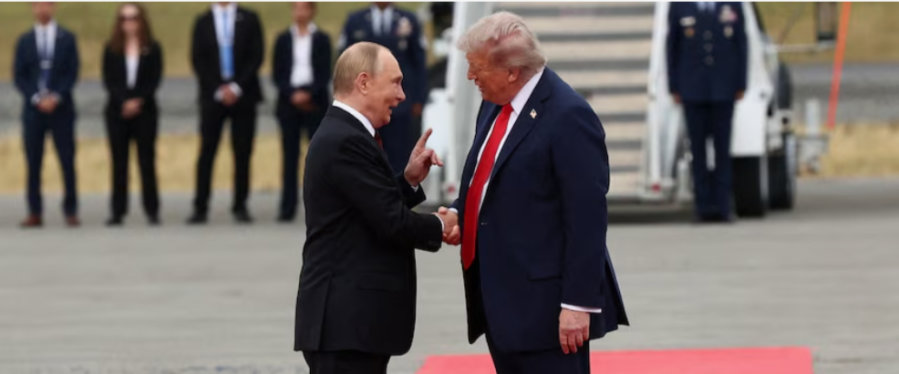
Consequences of the Alaska summit

Putin trump 2

Aug. 17 – Saturday was a day of reactions to the Alaska meeting, to the images it left behind, and to its implications, as the various actors tried to adapt to the new situation created by Donald Trump’s latest change of position, which was observed on Friday night and confirmed on Saturday in his call to European partners and his post on social media. 

Russia had arrived at the meeting in a position that was assumed to be vulnerable, especially after the United States’ apparent adoption of European postulates and red lines. Donald Trump adhered, at least judging by what has transpired from the meeting, to the idea of “nothing about Ukraine without Ukraine,” although not necessarily “nothing about Europe without Europe.” 

This is suggested by Vladimir Putin’s comment in his appearance alongside his U.S. counterpart, in which the Russian president referred to an “understanding” with the White House — and not an agreement, as several media outlets erroneously translated, causing significant confusion — and warned European countries against attempting to sabotage or manipulate the terms.

It’s not difficult to see in this statement a reminder of the Minsk process, in which both France and Germany protected Ukraine so it could afford not to comply with the terms it had signed. 

Despite this supposed understanding, the absence of questions at the press conference, the brief intervention of the U.S. president, and his lack of enthusiasm reflected what Trump confirmed in a subsequent interview with Sean Hannity, a sympathetic journalist who gave him the opportunity to present his message. 

According to Trump, an agreement with Russia is close, although there are some issues, especially one that the president did not specify, but that is easy to deduce — security — that have not yet been reached.

On the European continent, editorials and opinion pieces reflected disappointment in both the substance and the manner in which the Alaska summit was held. “Once again, Trump threatens but doesn’t deliver. When the opponent is stronger, of course. If they’re weaker, then he puffs out his chest and becomes a force to be reckoned with. 

“Just compare the more than deferential treatment of Putin at the Anchorage summit with the shameful and humiliating ambush he organized for Zelensky at the White House. Red carpet, flyover, applause and smiles, a shared seat in the presidential armored limousine, and not a single rebuke for the dictator, who faces an international arrest warrant for war crimes and who has once again rejected the essential ceasefire prior to balanced peace negotiations,” wrote Lluis Bassets in El País, an example of the tone taken yesterday by the European press, which focused only on the most negative aspects and failed to note, for example, that the planned lunch between the delegations didn’t take place or that Trump made it clear that there will be no economic agreements with Russia until a ceasefire is reached.

Throughout yesterday, analysts, leaders, and lobbyists tried to analyze every gesture and every word to reach the conclusion that neither the most negative scenario, that of the announcement of a firm agreement between two superpowers, nor the one desired by Kiev and its European allies, that of the application of the ultimatum to Russia, had occurred. However, positions softened over the hours toward much more pessimistic positions following Donald Trump’s post on his personal social media platform. 

“Everyone decided that the best way to end the terrible war between Russia and Ukraine is to directly reach a Peace Agreement, which would end the war, and not a simple Ceasefire Agreement, which often does not hold up. President Zelensky will come to Washington, D.C., to the Oval Office on Monday afternoon. If all goes well, we will schedule a meeting with President Putin. Potentially, millions of lives will be saved,” he wrote.

Root causes of the war

At the meeting, Russia failed to secure, if that was its objective, an agreement from the White House to accept its conditions for ending the war, but it may have achieved something more important, something that has greatly worried Kiev’s European allies. 

The nervousness caused by Vladimir Putin’s mention of the “root causes” of the war — a comment interpreted by media outlets such as the BBC as a rejection of Ukraine’s existence and a Russian desire to end the Ukrainian state, despite actually referring to NATO expansion and the policies implemented since the victory of Maidan — was compounded in the afternoon by information about the “complicated call” with European partners, who found themselves once again in the same situation as a week ago. 

Confident that last week’s collective conference call had made Trump understand the need for a ceasefire as a prerequisite for future negotiations, the Russian president was able to give his U.S. counterpart arguments to believe that a truce is not enough and a definitive agreement is necessary. What Trump may not understand is that this option, which would involve a binding document much more difficult to breach or manipulate, is the most detrimental for European countries, second only to a direct agreement between Russia and the United States. That option would mean, for continental capitals, the strategic defeat of the way they have approached war as a way to transform the European security structure to their advantage.

“We are clear that Ukraine must have unwavering security guarantees to effectively defend its sovereignty and territorial integrity. We welcome President Trump’s statement that the United States is ready to offer security guarantees. The Coalition of the Willing is ready to play an active role. No limitations should be imposed on Ukraine’s armed forces or its cooperation with third countries. Russia cannot veto Ukraine’s path to the EU and NATO,” stated the most relevant part of the European Commission’s statement, which, contrary to all realism, insists on Ukraine’s territorial integrity, a goal that has proven impossible, and on Ukraine’s Euro-Atlantic path, one of the root causes of the current war. 

Without the slightest ability to present a political path to end the war and with no proposals other than the eternal continuation of arms supplies to Ukraine until the final defeat of the Russian Federation, European countries persist in the same recipe that has failed for three years.

“After meeting with the Russian president, President Trump told European leaders that he now favors ceding unoccupied Ukrainian territory to Russia to end the fighting, a concession Ukraine has long opposed. This breaks with a strategy that Trump, his European allies, and Zelensky had agreed upon before the U.S.-Russia summit in Alaska,” the New York Times lamented yesterday. 

Without any certainty, the New York Times, like most of the Western press, assumes that Donald Trump has once again abandoned his pro-Ukrainian stance to adopt a pro-Russian one and has adopted Moscow’s postulates as his own — at least until Zelensky convinces him otherwise on Monday. 

As with the Ukrainian counterproposal, the same ideas have been repeated throughout this war, both at times when Ukraine was on the attack and when it was struggling to maintain its defense. 

There is nothing new in the Russian proposal. As already known from the leaks following the meeting with Witkoff, Russia proposes freezing the front in the Zaporozhye and Kherson regions, admitting that it will not capture all of these Ukrainian regions, returning the territories of Sumi and Kharkov, and demanding that Ukraine hand over the part of Donetsk currently under its control. As with Istanbul in 2022, Moscow is also demanding linguistic rights and religious freedom for the Ukrainian population whose language, culture, or religion is Russian, and the withdrawal from NATO membership, with the consolidation of neutrality.

The position of European countries, which, after the Witkoff meeting, believed they heard from the U.S. president that Russia was willing to withdraw from Kherson and Zaporozhye, but demanded to receive all of Donbass, is fraught with a curious paradox. 

Much less concerned about the fate of Donetsk, European capitals are willing to offer security guarantees to Ukraine, something Russia offered and Western countries denied in 2022, and demand a Russian withdrawal from those regions beyond Donbass. 

In other words, Brussels, London, Paris, and Berlin are demanding something very similar to what Moscow believed it had agreed with Ukraine in Istanbul in April 2022, before much of the death and destruction of the war had occurred — a proposal the European powers considered unacceptable at the time and which led to their commitment to war as the only possible path to resolving the conflict.

Translated by Melinda Butterfield

Source: Slavyangrad.es

Strugglelalucha256


List of ‘kidnapped’ Ukrainian children for sale? No, a regional database of Lugansk orphans

Fakebambini

Aug. 14 – In recent days, several Italian media outlets [as well as other Western media – SLL] have circulated a piece of news that quickly spread online: in the Lugansk People’s Republic (LPR), a “catalog” containing data on kidnapped Ukrainian children — allegedly destined for child trafficking — was said to have been published. 

The information was disseminated by Save Ukraine, an NGO founded in 2014 and described on its own website as being committed to “recovering kidnapped Ukrainian children.” Among its listed partners are USAID, the European Union, and the Austrian Ministry for European Affairs.

The story, relayed by various outlets without in-depth investigation, is not supported by concrete evidence: the articles do not cite any verifiable sources confirming Save Ukraine’s version. The accusations of “child trafficking” appear to fit into the context of intense political and propaganda confrontation between Kiev and Moscow, with Russia considering the LPR an integral part of its own territory following the 2022 referendum.

What Lugansk People’s Republic says


To clarify the nature of the document, we contacted Vladlena Shehovtsova, Deputy Minister of Education and Science of the LPR. In her reply, she firmly rejected any accusations of abductions:

“Children who have lost their family have the right to special protection and assistance from the state. This is guaranteed by the Convention on the Rights of the Child. These children must be guaranteed not only comfortable living conditions and quality education, but also the possibility of returning to a family. Parents, even if they are not the biological parents, can become a safe support, sharing their life experience and wisdom.

“To accelerate and optimize this process, a state database on children left without parental care has been created. Digitization is now being introduced in many sectors, including the work of guardianship and trusteeship bodies.”

According to the deputy minister, the creation of the database falls within the obligations set out by the UN Convention on the Rights of the Child and the Constitution of the Russian Federation, which assign the state the duty to guarantee protection and assistance to minors deprived of parental care.

The LPR Commissioner for Children’s Rights, Inna Shvenk, also commented on the situation:

“Work with foster families includes a set of activities aimed at supporting families that have taken in children left without parental care. This work provides psychological, pedagogical, social, and legal support, and is generally carried out in close cooperation with the competent state authorities. 

“Every guardian or foster parent is required to attend a ‘school for foster parents,’ undergo a medical examination, and prepare the set of documents required by federal legislation. In addition, efforts are made to establish contact between the potential guardian/foster parent and the child. 

If a positive relationship is established, the opinion of the child regarding their willingness to join a foster family is necessarily taken into account. In this way, the state acts exclusively in the best interests of the child.”

How the orphan database works

Shehovtsova explains that the platform is a regional database on children left without parental care, established “to help citizens who wish to take in a child in foster care or adopt them, and to create a single archive of reliable information quickly accessible to the competent authorities.”

Management is entrusted to the LPR’s Ministry of Education and Science, which acts as the regional operator of the register, in accordance with Russian federal law number 44-FZ of April 16, 2021.

Prospective adoptive parents or guardians must be adult Russian citizens and legally competent. Before placement, “a thorough check of the family’s moral, material, and physical level” is required, as well as completion of a specific training course.

Once the child is placed, “guardianship and care authorities carry out scheduled and unscheduled inspections at the place of residence to ensure that the child’s rights and interests are respected and that his or her property is safeguarded.”

What has been happening since 2014

Since 2014 [when Ukraine’s government launched its war on the people of Lugansk and Donetsk, backed by Washington], the deputy minister states, the LPR has promoted “numerous initiatives to place orphans and children deprived of parental care in new families,” significantly reducing “the number of minors housed in institutions” and fostering their upbringing “in family settings, with every opportunity for harmonious development.”

The case of the alleged “sale of children” shows how intense the informational conflict parallel to the military one has become. On one side, Ukraine and its Western allies accuse Moscow and the Russian authorities of deportations and illicit trafficking; on the other, the LPR and Russia reject the accusations, presenting initiatives like the orphan database as legal measures for child protection.

Presenting official LPR documents as “catalogs for the sale of children” without verifiable evidence means using disinformation as a political weapon to polarize public opinion and undermine the credibility of information itself.

Source: International Reporters

Strugglelalucha256


The Alaska summit and the crumbling proxy war in Ukraine

The carefully staged handshake between Donald Trump and Vladimir Putin on the tarmac of Joint Base Elmendorf-Richardson in Alaska on Aug. 15 wasn’t just a photo op. Big business media fixated on the summit’s brevity and lack of announcements – surface-level optics that obscured its real significance.

The handshake gave a clear message: the U.S.-NATO proxy war in Ukraine lies defeated.

When Trump landed in Anchorage, he said, “I want to see a ceasefire, I won’t be happy if it’s not today.” A ceasefire would give the U.S.-NATO proxy forces in Ukraine some relief, time to rearm and recover. 

For Trump, it was also one last chance to salvage his claim as “peacemaker-in-chief.” As Politico reported, Trump “urgently needed the meeting” and “urgently needed a tangible outcome” – a ceasefire.

Hollow threats: Sanctions boomeranged

Trump’s leverage going into the Alaska summit was the threat of secondary sanctions on top of the primary sanctions – penalties targeting third countries (like China, India, or others) that continued purchasing Russian oil. This was intended to cut off Russia’s oil revenue, its primary source of funding for the war.

But Trump’s threat was hollow. 

Three years of conflict, billions in weaponry, and a sanctions regime that boomeranged against U.S. interests. The push for secondary sanctions on India and China didn’t just fail; it drove New Delhi and Beijing closer to Moscow, knitting the Russia-China alliance ever tighter. 

What Russia has demanded is the demilitarization and denazification of Ukraine and the removal of NATO. That’s nonnegotiable.

Trump’s demand for an “immediate ceasefire” instead morphed overnight into calls for a “comprehensive peace agreement.” The pageantry of Zelensky’s Oval Office appearance on Aug. 18 is just preparation for the ending.

The deal

The deal reached in Alaska is imperialist realism stripped bare:

  • Ceasefire scrapped: Trump pivoted to an undefined peace
  • Sanctions shelved: Trump assured Fox News, “no need to think about that now.”
  • Proxy war buried: The summit signals the end of the U.S. promise to isolate Russia — a project that drenched Ukraine in blood but never toppled Moscow.

What emerged from Alaska was not peace. Ukraine becomes the pawn sacrificed so that Washington can reposition for a larger target: China.

Elbridge Colby, Trump’s Pentagon policy chief, has made clear that U.S. focus and resources must be overwhelmingly redirected towards China, not Ukraine or the proxy war against Russia. 

On Aug. 8, CNN reported that Colby had issued a memo that gave the Defense Department authorization to divert weapons and equipment intended to go to Ukraine. CNN concludes that the memo added uncertainty to “an already murky picture of the status of U.S. arms shipments to Ukraine ahead of President Donald Trump’s potential meeting with Russian President Vladimir Putin next week.”

Last month, Defense Secretary Pete Hegseth paused a large package of weapons shipments to Ukraine.

Hegseth has bluntly talked of the “stark strategic realities.” Hegseth’s own words are: “The U.S. is prioritizing deterring war with China in the Pacific, recognizing the reality of scarcity and making the resourcing tradeoffs.”

Repositioning, not peace

Imperialist strategy demands trade-offs, and Ukraine, bled white after billions in weapons and staggering human cost, is no longer considered a priority.

However, any peace agreement, if it comes, would still be irreconcilable with U.S. hegemony. Any truce, therefore, will be temporary at best, breakable the moment it no longer suits Washington.

The Alaska handshake signals not an end to U.S.-NATO warfare, but its redirection. The struggle against all imperialist war, and the system that necessitates it, remains the urgent task.

Strugglelalucha256


Proxy war in ruins: How U.S. and NATO led Ukraine to disaster

On Aug. 12, Russia’s Foreign Ministry reported that Foreign Minister Sergey Lavrov and U.S. Secretary of State Marco Rubio had discussed preparations for an Aug. 15 summit in Alaska between President Vladimir Putin and Donald Trump. Kremlin aide Yury Ushakov confirmed the meeting, saying the talks would center on a “long-term peaceful settlement” to the conflict, with a future round potentially taking place on Russian soil.

The tides of war in Ukraine have shifted decisively. Russia’s military is surging across eastern Ukraine, smashing through heavily fortified lines while the Ukrainian government teeters on the edge of collapse. These developments expose the inherent failure of U.S.-NATO proxy warfare.

Russia advances, Ukraine on the brink

The summer of 2025 has seen the most significant Russian military gains since the war began. In early August, Moscow’s forces captured the heavily fortified city of Chasov Yar in the Donetsk People’s Republic, after over a year of bitter fighting. This was followed by a breakthrough into the Dnipropetrovsk region, a key industrial and population hub that had been out of Russia’s reach for three years.

Russian forces, using overwhelming firepower — including over 1,300 FAB bombs in a single push — have breached Ukraine’s second Donbass defensive line. 

Even Western media are acknowledging the scale of the shift. The New York Times’ July 19 report on “Why Russia Is Gaining Ground in Ukraine,” says that Russia’s combination of troop numbers, air superiority, and artillery dominance has produced its largest monthly territorial gains since early 2025. Ukrainian brigades, some reduced to fewer than 100 soldiers covering miles of front, are crumbling under the pressure.

Political crisis in Kiev

The military collapse is being mirrored by political turmoil at home. Facing catastrophic casualties and a recruitment crisis, the Zelensky government has turned to coercive conscription — dragging men off the streets and raising the age barrier to pull in older recruits, some over 60 years old.

Protests are growing in Kiev, Odessa, Lviv, and Dnipro. Anger at corruption erupted in late July, with mass demonstrations demanding the reinstatement of anti-corruption agencies. In a surreal scene, Ukrainian lawmakers brawled in parliament before voting unanimously to restore the agencies they had recently disbanded.

The reality is stark: Zelensky’s government survives only through U.S. and NATO backing, and with that support now politically unstable in Washington and Europe, its legitimacy is rapidly eroding.

Washington’s desperation

The White House’s response has oscillated between erratic escalation and empty bravado. Instead of “peace in 24 hours” (as promised), President Trump’s administration has advanced new arms shipments, including $300 million worth of Patriot missile batteries. Not satisfied with merely fueling the bloodshed, Trump shortened his ultimatum to Putin from “50 days” to “10,” and provocatively deployed U.S. nuclear submarines off Russia’s coast.

Yet these gestures, born of imperial hubris and panic, are unlikely to reverse the battlefield realities. Russia’s advantage expands daily; Ukraine’s forces are outnumbered, outgunned, and exhausted. The only rational outcome — should Washington step back from the brink — is Russian victory and the collapse of the U.S. / NATO proxy project.

The proxy war’s failure

From the start, the Ukraine conflict was never just about Ukraine. It was a U.S.-NATO project aimed at weakening Russia and expanding imperialist control in Eastern Europe. Billions of dollars in weapons and economic aid were funneled into Kiev to advance the interests of imperialist finance capital.

Now, with the Ukrainian army collapsing and Russia on the offensive, the mask has slipped. The war has bled Ukraine white, devastated its economy, and turned its population into cannon fodder. The people of Ukraine have paid the price — while Western arms manufacturers and energy giants have reaped historic profits.

What comes next?

With Ukraine’s military near collapse and its government fracturing, the war’s trajectory is clear: Russia will prevail. The only question is whether the U.S. and NATO will recklessly escalate further, risking a global conflict, or accept that their proxy war has failed.

For now, the suffering continues — while Russia advances, Ukraine crumbles, and the U.S. scrambles for a way out.

Strugglelalucha256


DPRK troops defend Russia against U.S./NATO-backed fascist regime in Kiev

Tass 80482870

On April 28, the governments of Russia and the Democratic People’s Republic of Korea (DPRK or North Korea) confirmed the intervention of the North Korean military in Russia’s war with the NATO-backed fascist regime in Kiev. As part of the operation, several thousand DPRK special forces troopers assisted Russian efforts to retake Ukraine-occupied territory in the Russian state of Kursk. 

Russian President Vladimir Putin thanked “North Korean friends [who] acted in the spirit of solidarity, justice, and true camaraderie.” Putin further commented that the DPRK troops defended Russia as if it were their own homeland. The DPRK followed up with its own statements, not only confirming the deployment but providing some political perspective. 

Pyongyang framed the Ukrainian regime as “neo-Nazi” and described the North Korean military’s role in frustrating “an adventurous political and military attempt of the Western forces and the Ukrainian authorities” to change the momentum of the war. 

The Ukrainian offensive into Kursk began in August 2024. While claiming to be fighting a defensive war, Ukraine justified the incursion as creating leverage for peace talks. In reality, all the Ukrainian offensive accomplished was the sacrifice of life, destruction of expensive equipment, and to signal an escalation to Russia in an already bloody and dangerous war. Ukraine occupied between 100 and 400 square miles of Russian territory in Kursk until a successful Russian counter-attack in April 2025. 

Reports of Ukrainian abuses in Kursk

Russian citizens in Kursk have reported widespread abuses by Ukrainian forces, including the execution of unarmed prisoners, destruction of religious sites, and the shelling of residential areas. A resident of Sudzha told Russian war crime investigators, “Ukrainian armed forces tried to kill all of us, ordinary Russian people. I think this is just Nazism, genocide. I still can’t get it into my head. I’ll tell you honestly, I saw someone who came to kill. They came to exterminate the Russian people, just kill people.”

At the time the Ukrainian offensive began, U.S. corporate media noted that the incursion relied heavily upon Western tanks, artillery, and armored vehicles. The West continues to provide ample evidence that this war in Ukraine has been a U.S. imperialist provocation against Russia from the outset. 

As of April 26, Russian forces had retaken the vast majority of the occupied Kursk territory, including the strategic city of Sudzha. Soon after Putin’s announcement of North Korean support, footage was released showing Russian and North Korean soldiers embracing after liberating a village near the aforementioned Sudzha.

RU POV : The Russian Ministry of Defense has published footage of Russia soldier and North Korean soldier hugged each other after the liberation of a settlement near Sudzha.
byu/dmcsclgt inUkraineRussiaReport

The imagery of soldiers from the two countries struggling together against a NATO-backed white supremacist Ukraine rang similar to scenes of the Soviet liberation of Warsaw and Berlin towards the end of World War II. 

The United States and South Korea, of course, swiftly condemned the DPRK’s assistance to Russia as “a criminal act” and “inhumane and immoral.” The U.S. State Department even went as far as to say that the DPRK’s support for Russia is responsible for prolonging the war. This is the same State Department that,  by its own admission, has provided at least $66.5 billion in military assistance to Ukraine since 2022. The equipment provided with State Department funds included hundreds of artillery pieces, air defense systems and missiles, tanks, armored vehicles, small arms, and aircraft. 

It is laughable for the State Department to lecture North Korea on the alleged prolonging of the war when the war would never have happened without NATO provocation and U.S. military aid. The DPRK did not launch a fascist coup against a democratically elected government (that is, the U.S.-backed Maidan coup in Kiev in 2014). The DPRK did not relentlessly bomb the Donbass region for a decade. Ukraine and its NATO backers did that. 

The State Department’s moral superiority about the DPRK’s solidarity with Russia is particularly rich considering a March 29 report from the New York Times detailing the U.S. military involvement in Ukraine since the beginning of the war. The report essentially confirms the reality many have known for three years – the U.S. military has directed the war effort against Russia in Ukraine from the start. This war, often framed as Russia’s “invasion of Ukraine,” is in truth a NATO-U.S. campaign to weaken, isolate, and ultimately destroy the United Federation of Russia. 

Resistance against imperialism

North Korean participation in the defense of Kursk is not a collaboration of authoritarian governments, and it certainly isn’t responsible for the long and bloody conflict. However, the DPRK’s intervention in the war is a stunning demonstration of solidarity between the two countries. The collaboration between the two countries against imperialism and fascism reaches back 80 years to when the Soviet Red Army, in collaboration with the Korean People’s Revolutionary Army led by Kim Il Sung, liberated the Korean peninsula from imperial Japanese occupation. The two countries have maintained close diplomatic, cultural, military, and economic ties since.

As long as the United States and its allies insist on unleashing imperialist war across the world to create new markets and exploit more workers, there will be countries and people who stand up and resist. That is exactly what Russia and the DPRK are doing, and what the people of both countries have done since they defeated fascism and imperialism on their respective fronts of World War II. 


Strugglelalucha256


Victory Day: A war of narratives

2025 05 09 19 39 34

May 10 – “More than 25 million Soviet people died during World War II. Yet many Russian families still commemorate the Soviet victory over Nazi Germany on May 9,” Deutsche Welle wrote yesterday on social media, sharing one of its articles in what could be considered the strangest message on a day of contrasts, manipulation of reality, and widespread propaganda. 

The German outlet saw no need to explain why it considers it a contradiction that families in a former Soviet republic like Russia celebrate victory in a conflict that destroyed their country, caused millions of victims, and provoked a total mobilization against a war of annihilation in which Germany’s ambition was to hold territory, enslave the portion of the population needed to act as a slave working class, and expel or exterminate the rest.

The demonization of May 9 celebrations, an active policy in the European Union and Ukraine since 2014, despite the fact that those countries had participated in the commemorations in previous years, predates the Russian intervention [in Ukraine]  in 2022. But the effort to counteract Victory Day with Europe Day saw its clearest example yesterday of the political use of images and the attempt to keep open a political divide that Brussels hopes to maintain beyond the war. “War criminal Putler,” read a huge sign hanging in the museum in Narva, Estonia, so that it could be seen from the Russian side. 

Days earlier, Russia had placed several giant screens on its side of the river so that the Russian population of the Estonian city could watch the May 9 parade. To the chagrin of the authorities, hundreds of people gathered on the riverbank to watch the Victory Day concert broadcast from the Russian side.

From the celebration of the common victory—where a troop parade in Moscow was even seen, with the Ukrainian flag taking equal prominence with the Russian one—the event has shifted to proclaiming Russia’s failure in organizing the event by mocking the supposedly low-profile of those attending. However, the images that emerged yesterday from Moscow and Lviv, where Ukraine had counter-scheduled the Victory Parade with a tribute to itself attended by European Union leaders, told a very different story.

Without even bothering to show a minimally aesthetic photograph in a monumental city, [former Estonian Prime Minister and current EU representative] Kaja Kallas published her message of European unity in the form of a line of representatives from the member states and a wreath-laying ceremony in a cemetery littered with red and black flags, used today by the Right Sector and in the past by its ideological ancestors, the Organization of Ukrainian Nationalists (OUN) and the Ukrainian Insurgent Army (UPA). Meanwhile, in Moscow, Vladimir Putin appeared accompanied by Xi Jinping, leader of the world’s second-largest power, and surrounded by leaders from countries in Asia, Africa, Latin America, and Europe. 

This clear geopolitical message of a diversity currently lacking in European Union diplomacy, withdrawn inward and surrounded by the fanaticism of its representatives, was also sent by the Russian media. The presence of choirs from Indonesia, India, China, South Africa, Tanzania, and Zambia in the version of “Sacred War,” one of the anthems commemorating the Second World War, sends a similar message, one more in keeping with the existing multipolar world, in which the EU, the United States, and Canada continue to pretend they can mock other countries and leaders from the moral high ground.

Yesterday showed a Russia that has lost virtually all of its European allies, with the exception of Slovakia and Serbia, whose leaders defied Kaja Kallas’s order not to go to Moscow, but which maintains diplomatic appeal in the Global South. The relative success of the meeting—and not the failure predicted by people like [Ukrainian Interior Ministry advisor] Anton Gerashchenko, who camouflaged what were simply their wishes in their analysis—is what has sparked the wave of demonization of the event. 

“Creating a fatal problem for themselves—suffering massive losses—and then declaring themselves ‘victors.’ This is the usual and inescapable cycle of Russian history. In the mid-20th century, they supplied the Nazis with resources, helped them rebuild their army, colluded to divide Europe, and lost more than 20 million lives. Today they celebrate. And they have voluntarily taken the place of those same Nazis, now in the 21st century,” [Ukrainian politician] Mikhail Podolyak wrote yesterday. The deliberate distortion of history is blatant.

However, in a propaganda struggle, reality is less important than rhetoric, and the fact that media outlets and citizens continued to post messages on social media during the military parade is of little importance to those seeking only to impose a narrative. Suddenly, the country that has legally banned symbols of victory over fascism —millions of Ukrainians fought in the Red Army and partisan units whose monuments have been vandalized and demolished first by the far right and then by the state—and has exalted as heroes for the freedom of the homeland the small minority who fought side by side with Nazi Germany in groups like the OUN-UPA or the SS Galizien Division, has become the ultimate authority denouncing Russian revisionism. 

By banning symbols of victory and the army that caused the greatest number of casualties to the invading German army, Ukraine chose in 2015 to exclude itself from the celebration that had until then been a common one. Now, while many of the former Soviet republics participate in the May 9 celebrations in Moscow (whether with the presence of their political leaders, the parade of their troops, or both), Kiev demands recognition of the supposedly immense role that the Ukrainian nationalists played in the victory.

It does so by demonizing initiatives such as the Immortal Regiment, a parade to honor family members or friends who fought in the war, which has been exported to other countries and which Ukraine has sought to denounce as Russian interference or the propaganda use of a victory to which it apparently has no right. Ukraine celebrated Victory Day yesterday by arresting an elderly woman who came, carrying a portrait of her father, a war veteran, to pay tribute to those who gave their lives in the war. Unlike the handful of people who did the same in cities like Odessa, who carried only flowers and no flags or symbols, the detainee in Kiev was wearing a partisan cap from which she had not removed a banned symbol, the hammer and sickle, which since 2015 has been equivalent in Ukraine to the Nazi swastika.

In the same social media post, Mikhail Podolyak, an advisor to [Head of the Ukrainian President’s Office] Andriy Yermak, falsely claimed that Russia had disrupted communications across European Russia to prevent the thinly veiled attacks President Volodymyr Zelensky had threatened. Anton Gerashchenko, an advisor to the Interior Ministry under Arsen Avakov and one of the men who introduced Azov as a police battalion into the National Guard, echoed the same sentiment. “During the parade, there are snipers on every rooftop in Moscow. There have been jokes that Putin is using Xi Jinping as a kind of air defense, and that is why he was so anxious about Xi’s arrival,” he wrote on social media, deliberately confusing the protection of high-profile guests and the responsibility to take an obvious threat seriously with irrational fear. 

Xi Jinping’s visit was never in doubt, despite Ukraine’s obvious attempt to frighten potential parade guests by creating the impression that Russia would be unable to maintain security in the heart of its capital. Only Viktor Orban [president of NATO-member Hungary] and Ilham Aliyev [president of Azerbaijan] succumbed to fear and canceled their visits—a poor example of a threat that shouldn’t have gone unnoticed.

Several media outlets reported yesterday that Vladimir Putin had been accompanied by four Great Patriotic War veterans who are over 100 years old, a fact that serves as a reminder that the Second World War is gradually ceasing to be a living memory and becoming the memory held by generations who were not there to fight in it. The loss of these voices with the moral authority that comes with having participated in the events places a greater responsibility on those charged with safeguarding that memory, from the families who each year parade through Russian city centers with portraits of their parents, grandparents, or great-grandparents, to the historians and politicians, whose temptation to manipulate memory for political ends is evident. 

The struggle over discourse that took place yesterday, the European Union’s attempt to redefine May 9 as “Europe Day”—also changing the definition of Europe from a continent to a political bloc with the right to admission—and the demonization of the collective celebration of the victory over fascism were just another episode in the continental rupture, the Western attempt to maintain power and the narrative, and the prelude to a political and geopolitical confrontation that will continue no matter what happens in the coming months on the Ukrainian front.

Translated by Melinda Butterfield

Source: Slavyangrad.es

Strugglelalucha256


End the war in Ukraine, U.S./NATO out of Eastern Europe

It seems impossible to have a discussion with those who insist on calling for more billions for weapons, training, and mercenaries for Ukraine even after U.S./NATO wars have destroyed so many millions of lives. The cheerleaders for the U.S. war in Ukraine are as misguided and indoctrinated by the Biden regime as the dupes who believe that Trump will bring us peace. Biden’s minions, like Trump’s, stake their position on a mountain of lies, lack of information, wishful thinking, and hatred of the other while invoking high-sounding words like sovereignty, democracy, and freedom. Many cling to the ridiculous idea that Putin somehow controls Trump. This idea is a fairy tale invented by war profiteers to channel the justified hatred of Trump into support for war against Russia. In reality, both Biden and Trump want to subjugate Ukraine and Russia to U.S. capitalist control. They have different strategies to accomplish a common aim — to conquer the world for U.S. capitalist markets, labor, and resources. Trump will continue to arm Ukraine and work with the Nazi-led Ukrainian army, just as Biden did — if for no other reason than Chevron, Lockheed Martin, BlackRock, Amazon, and SpaceX demand it.

Military-Industrial-Banking Complex, enemy of all the people of the world, fully controls the White House and Congress

The first thing to admit is that both the Republican and Democratic parties have embraced the continuous buildup of the military budget, adding up to over $1.2 trillion, plus $952 billion in interest payments on a deficit that military spending caused. Not a word is spoken by the Democratic Party about this.

Secondly, we need to understand the real purpose of the military budget. On whose behalf do the president and Congress rule, regardless of administration? They rule on behalf of the major shareholders of the banks and war-profiteering firms that fund their campaigns. Whether by economic strangulation (so-called “sanctions”), invasions, coups, or bombardment, the foreign policy of the U.S. is aimed at enhancing the bloated profits of U.S. investment firms, banks, and conglomerates. Both parties pursue this mission regardless of the millions starved, maimed, or killed as a result.

There is not a single country in the world that has benefited politically, socially, or economically from a U.S. war, directly or by proxy. Certainly, the working class of the U.S. has no interest. In fact, militarism is destroying our lives.

Every year that the U.S. military budget has grown so has the power of the most reactionary sector of the capitalist ruling class. A large part of  the wealth amassed by the Nazi Elon Musk, Jeff Bezos, and JD Vance has come out of U.S. taxpayers’ pockets as subsidies and government contracts to the war-profiteering corporations in which Musk, Bezos, and Vance are invested, including SpaceX, Blue Origin, Amazon, Palantir, and Anduril. The austerity and repression of all civil, economic, and academic rights occurring under Trump is directly tied to the buildup of the U.S./NATO war budgets. In other words, Trump is a monster the Democratic Party helped to create.

Those who clamor for more NATO bases, more weapons, and ever younger Ukrainian conscripts have no right to decry the rise of right-wing governments in Europe, which are slashing social benefits and brutally repressing protest. This is what happens when war profiteers are allowed to raid government treasuries for ever higher profits.

History without lies: Zelensky and Biden plundered Ukraine, bombed and terrorized the Donbass

For years — especially since the U.S.-orchestrated coup in 2014 — foreign capitalists have plundered Ukraine of its public assets and impoverished its people. By 2020, Ukraine had become the poorest country in Europe, mainly due to the privatizations and cuts to public services dictated by the U.S.-controlled International Monetary Fund (IMF). It is no accident that the U.S.-sponsored buildup of openly Nazi forces like the Azov battalion coincided with the rapid decline in Ukrainians’ living standards. Austerity requires repression abroad and at home.

The looting of the economy and the vicious scapegoating and persecution of ethnic Russians and other minorities led the people of the Donbass and Crimea to rebel. In 2014, the Donetsk and Lugansk People’s Republics were formed as a defense against the dictatorship of the U.S.-backed Petro Poroshenko, the Ukrainian president who declared that “our children will go to school, to kindergartens – their children [in the Donbass] will sit in cellars.” Poroshenko made this speech as the Ukrainian National Guard was shelling apartment buildings in the Donbass with U.S.-made artillery. Since 2014, U.S. training, funds, and arms have enabled the Ukrainian military to kill tens of thousands of people who have resisted Kiev’s program of Nazism and austerity. Until this day, the Donbass has suffered most from the war, where battles still rage daily.

Like the eventual secession of the republics of the Donbass and Crimea, the special military operation declared by the Russian Federation in 2022 is also an act of self-defense. Few Americans fully appreciate that the people of the Soviet Union lost 27 million people in the fight to defeat the German Nazis and their collaborators, such as the Organization of Ukrainian Nationalists (OUN), whose members were supported by the CIA for decades after WWII. The more than 100,000 U.S.-armed and trained soldiers amassed at the border of the Donbass on February 23, 2022 were flying the flags and shouting the slogans of the OUN.  Imagine if open Nazis were approaching your border with tanks and rocket launchers.

Usbasesnearrussia 768x428

Dozens of military bases have encircled Russia in the last two decades despite a 1990 promise by the U.S. to cease the NATO buildup along Russia’s Western Border. Many of these bases are armed with nuclear weapons. Just this month, Poland’s right-wing president Andrzej Duda called on the U.S. to deploy nuclear warheads to Polish territory.

The 2015 Minsk agreement between Ukraine and Russia was worked out to cease hostilities and afford the Donbass republics some autonomy, but the U.S. and Ukraine tore it up. Ukrainian violations of the ceasefire skyrocketed in the days leading up to the February 24, 2022. In other words, Biden initiated the current war against Russia using Ukraine as a proxy.

Zelensky: Dictator and thief, servant to BlackRock

“We have already managed to attract attention and have cooperation with such giants of the international financial and investment world as Black Rock, J.P. Morgan and Goldman Sachs. Such American brands as Starlink or Westinghouse have already become part of our Ukrainian way. Your brilliant defense systems – such as HIMARS or Bradleys – are already uniting our history of freedom with your enterprises… everyone can become a big business by working with Ukraine.”

—Volodymyr Zelensky in a January 23, 2023 address to [U.S.] National Association of State Chambers [of Commerce]

Far from being a hero, the embezzler-in-chief Zelensky has facilitated the plunder and destruction of Ukraine while enriching himself by as much as $400 million, according to a report by Seymour Hersh. His government has canceled union contracts for 70% of the country’s workers, and he’s made it legal for companies to increase the work week from 40 to 60 hours. Civilians are routinely grabbed off the street for the army or are shot when they resist. Detention camps for political prisoners are now widespread throughout the territory under Kiev’s control. Press freedom has been crushed, and opposition parties are banned. The Zelensky government is now openly threatening to execute political prisoners like the Kononovich brothers, who are persecuted solely for opposing the U.S./NATO war.

While condemning thousands of Ukrainians to death on the frontlines, Zelensky has signed away Ukraine’s sovereignty to BlackRock. This U.S. investment company controls $10 trillion worth of the world’s resources and has controlling shares in most U.S. war-profiteering corporations. BlackRock is the same company that oversaw the corporate bailouts at the beginning of the COVID pandemic as millions died. They also got billions from the 2008 bank bailouts while millions of working people lost homes, jobs, and pensions.

BlackRock loots U.S. and NATO-member government treasuries to boost the profits of the weapons, fuel, logistics, and tech companies under its control. The bulk of the $100 billion in so-called U.S. ‘aid’ to Ukraine is dispersed to these companies through government contracts. As hundreds of thousands of Ukrainians and Russians have lost lives and limbs, profits have soared. Chevron, Lockheed Martin, Palantir, and SpaceX (which includes Musk’s Starlink) have also profited from the U.S./Israeli genocidal assault on Gaza.

Now that the billionaire owners of BlackRock have nearly exhausted Ukraine’s supply of soldiers, they want controlling shares of Ukraine itself: 50% “of all relevant Ukrainian Government-owned natural resource assets…and other infrastructure relevant to natural resource assets,” per the draft of Trump’s “minerals deal,” signed by the U.S. Treasury and Ministry of Economy of Ukraine.

It’s never been about Putin

The U.S. invasion of Iraq had nothing to do with Saddam Hussein. The U.S. invasion of Panama had nothing to do with Manuel Noriega. Just like Putin, Hussein, and Noriega were once U.S. allies. It was not until these countries declared that they would not allow the U.S. to dominate them economically and steal their resources that the U.S. turned and waged war against them. Putin was only judged to be “criminal” by the U.S. when his government resisted the takeover of Russian state oil and gas companies by foreign hedge funds. But, to mask their real aims, every imperialist war requires a bogeyman, even if it means the demonization of a once-faithful client.

As for their real aims, look to Libya whose people enjoyed the highest standard of living in Africa until their country was destroyed by U.S./NATO bombs. The same U.S./NATO cheerleaders that demonized the Pan-African leader Gaddafi and celebrated his lynching by U.S.-backed forces fail to mention that the Libya of today is a country torn apart by warlords, complete with open slave markets. Or look to Syria. The Biden administration never missed a chance to condemn Bashar al-Assad even as the U.S. imposed an economic blockade on Syria and occupied as much as a third of its territory in the oil-rich northeast. Now that Assad has been replaced with the ‘help’ of U.S. Special Forces, the government of Abu Mohammad al-Julani (aka Ahmed al-Sharaa) is mass executing its political opponents and selling off Syrian state property to foreign capitalists.

Democratic Party politicians cry about Putin’s ‘authoritarianism’ but give standing ovations to Benjamin Netanyahu as he carries out genocide in Palestine. They wine and dine Saudi monarchs while political dissidents in Saudi Arabia are punished with crucifixion. Supporters of the war in Ukraine decry the rule of “oligarchs” in Russia while five U.S. billionaires own more wealth than 170 million Americans, and the Nazi billionaire Elon Musk dictates U.S. policy. It’s worth remembering that before Musk was sieg-heiling at the presidential podium, he was getting billions in contracts with the Biden administration. We ought to deal with our oligarchs and let Russians deal with theirs.

All the hypocritical cries about Putin are cover for the capitalists who want Russia to be just like their neocolonies in Eastern Europe. With “their [Ukrainian] blood and our bullets,” as the war criminal Oliver North put it, U.S. capitalists want to use the Ukrainian military as a battering ram to achieve their conquest.

Trump may have reason to believe that he can more effectively carry out the imperialist takeover of Russia by bribery and extortion rather than open war. For one, Trump hopes that Putin can convince a sector of the Russian capitalists to sell out their country to Goldman Sachs. He is also trying to take advantage of Russia’s desire for peace to win them away from an alliance with China, the center of the imperialists’ crosshairs. We hope that, for the sake of all the people of Russia and China, Putin will not fall into this trap.

Destroying U.S. workers’ lives to attack China – Biden and Trump unite

While the call to tax billionaires is right, it means nothing if U.S. tax revenue continues to be sucked up by the war machine.

Through the investment banks, the war-profiteers have infiltrated of almost every sector of production in the U.S.. Their influence has spread like a cancer to every corner of economic and social life. To facilitate the continued looting of the treasury by the war-profiteers, governments cut non-military spending. To block resistance to the cuts, they destroy unions and progressive social organizations.

It’s not only that Musk and Trump are rotten to the core or that they pursue bad policies. They represent the historical outcome of capitalism as it has developed in the U.S. towards increasing militarism, austerity, and repression. Like any other capitalist government that turns toward fascism, the state relies increasingly on open white supremacy, gender oppression, anti-immigrant persecution, more police and prisons, and the destruction of all civil rights in order to keep profits flowing.

More than ever, it’s guns or butter, warfare or healthcare. That means that supporting the foreign policies of either capitalist party as they back war or sanctions against Russia, China, North Korea, Iran, etc., is tantamount to supporting cuts, repression, and poverty at home.

You cannot stand against the cuts to education and health care, national parks, the VA, postal service, and disaster relief while echoing the call for war in Ukraine and against Russia. The people of Russia can conduct their struggle where they are. Our struggle is here. We can start by demanding U.S./NATO out of Eastern Europe.

Source: Workers Voice

Strugglelalucha256


With two months left, Biden escalates NATO war on Russia

In a menacing shift of U.S. policy with less than two months left in office, President Joe Biden has authorized Ukraine to use U.S. long-range missiles for strikes deep within Russian territory, potentially engaging in a direct NATO war on Russia.

The authorization, reported on Nov. 17 by the New York Times, explicitly permits Ukraine to employ the Army Tactical Missile System (ATACMS) — a long-range missile designed for support of ground troop incursions — against both Russian forces and North Korean troops allegedly operating in Russia’s Kursk region.

Kim Jong Gyu, North Korea’s vice foreign minister, described the dispatch of Korean People’s Army forces to Russia as a “rumor.” U.S. Secretary of State Anthony Blinken, at a news conference with Defense Secretary Lloyd Austin, seemed to admit this when he said that “we’ve not seen” any North Korean troops in combat.”

So, while there are no North Korean troops active in combat in Russia, the Biden administration’s authorization for ATACMS missiles specifically says North Korean troops are a target, according to the New York Times.

The missile authorization also opens the door for U.S., British, and French long-range weapons to target Russian cities far from the front lines, including potentially Moscow itself. 

This development crosses what Russian President Vladimir Putin has explicitly labeled a “red line.” This can be taken as an act of war by NATO, not the Ukraine proxy army.

The Biden administration had delayed the authorization until after the presidential election, hoping a victory for Vice President Kamala Harris would provide a mandate for escalation. 

A recent White House meeting between Biden and Trump ostensibly focused on ensuring a “smooth transition” of power, including “cordial” discussions about Ukraine. National Security Advisor Jake Sullivan emphasized Biden’s intention to use his remaining 70 days to continue the proxy war against Russia. Biden promised to extend arms and other resources to the war effort.

On Nov. 8, just days after the defeat of Kamala Harris (the defeat was in part a refusal to vote for the Gaza siege and her pro-war message — “I will ensure America always has the strongest, most lethal fighting force in the world”), the Biden administration lifted a de facto ban on U.S. military contractors deploying to Ukraine to help the country’s military maintain and repair U.S.-provided weapons systems, particularly F16 fighter jets and Patriot air defense systems. This sets up a potential tripwire scenario should U.S. military contractors be casualties of Russian airstrikes, which could serve as a justification for significantly escalating U.S. military involvement in the war.

The Biden administration’s significant escalation occurs against the backdrop of the ongoing genocide in Gaza, intensified Israeli airstrikes on Lebanon and attacks on Iran, with growing talk in the U.S. media about the possibility of a “Third World War.”

Politico had declared this the World War III election. George Will wrote in the Washington Post that World War III is already underway. “Beginning Jan. 20, 2025, the next president will cope with today’s axis: China, Russia, Iran, and North Korea,” Will says.

Although Trump says he will end the Ukraine war quickly, he never says how. His is a “strongman” boast, not an anti-war message. In his first term in office, Trump’s administration laid the groundwork for escalating NATO intervention. In 2019, Trump became the first U.S. president to authorize large-scale shipments of lethal weapons to Ukraine, a move seen as integrating the country’s military into NATO, which eventually provoked Russia’s Special Military Operation against NATO expansion. 

In 2018, the Trump administration’s national security strategy marked a pivot for U.S. foreign policy. It emphasized “great power competition” over the previous focus on combating terrorism, explicitly identifying China and Russia as the central priority of U.S. national security efforts. Trump comes now not to end war but to expand the war efforts.


Strugglelalucha256


Behind Ukraine’s military incursion in southeast Russia

Kursk: A new grey area

Aug. 8 – For months, especially after the failure of the 2023 ground offensive, which prevented Ukraine from breaking through the Zaporozhye front in the direction of Crimea, Kiev has been looking for ways to extend the war to the territory of mainland Russia. 

The war is already actively present in the lives of the population of Donbass, which Kiev lost a decade ago, and which since the start of the Anti-Terrorist Operation in 2014 has looked to Moscow for security from Ukrainian aggression. 

Although not war, the conflict between the two countries has also marked the situation of the population of Crimea, protected from Ukrainian ground attacks, although not from drones or periodic missile attacks. 

Unable to resort to military means against the disloyal population, which since March 2014 has been overwhelmingly in favour of secession from Ukraine and joining Russia, Kiev has opted for collective punishment in the form of power cuts and in particular by blocking the Crimean-North Canal, the main source of water for the peninsula, destroying agriculture, one of the sources of employment and wealth in the area. 

Now, Kiev hopes to use more weapons and ammunition to show the people living in places like Sevastopol, Simferopol or Yalta the consequences of having rejected the coup d’état a decade ago and of having opted for Moscow at the time when the chaos in Kiev made separation possible.

However, the current situation is different from those attacks on people who identify themselves as Russian, who have obtained Russian citizenship, and who live in territories that have become part of the Russian Federation. Over time, and after months of pressure and lobbying, Ukraine has obtained explicit permission from the United States and other allies to use long-range weapons provided by the West against Russian military targets. 

At first, only border areas were mentioned, but the approach is increasingly ambiguous, and there are few Ukrainian actions that Washington is prepared to condemn. This week it has been seen that Kiev has carte blanche to extend the war, not only to Russian territory but to civilian villages without the slightest tactical, strategic, or logistical importance. 

And in addition to advancing on objectives that are important, especially the last gas pipeline that supplies gas to the European Union, Ukrainian actions openly seek to “make them feel what war is like.” Ukraine’s logic in dealing with civilians is one of revenge: It was Russia that started the war, therefore its population is as guilty as its government and must feel the consequences.

Months ago, President Volodymyr Zelensky had already prepared the ground for actions like those currently being carried out by Ukraine, claiming that “there are hardly any civilians” in the border area, which is blatantly false.

Shelling civilian areas

Much more is unknown than is known about the ongoing Ukrainian operations in Kursk, Russia, which have included shelling of civilian areas in Belgorod and attacks on Russian military bases, the latest in Lipetsk. Russian alternative channels, microbloggers as The Guardian has defined them to describe them as the best source for finding out the facts, remain highly critical of the actions of the Russian Ministry of Defense and the General Staff, accusing them of having been surprised by an action that should have been detected. 

These same sources confirm the Ukrainian advance on the areas through which it broke in on Aug. 6: that Ukraine is trying to avoid certain fortified areas, cut off the main supply route, and entrench itself in positions similar to those it usually uses in Donbass, that is, in residential buildings. 

And what is more, worrying for Russia is that Kiev’s troops are able, either by means of drones or by having gained access to security cameras on highways, as journalists such as Aleksandr Kots fear, to detect the movement of Russian troops. In the last few hours, Ukraine has been able to destroy a Russian armored column, causing losses of replaceable material and non-replaceable personnel. 

Russia has also demonstrated the destruction of a Ukrainian armored column, so the parties are accumulating losses in this fight that they will have to compensate for in the future.

“According to more reliable accounts from Russian military bloggers, the Ukrainian presence in a handful of villages was explained by the active use of reconnaissance groups in the Russian rear. Entering a village is not the same as controlling it,” wrote opposition journalist Leonid Ragozin, who summed up what is known about the situation perfectly, adding skeptically that “when the dust settles and the front line takes shape, the occupied area will be considerably smaller than the 350 square kilometers claimed by Agentsvo based on initial reports two days ago.” 

Regardless of the level of control, the reality is that Ukraine has managed to create a new grey zone of military operations in a place that Russia did not expect to have to defend.

Rybar, one of the most critical sources of Russia’s actions, published a video yesterday in which one could see the way in which Ukraine is fighting: Small mobile groups break into an area, one of them fixates the Russian troops and the rest advance in different directions, causing a problem and serious risk of being trapped for the Russian troops. 

This tactic is also harder to detect and cannot be destroyed with artillery as were the armored columns that were launched to the southern front to crash into the minefields and Russian artillery in Zaporozhye a year ago. 

Ukraine thus manages to bring the war to Russia in a way that it can repeat along the extensive Russian-Ukrainian and even Belarusian-Ukrainian border, causing casualties, losses and enormous nervousness among the Russian establishment. 

The fact that the Pyatnashka unit, formed in 2014 by Abkhaz as an international brigade of the first militia of the Donetsk People’s Republic (DPR), has been withdrawn from the Donbass front may indicate two aspects. 

On the one hand, its presence would not be necessary if Russia had sufficient strategic reserves. On the other hand, Pyatnashka’s experience in the Donbass war, which has similarities to the way Ukraine is acting at the moment, means sending into that battle a unit that has become strong precisely in a conflict in which large formations were conspicuous by their absence and lighter mobile groups were key to resolving complicated situations.

Ceasefire mirage 

The current situation, with attacks in Russia, new bombings of the Energodar nuclear power plant in Zaporozhye, and the emphasis on rearguard attacks, make it clear that the recent optimism about the possibility of starting negotiations and seeking a ceasefire was the mirage it always seemed. 

The operation in Kursk and the cross-border attacks also show the change that has taken place in the war since 2022, when, after the lightning attack with which Ukraine managed to recover its lost territories in Kharkov, Kiev did not continue to attack across the border, a natural extension of its offensive. 

At that time, Ukrainian troops did not have the approval of their creditors and suppliers to invade Russia, although this possibility was already on the table. For example, Andriy Biletsky dreamed of it. Now, although in a sparse way that is possibly due to electoral needs, Washington has given Ukraine the green light “to defend itself” in the way it sees fit.

In this case, this defense involves not only attacking military targets but also purely civilian villages, where Ukraine feels no responsibility for the population, whose importance for Kiev decreases as one advances from the Dnieper to the south and east, something that is perfectly felt by those who have been attacked in Donbass and now also in Kursk. 

“Russian military bloggers report that the regular army defending the Kursk region from the Ukrainian advance is being joined by local militias, i.e., men with hunting rifles. This, and not popular discontent and internal strife, is what the policy of bringing war to the Russian doorstep is most likely to produce,” Ragozin commented. Instead of the destabilization that Ukraine hopes to provoke, the journalist expects Kiev’s actions to be perceived as “an invasion by NATO, not by Ukraine.”

In Ukraine, born out of the “revolution of dignity” and the Maidan coup, defense is often carried out with the participation of units of questionable taste. The importance of the use of drones in this war has already become clear and this operation, whatever its real objectives, was not going to be an exception. 

In this case, the Nightingale battalion stands out in this task, a thinly veiled reference to Nachtigall, the Nazi unit led by Roman Shujevich during the German invasion of the Soviet Union in 1941. The battalion is led by Yehven Karas, one of the most radical leaders of the extreme right and whose associates have never hesitated to take justice into their own hands and kill for ideological reasons. 

Without any need to hide, Ukraine sends to Kursk, the scene of the first battle that stopped the ground advance of the Nazi killing machine, a unit whose name pays homage to those who collaborated with that regime.

Translated by Melinda Butterfield 

Source: Slavyangrad.es 

https://slavyangrad.es/2024/08/10/una-nueva-zona-gris/


Strugglelalucha256


Is Russia imperialist?

For socialists, the fundamental understanding of imperialism goes back to World War I and is found in V.I. Lenin’s pamphlet “Imperialism, the Highest Stage of Capitalism.”

Imperialism is not a policy chosen by one government and dropped by another. Imperialism is a system.

The first world war was the outcome of imperialism, Lenin wrote, an imperialist war waged for the political and economic exploitation of the world, export markets, sources of raw material, spheres of capital investment, etc. The imperialist powers raised huge armies and navies, not only to forcibly subjugate oppressed people in the colonies but to wage war against other imperialist countries competing for control.

According to Lenin, the world was already divided among the great capitalist powers when he wrote “Imperialism” in 1916. The war resulted from inter-imperialist competition to redivide the world.

The wars since WWI have changed circumstances. And World War II signaled a turning point in world imperialist relations. The United States emerged from WWII as the world’s most powerful imperialist country, gaining control of former European empires in Asia and Africa.

The overturn of the socialist Soviet Union in 1991 and the breakup of the Soviet republics into individual nation-states dismantled a planned economy, resulting in underdeveloped capitalist economies. Out of these ruins, an imperialist Russia has not suddenly, almost magically, appeared.

Lenin thought that imperialism had a few characteristics, including the rise of finance capital and the export of capital, not just commodities. The U.S., for example, exports not just commodities but capital — mostly in the form of loans or investments. U.S. banks are at the center of world commerce.

Russia’s economy is almost neocolonial

Today, capitalist Russia ranks 55th in GDP (PPP) per capita (a measure of a country’s economic output per person adjusted for the cost of living). Russia’s economy is almost neocolonial, heavily dependent on the export of raw materials like oil, natural gas, and metals. Russia is currently the world’s largest exporter of wheat and a major exporter of other grains like barley and corn. 

This is the classic economic relationship of a colony to imperialist finance capital. In the list of the top 50 banks in the world, not one is Russian. The ruble is not a currency of trade. Russia does not export capital.

During the Soviet period, Russia and the other republics that formed the Union of Soviet Socialist Republics made remarkable industrial progress. Indeed, between 1921 and 1988, there were no years of negative economic growth — no recessions — except for the World War II years.

The Soviet economy fell into recession only in 1989 as the Gorbachev government began to dismantle the planned economy.

Under Gorbachev and then even more drastically under the openly anti-communist, anti-socialist government of Boris Yeltsin in the Russian Federal Republic and in the new non-Russian former Soviet republics, including Ukraine, the socialist industry was dismantled.

Yeltsin finished the job of dismantling the Soviet economy that Gorbachev began. The years of Yeltsin are now remembered as perhaps the worst period in Russia’s 1,000-year history. This was the greatest economic disaster any country has seen in modern times, in war or peace.

Ukraine had the second-largest economy in the USSR. “Independent” Ukraine is now the poorest country in Europe. By the end of 2020, some 45% of the population was in the poor category, according to a study by the Ptukha Institute. 

Putin’s role

Putin, Yeltsin’s prime minister and chosen successor, took a more protectionist approach, unlike Yeltsin and Gorbachev, who had fawned on the West.

Does that mean Putin moved away from Yeltsin’s and Gorbachev’s policies, which had oriented the economy to exporting raw materials? Did Putin adopt a policy of industrialization?

Under Putin, there has been little growth in Russia’s manufacturing production that the “perestroika” reforms had demolished. Manufacturing is the foundation of any successful modern economy. Yet, under Putin, Russia continues mainly as an exporter of raw materials and grains. Manufacturing is a small part of Russia’s GDP.

Russia now accounts for about 6% of the global aluminum supply, 3.5% of the copper supply, and 4% of the cobalt supply. Russia is also the world’s largest crude oil producer and the second-largest dry natural gas producer after the U.S.

Russia is in the top 10 exporters of grain crops, including barley, corn, rye, oats and especially wheat. From 2017 to 2019, it was the biggest exporter of wheat, accounting for about 20% of the world market.

Russia is a capitalist state, but that does not make it imperialist. Not all capitalist countries are imperialist nations. For example, Indonesia is a capitalist country with an economy (Purchasing Power Parity — PPP) slightly larger than Russia’s, but is Indonesia an imperialist or exploited country? Saying that it is capitalist is not enough to know the answer.

Lenin named five characteristics of imperialism: concentration of production into monopoly; merging of bank capital with industrial capital, creating finance capital; export of capital as distinguished from the export of commodities; formation of international monopolist capitalist associations that share the world among themselves; and territorial division of the world among the biggest capitalist powers.

The role of finance capital and the export of capital may be most important. The World Bank and the International Monetary Fund have taken over the economies of the world. The dollar (not gold) is the currency of world trade. Today, almost every country is capitalist, and most of those are exploited by imperialism, by finance capital.

Indonesia is capitalist but not imperialist. Russia, too, is an exploited country in relation to imperialism, like Indonesia.

NATO targets Russia

Russia is the primary provider of gas and oil to much of Europe. The European Union imports 40% of its gas from Russia, putting Russia in competition with the U.S., the biggest producer of gas in the world. 

The U.S. has been on a drive to control the world market in oil and gas. This can be seen in its attacks, actual acts of war (sanctions) against Iran and Venezuela, as well as its war on Iraq. These are countries that had sought national sovereignty over oil and gas.

Russia, too, has been a target, especially its Nord Stream 2 pipeline, but not just for that. 

NATO is the U.S.-commanded military alliance established in 1949 as a military force aimed against the Soviet Union and the Eastern European socialist states. After the overturn of the Soviet Union, NATO was expanded to almost every country in Eastern Europe to lock in capitalist retrenchment in the formerly socialist countries. 

Look at a map of NATO’s expansion since the breakup of the USSR. The countries put under NATO include Estonia, Latvia, Lithuania, Poland, Czech Republic, Slovakia, Hungary, Slovenia, Croatia, Albania, Romania, Bulgaria, Montenegro, North Macedonia.

In 2008, NATO put the inclusion of Ukraine and Georgia, both bordering Russia, on the table.

The threatened expansion of NATO’s military force to Ukraine, on the border of Russia, along with NATO naval operations in the Black Sea, are direct provocations aimed at Russia. As Leon Panetta — White House Chief of Staff under Bill Clinton, CIA Director and Secretary of Defense under Barack Obama — explained, the conflict in Ukraine is a NATO “proxy war” against Russia.

NATO war on Yugoslavia

Despite the war propaganda that’s presented as news these days, the first war in Europe since World War II didn’t just start. That war was launched by the U.S. and NATO against Yugoslavia in 1999. 

For 78 days, from March 24 to June 10, 1999, U.S. and NATO bombers hit Belgrade, Pristina in Kosovo, Podgorica in Montenegro, and several other cities. On the first day, more than 20 buildings in Belgrade were leveled. 

Much of the U.S./NATO bombing hit civilian targets. A passenger train was bombed. Cruise missiles could be seen flying down the streets. The U.S. directly bombed the Embassy of the People’s Republic of China in Belgrade, killing three Chinese reporters.

Russia understood the lesson of Yugoslavia and told the U.S. and NATO “no” to expansion to Ukraine and Georgia on Russia’s borders – 5 minutes by missile to Moscow.

The former U.S. ambassador to Russia, William J. Burns, who is now director of the CIA, said in a February 2008 embassy cable that Ukraine joining NATO constituted a security threat for Russia. Burns noted that to push for this “could potentially split the country [Ukraine] in two, leading to violence or even, some claim, civil war, which would force Russia to decide whether to intervene.”

The U.S. never withdrew the proposal to include Ukraine.

Maidan coup

In Ukraine, the so-called Maidan coup in 2014 that was openly supported and financed by the U.S. put in a government that made NATO membership a policy mandate. 

The U.S. even picked the prime minister for the coup regime. 

In a leaked phone conversation from 2014, Victoria Nuland, then the Assistant Secretary of State for European and Eurasian Affairs at the U.S. Department of State, was heard discussing the political situation in Ukraine with the U.S. Ambassador to Ukraine, Geoffrey Pyatt. In the conversation, Nuland said, “Yats is the guy.” When Pyatt asked about the EU’s role, Nuland responded, “F**k the EU.”

Arseniy Yatsenyuk (Yats) became Prime Minister of the 2014 coup regime in Ukraine.

When Volodymyr Zelensky was made president in 2019, he repeatedly requested Ukraine’s entrance into NATO. On Feb. 19, 2022 — five days before Russia’s special military operation — at the Munich Security Conference, Zelensky demanded, once again, entry to NATO.

Many Ukrainians resisted the Maidan coup, particularly in the working class. In the Maidan civil war, fascist gangs emerged as a force for the coup. Resistance to the coup was strongest in the eastern section of the country. In Odessa, a neo-Nazi pro-Maidan gang targeted the Odessa House of Trade Unions, near the center of the resistance. The building was firebombed and at least 46 anti-fascists and labor activists were burned alive.

The resistance to the Maidan coup has continued from 2014 to today. The independent Donetsk People’s Republic and Lugansk People’s Republic were created when the people there voted overwhelmingly (89% and 96%) to secede from the Maidan regime. They have been subjected to continuous attack since then, particularly by the Ukrainian National Guard’s Azov regiment, a neo-Nazi stormtrooper-like operation. More than 14,000 were killed in Ukraine’s war on Donetsk and Lugansk before Russia’s special military operation to stop the neo-Nazi war on these independent republics.

As U.S. Ambassador Burns predicted, Russia was pushed into a corner by the unrelenting drive for NATO entry to Ukraine as well as the growing buildup of neo-Nazi militias and the war on Donetsk and Lugansk. Ukraine had promised in the Minsk agreements it signed in 2014 and 2015 that there would be a ceasefire, an end to all fighting, withdrawal of heavy weapons, the release of prisoners of war, and the recognition of self-government in Donetsk and Lugansk. Ukraine fulfilled none of these promises.

Putin may not be an anti-imperialist leader, but the Russian military operation to “demilitarize and denazify” Ukraine and recognize the Donetsk People’s Republic and the Lugansk People’s Republic is a move against imperialism, U.S. and NATO imperialism.

War and Lenin in the 21st century

Strugglelalucha256
https://www.struggle-la-lucha.org/nato/