Million Worker March leader talks with Teamsters: Roots of unity in the labor movement

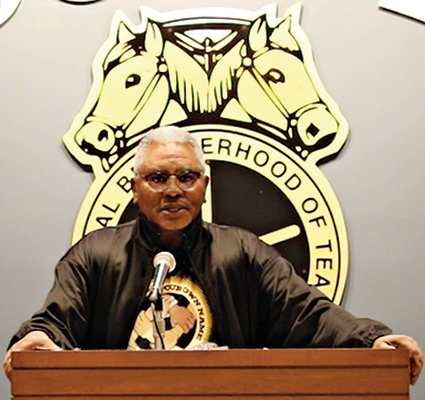
Clarence Thomas — labor organizer, retired member of International Longshore and Warehouse Union (ILWU) Local 10, leader of the Million Worker March Movement and author of the recently released “Mobilizing in our Own Name: Million Worker March” — spoke at Teamsters Joint Council 16 in New York City on May 14. Following are excerpts from his presentation.

Let me first say that I am glad to be here, on this part of a whirlwind book-signing tour. The Teamsters’ meeting is special and I’m going to get right into the reason why.

The Teamsters and Longshore Workers represent two of the strongest industrial unions in the nation, if not the world. We also share a radical rank-and-file militancy at the point of production.

Rise of industrial unionism

In May 1934, longshoremen on the West Coast and Teamsters in the Midwest took part in important struggles in the history of the U.S. labor movement: the 1934 Minneapolis Teamsters Strike and the West Coast Maritime Strike led by longshoremen in San Francisco.

Local leaders associated with the Communist League of America led the Minneapolis Teamsters Strike. The strike paved the way for the organization of over-the-road drivers and the Teamsters union.

Bloody Friday is the name of the event which occurred in Minneapolis, Minnesota, on July 20, 1934, when police shot at truck drivers who were flying pickets, injuring 67 picketers and killing strikers John Belor and Henry Ness. An investigation determined, “Police took direct aim at the pickets and fired to kill.”

When solidarity strikes protested the shooting, the governor declared martial law and deployed 4,000 troops. On July 24, over 100,000 people lined the streets of the route of the funeral procession for Henry Ness.

The strike was pivotal to Minneapolis’ strong union tradition and is seen as a critical moment for the Teamsters and the labor movement.

This outcome led to the enactment of legislation acknowledging the right of workers to organize.

July 5, 1934, marked a turning point in the West Coast waterfront strike. One of the demands was to end the shape-up, where each morning longshore workers would gather in front of the ferry landing in San Francisco to beg for jobs and to pay bribes to get a day’s work.

The union demanded the right to a worker-controlled hiring hall to end the shape-up and a six-hour workday so that work could be shared on the West Coast with their union brothers during the Great Depression.

On July 5, employers tried to open the San Francisco port with scab trucks escorted by the police at Pier 38. The police tear-gassed unarmed strikers. At least 100 strikers and their supporters were injured.

Howard Sperry, a longshoreman and a World War I veteran, and Nick Bordoise, a union cook and strike supporter, were both shot in the back and killed by plainclothes police officers outside the union headquarters. This date is known as Bloody Thursday. Teamsters had Bloody Friday; longshore workers had Bloody Thursday.

The following day, thousands of strikers’ families and sympathizers, including Teamsters, took part in a funeral procession down Market Street in San Francisco, stretching more than a mile and a half.

The city was paralyzed by a general strike. Six workers were shot or beaten to death on the West Coast by police or company goons during the strike, which lasted for 99 days.

These terrible events galvanized public support. Following Bloody Thursday, similar incidents up and down the coasts created a wave of rank-and-file unrest that conservative American Federation of Labor leaders were unable to stop.

This gives you some idea as to why our two respective unions are so strong. Brothers and sisters: this is our history and it is a hidden history.

The 1934 West Coast waterfront strike led by the Communist Party USA and Toledo Auto Workers strike led by the American Workers Party were catalysts for the rise of industrial unionism in the 1930s, much of which was organized by the Congress of Industrial Organizations.

International Workers’ Day

One of the things I want to talk about is International Workers’ Day — known as May Day — which the Million Worker March Movement pledged to reclaim.

As an African American, I know quite well what the enslavement of African Americans has meant to me, my family and many generations of African Americans who lived on these shores. We have been denied our names, our history, our culture, our traditions and our freedom.

Many people think May Day is a communist holiday. Yes, it is. It is an official holiday in socialist countries. But it started here in the U.S.

We don’t grow up understanding the importance of labor solidarity, or that whether a person is Black, white, Latino, trans or straight, we are all working people. If you are unemployed, you still are a worker. That’s a common bond.

The history of the labor movement is hidden because we didn’t learn how we got the eight-hour workday.

In 1886, workers in Chicago who manufactured the McCormick reapers were in the forefront of the struggle for the eight-hour workday. Children and women worked under inhuman conditions, while they and the men worked 12, 14, 16 hours a day.

Workers all over the world stood to attention when four men were framed up for throwing dynamite at the police department in 1886 and martyred by a kangaroo court.

There is a common thread that runs through labor history. That it is the role of police who represent the bosses, the state and the privileged.

We must understand that history — and the role of the police department. Whenever we have a picket, when there is a labor beef, and the police come out, they aren’t in solidarity with us. They come out on the side of the bosses. That’s their job.

There is a reason why the government and big business did not want the working class to celebrate May Day. They gave us Labor Day. That has no connection to our struggle.

The reason why the Teamsters are who they are is because of the militant history that we share.

Class interests – theirs and ours

We are working-class people whose interests are separate from those of the Democratic Party and the Republican Party. Their interests are not the same as ours and I can prove it.

Most people in this country would like to have national health care. Do we have it? No. Most working people in this country would like to have a living wage. A living wage today would really be calculated somewhere between $25 and $30 an hour.

The bosses want to make it appear as if there is something criminal about a worker making six figures, but they applaud the likes of Jeff Bezos and Bill Gates. They say the Teamsters and the Longshore Workers make too much money because they figure that we should be making the same wages as they pay people in Walmart.

The Democratic and Republican parties are funded in the interests of the rich. If they had their way, there wouldn’t be any unions.

We did not get the eight-hour work day, pensions and vacations because the bosses loved us. We got that because people fought and died for that. There’s nothing wrong with us standing up for our own class interests.

We don’t have a labor party in this country. They have them in other countries. Have you ever thought about why? Because they want us to believe that our interests are synonymous with the Republican and Democratic parties.

Let’s look at that. People in other countries don’t have to pay for their children to go to college, because they believe that a nation that does not invest in the youth doesn’t have a future. A country that really serves everybody would not be one with tremendous examples of income inequality.

Why do we have homelessness and poverty? We must be very clear as working people that we have our own class interest and that is what led to the Million Worker March.

To learn more about the formation of the MWM, read Clarence Thomas’ entire presentation online or listen to his speech, go to MillionWorkerMarch.com. Struggle-La Lucha will be publishing more from his book tour.

From transcription by Gloria Verdieu.

Strugglelalucha256


Clarence Thomas speaks in NYC – ‘Mobilizing in Our Own Name: Million Worker March’

This May, Clarence Thomas, a retired member of the International Longshore & Warehouse Union Local 10 in San Francisco, is touring the East Coast to broadcast his book’s claim: “It is the time to advance our own demands, and to proclaim a political agenda in our own vital interests.”

Thomas talked about the struggle that culminated in the Million Worker March (MWM) at the Lincoln Memorial in 2004 and about the struggles tackled by the MWM movement in the years that have followed.

All of this is covered in his anthology “Mobilizing in Our own Name.”

Thomas first spoke at the Al-Awda Conference on May 6.

On May 11 he spoke at The People’s Forum, joined by key organizers of the MWM: Brenda Stokely, Larry Holmes, Johnnie Stevens and Sharon Black. Gloria Verdieu, an editor of the book, started the panel discussion.

Thomas spoke at the Teamster Joint Council 16 in Flushing on May 14, invited by Local 808 Principal Officer and MWM organizer Chris Silvera.

His final meeting in the metropolitian area occured on May 21, led by the vice chair of Transport Worker Union Local 100; president of the Coalition of Black Trade Unionist New York chapter, and MWM organizer Charles Jenkins.

In between the meetings, Thomas spoke several times on WBAI and on a Zoom call celebrating Malcolm X’s birthday by People’s Organization for Progress in Newark, N.J.

Some of the urgent issues addressed in these forums have been organizing drives at Amazon, Starbucks and the labor fight against white supremacy after the murderous racist rampage in Buffalo, N.Y.

Find out more about the book at www.MillionWorkerMarch.com

Strugglelalucha256


Oakland teachers and dockworkers fight for their community


On April 29, thousands of teachers, students and parents from Schools and Labor Against Privatization (SLAP) rallied at Oscar Grant Plaza next to City Hall in Oakland, California, then marched to the Port of Oakland where they held a picket line that shut the port down.

The innovative joint labor action was an historic day in the campaign led by SLAP, union teachers of the Oakland Education Association (OEA) and International Longshore and Warehouse Union (ILWU) Local 10, against racist gentrification in Oakland.

Local 10 honored the picket line with a stop-work action in solidarity with the teachers and community to fight the privatization and destruction of the port and Oakland’s public school system engineered by billionaire John Fisher. 

Fisher is an heir to The Gap fortune, a real-estate developer and owner of the Oakland A’s baseball team. He also owns a charter school and acts as a national spokesperson for school privatization under the guise of charter schools. 

One-day strike

Oakland educators called a one-day unfair labor practice strike on April 29 after the Oakland Unified School District (OUSD) failed to follow its 2019 agreement with OEA to engage with families when considering closing schools. 

Despite widespread outcry from families, including legal action filed by the ACLU of Northern California on behalf of the Justice for Oakland Students Coalition, 11 schools are scheduled to close by the end of next year – three this year and eight the following year.

OUSD has a history of closing schools in predominantly Black and Brown communities. In the past 15 years, OUSD has closed 16 majority-Black schools, upending communities and pushing more than 18,000 Black students out of the district since 1996.

“Let’s be clear – educators don’t want to strike, but we are because OUSD has forced us to fight to protect the schools our Black and Brown students deserve,” said union President Keith Brown. “Rather than putting their resources towards unilaterally closing schools, OUSD should be acting as a respected governing body of learning and walking the walk to support the future of Oakland’s families.”

Watch a report of the day’s actions by Steve Zeltzer of the LaborVideo Project.

Widespread opposition

Preceding the one-day strike, trade unionists from OEA, ILWU Local 10, Service Employees Local 1021, and Steel Workers Local 5 held a joint press conference next to the Howard Terminal in the Port of Oakland to voice opposition to Fisher’s plan to privatize the terminal and build a new stadium, a sky-box hotel and 3,000 luxury condos. 

Other organizations engaged in building a united labor and community front against privatization in the Bay Area include ILWU Local 6, International Federation of Professional and Technical Engineers Local 21, University Professional & Technical Employees, and the All City Council student union.

Billionaire Fisher’s stadium privatization deal and a giveaway of $850 million in taxpayer money for the project is supported by Mayor Libby Schaaf, the Oakland City Council and the Alameda Labor Council, led by the conservative Alameda Building Trades.

Opposition to Fisher’s gentrification scheme won ground on March 16 when the Seaport Planning Advisory Committee, in a 5-4 vote, recommended that the 55-acre Howard Terminal property be used only for Port of Oakland activities, not as the site of a 35,000-seat ballpark surrounded by a planned village of 3,000 housing units, offices, retail, hotel rooms and parks. 

Angela Davis spoke at this year’s San Francisco May Day rally as an honorary member of ILWU Local 10. Davis denounced Fisher’s stadium gentrification as a project which would destroy the working Port of Oakland and part of the privatization of public areas. She joined the ILWU contingent at the head of the march.  

Zeltzer of the LaborVideo Project reports there were also solidarity greetings from the Japanese railway workers’ union Doro-Chiba, fired leaders of the Mineworkers Union Of Namibia Rössing branch, and Partido Obrera/Workers Party in Argentina.

Strugglelalucha256


Howard University Hospital nurses stage one-day strike

The District of Columbia Nurses Association staged a one-day strike to highlight the failure of Adventist Healthcare to sit down and bargain in good faith. Adventist Healthcare is the administration for Howard University Hospital. The day-long rally ran from 7:30 a.m. until 8 p.m. on April 11. The nurses that attended represented many different nationalities. For the morning rally over 200 participants were in attendance. 

Adventist Healthcare on several occasions has come to the bargaining table claiming that they had not seen any proposals. The union officials assert that all proposals were properly forwarded to the hospital administration. Just one day before the one-day strike was held, the hospital chief negotiator claimed at the start of the session that the union was attempting to back-date proposals for back pay that was owed to the nursing staff. He proclaimed the proposal was invalid and that the hospital couldn’t afford it. He told them that there was nothing to talk about and left the room.

Many issues have been raised by the union in this round of contract negotiations. Among them are patient ratios that make sure that nurses are not assigned more than a reasonable number of patients for care. Additionally, management has eliminated the differential pay for evening and weekend shifts which results in a cut in pay of several thousand dollars.  

Chants demanding safe staffing levels were heard continuously throughout the day along with chants demanding fair negotiations. The nurses on the picket line received tremendous support from the public as many drivers honked their horns in support. Just about every bus driver that drove by honked loudly to show support. Many people walking by stopped to listen and discuss the issues with the nurses.

Strugglelalucha256


Union victory for Amazon workers: A turning point for labor?

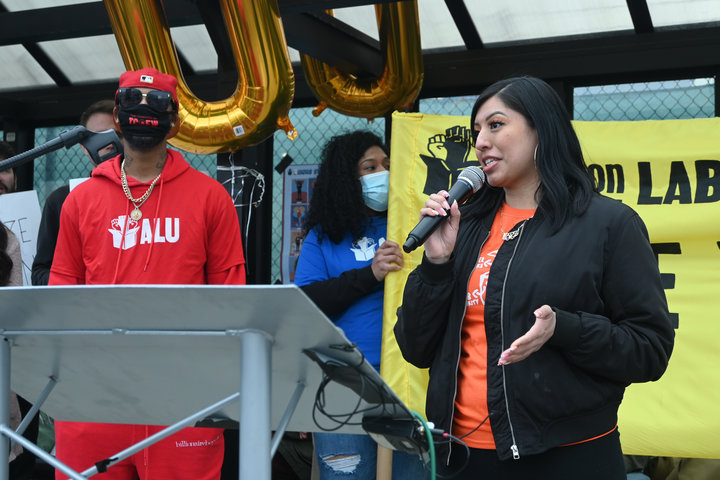
The first crack in the Amazon empire is officially opened! It came on April 1, when the Amazon Labor Union (ALU) won its election to represent the 8,000 warehouse workers at the JFK8 facility in Staten Island, New York.

We can’t help but think that bazillion-dollar boss Jeff Bezos – whose racist anti-union attorney had earlier declared in a leaked memo that Chris Smalls, the young Black rank-and-file leader of ALU, to be “not smart or articulate” – woke up with a giant headache that day.

On the other hand, news of the victory elated workers everywhere.

It has given confidence to workers in Amazon warehouses and facilities across the country. Chris Smalls, interim Amazon Labor Union president, has stated that the ALU has already heard from 50 warehouses interested in organizing.

In Maryland, warehouse workers who have been building a committee made plans to launch the Maryland Amazon Workers Union, based on the example of the ALU. The group has been distributing flyers to workers at bus stops.

Bessemer, Alabama

The outcome of the BAmazon vote in Bessemer, Alabama has yet to be decided. But what is clear is that there was a dramatic gain for the union in this second election for union representation.  

This time the difference is only 118 votes, 993 “against” to 875 “in favor.” And there are 416 contested ballots. While there is a slim chance that Retail, Wholesale and Department Store Union (RWDSU) will win representation, it’s not over yet.

Comparing Bessemer to Staten Island is like comparing apples and oranges. The Bessemer election took place in a “right to work” state (better known as a right to fire state).  

Just 30 minutes away from the Bessemer warehouse, the mine workers from Warrior Met Coal have been on a strike now going into its second year. The mine workers have been heroically holding out in a battle that symbolizes not just 900 miners fighting for justice, but workers everywhere fighting against billion-dollar bosses who do not want to let go of even a crumb of their overblown profits.

Some of the miners have taken jobs at the Amazon warehouse and this tends to strengthen union consciousness. But there is contradictory pressure also. The fact that these workers have been fighting for so long, under dire economic conditions, compounds the fear Amazon bosses have spread. 

In addition, the average wages in Alabama are far lower than Staten Island, which makes Amazon’s pay look attractive. 

But the pay does not mitigate the grueling conditions inside Amazon or the lack of power workers have without representation.

Some key lessons of Staten Island

Many of us who have been in the trenches looking for ways to organize will be evaluating what worked and what didn’t at the Staten Island warehouse.

One clear fact that stands out is that the initiative and organizing was built by the workers themselves inside the warehouse. 

Equally important is that the core organizers who took on this battle were representative of younger activists influenced by the Black Lives Matter movement. They spent time in the streets fighting police terror and other struggles against capitalism, including the development of mutual aid groups. Some of these workers consciously choose to take jobs at Amazon to help with organizing.

One thing that struck those of us from Baltimore who attended an ALU rally outside the Staten Island facility on March 20 was the care that ALU organizers had for fellow workers, similar to many grassroots community groups and assemblies.  

The Amazon Labor Union assisted and worried about workers faced with health and family crises, memorialized and marked the deaths of workers, and took on successfully fighting sexual harrassment in the adjoining LDJ5 warehouse. 

It is the example of this solidarity that is necessary to win struggles.

In terms of tactics, it is likely that there will not be a “one size fits all” solution to organizing Amazon. Workers will have to experiment – win, lose, or draw – and embrace each other in solidarity. It is the goal of building working-class power that must remain front and center.  

We are sure that debates and discussions will continue. Certainly what’s considered the “mainstream” union movement will be important in the coming battles. Its resources and especially the members that they represent are incredibly important.  

But it cannot and will not be the ultimate answer. The dynamic force of younger, more militant workers, who reject capitalism and worn-out models, and the engagement of the rank and file, will have to play the key role in reviving class struggle in this country.  

Will this mark a new stage of the labor movement?  

We believe it will. 

The pandemic has laid bare the deep and undeniable problems of capitalism. Bezos and his class of billionaire bosses and bankers have scored a windfall of profits on the backs of workers. These are the conditions that are propelling struggle.

We cannot forget that the Staten Island victory actually began with the walk-out of Amazon workers, led by Chris Smalls, against the callous disregard of the company for the health and well-being of workers during the early days of the COVID-19 pandemic. 

This stunning fightback proves that the huge multinational, multi-gendered, multi-generation, multi-abled working class is just beginning to be heard, both in the workplace and the community. Everyone’s task is to join in and strengthen this movement.

Sharon Black is a former Amazon worker and author of the pamphlet “Amazon Worker Tells All,” available free to download.

Strugglelalucha256


Minneapolis teachers and support professionals reach tentative agreements on 18th day of strike

Minneapolis, MN – Early on Friday, March 25, the striking Minneapolis teachers and education support professionals reached tentative agreements that will be voted on by union members. They have been on strike since Tuesday, March 8.

Over the almost three-week strike, the educators made major progress on several of their key demands. A big issue of the strike was improving the conditions of education support professionals (ESPs) who are largely oppressed nationality workers and make poverty wages. Details of the final agreement have not yet been announced but in the previous “last, best and final offer” from the school district they had already moved the district up by thousands of dollars a year for the ESPs to around $33,000 a year. The educators were holding the line for ESPs to reach a minimum of a $35,000 a year wage for ESPs at the bottom of the scale. While $35,000 a year is still far too low according to the union, it would represent a life changing increase for the ESPs at the bottom.

At the same time, the teachers had set 3% per year as a bottom line on across-the-board raises, with additional raises in the form of step increases. As of Monday, March 24, the school district was offering the teachers a package that would include 5% and 7% over a two-year contract with step increases factored in.

The educators also had demands for smaller class sizes with caps on maximum size, as well as increased mental health supports for students.

More details on the tentative agreement are expected in coming days with a vote by the members soon to follow. If the vote passes it will end the strike.

In the last week of the strike, community, student, parent and labor support actions had ticked up to a higher level of intensity. Notably, a group of Minneapolis students began an occupation of the Davis Center, where Minneapolis Public Schools office is located, and they were still present on Friday morning as the tentative agreement was announced. The occupation included a community meal served by the students in the building on Thursday night.

Community support activity for the educators’ strike was high throughout and included many actions, protests, support events and marches in support of the educators. Support for the educators ‘strike and their demands stayed high among community members and parents the whole way through.

The educators maintained strong picket lines throughout and over 95% of educators honored the strike for all 18 days. The educators appear stronger than ever before and ready to continue fighting for educators and students going forward.

Source: FightBack! News

Strugglelalucha256


Minneapolis teachers and education support specialists begin open-ended strike with no deal in sight

Minneapolis — Teachers and education support professionals in Minneapolis began striking at 7:30 a.m., March 8, with pickets held at public schools all over the city.

At Lyndale Community School in South Minneapolis spirits were high on the first day of the strike. MFT members said that 100% of the teachers at the school had signed in and were out on their picket line. The line marched back and forth around the two street sides of the school for about an hour before they began moving and the crowd of around 100 people marched over to Lyndale Avenue, a major street in the area. There they proceeded up and down both sides of Lyndale to the honks and pumped fists of passing cars as they chanted, “If our students don’t get it, shut it down!”

Similar scenes played out at schools all over Minneapolis from 7:30 a.m. to 10 a.m. Large crowds and serious but good moods were broadly reported from the picket lines.

At noon, a large unity rally marched to the Davis Center where the Minneapolis Public Schools (MPS) office is located. Around 7000 educators, students, parents and community members rallied for over an hour outside MPS to loud chants and speeches from educators and supporters.

At 4 p.m. a delegation of labor, community, and parent leaders marched on Superintendent Ed Graff’s office to deliver a demand that Minneapolis Public Schools settle the contract and meet the educators’ demands to give the students the safe and stable schools they deserve. Cherrene Horazuk is the president of AFSCME Local 3800 who represents clerical workers at the University of Minnesota. Horazuk said, “On Saturday more than 50 organizations sent a letter to Superintendent Ed Graff demanding that he negotiate but we got no response. Today we showed up in person but again we got no response, just like the educators and students have gotten no response from him. We let him know that we stand with the educators and the students and with their demands.”

At the same time as the Minneapolis educators began their strike, educators in Saint Paul across the Mississippi River from Minneapolis reached a contract settlement averting a strike and winning major gains on their key demands including getting class size caps reinstated, additional mental health supports for educators, demands around equity and inclusion, and wage increases.

Spirits were high among Saint Paul educators, who issued a call for their members and supporters to turn their support across the river to the Minneapolis fight. Sarah Vast is a parent of a student in Saint Paul and they said, “Saint Paul Public Schools found a way to meet the needs of their students and educators. It is time that Minneapolis Public Schools did the same.”

Picketing is expected to resume at 7:30 a.m. on Wednesday with unity events each day.

Source: FightBack! News

Strugglelalucha256


Railroad workers under attack

A common sign in sweatshops back in 1900 was “If you don’t come on Sunday, don’t come on Monday.” At the Sparrows Point steel mill outside Baltimore, employees worked 84 hours a week. Their only days off were Christmas and July 4th.

Fast forward to 2022. The Burlington Northern Santa Fe Railway is trying to impose a harsh new attendance policy. It could get workers fired for taking off just five holidays during their entire decades-long career.

Workers will be punished for being absent no matter what the reason. Every BNSF employee will be assigned 30 points. 

Except for vacation days, two points will be deducted for being absent on any day from Monday through Thursday. Three points will be taken away for taking off on a Sunday.

Workers will be fined four points if they don’t come in on Friday or Saturday. Federal holidays are the grand prize. Being sick those days will get a worker seven points.

Many days of overtime will be required to regain any points.

What makes this new policy all the more outrageous is that it’s being pushed through during the COVID-19 pandemic. Over 900,000 people have died of the virus in the United States.

Even the capitalist courts that railroad poor people to jail claim to consider people innocent until proven guilty. The BNSF will automatically penalize workers who “mark off” even if they or their children are ill. 

People get sick on holidays, too. Most transportation workers don’t have Monday through Friday work weeks. Neither do millions of workers in hospitals, restaurants and other 24-7 workplaces.

Railroad workers aren’t covered under Social Security. They get benefits from the Railroad Retirement Board instead and have to work 30 years to get the maximum. Some work 40 years or more.

BNSF executives want to be able to fire workers anytime during their careers, even for those with a 25-year good work record. Their new attendance policy will allow them to do it.

Under collective bargaining, such a drastic change in attendance policy is supposed to be subject to negotiation – not just imposed by management.

A union grievance – which on railroads is called a time card – would describe it as being “arbitrary and capricious.” Those words describe BNSF’s dictator-like change of policy.

Federal Judge Mark Pittman, who was appointed by Trump, ruled that unions can’t strike over this issue. That’s also an act of a dictator.

Job cuts = death

BNSF is one of six giant railroad outfits in the United States and Canada. It operates more than 32,000 miles of track in 28 western and midwestern states as well as British Columbia and Manitoba in Canada.  

Yet there are only 35,000 workers that make the system’s trains go from Chicago and Texas to California and the Pacific Northwest. The number of U.S. railroad workers has fallen from 1.5 million in 1947 to just 145,000 today.

That’s a 90% cut in employment. And it’s why billionaire Warren Buffett invested in BNSF, as he told Bloomberg Businessweek magazine in a 2010 interview. The money bags smelled profits from railroads killing over a million jobs.  

BNSF is now a subsidiary of Buffett’s Berkshire Hathaway financial empire. With his $114 billion fortune, Buffett doesn’t have to worry about calling in sick.

What does it mean when nearly 1.4 million railroad jobs are destroyed? Hundreds of thousands of Asian, Black, Indigenous and Latinx men and all women were denied a chance to get jobs from which they were excluded. Charles Hamilton Houston, who mentored U.S. Supreme Court Justice Thurgood Marshall, fought court battles against apartheid hiring by railroads.

Hamlet, North Carolina, was an important center of the old Seaboard Railroad. It still has a yard for CSX Transportation, which like BNSF is the result of mergers. Hiring opportunities are slim because of massive job elimination. 

Instead of getting railroad jobs, local workers got low-paying jobs at Emmett J. Rowe’s chicken plant. Twenty-five workers were murdered there on Sept. 3, 1991, because of an avoidable fire and locked doors.

Rowe locked the doors because he thought workers, many of whom were Black, would steal chickens. White and Black workers were killed by Rowe’s racism. Eighteen women died. Forty-nine children were orphaned.

Dozens of other railroad towns were devastated. They included Paducah, Kentucky, where the Illinois Central shops were closed, and Livingston, Montana, home to the former Northern Pacific shops.

Thousands of railroad jobs were lost in the New York City area. Among them were workers on the many ferries that used to carry freight cars from Hudson County, New Jersey, to terminals on the west side of Manhattan. 

The elimination of these ferries and docks forced more trucks into New York City streets. It allowed luxury housing to be built at Battery Park City on Manhattan’s waterfront. Donald Trump sold condos at Riverside South on top of the former 60th Street yards.

Reparations not strikebreaking 

These massive job losses don’t mean railroads are going out of business. In 2018, U.S. railroads carried 13.6 million carloads of freight. Trains carrying shipping containers from seaports are a vital part of the global supply chain.

BNSF isn’t going broke either. In 2019 it collected $5.5 billion in net income, another term for profit. 

So why are BNSF and the rest of the railroads increasing their attacks on workers? They want to go back to the days of the 19th century railroad tycoon Jay Gould, who bragged he could hire one-half of the working class to shoot the other half.

Today’s railroad kings want to reduce railroad crews to just one person. Having a one-person crew resulted in the 2013 Lac-Mégantic, Quebec, train wreck in which 47 people were killed.

Instead of attacking workers, BNSF should be paying reparations. 

The U.S. Army massacred Indigenous people on behalf of western railroads. General Custer died for the Northern Pacific Railroad, which was one of the rail lines that became the Burlington Northern Santa Fe.  

Nine thousand miles of track were built by enslaved Africans in the South before the Civil War. Thousands more miles were built afterwards by imprisoned Black people being used as slave labor.

Among them was John Henry, the “steel-driving man” who was worked to death building the Chesapeake and Ohio Railway, which is now part of CSX.

Railroad monopolies think they can steamroller workers. The 1926 Railroad Labor Act makes it difficult for workers to fight back. 

Today’s Congress can’t pass a bill to protect voting rights. But in 1991 it broke the last coast-to-coast strike within 24 hours.

An Amtrak yardmaster told this writer that when he worked for the Norfolk Southern Railway, a trainmaster demanded that he do stretch exercises. It was like the worker was still in kindergarten.

The arrogance displayed by the trainmasters is despised by workers. Union members are demonstrating with their families against the BNSF anti-family policy. Railroad workers will fight back.

The writer is a retired Amtrak worker.

Strugglelalucha256


Time to organize for workers’ power: Amazon workers have a right to a union

https://www.facebook.com/watch?v=257582599797762

Workers at Amazon are fed up! And they’re speaking out!
Source: What Up Baltimore

The recent National Labor Relations Board (NLRB) nationwide settlement that forces Amazon to notify workers of their rights to organize for union representation is a victory for Amazon workers and all workers.  

This decision orders Amazon to email approximately 750,000 workers describing their specific rights to organize for a union. In addition, according to the settlement, Amazon is not to threaten workers with discipline or call the police when they engage in union activity.

The company must also post the notice in prominent places in its fulfillment centers, sortation centers and delivery stations. Amazon must publish information on the news alert page of its “A to Z” app for workers and on its website.

You can read the entire agreement here.  

The credit for this decision squarely rests on the shoulders of the courageous workers from Chicago, Staten Island, New York, and Bessemer, Alabama. They not only filed charges but expressed themselves through work actions and protests.

Can workers use this moment to push forward to organize?  

A former Amazon worker, Steven Ceci, stated: “This could be an important moment. The present labor shortage, due not just to the so-called ‘big resignation’ but to the omicron crisis – together with this NLRB decision – can ignite the movement for union rights and workers’ power.”

Baltimore Amazon workers press forward

Inspired by Bessemer, Staten Island and Chicago Amazon warehouse workers, Baltimore workers spoke out at a Jan. 4 rally and press conference to support Amazon workers and demand that trillionaire boss Jeff Bezos keep his “hands off workers’ right to unionize.” 

Baltimore Amazon workers recounted unsafe conditions in the warehouse, unresponsive management, poor and unpaid wages, and the need for a union. The Unemployed Workers Union, Peoples Power Assembly and Seniors United vowed community support for their organizing efforts.

Warehouse workers shared this most recent message from Amazon management that cut paid time for COVID illness in half: “After reviewing the newly released guidance from the CDC, we are updating Amazon’s COVID-19 isolation and quarantine policy to one week (seven calendar days) from when you took the test, with up to 40 hours paid leave.”

From Walmart to Amazon, workers have seen sick pay cut as their billionaire bosses jump on the recent Centers for Disease Control (CDC) “miss-guidelines” that force COVID-infected workers back to work after just five days – a move that jeopardizes the health of workers and threatens community safety.

Andre Powell, a PPA organizer, described how a relative who works at Amazon is seriously ill with COVID and cannot work, and may end up fired and without money to support their children.

While some workers may recover quickly, many do not. Therefore, the community rally demanded that all workers have a right to full sick pay for the entire duration of the illness, regardless of time; no reprisals or firings for lost time; and COVID testing on the job, including negative tests to return to work.

The writer is a former Baltimore warehouse worker (BWI2) and author of the pamphlet Amazon Worker Tells All, which can be downloaded free at Struggle-La-Lucha.org.

Strugglelalucha256


It’s awfully convenient for shippers that longshore workers get blamed for delays, as contract fight looms

If you ordered a teddy bear or a designer picture frame as a holiday gift, you know that it likely took a lot longer to get here than in past years.

There have been problems getting things from point A to point B since the pandemic started. At one point in October, 77 percent of the world’s ports were experiencing long delays.

More than most Americans, Longshore Union (ILWU) members grasp what supply chain problems are and how they come about. Many come from multigenerational families of port workers who understand both their militant union’s storied history and its role in the global economy today.

ILWU members handle the containers that go into and out of the United States through nine West Coast ports. Containers are big metal boxes of standard sizes whose use since the 1950s has made transporting products by ship, rail, and truck much cheaper and faster.

For example, the ports of Los Angeles and Long Beach moved the equivalent of 10 million 20-foot containers in the first half of 2021 — a record high. The two side-by-side ports handle about 31 percent of all seaborne consumer goods and commodities entering the U.S., largely from Asia. Together they are the ninth-biggest port in the world, in part because they are among the few able to welcome newer, much larger ships.

But despite the increased volume processed this year, it hasn’t been enough to handle the consumer demand for more products. At one point in November, upwards of 80 ships were waiting to unload outside the two ports, as the “just-in-time” system crumbled under the weight of its own contradictions.

How it happened

China locked down manufacturing in early 2020, so shippers shut down their vessels for months. Then a surge in demand in the U.S.—also largely due to the pandemic—increased the quantity of goods demanded from Asia, changed the nature of those goods, and accelerated the shift to direct-to-consumer online purchasing.

“The supply chain’s predictive analytics were deeply flawed and unable to deal with a pandemic. For example, no one expected [so many] home office purchases,” said Dane Jones, Clerks’ Technology Coordinator for the ILWU’s Longshore Division.

By 2021, because of the enormous demand and the limited supply of ships, the price to ship goods across the ocean had skyrocketed. Another contributing factor: over the past decade the eight largest carrier companies had organized themselves into a cartel, which by 2018 controlled 80 percent of container shipping.

The cost of sending freight from Asia to the U.S. increased tenfold this past summer, and the freight carriers made out like bandits. Maersk, the largest shipping company, had its most profitable quarter in its century-long history: in the third quarter of 2021 alone its operating profits reached $5.9 billion.

The elevated shipping costs even affected U.S. agricultural exports. Whereas before, ocean carriers would take on American agricultural products to partially defray the costs of sending back empty containers to Asia, now they wanted to get those containers back as soon as possible. Containers were in short supply.

Also in short supply were truck drivers, truck chassis, warehouse space, and other links in the supply chain.

“There’s no excess capacity,” said Jones. “We have a logistics supply chain that was designed to give you exactly what you want, exactly when you want it”: just in time.

The supply chain problems we’re all experiencing now are “the fault squarely of bosses and politicians, and over a long period of time,” said Zack Pattin, a longshore worker with ILWU Local 23.

From deregulating the trucking industry in 1980 to allowing a powerful shipping cartel to emerge even after the financial crisis, the ones who created this situation were those who stood to gain financially, ideologically, and politically from just-in-time production—not factory workers, port workers, truckers, or warehouse workers.

2022 contract fight

Nonetheless, when the supply chain started to break down, frontline workers got blamed.

ILWU members say the port terminal operators are drawing attention to the delays to cast longshore workers in a bad light ahead of contract negotiations next year.

“The foreign-flag steamship lines are going to exert all of the leverage that they can towards American workers to get the absolute best deal that they can in the upcoming negotiations,” said Seattle longshore worker Justin Hirsch, “and if that means going to sympathetic ears in the press to throw mud at us, they’ll do it with absolutely no hesitations.”

One central issue is the employers’ drive to replace workers with bots.

“L.A./Long Beach is a major battleground for automation,” said Local 23 member Brian Skiffington. At four automated terminals there, “instead of five or more trucks per gang, there are cab-less robot trucks and a single supervisor—a massive elimination of labor.”

Terminal operators—which are often partly or wholly owned by ocean carriers—want such practices extended across the West Coast ports. They lease the ports from the public entities that own them, usually cities or counties.

But a fight over automation in the 2022 contract doesn’t tell the whole story of the long-term challenges ILWU members face, said Peter Olney, retired organizing director at the union. The ILWU’s historical militancy has created a bastion of good union jobs at the ports, but the deregulation of trucking and the emergence of non-union warehouse work threaten those conditions. As a result, ILWU might end up on an island.

A new ‘March Inland’?

Conditions for port truck drivers deteriorated after the Carter administration’s 1980 Motor Carrier Act led to the de-unionization of their industry. Now they represent a largely unorganized and misclassified workforce, ripe for exploitation by the bosses—and to be turned against longshore workers.

Port truck drivers provide fodder for anti-union propaganda, such as the right-wing Washington Examiner’s stream of recent pieces with titles like “Lazy crane operators making $250,000 a year exacerbating port crisis, truckers say,” which cites the boss’s skewed salary stats and six unnamed truckers.

“Our employers have P.R. people and this happens every time we have a contract [coming up],” Skiffington said.

The challenges that truckers and warehouse workers face are real. For example, drivers get paid by the load, so waiting hours or days for their truck to get loaded or unloaded can cost them a pretty penny.

What’s needed, Olney said, is another “March Inland” — the campaign in the 1930s when the ILWU organized workers in warehouses to make sure they could not be used to undermine longshore standards or supply scabs.

That, however, comes with its own set of challenges. Longshore work today is very different from warehouse and trucking work. It’s highly capital-intensive, says researcher Katy Fox-Hodess, whereas warehouse and trucking are labor-intensive. “There’s a reason that port crane operators have such high wages—they’re operating some of the biggest, most expensive equipment,” she said.

Whether or not ILWU—by itself or in partnership with other unions—will be able to organize the port logistics industry remains to be seen. But Pattin is undeterred by the challenges.

“The waterfront attracts people from every walk of the life you could imagine,” he said. “And the union brings them together, people you’d never see call each other ‘sister’ and ‘brother’ anywhere else.”

Source: Labor Notes

Strugglelalucha256
https://www.struggle-la-lucha.org/labor/page/9/