Starbucks Worker Solidarity Day of Action

SLL photo

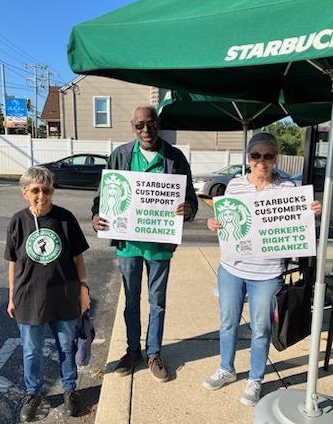
Although over 350 Starbucks Coffee stores around the country have voted to unionize, the company’s CEO and management have failed to come to the negotiating table to discuss workers’ concerns. Starbucks Workers United called for support actions on Sept. 14 for the morning rush hour.

Pictured here is the customer support action team at the Perry Hall, Maryland, store. Support team members collected 80% of the requested signatures during the hour-long petitioning effort. Team members were able to talk to customers as they waited in the drive-thru line, which continuously wrapped around the building the entire hour. There were only 7 workers staffing not only the drive-thru line but also the walk-in customers. 


Strugglelalucha256


When the auto workers went on strike in 1970: Revolutionary implications of the GM strike

The last major auto strike in the U.S. started on September 15, 1970, when 400,000 workers at 145 factories walked off the job at GM — then the largest corporation in the world — for 67 days.

First published September 30, 1970. 

When a few dozen workers in a sweatshop first take fate in their hands and embark upon a strike, they have to go through a revolution in their own spirits; they have to take a chance on losing their livelihood altogether, especially if there has been no union in their shop before, and if they do not succeed in getting recognition from their boss.

That is why it is so hard to organize the workers even on the elemental level of joining together to prevent the heel of capital from grinding them down altogether, much less organizing to overthrow imperialism and establish socialism.

When workers lose even one hour’s wages, it is often too much of a sacrifice. Those who are eternally in debt, eternally paying for the washing machine, the furniture, or the family automobile, hesitate to take off a day when they are really quite ill; how do they feel when they must face a strike of weeks and possibly several months’ duration? Even when the worker is fully convinced of the necessity of a strike, his or her family is not necessarily convinced equally. And not many workers are equipped to answer the natural conservatism of the family that requires to be fed.

Then there are the workers who do not want to go on strike and must be prevailed upon to do it. They must be convinced and life being what it is under capitalism, sometimes they must be convinced in a rather summary way.

This process is repeated every day somewhere in American industry among the garment shops, novelty and toy producers, plastics factories, in the hospitals where more than a million “non-professionals” are hideously exploited both as to wages and conditions of work, in laundries, dry cleaning centers, many small parts producers; the list is endless.

But in the great scientifically organized aggregations of capital ― basic steel, auto, rubber, basic chemicals, big electronic and electrical companies, trucking, and other transportation―the workers have been unionized for over a generation. They have some of the same problems of the sweatshop worker, but they now have more power and, therefore, more confidence.

Rupture of the status quo

Their strikes resemble the others in this respect: Every strike, large or small, is potentially a revolutionary action. It is a rupture of the status quo in a way more profound than the actions of the most courageous and daring students against the police and the other instruments of imperialist oppression.

Whether the strike be in a sweatshop paying less than the general minimum of $1.60 per hour or in a huge industrial plant like General Motors, where the workers make $3.50 or more an hour and often make $200 a week by working long days and/or coming in Saturday and Sunday, it means a sacrifice for the workers and their families.

[Note: Using the Bureau of Labor Statistics “inflation calculator,” these September 1970 figures are roughly equivalent to the following August 2023 wages: You would need at least $12.53 per hour to match the buying power of the 1970 minimum wage of $1.60. And at least $27.41 an hour would be needed to match the $3.50 hourly wage for unionized auto workers. Yet the federal minimum wage today is only $7.25 per hour, and thousands of UAW workers in lower pay tiers at the Big Three automakers are making less than $27 per hour. This shows how much our class has been thrown back in the last 53 years. ― S.M.]   

This sacrifice does not arise from idealism but from desperation. It is the result of a long choked-up anger at the conditions of their exploitation, often subconscious but nevertheless intractable and ultimately explosive.

Against one ― against all!

It is revolutionary not because of its explosive character alone but because of its objective relationship to production and to the power of the ruling class.

The stopping of any part of American industry has some connection with all American industry. Just as any little street in any town in the United States is connected by other streets, roads, and highways to every other street in every city in the whole country, so every big and little factory is connected by mortgages, stocks, bonds, interlocking directorates, bank control and a hundred other financial devices to every other factory.

A strike against any large corporation (and particularly in the case of GM, the biggest industrial corporation in the world) calls into question the power of the kings of finance who own it and also raises the question of the power of the workers who produce all the profits. It also raises the question of government intervention because of the importance of that industry to the whole economy.

GM is the government

After all, the government itself is run by those who run General Motors and the other great corporations. This means a strike in GM could provoke a crisis in government, especially because of the present weakness in the economy as a whole. The economic crisis can be further affected by the international crisis in the Far East and the Mideast which is also the crisis of the corporations as well as their government not to mention the immediate threat of expropriation of U.S. companies in parts of Latin America. 

On the workers’ side, a strike raises the question of the power of the exploited against their exploiters; the question of their will to withhold their work versus the strength of the bosses to maintain a commodity system while not producing commodities. It raises the question of solidarity within the ranks of the strikers and solidarity in the broader ranks of the whole working class. It is true, of course, that the workers ask “only” for an increased wage. It is true that the workers are by no means ready to overturn capitalist production relations when they go on strike for a raise in pay, even though the company is sometimes willing to murder them rather than yield this increase.

The workers expect to accomplish their aims entirely within the system as it is presently constituted. This expectation is never wholly justified, however, since the workers’ struggle is itself a challenge to the system.

When 345,000 workers demand even a nickel an hour more than the corporation is willing to pay, this is $34.5 million a year. And the union is not asking for just a nickel more, but 24 cents more than GM has offered.

The revolutionary hunger

The better-paid American workers, Black as well as white, eat three meals a day, which is a good deal more than half the world gets. However, the motive force of revolution is not absolute hunger but almost always arises from the hunger to get what can be gotten and what the masses of people think their exploiters owe them.

This varies from country to country and from one historical period to another. The workers at General Motors are potentially just as revolutionary as any other group of workers or peasants in the world. They only need to get a fuller understanding of their own class position and to place the revolutionists within their ranks in the position of leadership. The future crisis of U.S. imperialism will do the rest.

Black people and the wheel of history

The question of the super-exploited, however, is related to the GM strike in a very intimate way, but a way that is only perceptible with an understanding of the history of U.S. Black liberation struggles. First, there are a very large number of Black people working for this company sometimes whole plants are all Black, such as the GM foundry in Tonawanda, New York. [Note: This plant was shut down in 1984 ― S.M.]

How did these Black workers get there and what is their strength against their present oppressor as compared to their strength under chattel slavery?

The 345,000 workers at GM are nearly twice the number of adult slaves in the whole state of North Carolina at the time of the Civil War. And the value of the entire cotton crop of the South was about $200 million in 1860, while the 1969 sales of this one capitalist corporation, General Motors, were about $24 billion120 times as much as the whole South’s product (if no allowance is made for the very great change in the dollar).

And that whole production has been entirely stopped by the workers something the whole Union Army couldn’t do to the Southern cotton crop in four years of the bloodiest war this country ever fought (in terms of U.S. lives lost).

Vehicle for Black vengeance

The chattel slaves of the South, in spite of constant attempts to rebel and occasional glorious insurrections like those of Nat Turner and the attempt of Denmark Vesey, could never get together to make a united push of their own and were compelled to settle for an unreliable alliance with Northern capital an alliance whose fate is now only too well known.

The very nature of separated plantation life determined this, rather than the ability of slaves to fight. Thousands of plantations had less than a dozen slaves, and the means of communication and transportation were slow and completely controlled by the masters. It was impossible to unite for the nationwide insurrection that was necessary.

But General Motors has brought thousands of Black workers together under one roof, so to speak, and has thus helped them to organize against the same capitalist class that betrayed them after the Civil War. It has literally summoned the Black people from the Southern countryside by a hundred mechanical eliminators of farm labor and has done almost the same thing in the North. It has thus helped them to understand their own strength and to use it. This is no credit to General Motors, which is merely a more efficient slave master than the plantation owners at least a hundred times more efficient.

The bureaucratic barrier

There are, of course, great barriers to the revolution at General Motors, among them most prominently the bureaucratic leadership of the workers’ union. The most glaring commentary on this leadership is the fact that in the 1930s, the really revolutionary organizing strikes of GM were conducted by seizing the plants and occupying them until the company gave in.

The workers were not as strong then as they are now. And hardly any Black people worked there at that time. Today, the workers are highly organized, and the Black workers are there in great numbers. Black workers in the auto industry have formed their own caucuses and, in Detroit, organized the League of Revolutionary Black Workers. They not only fight the racist bosses and union bureaucrats but are also militant in their demands for better working conditions and pay.

In the light of all this, the present strike seems rather tame. Yet, it has the potential of far surpassing the perspective of its bureaucratic leaders. The very fact that it happened at all is a testimony to that.

Generally speaking, the beginning of a strike is no time to begin criticizing the union bureaucracy, which has called it and is compelled to support it and even to extend it. But it is well worth noting that Ford and Chrysler practically dared the union to shut them down, too. (Partly because there was such an overproduction of autos last year.)

And, of course, union president Leonard Woodcock regarded that as a “provocation” and pretended not to listen. The UAW leadership has always taken the “one-at-a-time” line that they are playing off one company against the other because the companies are “competitors” ― concealing the fact that two or three big banks virtually own all of them.

Even if this were not so, however, it is often demoralizing to the workers to see others work while they are on the bricks, and for that reason alone, it is better to shut all the companies down together. But of course, the bureaucrats’ real fear is the fear of the workers’ own power and the possible confrontation with the forces that the labor-fakers themselves support the combined corporations and their government U.S. imperialism.

These are only some of the aspects of the GM strike aspects which are true of most other big strikes but they should be sufficient to show how deep is the need for the emergence of a revolutionary leadership among the rank-and-file GM workers and the U.S. working class.

Notes by Stephen Millies.
Strugglelalucha256


Battle with the Big 3 auto companies is on as UAW strikes all three in historic first

September 15 — At midnight, United Auto Workers struck the Big Three companies — Ford, GM, and Stellanis — in what is being called a “Stand Up Strike.”  Striking at all three companies simultaneously is a historic first for the auto workers union.  

In a letter to union members and supporters, UAW President Shawn Fain announced, 

“A few minutes ago, thousands of UAW members at Ford, GM, and Stellantis walked out, marking the beginning of the Stand Up Strike.

  • UAW members at GM Wentzville Assembly, Local 2250 in Region 4 are ON STRIKE.  
  • UAW members at Stellantis Toledo Assembly Complex, Local 12 in Region 2B are ON STRIKE.
  • UAW members at Ford Michigan Assembly Plant – Final Assembly and Paint, Local 900 in Region 1A are ON STRIKE. 

“This fight is our generation’s defining moment. Not just at the Big Three, but across the entire working class.” 

UAW President Fain immediately left the bargaining table to join the 3,000-plus workers at the Michigan Ford Assembly Plant.  Altogether, 13,000 workers are on strike: 3,300 at Ford ln Michigan; 3,600 at GM at Wentzville, Missouri; and 5,800 at Stellantis at the Toledo Jeep complex in Ohio.

The “stand up strikes” are targeted strikes which auto industry expert Jeff Schuster from GlobalData described, “One engine or transmission location per company might be enough to shut down nearly three-quarters of the U.S. assembly plants. Two plants per company, you can pretty much idle North America.”

The advantage for the union is it saves on the strike funds, giving the workers an edge in holding on longer and keeping the companies questioning where the next strike will occur.

The CEOs are ratcheting up their anti-union rhetoric, which seems to be failing — a recent CNN poll proclaims that 75% of the public side with the workers.

In a recent interview with CNN’s Jake Tapper, UAW President Shawn Fain responded to the company’s claims that a workers’ strike would drive up car prices: “In the last four years, the price of cars went up 30%. [Automakers] CEO pay went up 40%. No one said a word. No one had any complaints about that, but God forbid the workers ask for their fair share,” 

Fain proclaimed, “It’s not [that] we’ll wreck the economy. We’ll wreck their economy, the economy that only works for the billionaire class and not the working class.”

The question on everyone’s minds is, will this strike and the “summer of strikes” be a historic turning point for workers, ending the long period of givebacks and retreats?

Tonight, auto workers and their supporters will converge in downtown Detroit. 

For details on demands, see: Class struggle is back! 150,000 auto workers poised to strike

Strugglelalucha256


Class struggle is back! 150,000 Auto Workers poised to strike

A strike by 150,000 workers at automakers Ford, General Motors, and Stellantis (formerly Chrysler) looks imminent.  

In a recent Facebook Live event, United Auto Workers President Shawn Fain declared the Stellantis proposal trash, tossing it into a wastebasket. Fain has aptly declared contract talks as war between billionaires and workers.  

If the Auto Workers walk out when their contract expires on Sept. 14, it would be the second-largest strike in over 25 years, second only to the current actors’ strike by 160,000 members of SAG-AFTRA. 

Strikes of 100 or more workers are up 40% in the past 12 months, according to Cornell University’s “strike tracker.”

What’s fueling this fight is the drive to reverse concessions the union made from 2007 to 2009. In real terms, workers who sacrificed to make obscene profits for the auto bosses, especially during the COVID-19 crisis, have seen their wages eroded, their backs and minds broken by forced overtime, and their health sacrificed. They are sick to death of inequalities and injustice.

Collectively, the Big Three auto companies posted net income of $164 billion over the last year.  CEOs earn multiple millions in annual compensation. That’s not even counting the bailouts by the federal government.

UAW President Fain spoke plainly to Ford workers in Louisville, Kentucky. “They get out-of-control salaries,” he said. “They get pensions they don’t even need. They get top-rate health care. They work whatever schedule they want. The majority of our members do not get a pension nowadays. It’s crazy. We get substandard health care. We don’t get to work remotely.”

Canadian auto workers, whose contract expires four days later, have also voted to strike. They have targeted Ford. 

There are separate contracts with the three U.S. automakers, and so it is possible that the union could stay on the job at one or two of them even if it strikes others.

Top union demands

The UAW has set a series of bold and necessary contract proposals meant to reverse workers’ losses and to better position its members for future battles, especially with the development and manufacture of electric cars.

Some of the top demands include:

  • Ending the two-tier wage and benefit system for those hired since 2007;
  • 46% pay increase over the four-year contract;
  • 32-hour work week;
  • Increased sick and vacation days and an end to mandatory overtime;
  • Traditional pensions plan rather than the current 401K plans, including retiree health care;
  • Limits on part-time and contract workers;
  • Reinstating COLA (cost of living allowance); 
  • The right to strike in the event of a plant closing, including provisions that would require bosses to pay workers to do community service if their plant closes. 

This is a partial list.

Two-tier wages, benefits 

The two-tier wage system, which was one of the key issues for Teamster drivers at United Parcel Service (UPS), became a strategy for bosses to beat back workers’ gains and a ploy during union contract negotiations following the Reagan administration’s defeat of the Professional Air Traffic Controllers Organization (PATCO) strike in 1981. 

It deepened during the financial crisis of 2007. By 2008, an estimated 30% of workers had been corralled into a two-tier wage system. Much of the union leadership had given up on class struggle during that period. The reasons for this acquiescence are complex. 

In simple terms, it meant new workers were hired at a lower scale of pay and benefits then workers already employed. It insidiously pits workers against each other and has a devastating impact for all workers by ultimately lowering wages and benefits across the board.  

How this works in the auto industry was explained by Vox in the article, “What a UAW strike could mean for labor”:

“But a major driver of the strike is actually a two-tiered wage system first instituted in the UAW’s 2007 contract; workers hired before that are in the first tier and started at about $28 per hour, while second-tier workers start at between $16 and $19 per hour — a rate that has barely increased over the past decade. The second-tier class of workers grows as first-tier workers retire and are replaced by new second-tier workers, ultimately bringing down wages for an increasing number of workers — who also increasingly make up the UAW membership.”

32-hour work week

The demand for a 32-hour work week is long overdue. Technology for people, not for profit, can give all humans a life where culture and leisure can become central. But in the hands of the capitalist class, it means fewer workers and greater exploitation, including longer hours for those still working.

It is exciting that the UAW is making this demand central. It lays the basis to restore a shorter work week as a major labor demand for all workers.

The union’s call to end the grueling work culture that forces people to put their lives last is best described directly in the words of its president: 

“If COVID did anything, it made people reflect on what’s important in life, and it sure as hell isn’t living in a factory. We need to get back to fighting for a vision of society in which everyone earns family-sustaining wages and everyone has enough free time to enjoy their lives and see their kids grow up and their parents grow old,” Fain said.

Electric vehicles: a key issue

With union workers set to battle the Big Three, the issue of the transition to electric vehicles remains ever-present.  

Automakers are spending tens of billions of dollars to transition to electrical vehicles. Their manufacture will require fewer workers. What happens in this contract will set the stage around this issue.

So far the UAW has withheld its endorsement of President Joe Biden in 2024 because of concerns over jobs created with federal subsidies for EVs (electric vehicles) and their related jobs. 

If the union emerges stronger, it will better position itself in this fight.

Strike! Strike! Strike!

There is no way to predict the outcome of this battle. Certainly, the stakes are high for the entire working class both at home and globally.  

For the rank-and-file members, it takes confidence and courage. It means facing the potential of losing homes and apartments, the risk of being locked out, of being cut off from needed health care, not just for themselves, but for their children and families. No worker takes a strike lightly.

What we do know is that it is certainly overdue and any form of win will reverberate widely among non-unionized workers – especially in the South, among Amazon and Starbucks workers who continue to stand up to Bezos and Schultz. And it will raise the floor for all workers.

A strike will be a test on many levels. It will test the newly elected leadership of the UAW, both its skill and resolve. Have preparations been successful? Will the leadership skirt company traps? Transparency and solidarity will be key, keeping workers informed will be critical.

But most importantly, it will be the rank-and-file members, the wind beneath the union’s wings, who will hold the answer in their hands.  

Everyone’s role will be to give these workers and all others on strike our active solidarity.

The writer is a former assembly line worker at the General Motors Wilmington, Delaware, plant, which shut down in 2009. She was one of the first women workers hired at the Boxwood plant during that period.

Strugglelalucha256


Coast-to-coast book tour introducing Cleophas Williams, first Black president of San Francisco dockworkers

Clarence Thomas, a Black labor union leader and third-generation retired member of the International Longshore & Warehouse Union (ILWU) Local 10, published — and wrote an introduction to — a new book called “Cleophas Williams: My Life Story in the International Longshore & Warehouse Union Local 10” (DeClare Publishing, 2023). 

Thomas is on a coast-to-coast book-signing tour promoting this historic work.

The book is a compilation of Cleophas Williams’ writings — selected by Clarence Thomas and edited by Delores Lemon-Thomas, in consultation with Cleophas’ widow Sadie Williams — giving a first-hand account of the life and work of the first African American president of ILWU Local 10. Williams was a union leader, civil-rights activist, and community organizer who played a major role in the fight for social justice and economic equality in the San Francisco Bay Area.

The book comes at a time when there is renewed interest in the history of the labor movement, the Black liberation movement, and the fight for social justice.

It provides a rare inside look at working on the waterfront in the San Francisco Bay Area in the mid-20th century. Williams’s story is one of struggle and triumph, as he became a powerful voice for working people and for civil-rights unionism. 

Williams’ writings also illuminate the history of the ILWU, one of the most militant and successful unions in U.S. history.

The book is a valuable contribution to the history of African Americans in the labor movement. Williams’ story is a reminder that African Americans have played a major role in the fight for workers’ rights, making significant contributions to the labor movement. The book is also a powerful reminder of the importance of fighting against racism and for economic equality.

To get your copy, visit MillionWorkerMarch.com.

Strugglelalucha256


UPS Teamsters union struggle is critical for all workers

Strengthen the union for this contract and the upcoming battle to save tens of thousands of jobs from automation.

340,000 workers, members of the Teamsters Union, worked tirelessly during the worst of the COVID pandemic. Despite exhaustion from overwork, disease, and family tragedies, they saved lives by delivering packages to those quarantined. Meanwhile, bosses at UPS lived in luxury as profits soared to $56.3 billion from 2019 to 2023. In 2023 alone, UPS says it will spend $3 billion in stock buybacks and $5.4 billion in dividends. Every penny of that profit is due to the labor of the workers.

Teamsters union negotiators reject insulting UPS economic proposal

The current contract expires in less than five weeks. Every day the company delays making a realistic offer to the union, the closer workers come to a strike authorized by 97% of the rank-and-file who voted. The union has already achieved 55 tentative agreements on essential issues, including outfitting of new vehicles with AC and retrofitting others with fans; new protections against discrimination based on gender identity or sexual orientation; increased penalties to the company for wage theft, harassment, and working management; and a host of other items.

On Wednesday, June 21, the Union submitted a 23-page economic proposal on critical remaining issues, including base pay and catch-up raises, elimination of the two-tiered driver classification (22.4s), cutting out sub-contracting (to truck companies or personal vehicle drivers) and more full-time job opportunities for part-time workers who make up 65% of the workforce. UPS responded with “an appalling economic counterproposal,” according to Teamsters National Negotiating Committee.

UPS, know this: The union will strike on August 1 if necessary

CEO Carol Tome mistakenly believes she can become a capitalist hero and housebreak the Teamsters on behalf of billionaire UPS shareholders and Wall Street. But she has, in fact, lit a renewed fire.  UPS will need to make significant offers to avert a strike.

Wall Street is watching – all unions need to join this battle

In the June 21 update by Teamster President Sean O’Brien and four rank-and-file negotiating team members, the union made the call to intensify unity and solidarity, practice picket lines, identify strike captains, and get information out to all members.

The union has resisted pulling back despite Wall Street’s tactic of threatening workers with a loss of jobs to other carriers. But this threat is, first and foremost, a problem for UPS if it loses a big chunk of the market share of logistics contracts.

Teamsters president denounces Supreme Court attack on the right to strike

On June 1, 2023, the Supreme Court ruled that a union can be held liable for damages caused by a strike. This judgment represents the strong drive by the capitalists—who control all branches of government—to destroy the most basic labor rights won through workers’ struggle and sacrifice. They ultimately seek to undermine labor’s right to carry out effective strikes that will economically injure companies. Immediately, Teamster President O’Brien shot back: “The Teamsters will strike any employer, when necessary, no matter their size or the depth of their pockets. Unions will never be broken by this court or any other. Today’s shameful ruling is simply one more reminder that the American people cannot rely on their government to protect them. They cannot rely on their employers. We must rely on each other. We must engage in organized, collective action. We can only rely on the protections inherent in the power of our unions.”

Strengthening the union by encouraging activism and rank-and-file involvement is on target — still more is needed in the locals

The Teamsters international union has continuously called for rank-and-file organizing, parking lot rallies, and education among the members. Rallies and trainings have taken place across the country, uniting workers of all nationalities, genders, and job classifications. Every worker, every steward, and every union local official needs to do all they can to ensure that members are getting information and otherwise prepare for the possibility of a strike. The UPS Teamsters app is helpful, but in many hubs, workers still don’t know it exists. Many local officials and rank-and-filers are getting the word out while others resist.

Southern workers deserve equity in regional agreements

There are many Teamster regions in UPS, each with a contract supplemental to the national contract. The Southern Region is extensive, encompassing nine states. Regional negotiations have already resulted in tentative agreements that affect everything from vacations to pensions, grievances, sick pay, and PTO. A regional comparison of past supplemental contracts reveals a vast difference in these categories. For example, a worker in Northern California gains three weeks of vacation after three years of work. In contrast, a Southern worker must work ten years to get the same amount. These disparities are mainly due to unions’ continued lack of attention to the South. Still, it also shows the need for more activity by the Southern Region leadership and some locals.

Southern workers will revive union militancy

Some locals in the South have been failing to enforce current contract provisions, press grievances, or mobilize members. Unions in “right-to-work” states need to sign up new members, which many locals have neglected. Signing up new members this month is especially critical because workers who are not in the union will not get strike pay. Many workers—particularly part-timers—don’t know there is a union, much less what it does, what the contract is, or how a grievance is carried out. Most UPS workers are part-time, and many have second jobs. Now is the time to prepare workers to walk the picket line on their usual shift (if not more) and promote unity between workers with different job classifications and seniority levels. Rank-and-file members and stewards need to put in extra effort to organize, educate, and inspire their fellow workers in places where local leadership is apathetic or worse.

Strike solidarity is important and should be encouraged. But those doing it should try to understand the problems and uplift members’ leadership, not substitute for them. No union, however large or strong, can succeed in isolation. Done right, solidarity can help lift morale and provide material support.

A well-organized strike can create a revolution in class consciousness and class unity if it fosters worker leadership, especially among members who may be stepping into that role for the first time. A strike can also clear the path to a stronger union by shaking up the cozy relationships that sometimes develop between local officials and the company.

UPS is using automation (AI, robotics) and uberization to destroy jobs

Whether UPS workers strike or not, the efforts already made to strengthen the union are critical. This contract is only one battle in the class war that pits the workers against UPS and its government supporters.

In some places, UPS has imposed hiring freezes for new drivers, creating a situation where the company gets too many packages for the current fleet to deliver. UPS then hires personal vehicle drivers (PVDs) to fill in the gaps that the company has created. PVDs make less and get no benefits while they pick up the costs for the upkeep and insurance of their vehicle. This Uberization is a major way for UPS to lower labor costs. They also want to subcontract to smaller trucking companies for the company-created overflow. A subcontracted company makes a profit while their drivers get much less than Teamster drivers, driving wages down across the industry.

The Teamsters Union has come to tentative agreements to prohibit the use of drones and driverless vehicles for the period of the next contract. But automation in the form of robotics and AI is already a significant threat to workers who sort and load packages. The union negotiated that UPS will notify them 45 days before any technological changes. This tentative agreement is good. But companies plan these changes for years, and UPS is likely looking to remove tens of thousands of inside workers who sort and load packages. The union needs to plan its offensive and lay the groundwork among the members to pursue new strategies to deal with this threat.

Unions need to find new ways to protect jobs and communities

Whatever you call it — AI, robotics, computerization, kiosks — it is all automation. The problem is not the technology itself. The problem is that we live in a capitalist system of private ownership of industry and business.

The capital used to retool and install new technology comes from the unpaid labor of the workers in the form of profits. The collective labor of the world’s workers could be used to our collective benefit—to make unsafe jobs safer, lessen the burden of work, or shorten work hours while maintaining living wages. But under capitalism, we workers wind up financing the destruction of our own jobs.

The capitalist U.S. government—local, state, and federal—is dedicated to protecting private corporate property using our tax dollars. In May, the Biden administration announced a $140 million subsidy to launch seven new AI research centers.

Workers have a property right to our jobs by virtue of our labor

We must fight to declare that workers have a property right in our jobs. Through united collective action—work actions, occupations, or general strikes—we need to assert control over the technology that our labor creates.

Hundreds of thousands of workers lost jobs in the auto and steel industries due to high-tech automation. This meant the destruction of entire communities. Unions at that time thought that working with their bosses to impose tariffs on cars and steel imports was the answer. While that charade played out, the companies downsized, set tiered wages and benefits, and made joint agreements with automakers from abroad, who the capitalists had previously called the enemy. The enemy was at home. As fewer workers could purchase cars, all these companies turned to military contracts with their unlimited money and war profiteering gotten by looting the federal treasury.

The best way for the Teamsters to prepare for the struggles ahead is to step up what is being done now to strengthen union forces nationally and locally for the best possible contract and to work towards victory if it comes to a strike. Even if everything is not won, the effort to educate and inspire the rank-and-file to action will be necessary for the future.

Source: Workers Voice

Strugglelalucha256


Danny Glover becomes honorary member Of ILWU Local 10 on Juneteenth

San Francisco actor and activist Danny Glover was made an honorary member of ILWU Local 10 on Juneteenth. All Bay Area ports were shut down on the day, and Glover and members of the ILWU talked about his history and relationship with the ILWU 10, where he worked as a striking student at San Francisco State strike in 1968.

ILWU Local 10 has also made Paul Robeson, Martin Luther King, and Angela Davis honorary members.

Strugglelalucha256


Seattle longshore worker on the meaning of Juneteenth

The morning of June 19, 2023, Local 19 led a Stop Work action in honor of Juneteenth. June 19, 1865, the calvary rolled into Galveston, Texas, and freed those slaves after 2 1⁄2 years of the employer refusing to abide by the Emancipation Proclamation. This is a day long celebrated by African Americans, but only recently became a federal holiday and popular to celebrate in the mainstream. Local 19 has had an action every year since 2020.

Video: https://www.instagram.com/tv/CtsABS6K_He/?igshid=MTc4MmM1YmI2Ng%3D%3D

The march left the Local 19 hall at 10 a.m., 120 strong, a dozen of which were children. Various unions and organizations brought their banners to follow behind ILWU Local 19’s: OWLs, Transit Union Local 587, and UAW 4121. Various others brought their signs and swag, including the IBU, Freedom Socialist Party, Reproductive Justice, UFCW 3000, UFCW 21, and NW Carpenters Union. We walked about 1.4 miles while chanting, “Jeff Berry, say his name, Anthony Lemon, say his name, Ronnie Thomas, say his name! PMA say their names!” These are the names of three Black men from Local 19 that died from COVID during the pandemic. We worked valiantly through the pandemic and took heavy losses. We will not forget.

After marching for about 40 minutes, participants were greeted with the sounds of C.T. Thompson and the Classic Soul Band crooning “A Change is Gonna Come,” along with water and refreshments. Those already at the rally bumped the number of participants up to about 200. After two more songs from the band, the 2-hour program began, which would include 16 speakers with song breaks in between.

Speakers climbed handcrafted stairs onto a secure flat rack with a banner below that read in big orange letters, “ALL WORKERS WIN WHEN SLAVERY ENDS.” Ricky Reyes spoke from WA NA WARI, an organization that promotes Black ownership of the preservation of their culture. Ricky said, “When we look at all the people who do this work a lot of the time none of them really look like us. They don’t come from our own communities … we want to look at how Black folks can take history keeping into our own hands and collect stories about us for us and archive them in our own communities.” I include this quote because there I was, sitting in the front row being reminded of my whiteness as a lead organizer of this Juneteenth event. I think we need to constantly remind ourselves, those of us that are white, to uplift Black folks and people of color, let them lead, and continue to educate ourselves.

The Black Prisoners Caucus, formed over 50 years ago inside Washington State prisons, spoke, “They created the 13th amendment, which supposedly freed people, but they slid in that clause that allowed prisoners to work for free. Does anyone know how much a prisoner makes in Washington state? $0.30/hr. After six months, you get a raise. You know how much the raise is? $0.06 … and you top out at $0.42” They requested help from the labor movement. Incarcerated people making pennies an hour is a labor issue.

A professor from the University of Washington Department of Labor Studies Moon-Ho Jung said, “Every fall I ask my students at UW this question: Who was the most responsible for the abolition of slavery? Usually more than half write down the answer that we are taught to believe and that answer is Abraham Lincoln. He supposedly freed the slaves by signing the Emancipation Proclamation on Jan. 1, 1863. The answer that generations of American historians have tried to ignore and dismiss is — the people most responsible for the abolition of slavery were the enslaved Black people themselves.” He called it one of the greatest slave rebellions in world history and quoted W. E. B. Du Bois, who said it was the general strike of a half million Black workers.

Thanks to the different unions and organizations who showed up for this event. Along with all the wonderful speakers and the band. To be successful in our labor movement, we need to incorporate community and other organizations in addition to other unions. The Juneteenth Committee to Stop Police Terror and End Systemic Racism is longshoreman-led but comprised of different unions and organizations, and that is what made this event possible. Thanks to our committee members and chair, Gabriel Prawl – Vice President of Local 52, who has been an invaluable resource to me personally and who has taught me what a good leader is. He is extremely well qualified and has a decades-long record of passion and experience in the labor movement. These Juneteenth events would not be possible without a leader of his caliber. The full video of the march and rally can be found on our Instagram @stoppoliceterrorseattle

Alia Lighter, from ILWU Local 19, is a member of the Seattle Juneteenth Committee to Stop Police Terror and End Systemic Racism organizing committee.


View this profile on Instagram


Stop Police Terror Seattle (@stoppoliceterrorseattle) • Instagram photos and videos

Strugglelalucha256


Longshore workers to review proposed union contract

In June, the union contract dispute between 22,000 longshore workers in 29 ports on the West Coast — members of the International Longshore and Warehouse Union (ILWU) — and the port bosses — the Pacific Maritime Association (PMA) — began to heat up.

ILWU members, angry that they had gone over a year without a contract, began to take steps to make their dissatisfaction known. It was then that they finally began hearing some results. On June 12, ILWU President Willie Adams announced to members of his union that the Longshore Caucus, the highest governing body of elected delegates, was preparing to review the terms of a contract just negotiated with the PMA.

Adams said: “We will discuss, we will debate and then at that point [the Longshore Caucus] will decide if this comes to you — the rank and file. We will be going through the contract and you’ll be asking questions. You’ll be debating it in our fair and true democratic process and you will vote it up, or you will vote it down.”

Overriding the democratic process of the union, the big business-controlled media leaked reports meant to strengthen the hand of the bosses in negotiations. The Wall Street Journal reported some terms of the proposed agreement as if it were a done deal and, at the same time, gave grossly inflated figures on the workers’ incomes. During contract negotiations, the press often reports on union workers’ incomes as a way to divide them from those who receive lower pay.

Terminal bosses profits $510 billion 

The ILWU union contract expired 13 months ago. During the past year, the PMA has balked at contract negotiations. Their profits have been astronomical, according to a June 2 ILWU press release: “PMA member carriers and terminal operators made historic profits of $510 billion during the pandemic. In some cases, profits jumped nearly 1000%. Even as shipping volumes return to normal in 2023, PMA members have continued to post revenues that far exceed pre-pandemic times by billions of dollars.

“ILWU workers risked and lost their lives during the pandemic to ensure grocery store shelves were stocked, PPE was made available, essential medical supplies were reaching our hospitals.” Record volumes of goods were moved, enabling the shipping industries’ astronomical revenues. “Despite this fact, from pre-pandemic levels through 2022, the percentage of ILWU wages and benefits continued to drop compared to PMA rising revenues.”

Gabriel Prawl, a longshore worker, a leading member of the Million Worker March Movement, and president of the Seattle A. Philip Randolph Institute, said that “longshore workers on the whole coast have been working above and beyond the requirements of their jobs, thereby violating their own safety rules to keep the supply chain moving.”

Longshore jobs are among the most dangerous. Clarence Thomas, a retired ILWU member, said: “The waterfront tonnage is moved by cranes and container movement machines. If anything hits you it’s either going to maim you for life or it’s going to kill you. I have seen signs at maritime terminals that disclose there are known carcinogens on the premises such as particulate matter, which is soot from diesel fuel. Longshore workers work in rain, sleet, snow, day and night. They’re subjected to a number of health challenges. A longshore brother was found to be unresponsive in the crane and he subsequently died of a heart attack in the hospital. It took 45 minutes to access the crane.”

Working safely antagonizes bosses

Up and down the West Coast after a full year of stalled contract negotiations, ILWU members began to follow the safety procedures designated for dangerous jobs, “working by the book.” Working safely antagonizes the carriers and terminal operators. It’s safer, slower, and it lowers profits.

In Seattle on June 2, port bosses fired ILWU Local 52 workers on the night shift and again on the morning shift. In response to the bosses’ attack in Seattle, the militant ILWU Local 10 in Oakland, California, stopped work and did not return over the weekend. CNBC reported that the port shutdowns were expected to spread across the West Coast as workers protest over wage negotiations in contract talks with port management.

Perhaps the most decisive impact on the port bosses was the preparations initiated by the militant African American Longshore Coalition (AALC) in the Ports of Oakland, Seattle, and Tacoma, Washington, for a “West Coast Stop Work Action to Commemorate Juneteenth” — June 19, 1865, the date that the last enslaved Black people in Texas were informed of their emancipation.

Thomas said, “It is a reminder that the job of ending all forms of slavery is not yet finished. The U.S. was built on the backs of enslaved labor. On Juneteenth, we celebrate the emancipation as our commitment to fight against the legacy of slavery, the long-standing impact of systemic racism and white supremacy, and all forms of discrimination which are used to keep the working class divided.

“Karl Marx made it abundantly clear that enslaved Black people in North America had to be free before wage slaves of the working class could be free of exploitation. As Marx wrote. ‘We have nothing to lose but our chains and a world to win,’” Thomas concluded.


Strugglelalucha256


Teamsters fight for union rights

UPS Teamsters take a strike vote

On June 12, the UPS Teamsters reported that 97% of the members voted to authorize a strike. The overwhelming unity of the members gives the union negotiating committee maximum leverage to win their contract demands with United Parcel Service Corporation.

The vote allows the “UPS Teamsters Negotiating Committee to call a strike should UPS fail to come to terms on new contract by July 31, when the union’s current Agreement expires. The Teamsters represent more than 340,000 UPS package delivery drivers and warehouse logistics workers nationwide,” the union said in a statement.

Teamsters General President Sean M. O’Brien said, “The strongest leverage our members have is their labor and they are prepared to withhold it to ensure UPS acts accordingly.”

Negotiations between the Teamsters and UPS began on April 17. Union representatives and rank-and-file members serve on the national negotiating committee. The UPS Teamsters Agreement is the largest private-sector contract in North America. Full-and part-time UPS Teamsters are working together for a new five-year agreement that guarantees higher wages for all workers, more full-time jobs, an end to forced overtime and harassment from management, elimination of a two-tier wage system, and protection from heat and other workplace hazards.

The strike authorization vote sends a clear message to UPS that the Teamsters are determined to take necessary action to secure a decent contract. The union reports UPS corporation hauled in more than $100 billion in profits just last year.

Amazon Teamsters drivers walk out in first-ever strike

In late April, Amazon delivery drivers and dispatchers in Palmdale, California, organized a union with Teamsters Local 396 in Los Angeles. They walked out of the delivery facility on June 15 to demand that Amazon bargain with them. According to a Teamsters statement, the 84 drivers currently on strike have held picket lines before, but this is the first time Amazon drivers have walked out in the U.S.

At Amazon’s “delivery service partner” — Battle-Tested Strategies (BTS) — workers had negotiated and ratified a union contract, the first agreement covering workers in Amazon’s massive delivery network. Despite the absolute control Amazon wields over BTS and workers’ terms and conditions of employment, it has refused to recognize and honor the union contract. Instead, Amazon has violated federal labor laws through dozens of unfair labor practices.

“Amazon has no respect for the rule of law, the health of its workers, or the livelihood of their families,” said Randy Korgan, Director of the Teamsters Amazon Division. “Workers are on strike today because the only thing this corporate criminal cares about is profits. We are sending a message to Amazon that violating worker rights will no longer be business as usual.”

Amazon drivers organized over concerns for their safety in extreme temperatures, which regularly exceed 100 degrees Fahrenheit during Palmdale summers.

“The back of an Amazon van feels like an oven in the summer,” said Cecilia Porter, an Amazon Teamsters driver. “I’ve felt dizzy and dehydrated, but if I take a break, I’ll get a call asking why I’m behind on deliveries. We are protecting ourselves and saying our safety comes first.”

“We are on the picket line today to demand the pay and safety standards that we deserve. We work hard for a multibillion-dollar corporation. We should be able to provide food and clothes for our kids,” said Raj Singh, another Amazon Teamsters driver.

Supreme Court rules against Seattle Teamsters

All organized labor’s right to strike has been threatened by the June 1 Supreme Court ruling against Teamsters Local 174 in their fight with a Seattle concrete firm, Glacier Northwest, in Washington State.

The union called for a strike when contract negotiations between Glacier Northwest and the local Teamsters union broke down. Drivers walked off the job following the union’s instructions to bring their trucks back to Glacier’s facility and to leave the trucks’ mixing drums spinning so that the concrete could be dumped before it began to harden.

The company sued the union in state court for intentionally damaging its property. The state court initially dismissed the lawsuit, as the union’s strike actions are protected by federal law under the National Labor Relations Act.

The anti-labor Supreme Court overturned the lower court’s decision. The single dissenting Supreme Court Justice, Ketanji Brown Jackson, wrote: “Workers are not indentured servants, bound to continue laboring until any planned work stoppage would be as painless as possible for their master. They are employees whose collective and peaceful decision to withhold their labor is protected by the NLRA even if economic injury results.”

Teamsters General President Sean O’Brien said in a statement that the ruling “opens the door for corporations to sue their own workers. The ability to strike has been on the books for nearly 100 years, and it’s no coincidence that this ruling is coming at a time when workers across the country are fed up and exercising their rights more and more.”   

Strugglelalucha256
https://www.struggle-la-lucha.org/labor/page/5/