Feds’ probe is retaliation for urging peace in Gaza
On Dec. 14, 2023, UAW President Shawn Fain called for a ceasefire alongside congresspersons Rashida Tlalib, Ayanna Pressley, and Ilhan Omar outside the U.S. Capitol. Photo from Tlaib on X.
What’s behind the investigation of United Auto Workers union president Shawn Fain by U.S. government-appointed monitor Neil Barofsky? The inquiry comes just eight months after UAW members won big wage gains by striking Ford, General Motors, and Stellantis (which took over Chrysler).
This was the first big strike in the U.S. since the Teamsters’ strike against UPS in 1997. The UAW has started organizing drives in southern auto plants. It won a union recognition election at the Volkswagen plant in Chattanooga, Tennessee.
The capitalist government took advantage of corruption charges involving both UAW officials and Chrysler corporation executives to impose a monitor on the UAW in 2021. Stealing money from a union is reprehensible, but it’s chicken feed compared to the crimes committed by the auto companies and their government.
Over 40 years of givebacks and job cuts devastated entire cities, including Detroit and Flint, Michigan. General Motors closed nine of its ten plants in Flint, impoverishing the Black-majority city.
Why wasn’t former Michigan Gov. Rick Snyder sent to jail for poisoning the children of Flint with filthy water?
The 2009 government bailout imposed pay tiers that sharply cut the pay of newly hired employees. These pay cuts helped GM to rake in $100 billion in profits in the following decade.
The victorious UAW strike last year restored equal pay for equal work.
‘Stay in your lane’
The current investigation is ostensibly about an internal union dispute concerning UAW Secretary-Treasurer Margaret Mock. But it’s really about the UAW President Shawn Fain supporting a ceasefire in Gaza.
The UAW is so far the largest union to demand an end to the killing of Palestinians. Other union leaders urging a stop to the war include American Postal Workers Union President Mark Diamondstein, who is Jewish.
Government monitor Barofsky urged Fain to be silent. Barofsky called Fain the night before the UAW president spoke at a Dec. 14, 2023, news conference calling for a ceasefire.
As the UAW attorney Benjamin Dictor pointed out, Barofsky’s action had nothing to do with his job as a monitor. Even Barofsky admitted that “this issue is outside the Monitor’s jurisdiction.”
This was an outrageous attempt to make a union leader shut up. Big business, if they tolerate unions at all, want labor leaders to “stay in their lane.”
The wealthy and powerful want to go back to the days of the Cold War. AFL-CIO President George Meany supported the dirty U.S. war against Vietnam, Laos, and Cambodia that killed millions, including 58,000 GIs.
Unions supporting a ceasefire in Gaza is a good first step. We hope the UAW and the rest of the labor movement go further.
The UAW’s endorsement of Joe Biden won’t stop the Trumps. Only mass action, like the UAW strike last year, can do that.
Government Monitor Neil Barofsky needs to be fired. Hands off the UAW.
Teamster Chris Silvera speaks on the history of class warfare
written by Struggle – La Lucha
July 17, 2024
Dockworkers commemorate Bloody Thursday 2024
On July 5, 1934, San Francisco port bosses pulled out all stops trying to break a two-month West Coast dock strike over the favoritism and racism of the “shape-up” hiring system.
Two maritime workers, Nick Bordoise and Howard Sperry, were shot in the back by the police on that “Bloody Thursday.” Outraged, over 100 unions shut down the city in the historic San Francisco General Strike.
Today, on the sidewalk outside the International Longshore and Warehouse Union (ILWU) Local 10 union hall are permanently drawn figures of the two labor heroes. Every year, the ILWU shuts down West Coast ports to commemorate Bloody Thursday.
On Bloody Thursday 2024, when ILWU retiree Clarence Thomas presented a resolution to Local 10 members inviting Chris Silvera to speak on Bloody Thursday 2024, he told Local 10 members who Silvera is, just in case they didn’t know.
The Resolution said:
Brother Chris Silvera, secretary-treasurer of the International Brotherhood of Teamsters, Local 808 in Long Island City, New York, is the longest-serving principal officer in the Teamsters; and
Brother Silvera was a critical East Coast organizer of the ILWU Local 10 initiated Million Worker March in 2004; and
In 2006, during his tenure as the Chairman of the Teamsters National Black Caucus (TNBC), the African American Longshore Coalition hosted delegates of the TNBC at a dinner/dance titled “A Joining of Hands,” at the William (Bill) Chester Hiring Hall; and
Brother Silvera has played a leading role in the reclaiming of May Day in the labor movement, resulting in his achieving May Day as a paid holiday for a division of his union members in their collective bargaining agreement; and
Brother Silvera is one of the most important radical voices with a long history of struggle in the Teamsters.
This is the video of Chris Silvera:
Chris Silvera’s full talk, which was cut short by time restrictions at the union commemoration.
1934, A year of good trouble
Good afternoon, Sisters and Brothers of International Longshore and Warehouse Union Local 10. I bring solidarity greetings from Teamsters Local 808 in NYC. I also want to express worker-to-worker solidarity. In times of open warfare between capital and labor, when we must resort to the battlefront of the picket line, Teamsters will stand firmly with the ILWU. We stand firmly on a legacy of solidarity between our international unions.
We must never forget the battles that brought us here — the sacrifices of life, blood, and the tears of families who carried the burden of family members’ deaths in the ongoing struggle of labor to defeat capital.
Why was 1934 so significant in the war against the capitalist ruling class? You must first go back to the Gilded Age, the Roaring Twenties.
During the period known as the Roaring Twenties, America experienced a surging economy with highly concentrated wealth at the top of the class division. This caused massive wealth inequalities between the zero-point one percent (the ruling class) and working-class families.
Consumption became the order of the day. For the first time in America, more people were living in cities than on farms.
The 1920s brought us the Harlem Renaissance, Jazz, and Big Band Clubs up in Harlem, mixing of the races, the introduction of the consumer culture, then Prohibition, and ending with the economic crash of Oct. 29, 1929.
The Great Depression lasted almost 12 years. Twenty-five percent of all jobs were wiped out. President Herbert Hoover acknowledged the “crazy and dangerous” actions of Wall Street speculators.
That being said, he believed that the Federal government was not the solution to the problems facing the country. Working families lost their savings and, as a result, their homes. Shantytowns grew and were nicknamed “Hoovervilles.” The 1930s brought a severe drought in the Plains states, known as the Dust Bowl. Two and a half million farmers packed up and moved to California, abandoning their farms back home. Between 1930 and 1933, over 9,000 banks folded, costing depositors over $2.5 billion in lost deposits.
That is $77.5 billion in today’s dollars when adjusted for inflation. At that time, banks were unregulated and uninsured, and the government offered no support to unemployed workers or banks. It must be pointed out that this period brought the American working class very close to seeking communism as a solution to their problems.
Enter Franklin D. Roosevelt and the New Deal. He was elected President in 1932 and moved to rescue capitalism with steps that some would argue were socialism.
His first step was to shore up the surviving banks. By June of his first term, he had passed 15 major laws. Some of these were the Glass-Steagall Act, the Home Owners’ Loan Act, the creation of the Tennessee Valley Authority, the Agricultural Act, and the National Industrial Recovery Act. These laws fundamentally changed the economy and its trajectory. In addition, he created the Civilian Conservation Corps, which gave millions of young men jobs on environmental and public works projects.
In 1941, President Roosevelt’s most well-known program was the Work Progress Administration. This program employed over 8 million people in government-created jobs. Skilled and unskilled workers found jobs in manufacturing, infrastructure construction, and the arts. One of the most important intellectual achievements was documenting the lives of surviving enslaved Africans.
The National Industrial Recovery Act was enacted on June 16, 1933. This law led to a growth spurt in organizing workers.
The birth of the Congress of Industrial Organizations – breaking away from the AFL and craft unionism
The Congress of Industrial Organizations chose to organize all workers in the industry, increasing the mass of workers who were now unionized and fighting for a greater share of the profits.
This new model brought significantly more workers into the fold of organized labor.
It also was more inclusive of Africans in America.
Some of the major unions were the United Mine Workers, ILWU, National Association of Broadcast Engineers and Technicians (NABET), TWU, RWDSU, and United Steelworkers of America, just to name a few.
Now unto good trouble, 1934, workers are feeling the brunt of a Depression that is now four years old and with no end in sight.
Today, workers are threatened by greed, technology, and greed. Our economic well-being in the workplace and in retirement is threatened as never before. The advancement of artificial intelligence and robotics is being developed to threaten workers across the spectrum of work. We must reach back and call upon our ancestors in the workplace and imbue the militancy of 1934 to protect our future and the future of our children and grandchildren.
What did the troublemakers all have in common? They were identified as socialists and/or communists.
Three great events created the momentum for labor’s advancement that carried us well into the mid-1960s.
Toledo Auto-Lite strike
The Toledo Auto-Lite strike started on April 1 and ended on June 3, 1934. The workers were organized by the American Federation of Labor into a Federal Labor Union. A Federal Labor Union is a group of workers who are organized and affiliated with the AFL but are not affiliated with an International Union.
The strike is most notable for a five-day running battle between 10,000 strikers and 1,300 members of the Ohio National Guard.
It is remembered as the Battle of Toledo. That struggle cost the lives of two strikers and injured 200.
In March 1934, the four Federal Labor unions organized in the automobile industry voted to strike for union recognition, a 20% wage increase, and the reinstatement of all workers fired for union activity.
William Green, President of the American Federation of Labor, opposed the strike, and President Franklin D. Roosevelt also opposed it because of its impact on the national economy.
Roosevelt created the Automobile Labor Board to resolve the issues. He also endorsed the idea of company unions.
Green endorsed a weak settlement, which resulted in the loss of almost half of the automobile workers that had been organized by the spring of 1934.
Unemployment had reached a staggering 70% in Toledo, and with the declaration of bankruptcy by the largest employer, Willys-Overland automobile company, the city’s largest bank collapsed, and other banks and savings and loan associations also collapsed.
The city of Toledo laid off hundreds of workers, including 150 police officers. Times were increasingly more difficult each and every day.
Against the economic and social devastation of the Depression, Federal Labor Union 18384 began to demand recognition of their union and wage increases. FLU 18384 was organized with multiple employers. The companies were Bingham Stamping and Tool Co. and Logan Gear Co., both of which were subsidiaries of the Electric Auto-Lite Co., as well as Spicer Manufacturing Co. This allowed the union to strike one employer and remain economically viable.
This economic power gave rise to a necessary militancy to defeat the capitalist class.
On Feb. 23, 1934, FLU 18384 initiated a strike that lasted for five days. The company agreed to a 5% wage increase and to negotiate a contract by April 1. The union demanded an additional 20% wage increase, seniority rights, a closed shop, improved working conditions, union recognition, and an end to discrimination against union members.
The employer refused to agree, and a strike was authorized. Only 25% of the workers walked out this time, and the strike started to collapse.
The American Workers Party intervened on the union’s side. The AWP was formed the year before, in 1933. The AWP had been organizing unemployed workers under the banner of the Lucas County Unemployed League throughout the city, and those workers became allies instead of strikebreakers.
The company sought and got an injunction against the picketers. The workers and their allies defied the court injunction. The picketers were arrested, and with hundreds of supporters in the courtroom singing, cheering, and disrupting the proceedings, the judge released the picketers without rendering a decision. The company hired 1,500 strikebreakers and armed guards in an attempt to restart production. The sheriff’s department deputized a large number of special deputies that were paid for by the Auto-Lite company. The company also purchased $11,000 worth of tear and vomit gas. On May 23, the sheriff’s deputies moved against 10,000 picketers, arresting one of the leaders of the strike and four picketers.
Then, they began to beat an old man, thus setting into motion a brick and bottle-throwing response by the supporters of the striking workers. A running battle with National Guardsmen and the police went on for two days. On May 24, the soldiers opened fire on the striking workers and their supporters. Two men died: 27-year-old Frank Hubay, who was shot four times, and 20-year-old Steve Cyigon. (Please say their names.)
On May 25, the company agreed to keep the plant closed in an attempt to quell the violence. However, violence continued around the factory, becoming more intense and ending the day with 51 of the cities’ unions endorsing a general strike. The struggle intensified, and by June 2, 1934, the union had accepted a settlement. That struggle led to more organizing in the auto industry and a successful strike against Chevrolet. Toledo remains one of the most unionized cities in America. In 1935, FLU 18384 became UAW Local 12.
West Coast longshoremen’s strike
In 1910, the Longshoremen on the West Coast agreed to re-affiliate with the International Longshore Association, the ILA, on the condition that they would remain and retain full autonomy within the ILA.
The Autonomous Pacific Coast District of the ILA called the strike.
On May 9, 1934, West Coast longshoremen went on strike, shutting down ports in Seattle, Tacoma, Portland, San Francisco, San Pedro, and San Diego. The issues included wages and working conditions. The workers wanted $1.00 per hour, a six-hour day, and a 30-hour week.
Equally important, they wanted to end the shape-up system and create a union hiring hall. The Embarcadero had become known as the slave market.
The strike lasted 84 days. By May 13, the Teamsters refused to handle any work on the docks in San Francisco, Oakland, Seattle, and Los Angeles. On May 13, sailors, firemen, cooks, stewards, masters, mates, and pilots joined the strike. On May 15, not one ship moved, and international commerce on the West Coast was effectively shut down.
The employer group called the Industrial Association of San Francisco and other employer groups in the Pacific Northwest and Los Angeles joined in a plan to break the strike by force.
The Industrial Association’s membership included almost all of the city’s banks, railroads, manufacturing, insurance, and shipping companies. Its mission was to eliminate unions and the influence of those unions that survived.
At that time, all work was casual, and there was no job security, paid vacation, sick days, or pensions.
It must be noted that the police did not work to protect the striking longshore workers but to protect the interest of the ruling class, the employers.
The media did not support the strikers; the newspapers called them vultures. The Central Labor Council passed a resolution condemning communists among the maritime workers. Remember that the media and the police are tools of the capitalist class and are never friends of labor when we are at war with them.
In mid-June 1934, the ILA International President Joseph Ryan, nicknamed King Ryan, arrived in San Francisco and entered into negotiations with Mayor Angelo Rossi, leaders of the Pacific Coast District, the head of the Industrial Association, the Chamber of Commerce and representatives of the Waterfront Employers.
On June 16, 1934, they announced that the strike was over. They were wrong, and the workers rejected the Ryan deal because it did not address the central demands of the Pacific Coast District. The strike continued with intensity, and on July 5, 1934, workers returned to the battle after taking some rest on July 4.
Some Teamster leaders stood in solidarity with the striking Longshore workers and refused to work any struck cargo.
The Mayor and the police decided to use force to end the strike. The mayor told Bridges and his committee that went to see him, “You had a chance to end this peacefully. You were told that if you didn’t take that June 16 agreement, the strike would be ended by force.”
Strikers and their supporters were in a rock-throwing battle to stop the strikebreakers from doing their work. The police drove them into an area at the intersection of Steuart and Mission Street. In the early afternoon, thousands had been driven into this area of Mission and Steuart streets.
A plainclothes policeman arrived and threatened the striking workers with guns in both hands. He started shooting into the crowd. One man died, one managed to survive, and later, one was found dead from buckshot from a police riot gun. More than 100 were injured by gunshots, tear gas, and police clubs.
The Governor sent in the National Guard equipped with tanks, machine gun nests, snipers, and soldiers equipped with bayonets on the waterfront to protect the strikebreakers, the employers, and their profits.
A few days later, there was a funeral procession from the union’s headquarters to a funeral parlor in the Mission District. Thousands of strikers and supporters marched in solidarity with the Longshore workers.
George Kidwell, a Teamster leader of the Bakery Wagon Drivers, led the calls for a general strike. Four days after the general strike, Local 38-79 voted to arbitrate the issues.
The arbitration was a win for the strikers and provided the union with what set the stage for today’s hiring hall. They got a six-hour workday and a 34-hour workweek.
The company and the union jointly paid for the hiring hall; however, the union determined the dispatcher.
In 1937, the Pacific Coast District voted to leave the ILA and affiliate with the Congress of Industrial Organizations. The creation of the International Longshore and Warehouse Union permanently divided the longshore workers in the United States. The solidarity of the coast-wide organization has led to better outcomes for the ILWU members in negotiations.
Please say their names: Nick Bordoise and Howard Sperry.
We must never forget those who gave all for us to have what we have today.
Minneapolis Teamsters’ strike
The other significant event of the Depression in 1934 occurred in Minneapolis, Minnesota. They were coal drivers, and we were organized under the leadership of Vincent Dunne and Carl Skoglund into Teamsters Local 574. When the coal operators refused to recognize the union, the workers went on strike on Feb. 7, 1934.
The strike lasted three days when the coal bosses agreed to negotiate wages and working conditions. Following the small win, the union moved to target the market district that dealt in perishable food. They targeted 11 major companies demanding a closed shop and $27.50 per week and overtime pay. The companies formed the Citizens’ Alliance, representing 166 companies. The companies refused to negotiate with the Teamsters. The union called for another strike. On May 16, 1934, Teamsters Local 574 took the workers out on strike.
The union demanded recognition of the union, wage increases, shorter working hours, and the right of the union to represent the inside workers. Inside workers were warehousemen and loaders. The strike brought all trucking in the city to a standstill. The union used a tactic known as flying pickets that patrolled the street to ensure that no scabs were used to break the strike. A Women’s Auxiliary group was formed to organize demonstrations at the city hall, support picket lines, and operate a food commissary and a hospital to fix up workers’ injuries during the struggle.
It was noted that many of the women took part in the street fighting when workers confronted the police. The union established a constructive relationship with unemployed workers’ organizations, undermining employers’ ability to find scabs.
Police violence against the workers first started on May 19, when workers tried to stop scabs from unloading a truck. May 21 and 22 saw significant violence as the police and armed vigilantes working for the Citizens’ Alliance attacked 20,000 workers and their supporters who were trying to keep the market closed.
Around this time, building trade workers walked out in opposition to the police violence against the workers.
On May 25, 1934, the employers agreed to accept the striking workers’ demands. The strikers returned to work, and the employers chose to renege on their agreement. The union filed over 700 grievances, and the companies refused to abide by their agreement to allow the union to organize the inside workers. On July 17, 1934, the workers returned to the picket line.
A large group of workers were lured to a street corner by police in a fake scab truck. More than 100 police began firing at the unarmed workers. This incident became known as Bloody Friday. Two picketers, Henry Ness and John Belor, were killed, and over 65 were injured. Please say their names: Henry Ness and John Belor.
The violence of the police was so vicious that support and donations rushed in. Workers joined in the strike to protest the shooting and other police violence.
A crowd of 100,000 people attended Henry Ness’s funeral. Governor Floyd B. Olson declared martial law and deployed 4,000 soldiers. Picketing was banned, and trucks driven by scabs were issued military permits and began to move again.
The union demanded that the permits be revoked and voted to return to the picket line on Aug. 1, 1934. On July 31, the National Guards surrounded the union hall and arrested many of the leaders.
Rank and file members from many of the city’s unions, 40,000 strong, confronted the soldiers and demanded the release of their leaders. The leaders were released, and the union hall was returned to the members.
The strike ended on Aug. 31, 1934, with the union winning most of its central demands. The Citizens’ Alliance was broken, and workers began to organize in earnest.
The Minneapolis Labor Review wrote, “The winning of this strike marks the greatest victory in the annals of the local trade union movement. … It has changed Minneapolis from being known as a scab’s paradise to being a city of hope for those who toil.”
The strike was pivotal for the Teamsters and the labor movement. Lessons learned from that strike led to the creation of the National Master Freight Agreement and later the UPS National Master Agreement – lessons learned by James R. Hoffa from socialists and communists.
Today, we have tent cities all over the country as wealth inequality continues to drive more people into homelessness.
ILWU retiree Clarence Thomas on labor’s role in Palestinian solidarity
written by Struggle – La Lucha
July 17, 2024
On May 23, 2024, Clarence Thomas was interviewed by brother Husayn Karimi. Karimi is one of the organizers of the successful People’s Conference for Palestine held in Detroit, Michigan, from May 24-26. Thomas’ statement on the video interview was intended to be aired during a Labor for Palestine Workshop at the conference.
Shown here is the raw video footage. Unfortunately, the edited final presentation was not shown as planned. An unexpected appearance by a Palestinian General Federation of Trade Unions member caused a major adjustment in the program.
Thomas’ interview is relevant not only in view of ILWU Local 10’s nearly two decades-long Palestinian solidarity actions. He explains why union actions in solidarity with Palestine to end the U.S./Zionist campaign of genocide – both here and around the world – are in the interests of the unions themselves. Please share the video widely.
From apartheid to Palestine: Bill Proctor’s ILWU journey
written by Struggle – La Lucha
July 17, 2024
Trade union retiree in Seattle talks with Clarence Thomas
William “Bill” Proctor was on the front lines of ILWU Local 10 rank-and-filers during the anti-apartheid struggle before transferring to Local 19 in the 1980s. As a winch operator, he personally refused to discharge South African cargo. He was a member of the Southern African Liberation Support Committee, the first rank-and-file labor organization of its kind. In the 1970s, a photo of Bill with Local 10 activists loading a container to be sent to freedom fighters in Southern Africa appeared in the ILWU Dispatcher Newspaper. The photo shows Bill holding his young son Max, who is now a longshore worker in Local 19 in Seattle.
Clarence Thomas: Were your parents International Longshore and Warehouse Union (ILWU) members?
Bill Proctor: I was born at Kaiser Hospital, Oakland, California, nine months after World War II ended, as were many of our generation. My mom and biological father separated and divorced before my fourth birthday. During the war, my mom was a Welder on the Oakland and Richmond dry docks, building Victory ships.
My grandparents were politically active and met in the IWW [Industrial Workers of the World] free speech campaign. Grandad was a member of the IWW free speech Flying Squad. Soapboxing was his thing; he had the gift of gab. I am only a continuation of IWW political doctrine in the flesh. My grandad’s book is Memoirs Of A Wobbly by H.E. McGuckin. It is, of course, out of print.
Following the war, my mom, Virginia McGuckin, found work out of Local 6 ILWU Eastbay and wound up at the Colgate/Palmolive plant in Berkeley. It was at this worksite that my mother met Roscoe “RQ” Proctor, the man who became my father by proxy. At age 16, when I wanted to find a summer job, I needed a Social Security card, and when I applied, I entered my name as William Proctor; from then on, it is the only name I go by, as RQ was the only father I knew. I met RQ when I was almost six years old, and over time, I guess you could say, RQ and I bonded soon after, and I learned lessons from him about many things, most importantly, the importance of the struggle to end racism.
We lived in West Oakland, and during that time, I attended Lafayette, Longfellow, and Durant elementary schools, went on to Hoover Jr. High, and in the middle of 7th grade, our family moved to South Berkeley.
During my formative preteen and teen years, I was part of a Red Diaper group of kids that circulated petitions to end the threat of nuclear war and to end school segregation at Housewives Market and Swan’s.
We were the kids of dyed-in-the-wool Communists. During the late 1950s and early 1960s, both of my folks were seated on the Central Committee CPUSA. My Dad, RQ, was indicted as an agent of a foreign power in the case of Albertson v. Subversive Activities Control Board in 1962 and acquitted by the Supreme Court in 1965.
I cited Proctor vs. USA in my successful avoidance of the Selective Service draft to fight in Vietnam.
As my dad read Jet magazine, I would often try to sneak a peek at the centerfold Beauties. In 1955, I opened one of his Jet magazines, and while thumbing through, I came across a photo of Emmitt Till. I was traumatized when I saw my playmates in that picture. The image is burned into my brain to this day!
CT: When did you become a member of the ILWU? Which Local?
BP: In May 1967, I was one of 600 or so B-man hires at Local 10. I started and worked my first shift on June 6, 1967. [B men get the dirtiest and heaviest jobs.]
CT: My waterfront career lasted 42 plus years, and I retired on Oct. 1, 2009, from the Port of Seattle. My career was almost evenly split between San Francisco and Seattle.
CT: Are you active in the local?
BP: Since retirement, I have been active with the Seattle Pension Club, PCPA. I am on the verge of leaving this Club as it is not at all interested in engaging in struggle; they are a fat and sassy bunch.
CT: Did you submit a resolution regarding the Palestinians to your pensioner’s club?
BP: Yes, I presented a Resolution that cited facts about civilian casualties, called for an end to the war on the Palestinian people by Zionist Israel, and an investigation of our pension funds for investments in Israeli stock, bonds, and securities, with an eye toward divestment.
It was rejected by the “Fat and Sassy” members!
CT: Did you attend the 39th ILWU Convention in Vancouver?
BP: I did not attend the 39th convention.
CT: How has the rank-and-file changed over the years, social justice issues?
BP: For the last 30 years or so, I see the union slowly moving to the right politically as the power base of the longshore division shifted from San Francisco south to Los Angeles and Long Beach, where the lion’s share of West Coast cargo comes in at Southern Cal.
Los Angeles has never been as radical politically as the Bay Area. In fact, it is quite conservative.
CT: What direction do you see the ILWU going and why?
BP: I truly do not have any idea where the union is headed. I just know it is not the same union it was when I entered the industry. When I consider our union stance on various social issues, I see that the union is losing its perspective.
Peace Out!
Clarence Thomas participated in the 39th Convention of the International Longshore and Warehouse Union (ILWU) held in Vancouver, B.C., as a fraternal delegate representing the ILWU Pacific Coast Pensioners Association (PCPA).
The photo of Bill Proctor with the Southern Africa Liberation Support Committee is from Thomas’ book “Mobilizing in Our Own Name, Million Worker March.” The book is available at millionworkermarch.com
‘Peace is union business’
written by Struggle – La Lucha
July 17, 2024
Support for Palestine and Cuba wins unanimous approval at the ILWU 39th convention
“Solidarity at the ILWU Convention was not an empty slogan,” reports retired dockworker Clarence Thomas.
Thomas participated in the 39th Convention of the International Longshore and Warehouse Union (ILWU) held in Vancouver, B.C., from June 17 to June 21 as a fraternal delegate representing the ILWU Pacific Coast Pensioners Association (PCPA).
Solidarity was substantial and real there. Unions shared their resources to help each other stay strong, and courageous union members stood up in support of their sisters and brothers in Palestine and Cuba.
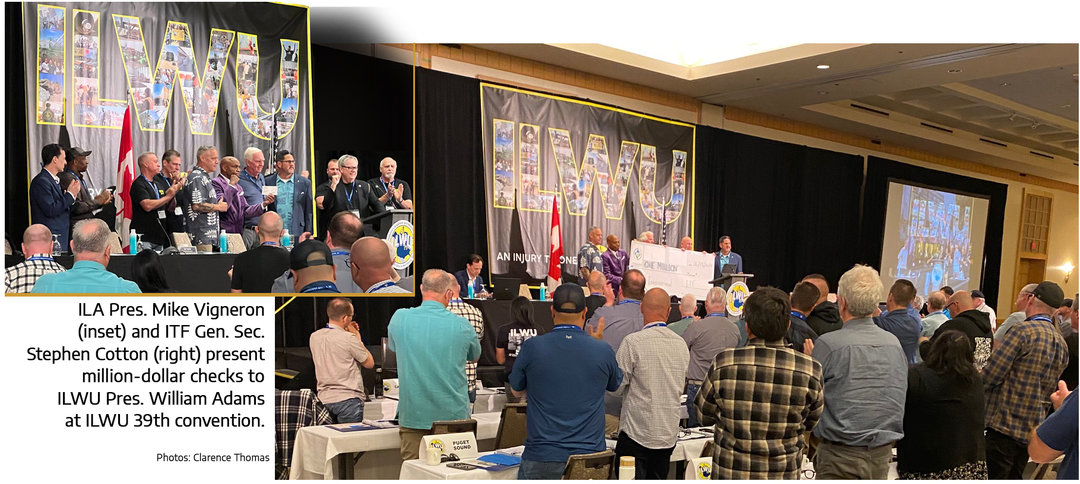
Million-dollar checks were presented to ILWU President William Adams at the convention podium. Mike Vigneron, President of the Atlantic Coast District of the International Longshoremen’s Association (ILA), gave one check. Stephen Cotton, General Secretary of the International Transport Workers Union Federation (ITF), matched that donation.
Their historic actions were taken to help restore the ILWU’s assets, which had been depleted by the International Container Terminal Services (ICTS) litigation against the ILWU Longshore Division. A federal court awarded ICTS $20.5 million of ILWU union funds over a dispute involving a job slowdown in Oregon.
International solidarity with Palestine and Cuba
Addressing the crisis of genocide in Gaza, Brother Cotton from the ITF spoke of his communications with Palestinian trade unionists. He explained that Palestinian taxi and truck drivers want U.S. workers to support their right to self-determination and the establishment of a Palestinian state.
Two Australian union leaders appealed for international labor action to stop the massacre and displacement of Palestinians. They received overwhelming applause.
Cris Cain, National Secretary of the 30,000-member Construction, Forestry and Maritime Employees Union (CFMEU), declared: “Peace is union business.”
He talked about how the ILWU port shutdowns helped to end apartheid in South Africa and how, recently, dockworkers in Australia have engaged in parallel actions by refusing to work vessels carrying military supplies to enforce apartheid and carry out genocide against Palestine.
Paddy Crumlin, National Secretary of the Maritime Union of Australia, called for an immediate ceasefire and a diplomatic resolution.
In a video message celebrating Juneteenth, ILWU Honorary Member Angela Davis sent greetings and a plea for support of the Palestinians.
The resolution to remove Cuba from the List of State Sponsors of Terrorism (SSOT) was first introduced at the Constitution Committee Meeting, where it was passed without opposition. Committee members, including Thomas, spoke about the devastating impact of the 62-year-long embargo, an act of war that deepened the hardship imposed on the entire Cuban population.
That resolution, calling for an end to the boycott of Cuba, was introduced to the convention delegates. They voted unanimously to approve the convention resolution.
The resolution follows:
Send Pacemakers to Cuba and end the U.S. embargo
WHEREAS: ILWU policies and actions on foreign affairs have always been built on the
belief that international labor solidarity and world peace are the cornerstones of
social and economic justice for all workers, including the membership of the ILWU;
and
WHEREAS: The union’s commitment to a peaceful world has been expressed in many ways,
each following a course of action or basic policy set by the membership through
the International Convention;
and
WHEREAS: Washington has placed Cuba on its list of alleged terrorist nations (SSOT), which severely impacts Cuba’s ability to secure loans and participate in world banking systems, thus disabling tourism, agriculture, and other productive markets;
and
WHEREAS: 243 punitive executive orders/sanctions were issued by President Trump and reinforced by President Biden, intensifying hardship for the working people;
and
WHEREAS: In 2023, a resolution to end the Cuban blockade [at the UN General Assembly] passed 182 to 2 (U.S. and Israel opposed);
and
WHEREAS: Except for empty campaign promises, the Biden administration has done nothing to undo the hardships of the blockade forced on the Cuban people. These policies leave Cuba with a shortage of fuel, food, medicines, spare parts;
and
WHEREAS: Cuba has sent 3,700 health workers in 52 international medical brigades to 39 countries overwhelmed by the Covid pandemic. Cuba’s international medical brigades have treated patients and saved lives for the past 18 years in 100 countries confronting natural disasters and serious epidemics, such as the Ebola crisis in West Africa;
and
WHEREAS: Cuba has developed five internationally recognized COVID-19 vaccines to meet its commitment to sharing its low-cost vaccines with poor nations and continues to develop new medicines for treating Alzheimer’s, Diabetic foot ulcers, and lung cancer. Thus continuing its tradition as a world leader in medical research and development;
and
WHEREAS: Recently, more than 30 labor bodies have passed strong resolutions calling for ending the sanctions and removing Cuba from the SSOT, including multiple entities in California (including the LA Federation of Labor representing 800,000 workers) and Washington State: and
WHEREAS: The majority of Cuban Americans in Miami oppose the blockade and have demonstrated with car caravans and other actions for years calling for an end to the blockade and instead build bridges of love, Puentes de Amor;
and
WHEREAS: the ILWU has historically enjoyed an international relationship with the Cuban Workers Federation (CTC), and in 1947, participated in organizing the International Sugar Workers Committee;
THEREFORE BE IT
RESOLVED: that the 2024 ILWU Convention calls on the Biden administration to vote FOR the U.N. Resolution to end the U.S. unilateral extraterritorial blockade of Cuba and remove Cuba from the spurious U.S. list of state sponsors of terrorism (SSOT), reset Cuba regulations to January 1, 2017, initiate the discussion to fully normalize US-Cuba relations, and
BE IT FURTHER
RESOLVED: that the ILWU will commit to donate $10,000 to Global Health Partners to purchase Pacemakers4Cuba* and
BE IT FINALLY
RESOLVED: that this Resolution will be distributed to Congressional delegations, the news media, and all labor organizations, urging them to do the same.
Submitted by Inlandboatmen’s Union of the Pacific
* GHPartners.org/Pacemakers4Cuba Global Health Partners is a 50Jc3 charity with a commerce License to send medical supplies to Cuba
UC fails twice to break UAW strike; court issues restraining order
written by Struggle – La Lucha
July 17, 2024
After weeks of solidarity with student demonstrators, academic workers across the University of California system were ordered to halt their unfair labor practice strike until June 27.
UAW 4811, which represents 48,000 academic workers across the UC system, called the strike in response to UC’s serious unfair labor practices, which began on May 1 when the university allowed an organized mob to beat students, faculty, and staff attending a Gaza solidarity protest at UCLA. More than a hundred were injured, and dozens were sent to the hospital. The next night, the university called in riot police to arrest those protesters who remained.
The union has denounced the restraining order and points out that this temporary restraining order does not mean the strike has been ruled “illegal.”
“UC academic workers are facing down an attack on our whole movement,” said Rafael Jaime, president of UAW 4811.
Orange County Superior Court Judge Randall J. Sherman issued the order. The ruling arrives after the UC tried and failed on two separate occasions to break the strike through lawsuits filed with the California Public Employment Relations Board (PERB) claiming UAW 4811 violated its no-strike clause.
Rafael Jaime responded, “PERB, the regulatory body with the expertise to rule on labor law, has twice found no grounds to halt our strike. I want to make clear that this struggle is far from over. In the courtroom, the law is on our side and we’re prepared to keep defending our rights — and outside, 48,000 workers are ready for a long fight.”
The court’s restraining order has galvanized support for UAW across many other unions. United Teachers Los Angeles members recently joined forces with UAW 4811 and 872 academic workers for a “Drop The Charges” rally outside of Los Angeles City Hall. The rally also received the support of LA councilmembers Hugo Soto-Martinez and Eunisses Hernandez.
Filipino community stages sit-in for fast food workers’ rights
written by Struggle – La Lucha
July 17, 2024
FOR IMMEDIATE RELEASE
Monday, May 27, 2024
Contact: Patrick M., J4JW Community Support Network, (240) 242-9729, j4jw.wheaton@gmail.com
WHEATON, MARYLAND — During the holiday lunch rush on Monday, the Wheaton Jollibee floor grew to standing-room only as crew members called out orders named “Holiday Pay” and “Fair Wages” to cheers. In a Memorial Day “dine-in” coordinated by the Justice 4 Jollibee Workers Community Support Network, Filipinos and allies across the Washington, D.C. metropolitan region sought to amplify workers’ demands for equitable pay. Around 60 community members attended, including the family members of Jollibee crew and local Starbucks workers, despite management’s attempts to quell the event.
In January, Wheaton Jollibee workers came forward with a public statement, sharing that their request for double pay on holidays has not been met by management. Since its opening in 2021, the restaurant serves customers year-round, including Thanksgiving and Christmas, but are not further compensated on these days. On May 1, the Community Support Network hosted a flyering event to amplify workers’ demands.
Instead of using their actual names for lunch orders, supporters opted to name their orders “holiday pay” and other labor-related slogans. Workers announcing these orders resulted in celebrations from customers and smiles on crew members’ faces. Alongside these calls, community members also flyered throughout the store about the Wheaton Jollibee workers’ campaign and placed a tip jar on the cashier counter. The event was inspired by the solidarity “sip-ins” supporting Starbucks baristas in their fight to unionize, according to Community Support Network organizers.
Restaurant management attempted to deter the dine-in by taking the tip jar away within the first 30 minutes and calling mall security. They further tried to mandate the cashiers to not take “Holiday Pay” as a name, but afternoon customers were creative, pivoting their orders to names like “Holly” or “Justice.”
The sit-in occurred while wait times peaked up to an hour as workers cooked and packed both in-person and online orders. These conditions exemplify the workers’ need to be compensated fairly on the busiest days of the year.
This holiday pay campaign is inspired by a similar campaign in New Jersey, where Jollibee workers won reinstatement, back pay and a public apology after being illegally fired last year. The Wheaton location is one of thousands of restaurants that are part of the multinational Jollibee Foods Corporation, which earned over $4.2 billion USD in revenue in 2023.
Link to press kit here. Please credit material to the Justice 4 Jollibee Workers Community Support Network. More photos and videos available upon request.
On May Day, New Orleans celebrates diverse working class
written by Melinda Butterfield
July 17, 2024
New Orleans, May 1 – Immigrant-worker organization Unión Migrante led a march to celebrate the international workers’ holiday, which has been revived across the country in recent years by immigrant activists.
The march began on Conti Street beneath a statue of Mexico’s Indigenous president, Benito Juárez. (Juárez was a Zapotec leader from a peasant family who was exiled by a conservative government during the 1850s, first in Havana, Cuba, and then in New Orleans.) The May Day march ended with a rally in front of City Hall.
Representatives from many endorsing organizations spoke, including unions like the National Association of Letter Carriers, United Teachers of New Orleans, and Starbucks Workers United. Speakers from revolutionary organizations also took to the mic, such as Workers Voice Socialist Movement, Freedom Road Socialist Organization, and Party for Socialism and Liberation.
Reflecting the great movement that is sweeping the country, many participants wore keffiyehs and speakers emphasized the importance of the Palestinian liberation struggle. An organizer with Students for a Democratic Society spoke on behalf of Tulane University’s Palestine encampment, which had been brutally suppressed by police the day before.
The prominence of Palestine solidarity on May Day is a very good thing. The workers’ movement cannot confine itself to narrow economics. All attacks on oppressed people are attacks on workers. These are all workers’ issues. Indeed, this was one of the main arguments in Bolshevik revolutionary Vladimir Lenin’s pamphlet, “What is to Be Done?”
He said that the workers’ struggle absolutely cannot confine itself to just wages or economics in the narrow sense. Instead, our movement must expose the oppressors and exploiters in whatever sphere they’re operating, and we must fight all their attacks. We might take this advice to heart, given that Lenin led the revolution that established the first lasting workers’ state.
‘Resist Landry!’
Queer and trans contingents were prominent throughout the march, from trans youth organization BreakOUT!, to La Familia LGBTQ del Sur, to the Queer and Trans Community Action Project (QTCAP), newly formed by members of the old Real Name Campaign.
QTCAP activists held aloft a banner saying, “Resist Landry.” Jeff Landry is Louisiana’s far-right, bigoted governor, who recently tried to prevent hungry kids from accessing school lunch over the summer (doesn’t seem like much of a “family man”). Others in the crowd held up the blue, pink and white trans pride flag.
One stage and film set worker with the International Alliance of Theatrical Stage Employees or IATSE gave a talk. He said: “The union movement right now in this country is huge. The workers’ voice is being heard and they are very frightened. Stay together, fight the fight, continue to spread the message of what is right.” This message of unity was echoed in all the speeches. We are living in dangerous times. Capitalism is in crisis and attacks are coming down everywhere. Things are bad in Louisiana. Landry and his fascist movement are ramming through anti-worker, anti-immigrant, anti-Black, anti-queer, and anti-trans legislation. They’re imposing anti-women legislation. (Landry made a career undermining abortion rights long before he was elected governor.) But that speaker was right. Our ruling class enemies are afraid. If they weren’t afraid, they wouldn’t be attacking us so fiercely. Six southern governors wouldn’t have signed a letter denouncing the United Auto Workers union drive in Chattanooga, Tennessee. Despite the governors’ efforts, the workers won! They organized a union.
As in cities and towns across the country, and around the world for that matter, the crowd that gathered in New Orleans on May Day was a microcosm of the working class. Our class is diverse. It is immigrant and non-immigrant, Black and white, Asian, Indigenous. It is trans, cis, straight, and queer. Despite these differences, we are all workers. The capitalists are afraid of that.
May Day was a warmup. They know that we can come out in the thousands and the millions, just like we did for Black lives in 2020.
¡El pueblo unido jamás será vencido! The people united will never be defeated!
UAW workers at Daimler Truck win big wage gains: Organize the South!
written by Melinda Butterfield
July 17, 2024
Blinking at the last minute on April 26, Daimler Truck agreed to union demands for big pay raises. The 7,300 United Auto Workers members won an immediate 10% wage increase.
Pay will go up by at least 25% over the proposed four-year contract. UAW President Sean Fain announced that employees will for the first time receive cost of living increases.
The lowest-paid UAW members making school buses at Daimler’s Thomas Built Bus won increases of over $8 an hour. Their wages will match the pay of the workers in the truck plants.
Equal pay for equal work was won. The hated pay tiers — where two workers doing the same job get different pay because of when they were hired — will be abolished.
Daimler — headquartered in Stuttgart, Germany — is the world’s biggest commercial vehicle manufacturer. It made $4.3 billion in profits last year from exploiting 100,000 workers in the United States, Germany, Mexico, South Africa, Brazil, India, Indonesia, Türkiye and other countries.
Corporate profits are stolen wages. Daimler’s wage theft amounted to an average of $43,000 in profit taken from every one of its employees.
The huge corporation saw how UAW’s successful strikes last year against General Motors, Ford and Stellantis (Chrysler and Jeep) brought the Big Three automakers to their knees. The week before, workers at Volkswagen’s Chattanooga, Tennessee, plant voted three to one to join the UAW.
What made the Daimler and Volkswagen victories all the more important is that they happened in the U.S. South.
Daimler has truck factories in Cleveland, Gastonia and Mount Holly, North Carolina, and Gaffney, South Carolina. The Thomas Built Buses plant is in Mount Holly. (There’s also a Daimler Freightliner truck plant in Portland, Oregon.)
Using the Klan to bust unions
The UAW breakthroughs in the Carolinas and Tennessee are historic because unions have been overwhelmingly kept out of southern states.
Just one out of 37 workers in North Carolina have union protection. That’s 2.7% of the workforce.
This union busting is a legacy of slavery and the bloody overthrow of the Reconstruction governments in the South following the U.S. Civil War. The Ku Klux Klan was used to break union drives like at the old Bibb textile mills in Macon, Georgia, in the 1940s.
Wall Street banksters were the puppet masters of these lynch regimes which they viewed as reservoirs of cheap labor. Behind the fascist Alabama Gov. George Wallace was U.S. Steel, whose mills dominated the state’s economy in the 1960s.
At least U.S. Steel hired Black workers, although usually in the worst jobs. Ford and General Motors refused to employ Black workers on their Atlanta area assembly lines until the early 1960s. They did so only after Black workers in Detroit threatened walkouts.
The biggest southern industry was textiles, centered in the Carolinas. Yankee textile outfits fled south to escape union drives in the North. By 1960, 89% of U.S. textile production was in the South.
Wages in southern mills were up to 40% below the northern average. Key to keeping this industry non-union was keeping out Black workers.
No other manufacturing industry in the United States was so segregated for so long. In the southeastern textile belt, millions of Black workers lived near mills where they couldn’t get a job.
Hiring Black workers in southern textile mills is one of the great triumphs of the civil rights movement. However, hundreds of these plants, including the Bibb Mills, have since shut down.
When Ezell Blair Jr., Franklin McCain, Joseph McNeill and David Richmond began their sit-in at a Woolworth’s lunch counter in Greensboro, North Carolina, on Feb. 1, 1960, just 3.3% of textile workers were Black.
Eighteen years later, in 1978, African Americans “held a quarter of all production jobs in the Southern textile industry.” (“Hiring the Black Worker, The Racial Integration of the Southern Textile Industry, 1960-1980,” by Timothy J. Minchin)
Avenging Ella May Wiggins
Some whites did break with Jim Crow. The most notable example was the Gastonia, North Carolina strike — led by the Communist Party — in 1929. Today Gastonia is home to one of the UAW-organized Daimler truck plants. Despite a fantastically intense campaign of race-baiting, hundreds of white workers remained loyal to the National Textile Workers Union. The NTW called for equality between Black and white workers.
The strike was drowned in blood. Among its martyrs was 29-year-old union leader Ella May Wiggins. She was shot to death in broad daylight on Sept. 14, 1929.
Typical of the poverty suffered by white textile workers was that four of Wiggins’ children died of whooping cough. (“The Lean Years: A History of the American Worker 1920-1933,” by Irving Bernstein)
Textile workers were seething. They exploded in 1934. One hundred seventy thousand workers went on strike in the South.
Bosses and their state governments mobilized 23,000 sheriff deputies, National Guard soldiers and private gunmen to break the strike.
After receiving $20,000 from mill owners, Georgia Governor Eugene Talmadge declared martial law. A concentration camp for arrested strikers was set up at Fort McPherson near Atlanta.
Thirteen strikers were killed in the South. Another two died in the North. Seven workers were murdered at the Chiquola Mill in Honea Path, South Carolina, alone. (“Testing the New Deal: The General Textile Strike of 1934 in the American South,” by Janet Irons)
President Franklin Roosevelt and Labor Secretary Frances Perkins did nothing about these bloody massacres. Don’t count on Joe Biden to help union organizing drives either. Genocide Joe is busy helping to kill children in Gaza.
The capitalist deep state also allowed the Klan and Nazis to murder five Communist Workers Party members in Greensboro, North Carolina, on Nov. 3, 1979.
Cesar Cauce, Mile Nathan, Bill Sampson, Sandi Smith and Jim Waller were murdered in front of TV cameras. The leader of these fascist killers, Edward Dawson, was on the payroll of the Bureau of Alcohol, Tobacco and Firearms of the United States Treasury Department.
None of the assassins spent a day in jail. Like the Honea Path atrocity in 1934, the Greensboro Massacre was approved by the wealthy and powerful. The UAW victories at Daimler and Volkswagen are helping to avenge Ella May Wiggins and the Greensboro martyrs. Organize the South!
Behind Southern governors’ anti-union agenda
written by Melinda Butterfield
July 17, 2024
Southern politicians who sold their souls to the corporations and banks are a bit rattled right now, and who can blame them? Volkswagen workers won big in Chattanooga, Tennessee, when 73% of plant workers voted to join the United Auto Workers Union.
This is the first time that autoworkers have successfully unionized via election in the South since the 1940s! What if more of us workers here in the South get an idea?
Before the vote even happened, six “anti-woke” southern governors put out a joint letter condemning the union. That should tell us how significant the unionization victory is.
Seriously. The Volkswagen vote is a big deal for all workers in the region. When economists compare workers of the same type, with the only difference being whether they’re union members, unionized workers earn 10-15% more in wages according to the U.S. Department of the Treasury. That’s just wages. Unionized workers have better benefits and working conditions, too.
And unlike with “trickle down economics” – the now totally disproven idea that tax breaks for the ultra-wealthy will trickle down to the rest of us – when it comes to the benefits of unions, the high tide really does lift all workers’ boats. The Treasury Department admits that the data is clear on this point. There is a spillover.
For every 1% increase in union membership in the private sector, that results in a 0.3% increase in wages for nonunion workers, and the benefits are greatest for workers without college degrees.
Workers in states that have extreme anti-union laws (misleadingly called “right to work” or RTW laws) make 3.2% less on average than those doing the same job in states with less restrictions on unions. That is to say, full time workers in RTW states like Louisiana or Mississippi make about $1,670 less per year.
The letter written by the governors has a laughable graphic saying “Republican governors stand with American Auto Workers.” It’s signed by Kay Ivey (Alabama), Brian Kemp (Georgia), Tate Reeves (Mississippi), Henry McMaster (South Carolina), Bill Lee (Tennessee), and Greg Abbott (Texas). Every word of the statement is a lie. We should ask who they’re working for, because it ain’t us.
Roster of shame
The governors’ main claim is that all the jobs are going to leave if the workforce unionizes. But there is no correlation between whether a state has RTW laws, and thus low unionization rates, and employment. When you look at whether prime working-age people (ages 25-54) have a job in RTW vs. non-RTW states, there’s no systematic difference. Fluctuations in employment follow the same capitalist boom-and-bust cycles (expansion followed by recession) across states.
Forbes looked at U.S. Census data for 2023 and ranked the states with highest and lowest poverty levels. Mississippi comes in as the poorest state, with 19.1% living below the federal poverty level. So there’s Tate Reeve’s state.
(U.S.-occupied Puerto Rico has a poverty rate of 43%, but the island is not a state, so is usually not included on these lists. It’s being plundered by corporations and banks. U.S. out of Puerto Rico, now! Puerto Rico will be free!)
Louisiana has the second-highest poverty level, but our governor – Jeff Landry – didn’t sign the letter; maybe because auto-manufacturing hasn’t taken off here yet. Alabama is the 7th highest, so Kay Ivy gets an “F.” South Carolina comes in at number 10; Henry McMaster is another loser.
So, three out of six of the signees govern states in the top 10 poorest. And since they’re doing absolutely nothing to alleviate poverty, we can rest assured that they do not care about workers, only about making themselves and their big donors rich. There’s no reason to trust them about unions.
Speaking of big donors, a Mississippi Today investigation in late 2023 found that Tate Reeve’s top campaign contributors brought home a whopping $1.4 billion in state contracts and grants, all from agencies Reeves oversees. It pays to play! Or is it pay to play?
Texas-sized hypocrisy
According to Market Realist, Greg Abbott has a net worth of $14 million. In December 2023, his campaign received $6 million – “the largest single donation in Texas history,” in the campaign’s words – from Pennsylvania billionaire Jeff Yass.
Yass is thought to have $29 billion. He’s the co-founder and managing director of investment firm Susquehanna International Group.
Why would a Pennsylvania capitalist be funding Texas politics? Because he champions the anti-public school voucher movement, tax cuts for billionaires, and all manner of other things that only benefit the rich. He’s making an investment in Texas.
The truth is that there is nothing unusual about these shenanigans, and Democratic politicians are no better. The Washington Post said it: “More than half of those who served in the House and Senate were worth more than $1 million; many had net worths that stretched into the tens of millions.”
We should not be surprised where these capitalist politicians’ allegiances lie. Every time they try to stir us up about unions, trans people, immigrants, or some supposed foreign adversary, we should ask: “What’s in it for you?”