From Black Reconstruction to Elon Musk: A Black Labor History Perspective

Mwm

The following text is based on a talk given by Clarence Thomas, a third-generation retired member of ILWU Local 10, on a podcast for the Teamster National Black Caucus (TNBC) co-hosted by Richard Hooker, Secretary-Treasurer, Teamsters Local 623 and Chris Silvera, Secretary-Treasurer, Teamsters Local 808. In addition to Thomas, guest speakers included David Gonzalez, National Vice President of District 2 AFGE.

Solidarity Greetings, sisters, brothers, friends and enemies. In fact, you know we would just be fooling ourselves to think there are no enemies present on this podcast. First of all, I would like to thank Brother Richard Hooker for having me on the show and all of those involved in making this podcast possible. I am honored to be with you all today!

The subject of my presentation today — “A Black Labor History Perspective” — could not be occurring at a better time, not just because of Black History Month but also because of the current presidency of Donald J. Trump, a reckless, avaricious billionaire known for making racist comments, failing to pay his workers and outsourcing his manufacturing firms, in case anyone has forgotten. He is currently presiding over an unprecedented effort to exercise authoritarian rule over all branches of the U.S. government, with Elon Musk wielding unmitigated authority as head of DOGE.

There has been a long history in this country of trade union and white working-class intransigence against Black working-class advancement — alongside episodes of interracial class unity and the elusive promise of a radical future and a labor party.

Racism has genuinely undermined working-class democracy and power in favor of the meager protections of white privilege. Alongside the placement of occupational color bars by unions to the outbreak of wildcat strikes against the hiring of Black workers, history is also scattered with episodes of anti-racism and interracial unity. From the Knights of Labor, the International Workers of the World (IWW) to the Congress of Industrial Organizations (CIO). From the League of Black Revolutionary Workers to the Coalition of Black Trade Unionists (CBTU), Black Labor militants appealed to white and other workers of color for solidarity. 

More recently, in 2004, we witnessed the emergence of the Million Worker March Movement, initiated by African American trade unionists, which assembled at the Lincoln Memorial on Oct. 17, 2004, calling for all workers to break with the two ruling class parties and embrace a worker agenda.

Capitalism and racism go together like a hand and glove

Slavery was capitalism on steroids! It provided free labor by an enslaved population that had no rights at all. Any child of an enslaved woman was born into a life of indefinite bondage. Efforts to enslave Indians were not successful; they could not adjust to the labor in captivity and often escaped to the familiar terrain of the forest. 

Free white laborers were scarce and were unwilling to work when cheap land was available — white indentured servitude was an important source of labor in some colonies. But, this limited term of bondage could not meet the growing demand for workers. Blacks could be forced into slavery more easily than whites because, once enslaved, they could not easily run away and mingle readily in strange surroundings. The Land Barons said, “A Black skin connoted, evil, and inferiority;  Blacks were said to be destined to be slaves by the ‘curse of Ham.’” They were pictured as savages and infidels from a barbaric, dark continent without a civilization, and enslavement was judged to be an improvement to their way of life.

The number of Black slaves grew slowly in the 17th Century. In 1700, there were probably a little more than 25,000 Black slaves in colonial British North America. Slavery was suited to plantation agriculture and to the Southern economy generally. Slave labor could be maintained at a subsistence standard of living. The offspring of Black women added to the profits of the masters.

Many of the Africans carried to America as slaves brought with them skills in metallurgy, woodworking, and leather, as well as cultivation of rice and indigo.

Free Black wage earners were members of the labor force before the Civil War. But, from the time white workers formed the first trade unions in the 1790s to the Civil War, no free Black wager was a member.

The Colored National Labor Union, or the National Labor Union, was formed by African Americans in 1869 with the goal of improving working conditions and the quality of life for its members. It represented African American laborers in 21 states. Among the goals of the union was the issue of Farmland for African Americans in the South, government aid for education, and non-discriminatory legislation that would help struggling Black workers.

Dr. W.E.B. Du Bois, in his book Black Reconstruction, describes how enslaved African Americans went on strike during the Civil War on the Plantations in the South. They frequently ran away and went to Union Army encampments. In some instances, they were led back to their plantations. 

Du Bois says: “Slaves are workers, as workers constantly struggle with their masters, not only over working conditions but over their legal and social status as well.” He gives a class analysis of how the enslaved contributed to their own freedom and were not just bystanders. There were thousands who fought and died as Union soldiers. He draws an analysis that better connects race and class. The enslaved increasingly ran away, took up arms against their masters, and intentionally sabotaged and disrupted global cotton production.

The Brotherhood of Sleeping Car Porters

In 1925, The Brotherhood of Sleeping Car Porters Union (BSCP) was founded by A. Philip Randolph, an African American radical trade unionist, and avowed socialist at the time. It was the first union led by African Americans to receive a charter in the American Federation of Labor (AFL). 

Beginning with the Civil War, the job of Pullman Porter had become an important means of work for African Americans. Randolph was its founder and President, Milton Webster, vice president, and C.L. Delum, vice president and the union’s second president. Porters on regular assignment worked an average of 73 hours per week and earned 27.8 cents an hour. In the 1920s, groups as diverse as the Urban League, the Socialist Party of America, and the Communist Party began to focus on the rights of Black workers.

In 1941, The March on Washington Movement (MWM) was initiated by A. Philip Randolph. It was the most militant and important action in African American politics in the early 1940s. Its objective was to bring 10,000 Negroes to Washington, D.C., to demand an end to discrimination in hiring in the defense industry and the discrimination in the U.S. military. 

President Franklin Delano Roosevelt cut a deal with Randolph unbeknownst to fellow organizers like William Patterson, a Black communist attorney, signing an executive order establishing a policy against employment discrimination as the nation prepared for war. Executive Order 8802 established the first Fair Employment Practices Committee. 

In 1947, another March on Washington was planned to end segregation in the military. At that time, President Harry Truman signed an executive order to end discrimination in the military. 

It wasn’t until Aug. 28, 1963, that a March on Washington took place. A. Philip Randolph led it with the leadership of Bayard Rustin.

The next march was the Million Worker March, which took place at the Lincoln Memorial on Oct. 17, 2004, in Washington, D.C. This time it was initiated by radical trade unionists from the International Longshore and Warehouse Union (ILWU) Local 10 in San Francisco. The call was for workers, organized and unorganized, to embrace a workers’ agenda which includes: 

  • Protecting Social Security
  • Stop the dismantling of public education
  • Repeal Taft Hartley
  • Universal health care
  • Slash the military budget 
  • National living wage
  • Amnesty for all undocumented workers
  • Workers’ right to organize 
  • Tax relief for working class
  • Stop corporate greed
  • Enforce all civil rights

among other demands. 

The MWM called workers to break from the two ruling-class parties and to form a Workers Party.

The Democratic Party and AFL-CIO both opposed the MWM. Prior to the 2004 Democratic Convention, a mini labor summit was held in Hyannisport at the Kennedy family compound. It was attended by many labor leaders, including those from the AFL-CIO, ILWU, SEIU, and the Teamsters. There it was established that the MWM was being held at the wrong time. A directive was sent to all AFL-CIO affiliates not to contribute any money, time, or resources to the march, even though they might agree with many of the MWM’s demands.

Such a letter was received by the Teamsters. In spite of that, during the Teamsters National Black Caucus (TNBC) in August 2004, the delegates voted to have the International Brotherhood of Teamsters contribute $10,000 to the MWM. General Secretary Treasurer C. Thomas Keegel, who was in attendance at the conference, said he would get it done. The Teamsters kept their commitment. 

In fact, one year later, when MWM held its labor gatherings during the 10th anniversary of the Million Man March, aka the Millions More March, Bro. Hoffa donated another $10,000 and wrote a letter supporting many of the demands of MWM and its participation in the Millions More Movement festivities. The MWM produced a video and sent a copy to the general president so that he could see Black labor’s participation during that anniversary. 

Chris Silvera, Patricia Ford of the Washington D.C. Labor Council, and myself all spoke at the Millions More Rally in Washington, D.C. Brother Silvera demanded that President George Bush reinstate the Davis Bacon Act during the rebuilding of New Orleans after Hurricane Katrina. The Act requires that federal dollars appropriated on public works projects must pay prevailing wages to workers on the project. A couple weeks later Bush enforced Davis Bacon on federally funded projects related to Katrina. 

 Thank you.

A question from the panel:
What is the difference between middle class and working class?

In capitalist America, there is an effort to divide the class by the amount of money you make, occupation, and education. Let’s take, for example, my former occupation as a dock worker, a longshore worker. Well, by capitalist definition, only 9.2% of workers in the U.S. had incomes exceeding $100,000. Depending on one’s skill level, job classification, and accumulated overtime hours, a dock worker’s pay can well exceed $100,000. Perhaps that would explain why you can find lawyers, accountants, teachers, and other highly educated people working on the waterfront. Are they not still working class? Of course they are, in fact, they are some of the most important workers to the global economy. 

The middle class is made up of those who are not wage earners, who have their own income like doctors, lawyers, accountants, and so forth.

My point is, if you’re a wage earner you are definitely working class. We recently witnessed people in the entertainment industry go out on strike over AI. Big-name Hollywood stars joined the picket lines and refused to go to work. They have consistently remained union members, no matter how much money they make or where they live. They make their income by working the same as those on the waterfront. 

Lastly, the term middle class divides workers on the basis of race. Being that race is the basis of wealth, education, income, and other disparities. Folks who have certain occupations don’t see themselves as part of the working class. I would conclude by pointing out that a significant number of the people teaching undergrad students are PhDs with no tenure and make far less than many skilled union workers.

Clarence Thomas is an ILWU Local 10 retiree and co-founder of DeClare Publishing.

Strugglelalucha256


Swedish unions and ILWU Local 10 in solidarity with fired worker over Israeli arms embargo

Swedish Dockworkers Union Condemns Employer Retaliation For Legally Sanctioned Boycott

Take Action Now!

The dismissal of Swedish Dockworkers Union (SDU) spokesperson and national deputy chair Erik Helgeson is a blatant act of retaliation for the union’s legally-sanctioned boycott of military cargo to and from Israel. This dismissal represents an attack on trade union rights, freedom of speech, and the democratic decision made by dockworkers across Sweden.

In December 2024, SDU members voted with a 68% majority to launch a six-day boycott of military cargo in response to the crisis in Gaza. The boycott was not only legal but also upheld by a unanimous preliminary ruling from Sweden’s labor courts. Yet, on the very day of this legal victory, Erik was dismissed by his employer, Gothenburg RoRo Terminal – a move designed to silence union voices and intimidate workers everywhere.

The SDU vote and action has been one of the strongest actions taken by workers anywhere in Europe in solidarity with the people of Palestine since 2023. It was voted on democratically, carried out lawfully, and targeted military cargo – not the operations of the employer.

Erik’s dismissal is an attack on all of us who believe in the right to organize, to speak out against injustice, and to take meaningful action in solidarity with oppressed peoples. We must act together to demand Erik’s immediate reinstatement and to defend the right of workers to stand up for justice without fear.

Take Action Now!

Send a message to the employer (sample below). Urge your union to join ILWU Local 10 in adopting a solidarity resolution. Send a copy to the Swedish Dockworkers Union at kansli@hamn.nu

Sample Email to Send to DFDS and Gothenburg RoRo Terminal

E-mail to: roroid@gotroro.com

Subject: Reinstate Erik Helgeson – Respect Trade Union Rights

I am writing to express my deep concern regarding the dismissal of Erik Helgeson, spokesperson and national deputy chair of the Swedish Dockworkers Union (SDU). Erik was fired on the very day that Sweden’s labor courts upheld the legality of the union’s boycott of military cargo to and from Israel – a boycott undertaken in response to the crisis in Gaza and supported by a democratic vote of the union’s members.

The decision to fire Erik appears to be a retaliatory measure against legitimate union activity, a move that undermines both trade union rights and freedom of speech. Sweden’s labor laws, as well as international standards on freedom of association, protect workers’ rights to organize and speak out about workplace actions without fear of retribution.

I urge you to:

  1. Immediately reinstate Erik Helgeson to his position.
  2. Publicly withdraw the baseless accusations against him.
  3. Commit to respecting the rights of workers to organize and take collective action.

The world is watching how DFDS and Gothenburg RoRo Terminal respond to this situation. Defending Erik’s rights is not just about one individual – it is about upholding democratic principles and protecting the right of all workers to stand in solidarity with those facing injustice.

Thank you for your time and attention.

Sincerely,

[Your Name]

[Your Contact Information]

[Optional: Affiliation/Union/Organisation Name]

Strugglelalucha256


Federal workers’ unions hold the line against Trump

Attack on federal workers is an attack on all workers

The Trump-Musk axis has never been shy about the fact they wanted to bust up federal organized labor. 

The Trump campaign made a lot of promises about the sort of hell they would unleash on federal workers and their unions. Since the inauguration, the Trump administration has followed through on that promise to the private sector and his fascist base. 

Since he took office, Trump has issued executive orders aimed at slashing federal jobs and weakening federal labor unions. These orders have included a return-to-work order, a hiring freeze, a deferred resignation program, and the restoration of policies that make it far easier for federal agencies to terminate career workers. 

Targeting organized labor

If the previous Trump administration’s labor policy is any indication, this is just the beginning. All unions in the federal sector are braced for executive orders and regulations that will remove local unions from their offices on government property, ban the deduction of union dues from paychecks, and severely limit the amount of duty time given to union officials to represent their fellow workers. 

With these attacks, Trump, and the ruling class more broadly, hope to break any organization that would see federal money spent on its workers or social programs rather than war or kickbacks for billionaires. 

Not only will the federal government save money to invest in the war machine, the cumulative effect of these policies is to function as a de-facto massive layoff. With this level of layoff, the labor market will be flooded with experienced workers in various professions. It’s not as if the U.S. jobs market is booming currently. For months, more and more people have had trouble finding a job. Capitalist economists have described it as a “low fire low hire” job market. This translates: “We know nobody can find a job but we don’t want to admit that we are also laying people off.” 

Since December, Meta, Microsoft, Workday, Amazon, Intel, JP Morgan, and Chevron have announced layoffs. Now, the federal government, via Elon Musk’s DOGE, will join the fray through literal layoffs, disciplinary removals, and employee buyouts called “deferred resignations.” 

Federal unions fight back

With a flooded labor market and a federal policy offensive against public and private sector unions, the Trump administration escalates its variety of fascism and looks to completely break what is left of organized labor in the federal sector and beyond. All there is left for the working class to do is fight back. 

To that end, federal sector unions have attempted to challenge this wave of Trump policies in the courts and to some extent, in the street. The American Federation of Government Employees, the largest federal union, has already joined or initiated lawsuits against Trump and DOGE for these policies. Further, AFGE has issued guidance that its members should refuse any deferred resignation offer. The slogan on this issue has become “hold the line.” AFGE represents over 600,000 workers across the country, with 300,000 members in the federal sector alone. 

On Feb. 11, AFGE held a rally on Capitol Hill to confront Trump and Musk’s attacks on federal workers. Representatives from American Postal Workers, AFSCME, Unite Here, the Office of Professional Employees International Union, and the United Steelworkers all joined AFGE in this demonstration of several hundred unionized workers. 

The message was clear: All workers must stand up to these attacks from Trump and Musk. This means organizing and defending their contracts to the letter. While the leadership of AFGE is heavily entrenched in the Democratic Party, this should not stop the progressive movement from coming to the defense of it as a workers’ organization. 

Trump wouldn’t be attacking AFGE and the other federal sector unions if they didn’t curb the efforts of the ruling class to some extent. In this period of rising fascism, it is important to stand by unions as they face this assault. An organized workforce is never a bad thing. 

AFGE staff union fights for their rights

With that said, support for AFGE’s mission cannot stop the workers who are employed at AFGE as staff from asserting their own rights as a union and as workers. In fact, the reason union staff are asserting their contractual rights and challenging AFGE upper management’s hypocrisy is exactly so they can better assist the AFGE members in their fight against Trump and Musk. 

Since the November election, AFGE’s upper management has increased its attack on its own workforce, which is represented by OPEIU Local 2. AFGE management has forced its employees back into the office 80% of the time after bargaining for 50% of the time. Further, the AFGE national president has continued to threaten layoffs and buyouts against its own staff. In general, AFGE’s upper management and human resources have worked to scuttle the attempts of their staff union to represent the workers. 

Due to these attacks, OPEIU Local 2 has mobilized to challenge these attacks on their contract. The day before AFGE’s rally, AFGE’s staff held a picket line where they demanded that AFGE “fight Trump not its staff” and to “respect the contract.” Well over 100 people showed up to the informational picket, including AFGE staff and members. 

While these AFGE attacks on their staff are hypocritical and anti-worker in themselves, they should not stop workers and progressives from supporting AFGE overall, particularly the rank and file, in their fight against DOGE fascism. The struggle of the OPEIU-represented workers aims not to hurt AFGE but to improve representation and put AFGE in a better position to fight Trump. 

The moral of these stories should not be to worship or condemn outright any particular workers’ organization. The lesson to be taken from these two struggles is to support worker organizations at all levels in their fights for not just better conditions, but existence.

Strugglelalucha256


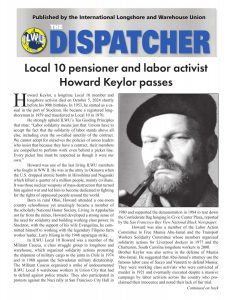
ILWU Local 10 pensioner and labor activist Howard Keylor passes

Howard Keylor, a longtime Local 10 member and longshore activist, died on October 5, 2024, shortly before his 99th birthday. In 1953, he started as a casual in the port of Stockton. He became a registered longshoreman in 1959 and transferred to Local 10 in 1970.

He strongly upheld ILWU’s Ten Guiding Principles that state: “Labor solidarity means just that. Unions have to accept the fact that the solidarity of labor stands above all else, including even the so-called sanctity of the contract. We cannot adopt for ourselves the policies of union leaders who insist that because they have a contract, their members are compelled to perform work even behind a picket line. Every picket line must be respected as though it were our Own.”

Howard was one of the last living ILWU members who fought in WW II. He was in the army in Okinawa when the U.S. dropped atomic bombs in Hiroshima and Nagasaki, which killed a quarter of a million people, mainly civilians. It was those nuclear weapons of mass destruction that turned him against war and led him to become dedicated to fighting for the rights of oppressed people around the world. Born in rural Ohio, Howard attended a one-room country schoolhouse yet amazingly became a member of the scholarly National Honor Society. Living in Appalachia not far from the mines, Howard developed a strong sense of the need for solidarity and building working-class power. 

In Stockton, with the support of his wife Evangelina, he committed himself to working with the legendary Filipino farm worker leader Larry Itliong in the 1948 asparagus strike. In ILWU Local 10, Howard was a member of the Militant Caucus, a class struggle group in longshore and warehouse, which organized solidarity actions protesting the shipment of military cargo to the junta in Chile in 1974 and in 1980 against the Salvadoran military dictatorship. The Militant Caucus organized a strike of undocumented ILWU Local 6 warehouse workers in Union City who had to defend against police attacks. 

They also participated in protests against the Nazi rally at San Francisco City Hall in 1980 and supported the demonstration in 1984 to tear down the Confederate flag hanging in Civic Center Plaza, reported by the San Francisco Bay View National Black Newspaper. Howard was also a member of the Labor Action Committee to Free Mumia Abu-Jamal and the Transport Workers Solidarity Committee, whose members organized solidarity actions for Liverpool dockers in 1977 and the Charleston, South Carolina, longshore workers in 2000.

Brother Keylor was also active in the defense of Mumia Abu-Jamal. He suggested that Abu-Jamal’s attorney use the famous labor case of Sacco and Vanzetti to defend Mumia. They were working-class activists who were convicted of murder in 1921 and eventually executed despite a massive \campaign by labor activists across the country who proclaimed their innocence and noted their lack of fair trial.

In 1999, Howard participated in the Local 10 contingent, leading a march of 25,000 protesters through the streets of San Francisco chanting, “An Injury to One is an Injury to All,” while all ILWU ports were shut down in support of Mumia.

The most significant action by Howard was the 1984 action against the Nedlloyd Kimberley, a ship from South Africa. While the apartheid regime was shooting down striking miners and arresting their leaders, Howard raised a motion at the Local 10 membership meeting to hit the

next ship that docked in San Francisco from South Africa. Leo Robinson, leader of the “Southern African Liberation Support Committee,” amended it to strike the South African cargo only. It passed unanimously. The rest was history.

Nelson Mandela, on his world tour in 1990 at the Oakland Coliseum, commended Local 10 for being on the front lines in the Bay Area of the international struggle against apartheid. Last year, the dockworkers union in Durban, South Africa, represented by the Revolutionary Trade Union of South Africa (RETUSA), invited Local 10 to send a delegation to celebrate the 50th anniversary of their strike that led to a General Strike against apartheid. The National Union of Metalworkers of South Africa and the Liverpool dockers have sent condolences to Howard’s family, to Local 10, and to his comrades.

A memorial service will be held for Brother Keylor on January 25, 2025, from 1:00 – 4:00 p.m. at Local 10, 400 North Point Street, San Francisco in the Henry Schmidt Room.

-Jack Heyman, #8780
Local 10 Pensioner

Strugglelalucha256


Starbucks barista strike spreads to 300 stores across U.S.

Washington DC—Over 5000 baristas walked off their jobs on Christmas eve in the largest action ever taken against Starbucks corporation. It was the fifth day of an escalating strike stretching from coast to coast across the country. The action involved over 300 stores that had previously voted to join Starbucks Workers United Union (SBWU) according to a press release from the union.

The strike comes amidst growing tensions between SBWU Union representatives and Starbucks corporate lawyers after 98% of union members voted to reject a wage increase of less than 2%. The Starbucks wage offer amounts to about 35 to 50 cents per worker and would not go into effect until the next fiscal year. The corporation offered no increases or relief for its barista healthcare package. (See video at foot of this story or here.)

The cost of living for the average U.S. worker was 2.7% ending on November 2024, according to a calculated cost average provided by the U.S. Department of Labor. For the same period In 2023, the cost of living increase was 2.6%. That means that the wage increase offer from Starbucks corporation was effectively at least 0.7% lower than the increase in the cost of living for last year and another 0.6% lower for the year before, placing Starbucks baristas at an increased economic disadvantage in terms of inflation.

Meanwhile Starbucks corporation has enjoyed increasing profits year over year during the same two periods. Starbucks corporation is the second highest profitable fast food company in the nation.

Union Stores Provide Barista A Voice

In December 2021 baristas in the first U.S. Starbucks store voted to form a union in Buffalo, NY. In the three years since then about 517 stores have voted to join SBWU Union with a steady increase of baristas voting to unionize at several stores each week. Each store is considered a separate work site, so baristas in each location are required to independently vote to join the union, and each store requires a majority of baristas to vote for union protection.

Starbucks representatives would not negotiate with the baristas when the union first organized but showed up to negotiations anyway without responding in substance to union negotiators. Starbucks corporate lawyers would only listen to union offers and then abruptly walk out. As the number of locations began to increase and public pressure began to build on Starbucks representatives to bargain with the union, they began to respond during the negotiations. Growing awareness that baristas were unionizing brought pressure on Starbucks corporation to take the union seriously and it first began to respond to the SBWU Union negotiation team in February 2024, over 2 years after the first Starbucks stores unionized.

The corporate representatives promised to complete a negotiated package by the end of 2024 but their wage and benefits offer to SBWU Union fell far short of union expectations. The backtrack began after the incoming anti-union administration was elected. It cannot be absolutely determined whether or not the election was the reason Starbucks representatives backtracked on their promises to offer reasonable wage increases but it is apparent, at least coincidentally, that many of the incoming administration’s cabinet and key position appointees are noted billionaires with corporate interests and none are union supporters.

“Starbucks has yet to present workers with a serious economic proposal. This month, less than two weeks before their end-of-year deadline, Starbucks proposed an economic package with no new wage increases for union baristas this year and a guarantee of only 1.5% in future years, which amounts to less than 50 cents an hour for most baristas,” wrote Molly Nunez, a press spokesperson for SBWU.

Starbucks Profits While Baristas Struggle

Starbucks is one of the most profitable companies in the United States with over 16,480 locations in the U.S. and over 40,200 locations worldwide, according to Cafely, a statistical research blog.

According to a Starbucks financial release in September, 2024, consolidated net revenues declined 3%, including on a constant currency basis, but Starbucks still had $9.1 billion in net revenues.

In 2023, net revenues were $6.9 billion.

There is sharp contrast between the median Starbucks barista wage of $17.50 per hour compared to the $50,000 per hour compensation package for CEO Brian Niccol. The Starbucks CEO makes over 2800 times the median wage of Starbucks baristas.

Court House Starbucks in Northern Virginia Joins Strike

The Starbucks store at Court-House in Northern Virginia joined the strike for 1 day. It was a cold and icy Christmas eve but several dozen took place in the strike which included affiliated union representatives and union allies as well as baristas from the store itself. Several former baristas also joined the strike to show their support of the baristas now employed.

All but one of its baristas from the Court House location took part in the strike. Managers from other Starbucks locations opened and staffed the store but the striking baristas outside dissuaded dozens of customers from crossing the picket line into the store by their presence. Baristas were careful not to block the doors of the store and allowed customers to freely go into the store but many customers chose not go inside in sympathy with strikers. Other customers chose to patronize a open deli across from the Court House Starbucks. Striking baristas handed out flyers to customers outlining their concerns about Starbucks low wage offer, worker treatment, lack of hours and reduced staffing, while they explained why they were striking. Some customers joined baristas for free coffee and doughnuts which baristas provided on a table outside the store.

Baristas and supporters picketed into the afternoon, chanting demands for a fair and equitable contract. They waited and watched as the managers staffing the store closed it at 12 noon, 6 hours before it was scheduled to close.

Sam Ducore, a barista for 13 years and a union leader at the Court House Starbucks said that wages have not kept up with inflation and told of the economic struggle many baristas face. He also spoke of the many hundreds of unresolved labor practice complaints still pending with the National Labor Relations Board (NLRB), an independent Federal agency that mediates issues in the workplaces of private employers.

“The company still has 100s of unresolved unfair labor practice [complaints],” said Ducore. “They have backtracked on the negotiations and not given us a fair wage.” Ducore explained that baristas are currently paid starting wages of $16.75 per hour but must work 5 years to qualify for a wage increase and then must work another 5 years to qualify for a second increase. He also noted the lack of hours given to baristas often fell under the 20 hour threshold for healthcare benefits. This along with late posting of schedules made it difficult for baristas to plan their work and life balance, he explained.

“They’re out here playing with people’s lives,” he said. He related his personal experience of being forced to hold off travel plans to visit family out of State during the holidays because the store manager posted the work schedule too late for him to plan travel.

The NLRB is vested with the power to safeguard employees’ rights to organize and to determine whether to have unions as their bargaining representative. The agency also acts to prevent and remedy unfair labor practices committed by private sector employers and unions, according to its website. Starbucks has hundreds of pending cases related to barista petitions.

Many Customers Supported The Starbucks Barista Strike

Many customers supported the strike once they understood why baristas were striking and decided not to enter the Court House location, at least for the period while the strike was in progress. Most customers who did not go into the store did not want to comment about their decision not to go inside but one customer did. Mya Mason who had previous experiences working in retail, said she did not go inside because she understood what was at stake with the workers struggling to make ends meet.

“I think it’s commendable that the working class is uniting,” said Mason. “If they don’t get what they’re asking for I’d choose not to go into Starbucks again,” she said.

Mason also was disappointed that Starbucks corporation stood against the Palestinian rights, an issue important to her. She previously boycotted Starbucks for a period over this issue.

Multiple union leaders joined the Starbucks baristas on the picket line, including Joseph McClure, President of DC-Baltimore Pride at Work, a union which advocates for the LGBTQIA+ community. DC-Baltimore Pride at Work is affiliated with the Communications Workers of America (CWA).

“Pride at Work and CEA supports SBWU Union because so many Students baristas are LGBTQIA+,” said McClure. “One big issue for us is that most workers can’t afford to live in the neighborhoods they work because housing is too expensive and they have to commute a half hour or more just to get to work. Workers rights are human rights so we support the workers trying to unionize.”

After the store had closed early, customers continued to stop only to find locked doors. Ducore waited and watched the disappointed customers stand at the door for a few moments before he spoke, “You see, this is what happens when Starbucks doesn’t treat their baristas right—they go on strike.” It was probably the most effective message helping customers to understand what Starbucks baristas were going through and that there were consequences for Starbucks labor practices.

[embedpress]https://youtu.be/haRtRhhVFOg[/embedpress]

Source: DCMediaGroup

Strugglelalucha256


Cops bust picket line as Teamsters strike seven Amazon warehouses

Amazon warehouse workers and delivery drivers at seven facilities in the metro areas of San Francisco, Chicago, Atlanta, Southern California, and New York City are out on strike today, in what the union says is the largest strike against Amazon in U.S. history. Unionized workers at Staten Island’s JFK8 fulfillment center have also authorized a strike and could soon follow.

Workers in all these locations—five delivery stations and two fulfillment centers—have already shown majority support and demanded union recognition. The Teamsters set Amazon an ultimatum: recognize the unions and agree to bargaining by December 15, or face strikes. Amazon hasn’t moved.

“They are skirting their responsibility as our employer to bargain with us on higher pay and safer working conditions,” said Riley Holzworth, a driver who makes deliveries from the DIL7 delivery station in Skokie, Illinois.

At the DBK4 delivery station in Queens, New York, cops swarmed and arrested an Amazon driver who stopped his van in support of the strike. In anticipation of a possible strike at JFK8, police had camped out by the facility in advance. Nonetheless, for six hours picketers slowed the flow of traffic out of the facility to a trickle, letting only one truck through every two minutes.

The Teamsters have made organizing Amazon a priority; the New York Times reported that the union has committed $8 million to the project, plus access to its $300 million strike fund.

‘All you can think of is sleep’

The strike’s timing is strategic: package volumes balloon around the holidays, known as “peak season,” so it’s no easy feat for Amazon to cope with disruption. During the 2023 holiday season, Amazon netted 29 percent of all global online orders.

To keep up with the surge in demand, many workers are forced to work mandatory overtime—childcare and other obligations be damned. “They give us one day extra, plus one hour extra a day,” said Wajdy Bzezi, a shift lead steward who has worked at JFK8 since 2018. “I barely see my son.”

“Whan you think of the holidays you think of spending time with your family, you think of reconnecting,” said Ken Coates, a packer who has worked at JFK8 for five years. “And during peak, all you can think of is sleep.”

To help meet the increased demand the company has hired 250,000 seasonal workers across the country. This influx could also dilute strike power, though seasonal workers face the same stressors and often support the union push.

Peak season, injury season

Rushed training for the seasonal hires has knock-on effects that leaves everyone less safe.

“Just this past month I think I ran into half a dozen new employees that didn’t know how to do the job,” Coates said. “Not due to any fault of their own, due entirely to the fault of their trainer not giving them adequate time.”

For instance, Coates says, new workers assigned to rebin duties (moving items from the conveyor belt to a designated shelf so packers can package and ship them) can unintentionally push items too far across the shelf, where they fall off the other side and hit packers.

Peak season at Amazon means peak injuries for workers. A July interim report from the Senate’s Health, Education, Labor and Pensions Committee found that injury rates skyrocket during Prime Day and the holiday season.

During the week of Prime Day 2019, the report found, Amazon’s rate of recordable injuries would correspond to more than 10 annual injuries per 100 workers—more than double the industry average. During that same period, Amazon’s total rate of injuries (including those that do not need to be reported to the Occupational Safety and Health Administration, OSHA) would correspond to almost 45 injuries per 100 full-time workers. That is to say, if they kept up the Prime Day pace, nearly half the workers would be injured in a year.

“There hasn’t been a year that I’ve worked at Amazon where we haven’t broken a record in the number of packages we’ve handled,” said Coates.

‘It doesn’t feel like a job that should be legal’

Even outside the busy season, the work is grueling. Amazon’s relentless productivity quotas are nearly impossible to meet safely, forcing workers to barter their backs and knees for $18 an hour.

A new report from the same Senate committee has found that Amazon’s injury rate is having a “significant and growing impact on the average injury rate for the entire warehouse sector.”

Amazon is a corporation that transports goods and breaks down bodies. And why wouldn’t it, when this level of exploitation is incentivized at every turn? Reporting requirements are easily bypassed; the company appears to be using its on-site health facilities to obscure the true number of injuries sustained by workers on the job, or to shift the blame to workers for using improper technique.

“I couldn’t tell you how many times I’ve been injured on the job,” said Coates. “In our bathroom there’s a mirror that says, ‘You’re looking at the person who is most responsible for your safety.’ It pisses me off every time I have to see it. That’s just them passing off the buck.”

The OSHA penalties for instances that do get reported are capped at around $16,000 for each serious violation, the report notes. For a company making $70,000 in profits per minute, that’s just the cost of doing business.

“It doesn’t feel like a job that should be legal,” Holzworth said. “I’ve had a lot of different jobs in this industry, and this one by far feels like my employer is really getting away with a lot.”

A global fight

Workers organizing at key chokepoints in the supply chain have managed to extract a few concessions from Amazon, including increased pay for Chicago-area delivery station workers and the reinstatement of a suspended air hub employee in San Bernardino and another in Queens.

But Amazon has made significant investments that reduce its vulnerability. The expansion of its fulfillment network allows the company to reroute orders within its network of warehouses and reduces its reliance on any one location in the event of strikes or disruptions. Building sufficient power to tip the scales will require organizing across the global supply chain.

Around the world, the company has fiercely opposed organizing efforts, leaning on anti-union tactics like delaying elections, holding captive-audience meetings, and going on a hiring spree ahead of a union election to dilute the vote.

Between 2022 and 2023, Amazon spent more than $17 million on union avoidance consultants. And where other companies are content to bring in these swindlers to train management, Amazon is sometimes cutting out the middleman and hiring them directly as managers.

‘Take some accountability’

For delivery drivers, there’s another wrinkle: The drivers officially work for third-party contractors known as delivery service partners (DSPs), allowing Amazon to skirt responsibility.

When drivers unionized last year at a DSP in California called Battle-Tested Strategies, Amazon ended its contract and cut ties with the contractor, effectively firing the 84 drivers (Amazon was the company’s only client, and the company hasn’t operated since.)

This year, Amazon pulled the same stunt when drivers organized at a DSP in Illinois, Four Star Express Delivery.

Amazon maintains that since drivers are employed by DSPs, it has no duty to bargain with the workers. But drivers call bullshit, insisting that Amazon meets the legal standard for a joint employer: “We drive your branded van, we wear your uniform,” said Rubie Wiggins, a delivery driver at Amazon’s DAX5 facility in Southern California. “Take some accountability.”

‘We can bring their standards here’

Safety is a central concern—and a key organizing issue. Delivery vans are packed to the brim, forcing some drivers to jam packages behind seats and behind any available crevice.

“It looks like a crypt in your van,” said Andrew Wiggins, Rubie’s husband, who works for the same DSP. “A lot of drivers put packages on the dash, wherever they can. It’s very unsafe, but people are just doing what they have to do.”

Rubie and Andrew talk regularly with UPS delivery drivers about the benefits of a strong union contract. “It’s amazing what you hear that they have,” Rubie said. “They have mechanics on site, they can watch their vehicles on site, we don’t have any of that. When you see that UPS is less profitable than Amazon and they’re able to do that for their drivers, you really want to tell Amazon, ‘Please take care of me like that.’”

“At Amazon it’s like, in order to perform, you have to think in your head a complete system of exact steps,” Holzworth said. “I’m gonna organize my packages in this way and as soon as I stop, I’m gonna engage the brake, pull out the keys, take off my seatbelt, in this order every single time so that you’re wasting as few seconds as possible.”

“If Amazon can have this as their business model, what’s the future working conditions gonna look like for other corporations?” Rubie Wiggins said. “We have nieces and nephews, I have younger brothers. What’s the workforce gonna look like for them in a couple years?

“You get a lot of ‘Why don’t you work for UPS?’” she said. “We’re drivers already. We can bring their standards here. We can start making the working conditions better here.”

Source: Labor Notes

Strugglelalucha256


Baltimore activists take on Amazon: Stop investing in genocide; justice for workers

Struggle-La Lucha interviews Andrew M of the PPA

SLL: We understand that the Peoples Power Assembly launched a campaign this past Labor Day around Amazon divesting in genocide and demanding justice for its workers.  What are the concrete demands of the campaign and its goals?

The “Amazon: Invest in Workers, not Genocide” campaign makes demands of both Amazon and the Baltimore City government. As the campaign grows, our demands will remain open to feedback from Amazon workers and the broader community. Currently, they are:

Amazon:

  • Institute a $30 minimum wage and proportional wage increases for all workers.
  • Full-time benefits for all workers.
  • Shut down Project Nimbus and all other projects, contracts, and investments with the apartheid government of Israel.

Baltimore City:

  • Hold an open forum for Amazon workers and the community to testify on working conditions without fear of reprisal.
  • Pass a city council resolution divesting the City from all projects, contracts, and investments with the apartheid government of Israel.

SLL: In what ways is Amazon investing in genocide?  

The Israeli military uses Amazon’s “Project Nimbus” to automate the software they use to operate their weapons systems. In other words, it allows Israel’s military to use artificial intelligence to surveil, target, and kill Palestinian civilians.

SLL: How have you been implementing your work, and what has been the response?  

An important aspect of this campaign is that, on the one hand, Amazon workers know their community supports them. On the other hand, the community needs to understand Amazon’s working conditions. 

PPA members have been to major transit hubs in Baltimore City, including some Amazon shuttle stops, to hand out and tape up flyers. 

Maybe a more important aspect of the campaign is to connect the worker struggle with the anti-imperialist struggle. So, while our flyers list our demands, they also aim to expose the connection between their employer, Amazon, and the genocide in Palestine. There’s room in the budget to kill innocent people, but none for raises or health care. 

The response from the broader community in Baltimore has been overwhelmingly positive. Amazon workers were enthusiastic about starting a conversation and talking more about conditions at work. 

In one of these conversations, we learned that Amazon prohibited the use of headphones or earbuds except for its own brand.

SLL: How is your campaign related to Starbucks and the Maersk campaign?  

We see our campaign as a localization of the Palestinian Youth Movement’s Mask Off Maersk campaign

These kinds of campaigns are crucial to the mass movement to free Palestine — they offer solutions and a program for accomplishing them. They identify the corporations that we all recognize in our everyday lives and expose their role in the system that creates and profits from war and genocide. But more importantly, they offer a way to plug in and fight back.

PPA members have met with many Starbucks Workers United members and organizers at solidarity sip-ins to discuss this campaign. It’s abundantly clear that, at least among the rank-and-file membership, the union effort’s organizers are pro-Palestine, including various calls to boycott Starbucks. In fact, Starbucks sued SBWU members for speaking out in support of Palestine. 

This puts SBWU, at least as an organization, in a precarious position. For now, members can’t say anything in support of Palestine as representatives of SBWU. However, we welcome SBWU members to our demonstrations around Palestine so they can raise their struggles. 

SLL: Is there anything else you would like to add? 

Anyone interested in the campaign can join the email list by signing up at http://tiny.cc/WorkersNotGenocide

Strugglelalucha256


Tens of thousands of dockworkers strike on East and Gulf Coasts

Oct. 1 — A striking force of almost 50,000 dockworkers from Maine to Texas has halted operations at 36 U.S. ports. Community activists from the People’s Power Assembly joined workers at the Baltimore Locust Point port today in solidarity.

Workers at this site were eager to share their experiences, challenging media narratives portraying them as overpaid and greedy — lies perpetuated by the U.S. Maritime Alliance (USMX). The truth is that union members are constantly on call with no guarantee of work or wages if there are no ships. Their benefits are tied to hours worked in previous years, and they must work at least six years to advance to the top tier. Additionally, the contract spans six years, with automation looming as a threat to their future.

One worker remarked, “They [the shipping companies] can afford to send their kids to Harvard; we are lucky if our kids can go to community college.”

The work environment is grueling and dangerous. ILA workers at Locust Point described horrific incidents involving fellow workers who fell to their deaths or were decapitated. “And if you survive, you are likely to see your pension eroded by unfair rules and manipulations.”  

Additionally, shipping companies have stolen funds meant as wage supplements, known as Container Royalties. The union is demanding that these funds be paid in full to the workers. 

Strikers expressed anger over how companies have repeatedly broken the previous contract.

The primary source of anger among workers centers around the rise of automation, especially as shipping companies raked in millions in profit during the COVID-19 pandemic while longshore workers, considered essential, operated with minimal protection for themselves and their families. The mood among the picketing workers is determined; workers see this as a life-and-death struggle for their future.

For more details from the International Longshoremen’s Association go to: https://ilaunion.org/letter-of-opposition-to-usmxs-misleading-statement/

Strugglelalucha256


Boeing workers are striking for everyone’s right to retire

The 33,000 Boeing workers on strike since Sept. 13 are fighting a corporate giant with nearly $78 billion in sales last year. While strikers are concentrated in the Seattle metropolitan area, workers are also picketing in Portland, Ore., and Southern California. 

Ninety-four percent of the International Association of Machinists and Aerospace Workers (IAM) members voted to reject Boeing’s meager wage offer that would barely keep up with inflation.

They also want their pensions back, which were stolen from them a decade ago. Instead of being guaranteed a fixed amount of money every month when they retire, Boeing workers had 401(k) plans foisted on them.

These schemes guarantee nothing. With them, workers’ retirement income is subject to the casino capitalism of the stock market. 

Boeing CEO Robert Kelly Ortberg doesn’t have to worry about his retirement. He’s raking in $22 million this year.

While workers struggle to afford housing, Ortberg just bought a $4.1 million house. Ortberg’s predecessor as Boeing’s CEO, Dave Calhoun, collected $32.7 million last year. 

Instead of bargaining in good faith, Ortberg has flown in 400 janitors from Alabama, Mississippi, and Texas who are doing the work of IAM members. 

Meanwhile, Boeing is forcing non-union employees to take an unpaid week off every month during the strike. The company’s proposal to its aerospace engineers to take voluntary layoffs sank like a lead balloon. It was turned down unanimously by the Society of Professional Engineering Employees in Aerospace executive board.

Boeing has constantly been the largest U.S. exporter and is an important part of Wall Street’s empire. Its B-17 planes dropped the atomic bombs on Hiroshima and Nagasaki, and its B-52s continue to threaten the world with their nuclear payloads.  

Capitalist greed and mass murder

Boeing’s greed led to the death of 346 people in crashes of its 737 Max aircraft in Ethiopia and Indonesia. According to a 2020 congressional report, Boeing’s rush to sell the plane ignored design flaws and other safety concerns. Former Boeing CEO Dennis Muilenburg was aided in a coverup by the heads of the Federal Aviation Administration.

“Boeing — under pressure to compete with Airbus and deliver profits for Wall Street — escaped scrutiny from the FAA, withheld critical information from pilots and ultimately put planes into service that killed 346 innocent people,” said the former House Transportation and Infrastructure Committee chairperson Peter DeFazio. “What’s particularly infuriating is how Boeing and [the] FAA both gambled with public safety in the critical time period between the two crashes.” 

Capitalist competition led to corporate murder. Boeing’s archrival Airbus had announced plans in 2010 to bring out a new plane — the 320 Neo — that would be more fuel efficient. Airlines’ profits are tied to fuel prices.

Boeing executives were confronted with the prospect of American Airlines placing a big order with Airbus. So, they canceled plans to build a brand-new aircraft that would have taken a decade to complete. 

Boeing instead launched a frenzied program in 2011 to bring out an updated version of its 737 model that first flew in 1967. Bigger, less fuel-hungry engines would be attached to its wings. 

The problem was that the larger engines would have scraped the ground if they were put below the wings. Boeing’s solution was to place the jet engines higher and more forward on the aircraft.

This remedy changed the plane’s aerodynamics, making it liable to stall in flight and then crash. Boeing created a defective software program called the Maneuvering Characteristics Augmentation System that was supposed to address this danger.

Muilenburg was forced to walk the plank but still collected a $62.2 million bonus. That’s $179,000 for each of the 346 passengers killed in the 737 Max crashes.

Boeing’s troubles with the 737 have continued. On Jan. 5, a panel flew off a Max 9 in flight, leaving a big hole in the airliner.  Fortunately, no one was killed on the Alaska Airlines plane.

NASA astronauts Sunita Williams and Butch Wilmore are currently stranded in space because Boeing’s Starliner was unable to bring them home from the International Space Station.

Give us back our pensions!

None of these tragedies and fiascos are the fault of Boeing workers. Management’s crimes include taking away the IAM members’ defined benefit pensions.

An important part of the anti-labor offensive since the 1970s has been eliminating these pensions. These company plans, like Social Security, promise a guaranteed monthly payment depending upon your wages and years of employment.

Corporations have ditched these pension plans because it forces them to pay the promised benefits. From 1962 to 2010, the percentage of employees with defined benefit-only pensions fell from 44% to 20% of the workforce. 

Shedding these pensions allowed corporations to make billions more in profit. The 401(k) plans are a poor substitute.

Boeing workers only agreed to the theft of their pensions because the corporation threatened to move more work to a non-union plant in South Carolina. Now they’re fighting to get them back.

Last year’s strike by the United Auto Workers against the Big Three auto companies got rid of the hated pay tiers where younger workers got lower pay and benefits. It led to the UAW winning a union representation election at the Volkswagen plant in Chattanooga, Tennessee.

Any victory by the IAM members at Boeing, particularly in getting back their pensions, can help get a union for the Boeing workers in South Carolina.

It will also echo throughout the United States. Millions of workers have no retirement plan at all. Billionaires want you to work until you drop.

A victory for the IAM members on strike at Boeing will be a victory for all working and poor people.

Strugglelalucha256


Dockworkers vs. Big Money: ILA faces off against Wall Street

At the beginning of August, leaders of North America’s largest dockworkers’ union, the International Longshoremen’s Association (ILA), sent the employer association, USMX, a strike notice that federal law requires 60 days before a strike. 

When ILA delegates met on Sept. 4 and 5, they reported that union members voiced unanimous support for a strike. As delegates discussed the demands and a strike strategy, ILA  president Harold Daggett told the ILA members they must be prepared “to hit the streets at 12:01 on Tuesday, Oct. 1.”

Longshore workers on the West Coast are in the International Longshore and Warehouse Union (ILWU). They deal with the country’s biggest container volume. On the East Coast, the five busiest ports are covered by the ILA contract agreement with USMX: New York/New Jersey, Savannah, Houston, Virginia, and Charleston.

A strike by the ILA, which moves the trade at the ports along the East Coast, Gulf Coast, and Puerto Rico, would impact 43% of all U.S. imports and billions of dollars in trade every month. 

Contract negotiations between the ILA and USMX began in 2022. The ILA demands are a wage increase, greater management contributions to retirement benefits, larger employer contributions to local benefits, higher starting pay, and a continuation of existing health care coverage.

The Real Story

On July 20, in an “Open Letter to the Public: The Real Story Behind Our Fight,” Dennis Daggett, the son of Harold Daggett and the ILA Executive Vice President, told members that a priority in the negotiations is the demand for the retention of existing technology language that created a framework on how to modernize and improve efficiency while protecting jobs and hours.

The leadership of ILA has long been considered more conservative than the ILWU on the West Coast. The ILA says they have not been on strike in half a century since 1977. Faced with the pressures of globalization, imperialist wars, and climate change conditions, such as the drought threatening the Panama Canal, the leadership appears to be becoming more active by calling on the members to take defensive action.

In his open letter, Daggett, who is also a representative of the International Dockworkers Council (IDC), wrote:

“Over the past few years, the shipping industry has undergone a significant transformation. Many private equity firms like BlackRock, Vanguard, and State Street, which now own 88% of the companies on the S&P 500, have started to infiltrate our industry. Firms like BlackRock, focused solely on profits and return on investment, have partnered with companies like Mediterranean Shipping Company’s subsidiary, Terminal Investment Logistics (TIL), and others to acquire and build terminals worldwide. Their influence is growing, and it poses a direct threat to our livelihoods. 

“A decade ago, ocean carriers decided to exit the terminal operating business to concentrate on their steamship lines and logistics. But now, in the aftermath of the pandemic, they are reclaiming control over terminals. This shift isn’t just about business strategy – it’s about controlling where and when they can place their cargo without dealing with third parties.

“For them, it’s about power and profits. For us, it’s about our jobs and the future of our families.

“BlackRock and other private equity firms don’t care about workers. They care about their bottom lines. They see automation as a way to increase profits, even if it means eliminating jobs historically performed by human beings. For the past two years, the ILA has been fighting to secure a new contract for our members, with our current contract expiring on Oct. 1, 2024. We know what we’re up against, and we’re ready to fight to protect and preserve our jobs and our industry. 

“We’ve been paying close attention to the enormous profits ocean carriers, and terminal operators have made in recent years. … These companies have raised rates on their customers to keep their profits soaring, but they refuse to share this wealth with the workers who helped them achieve these profits. Instead, they aim to cut costs further by eliminating jobs and attempting to automate our work.”

Will Biden issue strike-breaking Taft-Hartley order?

When ILA president Harold Daggett spoke to the members in a video during the September delegates meeting, he said they were bargaining in good faith. He threatened a worker slowdown if the Biden administration forced the union workers back to the docks using the Taft-Hartley Act.

“Taft-Hartley means I have to go back to work [for 80 days] after a cooling off period,” said Daggett. “What do you think when I go back after those [80 days], that those men are going to go back to work on that pier? It’s going to cost them money. They’re going to be like this,” he said, making a gesture of putting his hands around his throat in a choke hold. The company’s money to pay their salaries while they go from 30 [container] moves an hour maybe to eight?” he said. “You’re better off sitting down and let’s get a contract, and let’s move on with this.”

During ILWU contract negotiations on the West Coast in 2023, longshore workers worked at a rate that created a logjam of trucking and rail containers. Union actions in recent years have impacted the global supply chain.

Intervening on behalf of the distribution companies, governments have been forcing union workers off the picket line and back onto the job. 

The Canadian government intervened in contract negotiations this August. Trade between Canada and the U.S. was disrupted after Canadian freight rail workers, represented by the Teamsters, were locked out during contract negotiations by Canadian National Railway (CN) and Canadian Pacific Kansas City.   

The Canadian Teamsters issued a statement saying: “By resorting to binding arbitration, the government has allowed CN and CPKC to sidestep a union determined to protect rail safety. Despite claiming to value and honor the collective bargaining process, the federal government quickly used its authority to suspend it, mere hours after an employer-imposed work stoppage. This action mirrors their earlier interference this year, where they used the CIRB to stifle bargaining for months.”

Despite his claim to be “union-friendly,” U.S. President Joe Biden called on Congress to intervene in the stalled talks between railroads and some of the rail industry’s major unions. Congress passed legislation on Nov. 30, 2022, that enforced a rail labor agreement and blocked the workers’ right to strike. 

Reflecting the pressure of the upcoming election and in a naked distortion of the truth, the Biden administration told CNBC during the first week of September, “We’ve never invoked Taft-Hartley to break a strike and are not considering doing so now.” 

An ILA strike on Oct. 1 would impact not only the U.S. economy but the U.S. elections as well. It may be a bargaining chip in the union’s favor.

Strugglelalucha256
https://www.struggle-la-lucha.org/labor/page/2/