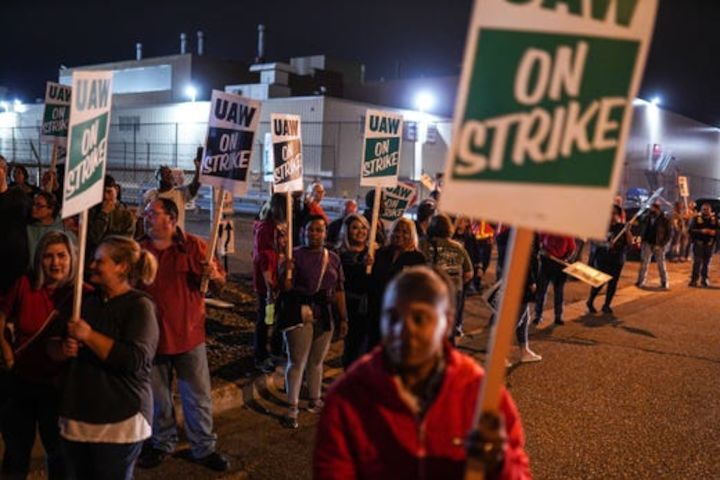
‘Fighting for future generations’: Auto workers strike against GM

Sept. 18 — Almost 50,000 members of the United Auto Workers union walked out against General Motors on Sept. 16, shutting down 55 factories and parts plants across the U.S. It’s the largest strike in the country since a two-day walkout against GM by the UAW in 2007.

GM was bailed out by the federal government with $11 billion in taxpayers’ (that is, workers’) money in 2009. Since then, the company’s profits have rocketed — GM made $8.1 billion in 2018 — but union workers, who were forced to make concessions in previous contracts, have not seen any benefit as a result. 

Instead, the company’s unionized workforce has fallen from 73,000 at the time of the 2007 strike to less than 50,000 today. Meanwhile, the auto giant relies increasingly on “second tier” temporary workers, who earn less and have fewer benefits than full time union members. Some of these “temp” workers have been employed up to six years in the same position.

Last year, GM CEO Mary Barra announced that the company was cutting an additional 15,000 jobs and closing five factories as it moves more work abroad. In contract negotiations, the company is also trying to force union members to take on more health care costs.

The strike, now in its third day, comes amidst a growing tide of worker fightback. Led by teachers and hotel workers, the number of strikes of more than 1,000 workers rose in 2018 to the highest level since the 1980s. Messages of solidarity and unity have poured in from unions representing GM and other auto workers around the world, from Brazil to Germany to Mexico.

Despite the decline in UAW membership, auto remains a strategic area of the U.S. capitalist economy, and this huge strike by tens of thousands of organized workers has the potential to take back some of the billions in corporate profits and inspire other workers — both organized and unorganized — to take action.

Contract talks are continuing in Detroit, where both the union and GM are headquartered. At issue are wages, profit sharing, pensions and “worker flexibility” — the company’s demand that workers allow themselves to be subject to dramatic shift changes and schedules, and even abruptly moved to different cities. 

But the standout issues are ending the influx of temps by turning those positions into jobs with full wages, benefits and job security, and ending the company’s assault on union members’ health coverage. 

The same issues affect workers at Ford and Fiat Chrysler. GM’s contract usually sets the standard for the other automakers.

“I work right across from a temporary employee who’s been there for two and a half years,” said striker Chaz Akers on the picket line outside the GM engine plant in Flint, Mich. “I install the passenger side headlight. He installs the driver side headlight. I make more money than he does. I have better health insurance than he does.

“It ain’t fair. It ain’t right,” said Akers. “If you’re going to pay people to do a job, pay them all the same.”

“GM works the crap out of temp workers and then throws them away,” said striker Harrison Bowyer. “I’m fighting for jobs for future generations.”

In Toledo, Ohio, striker Paul Kane described how the workers gave up pay raises and made other concessions too when GM went bankrupt a decade ago. “Now it’s their turn to pay us back. That was the promise they gave.”

While the company is losing between $50 million and $100 million a day during the strike, its bosses have deeper pockets than the union. The company is reported to have a 77-day reserve of vehicles and parts. Strikers will receive just $250 a week in strike benefits beginning after two weeks on the picket line.

Even worse, GM announced Sept. 17 that it had cut off health insurance for the strikers effective immediately, forcing the union to pick up the tab for continued coverage. It had been previously agreed that the company would continue health coverage through the end of September in the event of a strike.

“It’s unfortunate that General Motors is using current health care benefits as a way to leverage unfair concessions,” UAW spokesperson Jason Kaplan said.

Decades of high-tech capitalist restructuring and the anti-labor offensive that began with Ronald Reagan’s busting of the air controllers’ strike in the 1980s have made auto workers’ jobs and livelihoods increasingly vulnerable. The increasing use of lower-paid temp workers with no job security is an issue that affects workers across the board. 

It would enormously strengthen the auto workers’ struggle if the union reached out in solidarity to these workers and their communities, including the migrant and refugee workers who are under fierce attack by the Trump regime. In return, these workers and communities could help provide the solidarity and resources to help auto workers weather a prolonged strike.

“Ultimately, we’re just trying to get back what we’ve lost during the last couple of concessionary contracts,” said Celso Duque, a young worker at the Detroit-Hamtramck plant. “We’re trying to secure our future for the younger generations, trying to make sure our retirees still have benefits and that I’m able to retire once I get to that age.”

The writer is a member of the National Association of Legal Service Workers, Local 2320 of the UAW.

Strugglelalucha256


Call a new “Solidarity Day” against racism and bigotry!

To AFL-CIO President Richard Trumka,
Call a new “Solidarity Day” against racism and bigotry!
Defend migrants and refugees!

Over 130 years ago, the Wall Street wheeler-dealer Jay Gould declared he could “hire one-half of the working class to shoot the other half.” In 1886, Gould broke strikes on the old elevated lines in Manhattan and the Missouri Pacific railroad, now part of the Union Pacific.

The present serial bigot and sexual predator in the White House has the same desire as Gould did. Trump wants working and poor people to turn on each other and destroy everything that workers won, from social security to health safety regulations and much more.

Three days after the targeted killings of Mexican people by a white supremacist in El Paso, Texas, goaded on by Trump declaring “Stop the invasion,” nearly 700 poultry workers were jailed by U.S. Immigration and Customs Enforcement (ICE) in Mississippi. Their children were left alone, not knowing if they’d ever see their parents again. 

Many of the workers jailed in these raids were members of the United Food and Commercial Workers union. It’s not accidental that the Latinx workers had won a $3.75 million civil rights lawsuit a year before.

Retaliation via ICE raids also occurred at plants in Salem, Ohio, and Morristown, Tenn., following work-related complaints made by workers to authorities. 

ICE has became one of the biggest union busters. It forced immigrant workers to quit at a FreshDirect warehouse in Long Island City, N.Y., less than two weeks before union recognition votes were to be held in December 2007. The attempt to unionize was smashed. 

We need a new Solidarity Day

Based on a campaign from union locals, the AFL-CIO called for a March on Washington, D.C., on Sept. 18, 1981, to defend PATCO, the unionized air controller workers whom Reagan fired. Close to a half million workers participated.

Just as racism, sexism against women and homophobia divide poor and working people, so too, racism and bigotry promote prejudice against immigrants. Just as no child is illegitimate, no human being is illegal.

What should be illegal is Trump putting migrant children in cages and refugees in concentration camps.

The labor movement has been under attack for more than 40 years. Automation and plant closings have cut union membership wholesale. Deregulation by the capitalist government did the same to airline unions and the Teamsters.

AFL-CIO President Richard Trumka’s own United Mine Workers has less than 40,000 members. It once had 600,000. It was the miners that built the mighty CIO during the 1930s.

But the labor movement is like an uncoiled spring with vast amounts of potential energy. Millions of workers want union protection, pay and benefits. Teachers in West Virginia and around the country have been leading the way; and Mississippi poultry workers have been standing up. 

Corporate CEOs and their tool, Donald Trump, want to smash any organizing drive. Now is the time to organize a major show of workers’ solidarity against Trump’s offensive. We urge the AFL-CIO to call a national march, whether at the border, in Mississippi or in Washington, to say “No!” to Trump and racism.

We remember the wonderful union song and battle cry first popularized by coal miners in Harlan County: “Which side are you on!” We ask the officials of the AFL-CIO, President Richard Trumka and all of the other unions, that question: “Which side are you on?” The time to fight and defend migrants and refugees is now! An injury to one is an injury to all.

Strugglelalucha256


‘We are not robots!’ Amazon workers and their supporters stage strikes and protests worldwide

Shakopee workers lead the way

On Prime Day, Amazon’s so-called bargain shopping days, Shakopee, Minn., workers conducted a strike despite major intimidation tactics by the company. 

Bosses, police and “loss prevention” specialists lined the entrance and exits. Workers were told that the work stoppage would be taken out of their unpaid time off allowance. Amazon workers risk being fired if they go beyond their 20 hours a quarter of unpaid time off regardless of the reason.

Nevertheless, dozens of mostly East African workers held the first U.S. Prime Day work stoppage on July 15, 2019! 

Hundreds of supporters turned out to support and greet them. 

Passing trucks honked in agreement and some turned away. Captain Michael Russo, a pilot with one of the Amazon contracted carriers, from Teamsters Local 1224, spoke in solidarity. Tech workers representing Amazon Employees for Climate Justice came from Seattle, where a simultaneous protest was held. Two hundred of these workers wrote messages of support.

Kim Hatfield, a Texas Amazon worker who lost her job after a stress injury caused by production rates, flew to the Shakopee rally in support.

Sharo Shariff, a Shakopee Amazon worker, exclaimed to cheers: “We are here because we are human. We are not robots!”

The primary issue that has propelled the workers into action is the highly exploitative production rates that are almost impossible to perform. As workers have described, Amazon expects human beings to keep up with the pace of robotics, which has earned the slogan: “We are not robots!”


 For a description of production rates see An Amazon worker tells all, Part 2: 21st century exploitation


The Prime Day protest was backed and organized by the Atwood Center, which primarily represents the East African Muslim community, the largest percentage of workers at this fullfillment center. In fact, Amazon recruited heavily from Minneapolis’ neighborhood of Cedar-Riverside, nicknamed Little Mogadishu.

The Atwood Center has support from the Service Employees International Union (SEIU) and the Council on American-Islamic Center (CAIR). The Teamsters have also lent support.

Their organizing began in 2017, when Amazon cut funding for direct bus service to the warehouse and workers collected petitions to restore the service. While they didn’t win this initial battle, the Atwood Center and the workers took up several very successful campaigns to force Amazon to provide proper breaks and prayer rooms during Ramadan, an important religious period for Muslims.

Ramadan fell during the 2018 Prime Day, and many of the workers were afraid that the brutal production rates would become impossible for those fasting. As a result of protests, management agreed to prayer rooms and temporarily lowered quotas. This was a small but also a large victory, since it was one of the first times that Amazon bosses negotiated with an organized group of workers.

Protests in the U.S.

In Portland and Hillsboro, Ore., workers at two different warehouses held protests during the July 15th week against working conditions. Complaints have been filed with the Occupational Safety and Health Administration for safety violations: primarily dust, vehicle emissions and heat. Workers described the deafening noise and the breakneck pace of trucks and vehicles lined up to be loaded.

At Chicago’s DCH1 warehouse, a group of about 30 Amazon workers gathered in management’s offices to put forward demands for air conditioning, health insurance and $18 an hour for work during Prime Days.

Demanding Amazon end enabling ICE

Along with supporting the strikes and work actions, supporters also protested at Amazon offices, warehouses and even Bezo’s $80 million condo on Fifth Avenue in New York City to demand that the billionaire halt the providing of facial recognition technology to U.S. Immigration and Customs Enforcement (ICE). Recently, Amazon announced its decision to provide the intrusive facial recognition software to ICE, a technology globally recognized as a human rights violation. Right before Prime Day, hundreds of protesters gathered at the Javits Center to call for an end to Amazon’s contracts with ICE. 

In San Francisco, over 100 protesters gathered at Amazon’s downtown offices to present 270,000 signatures on petitions demanding that Amazon end this practice. Groups participating included Mijente, Daily KOS, Bay Area Resistance, Jobs with Justice, SF Rising and the Peoples Alliance. Instead of accepting the petitions, Amazon’s management ordered police to block the entrance.

In Baltimore, Amazon workers, youth and community activists rallied at City Hall to support the Shakopee workers and to announce a two-fold campaign: one to continue to gather signatures to demand Amazon stop enabling ICE raids and the other to demand justice for Amazon workers. 


A former Amazon worker, Steven Ceci, explained that “exploitation at Amazon is a community issue, it’s a civil rights issue, and it’s a worker’s issue.” Ceci is from the People’s Power Assembly and part of the newly founded Workers and Peoples Union. Another Amazon worker explained that the group’s purpose was to provide the kind of community support to buoy workers in their fight for justice. The group has been petitioning and distributing flyers at Amazon’s bus stops.

The online tech journal and blog The Verge published a piece on how the Baltimore Amazon warehouse fired 300 workers as a result of workers not being able to keep up with the grueling rates of production. 

Baltimore activists have described the Amazon’s Baltimore and Maryland fulfillment centers/warehouses as “a meat grinder,” which lures workers in with a slightly higher pay rate than other similar jobs in the area, but ends up as a revolving door for workers with a huge turnover rate. 

Worldwide workers strikes and protests

German workers

Amazon workers represented by the German union Verdi held strikes in Werne, Rheinberg, Leipzig, Graben, Koblenz and Bad Hersfeld. Orhan Akman, from Verdi, stated, “While Amazon throws huge discounts to its customers on Prime Day, employees lack a living wage.”

More than 2,000 workers participated in the German strikes.

Protests and work actions were also held in Britain, Ireland and Spain.

Beacon for the future

The strikes and protests during Prime Day are a small but serious beacon for the future. The courage of the East African Shakopee workers, who acted without a union contract to back them and in an atmosphere where union membership has dropped to a mere 10 percent in the U.S., has lit the spark. 

Much more must happen to keep the flame burning, but it behooves everyone to join this fight. Bezos may be the richest person in the world. Amazon may be seemingly all powerful. But the Amazon workers globally outnumber all of their bosses, and when their power is organized, nothing will be able to stop them. 

In the words of the famous Jimmy Cliff reggae song, “The harder they come, the harder they fall, one and all.”

Strugglelalucha256


Bringing back child labor

The capitalist drive to turn back the clock includes bringing back child labor. The wealthy and powerful want to return to the “good old days” when millions of girls and boys were exploited in farms, mines and sweatshops.

Between 1890 and 1910, 18 percent of all children between 10 and 15 were employed. Many were kept out of school.

Over a quarter of the nearly 100,000 Southern textile workers in 1900 were under 16. By 1904, the number of child textile workers had doubled, to reach 50,000, at least twenty thousand of them under 12.

Glass factories in East St. Louis, Ill., used “boy getters” who possessed the small, nimble fingers needed to wash bottles. Youth were taken from orphanages from as far away as New York City.

To paraphrase the unjustly imprisoned activist Imam Jamil Abdullah Al-Amin — then known as H. Rap Brown — “Child labor is as American as apple pie.”

On every plantation, enslaved African children worked from “no see” in the morning to “no see” at night. They were whipped like their parents and their labor made the ruling class rich.

The acclaimed musical “Hamilton” doesn’t mention Alexander Hamilton’s 1791 report on manufacturing that said children “who would otherwise be idle” could be a cheap labor source.

Child labor: “a gift our kids can handle”

The May 6 Washington Post reported on the drive to bring back child labor:

“President Trump’s now-withdrawn nominee for the Federal Reserve Board, Stephen Moore, came under fire for suggesting the repeal of child labor legislation. During a panel on the minimum wage at the 2016 GOP convention, Moore said: ‘I’m a radical on this. I’d get rid of these child labor laws. I want people starting work at 11, 12.’ …

“During his 2012 presidential campaign, former House speaker Newt Gingrich advocated for relaxing ‘truly stupid’ child labor laws and employing children as school janitors. In 2016, the Acton Institute, a conservative nonprofit that received donations from Education Secretary Betsy DeVos, called child labor ‘a gift our kids can handle.’ Earlier this year, an Indiana Republican state senator wrote a bill to weaken child labor regulations, while the Trump administration recently moved to weaken protections of child laborers working in agriculture.”

In 2011 and 2012, four states lifted restrictions on child labor.

Last year, Trump’s Department of Labor sought to weaken safety rules and allow 16 and 17-year-olds to operate hazardous machinery like chainsaws.

The labor movement fights for children

It was the labor movement that largely eliminated child labor. The legendary union organizer Mother Jones declared, “Some day, the workers will take possession of your city hall, and when we do, no child will be sacrificed on the altar of profit!”

Industrial Workers of the World leader Big Bill Haywood wrote that “the worst thief Is he who steals the playtime of children.”

In 1912, Bill Haywood and Elizabeth Gurley Flynn led a 10-week-long Bread and Roses Strike of 25,000 textile workers in Lawrence, Mass. Half of the workers at the American Woolen Company’s mills there were women between the ages of 14 and 18. Their average life expectancy was just 39 years.

Anna LoPizzo and two other strikers were killed. Forty years later, strike leader Elizabeth Gurley Flynn would be sent to prison under the anti-communist Smith Act.

Against the backdrop of a rising labor movement and nearly a million votes cast for Socialist Party presidential candidate Eugene Debs in 1912, even Congress was forced to act. But both the Keating-Owen Child Labor Act of 1916 and the 1919 Child Labor Tax law were declared unconstitutional by the Supreme Court.

The judges apparently agreed with the head of the National Association of Manufacturers, who declared that child labor laws were “a labor union plot against the advancement and the happiness of the American boy.”

The working-class upsurge of the 1930s swept away this opposition. When autoworkers seized the GM plants in Flint, Mich., they were also fighting against child labor. So were the thousands who demonstrated repeatedly to save the lives of the Scottsboro defendants.

These struggles led to the passing of the Fair Labor Standards Act of 1938, which largely outlawed child labor. Yet even today a half-million children work in agriculture.

Farms and ranches accounted for over half of the children killed while working between 2003 and 2016.

As outrageous as the proposals are to bring back child labor, it’s a mistake to think that it can’t happen. Trump already steals children from their parents and puts them in cages.

The only thing that will stop them is struggle and more struggle. As Frederick Douglass wrote, “Without struggle there is no progress.”

Strugglelalucha256


May Day 2019

May Day celebrations this year marked the many struggles that working people are waging against endless U.S. wars, both internationally and here, against workers facing militarized police and U.S. Immigration and Customs Enforcement.

But the celebrations also remind working and poor people who march together that they are the many who uniquely hold the potential power to change this system. Many of the demonstrations dedicated the day to building solidarity with Venezuela fighting U.S. imperialist attacks.

Los Angeles

The sentiment defending Venezuela and socialism was echoed at MacArthur Park near downtown Los Angeles, where the theme of community groups and groups independent of the Democratic and Republican Parties was “Fuck Trump! No wall! No war! Defend socialism!”

The event was initiated by Unión del Barrio, with participating organizations including MEChA de UCLA, United Electrical Workers (Local 1018), Frente Indígena de Organizaciones Binacionales (FIOB), Association of Raza Educators (ARE), the Socialist Unity Party, United Teachers Los Angeles (UTLA), BAYAN USA and Homies Unidos.

Almost all the speakers talked about the need to defend Venezuela and to fight against the many injustices of capitalism. They also pointed out the role of the Democratic Party in enabling Trump’s white supremacy and push toward war, calling for no reliance on corporate-sponsored politicians.

Earlier in the day, primarily major unions in Los Angeles and non-profit organizations with some community organizations held a rally and march starting at 3 p.m., also at MacArthur Park, with anti-Trump, pro-migrant themes. The Socialist Unity Party and Struggle for Socialism-La Lucha por Socialismo also tabled at this event, passing out papers and flyers on upcoming activities and gathering names of those interested in subscribing to the paper or attending meetings at the Harriet Tubman Center for Social Justice.

— John Parker

Baltimore

Labor activists in Baltimore dedicated their annual May Day activity to showing solidarity with the effort of nurses at Johns Hopkins Hospital to form a union.

The rally was called by the Baltimore Central Labor Council, AFL-CIO. Members of many unions came to demand that Johns Hopkins Hospital reinstate a nurse who was one of the leaders of the organizing efforts to establish a local chapter of the National Nurses Association.

Vivian Obijekwu was fired in February over so-called infractions. The reality is that this was an attempt by the hospital administration to try to break the will of those fighting for a union. The termination is even harsher given the fact that Ojibekwu is now 5 months pregnant.

At the noontime rally, attendees lined the sidewalk in front of the East Baltimore campus of the hospital. Each person held part of a block-long red cord to which was attached petition sheets containing the names of hospital staff who support the call for reinstatement.

After several speakers addressed the crowd, they marched to the front of the hospital to confront the hospital director. There, they were met by hospital security who restricted the number of people who would be allowed inside to five. Those allowed inside carried boxes of petitions that totaled 22,165 signatures demanding she be reinstated.

The petitions were given to hospital management representatives. This organizing drive is one of the many that have been initiated at the East Baltimore campus over nearly a decade. The hospital is one of the largest employers in Baltimore city and the overwhelming majority of its employees are not unionized.

— Andre Powell

New York

Struggle-La Lucha activists answered the call of the December 12th Movement, a revolutionary Black organization, for an emergency protest against the latest U.S. coup attempt in Venezuela. The action, near the United Nations headquarters in Manhattan, embodied the fighting internationalist spirit of May Day.

Carrying large Venezuelan, Haitian and Black Liberation flags, and signs denouncing U.S. imperialism, this Black-led, multinational protest marched on the U.S. Mission to the U.N.

“We’re doing what we’re supposed to do today,” emphasized D12’s Omawale Clay. “The Venezuelan people are in the streets defending President Maduro and the Bolivarian Revolution. And we are in the streets to support them.”

Steve Millies spoke on behalf of Struggle-La Lucha. He denounced the Trump-Bolton propaganda that is attempting to revive the imperialist Monroe Doctrine in their campaign against Venezuela, explaining how it was used to justify terror against nations and peoples throughout the Americas.

SLL attended several other May Day actions held across New York, including a march for immigrants rights organized by Filipino organizations in Queens, a 200-strong rally to support laundry workers in East Harlem, and multi-issue marches targeting Trump buildings on Wall Street and Midtown Manhattan.

— Greg Butterfield

Oakland, Calif.

Thousands rallied and marched in Oakland, Calif., to mark International Workers Day 2019. As was done last year and years before, International Longshore and Warehouse Union, Local 10, shut down the city’s port in observance of the day.

Earlier, the Alameda Building Trades Council led a rally to commemorate May Day and push for unionized jobs in the city.

That rally was followed by a march downtown with teachers, and union and social justice activists led by ILWU Local 10. The march began at the Howard Terminal and then marched to block the Port of Oakland headquarters.

Clarence Thomas, a retired longshore worker and ILWU spokesperson, told Struggle-La Lucha that he was marching and rallying on May Day to help protect union jobs and also to oppose the proposed the Oakland A’s baseball stadium and condominiums scheduled to be built at the Howard Terminal located at the port.

Thomas said: “This could create job losses and increase the drive toward gentrification in West Oakland. In addition, building on a maritime facility violates current restrictions, specifically the Public Trust Protections for State Tidelands, which includes waterfront property. John Fisher, who owns the Oakland A’s, is attempting to get exemptions so he can have a pass on environmental obligations. … When a billionaire can get away with building a ballpark at a location that threatens the economic engine of northern California, it’s a sterling example of the crisis of capitalism.”

San Diego

In San Diego, there was a combined march co-hosted by the San Diego-Imperial County Central Labor Council and a number of grassroots community organizations that had combined as the May 1st Planning Committee. This committee included the San Diego branch of the Socialist Unity Party, Unión del Barrio, the Association of Raza Educators, the San Diego Committee Against Police Brutality, the Free Mumia Coalition, the Friends of Leonard Peltier, the Peace and Freedom Party, the Party for Socialism and Liberation, the Palestinian Youth Movement, the San Diego Education Association, the California Teachers Association, the Otay Mesa Detention Resistance, the Migrant and Refugee Coalition, Indivisible and the Democratic Socialists of America, among others.

The Labor Council marched across the downtown area to the Sempra Energy building. Union speakers were heard at both the start and end of the march. The union leaders reminded those gathered of the history of May Day as International Workers’ Day and talked about local union struggles and victories, including the ongoing struggle for fair wages and better health care benefits for the employees of Sempra Energy’s San Diego Gas and Electric Company.

At the Sempra Energy building, the community organizations took over the march and continued to Chicano Park in Barrio Logan. Throughout both legs of the march, chants of “Union power!” “The people united will never be defeated!” “When workers’ rights are under attack, we say stand up! Fight back!” “Hands off Venezuela!” and “¡Vive la revolución bolivariana!” were heard.

Speakers from the community organizations spoke of the need to fight for the rights of working people for affordable housing, quality health care and education; to be protected from police brutality, police killings, Immigration and Customs Enforcement and Border Patrol raids on the community at schools, hospitals, courts and places of work; the unjust policies of this administration against immigrants and asylum-seeking refugees at the southern borders; stopping the attempted coup against the legally elected government of Nicolás Maduro; ending the illegal sanctions against Venezuela and the illegal seizure of Venezuelan assets; ending the ongoing attacks and threats against Cuba and Nicaragua in an attempt to enforce the Monroe Doctrine; and ending the militarization of local law enforcement at the borders.

The second march was characterized by organizations that have waged militant political struggles against racist police brutality and imperialist war. This was laid out in a press statement from the coalition written by Socialist Unity Party member Gloria Verdieu stating: “Workers and the poor around the world must join across false barriers to build a new world where life is more precious than profits. Workers must unite to abolish capitalism and its poverty, and imperialist wars and oppression. Build socialism!”

As the marchers proclaimed, “Long live the international workers’ struggle, which has no borders, and for a just and socialist world!”

— Mary Lou Finley

Strugglelalucha256


An Amazon worker tells all

There are few things that illustrate the ethical bankruptcy of capitalism as much as Jeff Bezos’ obscene amassed wealth. Bezos is the richest person in the world, raking in $236 million a minute, with a net worth of $153-plus billion. His world empire is built on the backs of a brutally exploited workforce, wrested from the communities in which Amazon operates.

To put this into context: it would take $20 billion to end homelessness; $30 billion to end world hunger. If Jeff Bezos had $50 billion less, he would still have another $100 billion. The question is, how many pairs of shoes can one wear, how many yachts can one sail on, how many houses can one person live in? The absurdity is obvious.

If you think that Bezos’ wealth trickles down in the form of taxes that provide services, note that this year Amazon paid $0 on $11.2 billion in profits and received a $129 million dollar return.  

How do we fight back?

No one can deny that it has been a difficult period for working-class struggle. Workers are forced to compete with each other globally, which has lowered wages and disempowered workers. If autoworkers complain in Detroit, auto bosses threaten to move to Mexico or to some other place where labor costs are lower. To make matters worse, giants like Walmart, FedEx and Amazon seem to have endless resources to thwart unionization.

We have also seen decades of defeats for unions to the point that union membership has dwindled to 10.7 percent, with the private sector dropping to 6.4 percent, leaving younger workers with little understanding of what being organized means.

As painful as this is, we shouldn’t despair, as these same dynamics have opened up incredible opportunities. We should look at the opportunities.

There are now approximately 351,000 Amazon workers worldwide and 280,000 in the U.S. alone. These figures are growing every day and are already out of date.

There are thousands of Amazon warehouse workers laboring under one roof, part of the logistics supply chain, making the power potential enormous. The “just-in-time” and “lean production” methods that now dominate the supply chain can give us the upper hand.

While technology has created a global working class, it has also opened up the means to organize and communicate worker-to-worker on a worldwide basis.

That process is beginning.

Amazon is unionized in many of the European countries, and workers’ strikes and struggles crossed borders in this past year. On Nov. 23, 2018, “Black Friday,” Amazon warehouse workers went on strike and held protests in Germany, Spain, Italy and the United Kingdom under the slogan of “We are not robots.” Amazon workers from Poland have organized with German workers.

The following are modest proposals:

National Union Coordinating Council for Amazon Workers

There are many unions, which to their credit are looking at unionizing or representing Amazon workers, including the Retail, Wholesale and Department Store Union, the Teamsters, the International Longshore and Warehouse Union, the Service Employees International Union, the American Postal Workers Union and the Communication Workers of America. (There may be others that I have left off or some on this list who are not currently actively engaged.)

What’s needed is a “National Union Coordinating Council” that includes all interested unions and the AFL-CIO leadership. Sectarian interests have to be set aside so that those who are committed can share resources, build adequate funds, engage in public campaigns and work jointly both nationally and locally.

An organized Amazon could revive the union movement and reverberate in all sectors, and no one union, whatever its size, can do it alone.

It’s a big job for those of us who are community members and Amazon workers to convince the unions, but it’s an important challenge.

Organize “Workers and Community Unions”

While the traditional trade union movement remains an important tool for workers, we should look for every avenue possible to advance workers’ power.

The Somalian workers demanding justice in Shakopee, Minn., outside of Minneapolis, are an exciting example. Through the Atwood Center, which represents East African workers, and with community support, they staged protests and successfully forced concessions from Amazon. The workers and the Center have led several protests and more recently, on March 10, 2019, a three-hour strike of workers in the stow department.

This was preceded by campaigns in Seattle, which set the stage for public pressure, most notably by Bernie Sanders, that led to Bezos’ announcement of raising wages to $15 an hour. Recently, widespread community protests in New York City against the building of a second Amazon headquarters forced Bezos to cancel the plans. Protests were aimed at making Amazon accountable to the community.

What are some of the concrete challenges in the Baltimore warehouses? Why would a community approach that is aimed at these workers be helpful, maybe more than any other at this point?

First, Amazon is largely a revolving door when it comes to workers; thousands of its workers are precarious, cycled back and forth between the community and seasonal work. You can ask almost any working-class family in Baltimore, and they have a relative or know someone who has worked at Amazon or is working there now.

At one warehouse, high school students worked the all-night shift, so that they could attend school during the day. The work is brutal, and it’s also common for people to work several months or even less before being forced to quit. Write-ups for failure to make production rates are done to weed out slower workers.

It makes exploitation at Amazon a community affair. The advantage of communitywide organizing is three fold: one, it serves as general education and organization; two, it provides the necessary rock-solid support that can encourage struggle inside (We’ve got your back!); and three, it harnesses broader working-class power against Amazon.

Finally, it may just be this kind of experimentation that revives a new chapter in working-class organizing in the U.S. Remember the heroic “Rising of 20,000” young women garment workers in 1909. Before this general strike, it was thought that women were incapable of being organized. And don’t forget the sit-down strikes, a new tactic that turned the labor movement upside down and paved the way for industrial worker organizing.

My appeal to youth

There is a whole new generation of youth who have turned against capitalism as a viable system precisely because it has offered them nothing. Many of them see themselves as socialists and some as revolutionaries.

Think of getting a job at Amazon!

If you can commit to staying and doing the patient work of organizing even better. But at a minimum, an Amazon warehouse job will give you the kind of education and understanding of exploitation that’s better than any textbook can do alone. It will increase your ability to empathize with and understand other workers. It will teach patience, humility and respect.

There are lots of mistakes that we will all make, of that I’m sure, but there is no simple road to changing the world and no way to do it without the working class.

The series “Eyewitness Amazon” was written by Sharon Black, a former Amazon worker.  The series began while the author was working but the conclusion was written after she was forced to resign as a result of several write-ups for failure to make production quotas in the “picker department.”

Strugglelalucha256


Teachers and communities unite to win

March 2 — After seven days on strike, members of the Oakland Education Association (OEA) have reached a tentative deal in what seems a resounding victory! A vote to ratify the deal is scheduled to take place on Saturday, March 2.

According to OEA’s website, where more detailed information is available, the offer includes an 11 percent salary increase over four years, a 3 percent bonus, more focus on retaining teachers (Oakland has a very low retention rate of teachers because of the astronomical cost of housing.), lower classroom sizes, a five-month moratorium on the planned closure of 24 Oakland schools, a moratorium on the growth of charter schools and other advances.

Oakland’s school board could only have been stunned by the energy, militancy and widespread support demonstrated during the strike. They have been trying to meet to discuss $20.2 million in budget cuts for the next school year, but board members were blocked from entering the building by union members and the board had to postpone their budget ax meeting twice. Charter school workers sent messages of solidarity and joined the picket lines. Thousands of students marched through Oakland in solidarity with their teachers.

The demands in the Oakland strike were very similar to those in the strike that took place in Los Angeles in early January: salary increases, smaller classroom sizes, more nurses, counselors, librarians and other support staff, and more oversight of charter schools. All of the demands are linked to the growth of charter schools, which draw funds away from public education budgets, yet are not subject to regulation and oversight that defends equality in education. As charters have become more prevalent, public education budgets have been starved for funds and have lost students and other staff.

The current and ongoing series of teachers’ strikes nationally in 2018 and 2019 began with a February 2018 teachers’ strike in West Virginia. West Virginia teachers were among the lowest paid in the country. The strike was initially unauthorized; in other words, it started as a wildcat strike. The odds against successful labor actions in a right-to-work state are stacked heavily in favor of the bosses. Politicians and the courts have progressively confined workers’ ability to organize inside a restricting fence of legality. Year after year, the fenced in area gets smaller and smaller, and that has been especially true in so-called right-to-work states. It wasn’t entirely expected that West Virginia teachers would win, but they did. They won a 5 percent wage increase for all public employees in West Virginia. Their strike did something else that was unexpected, too. It raised awareness nationwide about the growing exploitation of teachers and other education workers, and about the defunding of public education. Their struggle made people more aware that as the giant capitalist economy in the U.S. has transitioned from an industrial economy to a service economy, what was supposed to be one of the high ideals of capitalism — public education — is being thrown overboard as part of the broad corporate offensive against unions, an offensive that has continued for decades.

Even more importantly, it also reminded workers that when we fight back — we win! By the summer of 2018, teachers’ strikes had broken out in Oklahoma, Washington, Arizona, Kentucky, Colorado and North Carolina. Among those states only Colorado is not a right-to-work state. Each strike yielded at least a partial victory, and even in states where there weren’t strikes on the horizon, state governments noticed that the militancy was spreading. Arkansas, New Mexico, Maryland, South Carolina and Louisiana are among states in which increases in funding for teachers’ salaries have happened or are likely to happen.

Teachers have continued fighting back in 2019 with a January strike in Los Angeles in which it became clear that they were striking for their students and to defend public education as much as to defend their rights as workers. Agreement on salary was close near the beginning of the strike, but the negotiating team held out for more funding for badly needed librarians, counselors, lower class sizes and reduced testing. The strike ended with a gain on almost every demand, including a salary increase, more money for support staff, class size reductions and a cap on charter schools. Los Angeles has the highest number of charter schools — 274 — in the country.

On Feb. 11, after 15 months of negotiations, 2,000 members of the Denver Classroom Teachers Association (DCTA) struck. Colorado’s teachers are among the lowest paid in the country, earning an average of $46,155 in 2016, so salary increases were a major issue.

After just three days on the picket line, DCTA won a pay increase of 11.25 percent and cost of living increases in the future for all public education staff. They also won a new promotion system based on seniority, experience and training that was an answer to a bonus system that was based on “merit.”

WV teachers act: Bad law? It shall not pass!

In an interesting twist in the teachers’ 2018/2019 strike timeline, soon after the victory in Denver, teachers in West Virginia came to the forefront again. This time, an issue that didn’t exist in West Virginia at the time of their strike one year ago sparked another walkout, and West Virginia teachers turned the tables on bosses and politicians, who are accustomed to have the courts and legal system at their disposal. Teachers soundly defeated a bill working its way through the state legislature that would have legalized charter schools in West Virginia — sweetened by an additional 5 percent salary increase for teachers. The Feb. 20 Washington Post reported on the reaction to the offer of a 5 percent salary increase: “Teachers are willing to forsake their raises for the proposition that public education must be protected and that their voices must be protected,” said Randi Weingarten, president of the American Federation of Teachers, who went to Charleston, W.Va., for the strike on Tuesday. “I am done being disrespected,” said Jessica Maunz Salfia, who teaches at Spring Mills High School in Berkeley County, W.Va.

Charters have been legalized in 43 states and the District of Columbia, but are still not legal in West Virginia. Unions representing public school workers have lost a lot of membership over the years as both Democratic and Republican politicians have jumped on the “school choice” bandwagon.

How did the workers turn back this legislation? Did they send a team to lobby some politicians who were on the fence? Did they offer to concede on some other issue in return for support against this bill? Did they promise to canvas for some Democrat in the next primary? None of that. They walked off the job en mass in what was their second strike in less than a year. Teachers in 54 of West Virginia’s 55 counties struck and hundreds of union members occupied the rotunda of the state Capitol building in Charleston just like they did in 2018!

It was within hours of the beginning of the strike on Tuesday, Feb. 19, that the education bill was pulled from the floor. Wary of politicians’ treachery, and as if adding an exclamation point at the end of a sentence, the unions added one more day to the strike so that their message would be clear. When they were confident that the bill really was dead, the strike was called off. Then on Thursday, after they went back to teaching, the West Virginia House of Delegates and Senate passed a different bill. This one simply gave the teachers the 5 percent raise. Yes! This all really happened in a right-to-work state.

Strugglelalucha256


What was won in Los Angeles teachers’ strike

For almost two years the Los Angeles Unified School District (LAUSD) and Superintendent Austin Beutner, whose background is business and not education, had rejected proposals to invest in public schools.

They rejected the teachers’ demands for lower class sizes; rejected insuring enough full-time nurses, counselors and librarians sufficient for the needs of every school; rejected a commitment to quality education, including music, art and science — not more testing.

Instead, the district was aggressively pushing ahead plans to enable the increase of charter schools over public schools in order to defund public education in favor of private schools for the sake of corporate interests and the disempowerment of the working class. This is what the ruling class is doing nationally.

And, that is what the historic UTLA strike was about, pushing back against the attack on public education and the 97% people of color who make up the students of the Los Angeles Unified School District.

According to many teachers, the Jan. 22 contract agreement had significant gains that inspired respect for teachers. This is in spite of the fact that there were also disappointing allowances given to LAUSD and their corporate interests. The overall positive impact has encouraged teachers in other cities nationally from Oakland, Calif., to Denver to Virginia, where education workers are ready to strike as well.

Community, student, parent support

The strength of the union was bolstered by the massive community, student and parent support for the strike.

In spite of pouring rain almost every day of the strike, rallies of about 30,000 teachers were joined by thousands of community members, other unions and students. And, the strike was very visible to the community since the schools had active picket lines that community members could easily take part in or address with honking horns starting at 7 a.m.

That strength forced the district to agree to clauses in the agreement finally addressing the demand for full-time nurses, librarians and counselors. The agreement is to begin immediately by covering about half of the need this year and then completing coverage next year.

After seeing the tremendous outpouring of solidarity for the teachers, the mayor intervened, attempting to avoid a longer strike, one which could affect his political aspirations.

“There were some real disappointments due to fears causing a lack of militancy on the part of the union leadership. But, overall and in terms of making progress that we will continue to build on, this was a victory,” said Ron Gochez, a longtime United Teachers Los Angeles member and teacher who’s also a part of the organization Unión del Barrio, which has many members in UTLA and played a major role in raising community support for the strike.

Assistance to immigrants

Gochez mentioned an example that especially helped the community: forcing the district to agree to assist migrants threatened because of their immigration status. The agreement specifies that the district must provide “at least one attorney and necessary support staff to address immigration related concerns … and coordinating legal support from local organizations already doing this work.” This support includes a hotline for students and families facing the threat of deportation.

Another gain in the new contract is the elimination of the clause in the past agreement with LAUSD that did not allow a cap on class sizes. The union leadership refused to back down from the demand to eliminate Section 1.5 of Article 18 of the previous contract, in spite of threats to end negotiations.

An additional gain seen by many teachers is the creation of 30 community schools in “high need areas,” run primarily by local leadership made up of community and UTLA members — leadership that includes having a say on the budget for those schools, where usually it is just the principal and the district who determine budget and school policy. This will have a profound effect, especially on Black and Brown communities in Los Angeles.

Threat of charter schools remains

However, the danger posed by charter schools and co-location schools that share the same space with public schools is still a serious threat to public education and the right of students to quality education.

“We want to get rid of them completely,” said Gochez regarding charters. “They are a cancer and every penny spent on charters is a penny taken away from public education.”

In relation to co-location schools, Gochez mentioned how these schools leach off of the money spent by public schools in terms of sports, libraries and more. They do this when charter students use these services but the charter pays little to maintain them.

“Co-location charters are a cancer and also a vulture. If enrollment at public schools goes down, they try to take those rooms,” Gochez said.

In addition, the classroom size, librarian and counselor additions — although in a much better position of being implemented in the schools than before this contract was signed — can be sabotaged if LAUSD forces UTLA into a grievance procedure regarding those agreements.

These disappointments may be why, according to Gochez, about a quarter of the teachers didn’t vote at all, and about 19 percent voted no.

“This is significant. … We didn’t get everything we wanted, but it was a step toward progress.” In terms of what the district was first offering, originally it included no caps on class sizes or guarantees of nurses in the schools and offered only a 2 percent wage increase, but they were forced to raise that to 6 percent.

“I think if we held out for another week, we may have been able to get more, but now we just need to keep on fighting,” Gochez continued.

Labor unions strengthened

When considering how unions in general have been on the defensive and, like in this situation, up against billionaires fighting for privatization along with a ruling class that nationally sees educating our working class as an impediment to profits and control, the fact that UTLA held a strike resulting in an even more united force with the community — one that received national respect — means that any attacks or backsliding on the part of the billionaires, their politicians and LAUSD will be met with a now much stronger ability to fight back.

Another lesson of this strike concerns a glimpse into the future. Socialists always talk about taking the means of production away from the ruling class billionaires so that the working class can make the vital decisions concerning people’s lives and children’s lives.

Imagine if it were the teachers who decided how much would go into public education — would their concerns be just about themselves? Although teachers don’t make nearly enough, especially when considering that they reach into their own pockets to make up for the lack of funds in teaching their students, buying pencils and teaching aids and more, what was heard the loudest from them was about the needs of the students and the communities they live in.

Who is more qualified to decide the fate of our children — those that put students’ concerns first or those that represent Wall Street’s interests, like Austin Beutner the superintendent of the Los Angeles Unified School District?

Let’s let Gochez illustrate this with his talk at a press conference during the strike at the Dr. Maya Angelou Community High School, where he teaches:

“We have the parents, students and community leaders here because they know this cause is righteous. We understand that this fight is not just for the teachers, the librarians, the psychologists of Los Angeles. This fight is for the defense of public education at the national level. We understand that the billionaire capitalist class are hell bent on dismembering public education because public education is one of the fundamental sectors they have to destroy to keep the working class at the bottom of society. But we understand that we cannot afford to lose this battle because the future of public education, the future of the dignity and respect of our profession, the future of a decent education for our children is what’s at stake. We’re here to defend the rights of working-class people.”

Thank you UTLA and the community and students for fighting the good fight.


PDF flyer

[su_row][su_column size=”1/4″ center=”no” class=””][embeddoc url=”https://struggle-la-lucha.org/wp-content/uploads/2019/01/LAteachers_SLLJan26.pdf” download=”all” viewer=”google”][/su_column] [su_column size=”1/4″ center=”no” class=””]  [/su_column][su_column size=”1/4″ center=”no” class=””]  [/su_column][su_column size=”1/4″ center=”no” class=””]  [/su_column][/su_row]

Strugglelalucha256


Los Angeles teachers’ strike vs. school privatization

United Teachers Los Angeles (UTLA), representing more than 30,000 teachers, counselors, librarians, nurses and other school staff, waged a militant six-day strike in mid-January. They won enormous grassroots support from students, parents, the labor movement and the entire working-class community of Los Angeles. A settlement with the Los Angeles Unified School District (LAUSD) was reached on Jan. 22, and school workers returned to the job on Jan. 23.

A clear majority of teachers and school workers voted for the new contract, which includes wage increases and provisions for smaller classes, more essential staff such as nurses and counselors, reduction of standardized testing, and a community schools program meant to give more input to local residents. Read more about the settlement on the UTLA’s website.

While people are still discussing the outcome and specifics of the agreement, it’s clear that the UTLA’s strength and overwhelming community support pushed back LAUSD and Superintendent Austin Beutner, both of whom represent corporate interests determined to destroy public education. The spread of privately run charter schools that take funding and other resources from public schools — whose students are mainly Black, Brown and working class — was a major issue in the strike.

On Jan. 18, several UTLA chapters joined with Unión del Barrio for a large press conference of students, teachers, parents and community organizations at South Central Los Angeles’ Maya Angelou High School to demonstrate the broad community support for striking teachers.

Struggle ★ La Lucha correspondent John Parker spoke at the press conference, representing the Harriet Tubman Center for Social Justice and the International Action Center-West Coast. Following are his remarks:

“New Orleans is the largest nationwide experiment in charter schools — and let me tell you, it fails disabled students, it fails Black and Brown students, creating forced segregation to deny working-class children a decent education. It fails communities who’ve lost their right to local schools, so their children now must travel two hours, leaving at 6 o’clock in the morning and getting home at 5 o’clock in the evening. It fails teachers, whose unions and job skills are forced out for temporary, unskilled teaching staff.  The evidence is clear: charters and privatization of education are means to a bitter end.

“This privatization and gutting of essential school staff and programs, this denial of a livable wage for teachers, is not an accident. This is a national phenomenon reflecting the wishes of the owners of capital. And capitalism doesn’t want educated workers. As it decays, it requires cheap labor and quick profits, and quality education gets in the way of that.

“But what they require is not our concern. They can be stopped if we march, walk or roll on the picket lines side by side with teachers who have the potential to create a historic movement, like West Virginia teachers did last year when they sparked a viral movement from the South to the Midwest — a movement that benefited teachers, school workers and especially students, and inspired the imagination of our class.

“I’m a proud parent of a confident, intelligent young Black man who had his education in the LA public school system. I’ll be damned if I’m going to let some snotty-nosed, rich, privileged, self-serving representative of the owners of capital — I’m talking about Beutner now — destroy public education as it was destroyed in New Orleans.

“And I ain’t the only one. I’m a member of the Harvard Boulevard Block Club. This is my neighborhood, this is our community of Black and Brown working people united, and we’ll fight like hell to stop that destruction. We remain with UTLA, we remain with all the school workers and teachers who are defending our students’ right to a decent life that only a quality education can provide.”


Video: Firefighters solidarity with striking teachers, Jan. 22

Strugglelalucha256


LA teachers and community unite

Jan. 18 — Los Angeles shook this week. It wasn’t the shifting of tectonic plates that made the earth move, but the shifting of class forces.

Working-class people of all nationalities came out in the streets, inspired by the strike of 30,000 members of United Teachers Los Angeles (UTLA), determined to fight for the future of public education and for workers’ and students’ rights.

An old song claims, “It never rains in southern California.” This week the rain poured. But that didn’t stop students, parents, community members and trade unionists from coming out, umbrellas raised, to join picket lines and a series of mass rallies in downtown Los Angeles, targeting the Los Angeles Unified School District (LAUSD) — the strikers’ employer — and the California Charter Schools Association, a band of profiteers trying to privatize public schools by starving them of funds and space.

By Thursday, the fourth day of the strike, UTLA President Alex Caputo-Pearl reported that 15,000 parents had signed in to join morning picket lines at their local schools. Protests and press conferences organized by community groups, banner drops above Los Angeles freeways and a poll by Loyola Marymount University showing 80 percent support for the teachers, all offered evidence of the vast and deep solidarity with the strike.

Numerous sympathy strikes are happening and 1,000 charter school workers represented by UTLA also struck against their own private employer.

The city of Los Angeles and the state of California have some of the biggest gaps between rich and poor in the world. But it isn’t just the wealthy and powerful on the West Coast who are quaking in their fashionable boots. The reverberations are being felt as far as Wall Street and Washington — and everywhere in between.

Workers everywhere, though, are taking heart at this resurgence of school worker militancy following last year’s wave of strikes in the South and Southwestern U.S.

Inspired by the UTLA strike, teachers and students from Chicago to Richmond, Va. to Oakland, Calif., have announced plans to push forward their own struggles for higher wages, smaller class sizes and desperately needed resources.

Through it all, activists and reporters from Struggle-La Lucha have been there — joining the picket lines, talking to strikers, students and parents, and helping to organize community support.

Workers flex muscles, bosses’ unity crumbles

By midweek, cracks were already showing in the armor of the LAUSD bosses headed by Superintendent Austin Beutner.

Significantly, the number of students attending scab-run classrooms fell dramatically, down from 159,000 on Tuesday to 132,000 on Wednesday. That means only 27 percent of enrolled students showed up for classes.

One reason for the decline is that union members and supporters are succeeding in breaking through the lies and rumors spread by LAUSD through the media that students might face penalties for being absent during the strike.

“In all, the district says it has lost $69.1 million in state funding based on attendance” since the start of the strike, reported the Los Angeles Times. “Subtract the $10 million a day in wages it hasn’t had to pay its striking workforce, and that’s a net loss of $39.1 million.”

The head of the union representing school principals, Juan Flecha, urged that campuses be closed entirely because of “dire and unsafe working conditions.” And School Board member Scott Schmerelson broke ranks with Beutner, declaring, “I believe that there are resources available to end this strike.”

School Board President Monica Garcia, a staunch supporter of Beutner’s anti-union hard line, found herself confronted by more than 100 protesting students, parents and teachers who held a rally outside her home, chanting “Monica, come out!” Instead of responding to the protesters’ demand to meet with them, Garcia called the cops.

Negotiations between the union and LAUSD, which broke off on Jan. 11, resumed Jan. 19. These negotiations will include Mayor Eric Garcetti, who claims to be playing the role of mediator. However, it’s been reported that Garcetti referred to Beutner’s “strategic plan” to divide the district into 32 small units as a possible vehicle to resolution, if the union would collaborate with him.

Beutner once admitted to a group of businesspeople that this strategic plan could mean that there would be no public education system in Los Angeles by 2021. His plan to turn all education into education for profit has been clearly and forcefully rejected by the people of Los Angeles this week.

Teachers and other school workers have already won a resounding victory by bringing working-class Los Angeles into the streets in a united fight for their children’s futures. Continuing to organize our co-workers, neighbors and families to show solidarity with the strike is the best guarantee that the union will continue to stand strong in its demands and be on guard for any bad deals pushed by politicians claiming to be “friends of labor.”

Victory to UTLA and Los Angeles parents and students!

Visit Struggle-La-Lucha.org for regular strike updates, including exclusive videos, photos and interviews.

Strugglelalucha256
https://www.struggle-la-lucha.org/labor/page/16/