Union power wins: Baltimore library workers get jobs back

Library board2
Supporters of fired library workers packed the Baltimore County Public Library board meeting on Nov. 19. SLL photo: Lev Koufax

Fourteen part-time librarians at the Baltimore County Public Library received a jarring email on the afternoon of Nov. 12. BCPL leadership’s email informed them that they would no longer have jobs. The mass firing came just ahead of the holiday season and without any advance notice. 

All 14 are members of the International Association of Machinists Local 4538, which represents the several hundred BCPL workers and the staff of a nearby Apple Store. Several of those fired were particularly active members of their union. One of the fired librarians is an active union steward and member of the Local’s bargaining committee. 

Some of the fired librarians worked in the system for more than 30 years, only to be met with an undignified and sudden dismissal. These library workers provide a variety of services to the community beyond books and research. Many serve as de facto social workers, interfacing with large groups of children, the homeless, and people struggling with addiction. Luckily, the workers, their union, and the local community jumped into action. 

The outrage at the firings was immediate and passionate. Local 4538 called upon other unions and all concerned community members to flood the media with support. The Machinists’ local also urged those same people to pack the Baltimore County Council meeting and a BCPL board meeting. 

Simply from the outrage in the press and the public plans to mobilize, the BCPL backpedaled two days later and rehired all 14 part-time librarians. However, the workers still packed the BCPL board meeting on Tuesday, Nov. 19, to make sure this never happens again. 

At this meeting, Local 4538 President Anita Bass not only condemned the firing but spoke in favor of broader worker power, stating: 

“I don’t understand what any of you were thinking. We are a union. We are Machinists. We are here to protect our people. We will not tolerate intimidation, retaliation or union busting. We are also in the middle of negotiating our financial contract. How dare you fire a union member that is on the negotiating committee. Two days later the reinstatement of the part-time librarians was a result of community outcry and union power.” 

President Bass couldn’t be more correct. As Frederick Douglass taught, power concedes nothing without a demand. In the case of the Baltimore County Public Library, the workers mobilized to demand the reinstatement of their fellow library staff. Through struggle and organizing, they won that demand swiftly. Long live worker power! 

Strugglelalucha256


ILWU rank-and-file leader tells students how Local 10 led the battle against apartheid

Clarence Thomas Jr. is a retired third-generation longshore worker from ILWU Local 10, co-founder of the Million Worker March Movement, and co-founder of DeClare Publishing. In this presentation to students, Thomas told them that his activism began in 1967 at San Francisco State College as a member of the Black Student Union, which initiated the longest student strike in U.S. history to establish a Black Studies Department and a School of Ethnic Studies.

On Oct. 30, I had the honor of speaking at the University of California, Berkeley’s Department of African American Studies about a subject close to my heart: the International Longshore & Warehouse Union (ILWU) Local 10’s pivotal role in the anti-apartheid movement of the 1980s.

Longshore workers are responsible for the loading and discharging of maritime cargo on shipping vessels. The cars we drive, the clothes we wear, and the food we eat all pass through the hands of dockworkers, also known as longshore workers. ILWU longshore workers move maritime cargo at all 29 ports on the West Coast, including Hawaii, Alaska, and ports represented by ILWU Canada in Vancouver, BC. We are responsible for making the ports productive, safe, and efficient.

These workers are critical to the global economy. The hands of dockworkers move the commerce of the world, giving them enormous power through collective action. Over the years, ILWU Local 10 has taken historic rank-and-file action in support of domestic and international social justice issues. 

A tradition of international solidarity

Beginning in 1935, less than a year after the monumental 1934 West Coast Maritime Strike, Local 10 refused to load nickel and brass destined for the Italian fascist war machine ravaging Ethiopia. Shortly thereafter, members refused to load scrap iron destined for Japan. The union’s motto, adopted from the Industrial Workers of the World, is “An injury to one is an injury to all.”

Harry Bridges, one of the founders of ILWU and its first international president, said: “Interference with foreign policy of the country? Sure, as hell! That’s our job! That’s our privilege, that’s our right, that’s our duty.” He made those remarks after President Franklin Delano Roosevelt told him to stay out of U.S. foreign policy matters.

Local 10 activists refused to load U.S.-made military supplies intended for Pinochet’s military in Chile and for dictatorships in El Salvador, South Korea, and the Philippines. The positions Local 10 took against apartheid South Africa belong to this tradition spanning more than 80 years.

Understanding apartheid

Apartheid was a system of institutionalized racial segregation and discrimination in South Africa from 1948 to 1994, enforcing the political, social, and economic domination of the white minority over the non-white majority. The word apartheid means “apartness” in Afrikaans (a West Germanic language spoken in South Africa). The system is characterized by racist laws in housing, public facilities, and social events, treating non-white South Africans as inferior and stripping them of all rights.

The method of enforcement was the use of pass laws. Black South Africans had to carry passbooks that included photographs, fingerprints, addresses, the length of time the person had been employed, and other identifying personal information. Employers often entered an evaluation of the pass holder’s behavior.

As defined by law, an employer could only be a white person. The passbook also documented when permission was required to enter a certain region and whether the request was denied or granted. Urban areas were considered “white“, so a non-white person needed a passbook to be inside a city.

Under the law, any governmental employee could remove these entries, effectively denying permission to remain in the area. If a passbook didn’t have an entry, officials could arrest its owner and put them in prison. Colloquially, these passes were called the dompas — Afrikaans for “stupid pass” — a name Black South Africans used to describe the most hated and despicable symbol of apartheid.

Black South Africans often violated the pass laws to find work and support their families, and thus lived under constant threat of fines, harassment, and arrests. Protests against the suffocating laws brought the anti-apartheid struggle, including the Defiance Campaign in the early ‘50s, and the huge women’s protest in Pretoria in 1956.

My wife, Delores Lemon-Thomas, and I recently visited the Apartheid Museum in Johannesburg, where we learned of this brutal period of South Africa’s history, the injustices and hardships of people’s lives under apartheid. We also learned about people, organizations, and events that helped to end apartheid.

ILWU Local 10’s role in the anti-apartheid movement 

Dockworkers play a crucial role in shipping, a key global industry that contributed to capitalism’s emergence. These workers amass power through collective action, ideological commitment, and sheer force of will. They can deploy their power on behalf of an array of social movements in their own unions, cities, and countries, as well as beyond their shores. Such a movement was launched when ILWU Local 10 started its solidarity actions to dismantle the apartheid system in South Africa. This movement was led by leftists, both Black and white, in a predominantly African American local.

Dockworkers in Durban, South Africa, conducted work stoppages from the 1940s into the early 1970s. These actions proved to be among the most important forces against apartheid in Durban. ILWU Local 10 rank-and-filers were in the vanguard in the labor movement in the U.S. fighting apartheid. 

Sharpeville massacre

The Sharpeville massacre occurred on March 21, 1960. Some 6,000 people had gathered to protest the injustices of apartheid when police opened fire on the crowd. Sixty-nine people were killed and nearly 200 were wounded — many of them shot in the back as they fled.

Following these events, the American Committee on Africa (ACOA), the leading U.S. organization involved in South African liberation solidarity work, called for a boycott of South African goods and the enactment of U.S. sanctions in 1962. The ILWU Longshore Caucus endorsed such boycotts.

On Dec. 17, 1962, ACOA picketed the Dutch ship Raki, which arrived at San Francisco’s Pier 19 loaded with asbestos, coffee, and wool from South Africa. They sought to raise awareness of the horrors of apartheid and to encourage the U.S. to join a global boycott of South African goods.

Local 10 dockers stopped work to protest apartheid. ILWU traditionally doesn’t cross picket lines. William Bill Chester, the union’s Regional Director for Northern California, the highest-ranking African American in the ILWU, had worked closely with Mary Louise Hooper, the head of ACOA, in planning the boycott. Almost certainly, the Local 10 boycott was the first anti-apartheid action undertaken by a labor union in U.S. history.

The global struggle against apartheid surged in the 1970s. In 1976, the uprising of Black students in Soweto, despite ferocious repression, took the movement to the next level. Black freedom movements in Mozambique and Angola achieved freedom in 1975, and the armed struggle in southern Rhodesia heated up.

The freedom struggles in Africa resulted in the dramatic expansion of global solidarity in the San Francisco Bay Area. Radical rank-and-filers in ILWU Local 10 created the Southern African Liberation Support Committee (SALSC) to support these struggles. Black and white longshore workers’ efforts catapulted them to the front of the burgeoning global anti-apartheid movement. San Francisco dockworkers proved deeply committed and ultimately contributed to the downfall of white minority rule in South Africa.
Apartheirdshiip LeoRobinson

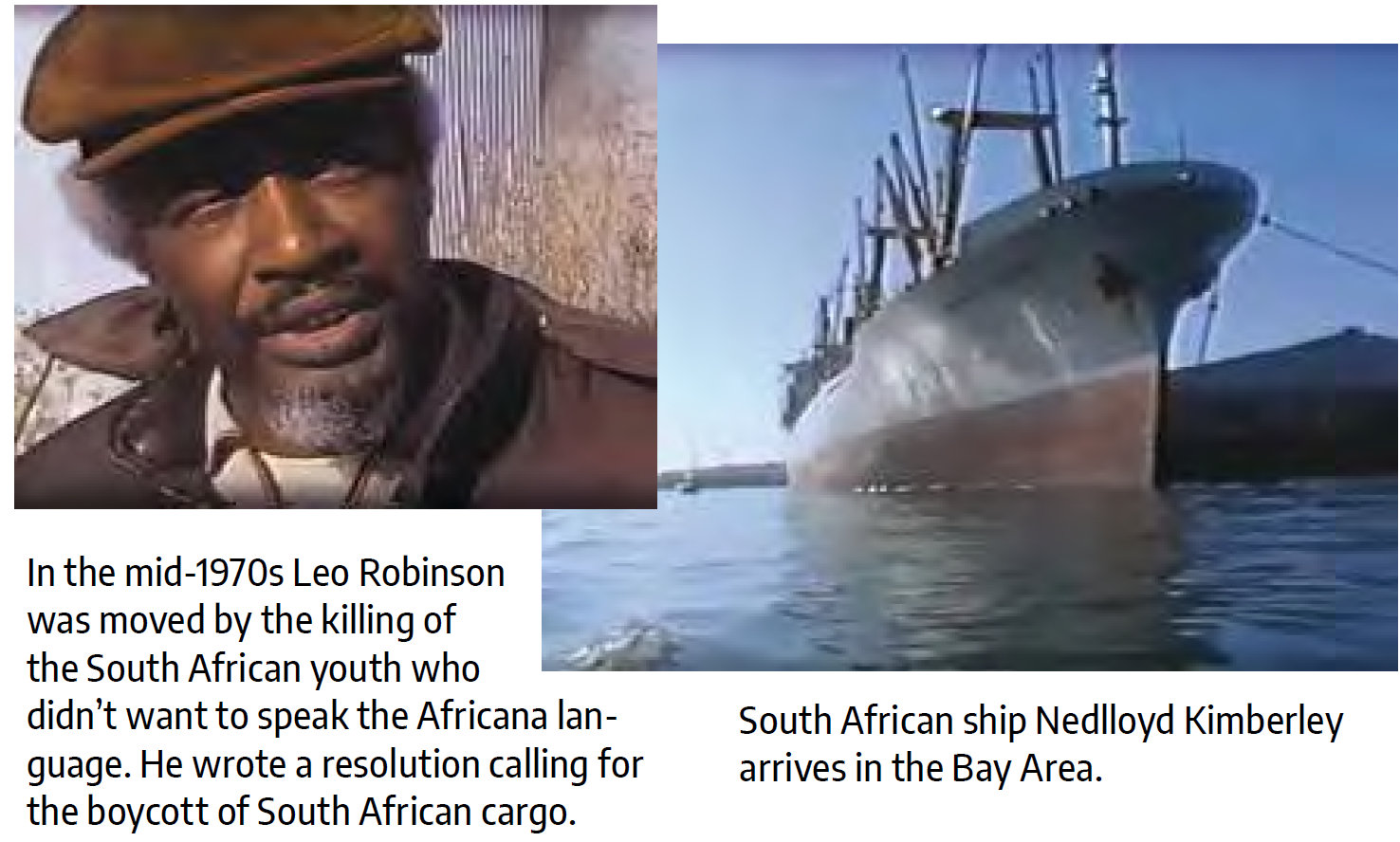
Brother Leo Robinson, an African American and communist who regularly critiqued capitalism, imperialism, and racism, became interested in South Africa during the Soweto uprising. He wrote a resolution to establish SALSC and boycott South African cargo, which Local 10’s Executive Board passed.

SALSC members included David Stewart, Bill Proctor, Larry Wright, Howard Keylor, Charlie Jones, and Leroy “Ned” Ingram — Black and white activists who were socialists or radical unionists who saw South Africans as fellow members of the global working class. They believed working-class power was strongest on the job and pushed for a boycott of South African cargo.

In July 1976, the ILWU International Executive Board issued communications to all locals regarding a boycott of South African cargo. SALSC helped Local 10 members to pass a resolution condemning the white minority governments of South Africa and Rhodesia, which had laws denying basic human rights to the Black majority of people in both nations. 

In 1977, SALSC coordinated a two-day Easter Sunday boycott of the ship, Nedlloyd Kimberley. Approximately 500 people, many from churches, cheered the ILWU members and hoisted banners. That same year, SALSC collected tons of supplies for South Africans, Mozambicans, and Zimbabweans in liberation struggles, loading two 40-foot containers with goods for African National Congress ANC exiles in Tanzania and Zimbabwean refugees in Mozambique.

ILWU activists also screened the documentary “Last Grave at Dimbaza,” secretly filmed in 1973 and smuggled out of South Africa, showing the horrible suffering of Black people under apartheid. Wright and Robinson showed the film to dozens of audiences up and down the Pacific Coast in the 1970s and ’80s, laying the groundwork for future actions.

The historic 1984 boycott

In October 1984, a screening of “Last Grave at Dimbaza” before almost 400 Local 10 members sparked the longest and most important workplace boycott against apartheid in U.S. history. A motion to boycott only South African cargo on the next Nedlloyd ship passed resoundingly.

The timing was right because a group of Black South African miners had been arrested and faced long prison sentences. Bay Area longshore workers had been educated about apartheid for nearly a decade and were primed to act in solidarity with persecuted unionists.

On Nov. 24, 1984, the Nedlloyd Kimberley arrived at San Francisco’s Pier 80 carrying South African cargo. Local 10 activists knew of its arrival thanks to Brother Alex Bagwell, an African American in the clerk’s ILWU Local 34. A sympathetic job dispatcher assigned workers committed to the boycott.

For the next 10 days, many Bay Area residents gathered daily at the pier’s gate. On Dec. 2, about 700 people, many from unions, religious groups, and civil rights organizations, rallied at the dock. Brother Leo Robinson described how, “You couldn’t get from Army and Third Street to the gate of Pier 80 because it was jam-packed with community organizations and people.” Among those who spoke were legendary activist Angela Davis and Congressman Ron Dellums, the most radical member of the House of Representatives.

As employers sought to end the boycott, dockworkers remained steadfast. The Pacific Maritime Association (PMA) proposed unloading the ship elsewhere, but ILWU locals in Stockton, Portland, and Seattle expressed solidarity by refusing to handle “hot cargo.”

The PMA then filed a federal injunction calling the work stoppage illegal. The judge declared Local 10 would be fined $200,000 per day for noncompliance. By the end of the standoff, Local 10 faced fines totaling more than $2 million. The injunction singled out Robinson and Keylor for fines of thousands of dollars a day. Local 10 officials maintained the boycott was not union-sanctioned — plausible deniability to prevent financial catastrophe.

Finally, on the 11th day, Local 10 members unloaded the South African cargo. Despite activists’ disappointment that the boycott did not expand, SALSC and Local 10 members felt they had greatly raised awareness of what could be done to oppose apartheid. Bay Area activist and photojournalist David Bacon said, “That was the real birth of the anti-apartheid movement in Northern California.”

National impact

The dockworkers’ boycott helped inspire students at UC Berkeley to expand their protests in 1985, the largest activism there since the Vietnam War. Thousands rallied, and hundreds erected shantytowns resembling South African townships, leading to repeated clashes with police and heightened public awareness. Wright and Keylor spoke at rallies with a large ILWU banner displaying “an injury to one is an injury to all.” The protests ultimately forced a very reluctant Board of Regents to divest relevant portions of its $3 billion endowment.

The ILWU embraced the divestment campaigns. In 1986, Oakland closed its account with Bank of America, which conducted business in South Africa, in the most dramatic application of the city’s rigorous new South Africa divestment ordinance to date. Bank of America lost the city’s $150 million investment portfolio and $120 million annual payroll.

Local 10 exerted influence on Representative Ron Dellums, whose father was a Local 10 member. His uncle, C.L. Dellums, was probably one of the most important Black labor and civil rights leaders in California in the mid-20th century. He was a leader in the BSCP (Brotherhood of Sleeping Car Porters), the first Black union to be affiliated with the AFL-CIO. He succeeded A. Philip Randolph as its president.

Dellums introduced a sanctions bill and joined the Washington, D.C.-based Free South Africa Movement, which in 1984 launched sit-ins at the South African embassy just three days before the Nedlloyd boycott. Local 10’s action had a national impact, perhaps never more so than when Congress, led by Dellums, overrode President Ronald Reagan’s veto and passed sanctions.

Nelson Mandela’s acknowledgment

The ILWU and the Bay Area proved so important that Nelson Mandela visited Oakland during his first U.S. tour in 1990. He spoke before 60,000 people at the Oakland Coliseum, saying: “We salute members of the International Longshore & Warehouse Union Local 10 who refused to unload a South African cargo ship in 1984. In response, other workers, church people, community activists, and educators gathered each day at the docks to express their solidarity with the dockworkers. They established themselves as the frontline of the anti-apartheid movement in the Bay Area.”

Mandela later described how this action belongs to the larger fight: “We are part of a worldwide movement. Just as we watched and learned from the continuing struggle within the United States, so too did activists there gain strength from our struggles.” That no less a figure than Nelson Mandela praised Local 10 speaks volumes about the role of unions in the movement.

In 2013, I chaired a Local 10 committee to organize a memorial recognizing Leo Robinson’s contributions to the struggle to end apartheid. I invited members of the South African Consulate General’s Office in Southern California to attend.  

Much to our surprise, Ambassador Rasool also attended the Memorial, presenting the Nelson Mandela Humanitarian Award posthumously to Leo’s widow, Johnnie Robinson. Consul General Cyril S. Ndaba presented the Nelson Mandela Freedom Award and a South African flag to Local 10. In his remarks at the memorial, the ambassador acknowledged the contributions of the entire Bay Area for its solidarity. Many activists from the anti-apartheid struggle attended.

The history of ILWU Local 10’s anti-apartheid activism demonstrates the power of international working-class solidarity. From the first boycott in 1962 to the historic 11-day action in 1984, San Francisco dockworkers proved that organized labor could be a decisive force in global struggles for justice. Their actions inspired a nationwide movement that helped bring down the apartheid regime. This legacy reminds us that “an injury to one is an injury to all.”

Peter Cole’s book, “Dockworker Power: Race and Activism in Durban and the San Francisco Bay Area,” was a contributing resource to this report. For speaking engagements or to purchase books from DeClare Publishing — “Mobilizing in Our Own Name – Million Worker March,” “Cleophus Williams – My Life Story in the ILWU, Local 10” and “The Year of Good Trouble, 1934” — visit millionworkermarch.com

Strugglelalucha256


Teamsters at a crossroads: Rank-and-file challenge takes on O’Brien’s alliance with Trump

The upcoming election for the leadership of the International Brotherhood of Teamsters — one of the largest and most powerful unions in the United States — could reshape the direction of the labor movement itself.

In November 2026, 1.3 million Teamsters will choose between incumbent General President Sean O’Brien and Richard Hooker Jr., a Philadelphia Teamsters leader who has become a leading critic of the current administration.

This election is about more than who sits at the top. It’s a fight over the union’s soul — whether it will stand with the working class or side with the bosses and politicians who exploit it.

A dangerous political turn

Under O’Brien, the Teamsters have drifted sharply to the right.

Once calling Donald Trump “our enemy,” O’Brien now praises him as “one tough SOB.” He met privately with the billionaire politician and even spoke at the 2024 Republican National Convention.

Hooker warns that this alignment “puts every working-class person in jeopardy.”

Trump, he points out, is a union buster who has cut jobs, eliminated labor protections, and attacked workers’ rights. He weakened the National Labor Relations Board and OSHA, and cheers on union-busting bosses.

O’Brien, who rose to power in 2021 as a self-styled reformer after the Hoffa era, has since courted the same corporate and right-wing forces he once criticized. His administration has shifted Teamsters’ political spending toward corporate-aligned and Republican-backed PACs.

To Hooker and many activists, this weakens labor solidarity and distances the union from the broader working-class movement.

Breaking the system of fear

The debate is also about democracy inside the union itself.

Hooker says the Teamsters have long been ruled by “a system of fear, bullying, retaliation, and intimidation” — a system that mirrors the boss’s own tactics. He accuses O’Brien of acting “like a king who expects blind loyalty.”

Hooker argues that members, not top officials, should set the union’s direction — from contract enforcement to grievance procedures to leadership accountability. His message is simple: the rank and file should have the power to decide how their union is run.

Fighting for jobs, pensions, and the future

At UPS — the largest Teamster employer — workers say the grievance process is slow and unclear. Hooker calls for transparency, direct communication, and stronger representation against management pressure.

Automation is another looming challenge. As logistics corporations rush to bring in robotics and artificial intelligence, thousands of Teamster jobs — and pension contributions — are at risk.

Hooker says the union must anticipate these changes and fight to protect wages, hours, and job security as technology transforms the industry.

A new chapter in Teamsters’ history

If elected, Richard Hooker Jr. would become the first Black president of the Teamsters — a historic breakthrough in a union whose membership includes large numbers of Black and Brown workers, even though its leadership remains overwhelmingly white.

Hooker’s campaign is more than a personal bid for office. It’s part of a growing rank-and-file movement to make the Teamsters once again a fighting union rooted in its diverse membership.

Which path forward?

The 2026 election offers a clear choice.

O’Brien’s camp defends a top-down union that cuts deals with bosses and courts the far right in the name of “access.”

Hooker’s campaign calls for a member-driven union — one that rejects collaboration with anti-worker politicians and puts power back in the hands of the rank and file.

It’s a choice between accommodation and transformation, between a union that adapts to the billionaire class and one that fights to defeat it.

The outcome will echo far beyond the Teamsters — across every shop floor where workers are asking the same question: Whose side is our union on?


Strugglelalucha256


Flight attendants vow to fight as gov’t, Air Canada try to crush strike

The federal government of Canada thought the Air Canada flight attendants’ strike was over on the afternoon of Aug. 17, when it ordered 10,000 striking flight attendants and cabin crew members back to work.  The Canadian government and its corporate backers thought wrong. 

The Canadian Union of Public Employees had announced the strike earlier the same day, which saw all 10,000 members working at Air Canada strike for the first time since 1985. On Sunday afternoon, the Union announced that it would defy the government’s back-to-work order. This is a powerful and courageous stand by the airline workers against the unhinged greed of billionaire corporations like Air Canada. 

The workers and the union clearly feel that they are still in a position of strength. Beyond the scientific fact that no industry can run without workers, the Canadian Constitution actually guarantees the right to strike. However, the Canadian government often uses legal technicalities to circumvent this constitutional right and repress strikes. 

Under Prime Minister Justin Trudeau, the government ordered striking rail and dock workers back to work. In those cases, the unions complied. Under these back-to-work orders, unions and management must submit to binding arbitration. This effectively takes the workers’ conditions out of their hands and into the hands of a private contractor that’s promised to protect corporate interests before all else. 

Binding arbitration has been Air Canada management’s desire since the parties reached an impasse. And that is precisely what the Canadian government wanted to give Air Canada. A core reason the Union of Public Employees called this strike was because binding arbitration requires a permanent waiving of the right to strike. 

The crucial issue is Air Canada’s refusal to pay flight attendants for time spent on the ground in between flights and for time spent helping passengers board the flight. Air Canada, with its CAD 30.2 billion (about USD 21.97 billion) in assets, has insisted that paying the attendants for this work would absolutely bankrupt the company – a ludicrous accusation. 

Air Canada rakes in hundreds of millions in profit per quarter. This isn’t about whether or not Air Canada would survive salary increases. They would. This is about wealthy billionaires and investment banks insisting on maximized profits at all costs. 

The Canadian government is often lauded for its social programs in health care and education. While these programs are progressive, it is important to recognize that they were won through struggle. These programs were not created out of generosity but as concessions to the working class and Indigenous movements in Canada. The Canadian government itself, as it again proved with its response to this strike, is completely subject to corporations and Canada’s five major banks

It is crucial that all progressive forces, really all working-class people broadly, stand in solidarity with the striking Air Canada flight attendants. The last time a Canadian union refused to comply with a back-to-work order was 1978. The Canadian Parliament eventually held the Postal Workers Union in contempt, fining them severely and jailing the union’s president. 

If the airline workers are going to avoid that fate, the people of Canada must be mobilized to support the strike. The government and Air Canada have already begun a media campaign to place the blame for canceled flights on the workers and their union.

This lie has to be refuted wherever and whenever possible. 

Flight attendants are essential to airline operations and passenger safety.  Airlines cannot legally or safely operate without their flight attendants, who serve as the primary safety professionals responsible for passenger protection, emergency response, and regulatory compliance on every flight.

Airlines can operate entirely without parasitic billionaire stockholders and banks that insist on low wages and long hours. 

So no matter what the Canadian government, Air Canada, or the Canadian banks throw at the flight attendants, we should all stand with them. Because ultimately, these showdowns between labor and capital – like the one between Air Canada and its flight attendants – always have larger class repercussions. A victory for the flight attendants would be a victory for the entire working class. 

Strugglelalucha256


SCOTUS to workers: drop dead — Trump’s layoffs can proceed

On July 8, the Supreme Court rubber-stamped another one of Donald Trump’s fascist policies. This time, the Court lifted all judicial holds on the implementation of Trump and DOGE’s massive layoffs of federal workers. 

Seventeen different government agencies with 40 different layoff actions will now begin those cuts in earnest. Tens of thousands, if not hundreds of thousands, of federal workers will likely find themselves without a job quickly and without ceremony. 

While the Federal layoffs resume, Donald Trump and his billionaire friends are demanding tax cuts and deregulation in an effort to consolidate their already massive profits. SCOTUS allowed Trump’s layoffs to resume four days after the passage and signing of the “Big Beautiful Bill.” The fascist megabill ravages what was left of an already meager social welfare net and effectively reinvests that money into a more profitable industry – war

Less money for federal worker salaries, Social Security, Medicare, Medicaid, and SNAP means more for war planes, tanks, and bombs from Lockheed Martin, General Dynamics, Boeing, and Northrop Grumman. The wealthy of this country have decided they will no longer approve any social programs for the people. It’s a massive across-the-board wage and benefit cut for the whole working class.

Musk and Trump may be having a public personal dispute, but their fundamental program of austerity and repression continues to be implemented. These layoffs are a brainchild of Musk and DOGE and represent the agenda of a broader class of billionaires beyond just Musk.

Bezos, the Walton Family, the Koch Brothers, and many more benefit greatly from the massive corporate tax cuts and austerity to social programs at the core of the “Big Beautiful Bill.” Trump and company aim to completely break the back of the organized working class by destroying what is left of the labor movement and forcing millions of workers into lower-paying jobs. 

The SCOTUS rubber stamp on Musk’s layoffs, along with the passage of the “Big Beautiful Bill,” signal a deepening of the capitalist crisis. The billionaire class no longer feels like it can afford a single cent invested into society beyond police and the military. As such, the myth that capitalism is a tide that raises all boats is more exposed than ever. The U.S. capitalist system was never meant to share the wealth, but to hoard it at the top on the backs of workers and oppressed people. 

And now, Trump is ensuring that the U.S. capitalist system pursues that purpose without compromise. There is no solution to capitalist greed or fascist repression in the furtherance of that greed within the framework of capitalism. Only a socialist system based on the power of the working class can end the exploitation and racism at the core of this rotten capitalist system, a system that only benefits the likes of Trump and Musk.

Strugglelalucha256


Labor leader faces prison after standing up to ICE

Unions rally for arrested leader

Labor3

In Washington, D.C., workers rallied across from the Justice Department on June 9 as part of national protests to end deportation raids and to free arrested California union leader David Huerta. 

Huerta, President of the Service Employees International Union – United Service Workers West, was brutalized and arrested June 6 during an Immigration and Customs Enforcement (ICE) raid at a Los Angeles workplace. 

Labor2

Although Huerta was released on bond today, he is charged with federal conspiracy to impede an officer, which carries a six-year prison term — a court date of July 7.

In addition to rallies and marches across the country, at least one student walkout joined the large action in Los Angeles.

Strugglelalucha256


Locomotive engineers shut down New Jersey Transit

May 16 — Four hundred fifty members of the Brotherhood of Locomotive Engineers and Trainmen went on strike at 12:01 a.m. today against New Jersey Transit. The railroad workers, who belong to the International Brotherhood of Teamsters, have been without a wage increase since 2019 despite prices and rent going through the roof.

NJ Transit engineers are being paid $10 less per hour than other engineers on Amtrak, Long Island, and Metro North railroads. The strikers often use the same tracks, serve the same stations, obey the same signals and follow the same rules as their Amtrak counterparts, yet they are paid far less.

On the final day, union negotiators held a 15-hour bargaining session with management, but the railroad bosses refused to budge.

New Jersey Gov. Phil Murphy, a Democrat, apologized to the over 100,000 railroad commuters affected by the strike, blaming the workers for the shutdown. It’s Murphy and his corporate backers who have forced these workers to strike.

Murphy doesn’t have to worry about frozen wages and rising rents. In 2024, the former Wall Street bankster reported income of $1.4 million, double his take from the year before.

While management claims the union demands are unaffordable, they spent $500 million on their lavish new headquarters. Just the $53 million spent on interior decoration could have paid for the engineers’ demands twice over.

Murphy and NJ Transit management are refusing to bargain in good faith because they fear being forced to give wage justice to other railroad workers, too.

The union members I met today in front of Pennsylvania Station in New York City were strong and confident. Railroaders remember how Congress schemed with the freight railroads in 2022 to stop a strike.

The struggle of the NJ Transit engineers shows the way forward for millions of other workers at Amazon and Walmart. Victory to the strikers!

Stephen Millies is a retired Amtrak worker and a member of the American Train Dispatchers Association and Transportation Communications International Union.

Strugglelalucha256


Postal workers nationwide rally against privatization of USPS

Postal workers across the United States held rallies on March 23 to speak out against ongoing proposals to privatize the U.S. Postal Service (USPS). Organized by branches of the National Association of Letter Carriers (NALC), postal workers and their supporters protested the dismantling of postal services through privatization. “Hell No!” and “Fight Like Hell!” were the main slogans.  

The protests were responding to the Trump administration’s threats to privatize the U.S. Postal Service when Postmaster General Louis DeJoy reached an agreement with Elon Musk and the Department of Government Efficiency. The deal makes drastic cuts by weakening or even dismantling legal obligations regarding pension funding, service mandates, and other essential measures. At least 10,000 jobs are to be eliminated.

Strugglelalucha256


Trump-Musk regime revokes union rights for 47,000 TSA workers

Afgepicket

The Trump administration announced on March 10 that 47,000 Transportation Security Administration (TSA) workers would no longer have collective bargaining rights. The vast majority of these workers perform passenger screening and other security responsibilities at the United States’ various airports. 

The loss of these rights means that TSA workers will no longer be able to legally negotiate working conditions such as hours, health insurance, and progressive discipline. Essentially, TSA is now at liberty to treat its workforce as poorly as it pleases. 

TSA has only been a union shop since 2011, bringing a short union tenure to an abrupt close. The AFGE campaign to organize the TSA workers lasted almost a decade and its conclusion represented a huge step forward for an underpaid and overworked airport security labor force. 

Out of the 47,000 TSA workers in the bargaining unit, more than 25,000 were dues-paying members of the American Federation of Government Employees, the largest labor union in the federal government. The aim of this policy is clear: to break what is left of public-sector organized labor. 

This is the latest in a series of anti-worker policies forced upon the federal labor force by the Trump and Musk regime. All workers and progressives must stand with federal workers as they face these attacks on their livelihoods and their basic rights as workers. 

Union jobs for all workers! Unions yes! Musk no! 

Strugglelalucha256


AFGE is under a MASSIVE attack

David Gonzalez, National Vice President of District 2 AFGE representing federal workers in New Jersey, New York, Connecticut, Maine, Vermont, Massachusetts, New Hampshire, and Rhode Island, discussed the Trump/Musk DOGE assault with the Teamster National Black Caucus (TNBC) on a podcast on Feb. 24. It was co-hosted by Richard Hooker, Secretary-Treasurer, Teamsters Local 623, and Chris Silvera, Secretary-Treasurer, Teamsters Local 808. In addition to Hooker, guest speakers included Clarence Thomas, a third-generation retired member of ILWU Local 10. Following is an abridged account of the report by AFGE Vice President Gonzalez.

First, I want to thank you and your organization, the Teamsters, for inviting us — to hear our plight. Yeah, we’re in the crosshairs on the front lines. And we’re out in these streets. We’re going to stay out in these streets until these attacks cease on the federal workforce. It’s not just the federal workforce, but the working people all over who are under attack. And it’s a shame. We have to unite together as one party, one organization, and fight for the working-class people, especially our people.

AFGE is under attack. We are the biggest federal union, representing 800,000 federal workers across the United States and Europe. We also represent USAID, the Department of Education, the EPA, and other agencies. With the exception of the post office and a couple of others, the federal workforce falls under us.

Our union and our workers are fighting for our existence right now. Donald Trump attacked us in his first term. When he got elected the first time around, he tried to take away our collective bargaining rights. He took away union officials’ time, the time that’s needed to represent our workers and our members. He took away or tried to take away the office space allotted to us contractually inside facilities. That is the space we need to meet with our members when they have issues and problems with their jobs.

So we were aware of what Donald Trump could do if he was elected again. We just want to ask you and other labor leaders to do everything in your power to help us right now because we’re in a fight for our existence, the federal workforce. Please speak out as loud as you can about what Elon Musk and Donald Trump are doing to destroy the federal government and the workforce. We’ve never seen anything like this before.

Schedule F — he tried to institute this his first time around. It didn’t get off the floor because of the COVID epidemic. But Schedule F, this action will transform the professional civil service into an army of political appointees loyal to only one person, and that’s Donald Trump, and not the mission of our jobs. It dismantles the merit-based civil service, jeopardizing professionalism and impartiality in government.

[Editor’s note: Trump’s Executive Order 13957 in October 2020 — Schedule F — reclassified tens of thousands of federal employees, replacing qualified federal workers with political appointees whose only qualification is loyalty to the administration. The Biden administration rescinded the Schedule F executive order. In January 2025, Trump introduced a new version that expands the scope of the original Schedule F.]

They are intimidating government workers into accepting their crooked and corrupt resignation offers. As many know, this has been public. They sent out mass notices asking people to resign in the federal workforce in droves. AFGE is in the courts fighting this illegal action. We can expect worse to come from Trump.

He’s showing that he will pay no attention to collective bargaining, even some that were enforced during his first term. We expect he’ll follow the “Project 2025 Playbook” and try to end collective bargaining to bust the union, not just our unions, but unions in general in the name of fake national security.

Congressional Republicans will go after federal pay and benefits when they decide how to fund the government budget, which expires March 14. Just a couple of days ago, the House and Senate passed a budget resolution for fiscal year 2025, which did just that, which came after the benefits and the retirement of the federal workforce. So, they’re already in motion with their plan.

Please use whatever leverage you have on the budget and the debt ceiling to save the Civil Service. Without functioning government agencies, there will be no way to undo the damage in two or four years. The damage will be done, and it will be too far gone. We ask that labor as a whole have our backs.

Hold the Line

Can you please speak out and tell all federal workers not to quit? If you know a federal worker, tell them to hold the line and not quit. We’ve been doing what we can, but our members are only 15% of the workforce. There are managers and executives that we don’t represent, so please help us reach everyone. Services will collapse if this is not stopped in its tracks. Departures will only lead to more departures. More work will be piled onto less people, which is already a common problem throughout government.

Government services have been understaffed for a long time. If you look at the Social Security Administration (SSA) and the Veterans Administration (VA) and all the plights they’ve put out, even during the Bush administration and during the Biden administration, these and other agencies have been short-staffed for years.

This is going to affect every congressional district. It’s food safety, it’s Social Security payments, it’s the VA benefits, and it’s the safety of the flying public with TSA. Here’s how you can help us. Please use mass media and social media to explain the work the federal workers do for you. We can help you identify powerful stories in your districts that show the critical work that federal workers do in the communities. Please caution federal workers not to resign. People are counting on them.

We need to speak up for this federal workforce in hearings and whenever you have the opportunity to speak at these high-level forums. Please consider submitting amicus briefs in support of lawsuits that AFGE is filing against the Trump administration to challenge its unjust and unfair treatment of the federal workforce. We need to get the message out to stop Donald Trump, Elon Musk, and all those billionaires that he entrusts his loyalty to instead of the working-class people.

One of the things that Trump did was “the return to work directive.” Everybody knows that telework isn’t new. One of the things that occurred during the pandemic was that a lot of the workforce went remote and the government was okay with it. Smart telework enhances productivity, recruitment, and retention of experienced workers. Rolling it back disrupts operations and progress in the government.

A hiring freeze since the 1970s

A hiring freeze was put in place beginning in the 1970s. The federal workforce hasn’t grown since then, while the U.S. population has skyrocketed. Bill Clinton did what Trump and Elon Musk are trying to do now, but in a different way. His cap on the workforce led to understaffing and has shortened skill gaps undermining vital government services. The hiring freeze does not on its face abrogate collective bargaining agreements. However, agency implementations must align with negotiated agreements. If violations occur, unions need to file grievances.

Now, Trump and Elon Musk are trying to dismantle the government without preemptive planning about its functions and what is needed for it to work. That is the difference now.

There’s a lot of misinformation about the federal workforce. They claim that the federal workforce is lazy, but the federal workforce is what makes this country work. When you retire and put in for social security, it’s a federal worker that will be processing the claim. When we go through the airport TSA, we expect to get on a safe airplane. It’s the TSA workers, the federal workers, that’s making our trip safe. When we eat or when we go to the supermarket, it’s a USDA worker, a federal worker, that’s inspecting that food and making sure that these companies that process our food are doing it in a safe and non-harmful manner for people. It’s a federal worker at the VA that’s taking care of veterans and aging veterans. So the federal workforce is important and they make this country thrive.

When you go to national parks and monuments, when you go to the Empire Building or the Statue of Liberty, it’s a federal worker there that’s keeping the grounds and giving you tours — making sure you have a good experience. So the federal workforce is broad and is out there.

So there’s many broad ways that the federal workforce functions. I can go on and on with all these agencies. There’s a lot of misinformation. When they talked about USAID buying condoms and stuff, that was misinformation. Elon Musk even came back and said something later, it wasn’t true. He said: “there is going to be misinformation.” So this is the Trump administration, and it’s not normal politics.

The Trump administration wants to divide us, especially the working people, so we won’t be on one accord, so we can’t unite our power, get back our government, and make these politicians respect the workforce.

This is PATCO on steroids

What Reagan did to the air traffic controllers is now being heaped on the entire federal system. When he fired the air traffic controllers who were on strike, the size of private sector unions between then and now shrank by half. Trump is trying to destroy unions. He’s going to start with us. We’re low-hanging fruit because he has control of the federal workforce. He’s going to start with us, and then he’ll come for you. This is why we need to unite as one in labor.

There’s a lot of us in the federal workforce. Over the years, people have been given a misconception of federal workers. One of the things that people need to know is that the federal government was one of the first places where people of African descent could get decent jobs. Frederick Douglass’s son worked in the federal government.

Trump and Musk are promoting this disinformation around the federal workers, that: There are too many of them, they’re not doing any work, they’re lazy, and what have you. It’s important that we expose all these lies and talk about the importance of the federal workers.

If you cut the workforce in half, what happens? If you sketch out what that would look like and see what happens when Donald Trump and his kind can now privatize out of these jobs and give the contracts to his billionaire friends. They can make money off the federal government. It’s no secret that most of Elon Musk’s contracts come from the Department of Defense, whose civilian workforce belongs to AFGE as well.

Elon Musk gets a lot of contracts for his satellites and his space company from the Department of Defense. So Elon Musk has his hand in the pocket of the federal government. Now he’s having a say on what the government does and doesn’t do in the federal workforce.

AFGE is a part of the AFL-CIO. We’ve got to do our due diligence and get our voice out there to gain the support of the whole union movement. That’s why we’re in the streets. We had a massive rally in Washington, D.C. with a lot of support from other unions. We just held a rally in New York Federal Plaza. We held one in Boston, and another in Connecticut on Feb. 28. In my district, we’re going to be in the streets. We will be in the streets by the thousands all over the country.

In the federal government, we’re low-hanging fruit for Donald Trump and his cronies like Elon Musk. Once they’re finished with us, they’re coming for the rest of labor. Those of us who lived in New York, New Jersey, and in the Northeast, we knew Donald Trump. We knew what he did to Atlantic City — how he bankrupted Atlantic City. He didn’t pay contractors. He made them go to court because his pockets were deep and their pockets were small. They didn’t have the money to keep up with him in a court of law.

We need to stick together as one and fight for our cause, for our work, for our working families, the working man and woman. He targeted DEI when the plane went down in Washington, D.C. He didn’t even console the families of those deceased on that flight. Right away, he blamed it on measures taken to end racism and discrimination. That was his press conference. It was terrible for him to act like that. It was one of his first executive actions. He came in and did an executive order to do away with DEI (Diversity, Equity, and Inclusion) programs throughout the federal government in our workforce.

Federal employees are not rich people. A lot of people start at the minimum wage. Federal employees have been underpaid for a long time. It depends on what you do and the location you are in, what level you come into, and the positions you apply for. Take a young woman who had gotten a master’s degree when she recently started work at the fish and wildlife department at base pay.

There’s pay inequity in the federal workforce already. So when Trump takes away the DEI initiatives and policies, then that’s going to create an even worse gender and racial pay gap.

We need a united front against Trump, Musk and his gangsters who want to smash the public unions. This is the agenda and program of Project 2025. We need actions.

Stand in solidarity with the federal workforce. When there’s an attack on us, it is an attack on you. Educate your members and your people in the private sector, and let them know that our cause and our fight is just. Partner with us every chance that you get to support us, just like we would support you. If you ever need AFGE, we’re there with you, just like I know that you will be here for us. We need to push back and push back hard.

Strugglelalucha256
https://www.struggle-la-lucha.org/labor/