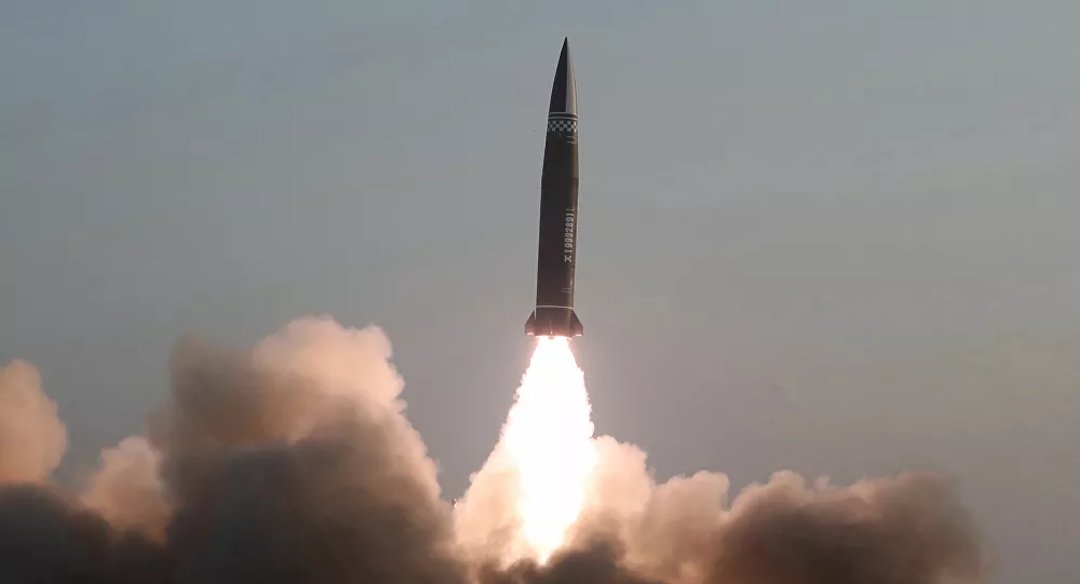
Korean missile launches are for self-defense

A newly developed new-type tactical guided projectile launched on March 25 is pictured in this photo released March 26 by KCNA in Pyongyang.

U.S. President Joe Biden said at his first major news conference that North Korea was a top foreign policy crisis for his administration, and that Washington would “respond accordingly” if Pyongyang continued to carry out missile tests. The tests came as a response to renewed war exercises being conducted by the U.S. and South Korea.

The Democratic People’s Republic of Korea (DPRK), the socialist north, has condemned Biden’s recent remarks regarding missile tests conducted by Pyongyang, warning the U.S. that it may face “something that is not good” if the president continues to make similar “thoughtless remarks.”

The statement from Ri Pyong Chol, secretary of the Central Committee of the Workers’ Party of Korea, notes that Biden is shedding light on his “deep-seated hostility” toward People’s Korea.

“The recent test-fire of new-type tactical guided missiles was an act tantamount to the exercise of the full-fledged right of a sovereign state for self-defense, as it was a process that had been undertaken to implement the goals of the policy on national defense science set forth by our Party and government to boost the defense capabilities of the country,” Ri explains.

Ri went on to state that Biden expressed a “gangster-like logic” by expecting the DPRK to not ensure its own security, as Washington gave the go-ahead to resume joint military exercises in the region.

“We are by no means developing weapons to draw someone’s attention or influence his policy. If the war exercise staged by the U.S. right next to its belligerent party across the ocean is for ‘defense,’ we have the full-fledged right to self-defense to contain the former’s military threat on its mainland,” Ri continued.

“The new U.S. administration obviously took its first wrong step. If the U.S. continues with its thoughtless remarks without thinking of the consequences, it may be faced with something that is not good.”

Full statement

The full statement by Ri Pyong Chol, secretary of the Central Committee of the Workers’ Party of Korea (WPK), was released by Korean Central News Agency (KCNA) on March 27:

The recent test-fire of new-type tactical guided missiles was an act tantamount to the exercise of the full-fledged right of a sovereign state for self-defense as it was a process that had been undertaken to implement the goals of the policy on national defense science set forth by our Party and government to boost the defense capabilities of the country.

We cannot but build invincible physical power for reliably defending the security of our state under the present situation in which South Korea and the U.S. constantly pose military threats to the Korean peninsula while persistently conducting dangerous war exercises and introducing advanced weapons.

We express our deep concern over the U.S. chief executive faulting the regular test-fire exercise of our state’s right to self-defense, as the violation of UN “resolutions” and openly revealing his deep-seated hostility toward the DPRK.

Such remarks from the U.S. president are an undisguised encroachment on our state’s right to self-defense and a provocation to it.

It is a gangster-like logic that it is allowable for the U.S. to ship strategic nuclear assets into the Korean peninsula and launch ICBMs any time it wants but not allowable for the DPRK, its belligerent party, to conduct even a test of a tactical weapon.

We clearly remember that since the appearance of the new administration in Washington there has been exploitation of every opportunity to make words and acts provoking the sovereignty and dignity of our state in which we were branded as the most serious “security threat.”

The bellicose stance of the new U.S. administration awakens us to the way to be followed by us and convinces us of the justice of the work to be done by us once again.

We are by no means developing weapons to draw someone’s attention or influence his policy.

If the war exercise staged by the U.S. right next to its belligerent party across the ocean is for “defense,” we have the full-fledged right to self-defense to contain the former’s military threat on its mainland.

I think that the new U.S. administration obviously took its first wrong step.

If the U.S. continues with its thoughtless remarks without thinking of the consequences, it may be faced with something that is not good.

We know very well what we must do.

We will continue to increase our most thoroughgoing and overwhelming military power.

Strugglelalucha256


Seventy years later: Remember Chinese solidarity against U.S. invasion of Korea

Seventy years ago, beginning on Oct. 25, 1950, the Chinese People’s Volunteer Army (PVA) crossed the Yalu River into the Korean Peninsula in defense of the Korean Revolution. Earlier that month, a coalition of United States and United Nations forces had invaded the Democratic People’s Republic of Korea (socialist north Korea) and engaged in a vicious scorched-earth campaign against Korean revolutionary forces led by Kim Il Sung. 

The imperialist occupiers, led by war criminal Douglas MacArthur, killed tens of thousands of innocent people and committed countless atrocities as they marched north through the Korean countryside. Fearing that the imperialist forces would not stop at the Chinese border, Mao Zedong ordered the army to reorganize and plan an offensive against the U.S. and U.N. forces occupying Korea. 

The united Chinese and north Korean forces started their counteroffensive with a victory at the Battle of Unsan in late October 1950 and pushed the imperialist forces as far south as the 38th parallel, the current location of the border between the DPRK and the U.S. puppet state of south Korea. 

The first and second wave offensives, as they were called, were a stunning victory by the global working class against imperialist aggression. The Korean-Chinese offensive in the fall of 1950 was a great victory that came at a great sacrifice. Among the many soldiers and workers who were killed was Mao Zedong’s son, Mao Anying, who was killed in a U.S. bombing run. 

Less than five years earlier, revolutionaries in both China and Korea had been fighting brutal, defensive wars against Japanese invaders. Both nations were recovering from the resulting devastation. Furthermore, both countries were relatively poor economically on the global scale. Yet, the united working-class revolutionary forces of China and north Korea repelled the combined armies of multiple, wealthy, industrialized, imperialist nations.

Strugglelalucha256


Workers’ Party of Korea celebrates 75 years of struggle

People in the Democratic People’s Republic of Korea celebrated the 75th anniversary of the founding of the Workers’ Party of Korea on Oct. 10, 1945. The WPK is the communist party that leads the building of socialism in the northern part of Korea.

Parades, dances, rallies and art shows were held in cities and towns throughout the north, as well as in factories, on collective farms, in hospitals and schools, and among soldiers of the Korean People’s Army. 

There were also fireworks displays, banquets, presentations of flowers at monuments to past WPK leaders and a torchlight parade of socialist youth.

In Pyongyang, the capital city, a mighty military parade was held to show the Trumps of the world that the DPRK is always prepared to defend its people and their socialist system from the aggression of capitalist powers.

Kim Jong Un, chairperson of the Workers’ Party, expressed his gratitude to the people for their perseverance. “The secret of how our Party, which has followed the revolutionary road, most arduous and beset with trials, has adorned this bloody road with victory and glory is that our people have sincerely trusted and supported it and defended its cause.” 

After the anniversary celebration, rallies continued around the country to begin organizing for the upcoming Eighth Congress of the WPK, planned for January 2021.

The celebrations are especially significant because the DPRK has successfully kept the COVID-19 pandemic at bay through quick preventive action and the strength of its socialist health care system. 

And in August, monsoons driven by climate change caused terrible flooding that killed more than 20 people, destroyed 16,680 homes and 630 public buildings. 

In his anniversary speech, Kim Jong Un explained, “On this planet at present, our country is faced with huge challenges and difficulties, like dealing with the anti-epidemic emergency and recovering from the catastrophic natural disasters, when everything is in short supply owing to the harsh and prolonged sanctions.”

The Korean People’s Army has played an especially important role in supporting urgent health measures and rebuilding from the flood damage, all while continuing to protect the country’s sovereignty and independence from U.S. imperialism. 

“At this very moment, many of our service personnel are courageously striving on the anti-epidemic front and at the rehabilitation project sites far away from this glorious Kim Il Sung Square, in defense of the security of the state and safety of the people,” Kim Jong Un said. “I feel pain in my heart as they are not all here at this glorious night with us.”

U.S. war and sanctions

The U.S. military continues to occupy South Korea, as it has done since 1945, and its “pivot to Asia” threatens the DPRK as well as China. Washington has imposed deadly sanctions in retaliation for the DPRK’s determined self-defense. The U.S. dominates South Korea’s capitalist economy and repressive political system, and uses the south as a base for all kinds of subversion. 

In fact, Washington’s failed, bloody war to destroy Korean socialism, from 1950 to 1953 — known as the Korean War here, or the Fatherland Liberation War in the DPRK — never really ended. Every U.S. president from Democrat Harry Truman, who launched the war, to Republican Donald Trump has refused to sign a peace treaty with the north.

In the aftermath of the U.S. bombing, not a single building over one storey was left standing in the north. Thousands of civilians were massacred by the U.S. and its allies in both the north and south in unspeakable war crimes. But motivated by the desire for independence and to build a socialist world, the people of north Korea together with volunteers from China were able to beat back the U.S. military behemoth to the 38th parallel.

Under the leadership of the Workers’ Party, including DPRK founder Kim Il Sung and his successor Kim Jong Il, the north was able to rebuild and become a strong socialist country. Korean people in the north openly advocate and organize for the peaceful, independent reunification of the country. In the capitalist south, many do the same, but at great danger because of repressive anti-communist laws.

The DPRK was able to withstand the counterrevolutionary setbacks to socialism in the USSR and Eastern Europe in the late 1980s and early 1990s. Like revolutionary Cuba, socialist Korea has survived by mobilizing the masses and ensuring their involvement in every step of the process of socialist construction.

“All of these hardships are undoubtedly a heavy burden and pain for every family and every citizen in our country,” said Kim Jong Un. “However, our people are grateful patriots who place national affairs before their family ones, share every difficulty experienced by the state with it, and firmly support their country with their sincere sweat and efforts.

“That is why our Party braves all sorts of national hardships by believing in and relying on the people, who always turn out as one if it unburdens the difficulties of the country.

“Our people have always been grateful to our Party, but it is none other than the people themselves who surely deserve a bow of gratitude.”

The Socialist Unity Party and Struggle-La Lucha newspaper join with workers and oppressed peoples around the world in expressing our congratulations to the Workers’ Party of Korea and the Korean people on this historic occasion. Korea is one!

Strugglelalucha256


70th anniversary of the Korean War

Seventy years ago, on June 25, 1950, U.S. imperialism used the United Nations as a cover to launch a genocidal war to prevent the liberation of the Korean peninsula and to invade socialist China.

In the Fatherland Liberation War (known as the Korean War in the West), the Democratic People’s Republic of Korea, led by Kim Il Sung and the Workers’ Party of Korea, was able to beat back the U.S. invasion to the 38th parallel with the help of Chinese volunteers and Soviet material assistance.

The human toll was enormous. U.S. and puppet forces carried out massacres of civilians suspected of sympathizing with the socialist north. Twenty percent of the population in the north were killed. Every building above one story in the north was destroyed by U.S. bombs, as was the country’s industrial and agricultural infrastructure. 

The Korean people in the north had to rebuild their country from the ground up. Today, thanks to a planned economy and the political mobilization of its people, the DPRK is a strong socialist country that is able to defend itself and its neighbors from U.S. aggression.

Although an armistice was signed in 1953, the U.S. government still refuses to sign a treaty officially ending the war. The Pentagon continues to illegally occupy south Korea on behalf of Wall Street, using it as a base for subversion and military aggression throughout the region. But none of this has blunted the desire of the Koren people, north and south, for peaceful reunification.

Hands off the DPRK!
U.S. out of Korea!
Korea is one!

Strugglelalucha256


Dr. Roh Kil Nam, advocate for peace and the reunification of Korea

Statement from the Socialist Unity Party / Partido de Socialismo Unido

On April 25, the world lost a great person dedicated to the Korean people, international solidarity, with an unflinching determination to expose the truth — all motivated by his love for humanity. Dr. Roh Kil Nam, also known as Ken Roh, was the founder of “Minjok Tongshin,” an online news publication started in 1999 in the U.S. dedicated to reporting honest news about the Democratic People’s Republic of Korea and countering misinformation from the U.S. media about North Korea.

Dr. Roh was born in 1944 in Gangneung, Gangwon-do, Korea, while under Japanese colonial rule. Roh began his political struggle for the democratization of South Korea during the dictatorship of U.S.-sponsored President Park Chung-hee.

Being born into the brutal Japanese colonial rule and enduring dictatorship in South Korea helped forge the steel of an activist and journalist. Dr. Roh lived his life determined to provide the movement for democracy in South Korea and the struggle for unification with the North with the necessary tools to counter imperialism’s powerful weapon of lies helping to continue the U.S. imperialist-maintained division between the North and South. He knew that the building of solidarity would require exposing those lies and professionally manufactured misinformation in the belly of the beast — the U.S.

Dr. Roh was instrumental in promoting organizations dedicated to that purpose and his work was recognized enough to have a meeting with a famous guerilla fighter against Japanese occupation who was also the DPRK’s first president, Kim Il Sung. Later in life, Dr. Roh would also be awarded the prestigious Kim Il Sung award by the DPRK government in 2014 for exemplary service towards building the ideals of the North Korean people.

Upon arriving in the U.S. in 1973, Dr. Roh quickly recognized that the claims of freedom and democracy in the U.S. were a myth that was exposed by the civil rights movement and historical racism faced by Black and Chinese people. His ideal of building solidarity and unity extended internationally. In Los Angeles County, where Dr. Roh lived, he was always happy to participate and use his media to cover protests supporting the liberation struggles of all oppressed peoples. He was also dedicated to the building of unity between progressive organizations in the U.S.

Dr. Roh was a tireless advocate for peace and reunification of the Korean Peninsula. He traveled 75 times to the Democratic People’s Republic of Korea and each time brought back the truth of North Korea, her people and their efforts to defend their sovereignty.

Our heart goes out to his family, and to all those who worked with Dr. Roh to end the imperialist division of beautiful Korea. Long live Dr. Roh Kil Nam! Korea is one!

For the Los Angeles Branch, Socialist Unity Party / Partido de Socialismo Unido:
Maggie Vascassenno
Rebecka Jackson
Scott Scheffer
Jefferson Azevedo
John Parker

Strugglelalucha256


Kim Il Sung: Anti-imperialist fighter, socialist hero

Kim Il Sung, leader of the Korean Revolution and founding president of the Democratic People’s Republic of Korea (DPRK), died 25 years ago on July 8, 1994. The Korean people are commemorating the anniversary with mass political meetings, performances and commemorations. The following appreciation of Kim Il Sung by Marxist leader Sam Marcy is abridged from an article originally published in the July 21, 1994, issue of Workers World newspaper.

By Sam Marcy 

Comrade Kim Il Sung devoted his whole life to the Korean people’s struggle for national self-determination and the international working-class struggle for socialist emancipation. With his leadership, the Korean people defeated the Japanese colonial occupation and soon after brought about the first defeat of the U.S. imperialist military machine.

For over 40 years since the armistice, the U.S. military has continued to occupy the south of Korea with troops and nuclear weapons. This occupation has been the chief obstacle to peaceful reunification of Korea and poses the chief danger of a new war on the peninsula.

The recent nuclear crisis is the latest episode in a long history of Pentagon threats and provocation against Korea. At a time when the people of the United States are suffering from unemployment, racism and a general decline in living standards, another U.S. war against Korea would be a terrible crime against the poor and working people of the U.S. as well as against the people of Korea.

Comrade Kim Il Sung worked tirelessly to bring about the peaceful reunification of Korea and to forge a lasting peace on the peninsula. … Comrade Kim Il Sung’s great efforts to achieve peace and reunification met the aspirations of the Korean people and also benefited the poor and working people of the U.S.

It is Kim Il Sung’s remarkable achievement that in his own lifetime he became a symbol of national liberation and reunification for the Korean people, and a symbol of the anti-imperialist and socialist struggles of all the world’s peoples. Although U.S. imperialism tried at every opportunity to blockade, threaten and sabotage the construction of socialism in the north, the Democratic People’s Republic of Korea stands strong. The accomplishments of socialist construction will be a lasting monument to the leadership of Comrade Kim Il Sung.

International developments in the last few years have created great difficulties for the working class and oppressed peoples of the world. And in the face of these difficulties some have wavered or even abandoned the struggle. But Comrade Kim Il Sung and the Workers’ Party of Korea refused to let go of the principles of revolutionary socialist internationalism.

Leadership in times of great difficulties is what makes a leader truly great.

We are proud to have known Kim Il Sung as a great leader and a comrade in the international communist movement. And it is with the most profound sense of loss that we mark his passing. Yet it is also with the greatest revolutionary optimism that we are confident that Comrade Kim Il Sung’s legacy will live on with your efforts to win new victories for the Korean people. His contributions and achievements for the cause of international socialism for all humanity will never be forgotten.

Strugglelalucha256


Behind Trump’s walkout of Korea summit

On Feb. 28, U.S. President Donald Trump and Workers’ Party of Korea Chairperson Kim Jong Un met in Hanoi, Vietnam, to officially open the second summit between the United States and the Democratic People’s Republic of Korea (commonly referred to as North Korea in the U.S. media).

Since 2006, the DPRK has faced a slew of sanctions from the United Nations and Washington. Western powers have argued that the sanctions were necessary until the DPRK ended its nuclear weapons program, which only exists for defensive purposes.

The sanctions have had damaging effects on the socialist country’s economy. They include restrictions on Korea’s imports; prohibition of certain U.S assistance to countries that aid North Korea; a cap on labor exports; a cap on the import of oil; a ban on the import of natural gas; and other policies that limit the DPRK’s economic development.

This summit’s stated purpose was for the two countries and their respective leaders to come to agreements regarding Korea’s nuclear program and the vast array of economic sanctions.

Vietnam welcomes Kim Jong Un

When DPRK leader Kim Jong Un arrived in the Socialist Republic of Vietnam, he was greeted by throngs of excited Vietnamese citizens. Crowds lined the streets to see the North Korean delegation as it made its way from the Dong Dang railway station to the summit location.

The two countries share a strong and storied alliance, dating back over five decades. Vietnamese revolutionary leader Ho Chi Minh worked closely with Kim Jong Un’s grandfather, DPRK founder Kim Il Sung. To this day, the countries’ leaders work closely together in continued efforts to strengthen their respective socialist states.

The Vietnamese government and Communist Party were excited to host the summit. After all, it was the culmination of years of diplomatic talks and overtures between the DPRK, China and Vietnam on one side, and the U.S. and its allies on the other.

The Vietnamese government and its people prepared thoroughly to provide a setting that would increase the likelihood of the summit’s success.

Trump walks out

At the start of the summit, there was hope that maybe this event would bring an end to decades of U.S.-led diplomatic and economic warfare on North Korea. There was hope that maybe this event would conclude in a legitimate peace treaty between the two countries. (Washington has refused to sign an official peace treaty since the end of the Korean War in 1953.)

There was hope that the people of socialist Korea, with the help of their allies, would finally achieve a major victory in their struggle against imperialist pressure.

Unfortunately, no such hopes were realized because the summit ended less than 48 hours later, when Donald Trump walked out of negotiations — a move praised by both Republicans and Democrats.

However, the summit’s unfortunate result was in no part the fault of the North Korean delegation’s obstinance or unwillingness to negotiate.

The corporate media would have us believe that the DPRK’s delegation, particularly Kim Jong Un, was unreasonable, immovable and illogical. In reality, it was the Trump administration’s own unreasonable expectations that led to the summit’s premature end. This is yet another chapter where North Korea’s goodwill and willingness to negotiate is met with imperialist obfuscation and animus.

In a post-summit press conference, the reason that Trump gave for ending the summit was North Korea’s refusal to accept anything less than a complete removal of U.N. and U.S. sanctions on the DPRK.

This was not the case. According to DPRK Foreign Minister Ri Yong Ho, Korea asked for relief from five U.N. sanctions imposed in 2016-2017 — out of a total of 11 — that were particularly harmful to the country’s economy.

But the question must be asked: why should the DPRK accept any deal with the U.S. to warm relations that does not involve the removal of all sanctions?

It seems that Trump expected the DPRK to end its nuclear program entirely while remaining under the boot of overwhelming trade restrictions, and also while South Korea remains under U.S. military occupation, as it has been for more than seven decades.

This expectation makes it abundantly clear that the U.S. intends to keep pursuing Korea’s total submission to the imperialist agenda.

Going forward

Since the conclusion of the summit, the U.S. government and the capitalist media have continued to propagandize that North Korea is a rogue state developing nuclear weapons so it can wreak global havoc for havoc’s sake. This is the same lie that the imperialist powers have used since the DPRK’s nuclear program started in the 1980s.

We must reject this racist ruling-class line. This portrayal plays on “yellow terror” anti-Asian stereotypes and falsely establishes the U.S. as a reasonable paragon of justice.

The wisdom of North Korea’s strong self-defense measures is amply demonstrated by Washington’s willful destruction of other sovereign countries that dared to resist U.S. dictates, such as Libya and Iraq. Moreover, this summit took place at the very moment when the U.S. was again attempting regime change against one of the DPRK’s allies: Bolivarian Venezuela.

We must say to the U.S. and its imperialist allies within the U.N.: Hands off the Democratic People’s Republic of Korea! The continued economic warfare on the people of the DPRK is nothing more than a cheap double standard and an attempt to destroy a heroic socialist nation.

Washington has no right to police other nations on nuclear weapons when the U.S itself poses the greatest threat to the safety of the planet with an arsenal of nukes numbering over 10,000. Only one country has ever militarily deployed a nuclear weapon: the U.S.

U.S. efforts to stifle the economy of North Korea must end. The global working class must stand with the DPRK as it continues its efforts to defend itself and find a diplomatic path to the easing of sanctions.

While the U.S.-DPRK summit in Vietnam did not have the best outcome, there is no doubt that the people of North Korea and progressive forces around the world will continue the struggle against imperialist economic warfare.

Strugglelalucha256
https://www.struggle-la-lucha.org/korea/page/3/