U.S. launches nuclear-capable bombers in military drills over Korea

The U.S. deployed B-52H bomber aimed at North Korea.
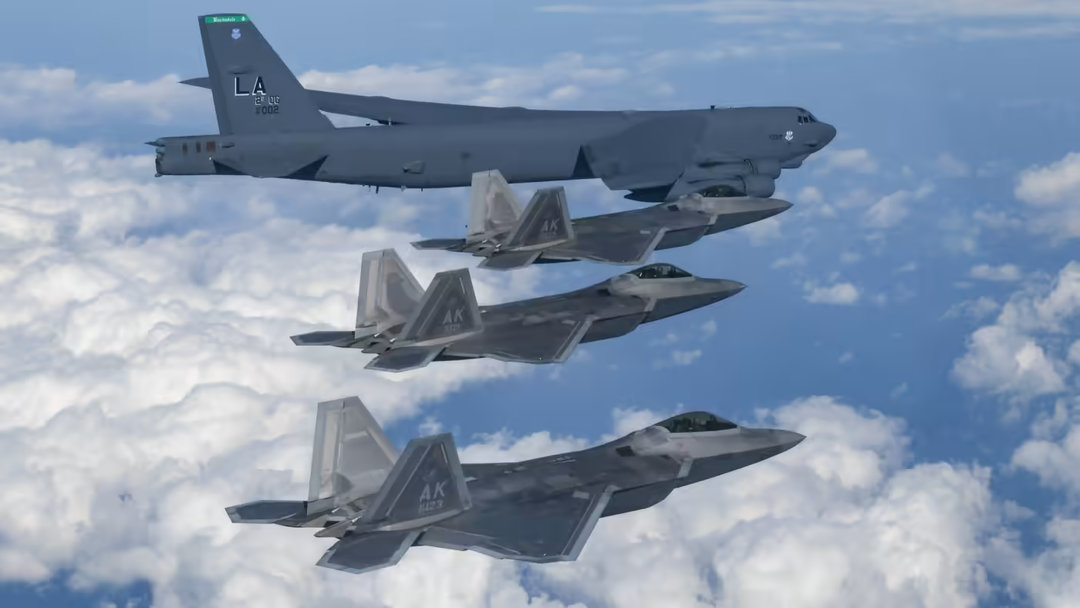
Photo: South Korean Ministry of National Defense

The United States flew nuclear-capable bombers and advanced stealth jets in a show of force aimed at socialist North Korea, the Associated Press reported.

The B-52H strategic bomber and F-22 stealth fighter jets were used in joint military drills over South Korea on Dec. 20. The B-52H is the primary strategic nuclear bomber for the U.S., capable of carrying large payloads at high speeds over long distances. The nuclear-capable F-22 jets were deployed in South Korea for the first time in four years.

In its first two years, the Biden administration’s foreign policy has been marked by increasing militarization, a report in Responsible Statecraft noted. The new $858-billion military budget now before Congress includes plans to develop a sea-launched nuclear cruise missile that former President Donald Trump initiated in 2018.

Biden’s nuclear expansion plans, outlined in a summary released in March, omit a “no first use” policy. The U.S. is now engaged in the most extensive military buildup in history. 

“The root reason for the current tension [in Korea] is the U.S.’s increasing pressure on North Korea, Lü Chao, an expert on the Korean Peninsula at the Liaoning Academy of Social Sciences, told the Global Times.

“Lü noted that the U.S. had organized several military drills with its allies South Korea and Japan, and with more new weapons and aircraft carriers being involved,” the Global Times reports.

At the end of October, the U.S. and South Korea conducted one of their largest joint military air drills, with hundreds of warplanes from both sides staging mock attacks 24 hours a day for a week, the report continues.

Officially pacifist Japan has meanwhile announced its largest military budget since World War II, unveiling a $320-billion plan, which will involve developing long-range offensive missiles.

Strugglelalucha256


Support South Korean National Workers’ Rally

We strongly support the Korean National Workers’ Rally which will bring down the hammer on the Yoon Soek-Yeol administration’s anti-worker and anti-democratic actions!

We mourn the tragic loss of life in the Itaewon disaster.

“We cannot live like this anymore!”

Soaring inflation and the destruction of the social security net, unstable employment and low wages: This is the anguish of working people who are shackled to long hours and murderous conditions in their workplaces. 

Working people who suffered in the last foreign exchange crisis continue to face the brink of disaster in an unstable economic climate within a country where the profits of the wealthy always come first.

Recently a young woman working for Paris Baguette, part of the SPC group, and a construction worker in Anseong both lost their lives in terrible accidents. Miners in Bonghwa are still trapped after a tunnel collapsed, 14 hours after it was reported. Even though 2,400 workers lose their lives at their worksite annually, no companies are punished. 

The Yoon Seok-Yeol administration is trying to dismantle the Workplace Accident Penalty Act, which is already incredibly weak. Ignoring the working conditions that put workers to death is a form of murder. The Workplace Accident Penalty Act, which currently allows for the pockets of companies to be lined by the blood of workers, should be strengthened to include workplaces with less than five employees.

Strengthening the public sector, such as expanding public medical facilities and caring for the underprivileged, is a social demand and a responsibility of the state. However, as we experienced throughout the pandemic, with each crisis the wealth of the rich grows daily while working people sacrifice and suffer. The Yun Seok-Yeol administration, which gave special favors to the wealthy through deregulation and tax cuts, is planning on the privatization of railways, medical care and education. 

By drastically reducing the budget for jobs, public rental housing, youth, the disabled and social welfare, they are destroying the quality of life for working people and by reducing personnel in the public sector they are endangering the safety of all. They cannot stand to breathe and live with working people. The privatization of the public sector, which places suffering upon working people to fill the coffers of the wealthy, must be stopped.

Temporary employees and subcontracted employees are not recognized as employees, so they are not protected by the Occupational Safety and Health Act in case of industrial accidents.  They are also denied the right to collectively bargain with their employer. Subcontracted workers work under the supervision of an employer, but employers hide behind the contracted company and mobilize public authorities to oppress the workers, making it illegal to fight against unfair treatment and dismissal. 

And as we see in the recent struggle of subcontractors of Daewoo Chosun, a company which demanded 47 billion won in financial damages from workers who earn 2 million won a month, employers demand absolutely unrealistic amounts of financial compensation from workers. 

Unless everybody who works is recognized as a worker, and unless the justified right to strike is restored, this vicious cycle will continue.

The pain and anguish of workers who have protested against this system, going as far as self-immolation and death, is hard to describe with words.

It is a terrifying reality in which workers must fight to defend their constitutionally guaranteed right to collectively bargain and take collective action.

There is an urgent need to revise Articles 2 and 3 of the Labor Union Act, which deprives workers their rights to unionize, bargain and go on strike, squeezing dry the blood of workers to fill the stomachs of corporations.

They say that the Vigilant Storm War Exercise, which preemptively targets the North, will continue. These nuclear war exercises target North Korea by land, sea and sky. North Korea has launched missiles in response.

The risk of the recurrence of war is increasing endlessly due to these exercises that the Yoon Seok Yeol government is engaging in with foreign powers.

In conclusion, we cannot live like this anymore. There is only one way to achieve national peace and reunification and restore the legitimate rights of the working people, and that is to win the struggle against the forces which are anti-unification and anti-democratic.

Stop privatization of the public sector!

Strengthen the Workplace Accident Penalty Act!

Amend Articles 2 and 3 of the Labor Union Act!

Stop the ROK-U.S. Combined War Exercises!

Dismantle the ROK-U.S. Alliance!

Korean American Support Committee for KCTU (Korean Confederation of Trade Unions)

November 5, 2022

Strugglelalucha256


North Korea responds to massive, ‘reckless’ U.S.-led war games

The Democratic People’s Republic of Korea has condemned the five days of U.S.-South Korea joint war drills that launched Nov. 1. 

After a flurry of joint exercises held in April, August, September and October – some of which included Japan – a DPRK spokesperson said the Nov. 1 aerial drills were the “largest-ever” in history and showed that “the U.S. nuclear war script against the Democratic People’s Republic of Korea has entered the final stage.”

The north vowed to take “all necessary measures” to defend itself, saying that the joint aerial drills are in preparation for a nuclear strike on the DPRK. 

A statement from a foreign ministry official cited in KCNA describes “an aggression-type war exercise with the basic purpose of hitting strategic targets of the Democratic People’s Republic of Korea,” which presents the risk of “serious confrontation with great powers.”

“Nowhere in the world can we find a military exercise with an aggressive character like the joint military exercise held by the United States and its followers in terms of duration, scale, content and density,” the foreign ministry official said. “The U.S. nuclear war script against the Democratic People’s Republic of Korea has entered the final stage.”

The drills include about 100 U.S. warplanes and 140 South Korean aircraft, with Australia also participating. 

The DPRK foreign ministry official said, “We are ready to take all necessary measures to protect the sovereignty of the country, the safety of our people and our territorial integrity from external military threats,” adding that Washington will “pay an equal price if it attempts to use force against the Democratic People’s Republic of Korea.”

The foreign ministry official reiterated that the DPRK’s nuclear arsenal is for defensive purposes only.

Massive protests are ongoing in South Korea, demanding the end of right-wing President Yoon Suk-yeol’s tenure and the U.S.-South Korea-Japan war exercises.

Strugglelalucha256


Massive protest in South Korea as U.S. launches ‘war games’

The U.S. military and its counterparts in South Korea are wrapping up a week-long rehearsal for an invasion of North Korea and the assassination of North Korean President Kim Jong Un. The Ulchi Freedom Shield exercises, as they are called, are a major escalation of the already provocative “war games” that the U.S. uses to threaten the socialist republic to the north. 

The name Ulchi is borrowed from the sixth-century Korean general who is said to have defeated China in battle. Given the “New Cold War,” in which U.S. rhetoric against China has escalated along with the presence of U.S. warships near China’s coast, the name can hardly be lost on anyone. 

The election of South Korean President Yoon Suk-Yeol signaled an escalation of U.S. and South Korean threats against North Korea. Yoon pledged increased military spending, new technology, and more cooperation with the Pentagon. The heightened hostility toward North Korea is a turn from the previous administration of President Moon Jae-In, who attempted to build a rapprochement with the leadership of the North independently of the U.S.

Largest in recent history

Ulchi Freedom Shield is among the largest military exercises in recent history. It goes beyond the scope of recent years’ war games – considered Command Post Exercises that involve simulations without live fire. Ulchi Freedom Shield is comprised of what are called Field Training Exercises, which involve significant mobilizations and live fire instead of simulations. The exact number of troops taking part isn’t yet available, but the last time similar exercises were held five years ago, some 50,000 South Korean troops and nearly 20,000 U.S. troops took part. 

This particular exercise is also called “Kill Chain” by Pentagon planners and is broken into three phases. The first involves reconnaissance after infiltrating North Korea to find and strike weapons and bases. The second is called “Korea Massive Punishment and Retaliation,” which involves massive destruction by land, sea, and air after rendering North Korea defenseless. Finally, the third phase is to find and execute the North Korean leadership — particularly President Kim Jong Un.

Under the leadership of its founder, President Kim il Sung, North Korea survived the brutal 1950-1953 Korean War. The U.S Air Force had carpet bombed in the first few months beginning in June and destroyed every city. The rest of the three-year war was a land war. The North Korean people forced the imperialist invaders south to Pusan at the bottom of the peninsula. The imperialists then launched a second invasion at Inchon on the West Coast but were finally driven out by North Korean soldiers, now joined by 1 million allied Chinese volunteers. Ultimately, 3 million or more North Korean people lost their lives. 

Korea divided by the U.S. in 1945

The Korean nation was arbitrarily divided by the U.S. in 1945 and remains divided at the 38th parallel today. The U.S. has refused to sign a peace treaty for all these decades. As a result, the war is still on, and it’s more than a technicality. U.S. guns have been aimed at North Korea ever since, and punishing U.S. economic sanctions that are among the most severe in the world are in place to try to starve North Korea into giving up its socialist agenda.

Yet, under seemingly impossible conditions, the DPRK has rebuilt its cities and, through its “military first” policy, has been able to survive against the U.S. threat of nuclear annihilation. 

The U.S. media paints a picture of two halves of the Korean nation hostile to each other and the U.S. in a position of having to defend the south from potential North Korea attacks. Actually, U.S. forces occupied South Korea when the Japanese imperialist empire collapsed at the close of World War II. The people of South Korea, just like Koreans in the north, had fought against the brutal occupation by Japan since 1910. They had sacrificed and longed for self-determination. Soon it became clear that the U.S. agenda was to take Japan’s place as colonizer. 

The people of the south had been ready to build a progressive society. They had no quarrel with the people of the north. There were no differences between them in their 5,000-year-old civilization. They all spoke the same language and shared the same history and customs.

People of the south rebelled 

The people of the south rebelled. Their struggle against the new U.S. occupiers was militant and continuous. Their movement was powerful and was met with U.S. brutality. The U.S. occupation government even called on the former Japanese colonizer’s military at times to help put down rebellions.

The people of South Korea don’t share President Yoon’s vision of a U.S./South Korea block to destroy North Korea. On the contrary, the permanent presence of U.S. troops and weapons is hated. 

This is a fact that the U.S. media works hard to conceal. Not one major U.S. publication mentioned that on August 14, tens of thousands of South Korean people demonstrated in the streets of Seoul against the U.S. military presence and plans for the Ulchi Freedom Shield exercises. The demonstration was called by the Korean Confederation of Trade Unions, South Korea’s second-largest labor confederation. 

Anti-war and anti-imperialist organizations in the U.S. and worldwide should extend full solidarity with the people of North and South Korea. Korea is one!


Strugglelalucha256


Los Angeles: Solidarity with South Korean workers

On June 25, a rally was held in solidarity with South Korean workers’ struggle against the right-wing Moon Jae-in regime and the ongoing U.S. military occupation. John Parker, the socialist candidate for U.S. Senate in California who got more than 100,000 votes in June’s primary, spoke about his recent visit to Donbass and compared the U.S.-NATO proxy war in Ukraine with the decades-long Pentagon occupation and division of the Korean peninsula.

The action was called by the Korean American Support Committee for the Korean Confederation of Trade Unions, and supported by the Harriet Tubman Center for Social Justice, Socialist Unity Party and ANSWER Coalition.

Strugglelalucha256


What does Yoon Seok-yeol’s presidency mean for South Korea?

Last week’s presidential elections in South Korea saw 77% of the country’s 44 million eligible voters mobilize to the polls. The race remained too close to call until 98% of votes had been counted early the next day. With a lead of less than one percent of the vote, the narrowest margin in Korean history, Yoon Seok-Yeol of the right-wing People Power Party bested his liberal opponent from the ruling Democratic Party, Lee Jae-Myeong.

Yoon’s victory marks a return to power for the South Korean right, which was ousted in 2017 by the impeachment of then President Park Geun-hye. With Yoon’s inauguration just two months away, many are bracing for the coming assault on progressive politics, and a possible return to South Korea’s autocratic past.

Sliding back to autocracy?

Buoyed by support from young men in their 20s and 30s, Yoon has pledged to abolish the Ministry of Gender Equality, which since its founding in 1998 has guided national gender equality policies while providing services to marginalized women and children, including single mothers and survivors of domestic and sexual violence. As in other patriarchal societies, South Korean women face the devaluation of their productive labor and an uneven burden of reproductive labor. According to the Organization for Economic Co-operation and Development (OECD), women accounted for 63.5% of all part-time workers in 2020. 20.8% of all employment for women was part-time, compared to just 8.9% for men. Correspondingly, about 28% of women workers earned below the minimum wage in 2018, compared to 12.8% of male workers. The OECD further found that South Korea had the highest gender pay gap among its 38 member countries, and that South Korean women spend roughly 215 minutes a day performing unpaid labor, compared to just 49 minutes a day for men.

Many commentators have pointed to the intensity of South Korea’s culture wars over gender equality as an explanation for Yoon’s anti-feminist politics. As the #MeToo movement swept the globe, several high profile sexual assault and harassment cases involving South Korean celebrities and politicians became the subject of intense media scrutiny. The Moon administration’s attempts to implement greater protections and punishments against sexual violence have provoked backlash and charges of “reverse discrimination.”

While Yoon’s appeals to misogyny do strike a chord with a considerable swath of the electorate, his anti-feminist politics also complement his anti-labor politics. As a self-described proponent of small government and private sector-led growth, the President-elect proposed to slash the minimum wage and raise the ceiling on working hours, which were lowered last year from 68 to 52 hours a week. Housing emerged as a key issue in the election after a surge in real estate prices, with the city of Seoul seeing a 52% increase in apartment prices in under five years. Yoon has eschewed calls to expand the public housing system, and instead offered to lower taxes on property owners as a way to stimulate development. As rising healthcare costs and privatization place additional strain on working people, Yoon has pledged to remove foreigners, particularly Chinese immigrants, from the national health insurance system. When considered comprehensively, Yoon’s misogyny and xenophobia are entirely consistent with a broader capitalist agenda to make all working people more vulnerable to exploitation.

How successfully Yoon will manage to implement his domestic agenda remains to be seen. More than half the seats in South Korea’s National Assembly remain under Democratic Party control, and legislative elections won’t be held again until 2024. Yoon’s People Power Party simply lacks the votes to pass anything without serious compromise, Whether the opposition will hold the line or capitulate in an attempt to broaden their appeal with conservative voters remains to be seen.

While Yoon may not have control of the legislature, he can still inflict considerable damage on South Korea’s progressive movements. In a country that experienced a democratic transition from military dictatorship within living memory, this threat is not taken lightly. The most recent period in which a conservative party held power from 2008-2017 saw heightened restrictions on press freedoms, blacklisting of thousands of artists and brutal crackdowns on working people’s movements.

The anti-communist National Security Law, first implemented in 1948 to facilitate the massacre of an estimated 60,000 people on Jeju island, is still on the books in South Korea. The law, which broadly criminalizes “anti-state activity,” has been applied to varying degrees under different administrations. Under President Park Geun-hye, it was used to outlaw the minor Unified Progressive Party and jail its leader, a member of the National Assembly at the time, for nearly a decade. More recently in 2021, a small publisher was charged under the National Security Law for reprinting deceased North Korean leader Kim Il-Sung’s autobiography. Only time will tell how the Yoon administration deploys the National Security Law. In the meantime, those who see in Yoon a troubling return to South Korea’s autocratic past take no comfort in knowing the legal tools that enabled past reigns of terror remain intact.

Scrapping rapprochement, siding with Washington

The geostrategic significance of the Korean peninsula at the crossroads of the Pacific and continental Northeast Asia has made it a battleground for clashing great powers since the 19th century. As the U.S. steps up its belligerence against China, Korea’s significance as a potential flashpoint in a wider regional conflict also rises. The stakes of South Korea’s handling of its relationships with China, North Korea and the U.S. were clearly demonstrated during the Moon administration. After South Korea agreed to host the U.S. THAAD missile defense shield, China retaliated with sanctions in 2017 that dealt a severe blow to South Korea’s economy.  That same year, Korea veered dangerously close to the return of open hostilities as the Trump administration ramped up its infamous “fire and fury” rhetoric against North Korea. The Moon administration responded to these pressures by seeking greater rapprochement with North Korea, advocating for an end to the Korean War, and avoiding Washington’s more explicit anti-China alliances without abandoning the U.S. military alliance.

The President-elect’s foreign policy agenda seeks to upend Moon’s balancing act. While Yoon outwardly supports “normalizing inter-Korean relations,” the substance of his proposals present a clear departure from the past administration’s approach. In a recent essay for Foreign Affairs, Yoon rejected the importance of denuclearization as a peninsular rather than a North Korea-only issue, and stated that inter-Korean cooperation should only proceed if North Korea makes the “bold decision” to denuclearize. Such a position denies Pyongyang’s legitimate security concerns (the U.S. stationed nearly 1,000 nuclear warheads in South Korea from 1958-1991), and essentially amounts to a refusal to negotiate. Past conservative administrations’ attempts at similar strategies did not succeed, and Yoon seems likely to repeat this history, albeit in a much more volatile international context.

In the same piece, Yoon also criticized the “three no’s” the Moon administration acknowledged as necessary to respect China’s security concerns: no new THAAD missile defense batteries, no joining a U.S. missile defense network, and no trilateral military alliance with South Korea, Japan, and the U.S. Yoon not only called for new THAAD battery deployments on the campaign trail, but even went as far as to declare his intent to request the return of U.S. tactical nukes to the peninsula (the Biden administration quickly rebuffed him). He has supported Seoul’s participation in working groups hosted by the Quadrilateral Security Dialogue, a military alliance between the U.S., India, Japan, and Australia aimed at containing China. Yoon has also campaigned on improving bilateral relations with Japan, with an eye towards enhancing trilateral security cooperation with the U.S. These signals could lead to South Korea’s membership in the Quadrilateral Security Dialogue, as well as the creation of a possible trilateral military alliance with Japan and the U.S. Both outcomes long sought-after by Washington, and that would drastically raise the stakes in any potential regional dispute.

With 28,000 U.S. troops and the largest U.S. military base outside North America, South Korea has already been a battleground against expanding militarization for decades. The coming of new THAAD batteries and possible other military hardware will only inflame existing struggles and open new fronts in resistance to U.S. occupation. Yet new military installations could be the least of South Koreans’ worries. Yoon’s brash endorsement of a preemptive strike on North Korea under certain conditions alarmed many observers on the campaign trail. While such antics might appeal to some voters, any attempt to follow through on such threats would have obviously catastrophic consequences.

What may prove a more pertinent question is what South Korea’s deepened economic and military alignment with the U.S. could mean for the regional balance of power, particularly as U.S. antagonism against China escalates. With 600,000 active-duty troops, South Korea has one of the largest armies on earth, and plays a crucial role as a “force multiplier” for U.S. security interests. While the current U.S.-South Korea Treaty of Mutual Defense only obliges South Korea to engage its military within the peninsula, South Korea’s potential entrance into new military pacts could change the conditions under which South Korean troops could be deployed elsewhere. As the Yoon era dawns, the shifts in South Korea’s political winds may well set the course for the region and the wider world.

Ju-Hyun Park is a writer and member of Nodutdol for Korean Community Development.

Source: Peoples Dispatch

Strugglelalucha256


In memoriam of Hyun Lee

Sept. 20, 1970-March 7, 2022

Women Cross DMZ and Korea Peace Now! are deeply saddened to announce that our beloved colleague, mentor, teacher, friend and sister, Hyun Lee, passed away on March 7 surrounded by her family and closest friends after a long battle with cancer.

Hyun was a tireless advocate for peace on the Korean Peninsula. Every generation has its leaders who build powerful movements; she was among the giants of our time.

Beginning in 2018, Hyun served as the U.S. National Organizer and then the Campaign Strategist for Women Cross DMZ and our Korea Peace Now! campaign. Her ability to move an organizing and advocacy agenda was instrumental to building the Korea Peace Now! Grassroots Network, which consists of more than a dozen chapters across the country. This multi-generational, grassroots, people-powered movement that Hyun helped create is what led to the first Congressional resolution calling for an end to the Korean War with a peace agreement.

In addition to her organizing skills, Hyun was an expert on Korea and a brilliant analyst and strategist. She was among the rare leaders who could speak cogently on a range of complex issues, from the necessity of stopping the joint US-South Korea military exercises to the need to lift the ban on US citizens traveling to North Korea. She was equally adept at addressing Members of Congress as she was speaking to grassroots activists, always delivering her thoughtful message of peace with poise, calm, and passion. Hyun served as a bridge between people, organizations, communities, and movements. She was completely bilingual in Korean and English, and used this skill to help strengthen relationships between social movements and policymakers in Korea and the United States.

All of us at Women Cross DMZ and Korea Peace Now! are absolutely devastated, but the seeds of peace and justice that Hyun sowed will continue to sprout for generations to come. Her guiding light will continue to shine brightly, helping our movements continue the path to achieve peace in Korea. We will miss her dearly and will forever carry her in our hearts.

It was Hyun’s wish that any memorial tributes be made in the form of contributions to Tongil Peace Foundation. Expressions of sympathy for Hyun’s parents (Mr. and Mrs. Lee) and family members can be sent c/o Women Cross DMZ, P.O. Box 61042, Honolulu, HI 96822, which will be forwarded to them. In the coming days we will share information on our plans to memorialize Hyun.

Music: “남누리 북누리” (Southern Land, Northern Land) – 백창우/글, 곡; written by Changwoo Baek; sung by Dohee Lee.

Lyrics:

어느 누가 이을건가

남누리 북누리 갈라진 우리 누리

그누(우)가 찾을 건가

그누가 찾을 건가

남누리 북누리 빼앗긴 우리 누리

우리 뿐일세 우리 뿐일세

이 땅을 딛고 살 우리 뿐일세

함께 가세 함께 가세 해방의 큰 춤추며

남누리 북누리 하나되는 그날까지

함께 가세 함께 가세 통일의 큰 춤추며

남누리 북누리 통일되는 그날까지

Who will reconnect

Who will reconnect

Southern land, northern land, our divided land

Who will be the one to find each other?

Who will be the one to find us

Southern land, northern land, our lost land

It’s just us, It’s just us

We are the only ones living on this land

Let’s go together, let’s go together, together in a big dance of liberation

Southern land, northern land, until the day we become one

Let’s go together Let’s go together, together in a big dance of unity

Until the day when the north and the south are reunified

Strugglelalucha256


Korean labor calls general strike to free union president

Yang Kyung-soo, the president of the Korean Confederation of Trade Unions (KCTU) —  South Korea’s largest and most militant trade union confederation — has been jailed and is on a hunger strike.

A general strike had already been called for Oct. 20, and has now taken on demands to release Yang. Police had attempted the arrest in mid-August at the KCTU headquarters but were fought off by union members and forced to retreat. 

Although the Moon Jae-in government rode a wave of support by labor unions, and in particular the KCTU, repression against the labor movement has not changed and is continuing. 

Since its foundation in 1995, there have been 13 presidents of the KCTU. All 13 were at one time or another jailed by the U.S.-backed South Korean state.

There has been no international outcry over the arrest, no word of it in the U.S. media. Compare that to what you’d hear if the head of a labor union were arrested in Cuba, China, Nicaragua, Venezuela or any other country that struggles to remain independent. Where are the cries for human rights in South Korea? 

Instead, the New York Times writes that South Korean workers have lost “enthusiasm” for strikes. They fail to mention that the KCTU has grown to become the largest trade union confederation based on its history of militant and determined struggle. 

The percentage of temporary workers in South Korea is among the highest in the world, ranging between 25% and 35% over time, mostly women, children and elderly. Secure, living-wage jobs with benefits are disappearing. Similar to but even more pronounced than the “gig economy” of the U.S., temporary workers in South Korea are forced to work long hours at low wages without even basic benefits. 

The pauperization of the working class

The disappearance of jobs with pensions has led to a 50% poverty rate among elderly workers, many of whom are now homeless. This pauperization of a large section of the working class has enabled South Korea’s giant corporate monopolies — chaebols — to run roughshod over the lives of the working class. The chaebols dominate the South Korean economy and have an incestuous relationship with U.S. financial institutions.

Claiming that South Korean workers have lost enthusiasm to fight back is not just twisting facts or taking things out of context – it is an out-and-out lie. The U.S. media hasn’t reported what happened in South Korea just last summer.

In June, some 2,100 couriers struck against unbelievably long hours and overwork that caused the deaths of 16 union members. They won a cap on hours and several delivery companies have committed to hire more workers to sort packages. During the strike, the workers rallied just blocks away from parliament and the skyscraper headquarters of the chaebols.

Workers at HMM, South Korea’s biggest container ship company, carried out a strike that lasted 77 days until the end of August. They won a 7.9% pay increase and incentives of up to 650% of workers’ monthly wages.

In August, healthcare workers’ threat to strike won many pandemic-related demands including the establishment of a nurse-to-patient ratio; the establishment of at least four public infectious disease hospitals by 2024; a detailed set of nurse deployment guidelines based on the severity of COVID-19 patients by October; and more funding to subsidize those treating contagious diseases, to go into effect in January 2022. 

When South Korea’s economy collapsed in 1997, representatives from the U.S. arranged an International Monetary Fund “rescue.” Some of the biggest U.S. banks, as well as bankers from Europe, swooped in and demanded restructuring in return for a bailout. 

The crisis gave the Western banks even more control over the half of the Korean nation that they divided and have dominated and used since the terrible destruction that they carried out in the 1950-53 Korean War. The 1997 restructuring of the South Korean economy was accompanied by a campaign to drive down wages so that the short and long-term loans that the U.S. arranged could be repaid. Those loans were at higher interest rates than the rate at which major global banks normally lend to one another. Now, South Korea’s external debt is growing once again and the financial burden is being placed on the working class.

All trade unionists and working-class activists, especially in the United States, should join the call to free Yang Kyung-soo! Solidarity with South Korean workers and the 2021 general strike!

Strugglelalucha256


History of U.S. betrayals and People’s Korea’s strong defense policy

The Biden administration said April 30 that it had completed its review of the diplomatic relationship with the Democratic People’s Republic of Korea (DPRK or North Korea) and concluded there is little hope for an agreement regarding the denuclearization of the Korean Peninsula. Yet White House spokesperson Jen Psaki stated, “Our goal remains the complete denuclearization of the Korean Peninsula.” 

If there is little hope by way of diplomacy, but the goal is still to “denuclearize,” there is only one option left. The statement is a thinly veiled war threat.

The real goal of the previous 14 U.S. administrations has been the overthrow of the leadership and total destruction of North Korea’s socialist state. That is also the Biden administration’s goal. 

The imperialist doctrine called the “Pivot to Asia” has put neo-Cold Warriors in the driver’s seat in the spheres of diplomacy and military matters. For the third succeeding U.S. administration, it has meant intensified U.S. hostility and belligerence, and the beat of war drums as the U.S. and the Pentagon threaten China and North Korea.

Over the decades, U.S. imperialism has caused immense damage and suffering to all Korean people, including 6 million deaths and an intense bombing campaign that leveled North Korean cities in the 1950-1953 Korean War. But the unity of the North Korean people and their dedication to a strong military defense against imperialism has frustrated White House officials and Pentagon brass for 75 years.

In 1991, when the U.S. removed nuclear weapons from South Korea as part of the disarmament negotiations that took place during the collapse of the Soviet Union, Washington demanded that North Korea give weapons inspectors access to its nuclear energy projects that were underway. 

The DPRK leadership pointed out that they had no aspirations to develop nuclear weapons. Their nuclear projects were for the purpose of energy only, and in any case, the U.S. had only removed land-based nuclear missiles from South Korea itself. The people of the north were still facing the threat of a U.S. nuclear attack by sea or from aircraft. Still, they agreed to inspections by the International Atomic Energy Agency in good faith.

Clinton at the brink of war

Soon, accusations of secret nuclear weapons development began. The loudest cries came from the U.S. administration. Even this soon after the collapse of the Soviet Union, the resulting shift in the balance of power at the United Nations brought into being an era when U.N. weapons inspectors could be more of a vehicle for imperialist plans, much as they were in the runup to the devastating war against Iraq. 

In 1994, after years of U.S. insults, slanders and accusations, North Korea expelled the weapons inspectors.

In response, the Clinton administration assembled an emergency meeting in the war room of the White House and was on the verge of attacking the north. An eleventh-hour deal was struck when DPRK President Kim Il Sung asked former President Jimmy Carter to travel to Pyongyang for discussions. 

Kim reiterated that the DPRK had no desire to develop nuclear weapons and proposed what became the “Agreed Framework.” Per the agreement, North Korea would shut down three nuclear energy reactors. In return, the Western powers would construct two “light water” nuclear reactors, capable of providing energy, but not weapons-grade plutonium. 

In addition, the U.S. was supposed to provide fuel oil to help North Koreans get through the harsh winters after losing access to oil supplied by the Soviet Union, their ally and largest trading partner. 

A participant in that War Room gathering later declared that the mood there was “crestfallen” on hearing the news of the Agreed Framework. The U.S. political establishment as a whole, though, was glad to accept the agreement. Most thought that they wouldn’t even have to live up to it because without the support of the Soviet Union, a North Korean collapse was imminent. 

Their analysis was very wrong.

But delay after delay in the West’s construction of the modern light water reactors meant that after several years, only the foundation for one reactor had been poured, while North Korea’s only reactors had been shut down in compliance with the agreement. Year after year, fuel shipments arrived too late to be of any help during the winters. The hostile propaganda from the U.S. continued. 

DPRK’s self-defense necessary

In 1998, the New York Times reported a secret underground “A-bomb site” had been discovered in the DPRK by U.S. intelligence agencies. After some negotiation, the north granted access to U.S. inspectors. The Times report, of course, turned out to be completely false.

For the leadership of North Korea, the handwriting was on the wall. Good faith efforts on their part hadn’t lessened the threat one bit. No U.S. promises had been kept. Facing an ongoing nuclear threat from the most destructive military in human history, North Korea announced that it was initiating a nuclear weapons program.

The danger of war is greater when the balance of power is uneven. This notion was tragically played out in reality when, after the downfall of the Soviet Union and its military power, the U.S. launched the horrific war against Iraq. 

The DPRK’s “Military First” policy has been maintained at great sacrifice since the horrors of the Korean War. But the refusal of the U.S. to bring its aircraft carriers, battleships, submarines and bombers home, to truly end the threat of nuclear war on the Korean Peninsula, forces the North Korean people to continue making this difficult sacrifice 

DPRK Supreme Leader Kim Jong-Un and others in the leadership hope that in addition to security, that the financial costs of maintaining national defense can be reduced, so that the effects of the terrible U.S. economic sanctions don’t weigh as heavily on the people. He has also clearly expressed a unilateral no-first-strike policy.

Anti-imperialist organizers in the U.S. have to build a powerful movement to disarm the Pentagon.

Strugglelalucha256


1948 Jeju uprising in Korea: Anti-imperialist resistance drowned in blood by U.S. military regime

Seventy-three years ago, in April 1948, the people of the Korean island of Jeju rose up. The uprising — one of many that took place in the five years between the end of the Second World War in 1945 and the beginning of the Korean War in 1950 — was to become one of the most important chapters in a pre-war struggle for self-determination by Koreans south of the 38th parallel. 

During World War II, Kim Il Sung, the great Korean communist leader and strategist, led a guerrilla army that chased Japanese colonizers south to the 38th parallel. The U.S. military, after dropping atomic bombs on the Japanese cities of Nagasaki and Hiroshima, exacted the surrender of Japan and occupied Korea south of the 38th parallel. 

Japan was already on the verge of surrender at that time. There was no military need for the atomic bombing, the worst atrocity in the history of modern warfare. But Washington strategists wanted to use the circumstances as a way to send a warning to the USSR.

The Korean people of the south were in no mood to be recolonized after 35 years of terrible cruelty at the hands of their former Japanese occupiers. But that was the plan that had been hatched by the administration of U.S. President Franklin Roosevelt and then carried out by his successor, Harry Truman. 

Nor was there a desire on the part of Koreans in the south to be separated from Koreans in the north. Korean society was unified for thousands of years, with no differences in language, customs or otherwise. The division was also part of Washington’s machinations. 

In fact, at the close of World War II, there was widespread support for socialism, admiration for Kim Il Sung and a great desire to rebuild all of Korean society along socialist lines among Koreans living south of the 38th parallel.

People’s Republic of Korea

Immediately after Japan’s defeat and retreat, while Kim Il Sung and other socialist leaders were beginning to reorganize society in the north, a provisional government was formed by movement leaders in the south. The People’s Republic of Korea (PRK), as it was called, set up People’s Committees all over the south. 

They called for land held by Japanese owners and collaborators to be seized and redistributed to peasants. They set out to establish equality for women, strong labor laws, an end to child labor, an eight-hour workday, and above all, independence and self-determination. 

But the U.S. refused to acknowledge the PRK, and set up a U.S. military government, whose true goal was to crush the Korean people’s movement. Within a couple of months the U.S. had banned and forcibly dissolved the PRK. But that didn’t slow down resistance or quell the hunger for self-determination throughout the south. 

Widespread and constant rebellions and strikes by workers, peasants and students were a huge challenge to the U.S. occupation government. As months and then years wore on, they were barely — and only through terrible, brutal repression — holding back a revolution that inevitably would have led to the reunification of Korea and an end to capitalist ownership and exploitation.

While trying to contain the movement, the U.S. military began to cobble together repressive forces made up of those Koreans who had collaborated with the Japanese — right-wing paramilitaries — and began to put together a South Korean army and put in place a pro-U.S. South Korean government. 

Under cover of the United Nations, they set up an election that resulted in Syngman Rhee being “elected” in 1948. Rhee had lived in the U.S. for years and was selected as figurehead of the Korean government. 

The Jeju Rebellion

It was this sham of an election that was the tinder for the Jeju Rebellion. The island was populated by about 300,000 people and was known to be a stronghold of communist and socialist sentiment. The organization and ideas put forth by the progressive PRK government had taken root on Jeju more than anyplace. 

People’s movement leaders knew months before the scheduled election that a Rhee victory was inevitable and that it would mean the division of north and south. In April 1948, a series of events, in which protesters on Jeju Island were attacked and killed by police aligned with the U.S. occupation forces, led to an island-wide insurrection. 

With hunting rifles and sometimes bows and arrows, the Jeju islanders’ insurrection lasted more than a year. Police buildings and other government institutions were all attacked and burned. Even though they were outgunned, the revolutionary side shook the U.S.-backed Korean forces. 

It took the combined fire power of right-wing Korean gangs called the Northwest Youth League that had been recruited by U.S. operatives, and an army quickly cobbled together by the United States Army Military Government of Korea with Syngman Rhee as the nominal head, primarily made up of forces from Japan. 

Though the U.S. occupation troops refrained from frontline battles, the occupiers provided aerial surveillance and were in fact the organizers of the counter-insurrection. 

In early 1949, a division of the new U.S.-backed Republic of Korea army was ordered by Syngman Rhee and the U.S. military to attack the Jeju guerillas, but they mutinied instead. Mutineers fought against Syngman Rhee’s forces on the mainland and killed most of their commanders. Many were believed to have fought their way all the way to the north and remained there.

The Jeju insurrection was ultimately drowned in blood. The death toll was terrible — at least 10% of the island’s population, that is, some 30,000 people, were killed.

Jeju was not the last of Korean resistance to U.S. occupation. The Korean people’s struggle for self-determination and reunification is long, inspired and heroic. Like many chapters of Korean history, Jeju is seared in the memories of Koreans everywhere. 

The entire history of the role of U.S. imperialism in dividing Korea, the grave threat that the presence of U.S. troops and weapons are to all Korean people, the deaths of millions of North Korean people at the hands of the U.S. military during the war — all of it flies in the face of the phony U.S. narrative of the Pentagon being needed to protect South Korea from North Korea.

Long live the heroic memory of Jeju! Korea is one!
Strugglelalucha256
https://www.struggle-la-lucha.org/korea/page/2/