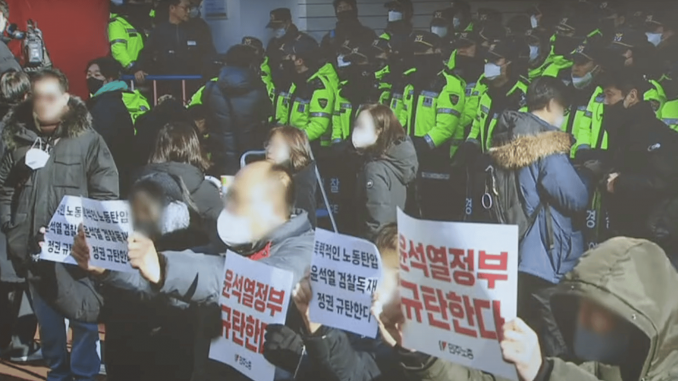
A commemoration of the Korean People’s March 1 Movement was organized by Nodutdol in Los Angeles, New York City and San Francisco. March 1, 1919, was a day when millions of Koreans rose up against Japanese colonialism. The Japanese imperialists massacred participants by the thousands, but the spirit of March 1 continues to inspire tremendous resistance against U.S. imperialism, the division of their country and occupation by U.S. troops today. Speakers talked about the joint war exercises being carried out by the U.S. and the Republic of Korea taking place in March. The exercises are in reality a practice run for a new Korean war.
Koreans rally across U.S. Against imperialist war exercises
Committee accuses U.S., South Korea of ‘war provocation’ after bombing incident
Statement from the Committee for the Preparation of a Sovereign Alliance
Immediately halt the U.S.-South Korea joint military drills, including bombing civilian areas and preemptive strikes against North Korea!
On March 6th, at approximately 10:05 AM, during a U.S.-South Korea joint military exercise near Nogok-ri, Idong-myeon, Pocheon City, two KF-16 fighter jets dropped bombs on civilian areas. The bombs fell about 8 km away from the originally intended target range, in a civilian area. As a result, 29 people, including 15 local residents and 14 soldiers, were injured, and 59 households were affected. The bombs also damaged five houses, a warehouse, a church, a 1-ton truck, and a greenhouse. Residents of border areas, as well as the entire population of South Korea, are suffering from extreme fear and anxiety.
How could such a horrific accident occur again? The military authorities announced that the cause of the incident was a “mistake” in the targeting coordinates entered by the pilots of the KF-16 fighter jets. The pilot of the first jet mistakenly entered the wrong coordinates and dropped the bombs without confirming alignment through system upload or visual observation. The second pilot followed suit. It is hard to believe that the pilots could not distinguish between a training area and a civilian area when they directly pressed the button to release the bombs. Furthermore, the announcement of the accident occurred 1 hour and 37 minutes after the incident, which raises further concerns. The military authorities must clearly explain the cause of the incident and the response process.
The MK-82 bombs used in the incident are 227 kg (500 pounds) general-purpose bombs, filled with tritonal explosive material (87-88 kg), which has significantly more explosive power and lethality than TNT. When one bomb detonates, the blast radius reaches 10 meters in diameter and 3 meters in depth, with a kill radius extending to the size of a football field. Two KF-16 fighter jets dropped a total of 8 bombs on civilian areas, all of which exploded. The consequences would have been unimaginable had the bombs hit nearby schools or other densely populated areas.
This incident occurred during the preliminary drills for the U.S.-South Korea joint military exercise, “Freedom Shield (FS),” scheduled from March 10th to 20th. The joint military exercise involved the U.S. Forces Korea and the South Korean Air Force and Army, with 13 fighter jets, including F-35A, F-15K, KF-16, and FA-50, participating in over 30 live-fire bombing drills. U.S.-South Korea joint commanders, including General JB Brunson of the U.S.-South Korea Combined Forces Command, General Kim Myung-soo of the Joint Chiefs of Staff of the Republic of Korea, and Deputy Commander Kang Shin-cheol, were directly involved in observing the training and managing the aftermath of the incident. The U.S. and South Korean military command cannot evade responsibility for this bombing incident.
The “2025 Freedom Shield” drills, marking the first exercise since the Trump administration’s second term began, will simulate preemptive strikes on North Korea’s nuclear facilities and ballistic missile launch sites, based on the new operational plan “OPLAN 2022.” The drills will involve extensive live-fire exercises, with all types of military assets used, including ground, air, sea, cyber, and space forces. In addition, electronic warfare drills, such as drone attacks, GPS jamming, and cyberattacks, will also take place. As long as the U.S. and South Korea continue their hostile policies toward North Korea and conduct provocative military exercises, North Korea’s strong backlash will only escalate, further threatening peace and security on the Korean Peninsula.
We strongly condemn the U.S. and South Korean authorities for provoking war and escalating tensions on the Korean Peninsula with large-scale military exercises, resulting in another bombing of civilian areas during live-fire drills.
Peace on the Korean Peninsula and war exercises can never coexist. If true peace is desired, the U.S. must halt these military drills and withdraw its forces from this land.
- Thoroughly investigate the cause of the fighter jet bombing of civilian areas and hold those responsible accountable!
- This land is not the U.S. military’s war training ground. Immediately cease all U.S.-South Korea joint military exercises!
- Immediately halt preemptive strike drills against North Korea that escalate the risk of war on the Korean Peninsula!
- Stop war confrontation with North Korea and initiate North Korea-U.S. peace talks!
- Investigate the war-provocation and foreign exchange criminals involved in the insurrection attempts by the Yoon Seok-yeol regime!
March 7, 2025
Committee for the Preparation of a Sovereign Alliance (Provisional)
Activists call for cancellation of U.S.-ROK military exercises In Korea
Actions across the U.S. ahead of the U.S.-ROK Freedom Shield exercises in Korea.
Nodutdol for Korean Community Development’s “U.S. Out of Korea” campaign mobilized hundreds of people in New York, San Francisco, Los Angeles, and Seattle to demand an end to U.S. militarization and escalation towards war.
UPDATE: Pocheon, South Korea, March 6 (Reuters) – South Korean fighter jets accidentally dropped eight bombs on a civilian district on Thursday, injuring 15 people and damaging houses and a church during military exercises in Pocheon, the Air Force and fire agency said. The fire agency said in a statement that 15 people were wounded, including two who were seriously hurt. Pocheon is about 40 kilometres (25 miles) northeast of Seoul, near the heavily militarized border with North Korea. “There was a sudden loud roar of a fighter jet, then an explosion rang out.. When I went to the scene, there were about four houses that were halved from the damage, people hurt,” said Oh Moung-su, a 65-year-old resident. “Dusk and smoke rose into the sky, water gushed out of a pipe. People in a vehicle going to a construction site were injured – some of them couldn’t even get out of the car. Another was outside the car covering his eye.” South Korea’s Air Force said eight 500-pound (225kg) Mk82 bombs from two KF-16 jets fell outside the shooting range during joint live-fire exercises. “We are sorry for the damage caused by the abnormal drop accident, and we wish the injured a speedy recovery,” the Air Force said in a statement.
On March 1, the U.S. out of Korea campaign held rallies across New York City, San Francisco, Los Angeles and Seattle, bringing together hundreds of people in opposition to the upcoming Freedom Shield military exercises taking place between March 10 to March 19 in South Korea.
In New York, over 200 people gathered in Dag Hammarskjöld Plaza, joined by Korean survivors of the atomic bombing of Hiroshima who shared the devastating impact of the U.S. nuclear bomb. Member of European Parliament Marc Botenga also spoke on the necessity of diverting resources away from militarism and war towards peace and international solidarity. Activists marched to the U.S. Mission to the UN building, where they shared a statement of support from progressive organizations in the Republic of Korea.
In San Francisco, 250 people gathered at the Comfort Women memorial, where a diverse program of cultural ceremony and drumming performances ensued. Speakers from BAYAN, Palestinian Youth Movement, and the Party for Socialism and Liberation highlighted the importance of international solidarity and the urgent need to remove U.S. military presence around the world.
In Los Angeles, 150 people took to the streets of Koreatown to demonstrate opposition against the upcoming Freedom Shield war games in Korea. The demonstration began with a slate of speakers and cultural performances at the Wilshire and Vermont Metro Station and ended with a march to the Republic of Korea (ROK) Consulate.
In Seattle, community members organized a vigil in front of the Republic of Korea Consulate in Seattle to commemorate and honor the life of Gil Won-Ok, a survivor of Japanese sexual slavery and activist for comfort women’s justice who passed away in February. They read testimonies from other comfort women, shared personal stories and migration histories, and reaffirmed the demand for the end of the U.S. military occupation of Korea.
As ROK President Yoon Suk Yeol faces his final impeachment hearing and President Trump continues to seek diplomacy with the DPRK, Korea’s political future faces much uncertainty. In the midst of this, the annual Freedom Shield military exercises will be taking place in March. Freedom Shield is an important source of tension with the DPRK, and this year will grow by 70% from 10 combined firepower drills in 2024 to 17 drills this year. On March 1, ROK progressive organizations, trade unions, civil society groups, and political parties mobilized a national protest raising a progressive agenda, including the demand to cancel the Freedom Shield military exercises.
Large-scale springtime U.S.-ROK military exercises have been held annually since 1976. These war games took on the name “Freedom Shield” under Biden in 2023, a year in which U.S.-DPRK relations entered their nadir and tensions within Korea and the region spiked. Last year, the Freedom Shield exercises reached a dangerous scale – evolving into a multilateral exercise involving the militaries of 12 countries, and double the number of exercises from the previous year. The participation of additional countries in Freedom Shield 2025 has yet to be announced.
Though the Trump administration has publicly indicated interest in reopening dialogue with the DPRK, activists say that the expansion of Freedom Shield, along with other military exercises like Polaris Hammer, demonstrates a lack of sincerity towards diplomacy. Organizers warn that the administration’s recent joint statement with the Republic of Korea and Japan—reaffirming its commitment to the Japan-South Korea-U.S. trilateral security cooperation (JAKU.S.), and to strengthening the international sanctions regime against the DPRK—closely mirrors the Biden administration’s Korea policy, which intensified the tensions between the two Koreas.
In light of this, the U.S. Out of Korea campaign is calling for the cancellation of the Freedom Shield 25 military exercises, and the end of U.S. military aggression of all forms against the Korean people. Over 100 U.S. organizations have endorsed a statement calling on President Trump to abide by these demands.
Winter Oh, Nodutdol for Korean Community Development said, “While the South Korean people are locked in a battle for their democracy during President Yoon Seok Yeol’s impeachment crisis, the Trump administration is moving forward with extremely aggressive war drills in Korea called Freedom Shield. This March 1, hundreds of thousands of people in South Korea mobilized against President Yoon and Freedom Shield. We stand in solidarity with the South Korean people’s call to end all U.S.-South Korea joint military exercises, and we further demand an end to the U.S. military occupation in Korea.”
Marc Botenga, Member of the European Parliament for Belgium said, “While, traditionally, some European countries participate in Freedom Shield, I believe European countries should not send forces that will escalate tensions on the other side of the world. They should concentrate on building peace, through diplomacy and disarmament. And there is already a lot to be done in this sense, both in Europe and its immediate neighbourhood.”
Manolo de los Santos, Executive Director of The People’s Forum said, “While Trump calls for peace, his rhetoric is overshadowed by war threats. The forthcoming U.S. War Games on the Korean Peninsula pose a grave risk not only to global peace but also to the sovereignty and dignity of the Korean people. On March 1st, we must unite in solidarity with the Korean people and their movements, affirming our commitment to peace and a future without occupation.”
Ket Maarte of BAYAN Northeast said, “BAYAN stands in solidarity with our Korean comrades in their demands to cancel Freedom Shield 25 and remove U.S. military out of Korean land. It is a shame that the Philippines was one out of the 12 nations to participate in the U.S.-ROK exercises last year. But it is not surprising that our government is complicit in the ongoing militarism against the Korean working class. The Filipino people know all too well what it is like to have our land, sea, and people exploited for the interests of U.S. imperialism. It is imperative that we show our solidarity in the genuine liberation of the Korean and Filipino working class! Because if the U.S. falls in one, the U.S. falls in all.”
Source: NODUTDOL
Was South Korea’s coup an attempt to restart the Korean War?
Opposition lawmakers are alleging the full scope of President Yoon’s coup involved a months-long plot to trigger a “limited war” with North Korea
As South Korea’s political crisis continues following President Yoon’s failed attempt to declare martial law on December 3, new details are emerging in the country’s legislature that suggest the full scope of Yoon’s coup plot may have included plans to trigger a “limited war” with North Korea. Planning documents circulated among accomplices prior to the martial law order also demonstrate that Yoon and former Defense Minister Kim Yong-hyun looked to past martial law orders as precedents, including those issued prior to the Gwangju Massacre and the Jeju Massacre.
A possible timeline of how Yoon’s coup plans interacted with escalations against North Korea has begun to emerge. Yoon’s tenure in office has been characterized by unbridled aggression against Pyongyang, and a cozy military relationship with Washington and Tokyo that sent tensions soaring throughout Northeast Asia. It is now known that Yoon’s coup plans began in July of 2023.
Upon coming into office in 2022, Yoon adopted a military policy towards North Korea known as the Kill Chain Doctrine, which advocates the use of preemptive strikes in the event of suspected attacks. Over the next two years, the rate and magnitude of joint military exercises with the US exploded; over 200 days of US-ROK war games were held in Korea in 2023, and in August of this year the two countries held their first joint nuclear tabletop exercise to rehearse plans for a nuclear strike on the peninsula. Consequently, inter-Korean relations have entered a historic nadir. In December 2023, North Korea took the unprecedented step of renouncing its policy of peaceful reunification.
From garbage war to “limited war”
Following this historic falling out between the two Korean governments, tensions spiked along the de facto land and sea borders of the divided peninsula. One of the more iconic signs of the deteriorating relationship have come in the form of garbage-laden balloons landing in South Korea from the north. For decades, Pyongyang tolerated US-funded NGOs in the south sending propaganda balloons across the DMZ. The fleets of garbage balloons that North Korea began to fly south this spring marked an end to this policy of patience.
In Seoul, the garbage balloons triggered a series of escalatory actions over the course of the summer. But in October, a new line was crossed. For the first time, North Korea reported a series of drone incursions into its territory—an allegation which South Korea’s Defense Ministry stated it could not confirm at the time. The incident led to Pyongyang detonating roads and bridges at the DMZ in an attempt to forestall potential invasion. Now, lawmakers are alleging the drone incursion may have been part of a months-long effort to trigger a military response from North Korea that would end in a “limited war.”
On Sunday, December 8, a military container used to house drones and launchers caught fire. The next day, Democratic Party lawmaker Park Beom-gye announced he had received a tip from a military whistleblower alleging South Korea’s armed forces were responsible for the drone incursion in October. On December 10, Kim Yong-dae, head of Drone Operations Command, submitted to questioning by parliament. He explained to lawmaker Kim Byung-joo that the fire was caused by a short circuit. However, when Kim Byung-joo inquired who ordered Drone Operations Command to send a drone to Pyongyang, Kim Yong-dae replied, “I cannot confirm that.” Kim Yong-dae provided an identical answer to the lawmaker’s follow-up question inquiring where the drones had been launched from. This prompted Kim Byung-Joo to accuse the military of setting the fire in order to destroy evidence of the drone incursion.
Suspicions of a plot to restart the Korean War have also been raised by lawmaker Lee Ki-heon, who reported on December 7 to the National Assembly that former Defense Minister Kim Yong-hyun attempted to order a direct strike on North Korea in order to “hit the origin of the garbage balloons” on November 28, just a week prior to the coup attempt on December 3. The Joint Chiefs of Staff have denied such an order was given, and reiterated the military’s position that a strike in retaliation for the garbage balloons would only be authorized in the event that they caused injury or death.
Meanwhile, correctional officials reported that Defense Minister Kim, who was detained on Sunday, December 8 , attempted suicide in custody on the evening of December 10. He is in stable condition and remains in detention awaiting an expected indictment.
While lawmakers allege that Yoon’s objective was to foment a “limited war,” any attack by either Korean government on each other’s de facto territory could rapidly escalate to a conflict involving the US, Russia, and China. All three of these countries have strategic military agreements on the peninsula.
A massacre in the making?
Other emerging details have demonstrated premeditated plans for repression in Yoon’s coup. Lawmaker Choo Mi-ae has circulated planning documents from the martial law order that reference the infamous massacres that put down popular uprisings in Jeju and Gwangju.
From 1948 to 1949, South Korean soldiers, police, and paramilitaries slaughtered between 30,000 and 60,000 people in Jeju, and burned 70% of the island’s villages as part of a scorched earth campaign conducted in response to a local armed insurgency against US occupation, and the impending 1948 election to establish the Republic of Korea, which was opposed by a majority of Koreans at the time. The counterinsurgency war in Jeju was prosecuted with the knowledge, support, and oversight of the US military.
In Gwangju, paratroopers acting under the orders of then-dictator Chun Doo Hwan killed up to 2,000 residents of the city, and engaged in a campaign of mass torture and rape. The incident occurred after Chun’s declaration of martial law on May 17, 1980, prompting students and workers in the city to rebel against the military and establish a people’s government that lasted for 9 days and resembled the Paris Commune. Once again, US support and foreknowledge was critical to enabling the massacre. President Jimmy Carter directed the Pentagon to assist Chun; South Korean paratroopers were permitted to be transferred from the DMZ, and an aircraft carrier and reconnaissance planes were deployed to the area.
Evidence of Yoon’s plans for repression go beyond historical citation. Choo Mi-ae has further revealed plans to secure hospitals in the early phases of the martial law order, a sign that she claims indicates preparations for acts of mass violence. Several high-ranking military and police officials have attested to receiving personal orders from President Yoon to arrest key political figures, including opposition leader Lee Jae Myung. In an exclusive interview with JTBC News, a Special Forces Officer revealed that second-day plans for the martial law order included the deployment of South Korea’s 7th and 13th Airborne Brigades to Seoul.
Allegations of a wider war plot
Further testimony at the National Assembly suggests a grander plan for war than the “limited war” theory outlined above.
Citing anonymous military sources, lawmaker Kim Byung-joo, a former four-star general, Kim told fellow lawmakers on December 10 that 20 members of the Special Forces’ Headquarters Intelligence Detachment (HID) unit “were on standby at a location in Seoul” on the night of the martial law order. Kim claims the HID unit would have been mobilized to the National Assembly to arrest lawmakers, and questions whether they would have killed those who resisted, possibly while wearing fake North Korean uniforms. The HID unit is normally deployed to the DMZ and is tasked with operations in North Korea, including sabotage, kidnappings, and assassinations. Kim has also said that the HID unit’s second-day orders were to cause disturbances at the National Election Commission, saying, “they were not a simple arrest team.” Kim is calling for further investigation.
On December 13, influential independent journalist Kim Eo-jun appeared before the National Assembly with a bombshell claim. According to Kim, whose studio was targeted by the military in the early hours of the coup attempt, a source from “the embassy of an allied country” told him Yoon planned to assassinate Han Dong-Hoon, the leader of the president’s ruling party, on the night of the martial law order.
Kim Eo-jun claimed Special Forces in North Korean uniform were to act as an “assassination squad” undertaking the following plot: “First, Han Dong-hoon is to be assassinated during transportation after his arrest. Second, attack the arrest unit escorting Cho Kuk, Yang Jeong-cheol and myself, pretending to rescue them. Third, North Korean military uniforms will be buried at a specific location. Fourth, after some time, the uniforms will be discovered, and the incident will be attributed to North Korea.”
Cho Kuk is an anti-Yoon politician who leads the minority Rebuilding Korea Party, and Yang Jeong-cheol is an influential former aide of former President Moon Jae-in.
Kim Eo-jun also said he received tips that Yoon planned to “kill American soldiers to induce the US to bomb North Korea,” and that a biochemical terror attack had also been under consideration. Yoon would have thereby manufactured a situation from which he could emerge as the “reunification president” who successfully ended Korea’s division by means of conquest.
Kim Eo-jun acknowledged the shocking nature of his claims, describing it as an “absurd story,” and clarifying, “I have not confirmed all the facts.” Journalist Kim further alleged that the First Lady, Kim Gun-hee, had also made contact with an OB (Old Boy, term for retired intelligence agent). Though he could not confirm the content of the call, journalist Kim raised the matter before the National Assembly out of consideration “that her husband is the Commander-in-Chief, so if there is even the slightest possibility these calls are related to disturbing public order, no risks should be taken.” Journalist Kim called on the National Assembly to restrict the First Lady’s communications.
The Democratic Party has vowed to investigate further, while the ruling People’s Power Party floor leader Kwon Sung-dong dismissed the testimony as “fake news.” The US Embassy in South Korea denied that it had provided information to Kim Eo-jun, clarifying that US intelligence would have been able to distinguish a false North Korean attack and notified the South Korean government. However, this statement has only raised further suspicions against the US Embassy in some circles due to its similarity to a pronouncement made by Congressman Brad Sherman in an interview with the South Korean outlet MBC News the day before.
Ju-Hyun Park is the engagement editor at The Real News and an organizer with Nodutdol.
Source: Peoples Dispatch
Korean community in U.S. stands up against martial law
In nearly back-to-back rallies, the Los Angeles Korean community turned out to protest the decree of martial law by White House-backed South Korean president Yoon Suk Yeol. Nodutdol, the youth activist organization based in the Korean diaspora in the U.S., held an emergency rally on Dec. 4 at the South Korean Consulate. Rallies were also held in the Bay Area and in New York City.
The U.S. representatives of the Korean Confederation of Trade Unions held a second rally at the Consulate on Dec. 7, calling for a general strike until Yoon steps down.
Korean unions say no to U.S. war buildup, demand Yoon’s resignation
On Nov. 2, the Korean Confederation of Trade Unions (KCTU) will host the National Workers’ Rally to carry on the spirit of martyr Jeon Tae-il, a dedicated South Korean sewing worker and labor rights activist who tragically took his life at just 22, a protest against deplorable working conditions in South Korea’s factories. This year, the rally will focus on the call for President Yoon Suk-yeol’s resignation.
Statement from the KCTU:
The Yoon Suk-yeol regime: We cannot wait a day, let alone three years.
The war crisis on the Korean Peninsula has reached its peak.
The use of loudspeakers and propaganda leaflets against North Korea led to the Yeoncheon artillery incident in 2015 and the destruction of the inter-Korean liaison office in 2020. Despite repeated strong warnings from North Korea, the Yoon regime continues its warmongering, pushing the nation’s fate to the brink of disaster.
It has been revealed that the South Korean Ministry of National Defense flew drones over Pyongyang, a serious violation of the armistice agreement that could escalate into a full-scale war between the North and South.
The U.S. military in South Korea, as a party to the armistice and the holder of operational control, bears direct responsibility for this provocation. Already, eight artillery brigades of the Korean People’s Army have entered a state of combat readiness along the border.
The National Intelligence Service (NIS) spread fake news about North Korea sending troops to Russia, which even the U.S. and NATO said they could not confirm. Nevertheless, Yoon Suk-yeol is deceiving the public with this fake news, seemingly preparing to send artillery shells and the Cheongung-2 missile unit to Ukraine. Yoon is positioning South Korea as an enemy of Russia, aiming to turn the country into a battlefield of destruction and death.
By offering land for the THAAD deployment, South Korea has already been reduced to a forward base, protecting the U.S. and Japan from Chinese ballistic missiles. Soaring prices, shrinking wages, and public suffering — Yoon Suk-yeol, upon taking office, immediately focused on raising taxes on the common people and cutting taxes for the rich.
With his push for a 69-hour workweek and labor flexibility, he has brutally violated workers’ rights to survive. He has labeled the construction workers’ union as a violent group, imprisoning and repressing them. By branding unions as criminal and corrupt organizations and even as anti-state groups, he is fueling hatred against unions and is obsessed with wiping them out.
Yoon has vetoed 24 labor and public welfare bills while pushing through a decision to clear his wife, Kim Keon-hee, of stock manipulation charges. He is driving the public to the brink of survival, and to escape his political crisis, he is plunging the nation into a deadly war crisis. To save workers, Yoon Suk-yeol must be defeated; to save the people, Yoon must be overthrown.
Recently, U.S. Republican presidential candidate Donald Trump called South Korea an ATM, boasting that if he were president, he would demand $10 billion a year. South Korea remains subordinated to the U.S., being extorted and mocked by the U.S. military, and now facing the outbreak of war. The path to overcoming this national crisis is clear: Yoon Suk-yeol, the puppet of the U.S., must be brought down, and the U.S. must be expelled.
South Korea seizes cargo ship, escalating U.S.-led sanctions and threats
On March 30, the South Korean Coast Guard forcibly seized the 3,000-ton cargo ship De Yi. The stateless ship had left North Korea’s western port of Nampo and was headed to Vladivostok, Russia.
After a scheduled stop in Shandong, China, the trip necessitated sailing around the southern end of the Korean peninsula and up the eastern coast to Vladivostok. South Korea claims the ship was probably carrying coal and violating UN sanctions against North Korea.
The ship’s Chinese captain and crew refused to allow the South Korean military to search the hull.
For 75 years, the U.S. military has occupied South Korea; there are currently some 30,000 troops stationed there on 73 bases, the third biggest U.S. military occupation in the world. The South Korean military is under the virtual command of the U.S., and any actions such as seizing a ship are generally considered to be done at the direction of the U.S.
The Democratic People’s Republic of Korea, or DPRK as North Korea is officially known, is one of the most sanctioned countries in the world. Certain UN sanctions were worsened in 2017 but will now lapse on April 30. There was a UN resolution to extend them, but the Russian ambassador to the UN vetoed it.
Over the decades, the U.S. State Department has been the prime motivator of multinational trade sanctions, pressuring allies to join the effort to starve North Korea and force them to become a pliant neocolony.
The U.S. first imposed sanctions during the 1950-53 Korean War after murdering millions of Koreans and a months-long bombing campaign that destroyed practically every building in major cities. By the end of the war, the capital city of Pyongyang looked very much like Gaza does today, with death and debris as far as the eye can see.
The U.S. refused to sign a peace treaty at the war’s close and still does. With U.S. nuclear weapons having been stationed in South Korea for years, and tens of thousands of troops still present there, as well as nuclear warheads within striking distance from the air and by sea, U.S. imperialism is more than a military menace – it is an existential threat to North Korea.
During the 1990s, the U.S. and its allies falsely accused the DPRK of developing a nuclear weapons program in secret. They were really trying to build nuclear power plants to make up for their inability to import fuel oil for heat due to the sanctions. North Koreans were suffering during long, cold winters.
The secrecy accusation is part of a constant refrain from the U.S. propaganda machine. However, in 2006, President Kim Jong Il announced that they had turned the U.S. lies into reality. The DPRK had successfully conducted its first nuclear weapons test.
North Korea has had a decades-long policy of “military first.” That means that even at great cost and despite difficult conditions under the U.S. sanctions regime, the Korean people agreed that defense was the top priority. That policy and Kim Jong Il’s decision may be the only reason North Korea still exists as a sovereign and socialist country.
After the first nuclear weapons test by North Korea, the White House pushed successfully for even more severe sanctions at the UN. Russia’s veto at the UN gave North Korea relief from at least some of the sanctions that have made life so difficult for millions of Korean people.
The imperialist war against the people of Korea has been uninterrupted and severe ever since the Korean People’s Army liberated the north under the leadership of the great revolutionary Kim Il Sung and the Communist Party of Korea.
The U.S. has its fingerprints all over this cargo ship seizure. Korea JoongAng Daily reported that “the United States is believed to have provided the South Korean government with circumstantial evidence of suspected sanctions violations.” ‘Circumstantial’ and ‘suspected’ are the key words. By prodding South Korea into seizing the ship, the White House is signaling that its campaign to destroy the DPRK will not let up one bit.
Korean people of both the north and the south want the country reunified. It was the U.S. that divided the country, drawing a line at the 38th parallel, dividing parents from children and siblings from each other for 75 years and counting. Right-wing South Korean President Yoon Suk Yeol has turned back some of the progress in relations made over the last two decades or more. He is steering South Korea closer to the U.S. and has imposed his own unilateral sanctions on the DPRK, adding to the punishment doled out by the U.S. and other imperialists.
This isn’t what the people of South Korea want. When the Japanese empire fell at the close of World War II, and the U.S. moved to take over Japan’s colonies, the U.S. spent years trying to crush a people’s movement in the south that resisted the division of Korea.
In 1945, Syngman Rhee — who had lived in the U.S. since 1904 and was a U.S. citizen — arrived in U.S.-occupied South Korea aboard General Douglas MacArthur’s personal plane. In 1948, under the direction of the CIA (then named OSS), Rhee was imposed as president through a rigged election. There was mass opposition to which Rhee responded with police-state repression, jailing over 300,000 and killing tens of thousands by 1950.
As this article is being composed, millions of South Koreans are remembering the great uprising on the island of Jeju in April 1948, a response to the sham election; nearly every police headquarters was destroyed, and a division of Syngman Rhee’s army mutinied.
Some of them fought their way north and joined in the development of socialism in North Korea. Many more strikes, rebellions, student walkouts, and other militant actions like the takeover of Gwangju in 1980 – sometimes referred to as the “2nd Paris Commune” — characterize the South Korean people’s righteous struggle.
Many South Koreans were killed over the years, but the struggle for self-determination lives on.
The U.S. media portrays North Korea as an isolated nation. That is another falsehood. Right now, North Korea is celebrating the “China-DPRK Friendship Year.’ Zhao Leji, the Chairman of China’s National People’s Congress, is leading a delegation to Pyongyang to mark the occasion. Zhao is also the third highest-ranking official in all of China and is meeting with his North Korean counterpart, Choe Ryong-hae. It is also noteworthy that the DPRK has been very vocal about its solidarity and support for the people of Gaza, as they have over the decades with Nicaragua, Iran, Venezuela, Cuba, and others. North Korea is an important ally and friend of the global struggle against U.S. imperialism!
Down with the U.S. empire, and long live the struggling people of North Korea! Korea is One!
Is a new Korean war in the offing?
In recent days, U.S. media have been proclaiming that North Korea plans to initiate military action against its neighbor to the south. An article by Robert L. Carlin and Siegfried S. Hecker, neither previously prone to making wild assertions, created quite a splash and set off a chain reaction of media fear-mongering. In Carlin’s and Hecker’s assessment, “[W]e believe that, like his grandfather in 1950, Kim Jong Un has made a strategic decision to go to war.” They add that if North Korean leader Kim Jong Un is convinced that engagement with the United States is not possible, then “his recent words and actions point toward the prospects of a military solution using [his nuclear] arsenal.” [1]
U.S. officials have stated that while they do not see “an imminent risk of a full-scale war on the Korean Peninsula,” Kim Jong Un “could take some form of lethal military action against South Korea in the coming months after having shifted to a policy of open hostility.” [2] How do these sensationalist claims stack up against the evidence?
It is no secret that lately, the stance of the United States and South Korea has hardened against the Democratic People’s Republic of Korea (DPRK – the formal name for North Korea). Since the centerpiece for suggesting that war may be on the horizon is Kim’s speech at the 14th Supreme People’s Assembly, its content is worth examining in some detail. [3] What strikes one when reading the text is that mainstream media have taken quotes out of context and ignored much of the content of Kim’s speech, creating an impression of unprovoked belligerence.
Also generally absent from media reporting is the speech’s relationship to the backdrop of events since the far-right Yoon Suk Yeol became president of South Korea in May 2022. Yoon came into office determined to smash every vestige of the improved inter-Korean environment established during his predecessor’s term. Instead, Yoon prioritized making South Korea a subordinate partner in the Biden administration’s hyper-militarized Indo-Pacific Strategy.
To fully understand Kim Jong Un’s speech, one must also consider the nature of the Biden administration’s rapid military escalation in the Asia-Pacific. The United States conducts a virtually nonstop series of military exercises at North Korea’s doorstep, practicing the bombing and invasion of that nation. One South Korean analyst has counted 42 joint U.S.-South Korean military exercises conducted in 2023 alone, along with ten more involving Japan. [4] Those totals do not include exercises that the U.S. and South Korea engaged in outside of Northeast Asia, such as Exercise Talisman Sabre in Australia and Exercise Cobra Gold in Thailand. Moreover, U.S. actions on the Korean Peninsula must also be situated within the broader geopolitical framework of its hostility towards China.
Last year, in an act of overt intimidation, the United States conducted seven exercises with nuclear-capable bombers over the Korean Peninsula. [5] Additional flights involved the B-1 bomber, which the U.S. Air Force says “can rapidly deliver massive quantities of precision and non-precision weapons.” [6] Through its actions, the United States sends far more provocative messages than anything that could be honestly construed in Kim’s speech. But then, we are led to see nothing amiss in such aggressive behavior from the United States. Nevertheless, the threat is real and unmistakable from the targeted nation’s perspective.
It also has not gone unnoticed in Pyongyang that U.S. and South Korean military forces regularly conduct training exercises to practice assassinating Kim Jong Un and other North Korean officials. [7] Just this month, U.S. Green Berets and soldiers from South Korea’s Special Warfare Command completed training focused on the targeted killing of North Korean individuals. [8] The Biden administration avers that it harbors no hostile intent toward the DPRK, but its actions say otherwise, loud and clear.
North Korea, with a GDP that the United Nations ranks just behind that of Congo and Laos, is considered such a danger that the U.S. must confront it with substantial military might. An inconvenient question that is never asked is why the DPRK is singled out for punishment and threats when the other nuclear non-members of the Non-Proliferation Treaty – each armed with ballistic missiles — are not. What distinguishes North Korea from India, Pakistan, and Israel? How is it that North Korea is regarded as a threat to peace but not Israel, notwithstanding mounting evidence to the contrary? The essential distinction is that North Korea is the only one of the four that is not a U.S. ally; moreover, one which the U.S. wishes to retain the ability to bomb, whether or not it ever exercises the option to do so.
It is a tribute to the persuasiveness of propaganda that the United States, with its record of multiple wars, bombings, and drone assassinations in recent decades, can convince so many that the DPRK, which has done none of these things during the same period, is a danger to international peace and stability. Yet, such towering hypocrisy goes largely unnoticed. It would appear that there is no principle involved in targeting only North Korea and not the other nuclear-armed non-members of the NPT — unless outrage over a small nation following an independent path being able to defend itself can be regarded as a principle.
Predictably, Washington think tank analysts and media commentators are throwing more heat than light on the subject of Kim’s pronouncements, and they are always ready with a cliché at hand. Some, like Bruce W. Bennett of RAND Corporation, let their imagination run wild, conjuring bizarre absurdities. Bennett suggests that armed with more nuclear weapons in the years ahead, North Korea “could threaten one or more U.S. cities with nuclear attack if the United States does not repeal its sanctions against North Korea.” Or perhaps, he suggests, the DPRK could threaten the U.S. with a limited nuclear attack “unless it abandons its alliance with [South Korea]” or “disengage from Ukraine.” As for South Korea, Bennett warns that Kim might insist that it “pay him $100 billion per year and permanently discontinue producing K-pop…” [9] This is what passes as expert analysis in Washington.
The military section of Kim’s speech was at root defensive, pointing out that North Korea’s “security environment has been steadily deteriorated” and that if it wants to take “the road of independent development,” it must be fully prepared to defend itself. Kim quotes specific threats made by U.S. and South Korean leaders to emphasize his awareness that his nation is in the crosshairs.
At one point in his speech, Kim suggested that the constitution could specify “the issue of completely occupying, subjugating and reclaiming the ROK [Republic of Korea, the formal name for South Korea] and annex it…in case war breaks out…” He added, “There is no reason to opt for war, and therefore, there is no intention of unilaterally going to war, but once a war becomes a reality facing us, we will never try to avoid it.” Such a war, he warned, “will terribly destroy the entity called the Republic of Korea and put an end to its existence” and “inflict an unimaginably crushing calamity and defeat upon the U.S.” Kim continues, “If the enemies ignite a war, our Republic will resolutely punish the enemies by mobilizing all its military forces including nuclear weapons.” Harsh language, indeed, intended to remind the war hawks in Washington and Seoul not to imagine that their nations are invulnerable if they attack the DPRK. Note also the conditional phrasing, which tends to get downplayed in Western media.
Even less attention is paid to more direct clarifying language, such as Kim’s statement that the DPRK’s military is for “legitimate self-defense” and “not a means of preemptive attack for realizing unilateral reunification by force of arms.” And: “Explicitly speaking, we will never unilaterally unleash a war if the enemies do not provoke us.”
It was entirely predictable that Western media would put the worst spin on Kim’s blunt language that mirrored earlier South Korean pronouncements. The month before Kim’s speech, South Korean Defense Minister Shin Won-sik warned, “North Korea has only two choices – peace or destruction. If North Korea makes reckless actions that harm peace, only a hell of destruction awaits them.” [10] A few days later, Yoon ordered his military to launch an “immediate and overwhelming response” to any provocation by the DPRK. [11] Yoon and South Korean military officials use the term ‘provocation’ so loosely as to encompass almost any action the DPRK takes that they do not like, including what is normal behavior for other nations – or for South Korea itself, for that matter. South Korean and North Korean rhetoric identifying each other as enemies and destruction in the event of war differ in that the former preceded the latter. By ignoring the fact that North Korea is reacting to prior South Korean statements, mainstream media can portray Kim’s language as unprovoked.
Last December, Yoon heightened the risk of conflict when he visited an infantry division near the border and gave them an order: “In case of provocations, I ask you to immediately retaliate in response and report it later.” [12] Vague in defining neither “provocation” nor the appropriate response level and delegating to lower-level commanders to decide those questions, this formula potentially can transform a minor clash of arms into a conflict of wider impact.
Kim’s statements are presented in Western media as tantamount to a plan to start a war. Earlier statements of a similar nature by the Yoon administration that created an acrimonious atmosphere are rendered invisible or uncontroversial. It is fair to say that given North Korea’s longstanding practice of responding in kind, Kim may have adopted more restrained phrasing without South Korean officials setting the tone.
Western media have raised concerns over Kim’s labeling of South Korea as a “principal enemy.” We are not reminded that nearly one year before, South Korea had re-designated the DPRK as “our enemy” in its Defense White Paper. [13]Under Yoon’s predecessor, Moon Jae-in, the defense paper dropped the reference to North Korea as an enemy. [14]The general pattern has been for liberal presidents to shun that tag in the interests of inter-Korean relations and for conservative presidents to embrace it as one element in their project to undo progress. Yoon himself frequently refers to North Korea as the enemy, and his administration’s National Security Strategy document describes the Kill Chain system, which is designed to launch preemptive strikes on North Korea. [15] In omitting such details, cause and effect are inverted, reinforcing the media-constructed Orientalist image of an irrational leader at the helm of the DPRK, prone to unpredictable statements and rash acts.
Patience has run thin in Pyongyang, as Biden’s trilateral alliance with South Korea and Japan, “buoyed with war fever,” as Kim put it, sharply escalates military tensions in the region. In a sharp reversal, North Korea has abandoned its longstanding policy of seeking improved inter-Korean relations and working toward peaceful reunification. Any headway achieved in the past has quickly been undone in South Korea whenever the conservative party came to power. Still, Yoon has taken matters further than the norm, not only willfully dynamiting inter-Korean relations but also deliberately raising the risk of military conflict. Inter-Korean relations have reached such a nadir under Yoon that the DPRK sees no hope of progress in the current circumstances. The North Koreans are not wrong in that perception.
Sadly, in a clear signal of its exasperation with Yoon, North Korea demolished the Arch of Reunification in Pyongyang, and all governmental bodies responsible for reunification planning and projects were shut down. The latter steps are not inherently irreversible, however. But as long as Yoon remains in power, there is no conceivable possibility of progress on reunification. Yoon has slammed the door shut on inter-Korean relations.
One would never know it from Western reports, but more than two-thirds of Kim’s speech focused on economic development. “The supreme task,” Kim announced, “is to stabilize and improve the people’s living as early as possible.” Peace is an essential prerequisite for the realization of that goal. North Koreans are well aware of American and South Korean military capabilities, and a war would not only wipe out new economic projects but most of the existing infrastructure as well.
Immense damage has been done to the DPRK’s economy by sanctions designed to target the entire population and inflict as much suffering as possible. [16] The period when North Korea closed its border with China in response to the COVID-19 pandemic added to economic challenges. Reversing direction is imperative. In his speech, Kim called for “a radical turn in the economic construction and improvement of the people’s living standard” and said that progress is being made “despite unprecedented trials.” Kim enumerated industrial, power, housing, and other ongoing projects.
Kim admitted there have been internal challenges in economic development. “It is a reality that the Party and the government yet fail to meet even the simple demand of the people in life…” In particular, regional and urban-rural economic imbalances have plagued the North Korean economy for decades. “At present,” Kim continued, “there is a great disparity of living standards between the capital city and provinces and between towns and the countryside.” Kim acknowledged that these issues have not been adequately addressed in the past, but it “is an immediate task” to do so now.
Kim took the occasion to officially unveil the launch of the Regional Development 20×10 Policy. This ambitious plan calls for substantially raising material and cultural standards in twenty counties over the next ten years, including constructing regional industrial factories and establishing advanced educational institutions. In particular, emphasis is to be given to scientific and technological development. The aim is to even out regional imbalances and to accelerate overall development.
None of this can be achieved if the U.S. and South Korea are showering the DPRK with high explosives, and the Regional 20×10 Policy makes nonsense of Western scaremongering that Kim has decided to go to war. As usual, though, when it comes to reporting on North Korea, assertion substitutes for evidence, and we can expect Washington think tanks, U.S. media, military contractors, and the Biden administration to capitalize on the manufactured image of a war-mad Kim Jong Un to accelerate the military buildup in the Asia-Pacific, aimed against the DPRK and the People’s Republic of China. For his part, Yoon can be expected to amplify military tensions on the Korean Peninsula and sharpen his war on South Korean progressives. What is not in the cards is militarism abating in the foreseeable future.
Notes.
[1] Robert L. Carlin and Siegfried S. Hecker, “Is Kim Jong Un Preparing for War,” 38 North, January 11, 2024.
[2] Edward Wong and Julian E. Barnes, “U.S. is Watching North Korea for Signs of Lethal Military Action,” New York Times, January 25, 2024.
[3] “Respected Comrade Kim Jong Un Makes Policy Speech at 10th Session of the 14th SPA,” KCNA, January 16, 2024.
[4] http://www.minplusnews.com/news/articleView.html?idxno=14494
[5] Chae Yun-hwan, “S. Korea, U.S. Stage Joint Air Drills with B-52H Bombers Over the Yellow Sea,” Yonhap, November 15, 2023.
[6] https://www.af.mil/About-Us/Fact-Sheets/Display/Article/104500/b-1b-lancer/
[7] Jeongmin Kim, “Drills on Assassinating Kim Jong Un Remain an ‘Option,’ ROK Defense Chief Says,” NK News, December 19, 2023.
[8] Lee Yu-jung and Esther Chung, “Kim Jong-un Instructs North Korea’s Navy to Prepare for War,” JoongAng Ilbo, February 2, 2024.
https://www.youtube.com/watch?v=lQJF7tbzwfY
Donald Kirk, “U.S. to Enrage Kim Jong Un with Assassination Dry Run,” Daily Beast, August 19, 2022.
[9] Bruce W. Bennett, “Is North Korea Really Getting Ready for a War Against America?” The National Interest, January 17, 2024.
[10] Chae Yun-hwan, “Defense Chief Warns N. Korea of ‘Hell of Destruction’ in Event of Reckless Acts,” Yonhap, December 13, 2023.
[11] “Yoon Orders Swift, Overwhelming Response to N. Korean Provocation,” KBS World, December 18, 2023.
[12] Kim Han-joo, “Yoon Orders Military to Retaliate First, Report Later in Case of Enemy Attacks,” Yonhap, December 28, 2023.
[13] Kwon Hyuk-chul, “S. Korea’s First Defense White Paper Under Yoon Defines N. Korea as ‘Enemy’”, Hankyoreh, February 17, 2023.
[14] Yosuke Onchi, “South Korea No Longer Calls Pyongyang ‘Enemy’ in Defense Paper,” Nikkei Asia, January 16, 2019.
[15] https://www.nknews.org/wp-content/uploads/2023/06/Yoon-Suk-yeol-Administrations-National-Security-Strategy-June-2023.pdf
Josh Smith, “South Korea Doubles Down on Risky ‘Kill Chain’ Plans to Counter North Korea Nuclear Threat,” Reuters, July 25, 2022.
[16] https://www.counterpunch.org/2017/09/19/trumps-war-on-the-north-korean-people/
Gregory Elich is a Korea Policy Institute board member. He is a contributor to the collection, Sanctions as War: Anti-Imperialist Perspectives on American Geo-Economic Strategy (Haymarket Books, 2023). His website is https://gregoryelich.org Follow him on Twitter at @GregoryElich.
Source: CounterPunch
Israeli war crimes expose imperialists’ anti-North Korea propaganda

Statement from Korean American Support for Prisoners of Conscience.
Asserting human rights while merely paying lip service to them — what an absurdity!
To be respected as a human being, one must be free from threats to survival.
One must break free from worrying about where to seek shelter from storms or how to alleviate hunger.
Even San Francisco’s streets, known for their countless homeless and bizarre manifestations of drug addiction that had become commonplace, briefly appeared clean. This was solely due to the San Francisco authorities meticulously cleaning the streets that foreign dignitaries attending the APEC conference would pass through. While efforts are made to deceive foreign dignitaries by disguising the city’s citizens’ shattered lives, there is no genuine concern for these citizens.
In a society where concerns about health issues are compounded by exorbitant health care costs and discrimination in health care insurance that individuals must bear entirely, even the sick struggle to access hospitals easily.
It’s a society where one cannot step out of their homes feeling secure, and even indoors, there is a constant fear for safety. Incidents of minor crimes and reports are routinely disregarded.
Despite a stable living environment being a fundamental right of citizens, this right is infringed upon, and the people have grown numb to this infringement in the United States.
While U.S. Imperialism spends astronomical amounts on wars worldwide, it annually provides $3.8 billion to Israel. Yet, the nation itself teeters on the brink of crisis due to an unsustainable increase in debt, nearly causing the government’s functions to fail.
An Arab boy, aged 5, loses his life, and his mother is critically injured as a white assailant targets a Muslim household. Three Arab youths are shot by a white person on the streets, resulting in the deaths of two. Countless incidents occur where Asian women are assaulted for no reason.
The unfounded China and Muslim hatred instigated by U.S. imperialism has led to persistent hate crimes in American society.
When MSNBC anchor Mehdi Hasan attempted to discuss events unfolding in Palestine, the ongoing program was abruptly canceled.
A university student supporting Palestinian liberation lost a confirmed job offer, while a Jewish professor advocating for the deaths of all Palestinians briefly left their position only to return. Workers are dismissed from their jobs for participating in pro-Palestinian demonstrations. Similarly, in Canada, a broadcaster was ousted for the same reason, while in France and Germany, police violently suppressed unarmed demonstrators.
The double standards imposed by the West and U.S. imperialism, which condemn and oppress underprivileged individuals for their own gain, reveal the true nature of their touted human rights.
Among the distortions and fabrications propagated by the West and nations against North Korea, there is a propaganda war labeling North Korea as a human rights-abusing nation.
Despite Israel indiscriminately bombing schools, hospitals, refugee camps, and residential areas in Palestine, causing the mass slaughter of women and children, U.S. imperialism and Western imperialism continue to support Israel’s inhumane crimes.
These countries have no right to even speak of human rights.
The authorities violently suppress workers fighting for their right to survive, and intelligence agencies and police raid union offices. Under the National Security Law, which claims that “a deeper understanding of North Korea poses a substantive danger to South Korea,” raids are rampant in the South, promoting such actions.
Though rights are violated, lives are taken, and truth is manipulated and suppressed, perpetrators often go unpunished. The National Security Law, a sharp blade that condemns ideologies, controls media, and silences the voices of the people, is shameless in its display while hypocritically talking about human rights.
In this landscape where human rights are being annihilated, there exists the “North Korean Human Rights Act,” purportedly aimed at guaranteeing and improving the basic human rights of North Korean citizens. However, with all communication channels to the North blocked and no real understanding of the basic human rights of North Korean citizens, how does the South claim to guarantee and improve them?
Just as North Korea’s reconnaissance satellite launch claims sovereignty over its territory, North Korea’s human rights are something that its citizens should handle themselves.
Dec. 6, 2023.
Korean American Support for Prisoners of Conscience
South Korean prisoners of conscience: ‘They are still warriors’
Beginning in 1905, the Empire of Japan occupied Korea. Korean resistance fighters throughout the nation were highly organized. By the time World War II was concluding, the guerilla army led by Kim Il Sung had driven the Japanese out of the northern half of the peninsula.
Resistance was also powerful in the South, and the occupiers killed and jailed thousands as they tried to hold on to power. When Japan was defeated, the United States moved into what is now South Korea. They continued the brutal occupation that Koreans had suffered since 1905.
The heroic resistance in the south delayed the U.S. attack on North Korea for five years as the U.S. and quisling Koreans who had collaborated with Japan barely held onto power. In the process, they murdered thousands of peasants, students, communist fighters, and unionists. They jailed tens of thousands.
Just before the 1950-53 Korean War, the U.S. oversaw mass executions of political prisoners carried out by their comprador South Korean puppets. Many who were spared execution spent the rest of their days in prison, refusing to renounce their desire for socialism, liberation, and reunification with the North.
Korea’s National Security Law remains in place today. Arrests have continued. Those refusing to renounce their desire for reunification and socialism serve some of the world’s longest sentences for political prisoners.
Struggle-La Lucha spoke with Peter Kim, a Los Angeles activist with the Support Committee for Korean Prisoners of Conscience.
SLL: You visited with some of the Prisoners of Conscience in South Korean prisons. Can you explain briefly what a prisoner of conscience is?
Peter Kim: A Prisoner of Conscience is a person imprisoned for holding political or religious views that are not tolerated by their own government. In Korea, prisoners of conscience are unconverted long-term prisoners. Who are unconverted prisoners? They are POWs from the Korean War. They were in the People’s Army to be returned under the cease-fire treaty but were sent to prison instead. This is a violation of the cease-fire treaty and the Geneva Convention. It’s a war crime.
SLL: What did it mean to be converted or unconverted?
Peter Kim: People living in the south who opposed the U.S. invasion supported the People’s Army. After the Korean War, they were victims of the KCIA’s fabricated spy allegations. What is conversion? When the Japanese occupied Korea, they tried to eliminate the national liberation movement. Koreans who fought for liberation were jailed, tortured, and eventually executed if they refused to pledge their loyalty to the Japanese. To prove loyalty, the prisoners had to write about their regretful behavior and sign their loyalty to the Japanese. People who did this received lighter sentences, and were pardoned and freed. Even the Nazis did not have a conversion program for dissenters. Japanese imperialism still has not apologized for its sexual slavery, forced labor, and occupation of neighboring countries.
SLL: What was the treatment of people, particularly the unconverted prisoners, after the U.S. moved in?
Peter Kim: After liberation from Japan, Americans used the same National Security Law that the Japanese used in the colonial era to put down their political enemies, those who resisted the government and were socialists. It’s shameful to say that unconverted long-term prisoners are going through a conversion course much worse than what the Japanese did to the Koreans. Many of them were killed in the conversion process. How can you change someone’s ideology or thought? Being able to think and speak freely is a basic human right!
SLL: That same National Security Law is still in place, and speaking out for reunification or visiting North Korea still gets people arrested in South Korea. Are there still long prison sentences?
Peter Kim: Yes. Nelson Mandela was a long-term prisoner. He was in prison for 27 years. Korean unconverted long-term prisoners’ average prison time is 33 years; the longest is 43 years and ten months. As a result of the North-South Korea summit in 2000, some 63 unconverted long-term prisoners, excluding those who wanted to remain in the south, returned to their motherland in September 2000.
They got a warm welcome and were treated as national heroes. Back then, the distinction between conversion and non-conversion mattered. So the few converted long-term prisoners didn’t go back. After the first repatriation, 46 people waited for the second repatriation. We are constantly asking the authorities for a second repatriation for those who were left out. After 23 years, most of them passed away without being able to return to their motherland and family. Only nine remain.
On my visit to Korea, I met 4 of the remaining 9. Two of them just underwent surgery, even though they are in their 90s. It is not easy to decide on surgery, and they may die during the operation. However, their tenacity to return to their motherland and report to the Workers Party of Korea seems to have led them to such determination. They recovered faster than expected and worked hard for rehabilitation. They are still warriors!
1