American Indian Movement leader dies at 85

Clyde Bellecourt, co-founder or the American Indian Movement, speaks on Jan. 26, 2018, at Minneapolis City Hall, in Minneapolis. Bellecourt, a leader in the Native American struggle for civil rights and a founder of the American Indian Movement, has died. He was 85. Bellecourt died Tuesday , Jan. 11, 2022, from cancer at his home in Minneapolis.

The co-founder of the American Indian Movement and longtime leader in the fight for Native civil rights has died.

Clyde Bellecourt, White Earth Nation, died from cancer at his Minneapolis home Tuesday, his wife Peggy Bellecourt confirmed with the Star Tribune. He was 85.

Bellecourt was a co-founder in 1968 of the American Indian Movement, which began as a local organization in Minneapolis that sought to grapple with issues of police brutality and discrimination against Native people. The group quickly became a national force. It would lead a string of major national protests in the 1970s.

AIM held major national protests in the 60s and 70s including the 1972 Trail of Broken Treaties — a march to Washington D.C. — and the 1973 Wounded Knee Occupation in South Dakota.

Bellecourt stepped aside as an AIM leader because he was experiencing medical issues, he told Indian Country Today in 2020. The handoff signaled a new era for the movement.

George Floyd was murdered by police in Minneapolis in 2020 just blocks from Bellecourt’s home and he said they started AIM on Minneapolis’ Franklin Avenue in 1968 to protest police violence.

Bellecourt’s family members and friends took to social media to share memories of him.

Lisa Bellanger, the current co-director of AIM, said he was known worldwide and condolences were coming in from around the globe.

Activist Winona LaDuke, White Earth Nation, said he was very influential in her life.

“Clyde was a really good man and influenced a lot of people,” LaDuke said.

Founder of the American Indian Movement and elder statesman in the Twin Cities civil rights community Clyde Bellecourt (L) speaks to U.S. Democratic presidential candidate Bernie Sanders during a forum on race and economic opportunity in Minneapolis, United States, February 12, 2016.

Clyde Bellecourt, left, a founder of the American Indian Movement, shakes hands with Nelson Mandela, right, and gets a smile from Sheila Sisulu, South African Ambassador to the United States at a news conference in Minneapolis, Tuesday, Nov. 21, 2000.

Strugglelalucha256


National Day of Mourning 2021: ‘Don’t give up. We can fight!’

Talk given by the co-leader of United American Indians of New England at the 52nd National Day of Mourning in Plymouth, Massachusetts, on Nov. 25, 2021.

So much has happened in the past year.

We lost our co-leader Moonanum James back in December, and dear Bert Waters back in August. We have lost thousands upon thousands of Indigenous relations to COVID-19. Many of us have been out on the streets marching against white supremacy. White supremacists are still walking free while Indigenous, Black and Brown people continue to die.

But Indigenous struggles never die. They can ebb and flow, though. Currently, we are in a time of Indigenous resurgence with things happening on so many fronts.

We will cover as many issues as we can in the time we have today. In addition to our speakers here in Plymouth, we will also have an online pre-recorded program that will follow this livestream. The pre-recorded program will have information and speakers from many important struggles, including speakers from the Mapuche struggle in Chile, the Northeast Megadam Resistance Alliance, Devin Attallah and Ahmal Bishara speaking about Palestine, Uahikea Maile speaking about the kanaka maoli Native Hawaiian resistance, and Elena Ortiz from The Red Nation.

I hear a lot of people talk about reconciliation. Reconciliation is when you try to repair an existing relationship, like when you go to marriage counseling to work things out. I don’t feel like we have ever had enough of a good relationship with settlers to think that something that has been so ugly can be reconciled or repaired. For example, can the damage done by Residential Schools ever actually be repaired?

Not schools, internment camps

Not just on September 30 — Orange Shirt Day — but every day, how can we stop thinking about and mourning for the Indigenous children in Canada and the U.S. that were forced into internment camps called Indian residential schools or boarding schools. (People say they should not even be called schools because of what happened there.) 

Hundreds of these schools were run for decades by governments and missionaries that made it their mission to “kill the Indian to save the child,” all too often abusing or killing the child in the process. Thousands of the children died at these institutions, from tuberculosis, from medical experiments including starvation, from abuse, from broken hearts. All of them were scarred. 

In Canada, some of the school grounds have been searched this year, and the remains of more than 7,000 children have been found. More than 7,000 children buried in unmarked graves! How can that be reconciled? How can you possibly make amends to the Indigenous communities that lost their children?

And there are many more places left to search. The residential school survivors had long said that there were mass graves at the residential schools, but the government took no action.

Here in the U.S., the Interior Department has now said that they are going to try to find out how many children lie in graves at the boarding schools, and every child they find, and every child whose remains have already been found, needs to be brought home to their families and tribal communities. We cannot rest until this happens. Bring the children home!

Residential schools are not just a thing of the past. Indigenous children continue to be put into residential schools in some parts of Latin America, often run by missionaries. Adivasi tribal children in India are also frequently forced to attend residential schools where they too are stripped of their cultural and familial ties. 

The residential schools in the U.S. and Canada may be closed, but our Indigenous children are instead disproportionately placed into foster care. Evangelicals and right-wing organizations like the Goldwater Institute have been leading the charge to get rid of the Indian Child Welfare Act that protects our children from being adopted out of their own communities. These groups want to push us back to the 1960s, when at least a third of Native children were stolen from their families and put into white homes, losing their tribal connections and cultures. 

A third of all Native children stolen from their families. How can that be reconciled?

Land back and self-determination

We do not need empty words of reconciliation or apologies. It is too late for that. What we need is land back and reparations. And when I say “land back,” I mean land back! Give the land back to Indigenous people! What we need is a brand new way of thinking and be able to move properly into the future. Native self-determination, land back, decolonization and Black liberation are the only way forward!

Land back is not a new concept that someone recently invented. Our ancestors always taught us to demand the return of our lands. The land and water are in our blood and bones, part of our bodies, and we have never forgotten that. As a starting point, return the national parks and state-held lands to the Native nations, so that Indigenous people can be free to caretake the land properly.

And all these months into the Biden administration, the Mashpee still have not had their land trust issues resolved by the Interior Department. So we say to President Biden: Resolve Mashpee’s land trust issues and respect the sovereignty of all Native nations!

Year after year, we stand on this hill and demand an end to the colonial borders, that ICE be abolished, and that Customs and Border Patrol stop detaining undocumented Immigrants. We think not only of the Native nations whose homelands have been divided by the arbitrary settler-colonial border, but also of the many thousands of Indigenous people impacted by the U.S. policies that have led them to flee their home countries in Mexico, El Salvador and elsewhere, and of our Haitian and many other relatives who have been attacked and rounded up and abused by border control. As always, we say, “No one is illegal on stolen land!!”

This year we will also talk again about Missing and Murdered Indigenous Women, Girls and Two-Sprit people (MMIWG2S). Biden says he cares about MMIWG2S, but then why will he not shut down pipelines and turn his back on the energy industry? It is well-known that the man camps that these pipelines bring with them are a major factor in MMIWG2S, yet his administration does not stop these projects.

Whether Republicans or Democrats, Conservatives or Liberals, the politicians uphold colonial rule and work hand in glove with energy corporations. They engage in intense, heavily militarized police repression against pipeline resisters. Divest from all these corporations and the banks that are funding these projects!

From Line 3 to Wet’suwet’en

Many of you may have heard of Line 3 in Minnesota; some of you even went out there to join the frontlines. Hundreds of water protectors are currently facing criminal charges in Minnesota for standing in defense of the water, the climate and the treaty rights of the Anishinaabeg people. They put their bodies on the line to stop Enbridge’s Line 3 pipeline, a massive tar sands project that threatens the state’s lakes, rivers, aquifers and wild rice beds.

Police forces — funded by Enbridge — responded to this massive movement with surveillance, rubber bullets, harassment, “pain compliance” and trumped-up charges, including felony charges. In this time of climate catastrophe, governments must listen to water protectors instead of criminalizing and prosecuting them. Even as the oil is now flowing through Line 3, the fight is not over. Please do what you can to support this struggle and all those arrested.

You may not have heard about Line 5, which is opposed by all the tribes in Michigan. Enbridge’s Line 5 pipeline transports 22 million gallons of crude oil and natural gas liquids from Superior, Wisconsin, through Michigan’s Upper Peninsula, under the Straits of Mackinac, and down to refineries in Sarnia, Ontario. Originally built in 1953, this aging line has significantly deteriorated over the course of the last several decades and poses catastrophic risks to the tribal lands and other areas that it cuts through.

Two parts of Line 5 are particularly concerning: a portion that traverses the Bad River Reservation in Wisconsin and another five-mile stretch that runs under the Straits of Mackinac through the Great Lakes. Line 5 puts the region’s wildlife, wetlands and people at risk. 

You also may not have heard about Thacker Pass in Nevada, where the Paiute, Shoshone and others are trying to stop a lithium mine that is situated on land where an 1865 massacre took place. The construction is scheduled to begin early next year at what would be the largest lithium mine in the U.S. and the biggest open pit lithium mine in the world.

We raise our voices today in solidarity with the Wet’suwet’en struggle in so-called British Columbia to stop the Coastal Gaslink project from going through their lands. Last week, there was an unprecedented cascade of climate events in the province, with flooding, mudslides and communities cut off from food deliveries. Despite this, the Royal Canadian Mounted Police (RCMP) made it a priority to move in and arrest unarmed Wet’suwet’en elders, leaders and other land defenders as well as journalists who were at blockades on unceded lands. Wet’suwet’en strong!

On Vancouver Island, more than a thousand people have been arrested for trying to defend the old growth trees at Fairy Creek.

Secwepemc tiny houses warriors continue their fierce resistance to Kinder Morgan’s Transmountain pipeline, and they continue to be harassed and sometimes arrested by the RCMP.

In eastern Canada, violent settlers and the Canadian Department of Fisheries and Oceans continue to harass Mi’kmaq fishers who are exercising their right to trap lobsters.

U.S. intervention and multinational corporations continue to wreak havoc in many countries. Indigenous people are being displaced and killed in Colombia, Mexico and other countries for trying to stop mining and megadam projects. In Bolivia, Indigenous people are forced to continue to resist the efforts of the U.S. to overthrow their government and reinstall an anti-Indigenous puppet government.

Capitalism vs. climate justice

I want to say that individual actions are not going to save us when corporations and the U.S. military account for 70% of the world’s pollution. Promoting a narrative of individual responsibility is not going to save us. Recycling and REDD and carbon offsets are not going to save us. 

Hoping that capitalism will get kinder will not save us. The Green New Deal is not enough to save us. Only by listening to Indigenous people and dismantling the systems that allowed climate collapse to happen in the first place will we be able to save the planet.

Indigenous peoples have always been caretakers of the land, water and the life therein, despite intense efforts of settler governments to stop us from doing so. For generations, Indigenous people have been warning about the climate crisis.

It is not too late to achieve some climate justice on this planet, but Indigenous voices must be acknowledged and centered.

One of many ways that people are working to center Indigenous voices is through education and legislation. We have been successful in getting Indigenous Peoples Day resolutions passed in many cities and towns, including Boston this past fall. 

Here in Massachusetts, we have a MA Indigenous Agenda that is supporting five bills: a bill to ban the use of Native mascots in public schools, a bill to redesign the racist state flag and seal, legislation to celebrate Indigenous Peoples Day statewide instead of Columbus Day, an education bill and a bill to protect Native heritage. There’s a lot you can do to help us get those bills out of committee. Please go to MAIndigenousAgenda.org for more information.

I end by returning to the concept of Land Back, something on the lips of many Indigenous people. Treaties need to be honored. Lands, including the sacred Black Hills and many more, need to be returned. A proposal, a starting place for the decolonization of our lands and a way to address climate collapse: 

First, ensure that no projects can go through any Indigenous nation’s land without free, prior and authentic informed consent. 

Second, take all of the land that is currently being mismanaged by all settler governments, such as the National Parks or the Amazon rainforest, and let Indigenous nations manage that land. That would mean the restoration of millions of acres of our lands to us. It would also mean the end of the desecration of our sacred sites, such as the Black Hills or Mauna Kea. 

Third, cancel the leases, the pipelines, the mining and the corporate contracts and start over.

Finally, since we all live here on this planet together, and since it is the only planet we have, everyone needs to support and listen to Indigenous peoples all over the world who are on the frontlines of dealing with climate change.

I don’t want anyone who hears this to give up despite how hard 2021 has been. Our ancestors are behind us every step of the way. We can fight for climate justice. We can do our best to mask up and reduce the spread of this plague. We can end settler colonialism. We can reclaim our lands.

We are not vanishing.  We are not conquered. We are stronger than ever.

Strugglelalucha256


Peltier’s message of struggle: ‘We made things better for our people’

The following message from Indigenous political prisoner Leonard Peltier was read at the 52nd National Day of Mourning in Plymouth, Massachusetts, on Nov. 25, 2021. For more information about his case, visit WhoIsLeonardPeltier.info.

Greetings relatives,

Each year as November nears, I try to think back on all that has happened in my world in the past 12 months. And I know that in my world I can only see a very small part of what is happening on the outside. For me, this year somehow seems to carry more weight than usual.

I have passed ever so slowly into the world of the elderly. I am now closer to 80 than to 70. The truth is, I never believed I would live this long. I was just past 31 years old when I came to prison. It was almost half a century ago. My body is now the body of an old man. And it is harder to try to keep myself from being overtaken by sickness or depression or loneliness. They are constant companions here. I keep them at arm’s length and I know I cannot ever let them overtake me. If I allow that to happen it will be the end. There is no mercy here. No compassion.

I cannot even imagine what it is like on the outside. I only hear stories and cannot believe half of what I hear.

For me, the best days here at USP Coleman 1 in Florida were the days when we could be outside in the yard and feel the sun. Even though they purposely built the walls so high that we cannot even see the treetops, the occasional bird or butterfly gives a welcome glimpse of our relatives in the natural world, but even that is very rare now.

I know COVID has cost all of us, you and me, in many ways. And I offer my condolences to all of you who have lost loved ones and friends to it.

Here inside the steel and concrete walls it is no different. Constant lockdowns caused by both COVID and violence have made life here even harder than usual. I have not been allowed to paint in 18 months and we are almost always in some form of lockdown.

We are stuck in our cells for days at a time. It is an extremely rare day when we get to go outside to the yard.

I feel moved to try to explain something that has been on my mind for many years. I think maybe it will be helpful if I say the words out loud.

When we started to emerge from the darkness of residential schools, it became clear that we had to go back to try and reclaim what they robbed from us.

And what they robbed us of was the very heart of who we were. Our language, our ways and our connections back home. They wanted us to leave those “schools” thinking like little non-Indians who would just go along with the program and not rock the boat. Even with all the terrible damage they did to so many of us, many of us did survive them. And then we began the process of reclaiming our culture and way of life. I know that process continues to this day.

I am so deeply saddened in hearing the stories of all the children’s graves they are finding at residential schools. I guess I was one of the lucky ones who made it home. But the deaths of those children is so sad and outrageous and I am glad the world is finding out at last.

Back then even our home at Turtle Mountain was under threat of government termination. I remember how hard my dad, who was a World War II veteran, fought to save us.

Fighting the outrages

Over the years we fought so many fights to keep our way of life alive and protect the natural world.

After our family was relocated to Portland, Oregon, I took part in the fishing struggles with Billy Frank and his Nisqually people at Frank’s Landing. The rednecks were cutting up their nets and attacking both women and men who just wanted to continue to fish as their ancestors did.

And when they shot Hank Adams it was a very dark time and outraged all of us, but we stood strong to protect the Nisqually people. I will always be proud of that.

There were so many outrages back then.

When the land at Fort Lawton in Washington State fell into disuse, we went there and occupied it under old treaty law. That was also a hard time. At one point soldiers were pointing flame throwers at us. But we held our ground and eventually they gave in. 

We put our good friend Bernie White Bear in charge and he helped to build the Daybreak Star Center that is still a great asset to Indian people today. Bernie is gone now, as are so many of the others from those days.

Same thing when we took the abandoned Coast Guard Station in Milwaukee with Herb Powless. Our actions might have been unpopular at the time, but they led to a school, alcohol treatment center and employment office. The school is still thriving and is an asset to the Native community and the Milwaukee area. Herb is gone too.

So even though the price we paid was very, very high, we did make things better for our people and we did help to turn things around.

I wonder if many people understand the events in our history and how connected they are. I was born in 1944. The massacre at Wounded Knee was in 1890. That was just 54 years earlier. Both Geronimo and Chief Joseph died only 35 years earlier, in 1909. Think about that. Today, 35 years ago was 1986. Not very long ago at all.

I want to leave you with some positive thoughts.

Retired United States Attorney James Reynolds did an interview with the Huffington Post last week and actually apologized to me for all the wrong they did to me. I hope that it spreads all over the world and I am grateful to him.

I can say that I am heartened and encouraged by the courageous water protectors from Standing Rock to the beautiful manoomin (wild rice) lands of Northern Minnesota.

I am proud of Winona LaDuke and her people’s work to protect those beautiful lands and lakes and her work to offer alternatives to fossil fuels.

Using hemp could fix so many things. It is not something we can fix in a year or 10 years but it is something that all reasonable people should understand.

We cannot poison the water that sustains us. All of us. Not just Native and First Nations people, but all people. We have that in common. People should understand, we are trying to protect our homes and our natural lands. Water IS life.

And I am deeply grateful for the courage and vision of Deb Haaland, the new secretary of the Interior Department. I know she went to Alcatraz this week. That is an acknowledgment that what we did was right and honorable. I was not at Alcatraz, but those of us, women and men, who stood up in those days were right. And in other parts of the country we formed our own branches of United Indians of All Tribes. So their efforts led to others joining in.

I heard that Deb Haaland said that the day has come when Indians no longer have to protest to be heard by the U.S. government. That is music to my old ears.

Our people were, and many still are, suffering.

Anyone of any race would do the same things to stop the sufferings of their people.

I wish all of you good health and happiness in all you do. You are in my prayers and I am grateful to all of you who have supported me or will support me going forward.

I still hold out hope that I can make it home to Turtle Mountain while I can still walk out under my own power.

I remain grateful for the gift of life.

In the Spirit of Crazy Horse,
Doksha,
Leonard Peltier

Strugglelalucha256


National Day of Mourning 2021 – PDF

From the pages of Struggle La Lucha.

Get the PDF here

8.5 x 11 flyer or 11 x 17 brochure

Strugglelalucha256


Shinnecock people fight for land in playground of 1%

Before Europeans arrived, the Shinnecock people occupied a 146-mile ancestral territory, which included oceanfront, bays, sounds, marshes, creeks, salt meadows, forests and grasslands, in what is now called Long Island, N.Y. 

The Shinnecock world began to change in 1640, when village leaders permitted English colonists to share a portion of their lands in exchange for 60 cloth coats, 60 bushels of corn and the promise of military protection. 

The English considered the agreement a land sale, memorializing it in a “deed” that transferred to themselves a swath of Indigenous territory upon which they established Southampton. 

The land appropriation continued in 1703, when the nation relinquished territory to Southampton in return for a 1,000-year lease of 3,500 acres. This included the Shinnecock Hills, now home of the ultra-exclusive Shinnecock Hills Golf Club. 

And in 1859, the New York legislature approved a shady deal that abrogated the 1703 lease, returned the Shinnecock Hills to Southampton and restored the peninsula known as  Shinnecock Neck to the tribe. The transaction, long considered fraudulent by the Shinnecock, reduced the tribe’s land base to its present size — approximately 800 acres for 1,200 enrolled members.

Increasingly bereft of land, Shinnecock tribal members were forced to find employment in the colonial economy. Women became domestic servants in non-Native households, and men worked as farm laborers and as whalers who harvested their quarry close to shore. (Shinnecock means “people of the shore.”)

Later, the tribe had to fight to stop pollution and pesticides from killing off their main source of food, the sealife at their shorelines and all bodies of water. The settlers sprayed to kill mosquitos. But the fish ate the mosquitos — no mosquitos, no fish, Natives starve. 

The pollution got so bad that in 2012, hundreds of dead crabs washed ashore on Shinnecock land.

The Hamptons has become a playground for the 1%. Meanwhile 60%-70% of Shinnecock people live below the poverty level.  Many celebrities live on Shinnecock land, including Anderson Cooper, Robert De Niro, Christie Brinkley, Alec Baldwin, Neil Patrick Harris, Beyonce and Jay Z, to name a few. 

Traditionally, the Shinnecock were a fishing community and caught scallops and clams. Heddy Creek was closed to them and they had to fight for fishing rights that were actually theirs by birthright. Now the fish that do swim the waters are undersized and the scallops and clams are hard to find as their numbers have dwindled.

The Shinnecock’s most recent struggle is an issue concerning the ancestors. The 1% continue to build on Shinnecock land. As they dig up ground for their swimming pools, they are unearthing entire skeletons. The wealthy see it as a land issue, while the Shinnecock see digging up ancestors as the worst thing a person can do.  

Lawsuits are ongoing. The bottom line is that the Shinnecock deserve their land back.

The Shinnecock made a wonderful documentary titled “Conscience Point,” a moving look at their lives on the peninsula, by Treva Wurmfeld (producer, writer, director and editor), Julianna Brannum (a Comanche producer and documentary filmmaker) and Alli Hunter Joseph (a Shinnecock journalist and producer). This project is proof that women know how to make movies.

The struggle of the Shinnecock continues, fighting for the return of their ancestral land. 

Zola Fish is a member of the Choctaw Nation.

Strugglelalucha256


So long, Columbus: Boston proclaims Indigenous Peoples Day

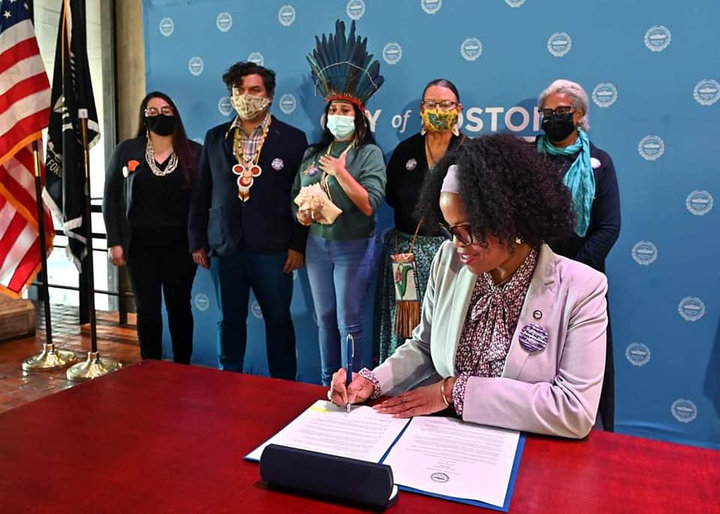
Oct. 6 — The Acting Mayor of Boston, Kim Janey, has today signed an Executive Order declaring that the second Monday in October will be Indigenous Peoples Day in the City of Boston, replacing Columbus Day and setting out a roadmap for future administrations to improve relations with Indigenous tribes and organizations.

Boston Mayor Janey has listened to Indigenous people and taken action today. Recognition of Indigenous Peoples Day on the second Monday in October is necessary to bring awareness of the true history of Columbus and to honor the Indigenous history of the Americas and Boston as well as the Indigenous Peoples who continue to live and work in and contribute to the City of Boston.

Elizabeth Solomon of the Massachusett Tribe at Ponkapoag remarked: “The people of the Massachusett Tribe have been a part of what is now called Boston for over 10,000 years. For far too long, the Indigenous history of this place has been obscured, and frequently erased, by the histories, myths and priorities of the dominant culture. 

“We are happy to see the City of Boston take the important step of recognizing and celebrating Indigenous peoples in Boston, the Americas and around the world. Many thanks to Mayor Janey and the many members of her administration who worked with the Indigenous community to make this happen.”

Kimimilasha James, an Aquinnah Wampanoag youth leader with United American Indians of New England (UAINE), said: “As someone who was born in Boston but never felt that Indigenous people were welcomed by the city government, I am very happy about Mayor Janey’s actions today. Indigenous Peoples Day brings a positive message about Indigenous survival and resilience in the face of genocidal actions directed against Indigenous peoples since 1492. It’s a day to learn about and celebrate Indigenous history and contemporary Indigenous peoples and cultures. 

“And it is just a first step for the city to begin to build relationships with Indigenous people and begin to address the many injustices faced by Indigenous people here in Boston and elsewhere. It is time for us to stop being largely ignored and erased.”

Gloria Colon, outreach coordinator for the North American Indian Center of Boston (NAICOB), said: “As a First Nation Migmaw mother, I am pleased that the city of Boston is honoring Indigenous Peoples Day. Growing up in Dorchester I experienced racism, I was targeted just for being Indigenous. While our city still has work to do to make all people safe, it is important that Indigenous children are appreciated and included.”

Mahtowin Munro (Lakota) from United American Indians of New England and the statewide Indigenous Peoples Day campaign (IndigenousPeoplesDayMA.org) said, “We have been working for several years to get Boston to properly acknowledge and be in relationship with Indigenous nations and people here.” 

She continued: “We wish to thank Mayor Janey and her staff for listening to the concerns of Indigenous people in the city and for her expressed commitment to Indigenous sovereignty and racial justice for Indigenous peoples in the Boston area. She and her staff have set an example as well by thoughtfully consulting and considering future steps that need to be taken by the city. We are elated that she has declared Oct. 11, 2021, to be Indigenous Peoples Day in the City of Boston.”

Raquel Halsey, member of the Mandan, Hidatsa and Arikara Nation and executive director of NAICOB, said: “I’m so proud to have a mayor who listens to the community and works to make Boston an inclusive city. As a service provider, we have heard countless stories of Indigenous people feeling unwelcome in Boston, and they have felt the lasting consequences of genocide and colonialism every day. 

“Recognizing Indigenous Peoples Day is an important step toward addressing the lived experiences of many residents and building trust between municipalities and Indigenous nations.”

Jean-Luc Pierite, member of the Tunica-Biloxi Tribe, president of NAICOB and member of the executive committee of the Black Mass. Coalition, said: “We must commend the tribal leaders, Indigenous activists and the City of Boston’s internal working group for their dedication towards the action steps to enable the health and wellness of our community members. NAICOB, following our over 50-year tradition and commitment to the New England Native American community, looks forward to being a partner in ensuring improved government-to-government relationships.”

For decades, Indigenous people have been calling for an end to the public celebration of Christopher Columbus. They have also asked that Indigenous Peoples Day, a day to honor Indigenous peoples from throughout the Americas, replace Columbus Day on the second Monday in October because of the date’s significance. They consider it a first step toward recognizing the genocide of millions of Indigenous people and the theft of their lands that began with the arrival of Columbus. It is a meaningful symbolic gesture in addressing the pain caused to Native Peoples by the many years of public celebrations of Columbus as a hero. 

An increasing number of towns, cities and states around the U.S. are now celebrating Indigenous peoples instead of Columbus on this day.

Mayor Janey also acknowledged that Boston is located on the land of the Massachusett Tribe.

Strugglelalucha256


Abuse of Indigenous children demands reparations, sovereignty

From a talk given at an Orange Shirt Day 2021 commemoration in Boston on Sept. 30.

Orange Shirt Day has been commemorated in Canada since 2013, to honor the survivors and remember the children who never made it home from the Indian residential schools. 

The Sept. 30 date was chosen because it is the time of year when children were forced to go into the residential schools. The orange shirt symbolism came about when Phyllis Webstad told her story of her first day at residential school in the 1970s, when her shiny new orange shirt, bought by her grandmother, was taken from her as a 6-year-old girl as she was violently stripped of her clothing and belongings.  

Today is also the first National Day of Truth and Reconciliation in Canada, although some provinces are refusing to honor it and there are too many Indigenous people saying they cannot even get the day off from work. Indigenous peoples have long been speaking the truth, and it is long overdue for settlers and newcomers to listen to that truth. 

But honestly, there can be no reconciliation until reparations are made, Indigenous sovereignty is respected, Indigenous rights to consent and refuse are respected. Landback efforts and the right to decolonize need to be respected by Canada, a country that has still not changed its anti-Indigenous behavior or improved often deplorable conditions for Indigenous people, especially children. Apologies without actions do not mean anything.

More than 6,500 children have been found in unmarked graves on residential school grounds this year alone. They were not suddenly “discovered.” The survivors knew and testified about this. As children, some of the survivors were even forced to work on digging the graves. 

One of the 2015 recommendations of the Canadian Truth & Reconciliation commission was that Canada fund and help Indigenous communities identify graves at the residential schools and reclaim their lost children. But Canada did nothing.

At least 150,000 Indigenous children were placed in the Canadian Indian residential school system. Some people now are referring to them as Institutions of Assimilation and Genocide, since that was the intent of the programs. And schools should not have graves full of children either, should they?

Genocide of Indigenous children

The residential schools were created to alienate Indigenous children from their communities, spiritualities, cultures, languages and homelands.  This genocide of children was an overt effort to destroy Indigenous family systems and remove Indigenous peoples from their lands. Mounties would raid some communities to snatch up all the children and take them away. 

In some schools, the children were not allowed to go home at all for years, and families were prevented from visiting them. Even preschool aged children were in these schools and died there. Children died of malnutrition, tuberculosis, heartbreak, abuse, medical experimentation and more. Families were often not even told that their child had died, and their bodies were often not brought home. All of this resulted in profound intergenerational trauma.

The number of school-related deaths in Canada remains unknown due to incomplete records. Estimates now range from several thousand to over 30,000. Indigenous communities are urgently trying to raise funds to bring in specialists to examine the land and find graves at residential schools. 

Many of the schools were run by the Catholic Church. One of the demands today is that the Catholic Church and its prelates not only apologize, but release all of its records, hand over the priests and nuns who did this to children, pay reparations out of its vast wealth, and take concrete actions to repair relationships with Indigenous peoples.

It’s only now, after this year’s revelation of thousands of unmarked graves of children, that more Canadians are finally listening to what has happened to Indigenous people in North America. Even now, there remain some genocide deniers who tell Indigenous people to get over it.

U.S. also stole children

Today is also a National Day of Remembrance for U.S. Indian Boarding Schools.

Between 1869 and the 1960s, hundreds of thousands of Native American and Alaska Native children were removed from their homes and families and placed in boarding schools operated by the U.S. government and churches, including the Catholic Church and several protestant denominations. 

Though we don’t know how many children were taken in total, by 1900 there were 20,000 children in Indian boarding schools, and by 1925 more than 60,000. The Native children who were removed from their homes, families and communities during this time were taken to schools sometimes thousands of miles away, where they were punished for speaking their native languages, stripped of traditional clothing and had their hair chopped off. They suffered physical, sexual, cultural and spiritual abuse, neglect and torture. 

Many children never returned home and their fates have yet to be accounted for by the U.S. government, although U.S. Interior Secretary Deb Haaland has recently promised that there will be a thorough investigation.

Both countries also had a long history of removing Indigenous children from their homes and placing them with white families to be adopted and assimilated and lose their ties to their communities, a practice that went on for decades and resulted in children we call “lost birds” because they grew up not knowing where they belong. 

As a result, Indigenous people worked very hard to get laws such as the Indian Child Welfare Act passed so that this practice would end forever. Unfortunately, right-wing forces in recent years have been trying to overturn the Indian Child Welfare Act so that more of our children will be stolen and adopted by whites, and the future of ICWA will soon be determined by the Supreme Court.

In both Canada and the U.S., Indigenous children are disproportionately taken from their families and put into foster care, at least four times more often than white kids. This has led some people to say that foster care has in effect become the new residential school system. 

The writer is a leader of United American Indians of New England (UAINE), which hosts the annual National Day of Mourning commemoration in Plymouth, Mass., on the last Thursday of November. For more info, visit UAINE.org.

Strugglelalucha256


Indigenous People of Brazil fight for their future

Brazilian President Jair Bolsonaro has given new license to the killing of Indigenous people in Brazil. Before he came to power in 2019, it wasn’t clear what he wanted to build, but he knew exactly who and what he wanted to destroy: the Indigenous people and the Amazon rainforest, respectively.

“Bolsonaro attacked a woman first, the land, our mother,” the Indigenous leader Célia Xakriabá told me. “We have no choice but to fight back.”

Since becoming president, the former Army captain, who served under the country’s last military dictator, has led an unprecedented war against the environment and the people protecting it. A slew of anti-Indigenous legislation, escalated violence against and assassinations of Indigenous land defenders, and the COVID-19 pandemic have threatened the existence of Brazil’s original people, the Amazon rainforest, and the future of the planet.

Under Bolsonaro’s oversight, about 7,700 square miles (20,000 square kilometers) of the Amazon has been deforested, mostly by fires caused by the cattle and logging industries. The destruction of the Amazon rainforest is pushing the biome toward an irreversible tipping point where it won’t be able to renew itself and making the Amazon uninhabitable for Indigenous people.

Meanwhile, in 2021, scientists found that for the first time the Amazon has been emitting more CO2 than it has been absorbing. The Amazon—often touted as the “lungs of the planet” for the oxygen it creates—seems to be dying faster than it is growing.

But Indigenous people, who call this forest their home, refuse to disappear.

At the end of August 2021, red dust rose like smoke from the pounding feet of some 6,000 Indigenous people marching on the main promenade surrounded by Brazil’s Supreme Court, Congress, and presidential palace in the country’s capital city of Brasilia. One hundred and seventy-six different Indigenous groups from every region of the country arrived at the encampment of Luta pela Vida (the Struggle for Life movement) to protest against their own erasure. This Indigenous mobilization, which is the largest in history, broke a spell of inviolability surrounding the institutions of power that have for centuries excluded Indigenous people or sought their demise.

“We need a union of Indigenous people,” Alessandra Munduruku from the Association of Indigenous Peoples of Brazil, known as APIB, said to me. “Our lives matter.”

They have a champion in Joênia Wapichana, the first Indigenous female lawyer and member of Congress. She’s calling for a “political renewal” of Brazilian and Indigenous rights. And she has helped spearhead the Indigenous movement at a national and international level with APIB.

APIB is a powerful unifying tool for the Indigenous peoples of the country. Indigenous Brazilians comprise a small fraction of Brazil’s population—about 900,000 Indigenous people survive today in a country of 211 million—yet they possess a profound human diversity in language and culture not seen in most modern countries. And they are now united in a common cause against Bolsonaro’s belligerence and the powerful forces that brought him into power.

On August 9, APIB filed a lawsuit in the International Criminal Court charging Bolsonaro with genocide. It’s the first time in the history of the ICC that the Indigenous people of the Western Hemisphere have defended themselves, with the help of Indigenous lawyers, against crimes against humanity in the Hague.

“We have been fighting every day for hundreds of years to ensure our existence and today our fight for rights is global,” APIB’s executive director Sonia Guajajara said in a statement.

A coalition of right-wing forces ranging from agribusinesses, the gun lobby, and evangelicals—collectively known as the “bull, bullet, and bible” bloc in parliament—is backing Bolsonaro’s project of destruction of the Amazon and its people.

Soy fields (mostly for animal feed) and cattle herds have replaced lush forestlands and traditional rural communities. Most of Brazil’s food is exported, largely feeding U.S. and European markets. And many Indigenous people blame multinational corporations like Cargill, the United States’ largest privately held company, for their role in driving environmental destruction to produce soy.

Rural landowners, loggers, and miners terrorize and evict Indigenous and traditional communities from their lands at the barrel of a gun. Relaxed firearm and ammunition laws have led to a sharp rise in gun ownership, especially among rural landowners, which has led to a subsequent rise in gun violence. Bolsonaro’s signature finger gun gestures signal support for arming his base.

Much of this influence, including ties to evangelical churches, comes from the United States, a country Bolsonaro and his supporters look to for inspiration.

“It’s a shame that the Brazilian cavalry wasn’t as efficient as the Americans, who exterminated the Indians,” Bolsonaro once lamented.

“Indigenous extermination has already happened in your country [the United States],” Munduruku told me. She sees a similar process unfolding in Brazil. But the connection doesn’t end there.

“At the rate [at which] your country [the United States] consumes soy, it contributes to the destruction of my land,” she added.

The final front of this onslaught is the very legal and political framework protecting Indigenous territories—the 1988 Brazilian Constitution. The Brazilian Congress has been voting on a series of bills that would undo hard-won rights such as protecting Indigenous territories, granting immunity to illegal land-grabbing, and sacrificing Indigenous lands for infrastructure, mining, and energy projects. One of the bills would authorize the president to leave the International Labor Organization Convention’s 1989 Indigenous and Tribal Peoples Convention 169, a major international treaty protecting Indigenous and tribal peoples.

At minimum, APIB and Luta pela Vida are asking the government to respect its own laws and constitution. That’s why a group of 150 Indigenous people burned an effigy of a large black coffin at the steps of Brazil’s Congress on August 27. Scrawled on its sides were the names of the bills aimed at their destruction. The message was clear: Indigenous people refuse to be burned.

On September 1, the Supreme Court began hearing arguments in a case that could lead to either enabling or preventing the usurping of ancestral lands from Indigenous people who were removed from their territories after the ratification of the 1988 Constitution. On September 15, the Supreme Court suspended the case without setting a date to revisit it. APIB claims a positive ruling for Indigenous people would immediately resolve hundreds of land conflicts in the country, and warns a negative ruling could accelerate violence.

What is important to consider is that Brazilian democracy is fragile. As Bolsonaro’s chances for reelection in 2022 dwindle, his supporters called for street mobilizations on September 7 to “begin a general cleansing process in Brazil.” The targets of the rally were the Congress, the Supreme Court, and the Chinese Embassy—and Bolsonaro supporters seemed to take their cues from their U.S. counterparts who stormed the U.S. Capitol on January 6.

On August 10, Bolsonaro’s son Eduardo Bolsonaro shared a stage with Trump supporters in my rural home state of South Dakota, hoping to cast doubt on the 2022 elections and draw international right-wing support. He was joined by Steve Bannon, who called Brazil’s former leftist leader Luiz Inácio Lula da Silva “the most dangerous leftist in the world” because his presidential candidacy poses a great threat of undoing what Bolsonaro has done during his presidential term over the last four years.

The following week, in an Indigenous ceremony, Sonia Guajajara designated Lula the “guardian of territories,” a reminder of his obligations to Indigenous people and the Amazon should he become president.

The Indigenous movement goes beyond Brazil and its constitution. “Our [Indigenous] history doesn’t begin in 1988,” was one popular slogan at the Luta pela Vida camp. And the Indigenous struggle is more than recuperating imagined halcyon days that never entirely existed for Indigenous people.

“The future is ancestral,” Guajajara told me. And she’s calling on the entire world to take leadership from Indigenous movements in this time of terrible danger.

This article was produced by Globetrotter. Nick Estes is a citizen of the Lower Brule Sioux Tribe. He is a journalist, historian and co-host of the Red Nation Podcast. He is the author of Our History Is the Future: Standing Rock Versus the Dakota Access Pipeline, and the Long Tradition of Indigenous Resistance (Verso, 2019).

Strugglelalucha256


The ‘Land Back’ Campaign: Oklahoma is only a start

Last year the U.S. Supreme Court made a decision that affected 40% of Oklahoma. The court decided to uphold a 19th century treaty made with five Indigenous tribes of Oklahoma: Choctaw, Chickasaw, Creek, Cherokee and Seminole. This was very significant for the five tribes. 

Tulsa, the second biggest city in Oklahoma, sits on Creek land. So does the fourth biggest city, Broken Arrow. The ruling gives Native governments better protections over the citizens of each nation. 

The state of Oklahoma no longer has the legal authority to prosecute cases involving Native Americans in territory previously owned by the state. 

The Creek Nation released a statement that partly read: “Today’s decision will allow the Nation to honor our ancestors by maintaining our established sovereignty and territorial boundaries.” 

The Supreme Court decision was 5-4, with Justices Neil Gorsuch, Sonia Sotomayor, Ruth Bader Ginsburg, Elena Kagan and Stephen Breyer in the majority, while Justices John Roberts, Brett Kavanaugh, Samuel Alito and Clarence Thomas dissented.

This was a good start for the LANDBACK Campaign. The 40% of land is Eastern and expands to the South of Oklahoma. 

Trail of Tears

The history of the five tribes is a sad one. The traditional lands of the tribes are Mississippi, Alabama and Louisiana. The Seminoles’ homeland was as far as Florida. 

The Trail of Tears was brutal and not all made it. They were colonized along the way. Most became farmers with crops of corn, beans and squash. Wild turkeys were also a food source. 

The colonial government quickly broke the treaty it had signed and the tribes were forced onto a small portion of what was promised. Other Native peoples already inhabited Oklahoma. The Wichita, Plains Apache, Quapaw and Caddo tribes were there during the colonization of the Spanish and French. 

By the early 1800s the Osage, Pawnee, Kiowa, Comanche, Cheyenne and Arapaho tribes migrated into “Indian Territory” — also known as Oklahoma. Tribes Native to present day Oklahoma are the Caddo, Osage and the Wichita. 

There is a “Land Back” movement building momentum. It’s beginning with the Black Hills and is trying to shut down the Mount Rushmore monument. 

To quote the NDN Collective working on the LANDBACK Campaign: “South Dakota is our cornerstone battle, from which we will build out this campaign. Not only does Mount Rushmore sit in the heart of the sacred Black Hills, but it is an international symbol of white supremacy and colonization.”

The land that was given back to the five tribes is a good start, but we want all of our land back. 

Zola Fish is a member of the Choctaw Nation.

Strugglelalucha256


Canada is waging an all-front legal war against Indigenous People

Canada is developing a new image: one of burning churchestoppling statues, and mass graves. There are thousands more unmarked graves, thousands more Indigenous children killed at residential schools, remaining to be unearthed. There can be no denying that this is Canada, and it has to change. But can Canada transform itself for the better? If the revelation of the mass killing of Indigenous children is to lead to any actual soul-searching and any meaningful change, the first order of business is for Canada to stop its all-front war against First Nations. Much of that war is taking place through the legal system.

Canadian politicians have said as much, adopting a motion in June calling for the government to stop fighting residential school survivors in court. A long-standing demand, it has been repeated by Indigenous advocates who have expressed amazement in the face of these horrific revelations that the Canadian government would nonetheless continue to fight Indigenous survivors of systematic child abuse by the state.

To get a sense of the scope of Canada’s legal war on First Nations, I looked at a Canadian legal database containing decisions (case law) pertaining to First Nations. I also looked at the hearing lists of the Federal Court of Canada for ongoing cases. My initial goal was to identify where Canada could easily settle or abandon cases, bringing about a harmonious solution to these conflicts. Two things surprised me.

The first was the volume and diversity of lawsuits Canada is fighting. Canada is fighting First Nations everywhere, on an astoundingly wide range of issues.

The second thing: Canada is losing.

The attack on Indigenous children and women

In his 1984 essay “‘Pioneering’ in the Nuclear Age,” political theorist Eqbal Ahmad argued that the “four fundamental elements… without which an indigenous community cannot survive” were “land, water, leaders and culture.” Canada fights Indigenous people over land, water, fishing rights, mining projects, freedom of movement, and more. The assault on Indigenous nations is also a war against Indigenous children and women.

In the high-profile case of First Nations Child & Family Caring Society of Canada et al. v. Attorney General of Canada, laid out in detail by Cindy Blackstock, “the First Nations Child and Family Caring Society of Canada and the Assembly of First Nations filed a complaint under the Canadian Human Rights Act alleging” in 2007 “that the Government of Canada had a longstanding pattern of providing less government funding for child welfare services to First Nations children on reserves than is provided to non-Aboriginal children.” The Canadian Human Rights Tribunal (CHRT) found in favor of the First Nations complainants in 2016.

Note that this isn’t about the history of residential schools. It’s about discrimination against Indigenous kids in the present day. “In fact, the problem might be getting worse,” writes Blackstock, compared to “the height of residential school operations.” As evidence, she refers to a 2005 study of three sample provinces showing a wide gap between the percent of First Nations children in child welfare care (10.23 percent) compared to a much lower rate for non-First Nations children (0.67 percent). In 2006, following the Canadian government’s repeated failures to act on the inequity described in this report (which also included comprehensive suggested reforms that had both moral and economic appeal), Blackstock writes, “the Caring Society and the Assembly of First Nations agreed that legal action was required.” The CHRT was very clear in its 2019 decision that the federal government should compensate each victim the maximum amount, which addressed the victims as follows:

“No amount of compensation can ever recover what you have lost, the scars that are left on your souls or the suffering that you have gone through as a result of racism, colonial practices and discrimination.”

In May 2021, Canada, which has spent millions of dollars fighting this case, tried to overturn the CHRT’s ruling.

Canada’s war on Indigenous children is also a war on Indigenous women. The sterilization of Indigenous women, beginning with Canada’s eugenics program around 1900, is another act of genocide, as scholar Karen Stote has argued. Indigenous women who had tubal ligation without their consent as part of this eugenics program have brought a class-action suit against the provinces of Alberta and British Columbia, both of which had Sexual Sterilization Acts in their provincial laws from the 1920s in Alberta and 1930s in British Columbia until the early 1970s, and Saskatchewan, where sexual sterilization legislation was proposed but failed by one vote in 1930. A Senate committee found a case of forced sterilization of an Indigenous woman as recently as 2019.

The legal-financial war on First Nations organizations

As Bob Joseph outlines in his 2018 book 21 Things You May Not Know About the Indian Act, Canada first gave itself the right to decide Indian status in the Gradual Civilization Act of 1857, which created a process by which Indigenous people could give up their Indian status and so become “enfranchised”—which they would have to do if they wanted to attend higher education or become professionals. The apartheid system was updated through the Indian Act of 1876, from which sprang many evils including both the residential schools and the assertion of Canadian control over the way First Nations govern themselves. In 1927, when Indigenous veterans of World War I began to hold meetings with one another to discuss their situation, Canada passed laws forbidding Indigenous people from political organization and from raising funds to hire legal counsel (and from playing billiards, among other things). The Indian Act—which is still in effect today with amendments, despite multiple attempts to repeal it—outlawed traditional governance structures and gave Canada the power to intervene to remove and install Indigenous governance authorities at will—which Canada did continuously, from Six Nations in 1924 to Barriere Lake in 1995. As a result, at any given moment, many First Nations are still embroiled in lawsuits over control of their own governments.

Canada controls the resources available to First Nations, including drinking water. In another national embarrassment, Canada has found itself able to provision drinking water to diamond mines but not First Nations. This battle too has entered the courts, with a class-action suit by Tataskweyak Cree Nation, Curve Lake First Nation, and Neskantaga First Nation demanding that Canada not only compensate their nations, but also work with them to build the necessary water systems.

Canada dribbles out humiliating application processes by which Indigenous people can try to exercise their human right to housing. When combined with the housing crisis on reserves, these application processes have attracted swindlers like consultant Jerry Paulin, who sued Cat Lake First Nation for $1.2 million, claiming that his efforts were the reason the First Nation received federal funds for urgent housing repairs.

Canada uses the threat of withdrawal of these funds to impose stringent financial “transparency” conditions on First Nations—the subject of legal struggle, in which Cold Lake First Nations has argued that the financial transparency provisions violate their rights. Canada has used financial transparency claims to put First Nations finances under third-party management, withholding and misusing the funds in a not-very-transparent way, as the Algonquins of Barriere Lake charged in another lawsuit. An insistence on transparency is astounding for a country that buried massive numbers of Indigenous children in unmarked graves.

Win or lose, the lawsuits themselves impose high costs on First Nations whose finances are, for the most part, controlled by Canada. The result is situations like the one where the Beaver Lake Cree are suing Canada for costs because they ran out of money suing Canada for their land. When First Nations are winning in court, Canada tries to bankrupt them before they get there.

Land and resources are the core of the struggle

The core issue between Canada and First Nations is land. Most battles are over the land on which the state of Canada sits, all of which was stolen and much of which was swindled through legal processes that couldn’t hold up to scrutiny and are now unraveling. “[I]n simple acreage,” the late Indigenous leader Arthur Manuel wrote in the 2017 book The Reconciliation Manifesto, this was “the biggest land theft in the history of mankind,” reducing Indigenous people from holding 100 percent of the landmass to 0.2 percent. One of the most economically important pieces of land is the Haldimand tract in southern Ontario, which generates billions of dollars in revenue that belongs, by right, to the Six Nations, as Phil Monture has extensively documented. Six Nations submitted ever-more detailed land claims, until Canada simply stopped accepting them. But in July, their sustained resistance led to the cancellation of a planned suburban development (read: settlement) on Six Nations land.

Many of the First Nations court battles are defensive. NamgisAhousahtDzawada’enuxw, and Gwa’sala-’Nakwaxda’xw First Nations have tried to defend their wild fisheries against encroachment and pollution by settler fish farms. West Moberly, Long Plain, Peguis, Roseau River Anishinabe, Aroland, Ginoogaming, Squamish, Coldwater, Tsleil-Waututh, Aitchelitz, Skowkale, and Shxwha:y Village First Nations challenged dams and pipelines. Canada has a history of “pouring big money” into these court battles to the tune of tens of millions—small money compared to its tens of billions subsidizing and taking over financially unviable pipelines running through Indigenous lands—including that of the Wet’suwet’en, whose resistance sparked mass protests across Canada in 2020. The duty to consult First Nations on such projects is itself the outcome of a legal struggle, won in the 2004 decision in Haida Nation v. British Columbia.

First Nations who were swindled or coerced out of their lands (or water, as with Iskatewizaagegan No. 39 Independent First Nation’s case against Winnipeg and Ontario for illegally taking their water from Shoal Lake for use by the city of Winnipeg starting in 1913) fight for their land back, for compensation, or both. The Specific Claims Tribunal has 132 ongoing cases. In Saskatchewan in May, the tribunal awarded Mosquito Grizzly Bear’s Head Lean Man First Nation $141 million and recognition that they never surrendered their land as Canada had claimed they had in 1905. In June, Heiltsuk First Nation won a part of their land back.

First Nations also fight for their fishing rights in courts and out on the water, as settler fishers have physically attacked and tried to intimidate Mi’kmaw fishers on Canada’s east coast. In June, on the west coast, after the British Columbia Court of Appeals found against Canada, the federal government announced it wouldn’t appeal, dropping a 15-year litigation that restricted Nuu-chah-nulth First Nations fishing quotas.

Decolonization just might be inevitable

Why does Canada keep fighting (and losing) even as its legitimacy as a state built on theft and genocide crumbles? It’s not merely the habits of centuries. It’s also the absence of any project besides the displacement of First Nations and the plunder of the land. Canada could take the first step to ending all this by declaring a unilateral ceasefire in the legal war. Too few Canadians understand that this would actually be a very good thing. First Nations lived sustainably for thousands of years in these extraordinary northern ecosystems. Then the European empires arrived, bringing smallpox and tuberculosis among other scourges. Local extinctions of beaver and buffalo quickly followed, as well as the total extinction of the passenger pigeon. Today’s settler state has poisoned pristine lakes with mine tailings, denuded the country’s spectacular forests, and gifted the atmosphere some of the world’s highest per capita carbon emissions (seventh in the world in 2018—more than Saudi Arabia, which was 10th, and the U.S., which was 11th). Indigenous visionaries have better ideas, such as those presented by Leanne Betasamosake Simpson and Arthur Manuel, or for that matter the Red Deal and the People’s Agreement of Cochabamba.

Under Indigenous sovereignty, Canadians could truly be guests of the First Nations, capable of fulfilling their obligations to their hosts and their hosts’ lands, rather than the pawns of the settler state’s war against those from whom the land was stolen.

This article was produced by GlobetrotterJustin Podur is a Toronto-based writer and a writing fellow at Globetrotter. You can find him on his website at podur.org and on Twitter @justinpodur. He teaches at York University in the Faculty of Environmental and Urban Change.

Strugglelalucha256
https://www.struggle-la-lucha.org/indigenous-peoples/page/4/