Indigenous people persevere, resist myth of Thanksgiving

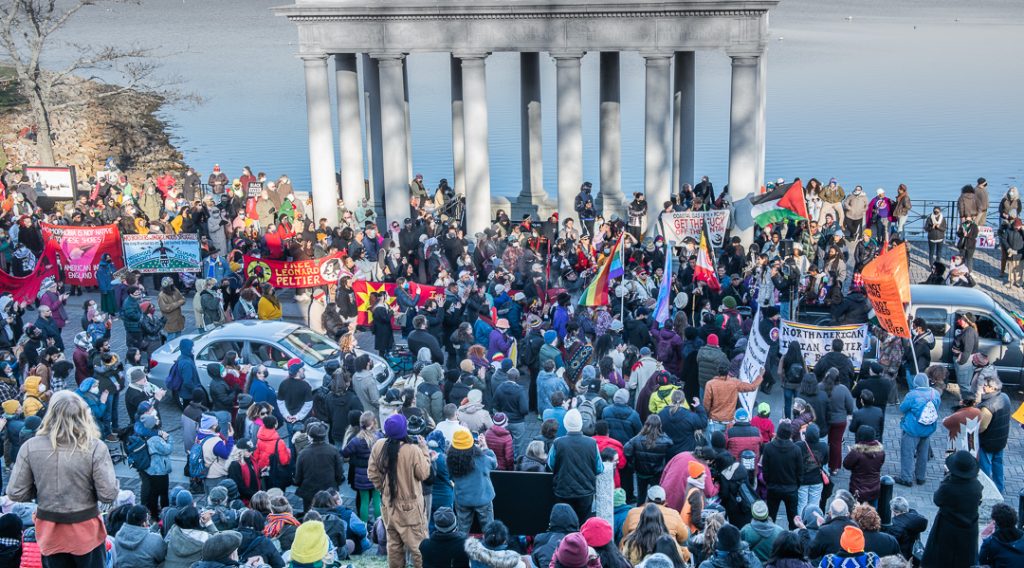
People surround Plymouth Rock during the 2022 National Day of Mourning on Nov. 24. Photo: Rachel Jones / UAINE

Remarks given at the 2022 National Day of Mourning on Nov. 24 in Plymouth, Massachusetts. Since 1970, Indigenous people and their allies have gathered at noon on Cole’s Hill to commemorate a National Day of Mourning on the U.S. Thanksgiving holiday. This year more than 2,000 people attended – the largest group ever.

Good afternoon sisters, brothers, and siblings!

Once again on so-called “Thanksgiving Day,” United American Indians of New England and our supporters are gathered on this hill to observe a National Day of Mourning for the Indigenous people murdered by settler colonialism and imperialism worldwide. Today marks the 53rd time we have gathered here to mourn our ancestors, tear down settler mythologies, and speak truth to power.

Today I want to tell you a story – the story of National Day of Mourning. Fifty-two Thanksgivings ago, my grandfather, an Aquinnah Wampanoag man named Wamsutta Frank James, was invited by the Commonwealth of Massachusetts to speak at a banquet celebrating the 350th anniversary of the arrival of the Pilgrims. 

The organizers of the banquet no doubt imagined that Wamsutta would sing the praises of the American settler-colonial project and thank the Pilgrims for bringing “civilization” to these shores. However, the speech that Wamsutta wrote, which was based on historical fact, rather than the sham version of history perpetuated in the Thanksgiving myth, was a far cry from complimentary.

In his speech, Wamsutta not only named atrocities committed by the Pilgrims, but also reflected upon the fate of the Wampanoag at the hands of the settler invaders. The speech contained a powerful message of Native American pride. 

“Our spirit refuses to die,” wrote Wamsutta. “Yesterday we walked the woodland paths and sandy trails. Today we must walk the macadam highways and roads. We are uniting … We stand tall and proud; and before too many moons pass, we’ll right the wrongs we have allowed to happen to us.” 

When state officials saw an advance copy of Wamsutta’s speech, they refused to allow him to deliver it, saying that the speech was too “inflammatory.” They told him he could speak only if he were willing to offer false praise of the Pilgrims. The organizers even offered to write a speech for him, one which would better fit with their settler-colonialist narrative. 

But Wamsutta refused to have words put into his mouth. His suppressed speech was printed in newspapers across the country, and he and other local Native activists began to plan a protest. The flier for this protest, which was circulated nationwide, read, “What do we have to be thankful for? The United American Indians of New England have declared Thanksgiving Day to be a National Day of Mourning for Native Americans.”

The first NDOM

On so-called Thanksgiving Day, 1970, Wamsutta and members of at least 25 tribes, as well as a sprinkling of non-Native allies, gathered here on this hill, and observed the first National Day of Mourning. That first year, my grandfather never got a chance to deliver his suppressed speech – although some who don’t actually know our history say he did. 

Up to 200 Native people and allies gathered on that day. They spoke out about the Pilgrim invasion and conditions in Indian Country, marched around Plymouth, boarded the Mayflower II, and even buried Plymouth Rock!

One leader of the American Indian Movement would later say of the first National Day of Mourning that it “is a day American Indians won’t forget. We went to Plymouth for a purpose: to mourn since the landing of the Pilgrims the repression of the American Indian; and to indict the hypocrisy of a system which glorifies that repression.”

The founders of National Day of Mourning could not have foreseen that generations would continue to gather here, year after year, carrying on this tradition. Nearly all of the elders who stood on this hill and organized that first National Day of Mourning are no longer with us, but we feel their spirits guiding us today. We are also thinking today of so many, especially those we have lost during the ongoing pandemic, and we mourn their loss.

Over the years we repeatedly disrupted the Pilgrim Progress parade, a tradition we continued until 1996. The following year, in 1997, we were blocked on Leyden Street, brutalized by police, and arrested without warning for simply trying to march peacefully. The resulting court case and settlement led to the National Day of Mourning plaque you see here on Cole’s Hill, and the Metacomet plaque we will visit when we march.

Consistently, our organization has never collaborated with the Pilgrims or their institutions, whether the Mayflower Society, the Plymouth 400 international colonizer celebrations, or Thanksgiving parades.

Exposing Thanksgiving myth

So – why do so many Native people object to the Thanksgiving myth? 

According to this myth, the Pilgrims, seeking religious freedom, landed on Plymouth Rock. The Indians welcomed them with open arms, and then conveniently faded into the background and everyone lived happily ever after. The end.

Here is the truth:

First, the pilgrims are glorified and mythologized because the circumstances of the first permanent English colony in North America – Jamestown – were too ugly to hold up as an effective national myth. Pilgrims and Indians are a much more marketable story than settler cannibalism.

Second, the Pilgrims came here as part of a commercial venture. They didn’t need religious freedom – they already had that back in the Netherlands. The Mayflower Compact was merely a group of white men who wanted to ensure they would get a return on their investment.

Third, when the Pilgrims arrived – on outer Cape Cod, by the way, not on that pebble down the hill — one of the first things they did was to rob Wampanoag graves at Corn Hill and steal as much of their winter provisions of corn and beans as they were able to carry.

Fourth, some Wampanoag ancestors did welcome the Pilgrims and save them from starvation. And what did we, the Indigenous people of this continent, get in return for this kindness? Genocide, the theft of our lands, the destruction of our traditional ways of life, slavery, starvation, and never-ending oppression.

Fifth, the first official Thanksgiving did not take place in 1621 when the Pilgrims had a harvest-time meal provided largely by the Wampanoag. Instead, the first Thanksgiving was declared in 1637 by Governor Winthrop of the Massachusetts Bay Colony to celebrate the massacre of over 700 Pequot men, women and children on the banks of the Mystic River in Connecticut.

William Bradford of the Plymouth colony wrote of this event: “Those that escaped the fire were slain with the sword; some hewed to pieces … they thus destroyed about 400 at this time. It was a fearful sight to see them thus frying in the fire … horrible was the stink and scent thereof, but the victory seemed a sweet sacrifice, and they gave the prayers thereof to God, who had wrought so wonderfully for them.” 

Subsequent slaughters of Indigenous people would be celebrated by a day of Thanksgiving. And yet we are labeled as “savages” in the history books.

So why does any of this matter? It is simple: When people perpetuate the myth of Thanksgiving, they are not only erasing our genocide, but also celebrating it.

Kimimilasha (Kisha) James. Photo: Rachel Jones / UAINE

The struggle continues!

We did not simply fade into the background as the Thanksgiving myth says. We have survived and flourished. We have persevered. The very fact that you are here is proof that we did not vanish. Our very presence frees this land from the lies of the history books and the mythmakers. 

We will remember and honor all of our ancestors in the struggle who went before us. We will speak truth to power as we have been doing since the first Day of Mourning in 1970.

That first Day of Mourning in 1970 was a powerful demonstration of Native unity and it has continued for all these years as a powerful demonstration of Indigenous unity and of the unity of all people who speak truth to power.

Many of the conditions that prevailed in Indian Country in 1970 still prevail today. In 1970, our average life expectancy was just 44 years. Today, we continue to have the lowest life expectancy of any group in the U.S., and the death rate for Native women has increased 20% over the past 15 years. In 1970, our suicide and infant mortality rates were the highest in the country. This has not changed.

We all know that racism is alive and well. All of us are struggling under the oppression of a capitalist system which forces people to make a bitter choice between heating and eating. And we will continue to gather on this hill until we are free from this oppressive system. Until corporations and the U.S. military stop polluting the earth. Until we dismantle the brutal apparatus of mass incarceration.

We will not stop until the oppression of our LGBTQ siblings is a thing of the past. Until unhoused people have homes. Until human beings are no longer locked in cages at the U.S. border, despite the fact that no one is illegal on stolen land. Until Palestine is free. Until no person goes hungry or is left to die because they have little or no access to quality health care. Until insulin is free. Until union busting is a thing of the past. Until then, the struggle will continue!

We are not conquered

In 1970, we demanded an end to the Bureau of Indian Affairs. It is still a demand today. Native nations do not need federal oversight to govern ourselves or take care of our own lands.

As we did in 1970, we mourn the loss of millions of our ancestors and the devastation of the land, water and air. We condemn all acts of violence and terrorism perpetrated by all governments and against innocent people worldwide. This includes the myriad crimes of the United States government.

Since the invasion of Columbus, Indigenous people have been terrorized by settler governments. From the colonial period to the 21st century, this has entailed torture, massacres, systematic military occupations, and the forced removals of Indigenous peoples from their ancestral homelands. 

Let us not forget that this country was founded on the ideology of white supremacy, the widespread practice of African slavery, and a policy of genocide and land theft. Let us not forget that under the pipelines, skyscrapers, mines and the oil rigs, lie the interred bones, sacred objects and villages of our Native ancestors.

Today, on liberated territory, we will correct the history of a country that continues to glorify murderers such as Christopher Columbus, that makes slave-owning presidents such as Washington and Jefferson into god-like figures, and even carves their faces into the sacred Black Hills of the Lakota.

In 1970 very few people would have given any thought to the fact that the Indigenous people of this hemisphere do not look upon the arrival of the European invaders as a reason to give thanks. Today, many thousands stand with us in spirit as we commemorate the 2022 National Day of Mourning. 

As my grandfather said back in 1970, “We are now being heard; we are now being listened to. The important point is that … we still have the spirit, we still have the unique culture, we still have the will and, most important of all, the determination to remain as Indians. We are determined, and our presence here … is living testimony that this is only the beginning of the American Indian, particularly the Wampanoag, to regain the position in this country that is rightfully ours.”

In the spirit of Crazy Horse, in the spirit of Metacom, in the spirit of Geronimo. Above all, to all people who fight and struggle for real justice.

We are not vanishing. We are not conquered. We are as strong as ever.

Strugglelalucha256


After 1,103 miles, Leonard Peltier Walk to Justice culminates in Washington, D.C.

Nov. 13: The “Walk to Justice” to demand freedom for Indigenous political prisoner Leonard Peltier culminated in Washington, D.C. this weekend. Organized by the American Indian Movement Grand Governing Council, its participants trekked 1,103 miles, beginning on Sept. 1 in Minnesota, AIM’s birthplace. 

Peltier, who is now 78 years old, was framed by the FBI and wrongfully convicted for a shooting at Oglala, South Dakota, in 1975. His case has garnered international support from such notable figures as Nelson Mandela and Desmond Tutu. 

A highlight of the closing rally at the Lincoln Memorial was a special letter from Leonard Peltier read by organizers. Participants pointed out that President Joe Biden can and must use his power to grant Peltier executive clemency. For full details on Leonard Peltier’s case, go to WhoIsLeonardPeltier.info. For information on the walk to justice, visit AIMGrandGoverningCouncil.org/LeonardPeltier.html.

SLL photos: Sharon Black

Strugglelalucha256


Plymouth, Mass.: National Day of Mourning 2022, Nov. 24

THURSDAY, NOVEMBER 24, 2022 AT 12 PM
2022 National Day of Mourning
Cole’s Hill, Plymouth, MA

E-mail: info@uaine.org
Website: http://www.uaine.org

Masks Up! Mayflowers Down!

WHAT IS THE NATIONAL DAY OF MOURNING?

An annual tradition since 1970, the Day of Mourning is a solemn, spiritual, and highly political day. Many of us fast from sundown the day before through the afternoon of that day. We are mourning our ancestors and the genocide of our peoples and the theft of our lands. NDOM is a day when we mourn, but we also feel our strength in action. Over the years, participants in Day of Mourning have buried Plymouth Rock a number of times, boarded the Mayflower replica, and placed ku klux klan sheets on the statue of William Bradford, etc.

WHEN AND WHERE IS THE NATIONAL DAY OF MOURNING?

Thursday, November 24, 2022 (U.S. “thanksgiving” day) at Cole’s Hill, Plymouth, Massachusetts, 12 noon SHARP. Cole’s Hill is the hill above Plymouth Rock in the Plymouth historic waterfront area.

WILL THERE BE A MARCH?

Yes, there will be a march through the historic district of Plymouth. Plymouth agreed, as part of the settlement of 10/19/98, that UAINE may march on the National Day of Mourning without the need for a permit as long as we give the town advance notice.

PROGRAM: Although we very much welcome our non-Native supporters to stand with us, it is a day when only Indigenous people speak about our history and the struggles that are taking place throughout the Americas. Speakers are by invitation only.

For those who cannot attend in person, THIS YEAR’S NDOM WILL HAVE LIVESTREAMING DIRECT FROM PLYMOUTH AS WELL AS MESSAGES FROM INDIGENOUS STRUGGLES IN MANY HOMELANDS!

Please note that NDOM is not a commercial event, so we ask that people do not sell merchandise or distribute leaflets at the outdoor program. Also, we ask that you do not eat (unless you must do so for medical reasons) at the outdoor speak-out and march out of respect for the participants who are fasting. Finally, dress for the weather!

SOCIAL: There will be NO sit-down pot-luck social this year due to COVID-19, but we may have small box lunches available for hungry travelers after the march.

TRANSPORTATION: If you cannot get to Plymouth, you can watch it online!

For carpools, please go to https://www.groupcarpool.com/t/mqyiup and offer to carpool if you have a car or join a carpool if you don’t.
We will post bus information for 2022 when we have it.

DONATIONS: Monetary donations are gratefully accepted to help defray the costs of the day and of UAINE’s many other efforts during the year:
https://gofund.me/de371f07

FOR UPDATES: Please join and check the UAINE Facebook group https://www.facebook.com/groups/UAINE for updates on the National Day of Mourning this year. Our website uaine.org will be updated, but not as quickly or frequently as the Facebook group.

COVID-19 has hit Indigenous communities very hard, and we want to ensure that no one gets sick from attending the National Day of Mourning. Everyone must wear a mask covering their mouth and nose – no exceptions!

Strugglelalucha256


Indigenous Peoples’ Day

Monday, Oct. 10, 2022, is Indigenous Peoples’ Day in the U.S. In 1977, Indigenous leaders from around the world organized a United Nations conference in Geneva to promote Indigenous sovereignty and self-determination. Their first recommendation was to observe the second Monday in October, the day of so-called ‘discovery’ of America, as an International Day of Solidarity with the Indigenous Peoples of the Americas.

Strugglelalucha256


It’s Autumn, and I can’t wait for the Fall (of Columbus)

I write this in October, in the midst of all of the fall celebrations in the U.S. — Columbus Day, Thanksgiving and even Halloween — that can give some big headaches to Indigenous people by enhancing the erasure of Indigenous history and the stereotyping of Indigenous peoples.

Responding to these fall holidays is just a starting point, but first steps are important. Of course, we still need to get rid of the vampire economic system that profits from misery and destruction of the Earth, along with settler colonialism, racism, misogyny, homophobia and much more. But in the meantime, we can all work to ensure that Indigenous peoples and histories are not marginalized and disrespected as one of the many ways to support frontline Indigenous struggles.

Here’s some more information about the fall holidays to think about, including what you can do to bring positive change to each holiday.

Columbus Day

Sometimes referred to as “Cruelumbus Day” by those who oppose it, Columbus Day is a disgusting celebration of the genocide of Indigenous peoples and theft of land that began when Columbus and his men got lost and arrived in this hemisphere in 1492. It does harm to everyone who grows up learning that he was a great hero and “discovered America.” The holiday sends the message that it is fine to completely whitewash history and celebrate the genocide of tens of millions of people.

Indigenous peoples in the Caribbean and elsewhere were not “discovered” by anybody since they were already here. Nor did they need to have civilization or spirituality brought to them, since they already had civilizations and beliefs. They had and still have the inherent right to continue to live in their own ways on their own lands.

Columbus’ policies on the islands where he landed, including slave labor, starvation, sex trafficking and slaughter, resulted in the near-complete genocide of the Indigenous peoples of Haiti, the Dominican Republic, Cuba, Puerto Rico and other places where the Spanish invaded. (Columbus was Italian, but he invaded on behalf of the Spanish crown.)

Altogether, Columbus shipped approximately 5,000 enslaved Indigenous people across the Atlantic — filling his pockets and setting the stage for the Trans-Atlantic slave trade and the enslavement of millions of Africans as well as Indigenous people. He sold Indigenous women and girls as young as 9 and 10 into sexual slavery.

The Spaniards hunted down Taíno and Arawak people with huge dogs that tore them apart and devoured them. Babies were fed to these dogs. The men tested the sharpness of their blades by cutting off the hands of the people.

The brutality of Columbus’s actions would reverberate through all the other invasions to come and the tens of millions of deaths that would follow. In fact, so many millions of people died as a result of European colonization that it even caused a climate change – a “little ice age.” 

Celebrating Columbus erases centuries of Indigenous reality; it erases the decimation of Taíno, Arawak and many other peoples. It is an effort to silence Indigenous peoples and make them invisible. Pretending it is acceptable to celebrate Columbus has a terrible impact not only on Indigenous people, especially kids, but also on non-Native people.

What you can do: The Columbus Day holiday needs to be abolished. Indigenous Peoples’ Day is the holiday that replaces it. Work with Indigenous people where you live to get the truth out about Indigenous history and get Indigenous Peoples’ Day celebrated instead of Columbus Day in your community, school, organization, workplace. Put up signs saying that the day is Indigenous Peoples’ Day. Put the day in your union contract. We can lead and celebrate this day, making it part of everyone’s life, even when some bigots refuse to pass legislation.

Halloween 

Halloween is fun, especially beloved within LGBTQ2S communities and by kids. And yet, every year, Halloween is also a hailstorm of cultural appropriation, with non-Native people “dressing up as Indians,” wearing blackface, brownface and yellowface, and so much more. 

Use of Pocahottie costumes (sexually suggestive fake-Native costumes for women) increases the view that Indigenous women exist for sexual exploitation. This is especially sickening given the crisis of thousands of #MMIWG2S (Missing & Murdered Indigenous, Women, Girls & Two-Spirits) in the U.S., Canada and Mexico.

If you see someone wearing a costume that smacks of cultural appropriation, you might talk to the person or send them this link (Step away from the ‘Indian’ costume!) for lots of information about what cultural appropriation is and why they shouldn’t do it. When you see fake-Native costumes at a store, tell them you won’t shop there unless they stop selling those costumes. Our culture is not your costume!

Thanksgiving

You may be asking yourself: “Wait a minute. Can’t I even celebrate a harvest festival without this writer complaining about something?”

Here’s the problem: Thanksgiving in the U.S. is not just a harvest festival. It is a celebration of the landing of the Pilgrims and the English theft of Indigenous lands and colonization of the U.S.

The myth of Thanksgiving is that the Pilgrims landed in Plymouth, Mass., the Native people welcomed them, they had a feast together with the “Indians,” and everyone lived happily ever after. The myth doesn’t talk about the enslavement of the Wampanoag, Nipmuc, Massachusett and other Native peoples, the colonial wars against them, how their lands were stolen and they were forced into concentration camps such as Deer Island, how widespread starvation and hangings of Indigenous people came to be.

And the myth of Thanksgiving certainly doesn’t tell you that the first official day of thanksgiving in Massachusetts was proclaimed by Massachusetts colony Gov. Winthrop in 1636 to celebrate the safe return of the white men who had helped to massacre several hundred Pequot children, women and men at Mystic, Conn.

On the East Coast, you can observe the 50th annual National Day of Mourning in Plymouth, Mass., on “thanksgiving” day, Nov. 28. On the West Coast, you can observe “Unthanksgiving” at Alcatraz Island. You can also do something within your own family or community to tell the truth and decolonize the holiday.

Strugglelalucha256


Supporters of Leonard Peltier demand ‘clemency now!’

Indigenous political prisoner Leonard Peltier has now spent over 47 years in prison. 

On Jan. 28 he tested positive for COVID-19. He was immediately placed in isolation but received no special care and was even without any drinking water for several days. After 15 days, Peltier sent an email that he had overcome the virus. But there’s still concern about long-term symptoms arising.

Recently a press conference was held in Tampa, Florida, about a mile from Coleman, the federal prison where Peltier is held. This brought significant media attention to his case, including NBC, CBS, and Democracy Now. There were interviews with one of his lawyers, former judge Kevin Sharp.

Two key senators, Brian Schwyz, (D-HI) head of the Indian Affairs Committee, and Patrick Leahy (D-VT), openly requested President Biden to grant immediate clemency.

Peltier’s current campaign includes a petition to sign and share asking for clemency now. Readers can also call the White House at (202) 456-1111 to tell President Biden that Leonard Peltier deserves immediate clemency. Donations are needed to fund the freedom campaign.

Bring Leonard home to Turtle Mountain Reservation in North Dakota now!

Strugglelalucha256


Leonard Peltier’s Walk to Justice in Wisconsin

Walkers in Eau Claire, Wis., after a pipe ceremony. From “Leonard Peltier’s Walk to Justice” on Facebook

Strugglelalucha256


National walk to free Leonard Peltier kicks off in Minneapolis

MINNEAPOLIS—The American Indian Movement (AIM) Grand Governing Council hosted a rally yesterday in Cedar Field Park to kick off a 15-week national walk demanding the release of Leonard Peltier.

The “Walk to Justice: Free Leonard Peltier” will travel from Minneapolis through Wisconsin, Illinois, Indiana, Ohio, and Pennsylvania, ending in Washington, D.C. on November 14.

“This is not an easy thing to plan a national walk,” Rachel Thunder, lead walk organizer and director of AIM’s True People of Indiana and Kentucky Chapter, said during the rally. “This walk wouldn’t be possible without all of our communities coming together along the way. Our brothers and sisters are going to suffer at this ceremony, just as Leonard has suffered for our people.”

Peltier, a member of the Turtle Mountain Band of Chippewa Indians, was convicted of aiding and abetting in the murder of two Federal Bureau of Investigation (FBI) agents on the Pine Ridge Indian Reservation in June 1975. His co-defendants, Dino Butler and Robert Robideau, were charged with two counts of murder and were acquitted under claims of self-defense.

The charge of aiding and abetting allows a court to convict someone guilty of a crime even if they are not the principal offender.

“Who could he have aided and abetted?” Lisa Bellanger, co-director of AIM’s Grand Convening Council, asked yesterday’s crowd. “We asked the federal government to release our elder and to release him now. And we told them that if it doesn’t happen, we’ll lift the spirit of the people, and we’ll walk to D.C.”

Many organizations have advocated for the release of Peltier and consider him America’s political prisoner. The federal appellate judge who oversaw Peltier’s appeal case, Gerald Heaney, later wrote a letter to former Chair on Senate Select Committee on Indian Affairs Daniel Inouye in 1991 stating that the FBI conducted an improper investigation in securing Peltier’s extradition from Canada.

“Although our Court decided that these actions were not grounds for reversal, they are, in my view, factors that merit consideration in any petition for leniency filed,” Heaney wrote in 1991.

Peltier has been in prison for 46 years.

“The first time I’ve seen my dad was when I was two years old,” Peltier’s daughter, Kathy Peltier, said at yesterday’s rally.

Kathy was born in November 1975, months after the Pine Ridge Indian Reservation shootout in June of that year that led to Peltier’s conviction.

“I’ve been speaking about my dad since I could speak, and we know in our hearts that our dad is free,” Kathy said.

“The day of the shootout in 1975, the FBI created a narrative that some super soldier killed two FBI agents,” Dr. Nick Estes said during the rally. “But they don’t tell you that the vast majority of people at that shootout were under the age of 18.”

Musicians Mitch Walking Elk and Robby Romero closed the evening with performances and stories on their lifetime advocating for the release of Leonard Peltier. In 1992, both musicians performed at the United States Federal Penitentiary in Leavenworth, Kansas.

For more information on the walk, please follow the “Walk to Justice: Free Leonard Peltier” Facebook page. Rallies and events will be hosted along the walk, with a convening in Washington, D.C. on November 14, 2022.

Source: Native News Online

Strugglelalucha256


Leonard Peltier shares his Indian boarding school story

Editor’s Note: This first-person account from Leonard Peltier about his experiences at the Wahpeton Indian School from 1952 to 1955 was sent to Native News Online by one of his longtime advisers. Its authenticity was confirmed by Peltier’s attorney, Kevin Sharp.  

My name is Leonard Peltier and I am 77 years old. I am a member of the Turtle Mountain Chippewa tribe. I am Anishanaabe and Dakota. I was taken to Wahpeton Indian School, an Indian boarding school, in Wahpeton, North Dakota when I was nine years old and did not leave until I was 12. This is my story.

When I lost my grandfather in 1952, life changed forever. He was a good and kind man and he was my mentor and knew how to live off the land. But then he got pneumonia and did not survive. I will never forget watching him die from the foot of his bed. Even now, that sad memory comes back to me as I lay in my bunk at night in a federal penitentiary.

About a year after my grandpa died, my grandma had to go to the Bureau of Indian Affairs (BIA) to beg for help for her and me, my sister Betty Ann and cousin Pauline. As it turned out, that made things much worse for us. Now, we had to worry about the BIA agents coming to take us away. I grew up with the stories. I was old enough to know what happened when the government took you away. I knew some children never came home.

So we — my grandma and my sisters and I — watched for new cars from the top of the hill. Indian cars were old and made a lot of noise so we heard them coming. We were always prepared to run and hide in the woods.

But then one day, I forgot to run and hide and the girls were hiding in the house. This shiny car drove up the hill and stopped in front of our house. A man stepped out of a 1952 Chevy Fleetline.

I will never forget that government car.

Grandma could not understand much of what he said, and no other adult was there. But she finally understood that he came to take us away. The government man told us he was taking us away to a boarding school because my grandma could not take care of us. I loved my grandma. I knew he was wrong.

She started to cry and pleaded with him not to take us. She cried out, but he told her she would be jailed if she tried to interfere. That was it. I said nothing. I was 9 years old, but I was afraid if I said anything or tried to run, the government man would take my grandma and put her in jail.

So I watched as Grandma packed the few clothes we had and put them in a small bundle.

“Protect your sisters. Do not let anyone harm them,” Grandma told me before the government man took us away.

I promised her I would. But I almost broke out crying. In a single day, my whole world changed. I know I was just a little kid, but I just felt so helpless.

Maybe that day was my introduction to this destiny I did not choose. Little did I know that those school years would condition me well. I was treated very badly by the people in that school, but it made me stronger. I found out in boarding school I had no rights. So I guess I am not surprised that at 77 and still locked up, it is the same for me now.

The government man drove us to a parking lot with a long line of buses at the Belcourt high school. Families were saying goodbye. Children and parents crying in each other’s arms.

Some of the traditional Natives were chanting in that way they do when someone has passed. It was an eerie sound for a small boy and a chill ran up my back. I almost lost it.

Betty and cousin Pauline were crying, and I could not do or say anything to get them to stop. I thought: “I have to stay strong and be ready to fight if anyone tries to hurt them.” They held onto me so tight I couldn’t move at times, though. I can only describe the scene at the bus loading as one of horror. I know I was terrified.

Everyone was crying as they kept yelling at us to get on the bus. The BIA officials and Indian Police were watching and guarding. They made sure no one escaped and no Indians came to help us. They were all powerless to come and take us home.

We traveled all day. Poor Betty and Pauline cried all the way. They asked for water and to use the restroom only once –- the bus driver told them to shut up and sit down. I told them I had to watch where we were going. If we got away, we needed to know how to get home. Getting home — all I could think about was getting home, but I soon understood that there were too many turns. I could not remember them all.

We finally got to a rest stop. Only a few at a time were allowed to get out. Everyone had to urinate so badly, poor Betty and Pauline barely made it.

When we finally got to Wahpeton, they separated us and lined us up in military formation, smallest to tallest.

The girls were sent to the girl’s dorm, a two-story building, and us boys to the other one. The dining hall was in the middle, the school was across the road. To rez kids, this looked scary as hell. It was hell.

I could hear Betty and Pauline crying and screaming for me not to leave them. I came close to breaking down. But I knew I had to show them I was strong and brave. I did not cry. Mostly for their sake.

Others kids did break down. It was the beginning of a nightmare that at 77 years old, the fear of remembering it all still keeps me awake some nights.

The matrons used our fear against us. They yelled, “Shut your mouths…stop your damned crying…it won’t help.”

Some of us were angry, but we were scared. We had to whisper our anger. They marched us down to the basement where the shower and laundry rooms and the barber shop was. First, they buzz-cut our hair off. Then they took us to the showers and stripped off all our clothes.

This was disrespectful and humiliating. In shame, we marched into the showers. They had set them on HOT. Very HOT.

Some of the kids screamed as the water scalded them. None of us knew how to adjust the temperature. The older kids showed us. Some kids never wanted to go to the showers again – they had to be forced.

When we left the showers they put DDT (an insecticide used in agriculture) all over us. The poison even got in our eyes and mouths. They said it was to kill lice and other insects that carried disease.

Then the matrons sat on benches with a large jar of Vaseline. They lined us up very close together, naked and spread it on the top and back of our ankles, arms, and elbows. They then took a towel, wrapped it around their finger and rubbed the Vaseline off. If any dead skin came off, we were hit with a fat ruler. That sucker hurt. Then we were sent back to wash again. We rubbed our skin raw so as not to get beaten.

A young Native student came and brought me over to the girl’s dorm that first night. Betty and Pauline were still clinging to each other, crying. I almost broke down again. I somehow managed to stay strong and console them. I told them that they would beat me if they didn’t stop and that worked.

Later, we were assigned to wash the smaller kids. If dead skin was found after we washed them, we got the beating.They made it clear they considered us filthy from the inside out.

They made it clear we were hated. With every look, with every cruel word, they continued a war our ancestors had fought since their ancestors landed here back in 1492.

The sound of the ruler hitting the boys and their screams is something that still affects me whenever I see someone striking a child on TV or in a picture.

When I was older, I was forced to scrub the little kids. A small boy named White Cloud had tender skin and cried, so I did not scrub him as hard as they told me to do it. They found dead skin and they beat me. I had to scrub him again, with a stiff brush like we used to scrub the floor, only smaller. I was angry and I scrubbed until he started to bleed.

How does a person live with those memories?

As time passed and I lay in my bed, I heard crying and whimpering every night. So much crying and so much fear. The bigger kids would try to quiet the little ones, telling them the matrons would come in and beat them if they didn’t stop.

Some older boys told us they were trying to scare us into being submissive, but for some of us, our pain turned to hate and it made us rebellious.

We spoke our language. We sang our songs. And we prayed in our languages, all in secret. We called ourselves the Resisters, after the famous French Resistance.

I think I’ve hidden my hate and my anger throughout my entire life. It was impossible to manage as a kid. But I learned how to deal with their demons. I had to, as I was determined not to ever become one of them. I never felt bigger by hurting others. I am my grandmother’s legacy, not Wahpeton’s.

There was a prison cell in the basement. In my last year at Wahpeton, they used it for storage. They had me take a broken chair down there one time, and I saw it. I thought of what kids must have gone through in that prison cell in the past. I heard some children committed suicide and had been buried somewhere on the grounds. We did not want to know where this sacred ground was, so we never tried to find it. I admit I was scared.

What could be worse – the yelling and beatings, or being buried there?

Some heard phantom crying in the night. Lost children, hurt so badly they took their own lives. Some of us would not allow ourselves to believe they were spirits crying.

At one point we heard Eisenhower ordered no more maltreatment of Native children. It took a couple of years for the law to be enforced and it did not come in time for us — if it ever came at all. The staff was used to having free reign to beat the hell out of children that could not fight back.

I used to sit around with Dennis Banks and other men and talk about our days at Wahpeton. We could not find a single pleasant memory. Our memories from those vulnerable, formative years are harsh and violent. But we learned one thing from those awful places your people sent us to: We are survivors.

And we survived with our hearts intact.

You don’t treat people badly like that. I rise only when I help you rise. Despite all those beatings, I still believe it. It’s a law, like physics, and it’s true. You get nowhere being mean and disrespecting the feelings of others, especially the most vulnerable. I have seen both kinds of people and more than my share of evil ones, and I know I’m right. I rise only when I help you rise.

Leonard Peltier is a Native American activist and leader of the American Indian Movement.  Following a controversial trial, he was convicted of aiding and abetting murder and has been imprisoned since 1977. Many people and human rights organizations, including Amnesty International, the Southern Christian Leadership Conference, National Congress of American Indians, the Robert F. Kennedy Memorial Center for Human Rights, Archbishop Desmond Tutu and others believe Peltier is a political prisoner who should be immediately released.

Source: Native News Online

Strugglelalucha256


Wet’suwet’en protesters face surveillance and harassment

As the Indigenous anti-pipeline resistance against the Coastal GasLink (CGL) continues in the Wet’suwet’en lands in Canada, the police have been intimidating the protesters and residents of the land and conducting surveillance. On Monday, April 18, the Royal Mounted Canadian Police (RCMP) arrested and later released a supporter of the Wet’suwet’en cause over mistaken identification.

According to the Gidimt’en Checkpoint, a group of Gidimt’en clan members of the Wet’suwet’en organizing the resistance, the arrest is an outcome of more than a month of intimidation and harassment by the police. “This tax-payer funded harassment and intimidation is an explicit attempt to make Wet’suwet’en people unsafe on our own lands,” the group said in a statement.

Gidimt’en Checkpoint stated that since March, the RCMP has been making nearly daily visits to village sites in the lands. The group claims that the federal police force made over 100 visits to residences and congregations in the Indigenous lands. The RCMP visits are made anywhere between four to eight times a day to intimidate and harass leaders, activists and supporters, said Gidimt’en Checkpoint.

Protesters have claimed that the lands have been under surveillance round the clock, since January, when protesters had to make a strategic retreat from a major occupation near Camp Coyote on the pipeline’s drill site to avoid further arrests and legal harassment.

The concerns of widespread state surveillance were only vindicated further when a recent report published on APTN (Aboriginal Peoples Television Network) on April 8 revealed that federal officials have been keeping an eye on possible coalition building among Wet’suwet’en activists and Mohawk groups protesting against logging in Fairy Creek in Vancouver.

The report based on de-classified internal memos showed that the crown-indigenous relations deputy minister, Daniel Quan-Watson, briefed the Privy Council Office (the bureaucratic arm of the Prime Minister’s Office) and its intelligence wing about the alliance-building and the possibility of such alliances causing a repeat of the nationwide protests of early 2020. Those protests were sparked by police repression against Wet’suwet’en activists.

Activists have also accused the police of interrupting Wet’suwet’en rituals due to these unwarranted visits, which the police say is to “check-in” on the activities in the lands. “It is not okay that this level of daily harassment is being normalized,” the group said. “We are not free on our own yintah (land).”

The RCMP has in the past employed heavy-handed tactics to break apart sit-ins and demonstrations near the CGL pipeline drillsite. According to reports, the RCMP spent close to CAD 943,234 (over USD 750,000) between November 1 and December 23, 2021, at the height of violent confrontations with Indigenous protesters.

The harassment comes at a time when pipeline resistors have taken to expand their movement outside the Wet’suwet’en lands and pressure investors of the controversial pipeline project. Last week, on April 7, a delegation of hereditary chiefs of Wet’suwet’en were scheduled to attend the shareholders’ meet of the Royal Bank of Canada, one of the main investors in the pipeline project.

The RBC had canceled the in-person meeting due to a COVID outbreak, which activists argued was an excuse to avoid uncomfortable questions from the Indigenous group. RBC had earlier scuttled a major proposal on financing of fossil fuel projects from being considered in the shareholders’ meeting, prior to the meeting.

“RBC has a track record of ignoring our concerns, and the criticism of shareholders and customers,” said Molly Wickham or Sleydo’, spokesperson for the Gidimt’en Checkpoint. “It seems like they don’t want to answer for their financing of the rights-violating Coastal GasLink fracked gas pipeline and to face us in person.”

Wet’suwet’en activists have nevertheless refused to back down and continued to attract solidarity and attention, both nationally and internationally.

In March, a group of 65 Hollywood personalities, including the likes Mark Ruffalo, Leonardo DiCaprio, Taika Waititi, Scarlett Johansson, Edward Norton, Jane Fonda, and Robert Downey Jr. wrote a joint letter to the RBC, demanding that it pull out of CGL.

“Despite claiming to be a leader in climate conscious banking, since acquiring CNB (City National Bank, a subsidiary of RBC) in 2015, RBC has spent over $160 billion to become one of the world’s largest and most aggressive financiers of tar sands, fossil fuel extraction, and transport,” the letter reads. CNB is often called the “bank of the stars” for holding bank accounts of major personalities in the entertainment industry.

Wet’suwet’en activists and traditional chiefs have long resisted the construction of the pipeline on their traditional lands. While TC Energy’s project has been backed by an injunction by the British Columbia Supreme Court which permitted the work to continue, Indigenous groups have argued that the lands were never ceded and any construction on it requires the consent of the traditional tribal chiefs.

They have also countered TC Energy’s argument of having secured consent from band council chiefs elected under the provisions of the controversial Indian Act, and instead cited a 1997 Canadian Supreme Court judgment that the aboriginal title for Wet’suwet’en lands have never been extinguished.

Source: Peoples Dispatch

Strugglelalucha256
https://www.struggle-la-lucha.org/indigenous-peoples/page/3/