‘Palestine must be free’: Mahtowin Munro on settler colonialism

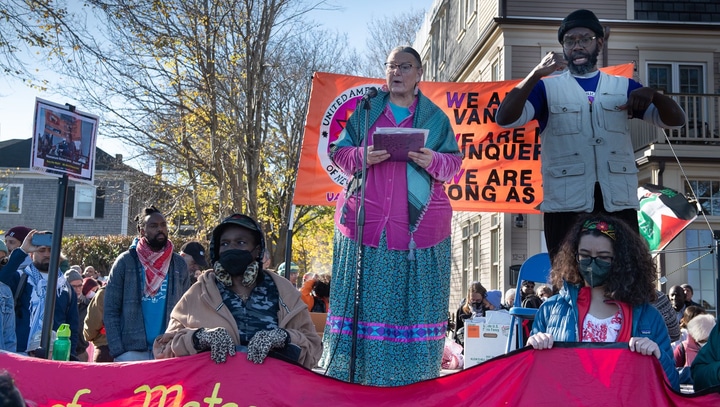
Mahtowin Munro speaks at the 2023 National Day of Mourning. Photo: Rachel Jones

Talk by Mahtowin Munro, co-leader of United American Indians of New England (UAINE), at the National Day of Mourning in Plymouth, Massachusetts, on Nov. 21.

In addition to warm greetings to our Indigenous relatives from North and South America, we welcome Black and Palestinian people to the National Day of Mourning, as well as members of the 2SLGBTQ community. We welcome all people here from the Four Directions who want to be in solidarity with Indigenous struggles. 

As an organization long dedicated to opposing colonialism, we at UAINE understand fully that our liberation is intertwined with that of other colonized and oppressed peoples. We want to express our solidarity with refugees and migrants, many of them Indigenous, who continue to be forced out of their home countries due to U.S. policies, and we continue to insist that the deadly U.S.-Mexican border, with its walls and concertina wire, is not our border.

Looking out over Plymouth Harbor, it is so beautiful. It’s hard though not to think about the environmental destruction the Pilgrims and subsequent waves of settlers brought with them. 

For example, just down the road from here, there is a now-decommissioned nuclear power plant called Pilgrim Nuclear Power Station. 

Holtec — the company that owns the power plant — has been planning for a long time to dump more than a million gallons of radioactive wastewater into Cape Cod Bay, and there has been widespread opposition to that. Meanwhile, Holtec has been releasing some of that radioactive water into the air in the form of gas and they clearly plan to release more in that manner. Yet they are not stopped. 

Down the road a little further you’ll find the Massachusetts Coastal Pine Barrens — one of only three Pine Barrens left in the world. This incredibly rare and important ecosystem — which formed over thousands of years and which houses hundreds of species of animals and birds — is under threat from sand and gravel mining. Water is life, and we humans are part of that web of life, but settlers have largely forgotten this.

Climate justice?

We say today that the way to address climate change is to center Indigenous knowledge of our own territories, not the “green new deal” or the fake carbon proposals made by nations at places like the big climate conferences. 

“Sustainable” energy sources are rarely sustainable, as Indigenous people — who protect 80% of the world’s biodiversity — often bear the consequences. Throughout Indigenous territories, land and water are constantly being exploited without the consent of the traditional owners. My mind is drawn to the wind turbines off Martha’s Vineyard that were installed without the consent of the Aquinnah Wampanoag Tribe.

The slogan landback is on everyone’s lips now, but that feeling has been there for centuries, hasn’t it? It’s time to dismantle the colonial structures that have stolen our lands and keep us in poverty. Tribes in Massachusetts — the Mashpee and Aquinnah Wampanoag, Nipmuc and other tribes — need landback to be able to bring their people back to their homelands.

There is no climate justice on stolen land! 

For instance, in Nevada, there is a sacred area called Thacker Pass, where a settler massacre of dozens of Paiute people took place in 1865. The pass is also the site of the largest known lithium deposit in the U.S. and one of the largest in the world. A massive mining project on the site by Lithium Americas was approved by both the Trump and Biden administrations and started construction earlier this year. 

For its proponents, the mine is an essential component for a U.S. shift to a greener future. But they ignore that the mine threatens irrevocable environmental and historical destruction to the area. 

We think today also of Kanaka Maoli people in Hawai’i, who continue to suffer from the hazards of colonialism. Often displaced on their own islands, the land is heavily militarized in many areas, the water in the Pearl Harbor area is polluted by the U.S. Navy, and the impacts of colonization led to the horrible fire on Maui a few months ago.

In so-called Canada, from coast to coast to coast, First Nations, Metis and Inuit communities are fighting against the effects of colonization — Mi’kmaq people are fighting for their fishing rights once again. Everywhere, First Nations are trying to stop destructive development. Drug deaths are hitting hard in all of our Indigenous communities.

In Guatemala, Peru, Mexico, Chile and elsewhere, Indigenous people are in resistance.

Missing and Murdered Indigenous Women (MMIW) continues to be a crisis throughout Indian Country. I think especially today of the situation in Winnipeg where a serial killer was known to have dumped bodies of murdered Indigenous women in a landfill, and people continue to demand that the landfill be searched for their bodies. The government has refused to do this. So we join them in calling for the landfill to be searched and say that Indigenous women are not trash!

Here in the so-called U.S., Native nations achieved a major victory when the Indian Child Welfare Act was upheld earlier this year. But ICWA needs to be strengthened! Our children are still being snatched and put into foster care, separating thousands of our youth from their land and culture. 

The theft of children has often been a core tenet of settler colonialism. I even see settlers online now talking about wanting to adopt Palestinian orphans. They should instead be demanding that the children of Palestine can grow up with their own families, free in their own homelands.

Supporters of Palestinian resistance

I want to turn to speaking about Palestine for a bit. Our organization has supported Palestinian resistance for decades and we pledge to never let our relatives down.

When you see a genocide happening — whether in Congo or Sudan or Armenia or Palestine — you need to try to do something about it. If you are silent, that is in effect supporting the genocide as well. That is a basic principle that many of us have taught to our children, yet too many people are still standing, afraid to speak up because of the repression right now.

We are honored to have a Palestinian speaker on our program today and I will explain why. From our perspective, Palestinian people are Indigenous. What has been happening to Palestinians in Gaza and the West Bank since October is an increase in what has been an ongoing genocide directed against them by the settler colonial state of Israel. But the violence against Palestinians has never stopped in more than 75 years. 

For instance, 60% of the children of Gaza were malnourished before October because of the conditions of the occupation, and Israel controls not only Gaza’s water but also 80% of the water in the West Bank. What we are witnessing is a resurgence of the ongoing barbaric violence of settler colonialism there. 

Palestinians have been subject to being killed, imprisoned, assaulted and tortured, starved and denied access to water for years. Right now, a second Nakba or Catastrophe has been happening.

If you believe that landback is necessary here, then you need to understand that landback is also necessary for other colonized people of the land.

As Indigenous people, we understand firsthand that to be a colonized person is to exist under constant violence — physical, cultural and psychological. We call what is happening in Palestine genocide because that is what it is. You can’t take a pause in genocide, nor is this a war, nor are there two armies. 

We see the same features of manifest destiny and white supremacy that we have experienced weaponized against Palestinians. We speak plainly and say that this is also apartheid. Our organization opposed apartheid in South Africa decades ago and we oppose it in Palestine now.

Puritans and Zionists

The Pilgrims in Plymouth and the Puritans in Boston were obsessed with the idea that they were in a wilderness provided for them by their god, as though the land was empty and waiting for them. This idea is so embedded that even today, I hear from school children and adults alike that the Europeans brought civilization here, that Indigenous peoples were not actually doing anything with the land. The invaders rename the streets and villages and rivers. They actively erase the existence of people who live here and continue to live here.

This certainly sounds familiar to Palestinians. Zionists still speak about Palestine as a land without people for a people without a land — and even if the land was not empty, it was supposedly full of people who had no real connection to the place, didn’t know how to develop and exploit the land the way Europeans did, didn’t know how to make the desert bloom, and so they lack legitimacy. The propaganda insists that Indigenous people lose legitimacy because they are somehow not sufficiently there, or they are somehow insufficiently civilized.

When I look at Gaza, I see reflections of all of the Indigenous people killed in the waves of massacres here in North America, in Guatemala, in Congo, Haiti, Australia and Ireland, Puerto Rico, the Philippines, Algeria — people around the world whose only crime has been to exist and resist settler colonialism.

And of course the United States, the unapologetic killer of millions of Indigenous, Black and other oppressed peoples, supports this.

If we the colonized suffer in silence, we are sometimes considered to be suitable objects of settler pity and charity. But we don’t want pity. We want freedom and the restoration of our homelands. We fight back because we must. We fight back by living, having children, loving each other, remembering our true history of who we were and still are. 

We fight back for our land because that is part of our bodies too. We fight back in any way we can because the alternative is to become extinct on our own homelands, which is the ultimate goal of settler colonialism. We know what it’s like to be considered animals and savages and to endure generations of ongoing genocide.

They try to dehumanize us, but we never lose our humanity. I think of the settlers who have often had no trouble killing even our children because they don’t see any of us as fully human, and they continue to tear our families apart so that our children will be separated from the land and the culture. 

Colonel Chivington from Colorado, who led the Sand Creek Massacre, said to “Kill em all, women and children, because nits make lice.” That is exactly the sentiment that we are hearing now from Netanyahu and many others in Israel as they justify the massacre of thousands of children and their families, as they now openly support the spread of infectious diseases to kill off even more Palestinians.

Resist dehumanization

As Indigenous peoples, we resist the violence and erasure of settler colonialism and the attempts to dehumanize until we can fully become ourselves through liberation. Like Indigenous people here, Palestinians themselves must decide what they want for their future and how they will resist. It is absolutely not for outsiders to decide that for them.

We also know there is greed underlying what is happening. Greed for the land, greed to control the water, greed for gas and oil and other resources.

We call out Genocide Joe Biden and nearly all politicians in the U.S., in Canada, in Britain and elsewhere who have been supporting genocide and providing billions of dollars in funding and weapons, filling their own pockets and the pockets of the manufacturers. We cannot appeal to the morality of our colonial oppressor. They have none.

But we are in relationship with each other and we are in relationship with the land. As Indigenous people, the land is part of our bodies, our stories, everything we are. The land, the rivers and seas and lakes of Palestine await the return of the Palestinian people.  

So today on U.S. Thanksgiving day, we say that we will not be thankful for these crimes against humanity laid bare for the whole world to see. We will not be thankful for the billions of dollars stolen from us, money that could be going to housing and education and food on tables that instead is flowing out in aid to the war criminal state of Israel. We will not be thankful for the ongoing destruction of our beautiful planet.

We feel the struggle of Palestinian people and of all Indigenous peoples in struggle in our hearts and bones.

Today, we are asking you to mourn and to listen. Tomorrow, we ask you to use your heartbreak and rage to fuel your action to make this end. 

A ceasefire is not enough. A ceasefire is the bare minimum. The Palestinian people need reparations to rebuild. Occupation and settlements must end. US aid to Israel must end. Palestine must be free!

Strugglelalucha256


The Red Nation’s account of Thursday’s shooting

FOR IMMEDIATE RELEASE: SEPTEMBER 30, 2023

CONTACT

editortherednation@gmail.com

WHAT

THE RED NATION RESPONDS TO RACIST ATTACK ON INDIGENOUS PEOPLE

WHERE/WHEN

SEPTEMBER 28, 2023 RIO ARRIBA COUNTY ANNEX BUILDING

WHO

CALLING ON ALL NATIONAL, STATE, TRIBAL, COUNTY, AND CITY OFFICIALS, AND MOVEMENT ALLIES, TO CONDEMN THIS RACIST ATTACK AND DEMAND THE PROTECTION OF INDIGENOUS PEOPLE

WHY

An agitator opened fire on a prayerful celebration in Tewa Territory (Española, New Mexico) shortly after 12PM local time on Thursday, September 28. This was a premeditated act of violence. The agitator shot Jacob Johns (Hopi and Akimel O’odham) in the torso. Johns was protecting a peaceful group of community members assembled at the Rio Arriba County Annex Building, along with half a dozen community peacekeepers. The gunman was heard saying “let’s do this” to a small group of men immediately before opening fire. At the time of the shooting, community members were celebrating a postponement of the reinstallation of a Juan de Oñate statue that was previously removed from Alcalde, New Mexico, on June 15, 2020. Rio Arriba County officials planned to reinstall the statue on Thursday morning in its new location in front of the county annex building but postponed the reinstallation after community members and activists mounted pressure earlier in the week. News of the postponement came as a relief to organizers, who turned the planned peaceful protest into an impromptu peaceful celebration with speeches and a community feed.

Before the shooting, the agitator was seen antagonizing the crowd, saying racist remarks, referring to attendees as “Indians,” and at one point proclaimed himself to be a follower of QAnon. The agitator also made a point to introduce himself to the media present and requested to be photographed and filmed. In the moments leading up to the shooting, the agitator attempted to approach the small crowd of mostly Indigenous women and children congregating around the event’s speakers in front of the building’s main entrance. Video evidence shows that Jacob Johns and other community peacekeepers successfully stopped the agitator from approaching the crowd. Eyewitnesses speculate that the shooter was trying to break through the crowd to shoot the speaker, or to jump on the cement pedestal to get a vantage point with the intent of carrying out a mass shooting. Video footage also shows that community peacekeepers did not pursue the agitator once they had successfully removed him to the other side of a wall separating the sidewalk from the complex. Despite this, the agitator reached under his sweatshirt with his right hand, drew a pistol, pointed, and shot one round into the crowd, hitting Johns in the torso. Additional ammo was seen tucked into his belt by eyewitnesses and on camera. Eyewitnesses have confirmed that the agitator quickly adjusted his aim after shooting Johns and pulled the trigger a second time with the intention of shooting Malaya Peixinho, one of the attendees, but the gun jammed, preventing the release of further rounds. Upon realizing he could go no further with his planned attack, the shooter turned and fled into the complex’s parking lot, got into a white Tesla, and sped off. Additionally, eyewitnesses report the shooter attempted to unjam his gun as he fled. The shooter was later apprehended eleven miles away by New Mexico State Police in Pojoaque, New Mexico.

Despite Rio Arriba County citing concerns for “public safety” as the rationale for postponing the reinstallment, the county offered no protection for Indigenous community members on Thursday. In fact Rio Arriba county and leaders at all levels of government were made well aware of the high possibility of gun violence. Denise Williams, mother of shooting victim Scott Williams, who was targeted at a 2020 Oñate protest, said prior to Thursday’s event she called Governor Michelle Lujan-Grisham’s office, the office of U.S. Senator Martin Heinrich, New Mexico State Police, the office of the New Mexico Attorney General, all members of U.S. Congress representing Valencia County in New Mexico, and all New Mexico state representatives and senators from Valencia County, to warn them of the high chance of gun violence directed at attendees. State senator Elizabeth “Liz” Stefanics was the only one to respond. Immediately after the shooting Scott Williams’ father, Dan Williams, called the governor’s office again to tell her that she “had blood on her hands” for failing to properly respond to both shootings.

Immediately after the shooting, two Rio Arriba County Annex employees denied children seeking shelter from the shooter entry into the building. They proceeded to come out, yelling at people to leave, and made disparaging comments about attendees and Jacob as he fought for his life feet away from them. The cops did not show up in a timely manner despite the shooter being in the same parking lot as the Rio Arriba County Sheriff’s office, and it took several more minutes for an ambulance to arrive. Eyewitnesses report the complete absence of police intervention. The event’s organizers assembled a community peacekeeping team to provide the only public safety measures present on the ground. Without hesitation, Johns and half a dozen other Indigenous men and allies volunteered. When Johns was shot, it was attendees who provided the first medical response, saving Johns’ life. The first law enforcement officer on the scene ordered the community members providing medical assistance to move away, but they refused because the officer did not identify himself as a medic and made no other attempts to provide assistance.

We are incredibly alarmed that pretrial services have recommended the agitator be released without cash bail. We know from first-hand experience that politically—and racially—motivated shootings like this embolden other like-minded vigilantes who hold the same contempt for Indigenous people and organizers. The agitator and his sympathizers pose a very real and serious threat to all Indigenous people, and to Indigenous women activists specifically. The establishment, which Alex Naranjo himself lauded as “a system that we’ve lived with for 400 years,” circles its wagons to protect Indian killers who are colonialism’s foot soldiers. This means there is virtually no formal protection or justice for Indigenous people, women, and activists in these times of heightened danger. We call upon all national, tribal, state, county, and city officials, and movement allies, to condemn this racist attack and demand safety and protection for Indigenous people, women, organizations, and communities. We call upon everyone to contact your officials and apply pressure.

Demand the following:

  1. Do not release the shooter!!
  2. This must be recognized as the racially-motivated hate crime it is at all levels of government.
  3. Protect Native women!!

As of now, the shooter is being held at Rio Arriba County Jail in Tierra Amarilla. The bond hearing is scheduled for Monday at 11:30AM at the Rio Arriba Magistrate Court. We will inform the public of any further updates.

Pray for Jacob Johns and his family. A GoFundMe has been set up to help support him and his family during this recovery. Donate and circulate the donation request.

The Red Nation Podcast will be recording an emergency live episode about Thursday’s events on Monday, October 2 at 5PM MT. The Red Nation and NDN Collective will be discussing the event’s wider significance for the Native liberation movement.

Further updates, The Red Nation social media channels, news reporting, and other links can be found here.
Our first press release and original demands can be found here.

Source: The Red Nation

Strugglelalucha256


Free Leonard Peltier!

On Sept. 12, Leonard Peltier turned 79 years old in a maximum security federal prison in Coleman, Florida. He has spent over 47 years being locked up for being a leader of AIM — the American Indian Movement.

That’s 20 years longer than the time the old apartheid regime in South Africa imprisoned Nelson Mandela. The late President Mandela sought Leonard Peltier’s freedom.

So have people around the world. Thirty-five people were arrested at the White House on Sept. 12, demanding the Indigenous political prisoner’s release.  

The same day, people rallied in New York City’s Union Square for the AIM leader. Among those attending were Estela Vazquez, Executive Vice President at 1199 SEIU healthcare workers, and James Tarik Haskins, the former political prisoner and Black Panther Party member.

All Joe Biden has to do is pick up a pen to free an older man suffering from diabetes, hypertension, and partial blindness from a stroke. Jonathan Nez, President of the Navajo Nation, urged Biden to do that in a Nov. 30, 2022 letter.

So has the United Nations Working Group on Arbitrary Detention, Pope Francis, and seven U.S. senators. 

Even former U.S. Attorney James Reynolds — whose office prosecuted Leonard Peltier — wrote to President Biden asking that the AIM leader be pardoned. Reynolds admits that Peltier was convicted “on the basis of minimal evidence.” 

Revenge for resistance

Leonard Peltier is being kept locked up in revenge for the historic 71-day occupation of Wounded Knee, South Dakota, by AIM members and supporters in 1973. That’s where 300 children, women, and men from the Lakota Nation were slaughtered by the U.S. army in 1890.

In the years following the 1973 Wounded Knee occupation, over 60 people were murdered in the surrounding Pine Ridge reservation. Just as Mississippi represents for Black people the height of racism, so does South Dakota mean the same for Indigenous people. 

For example, in 1967, William Janklow (who later became South Dakota Attorney General and then Governor) raped 15-year-old Jancita Eagle Deer, who lived on the Rosebud reservation. Several years later, she was killed in a hit-and-run incident.

The FBI refused to do anything about the murders on Pine Ridge. Residents asked Leonard Peltier and other AIM members to provide support and protection.

Tensions resulted in a shootout in which two FBI agents and a young Indigenous man, Joe Stuntz, were killed. No one was prosecuted for Stuntz’s death.

But the death of the FBI agents allowed the U.S. Government to indict AIM members Leonard Peltier, Robert Robideau, and Dean Butler. Robideau and Butler were found not guilty. Peltier, who was extradited from Canada, was tried later and convicted in a tainted trial. 

Leonard Peltier is now imprisoned in Sumter County, Florida, where three Black people were lynched. Sumter County is also where the U.S. army suffered one of its most significant defeats in the Dade battle during the Second Seminole War in 1835.

In the spirit of Crazy Horse, free Leonard Peltier!

Strugglelalucha256


Oppenheimer — and the other side of the story

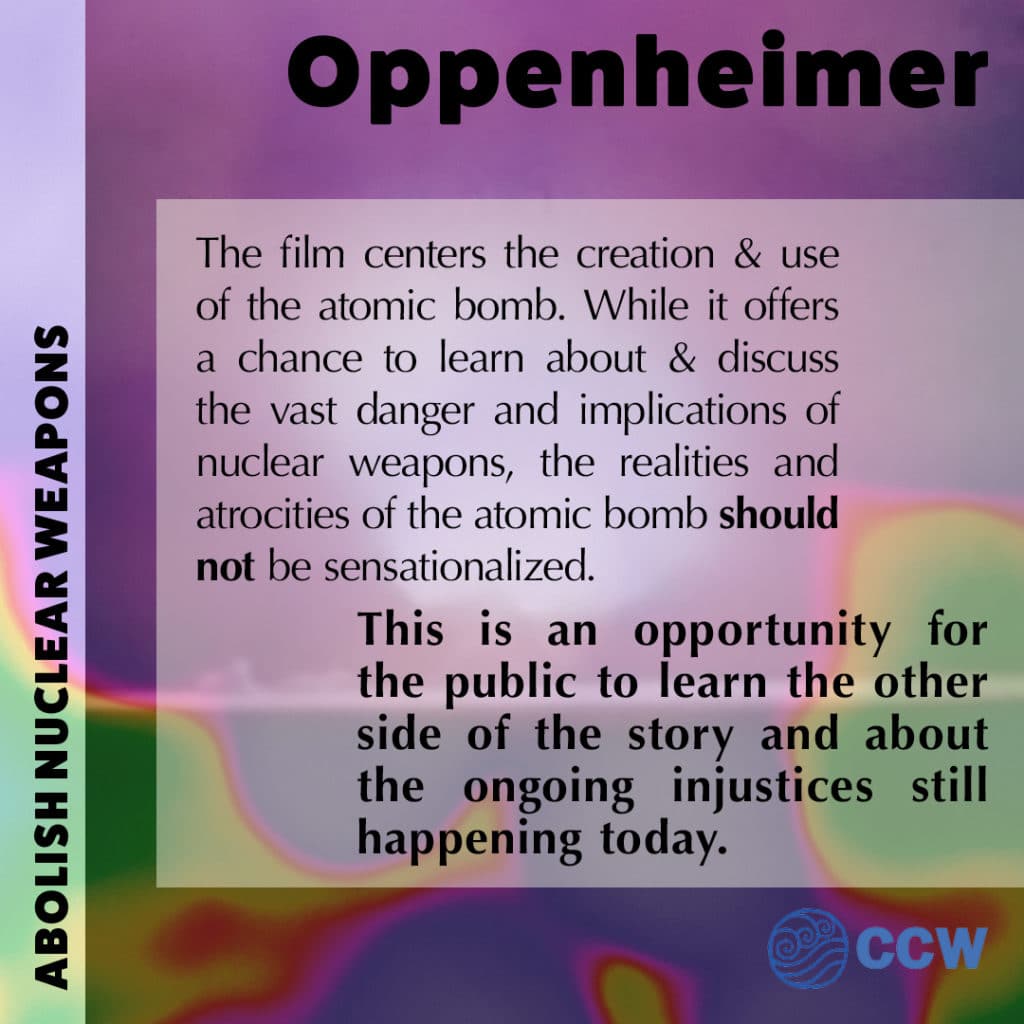
This week, “Oppenheimer” will open, a film that centers on the creation and use of the atomic bomb through the story of J. Robert Oppenheimer.

Go see the movie if it calls to you. But please also take time to learn about the other side of the story and what unfolded at Tsankawi (also known as Los Alamos) and the Pajarito Plateau 80 years ago — the story that centers the Indigenous and land-based peoples who were displaced from our homelands, the poisoning and contamination of sacred lands and waters that continues to this day, and the ongoing devastating impact of nuclear colonization on our lives and livelihoods.

We’ve put together this resource list with a focus on Indigenous and land-based communities, so you can learn more about our side of the story and ways to respond.

Together we are Beloved Community. Together we can grow a Culture of Peace.

LEARN ABOUT OUR SIDE OF THE STORY

Video and Audio

Books

Articles and Reports

Map

Water, Air, and Land: A Sacred Trust  This map is a work in progress. The uses of water, air and land are diverse in New Mexico and will change dramatically with climate change. For caretakers of this sacred trust, this map offers a bird’s eye view of the health of our environment. It documents primarily the energy- and nuclear-related sources of pollution, though other factors are also at work.

WHAT YOU CAN DO

This list is just a starting point. Connect with the organizations below for more opportunities to act, and we’ll add more soon.

Sign up for our NM Action Alerts email list – we’ll send you a message when there is an action you can take on behalf of environmental justice, including responses to LANL

2 Stand in solidarity with the Tularosa Basin Downwinders Consortium. Visit their website to learn more

3 Get involved with and support local organizations focusing on nuclear issues:

And this international network:

Source: Tewa Women United

Strugglelalucha256


The First Nations at the frontline of Canada’s fires

As smoke and smog choke the Northeast, Alberta’s Indigenous Nations face down apocalyptic wildfires

And the provincial government’s “let-it-burn” climate policy.

This story was produced by Ricochet Media and IndigiNews, and is being co-published by The Real News.

As he watched the last plane lumber down the runway, Chief Allan Adam was finally able to breathe freely again.

He had just posted a live video from the Fort Chipewyan airport on the evening of May 31, documenting the last flight out with evacuees fleeing impending disaster. A wildfire was advancing approximately seven kilometres from his remote community, which is accessible only by boat or plane.

But the relief was short-lived. The straight-shooting leader of the Athabasca Chipewyan First Nation, one of three Indigenous communities in Alberta who call Fort Chipewyan home, was abruptly hit with biting pain.

“That was the stress that hit me, right after that post, that’s when the pain came to my neck,” he said in a telephone interview the evening of June 1, between back-to-back meetings with local leaders, authorities and firefighting officials.

Despite the searing ache in his neck, he continues to roll with the punches. The homes and livelihoods of nearly 1,000 people are on the line. It’s the first time in anyone’s living memory that the hamlet, located about 300 kilometers north of Fort McMurray, has been under a mandatory evacuation order. Chief Adam — together with Billy-Joe Tuccaro, chief of the Mikisew Cree First Nation, and Kendrick Cardinal, president of the Fort Chip Métis — has stayed behind to oversee efforts to save his homelands.

“We had to get everybody out. Everything that we’ve done, that was our main focus, to get everybody out immediately. And then once that was accomplished, it was a relief for me because now we can focus our attention on preparedness (for) what’s coming.”

Record heat waves and dry conditions have sparked an unrivaled wildfire season of destruction across the country, affecting almost every province and territory.

In May, roughly 2.7 million hectares of forest — an area equal to about five million football fields — were burned to the ground in Canada, said Emergency Preparedness Minister Bill Blair at a press conference. Over the last 10 years, the average number of hectares burned in the same month was just 150,000.

Natural Resources Minister Jonathan Wilkinson told reporters at the same press conference that the rampant infernos are caused by climate change.

“It’s a simple fact that Canada is experiencing the impacts of climate change, including more frequent and more extreme wildfires,” he said.

Chief Adam is all too familiar with the consequences of climate change, and particularly the contamination of his territories. Fort Chipewyan, commonly referred to as Fort Chip, is downstream from Alberta’s notorious tar sands, one of the largest oil developments in the world.

The settlement is perched on the tip of Lake Athabasca, the largest body of water in Alberta and Saskatchewan. Known as the oldest community in the province, it once served as a hub for the Indigenous Nations who live up and down the mighty Athabasca River, as well as the European settlers who trekked north for trade. But since commercial-scale extraction of the oil sands began in 1967 — and then expanded to fuel the economic wellspring of Canada — the water, land and air quality of the vast Indigenous territories downstream has deteriorated.

Finding deformed fish and polluted water here is a normal occurrence. And dozens of Fort Chip residents have succumbed to a rare strain of bile duct cancer.

In April, Chief Adam testified before a House of Commons committee hearing in Ottawa to decry the release of millions of litres of toxic tailings waste in two separate incidents involving Imperial Oil’s Kearl mine. Just weeks later, Suncor reported it had released almost six million liters of contaminated water into a tributary of the Athabasca River.

Earlier, he had predicted his community would become environmental refugees.

Now, Fort Chip could be swept away by out-of-control flames.

“I tell them this,” he said during the phone interview, explaining that he confronts the Alberta and federal governments about climate change.

“I speak with them all the time and we hold them very accountable. The climate change issue is not going to go away. And we’re gonna have to deal with it — and you (governments) are gonna have to deal with us.”

Tar sands smokestacks belch smog into the sky.
Syncrude’s Mildred Lake site north of Fort McMurray, Alberta on Thursday, June 1, 2023. Over 1000 people have been evacuated from Fort Chipewyan as wildfires threaten the community downriver from the oil sands. Amber Bracken
Dwight Courtorielle, 48, with his son Kade McKay, 10 months in Fort McMurray, Alberta on Thursday, June 1, 2023. Over 1000 people have been evacuated from Fort Chipewyan as wildfires threaten the community downriver from the oil sands. Amber Bracken
Rob Leavitt, right, and Preston Wanderingspirit watch smoke on the horizon after clearing trees for a fire break in the Allison Bay area of Fort Chipewyan, Alberta on Friday, June 2, 2023. Over 1000 people have been evacuated from Fort Chipewyan as wildfires threaten the community downriver from the oil sands. Amber Bracken

Feels like 2016 all over again 

About 250 kilometres south from Fort Chip, the boat launch in Fort McKay First Nation — a community of 800 people about 58 kilometres north of Fort McMurray — is clogged with dozens of docked boats. Volunteers are patrolling the river day and night, searching for evacuees whose boats may have gotten stuck or broken down.

It’s déjà vu for Fort McKay residents, who are survivors of the worst natural disaster in Canadian history. They were forced to flee their homes during the massive 2016 blaze that ravaged Fort McMurray.

Even so, ushering Fort Chip evacuees to safety is a treacherous undertaking, according to Fort McKay Métis Nation president Ron Quintal.


“There’s a combination of the smoke, of the water coming up and having sticks in the water and traveling at night — it’s a concern for damage to your boat and could cause an emergency,” he says while visiting evacuees at a hotel in Fort McMurray.

Quintal directed his staff to focus on comforting the displaced, including whole families with children and elders who had made the eleventh-hour trip.

“We were there when families were pulling in,” says Quintal, his voice pinched with emotion. “You try to put on a happy face. These kids, they’re afraid, you know, they’ve had to leave their homes, given they’re an isolated community. And we let them know that you’re safe here, we’re here to help you.”

Jimmy Shortman, 64, waits at the boat launch for Ginger, his German Shepard, and her six three-week-old puppies to be delivered by a peace officer. He fled his home in Fort Chip by boat along with his wife and granddaughter. His beloved dog was cared for by officials in Fort McKay while he escorted his family to a hotel in Fort McMurray.

Shortman also fled the infamous Fort McMurray blaze in 2016. Now, he’s experiencing flashbacks of flames, falling ashes, and traffic jams holding back frantic passengers desperate to escape.

A former firefighter, he witnessed the moment the current wildfire ignited near his home community.

“When that lightning happened on Saturday in Fort Chip, I was outside my house, sitting on the deck. All of a sudden, lightning strikes.” His brown eyes widen as he describes the jolt of electricity hitting the ground.

“It started that night, because the lightning did it. It got bigger and bigger, and the wind was picking up.”

He did not expect the blaze would burn out of control and turn so many lives upside down. He describes people panicking in their rush to get out of Fort Chip. “My wife was scared and crying. Everybody was excited to just get out of there.”

“There were 14 boats trying to get out at the same time, and that’s unheard of. You couldn’t even see across the lake — it was covered in smoke. I don’t panic, but.…” His eyes briefly well with tears. “The only thing I worried about was my wife and the little girl.”

Now, he’s happy to be heading out to his cabin along the river with his brother, Stanley Shortman, about an hour and a half south of the fire. He feels most comfortable there, as do hundreds of other Fort Chip families whose cabin homes dot the shoreside. They have a kinship with the land and water. Many, like Shortman, spend half their lives in the wilderness of their territories.

Shortman says he will clean the yard around his cabin while he waits out the fire. But he predicts the situation will intensify.

“Look how hot May was.” Shaking his head, he emphasizes that the dry weather isn’t helping. “We haven’t gotten hardly any rain yet. Wait ’til July. Wait ’til it’s really hot. Oh, it’ll be worse. It’s scary.  Maybe the whole country will burn.”

A woman's hand extended over the flatbed of a truck, where various packaged and canned foods can be seen.
Loretta Waquan sorts care packages for evacuees in Fort McKay, Alberta on Friday, June 2, 2023. Three boats delivered eight care packages to evacuees staying in cabins. Each cabin received: one 10lb bag of flour, dried beans and barley, bread, 20lbs of potatoes, evaporated milk, canned tomatoes, baking powder, canned ham, canned corned beef, minute rice, two flats of canned soup, oats, vegetable oil, chocolate, coffee, red rose tea, arrowroot cookies, macaroni, powdered milk, jam, sugar, chocolate chip cookies, powdered coffee creamer, onions, oranges, apples, granola bars, honey, canned beans, water, and lard. Amber Bracken
View of Lake Athabasca. The sky is cloudless but smothered by smoke. The sun burns dimly in the sky.
Smoke hangs over oilsands tailings ponds north of Fort McMurray, Alberta on Friday, June 2, 2023. Over 1000 people have been evacuated from Fort Chipewyan as wildfires threaten the community downriver from the oil sands. Amber Bracken
An elderly First Nation woman sits in a hospital bed. Her hands are wrapped around a rosary.
Madeline Piche, 93, holds the rosary she evacuated with at the elders residence in Fort McKay, Alberta on Thursday, June 1, 2023. At 93-years-old, Piche is the oldest resident of Fort Chipewyan and says she is praying for everyone as they navigate the crisis. Amber Bracken

‘Praying helps’

The oldest resident evacuated from Fort Chip rests in her bed at the long-term care facility in Fort McKay. Madelaine Piche, 93, clutches a sparkling rosary, her milky brown eyes conveying a gentle naivety.

“I’m so tired,” she says with a sigh. “I’m scared, I was nervous inside the plane.”

Along with several other elders, Piche was airlifted out of Fort Chip and transported to the Fort McKay facility on May 30. She’s comfortable, she says, and the food is “good here.”

The view of the river outside her window reminds her of home.

Now Piche — grandmother of 43 and great-grandmother to countless great-grandchildren —  patiently waits for one of her daughters to visit from Fort McMurray.

She cries as she prays for her hometown, the only place she’s ever lived.

“Fort Chip is beautiful.… Praying helps,” she says with a whisper. “I pray a lot for everybody and for it to stop burning.”

Meanwhile, hundreds of displaced residents are scattered in various hotels throughout Fort McMurray. The Municipality of Wood Buffalo’s Emergency Social Services department is accepting donations of essential supplies such as toiletries, clothing, diapers, baby wipes and menstrual products. Families gather in hotel parking lots to catch up on the latest updates about the wildfires and let their children play on the grass.

But essential supplies for cabin dwellers are needed.

Riding the river

Mikisew Cree Nation evacuees Matthew Coutoreille and Yancey Kaskamin volunteer to deliver packages of food and water to nine cabins spread out along the river. They work alongside Coutoreille’s father, Lloyd Donovan, a resident of Fort McKay.

After sorting through various dried goods, gassing up, and loading their boats, the crew embarks on a Friday morning mission that will last until dusk.

Coutoreille, 36, has travelled the river since he was a young boy. He knows every bend swirling throughout the hundreds of kilometres of his homelands. He studies the current and weaves in and around sandbars, islands and debris to safely navigate his boat.

“My grandpa was one of the old-timers that used to come up and down this river,” he says in a calm and steady voice.

“You always have to have an eye out here. When you’re travelling with the old-timers, they tell you where the rocks are, where the sticks are and where to go. So I’ve learned from them.”

The river is ever-changing and unpredictable. Coutoreille is an environmental monitor for the Mikisew Cree. He observes the dwindling water levels as a result of impacts from industry and B.C. Hydro’s damming system. It makes maneuvering the river more dangerous.

“You can tell how much water dropped here and if it’s safe. And it’s gotten worse over the years because of water levels. Now everything is just drying up.”

A thick, smoggy gray haze blankets the horizon. Another wildfire to the east of the river a few hours south of Fort Chip is colliding with the smoke blowing in from there — as if Armageddon were descending upon the territory.

But Courtoreille isn’t afraid. He’s fixated on the task of helping his neighbours. Approaching the mouth of Lake Athabasca, he slows to assess the strength of the winds.

“It’s going to be rough.” He winks with a slight smile and takes a shallow breath.

After pulling on a hoodie and securing the boat canopy, he confers with his father and Kaskamin. They will steer their boats in the direction of the northeast-blowing winds.

Courtoreille nods as if to reassure me as he explains his boat is designed to take on water at the bow. If the waves are not navigated properly, they can swamp an open boat or capsize it. He’s crossed the lake in poorer conditions and is confident in his ability to safely do it again.

“Let’s get ’er done!” yells Donovan.

Motors roar in succession. Courtoreille leads the way to create a trail for the ensuing boats to have a smoother ride. After a harrowing 15-minute journey of dodging full-length logs and climbing whitecaps that crash against the boat, Courtoreille securely guides us to a bay in Fort Chip.

Whirling sounds of helicopters flying to and from the small airport penetrate the stillness of the near-empty hamlet. Pickup trucks, emergency vehicles and ATVs intermittently race between the emergency command centre in the middle of town and areas that personnel are working to fireproof.

Sheets of smoke billow into the sky less than three kilometres from Alison Bay, a residential area of the Mikisew Cree Nation on the boundaries of Fort Chip. Workers have dug trenches to the lake there to make the water more accessible.

Excavators clear fields of trees and shrubs surrounding the Mikisew community and Fort Chip. Pumps connected to water hoses supply a web of sprinklers attached to the rooftops of homes and other structures around town.

At an emergency meeting that evening of approximately 200 people, including local leaders, authorities, firefighters and community volunteers, one person yells out that they will work through the night to protect Fort Chip.

Chief Adam echoes the sentiment: whatever it takes to keep the fire at bay.

“We can cut grass, remove all the garbage and debris, and do all these little things,” he tells the crowd, appearing exhausted but unwavering.

“We will make it happen. If the fire does come into the community, we will assist in some way with the fire department,” he says. “But the forest fire, that belongs to Alberta Forestry and the professional firefighters. Now a lot of prayers are with us from other communities. Stay strong.”

After a hot meal, volunteers line up to attest to their skills so officials can enter them into a database.

It has been stressful to coordinate a community-led emergency operation at times, says Jay Telegdi, intergovernmental relations senior manager for the Athabasca Chipewyan First Nation. Yet he has been down this road before. He helped evacuate members of Fort McKay Métis Nation in 2016. Now he buckles down to make sure every community member on the ground is assigned a task.

Evacuee John Edmund Mercredi, 84, plays the fiddle in Fort McKay, Alberta on Thursday, June 1, 2023. Over 1000 people have been evacuated from Fort Chipewyan as wildfires threaten the community downriver from the oil sands. Amber Bracken
A dog eyes an overnight offering of coffee and cookies for residents and first responders at Chiefs Corner gas station and corner store in Fort Chipewyan, Alberta on Saturday, June 3, 2023. Over 1000 people have been evacuated from Fort Chipewyan as wildfires threaten the community downriver from the oil sands. Amber Bracken
Sprinklers protect houses on the edge of town in Fort Chipewyan, Alberta on Friday, June 2, 2023. Over 1000 people have been evacuated from Fort Chipewyan as wildfires threaten the community downriver from the oil sands. Amber Bracken

No time to contemplate causes

Calvin Waquan, Mikisew Cree, is the general manager of the Chief’s Corner gas station and convenience store in Fort Chip. He didn’t question staying behind to keep the store open when others closed their businesses down and left. After kissing his wife and two young children goodbye at the airport so they could fly to safety and find shelter in a Fort McMurray hotel, he sprang into action.

He cooks meals every day for up to 150 people in his store’s kitchen and caters to the varied schedules of anyone needing cigarettes, snacks or toiletries. He’s tallying the purchases on a charge basis, having buyers sign receipts for reimbursement from the province, which he says will be covering the full costs.

“I’m here to serve,” he says while mopping the store floor.

“I know one guy in town already passed out and fainted. So I’m making sure I get a lot of fruit and vegetables in me. And I don’t want my wife to come home right now.” He stops to laugh.  “Because it’s pretty messy around the kitchen at home. But I’ve been trying to listen to what she used to tell me about taking in nutrients and vitamins.”

“It’s tough because it’s emotional. It’s tough on my daughter, she cries and then I start crying. The way I see fires, what’s happening with Mother Nature, it’s kind of resetting and teaching us a lesson to slow down maybe and appreciate what we have.”

Calvin Waquan, Mikisew Cree, general manager of the Chief’s Corner gas station and convenience store in Fort Chip

Waquan is a former elected councillor of the Mikisew Cree Nation. He lobbied governments for compensation and accountability from the oil industry for damages to his territories. Lately, he’s noticed rapid changes to the seasons.

“We had the winter road come in way late this year, the water was open right until January. And now this.”

But in an active emergency, there isn’t much time to contemplate root causes. Every night since the evacuation, before he heads home to catch a few hours of sleep, Waquan sets up a table outside the store with two filled coffee urns, cream, sugar and a package of cookies for workers.

He speaks to his family daily, although he tries to avoid video calling them.

“It’s tough because it’s emotional. It’s tough on my daughter, she cries and then I start crying. The way I see fires, what’s happening with Mother Nature, it’s kind of resetting and teaching us a lesson to slow down maybe and appreciate what we have. And I think that’s what the families are learning and especially myself. Not having the kids being in here grabbing a slush, kids running by to go to the park or just hanging out on the concrete outside — I miss seeing the kids and all the noise that’s always going on.”

Lifelong Fort Chip resident Doris Cardinal works at the K’ai Talle Market a few blocks from Chief’s Corner. She and her husband, Happy, chose not to leave.

“This is my home and I wasn’t going to go anywhere,” she says while having a break outside the market. “I’d be afraid if I see the fire coming over the hills, then I’d run for the water.”

Cardinal is still processing the news that her cabin burned down two days prior. The home she and her husband built along the river just three years ago was their retirement plan. It was located north of Fort Chip, around the corner of what’s called Devil’s Gate, by Little Rapids, she explains.

She grew up on the land and river. It’s a special place she goes to wind down and take in the northern lights while sipping strong tea.

“Some of the leaders went up in the choppers and took a snapshot. And then my niece told me my house burned. I shed tears, I’m not gonna lie, and I swore. It was not the greatest feeling.”

Cardinal’s was one of several cabins devoured by the wildfire. Her husband vows to rebuild one day. For now, Cardinal is immersed in keeping the market afloat and lifting the morale of others on the ground.

“As long as the robins are singing, I’ll be okay,” she says with a chuckle.

Enter the army

That afternoon the Fort Chip airport is abuzz with anticipation as local rangers, chiefs and workers congregate to welcome the Canadian military. A gray Lockheed C-130 Hercules plane rumbles down the airstrip as a crowd watches in awe from behind a metal fence.

The warplane is carrying 65 soldiers dressed in camo and combat boots ready to battle the flames. It will return with dozens more soldiers later that evening.

The encroaching wildfire is less than three kilometres away, and smoke is descending on the site.

Chief Adam paces the parking lot while recording a Facebook live video. His long silver hair is tied back, and his shoulders slightly droop from an overwhelming cocktail of emotions. His eyes light up at the sight of the incoming army, and a grin emerges.

Kendrick Cardinal, the Fort Chip Métis Nation president, greets each soldier with a handshake as they march to an awaiting bus that will shuttle them to their command post.

He feels relieved. “I’m happy the army is here to help us out. It’s more manpower. With their help we’ll try to extinguish the fire as soon as possible.”

Officials are unsure when it will be safe for evacuees to return home. As of June 8, the wildfire has scorched over 31,000 hectares, and firefighters have so far been able to hold it back from Fort Chip.

But firefighters have their work cut out for them across the country. According to the Canadian Interagency Forest Fire Centre, there are over 400 fires actively burning in Canada, 240 of which are deemed out of control.

The effects of the wildfires are far-reaching. A thick haze drifted into parts of the northern United States mid-week, blotting out the sun, and creating a Code Red air quality level for millions of people.

Chief Adam notes a large influx of moose flies swarming the airport. The large insects, known for sending irritated moose into a frenzy, bite chunks of human and animal flesh in order to reproduce.

But it’s too early for moose flies, he says. They usually don’t appear until well into July.

It’s another sign something is off with the patterns of Mother Nature.

“Climate change is such a part of this, everything ties into it,” he says with frustration.

He declares he’ll continue confronting government leaders who push the status quo of excessive oil production up the river, which is exacerbating carbon emissions.

“(The Alberta government’s) let-it-burn policy has to change because it’s gonna get worse. It’s burning out of control.”

A pointed message spray painted on a fence in Fort McKay, Alberta on Thursday, June 1, 2023. Over 1000 people have been evacuated from Fort Chipewyan as wildfires threaten the community downriver from the oil sands. Amber Bracken
Calvin Waquan in Fort Chipewyan, Alberta on Saturday, June 3, 2023. Although they have been running short staffed, the family has kept Chiefs Corner open to help care for people fighting fire—and have given away all merchandise except for cigarettes and gas. Amber Bracken
Athabasca Chipewyan First Nation chief Allen Adam watches military arrive to help fight fires in Fort Chipewyan, Alberta on Saturday, June 3, 2023. Amber Bracken

This article first appeared on The Real News Network and is republished here under a Creative Commons license.


Strugglelalucha256


‘Indigenous communities are fighting to keep our families together’

Talk given by Mahtowin Munro of United American Indians of New England (UAINE) at the webinar “What We Can Learn from Cuba’s ‘Code of Freedom’ for Families,” hosted by Women In Struggle/Mujeres En Lucha on Jan. 22.

The new Families Code is an incredible achievement of the Cuban people, born out of thousands of hours of discussions and a desire to ensure that ideas and policies properly reflect what families should have at this historic time in their socialist system.

I contrast what Cuba has with what we have in the U.S. – or perhaps I should say, what we don’t have. I will largely speak about this from an Indigenous family perspective, but we know that conditions are also abysmal for other oppressed and marginalized communities.

Because I have been to Cuba, I know that there are many supports for families there, with daycare and health care right there in their communities. Housing is a right, whereas here, there are many thousands of unhoused children – more than 100,000 in New York City alone. 

In Cuba, families are supported, and the children are treated with great care, and this is reflected in the confidence of the children themselves and the extension of key rights through the Families Code.

Here in the U.S., children are criminalized as part of the school-to-prison pipeline. Many thousands of children, disproportionately children of color, are detained, disciplined at schools, and subjected to harsh discipline. Some of these children are as young as kindergarten age.

In the U.S., it can be hard to even have a family. Back in the 1970s, it was revealed that the U.S. government was sterilizing Indigenous women, Puerto Rican women, and Black women without their consent. 

It can also be hard to choose not to have a family. This is true not only because of Roe v. Wade being overturned. For instance, the Indian Health Service, upon which many Indigenous people rely, does not provide abortion services. So Native child-bearers must overcome substantial hurdles in order to get the services they need. 

Indigenous, Black, and other women of color are less likely to have the prenatal care that they need as well. In addition, maternal mortality and infant mortality rates are much higher in Black and Indigenous communities than for white people.

Boarding schools = concentration camps

The attacks on Indigenous families have been severe and have endured for generations. These attacks are not accidental but are key features of settler colonialism and capitalism. Because settlers and the U.S. government have been dedicated to stealing Indigenous lands and extracting resources from the lands, Indigenous families and communities have been shattered in many ways in order to weaken ties to the land and to make it easier to steal and exploit even more land and resources. These attacks are meant to destroy our spirits and cultures, break our communities, and break our ties to the land.

The Indian boarding schools that were established in Canada and the U.S. in the latter part of the 1800s were very much part of consolidating these attacks that had been occurring since invasion. The Canadian and U.S. governments worked hand in hand with churches to fill the seats at these schools. 

While some Indigenous families were persuaded that their children would be better off at the schools, many families were coerced and told that they would not receive their rations if they did not let their children be removed, at a time of starvation when many Indigenous people were denied the right to hunt and fish on their own homelands. Many children were forced to attend these schools, even at the point of being kidnapped from their home communities. 

Once at the schools, which in reality were not schools but concentration camps for kids and instruments of genocide, children were stripped of their clothing and put into uniforms, had their hair cut off, were beaten for speaking their own tribal languages, and were physically and sexually abused on a routine basis. 

In some of the schools, children were not allowed to return home at all for years. When they became older and went back home, they often no longer felt they belonged and could not even speak their own language. Children died at these so-called schools by the thousands. 

These institutions did not close until the 1960s and, in some cases, later than that. In the U.S. and Canada, there have been recent efforts by Indigenous people to speak the truth about what happened at these institutions, to demand reparations, to talk about the resulting intergenerational trauma, and to begin the very hard work of trying to find and identify unmarked graves at these schools.

Far from being over, the attacks on Indigenous families continued. By the 1970s, about a third of Native children in the U.S. had been taken from their families and adopted, usually by non-Native families, where they grew up without knowing who they were. 

ICWA under attack

Following a huge effort by tribes and individuals, the Indian Child Welfare Act was passed in 1978 and was intended to keep Native children in Native communities.

However, the ICWA is now under attack. Right-wing think tanks like the Goldwater Institute, evangelicals, and funding from energy companies have led to a case now before the Supreme Court that would and may overturn ICWA.

Indigenous children are also much more likely to be in foster care, with many hurdles existing before their families can get the children returned.

There are many more attacks against our families, including the ongoing epidemic of violence against Indigenous women, girls, and Two Spirit people in the U.S., Canada, Mexico, and elsewhere. In the U.S., at least 84% of Native women have experienced violence. While the government and police often say that this is due to the violence of Native men, in fact, it is non-Natives who commit the vast majority of this violence. 

Native women are murdered at a rate of 10 times the national average. The rates in urban areas, where the majority of Native people live, are also disproportionately high. Indigenous women hold families and cultures together. When one of them is attacked, disappears, or is killed, the impact is shattering. 

This is not a new issue, but rather is part of the ongoing violence against all Indigenous peoples that first began when Europeans arrived.

The violence against Indigenous women, Two Spirit people and children has deep roots in the invasion and colonization of Indigenous homelands and in white supremacy, marginalization, and poverty. The violence is a mechanism of domination and oppression. It is intended to terrorize, disrupt and demoralize Indigenous populations. It is a direct function of white supremacy, settler colonialism, and capitalism. 

But Indigenous communities throughout the Americas have been fighting back and are continuing to do everything possible to keep our families together, strengthen our communities, and defend the land and water.

Strugglelalucha256


Peruvian lawmakers attempt to pass bill to unprotect Indigenous people

Lawmakers in Peru have taken advantage of ousting President Pedro Castillo as a chance to secretly pass a bill into law that would take away the 2006 law protecting “uncontacted” Indigenous people, which would also risk reserves and spaces they call home.

Modifying the 2006 bill is aimed at impeding the creation of new reserves and eliminating existing ones – currently, there are seven in Peru’s Amazon. This poses a grave risk for up to 25 “uncontacted” peoples living in the Amazon rainforest, which is the second-largest following Brazil’s.

Beatriz Huertas, an anthropologist working with Orpio, the Indigenous federation in Loreto, Peru’s largest Amazon region, said, “I’ve never seen such a nefarious bill in 30 years working for the protection of isolated Indigenous peoples.”

Outright genocide

This comes swiftly as the country remains knee-deep in the crisis after President Castillo was ousted, leaving at least 22 people killed in violent clashes and protests with security forces. On Tuesday, Congress agreed to move forward with early elections, but a second vote is required to finalize it.

Peru’s Indigenous federation Aidesep said the bill “would cause genocide” and noted that their “brothers and sisters” were “highly vulnerable and threatened by the increasing pressures on their territories” from matters ranging from infrastructure projects, logging, and illegal mining to drug trafficking.

The proposal seems to be backed by a group of businessmen in Peru who have already financed a campaign in an effort to deny the existence of “isolated peoples” wholly.

The business group, which names itself the Loreto Sustainable Development Coordinator, claims that Indigenous reserves are a sham and impede development in the region that sizes larger than Germany.

In a separate yet recent context, a large majority of Indigenous Canadians protested in the streets of Montreal amid the final negotiations of the UNFCCC’s COP15 event on biodiversity, which was posing risks of threatening Indigenous peoples and homes.

“The people are trying to speak, trying to say you can’t just talk, you have got to act,” said Sheila Laursen, a member of the activist group Raging Grannies.

Member of a tribe that calls the Ecuadoran Amazon home, Helena Gualinga, commented, “Let’s not forget that… to protect biodiversity we need to protect Indigenous people first, Indigenous people are protecting biodiversity.”

‘It is suicidal’

Secretary-General of the Indigenous Federation of Orpio, Pablo Chota, is continuously fighting and has been for 19 years for the creation of the Napo-Tigre Indigenous reserve on Peru’s border with Ecuador. He expressed, “[The isolated people] are our brothers and sisters, we are protecting life.” The Napo-Tigre region has been subjected to oil drilling by the Anglo-French oil company Perenco.

According to Julia Urrunaga, director of the Environmental Investigation Agency in Peru, civil society groups in the country expressed grave concern about the bill, which may be passed in light of current circumstances. “Peru can’t take more conflict,” she said.

“In a world where we each day have more evidence of the role of Indigenous peoples in the protection of the world’s last remaining natural forests, it is suicidal to attempt to eliminate protections for Indigenous peoples and their forests,” she relayed.

Source: Al Mayadeen English

Strugglelalucha256


Justice demanded in death of Abbey Lynn Steele

Statement on the Death of Abbey Lynn Steele
By Tribal & Community Organizations and Concerned Individuals

On Friday, December 2, 2022, 20-year-old Abbey Lynn Steele of Rapid City, South Dakota, died at Monument Hospital after arriving unconscious and not breathing from the Pennington County Jail on November 16th. The Native community of Rapid City is grief-stricken and outraged by Abbey’s untimely death and the circumstances surrounding it. Abbey had given birth via emergency surgery merely 5 days before her violent arrest, detention, and hospitalization. Her death under the watch and authority of major institutions in Rapid City is an affront to common decency and basic human dignity. Abbey Steele should be alive today. Two children are now without their mother and have lost the opportunity to know her. Our community demands justice for Abbey and her family.

Abbey was arrested, on an outstanding warrant, by a Rapid City Police Department officer who had arrested her 3 times previously. Video footage shows this police officer chasing and forcing a distraught Abbey into handcuffs while she was postpartum, post-surgery, and highly medically vulnerable. The jail and police would not respond to Abbey Lynn Steele’s mother’s questions as to her whereabouts and did not disclose her being admitted to the hospital or that she was not only unconscious but not breathing. Abbey’s mother, Amy Steele, next called the hospital directly in a desperate attempt to find her daughter. The hospital disclosed that Abbey was a patient in their care and on a ventilator.

The ongoing violation of human, treaty, civil, and statutory rights of the Oceti Sakowin and other Indigenous Peoples in this city and in this state, has resulted in the death of a 20-year-old woman, Abbey Lynn Steele. We are demanding an immediate response around the failures of the justice
and medical systems here in Rapid City that are implicated in Abbey’s demise. These system failures are rooted in racial animus, white supremacy, and a pattern of practices aimed against Native Americans living in Pennington County, South Dakota. Right now, the family is unable to bury their daughter, sister, and mother as her body has not been released by the authorities.

The inconsistency in information is highly suspect. Given the historical mistreatment, discrimination, and grossly negligent behavior towards Indigenous Peoples by Pennington County, we have no reason to trust any narrative coming from institutions that continue to violate our people. We have reasons to believe that the administrators of the Pennington County Jail and adjacent agencies are likely to coordinate manipulation of the public to shift blame and escape accountability; Abbey Lynn Steele died while in their care and custody.

Indigenous Peoples, especially our women, do not enter into these situations or systems alone; they will always have relatives standing with them and behind them. We collectively demand, in support of the Steele family: Immediate release of Abbey back to her family. There are constitutionally protected Lakota religious and spiritual beliefs that must be respected.

An independent investigation and autopsy by expert parties outside of South Dakota must be funded.

Release of video and detail to the family regarding Abbey’s detention. They have a right to know what took place in her final hours of consciousness.

Develop a protocol for notifying family members and support systems when loved ones are transferred from the jail to the hospital. We now have multiple accounts of community members being transferred unconscious, from the jail to the hospital, because of injuries sustained within the jail without any notification to their families. Community members who are unable to contact their support systems during such a time should not be alone; their loved ones should not be in the dark regarding their location and health status.

Expunge or provide amnesty for non-violent warrants and re-direct warrant processes towards safer practices. Warrants create a dangerous situation for vulnerable people because of the tremendous violence that takes place at the time of arrest. Cities like Denver have deployed healthcare professionals for certain populations and situations, instead of law enforcement. Protocols like this would have preserved Abbey’s life. Develop specific protocol about how law enforcement and correction officers engage with those who may be pregnant, post-partum, and otherwise medically vulnerable. Announce this protocol publicly and provide regular public reports on how it was followed. Require attendance of all Pennington County law enforcement, hospital and jail staff at training on de-escalation and implicit bias.

The public is encouraged to come forward if they have similar stories.

Signed,

Organizations:

Wotakuye Mutual Aid aka Meals for Relatives COVID-19 Community Response
He Sapa Birth Circle
He Sapa Voters Initiative
COUP Council
International Leonard Peltier Defense Committee
Oyatekin Chante Wastepi
Native Lives Matter
Missing Indigenous Sisters Tools Initiative (MISTI)
Mothers Against Meth Alliance (MAMA)
Rise in Love Foundation
Florida Rising
Wičounčage Woasniya
Oyuhpe Tokala
Justice Empowerment Network (JEN)
Wowapi Luta, Oceti Sakowin Territory
Lakota Visions Jewelry Inc.
International Indigenous Youth Council – Oglala Lakota chapter
People of the Confluence
Women with Bows
Two Spirit Nation
West River Tenants United
Wiconi Waste Resistance Farm
Sovereign Sisters
Sacred Activism

Individuals:

Rakefet Leah Gruetze, Rapid City, SD
Lilias Jarding, Rapid City, SD
Michaela Madrid, Spearfish, SD
Cynthia Robertson, Rapid City, SD
Monica Apple, Oglala Lakota/Yankton, Rapid City, SD
Sharon McCoy, Dixie, WA
Valeria Primeaux, Cedar Rapids, Iowa
Julia Fike, Sisseton, SD
Lori Afraid of Lightning, Rapid City, SD
Laura Walsh, Fairview, MI
Roxie Bolnick, North Carolina
Lyndsay Dudd, Battle Creek, MI
Sarah Stout, Hill City, SD
Sarah Amiotte, Oglala Lakota, Rapid City, SD
Raine Little, Oglala Lakota, Oglala, SD
Trey Fields, Oglala Lakota, Jacksonville, FL
Julie Richards, Oglala Lakota, Pine Ridge, SD
Vandee Crane, Tesuque, NM
Glenebah Tulley, Navajo, Sioux Falls, SD
Raina Loafer, Rosebud Sioux, Rapid City, SD
Joyce Wheeler, Oglala Lakota, Rapid City, SD
Hermis Earle Tail, Oyupe Oglala, Manderson, SD
Thony Medicine Eagle-Schweigman, Oglala Lakota, Rapid City, SD
Ramona Herrington, Oglala Lakota, Rapid City, SD
Lisa Ricci, Minneapolis, MN
Teresa Estes, Kul Wicasa Lower Brule, SD
Dawn Young, Sicangu Lakota, Rosebud, SD
Kehala Diserly, Spirit Lake Dakota, Rapid City, SD
Natalie Stites Means, Cheyenne River Lakota, Rapid City, SD
Cheryl Angel, Rapid City, SD
Jean Roach, Rapid City, SD
Pandora Traversie, Cheyenne River Lakota, Pipestone, MN
Monica R Deschon, Fort Peck, MT
Miskooquwezance Means, Rapid City, SD
Kathryn McKibben, Dine/Quapaw, Reno NV
Taylor Casey Wade, Oglala Lakota, Rapid City, SD
Hermus Bettelyoun, Oglala Lakota, Rapid City, SD
Anne Reddy, Oglala Lakota, Rapid City, SD
Carly Black Bull, Oglala Lakota
Kimberlynn Floren, Sioux Falls, SD
Gloria Eastman, Sicangu Lakota, Rapid City, SD
Mitchell Zephier, Lower Brule, Rapid City, SD
Jacquelynn White Hat, Sicangu, Rapid City, SD
Hollis Neck, Rapid City, SD
Deborah Jihon, Pueblo Isleta, NM
Eleanor Ferguson, Oglala Lakota, Kyle, SD
Lona Knight, Dupree, SD
Elijiah Steele, MHA, Rapid City, SD
Cassandra Little Owl, Crow, Crow Agency, MT
Iliana Wood, Sicangu, Rosebud, SD
Arlene Hopkins, Oglala Lakota
Anna Montes, Oglala Lakota, Rapid City, SD
Theresa Lange, Oglala Lakota, Rapid City SD
Stardust Red Bow, Oglala Lakota, Rapid City SD
Lori Laiwa Thomas, Pomo, Hopland, CA
Allison Renville, Dakotas For America, Sissseton, SD
Zintkala Mahpiya Win Blackowl, sicangu lakota Brave Heart Dakota Womens Warrior Society, Oceti
Sakowin Treaty Territory
Karissa Loewen, Rapid City, SD
Shannon Emry, MD
Erica Moore, UCTP, Awarwakan Taino, Brookings, SD
Mary Haan, Rapid City, SD
Angel Flying Hawk, Oglala Lakota, Rapid City, SD
Tria Blue Wakpa, Los Angeles, CA
Linda Kramer, Borderlands Education and Spiritual Center, Hill City, SD
Jessica Hubner, Rapid City, SD
Carla Jones, Sicangu Lakota, Greenfield, WI
Heather Wood, Oglala Lakota citizen, Mniluzahan Otunwahe – Rapid City, SD
Jaminn Andreas Hubner, Rapid City, SD
Danae Mckee, Suttons Bay, MI
Mashugashon Camp, Ponca/Lakota/hopi, New Town, SD
Walaa Alqaisiya, Columbia University, Rapid City, SD
Michelle Tyon, Oglala Lakota, Wiconi Waste Resistance Farm, Porcupine, SD
Renee M Chacon, Wmxn from the mountain, Denver, CO

Strugglelalucha256


National Day of Mourning 2022: From Landback to bodily autonomy, Indigenous leadership is key

Opening remarks at the 2022 National Day of Mourning in Plymouth, Massachusetts, on Nov. 24. Since 1970, Indigenous people and their allies have gathered at noon on Cole’s Hill to commemorate a National Day of Mourning on the U.S. Thanksgiving holiday. This year more than 2,000 people attended – the largest group ever.

Greetings to everyone here with us today and to everyone listening via our livestream. This crowd is amazing! There are people from lots of different Indigenous Nations, and it gives us strength to be together today. Haitian and Palestinian community, Taino, Black, Asian, South Asian, Latino and white — I love looking out every year and seeing everyone together in solidarity with Indigenous struggles. 

People yearn to be in relation with each other and with the earth, and that is what we need in order to address the destructive systems that are hurting so many of us. At the United American Indians of New England (UAINE), we have long believed that our liberation is intertwined with the liberation of others.

Welcome Deaf community. Thanks to our ASL interpreters and Sunny Singh from hate5six for live streaming. We also send hearts to our kitchen crew, our sound crew and all the artists who worked on restoring some of our banners. Shout-out too to the Starbucks and other workers here who have been fighting hard to unionize their workplaces.

Reminder: COVID, flu and RSV are all around, and we don’t want anyone here to get sick. Masks up! Mayflowers down!

We have a lot of positive things happening in our communities, but this “thankstaking day” is a day of mourning. We start out by acknowledging that a lot of people listening today are feeling pain from the violence that their communities are experiencing. In particular, we embrace and are part of the LGBTQ2S and trans communities that are so under attack and are grieving the loss of family at Club Q in Colorado. 

Frontlines of climate crisis 

Some of our speakers today are Indigenous people whose nations are on the frontlines of the climate crisis, as are Indigenous peoples on multiple continents, suffering from floods, extreme heat, melting, the impact on fish and animals and plants. Land bases are disappearing and traditional cultural practices are being devastated by this. 

Despite this happening, climate conferences such as COP27 continue to have way too much useless talk without the necessary commitment and immediate action required to properly address what is happening, and they continue to largely exclude Indigenous people and voices.

Everywhere, Indigenous peoples are resisting megadams, lithium mines, copper mines, coal mines, gold mines, oil and gas pipelines, fracking and so many other destructive projects. Many Native communities do not have safe drinking water, often due to industrial and military pollution. 

So we say today: Hands off our land and water! Stop destroying our planet!

Attacks on ICWA 

Right now, many of us Native people in this country – really all of us – are closely watching the attacks on the Indian Child Welfare Act (ICWA), which is intended to protect Indigenous children from being removed from their communities. 

The ICWA appeal in the Supreme Court is backed by energy companies and evangelicals. They are viciously attacking Indigenous sovereignty, our nations and our families in an effort to steal more Indigenous land and return to the days when about a third of Indigenous children were taken away from their homes and tribal communities to be adopted into non-Native families. 

Along with concerns about ICWA is the blunt fact that Native children are at least 4 times more likely to be in foster care in the U.S., with those numbers even higher in some areas. 

We continue to join with those demanding the identification and return of the remains of thousands of Indigenous children who died at the residential schools and boarding schools sponsored by Canada and the U.S. in order to “kill the Indian” in the child and destroy Indigenous communities. Bring our children home! 

So we say today: Hands off our children!

Bodily autonomy and MMIWG2S (Missing and Murdered Indigenous Women, Girls, and Two Spirit)

We acknowledge that the current widespread attacks on reproductive rights affect all potential child-bearers. We also point out that a reproductive rights crisis has existed for decades for Indigenous women, long before the overturn of Roe v. Wade. 

That crisis includes a lack of support to be able to bear and bring up children with decent food and housing and without having them stolen by settler agencies, the need for free and safe abortions, and we cannot forget the former government practice of sterilizing Indigenous women and girls without consent, something that is still known to happen in Canada. 

We point out that violence against Indigenous women, girls and two spirits is rampant, the very highest rates. Our relatives continue to be stolen from us and killed, including right here in Massachusetts. 

So we say today: Hands and laws off our bodies! 

Museums and other institutions around the country, from Harvard to Berkeley, continue to hold onto our ancestors, by which I mean skeletal remains, skulls, hair, funerary items and more. The Native American Graves Protection and Repatriation Act needs to be strengthened, and all of our ancestors returned now. We cannot rest until that happens. 

So we say today: Hands off our ancestors!

Solidarity with migrants 

Year after year, we stand on this hill and demand an end to the colonial borders, that ICE be abolished, and that Customs and Border Patrol stop detaining undocumented migrants. We think not only of the tribal nations whose homelands have been divided by the arbitrary settler-colonial border, but also of the many thousands of Indigenous people impacted by the U.S. policies that have led them to flee their home countries, and the Haitian and other relatives who are denied entry or deported by border control.

So we say today: Hands off our relatives!

There are many important struggles happening right now that we don’t have time to touch upon. So I ask that you spend some time after today following UAINE and other Indigenous-led organizations on social media, and also start reading Indigenous media, to learn more about Indigenous movements here and internationally and what you can do to support them.

Landback 

Everywhere, there are calls for Landback and reparations.

Our ancestors always taught us to demand the return of our lands – it is not a new idea. The land and water are in our blood and bones, part of our bodies, and we have never forgotten that. 

Ensuring that Indigenous peoples around the world can manage land and water is documented to be much better for the earth. As part of urgently needed FIRST steps to achieve justice and address climate change, let’s ensure that no projects can go through any Indigenous nation’s land without free, prior and authentic informed consent. It’s time to cancel the leases, the pipelines, the mining and the corporate contracts and start over.

Take all of the land that is currently being mismanaged by settler governments, such as the National Parks, and hand it over to Indigenous Nations to caretake that land. That would mean the restoration of millions of acres. It would also mean the end of the desecration of sacred sites such as the Black Hills. Landback needs to happen internationally.

Strugglelalucha256


Leonard Peltier: ‘The world now faces the challenges our people foretold’

Statement by Indigenous political prisoner Leonard Peltier for the 2022 National Day of Mourning in Plymouth, Massachusetts, on Nov. 24.

Greetings my relatives, friends, loved ones and supporters.

First, I want to say how deeply grateful I am that you would want to hear what I have to say.

It is an honor to be with you in spirit, though I am far away. Being my age and having spent these many years in prison plays on your heart to the nth degree. I am here because I wanted to make a difference for our people, and I want to encourage others to do the same.

My heart has not changed, and my intentions have not changed. The love and faith I have in our future generation has not changed.

All the world now faces the same challenges that our people foretold regarding climate damage being caused by people who take more than they need, dismissing the teachings of our fathers, and the knowledge of countless generations living upon the earth in harmony.

I may sound a bit dramatic and sensitive, but after all these years and the 78 journeys around the sun, I often feel and think that I should speak my mind and heart to whomever I can whenever I can, because at my age, you never know if you are going to live another 20 years or 20 minutes.

Our people have been through a lot; generations have been imprisoned, beaten, murdered, dispossessed of our lands, and they fought so we might live.

We are proud of our ancestors. I have tried to make the best of my time upon the earth, in my given circumstances. To say the least, this has not been an enjoyable life journey, but I am proud to have been given a chance to stand for our people. I encourage you to do the same.

I am not a speaker, but I have spoken; I am not a leader, but I have led. Having said this, knowing what I know now, feeling what I’ve felt, seeing what I’ve seen and hearing what I have heard, I would do it all over again. For as our ancestors loved a future for us, I love all people who have walked upon this earth. I recognize her as the greatest manifestation of the Creator, and she should be recognized as such.

On this day of mourning, I encourage you, with a hopeful heart, to continue to gather and have a ceremony in remembrance of all our people, especially those who have given their lives so that we might live.

Each of you has within you the potential to make a difference in the world. Each one of you has the opportunity and ability to do one act of kindness to someone in need and one act to make the earth a better place for all life. 

I, with the help of others, have started a Food Forest Movement. We encourage all people throughout the earth to plant at least one fruit bearing tree, so that the animals and all creatures of the earth will have healthier food, better air and cleaner water.

Forgive me if I have said too much or too little. Time in this place is often irrelevant to the task at hand. May the Creator bless you, your families and all our peoples of like mind.

Peace, love and blessings,

In the Spirit of Crazy Horse,

Doksha,

Leonard Peltier

Mitakuye Oyasin (We are all related)

For more information on Leonard Peltier’s case, and to sign a petition demanding clemency from President Joe Biden, visit WhoIsLeonardPeltier.info.

Strugglelalucha256
https://www.struggle-la-lucha.org/indigenous-peoples/page/2/