National Day of Mourning
Thursday, November 27, 2025
12:00 Noon
Cole’s Hill (above Plymouth Rock), Plymouth, MA
Since 1970, Indigenous people & their allies have gathered at noon on Cole’s Hill in Plymouth to commemorate a National Day of Mourning on the US Thanksgiving holiday. Many Native people do not celebrate the arrival of the Pilgrims & other European settlers. Thanksgiving Day is a reminder of the genocide of millions of Native people, the theft of Native lands and the erasure of Native cultures. Participants in National Day of Mourning honor Indigenous ancestors and Native resilience. It is a day of remembrance and spiritual connection, as well as a protest against the racism and oppression that Indigenous people continue to experience worldwide.
Join us as we continue to create a true awareness of Native peoples and history. Help shatter the untrue image of the Pilgrims, and the unjust system based on white supremacy, settler colonialism, sexism, homophobia and the profit-driven destruction of the Earth that they and other European settlers introduced to these shores.
Solidarity with Indigenous struggles throughout the world!
From Turtle Island to Palestine, Colonialism is a Crime!
#NDOM2025 #NoThanksNoGiving
No sit-down social, but box lunches will be available.
Masks required.
Leonard Peltier released from 49 Years of wrongful incarceration
written by Struggle – La Lucha
November 23, 2025
Feb., 18, Sumterville, FL – This morning, Leonard Peltier was released from over 49 years of wrongful incarceration. Mr. Peltier is an enrolled citizen of the Turtle Mountain Band of Chippewa Indians and will reside on his tribal homelands in North Dakota.
Upon Peltier’s request, NDN Collective is bringing him home to the Turtle Mountain community. NDN Collective and partners built upon five decades of organizing and led the advocacy that secured Peltier’s release. Tomorrow, the organization is hosting a celebratory event and community feed to welcome Peltier back to his homelands.
“Today I am finally free! They may have imprisoned me but they never took my spirit!” said Leonard Peltier. “Thank you to all my supporters throughout the world who fought for my freedom. I am finally going home. I look forward to seeing my friends, my family, and my community. It’s a good day today.”
“Leonard Peltier is free! He never gave up fighting for his freedom so we never gave up fighting for him. Today our elder Leonard Peltier walks into the open arms of his people,” said Nick Tilsen, NDN Collective Founder and CEO. “Peltier’s liberation is invaluable in and of itself – yet just as his wrongful incarceration represented the oppression of Indigenous Peoples everywhere, his release today is a symbol of our collective power and inherent freedom.”
“This moment would not be happening without Secretary Deb Haaland and President Biden responding to the calls for Peltier’s release that have echoed through generations of grassroots organizing,” saidHolly Cook Macarro, Government Affairs for NDN Collective. “Today is a testament to the many voices who fought tirelessly for Peltier’s freedom and justice.”
NDN Collective is an Indigenous-led organization dedicated to building Indigenous power. Through organizing, activism, philanthropy, grantmaking, capacity-building, and narrative change, we are creating sustainable solutions on Indigenous terms.
Why the delay? Release Leonard Peltier now!
written by Struggle – La Lucha
November 23, 2025
In a final act of clemency on Jan. 20, President Joe Biden commuted the life sentence of Indigenous activist Leonard Peltier.
Peltier, an enrolled member of the Turtle Mountain Band of Chippewa, was a prominent figure in the American Indian Movement (AIM), which gained national attention in the 1970s for its advocacy of Native American self-determination and resistance to government oppression.
On April 18, 1977, a jury found Peltier guilty on two counts of first-degree murder for his alleged participation in the killing of two FBI agents on the Pine Ridge Indian Reservation in South Dakota. He was sentenced to two consecutive life terms for aiding and abetting murder.
Three AIM members were charged; two, Robert Robideau and Dino Butler, were acquitted of the same charges in separate trials based on self-defense.
The late Federal Judge Gerald William Heaney, who wrote a decision denying a new trial based on suppressed evidence, later urged Leonard Peltier’s release, stating that the FBI used improper tactics to convict him.
The decision to commute Peltier’s sentence, made just hours before Biden left office on Jan. 20, marks a significant moment in the decades-long fight for freedom, justice, and the broader struggles for Indigenous rights in the United States. Peltier was denied parole in July 2024 and would not be eligible again until 2026.
In February 2022, Kevin Sharp, former Federal Judge, had this to say in his push for clemency for then 77-year-old Leonard Peltier in an interview on CBS News:
“This is really Leonard’s last hope because of his age, because of his health problems. Clemency is just a time-served reduction; this is what he deserves. Really, the next step in trying to heal the relationship with the federal government and the Native American community, context matters, and it is hard to understand what happened at Pine Ridge in ‘75 without understanding Wounded Knee in ’73 and Wounded Knee in 1890. To end all the misconduct and broken treaties before that. That’s what led to this conflict and the FBI’s involvement. It is the President’s sole power at this point to fix that.”
Why did Biden commute Peltier’s life sentence just before he left office?
Biden’s move was part of his record-setting number of pardons and commutations, including nearly 2,500 individuals convicted of nonviolent drug offenses and several other high-profile cases.
Joe Biden said in a statement that the decision to commute Peltier’s sentence was part of his broader efforts to address the injustices of the past.
Tribal Nations, Nobel Peace Prize Laureates, former law enforcement officials, (including the former U.S. Attorney whose office oversaw Mr. Peltier’s prosecution and appeal), dozens of lawmakers, and human rights organizations strongly support granting Leonard Peltier’s clemency, citing his advanced age, illness and his close ties to the leadership in the Native American community and the substantial length of time he has already spent in prison.
Biden said, “Leonard Peltier will now have the opportunity to spend his remaining years with family and loved ones.”
In the years since his conviction, Peltier’s story has become one of the most enduring symbols of Indigenous resistance and the fight for justice in the U.S. His case continues to generate debate about the intersection of race, justice, and the U.S. legal system.
Leonard is now 80 years old. President Biden’s commutation on Jan. 20 is a welcomed victory in the fight to bring Leonard Peltier home. Leonard’s health is deteriorating, yet his release date is not until Feb. 18. Why the delay?
Release Leonard Peltier!
Bring Leonard home today!
Gloria Verdieu is an activist in the San Diego Coalition to Free Mumia Abu-Jamal and All Political Prisoners.
Day of Mourning protest against genocide and theft of land
written by Struggle – La Lucha
November 23, 2025
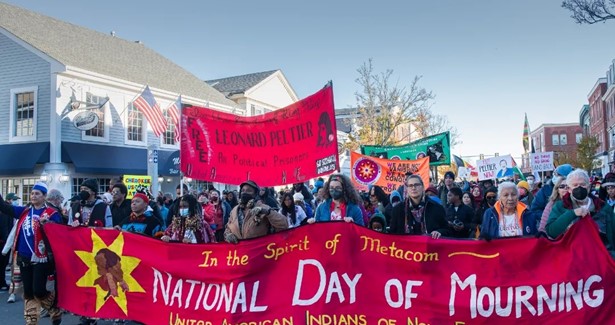
2024 National Day of Mourning was commemorated on Nov. 28 at Cole’s Hill in Plymouth, Massachusetts. United American Indians of New England have kept this annual tradition since 1970 to mourn their ancestors. As shown in the photo above, it was a protest against genocide and the theft of lands here and in Palestine. Photo: UAINE.org
An open letter to President Joe Biden: Free Leonard Peltier
written by Struggle – La Lucha
November 23, 2025
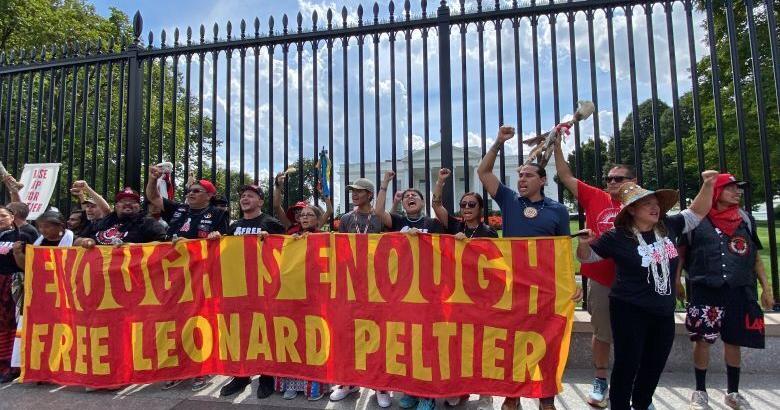
Mr. President, If you can pardon your son, why can’t you free the Indigenous political prisoner Leonard Peltier?
The 80-year-old man, a leader of the American Indian Movement, has been imprisoned for 48 years. He suffers from diabetes, high blood pressure, and a heart condition.
The FBI framed Leonard Peltier in retaliation for the historic 1973 occupation of Wounded Knee. Three years of violence followed this courageous stand for Indigenous rights, with over 60 AIM members and supporters murdered. Despite a large FBI presence, nothing was done to stop these murders and even more numerous assaults.
Peltier was convicted of killing two FBI agents — Jack Coler and Ronald Williams — in a shootout on the Pine Ridge Reservation on June 26, 1975. The agents were in unmarked cars.
Leonard Peltier was asked by traditional people at Pine Ridge, who were being targeted, to protect them from violence. Peltier and a small group of young AIM members set up camp on a ranch owned by the traditional Jumping Bull family. More than 150 FBI agents, cops, and vigilantes surrounded the ranch when shooting began.
Besides the two FBI agents killed, an AIM member — Joseph Stuntz Killsright — was shot and killed by a sniper’s bullet. His death has never even been investigated.
Although the FBI claim that 40 Indigenous people were involved in the gunfight, only AIM members Bob Robideau, Darrell Butler, and Leonard Peltier were brought to trial. A jury acquitted Robideau and Butler on grounds of self-defense.
Leonard Peltier was arrested in Canada on Feb. 6, 1976. The U.S. government in its extradition request, used affidavits signed by Myrtle Poor Bear who claimed she saw Leonard Peltier shoot the two FBI agents.
Ms. Poor Bear had never met Mr. Peltier and wasn’t present during the shoot-out. Soon after, Ms. Poor Bear recanted her statements and said the FBI threatened and coerced her into signing the affidavits.
Leonard Peltier was brought to the United States and tried in 1977. Myrtle Poor Bear wasn’t allowed to testify by the Nixon-appointed Judge Paul Benson. Not one witness identified Mr. Peltier as the shooter of the FBI agents.
More than 140,000 pages of FBI documents were withheld from the defense. A ballistic test proving that a bullet casing found near the FBI agents’ bodies did not come from the gun tied to Mr. Peltier was intentionally concealed.
Because this evidence was withheld, the jury found Leonard Peltier guilty. Judge Benson sentenced Mr. Peltier to two consecutive life terms.
The Eighth Federal Appeals Circuit ruled that “there is a possibility that the jury would have acquitted Leonard Peltier had the records and data improperly withheld from the defense been available to him in order to better exploit and reinforce the inconsistencies casting strong doubts upon the government’s case.”
Yet, the court denied Mr. Peltier a new trial. The late Federal Judge Gerald William Heaney, who wrote the decision denying a new trial, later urged Leonard Peltier’s release, stating that the FBI used improper tactics to convict him.
Among those calling for Leonard Peltier’s freedom was the late South African President Nelson Mandela, who spent 27 years in apartheid prisons. Leonard Peltier has spent 48 years in federal prisons.
Mr. President, you recently apologized for the federal government’s role in running boarding schools where thousands of Native American children endured abuse, neglect, and eradication of their tribal identities.
Follow up on your apology by freeing Leonard Peltier.
2024 National Day of Mourning, Nov. 28
written by Struggle – La Lucha
November 23, 2025
2024 National Day of Mourning
Thursday, November 28, 2024 at 12:00 p.m. to 3:00 p.m.EST
Cole’s Hill, Plymouth, MA
Join us as we continue to create a true awareness of Native peoples and history. Help shatter the untrue image of the Pilgrims, and the unjust system based on white supremacy, settler colonialism, sexism, homophobia and the profit-driven destruction of the Earth that they and other European settlers introduced to these shores.
Solidarity with Indigenous struggles throughout the world!
From Turtle Island to Palestine, Colonialism is a Crime!
Free Leonard Peltier! www.freeleonardpeltiernow.org
While many supporters will attend in person, we will also livestream the event from Plymouth.
#NDOM2024 #NoThanksNoGiving
No sit-down social, but box lunches will be available.
Masks required!
2024 orientation
What Is National Day Of Mourning?
An annual tradition since 1970, National Day of Mourning is a solemn, spiritual and highly political day. Many of us fast from sundown the day before through the afternoon of that day (and have a social after NDOM so that participants in NDOM can break their fasts). We are mourning our ancestors and the genocide of our peoples and the theft of our lands. NDOM is a day when we mourn, but we also feel our strength in action and solidarity.
When and where is day of mourning?
Thursday, November 28, 2023 (U.S. “thanksgiving” day) at Cole’s Hill, Plymouth, Massachusetts, 12 noon SHARP. Cole’s Hill is the hill above Plymouth Rock in the Plymouth historic waterfront area. The rallies and marches will last until approximately 3 pm (sometimes later).
Will there be a march?
Yes, there will be a march through the historic district of Plymouth. Plymouth agreed, as part of the settlement of 10/19/98, that UAINE may march on National Day of Mourning without the need for a permit as long as we give the town advance notice.
PROGRAM: Although we very much welcome our non-Native supporters to stand with us, it is a day when only Indigenous people speak about our history and the struggles that are taking place throughout the Americas. Speakers are by invitation only. This year’s NDOM will be livestreamed from Plymouth.
-Note that NDOM is not a commercial event, so we ask that people do not sell merchandise or distribute leaflets at the outdoor program. We might have UAINE t-shirts available for sale following the march.
-We also ask that you do not eat (unless you must do so for medical reasons) at the outdoor speak-out and march out of respect for the participants who are fasting.
-Dress for the weather!
SOCIAL: There will be box lunches available, but we will not have a full sit-down social due to ongoing health concerns.
TRANSPORTATION: If you cannot get to Plymouth, you can watch our livestream! We will also post information about buses and carpools from NY (Brooklyn and Bronx), CT, western MA, Boston, Maine and elsewhere if applicable at the UAINE facebook event.
ELDERS/DISABLED PEOPLE: We have some chairs available for any Elders and others who need to sit during the initial rally on Cole’s Hill. We also will have ASL interpreters on-stage.
FOR UPDATES: Please join and check out the UAINE facebook group https://www.facebook.com/groups/UAINE for updates on National Day of Mourning this year. Our website uaine.org will be updated, but not as quickly or frequently.
COVID-19 has hit Indigenous communities very hard, and we want to ensure that no one gets sick from attending National Day of Mourning. Please wear a mask!
Q&A: Former Federal Judge Kevin Sharp on Leonard Peltier’s June 10 parole hearing
written by Struggle – La Lucha
November 23, 2025
As Leonard Peltier’s parole hearing approaches on June 10, there is renewed hope and vigorous debate about his potential release.
Convicted for the killing of two FBI agents during a 1975 shootout on the Oglala Nation, Peltier has been imprisoned for over 47 years. Among the voices calling for justice is Kevin Sharp, a former Navy veteran and former federal judge.
Sharp is Co-Vice Chairman of Sanford Heisler Sharp and Co-Chair of the Public Interest Litigation Group. He served as a U.S. District Judge for the Middle District of Tennessee from 2011 to 2017, including as Chief Judge from 2014 to 2017, handling over 4,000 cases, including high-profile ones like Young v. Giles County Board of Education.
With nearly 30 years of experience, Sharp has litigated complex civil cases, including opioid litigation and significant employment settlements. He has received numerous accolades, including The American Lawyer’s South Trailblazers and Lawdragon 500. Since 2019, he has led efforts to secure presidential clemency for Leonard Peltier.
Sharp was on a recent Native Bidaské. He was asked by Native News Online’s editor Levi Rickert to discuss Leonard Peltier’s poor health at age 79 after decades in prison and his belief that Peltier risks death if kept in maximum security. He discusses the historical context of the 1975 Pine Ridge murders, and Peltier’s involvement with the American Indian Movement, arguing Peltier’s constitutional rights were violated during his 1977 trial.
Peliter’s June 10 parole hearing will consider testimony from both supporters and the government.
This interview has been condensed and edited for clarity.
Leonard is having some health issues; he’s nearly 80 years old. Can you talk about his current health conditions?
Thanks for asking about his health because, as you said, he has been in prison since 1977. He will turn 80 in September. He’s 79 now, so he has all the health issues that come along with a normal 79-year-old, plus additional health issues.
One of the worst is an aortic aneurysm, which is deadly if it ruptures. It has to be monitored closely, and it hasn’t been as closely monitored as it should have been. He has heart issues and diabetes. The last few times I’ve seen him, he’s used a walker. He’s been blind in one eye, left partially blind from a stroke he had years ago, and his eyesight has gotten worse. He hasn’t had access to a dentist in years. He’s in bad shape, and things are not going well.
With a parole hearing coming up on June 10th, if they deny parole, I don’t know that he makes it to the next one. He’s in Coleman 1, a maximum-security prison, which is dangerous for a frail, in-poor-health, 80-year-old man. It’s a perfect storm for something bad to happen if we don’t get him out.
We wish him well on parole. Before we talk about the parole hearing itself, can you tell us a bit about who you are and why you left the federal bench to do what you’re doing for Leonard?
I didn’t know who Leonard was; these events happened in 1975, and I was a young kid in Memphis at the time. I was a lawyer in Nashville doing civil rights work when I was nominated by the Obama administration for a position on the federal bench in 2010.
I became a federal district court judge in Nashville. As a judge, I encountered mandatory minimums, where Congress dictates the sentence, removing the judge’s ability to fashion a fair sentence. One case that really troubled me involved a young man convicted of a non-violent drug offense who I had to sentence to two life sentences.
This made me question whether I should be on the bench. I decided to step down and work on clemency for that young man, and we were successful. After that, Connie Nelson contacted me about Leonard. I started reading his case files and was disturbed by the constitutional violations and misconduct in his prosecution and investigation. I contacted Leonard in 2019 to help him, and here we are 4.5 years later, still working on his freedom.
You mentioned that Leonard was there at the time, and they talk about aiding and abetting. But the time period was volatile, and Pine Ridge Indian Reservation was in turmoil. Can you talk about the context of that time?
Pine Ridge was a powder keg with the Goon Squad operating there with the government’s help. AIM was there to protect those who were not part of the Goon Squad. There were many murders and assaults in a three-year timeframe.
When plain-clothed agents in unmarked cars arrived, a firefight ensued. Leonard did not shoot the agents, and the FBI knew this but withheld evidence. The court of appeals acknowledged this but couldn’t overturn the conviction due to legal standards.
Judge Heaney, who wrote the opinion, later supported clemency for Leonard. Now, 38 of Judge Heaney’s former clerks support parole for Leonard, including three who worked on his case.
The government admits they don’t know who killed the agents, but it wasn’t Leonard. It’s time to release Leonard and start the healing process.
Please tell us about the particulars of the parole hearing on June 10.
The hearing will take place at Coleman, with a hearing officer present to take evidence and witness testimonies. We don’t know all the witnesses yet, but some will testify in written form and some live.
We’ll hear from Leonard’s doctor about his health, and from James Reynolds, the former US attorney who supervised the appeals, who supports parole for Leonard. We’ll have witnesses to discuss Leonard’s life after release, including his housing and healthcare on the Turtle Mountain Band of Chippewa reservation.
Leonard will also address the hearing officer. The government will have people there arguing against his release. Support from the public is important, and we’ll provide information on how to write to the parole commission.
Typically, parole boards want to hear an admission of guilt and remorse. Leonard has maintained his innocence. How does this play into the hearing?
It’s difficult because Leonard didn’t commit the crime, and there’s no evidence that he did. He shouldn’t lie about something he didn’t do. Leonard has expressed remorse for the tragic events of that day and the overall situation.
The whole thing is tragic, and Leonard feels bad about everything that happened. It’s important for the hearing officer to understand this context and Leonard’s genuine feelings of remorse for the tragedy.
June 10 is an important date for Leonard Peltier and for all the committees calling for his release. A committee in the U.S. may decide on house arrest because of his health condition; Leonard is almost 80 years old and sick.
Initiatives are multiplying in different parts of the world to make the voices of all those close to him heard.
Six events took place in Rome in three days: at the Testaccio Library and Festival of Lands, at Spin Lab, at the Che Guevara Circle, at Friccicore, meetings, and especially screenings of Andrea Galafassi’s excellent documentary, “Mitakuye Oyasin.” These were small occasions not only to make his story known but also to forge relationships with comrades and companions.
Especially on Saturday, 18 May, in the morning, an important presidium was held in front of the U.S. Embassy. Several people thought it would never be allowed, but it was. The digos officers (Italian political police), on this occasion, were particularly polite and some even seemed interested in hearing the incredible story of Leonard Peltier. Many were the speeches, the slogans, the strength expressed by fifteen or so people well convinced of what they were doing.
And if you would like more information or would like to organize a projection, you can write to: bigoni.gastone@gmail.com
And pass the word, thank you.
After Lāhainā, Indigenous peoples call for independence
written by Struggle – La Lucha
November 23, 2025
On the evening of August 8, hours after a wildfire ravaged West Maui, Maui County’s top emergency management official, Herman Andaya, texted his secretary to ask about the status of other fires across the island.
“Still burning,” she replied.
“Wow … Lol,” Andaya texted back.
The messages were released in mid-April as part of a new state report analyzing the government’s response to the fire that ripped through Lāhainā killing more than 100 people, making it the deadliest wildfire in modern U.S. history. Documents, text messages and interviews reveal slow, poor communication between government agencies, causing hours of delay for leaders, like Andaya, to realize the gravity and extent of the crisis.
Andaya, who resigned soon after the wildfire due to broad criticism for his lack of qualifications and his agency’s decision not to sound any sirens as the fire spread, was at a training in Honolulu the day it happened. The texts show that hours after the inferno engulfed the town, Andaya didn’t know if any homes had been lost and thought only a single business had been leveled. The fire burned more than 2,000 buildings, displacing thousands of people.
To Alyssa Purcell, a Native Hawaiian archivist from Oʻahu, the lack of urgency in top officials’ response to the community’s struggles feels familiar.
“It’s a pattern,” she said. “This is not new. And I think the text messages show that there’s such a desensitization on their part to our needs that there’s nothing else that we can do at this point except go to the highest possible platforms and stages that we possibly can.”
Two days before the report came out, Purcell flew to the United Nations headquarters in New York City to speak at the U.N. Permanent Forum on Indigenous Issues, urging those present to support the self-determination of Native Hawaiians like herself.
“The 2023 Lāhainā wildfires exposed a systemic disregard for Indigenous rights,” said Purcell, who is a member of the Ka Lahui Hawaiʻi delegation, a group working to advance Native Hawaiian sovereignty. “Hawaiian families are struggling with disaster capitalism, where corporations and developers are using the aftermath of the fires to acquire land, develop properties, and initiate projects that are not in line with the needs of Indigenous communities or sustainable practices.”
The wildfire’s unprecedented destruction underscored the stakes of the group’s decades-old appeal for international support for Native Hawaiian self-determination. In her remarks this year, Purcell called for the U.N. to relist Hawaiʻi as a non-self-governing territory. That list includes more than a dozen territories — Guam, French Polynesia, and New Caledonia, to name a few — whose people still haven’t yet achieved self-government, either by obtaining independence or choosing to join another country.
The Hawaiian Islands were removed from the United Nations list of colonies after Hawaiʻi residents voted to become a state in 1959. But Hawai’i had only been given the option of statehood over their previous status as a U.S. territory. Unlike other island nations like Palau, Vanuatu, and Fiji, the Indigenous peoples of Hawaiʻi were never given the option of independence after the United States overthrew the Hawaiian monarchy in 1893.
“If you go back to the root of all these seemingly disparate problems, you’ll find very, very quickly that the root of all of it is the lack of self-determination,” Purcell said.
Take Lāhainā. In the decades prior to the overthrow, the coastal community was the capital of the Hawaiian Kingdom. Hawaiian royalty lived on a sandbar in the midst of an expansive fishpond along Maui’s leeward coast. But sugarcane owners in the 19th century diverted water from the wetlands to their fields, forcing many locals to abandon subsistence farming of crops like taro and breadfruit. Eventually, the fishpond was paved over for a parking lot and baseball field, and when last year’s wildfire came, the former wetland was arid and primed to burn.
The new state report on the Lāhainā wildfires found that as tourism and real estate have replaced large-scale agriculture as main economic drivers in Hawaiʻi in recent decades, landowners have left large tracts of land fallow and filled with highly flammable invasive grasses.
“The removal of active agriculture and the subsequent accumulation of highly combustible standing dead fuel on unmanaged lands is leading to more and larger fires,” the report said.
These destructive wildfires are modern and 99 percent human-caused, the report said.
“Unlike Indigenous uses of fire in continental fire-adapted ecosystems — where systemic and regular burns were used for millennia as a tool for forest health, regeneration, and swidden agriculture — the intentional use of fire in Hawaiʻi was largely limited to the clearing of lowland agricultural fields, cooking, the burning of waste, and small ceremonial practices,” the report said. “Since Hawaiian forests are less adapted to fire and are often destroyed when burned, the cultural ramifications of increased wildfires in Hawaiʻi are significant.”
Brandi Ahlo, another member of the Ka Lahui Hawaiʻi delegation to the U.N. who attended the Permanent Forum with Purcell for the first time this year, sees the Lāhainā wildfire as the inevitable consequence of Indigenous land dispossession.
“It goes back into history and the loss of water and the fact that us as Kanaka, who live on the land, aren’t able to steward our own resources,” Ahlo said. “I think bringing awareness to an international arena and forum is really important for people to see and to spotlight, because if it can happen here in Hawaiʻi, who is to say that it can’t happen to anywhere else?”
Extreme weather events like the wildfire are expected to grow more frequent as climate change accelerates. State leaders in Hawaiʻi are still trying to figure out exactly what happened in Lāhainā last year and plan to release two more reports analyzing officials’ decisions and how similar tragedies could be avoided.
A continuing concern is the potential for private interests to capitalize on the disaster’s aftermath by seizing more water and land, both highly contested limited resources on Maui long before the fires.
In the days following the fire, the state temporarily suspended water regulations in West Maui, benefiting a major local developer who had spent years fighting with Indigenous taro farmers over access to water. On the other side of the island, the state urged a court to allow corporations to divert more water from East Maui streams. The Board of Land and Natural Resources argued that limits on water diversion — limits imposed by the court after lawsuits from Native Hawaiian taro farmers asserting their right to the water — meant that there wasn’t enough water to fight fire in central Maui.
“It seems the BLNR tried to leverage the most horrific event in state history to advance its interests,” the Hawaiʻi Supreme Court ruling said.
Meanwhile, the community is still reeling emotionally from the grief of the fire’s destruction.
“When I look at the Lāhainā fires, I see cultural destruction, degradation. I see people dying. I see their homes — homes that they’ve lived on for generations — perished in a minute,” Purcell said. “And when foreigners look at the situation, when business owners look at the situation, they see opportunity.”
Grist is a nonprofit, independent media organization dedicated to telling stories of climate solutions and a just future. Learn more at Grist.org
Leonard Peltier: ‘I hope I make it to June 10’
written by Melinda Butterfield
November 23, 2025
Advocates say June parole hearing may be Leonard Peltier’s last chance at freedom and they plan to push hard for his release
RAPID CITY, S.D. – At 80 years old, Leonard Peltier is approaching what may be his last attempt at freedom.
On June 10, the Anishinaabe elder will participate in what may be his final parole hearing. Peltier is currently serving two consecutive life sentences after being convicted of killing two FBI agents in 1975 at the Jumping Bull Ranch in South Dakota.
Peltier is asking for the public to spread the word about his parole hearing, said Dawn Lawson, secretary of the Leonard Peltier Ad Hoc Committee.
“For a long time, people have been dying in that prison and the (Federal Bureau of Prisons) is out of control,” Lawson said. “They’re (U.S. Penitentiary Coleman 1) currently on indefinite lockdown, not because anybody has done anything, just because they can. They (prisoners) are living in their own filth. Leonard is making an appeal to his people to please get anybody’s attention.”
In the past few months, the Turtle Mountain Band of Chippewa citizen’s health has taken a turn for the worse, so much so that his attorneys say they’re concerned he won’t make it to the June parole hearing.
“He didn’t sound good when I spoke with him on the phone today (April 22), he doesn’t even know if he’s going to make it to next week,” said Nick Tilsen, Oglala Lakota and CEO of the NDN Collective. “He told me, ‘I hope I make it to June 10, and I hope I can make it 30 days after that.’”
Peltier has been struggling with health concerns for years. He’s had trouble managing his diabetes while incarcerated, experienced the loss of vision in one eye, had open heart surgery, an aortic aneurysm, and is dealing with the lingering effects of contracting COVID-19.
On April 16, the Leonard Peltier Ad Hoc Committee issued a press release and organized a calling campaign to urge federal prison officials to address Peltier’s health problems. Since then, Peltier’s lead attorney, Jenipher Jones, was able to arrange for a doctor outside the prison to meet with Peltier twice.
The medical visit revealed Peltier was experiencing eye damage and would need to see a specialist, but prison officials said it would take 8 to 10 months to coordinate such a visit.
In February, Judith LeBlanc, executive director of the Native Organizers Alliance, requested the U.S. Department of Justice approve the compassionate release of Peltier based on his health problems. Compassionate release is available for prisoners who seek early release due to extraordinary or compelling circumstances, according to the American Bar Association.
“At a time when democratic values are being challenged, DOJ should take action as he nears the end of his life and allow him to return to his family on his ancestral homeland,” LeBlanc said in a statement. “We implore the DOJ to grant Peltier’s compassionate release.”
Tilsen called on the Biden administration to take action.
“This administration, the Biden Administration, has said that Native American rights are a priority to them, and yet they’ve got the longest sitting Indigenous political prisoner locked up and we’ve seen no action from the federal government,” Tilsen said. “If he dies in prison this will forever be a part of that administration’s legacy as it relates to Native people.”
Tilsen said he’s been fighting for Peltier’s freedom since he was a small child. Now, his organization is on the front lines of Peltier’s fight.
“It’s all hands on deck,” Tilsen said. “With the right medical treatment Leonard could live for a while, but without it he’s almost guaranteed to not make it.”
With the announcement of Peltier’s parole date, NDN Collective is switching gears from putting its energy toward compassionate release for Peltier and instead educating the public on his push for parole.
A chance to tell his story
Within 30 days after the June 10 parole hearing, the parole commission will issue its decision. A recommendation will be delivered to the commission for a final decision to be made.
Since Peltier is a federal prisoner serving a sentence of 30 years or more, he is eligible for a parole hearing within 9 months of his eligibility date as determined by the Bureau of Prisons. This hearing may be his only shot.
“The parole hearing on June 10 is the most important parole hearing of Leonard’s life,” Tilsen said. “He won’t live long enough for another parole hearing to come around.”