Thomas Sankara, “Africa’s Che Guevara” Dec. 21, 1949 – Oct. 15, 1987

On Oct. 15, 1987, Thomas Sankara, Burkina Faso’s West African revolutionary leader, was assassinated. Sankara, a Marxist and revolutionary, has been nicknamed “Africa’s Che Guevara.”

It is interesting to note that at a time when youth have focused the world’s attention on the dire issue of climate crisis, and workers and Indigenous people in Ecuador are rising up against the International Monetary Fund’s austerity demands — that Sankara spearheaded major programs in both areas.

He promoted and led a massive people’s campaign called the “One village, one grove” program to combat desertification of the Sahel (the area between the Sahara Desert and Sudanian Savanna). Over 10 million trees were planted. That legacy lives on. 

Under Sankara’s leadership, Burkina Faso nationalized land and mineral wealth and refused aid from the International Monetary Fund and World Bank, which incurred the wrath of both U.S. and French imperialism. 

This began in 1983, when a group of revolutionaries under the leadership of 33-year-old Thomas Sankara led a popular revolt that took power. 

One of the first acts of Sankara and the new revolution was to rename the colonial Upper Volta to Burkina Faso, which means “The Land of the Upright People” in Mossi. It was an act in defiance of French imperialism, which had coined the name “Upper Volta.” Burkina Faso was meant to instill people’s pride.

In just four years, amazing progress was made. Education and health care were made a priority. A national literacy campaign was developed and 2.5 million children were vaccinated against yellow fever, meningitis and measles. Women were appointed to government positions and their status was elevated so that they could go to school and work outside the home. Forced marriages, polygamy and female genital mutilation were all outlawed.

The assassination of Thomas Sankara and the overturn of this amazing revolution is reminiscent of the Paris Commune. While brief, the revolution’s legacy deserves to be studied and remembered by generations to come. The spirit of revolution continues today in the fight of the workers and Indigenous people in Ecuador and those in the streets everywhere fighting capitalist crisis and imperialist domination and war.

Thomas Sankara, presente!

Struggle-La Lucha would like to commemorate and recognize Sankara’s legacy by reprinting the following speech. This speech was given Feb. 5, 1986, at the first International Silva Conference for the Protection of the Trees and Forests in Paris: 

Imperialism is the arsonist of our forests and savannas

My homeland, Burkina Faso, is without question one of the rare countries on this planet justified in calling itself and viewing itself as a distillation of all the natural evils from which mankind still suffers at the end of this twentieth century.

Eight million Burkinabè have painfully internalized this reality for twenty-three years. They have watched their mothers, fathers, daughters, and sons die, with hunger, famine, disease, and ignorance decimating them by the hundreds. With tears in their eyes, they have watched ponds and rivers dry up. Since 1973, they have seen the environment deteriorate, trees die, and the desert invade with giant strides. It is estimated that the desert in the Sahel advances at the rate of seven kilometers per year.

Only by looking at these realities can one understand and accept the legitimate revolt that was born, that matured over a long period of time, and that finally erupted in an organized way the night of August 4, 1983, in the form of a democratic and popular revolution in Burkina Faso.

Here I am merely a humble spokesperson of a people who, having passively watched their natural environment die, refuse to watch themselves die. Since August 4, 1983, water, trees, and lives—if not survival itself—have been fundamental and sacred elements in all action taken by the National Council of the Revolution, which leads Burkina Faso.

In this regard, I am also compelled to pay tribute to the French people, to their government, and in particular to their president, Mr. François Mitterrand, for this initiative, which expresses the political genius and clear-sightedness of a people always open to the world and sensitive to its misery. Burkina Faso, situated in the heart of the Sahel, will always fully appreciate initiatives that are in perfect harmony with the most vital concerns of its people. The country will be present at them whenever it is necessary, in contrast to useless pleasure trips.

For nearly three years now, my people, the Burkinabè people, have been fighting a battle against the encroachment of the desert. So it was their duty to be here on this platform to talk about their experience, and also benefit from the experience of other peoples from around the world. For nearly three years in Burkina Faso, every happy event—marriages, baptisms, award presentations, and visits by prominent individuals and others—is celebrated with a tree-planting ceremony.

To greet the new year, 1986, all the school children and students of our capital, Ouagadougou, built more than 3,500 improved cookstoves with their own hands, offering them to their mothers. This was in addition to the 80,000 cookstoves made by women themselves over the course of two years. This was their contribution to the national effort to reduce the consumption of firewood and to protect trees and life.

The ability to buy or simply rent one of the hundreds of public dwellings built since August 4, 1983, is strictly conditional on the beneficiary promising to plant a minimum number of trees and to nurture them like the apple of his eye. Those who receive these dwellings but were mindless of their commitment have already been evicted, thanks to the vigilance of our Committees for the Defense of the Revolution, committees that poisonous tongues take pleasure in systematically and unilaterally denigrating.

After having vaccinated throughout the national territory, in two weeks, 2.5 million children between the ages of nine months and fourteen years—children from Burkina Faso and from neighboring countries—against measles, meningitis, and yellow fever; after having sunk more than 150 wells assuring drinking water to the 20 or so districts in our capital that lacked this vital necessity until now; after having raised the literacy rate from 12 to 22 percent in two years—the Burkinabè people victoriously continue their struggle for a green Burkina.

Ten million trees were planted under the auspices of a fifteen-month People’s Development Program, our first venture while awaiting the five-year plan. In the villages and in the developed river valleys, families must each plant one hundred trees per year.

The cutting and selling of firewood has been completely reorganized and is now strictly regulated. These measures range from the requirement to hold a lumber merchant’s card, through respecting the zones designated for wood cutting, to the requirement to ensure reforestation of deforested areas. Today, every Burkinabè town and village owns a wood grove, thus reviving an ancestral tradition.

Thanks to the effort to make the popular masses aware of their responsibilities, our urban centers are free of the plague of roaming livestock. In our countryside, our efforts focus on settling livestock in one place as a means of promoting intensive stockbreeding in order to fight against unrestrained nomadism.

All criminal acts of arson by those who burn the forest are subject to trial and sanctioning by the Popular Courts of Conciliation in the villages. The requirement of planting a certain number of trees is one of the sanctions issued by these courts.

From February 10 to March 20, more than 35,000 peasants—officials of the cooperative village groups—will take intensive, basic courses on the subjects of economic management and environmental organization and maintenance.

Since January 15, a vast operation called the “Popular Harvest of Forest Seeds” has been under way in Burkina for the purpose of supplying the 7,000 village nurseries. We sum up all of these activities under the label “the three battles.”

Ladies and Gentlemen:

My intention is not to heap unrestrained and inordinate praise on the modest revolutionary experience of my people with regard to the defense of the trees and forests. My intention is to speak as explicitly as possible about the profound changes occurring in the relationship between men and trees in Burkina Faso. My intention is to bear witness as accurately as possible to the birth and development of a deep and sincere love between Burkinabè men and trees in my homeland.

In doing this, we believe we are applying our theoretical conceptions on this, based on the specific ways and means of our Sahel reality, in the search for resolutions to present and future dangers attacking trees all over the planet.

Our efforts and those of the entire community gathered here, your cumulative experience and ours, will surely guarantee us victory after victory in the struggle to save our trees, our environment, and, in short, our lives.

Excellencies, ladies and gentlemen:

I come to you with the hope that you are taking up a battle from which we cannot be absent, we who are attacked daily and who are waiting for the miracle of greenery to rise up from the courage to say what must be said. I have come to join with you in deploring the harshness of nature. But I have also come to denounce the ones whose selfishness is the source of his fellow man’s misfortune. Colonial plunder has decimated our forests without the slightest thought of replenishing them for our tomorrows.

The unpunished disruption of the biosphere by savage and murderous forays on the land and in the air continues. One cannot say too much about the extent to which all these machines that spew fumes spread carnage. Those who have the technological means to find the culprits have no interest in doing so, and those who have an interest in doing so lack the technological means. They have only their intuition and their innermost conviction.

We are not against progress, but we do not want progress that is anarchic and criminally neglects the rights of others. We therefore wish to affirm that the battle against the encroachment of the desert is a battle to establish a balance between man, nature, and society. As such it is a political battle above all, and not an act of fate.

The creation of a Ministry of Water as a complement to the Ministry of the Environment and Tourism in my country demonstrates our desire to clearly formulate the problems in order to be able to resolve them. We must fight to find the financial means to exploit our existing water resources—drilling operations, reservoirs, and dams. This is the place to denounce the one-sided contracts and draconian conditions imposed by banks and other financial institutions that doom our projects in this field. It is these prohibitive conditions that lead to our countries’ traumatizing debt and eliminate any meaningful maneuvering room.

Neither fallacious Malthusian arguments—and I assert that Africa remains an underpopulated continent—nor the vacation resorts pompously and demagogically christened “reforestation operations” provide an answer. We and our misery are spurned like bald and mangy dogs whose lamentations and cries disturb the peace and quiet of the manufacturers and merchants of misery.

That is why Burkina has proposed and continues to propose that at least 1 percent of the colossal sums of money sacrificed to the search for cohabitation with other stars and planets be used, by way of compensation, to finance projects to save trees and lives. We have not abandoned hope that a dialogue with the Martians might lead to the reconquest of Eden. But in the meantime, earthlings that we are, we also have the right to reject a choice limited simply to the alternatives of hell or purgatory.

Explained in this way, our struggle for the trees and forests is first and foremost a democratic and popular struggle. Because a handful of forestry engineers and experts getting themselves all worked up in a sterile and costly manner will never accomplish anything! Nor can the worked-up consciences of a multitude of forums and institutions—sincere and praiseworthy though they may be—make the Sahel green again, when we lack the funds to drill wells for drinking water a hundred meters deep, while money abounds to drill oil wells three thousand meters deep!

As Karl Marx said, those who live in a palace do not think about the same things, nor in the same way, as those who live in a hut. This struggle to defend the trees and forests is above all a struggle against imperialism. Because imperialism is the arsonist setting fire to our forests and our savannas.

Excellencies, ladies and gentlemen:

We rely on these revolutionary principles of struggle so that the green of abundance, joy, and happiness may take its rightful place. We believe in the power of the revolution to stop the death of our Faso and usher in a bright future for it. … 

This fight can be waged. We must not retreat in face of the immensity of the task. We must not turn away from the suffering of others, for the spread of the desert no longer knows any borders.

We can win this struggle if we choose to be architects and not simply bees. It will be the victory of consciousness over instinct. The bee and the architect, yes! If the author of these lines will allow me, I will extend this twofold analogy to a threefold one: the bee, the architect, and the revolutionary architect.

Homeland or death, we will win!

Strugglelalucha256


Hurricanes

This statement is a personal one intended to support opinions, especially in the Caribbean, that the costs of practical recovery from annual hurricanes should not fall, as they mainly do, on the victims of these natural disasters.  As it is, the pain, the agony, the distress, the abandonment, the unpredictable fatalities and other psychological costs of re-organizing and re-establishing their homes, their communities and their livelihoods are borne logically by the residents of the hurricane-prone countries.  It is the argument of this statement that the unfortunate victims should not be expected to bear the capital, recurrent, and other financial costs of rehabilitation after these more and more ruinous disasters.

Before making recommendations, it is only fair to note that big-hearted, generous and humane individuals and institutions of other countries, often with no relationship to the victims, have always been ready to organize and deliver critical items and services to relieve the extremes of suffering.  Our people will not forget these acts of generosity. In the case of the Bahamas, parts of which were devastated a month ago by hurricane Dorian, the assistance of the U.S. Coast Guard was frequently noted in dispatches, an intervention which might have justly attracted the attention of the people of Puerto Rico.  In a different mood, the United States civilian authorities received orders not to admit people in flight from the natural disaster, if they could not present visas and passports.

We now feel compelled once again, as a responsibility to history, to remind ourselves and the international community that the majority of residents in the hurricane-prone countries of the Caribbean, such as Bahamans, Barbudans, Haitians and others are there as a result of a specific centuries-long crime wave, known as the Atlantic Slave Trade.  These Caribbean people are in the hazardous paths of these annual and all-powerful winds, now seen as growing in force and frequency, as global warming increases.

High benefits with no sense of obligation

As a subset of the general demands for Reparations, the claims in this statement, made on European slave-owning of powers of the past, can be supported by repeating a selection of facts from world economic history:

  • In the French empire, Haiti produced more revenue for France than any other possession owned by that nation.
  • “How Europe Underdeveloped Africa” by Walter Rodney has laid bare the process by which one continent enriched itself at the expense of another.
  • Looking back at the Atlantic Slave Trade, Karl Marx wrote in his classic enquiry that the entombment in minds of Indigenous populations and the turning of Africa into a warren for the hunting of Blackskins marked what he called the Rosy Dawn of capitalist expansion.
  • For a whole century, it was admitted that India was “the most precious jewel” in the British crown.

Against this background, this statement makes a very logical and human claim:  The Caribbean countries randomly affected by hurricanes are populated by the descendants of people traded from the African continent, without any semblance of their consent.  As one African woman poet puts it:

“We had no part in it

You brought us in your ship

You beat us with your whip …”

To make the lack of consent more emphatic, any attempt of the enslaved to escape from the plantations was punishable under the slave codes.

It is the argument of this statement, therefore, that the successor governments of the slave-owning empires cannot escape responsibility for the suffering and loss which the descendants of their captives experienced from natural disasters in countries to which their fore-parents had been forcibly transported.

Attempts of the enslaved populations to free themselves and claim rights as human beings were regularly answered by the dispatch of gunboats and warships from the oppressor nations to reduce the rebels to submission.  This in brief is the process by which the populations of the countries randomly assaulted by hurricanes have become sitting ducks to these natural disasters. Moreover, the economic frameworks into which the Africans, and later others, were entrapped proved in time unsustainable as the powers concerned and the USA conducted their economic rivalries.  The cotton industry, the sugar industry and the banana industry are examples of how several Caribbean populations have been forced to experience a loss of economic security and have been left to survive mainly by their own devices.

Decades ago, the Working People’s Alliance, as an organization outside of government, had proposed publicly that small, disaster-prone countries should be protected by a new kind of multilateral Insurance Scheme from the injustice of bearing the cost of rebuilding and rehabilitation after a disaster.  The recommendation fell on deaf ears. Since those years, the problem has become more acute, as carbon emissions increase and render hurricanes more destructive.

The present personal statement is made in the hope that although it does not come from an organization, it can be the subject of critical study, leading to action that places responsibility where it really belongs, at the feet of the European empires referred to above.  It is hypocritical and impractical for the successor governments of the slave-owning powers to expect CARICOM [the Caribbean Community, an organisation of fifteen Caribbean nations and dependencies] and its citizens to muster the resources to respond to these calamities.  On the other hand, for CARICOM to aspire heroically to assemble the human resources, the financial resources and the hardware necessary in these emergencies is a serious misunderstanding, exaggeration and distortion of the principle of self reliance.

  1. Since the slave-owning powers had assumed the super-human right to deploy populations from their natural homes, their successor governments should consider themselves mainly liable.
  2. Since the hurricane season can be accurately predicted, it is not too much to ask that the governments concerned anticipate the needs of the hurricane-prone countries and deploy peace ships with necessary forms of relief to strategic locations in the region on a precautionary basis to make timely delivery of search and rescue and relief in the affected countries at the earliest possible moment.  In the same spirit and as advised by CARICOM or any other empowered regional organization, they should be ready to assist in the transport of medical and other service volunteers to the affected locations with as little delay as possible.

In making this statement, my purpose is clearly not to assign to the slave-owning powers and their successor governments any guilty knowledge of all the results of their expansionist activities of the centuries after the invasions of Columbus.  Rather, the purpose of this statement is to apply the standards of judgment of the present day and the 21st century to argue that they cannot escape the moral responsibility for the consequences of their self-serving and inhuman population transfers, and that it is time to apply adequate reparatory measures.

Eusi Kwayana
Of Guyana
And
Atlanta, Georgia, USA
10/8/19

Strugglelalucha256


Contradictions in the impeachment struggle


The impeachment struggle against Trump poses many contradictions.

On the one hand, hundreds of millions of people around the world would like to see Trump brought down in the hope that this will alleviate his administration’s oppressive, racist and corrupt rule.

On the other hand, the impeachment struggle is, at bottom, a struggle by various factions of the ruling class to keep Trump from undermining the strength of U.S. imperialism at home and abroad.

Tens of millions have suffered from Trump’s various forms of reaction. From the gag rule against abortion counseling, to immigrant families separated from their children, to Muslims and immigrants whom he has vilified, to Iranians suffering under sanctions, to Venezuelans and Cubans under threat from all sides, to Palestinians under Israeli occupation, to Zimbabweans under U.S. sanctions,  and environmentalists watching the administration allow the extreme pollution of the air, drinking water, land and oceans. Trump has cultivated the ultraright and fascist elements with his racist defense of killer cops as well as attacks on African and Caribbean countries. 

On the other hand, Trump has antagonized sections of the ruling class as well. He has weakened the NATO alliance, pulled out of the U.S.-sponsored Transpacific Partnership, pulled out of the Paris Climate Agreement, abused the Mexican government, the Canadian government and the German government, sided with the forces in Britain, and done numerous things to offend the allies of U.S. imperialism and to damage the military and diplomatic structure built up by Washington over decades. 

Three hundred so-called national security experts have supported the articles of impeachment. What are “national security” officials? They are the CIA, NSC, FBI and all the agents of sabotage, subversion, special operations and dirty tricks, whose job it is to undermine, remove or destroy all obstacles to the advancement of U.S. capitalist and imperialist interests at home and abroad. 

Trump’s corruption

Of course, it would be foolhardy to ignore Trump’s corruption. The Biden scandal would not have come out if he were not so contemptuous of capitalist norms and processes. It is hard to measure degrees of corruption in bourgeois politics, since it is so pervasive, but usually presidents wait until they leave office to enrich themselves. Trump did not wait. 

He openly cashes in on the presidency to bolster his personal fortune right out in the open and in defiance of capitalist political decorum. He has spent 300 days of his presidency on Trump properties spending government money. He has refused to put his properties in a blind trust and turned them over to his sons. He has had military flight crews stay at his hotels. And the Saudi monarchy, among others, has rented entire floors in his D.C. hotel.

So openly trying to get a government to put a hit on Biden, his political opponent, is just business as usual for Trump and the corrupt circle around him. 

The Democratic Party leadership and Ukraine scandal

The Democratic Party leadership has been given new life in the struggle against Trump by the Ukraine scandal. Trump tried to withhold $400 million in military aid to the reactionary regime in Kiev that is fighting the independence forces in the east of Ukraine until they came up with dirt on Joe Biden, Trump’s electoral opponent. 

Trump did so openly in a telephone call that was partially recorded in notes taken by Trump officials.  Some versions of those notes were made public, and in them Trump tells the Ukrainian president, Volodymyr Zelensky, to “do me a favor” and  “look into corruption” by Biden and his son Hunter. Trump had held up the military aid that Congress allocated to Ukraine well before the phone call, to be used as leverage.

The Ukraine question is like Russiagate on a smaller scale. But politically, it is, in essence, the same thing. The Democrats first opposed Trump by playing the Russia card over and over. Instead of pointing out the outrageous disenfranchisement of masses of voters, particularly people of color, and instead of attacking Trump’s racism, misogyny, and anti-worker and anti-environmental policies, they focused endlessly on the cry of collusion with Russia. First of all, these Democrats are allied with the military-industrial complex. But second of all, they assumed that this would be the easiest way to go about fighting Trump. If there is anything about the ruling class that is generally recognized, it is their hostility to Russia (and China). So the quickest and easiest way to attack Trump is to call him soft on Russia and a friend of Putin.

This put them squarely in the camp of the militarists. What they did not reckon on was the complete domination of the Republican Party by Trump and his intimidation of both the House and Senate Republicans.  So until they won the majority in the House, they were stymied. 

Nancy Pelosi was stalling on opening up an impeachment struggle despite the numerous crimes of Trump — against immigrants, women, his open profiteering from the presidency, etc.  Then, the revelation about the Ukraine issue fell into their lap. Trump bumbled into it. It came to the surface and they have seized upon it. 

The background to the Ukraine crisis

It is no accident that the Ukraine issue has become the focus of the impeachment struggle. It was the Obama administration, with Joe Biden as vice president and Hillary Clinton and later John Kerry as secretary of state, that overthrew the elected government of Ukraine under Viktor Yanukovych in February of 2014.

The Obama/Biden/Clinton/Kerry administration collaborated with fascist elements to put a right-wing government in power in Kiev. It is important to go back to the tape-recorded phone conversation between Assistant Secretary of State Victoria Nuland and Geoffrey Pyatt, the U.S. ambassador to Ukraine, in February 2014. 

The European Union was planning a soft takeover of Ukraine, trying to undermine its economic ties with Russia. The U.S. intervened in its own interests by encouraging fascist mobs to call for the overthrow of the elected government. The Ukraine Parliament pulled the police off the streets, allowing the mobs to break up the parliament.  That is when Nuland made the infamous “Fuck the EU” comment in which she openly expressed Washington’s preference for the ultra right-wing Fatherland Party, rife with fascists, to take over the government. (Washington Post, Feb. 6, 2014). When the smoke cleared, the Fatherland Party was in office and President Yanukovych was forced to flee.

On Biden the “victim”

Biden, who has been made the victim of Trump’s maneuvers, is a thoroughly reactionary racist, sexist politician, in addition to being a foreign policy reactionary.

In 1991, Biden was head of the Senate panel that oversaw the persecution of Anita Hill by ten white male senators who allowed her to be vilified by Clarence Thomas, who had been nominated for the Supreme Court. Thomas went on to be one of the most reactionary members of the court.  Biden presided over the hearings and participated in her vilification. Among other things, as the head of the panel, he failed to investigate her allegations against Thomas, failed to bring her witnesses before the committee and acted as if he did not believe her. (Washington Post, April 26, 2019)

In 1994, Biden was a Senate leader. He wrote and had passed the largest crime bill in U.S. history. The bill added 60 new death penalty offenses; it eliminated Pell grants that allowed prisoners to get an education; it made it extremely difficult for death row inmates to appeal; it provided for funding for 100,000 more cops on the streets; it appropriated $9.7 billion for more prisons; and it included the notorious “three strikes” provision which mandated life sentences for anyone convicted of three crimes. 

Under Biden’s and Bill Clinton’s leadership, mass incarceration soon followed.

Impeachment leaves the masses out of the struggle

The impeachment process is strictly for ruling-class politicians and lawyers. They shape the charges and the arguments. They call and question the witnesses. The masses are totally shut out of the process and their grass roots interests do not see the light of day. 

Trump should be tried for a whole host of crimes against the people. Witnesses should be called, like immigrant mothers who have been separated from their children. Black, Latinx, Native and Asian people who have been victims of racism should testify against Trump’s casual remarks equating Nazis to those opposing Nazis and white supremacy. 

LGBTQ2S people who have had friends murdered or beaten by bigots should testify. Black people whose relatives have been killed or beaten by the racist cops should be allowed to tell their stories indicting Trump.  The same should apply to people who have lost their health care, their pensions, their jobs, etc. 

Furthermore, it would be one thing if Trump were impeached under pressure from the enraged masses in the streets, on the campuses and in the workplaces. But at present, the masses are relying on the ruling class to fight their battle against Trump. He and his whole administration and their enablers should be swept into jail for their crimes.  That might bring some genuine relief to the working class and oppressed. 

Posted to lowwagecapitalism.com Sept . 29, 2019


Strugglelalucha256


U.S. uses wars and sanctions to jack up oil profits

U.S. fracking interests want war with Iran and Venezuela. They are a powerful voice in the Trump regime. Secretary of State Mike Pompeo, Energy Secretary Rick Perry and Interior Secretary David Bernhardt speak for them directly. 

When he was on Capitol Hill, Pompeo was called the “Congressman from Koch.” The Koch family has made billions off the fracking trade. 

Wall Street’s cash cow

Wall Street bankers control hundreds of billions of Saudi petrodollars. JPMorganChase is the lead banker for the planned stock sale of Saudi Aramco, the world’s most profitable company. 

Bank of America, Citigroup and Goldman Sachs also have their hands in the Saudi pie. These bankers want Iran’s state-owned oil off the world market. But they fear an all-out war that could endanger their Saudi cash cow. 

Four major Western oil companies — ExxonMobil, Chevron, BP and Shell — control Saudi Aramco’s exports. They’ve also made major investments in the U.S. fracking industry. 

The U.S. military-industrial complex depends on arms sales to Saudi Arabia and the other five monarchies on the Arabian Peninsula. At a Sept. 16 joint press conference with Prince Salman of Bahrain, President Donald Trump bragged that Saudi Arabia had spent $400 billion on U.S. arms “in the last few years.” 

Bahrain’s Al Khalifa dynasty, which is propped up by Saudi troops, is also a client. Lockheed Martin keeps the F16 in production to fill its orders. Bahrain is also home base for the U.S. Fifth Fleet.

These sometimes-competing interests drive U.S. sanctions and war threats against the Islamic Republic of Iran. 

Before the 1979 revolution, the Shah of Iran kept tens of billions of dollars in Chase Manhattan Bank (now JPMorganChase). He was also the U.S. arms industry’s biggest overseas paying customer. He owed his throne to a 1953 coup organized by the CIA. 

Yemen’s blood on U.S. hands

On Sept. 14, Yemeni freedom fighters blew up two Saudi Aramco production facilities. The U.S.-armed Saudi tyranny has bombed and starved the people of Yemen for five years. It has created what the United Nations calls “the worst humanitarian crisis in the world today.” 

The U.N. expects the death toll from the U.S.-Saudi war in Yemen to surpass 235,000 by the end of this year. That includes over 100,000 children dead from disease and starvation.

The Yemeni people have been resisting, fighting back. But the Trump regime, without evidence, blamed the strikes on Iran. 

In April, Congress passed a bill to limit (mildly) direct U.S. involvement in the murder of Yemen’s children. Trump vetoed it. Now he rages against what he calls Iran’s ”sponsorship of terror.”

U.S. attacks global energy supply

Pompeo called the Yemeni strike on Saudi Aramco “an unprecedented attack on the world’s energy supply.” That’s a lie. The U.S. has been waging war against the world’s energy supply for over 30 years. 

What else could you call the 13 years of bombing and blockade that killed over half a million Iraqi children between 1990 and 2003? (In 1995, Bill Clinton’s secretary of state, Madeleine Albright, told CBS, “We think the price was worth it.”) Or the 2003 invasion of Iraq that caused the death of perhaps 2.4 million more? 

How about the 2011 bombing of Libya that brought chaos and poverty to that oil-rich and once prosperous African land? Or the campaign of sanctions and sabotage that has already killed over 40,000 Venezuelans?

“Economic sanctions will kill tens of thousands of innocent Iranians,” professor Muhammad Sahimi wrote on LobeLog on July 30. 

Then there’s the 16-year invasion and occupation of Afghanistan, which sits astride potential pipeline routes from Central Asia to South Asia and the Indian Ocean. 

The bloody U.S.-Saudi-funded proxy war in Syria is now in its eighth year. It has prevented the construction of a pipeline to bring Iran’s oil and gas to the Mediterranean. 

There are nine countries in the world with over 40 billion barrels in proven oil reserves. Five of them — Iran, Iraq, Libya, Russia and Venezuela — have been sanctioned, bombed or invaded by the U.S. These five countries hold 614 billion barrels between them. Russia and Iran also have huge natural gas reserves.

Three others — the Saudi Kingdom, Kuwait and United Arab EmIrates — pay tribute, protection money, to the U.S. ruling class. U.S. companies own the lion’s share of Canada’s known reserves, the world’s third largest. 

Rise of fracking

What did all this death and suffering accomplish? The 2003 U.S. invasion of Iraq drove the price of oil from $30 a barrel to $147 a barrel in four years. Gas, coal and ethanol followed suit. Oil company profits rose nearly 300 percent. Oil majors like Exxon, Chevron and BP had their most profitable years ever. So did Saudi Aramco. 

It also opened huge new markets for capital investment. Not in the countries bombed and sanctioned, but in the vast deposits of shale rock found across North America, in Canadian tar sands and mountaintop removal projects in Appalachia. It enabled the fracking boom that has made the U.S. the world’s top oil and gas producer. 

Another new market was in the waters of Israeli-occupied Palestine, where Texas fracking firm Noble Energy struck natural gas in 2010. U.S. Interior Secretary David Bernhardt is a former lobbyist for Noble. 

A July study by the University of Colorado found children born near fracking fields have a 40 to 70 percent higher risk of congenital heart defects. The poisoning of Iraq’s children with depleted uranium made the poisoning of children in North America profitable. 

‘U.S. energy dominance’

Fracking has caused methane spikes in the atmosphere and artificial earthquakes in the western U.S. and Canada. It may cause a financial earthquake as well. 

The boom has ended, and prices are falling below the cost of production. “Could Fracking Debt Set Off Big Financial Tremors?” asked the online journal of the Wharton School of Business on Sept. 21. 

The Trump regime’s oft-stated dream of “U.S. energy dominance” depends on war, sanctions and environmental destruction. Will it launch yet another war to sustain it? 

When the Iraq war pushed fuel prices sky-high, Bolivarian Venezuela provided free oil to poor and oppressed communities in the U.S. and around the world. Now, U.S. sanctions have made that impossible. “Without Venezuela’s Oil, Haiti Struggles to Keep Lights On,” the Associated Press reported on May 16. “War With Iran Could Send Oil to $250 a Barrel,” OilPrice.Com wrote on May 20. 

In his Sept. 25 address to the United Nations, Iranian President Hassan Rouhani denounced U.S. sanctions as “international piracy” and “economic terrorism.” He invited other countries in the region to join with Iran in a security coalition to guarantee the free flow of oil in the Straits of Hormuz. 

But “Iran will never negotiate with an enemy that seeks to make Iran surrender with the weapon of poverty,” he said. “The security of our region will be provided when U.S. troops pull out.”

The Iranian president is right! No more blood for fracked oil! No more wars for monopoly profits! End the murderous sanctions! Bring all U.S. troops home right now! 

Strugglelalucha256


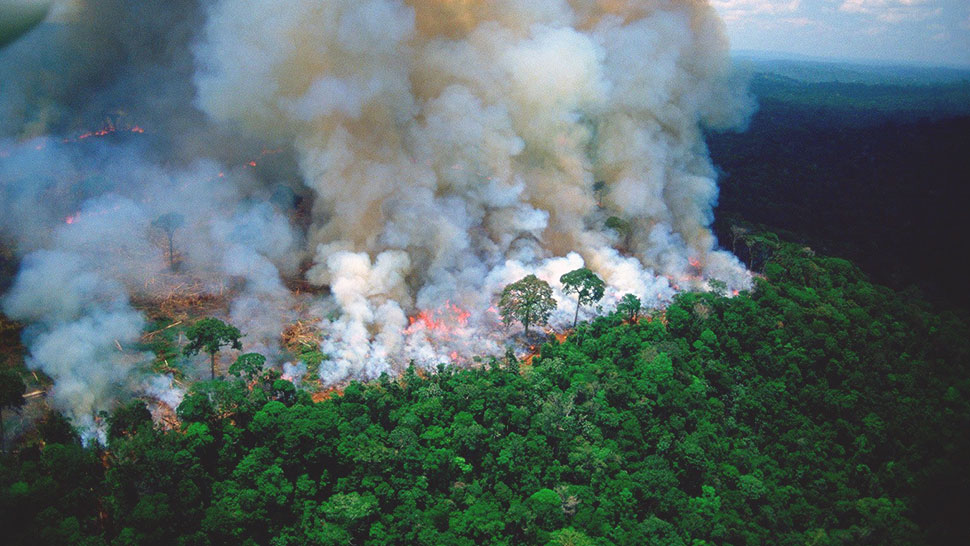
Amazon fires: ‘Justice for workers and the environment are the same struggle’

A Sept. 7 public forum focused on the fires blazing in the Amazon forest in Brazil. The event was held at the Harriet Tubman Center for Social Justice In Los Angeles and was co-sponsored by the People’s Power Assembly-Los Angeles and the American Indian Movement of Southern California.

Two AIM SoCal leaders, Gray Wolf and Brenda Gutierrez, spoke eloquently about the history of AIM, the battles at Standing Rock and about Indigenous peoples’ struggles throughout the world. Each of them expressed strong solidarity with the Indigenous peoples who reside in the Amazon and face being forced out by the right-wing drive to exploit the resources of the forest.

Brazilian activist Jefferson Azevedo of the Socialist Unity Party pointed the finger of blame at the capitalist system itself. He spoke about the dominance of the agricultural, meat and mineral corporations that have found a willing partner in right-wing President Jair Bolsonaro. 

But their dominance and the reckless destruction of the Amazon didn’t begin with Bolsonaro, Azevedo pointed out. Although deforestation slowed when former president and current political prisoner Lula Da Silva was elected, and during the first term of progressive President Dilma Roussef, it picked up again under pressure from the same forces in Roussef’s second term.

Acevedo attributed the sweeping attacks on progressive politics in Brazil to this same group of rich and powerful capitalists: “Former President Dilma Roussef being thrown out of office, Lula being imprisoned, the election of Bolsonaro — none of it would have happened were it not for the dominance in Brazilian politics of these right-wing millionaires.

“This explains [Bolsonaro’s] silence when it comes to the fire that is consuming one of the greatest wonders of this planet and the habitat of a wide variety of living species.”

Acevedo ended his talk on a hopeful note: “Capitalist greed dominates today, but is digging its own grave. Thousands of Brazilians are protesting against Bolsonaro now, in spite of the history of right-wing violence against working-class and progressive people. 

“Protests over environmental issues have been rare in Brazil, but now people see that this is an issue that affects workers, and that justice for workers and environmental justice are the same struggle.”

Strugglelalucha256


Activists issue ‘People’s Travel Advisory’ for Colombia

While the Colombian government wants to present the country as a safe and fun place for tourists, this is false due to the human rights violations going on in this South American country. 

On Sept. 27, the International Day of Tourism, the Coalition for Peace in Colombia is participating in an international day of action called the People’s Travel Advisory for Colombia. In the U.S., protests will be held at Colombian embassies, consulates and tourism offices in Boston; Detroit; Portland, Ore.; San Francisco; Tucson, Ariz.; Washington, D.C.; and other places to inform the public about the reality of the situation.

The coalition stated in their press release, “Colombia IS NOT a safe country, but a dangerous country for every person who desires a just peace!”

They add that Colombia was dangerous for the more than 700 human rights defenders and social leaders who have been murdered since the implementation of the Peace Accords in 2016. They have been killed at a rate of one victim every 30 hours. The assassins are military and paramilitary troops that act with impunity under the protection of President Iván Duque, a close ally of the U.S. government.

Colombia is dangerous for the ex-insurgents who have laid down their weapons in order to participate in the peace agreement and who, since the implementation of the accord, have lost more than 130 persons murdered by enemies of the peace.

Colombia is dangerous for the Indigenous and Afro-Colombian communities who constitute more than 40 percent of the victims of right-wing violence.

Colombia is dangerous for the Marcha Patriótica popular movement for peace, whose members also are more than 40 percent of the victims.

Colombia is dangerous for the more than 6,100 Indigenous children in the Department of La Guajira, who have died from hunger and thirst, and the Wayúu communities, who do not have food security while foreign mining companies rob their water and the Colombian and U.S. governments ignore them. Instead, these authorities invest in militarization and use their territory to foment interference and prepare for war against Venezuela.

Colombia is dangerous for the more than 8 million forcibly internally displaced persons and more than 5.5 million Colombian refugees in Venezuela. The majority of these are rural families and social leaders displaced due to the threats and assaults against them by the military and paramilitaries, and from the dispossession of their territories to satisfy the greed of big landowners, narco-traffickers, and foreign corporations.

Colombia is dangerous for the tourist who dares to deviate from the official path. If a tourist wants to see the beautiful mountains and forests of Cauca, she may find herself in the midst of a military incursion against a rural community. 

If a tourist wants to learn about the rich traditions of the Wayúu people in La Guajira or César, he can find himself in the line of fire of paramilitaries assaulting an Indigenous leader. 

If someone wants to celebrate the Afro-Colombian culture in Buenaventura, they will find themselves in a place without emergency medical facilities, in a place where union leaders are under constant threat.

To get involved in the People’s Travel Advisory for Colombia, visit the Alliance For Global Justice.

Strugglelalucha256


Los Fuegos de las Amazonas: ¿Cómo es que esto esté pasando en tan grande escala? ¿Quién está detrás de esto?

En 1992, líderes de varios países se reunieron en Río de Janeiro, Brasil, a discutir cooperación mutual posguerra fría para desarrollo internacional. Los temas ambientales fueron el tema principal. 

En su discurso en esta junta, Fidel Castro, advirtió sobre la destrucción de la selva amazónica. Fidel señaló que una sociedad basada en consumismo es el culpable fundamental y que está orientado por la vieja metrópoli colonial y las políticas imperialistas que generaron la pobreza y el subdesarrollo que asaltan a la gran mayoría de la humanidad. También cuestionó qué, sin la supuesta amenaza del comunismo y — por lo tanto, sin el pretexto para la guerra fría, lo que está impidiendo que las naciones ricas y desarrolladas inviertan todos los recursos gastados en armas, que se gastarán en el desarrollo del Tercer Mundo, con pólizas que eliminarán el hambre, la pobreza y la destrucción ecológica del planeta.

Los reciente fuegos en la parte Brasileña de la selva amazónica son sólo el último y mayor golpe para el “Gigante Verde.” Después de ver videos en la televisión, en las redes sociales y en varios sitios web en todo el mundo, personas de todas partes de la tierra han reaccionado.

Todos se preguntan, cómo es que esto esté pasando en tan grande escala? ¿Quién está detrás de esto? ¿Porque es que el gobierno brasileño se ha quedado callado acerca de los incendios en la selva amazónica desde julio y no están haciendo nada concreto para extinguirlos? 

El silencio se debe a la participación del gobierno, aunque indirecta, en él. Durante su campaña presidencial, Jair Bolsonaro, habló muchas veces sobre la necesidad de desregular, aflojar y/o simplemente poner fin a muchas de las leyes y regulaciones que obstaculizaron la explotación de la Amazonía.

A la segunda pregunta, la respuesta es que el gobierno simplemente no quiere. Quieren dejar que la selva tropical se queme tanto como sea posible porque ese es el deseo de los grandes jefes de los negocios agrícolas, cárnicos y minerales. Brasil es el mayor exportador mundial de carne de res, soja, café y azúcar. También es uno de los más grandes exportadores de minerales en sus formas naturales. 

En una economía capitalista, industrias tan ricas y poderosas tienen mucho control sobre las decisiones de formulación de políticas. Brasil no es diferente. 

Con todo el dinero que tienen el negocio agropecuario desarrolló el lobby más poderoso de la historia del Congreso brasileño: el lobby rural o la Bancada Ruralista en portugués. Entre los objetivos principales del lobby rural están el perdón de las deudas contraídas por los agricultores, la expansión de las tierras cultivables y el fin de la demarcación de las tierras de los pueblos indígenas, porque consisten de uno de los obstáculos mayores para la expansión de sus negocios.

El Frente Agrícola Parlamentario (FPA) tiene el 40 por ciento de los representantes peleando por los intereses de grandes terratenientes y grandes agronegocios. Estos jefes irán a cualquier extremo o tomarán cualquier medidas para lograr sus objetivos, incluso matar personas o quemar un área más grande que muchos países. Nada es aprobado, o hecho, en el congreso brasileño sin el permiso del FPA.

La ex presidenta Dilma Rousseff no habría sido desplegada por falsos cargos de infracción y Lula no habría sido arrestada por cargos falsos sin el apoyo de este lobby. También, Bolsonaro no habrá sido elegido o no estuviera todavía en el palacio presidencial. Esto explica su silencio y su inercia con respecto al fuego que ha estado consumiendo una de las mayores maravillas de este planeta y el hábitat de una amplia variedad de especies vivas. Con cinco millones kilómetros cuadrados, la selva amazónica engloba una área más grande que la Unión Europea y que ocupa más de la mitad del territorio brasileño. Hogar de veinticinco millones de habitantes, una quinta parte de las plantas y animales de la tierra, y aproximadamente trescientos noventa mil millones de árboles, las Amazonas ha sido atacado desde que el primer colonizador pisó su suelo.

Deforestación de las Amazonas–con el uso de motosierras o fuego—nada nuevo para lxs indígenxs o el pueblo local. Las tribus indígenas, además de lidiar con la invasión de sus tierras y el asesinato de su gente, ahora también tienen que luchar contra la presión ejercida sobre las autoridades para poner fin a la demarcación de sus tierras, abriendo así aún más las puertas a los terratenientes y sus matones. Sin representación en el congreso, sus súplicas son escuchadas solo por unos pocos.

La deforestación de las Amazonas se zambulló durante diez años durante la administración del ex presidente Lula da Silva y Dilma Rousseff, pero subió otra vez durante el segundo término de este último, que coincidió con la crecimiento del Lobby Rural, que eligió alrededor del 44 por ciento del congreso. 

En 2016, la deforestación tuvo su crecimiento más grande con un aumento del 29 por ciento.

Esto paso directamente después del coup que sacó a Dilma Rousseff, reemplazandola Michel Temer, un buen amigo de las oligarcas, que allanaron el camino para la continuación de la destrucción de la Amazonía que, lamentablemente, continúa ardiendo.

En un estudio titulado “O Futuro Climático da Amazônia,” un científico brasileño llamado Antonio Nobre, discute que los árboles son más importantes para la sobrevivencia de nuestro planeta de lo que la mayoría de la gente piensa. Nobre, que también es un miembro del Instituto Nacional de Investigación Espacial (INPE), afirma que el agua que se evapora de los árboles, que se saca del suelo, disminuye la presión atmosférica cuando se condensa. Debido a la menor presión atmosférica, el aire húmedo del océano ingresa al continente creando un enorme flujo de agua vaporizada.

Este fenómeno se llama un “río volador.” Este río volador es más grande que cualquier otro río y a medida que se disuelve, se convierte en lluvia, no solo en el bosque sino en todo el continente. Sin los árboles para sacar el agua del suelo, la presión atmosférica aumentará, enviando así toda el agua al océano y, finalmente, creando un desierto donde alguna vez existió el bosque más grande de la tierra.

¿Quién es responsable?

En cuanto a la cuestión de quién tiene la culpa, primero tenemos que decir quien no tiene la culpa. El pueblo no tiene la culpa. 

El presidente brasileño Bolsonaro pone la culpa por estos incendios criminales sobre las organizaciones ambientalistas no gubernamentales y las personas que defienden el bosque.

Aunque no directamente prendió el fuego, es Bolsonaro quien es responsable. Él es culpable por desmantelar y desembolsar a propósito las agencias que estaban evitando la destrucción masiva del medio ambiente en Brasil. Él es culpable por su uso de palabras que empoderan a aquellos que ganan de ellos y que garantizan la impunidad de sus crímenes. También es culpable por haber puesto a Ricardo Salles como el ministro de ambiente, un hombre que declaró que las Amazonas debe de ser explotado y quien, según The Intercept, falsificó documentos para beneficiar a las empresas mineras. Es culpable, junto con los oligarcas que, a través del dinero y la influencia, todavía hacen creer a muchos trabajadores brasileños que lo que es bueno para los patrones es bueno para ellos. La lucha de las Amazonas representa la lucha, no solo del pueblo brasileño, pero también de todo Latinoamérica y el Caribe que, después de siglos de devastaciones, lucha por su supervivencia, su hábitat, su cultura e incluso la lluvia. 

Strugglelalucha256


Amazon fires: how could this be happening on such a large scale? Who is behind it?

In 1992, leaders of many countries gathered in Rio De Janeiro, Brazil, to discuss mutual post-Cold War cooperation for international development. Environmental issues were the main topic. 

In his speech at that meeting, Fidel Castro warned about the destruction of the Amazon forest. Fidel pointed out that a society based on consumerism is the fundamental culprit, and that it is geared by the old colonial metropolis and the imperialist policies that generated the poverty and underdevelopment that assails the vast majority of humankind. He also questioned what — without the supposed threat of communism and therefore without the pretext for the cold war — what is impeding the rich and developed nations from investing all the resources spent on weapons, to be spent instead on the development of the Third World, with policies that will end hunger, poverty and the ecological destruction of the planet?

The recent fires in the Brazilian part of the Amazon forest are just the latest and biggest blow to the “Green Giant.” After seeing video footage on TV, on social media and on various websites across the globe, people from all parts of the earth have reacted. 

All are wondering, how could this be happening on such a large scale? Who is behind it? Why has the Brazilian government been silent about the Amazon rainforest fires since late July and not doing anything concrete to extinguish them? 

The silence is due to the government’s, although indirect, participation in it. During his presidential campaign, Jair Bolsonaro spoke many times about the necessity to deregulate, loosen and/or simply end many of the laws and regulations that hindered the exploitation of the Amazon. 

To the second question, the answer is that it simply does not want to. It wants to let the rainforest burn as much as possible because that is the wish of the big bosses of the agro, meat and mineral businesses. Brazil is the world’s largest exporter of beef, soybeans, coffee and sugar. It is also one of the biggest exporters of minerals in their natural form.

In a capitalist economy, such rich and powerful industries gain a lot of control over policymaking decisions. Brazil is no different. 

With all the money they have, the agro-cattle business developed the most powerful lobby in the history of the Brazilian Congress: the Rural Lobby or Bancada Ruralista in Portuguese. Among the main goals of the Rural Lobby are the forgiveness of the debts incurred by the farmers, the expansion of arable lands and the end of demarcation of Indigenous people`s land, as it consists of one of the main obstacles to the expansion of their business. 

The Parliamentary Agricultural Front (FPA) has around 40 percent of the representatives in its ranks fighting for the interests of the big landowners and big agribusiness. These bosses will go to any lengths or take any measures to achieve their goals, even killing people or burning an area larger than many countries. Nothing is approved, or done, in the Brazilian Congress without the consent of the Rural Lobby. 

Former President Dilma Roussef would not have been deposed on bogus infraction charges and Lula would not have been arrested on trumped up charges without the support of this lobby. Also, Bolsonaro would not have been elected, or would not still be in the presidential palace. This explains his silence and inertia in regards to the fire that has been consuming one of the greatest wonders of this planet and the habitat of a wide variety of living species.

With five million square kilometers, the Amazon forest encompasses an area larger than the European Union and that takes up more than half of the Brazilian territory. Home of twenty-five million inhabitants, one fifth of Earth’s plants and animals, and approximately three hundred and ninety billion trees, the Amazon has been under attack since the first colonizer set foot on its soil. 

Amazon deforestation — with the use of chain saws or fire — is nothing new to the Indigenous and local people. The Indigenous tribes, on top of dealing with the invasion of their land and the murder of their people, now have also to fight against the pressure exerted on the authorities to end the demarcation of their land, thus opening the doors even more to the landowners and their goons. Without any representation in the congress, their pleas are heard by only a few. 

The deforestation of the Amazon took a dive for ten years during the administration of former President Lula Da Silva and Dilma Roussef but rose again during the second term of the latter, which coincided with the growth of the Rural Lobby, which elected around 44 percent of the congress. 

In 2016, the deforestation had its greatest increase ever with a 29 percent rise. This was right after the coup that ousted Dilma Roussef, replacing her with Michel Temer, a friend of the oligarchs, who paved the way for the continuation of the destruction of the Amazon that, sadly, continues to burn.

In a study titled “O Futuro Climatico da Amazonia,” a Brazilian scientist named Antonio Nobre argues that the trees are more important for the survival of our planet than most people think. Nobre, who is also a member of the National Institute for Space Research (INPE), states that the water that evaporates from the trees, which is pulled from the ground, lowers the atmospheric pressure when condensed. Due to the lower atmospheric pressure, the moist air from the ocean enters the continent creating a huge flow of vaporized water. 

This phenomenon is called a “flying river.” This flying river is bigger than any other river and, as it dissolves, turns into rain, not only in the forest but all over the continent. Without the trees to pull the water out of the ground, the atmospheric pressure will rise, thus sending all the water to the ocean and eventually creating a desert where once existed the largest forest on earth.

Who is responsible?

As to the question of who is to blame, first we must say who is not to blame. The people are not to blame.  

Brazilian President Bolsonaro puts the blame for the criminal fires on the environmentalist nongovernmental organizations and people who defend the forest. 

Although not directly setting the fires, it is Bolsonaro himself who is responsible. He is guilty for purposely dismantling and defunding the agencies that were preventing the massive destruction of the environment in Brazil. He is guilty for his use of words that empower the ones who profit from it and for guaranteeing the impunity of their crimes. 

He’s also guilty for placing Ricardo Salles as minister of the environment, a man who stated that the Amazon should be exploited and who, according to The Intercept, forged documents to benefit mining companies. He is guilty along with the oligarchs who, through money and influence, still make many Brazilian workers believe that what is good for the bosses is good for them. 

The struggle of the Amazon represents the struggle, not only of the Brazilian people, but also of all Latin America and the Caribbean that, after centuries of devastations, fight for their survival, their habitat, their culture and even the rain.

Strugglelalucha256


Tariffs, trade and overproduction

All signs are that an economic downturn is coming. While the capitalists are the first to moan and groan about the declines in the stock market and bond market, an economic downturn is a crisis for the working class. It means layoffs, short shifts, reduced hours, general instability and suffering for the workers and oppressed.

What is needed in the coming period is for the working class, the unions, the unorganized in various organizations and communities to overcome disunity and passivity in time to fight back and push the crisis onto the backs of the bosses. 

There is endless speculation now about whether or not Trump’s policies, particularly the trade war with China, are causing or accelerating the downturn. But to be clear, should there be a downturn, capitalist overproduction would be its cause.

Behind Trump’s trade war

What is driving the trade war and the tariffs, which are really a tax on the working class, in the U.S. as well as in China? Trump is desperate to create the jobs he promised in his election bid in 2016. He thinks his re-election depends on it. He thinks that a tariff war will force U.S. corporations back to the U.S., where they will offer new jobs. This is Trump’s fantasy. It is utterly false and based upon total ignorance.

U.S. corporations have rushed to position themselves in China over the years because China’s workers had relatively low wages, there was a vast population of peasants streaming into the cities, along with a growing educated population, and a strong infrastructure built by the socialist government. China provided both a vast internal market and a platform for exporting commodities to third countries, including the U.S.

In short, being in China was profitable and it still is. The corporate bosses will refuse to give up their profits just because Trump tells them to. Of course, many of them wish that they could get out of China for other reasons: Wages are rising, there is communist influence on the workers, the bosses fear of the strength of the Chinese Communist Party (CCP), and they hate to conform to rules and regulations laid down by the CCP and the Chinese government. 

Some bosses are trying to find low-wage alternatives in Vietnam, Bangladesh, Indonesia, Singapore and other places. But shifting supply chains, finding infrastructure and breaking up production patterns is not as easy as Trump makes it sound. 

Giant corporations like Boeing, Caterpillar, Apple, GM and GE, among others, have large capital investments in China. Many of them were counting on a full-scale capitalist takeover, which would have allowed them to dominate China. But it is clear that such an overturn is not happening.

Trump’s tactics in the trade war with China also reflect the deep and growing hostility of the U.S. ruling class toward China, especially its socialist structure and its increasing political, economic and military influence in Asia and the world.

Capitalist overproduction is the problem

In their attempt to shore up the U.S. economy, Trump and the ruling class are really up against capitalism itself. The capitalist economy operates according to its own laws. 

Marxism shows that consumption and production are indissolubly linked. It also shows that every downturn begins, not with a decline in consumption, but with a decline in production. Where production declines, profits decline, and capitalists rush to protect their profits by hitting the workers with layoffs, wage cuts, cuts in hours, elimination of benefits — whatever it takes to keep profit margins from falling or to slow the fall.

Why are the imperialist countries—Germany, Britain, France, Italy, Japan, among others—either in a manufacturing decline or headed toward one? There is only one reason. There is a decline in markets for manufactured commodities. 

China, a socialist country, is not in a depression, but the rate of growth in the economy has declined from 5.7 percent in December 2018 to 5.5 percent in February 2019. But this is still a higher growth rate than anywhere in the world capitalist economies (Reuters. Business News, March 13, 2019). 

It is a law of capitalism that production expands at a rapid pace while consumption expands, if at all, at a snail’s pace. That is because the masses of workers get paid very little while profits boom. Profits and production outstrip consumption; that is an iron law of capitalism. That is what leads to capitalist overproduction.

The enormous productivity of labor makes it such that the mass of the working class cannot buy back all that they produce. High technology in production has aggravated this situation and has made the crisis of overproduction worse. With automation, fewer workers produce more commodities and services in a shorter time. This is what accounts for the vast number of workers who are excluded from the unemployment statistics — those who have dropped out of the official workforce altogether, who cobble together part-time jobs off the books to live and use other means to survive. 

Any talk of downturn, recession, depression, etc., should set off alarm bells among the more advanced workers. It should be a clarion call to workers’ leaders, wherever they are, to start organizing a fight back. 

Workers must demand to keep their income flowing by whatever means is available, whether payments by the capitalists out of their profits and savings, or by the government directly, through jobs programs. An economic downturn is an emergency for workers. It should be treated as such. 

Trump is desperate to increase the number of manufacturing jobs in the U.S. to try to shore up his electoral base. But the manufacturing index has shown contraction in the U.S. for the first time since 2009. This decline in manufacturing is certain to be followed by a decline in consumption. 

The University of Michigan Consumer Confidence report, which is the capitalist’s gold standard, has shown a drop in popular economic confidence in the future. That indicates a further threat to consumption. 

Amazon and other online retailers have driven out brick-and-mortar stores and closed down malls. These devastating events, driven by high tech, may pump up the bottom line at Amazon, but at the same time, they spread unemployment and poverty across the country. 

The number of workers in stores and malls who are laid off far exceeds the number of workers put to work at Amazon fulfillment centers or FedEx or UPS. When a store or a mall closes, retail workers lose their jobs and so do maintenance workers, window and floor designers, fast food workers who served the customers in the malls, etc. No matter how you slice it, workers take it on the chin when online retailers drive stores and malls out of business. 

The contradictions of capitalist exploitation have raised a dire threat to the working class and the capitalist economy. Trump should be ousted because of his unspeakable racism, misogyny and bigotry, as well as his vicious anti-immigrant policies. But the real problem is capitalism itself.

Posted to lowwagecapitalism.com on Aug. 25, 2019.

Strugglelalucha256


Southern African Development Community calls for solidarity on ending illegal sanctions on Zimbabwe

On Aug. 18, the 39th Southern African Development Community (SADC) Summit of the Heads of State and Government held in Dar Es Salaam, Tanzania, declared Oct. 25, 2019 to be a Day of Solidarity to Lift the Illegal Sanctions Imposed on Zimbabwe. The 16 member states of SADC have resolved to conduct actions in their countries to vigorously work toward this objective.

The SADC Secretariat is reaching out to the African Union chairperson, Egyptian President Abdel Fatthah el-Sisi, to push the anti-sanctions issue for support by the AU and for it to be discussed at the 74th United Nations General Assembly in September 2019.  As Executive Director Dr. Stergomena Lawrence Tax stated at the summit, “The embargo is militating against economic growth in both Zimbabwe and the region.”

Omowale Clay, spokesman of the December 12th International Secretariat, based in New York, said, “We are clear that this powerful show of solidarity and action by SADC helps to expose the lie that sanctions on Zimbabwe only targeted individuals rather than their real purpose to crash their economy in the hopes of fostering ‘regime change.’”

“These sanctions have challenged the economic growth of Zimbabwe by cutting off its foreign trade, and as a result, created a shortage of foreign currency, which compromises the government’s ability to acquire life sustaining necessities such as medicines, water purification equipment, heavy industrial equipment, fuel and many other necessities – sanctions kill!

 “After the fight for independence from the British (Rhodesian) colonizers in 1980, over 80 percent of the arable land was still held by settlers who were less than 5 percent of the population. In 1998, Zimbabwe enacted its land reform program and the land was finally returned to indigenous Zimbabweans who fought and died for it. The ZDERA [the Zimbabwe Democracy and Economic Recovery Act] sanctions implemented by the U.S. violate international laws protecting national sovereignty. ZDERA falsely states that the small, landlocked nation of Zimbabwe is a ‘threat to the national security of the United States.’ The U.S. sanctions must end now. It is a matter of life and death.

“This bold and united action by SADC on October 25th will help mobilize Africa and the Pan-African community against the criminal intent of sanctions — a Western weapon against the self-determination of developing countries — and further expose Western efforts at re-colonization,” Clay concluded.

Incoming SADC chair, Tanzanian President Dr. John Magufuli, stated in his closing remarks to the summit, “We are all aware, this brotherly and sisterly country has been on sanctions for a long time. These sanctions have not only affected the people of Zimbabwe and their government but our entire region.”

On Saturday, Sept. 21, 2019, the December 12th Movement will lead a March and Rally to End the Sanctions in Zimbabwe at the 74th Session of the General Assembly of the United Nations in Dag Hammarskjold Plaza on 47th Street and First Avenue, New York City.

All 193 member states of the U.N. are represented in this unique forum to discuss and work together on international issues covered by the U.N. Charter, such as development, peace and security, international law, etc. 

For more information please call the December 12th Movement at (718) 398-1766 or D12M.com.

Strugglelalucha256
https://www.struggle-la-lucha.org/global/page/5/