The scam behind ‘free elections’

Hillary Clinton went on a late-night talk show and told U.S. voters to “get over themselves” and choose between Genocide Joe and Donald Trump in this year’s U.S. presidential elections.

“Get over yourself. Those are the two choices,” she said. The smirk, the arrogance, and the “we don’t care about you” eye roll reminded me of psychopaths profiled in crime shows. The complete lack of empathy, the sense of superiority, the fake pleasantries and charisma. It’s the same attitude Biden displays when dismissing questions about Israel killing children in Gaza while casually licking an ice cream cone.

To be honest with you, she is right. Nobody should care about Biden or Trump because they both belong to the same ruling political and economic elite, they represent the interests of corporations, they are both professed Zionists, and share a profound love for imposing murderous sanctions against sovereign countries like Cuba and Venezuela.

The U.S. “democracy” is, and always has been, about the elite’s bipartisan rule. A circus that allows for the same warmongering government to continue spreading corporate greed and eliminating any resistance or political alternatives around the world.

Hillary’s words are a reminder, in case somebody needed it, that Washington does not care about democracy or freedom inside the U.S. or anywhere else. These are just tools to drive their neocolonial agenda. The formula is quite simple: Elections are only “free” and a country is only “democratic” when a U.S. puppet rules. Otherwise, collective punishment is coming for you until you capitulate.

For over two decades, Venezuela has been the target of the “free elections” broken record alongside regime change operations and economic sanctions, leaving a long trail of destruction behind. How does the U.S. get away with this “free elections” scam? With the unconditional support of the remorseless corporate media. Remorse, another emotion psychopaths lack.

For years, we have read the same lie over and over again: the 2018 presidential vote was “fraudulent” because the U.S.-backed far-right opposition decided not to participate and called for abstention (although anti-Chavista candidates still ran and got a sizable amount of votes). The election was preceded by U.S. financial sanctions against Venezuela’s oil industry to cause economic instability and pressure people into voting Maduro out of office.

When that strategy failed, more sanctions came raining down in the form of a full-fledged blockade while media stenographers piled one lie on top of another to set up the stage for more intervention. For example, according to The New York Times, the upcoming July 28 presidential vote is only happening because of a “commitment [made by Caracas] to the United States to hold elections this year in exchange for a lifting of crippling economic sanctions.”

There’s a lot to unpack in that small sentence.

The dialogue process and electoral agreement signed between Caracas and the U.S.-backed opposition in Barbados was entirely meant to steer the opposition away from fascist violence and into the electoral path. Presidential elections were constitutionally mandated for 2024, with or without the dialogue or the far-right participation.

While the government (and every human rights expert/organization) has demanded the lifting of sanctions, the relaxation was not a consequence of the Barbados Agreement. It was the result of a migration wave that came roosting home after years of economic aggression against Venezuela. Not to mention years of lobbying by corporations like Chevron that wanted to recoup debt from their Venezuelan joint ventures.

The “crippling economic sanctions” were also not lifted, just the energy and gold sectors’ measures were suspended for six months. As that period has now come to an end and Venezuela approaches another election we are once again tormented with threats of reimposing all sanctions because electoral conditions are still not “free.”

This time, the “free elections” campaigners focus on María Corina Machado’s ban on running for office. Anyone might think people are rallying in the streets demanding this Venezuelan heiress and sanctions enthusiast candidacy, but nothing could be farther from the truth. Then why is she promoted as a crucial factor that would finally make elections “free” according to Western liberal standards?

First, she represents the elite that would guarantee two things: U.S. economic interests and the extermination of popular power that shows socialism is viable. It is no surprise that Washington would cheerlead for Machado, but it’s surprising to see the Latin American left or even the Venezuelan left that opposes Maduro choosing her political rights to take a stand.

Are we supposed to pretend we live in a classless society? For decades, if not centuries, the upper crust has banned the working class from political power. This was the case in Venezuela until Hugo Chávez arrived and with him, the wretched of the earth finally tasted and began to transform power.

From my point of view, nobody like Machado should ever be allowed to run for office, especially when they openly admit their intentions to exterminate a grassroots force like Chavismo. She is on the record calling for a foreign invasion of Venezuela. Should fascists and oligarchs have political rights? Doesn’t that completely contradict the struggle for social justice and humanity’s well-being and survival?

Haven’t we learned how the far-right instrumentalizes hate speech and the “othering” of the poor, the Black and Brown, the different and the left, to rally support to achieve power? False promises and manipulation to turn our countries into U.S. vassal states again. Just look at the recent heartbreaking examples of Ecuador and Argentina. It seems to me that the only thing worse than being a country targeted by U.S. imperialism and resisting is being a U.S. neo-colony with no dignity.

I know that some might say, “But democracy means all political options should run and people can choose freely.” Venezuela is honoring that principle to the core. There are 13 candidates of which 12 are opposition, between newbies and old foxes, and they come in all flavors. You have free-market lovers, religious conservatives, businessmen, and libertarian comedians. Some might drop out of the race, but most will likely to plow ahead. Some have been pre-campaigning for quite some time now.

What is it about them that does not contribute to “free elections”? According to corporate media, they are Maduro allies because they don’t openly support U.S. sanctions and regime change. It’s either be a shameless servant or don’t even bother.

The reality is that Maduro is in a strong position to win the July vote, though not overwhelmingly, so Washington is preemptively delegitimizing the possible results. The United Socialist Party (PSUV) has superb electoral machinery and solid grassroots bases, while the far-right will most likely do what it does best: sabotage the election unless one of them, the creme de la creme of society, is set to rule. Otherwise, remaining out of power is better as they can continue to rely on U.S. funding.

As my mind continues to ponder the scam behind the “free elections” campaign and how it’s just a facade to impose Western-style democracy, I can’t help but wonder what would it feel like to participate in elections without having to worry about U.S. imperialist retaliation. Yes, we have learned to resist and we are in a much better economic situation than five years ago, but that does not mean that our situation is not PTSD-inducing.

Will the U.S. fascist agenda take more lives? How can we have (truly) free elections and free lives when we have a guillotine five millimeters from our already strangled necks?

I would love to be able to measure up Maduro’s government without factoring in sanctions to make a decision as a voter based entirely on how well or badly people are living exclusively because of government policies. It has become an agonizing exercise of self-control not to make rash decisions about the future and trust our leaders.

A lot of people like me are not entirely happy with the government’s liberal overtures in the name of circumventing the U.S. blockade that moves away from the socialist alternative. We have felt ignored when making criticisms or requesting information regarding salaries, socioeconomic data, and the real state of healthcare, education and the electrical system and what investment is going (if any) into them.

We don’t want to surrender our country to the U.S., but we also need guarantees about the next six years if Maduro wins. Will the government continue trapped in its echo chamber? Will they weed out the opportunists and corrupt? Will the socialist project be revitalized?

No matter what goes down on July 28, only the Venezuelan people can save themselves and guarantee real democracy on the ground and hope for the future. As Palestinian poet Mahmoud Darwish once wrote: “Hope is not the opposite of despair. Perhaps it is the faith that springs from divine indifference that has left us dependent on our own special talents to make sense of the fog surrounding us. Hope is neither tangible nor an idea. It is a talent.”

Andreína Chávez Alava was born in Maracaibo and studied journalism at the University of Zulia, graduating in 2012. She immediately started working as a writer and producer at a local radio station while also taking part in local and international solidarity struggles.

In 2014 she joined TeleSUR, where in six years she rose through the ranks to become editor-in-chief, overseeing news, analysis and multimedia content. Currently based in Caracas, she joined Venezuelanalysis in March 2021 as a writer and social media manager and is a member of Venezuelan artist collective Utopix. Her main interests are popular and feminist struggles.

Source: Venezuelanalysis

Strugglelalucha256


Columbia crackdown fuels national student protests for Gaza

April 19 — Columbia University students continue their “Gaza solidarity encampment” on the main lawn of the New York City campus, defying a heavy police crackdown, with 122 arrested. The action, coordinated by various student organizations, including Columbia University Apartheid Divest, Columbia Students for Justice in Palestine, and Columbia Jewish Voice for Peace, has persisted for over 48 hours.

Inspired by the Columbia students’ actions, students at the University of North Carolina and Miami University in Ohio have staged their own encampments in solidarity. National Students for Justice in Palestine issued a “call to action” for students nationwide to “seize the university and force the administration to divest, for the people of Gaza.” A large crowd has also taken to the streets outside Columbia University in support of the encampment.

Strugglelalucha256


Never forget the Ludlow, Colorado, and Veracruz, Mexico, massacres

Over 20 people were killed by the Colorado National Guard in Ludlow on April 20, 1914, during a coal miners’ strike. Eleven of those murdered were children. They choked to death when the tent above them had been set on fire by soldiers.

The next day, April 21, 1914, the U.S. began a military occupation of Veracruz, Mexico. Hundreds of Mexicans were killed during the invasion.

These two atrocities 110 years ago were committed on behalf of Wall Street banksters who are still running the United States today. Their Pentagon war machine is supplying the bombs and shells that have killed over 14,000 Palestinian children in Gaza.

The coal miners in Colorado were on strike against the Colorado Fuel and Iron Company, which was controlled by the Rockefellers, the world’s first billionaire family and founders of Big Oil.

Nine thousand miners had walked out of the Colorado Fuel and Iron company-owned camps on Sept. 23, 1913. They struck against $1.68-a-day wages.

They revolted against the CF&I company stores, CF&I-controlled schools, and CF&I-censored libraries. Strike leader Louis Tikas, a Greek immigrant, was shot in the back and killed.

The U.S. attack on Veracruz was in response to the Mexican Revolution, which began in 1910. The United States had stolen half of Mexico in the late 1840s to expand slavery.

Thirteen years before the U.S. occupation of Veracruz, Los Angeles oil tycoon Edward Doheny opened his first oil well in Tampico, Mexico. President Woodrow Wilson invaded Mexico to protect the profits of U.S. oil outfits, mining, and railroad companies.

Wilson was a super bigot who segregated government lunchrooms. He had “Birth of a Nation,” a film that glorified the Ku Klux Klan, shown in the White House.

Wilson’s Navy Secretary, Josephus Daniels, helped overthrow Wilmington, North Carolina’s Black elected government in 1898. An estimated 300 Black people were killed.

Every worker needs a rifle

Just as Wilson refused to do anything about lynchings, he did nothing to stop miners and their families from being killed in Colorado. The Ludlow massacre horrified the country.

Victor Berger — the socialist member of Congress from Milwaukee — got up in the House of Representatives and urged every worker to get a rifle. The Cleveland Leader wrote, “The charred bodies of two dozen women and children show that Rockefeller knows how to win!”

Enraged strikers in Colorado attacked mines being operated by strikebreakers. President Wilson sent in U.S. troops to break the strike.

The heroic strike was finally defeated. But, the Colorado Fuel and Iron Company was forced to sign a contract with the United Mine Workers in 1933.

Decades later, New York Gov. Nelson Rockefeller, a grandson of Big Oil founder John D. Rockefeller, had 30 Attica prisoners massacred in 1971.

Poor and working people in Mexico, Palestine, and the United States have the same enemy: the billionaire class whose headquarters is Wall Street.

Always remember the Ludlow, Veracruz, and Attica massacres. Fight like hell for Gaza and all of Palestine.

Strugglelalucha256


South Korea seizes cargo ship, escalating U.S.-led sanctions and threats

On March 30, the South Korean Coast Guard forcibly seized the 3,000-ton cargo ship De Yi. The stateless ship had left North Korea’s western port of Nampo and was headed to Vladivostok, Russia. 

After a scheduled stop in Shandong, China, the trip necessitated sailing around the southern end of the Korean peninsula and up the eastern coast to Vladivostok. South Korea claims the ship was probably carrying coal and violating UN sanctions against North Korea. 

The ship’s Chinese captain and crew refused to allow the South Korean military to search the hull. 

For 75 years, the U.S. military has occupied South Korea; there are currently some 30,000 troops stationed there on 73 bases, the third biggest U.S. military occupation in the world. The South Korean military is under the virtual command of the U.S., and any actions such as seizing a ship are generally considered to be done at the direction of the U.S.

The Democratic People’s Republic of Korea, or DPRK as North Korea is officially known, is one of the most sanctioned countries in the world. Certain UN sanctions were worsened in 2017 but will now lapse on April 30. There was a UN resolution to extend them, but the Russian ambassador to the UN vetoed it. 

Over the decades, the U.S. State Department has been the prime motivator of multinational trade sanctions, pressuring allies to join the effort to starve North Korea and force them to become a pliant neocolony.

The U.S. first imposed sanctions during the 1950-53 Korean War after murdering millions of Koreans and a months-long bombing campaign that destroyed practically every building in major cities. By the end of the war, the capital city of Pyongyang looked very much like Gaza does today, with death and debris as far as the eye can see. 

The U.S. refused to sign a peace treaty at the war’s close and still does. With U.S. nuclear weapons having been stationed in South Korea for years, and tens of thousands of troops still present there, as well as nuclear warheads within striking distance from the air and by sea, U.S. imperialism is more than a military menace – it is an existential threat to North Korea. 

During the 1990s, the U.S. and its allies falsely accused the DPRK of developing a nuclear weapons program in secret. They were really trying to build nuclear power plants to make up for their inability to import fuel oil for heat due to the sanctions. North Koreans were suffering during long, cold winters. 

The secrecy accusation is part of a constant refrain from the U.S. propaganda machine. However, in 2006, President Kim Jong Il announced that they had turned the U.S. lies into reality. The DPRK had successfully conducted its first nuclear weapons test. 

North Korea has had a decades-long policy of “military first.” That means that even at great cost and despite difficult conditions under the U.S. sanctions regime, the Korean people agreed that defense was the top priority. That policy and Kim Jong Il’s decision may be the only reason North Korea still exists as a sovereign and socialist country. 

After the first nuclear weapons test by North Korea, the White House pushed successfully for even more severe sanctions at the UN. Russia’s veto at the UN gave North Korea relief from at least some of the sanctions that have made life so difficult for millions of Korean people. 

The imperialist war against the people of Korea has been uninterrupted and severe ever since the Korean People’s Army liberated the north under the leadership of the great revolutionary Kim Il Sung and the Communist Party of Korea. 

The U.S. has its fingerprints all over this cargo ship seizure. Korea JoongAng Daily reported that “the United States is believed to have provided the South Korean government with circumstantial evidence of suspected sanctions violations.” ‘Circumstantial’ and ‘suspected’ are the key words. By prodding South Korea into seizing the ship, the White House is signaling that its campaign to destroy the DPRK will not let up one bit. 

Korean people of both the north and the south want the country reunified. It was the U.S. that divided the country, drawing a line at the 38th parallel, dividing parents from children and siblings from each other for 75 years and counting. Right-wing South Korean President Yoon Suk Yeol has turned back some of the progress in relations made over the last two decades or more. He is steering South Korea closer to the U.S. and has imposed his own unilateral sanctions on the DPRK, adding to the punishment doled out by the U.S. and other imperialists. 

This isn’t what the people of South Korea want. When the Japanese empire fell at the close of World War II, and the U.S. moved to take over Japan’s colonies, the U.S. spent years trying to crush a people’s movement in the south that resisted the division of Korea. 

In 1945, Syngman Rhee — who had lived in the U.S. since 1904 and was a U.S. citizen  — arrived in U.S.-occupied South Korea aboard General Douglas MacArthur’s personal plane. In 1948, under the direction of the CIA (then named OSS), Rhee was imposed as president through a rigged election. There was mass opposition to which Rhee responded with police-state repression, jailing over 300,000 and killing tens of thousands by 1950.

As this article is being composed, millions of South Koreans are remembering the great uprising on the island of Jeju in April 1948, a response to the sham election; nearly every police headquarters was destroyed, and a division of Syngman Rhee’s army mutinied. 

Some of them fought their way north and joined in the development of socialism in North Korea. Many more strikes, rebellions, student walkouts, and other militant actions like the takeover of Gwangju in 1980 – sometimes referred to as the “2nd Paris Commune” — characterize the South Korean people’s righteous struggle. 

Many South Koreans were killed over the years, but the struggle for self-determination lives on.

The U.S. media portrays North Korea as an isolated nation. That is another falsehood. Right now, North Korea is celebrating the “China-DPRK Friendship Year.’ Zhao Leji, the Chairman of China’s National People’s Congress, is leading a delegation to Pyongyang to mark the occasion. Zhao is also the third highest-ranking official in all of China and is meeting with his North Korean counterpart, Choe Ryong-hae. It is also noteworthy that the DPRK has been very vocal about its solidarity and support for the people of Gaza, as they have over the decades with Nicaragua, Iran, Venezuela, Cuba, and others. North Korea is an important ally and friend of the global struggle against U.S. imperialism!

Down with the U.S. empire, and long live the struggling people of North Korea! Korea is One!


Strugglelalucha256


Unsustainable war machine: U.S. imperialism in crisis

General Smedley Butler said, “War is a racket.” Wikipedia explains that he was referring to the war profiteers and the “imperialist motivations for U.S. foreign policy and wars.”

A Guardian headline on Feb. 18 declared: “World’s largest oil companies have made $281bn profit since invasion of Ukraine.” Below the headline was the teaser: “Global Witness says the five ‘super-majors’ are the ‘main winners of the war’ while many struggle to heat their homes.”

A Wall Street Journal headline on Feb. 18 declared: “How war in Europe boosts the U.S. economy.”

The U.S./NATO proxy war in Ukraine against Russia “is good for the U.S. economy,” the WSJ reports. “Industrial production in the U.S. defense and space sector has increased 17.5%.”

The report continues, “Biden administration officials say that of the $60.7 billion earmarked for Ukraine in a $95 billion supplemental defense bill, 64% will actually flow back to the U.S. defense industrial base.” 

The WSJ adds that the $95 billion military aid package also includes funds earmarked for Israel and Taiwan.

That’s war on three fronts.

The U.S. is in a steadily expanding military buildup of unprecedented proportions. But the economic basis for sustaining military expansion — for war on three fronts  — is in virtual ruin.

After World War II, the United States was the world’s leading imperialist economic and military force. As the predominant imperialist power, the U.S. had unrivaled political and military dominance over its imperialist rivals in Western Europe and Japan, as well as over developing countries and oppressed peoples globally. 

In the early 1950s, the United States accounted for over 50% of global economic production. In 2023, the U.S. has fallen to about 26% of global gross domestic product (GDP), with China, Germany, and Japan all rising, according to the IMF. China’s share of the global GDP surged from 2% in 1980 to 18% in 2021.

When adjusted for the cost of living (the IMF’s PPP – purchasing power parity), the U.S. per capita GDP now ranks ninth in the world.

The basic industries of the U.S. have declined after decades of deindustrialization that began in the late 1970s.

In terms of capitalist production for profit, which involves competition for capitalist markets and the acquisition of sources of raw materials, the U.S. has become tremendously weakened as a world power. For instance, in its current heated military expansion, the U.S. has access to a fraction of the world’s total production over what it had in the 1950s. 

Consider the supply chain crisis during the COVID shutdown. COVID restrictions and lockdowns, especially in China, a major global manufacturing hub, led to shortages of components and products. Factories and ports in the U.S. stalled. Global supply chains are interconnected and interdependent, with many companies reliant on just-in-time inventory and single sources for parts.

While the economic base of U.S. imperialism has been contracting, the drive for military expansion has increased. 

“U.S. military spending is at an all-time high,” writes John Feffer at the Institute for Policy Studies. “From 2017 to 2023, the Pentagon’s base budget increased by over 50%. For 2024, overall U.S. military spending — which includes the allotment for the Pentagon, the budget for nuclear weapons at the Department of Energy, and a few other items — will be $886 billion. With supplemental requests, like the current one for Ukraine and Israel, the total will approach $1 trillion, the highest military spending since World War II.”

In October 2023, President Joe Biden said that the U.S. must be “the arsenal of democracy,” echoing a 1940 call to arms by Franklin D. Roosevelt. Biden was emphasizing the wars in Ukraine and Gaza and the U.S. arms buildup in Taiwan.

The biggest part of the U.S. war buildup in the Pentagon budget is aimed at China.

The Modern War Institute at West Point says, “The U.S. military is attempting to quickly replenish diminished weapons stocks in its largest production ramp-up in decades. With an eye on its pacing threats and the risk of major conflict — with China, in particular — it is transitioning to modern platforms, including attack submarines, heavy bombers, and air defense systems, as well as new approaches to electric vehicles. Given its security assistance to Ukraine and recent military support to Israel, and conflict risks with China, it is simultaneously rearming with legacy munitions — 155-millimeter artillery, Javelin antitank missiles, and surface-to-air Stinger missiles.”

Crises of a declining empire

So, the Pentagon has launched a military expansion of unprecedented proportions, while the economic basis for sustaining such an unbridled military buildup has been severely eroded.

The U.S. capitalist system is facing multiple crises. 

The global production decline should not be confused with a capitalist overproduction crisis.   

Crises of overproduction are usually called cyclical capitalist events or simply recessions in the media. Capitalism has had economic crises periodically since 1825. Capitalism goes through a boom and bust cycle every 10 years or so. Marx identified these cyclical events as crises of overproduction. 

Capitalists produce goods and services only for profit and not for need. Production is disrupted when commodities can no longer be sold at a profit. Capitalist production can be effectively expanded, but the markets respond slowly, if at all. The overproduction is relative; that is, it’s not that more is produced than is needed. It’s that more is produced than can be sold at a profit. 

A cyclical recession looms over the U.S. economy. Recessions are sweeping the capitalist countries. Japan, Britain, Ireland, and Finland are now in what Wall Street calls “technical recessions,”  which means at least two successive quarters of GDP contraction. 

“This is only the tip of the iceberg,” says one report. Denmark, Luxembourg, Moldova, and Estonia were already in recession. Six countries — Ecuador, Bahrain, Iceland, South Africa, Canada, and New Zealand — reported shrinking GDP in October. And six more — Malaysia, Thailand, Romania, Lithuania, Germany, and Colombia — reported GDP contraction in December. 

Debt around $33 trillion

Heavy borrowing by the U.S. government has financed military expansion. The U.S. budget deficit doubled from 2022 to 2023. The overall debt now stands at around $33 trillion. That’s the value of the combined economies of China, Japan, Germany, India and Britain.

Military spending is different than the capitalist market. Military spending goes to produce planes, tanks, missiles, and other defense systems.

These military products do not function like regular commodities. They do not compete with other commodities for buyers in the capitalist market. There is no concern about overproducing since they do not compete for buyers based on market demands. 

Government loan-financed military spending raises industrial production but depresses the capitalist process of expansion. Capitalist production is not simply to meet consumer needs but to maximize surplus value (profits). A portion of the profits made are used to expand the means of production (machines, technology, infrastructure, etc.). 

Military spending redirects production from expanded production of the means of production into producing the means of destruction. More capital is consumed than is created.

The very goal of capitalist production is not meeting consumer demand or social needs but maximizing extraction of surplus value or profit from workers. Expansion is a key means to keep profits growing. Without expansion, profits fall.

The total product of the military-industrial complex is devoid of usefulness. The vast sums borrowed for the military budget have flooded the world with dollars of decreasing value due to military spending for which there has been no material return.

“Military spending has been crowding out other spending,” said Jason Furman, an economist at Harvard University. He noted that Vietnam War spending in the 1960s contributed to the soaring inflation at that time, which led to stagflation, the combination of high inflation and a slowing economy.

In the year 2000, the U.S. government debt was $3.5 trillion, equal to 35% of the GDP. By 2022, the debt was $24 trillion, equal to 95% of GDP. The single biggest source of this increase is military spending. According to the Watson Institute at Brown University, the cost of U.S. wars from fiscal year 2001 to fiscal year 2022 amounted to a whopping $8 trillion.

Forbes magazine recently noted that when adjusted for inflation, the U.S. bank leases and loans showed zero growth at the end of 2023. The capitalist economy simply cannot grow without sustained loan and lease growth. Zero growth means a contraction of the economy. “In simple terms, if this trend doesn’t change, then we are most likely to see a recession,” Forbes says.

On top of the periodic economic recessions inherent to capitalism, an even more severe crisis is plaguing U.S. monopoly capitalism. The decline of U.S. production and GDP and the rise of China, Germany, and Japan reveal the so-called competitive crisis: the loss of their competitive edge in the world market by significant elements of U.S. industry and finance.

The U.S. has slowly lost its dominant position in world trade and commerce. 

Look at Boeing, a monopoly once dominant in the world aircraft industry in commercial and military production. 

Barack Obama once quipped, “Other than — maybe — the CEO of Boeing, I don’t know anyone who’s done more to sell Boeing planes around the world than me.”

Then-President Donald Trump said during a 2017 visit to a plant in South Carolina: “God bless you, may God bless the United States of America, and God bless Boeing.” Boeing executive Patrick Shanahan was a Trump Secretary of Defense, the head of the Pentagon. Shanahan is also president and CEO of Spirit AeroSystems, which produced the defective parts for Boeing’s 737 MAX airline.

Capitalist monopoly retards technological development, discourages inventiveness and innovation, and prevents the normal renewal, retooling, and reequipment of the basic industrial apparatus. If profits can be made by jacking up prices as a result of monopoly rather than by plant renewal, retooling, or modernization, then it becomes plain that the ruling class as a whole will opt for industrial production based on obsolete plant and equipment so long as profits can be maintained at a high level.

At Boeing, production was maximized for profit at the cost of air safety. In the 1970s, Boeing commanded 66% of the world market; now it is 41%. 

A German-French-British consortium introduced the Airbus to compete with Boeing. Despite the occupying dominance of the U.S. and NATO, which has held Germany down by political and military means following the defeat of German imperialism in the Second World War, Airbus was mainly a German effort.

In 2019, Airbus displaced Boeing as the largest aerospace company by revenue due to the Boeing 737 MAX breakdowns.

German industrial engine stalls as U.S. guns and gas dictate terms

It’s not an accident that Germany was the first casualty in the U.S./NATO proxy war on Russia. 

In 2022, the European Union imported 40% of its gas from Russia. The primary route for gas from Russia was through the Nord Stream pipeline to Germany. Nord Stream 2 was built to at least double the capacity. 

The U.S. opposed Nord Stream 2 since the pipeline’s inception. Congressional efforts to block the pipeline imposed sanctions, with increasingly stringent sanctions legislation enacted in 2017, 2019, and 2020. 

The Nord Stream 2 project was finished in September 2022 but was idle pending certification by Germany and the EU.

On Feb. 7, 2022, before any Russian military actions in Ukraine, President Joe Biden declared, “There will be no longer a Nord Stream 2. We will bring an end to it.” (The U.S. Navy has since bombed and destroyed the pipeline.)

As the leading industrial economy in Europe, Germany had a heavy reliance on imported Russian oil, gas, and key minerals to fuel sectors like steel, chemicals, automotives, and complex machinery. This low-cost energy and raw material supply enabled the high productivity and exports behind Germany’s economic preeminence.

Germany has been forced to replace low-priced Russian pipeline gas with high-priced U.S. liquified natural gas (LNG), making German industry less competitive. 

Today, the U.S. is the top LNG exporter in the world and the biggest supplier of crude oil to Germany and the entire European Union at a much higher cost.

Gary Wilson is the author of War and Lenin in the 21st Century.

Strugglelalucha256


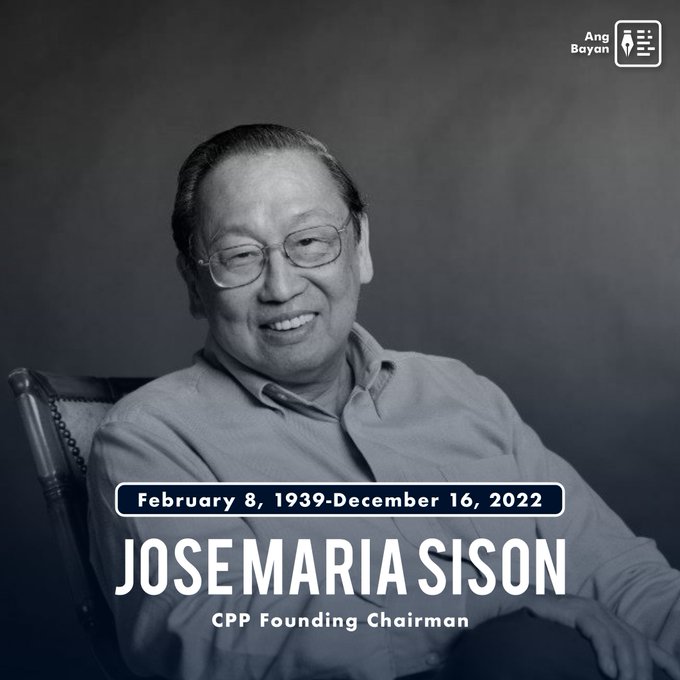
Jose Maria Sison, founding chair of the Communist Party of the Philippines

From the Philippine Revolution Web Central:

The greatest Filipino of the past century bereaved us peacefully last night.

Prof. Jose Ma. Sison, founding chair of the Communist Party of the Philippines, passed away at around 8:40 p.m. (Philippine time) after two weeks confinement in a hospital in Utrech, The Netherlands. He was 83.

The Filipino proletariat and toiling people grieve the death of their teacher and guiding light.

The entire Communist Party of the Philippines gives the highest possible tribute to its founding chairman, great Marxist-Leninist-Maoist thinker, patriot, internationalist and revolutionary leader.

Even as we mourn, we vow continue to give all our strength and determination to carry the revolution forward guided by the memory and teachings of the people’s beloved Ka Joma.

Let the immortal revolutionary spirit of Ka Joma live on!

December 17, 2022

Tribute of the 2nd Congress to Comrade Jose Ma. Sison

Resolution of the Second Congress of the Communist Party of the Philippines
November 7, 2016

The Second Congress of the Communist Party of the Philippines (CPP) extends its profound appreciation and expresses deepest gratitude to Comrade Jose Ma. Sison for his immense contribution to the Philippine revolution as founding chair of the Party, founder of the New People’s Army and pioneer of the People’s Democratic Government in the Philippines.

Ka Joma is a Marxist-Leninist-Maoist extraordinaire and indefatigable revolutionary fighter. He applied dialectical and historical materialism to expose the fundamental nature of the semicolonial and semifeudal social system in the Philippines. He put forward an incisive class analysis that laid bare the moribund, exploitative and oppressive rule of the big bourgeois compradors and big landlords in collusion with the US imperialists.

He set forth the program for a people’s democratic revolution as immediate preparation for the socialist revolution. He always sets sights on the ultimate goal of communism.

Ka Joma was a revolutionary trailblazer. In his youth, he joined workers federations and helped organize unions. Ka Joma formed the SCAUP (Student Cultural Association of the University of the Philippines) in 1959 to promote national democracy and Marxism-Leninism and wage ideological and cultural struggle against the religio-sectarians and anti-communist forces among the student intellectuals. Together with fellow proletarian revolutionaries, he initiated study meetings to read and discuss Marxist-Leninist classic writings.

Under Ka Joma’s leadership, the SCAUP organized a protest action in March 1961 against the congressional witchhunt of the Committee on Anti-Filipino Activities which targeted UP faculty members accused of writing and publishing Marxist materials in violation of the Anti-Subversion Law. Around 5,000 students joined the first demonstration with an anti-imperialist and anti-feudal character since more than ten years prior. As a consequence, Ka Joma became a target of reactionary violence and survived attempts on his life. Unfazed, he and the SCAUP continued to launch protests against the Laurel-Langley Agreement and the Military Bases Agreement and other issues as land reform and national industrialization, workers rights, civil and political liberties and solidarity with other peoples against US acts of agression up to 1964.

He and other proletarian revolutionaries eventually joined the old merger Socialist and Communist Party in 1961. In recognition of his communist and youthful fervor, he was assigned to head the youth bureau of the old Party and appointed as member of the executive committee. He initiated meetings to study the classic works of Marx, Lenin, Mao and other great communist thinkers which challenged the stale conditions of the old Party.

He founded the Kabataang Makabayan (KM) in November 1964 and led its development as one of the most important youth organizations in Philippine history. As KM chair, and as a young professor and militant, he went on campus tours and spoke before students as well as young professionals to espouse the necessity of waging a national democratic revolution. His speeches compiled in the volume Struggle for National Democracy (SND) served as one of the cornerstones of the national democratic propaganda movement. The KM would eventually be at the head and core of large mass demonstrations during the late 1960s up to the declaration of martial law in 1972.

As one of the leaders of the old party, Ka Joma prepared a political report exposing and repudiating the revisionism and opportunism of the successive Lava leadership as well as the errors of military adventurism and capitulation of the Taruc-Sumulong gang of the old people’s liberation army. The old party had deteriorated as an out-and-out revisionist party.

Despite Ka Joma’s effort, the old party proved to be beyond resuscitation from its revisionist death. Gangsters in the old party would carry out attempts on his life to snuff the revolutionary revival of the Filipino proletariat.

As Amado Guerrero, Ka Joma led the reestablishment of the Communist Party of the Philippines on the theoretical foundations of Marxism-Leninism-Maoism. He prepared the Party constitution, the Program for a People’s Democratic Revolution and the document Rectify Errors and Rebuild the Party and presided over the Congress of Reestablishment held in Alaminos, Pangasinan on December 26, 1968. In 1969, he authored Philippine Society and Revolution which presents the history of the Filipino people, analyzes the semicolonial and semifeudal character of Philippine society and defines the people’s democratic revolution. He prepared the Basic Rules of the New People’s Army and the Declaration of the New People’s Army and directed the Meeting of Red commanders and fighters to found the New People’s Army (NPA) on March 29, 1969.

He led the Party in its early period of growth. He wrote the Organizational Guide and Outline of Reports in April 1971 and the Revolutionary Guide to Land Reform in September 1972 which both served to direct the work of building the mass organizations, organs of political power, units of the people’s army and the Party, as well as in mobilizing the peasants in waging agrarian revolution. He authored the Preliminary Report on Northern Luzon in August 1970 which served as a template in the work of other regional committees.

While directing the development and training of the New People’s Army from its initial base in Central Luzon to the forests of Isabela in Cagayan Valley, he also guided the youth activists in waging mass struggles in Metro Manila against the US-Marcos dictatorship.

Ka Joma was ever on top of the revolutionary upsurge of the students and workers movement in 1970 and 1971. Chants of Amado Guerrero’s name reverberates in Manila and other cities in harmony with calls to join the people’s war in the countryside.

The CPP grew rapidly in its first few years under Ka Joma’s leadership. The Party established itself across the country and led the nationwide advance of the revolutionary armed struggle. He personally supervised the political and military training of Party cadres and NPA commanders in the forested region of Isabela from where they were deployed to other regions.

In 1971, he presided over the Central Committee and presented the Summing-Up Our Experiences After Three Years (1968-1971). He prepared in 1974 the Specific Characteristics of Our People’s War which authoritatively laid out the strategy and tactics for waging people’s war in the Philippines. In 1975, he authored Our Urgent Tasks, containing the Central Committee’s report and program of action. He served as editor-in-chief of Ang Bayan in its first years of publication.

In the underground movement, Ka Joma continued to guide the Party and the NPA in its growth under the brutal fascist martial law regime of dictator Marcos. He issued advisories to underground Party cadres and mass activists. Inspired by the raging people’s war in the countryside, they dared the fascist machinery and carried-out organizing efforts among students and workers.

The first workers’ strike broke out in 1975 preceding the growth of the workers movement. Large student demonstrations against rising school fees and the deterioration of the educational system were carried out from 1977 onwards completely shattering the terror of martial law.

Ka Joma continued to lead the Party in nationwide growth until 1977 when he and his wife Julie were arrested by the wild dogs of the Marcos dictatorship while in transit from one guerrilla zone to another. He was presented by the AFP to Marcos as a trophy. He was detained, subjected to severe torture, put under solitary confinement for more than five years interrupted only by joint confinement with Julie in 1980-1981, and later partial solitary confinement with one or two other political prisoners from 1982-1985.

While in prison, Ka Joma was able to maintain contact with the Party leadership and revolutionary forces outside through clandestine methods of communication. With the collaboration of Ka Julie, lifelong partner and comrade of Ka Joma, they produced important letters and advisories. In 1983, Ka Julie released the article JMS On the Mode of Production which served as a theoretical elucidation and clarification of the nature of the semicolonial and semifeudal social system in order to cast away confusion brought about by claims of industrialization by the US-Marcos dictatorship. It counterattacked claims made by pretenders to socialism who insist that the Philippines had become a developing capitalist country under the fascist dictatorship.

A powerful upsurge of the anti-fascist mass movement followed the assassination of Marcos archrival Benigno Aquino in 1983. This was principally propelled by the workers and student movement which could mount demonstrations of 50,000 or greater from the late 1970s and early 1980s. In 1984, Ka Joma released the paper On the Losing Course of the AFP under the pseudonym Patnubay Liwanag to assess the balance of forces and to signal to or sway the Pentagon to better drop Marcos, which would entail causing a split in the AFP. In September 1984, the Pentagon acceded to the Armacost formula and decided to join the US State Department and other US agencies to drop him. By early 1985 Reagan signed the National Security Directive with definite plan to ease out Marcos.

Ka Joma also asserted the need to weaken the reactionary armed strength in the countryside and expand the people’s army to a critical mass 25,000 rifles and one guerrilla platoon per municipality as constructive criticism of the plan to carry out a “strategic counter-offensive.”

The anti-fascist upsurge culminated in a people’s uprising supported by a military rebellion of elements in the reactionary AFP. The Party’s persevering and solid leadership of the anti-fascist movement and revolutionary armed struggle created favorable conditions that led to the overthrow the US-Marcos dictatorship in 1986. Despite strong opposition by the US and reactionary defense establishment, the Aquino regime was compelled to open the detested gates of the Marcos dungeons allowing Ka Joma to be released.

He wasted no time resuming revolutionary work. In a few months time, he mounted a major lecture series to propound a critical class analysis of the Corazon Aquino regime and expose it as representative of big bourgeois comprador and landlord rule. The series of lectures which later comprised the volume Philippine Crisis and Revolution countered the “political spectrum” analysis of populists which pictured the Aquino regime as a bourgeois liberal regime to goad the revolutionary forces along the path of class collaboration and capitulation.

These populists as well as other charlatans carried out a campaign to undermine the basic analysis of classes and production system in the Philippines to justify the convoluted concept of a strategic counter-offensive wishfully thinking that the people’s war can leapfrog to strategic victory bypassing the probable historical course. A number of key leaders of the Party and revolutionary forces were drawn to the self-destructive path of insurrectionism and premature regularization and military adventurism. This would later bring about grave and almost fatal losses to the Party and the NPA, as well as to the urban mass movement.

Forced to exile in 1987 by the Aquino regime which canceled his passport and travel papers, Ka Joma sought political asylum in The Netherlands while on a lecture tour. He eventually resided in Utrecht and work with other comrades in the international office of the National Democratic Front. Although thousand of miles away from the Philippines, he continued to maintain close contact with the Party leaders in the country and provide advise and guidance to help them in their work.

Ka Joma served as one of the steadfast exponent of the Second Great Rectification Movement launched by the 10th Plenum of the CPP Central Committee in 1992. The Party leadership actively sought Ka Joma’s theoretical insights and analysis. In preparing the key document Reaffirm Our Basic Principles and Rectify Errors, the Party leadership referred to Ka Joma and the Party’s founding documents which he authored. With Ka Joma’s full support, the rectification campaign of 1992-1998 united and strengthened the Party to ever greater heights.

Ka Joma also played a key role in authoring the paper Stand for Socialism Against Modern Revisionism which illuminated the path of socialist revolution during the dark hours of the complete restoration of capitalism in the Soviet Union in 1990 touted in the monopoly bourgeois mass media as the fall of socialism, a refutation of communism, and the “end of history” and final victory of the capitalist system.

Reflecting Ka Joma’s sharp Maoist critique of modern revisionism, the paper presented a clear historical understanding of the process of capitalist restoration in the USSR from 1956 onwards. This served as key to understanding the continuing viability of socialism and to inspiring the Filipino proletariat to persevere in the two-stage revolution and the international proletariat to carry forward the socialist cause.

Ka Joma’s Utrecht base eventually became a political center of the international communist and anti-imperialist resistance movements. He played an important role in the centennial celebration of Mao Zedong in 1993 which served as a vigorous ideological campaign to reaffirm Marxist-Leninist views and to proclaim Maoism as the third epochal development of Marxism-Leninism.

Up to the early 2000s, he also played a lead role in the formation of the International Conference of Marxist-Leninist Parties and Organizations (ICMLPO) which serves as a center for ideological and practical exchange among communist and workers parties which stood for socialism and opposed modern revisionism. He provided valuable insights and practical assistance to numerous communist parties from Asia to Europe and the Americas.

Over the past decade, he has led the International League of People’s Struggles or the ILPS which has served as coordinating center for anti-imperialist movements around the globe. He authored the paper “On imperialist globalization” in 1997 which clarified that the proletariat remains in the era of imperialism and socialist revolution.

Because of his role in guiding the advance of the international anti-imperialist struggle, Ka Joma was put in the crosshairs of US imperialism. He was included in the US list of “foreign terrorists”, together with the CPP and NPA. At 68 years old, he was arrested in 2007 by the Dutch police and detained for more than 15 days.

Since 1992, together with the NDFP Negotiating Panel, Ka Joma has also ably represented the interests of the Filipino people and revolutionary movement in peace negotiations with successive representatives of the Government of the Republic of the Philippines (GRP). He has been appointed as Chief Political Consultant of the NDFP Negotiating Panel and has deftly guided it in negotiations with the GRP over the past 25 years.

Over the past several years, Ka Joma continued to provide invaluable insights into the domestic crisis and the situation of the revolutionary forces. He continues to provide advise to the Party and the revolutionary forces in the Philippines on resolving the problems of advancing the revolution to a new and higher stage.

He has set forth critical analysis of the objective international conditions. He has put forward a Marxist-Leninist critique of the capitalist crisis of overproduction which is at the base of the international financial crisis and the prolonged depression that has wracked the global capitalist system. He has reaffirmed that we are still at the historical epoch of imperialism, the last crisis stage of capitalism.

Ka Joma is the torch bearer of the international communist movement. Through the dark period of capitalist restoration, he has kept the flames of Marxism-Leninism-Maoism burning and inspired the proletariat to take advantage of the crisis of global capitalism, persevere along the path of socialism and communism and bring the international communist revolution to a new chapter of revival and reinvigoration.

Resolutions:

The Second Congress of the Communist Party of the Philippines (CPP) resolves to give the highest honors to Comrade Jose Ma. Sison, great communist thinker, leader, teacher and guide of the Filipino proletariat and torch bearer of the international communist movement.

In recognition of Ka Joma’s immense contribution to the Philippine revolution and the international workers movement, the Second Congress further resolves:
1. to instruct the Central Committee to continue to seek Ka Joma’s insights and advise on various aspects of the Party’s work in the ideological, political and organizational fields.

2. to endorse the five volume writings of Jose Ma. Sison as basic reference and study material of the CPP and to urge the entire Party membership and revolutionary forces to read and study Ka Joma’s writings.

The Second Congress of the Communist Party of the Philippines (CPP) is certain that with the treasure of Marxist-Leninist-Maoist work that Ka Joma has produced over the past five decades of revolutionary practice, the Party is well-equipped in leading the national democratic revolution to greater heights and complete victory in the coming years.


Strugglelalucha256


Ten contradictions that plague Biden’s Democracy Summit

President Biden’s virtual Summit for Democracy on December 9-10 is part of a campaign to restore the United States’ standing in the world, which took such a beating under President Trump’s erratic foreign policies. Biden hopes to secure his place at the head of the “Free World” table by coming out as a champion for human rights and democratic practices worldwide.

The greater possible value of this gathering of 111 countries is that it could instead serve as an “intervention,” or an opportunity for people and governments around the world to express their concerns about the flaws in U.S. democracy and the undemocratic way the United States deals with the rest of the world. Here are just a few issues that should be considered:

1. The U.S. claims to be a leader in global democracy at a time when its own already deeply flawed democracy is crumbling, as evidenced by the shocking January 6 assault on the nation’s Capitol. On top of the systemic problem of a duopoly that keeps other political parties locked out and the obscene influence of money in politics, the U.S. electoral system is being further eroded by the increasing tendency to contest credible election results and widespread efforts to suppress voter participation (19 states have enacted 33 laws that make it more difficult for citizens to vote).

A broad global ranking of countries by various measures of democracy puts the U.S. at # 33, while the U.S. government-funded Freedom House ranks the United States a # 61 in the world for political freedom and civil liberties, on a par with Mongolia, Panama and Romania.

2. The unspoken U.S. agenda at this “summit” is to demonize and isolate China and Russia. But if we agree that democracies should be judged by how they treat their people, then why is the U.S. Congress failing to pass a bill to provide basic services like health care, child care, housing and education, which are guaranteed to most Chinese citizens for free or at minimal cost?

And consider China’s extraordinary success in relieving poverty. As UN Secretary General Antonio Guterres said, “Every time I visit China, I am stunned by the speed of change and progress. You have created one of the most dynamic economies in the world, while helping more than 800 million people to lift themselves out of poverty – the greatest anti-poverty achievement in history.”

China has also far surpassed the U.S. in dealing with the pandemic. Little wonder a Harvard University report found that over 90% of the Chinese people like their government. One would think that China’s extraordinary domestic achievements would make the Biden administration a bit more humble about its “one-size-fits-all” concept of democracy.

3. The climate crisis and the pandemic are a wake-up call for global cooperation, but this Summit is transparently designed to exacerbate divisions. The Chinese and Russian ambassadors to Washington have publicly accused the United States of staging the summit to stoke ideological confrontation and divide the world into hostile camps, while China held a competing International Democracy Forum with 120 countries the weekend before the U.S. summit.

Inviting the government of Taiwan to the U.S. summit further erodes the 1972 Shanghai Communiqué, in which the United States acknowledged the One-China policy and agreed to cut back military installations on Taiwan.

Also invited is the corrupt anti-Russian government installed by the 2014 U.S.-backed coup in Ukraine, which reportedly has half its military forces poised to invade the self-declared People’s Republics of Donetsk and Luhansk in Eastern Ukraine, who declared independence in response to the 2014 coup. The U.S. and NATO have so far supported this major escalation of a civil war that already killed 14,000 people.

4. The U.S. and its Western allies—the self-anointed leaders of human rights—just happen to be the major suppliers of weapons and training to some of the world’s most vicious dictators. Despite its verbal commitment to human rights, the Biden administration and Congress recently approved a $650 million weapons deal for Saudi Arabia at a time when this repressive kingdom is bombing and starving the people of Yemen.

Heck, the administration even uses U.S. tax dollars to “donate” weapons to dictators, like General Sisi in Egypt, who oversees a regime with thousands of political prisoners, many of whom have been tortured. Of course, these U.S. allies were not invited to the Democracy Summit—that would be too embarrassing.

5. Perhaps someone should inform Biden that the right to survive is a basic human right. The right to food is recognized in the 1948 Universal Declaration of Human Rights as part of the right to an adequate standard of living, and is enshrined in the 1966 International Covenant on Economic, Social and Cultural Rights.

So why is the U.S. imposing brutal sanctions on countries from Venezuela to North Korea that are causing inflation, scarcity, and malnutrition among children? Former UN special rapporteur Alfred de Zayas has blasted the United States for engaging in “economic warfare” and compared its illegal unilateral sanctions to medieval sieges. No country that purposely denies children the right to food and starves them to death can call itself a champion of democracy.

6. Since the United States was defeated by the Taliban and withdrew its occupation forces from Afghanistan, it is acting as a very sore loser and reneging on basic international and humanitarian commitments. Certainly Taliban rule in Afghanistan is a setback for human rights, especially for women, but pulling the plug on Afghanistan’s economy is catastrophic for the entire nation.

The United States is denying the new government access to billions of dollars in Afghanistan’s foreign currency reserves held in U.S. banks, causing a collapse in the banking system. Hundreds of thousands of public servants have not been paid. The UN is warning that millions of Afghans are at risk of starving to death this winter as the result of these coercive measures by the United States and its allies.

7. It’s telling that the Biden administration had such a difficult time finding Middle Eastern countries to invite to the summit. The United States just spent 20 years and $8 trillion trying to impose its brand of democracy on the Middle East and Afghanistan, so you’d think it would have a few proteges to showcase.

But no. In the end, they could only agree to invite the state of Israel, an apartheid regime that enforces Jewish supremacy over all the land it occupies, legally or otherwise. Embarrassed to have no Arab states attending, the Biden administration added Iraq, whose unstable government has been racked by corruption and sectarian divisions ever since the U.S. invasion in 2003. Its brutal security forces have killed over 600 demonstrators since huge anti-government protests began in 2019.

8. What, pray tell, is democratic about the U.S. gulag at Guantánamo Bay? The U.S. Government opened the Guantanamo detention center in January 2002 as a way to circumvent the rule of law as it kidnapped and jailed people without trial after the crimes of September 11, 2001. Since then, 780 men have been detained there. Very few were charged with any crime or confirmed as combatants, but still they were tortured, held for years without charges, and never tried.

This gross violation of human rights continues, with most of the 39 remaining detainees never even charged with a crime. Yet this country that has locked up hundreds of innocent men with no due process for up to 20 years still claims the authority to pass judgment on the legal processes of other countries, in particular on China’s efforts to cope with Islamist radicalism and terrorism among its Uighur minority.

9. With the recent investigations into the March 2019 U.S. bombing in Syria that left 70 civilians dead and the drone strike that killed an Afghan family of ten in August 2021, the truth of massive civilian casualties in U.S. drone strikes and airstrikes is gradually emerging, as well as how these war crimes have perpetuated and fueled the “war on terror,” instead of winning or ending it.

If this was a real democracy summit, whistleblowers like Daniel Hale, Chelsea Manning and Julian Assange, who have risked so much to expose the reality of U.S. war crimes to the world, would be honored guests at the summit instead of political prisoners in the American gulag.

10. The United States picks and chooses countries as “democracies” on an entirely self-serving basis. But in the case of Venezuela, it has gone even farther and invited an imaginary U.S.-appointed “president” instead of the country’s actual government.

The Trump administration anointed Juan Guaidó as “president” of Venezuela, and Biden invited him to the summit, but Guaidó is neither a president nor a democrat, and he boycotted parliamentary elections in 2020 and regional elections in 2021. But Guaido did come tops in one recent opinion poll, with the highest public disapproval of any opposition figure in Venezuela at 83%, and the lowest approval rating at 13%.

Guaidó named himself “interim president” (without any legal mandate) in 2019, and launched a failed coup against the elected government of Venezuela. When all his U.S.-backed efforts to overthrow the government failed, Guaidó signed off on a mercenary invasion which failed even more spectacularly. The European Union no longer recognizes Guaido’s claim to the presidency, and his “interim foreign minister” recently resigned, accusing Guaidó of corruption.

Conclusion

Just as the people of Venezuela have not elected or appointed Juan Guaidó as their president, the people of the world have not elected or appointed the United States as the president or leader of all Earthlings.

When the United States emerged from the Second World War as the strongest economic and military power in the world, its leaders had the wisdom not to claim such a role. Instead they brought the whole world together to form the United Nations, on the principles of sovereign equality, non-interference in each other’s internal affairs, a universal commitment to the peaceful resolution of disputes and a prohibition on the threat or use of force against each other.

The United States enjoyed great wealth and international power under the UN system it devised. But in the post-Cold War era, power-hungry U.S. leaders came to see the UN Charter and the rule of international law as obstacles to their insatiable ambitions. They belatedly staked a claim to universal global leadership and dominance, relying on the threat and use of force that the UN Charter prohibits. The results have been catastrophic for millions of people in many countries, including Americans.

Since the United States has invited its friends from around the world to this ”democracy summit,” maybe they can use the occasion to try to persuade their bomb-toting friend to recognize that its bid for unilateral global power has failed, and that it should instead make a real commitment to peace, cooperation and international democracy under the rules-based order of the UN Charter.

Medea Benjamin is cofounder of CODEPINK for Peace, and author of several books, including Inside Iran: The Real History and Politics of the Islamic Republic of Iran

Nicolas J. S. Davies is an independent journalist, a researcher with CODEPINK and the author of  Blood on Our Hands: The American Invasion and Destruction of Iraq.

Strugglelalucha256


World War II: U.S. expanded, and so, Pearl Harbor

Dec. 7, 2021, marks the 80th anniversary of the Japanese attack on the U.S. Naval Base in Pearl Harbor, Hawai’i. The anniversary is being used to ramp up propaganda for the current U.S. military buildup in Asia and the Pacific. This article, excerpted from Vince Copeland’s 1969 pamphlet “Expanding Empire: the Global War Drive of Big Business and the Forces That Will Stop It,” cuts through the imperialist mythology to expose the real driving forces of U.S. participation in the Second World War.

With the many and serious causes of the U.S. war with Japan, least among them was the Japanese attack on Pearl Harbor. At the time, it was given out as not only the main cause, but practically the only cause.

The “sneak attack” or the “stab in the back” as it was then called, created a veritable hysteria and “unified” the country in a war against imperialist Germany and Italy as well as Japan.

Considering the hesitancy of the masses to get into the war, considering that Roosevelt had been elected on a “He Kept Us Out of War” platform and a solemn promise never to “send your sons to die on foreign soil,” only something like a tremendous attack on the United States or U.S. citizens could have gotten the U.S. in the war.

So the attack came.

Pearl Harbor, in a military-political sense, was very much like the beginning of the Spanish-American war. The U.S. battleship “Maine” was sunk in Havana Harbor in 1898, and Washington used it as an excuse to declare war on Spain. But Spain needed the sinking of the Maine like it needed the proverbial hole in the head. And U.S. big business needed a war with Spain.

This is not to say that the Dec. 7, 1941, attack was in itself a hoax or that the Japanese did not really kill over 3,000 U.S. sailors by sending them to the bottom of Pearl Harbor. They did.

But some thoughtful people later considered it strange that the Japanese imperialists should have done something so “stupid” as to bring the U.S. into war against them just when they had their hands full in China and had taken over Indochina from the French imperialists — who could do nothing about it — because the Nazi imperialists had taken over France itself. Why on earth would the Japanese want the powerful U.S. to make war on them at just such a time, when they needed U.S. neutrality more than anything else?

A good question.

The fact is that the Japan-U.S. war was inevitable, given the U.S.-Japanese antagonisms over markets, possessions and economic colonies in Asia. But the Japanese attack on Pearl Harbor was not at all inevitable. It was not the inevitable beginning of the war. On the contrary, this attack was deliberately maneuvered by the politicians of big business, led at that time by Franklin D. Roosevelt.

Between Secretary of State Cordell Hull, Roosevelt and, in fact, the whole top leadership of the U.S. government, Japan was consciously maneuvered into “firing the first shot.” And since Japan had to bear the opprobrium of being the “aggressor” it got the most out of its “first shot” by making the action as devastating as possible — crippling the U.S. Navy, so the Japanese forces could take Southeast Asia with impunity.

Roosevelt immediately labeled Dec. 7 as “a day of infamy,” and spoke with almost theatrical horror about the event. Even three years later, a movie newsreel showed an officer handing him a captured Japanese flag, which Roosevelt recoiled from even touching.

But it would not be too much to say that Roosevelt was actually thankful for Pearl Harbor. An extreme statement? Let’s see.

Roosevelt’s Secretary of War, Henry L. Stimson, kept a diary. The diary, opened to the public years later, had this notation for Nov. 25, 1941. (Note the date. It is 12 days before Pearl Harbor.)

“Then at 12 o’clock we (viz. Gen. Marshall and I) went to the White House, where we were until nearly half-past one. At the meeting were Hull, Knox, Marshall, Stark and myself. There the President … brought up entirely the relations with the Japanese. He brought up the event that we were likely to be attacked perhaps (as soon as) next Monday, for the Japanese are notorious for making an attack without warning, and the question was what should we do. The question was how we should maneuver them into the position of firing the first shot without allowing too much danger to ourselves.” (Quoted in “President Roosevelt and the Coming of the War,” by Charles A. Beard, p. 517.)

It is difficult to convey the enormity of Stimson’s notation to any reader who did not live through the period of the Pearl Harbor attack and experience the wave of hysteria and hear the cry for vengeance that arose at the time.

Franklin Roosevelt, who presided at the meeting described by Stimson, led the chorus by saying: “No honest person today or a hundred years hence will be able to suppress a sense of indignation and horror” at the treachery of the Japanese government. Roosevelt’s friends and relatives who now have $1 billion in direct corporate investments and $4 billion in corporation and government loans to Japan have successfully repressed their “indignation and horror” in much less than a hundred years!

Was Stimson lying to his own diary? Did he, perhaps, believe in peace? Was he anti-colonial or pro-Japan?

No, none of these things.

Stimson himself had excellent credentials with the business community and an intimate knowledge of Asia that Japan was trying to take away from the United States. He had been a governor general of the Philippines. He was first cousin of two Morgan partners, according to the author of “America’s Sixty Families,” and had been secretary of state for Hoover and secretary of war for Taft. He was a blue ribbon representative of big business in the government and a “career diplomat” as well.

But he apparently talked too much — not only to his diary, but later to a Congressional Committee of Inquiry on Pearl Harbor in 1946. There he said:

“One problem troubled us very much. If you know that your enemy is going to strike you, it is not usually wise to wait until he gets the jump on you by taking the initiative. In spite of the risk involved, however, in letting the Japanese fire the first shot, we realized that in order to have the full support of the American people it was desirable to make sure that the Japanese be the ones to do this so that there should remain no doubt in anyone’s mind as to who were the aggressors.

“We discussed at this meeting [mentioned in his diary] the basis on which this country’s position could be most clearly explained to our own people and to the world, in case we had to go into the fight quickly, because of some sudden move on the part of the Japanese. We discussed the possibility of a statement summarizing all the steps of aggression that the Japanese had already taken — the encirclement of our interests in the Philippines which was resulting, and the threat to our vital supplies of rubber from Malay. I reminded the President that on Aug. 17 he had warned the Japanese Ambassador that if the steps which the Japanese were then taking continued across the border into Thailand, he would regard it as a matter affecting our safety.” (Beard, page 519)

“Thus the war against Japan was in defense of ‘our interests’ and ‘our vital supplies’ — in defense of Thailand … as a matter affecting our safety.”

The masses of the United States might not have been able to translate the word “our” correctly had they heard in 1941 what the little-publicized Congressional Committee heard in 1946. (This was still before the advent of TV.) They might not have understood that both Stimson and the president he quoted were speaking of “our” class — the class of big business, the capitalist class.

But they certainly would not have regarded the matter as a cause for war, in any case. It was only after “letting the Japanese fire the first shot” that they were willing to lay down their lives to defend “our” safety in Thailand.

In Thailand, where “our” safety was, and is, so important, Standard Oil of New Jersey, Union Oil of California, Union Carbide and Kaiser Aluminum are now going strong and quite “safely.” Union Carbide is exploiting the fabulous Thailand deposits of tin. And Kaiser has part interest in an aluminum rolling mill. In Bangkok, of course, these exploiters have a “friend” at the Chase Manhattan Bank.

Altogether, between 1950 and 1965, U.S. investments in Asia were multiplied by 6.5 times, says Victor Perlo. And this does not count Australia where they have been increasing at an even more rapid rate.

Without the defeat of Japan — where U.S. postwar investments are now approaching the billion-dollar mark — all this would have been impossible. So the bankers, of course, consider the loss of life at Pearl Harbor, Guadalcanal, Iwo Jima and Hiroshima as justified and their lies about the war as more than justified.

While the duplicity of the U.S. rulers was far greater at the time of Pearl Harbor than at the time of the “Maine” and the acquisition of the Philippines, the motive for war was exactly the same: to preserve and extend U.S. business interests in the Far East. The determination and need to do this had escalated even more than the lies.

But again, it is not the deceit of the U.S. rulers that is the main point here. The main point is this:

If the billionaire rulers would not retreat in 1900, and leave Asia to its own destiny; if in 1941 they would go so far as to virtually arrange an attack on their own forces to get the masses behind their war; if they now have many times the wealth in the area that they had then — is it any wonder that they don’t want to get out of Vietnam, much less the rest of Southeast Asia?

The Chinese and Vietnamese have used the phrase “bogged down” to describe some of the military aspects of U.S. involvement in Asia today. It is an eloquent phrase. But it is even more applicable to the whole social and political situation. The wealth of the U.S. ruling class is also “bogged down” in Asia.

Only a portion of their colossal holdings is in that continent and its adjoining islands, it is true. But this portion is deeply mired, inextricably stuck where it is — not because it is so important to Asia, but because it is so important to big business in the United States.

If the top U.S. businesses were to lose their vast holdings in eastern Asia and its neighboring lands, many of them would come crashing to the ground in the United States. This is what they mean by “defending the United States in Vietnam rather than Hawai’i.” This is why young men are dying by the thousands and the beautiful land is being mutilated along with the people — so the fortunes of billionaires will remain intact and the possibilities for more fortunes will remain open.

Strugglelalucha256


From Minneapolis to Philippines, shut down U.S.-funded death squads

Message from Andrew Concon of Maylaya Movement (Baltimore) at the March 7 Baltimore “Justice for George Floyd” rally, part of the National Alliance Against Racist and Political Repression day of action.

Today I’m representing the Malaya Movement (Baltimore), but I’m going to say this as an individual. And I don’t know how you all feel, but I hope Derek Chauvin rots in jail. I hope every person in that jail, every imprisoned person, knows that he is a murderer cop. And what they decide to do after that — I’m not saying anything. But I hope he rots in jail.

The reason this is so important is because it’s a historic moment, not just for Minnesota, but for the entire United States. This is the first time a Minnesota cop has been taken to court for murdering someone. This is going to set a precedent in Minnesota. That’s why we’re holding solidarity actions all over the U.S. Because we want them to throw the goddamn book at Derek Chauvin.

Because if we can’t set that precedent, it’s going to send a message to cops all over the U.S. It will say, “You can murder someone, on camera, in broad daylight, and you’re going to get away with it.” And that’s going to build that culture of police impunity where they know they can do whatever the hell they want and never suffer a moment for it. Maybe they get put on administrative leave, but that’s a vacation. [From the crowd: “With pay!”] With pay!

Another Bloody Sunday happened today on the other side of the world, in the Philippines. Nine activists, murdered in cold blood. This is two days after President Duterte of the Philippines said: “Kill them all. I’ll go to jail for it. It’s no problem.”

I raise this because there is a machine through which the U.S. funds death squads. My sign says, “Money for jobs and education, not for Duterte’s death squads.” Your tax dollars are not just funding the police, they are funding the world police. They’re funding the death squads in the Philippines, they’re funding the Israeli death squads that are every day brutalizing the Palestinian people, they’re funding the death squads in Honduras, they’re funding Saudi Arabia dropping bombs on Yemen. 

So while we raise the demand for community control of police, we should also demand community control of the world police. Defund the Pentagon, shut down every single U.S. military base, stop funding the death squads overseas. And let Derek Chauvin rot in jail.

Strugglelalucha256


NATO behind the Turkish attack in Syria

Several members of NATO are currently weeping crocodile tears about the terrible luck of the Kurds, thus masking the fact that they had in fact green-lit ” Operation Peace Spring » in advance. To crush any doubt, the General Secretary of the Alliance, Jens Stoltenberg, journeyed in person to Ankara, three days after the beginning of combat, to declare NATO’s support for Turkey.

Germany, France, Italy and certain other countries, who as members of the EU condemn Turkey for its attack in Syria, are co-members of NATO, which, while the attack had already begun, declared its support of Ankara. The General Secretary of the Alliance, Jens Stoltenberg, made this support official during a meeting on 11 October in Turkey with President Erdoğan and the Minister for Foreign Affairs, Çavuşoğlu [1].

” Turkey is on the front line in this extremely volatile region – no other Ally has suffered more terrorist attacks than Turkey, no other country is more exposed to the violence and turbulence coming from the Middle East,? said Stoltenberg, acknowledging that Turkey has ” legitimate preoccupations for its own security.”

After having suggested – diplomatically – “action in moderation,” Stoltenberg claimed that Turkey is a “powerful NATO ally, important for our collective defence,” and that the Alliance is “strongly engaged in the defence of its security.” For this purpose, NATO has increased its aerial and naval presence in Turkey, and has invested more than 5 billion dollars in bases and military infrastructures. Apart from this, it has deployed an important command centre (not mentioned by Stoltenberg) – LandCom – responsible for the coordination of all Allied ground forces.

Stoltenberg stressed the importance of “missile defence systems” deployed by NATO in order to “protect the Southern frontier of Turkey,” to be supplied in rotation by the Allies. On this subject, the Minister for Foreign Affairs Çavuşoğlu extended special thanks to Italy. Indeed, since 2016, Italy has deployed in the South-Eastern province of Turkey, Kahramanmaras, the “aerial defence system” Samp-T, co-produced with France.

A Samp-T unit consists of a command and control vehicle and six weapon-delivery vehicles each armed with eight missiles. Stationed in the border region close to Syria, they are able to shoot down any aircraft within Syrian air space. Their function, therefore, is anything but defensive. In last July, the Italian Chamber and Senate, on the basis of decisions taken by the joint commissions of Foreign Affairs, discussed the extension of the presence of Italian missiles in Turkey until 31 December.

Besides this, Stoltenberg revealed that meetings are currently being held between Italy and France, co-producers of the Samp-T missile system, which Turkey hopes to buy. So, on the basis of a decree announced by the Minister for Foreign Affairs Di Maio to block the exportation of weapons to Turkey, Italy must immediately remove the Samp-T missile system from Turkish territory and agree not to sell it to Turkey.

So this tragic little piece of political theater continues, and Syrian blood continues to flow. Those people who today claim to be horrified at the new massacres, and call for a blockage of the exportation of weapons to Turkey, are the same people who looked the other way when the New York Times itself published a detailed inquiry about the CIA networks [2] which facilitate the arrival in Turkey, and also Croatia, of floods of weapons for the secret war in Syria [3]. After having destroyed the Yugoslav Federation and Libya, NATO tried the same tactic in Syria. The attack force was composed of an armed horde of Islamist groups (defined only a short time ago as ’terrorists’ by Washington) from Afghanistan, Bosnia, Chechnya, Libya and other countries. They gathered in the Turkish provinces of Adana and Hatay, border regions with Syria, where the CIA has opened centres for military training. The command centre for these operations was situated on board of NATO ships in the port of Iskenderun (Alexandretta).

All this information has been erased, and Turkey is presented by the General Secretary of NATO as the Ally “the most exposed to the violence and turbulence coming from the Middle East.”

Translation Roger Lagassé

Source: Il Manifesto (Italy)

Strugglelalucha256
https://www.struggle-la-lucha.org/global/page/4/