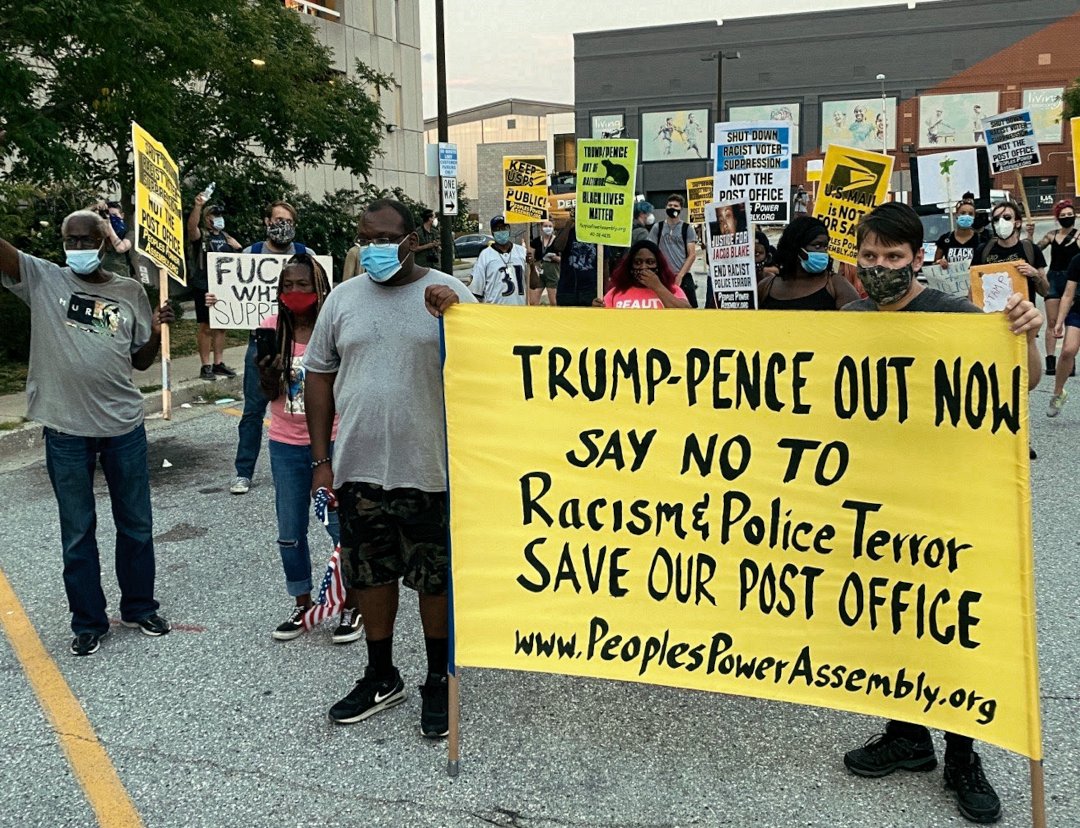
Trump lays groundwork to steal election

Aug. 27 protest at Ft. McHenry, Md., where Vice President Pence was appearing, demands end to attacks on Postal Service and voting rights.

The newly unleashed federal police force entered the Portland, Ore., area on Sept. 3 and assassinated anti-fascist activist and Black Lives Matter supporter Michael Reinoehl. Attorney General William Barr triumphantly announced: Agitator removed.” 

In the U.S., we’ve been told, one of the marks of democracy is that there is no national police force. The only police are employed by state and local governments, not the federal government. That excludes the Federal Bureau of Investigation, which claims it is not a national police force because it is confined to enforcing violations of federal laws, while most laws in the U.S. are state laws. 

However, since the creation of the Department of Homeland Security, established after 9/11 under President George W. Bush, federal security forces often wear uniforms that identify them as “police.” These are the secret, unidentified federal police being used against the people of major working-class cities where Black Lives Matter protests have been ongoing since the Minneapolis police murdered George Floyd on May 25, 2020.

Could Trump use these paramilitary forces to stage a coup d’etat if he loses the Nov. 3 presidential elections?

Trump has hinted that he might do that. When asked by Fox News anchor Chris Wallace whether he would accept the results of the presidential election, Trump answered: “It depends. I think mail-in voting is going to rig the election.”  

Pressed on whether he will accept the results of the November election, Trump responded, “I have to see.”

After the November 2016 election, when he lost the popular vote by almost three million votes to Hillary Clinton, Trump insisted that he had really won the popular vote and that Clinton only appeared to win because “unauthorized” immigrants had voted. Factcheck.org says there is no “evidence of wrongdoing, and numerous studies have found such voter fraud is virtually nonexistent.” 

Trump’s current election strategy counts on a turnout of “populist” racist voters combined with extensive voter suppression to ensure his reelection in the Electoral College. The Electoral College is an undemocratic institution that was created to ensure the dominance of the slaveholders in the U.S. and continues to do something like that today. (See The Electoral College’s Racist Origins,” The Atlantic, Nov. 17, 2019)

The state and the president

In The State and Revolution,” the Russian revolutionary leader and Marxist political theorist Vladimir Lenin wrote that the capitalist state is an institution of organized violence that is used by the ruling class of a country to maintain its rule. “State power,” Lenin said, is rooted in “special bodies of armed men having prisons, etc., at their command.”

The capitalist state machine is the legislative bodies, the prisons, the standing armies, National Guard and state militias, police and the government agencies. This is not the ruling class, but the instruments used by the capitalist class to maintain its rule.

Throughout the history of the state — from ancient slave states to medieval monarchies to bourgeois republics — there has been a tendency to personify the state power in the personality of an individual. In monarchies, it was claimed that the king was the living god on earth. In Japan, the emperor was considered a god right down to the defeat of the Empire of Japan in 1945. In current times, a president or to a lesser extent the prime minister personifies the state.

In the U.S., it is the president who is chief of state and personifies state power. The president personifies the state as the leader elected in a democratic election. However, in the U.S., which is a republic but not a democracy, no president has ever been directly elected by popular vote. Instead, the president is chosen by the Electoral College.

U.S. presidential elections are, by design, complicated procedures. The presidency is a national position, but the elections are organized by the individual states. According to current law and the Constitution as amended, all U.S. citizens who have reached the age of 18 and who have not been convicted of a felony — the exact rules vary state by state — are eligible to vote for the presidential electors on Nov. 3, 2020.

These electors form the Electoral College and are sworn to vote for a specific presidential candidate, with variations among the states as to how this is exactly decided. After the election, the electors will assemble on Dec. 14, 2020. That’s the Electoral College and the electors are expected, but not constitutionally bound, to vote for the candidates they represent. The electors cast ballots and pick a president. Immediately after this vote, the Electoral College is dissolved.

Finally, the Electoral College results are reported to Congress, where the Electoral College votes are to be counted and certified at a joint session on Jan. 6, 2021. That is when the victorious candidate formally becomes the president-elect. 

That’s the law. But there are also unofficial election rules. 

One unofficial rule is that only a Democrat or a Republican can be president. The laws protect the status of the two parties as official, putting them automatically on every ballot and restricting or prohibiting any other parties. This limit on parties in the U.S. makes it the least diverse of all the major capitalist countries, where normally, there are many political parties.

Hillary Clinton told to concede before results were known

Another unofficial rule is that the losing candidate in the presidential election, whether Democrat or Republican, is expected to concede as soon as possible to the victorious candidate. This is expected to occur on election night, when the TV networks “call” the election based on computer predictions of the results.

This occurs weeks before the Electoral College formally elects the president and two months before Congress certifies the result. Usually, the actual election of the president by the Electoral College is barely mentioned in the media.

In 2016, when it was predicted that Trump would carry the Electoral College, President Barack Obama called Hillary Clinton and demanded she concede the election to Donald Trump. You need to concede,” Obama told Clinton early on election night. 

Since Clinton was widely expected to win, there was some concern that she might resist or at least postpone conceding. This could have sparked a broader movement to keep Trump out of the White House, perhaps because he had lost the popular vote.

When Obama called Clinton demanding that she concede, the result of the popular vote wasn’t known. But at 1:30 a.m., the TV networks were predicting that Trump had won the Electoral College vote. Under the U.S. electoral system, that’s all that matters. It turned out that Clinton had gotten almost three million more votes than Trump. But the electors are chosen not on a national but a state basis, and on this basis, electors pledged to Trump were in the majority.

In theory, Clinton could have demanded that the GOP-majority Electoral College bow to the popular vote, which showed that the majority did not want the racist far-right Trump to be president. Also, the popular vote was extremely close in three states — Wisconsin, Michigan and Pennsylvania — where Trump had won by extremely narrow margins and preelection polls had indicated that Clinton would prevail. 

There was also the problem of widespread suppression of the Black vote. Racist voter suppression was restored by the Supreme Court in a 2013 decision that voided much of the Voting Rights Act of 1965, which was the first time that “one person, one vote” was made law in the U.S.

Clinton could have demanded recounts in these states, but didn’t. Jill Stein of the Green Party demanded recounts in Pennsylvania, Michigan and Wisconsin and raised more than $7 million to fund it, but ultimately, the effort was blocked by the courts.

However, Obama and the Democratic Party rejected such a challenge from the very beginning. Within a few hours, Clinton had already bowed to the overwhelming pressure and conceded the election to Trump. The media began to refer to Trump as the “president-elect,” though from a legal point of view he was not yet the president-elect. This killed any attempt to challenge Trump’s right to assume office, which he had no democratic claim to.

But the U.S. Constitution was written by and for slaveholders. In the words of Supreme Court Justice Thurgood Marshall, the Constitution and its many undemocratic features legalized slavery. At the time, there was no bourgeois democracy anywhere in the world and there were no plans for democracy. In the Federalist Papers, democracy was dismissed as mob rule — the mob being poor people and farmers — and slaves were dismissed as property, not people.

Trump had the slaveholders’ Constitution behind him in his claim to the presidency.

What will Trump do?

So far in the election campaign, there have been few if any differences in domestic and foreign policy between Trump and the extremely conservative Joe Biden. It seems improbable that Trump could find enough support to end more than 230 years of uninterrupted constitutional rule. It is this long period that gives the U.S. government its legitimacy.

The ruling U.S. capitalist class, dominated by the billionaires for Trump, may not support an open Trump coup, which would also put an end to the government’s legitimacy. After all, Biden wouldn’t be a real change. Biden’s primary campaign promises are to avoid Trump’s extreme racist rhetoric at home while continuing to target U.S. “enemies” such as China, Iran, Venezuela, Cuba and Zimbabwe. The essence of U.S. imperialism and its policies would remain unchanged.

However, Trump could get support for stealing the election as long as a pretext for constitutional rule is maintained. Indeed, this is an old tradition in the U.S. Tammany Hall, the corrupt Democratic machine that dominated New York City politics from the early 19th century until the 1960s, was notorious for the slogan, “Vote early and vote often.” Chicago, also home of a corrupt Democratic machine, was infamous for its “Chicago Methods” of stealing elections.

It is widely believed that John F. Kennedy won the presidency in 1960 only because the Chicago machine — Mayor Richard J. Daley and the Chicago Mob — managed to steal enough votes to swing the state of Illinois vote from Republican Richard Nixon to Democrat Kennedy. 

Republican Nixon conceded the election of 1960 that Democrat John F. Kennedy had stolen from him, just as Democrats Al Gore in 2000 and Hillary Clinton in 2016 conceded elections that were stolen from them.

For a hundred years, from the end of the Civil War until 1968, the “Jim Crow” system of apartheid in the U.S. was built in no small measure by election-stealing by the Democratic Party, achieved through the illegal and unconstitutional suppression of the Black vote.  

There are many ways that U.S. elections are undemocratic compared to most capitalist countries. One way is that elections are held on a workday, not on a holiday or a weekend, as they are in all other countries. This makes it difficult if not impossible for most workers to vote. 

Exhausted by work and not inspired by the candidates, most workers choose not to stand in line for hours to vote.

Voting by mail is safe and democratic

An attempt to overcome this limitation on voting has been the introduction of mail-in voting. Under this system, a ballot is mailed to eligible voters — either all voters or on request to individual voters. This way, voters have time to mark the ballot and then mail it in. They have more time to consider the issues and are less likely to make a mistake in marking the ballot.

This year, the still-rising COVID-19 pandemic means that if you stand in line to vote in a “booth” on Nov. 3, you will not only experience an inconvenience, you will be risking your life and the lives of your loved ones.

It appears that the majority of U.S. voters prefer Joe Biden as a “lesser evil” to the widely hated Donald Trump. They might be willing to go out of their way or vote after an exhausting working day to help get Trump out of the White House. But how many will be willing to risk their lives to do this? And of those who are willing to risk their own lives, how many are willing to risk the lives of family members if they catch COVID-19 while standing in line to vote? 

The Republicans and Trump are betting that many potential Biden voters will not be willing to risk the lives of themselves and/or their loved ones simply to vote for Biden.

Trump, therefore, has made a special issue of opposing voting by mail. He claims that voting by mail enables widespread “fraud.” In reality, he means voting by people of color. 

Trump threatened to sue the state of Nevada, whose legislature, now dominated by Democrats, has passed a vote-by-mail law. Trump even claims that if voting by mail is allowed, not a single Republican will ever again be elected to any office.

Though exaggerated, there is some truth in that. Under present U.S. political conditions where there is low socialist class consciousness in the working class, it has been a rule of thumb that if voter turnout is high the Democrat wins, and if it is low the Republican wins. Many elections are won by the Republicans because potential Democratic voters, though more numerous than Republican voters, are not inspired enough to bother to vote.

Trump has also stepped up his attack on the U.S. Postal Service with moves toward privatization. The attacks on the post office are significant because voting by mail is the only democratic and safe way to vote this year. Under the new postmaster-general, Trump appointee Louis DeJoy, mail deliveries have slowed considerably, according to the postal workers’ unions. Also, many mailboxes and mail-sorting machines have been removed.  

While public outrage has forced DeJoy to promise not to remove any more mailboxes and sorting equipment, he has indicated he will not replace those that have already been removed. If there is widespread voting by mail despite the obstacles, reporting of the November election results will be delayed. This increases the chances that the results will be contested, especially if Trump loses.

That’s where Trump’s statements come in that he may not “accept the results” because they will be fake, especially if voting by mail is allowed. The results, Trump said, will “be rigged.” By “rigging,” Trump means more people who are legally entitled to vote are voting.

Who will concede?

The unofficial rule is that a presidential candidate becomes the “president-elect” when his or her opponent concedes. However, once the candidate does “concede,” it becomes hard to build a movement in the streets or elsewhere to contest a stolen election. Richard Nixon in 1960, Al Gore in 2000 and Hillary Clinton in 2016 all put the stability of the state power ahead of the rules of democracy and the legalities that govern U.S. elections.

Trump hints that he will not concede the election even if the broadcast networks project Biden as the winner in the Electoral College. Instead, he may declare that the election was rigged. 

Perhaps Trump will challenge the result in the courts, including the Supreme Court. Remember, the Republican-controlled Supreme Court reversed the results of the 2000 elections by handing the White House to defeated Republican candidate George W. Bush. Could they do so again in 2020?

If Trump does not concede, according to previous practice, the media will not declare Biden the “president-elect.” Then, Trump’s reactionary-racist base may rally in the streets, perhaps even in armed demonstrations, demanding the courts declare Trump the winner. 

By allowing the elections of 2000 and 2016 to be stolen from them without a fight, the Democrats have made it much easier for Trump to steal the election in 2020.

Trump has good reason to believe that Biden would quickly concede the election to him if Trump has any pretext at all for claiming he won the Electoral College. If Biden concedes the election, the media will declare Trump “reelected,” and he will be sworn in for his second term as the unchallenged “legitimate” president of the United States on Jan. 20, 2021. If Biden doesn’t concede, it opens the possibility for a broad movement to “vote in the streets” and stop Trump from stealing the election.

Strugglelalucha256


Black voter suppression near 1950s level

The Supreme Court unanimously ruled July 6 that states can penalize members of the Electoral College who do not support the winner of their state’s popular vote in a presidential election. 

The court’s ruling is in response to the 2016 presidential election, when 10 electors voted for someone other than their state’s chosen candidate, highlighting how electors have the potential to swing an election. The ruling does not in any way change the Electoral College system.

The U.S. does not have direct elections for the president of the republic, though direct elections are considered to be the norm for a bourgeois democracy. The ability to vote directly is synonymous with democratic rights; the inability synonymous with denial of rights. The Electoral College system, borrowed from the Roman slave empire’s constitution some 2,000 years ago, gives only a semblance of voting rights, keeping real power in the hands of the wealthy few.

Indirect elections, through the Electoral College, increase the power of the wealthy. 

In the 2000 election, George W. Bush lost the popular vote but won in the Electoral College. The same happened again with Donald Trump, who lost the popular vote in 2016 by almost 3 million votes — over 2 percent  — but won the indirect Electoral College vote.

The 2020 election campaigns of the Democrats and Republicans have almost exclusively focused on winning the Electoral College vote, particularly in what are called “battleground states.” 

Court gutted Voting Rights Act

The Supreme Court has already gutted the Voting Rights Act of 1965. The court’s 2013 Shelby v. Holder ruling eliminated federal oversight of state election and voting laws.

According to the Brennan Center for Justice: “The decision in Shelby County opened the floodgates to laws restricting voting throughout the United States. The effects were immediate. Within 24 hours of the ruling, Texas announced that it would implement a strict photo ID law. Two other states, Mississippi and Alabama, also began to enforce photo ID laws that had previously been barred because of federal preclearance.”

In July 2017, in Georgia, 600,000 people, some 8 percent of the state’s registered voters, were purged from the rolls and required to re-register — an estimated 107,000 of them simply because they hadn’t voted in recent elections. In 2018, the state blocked the registration of 53,000 state residents, 70 percent of whom were African American.

Voter ID laws and other restrictions that fall most heavily on African American and Latinx people have been initiated in a number of other states, not all in the South. Polling locations have been closed, early voting restricted and registration rules made stricter.

Black voter suppression in this country has returned to near 1950s levels.

Constitution gave power to slaveholders

In 1787, the Constitution was adopted to insure that the executive power was always held by the slave-holding class. Of the first 10 presidents of the U.S., only two, John Adams and John Quincy Adams, were not slave owners.

In writing on the Electoral College’s racist origins, Yale constitutional law professor Akhil Reed Amar says: 

“If the system’s pro-slavery tilt was not overwhelmingly obvious when the Constitution was ratified, it quickly became so. For 32 of the Constitution’s first 36 years, a white slaveholding Virginian occupied the presidency.

“Southerner Thomas Jefferson, for example, won the election of 1800-01 against Northerner John Adams in a race where the slavery-skew of the Electoral College was the decisive margin of victory: without the extra Electoral College votes generated by slavery, the mostly southern states that supported Jefferson would not have sufficed to give him a majority. As pointed observers remarked at the time, Thomas Jefferson metaphorically rode into the executive mansion on the backs of slaves.” (“The Troubling Reason the Electoral College Exists” by Akhil Reed Amar, Time, Nov. 8, 2016)

More than two centuries after it was designed to empower a slavocracy, the system continues to suppress the Black vote and empower the wealthy.

Voting in 1787 was restricted to white male adult property owners, about 6 percent of the population. In the early 1800s, the property requirement was gradually changed to paying taxes so that by 1857, all white male taxpayers were allowed to vote. Citizenship was not required until 1928, following an anti-socialist, anti-immigrant campaign that led to the illegal deportation of 1.8 million people.

The Reconstruction era 15th Amendment states that voting rights cannot be denied or abridged based on “race, color or previous condition of servitude.” And briefly, voting rights were opened to African Americans. Disfranchisement came after the defeat of Reconstruction, with Jim Crow laws effectively keeping voting limited to white male taxpayers. 

The segregation and disenfranchisement laws known as “Jim Crow” represented a formal, codified system of racial apartheid that dominated the U.S. in the North as well as the South for three quarters of a century beginning in the 1890s.

Great struggles were waged in the following years and over time more democratic rights were won, particularly the right to vote. After a mass women’s movement for suffrage, women’s right to vote was won in 1920, with the 19th Amendment to the Constitution. 

In 1964, the 24th Amendment prohibited the requirement to pay poll taxes in order to vote. Not until the historic Civil Rights movement won the Voting Rights Act of 1965 was a nationwide “one person, one vote” electoral system established in the U.S., with the exception of prisoners. 

6 million denied right to vote

According to the Sentencing Project, as of 2010 an estimated 6 million people in this country were denied the right to vote because of a felony conviction, a number equivalent to 2.5 percent of the U.S. voting-age population. That number is certainly higher today. Given the racist justice system, these 6 million are predominantly from Black and Brown communities.

So the 1965 Voting Rights Act was functionally broken by the Supreme Court in 2013.

As Civil Rights leader Rep. John Lewis said this year on June 25, the anniversary day of the Supreme Court’s Shelby v. Holder decision: “The record is clear. A rampant war is being waged against minorities’ voting rights in my home state of Georgia and across the nation.” 

Lewis has introduced a resolution for a Right to Vote Amendment to the Constitution, as the right to vote is still not guaranteed. The amendment includes a provision to stop any attempts to restrict voting rights.

This year’s elections have already seen widespread denial of voting rights. In fact, the Trump campaign and the Republican National Committee have mounted an aggressive national effort to suppress voting rights, which they call “voter fraud.” It’s an in-your-face racist maneuver. Without a fight, the Black vote will be suppressed.

The Black Lives Matter movement has put a spotlight on the institutionalized racism governing this country. The electoral system is part of that. There’s more than statues that need to be toppled.

Strugglelalucha256


The rule of the rich is not democracy

The U.S. was established as a republic in 1787 and remains so to this day. It is a republic, but not a democracy.

The American Revolution was not a bourgeois democratic one, like the great Haitian Revolution of 1791–1804, where the ownership of the land was turned over to the formerly enslaved. Democracy, as Aristotle explained, means the rule of the poor.

Aristotle, describing the democracy of his day in Greece, was quite explicit about the fact that democracy means rule by the poor. Rule by the rich is oligarchy. Aristotle says that the real distinction between oligarchy and democracy is in fact the distinction between whether the wealthy or the poor rule, not whether the many or the few rule.

In the U.S., the wealthy rule, not the poor. It is an oligarchy, not a democracy.

The American Revolution — as the War of Independence by the 13 North American colonies is called — had a republican and anti-monarchy character. But republicanism is the political ideology of a landlord class defending itself from the encroachments of the king, not anything democratic. 

In the 13 colonies, the leadership of the American Revolution consisted of men of wealth and land; 34 of the 47 signers of the Declaration of Independence were slaveholders, perhaps the most conservative leadership of any revolution in history. 

Not until the Civil War and Black Reconstruction was there a democratic revolution in the U.S., but the Reconstruction revolution was drowned in blood. Pro-slavery terrorists murdered tens of thousands of Black people in the South from 1867 to 1877, burying the Reconstruction revolution.

Independence for bankers and slaveholders

The 1776 Declaration of Independence was a call to revolution written by bankers and plantation owners. It includes in its list of violations by the King of England Lord Dunmore’s Proclamation in 1775, also known as the First Emancipation Proclamation, that freed all enslaved peoples in the Royal Colony of Virginia. 

Another grievance against the king cited in the declaration was the Royal Proclamation of 1763, a decree prohibiting settlers moving into any land west of the Appalachian Mountains and recognizing the rights of the Indigenous peoples living there.

John Adams says that the American Revolution did not start in 1776 but in 1760, at the end of the Seven Years War (also known as the French and Indian War), a war that was led by the commander of the Virginia militia, the wealthy plantation owner George Washington. With their victory, the 13 colonies took control of all the Native land from the East Coast to the Mississippi River. Washington, one of the biggest slaveholders in Virginia, was given 20,000 acres of land in the Ohio region for his services in the war.

The British crown borrowed heavily from British and Dutch bankers to bankroll the war, doubling Britain’s national debt. King George III declared that since the French and Indian War was for the benefit of the colonists, they should contribute to paying down the war debt. To defend this newly won territory from future attacks, King George III also decided to install permanent British army units in the Americas, which required additional sources of revenue. These are the taxes that the colonists objected to and rallied against.

Taxes, however, weren’t the only objection. One of the offenses cited by the colonists against the King of England was the decree prohibiting settlers West of the Appalacians. In May 1763, Pontiac, an Ottawa leader, led a number of Native nations in the area of the Great Lakes in an uprising against British forces and settlers along the frontier, commonly called Pontiac’s Rebellion. The Royal Proclamation served as a peace treaty with the Indigenous nations who were battling to defend their homeland. 

Today, the Royal Proclamation of 1763 is recognized under international law as establishing the legal precedent that the Indigenous population had rights to the lands they occupied.

The colonists considered the entire territory West to the Mississippi to be their own conquered land and refused to recognize the Royal Proclamation.

War against the British and Native nations

The War of Independence (1775-1783) was fought not just against the British, but also against the Native peoples. At the end of the war, victory was declared not just over Britain but also over the Indigenous nations.

The newly formed United States and the Iroquois signed a treaty in 1784 under which the Iroquois ceded much of their historical homeland to the U.S., followed by another treaty in 1794 in which they ceded even more land. The governor of New York state, George Clinton, was constantly pressuring the Iroquois to turn over their land to white settlers. At the same time, European settlers continued to push into the lands beyond the Ohio River, leading to a war between the Western Confederacy and the United States. The war against the Native nations continues to this day.

Because the leaders of the War of Independence were the landowners and slaveholders, merchants and bankers, shippers and lawyers, the enslaved peoples and tenant farmers tended to side with the British against the revolution. That was behind British Gov. Lord Dunmore’s proclamation liberating all enslaved peoples. The British raised several Black regiments during the war. The proclamation also absolved all tenant farmers of their feudal rents, which were owed to the local landlords.

After the War of Independence was won, each of the 13 former colonies had separate governments run by the landowners and slaveholders, merchants and bankers, shippers and lawyers. They had led the rebellion, but the soldiers who fought the war were all from the laborers and small farmers who were promised “Life, Liberty and the pursuit of Happiness” in the Declaration of Independence’s call to revolution. They were also promised pay for their service. They got none of it.

Shays’ Rebellion

Shays’ Rebellion has been relegated to obscurity in the U.S. history books seeking to glorify the rule of slaveholders like George Washington and James Madison and financiers like Alexander Hamilton. (See “Whose Constitution is it?” by Gary Wilson, 1987)

Daniel Shays was a poor farm laborer who had joined the Continental army when the War of Independence broke out. He fought at Lexington, Bunker Hill and Saratoga and was wounded in action. By 1786, Shays had resigned from the army since he hadn’t been paid. Back at home, he found himself in court for nonpayment of debts. Army veterans were given certificates of promise instead of pay.

Farmers, many of them veterans, began to organize and form committees. It was a poor people’s mobilization. In Vermont and New Hampshire as well as Massachusetts, rallies were held against the heavy taxation and debt burden. The uprisings in Western Massachusetts were more foreboding. Taxes were high and the poor had no money to pay what they owed. Farmers with guns began to show up at court hearings to prevent their land from being taken away. Even the state militia, when it was called out to put down the farmers, split its ranks between those supporting the farmers and those opposed.

At Great Barrington, Mass., a militia of a thousand was called out to put down the armed crowd. The militia would not move when ordered. When the chief judge suggested that the militia divide with those supporting the court going to one side of the road and those opposed to the other, over 800 went against. The court adjourned and the crowd cheered.

What brought Shays onto the scene was the indictment of 11 leaders of those farmers’ protests. Shays organized a thousand armed farmers, most of them army veterans, and led them to Springfield, where the court was sitting. As they marched through the square their ranks grew. The judges postponed the hearings. The poor people’s army closed the courts for several months. Shays’ Rebellion was serious.

The upper classes throughout the 13 states were thoroughly frightened at this armed uprising of poor people. There was no money to pay the veterans what they were owed, but they had the money to raise a new army to put down Shays’ army.

Gen. Henry Knox, who became the first secretary of war of the United States, wrote a letter to George Washington at the time, warning of the dangerous ideas of the Massachusetts farmers. These farmers believed that since the revolutionary war had been fought “by the joint exertions of all, therefore [the land, etc.] ought to be the common property of all.”

A call went out immediately for a strong central government to, in the words of the preamble of the Constitution, “insure domestic tranquility.”

The Constitutional Convention, secretly assembled in Philadelphia in 1787 right after Shays’ Rebellion was put down, did not represent the small farmers, the slaves, the poor indentured servants, women, Native peoples or any of the other oppressed. They were the bankers, merchants, landowners and slaveholders, shippers and lawyers. They represented the rich.

In 1776, African Americans comprised about 20 percent of the entire population in the 13 colonies. At that time, enslaved people were about 60 percent of South Carolina’s total population and 40 percent of Virginia’s. Although the largest percentages of enslaved peoples were found in the South, slavery did exist in the middle and Northern colonies. In Boston and Newport, 20 to 25 percent of the population consisted of enslaved laborers. Other large cities, such as Philadelphia and New York, also supported significant enslaved populations.

Although enslaved people in cities and towns were not needed as agricultural workers, they were employed in a variety of other capacities: domestic servants, artisans, craftsmen, sailors, dockworkers, laundresses and coachmen.

All slaves were considered property that could be bought and sold. Slaves thus constituted a portion of the owners’ overall wealth. Although Southern slaveholders had a deeper investment in slavery than Northerners, many Northerners, too, had significant portions of their wealth tied up in the ownership of enslaved people.

Constitution modeled on Roman Republic

When the framers of the Constitution met in Philadelphia, they chose as a model the Roman Republic, a slave state. It was a republic, not a democracy. Rome was considered to be the most stable slaveholder state in the past. And that’s what they wanted.

The U.S. Constitution is almost a direct copy of that of Rome. The Roman Constitution was designed to give the semblance of power to the free, nonenslaved citizens (men only) while actually concentrating real power in a senatorial elite. The state structure in Rome was made up of: 

  1. The Consul. Consuls held the highest office and took on the kingly “power to command.” Two consuls were elected for a year and alternated in office on a monthly basis. The president of the U.S. has the same position today as the Roman consul. The consul has supreme command of the army and the civil administration.
  2. The Senate, which could pass decrees and represented the class from which the consuls were generally chosen. The U.S. Senate was explicitly modelled on this. Two senators were appointed by each state in the U.S.; direct election of senators didn’t happen until 1913 with the 17th Amendment.
  3. The “comitia centuriata” or Assembly of the Centuries, an assembly of military officers (property owners) that selected the consul by indirect election: almost exactly copied by the U.S. Electoral College.
  4. The Plebian Council or People’s Assembly. This was a mass democratic assembly that could pass laws. The Plebian Council operated on the basis of direct democracy, not elected representatives. It could not, however, set its own agenda, having to vote on motions put to it by magistrates who were invariably from the upper classes. The U.S. Constitution does not have a popular democratic assembly, but instead substitutes a House of Representatives, based on elections (which are funded by wealthy oligarchs).

The effect of the Roman structure was that executive power was always held by a member of the slave-owning patrician class. The Roman Senate likewise was always made up of slave owners rather than common people. Similar effects were achieved in the U.S. Of the first 10 presidents of the U.S., only two, John Adams and John Quincy Adams, were not slave owners. John and John Quincy were both lawyers, serving bankers and landlords.

The Constitution legalized slavery, as noted by Supreme Court Justice Thurgood Marshall in 1987, and specifically prohibits Native peoples from having any rights.

Elections by ballot favor wealthy

Elections by ballot, Aristotle also said, are a mark of oligarchy, the rule of the wealthy, not of democracy, the rule of the poor.

Elections always favor the wealthy. It takes money to be a professional politician. The rich can spend to influence elections and have an education that prepares them as orators. Indirect elections, the Electoral College, only increases the rule of the wealthy. 

In the 2000 election, George Bush lost the popular vote but won in the Electoral College. The same happened again with Donald Trump, who lost by almost 3 million votes — over 2 percent  — but won the indirect Electoral College vote.

The U.S. government is made up of professional politicians, lobbyists and bureaucrats.

After the American Revolution, most states allowed only white male adult property owners to vote, about 6 percent of the population. In the early 1800s, the property requirement was gradually changed to paying taxes so that by 1857, all white male taxpayers were allowed to vote. Citizenship was not required until 1928, following an anti-socialist, anti-immigrant campaign that led to the illegal deportation of 1.8 million people.

The Reconstruction era 15th Amendment states that voting rights cannot be denied or abridged based on “race, color, or previous condition of servitude.” And briefly, voting rights were opened to African Americans. Disfranchisement came after the defeat of Reconstruction, with Jim Crow laws effectively keeping voting limited to white male taxpayers.

Great struggles were waged in the following years and over time more democratic rights were won, particularly the right to vote. After a mass women’s movement for suffrage, women’s right to vote was won in 1920, with the 19th Amendment to the Constitution. 

In 1964, the 24th Amendment prohibited the requirement to pay poll taxes in order to vote. Not until the historic Civil Rights Movement won the Voting Rights Act of 1965 was a nationwide “one person, one vote” electoral system established in the U.S., with the notable exception that prisoners are often denied the right to vote. The U.S. currently has 2.3 million people in prison, the most of any country in the world.

Reconstruction: A democratic revolution

A democratic revolution in the U.S. came with the Civil War (1861-1865) and Black Reconstruction (1865-1877), but that revolution was drowned in blood, much like the revolution taking place at the same time in France — the Paris Commune of 1871. Reconstruction is known as the unfinished revolution.

It was a revolution that destroyed forever the power of the slave owners as a class and chattel slavery as a system. The institution of slavery was overthrown, but the popular democracy that emerged in Reconstruction was subverted by racism breaking the unity of the poor, the laboring class, against the rich, and then crushed by the Ku Klux Klan and the Northern capitalists.

Reconstruction instituted voting rights, free public education and equal rights for all, including former slaves and women. There is no more democratic period in all of U.S. history. W.E.B. Du Bois’ book “Black Reconstruction” details the significant, really revolutionary, advances made under Reconstruction.

As Du Bois notes elsewhere, socialism is the completion of the Reconstruction revolution. (See Black August 1619-2019 compiled by Gloria Verdieu)

Socialism is democracy, the rule of the poor, the working class. That’s the revolution that has to be finished.

Strugglelalucha256


Lenin on communist election tactics

Reprinted below is a report by William Paul — “Lenin on Communist Tactics in Britain” — that appeared in “The Communist,” published in London in 1920. Struggle-La Lucha believes this report holds useful insights for revolutionaries in the U.S. about relating to the Bernie Sanders election campaign.

In 1920, several revolutionary socialist groups in Britain were working together to form a Communist Party. One of the main obstacles to forming a united party was disagreement on the question of the parliamentary elections and the Labour Party.

The Labour Party was not a revolutionary party. In fact, at the outbreak of World War I, the head of the party resigned to protest the war and Arthur Henderson became head because of his pledge to support the war. Henderson even served in Prime Minister Lloyd George’s war cabinet.

Nevertheless, after the war, Henderson and the Labour Party were running on a democratic socialist platform, which had popular support among the workers.

The question was, should the communists support Henderson and the Labour Party in the elections? Some in the communist grouping said that communists must not compromise with reformism and take a direct road to revolution.

V.I. Lenin, leader of the socialist revolution in Russia, who had closely followed the working-class movement in Britain, responded in both writings and meetings with British communists. Lenin wrote that “the British Communists very often find it hard even to approach the masses, and even to get a hearing from them. If I come out as a Communist and call upon them to vote for Henderson and against Lloyd George, they will certainly give me a hearing.” He urged the communists to run their own candidates in the local elections for parliament, who would declare their support for Henderson and the Labour Party. 

Lenin noted that the fact that most British workers followed the lead of Henderson and the Labour Party and had not yet had experience of a government composed of people supporting a reformist socialist platform — “an experience which was necessary in Russia so as to secure the mass transition of the workers to communism” — undoubtedly indicated that the British communists should participate in parliamentary action, that they should, from within parliament, help the masses of the workers see the results of a Henderson government in practice, and that they should help Henderson defeat the united forces of Lloyd George, head of the Liberal Party, and Churchill, head of the Conservative (Tory) Party.

Lenin on Communist Tactics in Britain

By William Paul

The Communist, London, December 2, 1920

I have had a long and interesting interview with Lenin. We spoke on various aspects of the movement, and particularly upon the growth and progress of Communism in Britain. Lenin had read the report of the Communist Unity Convention held in London last August. He said that the verbatim report of the speeches and resolutions of the Convention showed that the formation of the Communist Party marked an epoch in the history of the British revolutionary movement. …

Lenin then proceeded to discuss the attitude of the Communist Party towards the Labour Party in view of the much-talked-of forthcoming General Election. His views on the subject showed that he abhors the type of revolutionary who has a canalized, or single track, mind. 

Lenin looks upon every weapon as necessary in the conflict with capitalism. To him, as a good student of old Dietzgen, every weapon, every policy, and every problem must be examined in the terms of its relations to the needs of the moment and the means at our disposal. This explains why he does not go out of his way to extol one particular weapon. He clearly realizes the value of revolutionary parliamentary action, but he also understands its limitations as a constructive power in the creation of a Workers Industrial Republic. To Lenin, the test of the real revolutionary Communist is to know when to use a given weapon and when to discard it.

Talking on the Labour Party, Lenin said he was very glad to learn that it had refused to accept the affiliation application of the Communist Party. It was a good move to have applied for affiliation, because the refusal of the Labour Party to accept Communists in its ranks showed the masses exactly where the Labour Party stood. 

Henderson had, thus, unwittingly paid a great tribute to the growing power of revolutionary Communism in Britain by being afraid to have aggressive Communists in his organization; and the Labour Party, by its own action, in turning down the Communist Party, had plainly indicated that there was, at last, a fighting group in Britain which had attracted good mass fighters to its ranks. 

Of course, continued Lenin, we must not forget that the Communist Party in its application for affiliation to the Labour Party very frankly put forward certain conditions which would have given it full freedom of action to conduct its own policy in its own way. We must never enter into negotiations with bodies, such as the Labour Party, without demanding full freedom of action. …

Lenin passed on to review the political situation in Britain. 

The next General Election would be of paramount importance, and the Communists ought to play a most important part in it. As Lenin favored the policy of supporting the Labour Party, in order to assist it to capture political power, this subject was thrashed out in detail. Lenin advises the Communists to help the Labour Party to get a majority at the next election in order to facilitate the general decadence of the Parliamentary system. 

Already, he reasoned, there are thousands of people in Britain who feel that the Parliamentary system of social representation cannot solve the problems which history has placed before it. These people had become discontented and disillusioned regarding the Parliamentary system of social control as a result of the inability of that machine to cope with the vital tasks of modern society. 

In other words, the passage of events was providing a series of concrete experiences which were educating the masses regarding the general breakdown of capitalism, in the sphere of social representation. The toiling masses, who had neither the time nor the inclination to examine social theories, always learnt their political lessons by undergoing concrete experiences. 

The task of the revolutionary Communist is not only to preach his Marxist theories; he must prove that his theories are correct by compelling his opponents to act in such a way that they provide the practical lessons which enables the Communist to test his theories before the eyes of the masses. 

The test of Marxist and Communist theory is experience. How then can the Communists of England prove to the workers that the Parliamentary machine has broken down and can no longer serve them or the interests of their class? 

Since the days of the Armistice, the Parliamentary system in England has been on trial. During the past two years the political policy of Lloyd George had shown many workers how little they could expect from any Parliamentary form of Government manned by the capitalist class. Since the Armistice, Lloyd George, Churchill, Bonar Law, and Co., have had an opportunity to demonstrate what they could do, and their reign of office has been one trail of disasters so far as the workers are concerned. 

The Labour Party solemnly assures the masses that they could solve the problems confronting society if once they were in control of the Governmental machine. So far as Henderson, Thomas, and the Labour Party are concerned, they only differ from Lloyd George in that they have never had an opportunity to control the Government. Knowing, as we do, that Henderson, MacDonald, and their followers cannot solve the immediate problems confronting the masses through the Parliamentary machine, we ought to prove the correctness of our theory by giving the Labour Party a chance to prove that we are correct. 

The return of the Labour Party to power will accelerate the inevitable collapse of the Parliamentary system, and this will provide the concrete experiences which will ultimately drive the masses towards Communism and the Soviet solution to the modern problems. For these reasons the Communists in Britain ought to support the Labour Party at the next election in order to help it to bring on, ever faster, the crisis which will ultimately overwhelm it. 

At this point, I interposed, and said that if the Communist Party officially assisted the Labour Party to capture political power in order to precipitate a crisis, it was just possible that the indignant masses, remembering that we had urged them to vote for the Labour Party, might sweep us away too, when the social crash took place. 

Lenin pondered over this for a moment and said that the Communist Party, in assisting the Labour Party to capture the Government, must make its own case very clear to the masses. He then advanced the following argument which he pressed forward very strongly, and which he wishes the Communist Party to discuss. He said the Communist Party could easily help the Labour Party to power and at the same time keep its own weapon clean. 

At the forthcoming elections, the Communist Party ought to contest as many seats as possible, but, where it could not put up a candidate, it ought to issue a manifesto in every constituency challenged by the Labour Party urging the workers to vote for the Labour candidate. The manifesto should frankly state that the Communist Party is most emphatically opposed to the Labour Party, but asks it to be supported in order that Henderson, MacDonald, and Co. may demonstrate to the masses their sheer helplessness. Such a manifesto, such a policy, would accelerate and intensify the problem now looming up before capitalism and its Parliamentary system. But, above all, such a policy would provide the concrete experiences which would teach the masses to look to the Soviet method as the historically evolved institution destined to seriously grapple with the manifold problems now pressing so heavily upon humanity.

We discussed this problem for some time and viewed it from many angles. I kept raising many points against Lenin’s position until at last he, no doubt scenting a good dialectical duel, challenged me to debate the whole matter in the columns of “The Communist.” I readily assented to this, and asked him when he would have his first contribution ready. He looked around sadly at the mountains of work—work involving the solution of international problems—piled up in front of him. I at once said I would write up his case for the Press, as I have done above. To this suggestion he heartily agreed.

I know, said Lenin, that it may seem awful to young and inexperienced Communists to have any relations with the Labour Party, whose policy of opportunism is more dangerous to the masses than that of consistent and openly avowed enemies like Winston Churchill. But if the Communist Party intends to secure and wield power it will be compelled to come into contact with groups and organizations which are bitterly opposed to it. And it will have to learn how to negotiate and deal with them. 

Here in Russia, we have been forced by circumstances to discuss and make arrangements with elements which would hang us if they got the chance. Have we not even entered into alliances and compacts with Governments whose very hands reeked with the blood of our murdered Communist comrades? 

Why have we entered into such contracts and adopted such a policy? It is because we are realists and not utopians. It is because, at present, international capitalism is more powerful than we are. Every move, each Treaty, and all our negotiations with capitalist States, are but one side of the Russian Soviet Government’s policy to conserve its strength in order to consolidate its power. Learn to meet your enemies and be not afraid. It tests your strength, it creates experiences, it judges the character of your members. And you may find that your most embittered critics are not in the camp of the enemy but are the shallow doctrinaires to whom revolutionary Socialism is a mere manual of phrases instead of a guide to action.

While we were talking, Lenin was continually interrupted by the arrival of cables, despatches and messages. He was frequently called to the phone. Despite these things, he could return quite serenely to the point under discussion. 

I confess that I was slightly agitated when entering the Kremlin; bad news had arrived from the various fronts; Poland was acting strangely at the Riga Conference; France had been indulging in one of her bullying outbursts; and Finland was on the point of signing peace. All these things, I imagined, would make it impossible for Lenin to settle down and have a quiet talk on the various details of the movement upon which I was anxious to have his opinion. 

When I entered the room he was courteous, cool and tranquil. He eagerly entered into a discussion of many points on Communist tactics, which, to some people, might have seemed almost trivial. Lenin is always anxious to hear of any new development in Marxism, and to him every aspect of the movement is important. I very timidly suggested the possible application of Marxist theory to a certain subject which had been monopolized by the anthropologists and ethnologists. He became enthusiastic over the problem which he quickly elaborated and extended, made several important suggestions, indicated where some good data could be found, and urged that the matter should be written and published. To Lenin, Communism is a synthetic philosophy.

After having had a talk with Lenin, it is easy to understand why his quiet and humorous style fails to impress middle-class intellectuals. People like Bertrand Russell are in the habit of meeting pompous bourgeois thinkers whose ideas on social theories are so incoherent and vague that they can only express themselves with great difficulty. This ponderous and floundering method of struggling to deliver an idea is, in certain quarters, mistaken for mental ability. Lenin, on the other hand, sees problems so clearly and is able to explain himself with such clarity and simplicity, that his conclusions seem to be the obvious deductions at which anyone would inevitably arrive.

Source: Marxist Internet Archive

Strugglelalucha256


The best democracy money can buy: Bloomberg is greasing the election

Millions of people know that billionaire Michael Bloomberg is trying to stop Bernie Sanders and buy the White House for himself. The former stop-and-frisk New York mayor has already spent over $400 million seeking the Democratic Party’s presidential nomination. He may spend billions more.

Bloomberg’s fellow billionaire, Amazon CEO Jeff Bezos, reportedly urged him a year ago to run for president. Bezos’ $104 billion fortune is even bigger than Bloomberg’s. Both of these tycoons run nonunion outfits.

When told of Bezos’ phone call to Bloomberg, Rep. Alexandria Ocasio-Cortez remarked: “They’ve got class solidarity. The billionaires are looking out for each other.”

Bernie Sanders sarcastically said that the two moguls, whose fortunes amount to a total of $164 billion, could make for “a strong grassroots movement.” Actually, the overworked employees in Amazon’s warehouses are among the largest contributors to the Bernie Sanders campaign.

Buying elections

Bloomberg isn’t just spending oodles of cash on Facebook and TV ads, like his $10-million Super Bowl commercial. Moneybags Mike is also buying endorsements, including those from elected officials. His tax-deductible charities are being used to purchase influence.    

Buying elections is nothing new for Bloomberg. In 2009, he spent $102 million, or about $183 per vote, to get re-elected mayor of New York City. Bloomberg had already spent $159 million in his previous successful runs for mayor in 2001 and 2005.

As repulsive as Bloomberg’s vote-buying is, there’s nothing illegal about it. Capitalist democracy is democracy for capitalists. Homeless people have the same “right” to contribute to political campaigns as Michael Bloomberg does with his $60 billion fortune

This is the sort of “democracy” that Wall Street wants to bring to Cuba and Venezuela. Working people there don’t want it and neither should we.

Hiring presidents 

Even with the U.S. dollar buying less than 15 cents of what it could buy 50 years ago, Bloomberg’s $60 billion stash is still a lot of money. It amounts to what 4 million low-paid workers earn in a year at the miserable federal minimum wage of $7.25 per hour.

But that’s only if these 4 million workers were able to work 40-hour weeks for the entire year and not suffer seasonal layoffs. That $60 billion also represents the annual wages of over 1.9 million workers earning $15 per hour. There was less inequality in the time of the Pharaohs.  

The United States has never been “a government of the people, by the people, for the people.” Forty-one of the 57 signers of the Declaration of Independence were slave owners. 

That means that 72 percent of these “founding fathers” directly profited from the African Holocaust. Among them was John Hancock, the guy with the big signature.

Money has always greased U.S. elections. The communist leader Vince Copeland wrote about this red, white and blue corruption in his book “Market Elections.” Almost $6 billion was spent on the 2018 congressional elections.

It’s been exceptional, however, for the biggest billionaires to try to seize the White House for themselves. When Treasury Secretary Andrew Mellon — whose family owned Alcoa, Gulf Oil and what is now the Bank of New York Mellon — made noises about running for president in 1928, his campaign went nowhere.

Nelson Rockefeller wasn’t able to become president either, although he came close by becoming the unelected President Gerald Ford’s vice president.

Big Capital prefers to hire their presidents. That was the case with professional politicians like Richard Nixon or Bill Clinton; the media-made “war hero” Dwight Eisenhower; or the washed-up movie star Ronald Reagan.

The wealthy and powerful knew that if a member of the Mellon or Rockefeller financial dynasty became president, they would steal everything they could. Another reason is that some capitalist intellectuals realize that there needs to be a curtain separating the billionaire masters from their bought-and-paid-for presidential puppets. 


Anybody but Bernie 

Bloomberg’s candidacy destroys this shell game. It proclaims in flashing lights that the United States is a government of the rich, by the rich and for the rich.

Many capitalists believe that Bloomberg’s fortune is the only thing that will stop Bernie Sanders from getting the Democratic nomination. If Bloomberg is able to steal the Democratic Party’s nomination at the Milwaukee convention, millions of people will be outraged.

It may be the catalyst for forming a mass working-class movement that will break decisively with the dead end of capitalist parties.

Both Trump and Bloomberg are wannabe dictators. “I have my own army in the NYPD [New York City Police Department], which is the seventh biggest army in the world,” proclaimed Bloomberg in 2011.

President Trump puts migrant children in cages. While Bloomberg was New York City mayor, thousands of youth — convicted of nothing — were sent to the Rikers Island prison simply because they couldn’t afford bail.

Among them was Black youth Kalief Browder, who spent three years in jail — two years of which were spent in solitary confinement — before his charges were dropped. Browder later committed suicide on June 6, 2015.

Bloomberg succeeding Trump in the White House will be like Bloomberg having replaced Rudy Giuliani in New York’s City Hall. Black and Latinx people suffered 20 years of hell from this racist tag team.

Michael Bloomberg may implode in the Feb. 19 Democratic debate. He still needs to be flushed out of politics. His $60 billion fortune should be seized for reparations.

Strugglelalucha256


El movimiento por Bernie Sanders: ¿De qué lado estás?

Por qué socialistas revolucionarios convocan a un apoyo crítico

8 de febrero de 2020 

No tenemos ninguna expectativa hacia el partido Demócrata. Es un partido guerrerista de multimillonarios y banqueros. Cualquier noción de que el Partido Demócrata represente a la clase trabajadora es una farsa. En su esencia, sigue siendo una institución neoliberal empeñada en preservar el dominio capitalista.

Guerras imperialistas destructivas han sido libradas bajo las administraciones del Partido Demócrata; los derechos de los trabajadores y beneficios para los pobres han sido despojados por cada administración, independientemente del partido. Lo que sí es constante, independientemente de qué partido gane, es el sistema de capitalismo e imperialismo que es el origen de tanta miseria humana.

Entonces, ¿por qué convocamos a un apoyo crítico al movimiento Sanders?

Bernie Sanders como candidato no es la cuestión crucial. Lo que sí es crítico es la lucha que su campaña ha despertado contra el sistema del Partido Demócrata. Una lucha que ha causado miedo en la clase dominante.

Esta campaña es un movimiento de la clase trabajadora, principalmente de jóvenes y cada vez más de los oprimidos, que desconfían profundamente del sistema de ambos partidos. Es un movimiento alimentado por la creciente ira contra el gobierno de los multimillonarios y la  creciente brecha entre ricos y pobres que ha dejado a tantos trabajadores empobrecidos.

El hecho de que la clase dominante esté tan preocupada y tan frenética por parar este movimiento, indica claramente su propio temor de que el movimiento, galvanizado en torno al cuidado médico,  la educación gratuita, la contención de la crisis climática, etc., bien podría perder el control. Lo que significa que podría abandonar la apretada camisa de fuerza del Partido Demócrata.

Los ataques cada vez más virulentos contra Bernie Sanders han ido ganando fuerza desde que se hizo evidente que la campaña de Sanders podría ganar las primarias. Por supuesto, habrá millones de trucos desde ahora hasta la Convención Demócrata en julio, y hay una gran probabilidad que haya robo de las elecciones.

La debacle del Caucus de Iowa fue un recordatorio repugnante de que las fuerzas detrás de la cortina mueven los hilos. Que hicieran tanto para destruir el Caucus de Iowa en un intento por frenar la campaña de Sanders, demuestra su verdadero desprecio por su susodicha democracia.

Multimillonarios rechazan hasta pequeñas reformas — su respuesta es la guerra imperialista

La clase de multimillonarios y banqueros no está inclinada en este punto para dar mucho en forma de concesiones, ya sea para proporcionar servicios de salud, educación, frenar a los propietarios depredadores o aumentar el salario mínimo — ni mucho menos detener el terror policial y el sistema supremacista blanco que lo impulsa, cerrar los centros de detención de inmigrantes, respetar los derechos de indígenas, dar justicia a la mujer, a los géneros oprimidos y la comunidad LGBTQ2S o salvar el planeta.

El capitalismo como sistema está en crisis y por esto se le hace más y más difícil satisfacer las necesidades de las mases. No solo se ha ampliado la brecha entre ricos y pobres, sino que la próxima generación enfrenta la amenaza de un colapso planetario.

Lo que mueve a los capitalistas es la guerra imperialista en todas sus formas, ya sea por intervención directa o por sanciones. Los demócratas y los republicanos están unidos en los ataques imperialistas contra Venezuela, Cuba, Irán, Palestina, Corea, Zimbabue, China y otros países.

La importancia del movimiento

¿Llevaría Sanders esto a la conclusión lógica, o sea, abiertamente romper con el Partido Demócrata? Si bien es poco probable según sus propias palabras, sigue siendo una pregunta importante. Sin embargo, lo que hacen sus seguidores es aún más crítico.

Es el movimiento lo que nos interesa, y el potencial de una lucha más grande para empujar a la clase trabajadora hacia una dirección independiente en su propio nombre.

Muchos de nosotros en Struggle-La Lucha estuvimos muy activos en la organización y promoción de la “Marcha del Millón de Trabajadores” (17 de octubre de 2004), que fue fundada y dirigida por sindicalistas negros que convocaron a la marcha nacional en gran parte con el objetivo de desarrollar un movimiento independiente de trabajadores que se liberara de las cadenas del Partido Demócrata.

¿No deberíamos los socialistas y comunistas revolucionarios estar en el movimiento Sanders, especialmente si toma un giro crítico, para que podamos agitar, educar y explicar cuál podría ser el próximo paso?

Referéndum entre capitalismo y socialismo

Tanto antes de la convención demócrata — pero también, si por alguna razón imprevista Sanders gana la nominación — lo que de hecho tendrá lugar es un referéndum entre capitalismo y socialismo.

No importa tanto si Bernie Sanders es o no un verdadero socialista o un “demócrata del ‘New Deal’”: el socialismo es cómo el establecimiento burgués de ambos partidos define el tema. Trump ya está definiendo esto, al igual que muchos en el sistema del Partido Demócrata.

Llamado a revolucionarios disgustados con las elecciones burguesas

El sistema electoral de los EUA es totalmente antidemocrático. Solo fijémonos en quien puede y no puede votar y cuantas veces las elecciones han sido manipuladas, robadas, subvertidas o compradas en interés de la clase dominante. Se podría hacer un buen contraste entre el sistema electoral cubano y el estadounidense en una discusión sobre cuál es más democrático.

Adicionalmente, el sistema electoral como está constituido en los EUA no cubre a la policía ni al ejército que no son elegidos, pero sus actos pueden ser una cuestión de vida o muerte. Tampoco son elegidos nuestros patronos, que ejercen el poder diario en nuestras vidas.

Sin embargo, fue el arquitecto de la revolución Bolchevique, V.I. Lenin, quien abogó por que los revolucionarios participaran en la política parlamentaria, no como un fin sino como un medio.

Las elecciones son un barómetro de la lucha, pero aún más importante en este caso, son donde se está llevando a cabo la lucha de un gran sector de la clase trabajadora.

¿Por qué es así? Muchos de nosotros tenemos un historial dentro del movimiento sindical y obrero.

Cualquier trabajador con experiencia o representante sindical dirá que la mayoría de los trabajadores no quiere irse en huelga. ¿Por qué lo harían? Significa no cobrar su paga, arriesgarse a perder su trabajo y enfrentar grandes dificultades que podrían afectar no solo a él, sino a sus hijos pequeños.

Una huelga, una sentada, una toma del lugar de trabajo solo se materializa en torno a la lucha real, después de que se agotan las rutas más fáciles. Quizás no en etapas, pero generalmente no como una primera opción.

Y requiere una preparación y un trabajo minucioso por parte de los organizadores que constantemente hacen el trabajo de extraer lecciones y de crear conciencia, como solíamos llamarlo popularmente.

Entonces no nos debe sorprender que muchos de los trabajadores y aquellos en la comunidad, tanto jóvenes y viejos, quieran ir con lo que ya están más acostumbrados y lo que parece más fácil, y eso es votar por el cambio en las elecciones.

Es solo la necesidad lo que impulsa la lucha de clases hacia adelante.

Apoyo Crítico

Finalmente, nadie está proponiendo que los revolucionarios nos unamos al Partido Demócrata, abandonemos nuestro llamado al socialismo revolucionario o suavicemos nuestras críticas a Bernie Sanders. Todo lo contrario. Él no es un antiimperialista; ni siquiera se puede afirmar que es completamente anticapitalista. En estos temas y quizás en otros, encontraremos formas de hacer críticas claras y efectivas.

Quizás la crítica más importante de su campaña en el frente interno ha sido su incapacidad de aceptar el llamado a reparaciones para los descendientes de los esclavizados. Podemos explicar por qué apoyar las reparaciones y oponerse a la supremacía blanca fortalecerá el movimiento de la clase trabajadora y por qué es un puente necesario para construir la solidaridad.

Pero ninguna de estas críticas será efectiva o significativa al margen de la lucha en carne y hueso.

Necesitamos estar con la clase trabajadora, la cual aprenderá intentando y errando a través de la experiencia, que solo podemos ganar nuestra liberación si estamos en las calles, realizando sentadas, mediante huelgas y, en última instancia, organizando el poder de clase a escala global. Como dijo Frederick Douglass, “Si no hay lucha, no hay progreso”.

Debemos recordar que la Revolución Rusa de 1917 se basó en el llamado a la “paz, el pan y la tierra”.

Las palabras del vicepresidente Mike Pence en un mitin de campaña en Atlanta, el 11 de agosto de 2019 no deberían olvidarse. Él dijo: “El momento en que Estados Unidos se convierta en un país socialista es el momento en que Estados Unidos deja de ser Estados Unidos”.

Para la clase capitalista, realmente no importa qué tipo de socialismo se esté considerando (al menos en este momento), ya sea una versión revolucionaria o simplemente una reforma que cree que reducirá su margen de ganancias. Por supuesto, todo eso cambiaría si se enfrentaran a estas dos opciones, reforma o revolución. Es nuestro trabajo ver que la última opción esté finalmente sobre la mesa.

Strugglelalucha256


The movement for Bernie Sanders: Which side are you on?

Why revolutionary socialists call for critical support

We have no illusions about the Democratic Party. It is a billionaire and bankers’ War Party. Any notion that the Democratic Party represents the working class is a sugar-coated charade. At its core, it remains a neoliberal institution bent on preserving capitalist rule. 

Destructive imperialist wars have been waged under Democratic Party administrations; workers’ rights and benefits for the poor have been stripped under every single administration, regardless of party. What is constant regardless of which party prevails is the system of capitalism and imperialism that is the root cause of so much human misery.

So why are we calling for critical support of the Sanders movement?

Bernie Sanders as the candidate is not the pivotal issue. What’s critical is the struggle that his campaign has unleashed against the Democratic Party establishment. A struggle which has struck fear in the ruling class. 

This campaign is a working-class movement, mostly of young people and increasingly of the oppressed, that deeply distrusts the Establishment of both parties. It is a movement fueled by increasing anger against the rule of billionaires and the growing gap between rich and poor that has left so many workers impoverished. 

The fact that the ruling class is so worried and so frantic to cut this movement off at the pass is a clear indicator of their own fear that the movement, galvanized around health care, free education, curbing the climate crisis, etc., may well get out of control. Meaning that it might leave the constricted straitjacket of the Democratic Party.

The increasingly virulent anti-Bernie Sanders attacks have been picking up steam ever since it’s become clear that Sanders’ campaign might win the primary. Of course, there are a million tricks between now and the July Democratic Convention, and the likelihood of a stolen election looms large.

The Iowa Caucus debacle was a sickening reminder that forces behind the curtain pull the strings. That they would go so far as to wreck the Iowa Caucus in an attempt to slow the Sanders campaign demonstrates their real contempt for their own so-called democracy. 

Billionaires reject even mild reforms — Imperialist war is their answer 

The class of billionaires and bankers isn’t inclined at this point to give much in the form of concessions — whether it’s to provide health care, education, curb predatory landlords or raise the minimum wage—let alone push back police terror and the white supremacist system driving it, shutting down the immigrant detention centers, respecting Indigenous rights, providing justice for women, oppressed genders and the LGBTQ2S communities or saving the planet.

Capitalism as a system is in crisis and because of this it has become harder and harder for it to provide for the needs of the mass of people. Not only has the gap between rich and poor widened, but the next generation faces the threat of planetary collapse.

What the capitalists are driven to is imperialist war in all its many forms, whether by direct intervention or through sanctions. Democrats and Republicans are united in the imperialist attacks on Venezuela, Cuba, Iran, Palestine, Korea, Zimbabwe, China and other countries.

The importance of the movement

Will Sanders take this to the logical conclusion, that is, to openingly break with the Democratic Party? While unlikely from his own admissions, it remains an important question. What his supporters do is even more critical. 

It is the movement that we are most interested in, and the potential for a larger struggle to push the working class in an independent direction in its own name.

Many of us at Struggle-La Lucha were extremely active in organizing and promoting the “Million Worker March” (October 17, 2004), which was founded and led by Black trade unionists who called the national march in large part with the goal of developing an independent workers’ movement that would break from the chains of the Democratic Party.

Shouldn’t revolutionary socialists and communists be in the Sanders movement—especially if it takes a critical turn—so that we can agitate, educate and explain what the next step could be?

Referendum between capitalism and socialism

Both in the time leading up to the Democratic Convention — and also, if for some unforeseen reason Sanders wins the nomination—what, de facto, will take place is a referendum between capitalism and socialism. 

It doesn’t so much matter whether Bernie Sanders is or is not a real socialist or a “New Deal Democrat” — socialism is how the issue is being defined by the bourgeois establishment of both parties. Trump is already defining this, as are many in the Democratic Party establishment.

Appeal to revolutionaries disgusted by the bourgeois elections

The U.S. electoral system is wholly undemocratic. Just look at who can and cannot vote and how many times elections have been rigged, stolen, subverted or bought off in the interests of the ruling class. A good contrast could be made between the Cuban electoral system and that of the U.S. in an argument about which is more democratic. 

In addition, the electoral system as it’s constituted in the U.S. does not cover the police and military, who are not elected, but their actions can be a matter of life and death. Also unelected are our bosses, who exercise day-to-day power. You get the picture.

Nevertheless, it was the architect of the Bolshevik revolution, V.I. Lenin, who argued for revolutionaries to participate in parliamentary politics, not as an end but as a means.

Elections are a barometer of the struggle, but more importantly in this instance, they are also where that struggle of a large layer of the working class is taking place. 

Why is this so?  Many of us have a history inside the workers’ and union movement. 

Any experienced worker or union representative will tell you that most workers do not want to go on strike. Why would they? It means going without a paycheck, taking the risk that you’ll lose your job completely and facing major hardships that could impact not only yourselves but your young children. 

A strike, a sit-down action, a workplace takeover only materializes around the actual fight — after easier routes are exhausted. Maybe not in stages, but usually not as the first choice. 

And it takes painstaking preparation and work by organizers who consistently do the work of distilling lessons and of raising consciousness, as we popularly used to call it. 

It should not be surprising then, that the many workers and those in the community, both young and old, would want to go with what they are most accustomed to and what seems easiest, and that is to vote for change at the ballot box. 

It is only necessity that drives class struggle forward.

Critical support

Finally, no one is proposing that revolutionaries join the Democratic Party, drop our call for revolutionary socialism or blunt our criticism of Bernie Sanders. 

Quite the contrary. He is not an anti-imperialist; you cannot even claim that he is thoroughly anti-capitalist. On these issues and perhaps others, we will find ways of making clear and effective critiques. 

Perhaps the most important criticism of his campaign on the domestic front has been his failure to embrace the call for reparations for the descendants of those enslaved. We can explain why supporting reparations and opposing white supremacy will strengthen the working-class movement and why it is a necessary bridge to building solidarity.

But none of this criticism will be effective or meaningful from the sidelines of the flesh and blood struggle.

We need to be with the working class, who will learn by trial and error, through experience, that we can only win our liberation by being in the streets, by conducting sit-ins and sit-downs, by strikes and ultimately organizing working-class power on a global scale. As Frederick Douglass said, “If there is no struggle, there is no progress.”

We should remind ourselves that the Russian revolution of 1917 based itself on the call for “peace, bread and land.” 

Vice President Mike Pence’s words at a campaign rally in Atlanta, on August 11, 2019, shouldn’t be lost on anyone. He said, “The moment America becomes a socialist country is the moment America ceases to be America.” 

For the capitalist class it doesn’t really matter what kind of socialism is under consideration (at least at this moment), whether it’s a revolutionary version, or simply a reform that they believe will cut into their profit margin. Of course, that would all change if they were confronted with these two choices, reform or revolution. It’s our job, to see that the latter choice is ultimately on the table.

Strugglelalucha256
https://www.struggle-la-lucha.org/elections/page/6/