Cuba July 26 celebration demands: Take Cuba off terrorism list, end U.S. blockade

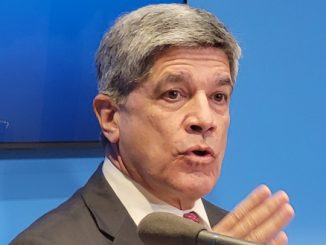
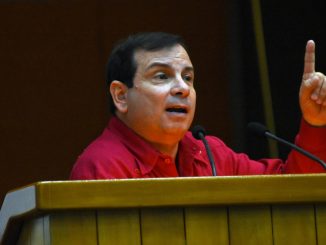
Ambassador Yuri Gala López. SLL photo: Lallan Schoenstein

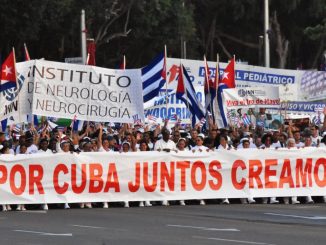
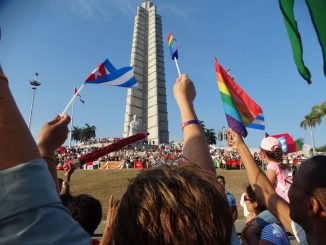
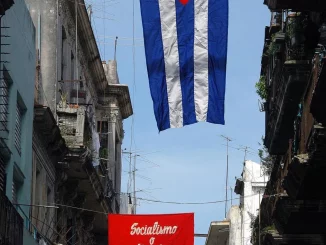
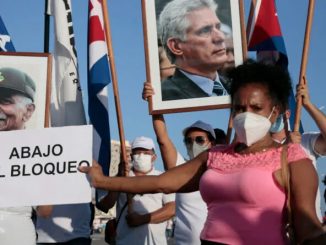
Thousands in Cuba and abroad celebrated the historic achievements of its socialist revolution on the anniversary of July 26. On that day in 1953, a group of young rebels led by Fidel Castro stormed the Moncada and Carlos Manuel de Céspedes garrisons. The attacks initiated the armed struggle and insurrection that triumphed over the brutal dictatorship of Fulgencio Batista on Jan. 1, 1959. 

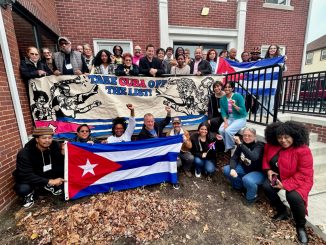
One of several July 26 celebrations in New York City was a reception hosting Cuba’s U.N. Ambassador, Yuri Gala López, who spoke to a diverse assembly at the New Canaan Baptist Church in Brooklyn. Omowale Clay from the December 12 Movement and Erin Feely-Nahem of the Saving Lives Campaign, Pacemakers for Cuba, also spoke.

Clay began the Moncada celebration with a historic film he’d made about Cuba’s role supporting the fight for liberation in southern Africa as well as the sanctuary Cuba provided African-American liberation fighters. The film included informal talks by Fidel Castro, Assatta Shakur, Kwame Ture, and Puerto Rican revolutionary William Morales. The film also featured African and Cuban cultural performances that honored the role of Cuba in ending apartheid.

Ambassador Gala López began by telling the gathering that Fidel Castro called for many Moncadas, such as their successful battle to win education and health care and the battle to eliminate racism and exploitation. 

Gala López spoke of the heavy damage inflicted by the U.S. government’s 60-year-long blockade of Cuba. During Trump’s administration, the stranglehold of the blockade was tightened in many insidious ways by placing Cuba on a State Sponsors of Terrorism list. Despite campaign promises to the contrary, President Joe Biden has done nothing to change Trump’s vicious policies.

Even under the U.S. military siege, Cuba has contributed to achievements in countries worldwide with its International Medical School (ELAN) and the scientific developments of the Cuban BioMedical Institute. They have provided countries with their own trained doctors and set up the production and supply of new medicines, including vaccines. 

Gala López spoke about Cuba’s remarkable work treating eye diseases and restoring vision to millions in Latin America and Africa. For example, while serving as Cuba’s ambassador to Jamaica, Gala López witnessed the daily restoration of sight for hundreds of people through cataract surgery and other eye diseases at a Cuban-built clinic in Kingston. 

One aspect of the U.S. blockade is how gravely it impacts Cuba’s ability to procure vital medical supplies. Erin Feely-Nahem ended the evening by raising funds for the Saving Lives Campaign, Pacemakers for Cuba campaign. 

Cuba must be removed from the SSOT list. Gala López pointed out that in the U.N. General Assembly, 187 countries voted against the embargo on Cuba. Only the U.S. and Israel voted for it, with Ukraine abstaining.

Strugglelalucha256


Cuba and Nicaragua: Two sister revolutions

On July 19, 2024, the 45th anniversary of the Nicaraguan Revolution

There are no identical political processes, much less Revolutions, which are conditioned by history and the context in which they develop. However, in our America, there are no two processes with as many similarities as those in Cuba and Nicaragua. The hallmark of both revolutions is often referred to as the method used to seize power through armed struggle, something that truly makes them unique and probably unrepeatable.

There are also other features that distinguish and identify them, among which we can mention:

1- Deep historical roots. Each of these processes is based on a long tradition of struggle of its peoples, which goes back to the rebellious and indomitable spirit of its indigenous and Creole populations. Diriangén, Nicarao, Adiact, Andrés Castro, Zeledón, Sandino; Hatuey, Aponte, Varela, Céspedes, Maceo, Martí are symbols deeply rooted in the popular consciousness of their respective peoples and constant sources of inspiration for successive struggles. Not many countries have such an extraordinary tradition of struggle and such a wide gallery of heroes as ours.

2- Authenticity. The independence processes and subsequent revolutions did not arrive on horseback or in tanks from other latitudes. Their battles were inspired, led and directed by people from their peoples, beyond the undeniable contributions of extraordinary internationalists such as Máximo Gómez, Farabundo Martí, Che Guevara, who fused their blood and ideals with ours.

3- Nationalism and anti-imperialism. The struggles in Cuba and Nicaragua, independent of their patriotic and nationalist character, were marked by a strong anti-imperialist sentiment from the beginning. Martí did it in silence, confessing it before his death, the same day Sandino was born, who made anti-imperialism his battle flag. The beating of the Yankees in Las Segovias and the victory at Playa Girón sealed that anti-imperialist destiny.

4- The spiritual and moral strength of the precursors precedes and surpasses the political and ideological components in both processes. Fidel and Carlos Fonseca drank from the sources of Marxism, but the first was precise in pointing out Martí as the intellectual author of Moncada and the second did not hesitate to define the Liberation Front that was founded as “Sandinista.” The people have rewarded this wisdom, and for that reason, although they fight for the ideals of socialism, the Nicaraguan people are above all Sandinista and Danielista, just as the Cuban people are above all Martian and Fidelista.

5- Another feature that distinguishes them is their radicalism. These were not half-measures. The changes carried out at the socioeconomic, structural, political, and legal levels were very radical in order to benefit the less favored sectors and combat the poverty inherited from centuries of exploitation. These changes, of course, unleashed the reaction of the empire and its local allies in the upper classes.

6- Reciprocal respect and loyalty. Not because it preceded it in time and enjoyed greater experience, did Cuba ever try to belittle, tutor or ignore the Sandinistas. On the contrary, there are plenty of examples of the respect, delicacy, and tact with which Fidel always treated his leaders, even in difficult moments of the war when divergences arose between the different tendencies of the FSLN. However, Cuba gave signs from very early on of a generous solidarity that was manifested in the most diverse spheres of cooperation and was sealed with the blood of combatants and civilian collaborators in the different stages of the Revolution. According to Fidel himself: “Nicaragua was one of the countries that best used Cuba’s collaboration in health and education.”

The Nicaraguan people, for their part, have always been on Cuba’s side, even in the fateful days when Somoza lent the territory for the invasion of Playa Girón and asked the mercenaries to bring him a hair from Fidel’s beard. The pilot Carlos Ulloa, who fell fighting in Girón, washed that affront with his blood, and years later, Fidel, himself in Managua, offered his entire beard in a symbolic gesture to the Nicaraguan people.

7- Leadership. Both Revolutions have had strong and clear leaders who have known how to guide the destinies of their people with firmness and wisdom. Fidel Castro managed to unite the different revolutionary forces, successfully lead such a radical process, and, above all, maintain resistance against an empire that had done everything it could to try to destroy it. His leadership and that of his successors have had a great impact, not only on a continental level but even on a global level.

The Sandinista Revolution had among its founders extraordinary leaders, such as Carlos Fonseca and Tomas Borges, and today it has in Commander Daniel and Compañera Rosario an experienced leadership with undeniable popular and international prestige. Fidel, who never gave away praise, said this to Daniel in a message for the 35th anniversary of the triumph of the Sandinista Popular Revolution: “You and Rosario, as was later the Bolivarian leader Hugo Chavez, unavoidable champion of the struggle for socialism and the anti-imperialist revolution in Latin America, will occupy a place of honor in the history of the peoples of this continent.”

For these seven reasons and for many more that cannot be put into words, we Cubans feel the joy of the Nicaraguan people as our own in celebrating this 45th Anniversary, and no occasion is more propitious to renew the commitment bequeathed by our heroes, to honor each day more these exemplary relations that forged years of struggle and sacrifice and that nothing and no one can stand between these two sister Revolutions.

Long live the 45th Anniversary of the Sandinista Popular Revolution.

Long live the indestructible brotherhood between Cuba and Nicaragua.

Sandino Lives, the Struggle Continues.

Free Homeland or Death.

Homeland or Death, We Shall Win.

Source: La Gente Radio, translation Cuba Alba Solidarity / Resumen Latinoamericano – English

Strugglelalucha256


Pacemakers for Cuba, a unique effort to save lives

More than 300 pacemakers will reach Cuban institutions thanks to a campaign in the United States and Europe aimed at supporting the health system in one of its most urgent needs.

The initiative, coordinated by the non-profit organizations Global Health Partners (GHP) and MediCuba Europe, is a unique effort, according to Bob Schwartz, vice-president of the former and with a long history of solidarity work with the Ministry of Public Health (Minsap).

In an interview with Prensa Latina, Schwartz described the project as one of the most valuable ones promoted by GHP in three decades of work in the Antillean country.

At the beginning of May, both organizations announced their intention to raise $150,000 to send 300 pacemakers to five hospitals in four months. The goal was reached in the middle of that period. By the second month, the amount exceeded $187,000.

During COVID-19, Global Health Partners launched a similar initiative to support immunization with Cuban vaccines, which raised six million syringes in a few months.

“In some ways, it’s similar to that project that captured the same imperative, but for cardiac patients a pacemaker is a matter of life and death,” he remarked.

Both projects, however, had to overcome restrictions imposed by the United States that limit access to a large part of the market and prevent the shipment to Cuba of equipment with more than 10 percent of U.S. components.

A respite for Cuba

The campaign coincides with a particularly sensitive moment for the health system in the Caribbean country. According to figures published by GHP, Cubans with heart disease face a three-year wait for pacemakers because of the U.S. encirclement policy that prevents the country from buying these devices on the market.

Some 70 elderly Cubans cannot leave their hospital beds until they receive pacemakers, while the country’s overall demand is estimated at about 2,000 patients in need.

In particular, Cuba’s inclusion on the U.S. list of alleged sponsors of terrorism hinders the nation’s access to the international banking system and limits its supply of foreign exchange.

It also obstructs the ability to purchase pacemakers from international suppliers in a market dominated by U.S. industry.

“We made the decision to launch this campaign not as a substitute, but to give Cuba a break and take some pressure off the Ministry of Public Health,” Schwartz explained.

The idea is to address the most serious cases of patients and acquire equipment in Europe with the support of MediCuba Europe and the coalition to save lives, which brings together a dozen organizations in the United States opposed to the blockade, he said.

Three years later on the list

The impact of sanctions on Cuba’s healthcare system poses difficult obstacles such as relationships with providers, imports and access to nearby markets to high transportation costs.

The designation as an alleged terrorist state prevents, in particular, access to most banks or the Swift system for electronic payments worldwide.

Cuba was first included on the US State Department’s list of sponsors of terrorism during the first term of President Ronald Reagan (1980-1982).

In 2015, then-President Barack Obama considered that designation to be without merit and withdrew it. However, his successor, Donald Trump, reinstated it before leaving the White House.

It has since remained in that relationship during Joe Biden’s presidency, despite calls for him to rectify that policy.

Cuba’s exit would represent a major relief for the work of Global Health Partners and the Ministry of Health.

During the campaign to carry syringes, the organization paid almost four times as much for them in the United States because of the fears of vendors who knew they would be going to Cuba, Schwartz confessed.

Without the designation, he added, the banking system would open up to Cuba, transportation costs would be drastically reduced, and they would be able to access more markets.

“The truth is there is no reason to keep Cuba on the terrorist list. No reason to return it to begin with. The Trump administration did it in a very vindictive way and here we are three years later.”

Three decades of work in Cuba

In all his years of work with Cuba, Schwartz has known all too well the complex web of obstacles to the shipment of medicines, equipment, or medical supplies to the largest of the Antilles.

From the convoluted journeys through third and fourth countries to send a shipment when it is impossible to do so directly to the request for more than 60 licenses in three decades to acquire equipment with more than 10 percent U.S. components.

“If the designation as a sponsor of terrorism did not exist, if the blockade did not exist, the truth is that there would be no need for the work we do, because Cuba could solve all the problems on its own,” assured the also consultant to the United Nations Economic and Social Council.

Even with these obstacles, the representative ratified the organization’s commitment to maintain its work in the Caribbean nation with the premise of “promising less and delivering more”. “I don’t think there is any case in which I have told Minsap that we are going to do something that we haven’t done; our word is important to us,” he acknowledged.

Removing Cuba from the list of sponsors of terrorism and ending restrictions on activities such as tourism or travel would do much to improve the lives of every Cuban, he further considered.

“I am amazed at what they have been able to accomplish with the limited resources they have.”

Elizabeth Borrego Rodríguez is the Chief UN Correspondent for Prensa Latina

Source: Prensa Latina, translation Resumen Latinoamericano – English

To make a donation to this important project, go to https://ghpartners.org/cuba2024/

Strugglelalucha256


Cuba neutralizes new terrorist plan from the U.S.

July 9 — This week it was reported that Cuba thwarted the attempts of a network of Cubans living in the United States who were trying to enter the island illegally with weapons, and with the purpose of starting a social outbreak. The Ministry of the Interior (Minint) disclosed details of a recruitment plan, neutralized in December 2023, directed, from U.S. territory, to promote and organize terrorist actions in Cuba.

In late November 2023, a Cuban citizen illegally entered Cuba by sea with firearms and ammunition. The individual, identified as Ardenys García Álvarez, entered the island through the Manuel Canal area, in the province of Matanzas, with a Jet Ski type nautical motorcycle, registered in the U.S. state of Florida.

Bullets and other arsenals were found during the seizure of the vehicle. Later, the authorities found that Garcia entered with five pistols of various origins and characteristics, cartridges including an American Tactical pistol and two different models of Smith & Wesson, manufactured in the United States, along with a Steyr, from Austria, and a Taurus, created in Brazil, along with rounds of ammunition.

Garcia was already known to Cuban law enforcement. Before immigrating to the United States in 2014, he was already wanted for crimes of robbery with force. A new legal process against him began immediately after he was caught red-handed on December 9.

During his imprisonment, he confessed to having had contact with Willy González, a representative of the anti-Cuban group calling itself La Nueva Nación Cubana en Armas (The New Cuban Nation in Arms).

In Garcia’s statements to the justice system between the time of his capture and May 2024, during his arrest awaiting charges, he confessed that the name of his recruiter was Dayan Quiñones, with whom he had exchanged messages via the social network Telegram. Subsequently, he had participated with the terrorist group in two military trainings.

During the training, the terrorist mentioned a document that gave a reason for this paraphernalia. In this document of undefined authorship, those involved state their “determination to employ armed struggle, putting at risk the lives of a group of determined men, in order to save the lives of many others.” It was a manifesto of their plans against Cuba.

Other real objectives behind this declaration of intentions were exposed in Willy Gonzalez’s multiple calls for the “awakening of the people,” through violence against offices, sugar cane fields, and the tobacco factories of Pinar del Rio…. “We are reaching the level when their will be physical harm,” he assured.

The story is even more sordid and involves many other terrorists who roam the streets of Florida with the full complicity of U.S. authorities, despite Cuba’s denunciations. Another member of the New Cuban Nation in Arms, alluded to by the accused under the nickname of “El Lobo”, is Jorge Luis Fernandez Figueras, promoter and financier of aggressive actions directed against children’s circles, schools, polyclinics and the warehouses of the Basic Electric Organization, especially in the municipality of San Miguel del Padron, in the province of Havana.

The criminal incursion occurred in November, but it is not by chance that the news is only fully coming to light now; a few days before Cuba remembers with pain and shame the violent events of July 11, 2021. The Cuban authorities took time now to remove the mask of the material authors of this act of provocation, which is not the first and will not be the last, as long as the White House turns a deaf ear to Cuba’s condemnations.

Yes, the fact that the results of the ongoing investigation were released shortly before July 11 is calculated but there is another message. Cuba is at peace, but the intelligence forces are alert and active and on the move. Mercenaries that come here from the US to disrupt and try to undermine Socialist Cuba will be caught and face the fullest extent of our laws and they will not be going back to their lairs in Miami anytime soon. Nothing will disturb the tranquility of the people. Cuba is protected.

Source: Resumen Latinoamericano – English

Strugglelalucha256


China responds to Wall Street Journal publication slandering its relationship with Cuba

Foreign Ministry spokeswoman Mao Ming told a press conference in Beijing on Wednesday that China will not allow third parties to slander her country’s relations with Cuba.

In response to a Wall Street Journal publication, according to which there are listening stations in Chinese military bases on the island, she commented, “We have taken note of the report and also of the fact that the Cuban Vice Minister of Foreign Affairs, Carlos Fernandez de Cossio, has pointed out that the report has no basis whatsoever. The alleged Chinese military bases have never existed, nor have they ever been seen by anyone.”

Mao pointed out that not even the U.S. embassy on the island seemed to believe in friendship, camaraderie, and brotherhood between the two peoples.

She stressed that China and Cuba’s cooperation is solemn and, above all, open and direct. It is not directed against a third party and will never be accepted, nor will slander be allowed, as the report maliciously discredits both countries.

The spokeswoman urged Washington to stop interfering in the internal affairs of the Caribbean nation and denounced the economic, commercial, and financial blockade imposed on Cuba from the White House for more than half a century.

“The report mentions Guantánamo, which is the clear evidence of more than a century of illegal U.S. occupation of Cuba. The United States has imposed the blockade and sanctions against Cuba for more than 60 years, which has brought great disasters to the Cuban people,” he said.

She also denounced the permanence of the largest of the Antilles by the U.S. on the list of so-called state sponsors of terrorism.

“Throwing mud at others will not alleviate or take attention away from their own crimes. The United States must do the opposite. Stop interfering in Cuba’s internal affairs. Remove Cuba immediately from the list of so-called state sponsors of terrorism. Lift the blockade and sanctions against Cuba.”

Meanwhile in Havana, Radio Havana Cuba (RHC) reported that Cuban Foreign Minister Bruno Rodríguez sent out a similar response to the absurdity and slander of the accusation by reiterating his country’s rejection of the unfounded accusations reported in the United States media about the alleged existence of Chinese military bases on the Caribbean island.

The top Cuban diplomat denounced that, in contrast, (those institutions) “ignore the almost 800 bases the United States has around the world, including the one illegally occupied in Guantánamo (eastern Cuba), and converted into a center of espionage, torture, and interference in global instability.”

The day before, the Government of Cuba denied such slander, repeated on other occasions by the U.S. administration and the media, as part of a campaign of intimidation related to the island.

The continuous stream of absurd lies against Cuba coming out of the US government and their loyal corporate media outlets would be laughable if they didn’t have such serious consequences for the Cuban people.

Source: Cuba en Resumen

Strugglelalucha256


Cuba stands with Palestine and joins the ICJ lawsuit

On Friday, the Cuban government announced that it will join Nicaragua, Colombia, Libya, Maldives, Egypt, Ireland, Belgium, Turkey, Mexico, Chile and Spain as countries formally joining the lawsuit filed by South Africa before the International Court of Justice (ICJ) against Israel for the ongoing genocide in Gaza. “We must put an end to the massacre against the people of Palestine,” said Foreign Minister Bruno Rodriguez, through his account on the social network X, shortly after the island made public its decision.

In view of the total impunity with which Israel continues to act, “the government of the Republic of Cuba has decided to intervene in the contentious proceedings initiated by the Republic of South Africa against the State of Israel before the ICJ. The decision was taken in correspondence with the firm and sustained commitment to support and contribute as much as possible to the legitimate international efforts to put an end to the genocide committed against the Palestinian people,” the MINREX statement reads.

We Cubans are watching with deep concern and horror the escalation of Israeli violence in the illegally occupied Palestinian territories that continues without even a pause. The Gaza Health Ministry reported on Thursday that the death toll stands at 37,431 and at least 85,653 people have also been injured in the onslaught, most of them women and children, since the hostilities escalated after October 7, 2023. We must remind ourselves of the thousands of missing Gazans buried beneath the rubble may never be found or counted.

Just today, the world got to see the barbaric display of a Palestine man strapped to the hood of an Israeli military jeep like he was some sort of war trophy instead of what he really is: a victim of Zionist torture.

“The Ministry strongly condemns, once again, the killing of civilians, especially women, children and humanitarian workers of the United Nations system, as well as the indiscriminate shelling of the Palestinian civilian population and the destruction of homes, hospitals and civilian infrastructure. Genocide, apartheid, forced displacement and collective punishment have no place in today’s world, nor can they be tolerated by the international community,” the Cuban statement continued.

In December last year, South Africa sued Israel for violating the Convention on the Prevention and Punishment of the Crime of Genocide. At that time, the Court declared itself competent and accepted South Africa’s claim. And in May, during a hearing at the International Court of Justice, South Africa asked the UN’s highest court to order a halt to the offensive in Rafah as part of its case in The Hague.

“Israel must be stopped. South Africa is before you again today to respectfully request the court to invoke its powers (…) to order a measure to stop Israel,” Adila Hassim, South Africa’s lawyer, said on that occasion.

Despite repeated historical calls for peace, Israel continues a genocide that is not new, dating back 75 years, but now takes on extreme proportions that require the joint action of the peoples and governments of the world to immediately stop the indiscriminate extermination of girls, boys, women and civilians in general.

Havana, as a member of the Convention on the Prevention and Punishment of the Crime of Genocide, “will make use of its right to present its interpretation of the norms of the Convention that Israel has flagrantly violated with its actions in the illegally occupied Palestinian territory of the Gaza Strip,” MINREX concluded.

Cuba will always be on the side of just causes. Palestine is not alone; the island will never abandon it, and we will defend its people until there is peace, justice, and respect for the United Nations Charter and International Law prevail.

Source: Resumen Latinoamericano – English

Strugglelalucha256


Bloody cost of the U.S. blockade of Cuba

A recent announcement by Discovery Therapeutics Caribe in Cleveland eases a major fear coming with a diabetes diagnosis: the fear of amputation. The advocacy group Diabetes.org reveals the fear is justified. “Every 3 minutes and 30 seconds in the United States, a limb is amputated due to diabetes. Amputations are on the rise in the United States — 154,000 people with diabetes undergo amputation each year.”

In a welcome breakthrough on April 10, the Federal Food and Drug Administration greenlighted the phase 3 study of Heberprot-P, a Cuban medicine developed by the Center for Genetic Engineering and Biotechnology (CIGB) that has been shown to reduce diabetic amputation by more than 70 percent. Although Heberprot-P is currently available to patients in 26 countries and received original Cuban regulatory approval in June 2006, this is the first time it will be studied with U.S. patients suffering from diabetic foot ulcers.

Why did it take so long? The failure of the U.S. to normalize relations with the Republic of Cuba has forced even urgent health initiatives like this one to thread its way through an insidious web of laws, regulations, and executive orders that only apply to Cuba. Together with the 2021 State Department’s cruel designation of Cuba as a ‘State Sponsor of Terrorism, ’ these measures are literally intended to create unbearable hardships for the Cuban people using global dollar power. 

In the words of Lester Mallory’s infamous April 6, 1960, State Dept. memo, “Every possible means should be undertaken promptly to weaken the economic life of Cuba. … a line of action which, while as adroit and inconspicuous as possible, makes the greatest inroads in denying money and supplies to Cuba, to decrease monetary and real wages, to bring about hunger, desperation, and overthrow of government.” 

Cuba’s socialist focus on cooperative development of human potential has unleashed internationally recognized pharmaceutical advances like Heberprot-P as well as Cimavax, a late-stage lung cancer vaccine, and much more. Without normalized U.S.-Cuba relations, our communities and families here in the U.S. have been blocked, while the rest of the world is not. 

Some steps in that direction produced a 2016 Memorandum of Understanding between the U.S. Department of Health and Human Services and Cuba’s Ministry of Public Health that may have helped open this opportunity. However, administrations have backed away since then.

On May 17, Discovery Therapeutics Caribe President Dr. Lee Weingart explained to Prensa Latina how these hurdles were overcome: “We could operate under the protection of an exception to the embargo [blockade] that allows joint medical research projects involving us and Cuban organizations, so we have taken advantage of this provision to move forward with this project.” 

The diabetes care industry is growing, too, explains Medtech.citeline.com’s  “Alarming Rise Of Diabetes In Several State” article “with some estimates it will reach $30bn by 2030 from $18bn in 2022 — it’s crucial that manufacturers continue to create innovative devices and products to treat and manage the disease.” Cuba’s Heberprot-P fits that need. 

Weingart announced this unique therapy is expected to be available in the U.S. in 2028. Quoted in Prensa Latina on May 17, he said that “38.4 million U.S. citizens have diabetes, 1.6 million of which will develop a diabetic foot ulcer each year, …160,000 will result in amputation, and 80,000 of those will die in the next five years, so if you follow the cycle, 80,000 people die every year from the complications of a diabetic foot ulcer, making it the eighth leading cause of death in the United States and more deadly than certain kinds of cancer.”

Diabetes risk highest among African Americans

President of the Professional Education & Research Institute (PERI), an international clinical research organization, Dr. Charles Zelen, noted the disproportionate impact on African American communities where “Medicare beneficiaries are nearly twice as likely to undergo lower limb amputation within a year of DFU diagnosis compared to their non-Hispanic white counterparts.” The National Medical Association, the collective voice of African American physicians, notes on its website: “African American patients are more likely than white patients to have diabetes. The risk of diabetes is 77% higher among African Americans than among non-Hispanic white Americans.” 

“Alarmingly, nearly half of patients who undergo DFU-related lower extremity amputation do not survive beyond five years. Among U.S. veterans, the prognosis is even more grim, where survival past two years is uncommon for patients presenting with gangrene.” (April 30, DTC Press Release)

The projected U.S. marketing date in 2028 will be twenty-two years after Heberprot-P was approved to save limbs and lives in 2006. At the rate of 160,000 amputations per year cited by Weingart, denying the potential healing rate of 70 percent has meant an estimated 2.5 million unnecessary amputations in the U.S. over these decades. 

Finding this sweet spot to penetrate the U.S. economic, financial, and commercial blockade for the benefit of Cuba and diabetics in the U.S. is something to celebrate, but it is not a solution. Normalization of U.S.-Cuba relations begins today with removing Cuba from the State Sponsors of Terrorism List, requiring only that the President send a notice to Congress. For more information, see the ACERE.org toolkit and one-page SSOT explainer.

Cuba is hosting the VII International Congress on Comprehensive Management of Complex Ulcers and Wounds in Varadero, Cuba, from September 1 to 5, 2024. Spread the word to medical professionals and researchers.

Cheryl LaBash is a co-chair of the National Network of Cuba (NNOC)

Strugglelalucha256


‘We are going to build a better world!’ Cuban President Miguel Díaz-Canel tells North American youth

On the last day of the “Let Cuba Live” Youth Brigade, organized by the International Peoples’ Assembly in the first week of June, the members of the brigade met with Cuban President Miguel Díaz-Canel to discuss the pressing issues facing humanity, the lessons from waging a socialist revolution, and how to maintain hope. This conversation was recorded as part of the president’s new podcast.

“Down with the blockade! The socialist world is the world we want!” shouted the over 100 young people gathered in the Palace of the Revolution.

“We had to come to Cuba to find ourselves and our struggle,” said Manolo De Los Santos, director of the People’s Forum and social leader in the United States, who moderated the conversation. “For us, it is a pleasure to share with young people from North America…We admire you a lot,” Díaz-Canel told the young activists.

He affirmed this because in his opinion, they have built an impressive social and political movement in the United States which channels the righteous feelings of justice, freedom, and emancipation which exist in North American society through these young people.

Memories

Díaz-Canel told them that he will never forget “the support that young people like you gave us in New York,” a place where Cuba has so many times denounced the imperial blockade that grips it. And he returned to the hours of September 2023, when he went out to the corner of Lexington and 38th – in front of the Cuban mission in New York City – to demand, in the middle of a demonstration of young Americans, the end of the blockade.

“You were in the streets every day,” the president acknowledged when referring to the brave youth. And another moment emerged with strength and clarity in the memory of the dignitary: on Saturday September 23, 2023, a rainy night at the New York Society for Ethical Culture, where hundreds of friends gathered in support of a nation that resists.

It was there where that the Cuban leader stated that Cuba embraces the American people and all brothers and sisters in the world who dream of a better world. Being able to share that night with friends was, he said, an “extraordinary experience.”

The beginning of an unforgettable conversation

“Welcome to the Palace of the Revolution, and let’s talk like you young people do,” the President said. Manolo De Los Santos, who introduced each student who spoke, was emphatic: “We are extremely grateful to the people of Cuba for receiving us during these times.”

De Los Santos highlighted that, although these are difficult times, the people of Cuba have not stopped showing solidarity, not only with them but also with the entire world.

“It has been an intense week,” said Manolo about the group’s stay in the Greater Antilles, “where we have recognized the ability of the Cuban people to talk about all topics, everything. We have been up late into the night, discussing democracy, human rights, economics, philosophy, culture, everything. And of course, dancing a little with the Cubans.”

“We do that very well,” commented President Díaz-Canel smiling. And Manolo shared another idea: “How rare this opportunity, for young Americans, to be able to meet with a President…. We have been mobilizing in the United States for months, demanding that our President listen to us, and today we woke up seeing a White House surrounded, fenced, impossible to reach; But here we arrive in Cuba and a revolutionary, socialist, honest, human President welcomes us openly and wants to listen to our questions.”

“The world cannot remain silent,” the Cuban president stressed in the initial moments. He did so categorically and in the face of evidence of the holocaust suffered by the Palestinian people.

Is it the same Revolution?

Ask anything and raise your criticisms, the Head of State said and added, “for the Cuban people it will be very good to know how young people like you think.”

“This is a small but very resilient nation,” said Palestinian organizer Celine Qussiny. For her, the imperial blockade causes Cuba to face many problems. It is a siege, she denounced, set up by the same government that attacks Palestine.

Next, the group asked: This Revolution – which did not begin in 1959 but much earlier – how has it evolved over the last 60 years?

Understanding the magnitude of what was raised, President Díaz-Canel said that the answer could be either very long or very short, but that he would strive to give it from an intermediate point. There began his journey to the beginnings of Cuban nationality, even to previous stages, when Columbus arrived in America and opened the doors to clashes of identity, to subsequent exterminations of the Indigenous populations, to the shameful chapter of the slave trade, to the emergence of Creole which begins to feel Cuban and not Spanish, at the birth of a desire for independence that has always been closely linked to the very emergence of national identity.

The President went through stages such as the Mambisas wars; everything done by the Caribbean country -already in the 20th century- for the sake of independence causes in Africa, because that commitment to the mother continent has to do with the vindication of the slaves who arrived on Cuban soil tied up in ships and whose blood flows through the veins of today’s Cubans.

Díaz-Canel spoke about Martí; of Antonio Maceo and his protest in Mangos de Baraguá; of the Centennial Generation with Fidel at the head; of the assault on the Moncada Barracks; from prison and exile in Mexico; of the incorporation of Che Guevara to the group of those who would later disembark on the Granma Yacht; of Fidel saying, with only seven rifles in hand, that then they would win the war against an army armed to the teeth.

Regarding that last episode, the president recalled that Cuba, in a line with a flavor of destiny, has tended to go from adversity to adversity, and from triumph to triumph, always without losing from its horizon, a Fidelista conviction, inherited from all previous struggles: “What there can never be is surrender,” Díaz-Canel conceptualized.

As Commander in Chief Fidel Castro also defined at the time, and as the current Head of State recalled, the Cuban Revolution is one, from the Mambisas to today.

When that Revolution triumphed, he said, that was a cause of great concern for the United States. And regarding such an event – blocked by the empire for so long – the president stressed that revolutions can set an example but cannot be exported, because “revolutions are made by the people.” Hence, he emphasized to the students, no one can influence them, no one guides them in the convictions they choose.

“We are not perfect nor do we want you to idealize us,” Díaz-Canel told the young people; and he added that what Cuban revolutionaries do have is an enormous vocation for perfection.

Regarding the youth of the Caribbean country, the dignitary expressed that they are present in all important events and processes in society. He listed several examples in this regard; and he affirmed that the Revolution is a story of continuity of generations that are united in principles; that may be distant from each other, due to time, but that are mutually supported by a unity of essences.

“We are going to build a better world!”

How does Cuba view the liberation process of Palestine? the young people asked. And that was the starting point for the President to affirm that the world has woken up at this moment in history, starting with the Palestinian cause.

It is as if, he reflected, the market had spread a blanket of idiocy over societies. Thus he spoke about a world marked by uncertainty, by the adverse climate situation, by increased inequalities after COVID-19, and by wars.

Another question that invited everyone to reflect: Palestine has suffered a war of more than 70 years, why is it not talked about and only Ukraine provokes concern? Why don’t the mainstream media go to the root causes of the conflict in Europe? Who caused this conflict in Ukraine? Who manufactured that war? Who benefits from it?

Regarding what is happening with the Palestinian people, President Díaz-Canel reflected on how so many human beings have died in such a short time. He devoted special attention to the martyrdom of women and children; and he wondered aloud: What could be in the conscience of those who have waged that war?

Palestine causes us pain, it has to affect us, he said, to assert that in that land, its children are defending human dignity. “I think that everything we do for Palestine is too little,” he stressed; and he imagined the moment when that nation must be rebuilt, and spoke about the pain of broken families, of mothers and fathers who have lived the terrible experience of seeing their children die.

Palestine opened an important space of consciousness; and in that the protests of American students have been very important. Díaz-Canel Bermúdez said, who did not overlook the fact that since the days of protests against the war in Vietnam, such intense demonstrations had not been experienced in North America.

The president confessed to the young people that he was among the idealists who imagined a better world after the heartbreak caused by COVID-19, because the systems “broke so much…”. But sadly – the president noted – the world went to war, the blockades tightened, and governments like the Israeli one have manifested themselves brutally against the Palestinian people.

We want a better world, where there is more equality, a more just world; That world is possible, what we have to do is defend it. This is how the Head of State reflected, who added that the world is defended as Cubans do every day, despite the blockade; and as do the Palestinian people.

“We are going to build a better world!” the president declared firmly and optimistically.

Fostering revolutionary optimism in the toughest of times

How do you deal with pessimism; How to create optimism in such difficult moments? Manolo De Los Santos asked President Díaz-Canel. And that was the launching pad for the dignitary to list many of the problems that affect life in Cuba; among them, the lack of medicines and food, blackouts, shortages of all kinds…

“And one says: we have to show our faces, we have to be in the streets,” said the Head of State, to then explain why in “the history of our country there are the answers to all our problems.”

The essence of his rationale was that we must “believe in history,” because Cuban history has been and is the fight against all adversity and in the midst of permanent attacks.

The other path that the President spoke about to respond to current challenges is ethics – “the truth must be explained,” he said; and the third element – he stressed – is what is fair, the Law.

The imperialist logic that is based on economic and media suffocation was also explained in detail by the dignitary, who expressed that “we fight here every day,” and that the logic of socialist construction takes precedence over the adversary’s plan. This consists of overcoming the blockade with one’s own effort and talent, with the philosophy of creative resistance, which consists of going beyond resistance to aspire to growth.

The priorities of the Party and the Government for the current times; the unforgettable story of how Cuban scientists saved an entire people from COVID-19 -and they did it with their own vaccines-; normative processes within society. The president spoke with the young people about such experiences; and when Manolo De Los Santos asked him how he explains to the people how complicated these moments are, he was emphatic: “With the truth, Manolo, with the truth.” He added that there is no more effective formula than the one-on-one exchange, as Fidel and Army General Raúl Castro Ruz taught.

Questions about hope

How to make the future part of the hope of young people in Cuba? What are the main issues being debated today in the spheres of the Communist Party and the Government?

Based on these questions asked by the young people, the Head of State continued sharing reflections alluding to the value of ideas, and all the effort deployed by the Revolution in social projects; and among the essential topics that are discussed, he said, is that of generational continuity.

Regarding the latter, Díaz-Canel Bermúdez made reference to the challenge of maintaining continuity despite the fact that current generations are already far away, in the timeline, from January 1, 1959. And he spoke of other cardinal challenges: “How to ensure that Fidel always remains among us? How to ensure that all the revolutionary epic, all the greatness, is not lost?

“We can win, but we have to believe it,” said the Cuban President at another point in the meeting, and also warned that it will be a long fight, and that there will even be generations who will not see the fruits of the effort, but who will have created the conditions for the triumph of future generations.

The afternoon in the Portocarrero Hall – the same space where Fidel took his long steps so many times – was full of emotions and very useful truths. Among many other certainties, Díaz-Canel expressed that “what the people defend is what triumphs.”

Manolo De Los Santos – who had already called the blockade suffered by Cuba a “silent genocide” – told the hosts at the Palace of the Revolution about a week full of emotions, about dialogues with young Cubans who “are not robots”, who have a very critical speech. And he told about the experience of having walked through the streets and being able to taste the feeling of freedom.

“Cuba for us is also what Palestine means. It is the flag of our generation,” said the director of the People’s Forum, who did not let the day pass without first giving, very heartfelt, thanks. The social leader assured that with them – the young people who have made headlines around the world for their protests and the way in which they have been mistreated – they will share about Cuba, the Revolution and its leaders. And that is how it will be today, tomorrow, and always.

Source: Peoples Dispatch

Strugglelalucha256


Cuban expert discusses the presence of Russian ships in Cuba

An interview with the Director of the Center for Investigations of International Politics (CIPI) José Ramón Cabañas, to the Spanish press outlet El Periódico on June 14, 2024

“ Is this (the October Crisis) a valid referent  for what is currently occurring ?”

Relating this news with what occurred in October 1962 is as inadequate as supposing that each time a U.S. naval detachment moves through Southeast Asia, alarms should be sounded in Hiroshima and Nagasaki.

Today, the USSR does not exist, nor does the so-called socialist bloc, and NATO has failed to keep all the promises made after the disappearance of both, promises not to expand eastward, creating enormous strategic risks.

The installation of defensive missile systems in Cuba during that period occurred immediately after a military invasion of Cuba organized by the U.S.  The Cuban government was always in favor of making this action public, the Soviet authorities opposed this, and the rest is well-known history. Today, Cuba and the U.S. have formal diplomatic relations and, therefore, various channels to deal with this and with other even more sensitive affairs.  We are speaking of three naval vessels (a submarine, a tanker, and a tugboat) that have come to a Cuban port in a region in which the U.S. has 80 military bases and many other means of domination.  Cuba has divulged the information in sovereign form, with adequate advance notice.

In recent years, we have received naval detachments from Canada, France, Spain, the UK, Japan, Holland, Mexico, Guatemala, Brazil, Jamaica, China, and Russia on friendly and cooperative visits.  The majority of these have not been worthy of international press attention. In fact, the arrival in Cuba on June 14 of a ship of the Royal Canadian Navy, the HMCS Margaret Brooke, has already been announced. Until now, the Canadians haven’t been worth the headlines.

On June 5 2023, Cuba denounced the presence of a U.S. nuclear submarine on the outlying areas of the Naval Base located in the illegally occupied territory of Guantanamo, Cuba.  Few media outlets in countries allied with the United States considered our concerns worthy of being a news item.

Therefore, we need to place each fact in its context and evaluate it in an objective way.

“How much should we be worried about the current situation?”

If this question is in reference to the particular fact of the naval visit, we repeat what we have already said, in the sense that it has no repercussions beyond bilateral friendly Cuban-Russian relations.

Now, if this refers to the current situation in a more general context, there is a lot we should worry about.  The genocide against Palestine has not stopped, and the international community is not capable of articulating a coherent response that can halt this massacre.

NATO insists on seeking a military solution in Ukraine, with the only goal of satisfying the great arms producers.  The countries that have the greatest reserves of strategic (or desirable) minerals are those that are least developed, and they are victims of constant destabilization plans.

Humanity as a whole has not learned the basic lessons from the experiences of the struggle against COVID-19 and has not prepared for the next similar events, at the same time that biological weapons labs financed by military institutions proliferate in the world.

A fourth industrial revolution is taking place that will create even more disparity between the more developed countries and those that have been spurred on repeatedly to guarantee the well-being of the colonizers.

There are many reasons to worry and to see the concept of peace as a goal to be reached rather than as an already shared achievement.

“What are the potential consequences, what are the current real impacts and the threats to keep in mind , though they have not yet materialized?”

The theme that is worrying you has no other repercussions beyond the end of the visit to Cuba.  If perhaps it remains in history, it will be another opportunity to attract attention to Cuban themes with a negative slant and, in passing, to stir up anti-Russian feelings.

Curiously enough, the press is very active in dealing with certain themes, but they seldom look back at what they have already said and fail to reflect on whether they have stuck to the truth or not.  Just in the last few years, there has been unlimited speculation about supposed attacks on the health of foreign diplomats located in Havana and about a supposed Cuban military presence in Venezuela.  Time and again, they have spoken of alleged Chinese spy stations in Cuba, and now there is a “worry”  about the visit of three naval vessels.

But they do not give information about the inexplicable retaining of Cuba on the list of countries that supposedly patronize terrorism, made up by the U.S. State Department, and the impacts that this has for our economy.

They do not say that Cuba is one of the countries that has made the most contributions to peace, not just in Colombia but in the whole continent.  It isn’t reported that Cuba is the only country that has organized two summits of the Nonaligned Countries Movement (1979 and 2023) and two summits the South, or G77 plus China (2000 and 2023), all of which imply enormous support by the international community.

Source: Minrex, unofficial translation by Leni Villagomez Reeves / Resumen Latinoamericano in English

Strugglelalucha256


Brace for hurricanes: In the U.S., ‘on your own;’ in Cuba, ready & united

New Orleans — The 2024 Atlantic hurricane season officially began on June 1, and meteorologists expect a bad one. Record ocean temperatures associated with climate change, combined with La Niña conditions, have led the U.S. National Oceanic and Atmospheric Administration (NOAA) to issue its most dire warnings on record.

They anticipate 17-25 named storms, with 8-13 of those growing into hurricanes with wind speeds of at least 74 mph. This comes on the heels of last year’s record-shattering heat, drought, and fire conditions that affected even the normally damp Gulf Coast just as they did the western U.S.

When people meet here in Louisiana these days, they ask one another, “Have you started making hurricane plans?” The question itself evinces that there is no plan for the state and country as a whole.

The state government issues some statements telling residents to stock up on water, fill their vehicle’s gas tanks, and so on. The meaning is clear: We’re on our own.

The Cuban approach

Socialist Cuba may be only 90 miles from South Florida, but it’s a world away, especially when it comes to dealing with storms. The whole of Cuban society is mobilized to deal with hurricanes, and the aftermath is about recovery, not greed. Regular preparedness drills are conducted everywhere. The focus is on risk reduction with an integrated response from local fire departments, health, transportation, and other public services.

Before storms occur, Cuban government officials, police, and military personnel help people move their belongings to safer locations. The government also guarantees replacement of all lost property.

Most impressively, they have a 100-year plan to move towns further inland in response to climate change. Cuba is carrying out major reforestation efforts. They have increased forest cover to 30.6% of the island, up from the mere 14% that existed at the time of the 1959 revolution. The country is a leader in urban agriculture, with 35,000 hectares being used for farming in the capital city, Havana. These are only a couple examples of Cuba’s proactive approach to dealing with the ecological crisis that is driving more frequent and intense storms. 

Cuba was prepared to help during Katrina

When discussing Cuba and hurricanes, we must never forget that Cuba prepared to send 1,600 medics, field hospitals, and 83 tons of medical supplies to help the devastated Gulf South after Hurricane Katrina. The George W. Bush administration refused while botching its own response. The racist indifference of the administration to the plight of Black and working-class victims of the storms marked the era and, for many, was as much a source of politicization as the Iraq war and then the 2007-08 financial crisis. 

After being brushed off, the Cuban medics continued to prepare, just in case they got the go-ahead to help. A Sept. 12, 2005, NBC News article reported:

“They remain on stand-by, their bags packed. And while they wait at a Havana medical school that normally houses international scholarship students, the brigade has been brushing up on English skills, the epidemiology common to natural disasters, and the local history of Louisiana and Mississippi.”

Testimony from a Cuban citizen

A Cuban friend of Struggle-La Lucha – who spent a great deal of time with us in May 2023 during the U.S. Friends Against Homophobia and Transphobia delegation to Havana – kindly summarized Cuba’s approach. We thank her for this contribution, and for all the solidarity we in the U.S. get from Cuba.

“As a consequence of its geographical position, Cuba has been repeatedly affected by several tropical storms and hurricanes, receiving the onslaught of a little more than 20 of these organisms during the last 50 years.

“For 2024, the seasonal forecast, issued since 1996 by the Cuban Institute of Meteorology, suggests the emergence of 20 tropical storms, 11 of them could reach the category of hurricane. Before 1959, there was no integral national system in our country to act preventively in the face of natural disasters, so their effects caused real catastrophes with very high numbers of material losses and human lives. The 1926, 1932, and 1944 hurricanes were among the most lethal phenomena of the time.

“Many people wonder how is it possible that a country with so many economic limitations can evacuate more than 700,000 people in a short time and reduce mortality to a minimum. In the first place, it is due to the political will of the Cuban Government and State, which, from the very beginning of the triumph of the Cuban Revolution, outlined strategies to safeguard the lives of citizens without sparing resources.

“Among the main actions carried out was the creation of the Civil Defense System in July 1966, which to date has been in charge of controlling the protection measures for the population and its assets, economic resources, social infrastructure, and natural resources that must be adopted before, during and after the occurrence of disasters.

“Also key is the organization of our society, the strengthening of the meteorological service and its early warning systems (including the timely transmission of information), the active participation of the people in compliance with the protection measures oriented and the role of the media. Every year during the month of May, the Meteoro Popular Exercise is carried out in the national territory, where all national institutions are prepared not only to face the cyclonic season but also to mitigate vulnerabilities to other possible catastrophes.

“In Cuba, the damages caused by disasters are further aggravated by the U.S. blockade, which considerably limits a quick and effective recovery. However, in the face of natural hurricanes, the Antillean nation has received hurricanes of solidarity in response, with the U.S. people among the main protagonists.

Sources https://www.granma.cu/ciencia/2024-05-31/preparados-y-alertas-comenzo-la-temporada-ciclonica-31-05-2024-22-05-14 https://www.dimecuba.com/revista/cuba-tiempo/huracanes-cuba/ https://www.granma.cu/granmad/2007/07/31/nacional/artic01.html https://www.presidencia.gob.cu/es/noticias/la-recuperacion-de-la-vivienda-el-principal-desafio-que-dejo-el-huracan-ian/

“Como consecuencia de su posición geográfica, Cuba se ha visto afectada en reiteradas ocasiones por el paso de diversas tormentas tropicales y huracanes, recibiendo los embates de poco más de una veintena de estos organismos durante los últimos 50 años.

“Para el 2024 el pronóstico estacional, que desde 1996 emite el Instituto Cubano de Meteorología, plantea el surgimiento de 20 tormentas tropicales, de las cuales 11 podrían alcanzar la categoría de huracán. Antes de 1959, en nuestro país no existía un sistema integral nacional que permitiera actuar de manera preventiva frente a los desastres naturales, por lo que sus efectos provocaban verdaderas catástrofes con elevadísimas cifras de pérdidas materiales y de vidas humanas. Entre los fenómenos más letales de la época pueden mencionarse los huracanes de 1926, 1932 y 1944.

“Muchas personas se preguntan ¿cómo es posible que un país con tantas limitaciones económicas pueda evacuar hasta más de 700 000 personas en poco tiempo y reducir al mínimo la mortalidad? En primer lugar, se debe a la voluntad política del Gobierno y el Estado cubanos, que desde el mismo triunfo de la Revolución trazaron estrategias para salvaguardar la vida de los ciudadanos sin escatimar recursos.

“Entre las principales acciones llevadas a cabo estuvo la creación del Sistema de Defensa Civil en julio de 1966, encargado hasta la fecha de controlar las medidas de protección de la población y sus bienes, los recursos económicos, la infraestructura social y los recursos naturales que deben adoptarse antes, durante y posterior a la ocurrencia de desastres.

“También resulta clave la organización de nuestra sociedad, el fortalecimiento del servicio meteorológico y de sus sistemas de alerta temprana (incluido la transmisión oportuna de la información), la participación activa del pueblo en cumplimiento de las medidas de protección orientadas y el papel de los medios de comunicación. Cada año durante el mes de mayo, se lleva a cabo en el territorio nacional el Ejercicio Popular Meteoro, donde todas las instituciones nacionales se preparan no solo para enfrentar la temporada ciclónica, sino también para mitigar vulnerabilidades ante otras posibles catástrofes.

“En Cuba los perjuicios causados por situaciones de desastres son arreciados aún más por causa del bloqueo impuesto por EEUU, que limita considerablemente una recuperación rápida y efectiva. Pero, ante embates de huracanes naturales la nación antillana ha recibido huracanes de solidaridad como respuesta, con el propio pueblo estadounidense entre los principales protagonistas.

Fuentes: https://www.granma.cu/ciencia/2024-05-31/preparados-y-alertas-comenzo-la-temporada-ciclonica-31-05-2024-22-05-14 https://www.dimecuba.com/revista/cuba-tiempo/huracanes-cuba/ https://www.granma.cu/granmad/2007/07/31/nacional/artic01.html https://www.presidencia.gob.cu/es/noticias/la-recuperacion-de-la-vivienda-el-principal-desafio-que-dejo-el-huracan-ian/

Strugglelalucha256
https://www.struggle-la-lucha.org/cuba/page/8/