Cuba faces nationwide blackout, activists renew calls for an end to the blockade

The inclusion of Cuba on the state sponsors of terrorism list has severely limited the island nation from accessing funds and the international market.

Thermoelectrical Center Antonio Maceo de Santiago de Cuba. Photo: Granma

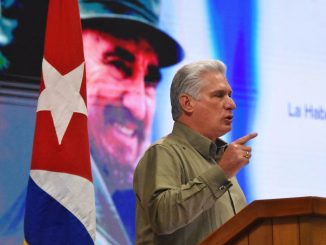
The Ministry of Energy and Mines in Cuba announced on Friday, October 18, that the National Electrical Energy System experienced a complete blackout due to an unexpected outage at the Antonio Guiteras Thermoelectric Power Plant. They also reported that the Electrical Union and relevant authorities were diligently working to restore full service. Cuban President Miguel Díaz-Canel addressed the situation, emphasizing, “We are prioritizing our attention to solving this critical energy issue for the nation. There will be no rest until full service is restored.”

By Friday evening, the Ministry of Energy and Mines (MINEM) reported progress in the phased restoration of the electrical system. According to their report, partial generation had begun at ENERGAS, Cuba’s gas company, which was supplying energy to the thermoelectric plants. Micro-electrical systems in Villa Clara, Holguín, Granma, and Guantánamo were also back online.

Engineer Lázaro Guerra Hernández, the Director of Electricity at MINEM, provided an update during a press conference, noting that the restoration efforts started immediately after the Guiteras outage. He mentioned that they were beginning energy distribution to the Santa Cruz del Norte Thermoelectric Power Plant, and a generator was to be activated at the Mariel floating power plant, which was currently directing fuel for power generation in the area. Guerra Hernández stressed that while the restoration process is careful and systematic, they are committed to speeding it up as much as possible.

The day before the blackout, the general director of the National Electric Union (UNE), Alfredo López Valdés, had addressed the nation in a televised broadcast about the ongoing electrical sector crisis. He pointed out a significant challenge for the power grid: the difficulties in securing fuel and a long-standing fuel deficit, which he attributed to many of the electrical grid issues.

López Valdés also laid out a comprehensive plan to tackle these challenges, highlighting the need to optimize thermoelectric plants and micro-electrical systems while ensuring they have adequate fuel supplies for operation.

The blockade’s role in the blackout

A major obstacle for Cuba in securing enough fuel for its electrical grid is the series of sanctions and coercive measures imposed by the United States. The blockade leads to substantial economic losses, estimated at $13 million a day, and restricts Cuba’s access to markets and financial transactions.

In November 2019, the Trump administration sanctioned the Panamericana Corporation, a Cuban company involved in purchasing liquefied natural gas for public use, arguing it was “owned or controlled by, or acting for or on behalf of, Cubametales,” which was designated for operating in Venezuela’s oil sector. Treasury Deputy Secretary Justin G. Muzinich stated, “Cuba has played a direct role in preventing the return of democracy to Venezuela.” The Treasury Department made it clear that since Cubametales’ designation, the company has faced significant difficulties as businesses avoided transactions with it, prompting Cubametales to suggest Corporacion Panamericana S.A. as an intermediary.

The Treasury was adamant: Cuba should not be afforded the opportunity to acquire fuel for its needs due to its failure to distance itself from Venezuela in line with Washington’s expectations. In January 2020, shortly after the sanctions on Panamericana, the Cubapetroleo Union announced in a released statement that “throughout 2019, the U.S. Government imposed new and successive sanctions on companies, shipowners, vessels, and insurance firms to hinder the delivery of fuel to our nation.” They clarified that following the sanctioning of Panamericana Corporation, “The Company’s suppliers refused to fulfill deliveries slated for late December and early January… efforts to procure LNG from other markets have not succeeded. We continue working to import LNG.”

Democratic President Joe Biden, who took office shortly after the imposition of sanctions on Panamericana, did not significantly change U.S. policy toward Cuba. He maintained the additional 243 sanctions enacted under Trump and continued to designate Cuba as a state sponsor of terrorism, further tightening the nation’s economic constraints and trade capabilities.

The nationwide blackout in Cuba highlights the significant impact the blockade has on the population, prompting many solidarity organizations to renew their calls for President Biden to lift these damaging restrictions.

Reporting by People’s Dispatch


Strugglelalucha256


The dirty war against Cuba: The sublimation of infamy

Whenever a powerful nation plans to invade, control, dominate another, the truth suffers a disruption. In the relationship between Cuba and the United States, lies have been a warlike resource used by the Empire to achieve its objectives of domination over the island.

Let us remember how already in the 19th century, to the racist and manipulative attack of the American newspapers The Manufactures and The Evening Post, Martí responded with “Vindication of Cuba” on March 25, 1889.

On February 17, 1957, the interview granted by Commander in Chief Fidel Castro to Herbert Matthews of The New York Times in the Sierra Maestra destroyed the fable constructed by the tyranny that the leader of the Rebel Army had died.

It took just a few days after the triumph of the Cuban Revolution in January 1959, for a virulent campaign of falsehoods against the Caribbean nation to be launched from the United States.

Major media outlets, among them the Associated Press, United Press, the Inter American Press Association, magazines such as Life, Newsweek, Us News and World Report were determined to show the world just how “criminal” Cuba was.

This is how Fidel would describe it: “In the cables there is a permanent insidiousness (…) They always mention -the rapid trials of Batista’s supporters-. They emphasize it. Apparently, they are impartial, but they use certain words and subtleties, as masters of intrigue (…)”.

The trials of the revolutionary tribunals against a group of the most notorious war criminals of the Batista dictatorship, important figures of the Eisenhower administration and numerous congressmen presented them as “acts of barbarism”.

Most of the CIA’s media operations in Latin America during the 1960s were directed against the Cuban Revolution and Fidel Castro. “No more Cubas” was a concrete policy for the CIA. What has changed, in terms of mass manipulation, since then, since the first covert action plans? What has changed since the bastard Radio and TV Marti was created?

Essentially two things: the eruption of the Internet and the advance of new technologies. Thousands of audiovisual materials, books, encyclopedias, electronic sites carry out this task relentlessly, broadcasting their false messages.

The fake news against Cuba, fabricated and replicated by social networks and the popular and powerful technological platforms of communication, are the vanguard of the attack against the Revolution, they are in charge of inventing and reiterating lies, to destroy the ideological defenses and make us vulnerable.

President Trump’s June 16, 2017 National Security Presidential Memorandum, “Strengthening U.S. Policy toward Cuba,” to promote through the internet “the free and unregulated flow of information to Cuba and within the Island,” resulted in the creation of the Cuba Internet Task Force.

On the same day that mobile internet access began in Cuba, the “information” strategies made public in the budget documents for fiscal years 2018 and 2019 of the U.S. Broadcasting Board of Governors were implemented, where it is oriented to use native and unbranded Cuban Facebook accounts to disseminate content created by the U.S. Government, without informing Cuban Facebook users.

These documents have been ratified year after year by the Biden administration.

One of the objectives to be fulfilled by the Task Force is to promote the so-called “independent” Internet sites in Cuba, to create fake accounts and profiles in different social networks, including Twitter, to disseminate anti-Cuban content.

A task force is a temporary unit established to work on a specific operation or mission.

In this case, they propose to analyze “the technological challenges and opportunities of extending Internet access in Cuba to help the Cuban people enjoy a free and unregulated flow of information”. Translated to the truth it means the opposite. What it really is to regulate information, to control in order to take advantage of the advances of new technologies to dominate the space and the flow of content to subvert the internal order in our country.

In the instruction manuals of the Yankee special services, psychological warfare is defined in the following terms:

“Coordination and use of all means, including physical and psychological (excepting the military operations of the regular army, but exploiting their psychological results), that serve to destroy the enemy’s will to win, to undermine his political and economic capacity….”.

The key to persuasion is the control of the information that is consumed, that the person, according to the CIA manuals, only reads what we want him to read, sees what we want him to see, hears what we want him to hear.

The CIA defines “psychological warfare” as “the struggle to win the minds and wills of men.”

The geniuses of the CIA have come up with everything, including trials of “paranormal” warfare. Any infamy can be expected from the U.S. government.

Source: Cuba en Resumen

Strugglelalucha256


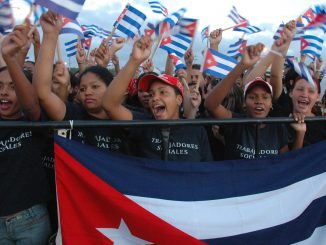
Cubans march for peace in solidarity with Palestine

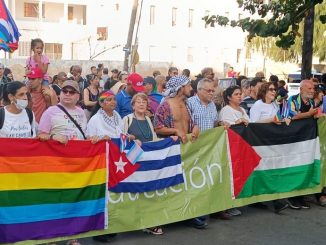
Havana, Oct 14 (Prensa Latina) — Thousands of Cubans of all ages marched Monday here demanding an end to the genocide committed by the Zionist Government of Israel against the Palestinian people and its attacks on other nations in the Middle East.

Participants in the march, led by Cuban President Miguel Díaz-Canel and other top leaders, denounced the complicity of the United States in the Zionist military onslaught that has killed more than 42,000 people in the Gaza Strip, including many women and children, and more than 2,000 in Lebanon.

At the Anti-Imperialist Tribune in Havana, final destination of the march that began at downtown Havana’s Fragua Martiana, Palestinian students in Cuba expressed their compatriots’ will to resist until they recover their nation, and achieve their inalienable rights and a just and lasting peace.

They denounced the expansionist interests of the State of Israel, and its aggression against nations such as Lebanon, Syria, Yemen, and the entire region, with the complicity of the United States, while the world remains paralyzed, unable to stop the tragedy.

It is not a war, it is a generalized and progressive genocide, they stated at the political-cultural event, at which they expressed their infinite gratitude to Cuba for its permanent solidarity with the just cause of the Palestinian people.

The first secretary of the Young Comminist League (UJC), Meyvis Estévez, stated that this march and the mobilizations held nationwide in recent days demonstrate Cuba’s support for the Palestinian people, whom she described as an impressive example of self-sacrifice and patriotism.

She stressed Cuba’s commitment to peace, justice and the defense of Palestinian sovereignty.

We will not close our eyes to the massacre; we will not forget the heroism of those attacked or the barbarity of the aggressors, Estévez noted.

Source: Prensa Latina

Strugglelalucha256


From Cuba to Palestine: The enduring spirit of Che Guevara inspires global resistance

Ernesto “Che” Guevara was killed Oct. 9, 1967. Che was an Argentine-born doctor who contributed tremendously to the Cuban Revolution, both in the military struggle against the U.S.-backed Batista dictatorship and in the building of socialism after 1959. He also participated in the African liberation struggle, fighting alongside anti-colonial forces in the Congo. Che died at only 39 years old during another epic of internationalist solidarity in Bolivia. While organizing with guerrillas there, he was captured by CIA-trained and directed Bolivian paramilitaries. Che’s example lives on. For almost 60 years since his death, he has inspired revolutionaries from the Black Panthers, right in the belly of the beast, to contemporary Palestinian freedom fighters. Following, Colby Byrd, a worker living in Baltimore, honors Che Guevara as a revolutionary force against oppression.

Che Guevara’s story is not just about an individual. Rather, it captures the many stories of all those who worked, fought, struggled, and died during the Cuban Revolution. It is the collection of all of those stories, all of those lives lived and ended, that freed Cuba from its imperialist domination. This focus on others is important to keep close to the heart of any revolutionary struggle at any level of intensity. 

Before his execution, Che proclaimed these final words: “I know you’ve come to kill me. Shoot, you are only going to kill a man.” 

Before he was a revolutionary, he was a person — a man with passion, dreams, and love. This movement, this forever struggle against the ever-invasive tendrils of imperialism, this epic endeavor … is championed by normal people.

Che and the fighting people of the Cuban Revolution were students, workers, peasants, parents, and children. It was only when they entwined themselves with the struggle that they became revolutionaries. Fred Hampton said that you can kill a revolutionary, but you can’t kill The Revolution. Che Guevara was executed — murdered by imperialist forces – yet Cuba stands, defying U.S. imperialism to this day. Countless people have fallen victim across the world, bombed, beaten, and battered by U.S. imperialism, and still today, people go out and fight in the name of international solidarity. The love of our class siblings guides us to challenge the systems that brutalize us every day. 

“Let me say, at the risk of seeming ridiculous, that the true revolutionary is guided by great feelings of love.” — Che Guevara

This Love that Che speaks about is not your typical love. It is not the same love you have for your favorite foods, your fond memories of the past, your hobbies and passions. It is not even the love you may share with a significant other. No, the Love Che speaks of is different. It manifests differently in everyone and is not fully explainable.

It is a transformative, ever-amplifying, and anarchic feeling that leads people to abandon or break the capitalist shackles that restrained them; to lift their arms and voices in the creation of a better future shaped by the collective struggle. The struggle is enacted by this tremendous feeling of love. 

This love can be seen today in both the direct struggle in Palestine and in the international support for that struggle. To put it plainly, the Palestinian Resistance of today is fighting for its people’s very right to exist. And I do not just mean the fighters engaged in direct combat against the U.S.-backed Israeli Occupation Forces and roaming gangs of Zionist settlers. I mean everyone. Every living soul that continues to stay and find a way to survive against the genocidal occupation. 

In this digital age, all forms of defiance are captured and uploaded online to be shared and immortalized by all who come into contact with it. During this time of relentless Israeli brutality, it is not just images of combat that show defiance, but also images of people sharing what little food they have with animals; videos of people cleaning the debris out of their homes or what is left of them, and moving back in to stay; videos of children expressing that they are unafraid of the Zionist enemy.

Many other depictions of love for their culture and way of life are documented and shared across the world. 

Around the world, this love is seen as millions take to the streets, demanding an end to the slaughter of their class siblings in occupied Palestine. Students on campuses creating tent encampments, workers striking in support of the Resistance, and more and more people seeing the horror for what it is and finding a way to say enough is enough. 

People around the world are joining the struggle however they can. Through any means available the people of the world are showing their solidarity with the struggle in Palestine.

The People of Cuba, forever fighting alongside those in the struggle, are offering free schooling to the people of Palestine on critical skills they will need to rebuild their society. The people of China and Russia meet with Palestinian dignitaries and leaders of the Resistance, offering aid and assistance wherever they can. 

Forget about the lines on maps that divide us and focus on the real human emotions that connect us all. This love lives there.

Marcellus Williams, a man murdered by the state of Missouri, in his last moments, wrote a poem honoring the resilience of Palestinian children in the face of their evil oppressors. Marcellus Williams, chained on death row, locked far away from the struggle outside, felt something within him. He felt something pull on that little red string of Fate, and in those final moments, it wasn’t a message of hate that came out.

He didn’t curse the state for its illegal and barbarous actions; he didn’t ask for forgiveness or look to a future that wasn’t coming. No, as he was meeting his end, he championed within himself the resilience of the Palestinian children who go out every day and live their lives, not knowing if that day could be their last. Over two million people attempted to get the decision to execute Marcellus Williams reversed. Over two million people felt the love in their hearts move them enough to fight back against the system within the belly of the beast. 

The struggle needs more Che Guevaras and Marcellus Williams. Normal people guided by love to achieve or face down the unimaginable. Through love, connections and communication can form. Through connection and communication rises organization and collective power. Finally, this collective power – reinforced and powered by the People, shaped into a united fist – will fight Imperial domination wherever it resides. 


Strugglelalucha256


‘Create Two, Three … Many Vietnams’

In April 1965, Che Guevara departed from Cuba to lend his skills as a guerrilla commander in revolutionary movements in other parts of the world, from the Congo to Bolivia. The following undated message was directed to the Organization of Solidarity with the Peoples of Asia, Africa, and Latin America (OSPAAAL), also known as the Tricontinental, which was founded after a conference held in Havana in January 1966. This message was published on April 16, 1967, in a special inaugural edition of Tricontinental magazine, released by the Executive Secretariat of OSPAAAL. It was featured under Guevara’s title, “Create Two, Three . . . Many Vietnams, That is the Watchword.” Manuel Piñeiro, who was responsible for Cuba’s relations with Third World revolutionaries at that time, stated in 1997 that the “Message” was composed by Che while he was in a training camp in Pinar del Río, Cuba, before his departure for Bolivia in 1966.

“Now is the time of the furnaces, and only light should be seen.”
Jose Marti

Twenty-one years have already elapsed since the end of the last world conflagration [World War II]; numerous publications, in every possible language, celebrate this event, symbolized by the defeat of Japan. There is a climate of apparent optimism in many areas of the different camps into which the world is divided.

Twenty-one years without a world war, in these times of maximum confrontations, of violent clashes, and sudden changes, appears to be a very high figure. However, without analyzing the practical results of this peace (poverty, degradation, increasingly larger exploitation of enormous sectors of humanity) for which all of us have stated that we are willing to fight, we would do well to inquire if this peace is real.

It is not the purpose of these notes to detail the different conflicts of a local character that have been occurring since the surrender of Japan, neither do we intend to recount the numerous and increasing instances of civilian strife which have taken place during these years of apparent peace. It will be enough just to name, as an example against undue optimism, the wars of Korea and Vietnam.

In the first one, after years of savage warfare, the Northern part of the country was submerged in the most terrible devastation known in the annals of modern warfare: riddled with bombs; without factories, schools, or hospitals; with absolutely no shelter for housing 10 million inhabitants.

Under the discredited flag of the United Nations, dozens of countries under the military leadership of the United States participated in this war with the massive intervention of U.S. soldiers and the use, as cannon fodder, of the South Korean population that was enrolled. On the other side, the army and the people of Korea, and the volunteers from the People’s Republic of China were furnished with supplies and advice by the Soviet military apparatus. The U.S. tested all sorts of weapons of destruction, excluding the thermo-nuclear type but including, on a limited scale, bacteriological and chemical warfare.

In Vietnam, the patriotic forces of that country have carried on an almost uninterrupted war against three imperialist powers: Japan, whose might suffered an almost vertical collapse after the bombs of Hiroshima and Nagasaki; France, who recovered from that defeated country its Indo-China colonies and ignored the promises it had made in harder times; and the United States, in this last phase of the struggle.

There were limited confrontations in every continent, although in our America, for a long time, there were only incipient liberation struggles and military coups d’etat until the Cuban revolution resounded the alert, signaling the importance of this region. This action attracted the wrath of the imperialists, and Cuba was finally obliged to defend its coasts, first in Playa Giron and again during the Missile Crisis.

This last incident could have unleashed a war of incalculable proportions if a U.S.-Soviet clash had occurred over the Cuban question.

But, evidently, the focal point of all contradictions is, at present, the territory of the peninsula of Indo-China and the adjacent areas. Laos and Vietnam are torn by a civil war that has ceased being such by the entry into the conflict of U.S. imperialism with all its might, thus transforming the whole zone into a dangerous detonator ready at any moment to explode.

In Vietnam, the confrontation has assumed extremely acute characteristics. It is not our intention, either, to chronicle this war. We shall simply remember and point out some milestones.

In 1954, after the annihilating defeat of Dien-Bien-Phu, an agreement was signed at Geneva dividing the country into two separate zones; elections were to be held within a term of 18 months to determine who should govern Vietnam and how the country should be reunified. The U.S. did not sign this document and started maneuvering to substitute the emperor Bao-Dai, who was a French puppet, for a man more amiable to its purposes. This happened to be Ngo-Din-Diem, whose tragic end – that of an orange squeezed dry by imperialism — is well known by all.

During the months following the agreement, optimism reigned supreme in the camp of the popular forces. The last pockets of the anti-French resistance were dismantled in the South of the country, and they awaited the fulfillment of the Geneva Agreements. But the patriots soon realized there would be no elections – unless the United States felt itself capable of imposing its will in the polls, which was practically impossible even resorting to all its fraudulent methods. Once again, the fighting broke out in the South and gradually acquired full intensity. At present, the U.S. army has increased to over half a million invaders while the puppet forces have decreased in number and, above all, have totally lost their combativeness.

Almost two years ago, the United States started bombing systematically the Democratic Republic of Vietnam in yet another attempt to overcome the belligerence of the South and impose, from a position of strength, a meeting at the conference table. At first, the bombardments were more or less isolated occurrences and were adorned with the mask of reprisals for alleged provocations from the North. Later on, as they increased in intensity and regularity, they became one gigantic attack carried out by the Air Force of the United States, day after day, for the purpose of destroying all vestiges of civilization in the Northern zone of the country. This is an episode of the infamously notorious “escalation.”

The material aspirations of the Yankee world have been fulfilled to a great extent, regardless of the unflinching defense of the Vietnamese anti-aircraft artillery, of the numerous planes shot down (over 1,700), and of the socialist countries aid in war supplies.

There is a sad reality: Vietnam — a nation representing the aspirations, the hopes of a whole world of forgotten peoples — is tragically alone. This nation must endure the furious attacks of U.S. technology, with practically no possibility of reprisals in the South and only some of defense in the North — but always alone.

The solidarity of all progressive forces of the world towards the people of Vietnam today is similar to the bitter irony of the plebeians coaxing on the gladiators in the Roman arena. It is not a matter of wishing success to the victim of aggression but of sharing his fate; one must accompany him to his death or to victory.

When we analyze the lonely situation of the Vietnamese people, we are overcome by anguish at this illogical moment of humanity.

U.S. imperialism is guilty of aggression — its crimes are enormous and cover the whole world. We already know all that, gentlemen! But this guilt also applies to those who, when the time came for a definition, hesitated to make Vietnam an inviolable part of the socialist world; running, of course, the risks of a war on a global scale but also forcing a decision upon imperialism. And the guilt also applies to those who maintain a war of abuse and snares — started quite some time ago by the representatives of the two greatest powers of the socialist camp.

We must ask ourselves, seeking an honest answer: is Vietnam isolated, or is it not? Is it not maintaining a dangerous equilibrium between the two quarreling powers?

And what great people these are! What stoicism and courage! And what a lesson for the world is contained in this struggle! Not for a long time shall we be able to know if President Johnson ever seriously thought of bringing about some of the reforms needed by his people – to iron out the barbed class contradictions that grow each day with explosive power. The truth is that the improvements announced under the pompous title of the “Great Society” have dropped into the cesspool of Vietnam.

The largest of all imperialist powers feels in its own guts the bleeding inflicted by a poor and underdeveloped country; its fabulous economy feels the strain of the war effort. Murder is ceasing to be the most convenient business for its monopolies. Defensive weapons, and never in adequate number, are all these extraordinary soldiers have – besides love for their homeland, their society and unsurpassed courage. But imperialism is bogging down in Vietnam, is unable to find a way out, and desperately seeks one that will overcome with dignity this dangerous situation in which it now finds itself. Furthermore, the Four Points put forward by the North and the Five Points of the South now corner imperialism, making the confrontation even more decisive.

Everything indicates that peace, this unstable peace which bears that name for the sole reason that no worldwide conflagration has taken place, is again in danger of being destroyed by some irrevocable and unacceptable step taken by the United States.

What role shall we, the exploited people of the world, play? The peoples of the three continents focus their attention on Vietnam and learn their lesson. Since imperialists blackmail humanity by threatening it with war, the wise reaction is not to fear war. The general tactics of the people should be to launch a constant and a firm attack in all fronts where the confrontation is taking place.

In those places where this meager peace we have has been violated which is our duty? To liberate ourselves at any price.

The world panorama is of great complexity. The struggle for liberation has not yet been undertaken by some countries of ancient Europe, sufficiently developed to realize the contradictions of capitalism, but weak to such a degree that they are unable either to follow imperialism or even to start on its own road. Their contradictions will reach an explosive stage during the forthcoming years-but their problems and, consequently, their own solutions are different from those of our dependent and economically underdeveloped countries.

The fundamental field of imperialist exploitation comprises the three underdeveloped continents: America, Asia, and Africa. Every country has also its own characteristics, but each continent, as a whole, also presents a certain unity.

Our America is integrated by a group of more or less homogeneous countries and in most parts of its territory, U.S. monopolist capitals maintain an absolute supremacy. Puppet governments or, in the best of cases, weak and fearful local rulers are incapable of contradicting orders from their Yankee master. The United States has nearly reached the climax of its political and economic domination; it could hardly advance much more; any change in the situation could bring about a setback. Their policy is to maintain that which has already been conquered. The line of action, at the present time, is limited to the brutal use of force with the purpose of thwarting the liberation movements, no matter of what type they might happen to be.

Behind the slogan “We will not permit another Cuba” hides the possibility of cowardly acts of aggression they can get away with–such as the one against the Dominican Republic; or, before that, the massacre in Panama and the clear warning that Yankee troops are ready to intervene anywhere in Latin America where a change in the established order endangers their interests. This policy enjoys almost absolute impunity. The OAS is a convenient mask, no matter how discredited it is. The UN’s ineffectiveness borders on the ridiculous or the tragic. The armies of all the countries of Latin America are ready to intervene to crush their own people. What has been formed, in fact, is the International of Crime and Betrayal.

On the other hand, the indigenous bourgeoisie have lost all capacity to oppose imperialism–if they ever had any–and are only dragged along behind it like a caboose. There are no other alternatives. Either a socialist revolution or a caricature of revolution.

Asia is a continent with many different characteristics. The struggle for liberation waged against a series of European colonial powers resulted in the establishment of more or less progressive governments, whose ulterior evolution has brought about, in some cases, the deepening of the primary objectives of national liberation and, in others, a setback towards the adoption of pro-imperialist positions.

From the economic point of view, the United States had very little to lose and much to gain from Asia. These changes benefited its interests; the struggle for the overthrow of other neocolonial powers and the penetration of new spheres of action in the economic field is carried out sometimes directly, occasionally through Japan.

But there are special political conditions, particularly in Indo-China, which create in Asia certain characteristics of capital importance and play a decisive role in the entire U.S. military strategy.

The imperialists encircle China through South Korea, Japan, Taiwan, South Vietnam and Thailand at least.

This dual situation, a strategic interest as important as the military encirclement of the Peoples’ Republic of China and the penetration of these great markets — which they do not dominate yet — turns Asia into one of the most explosive points of the world today, in spite of its apparent stability outside of the Vietnamese war zone.

The Middle East, though it geographically belongs to this continent, has its own contradictions and is actively in ferment; it is impossible to foretell how far this cold war between Israel, backed by the imperialists, and the progressive countries of that zone will go. This is just another one of the volcanoes threatening eruption in the world today.

Africa offers an almost virgin territory to the neocolonial invasion. There have been changes which, to some extent, forced neocolonial powers to give up their former absolute prerogatives. But when these changes are carried out uninterruptedly, colonialism continues in the form of neocolonialism with similar effects as far as the economic situation is concerned.

The United States had no colonies in this region but is now struggling to penetrate its partners’ fiefs. It can be said that following the strategic plans of U.S. imperialism, Africa constitutes its long-range reservoir; its present investments, though, are only important in the Union of South Africa, and its penetration is beginning to be felt in the Congo, Nigeria, and other countries where a violent rivalry with other imperialist powers is beginning to take place (in a pacific manner up to the present time).

So far, it does not have there great interests to defend except its pretended right to intervene in every spot of the world where its monopolies detect huge profits or the existence of large reserves of raw materials.

All this past history justifies our concern regarding the possibilities of liberating the peoples within a long or a short period of time.

If we stop to analyze Africa, we shall observe that in the Portuguese colonies of Guinea, Mozambique, and Angola, the struggle is waged with relative intensity, with a concrete success in the first one and with variable success in the other two. We still witness in the Congo the dispute between Lumumba’s successors and the old accomplices of Tshombe, a dispute which at the present time seems to favor the latter: those who have “pacified” a large area of the country for their own benefit — though the war is still latent.

In Rhodesia, we have a different problem: British imperialism used every means within its reach to place power in the hands of the white minority, who, at the present time, unlawfully holds it. The conflict, from the British point of view, is absolutely unofficial; this Western power, with its habitual diplomatic cleverness — also called hypocrisy in the strict sense of the word — presents a facade of displeasure before the measures adopted by the government of Ian Smith. Its crafty attitude is supported by some Commonwealth countries that follow it, but is attacked by a large group of countries belonging to Black Africa, whether they are or not servile economic lackeys of British imperialism.

Should the rebellious efforts of these patriots succeed and this movement receive the effective support of neighboring African nations, the situation in Rhodesia may become extremely explosive. But for the moment, all these problems are being discussed in harmless organizations such as the UN, the Commonwealth, and the OAU.

The social and political evolution of Africa does not lead us to expect a continental revolution. The liberation struggle against the Portuguese should end victoriously, but Portugal does not mean anything in the imperialist field. The confrontations of revolutionary importance are those which place at bay all the imperialist apparatus; this does not mean, however, that we should stop fighting for the liberation of the three Portuguese colonies and for the deepening of their revolutions.

When the black masses of South Africa or Rhodesia start their authentic revolutionary struggle, a new era will dawn in Africa. Or when the impoverished masses of a nation rise up to rescue their right to a decent life from the hands of the ruling oligarchies.

Up to now, army putsches follow one another; a group of officers succeeds another or substitute a ruler who no longer serves their caste interests or those of the powers who covertly manage him — but there are no great popular upheavals. In the Congo these characteristics appeared briefly, generated by the memory of Lumumba, but they have been losing strength in the last few months.

In Asia, as we have seen, the situation is explosive. The points of friction are not only Vietnam and Laos, where there is fighting; such a point is also Cambodia, where at any time a direct U.S. aggression may start, Thailand, Malaya, and, of course, Indonesia, where we can not assume that the last word has been said, regardless of the annihilation of the Communist Party in that country when the reactionaries took over. And also, naturally, the Middle East.

In Latin America, the armed struggle is going on in Guatemala, Colombia, Venezuela and Bolivia; the first uprisings are cropping up in Brazil. There are also some resistance focuses which appear and then are extinguished. But almost all the countries of this continent are ripe for a type of struggle that, in order to achieve victory, can not be content with anything less than establishing a government of socialist tendencies.

In this continent, practically only one tongue is spoken (with the exception of Brazil, with whose people, those who speak Spanish, can easily make themselves understood, owing to the great similarity of both languages). There is also such a great similarity between the classes in these countries that they have attained identification among themselves of an international americano type, much more complete than in the other continents. Language, habits, religion, a common foreign master, unite them. The degree and the form of exploitation are similar for both the exploiters and the men they exploit in the majority of the countries of Our America. And rebellion is ripening swiftly in it.

We may ask ourselves: how shall this rebellion flourish? What type will it be? We have maintained for quite some time now that, owing to the similarity of their characteristics, the struggle in Our America will achieve in due course, continental proportions. It shall be the scene of many great battles fought for the liberation of humanity.

Within the frame of this struggle of continental scale, the battles which are now taking place are only episodes — but they have already furnished their martyrs, they shall figure in the history of Our America as having given their necessary blood in this last stage of the fight for the total freedom of man. These names will include Comandante Turcios Lima, padre Camilo Torres, Comandante Fabricio Ojeda, Comandantes Lobaton and Luis de la Puente Uceda, all outstanding figures in the revolutionary movements of Guatemala, Colombia, Venezuela and Peru.

But the active movement of the people creates its new leaders; Cesar Montes and Yon Sosa raise up their flag in Guatemala; Fabio Vazquez and Marulanda in Colombia; Douglas Bravo in the Western part of the country and Americo Martin in El Bachiller, both directing their respective Venezuelan fronts.

New uprisings shall take place in these and other countries of Our America, as it has already happened in Bolivia, and they shall continue to grow in the midst of all the hardships inherent to this dangerous profession of being modern revolutionaries. Many shall perish, victims of their errors, others shall fall in the tough battle that approaches; new fighters and new leaders shall appear in the warmth of the revolutionary struggle. The people shall create their warriors and leaders in the selective framework of the war itself – and Yankee agents of repression shall increase. Today there are military aides in all the countries where armed struggle is growing; the Peruvian army apparently carried out a successful action against the revolutionaries in that country, an army also trained and advised by the Yankees. But if the focuses of war grow with sufficient political and military insight, they shall become practically invincible and shall force the Yankees to send reinforcements. In Peru itself many new figures, practically unknown, are now reorganizing the guerrilla. Little by little, the obsolete weapons, which are sufficient for the repression of small armed bands, will be exchanged for modern armaments and the U.S. military aides will be substituted by actual fighters until, at a given moment, they are forced to send increasingly greater number of regular troops to ensure the relative stability of a government whose national puppet army is disintegrating before the impetuous attacks of the guerrillas. It is the road of Vietnam, it is the road that should be followed by the people; it is the road that will be followed in Our America, with the advantage that the armed groups could create Coordinating Councils to embarrass the repressive forces of Yankee imperialism and accelerate the revolutionary triumph.

America, a forgotten continent in the last liberation struggles, is now beginning to make itself heard through the Tricontinental and, in the voice of the vanguard of its peoples, the Cuban Revolution, will today have a task of much greater relevance: creating a Second or a Third Vietnam, or the Second and Third Vietnam of the world.

We must bear in mind that imperialism is a world system, the last stage of capitalism — and it must be defeated in a world confrontation. The strategic end of this struggle should be the destruction of imperialism. Our share, the responsibility of the exploited and underdeveloped of the world is to eliminate the foundations of imperialism: our oppressed nations, from where they extract capitals, raw materials, technicians and cheap labor, and to which they export new capitals — instruments of domination — arms and all kinds of articles; thus submerging us in an absolute dependence.

The fundamental element of this strategic end shall be the real liberation of all people, a liberation that will be brought about through armed struggle in most cases and which shall be, in Our America, almost indefectibly, a Socialist Revolution.

While envisaging the destruction of imperialism, it is necessary to identify its head, which is no other than the United States of America.

We must carry out a general task with the tactical purpose of getting the enemy out of its natural environment, forcing him to fight in regions where his own life and habits will clash with the existing reality. We must not underrate our adversary; the U.S. soldier has technical capacity and is backed by weapons and resources of such magnitude that render him frightful. He lacks the essential ideological motivation that his bitterest enemies of today — the Vietnamese soldiers — have in the highest degree. We will only be able to overcome that army by undermining their morale — and this is accomplished by defeating it and causing it repeated sufferings.

But this brief outline of victories carries within itself the immense sacrifice of the people, sacrifices that should be demanded beginning today, in plain daylight, and which perhaps may be less painful than those we would have to endure if we constantly avoided battle in an attempt to have others pull our chestnuts out of the fire.

It is probable, of course, that the last liberated country shall accomplish this without an armed struggle and the sufferings of a long and cruel war against the imperialists — this they might avoid. But perhaps it will be impossible to avoid this struggle or its effects in a global conflagration; the suffering would be the same, or perhaps even greater. We cannot foresee the future, but we should never give in to the defeatist temptation of being the vanguard of a nation which yearns for freedom, but abhors the struggle it entails and awaits its freedom as a crumb of victory.

It is absolutely just to avoid all useless sacrifices. Therefore, it is so important to clear up the real possibilities that dependent America may have of liberating itself through pacific means. For us, the solution to this question is quite clear: The present moment may or may not be the proper one for starting the struggle, but we cannot harbor any illusions, and we have no right to do so, that freedom can be obtained without fighting. And these battles shall not be mere street fights with stones against tear-gas bombs, or of pacific general strikes; neither shall it be the battle of a furious people destroying in two or three days the repressive scaffolds of the ruling oligarchies; the struggle shall be long, harsh, and its front shall be in the guerrilla’s refuge, in the cities, in the homes of the fighters – where the repressive forces shall go seeking easy victims among their families – in the massacred rural population, in the villages or cities destroyed by the bombardments of the enemy.

They are pushing us into this struggle; there is no alternative: We must prepare it and we must decide to undertake it.

The beginnings will not be easy; they shall be extremely difficult. All the oligarchies’ powers of repression, all their capacity for brutality and demagoguery will be placed at the service of their cause. Our mission, in the first hour, shall be to survive; later, we shall follow the perennial example of the guerrilla, carrying out armed propaganda (in the Vietnamese sense, that is, the bullets of propaganda, of the battles won or lost — but fought — against the enemy). The great lesson of the invincibility of the guerrillas taking root in the dispossessed masses. The galvanizing of the national spirit, the preparation for harder tasks, for resisting even more violent repressions. Hatred as an element of the struggle; a relentless hatred of the enemy, impelling us over and beyond the natural limitations that man is heir to and transforming him into an effective, violent, selective and cold killing machine. Our soldiers must be thus; a people without hatred cannot vanquish a brutal enemy.

We must carry the war into every corner the enemy happens to carry it: to his home, to his centers of entertainment; a total war. It is necessary to prevent him from having a moment of peace, a quiet moment outside his barracks or even inside; we must attack him wherever he may be; make him feel like a cornered beast wherever he may move. Then his moral fiber shall begin to decline. He will even become more beastly, but we shall notice how the signs of decadence begin to appear.

And let us develop a true proletarian internationalism; with international proletarian armies; the flag under which we fight would be the sacred cause of redeeming humanity. To die under the flag of Vietnam, of Venezuela, of Guatemala, of Laos, of Guinea, of Colombia, of Bolivia, of Brazil — to name only a few scenes of today’s armed struggle — would be equally glorious and desirable for an American, an Asian, an African, even a European.

Each spilt drop of blood, in any country under whose flag one has not been born, is an experience passed on to those who survive, to be added later to the liberation struggle of his own country. And each nation liberated is a phase won in the battle for the liberation of one’s own country.

The time has come to settle our differences and place everything at the service of our struggle.

We all know great controversies rend the world now fighting for freedom; no one can hide it. We also know that they have reached such intensity and such bitterness that the possibility of dialogue and reconciliation seems extremely difficult, if not impossible. It is a useless task to search for means and ways to propitiate a dialogue which the hostile parties avoid. However, the enemy is there; it strikes every day, and threatens us with new blows and these blows will unite us, today, tomorrow, or the day after. Whoever understands this first, and prepares for this necessary union, shall have the people’s gratitude.

Owing to the virulence and the intransigence with which each cause is defended, we, the dispossessed, cannot take sides for one form or the other of these differences, even though sometimes we coincide with the contentions of one party or the other, or in a greater measure with those of one part more than with those of the other. In time of war, the expression of current differences constitutes a weakness; but at this stage it is an illusion to attempt to settle them by means of words. History shall erode them or shall give them their true meaning.

In our struggling world every difference regarding tactics, the methods of action for the attainment of limited objectives should be analyzed with due respect to another man’s opinions. Regarding our great strategic objective, the total destruction of imperialism by armed struggle, we should be uncompromising.

Let us sum up our hopes for victory: total destruction of imperialism by eliminating its firmest bulwark: the oppression exercised by the United States of America. To carry out, as a tactical method, the peoples’ gradual liberation, one by one or in groups: driving the enemy into a difficult fight away from its own territory; dismantling all its sustenance bases, that is, its dependent territories.

This means a long war. And, once more we repeat it, a cruel war. Let no one fool himself at the outstart and let no one hesitate to start out for fear of the consequences it may bring to his people. It is almost our sole hope for victory. We cannot elude the call of this hour. Vietnam is pointing it out with its endless lesson of heroism, its tragic and everyday lesson of struggle and death for the attainment of final victory.

There, the imperialist soldiers endure the discomforts of those who, used to enjoying the U.S. standard of living, have to live in a hostile land with the insecurity of being unable to move without being aware of walking on enemy territory: death to those who dare take a step out of their fortified encampment. The permanent hostility of the entire population. All this has internal repercussions in the United States; propitiates the resurgence of an element which is being minimized in spite of its vigor by all imperialist forces: class struggle even within its own territory.

How close we could look into a bright future should two, three or many Vietnams flourish throughout the world with their share of deaths and their immense tragedies, their everyday heroism and their repeated blows against imperialism, impelled to disperse its forces under the sudden attack and the increasing hatred of all peoples of the world!

And if we were all capable of uniting to make our blows stronger and infallible and so increase the effectiveness of all kinds of support given to the struggling people — how great and close would that future be!

If we, in a small point of the world map, are able to fulfill our duty and place at the disposal of this struggle whatever little of ourselves we are permitted to give: our lives, our sacrifice, and if some day we have to breathe our last breath on any land, already ours, sprinkled with our blood let it be known that we have measured the scope of our actions and that we only consider ourselves elements in the great army of the proletariat but that we are proud of having learned from the Cuban Revolution, and from its maximum leader, the great lesson emanating from his attitude in this part of the world: “What do the dangers or the sacrifices of a man or of a nation matter, when the destiny of humanity is at stake.”

Our every action is a battle cry against imperialism, and a battle hymn for the people’s unity against the great enemy of mankind: the United States of America. Wherever death may surprise us, let it be welcome, provided that this, our battle cry, may have reached some receptive ear and another hand may be extended to wield our weapons and other men be ready to intone the funeral dirge with the staccato singing of the machine-guns and new battle cries of war and victory.

Source: Marxists Internet Archive

Strugglelalucha256


Bill Camp ¡Presente!

Bill Camp, a leader in the union movement who fought tirelessly for workers’ rights, died Sept. 23. Camp was known not just as a labor union leader but equally for his years of work in solidarity with the workers of Cuba to end the damage inflicted on the people of Cuba by the U.S. government blockade of that country.

Lianys Torres Rivera, the head of the Cuban Mission in the United States, posted on X: “Deepest condolences to Bill Camp’s family, whom the Cuban people will never forget for his unconditional solidarity and ongoing struggle for justice, peace and better relations between our country and the U.S. RIP Dear friend🖤.” 

When Bill Camp received a diagnosis of brain cancer last summer, he never paused in his organizing work, determined to get Cuba off the list of “countries who support terrorism,” a fallacious narrative started by Trump and continued by Biden, to tighten the deadly strictures of the blockade on Cuba.  

A long life lived well with many accomplishments 

Bill Camp was born in 1944 in the cotton mill town of Anderson, South Carolina. While at College in Jackson, Mississippi, during the 1960s, he joined in actions supporting integration. The Mississippi White Citizens Council targeted Camp with a KKK-type death squad. He managed to escape across the border before sundown.

In 1968, while enrolled in a Ph.D. program at Duke University, he played a lead role in organizing student support for a strike by the Black workers on Duke’s maintenance staff who were receiving less than minimum wage. The strike was successful, and Camp was expelled from Duke.

In Redding, California, Bill Camp’s efforts helped to create the national model for parent participation in the early childhood education program, Head Start. 

From there he and his spouse, Catherine Camp, moved to Sacramento, where he worked for the California Agricultural Labor Relations Board. This state agency guaranteed the organizing rights of farm workers. He ran elections to recognize the bargaining rights of farm workers, investigated illegal actions by growers, and played a key role in helping to win the first collective bargaining contracts for lettuce workers in the Imperial Valley.  

California Gov. Deukmejian eliminated his job after Camp reported on illegal appointments to run the Prosecutorial Division of that State agency.

He joined the Sacramento Central Labor Council (SCLC), and during the 15 years he served on the Labor Council, it became a significant voice for the working class in the area. He remained on the Board of the SCLC and the SCLC newspaper even after he retired in 2014.

In 2015, Bill received a union flag signed by UFW President Arturo Rodriguez and Cesar Chavez Foundation President Paul Chavez, recognizing his decades of selfless service to farm workers.

His son Bayliss Camp noted that “my father may have been living with this cancer for perhaps two years before it was diagnosed. … During those two years, he organized trips to Cuba.”

Bill Camp was instrumental in organizing a group of union members, their union officers, and supporters, mainly from the U.S. West Coast, in the aptly named Building Relations with Cuban Labor (BRCL). That included leading a group of labor leaders and members to celebrate Cuba’s May Day 2024 in Havana. The visit was planned to support Cuban workers and see the many accomplishments of the Cuban workers.

Strugglelalucha256


U.S. imposes another year of blockade on Cuba

In September, and for the fourth consecutive year, U.S. President Joe Biden renewed U.S. sanctions on Cuba under the Trading with the Enemy Act (TWEA), an archaic 1917 law designed to cut off trade with Germany during World War I and a significant pillar of the blockade. The announcement means that the economic blockade, a policy upheld by both Republican and Democratic administrations for over six decades, will remain imposed on the island through 2025, despite Cuba’s urgent calls for it to end. Let’s not forget that it was Biden, the democrat who while campaigning for president, said he would improve relations with us.

The Caribbean Island is the only country in the world still subject to sanctions under the century-old law, which was originally intended to be used only in times of war. It is also the main obstacle preventing Cuba’s economic growth, as it is forced to face the same world crises, such as pandemics, inflation, and shortages, but under conditions to which most countries worldwide are not subject.

“Washington imposes another year of blockade against Cuba,” Foreign Minister Bruno Rodriguez reported when the White House released the news. The damages are in the billions and will continue to accumulate. From March 1, 2023, to February 29, 2024, alone, the blockade caused economic losses to Cuba estimated in the order of 5 billion 56.8 million dollars, which represents an increase of 189.8 million dollars compared to the previous report.

“The current challenges of the Cuban reality would have a better and easier solution if Cuba could have at its disposal the substantial resources that the blockade deprives it of. This policy is illegal and inhumane and severely affects key sectors such as social, public services, energy, and tourism, as well as the state-run industry and the private sector,” Rodriguez added.

In November, the Biden administration will reach its end without any profound changes in bilateral relations. Let’s recall that, during his 2020 electoral campaign, the Democratic candidate gave signs that his policy towards Cuba would return to the path of the so-called “constructive engagement” developed by the Obama administration, of which Biden was vice president. He assured he would lift the relentless policy of hostility followed by his predecessor, Donald Trump (2017-2021), who imposed over 200 coercive measures against the island during his mandate.

However, his discourse changed once Biden was installed in the White House.

“Our policy towards Cuba is being studied and is guided by two principles. First is support for democracy and human rights, which is the center of our efforts. The second is the Americans, especially the Cuban Americans, the best ambassadors of freedom in Cuba, so we are going to review the policies of the Trump administration,” said the then press secretary, Jen Psaki.

With few weeks ahead before the U.S. Presidential elections, with vice-president Kamala Harris and Republican and former president Donald Trump as candidates, Cuba is no priority for either of them since Cuba represents no threat to U.S. politics and security. They haven’t even mentioned what policy they will pursue toward the Caribbean island other than keeping a blockade that is strangling the Cuban people intact.

At this moment, they have many other hot topics to debate about, like who is the bigger supporter of Israel’s ongoing genocide in Palestine, the upheaval of tensions in the Middle East, or the rise of gun violence in the country. They could care less whether the island remains one more year under the yoke of the blockade 60 years later. Let’s be honest, humane policies of mutually beneficial relations are never on the minds of our imperial neighbor to the North.

Meanwhile, Cuba keeps struggling, being a victim of an archaic, outdated, and harmful policy, under which most of the Cuban population has been forced to live, which causes shortages, prejudice against Cubans, separation, and pain. However, they will never watch us tumble. “Despite the serious damage caused by the hostile policies of the U.S. governments on the Cuban people, they continue to fail in their objective of destroying the Revolution,” Rodriguez reaffirmed.

Source: Resumen Latinoamericano – US


Strugglelalucha256


U.S. solidarity campaign sends 800 tons of flour to Cuba

Havana, August 31 (RHC)– A shipment of 800 tons of wheat flour — collected by solidarity activists in the U.S. — has arrived in Cuba.  The donation will provide bread for millions of people in the provinces of Pinar del Rio, Artemisa, Mayabeque, Matanzas and Havana.

This campaign was organized in the United States by the New York City-based “Let Cuba Live: Bread for Our Neighbors” campaign.

According to Manolo De Los Santos, the executive director of The People’s Forum — which was the main coordinator of the solidarity effort — while the campaign has succeeded in carrying out this delivery, it wasn’t without significant hurdles created by Washington’s blockade of the Caribbean island.

In the process of organizing the campaign, Manolo De Los Santos said they reached out to 14 different grain producers in the U.S. to purchase the massive order but received not a single positive response.  In order to successfully complete the delivery, the grain had to be shipped from Turkey and suffered delays “because of the U.S. government’s policy of extreme and arbitrary harassment of Cuba’s foreign trade, which is meant to create desperation for the people of Cuba and has brutal consequences.”

The director of The People’s Forum said that the Joe Biden administration, “in its remaining months before January, has the power to swiftly end this crisis of hunger.”  It could remove Cuba from the “State Sponsors of Terrorism List,” an unfounded designation imposed in 2017 by Trump that restricts vital financial and trade transactions.

The “Let Cuba Live: Bread for Our Neighbors” campaign is just one part of the larger fight against the U.S. blockade on Cuba.  The people of the U.S. will continue to fight against this brutal blockade and build bridges of solidarity with our neighbors in Cuba.

Manolo De Los Santos emphasized that donations are still being accepted to help offset the costs of this massive delivery, calling on supporters around the world to consider an additional donation.

For more information:  https://secure.givelively.org/donate/peoples-forum-inc/let-cuba-live-bread-for-our-neighbors

Source: Radio Havana Cuba
Edited by Ed Newman on August 31, 2024

Strugglelalucha256


Cuba’s parallel reality in Paris

Miserable is a society that imposes repudiatory practices of inquisition and falsehood. Miserable are those who deny Cuba the joy of its nine Olympic medals, the same number won by Denmark, a country without a U.S. blockade and without the press and the media reproaching its performance in Paris.

The publicity strategy to turn every success of Cuba into a failure has an interesting peculiarity: it operates by continuous streaks, by brief and intense periods in which a thematic axis is installed. From the alleged arrival in Caracas of 32 flights from Havana to intervene in the Venezuelan elections, the non-existent Chinese military bases in Cuban territory, the presence of Russian submarines with nuclear weapons in Havana Bay that did not actually take place, the alleged failure of Cuba in the Paris Olympics, everything is aimed at producing an “agenda”.

The vertigo with which the publicity events follow one after the other suggests that none of them reaches a minimum of power in public opinion: their objective is not essentially to modify opinions, but the installation of a parallel reality, the agitation of prejudices, the persistence of hatred as an excluding source of legitimacy of a government that leads the country in its worst economic crisis while under permanent siege.

The last cry of this fashion, however, seems to be crossing a barrier and beginning the transition to a new period, flatly denying reality, ignoring the evidence of facts that have been corroborated by millions of spectators attending the Olympic Games. Cuba was not only the Latin American country with the highest number of medals won, surpassed only by Brazil, but also the Cuban athlete who for the first time in history won five consecutive medals at the Olympics in the same sport, Mijaín López.

Neither Bolt nor Phelps nor Lewis nor other sport legends achieved what Mijaín did. He made his debut in Athens 2004 and from Beijing 2008 to Paris 2024 he took the gold medals in Greco-Roman wrestling, a discipline that was practiced in the classical world before the birth of Jesus Christ and in which since the establishment of the Olympic Games no other gladiator held the scepter for so many years. Until Mijaín appeared, a compendium of culture and the comings and goings of national history: black with a Russian name, known throughout Cuba as the Giant of Herradura, because he is 1.93 meters tall, weighs 130 kilograms and was born in a small town of that name with barely 10,000 inhabitants, which did not exist on the map until American settlers discovered its fertile lands and settled there at the beginning of the 20th century.

His family descends from Africans who worked all their lives for the rich whites of that area until they became literate with the 1959 revolution and, thanks to it and to the plans to extend sports to every town in the country, while his father, Bartolo, tilled the land, Mijaín and his two brothers won medals in national and international boxing and Greco-Roman wrestling championships.

And this Cuban athlete was selected to represent the athletes of the Americas at the closing ceremony of the Olympic Games in Paris.

But with this attitude of contempt for others, of cult of violence that takes pleasure in the suffering of others, not a few media and agencies, in addition to the pack of cyberspace, have denied the medal to Mijaín and the other Cuban Olympic athletes. With indignation we read everywhere the “expected failure”, “worst Olympics for Cuba”, “decline”, “sports crisis”, “shipwreck” and other nonsense, and as a footnote, insignificant, the results that most of the nations of this planet would have liked to have.

The French philosopher and urbanist Paulo Virilio anticipated in the book Cibermundo, la política de lo peor ( 1997), a long interview with his compatriot Philippe Petit, that “the day will come when virtual reality will defeat the real world…. One’s own body will cease to exist in favor of the spectral body, and one’s own world in favor of a virtual world”. For saying these things, which are our daily bread, Virilio was accused 30 years ago of being an apocalyptic.

Rosa Miriam Elizalde is a Cuban journalist who served as the Vice-President of the Union of Cuban Journalists  (UPEC).  She holds a PhD in Communication Sciences and is the author of several books. Rosa is a founder of Cubadebate and its Editor-in-Chief until January 2017. Currently she is a columnist for La Jornada, Mexico.

Source: La Jornada translation Resumen Latinoamericano – English

Strugglelalucha256


Cuban Mijain Lopez becomes a legend with fifth consecutive Olympic medal

Mijaín López has taken Cuba’s name to the top in the Olympic Games in Paris 2024, in France. on Tuesday, the Greco-Roman wrestling athlete won his fifth consecutive Olympic gold medal, a feat never seen before, admirable, especially for an athlete who is about to turn 41 years old. At a distance of 7,846 kilometers from this Caribbean island, Bartolo’s son, a native of Pinar del Rio, defeated his teammate and friend Yasmani Acosta from Chile, 6-0 in the 130 kilograms.

We were with him on the sands of the Champ-de-Mars. Five minutes in which all of Cuba cheered from their homes, workplaces, for the invincible giant. We raised our fists and got up from our seats. And like all of Cuba, those who were lucky to witness Mijain live and direct also lived with him every push and every effort.

All the tension was in the center of that venue; anticipating. People could not fit in their seats, they and they swayed with anxiety at each movement. They cheered for the Hero in French, Spanish, English, and all languages. Lopez, Lopez! Those chantings were heard seconds before the victory. A few days earlier, a giant Mijain poster was displayed around the Eiffel Tower, one of the most iconic and most visited points of the city. Everyone there knew they would be witnessing an historic moment.

“Cuba was Mijain tonight and he knows it. He planted himself like an oak tree in the center of the mat, right where the Parisian logo is placed, and from there he poured his strength and his lineage into his legs and arms, face and skin,” said Cuban journalist Oscar Figueredo, who was part of the Cuban delegation to the sporting event in Paris.

One of the most emotional moments of the competition was when the giant advanced to the center of the arena. He threw himself on the floor and kissed it. He took his shoes off in tears and placed them perfectly side by side. He left them there and slowly retreated towards his coaches, who were also waiting for him with tears in their eyes, clutching the Cuban flag. He said goodbye to competitions, and Cuba hugged him symbolically.

Tributes were not long in coming after the victory. As Mijain walked from the mat for the last time he was met by Thomas Bach, the President of the International Olympic Committee, who came up to him to recognize his sacrifice and talent. Only then was he able to advance slowly amid the turmoil generated by his presence. Hundreds of journalists, athletes, coaches, and volunteers wanted to be close to the champion.

On social networks, there was nothing else to talk about but Mijain’s victory. Friends, families, and a whole country shared messages of pride. “How beautiful to be Cuban, and to coincide in time with a giant like Mijain,” agreed the users. President Miguel Díaz-Canel also shared on his official X account: “Your victory is the most important sporting event of the Games. You are an exemplary Cuban and revolutionary.”

The most admirable characteristic of Mijain is not just his strength but also his kindness. Everyone who knows him agrees that he is one more among all Cubans, humble and close. That is why his first words after the victory were of gratitude.

“I dedicate the triumph to all the human beings who have contributed to my triumphs and have helped me to stay on this path for so many years… Also, I’m grateful to all those young people who have inspired me. I feel happy to be Cuban and to have carried the Cuban flag so many times, and to have given this medal to our delegation,” he commented minutes later.

Mijain Lopez knows that achieving this victory is the result of a lot of personal effort, but also of his family roots, and of the opportunities that Cuba has also created for athletes like him, who come from humble families, to dream of achieving a gold medal at 5 consecutive Olympic Games.

Cuba is filled with pride for your strength, love and perseverance Mijain. Congratulations, Champion.

Source: Resumen Latinoamericano – English

Strugglelalucha256
https://www.struggle-la-lucha.org/cuba/page/7/