The National Network on Cuba denounces U.S. announcement increasing sanctions on Cuba

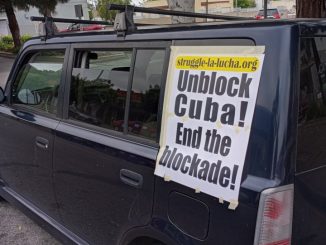
1996, protest against US blockade of Cuba in San Francisco. Photo: Bill Hackwell

The latest U.S. sanctions on Cuba  has been widely reported as a prohibition on the importation of rum and cigars as well as increasing the number of hotels in which U.S. travelers are not allowed to stay.  These restrictions are a continuation of the 2019 Trump ban on cruise ship travel and eliminating much educational and cultural travel.

But the greater and more troublesome impact is the prohibition on “persons subject to U.S. jurisdiction” from attending professional meetings and conferences in Cuba.  Furthermore, the general licenses allowing participation in cultural performances, clinics, athletic and other competitions are now prohibited.

While these measures are purportedly aimed at financially harming the Cuban people, they more importantly deny the rights of U.S. citizens to travel, study, and interact with Cubans on both academic and personal levels.  The implications of this are far greater than election year campaign gestures.  By forbidding U.S. participation in conferences and meetings with their Cuban counterparts, scientific and academic research and collaboration are jeopardized.

For example, Cuba’s medical advances in the treatment of Covid-19 are well known internationally and people in the United States could greatly benefit should they have access to Cuban drugs and treatments.  Members of Cuba’s Henry Reeve Brigade are providing medical care in over two dozen countries and employing effective treatments not available in the United States solely due to U.S. policy.  Right now on the 15th anniversary of the Henry Reeve Brigade it is important to recall that Cuba offered its medical crisis expertise to the U.S. during Hurricane Katrina, and that this humanitarian offer which has since been gratefully welcomed around the globe was rejected by the U.S.

The comparison between U.S. and Cuba Covid-19 deaths is stunning.  The U.S. has more than 7 million cases and over 200,000 deaths; a rate of 610 per million.  Cuba’s death rate is 10 per million.  How many people in the United States are aware of this?  We need to consider how many people could potentially benefit from access to the medicines, treatments, and approach of the Cuban health care system.

These regulations will make it even more difficult for people in the United States to learn first-hand about Cuba; to learn from Cubans about their revolution; to see the achievements of the Cuban revolution; to experience a society focused on human needs; so different from the United States reality.

These new sanctions are about much more than hotels, rum, and cigars.  They are about denying the rights to exchange ideas, engage in mutual education, and express solidarity with our brothers and sisters in Cuba.

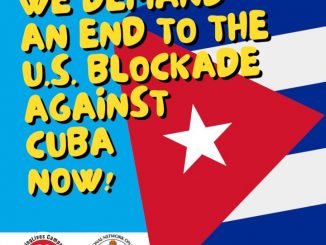
The U. S. policy toward Cuba has failed for 60 years.  Cuba has, for 60 years, rejected the hostile United States policy and never compromised its principals.  The NNOC has a 30 year history of solidarity with Cuba and supporting Cuban sovereignty.  We will continue this solidarity; we will continue to visit Cuba, we will continue to learn from the Cuban example, we will continue to demand an end to the economic, commercial, and financial blockade of Cuba.

Source: Resumen

Strugglelalucha256


60th anniversary of President Fidel Castro’s historic New York visit

Sixty years have passed since Fidel Castro’s historic 1960 visit to the United Nations General Assembly and electrifying welcome in Harlem. The 1990 commemoration of these events in Havana is captured in Rosemari Mealy’s book “Fidel and Malcolm X.” In the midst of the current COVID-19 pandemic, Mealy used virtual tools to once again organize a remembrance of this history, bringing new voices and material to events demonstrating the unbreakable bond between Black people and the Cuban Revolution. Look for video of this event at IFCO/Pastors for Peace Facebook and YouTube coming soon.

On Saturday, Sept. 19, 2020, a webinar commemorating the sixtieth anniversary of President Fidel Castro’s historic New York visit, was hosted by Rosemari Mealy and Nancy Cabrera, from Casa de Las Americas.

Cabrera meticulously detailed previously little known history of the early ties of Cuba’s July 26 Movement with the movement in New York City through the remembrances and documents of Arnaldo Barrón, a founding leader of the New York 26th of July Movement that became today’s Casa de las Americas. Cabrera’s words drew pictures of the working-class movement including the contributions of Barron’s spouse and political partner Gloria Barrón.

The webinar featured two longtime activists who witnessed the crowds who welcomed the Cuban delegation to Harlem — Joe Kaye and Jim Campbell — plus a telephone interview with Raúl Roa Kouri in Havana, who at the time was a young diplomat that had the community contacts and literally orchestrated the move of the delegation to the Hotel Theresa in Harlem.

Joe Kaye, author and New York activist, was part of the thousands of onlookers who welcomed the Cuban delegation. Kaye read a recollection by his late spouse, novelist Sarah Wright, from the book “Fidel and Martin: Memories of a Meeting.”

Jim Campbell, a 95-year-old civil rights activist, joined the commemorative virtual event from Charleston, S.C. Campbell is known throughout the country and abroad as a loved and respected movement teacher in Tanzania, having worked alongside Malcolm X. Throughout his life, Campbell has worked with organizations focused on socialism, Pan Africanism, freedom struggles and equality in education.

Campbell recalled the huge crowds of people and the chants that alternated between “Cuba Si! Yankee No!” and “Fidel and Che!”

“It was a tremendous mixture. I was observing and listening to the expression of an American constitutional right of freedom of speech and its responsibility and was amazed by the mixture of African Americans and Latinos, whom I assumed were Cubans.

“I imagined, in that mixture, there were a few hundred people around and every now and then someone from the top floor where the delegation was would come out and wave.” He recalled seeing Comandante Juan Almeida walking among the crowds. Almeida fought alongside Fidel in the guerrilla war against the U.S.-backed Batista regime.

Raúl Roa Kouri recalled being given the task of writing notes on cards that Fidel used when he addressed the U.N. General Assembly. Fidel’s four-hour speech, an indictment against imperialism, was incredible. The Hall was packed full of people from all over, all nations, delegates, and members of the secretariat, were present listening with intense, tremendous interest. After his speech, many came to greet and speak with him.

When asked what the significance of the 1960 meeting is today, Rao answered, “The significance of the meeting of Fidel with Malcolm X is that the struggle is not only on, but it is still pending. The resource, the achievement of a society free of racism, free of racial discrimination is something we must do, especially in the United States.”

Strugglelalucha256


On its 60th Anniversary: Reviewing ‘Fidel and Malcolm X: Memories of a meeting’


On Sept. 19, 1960, thousands of New Yorkers embraced 125th Street and Seventh Avenue to greet Premier Fidel Castro’s arrival. For 24 hours that day, Harlem’s streets were carpeted by the energy and warmth of its people.                                                                                                                                                           

 These were rare events indeed, rivaled only by another event some 30 years later when Nelson Mandela stood on almost the same street corner, looking over the sea of Black faces cheering his homecoming to the Black capital of the world.                     

— “Fidel and Malcolm: Memories of a Meeting” by Rosemari Mealy (pg.14)

Sept. 18, 2020, marked 60 years since the Cuban delegation arrived in New York City for Prime Minister Fidel Castro to address the fifteenth session of the United Nations General Assembly.  Sept. 19 is when 35-year-old Nation of Islam Minister Malcolm X and 34-year-old Cuban head of state Fidel Castro had a historic meeting of the minds on the ninth floor of the Black-owned Hotel Theresa in one of the poorest, predominately Black neighborhoods in New York: Harlem.

How did this happen?  There are many stories written about the circumstances which led to the Cuban delegation checking into Hotel Theresa and the meeting of Malcolm X and Fidel Castro. But what really happened between Sept. 18, when the Cuban delegation arrived in New York and Sept. 28, when the delegation flew back to Havana, Cuba?

Let the truth be told

“Fidel and Malcolm X: Memories of a Meeting” was compiled by Rosemari Mealy with voices from Cuba and the U.S. who added their perspectives as historians, poets, journalists and political activists.

First published in 1993, Mealy explains In the introduction to the 2013 second edition that the book was ‘“inspired by a 1990 ‘Malcolm X Speaks’ symposium commemorating Malcolm X’s 65th birthday held In Cuba. The symposium was organized by Mealy and Assata Shakur and hosted by the Casa De Las Americas Cultural Center in Havana.

The timing of the symposium also commemorated the 30th anniversary of the meeting of Malcolm X and Fidel Castro. “It was an unforgettable moment when Cuba’s former U.N. Ambassador Raúl Roa Kouri and renowned Afro-Cuban journalist Reinaldo Penalver addressed the symposium, mesmerizing the participants with their vivid and colorful stories, reflections and memories of the famed encounter between two of the greatest leaders of the 20th century.”

It was at this symposium that we learned that Roa should be credited for arranging the logistics of that meeting and Penalver personally interviewed Malcolm or, as he told it, Malcolm interviewed him.

“For Havana to host the symposium was clearly a recognition of Malcolm’s contribution to the worldwide struggle for justice and quality. In the view of many, it was an important contribution to the internationalizing of Malcolm X thought.”

Cubans have access to the writings of Malcolm X. Their publishing houses were some of the first to translate his ideas into a foreign language. In Cuban language schools, Malcolm’s speeches are required texts for future translators and interpreters.

The Cuban delegation arrives in New York and moves from the Shelburne Hotel to Hotel Theresa

Prior to the arrival of the delegation, Raúl Roa Kouri spoke to Robert Tabor, one of the founding members of the Fair Play for Cuba Committee (FPCC), who said that Malcolm X had suggested that the Cuban delegation stay at the Hotel Theresa. Rao mentioned this idea to the delegation, but when he returned to the Cuban Mission, he was informed that the Shelburne Hotel, located near the Cuban Consulate, had been chosen to house the delegation.

On Sunday, Sept. 18, 1960, when the Cuban delegation arrived in New York City, the Cuban revolution was one year old. The administration of Dwight D. Eisenhower and counterrevolutionary Cubans had already begun a policy of hostility towards Cuba and Prime Minister Fidel Castro.

The delegation was greeted by cheering crowds of patriotic Cubans who lined the airport route. A reactionary group of Cuban exiles called “Rosa Blanca” (White Rose) formed a picket line in front of the hotel, provoking terrorism by threatened to blow up the Shelburne Hotel. There was a line of police separating the U.S. Cuban exiles from the hotel entrance.

On Monday, Sept. 19, the hotel manager told Roa to inform his prime minister that the hotel was in grave danger of being severely damaged by protesters, and he must deposit a $20,000 security fee in order to stay in this hotel. Fidel was outraged. Security and maintaining order were problems for the New York City police. His response to the manager was for Roa to tell him to his face, “You are a gangster and we are not paying a single cent,” at which time the manager told Roa that the delegation would be evicted from the hotel. Fidel’s response was to leave the hotel immediately.

Fidel began pacing the hotel room preparing to leave and looking at the options for the delegation, which included purchasing tents and camping outside of the U.N. That is when Roa told him about Malcolm X’s suggestion to stay at the Hotel Theresa. Fidel asked, where is the Hotel Theresa? Roa replied, “In Harlem.” Fidel repeated, “In Harlem? In the Black ghetto?” Fidel told Raul to contact Tabor and go see Malcolm X and book rooms.

Conrad Lynn, an African American civil rights lawyer, political activist and member of FPCC, contacted Love Woods, manager of the Hotel Theresa, who hesitated at first because there might be difficulties in cashing a check from Fidel. He would need cash. Lynn got the cash from a sympathetic gambler in Harlem after explaining the situation. The gambler, whom Lynn did not name, was Black and paid one thousand dollars to Woods. The Cuban delegation checked into the Hotel Theresa the night of Sept. 19.

The government tried to put pressure on Mr. Woods, but he responded that this was a public hotel and they could not dictate who he rented the rooms to. Mr. Woods made it clear to Lynn that he did not want to get politically involved and that he was renting the room as a proprietor and did not endorse any of Fidel’s ideas.

Woods, in his late 80s at the time, was a vocal and respected leader in the Harlem community. “Almost everyone that I interviewed spoke of the respect Love [Woods] garnered when he refused to back down in his commitment to host the Cuban delegation,” observed Reinaldo Penalver.

So that is how the Cuban delegation came to stay in Harlem at the Theresa Hotel, making Fidel the first international leader to set foot on Harlem soil in a public way.

The news that the Cuban delegation was moving to Harlem was not well received by the U.N. What an embarrassment! Word was out that the Cubans were moving to Harlem or pitching tents on the U.N. grounds. The U.S. Secret Service was getting anxious, and the Cubans began receiving calls from the best hotels in town, offering suites and entire floors, free of charge.

Fidel announced that the delegation was going to stay at Hotel Theresa in Harlem: “That is where the Black people live; that is where the working-class people live; that is where Latin Americans live. That is where we are going to go because our revolution is the revolution of the humble, the revolution of the poor, the revolution of racial integration and anti-racism.”

Meeting with Malcom X at midnight on Sept. 19

To see Fidel at the Hotel Theresa meant getting past a small army of New York City police guarding the building, and U.S. and Cuban security. Malcolm X gained entry because he had recently been named to a welcoming committee for dignitaries set up by Harlem’s 288th police precinct. Fidel did not want to be bothered with reporters, but he consented to see two representatives of the Black press.

The meeting lasted about 15 minutes according to journalist Jimmy Booker of Amsterdam News, who spoke with Malcolm before the meeting at which time Malcolm said, “I just want to welcome Fidel.” A translator introduced the various people who came to greet and welcome the Cuban delegation. But the language barrier made it difficult for the two to converse even with the interpreter. In summary, Booker saw this as a meeting of two people exchanging ideas and experiences.

Ralph D. Matthews from New York Citizens-Call said that Cuba’s Castro and Harlem’s Malcolm covered much political and philosophical ground. Castro spoke of his troubles at the Shelburne Hotel, racism and racial discrimination, the media, Africa, and told Malcolm that he would speak in “the Hall” (the U.N. General Assembly). Fidel said, “There is a tremendous lesson to be learned at this session. Many things will happen in this session, and the people will have a clearer idea of their rights.” 

Cuban journalist Reinaldo Penalver recalled that the presence of Fidel and the Cuban delegation became something of an event for the entire Harlem community. There were mobilizations 24 hours a day. Every time Fidel left for the U.N. or came back, there was always a demonstration, chanting “Long live Castro!” Hundreds of men and women were always cheering, “Viva Fidel!”

Highlights of the Cuban delegation’s visit to Harlem at the famed Theresa Hotel.

After the trips to the U.N. General Assembly, Castro spent the next few days in Harlem meeting several heads of states. When President Eisenhower excluded him from a Sept. 22 luncheon for Latin American leaders, Castro held his own banquet in the Theresa’s ballroom and invited “the poor and humble people of Harlem” to join him. At a news briefing, Castro told reporters, “I will be honored to lunch with the poor and humble people of Harlem. I belong to the poor, humble people.

On Sept. 21, the FPCC held a reception for the delegation in the Hotel Theresa banquet hall hosted by Richard Gibson, president of the committee. Among the attendees were poet Langston Hughes, Columbia University professor C. Wright Mills, poet Allen Ginsberg and French photographer Henri Cartier-Besson.

The Harlem branch of the Communist Party of the U.S., under the leadership of political prisoner Ben Davis, held a rally in Harlem in solidarity with Cuba on Sept. 24.

The Cuban delegates were guests of Ghanaian Prime Minister Kwame Nkrumah. They received visits from Soviet leader Nikita Khrushchev, President Gamal Abdel Nassar of United Arab Republic, India’s Prime Minister Jwaharlal Nehru and Foreign Minister V.K. Khrisha Menon and Bulgarian Leader Tedor Zhivkov at the Hotel Theresa.

On Sept. 26, Fidel addressed the U.N. General Assembly for four-and-a-half hours. He assured the gathering that he would “endeavor to be brief” before launching into a searing monologue that holds the U.N. record to this day. The transcript of Fidel’s speech can be found on the internet by googling “Fidel Castro addresses the U.N. General Assembly in 1960.”

On the evening of Sept. 28, the Cuban delegation checked out of the Hotel Theresa and left for the airport only to find that their planes had been seized by American creditors. Soviet leader Khrushchev stepped forward and was happy to lend the Cubans a luxury Soviet airliner for their return to Havana.

Fidel ended his powerful, articulate speech to the fifteenth U.N. General Assembly by summarizing the policy of the revolutionary government of Cuba:

“Therefore, the National General Assembly of the Cuban People proclaims before America, and proclaims here before the world, the right of the peasants to the land; the right of the workers to the fruits of their labor; the right of the children to education: the right of the sick to medical care and hospitalization; the right of young people to work; the right of students to free vocational training and scientific education; the right of Negroes, and Indians to full human dignity; the right of women to civil, social and political equality; the right of the elderly to security in their old age; the right of intellectuals, artists and scientists to fight through their works for a better world; the right of States to nationalize imperialist monopolies, thus rescuing their national wealth and resources; the right of nations to their full sovereignty; the right of peoples to convert their military fortresses into schools, and to arm their workers — because in this we too have to be arms-conscious, to arm our people in defense against imperialist attacks — their peasants, their students, their intellectuals, Negroes, Indians, women, young people, old people, all the oppressed and exploited, so that they themselves can defend their rights and their destinies.” 

Long Live Fidel and the Cuban Revolution!

For more on Fidel’s Visit to Harlem in 1960, read all of Fidel’s speech at http://www.fidelcastro.cu/en/discursos/speech-un-headquarters-us-september-26-1960  

“Fidel and Malcolm X: Memories of a Meeting” by Rosemari Mealy is available at http://www.blackclassicbooks.com/e-book-fidel-malcolm-x-memories-of-a-meeting-rosemari-mealy/ or other online booksellers.


Strugglelalucha256


Universal collaboration is needed to end this pandemic

Cuba, battling successfully to contain COVID-19 at home, also provides medical internationalism and solidarity abroad. While Cuba dispatches the Henry Reeve Brigade to countries requesting health care assistance, Donald Trump’s administration escalates the anti-Cuba economic, financial and commercial blockade while threatening sovereign states who request needed Cuban medical solidarity — in a global pandemic.

The limited measures implemented by President Barack Obama towards U.S.-Cuba normalization are being steadily dismantled by the Trump administration. Between January 2019 and March 2020, many new measures were implemented against Cuba and incrementally announced.  In April, after a shipment of coronavirus aid delivery to Cuba was blocked, the Associated Press reported: “The embargo has exceptions for food and medical aid, but companies are often afraid to carry out related financing or transportation due to the risk of fines or prosecution under the embargo.” Despite the blockade, Cuba has created an economy and society that provide universal health care and free education.

The Saving Lives Campaign initiated by our organizations believes that enhancing the 60-year-old U.S. blockade during a pandemic is nothing short of criminal.  We demand that the United States government lift the blockade, end all punitive sanctions and collaborate with Cuba, facilitating their internal and external efforts to control the pandemic. 

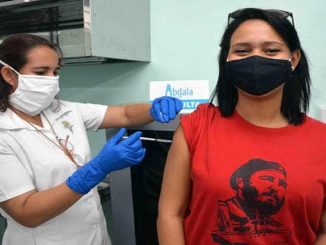
Cuba’s success in fighting COVID-19 is evidenced by their low rate of infections and COVID-19 related deaths. “Cuba has a lower infection rate than most countries in the hemisphere … and [Cubans] are currently 42 times less likely to contract the virus than people in the United States.”  Comparatively, Cuba has 11.33 million people. In Cuba as of Sept. 24, 2020, there have been 5,310 people infected with COVID-19 and 118 deaths, with 577 hospitalized.

Simultaneously, in Florida, home for 22 million people, there have been, as of Sept. 24, some 690,491 known infections and 13,617 deaths. These include at least 202 new coronavirus deaths, and 2,590 new cases were reported in Florida on Sept. 23, 2020.

Similar incredible contrasts can be made with Cuba’s COVID-19 record and the appalling statistics and human suffering in Brazil, Ecuador, Peru and across the Americas.

What are the Cubans doing right?

Three U.S. municipalities and two U.S. central labor councils would like to know the answer to that question, but are prevented from deeper sharing by the unilateral U.S. economic, financial and commercial blockade. In California, the Richmond and Berkeley city councils and the San Francisco Board of Supervisors unanimously passed resolutions calling for medical collaboration with Cuba, all since May 5. The Sacramento Labor Council and Seattle’s Martin Luther King Labor Council have joined in. In Quebec, Louise Gareau, executive secretary, Office of the President of the CSN (Confédération des syndicats nationaux), confirmed by email that the 300,000-member labor organization supports medical collaboration between the U.S., Cuba and Canada. The hundreds of Saving Lives endorsers include medical doctors, elected officials and progressive actors and artists.

The Saving Lives Campaign’s aim is to facilitate medical and scientific collaboration between the peoples of our countries, and between government authorities in the U.S. and Canada with Cuban counterparts. Cuba’s health care system has proven effective in identifying, treating and containing COVID-19, while the U.S. and much of Latin America fight rising infection and mortality rates. Cuban medical care, with its preventative focus and humanist values, includes a powerfully advanced biopharmaceutical industry, allowing for the development and distribution of medications.

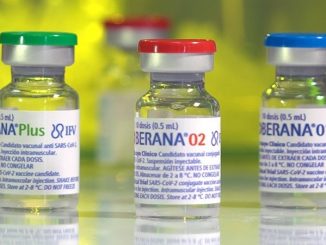
Soberana 01 is the first candidate from Latin America or the Caribbean of a SARS-CoV-2 vaccine. Registered by the World Health Organization, Cuba’s Finlay Vaccine Institute initiated clinical trials on Aug. 24, 2020, by testing 676 volunteers. Cuba willingly shares its medical experience with the novel coronavirus by publishing its extensive protocol. 

Yet, at a time when countries should be working together, sharing scientific discoveries and medications, Cuba’s achievements are either ignored, or in the case of Cuba’s Henry Reeve Brigades, absurdly slandered and denigrated by State Department head Mike Pompeo and Trump as “human trafficking.” 

Medical professionals in the Henry Reeve Brigade refute these accusations, explaining that their work is voluntary in a short video produced by the new media outlet Belly of the Beast.  Having received a free education, and knowing that their families will be cared for financially in their absence, these health care workers view their humanitarian efforts as an expression of the principles and ideals that the Cuban Revolution has taught them, and that they have fought to maintain. On Sept. 26, Cuban Henry Reeve Brigade doctors currently on assignment will speak publicly about their service. 

Disgracefully, instead of applauding Cuba’s medical internationalism, Trump threatens any country requesting Cuban assistance, while failing to provide an alternative for the avertible crisis in the U.S. and across the Americas. Under this pretense, countries such as Ecuador, Colombia, Brazil, and now Panama, have refused Cuban health care workers, while their death rate soars.Cubans are currently 57 times less likely to contract the virus than Brazilians.” 

The General Assembly of the United Nations has increasingly voted to lift the blockade since 1992, with 187 voting in favor in 2019, with only 3 against. Yet the U.S. Congress remains complicit with this cruel blockade policy which hurts the Americas, the U.S., Canada, Latin America and the Caribbean by limiting our access to the scientific and medical advances developed by Cuba’s advanced biopharmaceutical industry.

It is time for all governments to recognize the need for scientific and medical collaboration if we are to eradicate or contain the pandemic. People continue to suffer needlessly and will continue to die alone, without it. This virus hits hardest the working classes and impoverished, disproportionately among Black, Brown and Indigenous communities. Cuba’s prior experience in battling epidemics and natural disasters is beneficial for containment of the virus. With collaboration, we can realize this goal. The U.S. and Canadian governments must put aside historic conflicts and alliances to acknowledge the mutual benefits for the peoples of all our countries of U.S.-Cuba-Canada medical cooperation. Let us stop playing politics and start saving lives.

Cheryl LaBash, co-chair, National Network on Cuba

Isaac Saney, Ph.D., Dalhousie University* co-chair and spokesperson, Canadian Network on Cuba

Sean O’Donoghue, secretary, Table de concertation de solidarité Québec-Cuba

*Identification only

Saving Lives Campaign

Strugglelalucha256


Speech by the president of the Republic of Cuba Miguel Díaz-Canel Bermúdez at the General Debate of the 75th session of the UNGA

The attempts at imposing neocolonial domination on Our America by publicly declaring the present value of the Monroe Doctrine contravene the Proclamation of Latin America and the Caribbean as a Zone of Peace

Mr. Secretary General,

Mr. President,

A global pandemic has changed everyday life drastically. From one day to the next, millions of people get infected and thousands die even when their life expectancy was longer thanks to development. Hospital systems with high-level services have collapsed and the health structures of poor countries are affected by their chronic lack of capacity. Drastic quarantines are turning the most populated cities into deserted areas. Social life is non-existent except in the digital networks. Theaters, discos, galleries and even schools are closed or being readjusted.

Our borders have been closed, our economies are shrinking and our reserves are dwindling. Life is experiencing a radical redesigning of age-old ways and uncertainty is replacing certainty. Even close friends cannot recognize each other due to the masks that protect us from the contagion. Everything is changing.

Like finding a solution to the pandemic, it is already urgent to democratize this indispensable Organization so that it effectively meets the needs and aspirations of all peoples.

The sought-after right of humanity to live in peace and security, with justice and freedom, the basis for unity among nations, is constantly under threat.

Over 1.9 trillion dollars are being squandered today in a senseless arms race promoted by the aggressive and war-mongering policies of imperialism, whose leader is the present government of the U.S., which accounts for 38 percent of the global military expenditure.

We are referring to a markedly aggressive and morally corrupt regime that despises and attacks multilateralism, uses financial blackmailing in its relations with U.N. system agencies and that, in a show of unprecedented overbearance, has withdrawn from the World Health Organization, UNESCO and the Human Rights Council.

Paradoxically, the country where the U.N. headquarters is located is also staying away from fundamental international treaties such as the Paris Agreement on climate change; it rejects the nuclear agreement with Iran reached by consensus; it promotes trade wars; it ends its commitment with international disarmament control instruments; it militarizes cyberspace; it expands coercion and unilateral sanctions against those who do not bend to its designs and sponsors the forcible overthrow of sovereign governments through non-conventional war methods.

Along such line of action, which ignores the old principles of peaceful co-existence and respect of the right of others´ to self-determination as the guarantee for peace, the Donald Trump administration it also manipulating, with subversive aims, cooperation in the sphere of democracy and human rights, while in its own territory there is an abundance of practically uncontrolled expressions of hatred, racism, police brutality and irregularities in the election system and as to the voting rights of citizens

It is urgent to reform the U.N. This powerful organization, which emerged after the loss of millions of lives in two world wars and as a result of a world understanding of the importance of dialogue, negotiation, cooperation and international law, must not postpone any further its updating and democratization. Today´s world needs the U.N. just as the one where it came into being did.

Something that is very special and profound has failed, as evidenced by the daily and permanent violation of the U.N. Charter principles, and by the ever-increasing use or threat of use of force in international relations.

There is no way to sustain any longer, as if it were natural and unshakable, an unequal, unjust and anti-democratic International order where selfishness prevails over solidarity and the mean interests of a powerful minority over the legitimate aspirations of millions of people.

Notwithstanding the dissatisfactions and the demands for change that, together with other states and millions of citizens in the world, we are presenting to the U.N., the Cuban Revolution shall always uphold the existence of the Organization, to which we owe the little but indispensable multilateralism that is surviving imperial overbearance.

More than once, at this very forum, Cuba has reiterated its willingness to cooperate with the democratization of the U.N. and the upholding of international cooperation, that can be saved only by it. As stated by the First Secretary of the Communist Party of Cuba and Army General Raúl Castro Ruz, and I quote: “The international community shall always count on Cuba´s honest voice in the face of injustice, inequality, underdevelopment, discrimination and manipulation, and for the establishment of a more just and equitable international order which really centers on human beings, their dignity and wellbeing.” End of quote.

Mr. President,

Coming back to the seriousness of the present situation, which many blame only on the COVID-19 pandemic, I think it is essential to say that its impact is by far overflowing the health sphere.

Due to its nefarious sequels, impressive death toll and damages to the world economy and the deterioration of social development levels, the spreading of the pandemic in the last few months brings anguish and despair to leaders and citizens in practically all nations.

But the multidimensional crisis it has unleashed clearly shows the great mistake of the dehumanized policies fully imposed by the market dictatorship.

Today, we are witnessing with sadness the disaster the world has been led to by the irrational and unsustainable production and consumption system of capitalism, decades of an unjust international order and the implementation of ruthless and rampant neoliberalism, which has widened inequalities and sacrificed the right of peoples to development.

Unlike excluding neoliberalism, which puts aside and discards millions of human beings and condemns them to survive on the leftovers from the banquet of the richest one percent, the COVID-19 virus does not discriminate between them, but its devastating economic and social effects shall be lethal among the most vulnerable and those with lower incomes, whether they live in the underdeveloped world or in the pockets of poverty of big industrial cities.

According to the U.N. Food and Agriculture Organization (FAO) projections, the 690 million people who were going hungry in 2019 might be joined by a further 130 million as a result of the economic recession caused by the pandemic. Studies by the International Labor Organization (ILO) say that over 305 million jobs have been lost and that more than 1.6 billion workers are having their livelihoods at stake.

We cannot face COVID-19, hunger, unemployment and the growing economic and social inequalities between individuals and countries as unrelated phenomena. There is an urgency to implement integrated policies that prioritize human beings and not economic profits or political advantages.

It would a crime to postpone decisions that are for yesterday and for today. It is imperative to promote solidarity and international cooperation to lessen the impact.

Only the U.N., with its world membership, has the required authority and reach to resume the just struggle to write off the uncollectable foreign debt which, aggravated by the social and economic effects of the pandemic, is threatening the survival of the peoples of the South.

Mr. President,

The SARS-CoV-2 outbreak and the early signs that it would bring a pandemic did not catch Cuba off guard.

With the decade-long experience of facing terrible epidemics, some of which were provoked deliberately as part of the permanent war against our political project, we immediately implemented a series of measures based on our main capabilities and strengths, namely, a well-structured socialist state that cares for the health of its citizens, a highly-skilled human capital and a society with much people´s involvement in its decision-making and problem solving processes.

The implementation of those measures, combined with the knowledge accrued for over 60 years of great efforts to create and expand a high-quality and universal health system, plus scientific research and development, has made it possible not only to preserve the right to health of all citizens, without exception, but also to be in a better position to face the pandemic.

We have been able to do it in spite of the harsh restrictions of the long economic, commercial and financial blockade being imposed by the US government, which has been brutally tightened in the last two years, even at these pandemic times, something that shows it is the essential component of the hostile U.S. Cuba policy.

The aggressiveness of the blockade has reached a qualitatively higher level that further asserts its role as the real and determining impediment to the managing of the economy and the development of our country. The US government has intensified in particular its harassment of Cuban financial transactions and, beginning in 2019, it has been adopting measures that violate international law to deprive the Cuban people of the possibility to buy fuels they need for their everyday activities and for their development.

So as to damage and demonize the Cuban Revolution and others it defines as adversaries, the US has been publishing spurious lists having no legitimacy by which it abrogates itself the right to impose unilateral coercive measures and unfounded qualifications on the world.

Every week, that government issues statements against Cuba or imposes new restrictions. Paradoxically, however, it has refused to term as terrorist the attack that was carried out against the Cuban embassy in Washington on April 30, 2020, when an individual armed with an assault rifle fired over 30 rounds against the diplomatic mission and later admitted to his intent to kill.

We denounce the double standards of the US government in the fight against terror and demand a public condemnation of that brutal attack.

We demand a cease of the hostility and slanderous campaign against the altruistic work by Cuba´s international medical cooperation that, with much prestige and verifiable results, has contributed to saving hundreds of lives and lowering the impact of the disease in many countries. Prominent international figures and highly prestigious social organizations have acknowledged the humanistic work done by the “Henry Reeve” International Medical Brigade for Disaster Situations and Serious Epidemics and called for the Nobel Peace Prize to be given to them.

While the US government is ignoring the call to combine efforts to fight the pandemic and it withdraws from the WHO, Cuba, in response to requests made to it, and guided by the profound solidarity and humanistic vocation of its people, is expanding its cooperation by sending over 3 700 cooperation workers distributed in 46 medical brigades to 39 countries and territories hit by COVID-19.

In this sense, we condemn the gangster blackmailing by the US to pressure the Pan-American Health Organization so as to make that regional agency a tool for its morbid aggression against our country. As usual, the force of truth shall do away with lies, and facts and protagonists shall go down in history as they should. Cuba´s example shall prevail.

Our dedicated health workers, the pride of a nation brought up in José Marti’s idea that My Country Is Humanity, shall be awarded the prize their noble hearts deserve, or not; but it has been years since they won the recognition of the peoples blessed by their health work.

The US government is not hiding its intention to enforce new and harsher aggressive measures against Cuba in the next few months. We state once again before the international community that our people, who take pride in their history and are committed to the ideals and achievements of the Revolution, shall resist and overcome.

Mr. President,

The attempts at imposing neocolonial domination on Our America by publicly declaring the present value of the Monroe Doctrine contravene the Proclamation of Latin America and the Caribbean as a Zone of Peace.

We wish to restate publicly in this virtual forum that the Bolivarian Republic of Venezuela shall always have the solidarity of Cuba in the face of attempts at destabilizing and subverting constitutional order and the civic-military unity and at destroying the work started by Commander Hugo Chávez Frías and continued by President Nicolás Maduro Moros to benefit the Venezuelan people.

We also reject US actions aimed at destabilizing the Republic of Nicaragua and ratify our invariable solidarity with its people and government led by Commander Daniel Ortega.

We state our solidarity with the Caribbean nations, which are demanding just reparations for the horrors of slavery and the slave trade, in a world where racial discrimination and the repression against Afro-descendant communities have been on the rise.

We reaffirm our historical commitment with the self-determination and independence of the sisterly people of Puerto Rico.

We support the legitimate claim by Argentina to its sovereignty over the Malvinas, the South Sandwich and South Georgia islands.

We reiterate our commitment with peace in Colombia and the conviction that dialogue between the parties is the road to achieving stable and lasting peace in that country.

We support the search for a peaceful and negotiated solution to the situation imposed on Syria, with no foreign interference and in full respect of its sovereignty and territorial integrity.

We demand a just solution to the conflict in the Middle East, which must include the real exercise by the Palestinian people of the inalienable right to build their own State within the borders prior to 1967 and with East Jerusalem as its capital. We reject Israel´s attempts to annex more territories in the West Bank.

We state our solidarity with the Islamic Republic of Iran in the face of US aggressive escalation.

We reaffirm our invariable solidarity with the Sahrawi people.

We strongly condemn the unilateral and unjust sanctions against the Democratic People´s Republic of Korea.

We restate our rejection of the intention to expand NATO´s presence to the Russian borders and the imposition of unilateral and unjust sanctions against Russia.

We reject foreign interference into the internal affairs of the Republic of Belarus and reiterate our solidarity with the legitimate president of that country, Aleksandr Lukashenko, and the sisterly people of Belarus.

We condemn the interference into the internal affairs of the People´s Republic of China and oppose any attempt to harm its territorial integrity and its sovereignty.

Mr. President,

Today´s disturbing circumstances have led to the fact that, for the first time in the 75-year-long history of the United Nations, we have had to meet in a non-presential format.

Cuba´s scientific community, another source of pride for the nation that, since the triumph of the Revolution of the just, announced to the world its intention to be a country of men and women of science, is working non-stop on one of the first vaccines that are going through clinical trials in the world.

Its creators and other researchers and experts, in coordination with the health system, are writing protocols on healthcare for infected persons, recovered patients and the risk population that have allowed us to keep epidemic statistics of around 80% of infected persons saved and a mortality rate below the average in the Americas and the world.

“Doctors and not bombs.” That was announced one day by the historical leader of the Cuban Revolution and chief sponsor of scientific development in Cuba: Commander-in-Chief Fidel Castro Ruz. That´s our motto. Saving lives and sharing what we are and have, no matter any sacrifice it takes; that is what we are offering to the world from the United Nations, to which we only request to be attuned with the gravity of the present time.

We are Cuba.

Let us strive together to promote peace, solidarity and development.

Thank you very much.

Source: Granma

Strugglelalucha256


The United States is the world’s major violator of human rights

“The United States is the world’s major violator of human rights,” stated Jorge Valero, the Bolivarian Republic of Venezuela’s ambassador to the United Nations Human Rights Council.

“The United States is the world’s major violator of human rights,” stated Jorge Valero, the Bolivarian Republic of Venezuela’s ambassador to the United Nations Human Rights Council.

As part of a series of conferences on global governance and development, entitled “The challenges and common problems of humanity at the current

time,” the diplomat recalled that amidst the worsening pandemic, the United States announced its withdrawal from the World Health Organization (WHO).

“It is ironic that the imperialist government made this decision just when the strengthening of this organization was most needed,” he noted.

In terms of security and disarmament, he denounced the U.S. decision to renounce its commitment to the Intermediate Range Nuclear Forces Treaty, and emphasized, “Trump has also stated that the Reduction of Strategic Arms Treaty (Start) will not be extended,” the only agreement on nuclear weapons currently in effect.

Valero insisted that multi-lateralism is the path to peace and emphasized that this is the focus promoted by the “Bolivarian, Chavista government, looking to construct an international structure that unites states in brotherhood and foments shared responsibility in international affairs.”

Cuban President Miguel Díaz-Canel Bermúdez, in his comments during the leaders meeting on the occasion of the 30th anniversary of the Sao Paulo Forum condemned the illegal U.S. blockade that has systematically violated the human rights of Cubans for over 60 years.

He sharply criticized the imperialists’ outrageous treatment of migrant families, “particularly boys and girls, mistreated, abused in a kind of cage, depriving human beings of dignity and their most elemental rights.”

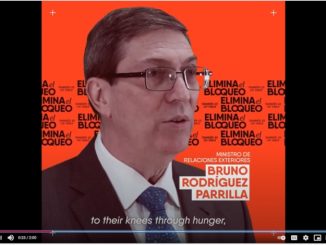
Before the UN General Assembly, Cuban Foreign Minister Bruno Rodríguez Parrilla denounced the United States as the world’s principal violator of human rights, a pattern repeated systematically, massively and flagrantly.

During a meeting held November 1, 2019, to present the proposed UN resolution entitled: “The necessity of putting an end to the U.S. economic, commercial, and financial blockade against Cuba,” Rodríguez recalled that there were 2.3 million persons incarcerated in the United States, where 10.5 arrests a year are made, and that prisoners continue to be held illicitly and indefinitely at the illegal U.S. Naval Base in Guantánamo.

“More than a million of their citizens sleep in the street; 28.5 lack medical insurance; women earn approximately 85% of what men do; and accusations of sexual harassment are common.”

On a global level, Rodríguez noted, the U.S. government has signed only 30% instruments of international law and does not recognize the right to peace or development, not even the rights of boys and girls.

Source: Granma

Strugglelalucha256


Celebrating the Life of Fidel Castro Ruz – on his 94th birthday

On Aug. 13, 2020, the U.S.-Cuba Normalization International Conference webinar celebrated and honored the life and legacy of revolutionary leader Fidel Castro Ruz on his 94th birthday. This historic event was attended by hundreds on Zoom and many hundreds more via a live broadcast on Facebook. The entire event can be viewed on the U.S.-Cuba Normalization website, and on the National Network on Cuba Facebook page and YouTube channel. Some of the content is summarized here. 

Nalda Vigezzi, co-chair of the National Network on Cuba (NNOC), opened the program, welcomed everyone and thanked all the organizers who worked to bring this amazing virtual program filled with distinguished speakers, ambassadors, scholars, states people, academics, activists and so many of us who have learned from the brilliance of Fidel and the Cuban people.

The NNOC, the U.S. umbrella organization of solidarity groups, has been involved in the struggle to support Cuban sovereignty and end the travel ban and the unilateral economic, commercial and financial blockade of Cuba since 1991.

Vigezzi introduced the co-facilitators: Ike Nahem, anti-imperialist, socialist activist, author of “The Life of Fidel Castro: A Marxist Appreciation,” and member of Teamsters and Railroad Workers United Union; and Tamara Hansen, executive member of the Canadian Network on Cuba, author of “5 Decades of the Cuban Revolution: The Challenges of an Unwavering Leadership.” Vigezzi also thanked all the organizers who worked to bring this amazing program together, virtually.

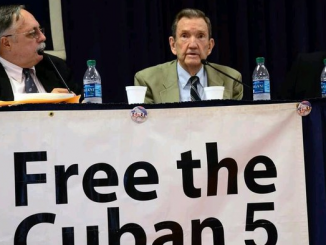
Vigezzi spoke of the many lessons learned from Fidel, beginning with the first days following the triumph of the revolution prioritizing education and health care. She gave an overview of the many struggles that many of us in the U.S. have participated in, including traveling to Cuba in defiance of the travel ban, struggling to return Elián González to his home, campaigning to Free the Five, organizing programs to bring awareness of the medical opportunities offered by the Latin American School of Medical Science and of the many countries that currently have volunteer medical staff from Cuba.

A beautiful inspiring music video, Yo Te Veo by Raúl Torres, presented pictures of Fidel embracing and being embraced by the Cuban people. Then, a moment of silence recognized Eusebio Leal Spengler. This important revolutionary died on July 31. He served as Havana historian and directed the restoration of Havana’s historic architectural beauty. 

One of Fidel Castro’s early projects to respond to the global support for the young emerging Cuban Revolution was the Cuban Institute of Friendship with the People (ICAP) formed in 1960. A video message from Fernando González Llort, one of the Cuban Five heroes and now ICAP president, expressed highlights of solidarity in the U.S. 

González began his presentation by saying that, for the Cuban people, Fidel lives on in our daily tasks and efforts. He continued, saying, “It is almost difficult to talk about Fidel because we run the risk of omitting aspects of his life that are of great significance. However, it is imperative that we make reference to ICAP.” Fidel created ICAP to connect with the hundreds of thousands of friends all over the world who supported the emerging revolution and wanted to know firsthand what the revolution was all about. Today, ICAP has links with more than 2,000 solidarity organizations in 158 countries.

González highlighted the U.S. solidarity movement continuing from the Revolution’s earliest days to now. He mentioned Sandra Levinson, and Center for Cuban Studies; Rosemari Mealy, former Black Panther and author of “Fidel & Malcolm X: Memories of a Meeting,” who organized Fidel’s second visit to Harlem. Marazul Travel who organized immigrant Cubans travel to Cuba even after their offices were bombed; Pastors for Peace caravans led by the late Rev. Lucius Walker and defended today with dignity and courage by his daughter Gail; the courageous members of the Venceremos Brigades, who worked side by side with Fidel in cutting cane; our friend Gloria LaRiva who Fidel asked to speak on May 1; the U.S. students who graduated from the Latin American School of Medical Science and are practicing medicine at the invitation of Fidel; those who joined Fidel’s call in the campaign to Free the Cuban Five; and the many who have visited Cuba in defiance of the travel blockade. These were among the many activists and solidarity actions that González acknowledged.

González spoke of the current COVID-19 crisis, where the U.S. government has blocked the purchase of medical supplies, and the many Cuban medical personnel saving lives in 28 countries.

Cuba’s Henry Reeve International Brigade — named by Fidel Castro for the 26-year-old U.S. soldier who fought and died on Aug. 4, 1876 in Cuba’s War of Independence  — formed from the volunteers gathered to respond to the devastation caused by Hurricane Katrina in 2005. 

The three-hour program flowed nonstop with many live speakers, video-taped presentations, live cultural performances and solidarity messages. 

Five ambassadors on the program made amazing presentations on the legacy of Fidel and the Cuban Revolution and the promise that a better world is possible: José Ramón Cabañas, Cuban ambassador to the United States; Ambassador Dang Dinh Quy, permanent representative of Vietnam to the United Nations; Ana Silvia Rodríguez, Permanent Mission of Cuba to the United Nations; Josefina Vidal, Cuban ambassador to Canada; and Adán Chávez, Venezuelan ambassador to Cuba. 

Ambassador José Ramón Cabañas [The full text of his remarks is published on Struggle-La-Lucha.org.]

Ambassador Josefina Vidal referred to one of the pillars of Fidel’s revolutionary thoughts and work by quoting, “The defense of universal access and free health care is a fundamental human right for every human being and the importance of training, the necessary resources, and establishing an effective health care system at all levels that allows the exercise and enjoyment by the people.”

Ambassador Ana Silvia Rodríguez remarked on Cuba’s foreign policy, quoting Fidel at the United Nations General Assembly 60 years ago. He said, “In sum, we support all the noble aspirations of all peoples. That´s our position. We support and shall always support everything that is just, and be against colonialism, against exploitation, against monopolies, against militarism, against the arms race, against playing with war. We shall always be against those things. That shall be our position.”

Ambassador Dang Dinh Quy said that for the Vietnamese people Fidel has been a symbol of revolutionary heroism. Cuba was the first country to recognize the National Liberation Front in South Vietnam in 1963 and the only country who set up an embassy in 1967. Fidel sent construction engineers to build hospitals, and those hospitals were built very well and are functioning now. These are concrete examples of solidarity that Fidel had with the Vietnamese people and that solidarity exists today as we can see Cuban medical teams in many countries to fight COVID-19.

Ambassador Adán Chávez is the Venezuelan ambassador to Cuba; vice president of International Affairs of the United Socialist Party of Venezuela; and director of the Hugo Chávez Institute of Higher Studies.

Chávez began his presentation by sending a big Bolivarian, revolutionary, Chavista, Fidelista and, therefore, anti-imperialist hug to all the organizers, speakers and viewers.

President Dilma Rousseff, as president of Brazil, invited Cuban doctors to her country. She was removed from office on trumped-up charges in a parliamentary coup. Rousseff said, “Cuba’s humanitarian relationship with the world is exemplary and demonstrates that solidarity is its basic value and principle.”

Don Rojas, former press secretary for the martyred prime minister of Grenada, Maurice Bishop, recalled the day in early 1980 when a Cuban ship arrived in Grenada to fulfill an economic development goal expressed by Bishop to Fidel Castro. Its cargo included brand new construction equipment from bulldozers to cranes and earthmoving trucks for construction of Grenada’s international airport, today named for comrade Maurice Bishop. 

In the following months, Fidel sent medical doctors, dentists and nurses, and then teams of Cuban engineers and architects who worked alongside their Grenadian counterparts to construct the airport as well as access roads to the airport. Today, there are literally hundreds of doctors and nurses from Cuba scattered throughout the country assisting in the fight against the COVID-19 pandemic. 

Rojas concluded by saying that on this occasion, while we honor the life and legacy of Fidel Castro, “I also want to honor the memory of the many Cuban internationalist workers who fought and shed their blood and died defending themselves and defending their Grenadian comrades when the U.S. military under the command of President Ronald Reagan invaded Grenada in October of 1983, and to say, ‘Down, down with the illegal and immoral blockade of Cuba! Viva Fidel and the glorious Cuban Revolution.’”

Clever Banganayi, with the Friends of Cuba in South Africa, is a Cuban trained engineer who studied in Cuba from 1991 to 1996 and the recipient of the Friendship Medal Award from the Cuban Council of State for his work in the campaign against the U.S. blockade and for the freedom of the Cuban Five. This is a portion of the statement he presented in person from South Africa.

“We celebrate Fidel Castro’s outstanding contribution as a world revolutionary leader, as a committed internationalist, as a statesman truly devoted to the aspirations of freedom, social justice, equality for the people of Cuba and for millions of people of the developing world. As a loyal friend of Africa, South Africa in particular, Fidel Castro led the people of Cuba in a most significant international contribution for the liberation of the African continent with his conviction, unity, and solidarity as a tool of victory. Fidel Castro’s lessons of unity, solidarity, and commitment to revolutionary peace groups are a source of inspiration for today’s young generations of Africans and all other youth in the world. His profound political ideas must be widely shared and understood. Only socialism can ensure conditions of survival of the human species, that another world, a better and peaceful one in harmony with nature is possible and that the oppressed have the rights and capacity to build against injustice.”

Gail Walker, executive director of IFCO/Pastors for Peace, referenced one of Fidel’s many living legacies, the creation of the Latin American of School of Medical Science (ELAM).

“It was the forward vision of Fidel Castro to take a naval barracks and convert it into an internationally renowned medical training center and, thanks to that vision, tens of thousands of young people from more than 125 nations including the U.S. are now practicing medicine in underserved communities across the globe. In the year 2000 at that historical Riverside Church meeting, Fidel offered free medical scholarships to qualified candidates from all regions of the U.S. from low income communities and communities of color who would not otherwise have access to medical education. That was the gift with the only obligation being that those scholarship recipients would return and practice in medically underserved communities in the U.S. 

“And since that year 2000, under the direction of my father, Rev. Lucius Walker, IFCO has been honored to take on the role for young people to participate in this scholarship program. To date, as the ambassador explained, Cuba has graduated 196 doctors from the U.S., the very country that has imposed a genocidal blockade for more than six decades.”

Walker continued, “From Standing Rock to the front lines of the fight against coronavirus, we in the United States are the benefactors of Cuba’s long-standing commitment to medical internationalism. The U.S. government may have shamefully rejected Cuba’s beautiful offer to send doctors in the aftermath of Hurricane Katrina to New Orleans or to Puerto Rico after it was viciously slammed by Hurricane María, but today Cuba is beginning to revolutionize health care in the U.S., one ELAM grad at a time. And we are immensely grateful to Fidel for planting those seeds for solidarity that are now bearing fruit.”

Vijay Prashad, Indian historian and Marxist intellectual, executive director of the Tricontinental Institute for Social Research and chief editor of LeftWord Books, joined in person to celebrate the life of Fidel Castro. Prashad emphasized Fidel as a socialist human being, the highest form of human being. He explained that Fidel’s real dynamism came out, not at a time of victory, but at a time of defeat. Prashad read a quote from the famous speech at trial after his arrest at the Moncada Barracks uprising, “History Will Absolve Me.” On July 26, 1970, after the 10-million-ton sugarcane harvest failed, Fidel went before the people and said, “I am ready to be removed from office.” Fidel analyzed the mistakes. As his comrade Amilcar Cabral of Guinea-Bissau said, “Tell no lies, claim no easy victories.” Fidel never lied. Prashad ended by saying, “The Cuban revolution brought humanity to the planet earth. It affirms life through the doctors, which is why those doctors, more than anybody else, deserve the Nobel Prize. It expends social resources of the Cuban citizens to affirm life, not to build a military force.” Join together to defeat the decaying forces of Imperialism, he urged.

All African People’s Revolutionary Party representative Onyesonwu Chatoyer said by video message that the AAPRP stands in solidarity with the Cuban Revolution and will uplift the legacy of Fidel Castro. “The Cuban Revolution embodies the possibility of socialism, a world that can be built once people come together collectively and decide to be free and move in a spirit of humanism and solidarity. The AAPRP deeply respects and honors Fidel Castro. We study him, learn from his example, we seek to continue his work in this world and to bring that model of liberation to the African continent and African people around the world.”

Additional messages were aired from Mary-Alice Waters, president of Pathfinder Press, publisher of the speeches and writing of Fidel Castro. Waters has edited or written 30 books on the Cuban Revolution; Nancy Cabrero from Casa de las Americas, the oldest Cuban organization in the U.S. that supports the normalization of the relationship between Cuba and the U.S.; and João Pedro Stédile from Brazil’s Movimento dos Trabalhadores Rurais Sem Terra (MST), the Landless Workers Movement.

Cultural performances were interspersed throughout by artists and poets live and recorded and greatly enriched the program.

Nancy Morejón, Cuba’s most renowned, widely published and translated post-revolutionary poet, wrote a Poem for Fidel during his lifetime. The recorded poem was read by Morejón in Spanish and English and provided by the Cuba In Focus monthly program on WBAI in New York City.

El Jones is a Canadian poet, professor, activist and author of “Live from the Afrikan Resistance.” Jones recited her poem, which began with “This is a birthday card from the Wretched of the Earth,” written for Fidel’s 94th birthday, especially to be read at this program

Singer-songwriter, musician and poet Normand Raymond, sang and played guitar. He is a member of the Artistes pour la paix du Québec board of directors. As an anti-imperialist and social justice activist, he is a longtime supporter of the Cuban Revolution.

Katharine Beeman, poet and a longtime member of La Table de concertation de solidarité Québec-Cuba also presented.

In closing, co-facilitators emphasized that we have to continue to fight to end the criminal U.S. blockade, and we have a duty to call on the world to mobilize and demand that the Cuban doctors receive the Nobel Peace Prize because they deserve it, because they are working towards peace and because they are working while under attack by the Trump administration.

Strugglelalucha256


Solidarity with Cuban Women Federation in their 60th Anniversary

Just eight months after the victory of the Cuban Revolution, on Aug. 23, 1960, the Federation of Cuban Women was founded. At that meeting, Fidel Castro remembered the historic contributions of Cuban women, including mothers like Mariana Grajales, all of whose sons fought and died for Cuban independence, and the women who carried messages from the Sierra to the cities past the enemy lines. Clodomira and Lidia eventually were caught by the dictatorship, tortured and murdered without revealing secrets.

From the slave rebellion leader Carlota to women of the Moncada and the Mariana Grajales Women’ Platoon in the Sierra Maestra, from the development of CENESEX, Cuba’s National Center for Sex Education, to address the spectrum of gender identity and educate to eliminate homophobia and transphobia, to today’s women scientists who produced Soberana-01 COVID-19 vaccine that began clinical trials on Aug. 24, women are a revolutionary force inside the revolution.

On Aug. 15, the Federación de Mujeres Cubanas virtual program gathered friends of the Federación Democrática Internacional de Mujeres (Women’s International Democratic Federation), World Women’s March and other organizations in a virtual forum with Secretary General of FMC Teresa  Amarelle Boué. Present were representatives from Venezuela, Mexico, Ecuador, Brazil, Panama and Argentina, and Berta Joubert-Ceci from Puerto Rico, whose comments follow:

Comrades, thank you for making this celebration forum possible and for the honor of inviting us to participate.

Our organization, Mujeres en Lucha/Women in Struggle, member of the Women’s International Democratic Federation/Federación Democrática Internacional de Mujeres (WIDF/FDIM) congratulates the Federación de Mujeres Cubanas on its 60th anniversary.

We would like to start by highlighting the role of the FMC, through Vilma Espín, who had the vision of ensuring the continuity of the FDIM, after the dismantling of the socialist countries in the 1990s, continuing the project of international unity led by women.

Comrades, after having participated in various international forums with the women of the FMC, we would like to share some of the qualities that have most impacted us about them, qualities that serve as an example to all of us: their great generosity with their time, always ready to share experiences and suggestions — strong defenders of their revolution, their understanding, their search for consensus, and their tenacity to face problems or obstacles. Much we have learned from you compañeras.

This year we have faced a global challenge: the COVID-19 pandemic, which has forced us to assume physical isolation as a preventive measure. However, that same isolation has forced the opening of a virtual door to the world. The pandemic has become a challenge and at the same time an opportunity to get intimately closer to other struggles, to look for the similarities and differences, to feel closer to their vicissitudes, their sufferings and the resistance of their peoples. It has led us to learn new forms of mobilization and resistance, to feel more a part of other struggles.

Although we have not yet found that crucial point of a global joint response that could once and for all destroy this capitalist system that is the root of so much oppression, this process is giving us the opportunity to launch global campaigns.

The criminality of capitalism has been exposed more clearly with this pandemic. Cuba has defeated the mistaken notion of the USA as “the savior of democracy,” the Cuban medical brigades are bringing health, hope and a model of generosity that only Revolutionary Cuba and its socialist development can do.

Cuba has always been an example of humanity, and the women of the FMC have been exponents of it. Wherever their delegations go, they have stood out for their commitment to just causes raising their voice in all forums. They have never been silent observers. And they have always taken advantage of every forum to defend their revolution, to expose US crimes against their island, from Elián to the Five Cuban heroes, always demanding that this murderous blockade be removed.

So, following your example, I would like to appeal to all the participants by asking for:

  • Solidarity with the Black Lives Matter Movement and the Immigrant movement in the USA.
  • And with Puerto Rico, let’s raise our voices worldwide against 122 years of invasion, occupation and colonialism by the USA.
  • We are experiencing very difficult times in our Boricua archipelago. There is hunger and unemployment. There is still a lack of housing ever since Hurricanes Irma and Maria three years ago. Since last January, there have been constant earthquakes in the south and more homes, schools and historical buildings have collapsed. There have been droughts followed by heavy rains that cause landslides. And then this pandemic during which the corrupt government and its cronies have robbed the people and denied the help that is most needed.

The straitjacket, that is being a colony, does not even allow for closing the airport through which thousands of people arrive daily — many contaminated with COVID — from the states with the most contagion of the pandemic such as Florida and Texas.

We have made a request for help from the Cuban medical brigades, but our lack of sovereignty prevents their arriving in Puerto Rico, while the U.S. denies the Puerto Rican people the most precious thing: their freedom.

Comrades, thanks again for making this forum possible and for the honor of inviting us to participate.

Long live the Federation of Cuban Women!

Strugglelalucha256


60 aniversario: Una mensaje a Federación de Mujeres Cubanas

Apenas ocho meses después del triunfo de la Revolución Cubana el 23 de agosto de 1960, se fundó la Federación de Mujeres Cubanas. En esa reunión Fidel Castro recordó las contribuciones históricas de las mujeres cubanas, incluidas madres como Mariana Grajales cuyos hijos lucharon y murieron por la independencia de Cuba, las mujeres que llevaban mensajes desde la Sierra a las ciudades más allá de las líneas enemigas Clodomira y Lidia finalmente fueron capturadas por la dictadura, torturada y asesinada sin revelar secretos.

Desde la líder de la rebelión esclavista Carlota hasta las mujeres del Moncada y el Pelotón de Mujeres Mariana Grajales en la Sierra Maestra, el desarrollo de CENESEX, el Centro Nacional de Educación Sexual de Cuba para abordar el espectro de la identidad de género y educar para eliminar la homofobia y la transfobia, a las mujeres científicas de hoy que produjeron la vacuna Soberana-01 COVID-19 que comenzaron los ensayos clínicos el 24 de agosto, las mujeres son una fuerza revolucionaria dentro de la revolución.

El 15 de agosto, el programa virtual de la Federación de Mujeres Cubanas reunió a amigos de la Federación Democrática Internacional de Mujeres, la Marcha Mundial de Mujeres y otras organizaciones en un foro virtual con la Secretaria General de la FMC Teresa Amarelle Boué. Venezuela, México, Ecuador, Brasil, Panamá, Argentina y Berta Joubert-Ceci de Puerto Rico cuyos comentarios a continuación:

Compañeras, gracias por hacer posible este foro de celebración y por el honor de habernos invitado a participar.

Nuestra organización Mujeres en Lucha, miembro de la FDIM felicita a la FMC en su aniversario.

Quisiera comenzar destacando el papel de la FMC, a través de Vilma Espín, quien tuvo esa visión de asegurar la continuidad de la FDIM luego de la desarticulación de los países socialistas en los 90, de continuar ese proyecto de unidad internacional liderado por mujeres.

Compañeras, después de haber participado en varios escenarios a nivel internacional con las mujeres de la FMC, nos gustaría compartir algunas de las cualidades que más nos han impactado de ellas, cualidades que sirven como ejemplo para todas nosotras:  su gran generosidad con su tiempo, siempre dispuestas a compartir experiencias y sugerencias — férreas defensoras de su revolución, su comprensión, su búsqueda de consensos, y su tenacidad para enfrentar problemas u obstáculos. Mucho hemos aprendido de ustedes compañeras.

Este año, nos hemos enfrentado a un desafío a nivel global; la pandemia del COVID-19 nos ha obligado a asumir un aislamiento físico, sin embargo, ese mismo aislamiento ha forzado la apertura de una puerta virtual hacia el mundo. La pandemia se ha convertido en un desafío y a la misma vez en una oportunidad para acercarnos más íntimamente a otras luchas, a comprobar las similitudes y las diferencias, a sentir más de cerca sus vicisitudes, sus sufrimientos y la resistencia de sus pueblos. Nos ha llevado a aprender nuevas formas de movilizaciones y de resistencia. De sentirnos más parte de otras luchas.

Aunque no hayamos encontrado aún ese punto crucial de respuesta global conjunta que pueda de una vez y por todas destruir este sistema capitalista que es la raíz de tanta opresión, se está dando ese proceso de acercamiento que nos da la oportunidad de lanzar campañas globales.

La criminalidad del capitalismo ha sido expuesta más claramente con esta pandemia. Cuba ha derrotado la noción equivocada de los EUA como “ente salvador de la democracia”, las brigadas médicas cubanas han llevando salud, esperanza y una muestra de generosidad como sólo Cuba revolucionaria y su desarrollo socialista puede hacer.

Cuba siempre ha sido ejemplo de humanidad, y las mujeres de la FMC han sido exponentes de ello. Por donde quiera que han ido sus delegaciones, se han destacado por su compromiso con las causas justas alzando su voz en todos los foros. Nunca han sido observadoras silentes. Y siempre han aprovechado cada foro para defender su revolución, para exponer los crímenes de EUA contra su isla, desde Elián hasta los Cinco Héroes cubanos, exigiendo siempre que se elimine ese bloqueo asesino.

Así que, siguiendo su ejemplo, quisiera hacer un llamado a todas las participantes:

  • Solidaridad con el Movimiento Las Vidas Negras Importan y el Movimiento Inmigrante en los EUA.
  • Y con Puerto Rico, alzar nuestras voces a nivel mundial contra 122 años de invasión, ocupación y colonialismo por los EUA.
  • Estamos viviendo momentos muy difíciles en nuestro archipiélago. Hay hambre y desempleo, hay falta de viviendas desde los huracanes Irma y María hace tres años. Desde enero la tierra en el sur ha estado temblando constantemente y se han derrumbado más viviendas, escuelas y edificios históricos; Ha habido sequías seguidas de lluvias copiosas que provocan deslizamientos de tierra; y luego esta pandemia durante la cual el gobierno corrupto y sus secuaces, han robado al pueblo y negado las ayudas que más se necesitan.

La camisa de fuerza que es ser colonia ni siquiera permite cerrar el aeropuerto por donde diariamente llegan miles de personas — muchas contaminadas con el COVID — desde los estados con más contagio de la pandemia como son la Florida y Texas.

Hemos hecho un pedido de ayuda para que vengan las brigadas médicas cubanas, pero nuestra falta de soberanía lo impide, a la vez que los EUA le niega al pueblo boricua lo más preciado, su libertad.

Compañeras, nuevamente gracias por hacer posible este foro y por el honor de habernos invitado a participar.

¡Viva la Federación de Mujeres Cubanas!

Strugglelalucha256


‘Fidel has a presence among young people who firmly believe that a better world is possible’

On Aug. 13, 2020, the Organizing Committee of the International Conference for the Normalization of US-Cuba Relations, the Saving Lives Campaign U.S.-Canada-Cuba Cooperation, and the New York-New Jersey Cuba Sí Coalition held a webinar paying tribute to the remarkable life of Fidel Castro on his 94th birthday. Following are the remarks made by José Ramón Cabañas, the Cuban ambassador to the United States.

Thank you to all organizers and thanks for having us.

In terms of Fidel Castro’s legacy, there is no doubt that his ideas, speeches, works and reflections are the main asset, the cornerstone of Cuban foreign policy in general, but particularly in terms of our bilateral ties with the United States.

Let’s remember Fidel´s visits to the United States before the Revolution and immediately after, in April 1959. We treasure at the embassy many pictures of those moments.

He came to explain the meaning and the many reasons why the Cuban Revolution happened. President Eisenhower passed on the opportunity to meet him and he was welcomed by then Vice President Richard Nixon, who evidently didn’t get the message.

Fidel had the time to pay tribute to Abraham Lincoln at his memorial, he exchanged views at the National Press Club with hundreds of journalists, talked to social leaders and walked all along 16th Street, where he exchanged directly with the local population. A lot could be said about his visits to New York.

Without any doubts, Fidel was the Latin American Leader who welcomed more senators and congressmen from the United States throughout many years. On April 6th, 2009, Fidel wrote an article about the subject, specifically about the Congressional Black Caucus’ visits to Cuba. In the article, he mentioned the caucus’s first visits to Cuba in February 1999 and January 2000. He remembered the role played by the Congressional Black Caucus in the return of the child Elián González to Cuba.

A third delegation of the CBC visited Cuba in May 2000, presided by the Honorable James Clyburn, current Majority Whip at the House of Representatives. On that occasion, Fidel explained the project known as ELAM [Latin American School of Medicine] and offered scholarships at that school to members of the delegation.

ELAM was created a year before. In 1998, Central America was severely hit by Hurricane Mitch and Fidel had the idea of helping those countries by not only sending experts to support the local populations, but by creating human resources in a sustainable way. But suddenly he realized that this project would bring the attention of several countries outside Latin America and the Caribbean.

The same offer of scholarships for American students was made by Fidel to the religious organization Pastors for Peace, presided over at the time by the Rev. Lucius Walker, who was able to select the first American students that would benefit from the offer. Since then, ELAM has graduated 196 American students and currently there are 70 others. ELAM has also graduated 30,000 medical doctors from another 114 countries.

Fidel wrote that article three months after President Obama came to power and at a time when another delegation from the CBC was visiting the island with a message of willingness to support a rapprochement between the two countries. You all know what happened afterwards. Relations were re-established and embassies reopened in 2015. We were involved in a process of negotiation that brought about 23 memoranda of understanding, among them one very meaningful on public health. Under that agreement, a project for bilateral cooperation on public health between the city of Chicago and Cuba was created. By mid-2017, four Cuban experts were working with their counterparts in Chicago.

Among the many activities around the project, we were invited to a public presentation on how medical systems in Cuba and the U.S. could complement each other. One of the main speakers was a young, brilliant woman who graduated as a medical doctor from ELAM years before. She started her presentation by saying thanks to “Papa Fidel.” She went on by saying that probably for some people that term would not be politically correct, but she was thankful to Fidel simply because he provided her with the possibility of becoming a doctor in a family with no resources to face that cost in the United States. Her example is not the only one. As we speak you have almost 200 young medical doctors all over the United States who graduated in Cuba and are fighting COVID here. They are doing their best respecting a principle that health is a human right and that all humans are equal and deserve solidarity and respect. They didn’t come from Cuba to make a fortune at fancy clinics, but to help the low-income communities where they come from.

Fidel definitely has a place in their hearts, probably even a picture at their homes, but more importantly, he has a presence among young people who firmly believe that a better world is possible.

Thank you for your attention.

Source: Minrex

Strugglelalucha256
https://www.struggle-la-lucha.org/cuba/page/33/