Cuba: We defend the Revolution, above all else

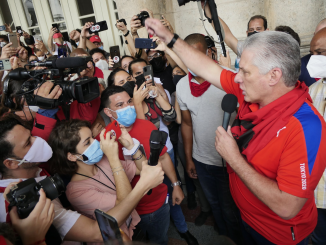
For 60 years the example of the Cuban Revolution has bothered the United States, stated First Secretary of the Communist Party of Cuba and President of the Republic, Miguel Díaz-Canel Bermúdez, yesterday, during a special message from the Palace of the Revolution explaining to the people the most recent provocation orchestrated by small groups of counterrevolutionaries.

Photo: Estudios Revolución

For 60 years the example of the Cuban Revolution has bothered the United States, stated First Secretary of the Communist Party of Cuba and President of the Republic, Miguel Díaz-Canel Bermúdez, yesterday, during a special message from the Palace of the Revolution explaining to the people the most recent provocation orchestrated by small groups of counterrevolutionaries.

The President began his remarks with a revolutionary greeting to the entire people, and said: “Unfortunately, we have been obliged to interrupt our Sunday, that all our families take to rest and spend time together, to inform you and share with you a series of elements related to the events that have been taking place today, which are part of a high level, systematic, escalating provocation, which has been promoted by the counterrevolution over these days.”

What is the background to this situation we are experiencing, he asked.

“We have been honest, we have been open, we have been clear, and at all times we have explained the complexities of the current situation to our people. I remember that more than a year and a half ago, when the second half of 2019 was just starting, we had to explain that we were heading toward a difficult conjuncture, and we used that term, which was later taken up as part of popular humor, since we have remained in this ‘conjuncture’ for a long time…Beginning with all the signs that the U.S. government, headed by the Trump administration, was giving in relation to Cuba.”

Diaz-Canel recalled that the adoption of an extensive series of restrictive measures to tighten the blockade began; financial persecution, energy persecution, with the goal of asphyxiating the country’s economy.

He denounced ongoing efforts to provoke a massive social explosion in Cuba, including all sorts of propaganda and ideological constructions they fabricate to call for misnamed humanitarian interventions, which end up as military interventions and interference, trampling the rights and violating the sovereignty, the independence of peoples.

This succession of hostile acts continued, he noted, “Then came the 243 measures we all know about. And in the last days of that administration the decision was made to include Cuba on the list of countries sponsoring terrorism.”

He reiterated that this list is a totally spurious list, an illegitimate list, and a unilateral list, fabricated by the U.S. in the belief that they are the power dominates the world, that they are the emperors of this world.”

He noted that, unfortunately, due to the lack of principles that exists within more than a few international institutions and national governments, many cave in and go along with these hostile measures and actions.

“It must be recognized that others do not submit to be the imposition of these measures, but they are limited by the extraterritorial nature that these.

“And that further increased the impact of the restrictions, which above all implied that the country was immediately cut off from its main sources of foreign currency income: I am talking about tourism, I am talking about the trips of Cubans and U.S. citizens to our country, about the much-awaited remittances to Cuban families from their relatives in the United States.”

The President also denounced U.S. efforts to discredit Cuban medical brigades, since this medical collaboration, beyond the many instances of solidarity provided, also generates foreign currency income.

All this, he said, is causing shortages in the country: “Shortages of food, of medicines, raw materials and inputs needed by our economic and productive processes, which contribute both exports and supplies for the people; therefore here two important elements are cut off: the capacity to export and to acquire foreign currency to import and invest, and the capacity of the productive processes to be produce a full range of goods and services for our population.”

He pointed out that the country “has seen its fuel supply limited, access to spare parts limited, and all this has caused dissatisfaction, has exacerbated accumulated problems, which we have not been able to resolve, have been around since the special period, and to all this has been added a ferocious media campaign to discredit us, as part of a so-called non-conventional war, which attempts, on the one hand, to break the unity of the Party, the government, the state and the people, attempting to portray the government as inept, incapable of providing wellbeing to the Cuban people, attempting to portray the U.S. government as “very concerned about the welfare of the Cuban people,” who it has unjustly blockaded, telling them how they can aspire to development and progress in a country such as ours.

“These are the usual hypocritical prescriptions and speeches of double standards, which we know very well, throughout the history of United States behavior toward Cuba. We know how they intervened in our country, how they appropriated our island, how they maintained domination of our Island during the pseudo-republic and how their interests were hit hard by the triumph of the Cuban Revolution.

“For 60 years the example of the Cuban Revolution has bothered them, and they have constantly tightened… applied an unjust, criminal, cruel blockade, reinforced, worse than ever under pandemic conditions. Therein lies the manifest perversity, the maliciousness of all these intentions: blockade and restrictive measures, which they have never taken against any other country, or against those they consider their main enemies.

“This has been a work and a policy of viciousness against a small Island, which only aspires to defend its independence, its sovereignty and build, with self-determination, its society in accordance with the principles that more than 86% of the population has approved, has supported in the broad and democratic exercise we held, to approve the current Constitution of the Republic of Cuba.

“And in the midst of these conditions comes the pandemic, a pandemic that has not only affected Cuba, a pandemic that has affected the whole world, a pandemic that has also affected the United States, that has affected rich countries. It must be said that the United States and other rich countries did not have the capacity to confront the effects of this pandemic at the beginning.

“And in many of those first world countries, with much more wealth, health systems collapsed, intensive care units were overwhelmed. The poor have been disadvantaged because there are no public policies directed toward saving the people,” and these rich countries in many cases have worse results than Cuba in terms of responding to the pandemic.

“And we were impacted by the pandemic and, in the midst of all these other restrictions, with the reserves that the country has created, with the little we had in the country, with the little we have been able to acquire this difficult year and a half, is that we have been able to meet these challenges, these tests.

“And we have done it with courage, we have done it without giving in and, above all, we have done it by sharing among all the little we have, and we have not only shared within Cuba, we have shared with the world. There is the example of the Henry Reeve internationalist brigades, which has gone to places brutally affected by the pandemic.

“And this is how we have moved forward, controlling one wave after another, with a tremendous capacity for sacrifice on the part of our people, of our scientists, of our health personnel, of almost the entire country involved in this.

Díaz-Canel recalled that five candidate vaccines have been developed, one already recognized as a vaccine, the first in Latin America against COVID-19. Cuba is already vaccinating our population, and this is a process that takes time. Vaccines must be produced, but we currently have one of the highest vaccination rates in the world and in a few weeks we will have reached more than 20% of the total population,” he noted.

However, he noted, in the last few months more aggressive strains have appeared, and in the midst of this already serious situation, another group of complications began to appear.

“First of all, new cases are emerging at a speed and accumulation that exceeded the capacities we have been able to create to treat these patients in state institutions. On the other hand, we have been obliged to expand capacity in other centers,” he explained.

In this sense, by opening more centers, to which energy priority must be given – in the midst of the accumulation of problems in the generation of electricity, the number of circuits that we must protect, to attend these patients, has increased.

With more patients, he continued, the stock of medicines is also running low and acquiring them is very difficult; and in the midst of all this, we continue to work for everyone.

“Now we have been obliged to resort to home isolation due to the lack of capacity in a number of provinces, and call on families to participate more directly, more responsibly. One never tires of admiring the capacity for creative resistance of our people.”

With these values, he insisted, with vaccination advancing, complying with the necessary sanitary measures, we will emerge sooner rather than later from this peak in the pandemic, which is not only hitting Cuba. Cuba managed to postpone this high point with everything we did, and we will overcome it.

But now, he noted, in a very cowardly, subtle, opportunistic and perverse manner, exploiting the most difficult situations we have in provinces like Matanzas and Ciego de Avila, those who have always supported the blockade, those who have served as mercenaries, lackeys of the Yankee empire, begin to appear with calls for a humanitarian intervention, a humanitarian corridor, to strengthen the idea that the Cuban government is not capable of handling this situation, as if they were really interested in the welfare and health of our people.

“If they want to make a gesture toward Cuba, if they really are concerned about the people, if they want to solve Cuba’s problems: lift the blockade and let’s see how we do, why don’t they do that? Why don’t they have the courage to lift the blockade, what legal and moral basis allows a foreign government to implement such a policy against a small country, and in the midst of such adverse conditions? Isn’t this genocide?”

He denounced the assertion that a dictatorship exists in Cuba, “A dictatorship that is concerned about providing healthcare for its entire population, that seeks welfare for all, that in the midst of this situation is capable of conducting public policies, aspiring to vaccination with a Cuban vaccine, because we knew that no one was going to sell us any, since we don’t have the money to buy them,” he said.

“What a strange dictatorship,” he exclaimed. Now they are shouting that we are murderers. Where are the murder victims in Cuba, where are the missing persons in Cuba? Other countries that have suffered these pandemic peaks were not attacked in the press and they were not offered humanitarian intervention as a solution, nor were they subjected to these slander campaigns as we are, Díaz-Canel emphasized.

“I believe that life, history, the facts show what is behind all this, which is the effort to asphyxiate us and put an end to the Revolution, and for that they are trying to discourage our people, to confuse our people. And when the people are facing severe conditions, then events like the ones we experienced in San Antonio de los Baños take place.”

About the events in this area, he detailed:

Who was part of the group? It included members of the population, who have needs, who are experiencing some of these shortages; it included revolutionaries who are confused, do not have all the arguments, or were expressing these dissatisfactions, but they were doing differently, because they were seeking to understand, seeking explanations.

“But this was led by a core group of manipulators who are indeed lending themselves to the designs of the SOS Matanzas or SOS Cuba campaigns… Several days ago, they were preparing demonstrations or social disturbances of this type in several Cuban cities. This is criminal, at a time when people should be at home, protecting themselves.”

Diaz-Canel reported that revolutionaries in San Antonio de los Baños, provincial authorities, a group from the country’s leadership showed up there, we confronted the counterrevolutionaries and we talked to the revolutionaries, and to those asking for explanations, to show that Cuba’s streets belong to revolutionaries.

He pointed out that we know there are other groups of people gathering in streets and plazas, in other cities of the country, also moved by unhealthy purposes. “I am also giving this information, to reaffirm that in Cuba the streets belong to revolutionaries, that the state, the revolutionary government, guided by the Party, are more than willing to discuss, to argue and to participate with the people in the solution of problems, but recognizing the real cause of our problems, without allowing ourselves to be confused.”

Those who are encouraging demonstrations are not interested in good healthcare for Cuba, he emphasized. Remember that their model is neoliberal, the privatization of health, of medical services, of education; that everyone should save themselves as best they can, that those who have the money can access health care, he warned.

“We are not going to surrender sovereignty, the independence of our people, or the freedom of this nation. There are many of us revolutionaries in this town who are willing to give our lives and this is not a slogan, it is a conviction. They will have to step over our corpses if they want to confront the Revolution, and we are ready for anything and we will be in the streets fighting.”

We know that incidents of this type are being orchestrated in the streets of Havana and that there are large groups of revolutionaries confronting counterrevolutionary elements. We are separating the confused revolutionaries, the inhabitants of Cuba who have specific concerns, but we are not going to allow any counterrevolutionary, any mercenary, to provoke destabilization among our people.

“This is why we are calling on all revolutionaries in our country, all communists, to take to the streets in any of the places where these provocations may take place today, from now on, throughout these days,” he insisted.

“As I said in my closing speech at the Party Congress, we revolutionaries defend the Revolution above all else, we communists on the front lines, and with that conviction we are now in the streets, we are not going to allow anyone to manipulate our situation, or defend a plan that is not Cuban, that is not for the welfare of Cubans and that is annexationist. This is the task to which we call revolutionaries and communists of this country,” he concluded.

Source: Granma

Strugglelalucha256


Defend the Cuban Revolution! No U.S. intervention from Cuba to Haiti

On the weekend of July 10-11, a series of counter-revolutionary provocations took place in Cuba in the form of street protests blaming the socialist government for the shortages of medical supplies, fuel and food caused by the unilateral U.S. blockade, which was tightened by Donald Trump and enforced by Joe Biden. The Cuban government has identified U.S.-funded opposition groups and media outlets as the source of these provocations.

In a televised address to the Cuban people on July 11, President Miguel Díaz-Canel denounced the destabilization attempt emanating from Washington, D.C., and Miami. He reviewed the serious problems caused by the tightening of the U.S. blockade under Trump and Biden, after the brief thaw in relations under President Obama. He urged the Cuban people to take to the streets to defend their Revolution and to continue fighting alongside people worldwide for an end to the cruel blockade.

“The streets belong to the revolutionaries,” Díaz-Canel proclaimed. In response, workers, farmers, students and members of the revolutionary armed forces held demonstrations Sunday across the island in support of the Cuban Revolution and its leadership. Many carried portraits of the historic leader of the Cuban Revolution, Fidel Castro. Earlier, President Díaz-Canel himself went to San Antonio de los Baños, a small town south of Havana where the provocations began, where he walked through the streets and held discussions with the people.

It is now apparent why President Biden’s administration hasn’t reversed Trump’s cruel intensification of the blockade, as he had promised during his election campaign. The U.S. capitalist ruling class, the bosses and bankers who call the shots for both the Republicans and Democrats, are united in their hatred of Cuba. After the retirement of former president and Communist Party leader Raul Castro earlier this year, the U.S. bosses are testing for cracks in the Cuban government and military that they can exploit to destroy the Revolution.

The hypocrisy of U.S.-funded “human rights” and “independent media” groups is blatant. They are trying to stir up anger at the Cuban government among people affected by shortages which are purely the responsibility of the U.S. government and its six-decade criminal blockade. 

Despite the difficulties imposed by the blockade, Cuba has done so much in the past 18 months to help protect not only its own people, but poor and working people around the world, from the scourge of the COVID-19 pandemic. It has sent medical brigades to dozens of countries to help combat the virus. Cuba has even developed its own very effective vaccines — but lacks the necessary syringes to administer doses to the people because of the cruel blockade.

Nor is it a coincidence that this is happening just days after the assassination of the discredited U.S. puppet president of Haiti, Jovenel Moïse, in a sophisticated operation carried out by U.S. and Colombian mercenaries. The new acting leaders of Haiti have already called for the intervention of U.S. troops. A U.S. occupation of Haiti could serve as the launching pad for an invasion of Cuba. 

The U.S. naval base at Guantanamo Bay, site of ongoing “War on Terror” torture of prisoners, is on illegally-occupied Cuban territory. This is a cancerous tumor that threatens not only Cuba but Haiti and all of the Caribbean.

The U.S. rulers have never forgiven the people of Haiti for carrying out the first successful slave revolution. Likewise, they’ve never forgiven the Cuban people for carrying out the first socialist revolution in the Western hemisphere right under their noses — and successfully defending it for over 62 years.

But significantly, this attack also comes at a time when the U.S. blockade is more unpopular than ever. More and more people in the U.S. and around the world have been coming out in the streets to denounce the blockade with monthly caravans. Cuban American opponents of the blockade are currently participating in a 1,300-mile protest walk to Washington, D.C. Dozens of cities and labor councils have adopted resolutions calling for an end to the blockade and medical cooperation with Cuba. Solidarity groups in many countries are collecting #Syringes4Cuba — including in the U.S., where $500,000 has been raised so far.

And, on June 23, 184 countries in the United Nations General Assembly once again supported Cuba’s resolution against the blockade. Only the U.S. and its tool Israel voted against it.

Now is the time for every worker, every progressive person, every revolutionary, to lift their voice and come to the defense of Cuba, which has done so much to give the world health, solidarity and hope for a humane future.

U.S. hands off Cuba! No intervention in Cuba or Haiti! End the blockade now!

Support the international solidarity campaign to bring Cuba tens of millions of medical syringes by visiting Ghpartners.org/syringes4Cuba.

Strugglelalucha256


Network of Intellectuals and Artists in Defense of Humanity: Cuba wins and will continue to win!

In absolute unison with the revolutionary Cuban people, the Network of Intellectuals and Artists in Defense of Humanity (REDH) calls on the entire world to remain alert and oppose the interference that the U.S. government and its cronies intend to apply in Cuba. We send a warning about the implications of the recent campaign for a “humanitarian corridor” that the United States is promoting under the pretext of the pandemic, because Cuba is not only a unique country in the South, which, in addition to being among the first in the world in the vaccination ranking, thanks to its universal policies of humanistic health care and high professionalism, has one of the lowest death rates for the pandemic. Cuba has supported dozens of countries with their offering of humanity assistance to save lives, while the so called “humanitarian interventions” imposed by the United States are all about occupations, designed only to bring about destruction, misery and the most atrocious violations against the dignity of nations and individuals.

The US government is determined to provoke a social explosion in Cuba. To that end the administration of Joseph Biden has not only left every bit of the cruelty of the sanctions that his predecessor Donald Trump put into place but has even tightened them, ratcheting up the subversive drift against Cuba. Trump redoubled the maximum cruel measures of the economic, financial and commercial blockade; moreover, he took advantage of the economic repercussions caused by the pandemic to impose additional punitive measures. It is the imposition of these illegal sanctions that affects Cuba and that is why the people, the government of Cuba and the international community itself are urgently calling for an end to the blockade.

The Network of Intellectuals and Artists in Defense of Humanity urges President Biden to comply with the resolution rejecting the blockade issued on 29 occasions by the UN General Assembly, for being contrary to international law. We also call on Biden to immediately act on the electoral promises he made to revoke the measures taken by Trump to reinforce the blockade.

We whole heartedly support the measures adopted by the Cuban government and its people to defend their independence, their sovereignty and their socialist project of emancipation. We especially support the Cuban people who are mobilized in the street and in the social media in defense of their revolution. It is in the same spirit, that we support the call of President Miguel Díaz-Canel Bermúdez encouraging the most democratic of acts of taking the streets by the people, with the revolutionaries at the forefront, to put a stop to this latest threat of a soft coup.

Cuba will win against every imperialist counterrevolutionary attempt!

There is no power in the world capable of subduing its heroic people!

Network in Defense of Humanity

Our America, July 11, 2021

Strugglelalucha256


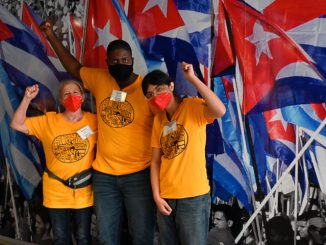
Cubans march in Havana in support of the government

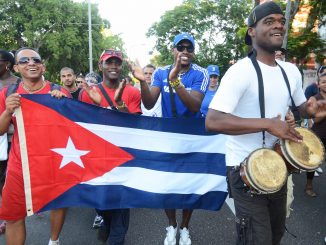
Havana, July 11 (Prensa Latina) Cubans came out to march in Havana in support of the Government and the revolution after President Miguel Diaz-Canel addressed the nation in a radio television hook-up, calling on the people to defend the country’s streets in the face of intensified destabilization and subversion actions.

Cuban Foreign Minister Bruno Rodriguez shared through his Twitter account a video showing citizens in the Centro Habana municipality marching with Cuban flags and chanting in support of the Government and in rejection of the destabilizing incidents that took place this Sunday in some localities.

‘The people are mobilizing in the face of imperialism’s campaign against Cuba’, wrote the Foreign Minister, adding that international solidarity and Cubans living abroad are organizing support for the island.

Cuban President Miguel Díaz-Canel, in a televised appearance, summoned all revolutionaries to take to the streets in defense of the Revolution, wherever there is an attempt to generate disorder, and to confront them with decision and firmness.

The president himself went this Sunday, together with other leaders of the Communist Party of Cuba and the Government, to the town of San Antonio de los Baños, south of Havana, where a group of people, encouraged by media campaigns from the US, gathered in the town main square.

The head of state talked to the local population about their concerns and dissatisfactions, and then they marched along several streets of the small town.

‘We will not allow any sold-out counterrevolutionary, who receives money from US agencies, to provoke destabilization in Cuba, Diaz-Canel stressed on national television.

Strugglelalucha256


Biden’s failure to end Trump’s war on Cuba is threatening lives

Imagine a country developing and producing its own Covid-19 vaccines, enough to cover its entire population, but being unable to inoculate everyone because of a syringe shortage. This absurd situation is real, and one that Cuba will soon face. Cuba has already vaccinated about 2 million of its 11 million people, and hopes to have 70 percent of the population vaccinated by August. Yet, because of the 60-year US embargo, which punishes civilians during a pandemic, the country is facing a shortage of millions of syringes.

It makes little sense that a country so advanced in biotech and pharmaceuticals should have trouble sourcing syringes. This reality is a consequence of what amounts to US economic warfare, which makes it extremely difficult for Cuba to acquire medicine, equipment, and supplies from vendors or transportation companies that do business in or with the United States. Syringes are in short supply internationally, so no company wants to be bogged down navigating the complicated banking and licensing demands the US government places on transactions with Cuba.

The irony is that Cuba’s achievements in health are a model and a demonstrable benefit for the entire world—one that the United States should be supporting. This is a country that is developing its economy through health and education—a project that began 60 years ago with rural literacy and health campaigns. Cuba’s public health system has allowed it to outperform much of the world in terms of life expectancy, infant mortality and, most recently, per capita pandemic statistics.

At the beginning of the pandemic, Cuba’s cutting-edge biotech industry shifted rapidly to produce treatments and develop Covid-19 vaccines. At the same time, Cuban doctors, nurses, and other health professionals were deployed to over 40 countries to fight the pandemic on the front lines, helping the world’s poor and under served populations weather the worst of the crisis. For Cuba, health is not just a right for its own people; it’s a right to be upheld and shared with all peoples.

When the administrations of Barack Obama and Raúl Castro charted a new course toward Cuba-US diplomatic relations, there was hope that an end to the embargo was on the horizon. President Obama engaged the Cuban government to establish full diplomatic relations, eased restrictions on travel and remittances, removed Cuba from the state sponsors of terror list, and expanded US exports to the nation.

All of this progress was undone by the Trump administration, which tightened sanctions on Cuba in the middle of the pandemic. On top of that, it pressured US allies in Latin America, notably Brazil and Bolivia, to expel Cuban doctors. There is no doubt that these decisions cost lives.

On the first day of the new administration, President Biden issued a national security directive calling for a review of the impact of sanctions on the response to the pandemic, with an eye toward offering relief. Hope for a sensible US policy toward Cuba was once again kindled. Now, almost half a year into the Biden administration, the Trump-era policies of “maximum pressure” remain in place. The White House has made it clear that improving Cuba-US relations—and with them, the daily lives of the Cuban people—is not a priority. Hope is quickly turning to indignation among US and Cuban citizens alike who believed Biden’s promises to reverse the Trump administration’s policy of threats, interference in Cuban internal affairs, and obstruction of access to basic human needs.

The Biden administration is facing mounting pressure from Congress to take decisive action and put us on a path toward peace and friendly relations with Cuba. In March, 80 US congressional representatives sent a letter to the president, urging him to reverse the Trump administration’s policies. More than 100 organizations, from the American Public Health Organization to Amnesty International, made a similar request to Biden. On the grassroots level, activists have organized monthly car caravans in over a dozen cities to demand an end to the embargo. Civil society organizations and social movements have raised over $400,000 to send syringes to Cuba.

If human rights are to be a core pillar of US policy, as a White House spokesperson recently declared, then the embargo must end. It is a policy that indiscriminately targets and harms civilians. It is a systematic violation of human rights on a massive scale.

Secretary of State Antony Blinken’s eloquent speeches about a rules-based international order ring false when it comes to US Cuba policy. Under international law, the US embargo of Cuba is illegal. Since 1991, the United Nations General Assembly has held a yearly vote to adopt a resolution calling for an end to the embargo. Every year, the United States finds itself isolated as nearly every country in the world votes in favor of this resolution. This year was no different: The June 23 vote showed 184 nations against the embargo, with only the United States and Israel in favor.

If he truly wants to show global leadership, Biden should reverse a policy that isolates the United States, not merely Cuba. Instead of following Trump’s belligerent path, he should return to Obama’s path breaking efforts towards normalization. He should applaud and facilitate Cuba’s pledge to produce 100 million doses of its vaccines, which it will share with the world. As the pandemic continues to ravage the Global South, the world needs the United States’ cooperation with Cuba, not confrontation.

Source: Resumen

Strugglelalucha256


Longshore union backs Cuba’s fight against U.S. blockade

A National Network On Cuba press conference on the eve of the June 23 United Nations General Assembly vote urged the U.S. to “Vote Yes” on the “Necessity of ending the economic, commercial and financial embargo imposed by the United States of America against Cuba — Item 42.” 

The 42,000-member International Longshore and Warehouse Union (ILWU) voted to call on the U.S. to “Vote Yes” on the resolution at its International Convention held June 14-18. 

Significantly, the union’s resolution also approved a $10,000 contribution to the #Syringes4Cuba Campaign to aid Cuba’s vaccination program using its effective COVID-19 vaccines. Gabriel Prawl, chapter president of the Seattle A. Philip Randolph Institute, Million Worker March Movement and ILWU member, reported this significant news at the NNOC event June 22.

The ILWU resolution is the latest example of the widespread and growing support inside the United States for finally ending the unilateral, six-decade regime-change war on Cuba. The world has voted with Cuba at the U.N. General Assembly annually since 1992. 

This year the U.S.-based Saving Lives Campaign mobilized to show how, in contrast to the Biden and Trump administrations, the U.S. people want to “Vote Yes” to end the blockade.

Nancy Yamada from Building Relations with Cuban Labor summarized the work that has gathered resolutions from city councils and labor councils, state legislatures, county commissions, school boards and more. These combined resolutions represent at least 30 million people inside the United States. 

Hard copies of the resolutions were sent and received at the U.S. Mission to the United Nations, with email copies to President Joe Biden, Vice President Kamala Harris, House Speaker Nancy Pelosi and Senate Majority Leader Chuck Schumer. Individual “Vote Yes” letters came from the mayor of Cambridge, Mass., and Central Labor Councils of Sacramento and Fresno, Calif. 

The U.S. government is intentionally imposing hardship on the Cuban people. Cuban-American Felix Sharpe-Caballero from Project EL PAN and award-winning filmmaker Liz Oliva Fernandez, speaking from Cuba, gave testimony about the human cost in daily life. This includes long lines for limited food, and unavailability of even common medicines and feminine hygiene supplies. 

Two elected officials from Detroit, Wayne County Commission Chairperson Alicia Bell and former state representative and current Detroit school board member the Hon. Sherry Gay-Dagnogo, spoke at the NNOC event. Also speaking was Gail Walker, executive director of the Interreligious Foundation for Community Organization/Pastors for Peace. 

The full event can be viewed here

Strugglelalucha256


Baltimore joins world demand to end Cuba blockade

Baltimore City Council Member Sharon Middleton, at the request of the Baltimore Cuba Resolution Committee, introduced City Council Bill No. 21-0048R, “Request for Federal Action — End the Embargo Against Cuba,” on June 8, 2021. The motion was adopted by the City Council.

The move came after almost two years of unanswered requests from activists to introduce the resolution and to meet with Baltimore City Council members.

The resolution urges the U.S. Congress and President Joe Biden to immediately end all aspects of the U.S. blockade against Cuba; to remove Cuba from the U.S. list of “state sponsors of terrorism”; and to return Guantanamo Bay to Cuba. 

The resolution will be transmitted to Biden, the Maryland Congressional Delegation, the City Council president’s legislative staff and the mayor’s legislative liaison to the City Council.

On June 23, 2021, the United Nations voted overwhelmingly in support of ending the blockade on Cuba for the 29th consecutive year. Only the U.S. and Israel voted against the U.N. resolution. Colombia, Brazil and Ukraine abstained.

Now, Baltimore City joins the rest of the world in coming out against the blockade.

The Baltimore Cuba Resolution Committee consists of members of the Peoples Power Assembly, Friends of Latin America, CPUSA Baltimore, Baltimore Peace Action and the D.C. Metro Coalition in Solidarity with the Cuban Revolution. 

The adopted resolution can be found here.


Strugglelalucha256


Cuban-Americans embark on 1,300-mile walk to end U.S. blockade

A 1,300 mile pilgrimage to end the U.S. blockade of Cuba departed from Miami on June 27. Participants are walking to the White House in Washington, D.C. The 13th consecutive monthly caravan initiated by Miami Cuban-Americans sent them on their journey. 

You can follow their trip on Facebook. Please sign the accompanying petition to end the blockade, available in Spanish and English.

The caravan movement has spread across North America. Events were held in many cities on June 20 instead of the usual last Sunday of the month to mobilize ahead of the overwhelming vote June 23 for Cuba’s resolution at the United Nations General Assembly. Only the United States and Israel voted against the resolution, while 187 countries voted with Cuba. 

A June 26 press release announced the send off:

“Cuban activists set off on a 1,300 mile walk from Miami to the White House demanding an end to the U.S. blockade. The send-off caravan will demand Biden heed the giant majority vote at the U.N. condemning the blockade. 

“High school teacher and Iraq war combat medic veteran Carlos Lazo of Puentes de Amor, along with three other Cuban Americans, will set out on a 1,300-mile march to Washington, D.C., at the conclusion of a send-off car caravan through the streets of Miami on Sunday, June 27.

“‘It is time to lift the sanctions that weigh on the Cuban family. In the face of hatred and intolerance, it is high time that we extend a hand of generosity and humanity to a people who, in the midst of a pandemic, resist an economic siege,’ says Lazo.

“Lazo’s pilgrimage to Washington, D.C., comes on the heels of a cross-country bicycle trip he undertook last year from Seattle to Washington, D.C., calling for an end to the blockade. That trip inspired Miami’s Cuban-Americans to start monthly caravans to end the blockade, a movement that has spread all over the country — and the world. Sunday’s Miami caravan will be the 13th one, each one larger than the one before.”


Strugglelalucha256


The world says no to the blockade of Cuba

Cuba won another diplomatic victory in the General Assembly of the United Nations June 23 against the government of the United States. The majority of countries (184) voted in favor of the resolution which calls for the lifting of the blockade against Cuba. 

The resolution has been brought to the U.N. every year since 1992, except in 2020 when the government of Havana was unable to present it due to the COVID-19 pandemic. 

This victory is a reminder of the Cuban people’s long wait for an act of justice that can rectify the worrying situation, which is a mix of the abuse of authority, the disproportionate use of violence, and the very specific intention to “destroy, totally or in part, a national, ethnic or racial group, in its totality,” the U.N.’s definition of genocide in its 1948 Convention.

Only a very few cases of mass killings have been considered genocides unequivocally by the international community. However, there is no other name for this horror which has lasted for more than 60 years and has forced several generations of Cubans to go about their daily lives under a heavy fog. 

This powerful elite carries out inhuman monstrosities against millions of people for the mere crime of existing. Is it not genocide to deny people, in the middle of a pandemic, medicine and food, access to internet services to the majority of people, to finance and trade between equals? If so, we must then, like Raphael Lemkin, invent a word for this nameless crime.

It is difficult to account for how many in Cuba have died because they did not have the medicine they needed or because it did not arrive on time. The report presented by Cuba’s Foreign Minister Bruno Rodríguez, on the damages of the blockade in 2020, has 60 pages without one adjective. The report is merely a list of what happened, excessive costs, items that did not arrive on time because they had some component from the U.S. — from a plane to a respirator that was destined for an intensive care unit — names of companies that have refused to supply the island with the technology, raw materials, reactive agents, diagnostic kits, medicine, devices, equipment and replacement parts needed by a public health system.

A friend told me that the images of George Floyd’s assassination had a strong impact in Cuba. Being suffocated on the ground by the police officer who refused to lift his knee off his neck, despite the cries of the victim saying that he couldn’t breathe. The video went viral across the world and was the catalyst for the largest anti-racist protest in the United States since the civil rights movement of the 1960s.

We understand the feeling of impotence of the people of the United States who feel rightly so that this is a systematic abuse of power. In the case of the 8 minutes and 46 seconds of George’s agony, it was key that the entire incident was recorded. 

The question that remains, after the conviction of the killer cop, is how many other people have been killed or have suffered in silence simply because there was no camera when the system didn’t let them breathe. We know that there is always a knee on someone’s neck, suffocating them. 

This is what happens with the blockade. This strange word that may seem to be abstract for many, but not for the person who finds themselves in the emergency room in Cuba, has a sick child or has spent six hours in line to buy food that before the 242 additional sanctions added by Donald Trump and before the damn pandemic, could be found with less difficulty.

Joe Biden’s representative at the U.N. reached new levels of cynicism when they said that the blockade is the responsibility of the Cuban government which uses it as a pretext to remain in power. This is like George Floyd’s killer saying his knee on somebody else’s neck was the victim’s excuse for suffocating.

As such, these are moments of joy in Cuba as we learn that once again from the New York headquarters of the U.N., the world said no to the U.S. blockade. This coincided with more hopeful news: Cuban scientists were able to finalize the first two Latin American vaccines. One of them, Abdala, has a 92.28% rate of efficacy.

Rosa Miriam Elizalde is a Cuban journalist and founder of the site Cubadebate. She is vice president of both the Union of Cuban Journalists (UPEC) and the Latin American Federation of Journalists (FELAP). She has written and co-written several books including Jineteros en la Habana and Our Chavez. She has received the Juan Gualberto Gómez National Prize for Journalism on multiple occasions for her outstanding work. She is currently a weekly columnist for La Jornada of Mexico City.

This article was first published in La Jornada.

Strugglelalucha256


Cuba demands to be left in peace, to live without a blockade

Statement by Cuban Foreign Minister at the UN General Assembly

United Nations, Jun 23 (Prensa Latina) Here’s the full text of Cuban Foreign Minister, Bruno Rodriguez’, statement at the UN General Assembly which once again condemned on Wednesday the U.S. blockade by 184 votes in favor, two against and three abstentions:

STATEMENT BY H.E. Mr. BRUNO RODRÍGUEZ PARRILLA, MINISTER OF FOREIGN AFFAIRS OF THE REPUBLIC OF CUBA, ON AGENDA ITEM 42, ‘NECESSITY OF ENDING THE ECONOMIC, COMMERCIAL AND FINANCIAL BLOCKADE IMPOSED BY THE GOVERNMENT OF THE UNITED STATES OF AMERICA AGAINST CUBA’. NEW YORK, JUNE 23, 2021.

His Excellency, Mr. President;

Excellencies, Permanent Representatives;

Delegates all;

In 2020, Cuba, like the rest of the world, had to cope with the extraordinary challenges posed by the COVID-19 pandemic. The government of the United States considered the virus as an ally in its ruthless, non-conventional war. It deliberately and opportunistically tightened the economic, commercial and financial blockade and caused our country to incur record losses estimated at around 5 billion dollars.

President Donald Trump applied 243 unilateral coercive measures intended to restrict travel by U.S. citizens to our country and damage tourist markets in third countries. He adopted measures that are proper to times of war with the purpose of depriving us from fuel supplies. He persecuted the health services that Cuba offers in numerous countries. He increasingly harassed our country’s commercial and financial transactions in other markets and set out to spread fear among foreign investors and commercial entities through the implementation of Title III of the Helms-Burton Act.

He also hindered the regular and institutional flow of remittances to families. He dealt very harsh blows to self-employed or private workers and hampered the links with Cubans residing in the United States as well as family reunification.

All these measures remain in force today and are being fully implemented. And, paradoxically, they are shaping up the behavior of the current U.S. administration, particularly during the months when Cuba has experienced the highest COVID-19 infection rate; the highest number of fatalities and a much worse economic impact.

The Democratic Party electoral platform promised voters to swiftly reverse the actions taken by the administration of Donald Trump, particularly the elimination of restrictions on travel to Cuba, financial remittances and the implementation of the bilateral migration accords, including the granting of visas.

It is a well-established fact that a large majority of U.S. citizens supports the lifting of the blockade and the freedom to travel to the island and that Cubans living in this country want normal relations and wellbeing for their families.

There are some who put the blame of this pernicious inertia on the electoral ambitions associated to Florida or the balances, in no way transparent, of the political and legislative elites.

What would those who voted for President Joseph Biden think about what is going on?

Mr. President;

The human damage caused by the blockade is incalculable. No Cuban family is spared from the effects of this inhumane policy. No one could honestly assert that the blockade does not have a real impact on the population.

In the area of health, there’s a lingering impossibility to access equipment, technologies, devices, therapies and the best-suited pharmaceuticals that the blockade prevents us from acquiring from U.S. companies and are to be bought at exorbitant prices, through intermediaries, or replaced with less effective generics, even to treat sick newly born babies and children.

But now, the cunning blow dealt to our finances and the costs associated to the COVID-19 pandemic –which are around 2 billion pesos and 300 million dollars- are also leading to the lack or unstable supplies of medicines for hospital use, which make the difference between life and death; and create difficulties, on a daily basis, to persons that need to have timely access to insulin, antibiotics, painkillers as well as the medicines used to treat high blood pressure, allergies and other chronic diseases.

Cuba sought to protect everybody from the virus; activated its universal and sound health system; relied on the selflessness, willingness to sacrifice and high qualification of its health staff; mobilized its national scientific potential and its world-class bio-pharmaceutical industry and enjoyed the express support and consensus of the people, particularly youths and students, who offered to work as volunteers in risk areas and epidemiological surveys.

That is why we were able to quickly develop highly effective protocols of our own making to treat those who were infected or suspected to have been infected with the COVID-19 virus; increased capacities to hospitalize all infected patients; guaranteed the full sustainability of intensive care services, the institutional isolation of the contacts of sick persons, free access to PCR or antigens tests; and established molecular biology labs in all provinces of the country.

When the blockade cruelly impeded the supply of ventilators, Cuba developed their local production based on prototypes of its own making.

All this effort involving the entire Nation has made it possible to record a comparatively very low fatality rate as a result of the pandemic, particularly among our health staff, infants, children and pregnant women.

It is worth noting that a small, blockaded Island has developed 5 candidate vaccines and applied 3 of them, through intervention studies or health interventions, to 2 million 244 thousand 350 Cubans, who have received at least one dose; and intends to immunize 70 per cent of its population during the summer, and its entire population before the end of this year, despite the fact that the blockade is severely hampering the industrial scaling-up of these productions.

These results are an evidence of the efforts of science to the service of the people as well as the effectiveness of public service.

During the pandemic, when the U.S. government strengthened its slanderous campaign against our medical cooperation, Cuba sent 57 specialized medical brigades of the ‘Henry Reeve’ International Contingent to 40 countries or territories, who joined the more than 28 thousand health professionals who were already offering their services in 59 countries.

The blockade also deprives the national industry from the funds needed to acquire the necessary inputs destined to the production of foodstuffs, thus causing a collapse in the production of pork and other goods.

Foodstuffs imports from the U.S. are made under strict licenses and discriminatory conditions and their discrete volumes cannot compare to the huge damage that the blockade causes to our finances and the effects of its extraterritorial implementation on third markets.

I can attest to the hardships and anxiety that the shortage of supplies and the instability in staples and basic commodities create among Cuban families, which are visible in the long queues which day after day are overwhelming Cubans in the midst of the COVID-19 pandemic.

The shortage of supplies in our stores as well as the uncontrolled increase in prices, despite the strenuous efforts made by the government are also a result of the critical impact derived from the tightening of the blockade, under the conditions imposed by the pandemic and the global economic crisis.

As was expressed by Army General Raúl Castro on April 16 last, and I quote: ‘…the damage that these measures cause to the living standards of the people is neither fortuitous nor the result of collateral effects. It is a consequence of a deliberate intention to punish the entire Cuban people’, end of quote.

The blockade is a massive, flagrant and systematic violation of the human rights of all the Cuban people and qualifies, under Article II paragraph C of the Geneva Convention of 1948, as an act of genocide.

Mr. President;

The U.S. authorities have cynically tried to spread the idea about the failure of the Cuban system and the inefficiency of the Cuban government; that coercive measures do not affect the people nor are a truly significant factor in the difficulties facing the national economy.

Let us check the data. From April, 2019, until December, 2020, the damages caused by the blockade have been estimated at 9.157 billion dollars at current prices -436 millions a month as an average. During the last five year period, the losses Cuba incurred for that matter were above 17 billion dollars. Damages accumulated after six decades total 147.853 billion dollars, at current prices; or 1.377 trillion dollars based on gold prices.

On June 10 last, our banking and financial system was forced to temporarily suspend the acceptance of U.S. dollars deposits in cash, which became an indispensable measure in view of the obstacles imposed by the blockade that prevent us from giving use value to that currency. This was an action we had wanted to avoid but, as it happened, it could not be put off any longer.

This is an extraterritorial warfare against a small country that had been already affected in recent times by the recession and the global economic crisis generated by the pandemic, which has deprived us from indispensable revenues, such as those derived from tourism.

As was affirmed by President Miguel Díaz-Canel on April 19 last, and I quote: ‘…no one with a modicum of honesty and relying on economic data that are in the public domain could ignore the fact that this siege is the main obstacle to the development of our country and the achievement of prosperity and wellbeing…’, end of quote.

What would happen to other economies, even in rich countries, if they were subject to similar conditions? What would be the resulting social and political effects?

Mr. President;

The blockade is a politically motivated act, which was accurately described in the infamous memorandum written by the then Deputy Assistant Secretary of State, Lester Mallory, on April 6, 1960, which I quote:

‘…Every possible means should be undertaken promptly to weaken the economic life (…) denying money and supplies to Cuba, to decrease monetary and real wages, to bring about hunger, desperation and overthrow of government’, end of quote.

This memorandum is being maliciously complemented by an intensive campaign of political interference in the internal affairs of Cuba, by means of subversive programs to which the U.S. government allocates every year tens of millions of dollars from the federal budget as well as some additional covert funds. The purpose is to bring about political and social instability in the context of the economic difficulties that the U.S. government itself is creating.

The U.S. authorities assume that if they submit the Cuban people to hardships and promote artificial leaders to instigate disorder and instability, they may generate a virtual political movement in digital networks and then take it to the real world.

They allocate huge resources and rely on social laboratories and high-tech tools to launch a wild campaign to discredit Cuba by brazenly resorting to lies and data manipulation. They have triggered a renewed McCarthyism, ideological intolerance and brutal attacks against those who defend the truth.

Some of them dream about creating social chaos, disorder, violence and death in Cuba. And it comes as no surprise, because this is a political weapon that the government of the United States has used already in other countries, with nefarious consequences.

A few others become delirious over the possibility of triggering an irregular and uncontrolled migration between Cuba and the United States. This is a dangerous bet about which we have warned the U.S. government, the one that has the legal and moral obligation to honor the migration accords, particularly when it comes to the granting of visas. This is a sensitive issue that is taking a toll on human lives.

Mr. President;

The States represented here are victims of the extraterritorial impact of the blockade which harms their sovereignty, infringes upon their national legislations, submits them to U.S. court rulings and harms the interests of the companies that may be willing to have relations with both countries, all of that in violation of International Law.

It is neither legal nor ethical for the government of a foreign power to submit a small nation, for decades, to a relentless economic warfare in the interest of imposing an alien political system and a government of its own design. Depriving an entire people from the right to peace, development, wellbeing and human progress is absolutely unacceptable.

It is unacceptable that, for 28 years now, the United States has ignored the successive resolutions of this democratic and representative General Assembly of the United Nations.

In September of 2000, Commander in Chief Fidel Castro said, from this very podium, and I quote: ‘… we must state, once and for all, with absolute firmness, that the principle of sovereignty can not be sacrificed in the interest of an exploitative and unjust order in which an hegemonic superpower, relying on its power and strength, intends to decide on everything’, end of quote.

Cuba demands to be left in peace, to live without a blockade, and calls for an end to the persecution of our commercial and financial relations with the rest of the world.

We call for an end to manipulation, discrimination and the obstacles to relations between Cubans living in the United States and their relatives in Cuba and the country where they were born. We recognize the efforts that are being made by those who, at this difficult juncture, have persisted in maintaining communication with and supporting their relatives in the Island, despite hatred and political persecution.

There are many who, even within the U.S. government, have claimed, following a pragmatic approach, that the blockade should be ended because it is an anachronistic and ineffective policy that has not achieved nor will ever achieved its goal, and has ended up by discrediting and isolating the United States itself.

The manipulation of the struggle against terrorism following political or electoral purposes is equally unacceptable.

In January this year, 9 days before the inauguration of the current U.S. administration, the government of President Donald Trump included Cuba in an arbitrary and unilateral list of States that were allegedly sponsoring international terrorism. This list, however, has a major impact on the international financial system.

No one could honestly claim that Cuba is a country that sponsors terrorism. Recent revelations have made the most recent of all these pretexts sound ridiculous.

Nevertheless, on May 14 last, the U.S. State Department once again designated Cuba, as it had done in 2020, under the former administration, as a country that was not cooperating fully with the United States counterterrorism efforts.

Cuba has been a victim of terrorist actions that have been organized, financed and perpetrated by the U.S. government or from the territory of that country, which have taken a toll on the lives of 3 478 and caused disabilities to 2 099 Cubans. There is abundant evidence of cooperation attempts and also of effective cooperation actions in recent years between agencies of both countries.

Our standing with regard to terrorism is of absolute condemnation of that practice, regardless of its forms and manifestations.

Mr. President;

Based on a sovereign decision and in the interest of the wellbeing of our Nation, Cuba has been for years carrying out sustained efforts to update its economic model and its socialist State, the rule of law and its social justice, with the support of a very large majority of our citizens, expressed through a free, direct and universal referendum.

It is an audacious and highly complex task under any circumstances that becomes all the more difficult in the face of the persistent hostility of the U.S. imperialism which, in no case, is going to stop us or break the will of present and future generations of Cubans.

I am deeply grateful for the fraternal assistance sent by our compatriots and friends of Cuba from different latitudes, which we so much appreciate, including the assistance that, after great efforts and against the opposition of its government, has been received from the United States.

We feel encouraged for being able to count on the support of thousands of persons who, all over the world, have united to urge the U.S. government to put an end to the blockade. Among the key actors in these actions are numerous Cubans who dignify the Lone-Star Flag even in this country.

On behalf of my country, its proud and generous people, who is resisting and advancing heroically, I submit to your consideration the draft resolution A/75/L.97, ‘Necessity of ending the economic, commercial and financial blockade imposed by the government of the United States of America against Cuba.’

Like the virus, the blockade causes asphyxia and death, and should be eliminated!

Homeland or Death, We Shall Overcome!

Thanks

Source: Prensa Latina
Strugglelalucha256
https://www.struggle-la-lucha.org/cuba/page/29/