Watch: End the U.S. blockade of Cuba rally in Washington, July 25

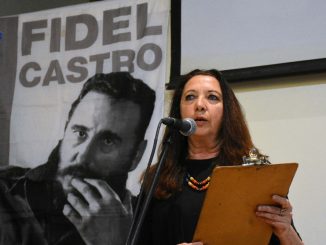
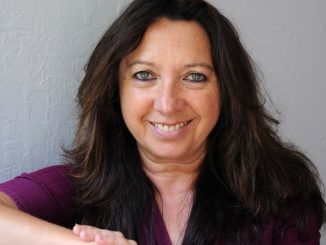
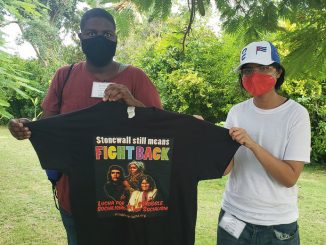
Struggle-La Lucha’s Cheryl LaBash, co-chair of the National Network On Cuba, welcomes people to the rally. SLL photos: Andre Powell

On July 25, a welcome rally was held for Cuban American “Miami to D.C.” walkers calling for an end to the U.S. blockade of Cuba.

Carlos Lazo, a Cuban American teacher and Iraq war veteran, has been on a 1,300-mile pilgrimage — with six other Cuban Americans—all the way from Miami. He arrived in Washington, D.C., to present the Biden administration with a petition signed by over 25,000 people calling for an end to the U.S. blockade of Cuba, and demanding:

  • the end of all sanctions
  • restoration of remittances
  • resumption of flights from the U.S., not only to Havana but to all the regional centers of Cuba
  • reopening of the U.S. Embassy in Havana
  • a restart to the program of family reunification

More than 400 supporters of Cuba turned out at Lafayette Park in front of the White House to greet Lazo’s group and support his project of building bridges of solidarity between people in Cuba and the U.S.

Join the call to end the U.S. blockade now!

SLL video: Raskia Ruwanpathirana

Strugglelalucha256


Cuba, the invincible revolution

The following article by Sam Marcy, a leading Marxist thinker and fighter of the second half of the 20th century, was originally published on Sept. 30, 1993, during an earlier imperialist offensive against socialist Cuba. 

Of the great revolutions of the 20th century, including those of the USSR and China, the Cuban Revolution has been subjected to the most onerous siege of all.

It is true that in the early days after the victory of the October Revolution, the Soviet Union was encircled and invaded in a siege unparalleled in all previous modern history. But soon it did have the great advantage that there were revolutionary developments — indeed unprecedented proletarian struggles — in Germany, Hungary, France and all over Europe, including a general strike in Britain.

All this helped lift, at least in part, the siege imposed by the imperialists.

Soon after the victory of the Chinese Revolution in 1949, when the Chiang Kai-shek clique was finally routed and had to take refuge in Taiwan, the Sino-Soviet agreement was concluded. This historic treaty between the two great socialist countries put the imperialists on notice that China would be defended in case of aggression by the U.S.

Of course, none of this stopped the imperialists from provoking a struggle on the Korean peninsula and beginning a siege of Korea that has lasted to this very day.

Cuba, however, has had none of the great advantages enjoyed by the USSR, China or the DPRK — each of which has had socialist allies on its borders.

Indeed, only 90 miles away from Cuba is the colossus of U.S. finance capital and its vast military establishment. It takes an enormous amount of fortitude, unmatched determination, sheer grit and perseverance to hold on and move forward with the revolution, as has been done in Cuba.

All this describes the qualities of the popular and heroic leader of the Cuban Revolution, Fidel Castro.

Eisenhower, Nixon and Kennedy

In March 1960, just a little over a year after the triumph of the Cuban Revolution, President Dwight Eisenhower secretly approved a CIA plan to invade the island. The idea was to use U.S.-trained Cuban mercenaries as a cover for Yankee aggression.

The Cuban revolutionary leaders soon knew of the plan. They publicly warned the people that an invasion was coming.

That was in a presidential election year. Eisenhower’s vice president, Richard Nixon, was running against John F. Kennedy. You would think there would have been public debate in the U.S. on the advisability of an intervention in Cuba. Wouldn’t a so-called free press itself be a participant in molding public opinion on this dangerous military initiative from the Pentagon?

But the historical record shows that the debate in the U.S. media at that time was not about Cuba at all. It focused almost completely on China — whether the U.S. should intervene to prevent the People’s Republic from recovering two little offshore islands, Quemoy and Matsu.

It was altogether a false issue. Both the outgoing Eisenhower-Nixon administration and the incoming Kennedy administration deliberately conjured it up in order to divert public opinion from what they were planning for Cuba.

Nixon and Kennedy were vying for advantage in the eyes of bourgeois public opinion, trying to out-hawk each other in condemning Cuba. At the same time they cooperated in remaining silent about the actual planning for the invasion. Such is the nature of Republican-Democratic bipartisan politics.

The invasion of April 1961 ended, as the whole world knows, in a humiliating defeat at the Bay of Pigs for the CIA and its lackeys.

The Bay of Pigs disaster was not merely the result of a military miscalculation, although that may have happened, too. The imperialists’ political miscalculation was far greater.

The Eisenhower and Kennedy administrations failed to understand that what they faced in Cuba was not just another political change. They had experienced many political changes in the history of Latin America. But none had been a true social revolution.

This was what was new about the Cuban Revolution. It was not just a change of the superstructure but of the class structure itself. It was a revolution against the landlords, capitalists and foreign owners of the vast wealth of Cuba.

New form, same old content

How much have U.S. imperialism’s plans for Cuba changed since the debacle at the Bay of Pigs? They differ widely in form — but not in content. The effort to overcome and destroy one of the most profound social revolutions in history goes on unabated.

Today’s method is not to use naked, open predatory force. It is to carry out a disguised yet equally deadly economic strangulation.

Both in spirit and substance, the Clinton administration is continuing the policy the earlier Eisenhower and Kennedy administrations pursued.

Instead of a blatant, predatory military attack, the imperialists are pursuing the same goals through the use of the vast economic power of the U.S. in order to strangle Cuba economically.

A nation proves its true worth when it can fall back on its own inner resources in the face of overwhelming odds. Cuba has done that splendidly for so long. But the siege of Cuba has lasted much too long, even if it were a larger nation with many more millions of people in it.

All this underlines the very urgent need for international support. This international support can and must come above all from the United States. This is of the greatest urgency: a reawakening of the U.S. working class to its responsibilities in the face of the monstrous character of this attempt to strangle the Cuban Revolution.

One must hope for and continue to work ceaselessly and relentlessly to awaken the tremendous potential inherent in the U.S. working class to carry out its international responsibilities to the besieged Cuban Revolution.

There can be no greater act of international class solidarity than to energetically defend the Cuban Revolution against blatant, predatory U.S. imperialism.

Strugglelalucha256


Haiti and Cuba — two great revolutions

The Haitian and Cuban revolutions are two of the greatest events in world history. Both social upheavals inspired oppressed peoples and terrified their oppressors.

The Haitian Revolution was the only successful slave revolution in history. Every slave master from Texas to Maryland feared enslaved Africans rising up and breaking their chains, like they did in Haiti.

Haiti gave crucial aid to the liberator Simón Bolívar, who defeated Spanish colonialism in much of South America.

Since 1959, Wall Street’s nightmare has been all of Latin America becoming “another Cuba.” Two thousand Cuban soldiers died fighting alongside their African comrades in defeating the Nazi armies of apartheid South Africa.

The initial assistance to newly independent Angola was called “Operation Carlota.” It was named after an enslaved African woman who led a Cuban revolt against Spanish colonial rule. After being captured she was torn apart by horses.

Less than two years after the apartheid invaders were finally defeated at the battle of Cuito Cuanavale in southern Angola, Nelson Mandela walked out of prison on Feb. 11, 1990.

Cuba and Haiti are neighbors. The distance between them is less than a hundred miles across the Caribbean Windward Passage.

While the Haitian Revolution began in 1791, the Cuban revolutionaries entered Havana in 1959. This historical distance of more than 160 years explains their different outcomes.

No French Revolution without Haiti

The French Revolution was a capitalist revolution. But it was poor people in both France and Haiti who pushed it forward. The storming of the Bastille prison in Paris on July 14, 1789, has never been forgotten.

Over two million poor people are jailed in U.S. Bastilles. These need to be torn down and the prisoners reunited with their families.

In the late 1700s, Haiti was the richest colony in the world. While today Big Oil calls the shots in the United States, it was sugar along with stealing and selling Africans that was central to the rise of European capitalism. Africans were their capital.

It was the profits from their sugar plantations in Haiti, Guadeloupe and Martinique that emboldened French capitalists to challenge King Louis and the rest of the feudal aristocracy. “Nearly all the industries which developed in France during the eighteenth century had their origin in goods or commodities destined either for the coast of Guinea or for America,” wrote C.L.R. James in “The Black Jacobins.”

Over 60 percent of French overseas trade was with Haiti. Its maritime trade with Haiti employed 24,000 French sailors on 750 ships.

French shipowners and other capitalists grew rich by working Africans to death. The average life expectancy of Africans in Haiti was just 21 years.

These conditions led to Dutty Boukman starting a revolt in August 1791 that burned 1,800 plantations.

Haiti helped shield the French Revolution from foreign invasion. Haitians defeated a British army trying to conquer Haiti. Because the redcoats were being vanquished in Haiti, they couldn’t march on Paris.

The French revolutionaries abolished slavery on Feb. 4, 1794. This act simply confirmed what Haitian people had already won on the ground under the leadership of Toussaint Louverture.

It also reflected the feelings of the French poor. They hated the “aristocracy of the skin,” the white slave masters who worked Black people to death. Peasants and other French working people boycotted coffee because it was grown by enslaved Africans.

But beginning in July 1794, the French Revolution was thrown back. Its leaders were sent to the guillotine.

Napoleon kidnapped Toussaint Louverture and let him die in a cold prison cell. The French dictator sent an army to try to restore slavery in Haiti. It was defeated with 24,000 out of 34,000 soldiers having perished.

Haiti against the capitalist world

Jean-Jacques Dessalines declared Haiti’s independence on Jan. 1, 1804. But the world capitalist class never forgave Haiti for its revolution. The two centuries of revenge that followed made Haiti poor.

The United States refused to recognize Haiti until after the U.S. Civil War had started, in 1862. The restored Bourbon monarchy in France agreed to diplomatic relations and trade with Haiti in 1825.

The French government did so on the condition that Haiti pay reparations to the defeated slave masters! The last payment on this reverse blood transfusion wasn’t made until 1947.

In order to pay off this blood money, Haitians were forced to chop down trees. Floods resulted from the hills becoming bare.

When Haiti’s elected President Jean-Bertrand Aristide righteously demanded this money back—which with interest amounted to $21 billion—he was soon overthrown on Feb. 29, 2004.

The United States has continuously intervened in Haiti for more than a century. U.S. Marines invaded the country in 1915 and stayed there until 1934.

A half-million dollars of gold was stolen from Haiti’s central bank by U.S. soldiers and given to New York’s National City Bank, now named CitiBank. A U.S. marine was given the medal of honor for assassinating Haitian resistance leader Charlemagne Péralte.

It was the CIA that helped prop up the dictatorships of “Papa Doc” François Duvalier and his son “Baby Doc” from 1957 to 1986.

Haiti’s revolution occurred as capitalism was on the rise. British textile factories, which were the starting point of the industrial revolution, depended on cotton grown by enslaved Africans in the U.S.

By the 1840’s, British capitalists invaded China to sell opium. The 1884-85 Berlin conference of European colonialists carved up Africa. Belgian King Leopold killed between 8 and 15 million Africans in Congo for rubber profits.

Black people in the United States played a crucial role in defeating the slave owners’ confederacy in the Civil War. After a brief springtime of freedom, Black people were pushed back by Ku Klux Klan terror that overthrew the Reconstruction governments. Haiti was all alone.

Socialist solidarity with Cuba

In contrast, when the Cuban Revolution triumphed on Jan. 1, 1959—155 years after Haiti declared its independence—there was a constellation of socialist countries that embraced it. The Cuban Revolution came four decades after the 1917 Bolshevik Revolution.

One-third of humanity lived under these people’s governments stretching from East Germany to Vietnam. Che Guevara was welcomed in both the People’s Republic of China and the Democratic People’s Republic of Korea.

That doesn’t mean the Cuban people had it easy. Over 3,000 Cubans were killed by terrorist attacks instigated by the CIA.

George Herbert Walker Bush was CIA director when 73 people were murdered on Cubana de Aviación Flight 455. They were killed on Oct. 6, 1976, by a bomb placed by Bush’s pal Luis Posada Carriles. It was revenge for Cuba helping to fight apartheid South Africa and the CIA in Angola.

For 60 years the U.S. has enforced an economic blockade that tries to strangle Cuba. It has cost the country at least $144 billion or $13,000 per person.

The banksters were furious that the Cuban people took back their sugar mills, railroads and electric utilities from U.S. financiers. Of the $12 billion in U.S. foreign investments from Latin America in 1959, $2 billion were in Cuba. That’s worth nine times as much in today’s money.

As Fidel Castro said after the CIA’s attempted invasion at Playa Giron (Bay of Pigs): “This is what they cannot forgive: the fact that we are here right under their very noses. And that we have carried out a socialist revolution right under the nose of the United States!”

After 80 percent of Cuban doctors left the country, the socialist republic of Czechoslovakia helped train a new generation of physicians for Cuba.

The thousands of Cuban doctors who save lives around the world are also a legacy of the labor donated by Slovak, Czech, Hungarian and Roma workers. So are the 300,000 people in Central American who had their sight saved or restored by Cuban health workers in “Operation Miracle.”

The Soviet Union went to the brink of nuclear war in October 1962 to defend Cuba during the “missile crisis.” Vital economic assistance was given by the socialist countries of Eastern Europe and the Soviet Union.

Just the fact that these socialist countries conducted fair and equitable trade with Cuba served as a counterweight to the U.S. economic blockade.

Cuba’s solidarity with the world

It’s been 30 years since the Soviet Union and the socialist countries of Eastern Europe were overthrown. This immense tragedy is a greater defeat than Reconstruction’s overthrow in the U.S. and more dangerous than Hitler’s crushing of the German working class.

Cuba lost two-thirds of its trade. So how has Cuba survived?

Fidel Castro told the Cuban people that an economic storm had arrived. The historical leader of the Cuban Revolution called it a “special period.”

The Cuban people endured shortages, but because of socialist economic planning not a single school or hospital was closed. Funding was continued on medical research.

While there are 111,000 homeless school children in New York City—the capital of capitalism—there are no homeless children in Cuba.

The Cuban people have never forgotten the aid given to their revolution by the Soviet people. Thousands of Ukrainian children who were victims of the Chernobyl nuclear disaster have been treated free of charge in Cuban hospitals.

Towards the end of the initial special period in 1999, Cuba opened the Latin American School of Medicine. Tens of thousands of doctors from around the world have been trained there for free.

Among them are hundreds of doctors who are helping poor people in the United States. The Cuban people are continuing this aid despite new economic sanctions imposed by Trump and continued by Biden.

The courage of Cuba and Haiti

The Cuban Revolution is the continuation of centuries of struggle. Cuba’s economy, like Haiti’s, was based on sugar. Revolts of enslaved Africans broke out, including the 1825 uprising in Matanzas and Carlota’s rebellion in 1844.

Hundreds of thousands of Cubans died during two liberation wars from 1868 to 1878 and 1895 to 1898. It was only because of these sacrifices that Spain was forced to abolish slavery in 1886.

Cuba’s national hero, José Martí, died in battle on May 19, 1895. May 19 is also the birthday of Ho Chi Minh and Malcolm X.

Just on the brink of Cuba’s victory, the U.S. declared war on Spain. Wall Street turned Cuba into a virtual colony.

The U.S. Navy seized part of Guantánamo. Hundreds of detainees have been tortured there since 2001 while the U.S. State Department and corporate media claim the Cuban government violates human rights.

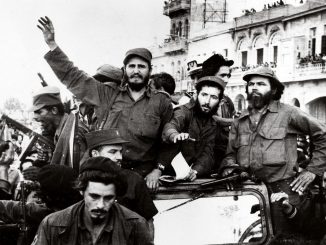
Twenty thousand Cubans were murdered by the U.S.-backed dictator Fulgencio Batista in the 1950s. Cuban revolutionaries, led by Fidel Castro, overthrew Batista in a guerrilla war.

The Cuban Revolution has been able to march forward since 1959 despite being just 90 miles from the United States. The first reason is the courage of the Cuban people and the leadership of Cuba’s Communist Party.

Cuba was also helped by the rising struggles of Black people in the United States. Even the Pentagon brass worried that if they invaded Cuba, Black troops might rebel.

The solidarity of socialist Cuba includes giving asylum to Assata Shakur and many other Black revolutionaries. Malcolm X met with Fidel Castro in 1960 at the Hotel Theresa in Harlem.

Haiti deserves reparations and a new revolution. Both Haiti and Cuba have done so much for workers and oppressed peoples around the world.

U.S. hands off Haiti and Cuba!

Strugglelalucha256


Answering U.S. media lies about Cuba

In the wake of U.S. sabotage of the Cuban economy and efforts by the CIA’s National Endowment for Democracy (NED) to build counter-revolutionary sentiment, the anti-imperialist and socialist movement needs to be strong and united, and not be weakened by the web of lies being spun by U.S. media and politicians.

Many corporate media aligned with the Democratic Party did “fact-checking” to support their own imperialist and disingenuous narrative during the torrent of lies that emanated from the Trump administration on many issues. To many, they seemed momentarily to be the defenders of democracy and truth.

Now the curtain is lifted. There is not a shade of difference between the two capitalist parties in their vicious attacks on — and lies about — Cuba. It is up to working-class activists and Cuba’s supporters to do the real fact-checking.

Fact: The U.S. trade embargo is causing all of the hardship in Cuba.

Six decades ago, as soon as it was clear that Cuba was beginning the process of building socialism, the U.S. imposed sanctions. Initially all but food and medicine were blocked, and at times over the years, food and medicine were also formally included.

Over the decades, adjustments have been made that sometimes brought some relief from the terrible impact of the blockade. But overall, the restrictions have been tightened. The Torricelli Act of 1992, the Helms-Burton Act of 1996, and most recently Donald Trump’s addition of 243 additional sanctions, have all been big escalations that added to Cuba’s difficulties conducting trade.

When U.S. business journals deny that the embargo is a total blockade, they are only technically right. Yes, Cuba is able to trade on the global market to a limited extent. But even U.S. allies are punished for doing any business with Cuba, and the effects are even worse than the laws dictate. The sanctions definitely impact the importation of food, medicine and medical supplies, and more.

A 1997 study by the American Association for World Health (AAWH) and a 1996 article in The Lancet showed that even though the Torricelli Act “was amended to allow … food and medicines into the country, … the act’s enforcement significantly restricted the accessibility of both within Cuba.”

Trade sanctions as a favored weapon of U.S. imperialism were in a sense outed by Henry Kissinger’s call to “make the economy scream” to bring down Chilean President Salvador Allende in the early 1970s. But over a decade earlier, Roy Rubottom, a U.S. State Department official during the Eisenhower administration, issued a memorandum recommending “the denial of money and supplies to Cuba …to bring about hunger, desperation and overthrow the government.”

Since then, every U.S. president has tried to make this vile vision a reality — and failed. But the embargo has caused terrible suffering and hardship for 11 million Cuban people.

  • The U.S. media has nearly unanimously portrayed the July 2021 riots as “grassroots” and “spontaneous” protests.

Fact: The website for the National Endowment for Democracy, a CIA front, reveals how it spent several million dollars in its latest budget to fund various groups operating inside Cuba – all part of a multi-pronged strategy to try to fracture Cuba’s socialist solidarity.

As the effects of the U.S. blockade deepened the hardship of the pandemic, and the shortages of food and medicine in Cuba worsened, a clandestine digital attack from operatives in Miami started to take shape. Twitter bots responded to every post that expressed anything about the hardships by prodding posters to link up with “SOS Cuba,” the chosen CIA vehicle for this latest attempt at regime change.

During the second week of July, Twitter accounts were overwhelmed with messages aimed at turning legitimate dissatisfaction caused by the embargo into counterrevolutionary sentiment and violent demonstrations. The July 11 protests that the media claims took place in 40 places across the island were the result of a methodical — and well-funded — campaign by U.S. intelligence agencies.

  • Hyperbolic charges that Cuban people have been detained, tortured and disappeared have permeated the airwaves and print media in the U.S.

Fact: What actually happened in Cuba were arrests in response to violent attacks on Cuban police, acts of arson and vandalism. Detainees were charged and will have trials, and some have already been released. No one in Cuba was “disappeared.”

The term ‘disappeared’ originated in reference to a particular episode in history and became part of anti-imperialist terminology. It refers to Argentina’s 1970s “Dirty War,” when the brutal U.S.-backed right-wing dictatorship hunted down and abducted 30,000 socialist and progressive activists who were never heard from again. Over the years, evidence made clear that many victims were thrown into the ocean from helicopters.

Peddlers of counterrevolutionary anti-Cuba hatred now want to hijack the term. But since the end of the U.S.-backed Batista government, no one in Cuba has been “disappeared.” The only torture that takes place in Cuba is at Guantanamo, the tip of the island illegally held by the U.S. military, where waterboarding and other methods of torture took place in the aftermath of the 9/11 attack on the World Trade Center, and where some prisoners are still unlawfully detained 20 years later.

The response to this U.S. attempt to breed chaos and overturn the Cuban people’s revolution has also been falsely compared to the racist repression of Black Lives Matter protests in the U.S.

Cuba has accomplished amazing things in spite of six decades of U.S. aggression. From the early days of the Cuban Revolution, it became clear that literacy, health care, international solidarity and elimination of poverty were the priorities of Cuba’s leadership and the Cuban people.

In a blatant and current example of how the U.S. is preventing progress, consider the COVID-19 pandemic. Cuba’s five vaccines can help to inoculate not only its own population, but much of Latin America and Africa. That is the stated intent of Cuba’s medical and scientific professionals. But the blockade prevents the import of basic materials and medical supplies that are needed to make this mission a reality.

Instead of being able to trade on the world market, Cuba’s success may depend on efforts by the organization Global Health Partners. The group has sent six million badly-needed syringes to help Cuba meet its goal and is fundraising to send more. Readers can donate to the campaign by visiting the Syringes for Cuba website.

Further solidarity is needed in the form of street actions, education and all manner of fighting back against Joe Biden’s continuation and worsening of the embargo and other forms of counter-revolutionary aggression.

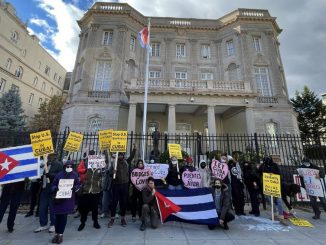
A series of monthly car caravans during 2021 in as many as 50 cities internationally has pushed for an end to the blockade. During July, a group of Cuban Americans opposed to the blockade walked from Miami to Washington, D.C., as a way to publicize their opposition, and were greeted by hundreds of Cuba supporters at the White House on July 25.

All out to defend Cuba and turn back U.S. attacks!

Strugglelalucha256


A response to anti-Cuba attacks made by U.S. ‘socialist’ group

The Freedom Socialist Party statement, “FSP demands an end to the U.S. blockade and intervention against Cuba while supporting the right of Cubans to protest for survival needs,” is beyond irresponsible. If you need information that proves that what the U.S. is saying about repression occurring in Cuba is false, there is plenty to be had.

The Cuban government has said that there are some who are protesting as a result of the shortages (which are solely due to the U.S. blockade) and have legitimate concerns. The response to the protests of 1,000 people July 11 has been unprecedented in terms of dialogue with the protesters and lack of militarized or judicial response.

Your statement overall, although more sophisticated than the first version (now removed from your website), uses reports that have been contradicted with evidence showing them as outright lies or missing essential information for proper context — but the choice is made to believe the narrative that fits your conjecture about the Cuban leadership’s supposed opportunism, corruption and “top down approach,” which so conveniently dovetails with U.S. imperialist propaganda.

Cuba’s exemplary achievements against COVID-19 are also ignored. In spite of the lack of resources due to the U.S. blockade, Cuba developed effective treatments to prevent much of the spread of the virus, in addition to coming up with its own vaccines and sending doctors throughout Africa, Latin America and Europe to help those most vulnerable fight the virus. Cuba has carried out this international solidarity and exemplary work to minimize deaths from the virus despite the essential resources — like energy needed for electricity production, drug supplies and other vital resources — that were sacrificed to do this. This is not even mentioned.

Cuba, a country the same size as Los Angeles County, has a little over 2,000 deaths from COVID-19, while Los Angeles now has nearly 25,000 — and LA, like the U.S., has far more resources than Cuba since it hasn’t been under a crushing blockade for 60 years and derives its wealth from the misery of other nations.

And you ignore the over 100,000 Cubans who came out in support of the socialist government on July 17 — since that also undermines your narrative, which attempts to legitimize the lie that those who are protesting the Cuban government are possibly a majority in Cuba.

Your article spits in the face of the Cuban nurses, doctors, scientists and other health workers who literally sacrifice their lives under unbearable conditions in heroic work against the pandemic. You choose to ignore their labor and the socialist government’s superior handling of the crisis despite having little to work with. Instead, your statement gives the impression that the Cuban government is to blame for the pandemic’s effects on Cuba.

You ignore the articles even from capitalist sources, like the Reuters piece “Fake news muddies online waters during Cuba protests,” admitting that many of the videos and photos of mass protests were fake or misattributed. Your organization arrogantly ignores the research of many progressive Cuban Americans, Cuba solidarity activists and organizations that have traveled to Cuba, and the information provided by the National Network On Cuba.

Just because something is claimed doesn’t make allegations against Cuba or Venezuela or Syria or the Democratic People’s Republic of Korea or any target of U.S. imperialism necessarily true — you have to dig deeper and you especially shouldn’t encourage the primary and immediate justifications for military action against Cuba. That’s what this statement and your first on this crisis are doing, no question about it.

The evidence does not justify your opinions. As Marxists, as social scientists, we have to use evidence, not just go with the waves of imperialist propaganda that may seem easier to swim with.

This is not to say that the Freedom Socialist Party has not done important work in other areas of the struggle. It has and that is understood. That’s why this stand is so disappointing. Regretfully, since this position was made publicly and assists the furthering of U.S. war using sanctions and regime change tactics, it must be publicly addressed.

The fact remains that supporting the false ideological justifications for imperialist intervention in Cuba plays a reactionary, not progressive, role.

John Parker, Socialist Unity Party, Los Angeles

Strugglelalucha256


July 26th became a movement: The Cuban masses make history

Today the Moncada Barracks in Santiago de Cuba is a museum and a school—fitting, given the Cuban Revolution’s well-known commitment to education. But this was the site of a battle that radically altered the course of history on the island.

In the early morning hours of July 26, 1953, an “army” consisting of approximately 120 rebels (including two women, Melba Hernández and Haydée Santamaría) attacked the Fort Moncada Barracks, beginning the revolutionary process that would create the Cuba of today.

This group of young revolutionaries had begun organizing only a year before, meeting in an apartment in Havana. Among them was Fidel Castro, who was only 26 when those meetings began; he was barely out of law school.

Their beginnings were as humble as their goals were ambitious. They wanted to oust the U.S.-backed dictator, Fulgencio Batista, and usher in a new era of democracy and people-centered development.

At the time of the Moncada attack, a simple accounting exercise might have suggested that the revolutionaries’ prospects were not great. They had already failed to bring down Batista through legal agitation, and militarily they were vastly outnumbered. Some sources claim there were up to 1,000 soldiers quartering in Moncada alone. Batista’s military was supplied by the United States government.

In fact, even the revolutionaries’ immediate aim of capturing supplies was only partly successful. And in the aftermath, Batista’s police and military forces lashed out with unprecedented fury. They fired at civilians in the streets, adults and children included. Civil rights were suspended. Revolutionaries were arrested, executed and tortured.

Nevertheless, the regime had been exposed, and the masses were activated. By 1959 Batista would be out and the revolutionaries would be in power.

Oppression breeds resistance

Cuba is a rich, fertile land that came under Spanish colonial control beginning in the 1500s. On behalf of the rising capitalist class in Europe, the colonial forces committed genocide against the Indigenous peoples, such as the Taíno and Guanahatabey, and forced enslaved Africans to toil on plantations.

The colonial society was as rotten as that of the U.S. South. Slavery was not abolished in Cuba until 1886, 21 years after the end of the U.S. Civil War.

Oppression breeds resistance. A wave of slave rebellions swept the island in the 1840s. One of the most famous insurrectionists was Carlota Lucumí, a Yoruba woman who led an uprising at the Triumvirato sugar mill.

Later in the 19th century, Cuban people were inflamed by the revolutionary writings of José Martí, who—like Carlota Lucumí—is celebrated in Cuba to this day. They fought the Spanish from 1868-1878, from 1879-1880, and from 1895-1898. Independence came in 1902.

Unfortunately, the U.S. imperialists were against Cuban independence. U.S. military occupation began during the conflicts with Spain because the long-term goal was to make Cuba a U.S. colony.

These imperial ambitions were not secret. Speaking in New Orleans in 1858, Senator Stephen A. Douglas said, “It is our destiny to have Cuba and it is folly to debate the question.”

Meanwhile, the U.S. capitalists were buying up the sugarcane and tobacco farms along with mining properties on the island (iron ore, manganese, and nickel). The imperialists forced the Platt Amendment into the Cuban constitution, making subordination official. The Cubans had run the Spanish out, but Wall Street came in.

Batista’s Cuba of the 1950s was, unsurprisingly, a nightmare for the great majority; he was Washington’s hand-picked stooge. The capital city of Havana was a playground for the world’s rich.

Countrywide, per capita income was half that of Mississippi, the poorest state in the U.S. The average Cuban was living on 312 pesos or $6 per week. Few rural areas had schools, and children often died early from infectious disease. Most workers were employed on the huge farms and were out of work—suffering from malnutrition and other plights—during the off season.

This was not a situation that could be tolerated. As Fidel Castro said while standing trial following the Moncada attack, “The future of the country and the solution of its problems cannot continue to depend on the selfish interests of a dozen financiers, nor on the cold calculations of profits that ten or twelve magnates draw up in their air-conditioned offices.”

Zig-zags of the revolution

The revolutionaries were forced into retreat after the events of 1953. Principal leaders like Fidel and Raúl Castro spent time in prison.

To some, this may have looked like the end, but the arc from then until the seizure of power in 1959 was one of deepening the revolution by building among the masses.

There was no straight path to victory, and no shortcuts, but victory would come.

The revolutionaries traveled the Western Hemisphere raising funds. They regrouped in Mexico and underwent serious military training (along with Argentinian Che Guevara) under 63-year-old Colonel Alberto Bayo, who had fought the fascists during the Spanish Civil War.

They made blunders, as when they nearly drowned at sea and failed to successfully carry out a campaign when returning to Cuba from Mexico.

Regardless, throughout various phases of the revolutionary process, they communicated with the people via radio broadcasts. Resistance to Batista increased throughout the population.

Sympathizers distributed radical literature, despite censorship. Workers identifying with the movement carried out strikes in urban areas. Meanwhile, the ranks of the rebel army swelled, primarily with farm laborers. July 26th had truly become a movement, incorporating the broad, democratic forces of the society and giving those forces direction.

Writing in 1994, U.S. Marxist leader Sam Marcy observed: “The Cuban Revolution came after the Great October Socialist Revolution in Russia and the revolutions in China, Vietnam and Korea. The industrial development of Cuba was greatly advanced compared to some of the other areas of Latin America, despite the constraints imposed by the imperialist control of ownership—and the poverty and underdevelopment of much of the countryside […]

“It’s important to note that before the rise of the 26th of July Movement that launched the revolutionary struggle for power, Cuba had for many years had a strong Communist Party and trade unions that survived years of repression. […] Objective and subjective conditions in Cuba had matured to the point where a strong Communist Party was possible.”

Indeed, in its archives, U.S. State Department writers soberly note: “In 1958, the labor movement was a powerful force in Cuban society. […] Almost all sectors of the economy were organized, with union members reaching nearly one million or one in five workers.”

The objective and subjective groundwork for revolution had been laid over a long period of time. Part of the July 26th Movement’s success lay in the fact that it was able to creatively fuse with these existing forces (who had their own internal dynamics and zig-zagging development) while bringing new people into struggle.

Thus, the 1959 victory was not merely a military one, and it certainly was not a coup d’état. The July 26th organization effectively built a peoples’ army that acted in concert with the broad masses. This explains why the Cuban Revolution was so profound, and has lasted to the present.

Cuba and the global class struggle

Because the Cuban Revolution occurred after the October Revolution of 1917—and because it was based on the masses—it could only succeed by building socialism.

The new government was led by a Communist Party that resulted from the fusion of forces that occurred during the fight for power. They swept away the existing state machinery. They dissolved the old military and replaced it with a revolutionary army. They did away with the big landowners, capitalists, and foreign domination, to boot. They gave land to the farmers.

They set up popular Committees in Defense of the Revolution. They advanced the interests of women and LGBTQ2S people. They routed the racist structures rooted in the colonial past. They sent fighters to aid in the anti-colonial struggles throughout Africa, Asia and Latin America.

Cuba may be a small country, but its revolution has had global effects. The revolution has to weaken links in the chain of world imperialism.

None of this was easy. The U.S. attempted an invasion in 1961, and has used economic strangulation to try to kill the revolution ever since. The tactics have changed from administration to administration, but the goal is still to recolonize Cuba on behalf of the capitalists.

None of this has worked. Cuba remains a bulwark of socialism, despite being forced to make some concessions to capitalist markets in the long period of world revolutionary retreat, especially given the fallout from the counterrevolution in the USSR.

Cuba is a beacon for oppressed and exploited people. Cuba’s medical internationalism during the COVID-19 pandemic has demonstrated an entirely different model of global development than the one pursued by the U.S. and its lackey states.

Cuba has survived and remained independent, 90 miles south of Florida. For all these and other reasons, we can conclude that the spirit of July 26 lives on.

And as the crises of capitalism worsen and increasing numbers of working class and oppressed people here in the belly of the beast turn to socialism, we can look to Cuba for revolutionary solidarity, as countless movements have done since 1959.

Strugglelalucha256


Cuba: We are going to put heart into the common work!

Early on the morning of July 17, more than 100,000 people gathered at the Havana seawall to reaffirm their commitment to an independent, socialist Cuba. Actions in defense of the Cuban Revolution also took place in cities and towns across the island. 

Speech delivered by Miguel Mario Díaz-Canel Bermúdez, First Secretary of the Communist Party of Cuba Central Committee and President of the Republic, during the revolutionary reaffirmation event, held on the Piragua esplanade, Havana, July 17, 2021, Year 63 of the Revolution.

Dear Army General Raúl Castro Ruz, leader of the Cuban Revolution;

People of Cuba, Cuban men and women;

Compatriots:

Long live free Cuba! (Exclamations of: Viva!)

Free from foreign interference and free from the hatred incited by those who for 60 years have attempted to asphyxiate the nation and provoke a social explosion, and now presenting themselves as our saviors.

Stop the lies, the infamy and the hatred. Cuba is absolutely allergic to hatred, and it will never be a land of hate!

Nothing good can be built with hate. Hatred robs us of time to love and of love itself, if we let it in, as a reaction to the hatred of our adversaries.

We have experienced it during these days of hate inundating us on social networks, not-so “social” networks, with which parents and children have kept company throughout these long months of pandemic, to the point that many spend more time connected to the internet than their families; that family, which, with unity, can be invulnerable to anything that threatens.

A mother was telling me yesterday that her teenage daughter had asked, with tears in her eyes, if this was Cuba, when she saw the images of violent acts shared by some friends on Facebook.

The owners of these networks, the dictators with their algorithms, as a recent documentary denounces, have opened the floodgates of their powerful platforms to hate, without a minimum of ethical control.

This is hatred that divides families, friends, society, and threatens to sweep many of our values into the corner of the useless.

The images bombarding us with violence, blood, protests, shouting, vandalism, threats, harassment and repression have continued without pause over the last six days.

During previous weeks, an intense political-communications operation was mounted by an articulated platform of media poison, financed by the U.S. government and by the state of Florida’s political machinery.

Its objective was to encourage disturbances and instability in the country, taking advantage of the difficult conditions caused by the pandemic, the tightened blockade and the Trump administration’s 243 additional measures.

During those days, acts of unconventional warfare were committed, including calls for a social explosion, violence, aggression against police agents, vandalism and sabotage.

To accomplish this, they used artificial intelligence and Big Data systems, cyber-troops and cyber-terrorism to promote the fabrication of homemade weapons and incendiary devices, harassing speech, coercion and financing of digital “leaders” and international influencers.

This was facilitated by the complicity of a powerful transnational that allowed their own regulations to be violated with impunity, disregarding the legitimate complaints of users and some press media and cable agencies.

Cyber warfare

Cuban television has made the objectives of this campaign abundantly clear by reconstructing the sequence of events that occurred last Sunday.

First the protests were called, then a false account of the events was constructed to generate emotional reactions of solidarity with the demonstrators, and then the vandalism was unleashed, which occurred hours before our improvised appearance on television, after returning from San Antonio de los Baños.

The route of this outrage is clear. After the fact, the events were presented out of order, as if they were the result of our legitimate call for revolutionaries to defend the Revolution.

An attempt was made to tell the story backward. What I may have said didn’t matter; the calls for unity, peace and solidarity made by many do not count. The ill-intentioned interpretation is that a civil war was called.

We can take apart the so-called fake news, expose the lies, show how a completely false reality of Cuba was fabricated on virtual platforms, but they have already caused immeasurable damage to the national soul, which has among its most sacred values citizen tranquility, coexistence, solidarity and unity.

We are under fire from sophisticated cyber-warfare that includes cyber-terrorism and media terrorism in its aggressive toolkit.

The denunciations made by Cuba’s Foreign Minister last Tuesday (July 13) have not been answered. There has not been even an attempted response by authorities of the Republican government in Florida, regarding funds allocated to these projects, with which they intend to attack our country and, at the same time, disarm us of any possible means of defense.

Not only the Foreign Ministry, but also the websites of the Presidency, the popular news and analysis portal covering Cuba’s reality Cubadebate, Granma, Juventud Rebelde and practically all Cuban public media are suffering intermittent attacks with denial of services in the midst of an atrocious campaign to demonize the government.

They are trying to silence any alternative to the anti-Cuban narrative that today is displayed on alarmist front pages. Friends of Cuba, who know and suffer the manipulation and the silence, are unable to access Cuban media and have sent us reports of access denial.

Taking the lies to new heights, false images are used, already well-documented by our journalists, inciting and glorifying contempt of authority and destruction of property, encouraging assaults and threatening harassment of citizens and families.

Right now, what the world is seeing of Cuba is a lie: an entire people rising up against the government and a government repressing its people.

It is not strange that, under such a media barrage, some doubt and make statements assuming division that does not exist.

I do not judge, I do not condemn. I understand that the adversary’s weapons are overwhelming. But on the side of the people, with the people and for the people, the Revolution continues to stand! (Applause and exclamations of: Long live the Revolution! Long live Diaz-Canel! Long live the people! Down with the Yankees! Down with the blockade!)

Not with statements, but with deeds. As the #SOSMatanzas hashtag was fading in cyberspace, the promoters of a humanitarian intervention were nowhere to be seen, on the side of Matanzas and all of Cuba. The same noble, solid people were still present, suffering the consequences of the blockade, and the Cuban government was there.

Hospital children’s ward attacked

Who was not shocked to learn that vandals of the worst kind had stoned the children’s ward of the Cárdenas hospital, forcing children and mothers to seek refuge in the bathrooms or under beds at the institution?

Over the days to come, many personal stories must be told about the popular reaction to the attacks and harassment; about how much the forces of order were obliged to restrain themselves, given the care required of them to avoid excesses. But make no mistake: the majority of the people, the same people exhausted and irritated by the shortages, who demand better government management, also demand an end to violence. (Applause and exclamations of: Long live our doctors!)

No lie has emerged by chance or because of a mistake. Everything is coldly calculated according to the unconventional warfare manual. The indecent representative of the Organization of American States (OAS), the Ministry of Colonies, which we are honored to not be a part of, has already spoken.

We are not speculating. Some speak so that others may issue statements later. There it is, lying in wait, the hard right wing of the U.S. Congress, sharpening its teeth and demanding that its political adversaries in the current administration take action against Cuba, convene the United Nations Security Council, warning that any attempt of massive emigration to its shores constitutes a hostile act and a threat to the sacrosanct National Security of the empire.

None of this is new. They have tried it before. It is their way of putting the adversary administration against the ropes, and attempting to force them to achieve the never-met objective of wiping off the map the bad example of this small Island, determined to remain sovereign and independent, when so many others bow down to their orders. (Applause and exclamations of: Let those born and those to be born know, we were born to win and not to be defeated!)

Almost along with our mother’s milk, our parents instilled in us Marti’s alert: “Men go in two camps: those who love and create, and those who hate and destroy,” the Apostle told us.

Cuba will continue creating!  Cuba is doing so right now, with the first two vaccines in Latin America: Abdala and Soberana. (Applause and exclamations of: Long live Cuban medicine! Viva!”) She is doing so with another piece of news that the malicious want to hide: the one-hundred-percent efficacy in preventing serious symptoms or death, shown in the third phase of Abdala’s clinical trials. (Applause and exclamations of: Viva!)

When a people has come so far in the realization of its dreams and in the conquest of rights, which for half the planet are only a pipedream, neither violence nor fear can stop them.

None of this that we denounce today excuses us from the obligation to conduct self-criticism, complete pending rectifications, reconsider thoroughly our methods and styles of work that clash with the will to serve the people, due to the bureaucracy, the obstacles and the insensitivity of some that is so damaging.

Today I come to reiterate the commitment to work for and demand the fulfillment of the program we have given ourselves as a government and as a people, reviewed in light of possible mistakes committed during these years of intense pressure, particularly the last two.

Denounce blockade, aggression and terror

Compatriots:

We are not gathering here this morning on a capricious whim, in the midst of a complex epidemiological situation. Respecting sanitary measures and physical distancing as much as possible, we have called you here to denounce once again the blockade, the aggression and the terror. We could not delay this meeting; the enemy has once again launched an all-out attack to destroy the sacred unity and tranquility of our citizens.

We reaffirm that Cuba belongs to all! (Applause and exclamations of: Long live Cuba! Long live Cubans!” Long live unity! Long live Raúl! Long live Díaz-Canel!) We will triumph!

I am sharing with you sentiments and reflections, emotions, disposition and convictions. (Applause and exclamations of: (Ready) for whatever, Díaz-Canel, for whatever!)

We can only have more if we create more. We will achieve what we set out to do by pushing the work forward together. We have the immense example of Cuban science, which proposed and achieved in record time, and with hardly any resources, two vaccines and other candidate vaccines that allow us to face the future with hopes that other peoples do not have.

If we have been able to do something so huge and difficult, what can we not do in other areas?

And, above all, how much more can we do if we articulate pending dialogues, recover social work, promote greater attention to vulnerable sectors, to neighborhoods, supported by the experience of the work bequeathed to us by the Comandante en Jefe, in years as challenging as these; this is what Gerardo called for.

The Cuban Revolution erased forever the seeds of evil, hatred, dishonor and crime. It is important, therefore, that we seek the deep causes of the violence that is boiling below the surface, given the unmet needs, and complete the pending task of ensuring that the gene of the brave, the honest, the just, the honorable, the joyful children of this Cuban land prevails in Cuba’s heritage (Applause and exclamations of: Down with the blockade! Down with imperialist aggression!)

“Only love turns mud into a miracle / Only love illuminates that which endures,” we have sung a thousand times with Silvio, evoking Martí.

We are going to put heart into the common work, a heart as big as our difficulties! Together we can! (Applause and exclamations of: Together we can, together we can, together we can, together we can!)

Long live sovereign, independent and socialist Cuba! (Exclamations of: Viva!)

Cuba of love, Cuba of peace, Cuba of unity, Cuba of solidarity! (Exclamations of: Viva!) Cuba for all Cubans, who, wherever they are, work to see her advance on our own legs, with our own arms. Toward a destiny of prosperity, which is possible! (Exclamations of: Viva!)

Put some heart into Cuba! Heart to the homeland, to the Revolution, to socialism!

We will win! (Exclamations of: We will win, we will win, we will win! Together we can, together we can!)

Source: Granma English


Strugglelalucha256


Los Angeles: Groups protest U.S. intervention in Cuba and Haiti

Los Angeles — An emergency protest by progressive organizations was held July 17 in solidarity with the people of Haiti and Cuba. The rally demanded that the U.S. end its attacks, sabotage and internal subversion in Cuba and Haiti, including an immediate end to the blockade of Cuba and no U.S. troops to Haiti. 

The rally was co-sponsored by the Harriet Tubman Center for Social Justice, American Indian Movement SoCal and Unión del Barrio.

“We’re sending a clear message to President Biden, who has continued and in some cases escalated the attacks against Cuba and Haiti,” said Anthony Dawahare of the Harriet Tubman Center. 

“From the 60-year-old blockade that has denied Cuba basic necessities, to continual military interventions that have devastated the Haitian economy, we are demanding the U.S. end its attacks on their right to self-determination.” 

“We don’t need a country that kills Black and Brown people in the streets telling Cuba how to handle its affairs or intervening in their country,” said Rebecka Jackson from the Harriet Tubman Center, who MC’d the rally. “The U.S. has a long history of sabotaging Cuba’s economy, and that economic blockade is condemned by the world. 

“The U.S. uses its intelligence agencies and vast amounts of money to take advantage of the hardships the blockade creates to manufacture internal divisions. That is well-documented,” Jackson stated. 

Ron Gochez of Unión del Barrio gave an impassioned speech about the importance of defending Cuba and its solidarity with the world’s workers and oppressed peoples: “We support the Cuban government, we support the revolution, we support socialism, because we know that it’s not socialism that’s causing the poverty in Cuba — it’s the blockade.

“For those of us who know a little bit of history, we know what the Cuban Revolution has meant for Africa and the liberation struggles there. We know what Cuba has meant for all of Nuestra America and the many revolutions that have happened across the continent,” explained Gochez.

“We know the solidarity of Cuban doctors, sent all over the world to heal people for free. We know what Cuba is about and we are not going to let the mainstream media lie about it and say that there’s a ‘revolution’ happening in Cuba. I’ve got news for them, it already happened; it happened in 1959.”

Defending rally from fascists 

There was a disturbance during Gochez’s talk which briefly interrupted the rally. Unbeknownst to the organizers and activists, the Proud Boys had called a fascist demonstration one block away at a spa that refused to turn away transgender customers. 

Many Proud Boys passed through the Cuba-Haiti action and participants naturally assumed they had come to violently stop the rally. Most of them kept walking down the block to their own event. However, during the entire rally, the anti-intervention protest was threatened by some members of the Proud Boys, who were then firmly encouraged to leave, and did. 

Organizers of the Cuba action found out the next day that the Proud Boys’ demonstration was met by a counter-protest of progressive activists. The counter-protesters were targeted by the Los Angeles Police Department. Some were shot at with rubber bullets and some were arrested. 

As of this writing, there is no evidence of any Proud Boys being shot at or arrested, even though some were armed with rifles and bats, or wore bullet proof vests and helmets. 

In spite of the actions of the police and Proud Boys, the program of those who supported Cuba and the Haitian people continued. Other speakers represented Code Pink: Women for Peace, Anti-Racist Action, BAYAN USA, the U.S. Hands of Cuba Committee and the Internationalist Group. Walter Lippmann of the Cuba News Service also spoke. 

Jefferson Azevedo of the Socialist Unity Party drew the connection between the attacks on the Cuban Revolution and the long history of U.S. intervention against Haiti, ever since the Haitian people had the audacity to free themselves with the first successful slave revolution in 1804. 

Despite several U.S. military interventions, the Haitian people refuse to give up their right to self-determination, which includes today’s demand for no U.S. troops in Haiti.


Strugglelalucha256


Cuba’s freedom and Assata Shakur’s

For all of those saying that Cuba is not free, consider the freedom of our sister and former Black Panther Assata Shakur, who, like many other Black liberation fighter, was framed for murder in a blatantly racist and unfair trial. 

Her freedom today would not be possible if not for the solidarity and principled leadership of the Cuban Communist Party and the revolutionary people who make up the great majority in Cuba. They gave our sister asylum. 

If not for Cuba, Assata would instead be dead (the U.S. currently has a $2 million bounty on her head, dead or alive) or among the ranks of over 2 million incarcerated people in the U.S. The U.S. has the largest jailed population in the world; by far the largest in actual number and percentage of population, predominantly Black, Brown and other oppressed people.  

So for those people who live in the U.S. and continue to lie about Cuba, we say enjoy your “freedom” and your ignorance and we’ll enjoy wishing our free sister Assata a very happy belated birthday. (She was born on July 16.)

Strugglelalucha256


Defending Cuba in New York City

Two hundred people came to Manhattan’s Union Square on July 15 to defend the Cuban Revolution. They rejected the lies of the big business media that’s attacking socialist Cuba.


The rally was called by the Young Communist League and supported by many different organizations. Among them were the New York-New Jersey Cuba Sí Coalition; the December 12th Movement; the Interreligious Foundation for Community Organization (IFCO): Venceremos Brigade, The People’s Forum; and the Samidoun Palestinian Prisoner Solidarity Network.


Chants of “Cuba sí, bloqueo no!” filled the park. A contingent of Brazilians came to support Cuba.


Everyone pointed to the 62-year-long criminal blockade of Cuba by the U.S. as the source of the socialist country’s shortages. They denounced any intervention in Cuba or Haiti.


Justine Medina, co-chair of New York’s Young Communist League, described how her parents emigrated from Cuba. She said they’re not socialists but they are against the U.S. blockade of Cuba. 


Maicol Lynch and Cameron Orr also spoke from the YCL. Lynch denounced the U.S. economic sanctions on Iran, Syria, Venezuela and Zimbabwe. Like the sanctions on Cuba, they are cruel and inhuman.

Gail Walker, executive director of the Interreligious Foundation for Community Organization (IFCO), spoke. She and her late father, the Rev. Lucius Walker, have broken the blockade many times with the Pastors for Peace caravans.

 “When Africa called, Cuba answered,” was a chant started by members of the December 12th Movement. Thousands of Cuban soldiers gave their lives alongside their African comrades in helping to defeat the Nazi armies of apartheid South Africa.

 Manolo De Los Santos, co-executive director of The People’s Forum, raised the campaign to donate syringes to Cuba. Although Cuba has developed its own effective vaccines against the coronavirus, the country is short of syringes.  All the more reason to stop the blockade.  

Monica Cruz from the Party for Socialism and Liberation refuted many of the media lies about Cuba. The TV networks don’t tell their viewers that infant mortality rates in socialist Cuba are lower than in the capitalist U.S.

 Poor and working people in the United States are also hurt by the blockade of Cuba. Two former co-workers of this writer died of meningitis.  

Thirty years ago Cuban scientists developed a vaccine against meningitis. But it’s not allowed to be used in the U.S. because of the blockade.

 Listen up, Joe Biden: Hands off Cuba! Stop the blockade!

Strugglelalucha256
https://www.struggle-la-lucha.org/cuba/page/28/