Report from Havana: Despite U.S. blockade, Cuba has 90% vaccinated, opens to world visitors

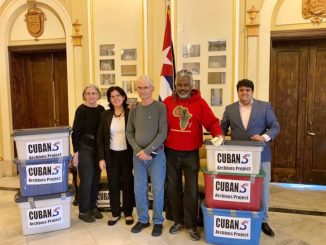
Struggle-La-Lucha reporters Sharon Black, Russell McClain and Lars Bertling in Havana. SLL photos.

Lars Bertling, Russell McClain and Sharon Black, three reporters for Struggle-La Lucha, members of the Socialist Unity Party, and representatives of the Baltimore Peoples Power Assembly are participating in the 31st U.S.-Cuba IFCO-Pastors for Peace Friendshipment Caravan..

Havana, Nov. 16 — It was an all day ordeal on Monday, Nov. 15, on the U.S. side. We waited in grueling airport security lines and spent hours checking in. Two of our representatives barely got their passports. We had to get up at 5 a.m. and drive to the passport office in Miami and keep our fingers crossed.

But when we got to Cuba it was all worth it.

On landing our spirits soared and our energy returned. Cuban people and their leaders were waiting at the airport, along with a bevy of news media. Our group was literally the first delegation to travel to the newly opened Cuba, which had been closed to international visitors because of the pandemic. Nov. 15 was the opening of schools and services in Cuba and is also a day celebrating the anniversary of Havana.

When we got to the Cuban Martin Luther King Center (yes, there is such a thing) young Cuban singers and musicians greeted us along with local Marianao community and political leaders and representatives of the MLK Center . 

Today, Tuesday, was our first whole day of learning and visiting. Our entire group was large, over 70 people, so we split up.

Russell McClain and Gail Walker discuss the display of the CIA biological war on Cuba.

Memorial de la Denuncia

Most people living in the U.S. only equate terrorism with the 9/11 attacks. It’s a sad hypocrisy.  Far more Cuban people, many who are young children, have died in terrorist attacks. Only, these attacks were perpetrated by the Pentagon, CIA, the right wing, and U.S. imperialism.

This state-of-the art, modern museum documents those countless attacks.

The entrance has a revolving, updated count of the number of people who have lost their lives to terrorism. This does not cover those impacted by the blockade but strictly through bombings and violent acts of terrorism. Today the count is 3,476.

There were 637 (known) attempts to assassinate Fidel; 21 CIA air raids; 11 CIA bombings; and 581 terrorist attacks aimed at Cuban missions overseas. 

A special film documents the March 4, 1960, bombing of the French freighter La Coubre in the Havana port and the loss of 110 lives. Fidel and Che lead the massive street marches to honor those who lost their lives and to defy U.S. imperialism. The families of the victims still mourn their loss.

Terrorist and CIA agent Luis Posada and his accomplices, who were all sheltered in the U.S., bragged of the cowardly bombing of Cubana Flight 455 on Oct. 6, 1976, killing all 73 passengers, many Cuban children and all 24 members of a youth sports team that had just won every gold medal in the Central American and Caribbean Championships. 

There seemed to be no end to the U.S. war on Cuba: from Operation Peter Pan that kidnapped 14,000 Cuban children over a two-year span from 1960 to 1963 and later in 2000, the kidnapping of Elián González. The U.S. also carried out biological warfare against Cuba, including the destruction of the pig industry and the sabotage of agricultural crops.

These are just a few examples. 

The Memorial will grip your heart and change your view on who the real terrorists are. 

Cuban guides at the Memorial de la Denuncia discuss the museum that documents the 3,478 people who have died as a result of U.S. Pentagon, CIA and rightwing. The crosses in the background of this modern Memorial represent lost lives.

Finlay Vaccine Institute

Our next stop was the Vaccine Institute which helped produce three Cuban COVID-19 vaccines: Soberana, Soberana 2 and Soberana Plus. 

So many things stood out in the discussion and presentation by the representatives of the institute.

Under the most difficult conditions due to the blockade, Cuba was able to produce these three highly effective vaccines, rivaling the effectiveness of U.S. vaccines. The blockade had prevented Cuba from importing the reagents necessary for the production of the vaccine. And international patent restrictions blocked Cuban scientists from sharing important information. 

In addition, it was nearly the first time that Cuba had to produce a vaccine aimed at a virus (not a bacterial infection) and they were able to do it in a very short time. So you might consider it a miracle.

So how did they do it?

One of the major reasons given was the cooperation between Cuban organizations, the lack of competition and personal profit. In fact, these were some of the same reasons, along with a few others, for the high vaccination rate in Cuba that has now reached an astounding 90% of the population. 

At this moment children under 2 years of age are not being vaccinated, so given that 90% includes all the population, the percentage of vaccinations among those who are eligible is even higher.

The people of Cuba trust the vaccines because the country has a long history of preventative health care that is steeped in education and community implementation. There is no profit requirement to block health care in Cuba. 

Strugglelalucha256


Women’s Int’l Federation: End the U.S. blockade against Cuba! #NoMasBloqueo

Pronouncement

Havana, Nov. 11 — The Regional Office of the Federación Democrática Internacional de Mujeres / Women’s International Democratic Federation (FDIM) for the Americas and the Caribbean, together with the 68 national women’s organizations affiliated and associated with FDIM in this area, whose work it coordinates on behalf of the Federation of Cuban Women (FMC), expresses its unconditional support for the firm proposals made by the Minister of Foreign Affairs of Cuba, Bruno Rodríguez Parrilla, before the diplomatic corps accredited to Cuba on 10 November, by exposing the new undisguised and abominable warp of the government of the United States and other influential figures in that nation … with its despicable 29 declarations, applicable around November 15, aimed at trying to show Cuba as a failed state, and to do so, to try to subvert the constitutional order, alter the citizen’s tranquility, and damage peace in Cuba, with actions that provoke instability and violence, which include pressures and threats to governments of other countries and diplomats accredited in Cuba to carry out actions requested by the United States to achieve their goals.

All this, while the committed, capable and reliable authorities of Cuba, together with their people of women, men and brave young people,  laborious, and courageous, among which the scientific community stands out, have engaged and achieved worthily, the almost absolute control of the devastating COVID-19 pandemic, and its effects in all spheres of life of the country, through the mass vaccination of 75% of the adult population with drugs manufactured in Cuba, proven by the relevant authorities, and have won for the country the first place to begin vaccinating its children aged 2 to 18, with the express consent of the beneficiaries.

At the same time, the country has provided the assistance of its doctors and other health workers to more than 40 nations in the world to save human lives, with proven success, in addition to having already shared significant quantities of these vaccines with several countries.

However, in the face of so much evidence of the protection of life as the main human right of individuals, among other fundamental rights reliably protected by Cuban society throughout its more than 60 years of existence, the United States government, frustrated champion of respect for human rights in the world, and its hypocritical allies in the region, only manage to seek the intensification of the economic, commercial and financial blockade against our country, with increasing unilateral coercive measures, at all costs…

That is why the FDIM Regional Office for the Americas and the Caribbean calls on women’s organizations in the Americas and the Caribbean, and throughout the world, as well as international public opinion, to speak out against this new, brutal and infamous outrage against Cuba with strong solidarity actions that demonstrate recognition of Cuba’s efforts and resistance to the frequent and unsuccessful onslaught of the imperialist power against this enterprising country.  We also urge them to remain alert to the actions of the counter-revolution in the countries, which are being unscrupulously demanded by the current U.S. government and its acolytes, and financed with U.S. taxpayers’ money.

Have no doubts, just as the “Historical Leader of the Cuban Revolution, Commander in Chief Fidel Castro Ruz, spent immortality convinced that “the Cuban people will win”, the current Maximum Leadership, Continuity of the Revolution, and the people all, their women, men and young people will remain faithful to that Legacy, and to the Values inculcated by Che “Hasta la Victoria Siempre”.

#CubaVive

We will resist and we will conquer!

Regional Office of the Federación Democrática Internacional de Mujeres / Women’s International Democratic Federation (FDIM) for the Americas and the Caribbean

Women In Struggle – Mujeres En Lucha (U.S.) is a member organization of the FDIM.

Strugglelalucha256


Federación Democrática Internacional de Mujeres: ¡Alto al bloqueo contra Cuba! #NoMasBloqueo

Pronunciamiento

La Habana, 11 de Noviembre — La Oficina Regional de la Federación Democrática Internacional de Mujeres (FDIM) para América y el Caribe, junto, a las 68 organizaciones nacionales de mujeres afiliadas y asociadas de la FDIM en esta Área, cuyo trabajo coordina en representación de la Federación de Mujeres Cubanas (FMC), expresa su incondicional respaldo a los firmes planteamientos del Ministro de Relaciones Exteriores de Cuba, Bruno Rodríguez Parrilla, ante el cuerpo diplomático acreditado en Cuba el pasado 10 de noviembre, al poner al descubierto la nueva, desembozada y abominable urdimbre injerencista del gobierno de los Estados Unidos y otras figuras influyentes en esa nación… con sus despreciables 29 declaraciones, aplicables hacia el 15 de noviembre próximo, encaminadas a tratar de mostrar a Cuba como un estado fallido, y para ello, tratar de subvertir el orden constitucional, alterar la tranquilidad ciudadana, y dañar la paz en Cuba, con acciones que provoquen inestabilidad y violencia, las cuales incluyen presiones y amenazas a gobiernos de otros países y a diplomáticos acreditados en Cuba para que realicen acciones solicitadas por Estado Unidos para lograr sus fines.   

Todo ello, mientras las comprometidas, capaces y confiables autoridades de Cuba, junto a su pueblo de mujeres, hombres y jóvenes aguerridos,  laboriosos, y valientes, entre los que  destaca la comunidad científica, se han enfrascado y logrado dignamente, el control casi absoluto de la devastadora pandemia de la COVID-19, y sus efectos en todas las esferas de la vida del país, mediante la vacunación masiva del 75% de la población adulta con fármacos fabricados en Cuba, de eficacia probada por las autoridades correspondientes, y han conquistado para el país el primer lugar en comenzar a vacunar a sus niños de entre 2 y 18 años, con el consentimiento expreso de los beneficiarios. 

Al mismo tiempo, el país ha hecho efectiva la asistencia de sus médicos y demás trabajadores de la salud a más de 40 naciones del mundo para salvar vidas humanas, con probados resultados satisfactorios, además de haber compartido ya con varios países cantidades apreciables de las referidas vacunas.

Sin embargo, ante tantas evidencias de protección de la vida como principal derecho humano de las personas, entre otros derechos fundamentales  fehacientemente protegidos por la sociedad cubana a lo largo de sus más de 60 años de existencia, el gobierno de Estados Unidos, frustrado paladín del respeto a los derechos humanos en el mundo, y sus hipócritas aliados en la región, solo atinan a procurar el recrudecimiento del bloqueo económico, comercial y financiero contra nuestro país, con crecientes medidas coercitivas unilaterales, a toda costa…   

Es por todo ello que la Oficina Regional de la FDIM para América y el Caribe llama a las organizaciones de mujeres en América y el Caribe, y en todo en mundo, así como a la opinión pública internacional, a pronunciarse contra este nuevo, brutal e infame atropello contra Cuba con enérgicas acciones de solidaridad que demuestren el reconocimiento de los esfuerzos y la resistencia de Cuba ante las frecuentes y fracasadas embestidas de la potencia imperialista hacia este emprendedor país.  Asimismo, les instamos a mantenerse alertas ante las acciones de la contrarrevolución en los países, que están siendo inescrupulosamente demandadas  por el actual el gobierno de Estados Unidos y sus acólitos, y financiadas con el dinero de los contribuyentes norteamericanos.

No tengan dudas, tal y como el “Líder Histórico de la Revolución Cubana, Comandante en Jefe Fidel Castro Ruz, pasó la inmortalidad convencido de que “el pueblo cubano vencerá”, la Máxima Dirección actual, Continuidad de la Revolución, y el pueblo todo, sus mujeres, hombres y jóvenes nos mantendremos fieles a ese Legado, y a los Valores inculcados por el Che “Hasta la Victoria Siempre”.    

#CubaVive

Resistiremos y Venceremos

Oficina de Regional FDIM (Federación Democrática Internacional de Mujeres)Para América y el Caribe

Women In Struggle-Mujeres En Lucha (EE.UU.) es una organización miembro de la FDIM.

Strugglelalucha256


Stop the U.S. economic war on Cuba! End the U.S. blockade now!

To the Honorable President Miguel Diaz-Canal and the Government of the Cuban People:

The Socialist Unity Party, based in the United States, sends our deepest solidarity to the Cuban people and renews our commitment to ending the criminal U.S. blockade that seeks to strangle the Cuban people in an effort to dismember, control and create chaos.

Cuba has remained a beacon of hope for people around the world who cherish peace and justice.  The perseverance and spirit of the Cuban people and it’s government continues to shine bright.

For those of us living in the Belly of the Beast, the U.S. blockade is a cruel reminder that our government does not want us to see the gains of Cuba, including free medical care, education and social programs, that have been stripped in the United States.

There are no words to describe what Cuba means and symbolizes for us.  It shows that another world is possible.

We will not rest until the U.S. war on Cuba is ended.

The Pentagon and the wealthy corporate rulers in the United States would like to plunder and exploit Cuba again.  This is not possible.  We pledge that we will join the Cuban people in saying no!  End the U.S. blockade now.

Socialist Unity Party, USA
John Parker and Sharon Black, West Coast and East Coast coordinators

Strugglelalucha256


Cuba defends socialism in peace, says President Diaz-Canel

Havana, November 14 (RHC)– President Miguel Díaz-Canel affirmed Sunday that Cuba is perfecting its society in peace, defending socialism and emancipation.

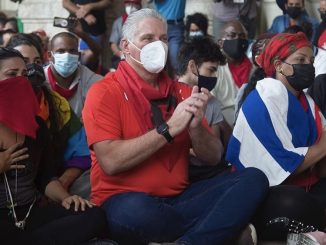
He made those statements while accompanying young people in an anti-imperialist sit-in in Havana’s Central Park.

“I am very grateful to be able to spend this Sunday with you,” said the president to representatives of the Cuban civil society who since last Friday and until Sunday have been holding concerts, poetry readings, speeches, documentary screenings, and book presentations.

The head of state stressed that the Caribbean island condemns the campaigns to subvert the internal order and the economic, commercial, and financial blockade imposed by the United States. “Cuba is going to live in peace, and living in peace, we are going to perfect ourselves,” he ratified.

Díaz-Canel participated in the Sit-in of the Red Neckerchiefs initiative, which opposes the unconventional warfare practices against the Caribbean nation.

In the voices of those present, phrases such as ‘The homeland is not alone’ and ‘Put your heart into Cuba’ greeted the president, who also listened to songs by Cuban troubadour Tony Avila.

Students, workers, homemakers, and members of the LGBTIQ+ community participated in the anti-imperialist sit-in to voice their

support of the emancipation struggles and the commitment of its members to perfectible socialism.

At the same time, Cuba is receiving the support of supportive friends and Cubans living in more than 80 cities around the world, who are celebrating the country’s return to normality tomorrow, Monday, after months of the COVID-19 pandemic.

Source: Radio Habana Cuba

Strugglelalucha256


Why is the U.S. fueling the November 15 Cuba protests?

On September 20, letters began to arrive at eight Cuban municipal or provincial government headquarters announcing the holding of “peaceful” marches on November 15 by a group called Archipiélago. The motivation for these marches was a call for change. The letter was not a formal request to occupy the busiest streets of some cities in Cuba, but rather a notification by the group that they would do so and they also demanded that the authorities provide them with security for these marches. By virtue of Cuban laws and obsessive American support for the marches, the Cuban government denied permission for holding the protests.

Almost two months have passed since these letters were sent, but there are few indications that the march will take place in Cuba. Florida’s propaganda machine assures the opposite and adds that similar marches will take place across more than a hundred cities in the world, a third of them in the United States.

On November 10, Cuban Foreign Minister Bruno Rodríguez warned the diplomatic corps accredited in Havana that the Cuban government “will not tolerate an opposition march” and further said that “Cuba will never allow actions of a foreign government in our territory, trying to destabilize the country,” while referring to the U.S.’s support of these marches. The provocation follows the plot seen many times before. Meanwhile, this march, which has been scheduled for November 15, is not what many hope it will be: a movement for change in Cuba.

The march is not autonomous

Two days after the delivery of the first letter to the authorities, a string of statements by the U.S. officials and members of Congress began pouring in on September 22. Until November 10, there had been several public interventions from Washington or Florida with all kinds of demands and threats to the island’s authorities. No other issue in the U.S. domestic politics, in recent weeks, has received so much attention or been the case of such obsession before these marches.

The spokesman for the U.S. State Department Ned Price issued a statement on October 16 condemning the denial of permission by the Cuban government to hold the march. Meanwhile, U.S. Senator Marco Rubio (R-FL) extended his support for these anti-government protests soon after the news about these marches began circulating, while a couple of top advisers from the Biden administration have threatened more sanctions on the Cuban government for denying permission to hold the march on November 15.

As if that were not enough, more money has been raining in for such efforts against the Cuban government. In September 2021, the Biden administration gave almost 7 million dollars to 12 organizations that almost daily publicize the “civic march for change” in Cuba. Many analysts see the hidden hand of the “color revolutions” in this, which were exported by the West to the Russian periphery.

In addition to “moral,” political and financial support, the U.S. diplomats offer support in many ways to the anti-government movement in Cuba and occasionally serve as chauffeurs to the opposition. The only thing missing in terms of interference is a show like that of the U.S. Under Secretary of State Victoria Nuland, who distributed food to anti-government protesters in Independence Square, in the capital of Ukraine, Kiev, in 2013.

The march is not disconnected from other processes

The march is just another episode in a more comprehensive strategy. The Biden administration has interpreted the combined effect of the pandemic, the global crisis and the economic blockade—plus the 243 additional measures imposed by the former U.S. President Donald Trump—as exceptional conditions that have hit Cuba even harder. No spies are required to realize that there are more queues, inflation and shortages in a country that has been managing shortages for 60 years, but it is also important to understand that the march does not have popular support within the country. Cuba is returning to normalcy with the opening of flights, families reuniting after being separated for two years, the return of students to schools and the revival of the national economy.

The group organizing the march is not peaceful

The private Facebook group listed as the march organizer, Archipiélago, is anything but moderate. A large number of publications by the group support symbolic violence and political disqualification of those who defend the socialist project or celebrate some social achievements in Cuba. The debate in these spaces is not to modify opinions, but to stir up prejudices, instill hatred among Cubans as an exclusive source of legitimacy for a government that has led the country under very difficult conditions.

The repertoire is an unbridled McCarthyism and an inordinate impulse to indulge in stigmatization that are very common communicative practices in the current political climate of the United States, but alien to the political, cultural and idiosyncratic character of Cubans. Cuba’s Foreign Minister Bruno Rodríguez, on November 10, assured that Facebook could be sued for supporting the “dissident movement “ in Cuba, according to Reuters.

The marches are not synchronous

There is talk of the synchronization of the marches inside and outside of Cuba to promote change. But there is no such thing. In Cuba, there is definitely no atmosphere to support these marches, while the organizers of Florida speak of the participation of people from a hundred cities in the world on November 15, they have not specified the number of people who will do so.

In reality, those willing to participate in this type of anti-Castro chaos are usually few, but that does not matter. On April 30, 2020, an individual opened fire at the Cuban Embassy in Washington with an assault weapon, which led to the recalling of the foreign minister. On the night of July 27, two individuals threw a Molotov cocktail at the Cuban Embassy in Paris.

It’s not what they say

The conservative ghost of the far-right that travels the world and arrives in Cuba is not what it seems or what is visible to the naked eye. Behind the “non-violent march” mantra is the long shadow of the life-long reactionaries who now combine economic ultra-liberalism, conservative morality, empty concepts, and creative use of social media. They dream of ending the Cuban Revolution no later than November 15, while leaving a moral question unanswered: How is it possible to talk of a civil, peaceful and independent protest, if Washington is lubricating the route plan of the protest with threats and dollars?

This article was produced by Globetrotter. Rosa Miriam Elizalde is a Cuban journalist and founder of the site Cubadebate. She is vice president of both the Union of Cuban Journalists (UPEC) and the Latin American Federation of Journalists (FELAP). She has written and co-written several books including Jineteros en la Habana and Our Chavez. She has received the Juan Gualberto Gómez National Prize for Journalism on multiple occasions for her outstanding work. She is currently a weekly columnist for La Jornada of Mexico City.

Strugglelalucha256


Cuba: Nothing will tarnish our celebration

Havana — Cuba is getting ready to make a transition toward normalcy after more than one year of struggle against the pandemic. On Monday, thousands of children from first to fifth grade will return to classrooms as the country’s borders will be open to receive international travelers and all Cubans who have been unable to return home due to international health restrictions.

November 15 will be a symbolic day; the country will gradually begin the reactivation of its economy, battered by the impact of the COVID-19 and the blockade imposed by the United States on the island for almost 60 years. On the 15th, we will also celebrate that these two realities were successfully overcome, thanks to the diligence of the Cuban authorities and the people’s capacity to make the impossible possible.

However, Washington, the right-wing in the region, the international media emporiums, and a small opposition group on the island, which calls itself Archipelago in social networks, insist on turning this date into a day of protest, hatred, and fear. It is no coincidence that these reactionaries and their masters chose this date because they would like nothing better than to sabotage the launching of our recovery that is based on hard work, patriotism and humanism.

“They seek to spoil our party, but they will not succeed. Nothing will take away Cuba’s enthusiasm after a year of achievements and challenges,” Cuban Foreign Minister Bruno Rodriguez Parrilla told a group of diplomats and the press accredited on the island on Wednesday.

“The constant attempts to generate destabilization conditions in the country have worsened in recent months. But we will not allow organized aggression from abroad to spoil our people’s joyful moment,” the minister added.

There is no doubt about who is orchestrating this operation, which involves U.S. high-ranking officials, lawmakers, and senators who feel an unjustified hatred against Cuba and its people. The attempt at this type of destabilization has had irreparable consequences in other countries.

No one I know supports the day of protests that the Archipelago insists on holding on Monday, even when the Cuban authorities did not authorize it. My closest friends, neighbors, and the people I hear talking on the street are afraid to even go out on the street that day, lest they be branded as government opponents. Much less will they hang white sheets on their balconies, nor will they wear white t-shirts on November 15.

The “powerful communicational machinery,” as Rodriguez called the destabilizing attempts that seek to turn a non-existent scenario into a supposed reality, has not managed to permeate the Cuban population, as they want to make it seem.

“You can walk through our streets, and you will see the joy of Cubans at this moment when our country is opening up to world travelers and a new year is approaching,” the minister said to the diplomats gathered at the Havana Convention Palace on Wednesday.

“The US government knows perfectly well that its campaigns try to provoke suffering, a suffering that causes the so-called social explosion,” Rodriguez clarified and said that this attitude violates our sovereignty and seeks to force a change of regime by strictly political decisions.

The script followed by Washington is not new. Sixty years have shown that this policy is destined to fail.

“The obstinate desire to see the end of the Revolution founded by Fidel will never come true. They need to wake up from that dream. It is not going to happen. Nothing is going to tarnish our celebration,” Cuban President Miguel Diaz-Canel reaffirmed.

Source: Resumen Latinoamericano – English

Strugglelalucha256


Letter to the international community: End the blockade and the destabilizing actions against Cuba

Letter signed by hundreds of world leaders and personalities in solidarity with the Cuban people and government up against the full-fledged destabilization attempts planned for November 15.

The United States has maintained a blockade against Cuba for more than sixty years. Since the nineties of the last century, Washington issued a series of laws that tightened it even more, trying to close off possibilities for the purchase of food, seeking to crush its people by hunger.

Donald Trump’s government alone issued 243 measures that affect Cuba’s economy much more, many of them during the Covid-19 pandemic. They are still in effect under the Joe Biden administration.

The objective has not changed: to suffocate the Cuban economy and cause suffering to its population so that it revolts against the revolutionary government.

Washington has arrogantly disregarded the annual condemnation of the United Nations General Assembly, which demands an end to this inhumane procedure.

At the same time, for decades the US government has been investing millions of dollars in the creation of “dissidents”, of “opponents”, of all kinds, irrelevant inside Cuba but extolled by the international press with the purpose of damaging the image of the revolution and thus justifying the application of the criminal blockade.

With this, it also seeks the isolation of Cuba, one of the main objectives being that the European Union should break off relations with Cuba.

Without hiding it, it allocates millions of dollars to promote internal subversion, calling for civil disobedience, anarchy and chaos, with the sole purpose of putting an end to the current political system and installing one that only responds to its interests.

Washington cares nothing about the immense scientific achievements of the revolution which, among other things, will make Cuba the first country in the world to have its entire population vaccinated against Covid-19 in a few weeks, and with its own vaccines. Although Washington went to great lengths to prevent Cuba from acquiring even syringes with which to administer the vaccines.

Washington, in addition to counting on the complicity of the great corporate press, also relies on individuals who, mainly from Florida, set up campaigns calling for violent protests in the streets in order to overthrow the government.

Inside the country, individuals who feel supported and protected by Washington, using as a banner the difficult economic situation due to the blockade (a situation that is exacerbated by Covid, as in all other nations), call for subversive demonstrations. They do so regardless of the laws in force which prohibit

any attack on the political system in force, as is logical political system in force, as is logical in all the states of the world. And even more so when it is incited by a foreign power.

We, the undersigned, once again call upon the government of the United States to cease the inhumane blockade against Cuba, and to stop its attempts to destabilize a nation that at no time has carried out actions against its security; much less has it interfered in its internal affairs, nor has it called upon the U.S. citizenry to subvert the Cuban government.

U.S. citizens to subvert the established order, in spite of the multiple and serious internal social problems of this world power.

On the initiative of Ignacio Ramonet, journalist, Spain; Hernando Calvo Ospina, writer, France; Atilio Borón, sociologist, Argentina and Fernando Buen Abad, philosopher, Mexico,

We the under signed :

Dilma Roussef, former president of Brazil.

Rafael Correa, former president of Ecuador.

José Manuel Zelaya, former president of Honduras.

Ernesto Samper Pizano, former president of Colombia.

Adolfo Pérez Esquivel, Nobel Peace Prize, Argentina.

Martín Almada, Alternative Nobel Prize, Paraguay.

Pablo González Casanova, UNESCO Prize, Mexico.

Alfred de Zayas, UN independent expert, USA.

Jean Ziegler, former Special Rapporteur, UN, Switzerland.

César Luis Menotti, former coach of Argentina’s national soccer team.

Monsignor Jacques Gaillot, France.

Leonardo Boff, liberation theologian, Brazil.

Marcelo Barros, Benedictine monk, Brazil.

Heinz Bierbaum, member of the European Parliament, president of the Party of the European Left,Germany.

Maite Mola, MEP, vice-president of the Party of the European Left, Spain.

European Left Party, Spain.

Manu Pineda, MEP, Spain.

Yeidckol Polevnsky, Chamber of Deputies, Mexico.

Héctor Díaz-Polanco, Deputy, Mexico City, Mexico.

Bert Anciaux, Senator, Belgium.

Carlo Sommaruga, Senator, Switzerland.

María de Lourdes Santiago, senator, Puerto Rico.

François-Michel Lambert, deputy, France.

André Chassaigne, deputy, France.

Miguel Mejía, minister, Dominican Republic.

Juan E. Romero, deputy, National Assembly, Venezuela.

Michele de Col, Councilman of Venice, Italy.

Dmitrij Palagi, Councilman of Florence, Italy.

Thanasis Petrakos, Regional Councilor, Greece.

José Agualsaca, Legislator, Ecuador.

Costas Isychos, former Alternate Minister of Defense, former MP, Greece.

Dimitris Stratoulis, former MP, former minister, Greece.

Nandia Valavani, former Deputy Minister of Finance and former MP, Greece.

Olivio Dutra, former minister, Brazil.

Paulo Vanucchi, former minister, Brazil.

Juan Ramón Quintana, former minister, Bolivia.

Paolo Ferrero, former minister, Italy.

Ricardo Patiño, former minister, Ecuador.

Galo Chiriboga, former prosecutor, Ecuador.

Gabriela Rivadeneira, former president of the National Assembly, Ecuador.

Piedad Córdoba, former senator, Colombia.

Giovanni Russo Spena, former senator, Italy.

Leonardo Caponi, former senator, Italy.

Eleonora Forenza, former Member of the European Parliament, Italy.

Juliana Isabel Marino, former ambassador, Argentina.

Rosa Rinaldi, former vice-president, Province of Rome, Italy.

Blanca Flor Bonilla, former congresswoman, El Salvador.

Kenarik Boujikian, former TJ-SP judge, Brazil.

Carlos Viteri, former congressman, Ecuador.

Fidel Narváez, diplomat, Ecuador.

Juan Carlos Monedero, Podemos Party, Spain.

Joao Pedro Stedile, Landless Movement, Brazil.

Tania Díaz González, Deputy and Vice-President of Communication of the PSUV, Venezuela.

Mauricio Acerbo, National Secretary of the Communist Refoundation, Italy.

Marco Consolo, International Relations, Communist Refoundation, Italy,

Andrea Ferroni, national coordinator Communist Youth, Italy.

Izquierda Unida, Spain.

Communist Party of Spain.

Communist Party of the Peoples of Spain.

Communist Party of Spain (m-l).

Ruben Suarez Ciria, Frente Amplio, Uruguay.

Lois López Leoira, Anti-imperialist International of the Peoples,

Ana Valentino, Movimiento Octubres, Argentina.

Manuel Bertoldi, Frente Patria Grande, Argentina.

Franco Zunino, President ARCI, Savona, Italy.

José Escoda, Frente Socialista, Puerto Rico.

Oscar Bonilla, Acción Política, Ecuador.

Cristian Armando, Fundación Sueños Colectivos, Argentina.

Ricardo Ulcuango, Indigenous leader, Ecuador.

Kanelis Giorgos, Deputy Secretary, Kalamata Labor Center, Greece.

Pratis Dimitris, DOY Mesinias Union, Greece.

Fernando Cardozo, CTA Autónoma, Argentina.

Mariano Ciafardini, Solidarity Party, Argentina.

Chico Buarque, musician, Brazil.

Willie Toledo, actor, Spain.

Norman Briski, actor, Argentina.

Chabela Rodríguez, singer, Puerto Rico.

Daniel Devita, musician, Argentina.

Chico Diaz, actor, Brazil.

Takis Vamvakidis, actor, Greece.

Pierre Carles, filmmaker, France.

Adorno Martín, film director, Argentina.

Tania Hermida, filmmaker, Ecuador.

Ricardo Kiko Cerone, theater director, Argentina.

Enrique Dacal, theater director, Argentina.

Jorge Falcone, documentary filmmaker, Argentina.

Paula Ferré, troubadour. Argentina.

Fabián Bertero, musician, Argentina.

Facundo Jofre, troubadour, Argentina.

Solimar Ortíz Jusino, poet, Puerto Rico.

William Pérez Vega, Poetas en Marcha, Puerto Rico.

Juan Camacho, poet, Puerto Rico.

Francis Combes, poet, France.

Raúl Zurita, poet, Chile.

Jaime Svart, poet, Chile/Greece.

Mauricio Vidales, poet, Colombia.

Manuel Santos Iñurrieta, playwright, Argentina.

Cachito Vera, cultural manager, Ecuador.

Pablo Guayasamin, cultural manager, Ecuador.

Techi Cusmanich, cultural manager, Paraguay.

Javier Etayo, humorist, Basque Country.

Pilar Bustos, artist, Ecuador.

María Centeno, artist, Venezuela.

Martha Moreleon, artist, Mexico/Greece.

Pavel Eguez, painter, Ecuador.

Ilonka Vargas, artist, Ecuador.

Loukia Konstantinou, Cultural Center “Our America,” Greece.

Fernando Morais, writer, Brazil.

Frei Betto, writer, Brazil.

Luis Britto García, writer, Venezuela.

Michel Collon, writer, Belgium.

Panagiotis Maniatis, writer, Greece.

Argentina Chiriboga, writer, Ecuador.

Vicente Battista, writer, Argentina.

Τasos Kantaras, writer, Greece.

Galo Mora, writer, Ecuador.

José Regato, writer, Ecuador.

Jenny Londoño, writer, Ecuador.

Patricia Villegas, President Telesur, Venezuela.

Wafi Ibrahim, journalist, Lebanon.

Manuel Cabieses, journalist, Chile.

Stella Calloni, journalist, Argentina.

Mario Silva, journalist, Venezuela.

Gustavo Veiga, journalist, Argentina.

Maxime Vivas, journalist, France.

Cathy Dos Santos, journalist, France.

Pascual Serrano, journalist. Spain.

Geraldina Colotti, journalist, Italy.

Orlando Pérez, journalist, Ecuador.

Carlos Aznárez, journalist, Argentina.

Ivano Iogna Prat, journalist, Luxembourg.

Mery Kampouraki, journalist, Greece.

Maria Kaliva, journalist, Greece.

Daniele Biacchessi, journalist, Italy.

Juan Carlos Espinal, journalist, Dominican Republic.

Ascanio Bernardeschi, journalist, Italy.

Kintto Lucas, journalist, Ecuador.

Telma Luzzani, journalist, Argentina.

José Manzaneda, Cuba Información, Spain.

Jorge Elbaum, journalist, Argentina.

Fabrizio Casari, journalist, Italy.

Sandra Russo, journalist, Argentina.

Omar Ospina, journalist, Ecuador.

Sally Burch, journalist, Ecuador.

Xavier Lasso, journalist, Ecuador.

Elaine Tavares, journalist, Brazil.

Mabel Elina Cury, journalist, Argentina.

Horacio Finoli, journalist, Argentina.

Patricia Latour, journalist, France.

Fernando Arellano Ortiz, journalist, Colombia.

Vaquelis Gonatas, Red Solid@ria, Greece.

Beinusz Smukler, American Association of Jurists, USA.

Carol Proner, jurist, Brazil.

Eduardo “Tuto” Villanueva, lawyer, Puerto Rico.

Wilma Reverón Collazo, lawyer, Puerto Rico.

Paul-Emile Dupret, lawyer, Belgium.

Carmen Diniz, lawyer, Brazil.

Yiannis Rachiotis, lawyer, Greece.

Geovy Jaramillo, lawyer, Ecuador.

Gianluca Schiavon, lawyer, Italy.

Héctor Ortega, lawyer, Spain.

Karla Díaz Martínez, lawyer, Chile.

Glenna Cabello, political scientist, Venezuela.

Gianni Vattimo, philosopher, Italy.

Graciela Ramirez, activist, Argentina.

Alicia Jrapko, activist, United States

Bill Hackwell, activist, United States

Milagros Rivera, social leader, Puerto Rico.

Irene León, sociologist, Ecuador.

Paul Estrade, professor, France.

Paula Klachko, sociologist, Argentina.

Arantxa Tirado, political scientist, Spain.

Pasquale Voza, professor, Italy.

Angelo Baracca, professor, Italy.

Francisco Sierra Caballero, professor, Spain.

Ana Esther Ceceña, professor, Mexico.

Waldir Rampinelli, Professor, Brazil.

Nildo Domingos, professor, Brazil.

Emilio H. Taddei, Professor, Argentina.

Ioannis Kouzis, Professor, Greece.

Juan Torres López, professor, Spain.

Andrea Vento, Professor, Italy.

Themis Tzimas , professor, Greece.

Dimitris Katsonis, professor, Greece.

Gonzalo Perera, mathematician, Uruguay.

Rosella Franconi, biotechnologist, Italy.

Fabrizio Chiodo, scientist, Italy.

Clóvis Cavalcanti, ecological economist, Brazil.

Rosella Franconi, researcher, Italy.

Gilberto López y Rivas, anthropologist, Mexico.

Alicia Castellanos, anthropologist, Mexico.

Tiziano Tussi, CESPI Scientific Committee, Italy.

Giovanna Di Matteo, geographer, Italy.

Luis E. Wainer, sociologist, Argentina.

David Chávez, sociologist, Ecuador.

Juan Paz y Miño, historian, Ecuador.

Eirini Nedelkou, architect, Greece.

Mario Della Rocca, researcher, Argentina.

Erika Silva, sociologist, Ecuador.

Julio Peña y Lillo, sociologist, Ecuador.

María Fernanda Barreto, researcher, Venezuela.

Nelson Rolim de Moura, editor, Brazil.

Pedro Páez, economist, Ecuador.

Miguel Ruiz, economist, Ecuador.

Ricardo Sánchez, economist, Ecuador.

Melania Mora, economist, Ecuador.

Cristian Orosco, economist, Ecuador.

Mario Ramos, sociologist, Ecuador.

Alessandro Fanetti, researcher, Italy.

Rafael Quintero, sociologist, Ecuador.

Movimiento Estatal de Solidaridad con Cuba, Spain.

MediCuba, Spain.

Sodepaz, Spain.

Samuel Wanitsch, coordination Switzerland-Cuba Association.

Marco Papacci, president Italy-Cuba Association.

Didier Philippe, President of the France-Cuba Association.

Victor Fernández, President Cuba Cooperación, France.

Didier Lalande, president Cuba Linda Association, France.

Charly Bouhana, president Asociación Cuba Sí Francia.

Roberto Casella, Circulo Granma Italy-Cuba.

Anna Serena Bartolucci, president AsiCuba, Italy.

Source: Network in Defense of Humanity / Resumen

Strugglelalucha256


The U.S. has an unhealthy obsession with Cuba

The piggy bank was rattled again. In September 2021, the United States Agency for International Development (USAID) gave $6,669,000 in grants for projects aimed at “regime change” in Cuba, a euphemism to avoid saying “direct intervention by a foreign power.” The United States’ current Democratic administration has especially favored the International Republican Institute (IRI) with a bipartisan generosity that Donald Trump never had. Other groups in Miami, Washington and Madrid that have also received generous amounts have been among those calling for an invasion of the island. These groups paint an apocalyptic panorama in Havana to secure greater funding next year.

Public funding for the anti-Castro industry in the United States seems inexhaustible. In the last year, at least 54 organizations have benefited from the State Department, the National Endowment for Democracy (NED) and USAID programs for Cuba. In the last 20 years, this agency has given Creative Associates International, a CIA front, more than $1.8 billion for espionage, propaganda and the recruitment of agents of “change” including on the island. One of its best-known projects, the so-called “Cuban Twitter” or ZunZuneo, resulted in a superb failure that unveiled a plot of corruption and flagrant violations of U.S. law. ZunZuneo cost the USAID director his job, but Creative Associates International continues to operate, only now undercover.

The American researcher Tracey Eaton, who for years has followed the route of these funds, commented in a recent interview that many of the financing programs for “regime change” in Cuba are so stealthy that we will probably never know who all the recipients are or what the total amount is, and judging by the known millions, the subsidy must reach an even greater figure. According to letters from the State Department and USAID that Eaton has received, “democracy-building” strategies are considered “trade secrets” and are exempt from disclosure under the U.S. Freedom of Information Act.

The United States goes berserk at the alleged hint of Russian, Chinese or Islamic intrusion into local politics and online platforms. However, it does not hesitate for a minute to rudely intervene in Cuba, as exposed by the digital daily MintPress News, which documented how private Facebook groups instigated the July 11 riots in several Cuban cities. “The involvement of foreign nationals in the domestic affairs of Cuba is on a level that can scarcely be conceived of in the United States,” says the publication, adding: “the people who sparked the July 11 protests in Cuba are planning similar actions for October and November.”

The United States is a military superpower whose plans for political subversion are a shame and a scandal, and there is no indication that Washington will now achieve what it has failed to do in 60 years. In fact, the U.S. government’s obsession with Cuba is two centuries old, as Louis A. Pérez, a historian at the University of North Carolina at Chapel Hill, has shown in a brilliant essay entitled “Cuba as an Obsessive Compulsive Disorder.”

“The subject of Cuba has rarely been a topic of reasoned disquisition. It defies facile explanation, and certainly cannot be understood solely—or even principally—within the logic of the policy calculus that otherwise serves to inform U.S. foreign relations, mostly because it is not logical,” writes the historian.

What does make sense is the permanence in time of Cuban “intransigence.” Ernesto Che Guevara used to repeat in his speeches in the first years of the 1959 revolution that “Cuba will not be another Guatemala.” In other words, its independence from the U.S. empire could not be boycotted with media bombings first, induced mobilizations and military attacks later.

The custom of overthrowing independent alternatives is so long and the arrogance by an overwhelming military and media force is so blind that the U.S. government has not been able to foresee its continuous defeats nor has it overcome the trauma of having a rebellious island “almost within sight of our shores,” as John Quincy Adams put it, and to top it all, without the slightest interest in being “the state that we lack between the entrance to the Gulf and the exit of the vast Mississippi Valley.”

The great truth of all this, as Louis A. Pérez wisely comments, is that Cubans have learned from history, but Washington has not.

This article was produced by Globetrotter. Rosa Miriam Elizalde is a Cuban journalist and founder of the site Cubadebate. She is vice president of both the Union of Cuban Journalists (UPEC) and the Latin American Federation of Journalists (FELAP). She has written and co-written several books including Jineteros en la Habana and Our Chavez. She has received the Juan Gualberto Gómez National Prize for Journalism on multiple occasions for her outstanding work. She is currently a weekly columnist for La Jornada of Mexico City.


Strugglelalucha256


Cuba and China strengthen ties through the Belt and Road strategy

Cuba it should be remembered was the first Latin American country to establish diplomatic relations with China back in 1960. Sixty-one years after that union, both nations continue to collaborate with each other in the fight against hegemonism and unilateralism, the use of force, and violation of international laws.

Today, the two countries have a new reason for rapprochement; the Chinese project of the Belt and Road, which once again unites the island with the Asian giant, this time to further strengthen trade ties and boost the economic development of the Greater Antilles.

“This is the initiative of the future. It has great prospects, not only for Cuba but for all the countries that are part of it,” the island’s Vice President of the Council of State Gladys Bejerano said as early as 2019 when the Cuban government was amid dialogues for its incorporation into the Chinese initiative.

And the official was not wrong. This week, two years later, the island’s Ministry of Foreign Affairs announced Cuba’s insertion into the Energy Alliance, one of the initiatives promoted by the Belt and Road that seeks to build an international mega-platform for cooperation and exchanges under the principle of mutual gain.

“This new platform promoted by China will expand and diversify energy cooperation and help to overcome global energy challenges,” Cuba’s ambassador to Beijing Carlos Pereira assured.

So dreamed President Miguel Díaz-Canel during his visit to China in November 2018, when Cuba signed a Memorandum of Understanding for the cooperation within the framework of the Silk Road Economic Belt and 21st Century Maritime Silk Road initiative.

The project, which circumvents distances and brings cultures closer, allows peoples from both nations to interconnect and help each other achieve mutual development in an environment away from the neo liberal and aggressive policy of the United States.

Cuba-China cooperation with has been historically based on commercial reciprocity and respect in its political and commercial relations. This is a new step, the most important one, as it includes local development and greater efforts to achieve a sustainable and environmentally friendly future.

“Thanks to the Belt and Road, we will promote green energy and inclusive access to energy services,” Pereira explained, adding that the island is one of the 29 nations that make up the project.

From Havana, Cuban Minister of Energy Liván Arronte stressed that the country’s arrival in the alliance occurred at a crucial moment for the island, besieged for almost six decades by the draconian economic blockade, which intensified amid the COVID-19 pandemic.

“At a time when the United States is trying to isolate Cuba from the rest of the world, there are projects such as the Belt and Road showing us that the island is not alone, that our local development is not a chimera, and that we can move forward without harming the environment,” Arronte explained.

The essence of this development shows that mutually beneficial projects hold the possibility of a future world made up of interconnecting countries built on trust and cooperation.  The people of the world have had to suffer way too long from the devastation of the neo liberal model that operates with one country hording and gaining in wealth and domination while other countries get pushed into ever deeper poverty and submission.

Source: Resumen Latinoamericano – English

Strugglelalucha256
https://www.struggle-la-lucha.org/cuba/page/26/