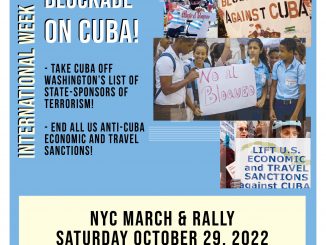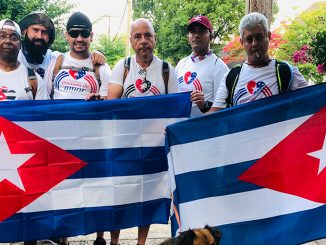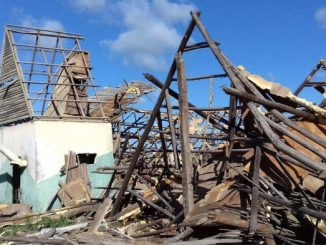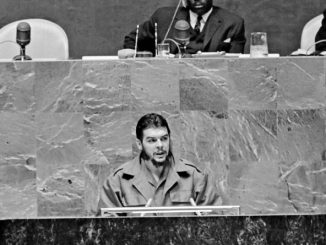
Cuba should be removed from the U.S. list of state sponsors of terrorism

Cuba is not a state sponsor of terrorism but a state sponsor of global well-being.The United States maintains a list of countries that it considers as “state sponsors of terrorism.” There are currently four countries on that list: Cuba, North Korea, Iran and Syria. The basic idea behind this list is that the U.S. State Department determines that these countries have “provided support for acts of international terrorism.” Evidence about those “acts” are not provided by the U.S. government. For Cuba, there is not one shred of evidence that the government has offered any such support to terrorism activities, in fact, Cuba has—since 1959—been a victim of acts of terrorism by the United States, including an attempted invasion in 1961 (Bay of Pigs) and repeated assassination attempts against its leaders (638 times against Fidel Castro).

Cuba, rather than exporting weapons around the world, has a long history of medical internationalism with Cuban doctors and medicines being a familiar sight from Pakistan to Peru. In fact, there is an international campaign for Cuban doctors to win the Nobel Peace Prize. Why would a country that floods the world with health care be targeted as a state sponsor of terrorism?

Washington’s vindictiveness

Cuba was not on the state sponsor of terrorism list from 2015 onward, when President Barack Obama removed Cuba from that list (it was first added to the list in 1982 by President Ronald Reagan). In his last week in office, and days before Joe Biden was inaugurated to replace him, former President Donald Trump put Cuba back on the list on January 12, 2021. The comments made by then-U.S. Secretary of State Mike Pompeo provide a strange justification for this action: despite Cuba having been removed from the list in 2015, five years previously, Pompeo said that “[f]or decades, the Cuban government has fed, housed, and provided medical care for murderers, bombmakers, and hijackers.”

The phrase “for decades” suggests that the Trump administration went back beyond 2015, not assessing the situation in Cuba during the five years since it was removed from the list but going back to an era before Obama’s action. There was no new evidence of anything having changed since 2015, which showed that Trump’s actions were purely political (to curry favor with the hard-right wing that continues to want to conduct regime change in Cuba and to nullify as many of Obama’s policies as possible).

The United States has carried out a blockade against Cuba since 1959 when the Cuban Revolution began a process to transform the country that was ruled by gangsters (including the U.S. mafia) into a country that tended to the needs of its people. The revolution developed programs for literacy and health care and for building up the cultural confidence of the people long suppressed by Spanish and U.S. colonialism. The United States elite was eager to snuff out the example of Cuba, which showed that even a poor country could transcend the socioeconomic conditions of poverty. Each year since 1992, almost all the countries in the world — 184 out of 193 at last count — vote in the United Nations General Assembly to condemn the blockade of Cuba.

Remove Cuba from the list

The designation of Cuba as a state sponsor of terrorism by the United States deeply harms the ability of the Cuban government and its people from carrying on with the basic functions of life. The immense power of the United States government over the world financial system means that banks and traders refuse to do business with Cuba since they are afraid of retaliation by the United States government for breaking the blockade. It is stunning to learn that because of this blockade, and despite the murmurs from the U.S. government about medical exceptions, firms refuse to sell Cuba raw materials, reactive agents, diagnostic kits, pharmaceutical drugs and devices, and a range of other materials necessary for operating Cuba’s excellent but stressed public science and health care system.

U.S. President Joe Biden can remove Cuba from this list with a stroke of his pen. It’s as simple as that. When he was running for the presidency, Biden said he would even reverse the harsher of Trump’s sanctions and revert to the policies of the Obama administration. But he has not done so, which might be for reasons of political expediency. There is a streak of vindictiveness that runs through U.S. policies against Cuba, an island that proved during the pandemic that its revolutionary process cares for its people. The example of public health care in Cuba, despite being a small island nation, should be exported around the world. The country is not a state sponsor of terrorism but a state sponsor of global well-being.

This article was produced by Globetrotter.

Roger Waters is a musician. He is in the midst of his tour, This is Not a Drill.

Vijay Prashad is an Indian historian, editor and journalist. He is a writing fellow and chief correspondent at Globetrotter. He is an editor of LeftWord Books and the director of Tricontinental: Institute for Social Research. He is a senior non-resident fellow at Chongyang Institute for Financial Studies, Renmin University of China. He has written more than 20 books, including The Darker Nations and The Poorer Nations. His latest books are Struggle Makes Us Human: Learning from Movements for Socialism and (with Noam Chomsky) The Withdrawal: Iraq, Libya, Afghanistan, and the Fragility of U.S. Power.

Manolo De Los Santos is the co-executive director of the People’s Forum and is a researcher at Tricontinental: Institute for Social Research. He co-edited, most recently, Viviremos: Venezuela vs. Hybrid War (LeftWord Books/1804 Books, 2020) and Comrade of the Revolution: Selected Speeches of Fidel Castro (LeftWord Books/1804 Books, 2021). He is a co-coordinator of the People’s Summit for Democracy.

Strugglelalucha256


How Cuba is eradicating child mortality and banishing the diseases of the poor

To move from 59 infant deaths out of every 1,000 live births to no infant deaths in the matter of a few decades is an extraordinary feat.

Palpite, Cuba, is just a few miles away from Playa Girón, along the Bay of Pigs, where the United States attempted to overthrow the Cuban Revolution in 1961. Down a modest street in a small building with a Cuban flag and a large picture of Fidel Castro near the front door, Dr. Dayamis Gómez La Rosa sees patients from 8 AM to 5 PM. In fact, that is an inaccurate sentence. Dr. Dayamis, like most primary care doctors in Cuba, lives above the clinic that she runs. “I became a doctor,” she told us as we sat in the clinic’s waiting room, “because I wanted to make the world a better place.” Her father was a bartender, and her mother was a housecleaner, but “thanks to the Revolution,” she says, she is a primary care doctor, and her brother is a dentist. Patients come when they need care, even in the middle of the night.

Apart from the waiting room, the clinic only has three other rooms, all of them small and clean. The 1,970 people in Palpite come to see Dr. Dayamis, who emphasizes that she has in her care several pregnant women and infants. She wants to talk about pregnancy and children because she wants to let me know that over the past three years, not one infant has died in her town or in the municipality. “The last time an infant died,” she said, “was in 2008 when a child was born prematurely and had great difficulty breathing.” When we asked her how she remembered that death with such clarity, she said that for her as a doctor any death is terrible, but the death of a child must be avoided at all costs. “I wish I did not have to experience that,” she said.

Eradicate the diseases of the poor

The region of the Zapata Swamp, where the Bay of Pigs is located, before the Revolution, had an infant mortality rate of 59 per 1,000 live births. The population of the area, mostly engaged in subsistence fishing and in the charcoal trade, lived in great poverty. Fidel spent the first Christmas Eve after the Revolution of 1959 with the newly formed cooperative of charcoal producers, listening to them talk about their problems and working with them to find a way to exit the condition of hunger, illiteracy, and ill-health. A large-scale project of transformation had been set into motion a few months before, which drew in hundreds of very poor people into a process to lift themselves up from the wretched conditions that afflicted them. This is the reason why these people rose in large numbers to defend the Revolution against the attack by the United States and its mercenaries in 1961.

To move from 59 infant deaths out of every 1,000 live births to no infant deaths in the matter of a few decades is an extraordinary feat. It was done, Dr. Dayamis says, because the Cuban Revolution pays an enormous attention to the health of the population. Pregnant mothers are given regular care from primary care doctors and gynecologists and their infants are tended by pediatricians—all of it paid from the social wealth of the country. Small towns such as Palpite do not have specialists such as gynecologists and pediatricians, but within a short ride a few miles away, they can access these doctors in Playa Larga.

Walking through the Playa Giron museum earlier that day, the museum’s director Dulce María Limonta del Pozo tells us that the many of the captured mercenaries were returned to the United States in exchange for food and medicines for children; it is telling that this is what the Cuban Revolution demanded. From early into the Revolution, literacy campaigns and vaccination campaigns developed to address the facts of poverty. Now, Dr. Dayamis reports, each child gets between twelve and sixteen vaccinations for such ailments as smallpox and hepatitis.

In Havana’s Center for Genetic Engineering and Biotechnology (CIGB), Dr. Merardo Pujol Ferrer tells us that the country has almost eradicated hepatitis B using a vaccine developed by their Center. That vaccine—Heberbiovac HB—has been administered to 70 million people around the world. “We believe that this vaccine is safe and effective,” he said. “It could help to eradicate hepatitis around the world, particularly in poorer countries.” All the children in her town are vaccinated against hepatitis, Dr. Dayamis says. “The health care system ensures that not one person dies from diarrhea or malnutrition, and not one person dies from diseases of poverty.”

Public health

What ails the people of Palpite, Dr. Dayamis says, are now the diseases that one sees in richer countries. It is one of the paradoxes of Cuba, which remains a country of limited means—largely because of the U.S. government’s blockade of this island of 11 million people—and yet has transcended the diseases of poverty. The new illnesses that she says are hypertension and cardiovascular diseases as well as prostate and breast cancer. These problems, she points out, must be dealt with by public education, which is why she has a radio show on Radio Victoria de Girón, the local community station, each Thursday, called Education for Health.

If we invest in sports, says Raúl Fornés Valenciano, the vice president of the Institute of Physical Education and Recreation (INDER), then we will have less problems of health. Across the country, INDER focuses on getting the entire population active with a variety of sports and physical exercises. Over 70,000 sports health workers collaborate with the schools and the centers for the elderly to provide opportunities for leisure time to be spent in physical activity. This, along with the public education campaign that Dr. Dayamis told us about, are key mechanisms to prevent chronic diseases from harming the population.

If you take a boat out of the Bay of Pigs and land in other Caribbean countries, you will find yourself in a situation where healthcare is almost nonexistent. In the Dominican Republic, for example, infant mortality is at 34 per 1,000 live births. These countries—unlike Cuba—have not been able to harness the commitment and ingenuity of people such as Dr. Dayamis and Dr. Merardo. In these other countries, children die in conditions where no doctor is present to mourn their loss decades later.

—–

This article was produced by Globetrotter. Vijay Prashad is an Indian historian, editor and journalist. He is a writing fellow and chief correspondent at Globetrotter. He is an editor of LeftWord Books and the director of Tricontinental: Institute for Social Research. He is a senior non-resident fellow at Chongyang Institute for Financial Studies, Renmin University of China. He has written more than 20 books, including The Darker Nations and The Poorer Nations. His latest books are Struggle Makes Us Human: Learning from Movements for Socialism and (with Noam Chomsky) The Withdrawal: Iraq, Libya, Afghanistan, and the Fragility of U.S. Power.

Manolo De Los Santos is the co-executive director of the People’s Forum and is a researcher at Tricontinental: Institute for Social Research. He co-edited, most recently, Viviremos: Venezuela vs. Hybrid War (LeftWord Books/1804 Books, 2020) and Comrade of the Revolution: Selected Speeches of Fidel Castro (LeftWord Books/1804 Books, 2021). He is a co-coordinator of the People’s Summit for Democracy.

Strugglelalucha256


Cuba, Haiti, the Helms-Burton and the crime of insubordination

Haiti was the first free nation in Latin America and the Caribbean, the first nation in the modern world emerging from a slave revolt, and the second most long-standing republic in the Western Hemisphere. The Haitian people overthrew the French colonialists in 1804, abolished slavery, and declared independence.

Their revolution was worse nightmare of colonial powers with possessions in the Caribbean – the ghost of Saint-Domingue disturbed the sleep of slave holders for years.

The imperial powers imposed a rigorous cultural, economic and political blockade on the new Haiti, to prevent the extension of its example.

Two decades after independence was proclaimed, in 1825, French warships returned, blockaded the young nation and issued an ultimatum: pay compensation or prepare for war.

An emissary from King Charles X delivered the message. France demanded payment for properties confiscated by the Haitian Revolution: 150 million gold francs, some 21 billion dollars today, payable in five installments.

According to the colonial empire, the young nation was obliged to compensate French planters for the property and slaves they had lost.

On April 17, 1825, Haitian President Jean-Pierre Boyer signed the Royal Decree presented by Charles X, who promised French diplomatic recognition in exchange for a 50% reduction of tariffs on French imports and the outrageous compensation.

For Haiti the figure was impossible to pay, given the conditions of its economy, ravaged by the French naval blockade and a devastating war, but the “generous” colonialists made a proposal “they couldn’t turn down.”

A group of French banks offered Haiti a loan to cover the compensation, resulting in a double debt that, along with the interest, bled the small country to death, over the course of the 122 years required to pay off its “independence debt.”

What’s more, The New York Times recounts in a recent five-part series of articles, when the U.S. army invaded Haiti in the summer of 1915, a group of Marines entered the national bank and stole some 500,000 dollars in gold, that days later made its way to a Wall Street bank vault.

The United States, using the financial and political chaos the island was experiencing as a pretext, occupied the country militarily, continuing its longstanding policy in the region.

Haiti was to be governed by a U.S. military proconsul.

For more than ten years, a quarter of all Haitian income went to pay off debts to the National City Bank, incurred by the country to cover the expense of “assistance from the U.S. government,” according to The Times.

ANOTHER ISLAND DARES TO CHALLENGE THE EMPIRE

In January 1959, another small Caribbean island, Cuba, defying U.S. imperial power, declared itself the first free territory of the Americas and dared to announce its decision to build the first socialist nation in the hemisphere.

The “crime of insubordination” committed required immediate action by the “superpower.” Since then, all variants of war have been waged against the rebel island, including the economic, without success.

As an essential part of the plan to break the soul and subsequent extermination of the Cuban people, a monstrosity known as the Law for Cuban Democratic Freedom and Solidarity was concocted.

What similarities can be seen between this legal atrocity and the one foisted on Haiti by the French empire? Let’s skip some frightening sections of the Helms-Burton Act, as it is also known, and consider the plan it envisions.

Let’s imagine two hypothetical scenarios, totally impossible for those of us who have confidence in the capacity for resistance and courage of our people.

First: The imperialist enemy and his allies, making use of their military power, would manage to occupy most of the country and establish a transitional government, after proclaiming the end of the Revolution.

Second: Division, deception, and discouragement sown by the enemy would lead to betrayal, another Baraguá, and we would “let the sword fall,” as in 1878.

Would we then have “free and democratic” elections? No, the transitional government, handpicked by the occupying forces, would not call elections until the United States Congress approved such a move.

The U.S. President or his proconsul, appointed for this purpose, would prepare a report to Congress every six months outlining progress being made in the transition process on the occupied island.

How long would this process supposedly last, if they are requiring a report every six months? How long would Yankee troops remain in Cuba?

The answer to both questions is “Who knows?” (Reading the Bush Plan is recommended.)

Finally, after who knows how many years, the U.S. Congress would approve elections. What about the economic, commercial and financial blockade? Would it be lifted when the end of the Revolution was proclaimed?

No, this is not part of the plan; the blockade is to remain intact during the transition, as an ironclad mechanism to apply pressure.
Once the elections were held in U.S. occupied Cuba, with the Revolution removed from power, we would have a president and government, in the style of the imperialists and to their liking.

Insistent questions remain: Would the blockade be lifted? Would the economic war end? The answer is no, that’s not what the Helms Burton proposes.

The new Cuban “president” would verify to Congress that all U.S. citizens who were “former owners” had been compensated with the full value of all properties nationalized or confiscated in accordance with revolutionary laws and in line with international law, including those Cubans who, after 1959, became “Cuban-Americans.”

The “indemnity” or “compensation,” according to U.S. experts in 1997, would have an approximate value of 100 billion dollars.

The empire has a solution that would allow the Cuban government to pay for the legal procedures, compensation and debt: loans from U.S. banks, the IMF, etc., which would generate ever-increasing interest payments and create an endless spiral of plunder.

Cubans, like Haitians years ago, would spend decades paying off a practically impossible debt. How could a country devastated, depleted, impoverished by war and occupation, a country that had lost a good part of its population of working and productive age, afford to do so? It must be clear that they could never occupy our island, without defeating a

Cuban people determined to defend every inch of our homeland.

We would be left in the hands of our hangmen, ready and willing to drain every last drop of our national wealth.

Thomas Piketty, one of the economists consulted by The New York Times, in his work on Haiti, referred to this policy as “neo-colonialism by debt.”

The “crime of insubordination” is the greatest “sin” that a people can commit. Empires never forgive rebels. An insubordinate rebel plants a seed that can sprout many generations later.

The Haitian Revolution was a breeding ground of revolutions. The punishment, the viciousness of the colonial master, could not erase its example. Inspired, Our America rose up to fight for its independence, again and again, as tireless as the courageous Haitians who defeated Napoleon’s best generals, in the first years of the19th century.

Source: Granma
Strugglelalucha256


Summit of the Americas: Imperialist domination and exclusion

Statement by the Revolutionary Government

Havana, June 6th, 2022.- The US Government, abusing its privilege of being the host country, decided at a very early stage to exclude Cuba, Venezuela and Nicaragua from the 9th Summit of the Americas to be held in the city of Los Angeles this month of June.  It has refused to attend to the just claims of many governments to change that discriminatory and unacceptable stand.

There is no single reason that justifies the anti-democratic and arbitrary exclusion of any country of the hemisphere from this continental meeting, as warned by the Latin American and Caribbean nations at the 6th Summit held in Cartagena de Indias in 2012.

President Miguel Díaz-Canel Bermúdez announced last May 25 that he would not attend the meeting.  This was Cuba’s final decision if all countries of the hemisphere were not convened on an equal footing.

Arrogance, fear of inconvenient truths being voiced, determination to prevent the meeting from discussing the most pressing and complex issues in the hemisphere, and the contradictions of its own feeble and polarized political system are behind the US government’s decision to once again resort to exclusion in order to hold a meeting with no concrete contributions yet beneficial for imperialism’s image.

It is a well-known fact that the US Government has engaged in intensive high-level efforts with governments of the region seeking to reverse the intention of many of not attending the meeting unless all countries are invited. Such efforts included immoral pressure, blackmail, threats and dirty deceptive maneuvers.  These are all common practices that reflect imperialism’s traditional disdain for our countries and deserve the strongest rejection.

Cuba appreciates and respects the honorable, brave and legitimate stand of many governments in defense of the full and equal participation of all countries.

The leadership of Mexican president Andres Manuel Lopez Obrador deserves special recognition. We highlight the clear stand of CARICOM member countries from the outset against such exclusions, as well as the firm stance of Bolivian president Luis Arce Catacora and of the president of Honduras Xiomara Castro. The position of Argentine as chairman of CELAC expresses the majority view of the region against a selective Summit, as expressed, both publicly and in private, by many governments of South and Central America.

Such genuine and spontaneous solidarity in reaction to this US discriminatory action against countries of the region reflects the sentiment of the peoples of Our America. The United States underestimated the support Cuba enjoys in the region, when it attempted to impose its unilateral and universally rejected hostile policy towards Cuba as a consensus regional position, however, the debate on the invitation process proved them wrong.

The 21st ALBA Summit held in Havana last May 27, showed the unequivocal repudiation of exclusions and discriminatory and selective treatment.

Such exclusions confirm that the United States conceived and uses this high-level dialogue mechanism as an instrument to further its hegemonic system in the hemisphere, just like the Organization of American States (OAS), the Inter-American Treaty of Reciprocal Assistance (TIAR) and other bodies established in the 20th century to curb independence, limit the sovereignty of nations in the region and thwart Latin American and Caribbean unity and integration aspirations.

They are part of the efforts to implement the Monroe Doctrine and promote exclusion as a dividing strategy for clear political, electoral and domination purposes.

One cannot speak of “The Americas” without including all the countries of the hemisphere.  Our region demands cooperation, not exclusion; solidarity, not meanness; respect, not arrogance; sovereignty and self-determination, not subordination.

It is known that the documents to be adopted at Los Angeles are completely divorced from the real problems facing the region and that beyond the effort to grant the OAS supranational prerogatives to decide upon the legitimacy of electoral processes and to compel Latin American and Caribbean governments to impose repressive, discriminatory and excluding actions against migrants, these documents are useless and vague.

We know that, like in the past, the voice of Latin America and the Caribbean will resound during those days in Los Angeles with the admirable and principled absence of relevant leaders who enjoy political and moral authority and the recognition of their people and the world.

We are also fully confident that the leaders of the region, who choose to attend, will argue with dignity that the United States cannot treat our peoples as they used to in the 20th century.

Cuba supports the genuine efforts to promote integration throughout the hemisphere based on civilized coexistence, peace, respect for diversity and solidarity. Cuba has a widely acknowledged record of unreserved support and contribution to all legitimate proposals for actual and concrete solutions to the most pressing problems faced by our peoples. The reality we are presented with today is far from such aspirations.

(Cubaminrex)

Strugglelalucha256


Families, plural

Recognizing the existence in Cuba of multiple family structures that break with the traditional model is among the most significant elements of the new Families Code being drafted

Recognizing the existence in Cuba of multiple family structures that break with the traditional model is among the most significant elements of the new Families Code, being drafted.

Accepting the plurality evident in Cuban society when it comes to this fundamental unit, allows for the inclusion and protection of families that break from the most traditional and conservative models, providing them rights and opportunities.

It also gives our law a profoundly inclusive character and opens the doors to the elimination of backward prejudices that no longer have a place in a just society like Cuba’s.

The truth is, as renowned experts in diverse family matters have stated, that this is a code honoring the bonds of affection and love, on which families are truly built.

THE FIRST STEPS…

The broad popular consultation before the referendum that approved the current Constitution was undoubtedly the first sign of the need for a Families Code more in line with the changes and growing diversity of Cuban families environment over time.

The controversies generated in the debate of articles such as the marriage between two people, instead of a man and a woman, showed there was a wide sector of the population struggling to have those unions recognized, another that knew little or nothing about it, and a third that still harbors backward ideas on that matter.

Finally, article 81 of the Constitution of the Republic of Cuba provides that “the State recognizes and protects the family, no matter how it is organized, as the basic cell in society and it creates the conditions to guarantee that its purposes may be achieved as a whole. Families may be constituted legally or by common law, based on love and the equality of rights, obligation and opportunities for its members.”

If we read this article carefully we can see some concepts that are now reflected in the bill of the new Families Code.

It can be said then that the bill embraces a principle of respect to plurality and lead us towards a more comprehensive vision of what we see as the fundamental unit of society.

THE EYES OF LOVE

People say everything is possible when we look at it with the eyes of love. Therefore, during these months, with the support of experts and from within the homes and the communities, a broad popular consultation has been conducted, during which the draft code was widely accepted as the codes of affection.

Deconstructing patterns deeply rooted in the collective mentality is not an easy task, but the first step is to begin with respect and acceptance.
We must be aware that this is not at all about proving that the traditional family does not exist anymore. This structure is common, and will remain, without a doubt. The purpose is to understand there are other family structures, which also deserve protection.

A family can also be a single mother, or father, who raises their children alone. A family can be one in which the spouses are of the same sex. Or one composed only of grandparents and grandchildren because the parents are out of the picture. Ultimately, it is the space where affective ties are strong enough to allow for the construction of a unit in which all members have the same rights and opportunities.

As the Act states, “Different family structures, based on a relationship of affection, are created among relatives, whatever the nature of the relationship, and between spouses or in common-law unions.”

“The members of the families are bound to perform family and societial duties on the basis of love, affection, consideration, solidarity, fraternity, co-participation, protection, responsibility and mutual respect.”

In other words, a family is not successful based on its structure or the number of members.

A family is a social structure that recognizes itself as such and takes on the duties and responsibilities it entails.

THE “OTHER” FAMILIES

Given the real possibility (from the legal standpoint) of being recognized and supported in terms of rights, several families that do not
fit the traditional structure have opened the doors to their lives, which usually remain close because they are usually the target of accusing looks who judge them because of their ignorance rather than truly discriminatory feelings.

It is not strange that people reject what they do not know or want to keep their eyes shut when facing something they consider taboo.
Nonetheless, both in popular consultation meetings, the mainstream media and social networks, new platforms have been opened to disseminate testimony to this reality, demonstrating that love and true feelings are capable of shattering barriers and that, many times, dreams and expectations are no different from those of traditional families.

Families in which there is only one parent, the spouses are of the same sex, or grandparents are in charge of raising the children, to present just a few examples, in no way produce a bad upbringing, or internal conflicts of greater complexity or dysfunctionality.

If we let prejudice and established patterns condition our thinking, we will lose the wonderful opportunity to understand the world and therefore, to be a better part of it.

WE DO NOT CHOOSE OUR FAMILIES, OR DO WE?

Many times, people say that we do not choose our family. It is what it is. If you like it or not, well, there is no choice.

Although it is not possible to change blood relation objectively speaking, this is a very relative statement when it comes to the subjective aspect of it.

Truth is that, beyond the family environment a person grows up in, everyone has the right to form their own family, with their own particularities. A family in which a human being can feel truly fulfilled and happy.

As varied as the family structures that surround us, or more, are the ideas that people have as to what they call a family.

Precisely, the first family right provided in the bill of the new Families Code is the opportunity to build one. Of course, the principles on which a family should be built are clearly stated in the new bill and they all have a central idea, dignity is the supreme value when it comes to the relationships within the family.

Hence, if the family we want, the one we dream about, the one that meets our expectations as human beings, is indeed chosen and built, there is no doubt it will always be our shelter and support.

ALL FAMILIES, ALL MODELS

The bill of the new Families Code, if approved, will be an instrument of profound scope that will be among the most advanced currently in force in our continent. And this says a lot about the path the Cuban society has taken.

Under the principle that love is the first condition a family needs to exist, the new Families Code has the merit of broadening the concepts of inclusion we have known so far, of putting a name to what we could not practically name one day, of moving forward toward the naturalization of family structures whose status in matter of rights have remained uncertain for years.

This document, of which any Cuban who has read it can speak at length, is a major qualitative leap towards one of the primary targets of our social system: to fight all types of discrimination.

This code is a mirror that truthfully reflects the families that exist in Cuba today.

Source: Granma

Strugglelalucha256


Cuba’s voice will be heard in the People’s Summit for Democracy despite U.S. hostilities

The United States insists on denying Cuba’s participation in the two most important political events to be held in the region this year: the Summit of the Americas and the People’s Summit for Democracy.

In early May, Foreign Minister Bruno Rodríguez Parrilla denounced that Washington had left the Caribbean island out of the initial preparations for the Summit of the Americas, which will take place in Los Angeles this week. Rodriguez also rejected The White House’s intentions to exclude Cuba, Venezuela, and Nicaragua from the continental event.

“The U.S. government is calling for a limited and exclusive Summit in Los Angeles due to the pressure put on it by the hemisphere’s far-right-wing. It excludes Cuba from discussions on issues that occupy an important place in the bilateral and regional relationship, such as migration,” the foreign affairs minister said.

Almost immediately, over 25 governments expressed their public discontent and demanded that all the countries of the Americas be invited. “Are Cuba, Venezuela, and Nicaragua part of another continent, another planet, another galaxy?” Mexican President Andres Manuel Lopez Obrador asked and asserted that he would not attend the meeting if all nations were not present.

Today, President Joe Biden, despite all his maneuvering, will have a very difficult time making a success of that Summit. He says he plans to address crucial issues such as migration, human rights, and democracy without the leaders of not only Cuba, Venezuela, and Nicaragua but also Honduras, Guatemala, Bolivia, among others. How can Biden turn around U.S. political relations with the hemisphere before an empty auditorium? Is Biden becoming the Emperor who has no clothes?

Parallel to this failing event, there will be the People’s Summit that is a promising coming together of now over 225 progressive groups from all over the US along with representatives of political organizations and leftist social movements from Latin America and the Caribbean. This gathering is taking place not that far away from Biden’s Summit at the Los Angeles Trade-Technical College and will be an important convergence of progressive forces who are emerging from the post covid quarantine with a sense of urgency. The convergence will take on June 8, 9, and 10 with plenaries, panels, workshops and musical performances culminating with a march to the Summit of the America’s location on the last day.

The thrust of the Peoples meeting is an effort to put the Americas on the same geopolitical path of regional co operation outside the clutches of the imperialism that was pushed in the era of Venezuelan President Hugo Chavez, Cuban leader Fidel Castro and other Latin America leaders.

However, Cuba will not be able to participate in this event either. Recently, the organizers of the Peoples’ Summit denounced that the U.S. government denied visas to the Cuban delegation that were invited and planning to attend this alternative meeting in Los Angeles.

This is an affront to the very democratic values that the U.S. government claims to defend, said the coordinators of the continental meeting.

“The policy of the U.S. government is cruel to the Cuban people and also to the people of the United States, who are denied the right not only to travel to the island but to be able to speak and dialogue directly with the Cuban people,” one of the coordinators of the summit and The People’s Forum director, Manolo De Los Santos, told the press.

Among the 23 people from Cuban civil society whose visas were denied by the US were renowned Cuban scientist and physician Tania Crombet Ramos, Olympic medalist Reineris Salas Perez, queer Christian student leader Jorge Gonzalez Nunez, and many others, including journalists, artists, trade unionists, and community leaders.

Joe Biden’s Summit of the Americas is marked by exclusion and the imposition of a political agenda the exact opposite of the parallel Summit that is striving for inclusiveness by bringing together diverse voices from across the Americas.

Despite the efforts coming from Washington Cuba will be represented because they have many friends who will defend Cuba and bring Cuba’s accomplishments despite, the over 60 year old blockade, to the Summit of the Americas and also to the Peoples Summit for Democracy.

The people of Cuba can be reassured that, “Cuba’s voice will be heard in the world, despite Washington’s efforts to prevent it,” as  Cuban President Miguel Díaz-Canel asserted.

Source: Resumen Latinoamericno – English

Strugglelalucha256


Declaration of the 21st Summit of Heads of State and Government of ALBA-TCP

“ALBA-TCP REJECTS EXCLUSIONS AND THE DISCRIMINATORY TREATMENT IN THE SO-CALLED SUMMIT OF THE AMERICAS IN LOS ANGELES”

Havana, May 27, 2022 – The Heads of State and Government and the Heads of Delegations of the countries of the Bolivarian Alliance for the Peoples of Our America – Peoples’ Trade Treaty (ALBA-TCP), gathered in Havana, Cuba, on May 27, 2022, at its 21st Summit:

  1. Ratify their commitment to strengthen ALBA-TCP as an instrument of union of our peoples, based on the principles of solidarity, social justice, cooperation and economic complementarity; with the genuine regional integration led by the Community of Latin American and Caribbean States (CELAC); and with the postulates of the Proclamation of Latin America and the Caribbean as a Zone of Peace.  
  2. Support the demands of the countries of Our America to materialize a change in the hemispheric relations, based on the Charter of the United Nations and the International Law, including the principles of sovereign equality, non-interference in the internal affairs, non-use or threat of use of force, peaceful settlement of disputes and self-determination of people.  
  3. Reaffirm their support to multilateralism, as the main instrument to address multifaceted and complex global challenges through collective action.
  4. Denounce the pretensions of imperialist domination over the peoples of Latin America and the Caribbean to maintain the region divided according to their hegemonic interests.
  5. Reject the arbitrary, ideological and politically motivated exclusion of several of our countries from the so-called Summit of the Americas, to be held in June in Los Angeles, United States. Such unilateral decision constitutes a serious historic regression in the hemispheric relations and an outrage to the Latin American and Caribbean peoples.
  6. Support the right of all countries of the continent to be invited and to participate in said event on an equal footing and underscore that the host country of the meeting of Los Angeles has no right to impose exclusions or conditions in violation of their sovereignty and independence.
  7. Denounce the discriminatory treatment by the Unites States as the host country of the so-called Summit of the Americas against numerous representatives of the genuine civil society of our continent.
  8. Emphasize that this kind of exclusionary meeting, does not contribute to the solution of any of the urgent integration challenges or the global and regional threats.
  9. Support and thank the courageous and dignified standing adopted by governments, social actors, organizations and the brotherly peoples of our continent, which have rejected, overwhelmingly and in different ways, the exclusions from the meeting of Los Angeles.
  10. Reject the imposition of coercive unilateral measures against Venezuela and Nicaragua, and the economic, commercial and financial blockade against Cuba in violation of the principles and purposes enshrined in the Charter of the United Nations and the International Law. 
  11. Vindicate the national dignity of our peoples, based on the respect for the ideals of the national heroes and founding fathers of Latin America and the Caribbean.
  12. Support the genuine efforts to foster a respectful dialogue, tolerance and peaceful coexistence and cooperation among the countries of our Americas, without exception, in order to find effective solutions to major problems affecting our hemisphere.

(Cubaminrex)

Strugglelalucha256


The times continue to be complex and challenging, but we are well trained!

Remarks by Miguel Mario Díaz-Canel Bermúdez, First Secretary of the Communist Party of Cuba Central Committee and President of the Republic, at the closing of the Fifth Extraordinary Session of the National Assembly of People’s Power’s Ninth Legislature, at the Convention Center, May 16, 2022, Year 64 of the Revolution

(Transcript: Presidency of the Republic/Translation: GI)

Dear Army General Raúl Castro Ruz, leader of the Cuban Revolution;
Dear Assemblywomen and men:

The current times are intense and complex; we revolutionaries call them challenging, to scare away the impossible. But this does not relieve us of our sense of reality, a reality marked by inequalities and imbalances that were developed over centuries and dramatically accentuated under the reign of neoliberalism, in the so-called post-truth era.

Luck would have it that our longing for justice, natural in human beings, survives. As Martí said: “When there are many men without decorum, there are always others who bear the decorum of many men.”

If we needed one more test to determine the great values of our people, the deep mark that the heroes and heroines of our country’s history have left in their natural nobility, the response to the Saratoga Hotel tragedy will do: The scenes of everyday people who, risking their own lives, rushed to help the victims of the explosion in the first minutes.

These anonymous heroes have something inside of the barefoot Mambises, who made the most powerful army of their time tremble, machete in hand and shouting: Long live free Cuba!

The acts of solidarity and altruism of these people, of the hundreds of compatriots who donated blood, of our always heroic firefighters, our courageous rescuers, the agile drivers of ambulances and other vehicles who happened to pass by and transported the injured, of the consecrated hospital workers, the essential specialists in medicine and nursing, the honest and untiring reporters who reached the site, intent upon not missing a single detail, all those who brought water, coffee and food from their private businesses to the tired search and rescue brigades; of every citizen who wanted to do and did something, even if it was only tpost a message of condolence on the net. In all these attitudes – along with those of Party, government and People’s Power cadres and leaders, who have the social responsibility to resolve problems and work to move the country forward – the best of being a Cuban citizen, a natural Cuban, is evidenced, (values) we have also defended in the cultural laws that we have approved here today.

All that I have described contrasts sharply with the cruelty of the haters who, in these days of uncertainty and pain, have contaminated the networks with messages of contempt for authorities, but also citizens, apparently because they are capable of doing extraordinary things without waiting for something in return. A mercenary will never understand a patriot. Those who put a price on their ideas are unable to understand those who have the courage to protect and defend theirs.

Cuba mourned without fanfare; before the Decree with which we made our response official, and did not stopped mourning during the days that followed. As for those who hoped to profit from the pain, I can only say that we are not going to waste any more words or time on people who continue to bury their credibility in the dirt of lies. In the Cuba that saves lives and pays respectful tribute to its dead, those who hate do not count!
For the lives that were lost under the rubble of the Saratoga and for those who continue to fight for theirs in hospitals and at home, we are committed to redressing the hard blows of this unexpected incident, prioritizing the recovery of the injured, care for affected families and the rehabilitation of homes and other properties which were totally or partially destroyed.

Once again, heartfelt condolences to those who suffered the loss of loved ones and support to the families and friends of the victims.

I take this opportunity to reiterate our deep gratitude to political leaders and individuals who from various parts of the world have expressed to us their condolences, support and empathy in these hard times for Cuba. In the midst of pain, solidarity consoles!

Assemblywomen and men:

The U.S. embassy in Havana and other toxic platforms, devoted to attacks on Cuba, are attempting to revive the events of July 11, last year, and outrageous versions have been constructed of the trials in which perpetuators of the acts of violence were prosecuted. Displaying paramount cynicism, the country holding world records for incarceration and prison mistreatment of girls and boys, accuses us of having prosecuted and sentenced children under 16 years of age.

The Cubainformacion website has published brief data on prisons and children in the United States, indicating that 2,000 children are arrested every day and 44,000 are in prison. We only cite this data to demonstrate, once again, the hypocrisy and double standards of those who presume to judge what happens around the world.

Yes, we are interested in stating, before our people and the world, that in Cuba no one under 16 years of age is imprisoned! That those prosecuted for their acts during the events of July 11 and 12 enjoyed procedural guarantees established by Cuban law. Respecting these laws and our Constitution, those who attempt to undermine our sovereignty, independence and internal order must know that the law exists to be enforced. We are a socialist state of law that has the right to exist. Precisely what our adversaries refuse to accept.

Now, blind with frustration, the empire and its paid employees resort to the old practices of attack with modern techniques of Unconventional Warfare. They label us and return to the infamous path of hatred, with constant calls for acts of vandalism, and encourage terrorism.

In an effort to create a climate of public insecurity, as a prelude to a social explosion, they no longer even try to mask their calls, which they amplify using vulgar talking heads on a variety of Internet platforms. Since they can’t kill us, they scream during the attempt, to earn their check.

In an effort to demobilize our people, they tried everything this last May Day. Blind drunk with their own lies, they thought very few would respond to the call to celebrate International Workers’ Day made by the Federation of Cuban Workers and its unions.

They have yet to recover from the astonishment and are demanding data from their lackeys, in an effort to understand the tremendous, massive response of our people.

The rumor is that their media platforms, that lost all credibility after covering the events of July 11 with fake news and doctored photos, were ordered to downplay images of the massive crowds and joy.

Our people who criticize what we do wrong or what we don’t do, on a daily basis, who are outraged by shoddy work, insensitivity, indolence and bureaucracy, this same people marched, paraded in congas and raised banners in support of the Revolution and, once at home, exposed the lies by posting the truth in their publications on the net.

The people took it upon themselves to paint a landscape portrait of our creative resistance. Beautiful visual testimony of Cuba celebrating the triumph of talent, effort and solidarity in confronting the most colossal challenge we have faced: Two years of pandemic with a brutally tightened blockade.

We said it here, at the foot of the José Martí Memorial and in all the country’s plazas. With Raúl and the heroic Centennial Generation, we reiterated this May Day that it has been possible; it is possible and will always be possible! (Applause)

Of course this is not about repeating a slogan. A conviction is being expressed that must always be accompanied by a principle: everything by the people, with the people and for the people. (Applause)

Assemblywomen and men:

Since the second half of last year, we have been warning that the United States government is promoting a dangerous international schism, attempting to selectively divide the world between those who are willing to submit to the servitude imposed by Washington, on the one hand, and those who are convinced of their sovereign right to self-determination and determined to defend it, on the other.

The expressions of this senseless ambition were not long in coming and the consequences are taking their toll, especially in Europe. They are costing lives and suffering, and causing global economic damage, the outcome of which is difficult to predict. They are turning the European stage into the principal destination of their weapons of all kinds, with no real control or awareness of their subsequent use.

It should not be forgotten that existing nuclear weapons, concentrated today in the hands of a few countries, have the capacity to destroy the planet several times over and the possibility of a miscalculation cannot be underestimated.

The global scenario of the 1990s, when the United States enjoyed singular hegemonic supremacy after the collapse of the socialist camp in Europe, is not today’s, and it would be a dangerous mistake to attempt to impose it by force.

Conscious of these realities, we are developing international relations based on principles and in full adherence to international law, committed to peace, justice and the right to full independence, development and security of all countries, especially those of the Third World, which are the most threatened.

This is how we defend our positions in international organizations, with full independence, coherence and responsibility.

Cuban foreign policy will continue to have as a priority the incessant battle against the economic blockade of the United States, its condemnation at all times and in all corners of the planet.

The aggressive, criminal and genocidal nature of this policy, and its overwhelming impact on all of society and the life of the country, forces us to concentrate and redouble our efforts to combat it tirelessly.

In our region, the compass that guides us continues to be the development of amicable, cooperative relations with all Latin American and Caribbean countries, supporting regional integration, based on the precept of unity within diversity, observance of the Proclamation of Latin America and the Caribbean as a Zone of Peace, and the solidary commitment to social justice for all the peoples of Our America.

During the month of April we received official visits from the Prime Ministers of Dominica and Belize, Roosevelt Skerrit and John Briceño, respectively, with whom we made progress in bilateral relations, as befits the traditional ties of brotherhood shared by our nations.

More than 1,000 delegates from 60 countries and 219 organizations accompanied the Cuban people at the International Solidarity with Cuba Conference (May 1-2), which confirmed the support of millions of people around the world for the cause of the Cuban Revolution.

Just a few days ago, we had the special honor of welcoming the President of Mexico, Andrés Manuel López Obrador, and a delegation that accompanied him to Havana. It was an official visit, important in the mutual effort to strengthen and deepen bilateral ties, and to contribute to the progress in the region, its independence and integration. The visit coincided with the 120th anniversary of the establishment of relations between our two countries, a date of great significance for Cuba, which has always found in the land of Juárez the brotherhood and support that Martí and Fidel found in their Mexican contemporaries. In those hours we came to understand much better the depth of the ties that unite us, but also the political caliber, the deep sensitivity and the endearing commitment of López Obrador in his relationship with all peoples of Our America.

Esteemed Assemblywomen and men:

The old neo-colonial ambitions of the United States remain in place, directed toward fragmenting and weakening this part of the world, as a way to preserve the hegemonic power of imperialism or restore ithis hegemony where it has been lost.

Washington has called a meeting next month, which they are curiously calling the “Summit of the Americas,” even though several countries have been excluded.

They concealed until the last moment the selective and discriminatory nature of the announcement, with the clear purpose of avoiding as much as possible the natural discomfort of the region’s governments, which have long rejected capricious exclusions.

The extensive, desperate efforts which the United States has been obliged to make are well known, even deploying high-level special envoys, to avoid demands that the event be an inclusive one, a truly representative gathering of countries in the hemisphere.

Whoever makes a commitment to host a hemispheric meeting must have the ability and courage to listen to everyone, from the Arctic to Patagonia, to listen to differing opinions, willing to deliberate with solid arguments, not with impositions and evasions; facing the truth, no matter how harsh and unpleasant it may be.

A country incapable of accommodating everyone is disqualified from serving as host.

Beneath all this, of course, is an ideological factor. The Monroe Doctrine that, recognized or not, continues to be the guide and political focus of the United States for the region that José Martí called Our America.

It is well known that nothing about economic and social inequality will be discussed or approved at this meeting; nothing concerning growing marginalization in the region, including the United States itself. We know that the growing problem of using the courts as political tools to sabotage the popular will – and undermine governments elected with the support of the most humble sectors – will not be addressed, nor will corporate efforts by large transnationals to corrupt governments of the region.

The role of the Organization of American States (OAS) in orchestrating a coup in Bolivia will not be discussed, nor will any decision be adopted that truly promotes the aspirations for democracy, inclusion and respect that the peoples of the region deserve.

The reasons why both the United States and Latin America are among the regions most affected by the COVID-19 pandemic will not be analyzed.

None of the documents proposed by the State Department are intended to advance practical action in the struggle against racism, to promote women’s rights, or address the precarious situation of immigrants.

There will be no discussion of manipulation by the U.S. government of the migratory issue, which is used to promote destabilization in Cuba, while an illegal policy is implemented based on unilateral, coercive measures meant to cause economic collapse, and encourage irregular, disorderly and insecure emigration, while the commitments and agreements in force in this arena are deliberately broken.

No discussion is projected of the disastrous impact on societies of organized crime or trafficking in weapons, produced mainly in the United States, or the cancer of drug running, fueled by the high level of consumption in U.S. society.

Terrorism, including state terrorism, and manipulation of the issue for political ends are not on the agenda. It is unlikely that the special, differential treatment which small Caribbean countries deserve will be recognized or that Argentina’s right to the Malvinas Islands will be confirmed.

There will be no statement condemning unilateral coercive economic measures and their use against countries of the region as a ruthless weapon of aggression.

Puerto Rico’s right to independence will not be recognized.

The President of the United States will enjoy a photograph and use the Summit in his internal political campaigns, especially in Florida, but hours later, few will remember what happened or the meaning of documents using U.S. language, based on U.S. conceptions, which they intend to have adopted.

The so-called Summit of the Americas seems to be identified with the OAS. It will bear the same discredit and moral disqualification which characterize this Pan-American institution. The organization has been condemned for a long time and it is time to finally recognize it for what it is, with total transparency. Its performance in recent years has only accelerated its moribund condition.

Compañeras and compañeros:

These sessions of the National Assembly confirm progress the country is making in a process to which we grant the highest priority: the deepening of socialist democracy and the promotion, protection and effectiveness of rights enshrined in the Constitution, in international treaties to which the Republic of Cuba id party and in laws under development.

We are conscious that the socialist state of law and social justice will become more democratic as as it maintains and deepens our protection of human dignity, as the supreme value that supports the recognition and exercise of rights and the fulfillment of duties in society.

The protection against violation or transgression of constitutional rights can now be demanded and redressed, through various channels and mechanisms, thus affording our political system solid legitimacy.

In this Legislature, several complementary laws have been approved to comply with Constitutional mandates. Public policies are promoted intended to provide comprehensive protection of children, adolescents, the elderly, persons with disabilities, and women. Programs have been developed to ensure equality and non-discrimination for reasons of any individual condition or circumstance that implies a distinction that undermines human dignity.

The judicial function is strengthened so that the popular court system can serve as a guarantor of Constitutional rights.

Eight important laws have been approved for our country: Food Sovereignty & Food and Nutritional Security; one protecting Personal Data; the new Penal Code; the Criminal Procedures Law; the Protection of Constitutional Rights; one establishing a Natural Resources and Environment system; one to protect the rights of authors and performing artists, as well as a Protection of Cultural and Natural Heritage law.

Each of these laws, as was reported in their presentations, is the result of a broad consultation process with the participation of specialists, experts, university professors and the population.

Their contents have been discussed and explained, in particular everything related to the new Penal Code, with which regulations on this matter have ben updated and the country’s legal-criminal system is unified in a single text, taking into account the treaties on this matter to which Cuba is a party. It also complements laws that have been approved by this Assembly in the criminal procedure system, and introduces important modifications in the field of crime prevention and law enforcement. Now it is time to disseminate its content, to encourage our citizens to respect socialist legality.

Those responsible for its implementation are called upon to act with the expected fairness. This is a tool that must be used with the appropriate rationality. It is an instrument to protect society, persons and the political, economic and social order established in the Constitution of the Republic.

As you recall, among the most innovative elements introduced by the current Constitution of the Republic is the wide range of rights recognized. Protecting them against any violation by state bodies, their directors, officials and employees, or citizens, is the objective of the Protection of Constitutional Rights Process Law, which we approved yesterday. It is a law that strengthens the country’s institutionality and concretizes the definition of Cuba as a socialist state of law and social justice.

Another of the approved laws, which represents a step forward, is the law on the Natural Resources and the Environment System. The text reinforces the ability to exercise of the right of people to enjoy a healthy, balanced environment, establishing the responsibility of all for the conservation, protection and rational use of resources, in order to make human life more rational and ensure the survival, well-being and security of our citizens.
For its part, the Copyright and Performing Artist Law aligns the legal framework with changes experienced in the processes of creation and dissemination in the literary, artistic, journalistic, scientific and educational spheres; reinforcing the state’s educational, scientific and cultural policy by conciliating the interests of society with the recognition of creators for their work.

The Law for the Protection of Cultural and Natural Heritage approved by this Assembly also generated great interest among specialists and those knowledgeable of this topic. It concretizes the state’s obligation to protect the natural, historical and cultural heritage of the nation, and the duty to protect them. National and local identity, cultural sovereignty and the legitimate right of the people to the creation, enjoyment and protection of culture are strengthened.

Assemblymen and women:

The comprehensive protection of human rights is essential to socialism, since human beings and their dignity are the epicenter of society. The capitalist discourse and narrative regarding human rights promote forms of domination, sometimes hidden, sometimes open, which take refuge in apparent legitimacy.

Not submitting to the hegemony of imperialism, swimming against the current, has consequences. The blockade and its brutal tightening are among them. This cruel and inhumane system seeks to eliminate socialism as an alternative, seeking the restoration of capitalism, attempting to limit state action, hinder and undermine its policies, plans and programs to promote, protect and guarantee rights; exacerbating contradictions and internal errors in an effort to impose a colonializing vision of rights.

Despite this, we reaffirm the conviction that, even under difficult economic conditions, the Cuban state will maintain its essential objective of guaranteeing effective equality in the enjoyment and exercise of rights and the fulfillment of duties enshrined in the Constitution and by law; promote sustainable development that ensures individual and collective prosperity and seek increasingly higher levels of equity and social justice; preserve and multiply the achievements of the Revolution and guarantee the full dignity of persons and their comprehensive development.

Although they constitute important advances, the laws that we approved in these sessions are not enough. It is necessary to raise the levels of civic education, of legal culture, adopt all the necessary measures, in different orders and at levels that allow for the effective enjoyment of rights and ensure the circumstances to inhibit violatory behaviors. Recognize, promote, prevent, protect, guarantee are verbs that denote state action and for which joint work with different social actors, with popular participation, with People’s Power bodies, is essential.

If we examine the international context, there are few countries which, within such a short period of time, have submitted draft legal provisions to two mechanisms of democratic, popular participation: the popular consultation and the constitutional referendum in 2019 and, coming soon, the legislative referendum on the proposed Families Code. Why don’t those who insist on asserting that there is no democracy in Cuba talk about how deliberation is fostered in popular consultations and the binding decision-making process of our referendums in the process of creating legislation? Why don’t they refer to popular involvement in these participatory processes, the search for legitimacy and consensus?

Before moving on to another topic, I would like to return to a very important law that we approved: the Food Sovereignty and Nutritional Security Law.

We cannot separate the significance of this regulation from one of the greatest uncertainties plaguing the entire world today. The FAO (UN Food and Agriculture Organization) recently stated that it fears serious food insecurity across the planet: “Over seven years, the FAO has noted a deterioration in the ability of countries to feed their populations. We are now in what we call a perfect storm. We were already in bad shape and the pandemic was a true atomic bomb in terms of hunger. With this new crisis between Russia and Ukraine, frankly, what we are talking about now is a global, generalized crisis… a situation of serious food insecurity throughout the planet.” These are the words of the representative of the United Nations organization in Mexico.

“In Latin America, the number of people living with hunger increased by 13.8 million during the first year of the pandemic and reached a total of 59.7 million… food insecurity… impacts 41% of the population, either severely or moderately.”

This dramatic reality is one of the most serious consequences of the economic and social imbalances generated by neoliberalism and about which Fidel warned so many times in his historic Reflections.

This is not, therefore, something that surprises us. There is awareness of the problem and projections made to confront it. And it is very important to strengthen our Plan for Food Sovereignty and Nutritional Education (SAN), which involves practically all organizations and our entire society.

We are called upon to train and mobilize government structures, at the municipal level, to ensure that they are in a position to lead the production process with popular participation on the local level and also promote an intense effort to reach all local producers – state, cooperative and private, from the state enterprise to the last farm, from the agro-industrial pole to every local development project, favoring agroecology as a necessary alternative for agricultural production in the current circumstances.

Compatriots:

It is very gratifying and satisfying for me to confirm, before this Assembly, that the pandemic continues to be successfully controlled in our country.

As I have publicly acknowledged, more than once, healthcare and scientific workers saved the country. May absolutely everyone feel this recognition: from the most renowned doctor or researcher to the most modest operator. From the consecrated cadres who direct prestigious scientific and hospital institutions to the tireless leaders of the political and union organizations in the two sectors.

The alliances forged in the midst of the worst circumstances, enormous effort and limitless dedication have allowed us to return to a new normality and gradually revive economic activity and social life.

We are not done. Cuba’s Finlay Vaccine Institute, creators of the Soberana 02 and Soberana Plus anti-COVID-19 vaccines, is today conducting two studies with the objective of protecting infants from SARS-CoV-2. According to the experts, after having vaccinated the country’s entire pediatric population above two years of age, with Soberana 02, moving to immunization of this (younger) age group involves very low risk, in terms of safety.
In another area of ideas, let’s talk about the economy, the world economy. After a period of gradual recovery in 2021, with growth of 5.9%, 2022 began in conditions of great uncertainty, with projections of around 3.6% growth.

Disruptions in supply chains plus higher food and energy prices have led to increased inflation, in addition to COVID-19 infections and, more recently, the European conflict.

Alongside this trend, the post-pandemic stage is projected globally as a period of weak, uneven recovery, marked by a slow recovery of international trade.

These pressures on prices are reflected in projected average inflation, in 2022, of 5.7% for advanced economies and 8.7% in emerging and developing economies.

For Cuba, subjected to a brutally tightened, criminal blockade, the scenario is additionally impacted by the increase in prices for imports, especially fuel and food.

This complex context, which we must confront decidedly with audacious, innovative measures, aligned with our social development model and commitment to the greatest degree of equity possible, implies great challenges for management of the economy.

Toward this end, we have updated the Economic-Social Strategy, information on which deputies have received and which constitutes the roadmap for implementation of the principal measures needed to ensure that the objectives and goals of the National Economic Plan are met.

The extensive, well documented information that compañero Alejandro Gil presented here frees me from addressing more details that would unnecessarily lengthen my remarks. I will only comment briefly on what is at the center of everyone’s concerns right now: measures to contain inflation.

The Council of Ministers is working intensely with very clear objectives and tasks outlined to begin a secondary exchange scheme to later advance in the recovery of the exchange market, including, to the extent possible, the purchase and sale of foreign currency to the population.

We have not lost sight of the need to increase supply and steps are being taken in this direction, stimulating, above all, the contribution of national productions, but also through different channels of foreign trade.
Limits will be imposed on excessive income in state institutions and enterprises not working on increasing production and efficiency, and there will be a re-sizing of the state apparatus to reduce expenses and direct funds toward support for those in situations of vulnerability.

Also as part of the strategy, the process of expansion and diversification of economic actors will continue and development must be accelerated of proposals for new transformations in socialist state enterprises, the principal economic subject in our model, mainly in relation to autonomy, access to resources, the mission and role of government administrative councils and central state management (OSDE), the operations of micro, small and medium-sized state enterprises and affiliated companies, among other issues.

Another complex aspect is the level of macroeconomic imbalance, which is expressed in greater inflationary pressures and depreciation of the informal exchange rate. The different exchange environments in which state and non-state sectors operate creates obstacles to the expansion of productive chains between the two sectors.

Despite the positive aspects that have been seen thus far in the gradual recovery of the country’s economic and social activity, more rapid progress is needed in establishing macroeconomic stability, and in increasing national production and exports, as well as direct foreign investment, the substitution of imports with domestic products and efficiency in the investment process.

In the midst of the complex situation we are facing, the following have been reiterated as priorities: the gradual recovery of the Cuban peso as the center of the financial system; confronting inflation; ensuring the stability of the national electricity system; priority attention to persons, households and communities in situations of vulnerability; decentralization of authority based on greater autonomy in municipalities and the transformations of the state enterprise system.

As we work on urgent issues, we are not renouncing development. The country’s strategic planning continues to be perfected through macro-programs, programs, projects and a work system which has allowed progress to be made in the implementation of guidelines approved at the Eighth Congress of the Communist Party of Cuba for the period 2021-2026.

Compatriots:

The shock and loss of the last few days, once again, presented us with a seemingly insurmountable challenge. Unity, solidarity and work have again proved to us that, together, all challenges can be overcome.

Not even the most recalcitrant adversaries of the Cuban Revolution, attacking it on all fronts, continuously for 63 years, have been able to bring Fidel’s invincible people to their knees. And for the record, they have not given up trying to erase “this bad example” of creative resistance from the map of America. This is why they haven’t invited us to the table they are obliged to set. We are an insubordinate voice. And not the only one! (Applause)

I was recently asked why we were returned, for example, to the list of countries that promote terrorism. There is no reason. There is no reason for punishment, for sanctions, for hatred of a noble, loving, gentle and happy people like the Cuban people. There are only unfounded arguments, perversity, a lack of ethics and great frustration, because they continue failing, from defeat to defeat for 63 years. (Applause)

We have defeated them in all arenas, not because there are more of us, because that is not the case. Not because we have more weapons, because we don’t have many. Not by grace or divine intervention, because we do not consider ourselves a chosen people. We have defeated them because we are sustained by just ideas, because we love love and hate hate.

Our strength lies in the human values inspired by Martí and Fidel; in the power of truth and in the transforming capacity of education and culture. These assets are not listed on the stock exchange; they do not depend on fluctuations in the market. They are sown with the learning of history and strengthened in the practice of solidarity.

Conquering all justice is our maxim and our horizon! Unity affirmed within diversity is the road forward. On it, we advance!

The times continue to be complex and challenging, but we are well trained!

With determination and conviction:

Onward always to victory!
(Ovation)

Granma

Strugglelalucha256


U.S. government denies visas to Cuban civil society delegation to People’s Summit

People’s Summit for Democracy
May 18, 2022 – FOR IMMEDIATE RELEASE

U.S. government denies visas to Cuban civil society delegation to People’s Summit

Among the 23 person delegation that was set to travel to Los Angeles to participate in the Summit
are scientists, Olympians, and youth activists

Los Angeles – The People’s Summit for Democracy is outraged by the decision of the United
States government to deny visas to a 23 person delegation from Cuban civil society. The denial
of their visas is an affront to the same democratic values that the U.S. government and its
“Summit of the Americas” pretends to uphold. With this decision and Cuba’s exclusion from
Biden’s official Summit, Cuba has been denied a voice in vital discussions about democracy,
integration, and regional cooperation.

Among the 23 people set to travel to Los Angeles to participate in the People’s Summit for
Democracy were renowned Cuban scientist and medical doctor Tania Crombet Ramos a
member of the World Academy of Sciences who contributed to the development of several
life-saving vaccines, Reineris Salas Pérez an Olympic wrestler who won the Bronze medal in
Tokyo, Jorge González Nuñez a queer Christian student leader, and many others including
journalists, artists, trade unionists, and community leaders.

The participation of these diverse representatives of Cuban society would have given people in
the U.S., particularly young people, an important opportunity to learn more about the island
and build people to people relationships. It is an affront to the very necessary dialogue and
normalization of relations between the people of the United States with the Cuban people who
have been unjustly separated by the six-decade illegal U.S. blockade.

Manolo De Los Santos, one of the organizers of the People’s Summit said: “The U.S.
government’s policy towards is cruel towards the Cuban people, but also towards the people
of the United States who are being denied the right to not only relate with the people on the
Island, but also to be able to speak and dialogue directly with them.”
We call on the U.S. government and its Embassy in Havana, to reverse the decision to deny their
visas.

Sign our petition calling on the US to reverse their decision: https://chng.it/CjY4x8R4bq

Follow the People’s Summit on Twitter, Instagram, Facebook and our website.

For press inquiries and interview requests contact: press@peoplessummit2022.org

Source: PeoplesSummit2022.org

Strugglelalucha256


Cuba: ‘One limited step in the right direction’

Declaration of the Ministry of Foreign Affairs of the Republic of Cuba.

Havana, May 16, 2022 — Today, the government of the United States announced several measures, which are positive but of a very limited scope, regarding Cuba associated to the granting of visas, regular migration, flights to Cuban provinces, remittances and adjustments to the regulations governing transactions with the non-state sector.

Taking into account the nature of such measures, it would be possible to identify some of the promises made by President Biden during the electoral campaign of 2020 to alleviate the inhumane decisions adopted by President Trump’s administration, which tightened the blockade to unprecedented levels and increased the “maximum pressure” policy applied ever since against our country.

These announcements in no way modify the blockade or the main measures of economic siege adopted by Trump, such as the lists of Cuban entities subject to additional coercive measures; nor do they eliminate travelling restrictions for US citizens.

They do not reverse either the arbitrary and fraudulent inclusion of Cuba in the State Department list of countries that allegedly sponsor terrorism, one of the main causes for the difficulties Cuba comes up against in its commercial and financial transactions in many parts of the world.

However, this is a limited step in the right direction, a response to the denunciations made by the Cuban people and government. It is also a response to the claims made by the US society and the Cubans residing in that country.  This has been a demand by the Community of Latin American and Caribbean States and virtually all members of the United Nations, expressed in the overwhelming vote against the blockade. These are just demands which have been ignored by the government of the United States at a very high cost for our people.

Since 2019, the blockade has been tightened to the extreme, taking advantage, in an opportunistic way, of the context of the pandemic, the international crisis and the consequent economic depression.  It would be no exaggeration to affirm that the consequences of this siege could be described as devastating.  The increase in migration is an evidence of that.

In taking these steps, the State Department uses an openly hostile language, accompanied by traditional slanders and new fallacies that have become fashionable in the last few months, which show that neither the goals pursued by the US policy against Cuba nor its main instruments have changed

Understanding the true dimension of this announcement would require waiting until the implementing regulations are published.

The Government of Cuba reiterates its willingness to establish a respectful dialogue, on an equal footing, with the government of the United States, based on the UN Charter, without any interference in the internal affairs of States and with full respect for independence and sovereignty.

(Cubaminrex)

Strugglelalucha256
https://www.struggle-la-lucha.org/cuba/page/22/