Cuba prepares for referendum on progressive Family Code

The new Family Code, drafted in consultation with the general public, is considered to be the world’s most inclusive and progressive code

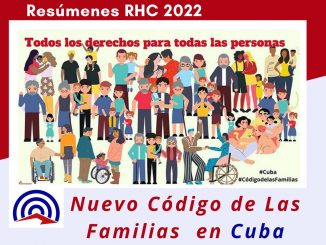
In addition to expanding the definition of the family beyond the hetero-normative conception, the Code also enshrines women’s rights, promotes gender equality, protects the role of grandparents in family relations, and much more. Photo: MinRex

Cuba is set to hold a popular referendum on its new Family Code, which changes the concept of the family nucleus and expands women’s rights and LGBTQ+ rights. This Sunday, on September 18, Cuban citizens living abroad, and next Sunday, on September 25, citizens in Cuba will vote to decide whether to “approve” or “reject” a new progressive Family Code, which has been drafted in consultation with the general public.

This referendum is an unprecedented democratic exercise in Cuba since, for the first time in the country’s history, a referendum on a code is being held. Until now, only constitutional referendums have been held in the country. Additionally, it is a pioneering event in the world, as Cuba has become the first country to have submitted a Family Code to popular consultation and referendum. The new Family Code is also considered the most inclusive and progressive code in the world.

The new code guarantees the right of all people to form a family without discrimination, legalizing same-sex marriage and allowing such couples to adopt children. It allows for parental rights to be shared among extended and non-traditional family structures that could include grandparents, step-parents, and surrogate mothers. It also adds novelties such as prenuptial agreements and assisted reproduction.

It boosts women’s rights, promoting equal sharing of domestic responsibilities and extending labor rights to those who care full-time for children, the elderly, or people with disabilities. It establishes the right to a family life free from violence; that values ​​love, affection, solidarity, and responsibility. It codifies domestic violence penalties and outlaws corporal punishment. It states that parents will have “responsibility” instead of “custody” of children and be required to be “respectful of the dignity and physical and mental integrity of children and adolescents.” It also asserts that parents should grant maturing offspring more say over their lives.

On Thursday, September 15, during the Round Table with members of the drafting commission and the National Electoral Council (CEN), Justice Minister Oscar Silvera Martínez noted that the new Family Code “protects human dignity, all family law institutions, eliminates any vestige of discrimination in the family sphere and rejects violence.” He highlighted that “its preparation process was a complex exercise, widely democratic and had diverse views from science, multidisciplinarity and the cultural aspects of the Cuban people, which reinforces the quality of the regulations.”

Last month, Silvera Martínez, confirming the date of the referendum and thanking those who contributed to the process, said that the Family Code “is worthy of its people and a reflection of its reality, which reaffirms the humanist character of the Revolution and leads our State and society in the search for a fairer Cuba.”

Cuba’s current Family Code was written in 1976 and was one of the only aspects not addressed by the 2019 Constitutional Reform. In 2018, during the discussions and meetings on constitutional changes, while opinions were divided, it was found that there was significant support for the recognition of marriage outside of the hetero-normative conception. The commission felt that it was something that needed more discussion with people. Eventually, the National Assembly of People’s Power decided to omit the definition of marriage, leaving it to be decided in the family code and not the constitution. Nevertheless, marriage as a contract between two partners remained, without specifying the definition of the parties that are and are not allowed to enter it.

Following the approval of the new constitution in February 2019, the members of the drafting commission began working on a new Family Code. By September 2021, 22 versions of the new code were presented. In December 2021, the National Assembly approved the draft submitted to popular consultation in February 2022.

Three months of popular consultation, in which 6,481,200 voters or 75.93 % of a total of 8,535,742 participated with 336,595 interventions in more than 79,000 meetings throughout Cuba, led to changes to 49.15% of the content of the draft. This draft, with suggestions from citizens, underwent a new evaluation by the National Assembly and was unanimously approved in June. Now, it is awaiting its ratification in the popular referendum.

As established in the Constitution, all citizens over 16 years of age are eligible to vote in the referendum. The new Code must receive more than 50% of the valid votes in order to be applied as a law. According to the data issued by the CEN, 61% of those consulted on the referendum expressed themselves in favor of the new code.

On Saturday, September 17, in anticipation of the vote, activists and community members participated in a bike caravan to mobilize support for the new Family Code and took to social media with the HT #CodigoSí (#CodeYes).

Source: Peoples Dispatch

Strugglelalucha256


Did you know? There are no homeless people in Cuba. No landlords, foreclosures, or evictions

You heard that right. No one in Cuba is living in the streets, in tents, or sleeping in cars at Walmart parking lots — scraping by without health care, regular showers, clean water, food, or even toilets.

That is not to say that there isn’t a housing problem in Cuba.  There is a housing shortage. Cuba is tackling building more housing for its people. This is extremely difficult because the 60-year U.S. blockade makes it impossible for Cuba to import needed materials. So there are instances where people live with relatives, and there is a need to improve existing housing. But housing is a right. 

But yes, even the capitalist press admits — not a single child, family, or person is living in the street in Cuba — an island as big as the state of Tennessee or Virginia with 11.3 million people, just 90 miles from Florida. 

In the U.S. homelessness is growing. Tennessee just made it a felony for homeless people to camp in parks and public property. Miami considered a plan to move unhoused people to a city-sponsored encampment on Virginia Key — next to a sewer wastewater treatment plant and away from services. The Los Angeles City Council has begun bans. 

There are now an estimated 1.5 million unhoused people in the wealthiest capitalist country in the world. Another 6.4 million face eviction as rents have skyrocketed. 

Interestingly, it isn’t that there isn’t enough housing. Unlike Cuba, there are plenty of vacant houses and apartments, many of them brand new. The problem is the opposite of Cuba. People cannot afford sky-high rents and mortgages. If you don’t have the money and landlords can’t make a profit, then they’d rather have housing lie vacant. 

And that should be a crime.


Strugglelalucha256


Fidel’s guidance in all of Cuba’s struggles

Havana, Aug. 11 — These days Cuba is recovering from an unprecedented fire, which has kept Matanzas, the whole island, and especially rescuers, firefighters, and authorities on full alert since the night of August 5. The continuous explosions in one of the main oil storage facilities in the country left a trail of thick black smoke that covered the Havana sky for five days. It also left so far two deaths, 14 people missing, and over a hundred people injured. Now that the flames have been extinguished the next phase of clean up will begin and it will start with finding the remains of those brave firefighters who threw themselves immediately into battle for their homeland.

However, amid pain and agony, Cuba has one great consolation: since 1959, the people have never been alone in struggles, accidents, or catastrophes of any kind. Fidel never permitted it. Today, when the island is just 2 days away from remembering the 96th anniversary of his birth, the 6th that has passed without his physical presence, the people proved once again that his ideas and his example do not abandon them.

In the most uncertain moments of the fight to put out the fire, Cuban President Miguel Díaz-Canel Bermudez mentioned, again and again, a phrase well known to Cubans: “The protection of our citizens will always occupy the first place in our efforts. Nothing will have priority over this.”

Fidel repeated those same words in March 2003, a few months after two powerful hurricanes, Lili and Isidore, crossed the island in September 2002, both of which had an almost identical path, coming barely 11 days between one another.

“In the face of climate changes, the environmental damage caused by humankind, economic crises, epidemics and cyclones, our material, scientific and technical resources are increasingly abundant,” he added.

Cuba had already lived through other extreme experiences at that time. Hurricane Flora, for example, passed over the island in October 1963 and is remembered for its heavy rains, which overflowed rivers, ruined crops, and destroyed houses. More than 1,150 people died during that violent five-day storm, as well as thousands of animals.

According to Bohemia, Fidel directed the relief operations and moved from one province to another. First Santa Clara, then Camagüey, and even into the most dangerous area of the Cauto River.

“The Commander-in-Chief of the Revolution was, as always, in the front line. It was not uncommon to see him personally organizing rescue brigades, attending to the victims, sharing the pain of the people,” the magazine reported.

Fidel Castro was on the front line of the catastrophe, even during the battering of the winds and waters, even though the historic hurricane had not yet left the eastern province within which it performed several loops while trapped by the mountains.

The leader of the Revolution moved there with amphibious tanks of the Rebel Army and he personally saved many victims who remained on the roofs, the top of trees, or those who were trapped in the floodwaters. The helicopters fought against the heavy winds, taking advantage of every space of calm to save entire families.

All the victims received material assistance. The enormous damage was mitigated and everything was rebuilt. No family was left behind.

Since 2016, the year Fidel died, Cuba has faced other situations of great pain: Hurricane Irma (2016), the plane crash at José Martí International Airport (2018), and the tornado that destroyed hundreds of houses in Havana (2019), an unprecedented pandemic, a raging fire…

But Cuban leaders continue Fidel’s legacy. From the checkpoint stationed a few kilometers from the fire, after it was made known that the flames were already under control, Díaz-Canel took a few minutes to recall – as he does every day – some words of the man who remains and will remain present in each of our struggles: “Our people will be able to overcome any obstacle, any difficulty; our people will be able to march forward unstoppable, and they will be able to overcome their own weaknesses.”

Source: Resumen Latinoamericano-US

In commemoration of Fidel’s  birthday on August 13 we present Estela Bravo’s extraordinary documentary, Fidel the Untold Story

Strugglelalucha256


Sanctions fuel the fire at Cuba’s Matanzas oil storage

On August 5, a major oil storage facility in Matanzas, Cuba, 65 miles east of Havana, was hit by lightning. A tank that contained 25,000 cubic meters of crude oil caught fire after being struck. Since then, an enormous fire has been raging in Matanzas. Lieutenant Colonel Alexander Ávalos Jorge, deputy head of Cuba’s fire department, said that it was impossible to estimate when the fire would be completely extinguished. This tremendous explosion and hard-to-control fire has led to several people being reported missing (including firefighters), many others injured with severe burns, and hundreds more evacuated from their homes. Cuba’s president, Miguel Díaz-Canel, rushed to Matanzas on August 6, interacted with the local officials who were trying to get the fire under control, met residents of the town, and the next day, interacted with the press and spoke about the heroic work done by the firefighters and the solidarity of the Cuban people. “We are going to overcome this adversity,” he said.

Four of the eight tanks at the storage facility have been impacted by these fires. By August 8, Matanzas Governor Mario Sabines Lorenzo also confirmed that three tanks had been compromised. Clouds of dust now hover over the island. Elba Rosa Pérez Montoya, Cuba’s minister of Science, Technology, and Environment (CITMA), said that scientists from various backgrounds were monitoring the situation to see if the smoke resulting from the fire will lead to any negative health effects for the residents of the surrounding areas. As of that point, she said, “We have no evidence that there are effects on human health.” Nonetheless, strange substances have been detected in the water supplies in Yumurí Valley, Matanzas. Diosdado Vera, an 89-year-old farmer, showed journalist Arnaldo Mirabal Hernández the unusual color and odor of the water in an old bathtub that serves as the water source for her cows. “There are approximately 3,200 particles in the air right now,” said CITMA Minister Pérez Montoya. “The clouds have sulfur dioxide, nitrogen dioxide, carbon monoxide, among other substances that are falling on Matanzas, Mayabeque, and Havana.” Meanwhile, Pérez Montoya said that a team of scientists is investigating the strange substances found in the Yumurí Valley.

This tragedy has also had immediate repercussions for the entire population in the province of Matanzas and the whole island of Cuba since it affects their electricity supply and access to health care, which already are strained under the weight of the U.S. blockade, due to lack of availability of spare parts and scarcity of medicines in Cuba, respectively.

The fire has already led to the Antonio Guiteras thermoelectric plant in Matanzas being out of service due to a shortage of water and the contamination of the water cycle. This will likely lead to severe electricity outages amid record heat waves this summer. Ricardo Ronquillo Bello, president of the Union of Cuban Journalists (UPEC), tweeted that this tragedy will be “another test for Cuban journalism that will know how to honor with its humanism and social responsibility.” Ronquillo was referring to the onslaught of fake news that swept through social media, leading to a sense of alarm during an already difficult period.

In this dire crisis, the people of Cuba and their government have responded immediately, and this has resulted in on-site efforts to contain the fire, prevent a major environmental disaster, and keep the population safe. It has also led to a call for international aid and solidarity. The governments of Mexico, Venezuela, Russia, Nicaragua, Argentina, Chile and several others have promptly offered material aid, and some countries like Mexico and Venezuela have also sent experts and firefighters to confront this complex situation. Cuba’s Credit and Commerce Bank (Bandec) has set up an account so that people in the country can donate money to the people of Matanzas.

“Cuba is Matanzas,” said President Díaz-Canel, in the context of both the impact of the fire on the entire island and the solidarity that is visible across Cuba.

Sanctions

The U.S. blockade of Cuba fuels the fire that rages on in the country, despite denials by authorities in the United States. The U.S. government has both been stiffening up the blockade of Cuba and denying that sanctions have any impact on the functioning of the country (in fact, in 2021, then-White House press secretary Jen Psaki had said that the problems in Cuba are not due to the U.S. sanctions but rather are due to “the Cuban government’s economic mismanagement”). The U.S. Embassy in Havana has made assurances that the blockade authorizes U.S. entities and organizations to provide disaster relief and response. But organizations tell us that this is not the case, with the 243 sanctions imposed on Cuba working as a stranglehold against pursuing any activity in the country. Many of these organizations say that the process to send aid to Cuba is lengthy, with a licensing regime in place that requires expensive lawyers. Cuba’s inclusion in the state sponsors of terrorism list means that banks in both the United States and abroad are reluctant to process humanitarian donations.

While Washington says one thing and does another, the firefighters in Matanzas—aided by the reinforcements from Mexico and Venezuela—have been spraying foam on the fire to prevent it from spreading further, and helicopters have been pouring water on the other oil tanks to stop them from combusting. Even after the fire settles and the ashes remain, Cuba will struggle to rebuild these tanks and to solve its energy crisis. These are not merely domestic problems but rather are problems created and exaggerated by the harmful U.S.-imposed blockade that has been in existence for the past six decades.

Not long after the lightning strike, users on social media shared the hashtag #FuerzaMatanzas (be strong, Matanzas) on various platforms. Within 24 hours, the hashtag was shared by nearly a billion users, according to Dayron Avello, social media manager at Clínica Internacional Camilo Cienfuegos. A billion people have signaled their support for Cuba, a solidarity the U.S. blockade is unable to prevent.

This article was produced by Globetrotter.

Vijay Prashad is an Indian historian, editor and journalist. He is a writing fellow and chief correspondent at Globetrotter. He is an editor of LeftWord Books and the director of Tricontinental: Institute for Social Research. He is a senior non-resident fellow at Chongyang Institute for Financial Studies, Renmin University of China. He has written more than 20 books, including The Darker Nations and The Poorer Nations. His latest books are Struggle Makes Us Human: Learning from Movements for Socialism and (with Noam Chomsky) The Withdrawal: Iraq, Libya, Afghanistan, and the Fragility of U.S. Power.

Manolo De Los Santos is the co-executive director of the People’s Forum and is a researcher at Tricontinental: Institute for Social Research. He co-edited, most recently, Viviremos: Venezuela vs. Hybrid War (LeftWord Books/1804 Books, 2020) and Comrade of the Revolution: Selected Speeches of Fidel Castro (LeftWord Books/1804 Books, 2021). He is a co-coordinator of the People’s Summit for Democracy.

Strugglelalucha256


Diaz-Canel calls for unity among communist parties around the world

Havana, Jul 28 (Prensa Latina) The first secretary of the Communist Party of Cuba (PCC), Miguel Díaz-Canel, described unity among the world’s communist groups as necessary and urgent, Granma newspaper reported on its website on Thursday.

According to the newspaper, in a message to the International Forum of Marxist Parties, held virtually and organized by the Communist Party of China, the Cuban head of State expressed gratitude for the opportunity to exchange theoretical advances and practical experiences of these organizations.

In the text, read in front of representatives of 109 parties from all over the world by Rosario Penton, rector of the Ñico Lopez PCC Superior School, the head of State stressed that since its emergence, Marxism have given the scientific foundation to the class struggles of the world proletariat and of the international working class.

He pointed out that the objectivity of its postulates is revealed in a particular way in times of crisis.

Diaz-Canel referred in the letter to the mistakes made in the name of the Marxist tradition, the setbacks and deformations; although he highlighted the ways in which Marxism in Cuba merged with the best of the revolutionary national tradition, which had among its highest exponents Jose Marti and Fidel Castro Ruz.

He affirmed that for Cubans, being a Marxist means permanent learning from practice to integrate the development of the social sciences.

Diaz-Canel highlighted the ideas, concepts and guidelines approved in the 8th PCC Congress, and pointed out the three main tasks that have become strategies for partisan work: the economic battle, unity and struggle for peace and ideological firmness.

He pointed out that Cuba is working on the formation of a critical and transforming subject of prosperous, sustainable and democratic socialism, as part of the process of updating its development model.

We are firmly convinced that socialism is the only path to development with social justice as a creative overcoming of capitalism, its unsustainable irrationality and the values that guide it, he added.

Diaz-Canel recalled the positive and negative lessons of other countries that have previously embarked on this path and what it means to be close to and permanently stalking an adversary as powerful as the United States Government.

He denounced the growing aggressiveness of that power against Cuba, as well as the use of perverse instruments of unconventional warfare, the media intoxication laboratories, the disinformation campaign, lies, double standards and hypocrisy, through social networks.

“The reality of today’s world confirms that it is increasingly necessary and urgent for Marxist parties to unite to face the great challenges that lie ahead. Only unity in diversity will ensure victory,” the message concluded.

Source: Prensa Latina – English

Strugglelalucha256


The Cuban people will not be defeated

A gathering was held at the People’s Forum in New York City on July 26, the anniversary of the attack on the Moncada Barracks in Cuba in 1953, also known as National Rebellion Day. This attack was the spark that ignited the Cuban revolution and was led by the same leaders of the revolution such as Fidel and Raúl Castro, Haydée Santamaría, and others.

Yuri A. Gala López, Cuban Ambassador and Deputy Permanent Representative of Cuba to the UN gave an address to this gathering to emphasize the importance of the July 26 anniversary and efforts Cuba has made to overcome the COVID-19 pandemic and the stranglehold of US unilateral coercive measures. Below are his words:

Today, the main ceremony of the celebration [of National Rebellion Day] took place, in the province of Cienfuegos with the presence of Army General Raul Castro, the leader of the revolution, and Miguel Diaz-Canel, the president of the Republic of Cuba.

A day like today, but in 1953, marked the beginning of a new stage in our nation’s struggle to achieve our true independence. A group of youngsters, like in the picture we saw a couple of minutes before, led by Fidel, sought to find an ultimate solution to the country’s economic and social problems and its heavy dependance on the United States. Although on July 26, 1953, the taking of those barracks was not possible, the actions meant the solidification of a revolutionary movement that never wavered in the struggle until achieving the final victory on January 1, 1959.

These milestones, which we commemorate and which have been declared in Cuba as Cuba’s National Rebellion Day, bring us together to remember those historic events and their views, as well as honoring the bravery and loyalty of that group of young people who embarked on the assault on those barracks. The Moncada attack taught us to turn setbacks into victories, and learn the lesson of perseverance.

It has been said that it is not possible to explain Cuba’s socialism without the reasons that led Fidel to storm the barracks with simple rifles and an arsenal of ideas.

Dear friends, the 1959 victorious revolution continues to endure, and overcome against hostility. It remains strong because our people back in Cuba inherited, throughout history, solid concepts and revolutionary principles from men and women who gave everything for their motherland.

While the United States blockade has been implemented for the past six decades, since 2017, the Cuban people have endured an unparalleled and excessive tightening of that system of unilateral coercive measures. During the Trump administration, more than 240 unilateral measures were adopted against Cuba, and some of them, out of an unprecedented cruelty, as part of the so-called policy of maximum pressure, with a ruthless objective of suffocating sensitive sectors of the Cuban economy, such as foreign trade and tourism. These measures posed and continue to be a huge burden on Cuban families, including through the imposition of serious restrictions on remittances.

In 2020, the then US administration took on the virus as an ally, in its merciless, unconventional war against our country. And tightened the blockade. Those coercive measures remain in force, they are in full practical application under the current US administration, in spite of the fact that a large majority of Americans do support the lifting of the blockade, and the freedom to travel to the island, and that many Cubans living in the United States yearn for normal relations and well-being for their families.

In addition to that, Cuba has also had to face political and communications operations orchestrated from the US territory, supported by a sophisticated technological infrastructure, dedicated to the disinformation or misinformation, slander and smear campaigns. They apply against Cuba the recipes of the unconventional warfare already rehearsed and implemented in other parts of the world with serious human and material costs. Even during this current month of July, they have tried again to force a popular uprising, but they have failed as they did, or as they tried and failed in 2021.

Dear friends, for 29 years, the General Assembly of the United Nations, its most comprehensive and democratic body, has adopted the text of a resolution on the necessity of ending the blockade imposed by the United States against Cuba. Throughout these years, the number of countries voting in favor of this resolution has been increasing. The most recent vote took place in June 2021, when 184 countries voted in favor, and only two countries voted against. This shows clearly that the overwhelming majority of member states are in favor of putting an end to the blockade that affects the Cuban nation and has a strong territorial effect as well.

However, year after year, the US government has dismissed that demand of the vast majority of the UN Member States, an attitude that is neither democratic nor ethical. The human damage posed by the blockade cannot be measured. No Cuban family is spared from the effects of this inhumane policy. No one could honestly claim that it does not have a real and very negative impact on our population.

The in-person ceremony today in Cuba to mark the National Rebellion Day is indeed a feat, achieved thanks to the control of the pandemic with our own resources. It should be recalled that within a context of strengthened blockade, Cuba has had to face COVID-19 with very limited resources. But the results are evident. We’ve succeeded in developing highly effective treatments for patients. We have to remember that while, or when the US blockade cruelty, or cruelly prevented the supply of lung ventilators, Cuba had to develop its domestic production with our own prototypes.

And Cuba is today the first country in Latin America and the Caribbean to have three anti-COVID vaccines of its own and two vaccine candidates waiting approval. But Cuba is also the first country in the world to have carried out a vaccination campaign in children between the ages of two and 18. I guarantee more than 90% of the Cuban population is fully vaccinated with our own vaccines and more than 60% of that population have already gotten a booster dose.

We also make our humble contribution to other countries in a manner consistent with our international vocation. In fact, when the slanderous campaign of the United States administration against our medical cooperation intensified amidst the pandemic, Cuba sent 57 specialized brigades of the Henry Reeve International Contingent to 40 countries or territories to join over 28,000 health professionals already providing services in 59 nations at that time.

Cuba makes an effort not only to survive, which is difficult, but we also make efforts to continue to make headway in all possible areas. For example, in recent days the National Assembly of the People’s Power met and approved the new Family Code, an indispensable legislation for the Cuban society, which in September will be submitted to a referendum so that the people can vote on it. We want to commemorate and to actually give thanks to those scientists, professors, academicians and people who actually contributed to the design, to the conceptualization of that important document, and more importantly, to those who are on the streets explaining to the Cuban population what the family code is all about.

In the sections of the National Assembly, important measures in economic matters were also announced. Our role, dear friends, has not been easy, will not be easy, as you know. But Cuba, as our president said this morning, will not stop. In that battle, the face of Cuba in the United States and in every corner of the world, is essential and represents a bulwark for the resistance of the Cuban people in their defense of their sovereignty.

It is you, our dear friends, the ones who stand up and resolutely call for the end of the unjust blockade against Cuba, in every possible space. It is you who carry out our just call for justice to every community. That is why we will always be grateful to you.

Countless will be the challenges and even greater the threats that will put to the test the tenacity and determination of Cubans. But we will always be accompanied by the example of struggle of those young people who stormed the Moncada and Carlos Manuel de Céspedes Barracks. The unshakeable ideas and the faith in victory that our commander in chief, Fidel Castro, always had, and the symbolism of the “Yes we can!” proclaimed by Army General Raul Castro.

So allow me to conclude my remarks by recalling words of Cuban President Miguel Diaz-Canel who stated just a few days ago the following, and I quote, “They want to stop this country. Well, we are not stuck and we are not going to stop. Our alternative is clear, and it will never be capitulation. We will not surrender, nor will we let ourselves be defeated.”

So join me in expressing aloud: “Let Cuba live!” (“Let Cuba live!”)

Also join me in saying, “Long live the solidarity movement with Cuba in the United States!” (Viva!)

Viva la revolución cubana! (Viva!) Viva el 26 de julio! (Viva!) Venceremos! (Venceremos!)

Thank you.

Source: Peoples Dispatch

Strugglelalucha256


The legacy of Pastors for Peace support for Cuba continues

For the 32nd time in 30 years a Pastors for Peace caravan is in Cuba bringing close to 100 people including many young people who are experiencing the reality of Cuba for the first time; seeing for themselves instead of through the filter of lies and hate so prevalent in the mainstream media of the U.S..

But the delegation is not just made up of first time supporters but veterans of many of the friendshipment caravans too who accompanied Pastor’s visionary leader the Reverend Lucius Walker through all those years of collecting essential material aid for the island in cities and towns all around the U.S.. While tons of aid was delivered it was the explaining the truth about Cuba and its example of what a better world could look like along the way was what was most important. Walker’s message was one of defiance against the cruelty of the blockade, wrapped in love. He said more than once, “our government has no authority to tell us who our friends are. The Cuban people are our brothers and sisters.”

The history of the caravans is being carried in the stories of these veterans like Lisa Valenti who accompanied Lucius in 1996 on a 90 day hunger strike in front of Congress to demand the release of Cuba bound computers confiscated at the Mexican border by U.S. agents.

Longtime Pastor’s Bus driver Bill Hill is another one who has participated in most of the caravans including many stopped at the border with furious resistance. From the first caravan in 1992 when border agents seized bibles and bicycles from the hands of priests and students to a caravan stopped at the Canadian border and the aid was then defiantly carried by caravanistas box by box to the other side. Other caravans have defied the U.S. ban on sending technology to Cuba containing any more than 10% of U.S. made components in it including satellite dishes and solar panels. In 1993, during the second caravan, a little yellow school bus was seized by Treasury officials and impounded for 23 days, with 13 caravanistas (including Lisa Valenti) inside, at the border town of Hidalgo, in the blistering heat, until an international outcry forced its release. The State Department claimed the little yellow bus could be used for the military when in fact it was meant for a Cuban school for children with disabilities.

In the history of the caravans there always seemed to be another way to break the blockade.

To sum up the determination of these trips of solidarity and love Bill Hill remembered what Lucius once said, “These trucks and buses don’t have a reverse, they only go forward to Cuba.”

Pastors for Peace’s commitment to ending the blockade didn’t just focus on their own projects but it has always extended to other Cuban solidarity groups in the U.S. when their support was needed. In 2011, for example, when the International Committee for the Freedom of the Cuban 5 was organizing a tour of the famed Cuban National Children’s Theater Group; La Colmenita in the U.S., there was a need for a bus to transport the children between cities on the East coast and it was Pastors who provided one and Bill Hill drove it.

Cheryl LaBash, co-chair of the National Network on Cuba, is also on this caravan and explained to Resumen Latinoamericano why Pastor for Peace decided to launch the friendshipment caravans during the most difficult years of the Revolution.

“At that time it was the 1990s, and the island was going through its worst economic crisis up to that time, known as the Special Period.

Our initiatives were carried out while the administration of then President George Bush (Sr.) was creating all kinds of measures to hinder Cuba’s efforts to overcome the crisis. Bush had decided to maintain the fundamentals of the genocidal policy against Cuba, implemented shortly after the triumph of the Revolution of 1959.

On April 6, 1960 Lester D. Mallory, Deputy Assistant Secretary of State for Inter-American Affairs, in a secret State Department memo defined the U.S. strategy that continues to this day:

“The majority of Cubans support Castro…the only foreseeable way to detract from his domestic support is by disenchantment and dissatisfaction arising from economic malaise and material hardship…every possible means must be rapidly employed to weaken the economic life of Cuba…a course of action which, being as skillful and discreet as possible, will achieve the greatest advances in depriving Cuba of money and supplies, to reduce its financial resources, to bring about hunger, despair, and the overthrow of the Government.”

That prescribed as surreptitiously as possible to create difficulties without the major trading partners of the Eastern bloc and the Soviet Union. And the progressive movement urgently needed to do something from the United States.

Why? Because Cuba and the Cuban Revolution were a symbol of resistance right here in our hemisphere, of constructing a new social order based on human needs, not on profit. So that’s why in my opinion, the 1st Caravans were organized and undertaken.”

LaBash concluded, “Cuba was never alone and never will be. Pastors for Peace and the new generation of caravanistas will continue the legacy of Lucius Walker and the hundreds of caravanistas who have preceded them for as long as it takes to put this criminal blockade of Cuba into the dustbin of history”

Source: Resumen Latinoamericano – English

Strugglelalucha256


Cuba facing hybrid warfare

July 21 — Cuba must learn to live, advance and develop under the rigors of the fourth generation -or hybrid- warfare with which the United States systematically harasses it. That is the approach that emerges from observing the tireless activity of the government, the Communist Party and the Cuban institutional system in all spheres of economic, political, social and cultural activity. In addition to struggling to recover and transform its economy, the island, to give a couple of examples of great importance, is engaged in two tremendous political and legislative challenges: the debate on the family code -already in the process of approval in the National Assembly of People’s Power, after receiving substantial modifications in popular assemblies- and the new communication law, two instruments that tend to deepen the vibrance of Cuban democracy.

Precisely, on Wednesday, the day in which the parliamentary commission discussed the opinion of the aforementioned code, President Miguel Díaz-Canel called, in the economic commission, to deepen Cuban democracy in the face of economic asphyxia and the subversive plans of the U.S.. There is talk of the defeated imperialist and counterrevolutionary attempt of 9/11, but every day the Cuban people must face numerous manifestations of hostility, both in the economic, political and diplomatic order as well as in the cultural-communication battle. It is worth reiterating, so far President Joseph Biden has changed very little of the 243 measures added by Donald Trump to reinforce the blockade.

Biden’s administration announced the reestablishment of family remittances and a greater delivery of visas, but so far he has not implemented them. However, the gray Secretary of State Anthony Blinken announced the day before yesterday the inclusion of Cuba in the black list of countries that do not perform well in human trafficking. It is a big lie, which identifies Cuba’s prestigious medical cooperation as “trafficking”.

In order to understand what fourth-generation warfare, or hybrid warfare, as applied to Cuba consists of, I briefly return to my previous week’s post. There I summarized different forms of aggression applied by the United States (U.S.) against Cuba since 1959, the year of the revolutionary triumph. I tried to historically frame the social disorders provoked in the island on July 11, 2021 and to explain the combination of irritating factors that came together to propitiate them. Some, like the pandemic and the confinement, an objective reality. Others, the most deliberate, such as the cruelty with which the government of Donald Trump sought to intensify during the pandemic the hardships and shortages caused by the blockade in order to inflict the maximum degree of pain and despair on the Cuban people. All this combined with a ferocious onslaught on social networks and in the conventional media.

Based on its long experience of wars of aggression, hostile campaigns and coups d’état against peoples and governments, including those of the first Cold War against the U.S.SR, the U.S. has been modifying its military doctrine, adapting it to its scientific and technological development and to the advances and lessons learned from those it considers its enemies. That is to say, the revolutionary and progressive movements and governments, or also, those that do not subordinate themselves to the dictates of the empire. The fourth generation war is the combination of economic, financial and commercial asphyxiation, with which it bets on the division of the Cuban people. It is the use of digital networks, the digital media created for that purpose and the conventional ones, to sow hatred and violence in Cuba, no matter the lies and slander used. It is also the reiterated call for the U.S. military intervention by the most vicious spokesmen of the counterrevolution. It is the millions of dollars of U.S. taxpayers’ money used to sustain the aforementioned media campaigns and to pay the mercenary fifth column inside the island. In the height of delirium, they have gone so far as to use the slogan revolution, understanding as such the unleashing of chaos and social disorder in Cuba. Everything seems little enough to precipitate the longed-for day of the end of “communism”. It was not July 11 of 2021, nor November 15 and nothing happened this July 11 either. Instead, Havana, very calm.

It does not matter. Four days later they were already mounting an operation on the Twitter network, denounced by the Union of Cuban Journalists, whose analysts found 8,190 users, the vast majority located outside Cuba, who have generated 27,301 interactions in the last few days, in which, with the greatest impunity, they call for street violence on the island. It is obvious that none of these accounts will be closed by Twitter, as they have done to many users who defend the revolution.

Source: La Jornada, translation Resumen Latinoamericano – English

Strugglelalucha256


Friendshipment Caravan tours 21 cities, set to travel to Cuba

July 14 — The 32nd Friendshipment Caravan of IFCO/Pastors for Peace will leave in several days for Cuba, bringing solidarity, love and medical support to underscore the urgent need to end the criminal U.S. blockade of Cuba. The caravan celebrates the 30th anniversary of the Pastors for Peace Friendshipment solidarity movement to demonstrate that the people of the U.S. do not support their government’s campaign against the people of Cuba.

Ninety-one participants, the majority of them young people of color and first-time visitors to Cuba, will take part in this rich educational experience. This brigade will break the blockade of lies and propaganda against Cuba. 

The Friendshipment Caravan this year was launched with a national tour that included East Coast, Midwest, South, and all-Florida to speak with a variety of communities. The tour visited a total of 21 cities and towns. 

Team East Coast on Facebook 

Team Midwest: Dr. Samira Addrey and Cheryl LaBash on Facebook 

At the Columbia, Maryland, stop, both Gail Walker — Executive Director of Interreligious Foundation for Community Organization and Reverend Dorlimar Lebrón Malavé, liberation theologist and IFCO Board member stressed the need to end the U.S. blockade that is meant to strangle the Cuban people and create human suffering. They urged those who have not visited Cuba to participate and those who have to help a new generation experience Cuba for themselves. 

Although IFCO stresses that the tons of much needed medicines carried with the brigade is only symbolic, it highlights the unimaginable crime committed by the U.S. government when the blockade was intensified in the midst of the pandemic when Cuba’s essential tourist income became unavailable. Financial contributions to buy medicines are accepted at Ifconews.org.

IFCO/Pastors for Peace enables young people, especially Black, Brown and poor students, to take advantage of Cuba’s generous full-ride scholarships to attend its Latin America School of Medicine (ELAM). The main requirement is that those who receive training as debt-free doctors return to serve in their communities.

ELAM was conceived by Cuba’s leader, Fidel Castro, to give an opportunity to students around the globe from Africa and the Americas to train to become doctors and contribute to solving global healthcare needs. The school now includes students from 124 countries. For more information go to Elam Medical School.

July 31, Urgent support needed for ‘Bridges of Love’

On Sunday, July 31, the day following their return, Pastors for Peace organizers will make it a priority to show support for the “Bridges of Love” bike and car caravans in Miami inspired by Cuban-American teacher Carlos Lazo. On the last Sunday of every month for two years, Cuban Americans supported by others have publicly displayed support for ending the U.S. economic warfare against their relatives living in Cuba — breaking the narrative monopoly. Across the U.S., Canada and in many countries, “last Sunday of the month” caravans show solidarity with their counterparts in Miami. 

In June, for the first time the Miami caravan was physically attacked. Actions of solidarity across all states are being urged for Sunday, July 31. Whether you hold a solidarity caravan, picket line or simply gather on a street corner with signs and snap a photo, every effort will demonstrate that violence will not be tolerated and will not silence our voices. Send a photo of your July 31 activity to SundayCaravan@nnoc.org

If you are interested in traveling with IFCO/Pastors for Peace caravans, go to their website at IFCOnews.org. Sign up to receive the weekly e-newsletter CubaBuzz.

Strugglelalucha256


Cuba’s solidarity with Africa and the Soviet Union

“When Africa called, Cuba answered” is a well-known and true description of how Cuba aided the African liberation struggle. The slogan was popularized by Elombe Brath, the late Pan African educator and organizer who was a founder of the December 12th Movement.

Over 2,000 Cuban soldiers died fighting alongside their African comrades in defeating the fascist army of apartheid South Africa.

At the decisive battle of Cuito Cuanavale in southern Angola, soldiers from the People’s Armed Forces of Liberation of Angola threw back the apartheid invaders in 1988. Joining Angolans were soldiers from the People’s Liberation Army of Namibia (PLAN), the armed wing of the South West Africa People’s Organization (SWAPO); uMkhonto we Sizwe (MK), the armed section of the African National Congress (ANC), and the Revolutionary Armed Forces of Cuba.

Also present were military advisers from the Socialist Republic of Vietnam and the Soviet Union. It was Soviet-built MiG-25 jet fighters that gave the African forces air superiority.

Less than two years later Nelson Mandela walked out of prison on Feb. 11, 1990. Mandela declared that “the Cuban people hold a special place in the hearts of the peoples of Africa.

“The Cuban internationalists have made a contribution to African independence, freedom and justice, unparalleled for its principled and selfless character,” said Mandela. “Cubans came to our region as doctors, teachers, soldiers, agricultural experts, but never as colonizers. They have shared the same trenches with us in the struggle against colonialism, underdevelopment, and apartheid.”

Che and Fidel in Africa

One million Algerians died winning independence from France in 1962. Forty thousand Algerians were tortured to death by war criminals like Jean-Marie Le Pen, the founder of the French fascist movement now called the National Rally.

In 1963, Cubans helped Algeria fight off an attack by the U.S.- backed Moroccan monarchy. Che Guevara and other Cuban internationalists fought alongside the followers of the murdered Patrice Lumumba in Congo in 1965.

Fidel Castro helped freedom fighters in Zimbabwe unite and form the Patriotic Front that overthrew the white minority regime. Just as the U.S. economically blockades Cuba, Wall Street sanctions the people of Zimbabwe for taking back their land from white settlers.

Amílcar Cabral, the leader of the African Party for the Independence of Guinea and Cape Verde (PAIGC), met with Fidel Castro in Cuba. Cabral was assassinated in a plot masterminded by the Portuguese secret police, which was a close ally of the CIA.

Cuban military instructors assisted PAIGC liberation fighters while Cuban doctors treated their wounds.

Meanwhile the Pentagon was sending napalm bombs to its fellow NATO member, the fascist regime then in power in Portugal. Today the U.S. and NATO are supplying fascists in Ukraine with billions of dollars of bombs.

Portuguese communists aided their African comrades and helped overthrow the fascist regime in Lisbon on April 25, 1974. The hundreds of thousands of Africans who died fighting for independence also brought some freedom to poor and working people in Portugal.

Saving the world twice

When the Cuban revolution triumphed on Jan. 1, 1959, the Bolshevik Revolution was 41 years old. Lenin and the other Bolshevik leaders hoped their revolution would inspire people around the world to break their chains.

The Bolshevik Revolution itself was an international event since more than 150 nationalities and peoples took part. Oppressed peoples who had been humiliated by the Russian czar and Russian capitalists now stood up.

After Lenin died on Jan. 21, 1924, the Honorable Marcus Garvey said, “We as Negroes mourn for Lenin because Russia promised great hope not only for Negroes but to the weaker people of the world.” 

A year after the Bolshevik victory, the German Kaiser was overthrown in November 1918. German workers and sailors formed soviets, councils of poor and working people.

But this revolution was drowned in blood. Revolutionary leaders Rosa Luxemburg and Karl Liebknecht were killed on Jan. 15, 1919.

A dozen armies invaded the new Soviet Republic. U.S. soldiers occupied Vladivostok on the Pacific and Arkhangelsk near the Artic.

Millions of people died in a civil war supported by the imperialist capitalist powers. It was followed by a terrible famine with more victims.

In 1919, the Hungarian Soviet Republic lasted 133 days before it was overthrown by foreign troops. The Soviet people were all alone.

Instead of a fellow socialist republic in Germany ― the homeland of Karl Marx and Frederick Engels ― the Nazis came to power over the bones of the working class.

Twenty-seven million Soviet people died defeating Hitler. Close to 80% of the Nazi regime’s military casualties were on the eastern front.

President John F. Kennedy described the destruction wrought by Nazis as comparable to everything east of the Mississippi River in the United States being destroyed.

After World War II, Soviet workers and peasants not only had to rebuild their country. They also had to devote a large part of their economy to match the U.S. nuclear arsenal.

Whistleblower Daniel Ellsberg, who revealed the Pentagon Papers, wrote that the military-industrial complex had plans to launch a nuclear first strike on the socialist countries. An estimated 600 million people would be killed.

It was only because the Soviet Union was able to match the Pentagon’s arsenal that this genocide was averted. The Bolshevik Revolution saved the world twice: first from the Nazis and then from Wall Street.

Dangerous illusions

Lenin described a strike as a small revolution. In a long strike of a few months, some strikers weaken. Capitalists do everything to demoralize workers.

All of the socialist countries have been on strike against world capitalism for decades.

Last year the official U.S. spy budget was $84 billion. The U.S. State Department ― which is just another spy shop ― is getting another $83 billion.

All this money is spent to fight socialist countries, workers’ movements and any country that wants to be independent of world capitalism. At the same time, the capitalist media lies 24/7, like their current denials about the fascist gangs in Ukraine.

After being isolated for over 25 years, the peoples of the Soviet Union welcomed the Chinese Revolution. The world’s most populous country had chosen communism!

Yet the post-war world capitalist economic boom nurtured political illusions, which were spread by U.S. propaganda outlets like Radio Free Europe and Radio Liberty.

At least 60 million people died in World War II. For capitalism, however, the destruction of much of Western Europe and Japan got rid of a vast inventory of unsold goods that  had caused the Great Depression. Capitalist “prosperity” sprung from the ruins.

Capitalist illusions were particularly dangerous in the new socialist countries of Eastern Europe. For example, around a quarter of Hungarians had relatives in the United States.

In the 1920s the Communist Party published a Hungarian language daily newspaper in Cleveland. The great CIO union organizing drives improved the living conditions of millions of U.S. workers, including those from Eastern European backgrounds.

So some Hungarians compared their living standards in a region rebuilding from war with their cousins in the United States. Many people thought that everybody in the U.S. had a car. In fact, in the 1950s less than 50% of households in the U.S. had a car, with only about 10% of households having two cars.

Radio Free Europe wasn’t telling Hungarians about the living conditions of Black people or the millions of poor white people. The propaganda outlet was saying socialism was inferior.

There were also unnecessary concessions towards political reaction in the Soviet Union. It didn’t help world peace to allow Vice President Richard Nixon to come to Moscow with a “typical” U.S. kitchen.

The truth was that millions of working-class families in the United States couldn’t afford those “typical” appliances Nixon was advertising. What Soviet people needed to be told was that millions of people in the U.S. were hungry.

It was the Black liberation movement that won food stamps, now called SNAP benefits. The Black Panther Party pioneered school breakfast programs.

More than 20 years before Mikhail Gorbachev became General Secretary of the Communist Party of the Soviet Union, “One Day in the Life of Ivan Denisovich,” by Aleksandr Solzhenitsyn, was allowed to be published in 1962.

Solzhenitsyn was so right-wing that he later praised Soviet Gen. Andrey Vlasov―who defected to the Nazis ― in his book “The Gulag Archipelago.”

Welcome Fidel!

While Nixon was in Moscow, the Cuban Revolution was already six months old. Cuban workers and peasants were taking back their country.

This included $2 billion of U.S.-owned plantations, railroads, mines and other properties. That was one-sixth of Wall Street’s loot in Latin America.

As Fidel Castro said after the attempted U.S.-mercenary invasion at Playa Girón (Bay of Pigs), “This is what they cannot forgive: the fact that we are here right under their very noses. And that we have carried out a socialist revolution right under the nose of the United States!” 

In October 1962, the U.S. threatened nuclear war over the defensive missiles placed in Cuba by the Soviet Union. A few months later, Fidel Castro was invited to visit the USSR.

The historical leader of the Cuban Revolution spent 40 days in the Soviet Union, from April 26 to June 3, 1963. Everywhere the Soviet people of every national background welcomed him, particularly the youth.

That the Cuban people made a socialist revolution right under Wall Street’s nose lifted the spirits of Soviet communists ― while it set back the cynics and the pro-capitalist elements.

The Soviet Union and the other socialist countries gave much aid to Cuba. After 80% of Cuban doctors were enticed to leave their country, Czechoslovakia helped train a new generation of medical workers.

This aid wasn’t all one way. Cuban exports also helped the socialist bloc. Even more important was Cuba’s revolutionary policies, like its aid to Africa.

The overthrow of Soviet power and the socialist countries in Eastern Europe was an immense tragedy. But what if these counter revolutions had occurred not in 1989-1991 but ten years earlier?

It would have been even worse. Besides all the other accomplishments of the Cuban Revolution, it helped set back capitalist restorationist elements in the Soviet Union during the early 1960s. 

Strugglelalucha256
https://www.struggle-la-lucha.org/cuba/page/21/