The 1976 Barbados terrorist bomb attack: The pain is still intact for Cubans

Families of the Victims of Barbados. Photo: Bill Hackwell

Today October 6, on the occasion of the 46th anniversary of the Barbados Crime, Resumen Latinoamericano shares an interview with the daughter of the Cubana de Aviación Flight 455 co-pilot, Miguel Espinosa, one of the 73 innocent people, many of whom were children, killed in that terrorist attack that the Cuban people will never forget. Luis Posada Carriles and Orlando Bosch, the CIA operatives who planned the bombing and many others, never were held accountable, in fact, they bragged about it.

Miguel Espinosa was afraid. “I feel I don’t have long to live,” he told his family days before the crime in Barbados.

On two occasions in 1976, Espinosa co-piloted a plane in danger of exploding. The first time was when he was transporting Hortensia Bussi, the widow of Chilean President Salvador Allende, from Mexico to Havana shortly after the coup in Santiago de Chile. One of the aircraft’s luggage contained a bomb that failed to detonate.

A few months later, the Cubana de Aviacion airplane he would command on his way back to the island was waiting for his departure from the Kingston airport in Jamaica when a technical delay prevented the death of Espinosa and the rest of the passengers. One bomb exploded in the carriage that transported the luggage to the aircraft just minutes before the estimated time of departure.

Miguel Espinosa

On the third occasion, Espinosa didn’t have the same luck. He was not on the CU-455 flight list from Barbados to Havana on October 6, but at the last minute, he had to fill in for a crew member. The aircraft left on time with two active bombs that exploded within minutes of takeoff, just 600 meters off the coast of Bridgetown. Miguel Espinosa died at the age of 47, along with the rest of the crew and passengers:  73, including 57 Cubans. He is one of the 3,478 victims of the terrorism that has plagued Cuba with the complicity of successive U.S. administrations from 1959 to the present.

“I was ten years old,” Haymel Espinosa Gómez said as she leafs through a thick book of photos and newspaper clippings assembled by her over the past 40 years. Each headline relates to the crime in which her father, Miguel Espinosa, lost his life.

“On October 6, we had arranged for Dad to pick up my mom and me at the school exit. We were there together because we had to fix and paint the classroom with other mothers and classmates. When we hadn’t heard from him by four in the afternoon, we felt something had happened,” she remarked.

Around five o’clock, a small bus parked right in front of her elementary school, and men and women dressed in Cubana de Aviación uniforms began to get out of the vehicle. “We deduced that the worst had happened”. The news of the terrorist bomb attack spread like wildfire and the Espinosa-Gomez family’s house began to quickly fill up with neighbors, friends, and relatives.

“Everyone came to support us. Our pain multiplied. Days later, I heard the recording recovered from the plane’s black box,” she recalled as her eyes misted with tears. “Although I was a very young girl, I have never been able to forget the desperation in that beloved voice.”

Today, after so many years, the pain in Haymel Espinosa remains intact. ” Whenever I hear the recording, I change the channel or move away from the TV.”

In 2006, relatives of the victims of this horrific attack visited the monument erected in Barbados in honor of the 73 passengers aboard the CU-455.

“It’s very close to shore -Haymel recalled-. I remember we sat in silence as close to the sea as possible. We spent a long time looking at the horizon, and we cried. We longed for a place in Cuba to place flowers for them.”

If he hadn’t praised the red dress of a doctor on the block -which was actually green- we would still think he didn’t know the colors. She, astonished due to that mistake, did all the necessary tests, and the results were positive for color blindness. He wasn’t released from Cubana de Aviación because of country’s lack of pilots and his prestige and experience in the airline”.

Haymel Espinosa became a doctor not only because of her vocation but also because her father would have wanted her to. She joined the Revolutionary Armed Forces, just like he did. “And I even tried to become a pilot, but I couldn’t,” she said and smiled.

“The tragedy changed my life. Shortly before the bombing in Barbados, I was learning to play the guitar. My dad had put one together for me from parts of older ones. The day before he left, he swore to bring me a new one when he got home that October 6; he had already raised the money. That day, he would have picked me up from school with it in his hands. That’s how I imagined it. The guitar never arrived, neither did he, and I never wanted to play again.”

Source: Resumen Latinoamericano – US

Strugglelalucha256


Cuba: Hope emerges with collective strength after Hurricane Ian

October 4, 2022 from Havana

On September 26, Cuba was hit by Hurricane Ian, which didn’t stop intensifying as it passed through the western part of the island where it hovered for hours. There it left a trail of pain and disaster in those areas that were very close to its center and in most of the territory that were hit by its bands of hurricane-force winds. Thousands of people were left in the dark after it knocked down trees and electric poles and caused failures in the main thermo electric plants of the country.

Two people lost their lives, thousands had to be evacuated, many others couldn’t return because the wind had blown down their homes leaving only debris. But at the exact moment when Ian ceased to be an imminent danger the people began raising their communities from the devastation with urgency, determination and resilience that characterizes the Cuban people. There was no time to lose.

One week after Ian’s devastating passage, the island continues its recovery already with great progress. The cities have almost completely regained a semblance of normalcy, although with many missing trees. Most of the communities that were left in darkness now have electricity and water services back.

Recovery is taking place in record time, considering the dimensions of the damage. Let’s highlight the fact that all of Cuba had zero electricity being generated on the night of September 27.

This rebound has been made possible thanks to countless anonymous heroes, like the linemen who worked from the heights to tie downed cables, putting their own lives at risk; or specialists from the country’s thermo electric plants, who struggled day and night to start up those mechanical beasts; or the neighbors who cleared the streets of fallen trees with axes, saws and their shoulders.

There were many other heroes, like those who offered their few resources to help the helpless, offering them a space in their refrigerators to cool their food; and the directors of medical institutions who allowed citizens to recharge their cell phones, which are, for many, their only means of communication.

But, above all, it has been admirable how the country’s authorities have not left the people alone even for a minute. President Miguel Díaz-Canel has been seen visiting the areas most affected by the hurricane, especially in the western part of the country.

This Monday, he went to Cocodrilo, a fishing community located on the Isle of Youth, where he got to see that all of its neighbors are involved in the recovery efforts. There, he spoke of rebuilding houses as beautiful as the environment, one of the most unique distinctions of that Cuban municipality. He made it clear that not only did they need to rebuild their homes but they had to be made better than before.

This is not the only trip made by the president. In just one week, he has visited most of the territories hardest hit by Ian in Pinar del Rio, where he got to see the pain of those who lost everything, and assured them they were not alone. This was not a president making token visits but one who is immersed in the process.

He also spoke through various media to the citizens who took to the streets in frustration due to the blackouts, the lack of water, and the loss of food that couldn’t be preserved in their refrigerators.

“All together, we will get out of this situation. It is understandable that citizens are upset about the damage left by Ian, but we are working tirelessly to solve the problems,” he said.

During a meeting with the country’s main authorities at the Palace of the Revolution, Diaz-Canel talked about the importance of people feeling accompanied by their leaders. “We have to reach all communities, he emphasized, especially the most remote ones and those that still remain without electrical service. We have to offer daily information on how the repair work is going in each community.”

This empathy is just one of the things missing for those affected by Hurricane Ian in Florida, where the death toll is well over a hundred due in part to the fact that state and local officials did not issue an evacuation notice until the storm was less than 24 hours away and even then there was no coordinated plan of how and where to go. Thousands of people are still without electricity, stores are out of supplies, and there is no hope of solutions in an atmosphere of uncertainty.

“We are tired, dirty and hungry. Hurricane Ian Survivors leave Fort Myers on Foot”, reads a Miami Herald headline. One citizen told that newspaper, “We’re alive. That makes us luckier than some of our neighbors.” Tragically the death toll in Florida continues to rise.

In Cuba, we feel confident because no one will be left behind. The people’s concerns will be heard, as long as they are expressed in a peaceful and civic manner. We approach disasters and recovery collectively and in every corner of the country where devastation and pain remain, hope will re-surge with new strength.

Source: Resumen Latinoamericano –  US

Strugglelalucha256


How Cuba is dealing with the devastation of Hurricane Ian

On September 27, 2022, a tropical cyclone — Hurricane Ian — struck Cuba’s western province of Pinar del Río. Sustained winds of around 125 miles per hour lingered over Cuba for more than eight hours, bringing down trees and power lines, and causing damage not seen during previous tropical cyclones. The hurricane then lingered over the warm waters of the Gulf of Mexico, picking up energy before striking the U.S. island of Cayo Costa, Florida, with approximately 155 mph winds. The World Meteorological Organization (WMO) called it “one of the worst hurricanes to hit the area in a century.”

The National Oceanic and Atmospheric Administration’s Climate Prediction Center said that this year will be the “seventh consecutive above-average hurricane season.” Both Cuba and Florida have faced the wrath of the waters and winds, but beneath this lies the ferocity of the climate catastrophe. “Climate science is increasingly able to show that many of the extreme weather events that we are experiencing have become more likely and more intense due to human-induced climate change,” said WMO Secretary-General Petteri Taalas.

Prepare and relieve

Cuba, said the WMO, is one of the “world leaders in terms of hurricane preparedness and disaster management.” This was not always the case. Hurricane Flora hit the eastern coast of the island on October 4, 1963. When news of the approaching hurricane reached Fidel Castro, he immediately ordered the evacuation of the homes of people who lived in the projected path of the storm (in Haiti, former dictator François Duvalier did not call for an evacuation, which led to the death of more than 5,000 people). Castro rushed to Camagüey, almost dying in the Cauto River as his amphibious vehicle was struck by a drifting log. Two years later, in his Socialism and Man in Cuba, Che Guevara wrote the Cuban people showed “exceptional deeds of valor and sacrifice” as they rebuilt the country after the devastation caused by Flora.

In 1966, the Cuban government created the Civil Defense System to prepare for not only extreme weather events such as hurricanes but also the outbreak of epidemics. Using science as the foundation for its hurricane preparedness, the Cuban government was able to evacuate 2 million people as Hurricane Ivan moved toward the island in 2004. As part of disaster management, the entire Cuban population participates in drills, and the Cuban mass organizations (the Federation of Cuban Women and the Committees for the Defense of the Revolution) work in an integrated manner to mobilize the population to respond to disasters.

The day before Hurricane Ian hit Cuba, 50,000 people were evacuated and taken to 55 shelters. No private vehicles or public transportation was visible on the streets. Work brigades were mobilized to work on the resumption of electricity supply after the storm had passed. In Artemisa, for instance, the Provincial Defense Council met to discuss how to react to the inevitable flooding. Despite the best efforts made by Cubans, three people died because of the hurricane, and the electrical grid suffered significant damage.

Damage

The entire island — including Havana — had no power for more than three days. The electrical grid, which was already suffering from a lack of major repairs, collapsed. Without power, Cubans had to throw away food that needed to be refrigerated and faced difficulty in preparing meals, among other hardships. By October 1, less than five days after landfall, 82 percent of the residents of Havana had their power restored with work ongoing for the western part of the island (the amount of time without power in Puerto Rico, which was hit by Hurricane Fiona on September 18, is longer—a quarter of a million people remain without power more than two weeks later).

The long-term impact of Hurricane Ian is yet to be assessed, although some believe the cost of damages will surpass $1 billion. More than 8,500 hectares of cropland have been hit by the flooding, with the banana crop most impacted. The most dramatic problem will be faced by Cuba’s tobacco industry since Pinar del Río — where 5,000 farms were destroyed — is its heartland (with 65 percent of the country’s tobacco production). Hirochi Robaina, a tobacco farmer in Pinar del Río, wrote, “It was apocalyptic. A real disaster.”

Blockade

Mexico and Venezuela immediately pledged to send materials to assist in the reconstruction of the electrical grid on the island.

All eyes turned to Washington —not only to see whether it would send aid, which would be welcome, but also if it would remove Cuba from the state sponsors of terrorism list and end sanctions imposed by the United States. These measures cause banks in both the United States and elsewhere to be reluctant to process any financial transactions, including humanitarian donations. The U.S. has a mixed record regarding humanitarian aid to Cuba. After Hurricane Michelle (2001), Hurricane Charley (2004), and Hurricane Wilma (2005), the U.S. did offer assistance, but would not even temporarily lift the blockade. After the fire at a Matanzas oil storage facility in August 2022, the U.S. did offer to join Mexico and Venezuela to help the Cubans put out the fire. Cuba’s Deputy Foreign Minister Carlos Fernández de Cossio offered “profound gratitude” for the gesture, but the administration of U.S. President Joe Biden did not follow through.

Rather than lift the sanctions even for a limited period, the U.S. government sat back and watched as mysterious forces from Miami unleashed a torrent of Facebook and WhatsApp messages to drive desperate Cubans onto the street. Not a moment is wasted by Washington to use even a natural disaster to try to destabilize the situation in Cuba (a history that goes back to 1963, when the Central Intelligence Agency reflected on how to leverage natural disasters for political gains). “Most people don’t shout out freedom,” a person who observed one of these protests told us. “They ask for power and food.”

This article was produced by Globetrotter.

Vijay Prashad is an Indian historian, editor, and journalist. He is a writing fellow and chief correspondent at Globetrotter. He is an editor of LeftWord Books and the director of Tricontinental: Institute for Social Research. He is a senior non-resident fellow at Chongyang Institute for Financial Studies, Renmin University of China. He has written more than 20 books, including The Darker Nations and The Poorer Nations. His latest books are Struggle Makes Us Human: Learning from Movements for Socialism and (with Noam Chomsky) The Withdrawal: Iraq, Libya, Afghanistan, and the Fragility of U.S. Power.

Manolo De Los Santos is the co-executive director of the People’s Forum and is a researcher at Tricontinental: Institute for Social Research. He co-edited, most recently, Viviremos: Venezuela vs. Hybrid War (LeftWord Books/1804 Books, 2020) and Comrade of the Revolution: Selected Speeches of Fidel Castro (LeftWord Books/1804 Books, 2021). He is a co-coordinator of the People’s Summit for Democracy.

Strugglelalucha256


Let Cuba rebuild!

This is a reprint of the full-page ad that appeared in the Sunday, October 2, 2022 New York Times

An Urgent Appeal to President Biden

The US sanctions and embargo are preventing Cuba from rebuilding after Hurricane Ian.

The Biden Administration needs to act right now to help the Cuban people. Hurricane Ian caused great devastation. The power grid was damaged, and the electrical system collapsed. Over four thousand homes have been completely destroyed or badly damaged.

Cuba must be allowed, even if just for the next six months, to purchase the necessary construction materials to rebuild. Cubans are facing a  major setback because of Hurricane Ian.

Despite Cuba’s well-known preparedness for natural disasters, the damage from this hurricane has been immense. In the western province of Pinar del Rio, famous for Its tobacco production, over 5,000 farms were destroyed. In small towns like San Luis, 80% of all homes were left damaged.

Despite previous assurances by the U.S. Embassy in Havana that the law authorizes U.S. entities and organizations to provide disaster relief and response, it’s proven not so easy. For many organizations wanting to send aid to the island urgently, there are long, complex processes to receive licenses that often require expensive lawyers. Also, Cuba’s inclusion In the State Sponsors of Terrorism List means that banks in both the United States and abroad are reluctant to process any transactions, including humanitarian donations. The Trump administration absurdly placed Cuba on the State Sponsors of Terrorism list simply for hosting the internationally recognized peace talks for Colombia.

It is unconscionable at this critical hour to maintain the embargo and engage in collective punishment against an entire people by preventing Cuba from purchasing construction materials or receiving aid.

President Biden, put Cold War politics aside – even for six months!

The people of Cuba are part of our family – the human family. Don’t let outdated Cold War politics prevent peace-loving people from helping the Cubans to rebuild and return to their homes, rebuild the electrical grid, and have clean drinking water and access to food. The time to act is now!

Cuba is our neighbor. The United States loses nothing by being a good neighbor and allowing Cuba to recover fully from this tragic moment.

lnfo@peoplesforum.com
(347) 695-1095
LetCubaLive.info

DONATE TO THE RECOVERY

DONATE BY MAIL: DONATE ONLINE:
Make checks payable to: LetCubaLive.info/donate
People’s Forum, Inc.
Memo Line:
Hurricane Ian Recovery Fund
Mailing address:
The People’s Forum
320 W. 37th St.
New York, NY 10018
Strugglelalucha256


Cuba says yes to ‘code of freedom’ for families

Sept. 27 – Two days after the historic referendum approving Cuba’s new Code of Families, diplomats held a special briefing at the Cuban Mission to the United Nations in New York City. 

The evening gathering was attended by about a hundred people, including progressive attorneys and judges, representatives of nonprofits dedicated to protecting children and LGBTQ2S people, U.N. diplomats from friendly countries, and Cuba solidarity activists. Cuba’s Ambassador to the U.S., Lianys Torres Rivera, traveled from Washington, D.C., to attend.

Two things were immediately apparent: the immense pride of the Cuban representatives in the victory of the new Code of Families; and the hunger of people from the U.S. to learn from Cuba’s experience in light of ongoing right-wing efforts to roll back people’s rights here.

Cuban Foreign Minister Bruno Rodríguez Parrilla opened the meeting. He explained that Cuba’s revolutionary government and mass organizations were long committed to updating and strengthening the country’s 1975 Family Code to reflect modern social realities. 

Originally, Rodríguez explained, equality in marriage rights for same-sex couples and other updated provisions were to be included in the 2019 Constitution. But the democratic consultations throughout Cuban society at that time revealed there was no consensus on these questions. 

It was decided to set the issues aside to permit more discussion and education, leading to the referendum on the Code of Families.

Rodríguez reviewed the enormous obstacles Cuba has faced in the last few years – from the COVID pandemic to climate-change-fueled disasters to last summer’s terrible fuel fire – and of course, underlying all these problems, the tightened U.S. blockade and sabotage. 

“We launched the referendum in these difficult conditions because we are committed to a family model based on social justice,” Rodríguez said. The discussion in the leadup to the Sept. 25 vote “exposed differences, but that it was ratified showed progress.”

‘Expands rights’

Seventy-four percent of the electorate participated in the referendum. Of those who voted, over two-thirds of Cubans said “yes” to the updated code. This is despite a concerted “no” campaign by religious and social conservatives and foreign actors.

The new code is “very progressive,” said Rodríguez. “It expands rights; it doesn’t take away from anybody. It is an act of justice for many people.”

Diplomatic personnel then outlined some of the key points of the new Code of Families and how it was achieved.

They said Cuban and Latin American identity was central to the process of shaping the new code. Family laws throughout the hemisphere were reviewed and pulled from – even U.S. case law. 

The guiding idea is that family plurality, diversity and human dignity are at the center of the Cuban Revolution. The code has an educational and pedagogical nature. 

The definition of a family is now based on affection and emotional ties rather than blood relations, something new in the country’s history. 

It is a “code of freedom” to choose the form of family that works best for its members. It’s a comprehensive code – one of the most advanced laws in the world.

Included in the Code of Families:

  • Protection of all forms of families with no discrimination;
  • The parental relationship is based on responsibilities and duties; 
  • The rights of children and youth, elders and the disabled to independence, dignity,  accessibility and respect;
  • Consequences for violence or other abuse in family situations; 
  • Equality of marriage and common law unions;
  • Gender equality, including for transgender and nonbinary Cubans;
  • Equality of rights in adoption and technologically assisted methods like in vitro fertilization;
  • Duty to contribute to the family and the value of domestic labor;
  • Institutional and community responsibility to uphold these rights.

‘Did not happen overnight’

In response to an audience question about overcoming ingrained sexist and homophobic attitudes, Cuba’s Deputy Foreign Minister Carlos Fernández de Cossío explained that the development of consciousness “did not happen overnight. 

“Cuban society has developed greatly over the last 60 years. We have had equal pay for women and men since the 1960s and non-discrimination in education. The process of popular consultation of the last few years has helped, of course.”

Fernández continued: “Cuba’s practice has been to submit changes affecting all of society to popular approval since Fidel proclaimed the socialist character of the revolution. The discussion of the Code of Families was not an exception – it is the practice.”

Speakers explained how the process of consultations was carried out through popular assemblies where experts and members of affected groups explained the aims of the various provisions. From there, “The whole society discussed the proposals in homes, workplaces and mass organizations.”

More than 4,000 proposals were made in the assemblies, many of which were incorporated into the final document. For example, a provision clarifying inheritance rights for same-sex marriages was incorporated from one of these discussions.

In all, the new Code of Families went through 26 revisions before the final vote. Even as late as the 25th draft, there were 255 amendments.

The discussions exposed a generational divide on issues of sexuality and gender, parental responsibility, and children’s rights, and young people were key to educating and winning over their elders.

In conclusion, Foreign Minister Bruno Rodriguez said: “We have to keep working hard. We have to deal every day with the 30% who voted against [the new code] and build more consensus in society.” 

Estela Vazquez, a retired leader of 1199SEIU United Healthcare Workers, summed it up: “This is an incredible achievement — changing the legacy of 500 years of slavery, colonialism and neocolonialism.”

Strugglelalucha256


Cuba slowly begins to recover from devastating Hurricane Ian

September 29, 2022, from Havana

Cuba is slowly rising from the aftermath of Hurricane Ian, which left desolate images in the western part of the country. Fallen trees and power lines crossed in the streets are part of the scene of many of the communities that felt the force of its winds, especially Pinar del Río. It is also very common to see the same neighbors cutting down trees with axes in hand, sweeping the streets, piling up the leaves that are already beginning to dry on the pavement.

Cuba does not stop, despite the fact that one of Ian’s after-effects was the almost total collapse of the national electrical grid. Cafeterias are opening their doors as long as daylight permits; people are traveling between municipalities to meet up with relatives; public transportation has resumed its service; the press reports uninterruptedly.

Since Wednesday afternoon and evening, some communities have been recovering their electricity, while authorities of the Union Electrica de Cuba (UNE) are working tirelessly to restart the country’s thermoelectric plants, severely impacted by Ian, but also by the shortages and the technological obsolescence.

According to authorities, only 37 percent of Havana’s customers had electricity at home as of midday today; that is, 316,000 of the 856,000 customers here in the capital.

The commercial director of the UNE in Havana, Leisy Hernández González, explained that most of the damages were caused by cracked poles and conductor cables, and damaged transformers. “One hundred-and-twenty-three of Havana’s 285 electrical circuits have experienced breakdowns, while around 80 are in operation,” she explained.

Hernandez added more data: only 13 of the 25 hospitals in the capital have electricity, and the municipalities most technically affected were Playa, La Lisa, and Boyeros.

The figures hurt. There are families who have been without electricity for more than 50 hours, and who have resigned themselves to throwing away their food because their refrigerators can no longer withstand being disconnected for many more hours.  But, at the same time, there is no dismay.

Authorities are prioritizing repairs in those areas where hospitals, supermarkets, and the main food processing centers are located. Meanwhile, neighborhoods are pulling together; families and friends of those who haven’t had their service restored yet, offer them any possible space inside their refrigerators to cool their food, or power sockets where they can charge their cell phones so that they are not left out of communication.

When Cubans believe that things cannot get worse, they do. For more than half a century we have been suffering from an economic blockade that prevents us from living in normal conditions, we have been living through an unprecedented pandemic that has left in its wake – along with the blockade – inflation, and shortages of food and fuel. For months we have been suffering from programmed blackouts due to failures in the main thermoelectric plants of the country. A devastating fire evaporated a good part of our crude oil reserves.  And now not even two months later, one of the most powerful hurricanes of the season left two people dead and devastation and pain on the island.

But, once again, Cubans show that no matter how hard the circumstances are, solidarity, hope, and the will to overcome the impossible remain intact. For over 60 years we have lived through the most severe blockade in modern history and during that time we have learned to be resilient and to adjust to inconvenience, difficulties, and complications. Getting back up is part of our character and while Hurricane Ian has delivered us a powerful blow we will get through it together as we always do.

Source: Resumen Latinoamericano – US

Strugglelalucha256


Cuba will continue to raise its voice to reject domination and hegemonism

Speech by Cuba’s Minister of Foreign Affairs, Bruno Rodríguez, at the United Nations General Assembly, Sept. 21, 2022

Delegates:

The impact of the COVID-19 pandemic has exposed, as never before, the true essence of the unjust and unsustainable prevailing international order.

Humanity never had this formidable scientific-technical potential nor this extraordinary capacity to generate wealth and well-being, and yet, never before has the world been so unequal and inequality so profound.

Eight hundred and twenty-eight million people, 10% of the world’s population, suffer from hunger, and about 50 million children suffer from wasting, the deadliest form of malnutrition.

Unemployment will affect 207 million people in 2022, 21 million more than in 2019. In the middle of the fourth industrial revolution, 773 million human beings do not know how to read or write.

About 6.5 million people have died due to the COVID-19 pandemic. Vaccines to deal with it are inaccessible to a billion people in low-income countries. In 2021, pharmaceutical transnationals earned $84,588 million.

The foreign debt has been paid several times, but it multiplies. Paradoxically, global military spending is growing rapidly and exceeds $2 trillion annually for the first time.

There is no justification for humanity to continue to be threatened by the existence of almost 13,000 nuclear weapons. We advocate for the universality of the Treaty on the Prohibition of Nuclear Weapons.

How much more could we do if these resources were used to promote health and development? How many deaths from COVID-19 and other causes could have been avoided? How many children would be saved from hunger and preventable or curable diseases?

Mr. President:

Greenhouse gases recorded record concentrations in 2021, and it will be the same in 2022. The average sea level has reached a new high. The last seven years are the warmest ever registered.

We can’t continue ignoring the alarms that warn about the imminent climate catastrophe. We have only one Earth, the only home of all, rich and poor. We have to act without further delay.

The “philosophy of war and dispossession” and the irrational patterns of production and consumption of capitalism, denounced by President Fidel Castro, will lead to catastrophe.

International relations are on a very dangerous path. The American offensive aimed at subjugating States through economic, military and political-diplomatic threat and coercion, to subject them to an order based on their capricious rules, together with the expansion of NATO and the development of an aggressive doctrine and the fifth-generation unconventional war, inevitably lead to a climate of tension and conflict, the consequences of which are unpredictable.

Mr. President:

Cuba, a small island developing state, has paid a high price for defending its legitimate right to exist as a sovereign and independent nation.

For more than six decades we have resisted a ruthless and unilateral economic, commercial and financial blockade that has intensified to extreme extent, at unprecedented levels since 2019 and during the pandemic.

Thirty years after the first resolution of this Assembly against the blockade, the Government of the United States continues to ignore the almost unanimous demand of the international community to cease its illegal and cruel policy against Cuba.

The effort persists to generate material shortages, scarcity, suffering, sow discouragement, dissatisfaction and cause damage to the Cuban people.

The Government of the United States reinforces the pressures on governments, banking institutions and companies around the world interested in interacting with Cuba and obsessively pursues all sources of income and entry of foreign currency into the country, to provoke economic collapse.

As a result, the Cuban economy has experienced extraordinary pressures, which are manifested in industry, the provision of services, the shortage of food and medicine and the deterioration of the level of consumption and general well-being of the population.

The human damage that this policy generates for all Cuban families, impossible to quantify, is enormous, cruel and immoral.

The blockade is an act of economic war in peacetime.

The current Government of the United States maintains the most aggressive pressure measures against our country adopted by President Donald Trump’s government.

The unjustified inclusion of Cuba in the arbitrary and unilateral list issued by the State Department of countries that are supposed to sponsor terrorism continues.

This slanderous rating imposes a stigma on our entities and institutions and makes financial and commercial transactions extremely difficult and the possibilities of payments and credits.

Cuba, which has been a victim of state terrorism, never promotes and will never promote terrorism. On the contrary, we condemn it in all its forms and manifestations.

The United States Government deals with opportunism with high sensitivity issues such as terrorism, religion, democracy, justice, corruption and human rights.

Double standards, incoherence, selectivity, political manipulation damage the cause of human rights.

The previous speech of the Czech Foreign Minister, who does not dare to mention the crime of the blockade of Cuba, is a sad example.

We have clearly warned the Government of the United States that the factors that encourage irregular migration and cause loss of life must be solved, such as the failure on its part since 2017, of its obligation, according to the bilateral agreements in force, to grant no less than 20,000 visas per year for migrants; the existence of the Cuban Adjustment Act; privileged treatment with political motivation; restrictive pressures on regular transit countries; and the reinforced economic blockade.

Today’s announcement that the processing of migrant visas will return to the United States Embassy in Havana is a positive step.

Cuba reiterates its willingness to move toward a better understanding with the Government of the United States and to develop civilized and even cooperative relations between the two countries, on the basis of mutual respect, sovereign equality and without prejudice to our independence and sovereignty, despite profound differences.

We highlight the valuable commitment and recent demonstrations by Cubans and descendants of Cubans in all latitudes and in this country, of respect for Cuba’s sovereign rights and the rejection of the ruthless aggression of the United States, in particular the economic blockade.

I also deeply appreciate the statements of Heads of State and Government in this general debate, the historical support of this Assembly and the expressions of solidarity with Cuba by governments, personalities, political organizations and solidarity, social and popular movements around the world.

Today, that solidarity and support are still essential.

Mr. President:

Despite the enormous challenges, the Cuban people and government have not ceased in their efforts to advance in the construction of a more just, democratic, prosperous and sustainable socialist society.

We defeated COVID-19 with resources, our own vaccines and the strength of our Public Health and science system. We were able to collaborate modestly with the sending of 58 medical brigades, at the worst moment of the pandemic, to 42 countries and territories.

We work to recover the economic and social life of the country, support the transformation of our communities and sustain and expand social programs.

We continue to improve our legal system, of our socialist state of law and social justice, to ensure the full enjoyment of all human rights for all Cuban women and men and to enrich the social justice system that several generations have enjoyed.

On Sept. 25, after an extensive process of participation and popular consultation, the legislative referendum on a novel and inclusive Families Code will take place. It will be an exercise of genuine direct democracy and effective power of the Cuban people.

Mr. President:

The “unity in diversity,” proposed by then-President Raúl Castro, is possible in the countries of the South and the Community of Latin American and Caribbean States, which is becoming increasingly strengthened and is creating the conditions for our region to move toward higher forms of integration and cooperation, based on the postulates of the Proclamation of Latin America and the Caribbean as a Zone of Peace.

We appreciate the dignified position taken by several countries in our region in the face of arbitrary exclusions in hemispheric forums.

We renew our support and solidarity with the Bolivarian Republic of Venezuela, its constitutional president Nicolás Maduro Moros and the civic-military unity of its people, in the face of attempts to destabilize and subvert the internal order of that sister country. We reject the application of unilateral coercive measures against Venezuela.

We denounce the imperialist attempts to destabilize the Government of Reconciliation and National Unity of Nicaragua. We reiterate our firm support for the sister Nicaraguan people and its president, Daniel Ortega.

We stand in solidarity with the Caribbean sisters and support their legitimate demand for reparation for the harmful effects of colonialism and slavery. They need and deserve to receive fair, special and differentiated treatment.

We reaffirm our historic commitment to self-determination and independence of the people of Puerto Rico.

Haiti needs a special contribution from the international community for its reconstruction and development. Humanity owes a debt to that founding Republic.

We support the legitimate claim of President Alberto Fernández and the people of the sovereignty of the Republic of Argentina over the Falkland Islands, South Sandwich and South Georgia and the surrounding maritime spaces.

We express our total solidarity with the Argentine vice president, Cristina Fernández de Kirchner, who, victim of unjust and unfounded judicial and media harassment, recently suffered a vile assassination attempt.

We reiterate our firm commitment to peace in Colombia. The manifest readiness for peace of the current President Gustavo Petro and the parties concerned deserve the support of the region and the international community.

The necessary resources must be provided to support the Agenda 2063 of the African Union, which sets out the road map for the development of that sister continent.

We advocate the search for a peaceful and negotiated solution to the imposed situation on Syria, and we demand the cessation of external interference and full respect for its sovereignty and territorial integrity.

We support a just, comprehensive and lasting solution to the Middle East conflict, which guarantees the real exercise of the inalienable right of the Palestinian people to build their own state within the pre-1967 borders, with their capital in East Jerusalem, and the end of the Israeli occupation of the occupied Palestinian and Arab territories.

We reaffirm our invariable solidarity with the Saharawi people.

We reject the unilateral coercive measures imposed on the Islamic Republic of Iran.

We condemn the imposition of unjust unilateral economic measures against the Democratic People’s Republic of Korea and external interference in its affairs.

We oppose interference in the internal affairs of the Republic of Belarus.

We reaffirm our rejection of the imposition of unilateral sanctions against the Russian Federation.

We condemn the unfounded campaigns of discredit against the People’s Republic of China and the attempts to damage its territorial integrity and sovereignty. We reiterate our unwavering support for the One China principle.

We advocate a serious, constructive and realistic diplomatic solution to the current war in Ukraine, by peaceful means and in accordance with the rules of international law, which guarantees the security and sovereignty of all.

Mr. President:

Cuba will continue to raise its voice to reject domination and hegemony, unilateral coercive measures, genocidal blockades and the intention to impose one culture and one model on the world.

We will never renounce the defense of the independence, sovereignty and self-determination of peoples, without foreign interference or intervention.

For our glorious past, for the present and future of the new generations of Cubans, with the leadership of President Miguel Díaz-Canel, we will resist creatively and fight tirelessly until we achieve our dreams of peace and development, with equity and social justice for Cuba and for the world.

Thank you very much.

Strugglelalucha256


Corona, Queens (NYC), says yes to Cuba

Sept. 25 — A rally in Corona Plaza, Queens, New York, today protested the inhuman U.S. economic blockade of Cuba. As the No. 7 elevated train rumbled overhead, speakers pointed out how the U.S. blockade also hurts poor and working people in the U.S.

Jason Corley chaired the Sunday afternoon rally called by the New York-New Jersey Cuba Sí Coalition. The coalition is gearing up for the annual United Nations vote against U.S. sanctions on Cuba, which will be taking place in October.

Last year’s vote was 184 countries against the blockade compared to just two votes in favor.

Speakers mentioned the referendum on Cuba’s new family code, which was taking place the same day. These laws will help protect LGBTQ2S people, as well as all women and youth.

There was also a short march through Corona, a poor working-class neighborhood with many immigrants. Estela Vazquez, Executive Vice President at 1199 SEIU, a health care workers union, said the community was hard hit by COVID-19.

One out of every 168 people died of the coronavirus in Corona, Queens. Despite the U.S. blockade, socialist Cuba has been able to contain the pandemic with its own vaccines.

Other speakers at the rally included Bill Sacks from the Venceremos Brigade; Camilo from the Puerto Rican Nationalist Party; and Samar from the Palestine Youth Movement.

U.S. hands off Cuba!

Strugglelalucha256


Cuba says yes to the Code of Families!

September 26, 2022, from Havana

Cuba dawned today with great expectation for the long-awaited news: The Family Code will be law after the majority of Cubans supported the document during the popular Referendum held on Sunday.

Early this morning, the president of the National Electoral Council (CEN), Alina Balseiro Gutiérrez, announced in a live broadcast that the preliminary results of the vote count have affirmed that the Code will be law.

The count at this point has determined that 3,936,790 of the 6,251,786 Cubans who went to the polls voted Yes for the document (66.87 percent). With most of the ballots counted, the electoral authority assured that 1,950,090 people voted NO, (33.13 percent).

“Although some constituencies in three provinces are still counting, the CEN certifies these results as valid and irreversible,” the president of the CEN said and congratulated the people for their participation in the legislative process and for the discipline and civility demonstrated during the Referendum.

“The official results will be released later today, but it can already be confirmed that the Family Code has been ratified,” she stressed.

The results are a reflection of Cuba’s need to have a new Code of Families, one that portrays the country we are and the one we want to be, that complements the humanist essences of the Constitution, and that leads us towards a fairer and more inclusive country.

The results are not a surprise. The document was submitted to a popular consultation at the beginning of 2022 and was built on the basis of almost individual experiences and needs of Cubans. Each one was a legislator with input, and expectations grew along with the document, which advocates affection and love.

However, since the Code began to be designed some conservative sectors of the country tried to incite the ‘No’ because some of the rights it extends -such as the possibility that two people of the same sex can marry or adopt children – goes against their religious beliefs.

“There are people who, by faith or creed, have not understood that the Code doesn’t deny the type of family they defend, but rather gives guarantees for other types of families,” the Cuban president said after casting his vote on Sunday.

At the same time, there were toxic campaigns on social networks and in the extreme right-wing media sponsored from U.S. Florida to incite Cubans to say No, under the argument that “supporting the bill means supporting the government.”

It is a new strategy to demonize and discredit the Cuban Revolution. “If the Code said the complete opposite of what this one says, those haters would also be criticizing it,” Diaz-Canel clarified.

“It is not a problem of convictions, reasoning, or feelings; there are people who adopt that position because they consider that if it is a Code within the Revolution, then it should not be approved,” he added.

But Cuba, with our love, and the heterogeneity of our society won. September 25, 2022, is already a historic day. Cuba proved once again that building a revolution means never stopping to search for more justice, in spite of adversities.

Source: Resumen Latinoamericano -US

Strugglelalucha256


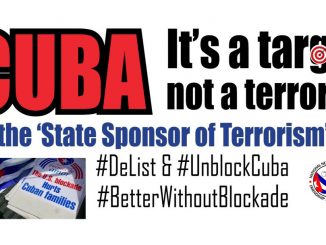
Punishing Cuba: the self-serving ‘State Sponsors of Terror’ list

On Sept. 25 car and bike caravans in many U.S. cities are rightly demanding that Cuba be taken off the U.S. State Department’s “State Sponsors of Terrorism” list. 

Didn’t know there was such a thing?

Every presidential administration appoints a secretary of state. Now it is Antony Blinken; before him was Mike Pompeo, and under Obama it was John Kerry and Hillary Clinton. And the president, through the secretary of state, can put countries on this list or take them off. It is arbitrary. 

As a parting slam against Cuba, on Jan. 12, 2021, just eight days before Joe Biden assumed the presidency, the Trump administration condemned Cuba once again. And Biden has let it stand, although he can waive provisions or decide to remove Cuba from the list altogether.

There are automatic consequences, not only for the country put on the “naughty” list, but other countries, businesses and even individuals. The State Department website says sanctions “include restrictions on U.S. foreign assistance; a ban on defense exports and sales; certain controls over exports of dual-use items; and miscellaneous financial and other restrictions.” 

Okay, the U.S. won’t give foreign aid or sell weapons or export “dual use” items – like how Washington blocked chlorine to purify water in Iraq when that country was on “the list,” or how it designated Pastors for Peace/U.S.-Cuba Friendshipment school buses and toasters as possible “dual use” items!

But let’s look at “miscellaneous and other restrictions.” Additional “sanctions laws that penalize persons and countries engaging in certain trade with state sponsors” are activated. 

If a relatively small country like Cuba wants to buy ventilators or other medical equipment, raw materials for their life-saving vaccines, or anything on the international market, who will trade with it when threatened by the U.S.? 

There are plenty of examples of mega-fines levied by the U.S. against major foreign banks, corporations like Honda and even Airbnb. Is it worth the risk of irritating Uncle Sam to trade with a small market of 11 million people?

There is no knowing what else is activated, just by putting a country on “the list,” until you run afoul of it. If a vacationer from England enjoys a vacation at Varadero, snorkeled, or enjoyed a bird-watching or cigar aficionado trip – perfectly legal in their country, unlike the U.S. – they are surprised if they decide to visit the U.S. 

The U.S. excludes these individuals from using the visa waiver program simply because they enjoyed a Cuban beach. They may not get an appointment for a visa interview for months. 

Even U.S. states have automatic laws prohibiting sales to countries on “the list.”

Who is the real terrorist?

What gives the United States the authority to call anyone a terrorist? 

Cuba was again voted to be part of the United Nations Human Rights Commission. A Cuban woman got the highest number of votes for the Convention on the Elimination of All Forms of Discrimination against Women (CEDAW). On Nov. 2 and 3 the U.N. General Assembly will again call on the United States to end its one-sided war against Cuba – as it has for 30 years.

Pro-blockade politicians try to use the scary word “terrorism” to stop people from looking for the facts. Is it really terrorism to help end racist South African apartheid? At a time when police and their agents were assassinating Black leaders like Fred Hampton, Mark Clark, Malcolm X and Martin Luther King Jr. was it wrong to give refuge to Assata Shakur? Was it wrong to host peace talks to end the civil war in Colombia? These are some of the excuses that are given to divert from the real reasons.

Cuba gained independence and sovereignty through a revolution. Cuba prioritizes human needs and development, not exploiting workers to make a handful of billionaires rich. It has no landlords or predatory bankers. Instead of restricting rights, Cuba expands rights, consultation and participation. 

Compare Cuba’s new Families Code referendum on Sept. 25 with the U.S. Supreme Court’s reversal of Roe v. Wade, denying bodily autonomy – the most basic of human rights.

“Will the real terrorist please stand up?” The title of this documentary made by Saul Landau as the world fought to free the Cuban 5 from U.S. prisons seemed irrelevant on Dec. 17, 2014, when the U.S. decided to switch Cuba strategies — Gerardo Hernandez, Ramon Labanino and Antonio Guerrero, the last three Cuban heroes, flew home, free from U.S. penitentiaries. 

But after Jan. 12, 2021, the history of U.S.-sponsored terrorism against Cuba and its friends became important to review. 

It is important to note that Cuba has never attacked or threatened the United States. Never planted bombs in hotels, shot bazookas at the United Nations or assassinated diplomats in the streets of New York or Washington, D.C., never spread biological toxins or attempted to assassinate political leaders. In fact, it was information from Cuban intelligence in October 1984 that prevented the assassination of President Ronald Reagan in North Carolina. 

All of the actions described above were, however, carried out by the U.S. and its agents against Cuba.

The Oct. 6 anniversary of the first midair bombing of a commercial airliner will be recognized in Barbados with a renovated memorial to Cubana Flight 455 and the 73 people who died. Luis Posada Carilles, who died a free man in the U.S., organized and paid for this mass murder.

At the same time, communities across the U.S. are asking for better relations with Cuba. Most recently, the City Council of Willimantic, Connecticut, called for the U.S. to end the blockade in a 7-2 vote. 

It is likely that ratio could be applied to the entire U.S., where resolutions representing more than 41 million residents have been passed in labor unions and city councils, state legislatures, school boards and county commissions.

A small but important first step toward justice is for President Biden to remove Cuba from this scurrilous and self-serving list. Do it now!

As we support the heroic Puentes de Amor monthly caravans through the streets of Miami by creating support actions in our local communities on the last weekend of each month, let’s raise the demand to #Delist along with #UnblockCuba. 

All out for Cuba on the weekend before the vote at the United Nations, Oct. 29-30!

Strugglelalucha256
https://www.struggle-la-lucha.org/cuba/page/20/