Havana and the world: Al Mayadeen interviews the Cuban President (Part 2)
written by Struggle – La Lucha
March 21, 2023
In an exclusive interview for Al Mayadeen, the Cuban President talks about Cuba’s stance on the war in Ukraine and his country’s relationship with Russia, China, and other countries.
Media Network Chairman Ghassan Ben Jeddou interviews Cuban President Miguel Diaz-Canel. Photo: Al Mayadeen
During the second part of Al Mayadeen Media Network Chairman Ghassan Ben Jeddou’s interview with Cuban President Miguel Diaz-Canel, the president discusses Cuba’s assessment of current alliances, in addition to its position on the war in Ukraine.
The Cuban president discussed the solid relationship that consolidates his country with Russia, China, and Iran, as well as his country’s relationship with Latin American leaders and what he aspires for in the Arab region. He also expressed his admiration for Syrian President Bashar al-Assad, and his desire to visit Damascus this year.
The world that Cuba aspires to
During his interview with Al Mayadeen, Diaz-Canel said that “the assessment of alliances in today’s world must be on the current context, and on an analysis of the current situation,” noting that this is related to what happened in the world, as the world is going through a multidimensional crisis.
He stresses that the situation has also been exacerbated by the Covid-19 pandemic, which has plunged the world into a state of uncertainty.
Diaz-Canel added, “Instead of enforcing the language of cooperation and respect for one another, the world has resorted to imposing new sanctions and resolving conflicts using the language of war.” “This is not the world we want and I think it is not the world that the majority of people on Earth want.”
“Today,” the Cuban president said, “we need a world capable of globalizing solidarity, peace, and friendship, a world that has a system of relations that defends pluralism,” noting that “this world is being built in accordance with common values based on peace, solidarity, friendship, and pluralism, which are capable of preserving, first and foremost, the human race.”
He added that this issue was former Cuban President Fidel Castro’s concern from an early age, and it was mentioned in many of his messages to the world on various international occasions and that Cuba aims to resolve conflicts through dialogue and for the world to become more democratic.
The Cuban president asserted to Al Mayadeen the need to change the “current global economic system, because it is based on exploitation and inequality, serves the rich at the expense of the majority of the world’s poor, and does not offer developing countries any alternatives, as it is subject to the interests of military-industrial complexes and great Western powers.”
If “we are able to achieve alliances that contribute to achieving pluralism, understanding, respect for others, and the struggle for peace… these alliances will then be valid and supportive.”
In the same context, he refers to the Bolivarian Alliance for the Peoples of America (ALBA), the alternative adopted by Latin America to confront the ALCA Free Trade Agreement, which represents an imperialist project.
One of the most important reasons for the success of these alliances is, according to Diaz-Canel, that they are based on cooperation, solidarity, and sincere stances and not on concepts that prioritize money and the economy.
The president stressed that the Cuban revolution is based on sharing what it has with others, and that this is what the future of the world should be like.
Blame for Russia-Ukraine war lies with Washington
Regarding Cuba’s position on the Russian-Ukrainian war, Diaz-Canel stressed that this conflict has serious consequences for the world, not just the parties involved.
The president accused Washington of using its power of influence through the media to spread Russophobia and disinformation on the origin of the conflict, labeling Russia as a culprit while concealing the real reasons behind the war.
He stressed that “the culprit in this conflict is the United States itself, which resorts to wars to solve its problems and overcome its crises,” adding that “Washington puts the interests of the military-industrial complex at the forefront, as it needs the war to sell weapons and to solve the internal problems it suffers from.”
The Cuban president indicated that the US has always sought to encircle Russia by promoting NATO expansionism on its borders, which he says Russia is aware of. The countries that are accomplices in the war will lose the most, he added, as they began to suffer from food shortages and an energy crisis, while those directly involved in the conflict are losing human lives.
The biggest beneficiary of the war, he said, is the US administration, and there need to be initiatives at the international level that facilitate the process of dialogue between the concerned parties to put an end to the war.
Diaz-Canel reiterated his country’s disapproval of the continued use of the language of war and the imposition of sanctions against Russia instead of dialogue, as these measures do not solve crises, but rather exacerbate the state of war. He added that the way Western nations are dealing with the crisis may drag the world into a possible world war.
He further wondered how Europe, which was the theater of two previous world wars, and the theater for Fascism and Nazism, is incapable of extracting the necessary lessons from history to play an effective role in avoiding a third world war.
Cuba’s relationship with China
Speaking about Cuban-Chinese relations, the president stressed that his country and China enjoy historical and friendly relations based on common principles that bring the two countries together.
He added that his country shares convictions with China regarding a structured socialist path in both countries that takes into account the specificities of each; both countries also share strong relations at the levels of their governments, peoples, and parties (the Communist Party of China and the Communist Party of Cuba).
Diaz-Canel praised the Chinese model of socialism and reform and its establishment of a firm economic base, which transformed it into one of the world’s great powers. He added that China adopted a distinguished position in terms of cooperation and solidarity, as is the case in Cuba, referring in this context to the initiatives and proposals presented by Chinese President Xi Jinping to achieve more harmony on the global level.
The Cuban president said that during his visit to China at the end of last year, he felt assured by the clear Chinese desire to support Cuba out of its crisis. He pointed out that during the visit, decisions were taken regarding the development of bilateral relations.
He said that China is one of Cuba’s main economic partners and that it is directly involved with Cuban energy, transportation, and telecommunication projects, referring also to the wide exchange between the two countries in terms of education, culture, science, technologies, and innovation, calling China “a friend of Cuba.”
Cuba’s relationship with Russia
Regarding Cuban-Russian relations, Diaz-Canel affirmed the high level of political, economic, and commercial relations between Moscow and Havana.
He added that Russia is present in the most strategic sectors that were developed within the national plan for economic and social development in Cuba until 2030: the energy sector, transportation and communications, cybersecurity, the mineral sector, the industrial sector, and in food production.
Diaz-Canel discussed how Russia sent a plane to assist his country during the Covid-19 pandemic and placed it at the disposal of Havana to transport oxygen cylinders imported from various places in Latin America and the Caribbean. He added that while Cuba was in a crisis, Russia donated factories to help it produce oxygen, and many concentrators, as did China.
The Cuban president touched on his recent visit to Russia, pointing out that he saw that Russian President Vladimir Putin understood Cuba’s problems and Moscow’s political and governmental will to help alleviate the problems his country suffers from. He added that since that visit, Cuba has constantly been updated with regard to the agreements with Moscow, especially concerning energy and food.
He stressed that China and Russia are friendly states and that Chinese President Xi Jinping and Russian President Vladimir Putin have demonstrated the will to embody a true friendship with Cuba.
During the interview with Al Mayadeen, the Cuban president did not hide his admiration for his Russian counterpart, pointing out that Putin’s speeches are rich in historical references. He added that Putin is constantly referring to lessons from history in order to reaffirm what is happening today, and what needs to be done in the future.
He added that “I don’t think it was Putin who caused the conflict with Ukraine, they were about to impose a siege on the Russian Federation,” pointing out that the Russian president is defending Russia’s interests and security.
“Dialogue with the Russian president is not impossible, but rather possible, provided that it is linked to a sincere will and without the imposition of preconditions.”
Cuba’s relationship with Iran
Speaking about Cuban-Iranian relations, the Cuban president described Iran as Cuba’s sister nation. He said that the foundations of the relationship between the two countries are based on history and mutual respect, as well as the great resistance that the two people waged in the face of imperial blockades and sanctions.
According to the Cuban president, “the Cuban and Iranian people share an understanding of resistance, courage, heroism, dignity, and defiance to the plans of imperialist power.”
He also expressed his appreciation for the Iranian leader, Sayyed Ali Khamenei, as a politician and as the leader of the Iranian Revolution, admiring his “tremendous capability for logical thinking and analysis,” also describing him as a wise leader.
The Cuban president indicated that the two countries are working on joint projects that serve the economic development of both, especially in the fields of energy and food. He pointed out that Iranian President Ebrahim Raisi might visit his country while also expressing his desire to visit Tehran this year.
Diaz-Canel stressed to Al Mayadeen that this year will witness a deepening of relations between the two countries, and the adoption of projects that are of mutual benefit. He specified both nations share mutual projects that include scientific research, technology, and energy.
The Cuban president expressed his admiration for Iran’s culture, civilization, and resistance against aggression, and said that the technological development that Iran has achieved despite the embargo and sanctions is very important, and multifaceted, pointing out that being familiar with Iran’s development can benefit Havana.
Diaz-Canel pointed out that the late Venezuelan President Hugo Chavez sowed hope in Venezuela, shining throughout Latin America, and that Venezuela has always been an important country and played a key role in Latin America, especially during Chavez’s leadership of the Bolivarian Revolution.
He added that many values have come together in Chavez, as he was Bolivarian in thought par excellence, was well versed in the history of Latin America and the Caribbean, and was an exceptional defender of Simon Bolivar’s thought and of the pioneers of liberation in Latin America.
The Cuban president noted that “Chavez was able, as an exemplary leader, to understand the concerns and aspirations of the Venezuelan people,” adding that the friendship between former Cuban President Fidel Castro and Chavez, “was like a father-son relationship.”
In this context, he referred to the achievements made by the two countries during the Chavez and Fidel eras, especially with regard to the ALBA.
He added that when Chavez was head of the Bolivarian Revolution, he was preparing cadres who were distinguished by their true commitment to the revolution’s path, to the Venezuelan people, and their loyalty to the revolution, referring in this context to Venezuelan President Nicolas Maduro.
The Cuban president described Maduro as a brother to Cuba, and admired how he defended the Bolivarian Revolution against all destabilization attempts planned by the US government. He pointed out that “Maduro, with his efforts and persistence, was able to achieve civil-military unity, preserve the Bolivarian Revolution, and move it forward on the path of victory.”
Cuba and Colombia
Speaking about Colombia, the Cuban president said that there is now a government in Colombia that prioritizes dialogue with Venezuela, adding that Nicolas Maduro and Gustavo Petro have agreed on a whole set of measures that also aim to ensure peace in one of Latin America’s most important regions.
Cuba and Brazil
The Cuban president also described his Brazilian counterpart, Lula da Silva, as an exceptional leader, pointing to his prominent role in extracting Brazil from its economic crisis, which turned it into a reference for what can be achieved in the policy of social justice, adding that “Lula doesn’t suit US interests, so the administration worked to discredit him by fabricating legal cases against him.”
He added that Lula did not surrender and did not accept any conditions to be imposed on him, despite his imprisonment and the pressure exerted on him to subdue him. He complimented the Brazilian president, stressing that his new projects help develop programs and investments in the country.
Cuba and Nicaragua
The Cuban president also expressed his admiration for the Sandinista revolution in Nicaragua, noting that it was a success the United States could not bear, and against which it launched a fierce campaign of destabilization, backed by a fierce media campaign to discredit Nicaragua.
“Therefore, I believe that whenever we want to assess the situation in Nicaragua, we must start from where we proceed in our analysis of what the Sandinista revolution contributed to in the areas of economic and social development for the Nicaraguan people, and what the Sandinista revolution means in terms of building a state with national security, and remove everything related to imperialist distortion and tampering.”
Cuba’s relationship with the Arab world
Regarding the island’s relationship with the Arab world, Diaz-Canel affirmed that Havana has good relations with Arab countries based on respect and mutual understanding of the historical and cultural specifics of each country.
He pointed out that there was space for cooperation, for the defense of common struggles, and coordination of efforts in international forums, adding that Cuba has always felt the solidarity and support of the Arab communities.
Diaz-Canel stressed that there is room to deepen the already strong ties on the economic and commercial level, as the historical foundations laid out for these relations are strong and Cuba looks to strengthen this relationship with the Arab world.
The Cuban president expressed his admiration for Syria’s courage, steadfastness, and self-confidence in the face of an aggressive campaign aimed at destroying it, noting that Syria, after many years of the unjust war against it, remained a strong and united nation.
In this context, he praised the role of Syrian President Bashar al-Assad, “The Syrian president has shown sincerity to his people and has remained at the forefront without giving up… I have always seen a great deal of steadfastness and composure in him.”
Before concluding the interview with Al Mayadeen, the Cuban President renewed his support for Syria, saying that Havana will remain with the Syrian people, and condemned the ongoing Israeli aggression against it, as well as the sanctions imposed on the Syrian people.
The Cuban president expressed his desire to visit Damascus this year and admired the nation’s steadfastness and the solidity and dignity of the Syrian people.
Cuban Revolution, U.S. embargo: Al Mayadeen interviews the Cuban President (Part 1)
written by Struggle – La Lucha
March 21, 2023
In an exclusive interview for Al Mayadeen, the Cuban President touches on the Cuban Revolution, its challenges, and achievements, as well as U.S. manipulations.
Media Network Chairman Ghassan Ben Jeddou conducted an exclusive interview with Cuban President Miguel Diaz-Canel, during which the latter discussed the Cuban Revolution and its challenges, international relations, the situation in Latin America, and the blockade imposed on Cuba.
In the first part of the 3 hour interview, the Cuban President touched on the concepts on which the Cuban Revolution was based and Cuba’s position on the progressive, revolutionary, and resistance currents in the world, as well as the protests that the country witnessed in 2021 and Cuba’s policies toward the new generations.
The Moncada and the Revolution
Speaking about the pre-revolutionary period in the country, Diaz-Canel told Al Mayadeen that the 50s was a terrible decade for Cuba and the Cuban people, as it came after years of imperial domination of Cuba where the country had turned into an American colony.
He pointed out that whatever strategies were put in to camouflage this situation and its essence, the situation stemmed from the frustration of the struggle for Cuban independence in 1895.
He specified that at the last moment of the war for independence, when Cuba had practically defeated Spain, the first imperialist war occurred, referring to the U.S. interference in the Spanish-Cuban War, which was later called the Spanish-Cuban-American war.
Diaz-Canel continued that “far from achieving its real independence, Cuba became a colony of the United States government,” and since then, the country has been ruled by a number of submissive governments and agents of the empire, administrative corruption prevailed, and an oligarchy — that did not defend the interests of the country or the Cuban people, but rather was defending the interests of the United States — became more enrooted.
Back then, according to the Cuban President, the United States seized practically all of the country’s natural resources and started investing in Cuba. Thus, the Cuban people reached a very complicated situation where illiteracy increased and no one practically owned a home.
The situation back then was described by Fidel Castro in his self-defense document titled “History Will Absolve Me,” thus, the Moncada was the program that Castro developed for launching the Revolution, Diaz-Canel said.
Speaking about the pre-revolutionary period in the country, Diaz-Canel told #AlMayadeen that the 50s were a terrible decade for #Cuba and the #Cuban people, as it came after years of imperial domination of Cuba where the country had turned into an #American colony. pic.twitter.com/POeMZxGyDy
The Cuban leader considered that in the case of Cuba in particular and the complex situation that it was living in, the Revolution was necessary with no other solution available, and therefore, it was very acceptable — a revolution that completes the true independence of Cuba.
Diaz-Canel explained that for this reason, the Revolution, which meant primarily making profound changes in Cuban society, was accepted by the majority of the Cuban people and was a completely dynamic and liberating process that gave Cuba true independence, sovereignty, and self-determination.
Thus, the revolutionary process began to advance along a set of social achievements, which gave the right to free education, free health, and sports for everyone, as well as the spread of world and Cuban culture, he indicated.
“It was a process of reaffirming the cultural values on which the Cuban nation was built, throughout its years, basing all its actions on the law, that is, always defending what is just,” he added.
He pointed out that one of the basic concepts of the Revolution has always been achieving the greatest possible amount of social justice, taking into account culture in its broadest sense, and not referring only to artistic and literary creativity, but rather taking into account the values that have formed in the Cuban nation over many years, and highlighting the best of those values enjoyed by its people in the revolutionary process.
Likewise, Diaz-Canel asserted that the Revolution never deceived the people. In fact, the Revolution asked the people to read in order to believe and granted them the right to learn, he said.
All of this was linked to the thought of Commander-in-Chief Fidel Castro and his legacy and the continuity that General Raul Castro later attributed to the revolutionary process, Diaz-Canel added.
The Revolution renewing itself
The Cuban President said the Revolution was in a state of continuous boiling and was constantly transforming and changing, adapting to all the complex historical moments that it had to pass through.
According to Diaz-Canel, one must ask how this Revolution, which was born besieged and encircled since its inception, by the main imperialist power and the most powerful superpower in the world, could resist all the sieges, sanctions, aggressions, and currently the tightened siege and widespread media attacks that seek to discredit the Revolution and undermine its authority and model.
He said that when one thinks about the attitude the U.S. adopted in its dealing with the Revolution that only wants the well-being of the Cuban people, there is only one answer for that: It did so out of hatred and malice because it was disturbed by the model of this Revolution.
The Cuban President stressed: “I believe that we are continuing the Revolution, and the Revolution will continue to advance despite the difficulties,” highlighting that “the majority of the Cuban people will continue to support this Revolution, and for that, we must continue in a state of revolution within the Revolution.”
On the other hand, the Cuban President explained that the world is witnessing a very difficult situation and is full of uncertainty. “We have just suffered from an epidemic that destroyed the models of neoliberalism,” he considered.
He said that despite the many years of neoliberalism and the promotion of a lot of propaganda that supports it – when a complex moment has come – the world found that neoliberalism is unable to solve all the problems of the epidemic with equality and inclusion of all people.
Diaz-Canel pointed out that health systems in the most advanced capitalist countries had collapsed, and a question was raised about how to explain the neoliberal world’s failure to provide alternatives to the majority.
“Since the world has just gone through a pandemic, I think we still cannot talk about the post-pandemic stage, as there are still more than 20 countries in the world that have not even been able to vaccinate 10% of their population, and we see that there is a lot of inequality,” the Cuban leader explained.
He noted that amid the pandemic, there was a very selfish attitude on the part of the oligarchy, and the rich became richer while the poor became poorer.
“This is why we see this inequality that arises in the capitalist societies themselves, and then this inequality leads to rebellion and leads above all to the rebellion of the youths, and the new generations as well,” he added.
Diaz-Canel stressed that regardless of the way it is implemented, the Revolution will continue to be an alternative and will remain an aspiration for the youth.
However, he underlined that it will inevitably be necessary to take into account the historical stages and to conduct a critical analysis of revolutionary experiences, not to see revolutions from an idealistic point of view, but from all their contradictions and the situations they overcame.
The Cuban President highlighted that in today’s world, there is a deep revolutionary feeling and an embrace of Marxist ideas, and one sees that there is much hope for these generations to build a better world.
He noted that he felt that because he had the opportunity to talk to many young people who visit Cuba from different parts of the world.
Diaz-Canel pointed out the need to preserve the environment as an indispensable condition for preserving the human race, pointing out that all these trials and deep reflections on the multidimensional crisis that the world is going through today give an answer that revolution is still an alternative.
Cuba and the revolutionary progressive currents
When asked about the new progressive left in Latin America and the world, the Cuban President said that in the region, there is a historical reference that indicates the need to delve deeper into these ideas and provides the basis for the continuity of these progressive leftist ideas.
Diaz-Canel believes that a huge part of the people of Latin America has embraced these ideas, noting that in recent years “we have witnessed stages that express this historical continuity in the independence experiences of Latin America and the Caribbean.”
He explained that the situation that the U.S., with its neoliberal practices, led the region to saw an increase in inequality in Latin America and subjected the population of most Latin American countries to a very complicated situation.
The Cuban President considered that it has become necessary for revolutionary experiences to take place, just as a decade passed in which a whole group of revolutionary experiences arose in response and as an alternative to this situation.
According to Diaz-Canel, the exemplary experience in this sense was the Venezuelan experience, where Hugo Chavez, who was a well-established Bolivarian and well-versed in Latin American history, carried out a Bolivarian Revolution in Venezuela.
He continued that, at that time, the experience of the Bolivarian Revolution coincided with the Nicaraguan Revolution, the Cuban Revolution, the Cultural Revolution in Bolivia, and the Citizenship Revolution in Ecuador, as well as the experience of Luiz Inácio Lula da Silva in Brazil and that of Cristina Kirchner in Argentina, among others.
When asked about the new progressive left in #LatinAmerica and the world, the #Cuban President said that in the region, there is a historical reference that indicates the need to delve deeper into these ideas and provides the basis for the continuity of progressive leftist ideas. pic.twitter.com/eqWRZZxPYp
Diaz-Canel noted that there was also a progressive president in Paraguay and Uruguay, which allowed the consolidation of a whole set of integration measures in Latin America and the Caribbean where millions of Latin Americans no longer suffered from hunger and were able to change their social status after all these progressive governments initiated measures of a social and economic nature in the interest of the majority.
However, the Cuban President pointed out that imperialism did not stand idly by and tried to undermine those movements that were an expression of those progressive and leftist ideas, pointing to the countless vicious, divisive acts that the U.S. government, with the support of its huge media, applied to bury these experiences.
“We all know how they carried out a parliamentary coup in Paraguay, how they caused the impeachment of the President of Brazil, Dilma [Rousseff], and how they also prosecuted a group of Latin American leaders politically,” Diaz-Canel said.
“We are still witnessing judicial persecution against [former Argentine Vice President] Cristina Kirchner, and how they tried to carry out a coup under the auspices of the Organization of American States against the Bolivian experiment led by Evo Morales,” he noted.
But the Cuban leader indicated that Latin America is witnessing a cycle in which the defense of those leftist ideas and work to strengthen them began again.
He said that in the decade in which all the aforementioned experiences converged, an integration mechanism for Latin America was achieved, highlighting that through this mechanism of integration in less than ten years, Venezuela, Nicaragua, Bolivia, and Ecuador were able to win the battle of eradicating illiteracy.
First illiteracy-free region in Latin America and the Caribbean
According to the Cuban President, this achievement holds much significance for Cuba, which declared itself the first illiteracy-free region in Latin America and the Caribbean, pointing out that it took more than 50 years with authentic and real complementary experiences in Latin America and with human, revolutionary, and progressive ideas, for other countries to realize what previously seemed like a figment of the imagination.
Diaz-Canel said that for many people in other parts of the world, this is still a dream and an out-of-the-reach matter.
He recalled that with this process of integration between Latin American countries, what was known as Operation Miracle was achieved, restoring sight to millions in Latin America who would not have had it in the circumstances that they were living in countries implementing neoliberal projects and programs.
The Cuban leader explained that Petro-Caribbean projects became consolidated on the basis of sharing energy resources in Latin America and the Caribbean.
Diaz-Canel also highlighted that other consultation mechanisms were established, such as the Union of South American Nations (UNASUR) and the Group of Latin American and Caribbean States (CELAC), where for the first time, 33 countries from Latin America and the Caribbean sat down to discuss their problems together without the U.S. presence or participation.
He also pointed out that Latin America and the Caribbean have now decided for themselves freely, on the basis of the concept of unity within diversity, to announce the document declaring Latin America and the Caribbean a region of peace.
This was specifically approved during the summit held by the Group of Latin American and Caribbean States (CELAC) in Havana, which also guarantees or proposes the full political will of Latin America and the Caribbean as a zone of peace, according to Diaz-Canel.
He underlined that Cuba supports and respects these experiences, stressing that his country will continue to defend, understand, and respect everything that can be done in order to achieve a better world based on the most humane, revolutionary, liberating, and comprehensive stances.
The new generations
In the same context, the Cuban President pointed out that the new generations today that lead leftist courses have learned lessons from history, having analyzed the historical watersheds of the left in the world, thus understanding the need to unite while accounting for diversity, in order to establish a robust framework for the revolutionary struggle.
According to the Cuban President, valuable lessons have been drawn on why socialism has failed in Eastern Europe, and lessons have been drawn from revolutionary endeavors in the world.
He added that the claims and intentions of imperialism at this time have also been analyzed, confirming that it is not possible to talk about a new left or a renewed left or a left that gives continuity to historical milestones if this left is uncertain of its course, what it seeks, or its origin.
“We must bear in mind that imperialism today is developing a whole concept of world domination, and therefore it is ideologically based on an integrated program to restore the momentum of capitalism, neoliberalism, and cultural colonialism,” he said.
“The only means that imperialism employs to abolish identity and destroy nations, culture, and the roots and essence of our peoples is precisely through cultural penetration [ideological subversion] that lures people into skepticism and dismisses all their ideas as obsolete,” Diaz-Canel said.
“Understanding these attitudes is what unites us all to defend our essence, in a common defense of culture and identity, to avoid cultural colonialism and the domination of only one thought that prevails in the world, which is why it is also important to analyze the problems of the left, which, in itself, is lost in problems of neoliberal globalization,” he added.
The Cuban President added, “If we ask what has been globalized? Selfishness has been globalized; it is the language of war. Aggression has also been globalized, leaving social inequality in its wake. It is the imperialist logic, and in the face of this imperialist logic, the logic of the left, or progressive logic, must prevail.”
“In our case, we have a socialist logic, however, we never turn down criticism of our ideology, but I believe it is fundamental to eliminate human exploitation of man to have equality among all the inhabitants of the planet and to distribute wealth in a better manner,” Diaz-Canel said.
“It is very difficult to understand today that in this world of inequality, where so many are impoverished, millions and millions of dollars are being employed in war budgets or spent on armaments,” he said.
“How much more can the world do for the benefit of all its people if these funds are used for other purposes? How much more can be accomplished if there is more integration, if there is mutual respect, and if there are genuine decolonization programs and programs that actually create opportunities for all,” he wondered.
Challenges the Revolution faced
The Cuban President said, “When I was elected President of the Republic, I said that before anything else, we stand as the generation of continuity; [historical] continuity in the dialectical sense of the word, the kind that stands up for the essence of the Revolution that shall lead the Revolution to perfection as well.”
He further explained, “In other words, it was not a generation that wanted to maintain a rigid pace in the development of the Revolution, so in this concept of continuity, a set of values from the historical legacy of the Revolution is also adopted.”
Diaz-Canel believed that “among those values stands out the courage that Fidel and Raul engraved in us; courage that extends throughout our wars for independence and our decision to firmly defend sovereignty and independence and defend the right to self-determination of the Cuban people. In the same sense, the concept of broader communication with the people stands out.” According to Cuba’s leader, the aforementioned constitute elements that shall always distinguish the stance that “we, the revolutionary cadres and fighters, will take in our lives, especially in the most difficult moments.”
“We will always stand up against adversity, we will always stand up against the most difficult, most complex moments, with courage yet calmly because they are moments that we should consider deeply and analyze thoroughly. Such moments cannot be handled in an indecisive spontaneous, disorderly, or arrogant manner,” the Cuban President stressed.
He went on to say that “such are moments in which you must study the reasons and contradictions that are inflicted on the facts, before anything else, followed by looking for the best solutions with the participation of everyone.”
He added, “I always say that none of us can know more than what we all, combined, know, and I believe that the Cuban people have proven throughout their history that they enjoy the talent, strong will, and valor… that they are heroes who regard their dignity highly.”
Diaz-Canel pointed out that the Cuban people have been under siege for more than sixty years, and continued that his generation, which was born after the Revolution, is “a besieged generation since then. We have lived under siege, but this is something that we shared with our children and grandchildren.”
Furthermore, the Cuban President indicated that “the generations that were born after the Revolution are generations that lived their entire lives under the pressure of the blockade, under the aggression of the blockade, under the repercussions of the blockade, but still, the Revolution did not stop, and it stood in the face of the blockade and was able to develop its programs and projects, although the blockade stood out as the main obstacle in the face of achieving all the aforementioned.”
It goes without saying that “the blockade is a fait accompli that slows down our aspirations and the realization of our projects and dreams,” he tersely stated.
Diaz-Canel added that, starting from the second half of 2019, a very delicate situation prevails, whereby the Trump administration announces more than 243 measures against the Cuban Revolution, which intensified the blockade.
He continued, “Therefore, we are not talking here about the blockade imposed in the sixties or the seventies, nor about the blockade in the ‘delicate period (the nineties).’”
“We are talking about a very intense siege that the world is still experiencing, and based on scrutiny and analysis that we conducted within the leadership of the Revolution at the time, we explained to the people, within a long notice, the problems that we will face,” he added.
The Cuban President stressed that “we have prepared our people in a way that makes it clear to them that we are stepping into a stage full of complications, in which we will face a shortage of food, medical supplies, fuel, spare parts, and foreign currency that enables us to obtain the necessary supplies for our basic productions, as well as providing food and solving the people’s basic problems.”
With Trump’s 243 measures, all sources of the country’s foreign financing were suddenly cut off, and at the same time, the United States initiated up-close monitoring at the level of finances and energy resources against the country with the U.S. government making every effort to prevent, by all means, the entry of fuel into Cuba or that Cuba obtain credit or any sort of financing regardless of how scarce it may be, according to the Cuban President.
Diaz-Canel recalled how, in January 2020, Trump placed Cuba, just a few days before the end of his term as President, on the U.S. list of “state sponsors of terrorism,” which is a made-up, fake list. The reason is that, according to the Cuban President, when a country is arbitrarily included in that list, all banks and financial institutions agencies start to sever ties with the relevant country, thus weakening most of the sources of foreign financing, which are already affected by Trump’s other measures.
He explained how up to this very day, a lot of effort is required if any Cuban tries to conduct business dealings or settle certain payments “because almost no bank wants to be involved in that ever since the sanctions were imposed.”
According to the Cuban President, Trump’s sanctions included activating Chapter Three of the Helms-Burton Act, which imposes the internationalization of the blockade and punishing countries across the world, meaning that the “Great Empire” even imposes restrictions on the rest of the world [in their dealing with Cuba].
He further explained how the insistence on applying these sanctions over time, as pursued by Biden’s administration, without any change is causing a more severe shortage in supplies of medicines, fuel, and raw materials necessary for Cuba’s main production operations and electricity generation, not to mention hindering the rest of the production and service processes in the country.
Attempts to fail the Revolution
The Cuban President pointed out that alongside these intense problems, which have social repercussions, leading people to develop a sense of resentment and misunderstanding of the situation that started to occupy their lives, the Corona pandemic hit in March 2020.
Therefore, almost all the conditions for a perfect storm were in place, paving the way for a social explosion that the U.S. government longed for in order to fail and put an end to the Cuban Revolution, he further explained, revealing that all this was accompanied by a large-scale U.S. intel operation.
Diaz-Canel stressed that Cuba has evidence and information which clearly show how they led an intense campaign aimed at discrediting the Cuban Revolution on social networks seeking to spread frustration and create estrangement and misunderstanding, knowing that the campaign was directed particularly at the youth category.
“It must be noted that at the beginning of the pandemic which was indeed exacerbating in light of this whole situation, we still dispatched medical teams to countries with pandemic hotspots, as we learned a lot about the disease and were immediately able to develop a plan to combat it, which allowed us primarily by the end of 2020 to reduce the number of infected cases so as to curb a major outbreak,” he further detailed.
The Cuban leader pointed out that they decided to open the borders in 2020, and when they actually did, the Delta strain took over, and since they had not obtained their vaccines at the time, the result was a Delta-instigated pandemic that lasted for about a year.
“All this happened amid the [dire] situation we were in,” he said.
Shedding light on the effect of U.S. sanctions, Diaz-Canel went on to say, “We pursued our program to confront the pandemic, and when we decided to open new intensive care units that we were in dire need of, the United States government prevented companies that manufacture ventilators which are extremely necessary in intensive care rooms or units from selling them to Cuba. Thus, we came across an oxygen-supply crisis, because consumption was higher due to the high number of patients and because our factories faced major setbacks.”
During his interview for Al Mayadeen, the Cuban President stressed that the United States government pressured companies in Latin America not to sell us the medical oxygen that Cuba desperately needed and prevented the arrival of medications and vaccines as well.
He went on to say that amid this entire dire situation, they launched a hypocrisy, disinformation, and slander campaign under the title of “SOSCUBA” at the level of international networks.
#AlMayadeen Media Network Chairman Ghassan Ben Jeddou held an exclusive interview with Cuban President Miguel Diaz-Canel, during which the latter discussed the #Cuban Revolution and its challenges.
The Cuban President assessed that all the aforementioned factors, coupled with the dire situation of the Cuban population, have conditioned the Cuban scene for cooptation.
According to Diaz-Canel, Cuba tolerates criticism of the government and provides citizens with suitable mechanisms and platforms for doing so, but what happened in 2021 was something else.
The protests were far from peaceful, and this became clear very soon. After the authorities began their investigations, they uncovered the underpinnings of these protests, revealing the monetary incentives for rioting and vandalizing.
This was what happened on July 11, 2021, the Cuban President said, adding that some had gone out to protest oblivious of the underpinnings, while others were paid to riot and vandalize. “These were not peaceful protesters; they attacked shops and public security forces, trying to disrupt social stability. They were trying to destroy the most significant element of Cuban society that the Cuban citizens are largely fond of: tranquility and reassurance,” he added.
He pointed out that “these were unpleasant times, but lessons were learned, because here, unlike other places in the world, the security forces or the armed forces did not go down to the streets to crack down on the rioters. Instead, they were the revolutionary Cuban people who came out to defend the Revolution.”
“We were the first to arrive at one of the outposts from where the protests broke out, and we explained to the people the situation we were living in,” he said, stressing that “in one day, practically all the nodes of subversive protests were contained and eventually dissipated.”
He added that on the second day, in a neighborhood in Havana, another subversive stunt was pulled but it was short-lived.
“There was a whole scenario prepared by the ’empire’, which was to manufacture an inflated scene of social unrest that would serve as the necessary pretext for the United States to intervene by ‘providing humanitarian assistance’. And we have already seen how the United States ‘provided humanitarian assistance’ for other countries of the world,” the Cuban leader highlighted.
“There are many examples in the Arab world and in Africa, when the United States came with its humanitarian aid in brackets, the conditions of the recipient people and governments deteriorated if anything. It was not humanitarian aid; it was effectively invasions, aggressions, and military interventions – that was the case in Libya and Iraq and other places, and we also have the dirty war that they waged against the Syrian people and nation,” he said.
“These events unfolded like a scenario whereby if Cuba calls on the population to defend the Revolution, then they would have called for a civil war,” Diaz-Canel said, explaining, “Never ever has anyone come out here with weapons to suppress anyone. Had the armed institutions intervened, it would have been possible to say that there was police and armed repression.”
“The second part of the scenario was that when people were to be tried before the law as any country in the world would do in cases of rioting, they would be advertised as political prisoners of the ‘regime’ as they like to portray us. No one has been arrested here, and no one has been subjected to judicial proceedings for simply protesting the situation in Cuba,” he said.
Diaz-Canel stressed that in Cuba, there has never been police repression, unlike the situation in the United States, adding that “they also tried to manipulate the situation, claiming that we were harsher with Blacks than with whites, when, in Cuba, we have programs contending all form of discrimination, especially racial discrimination.”
“It was all just manipulation and fake news; they broadcast these lies to discredit our achievements that are not subject to their purposes and objectives, he said, explaining that had there been supposedly a case of large-scale social unrest in Cuba, the United States would have capitalized on any chance to prove the failure of the Revolution.”
“Despite this, what did they do on social media? They posted pictures of a supposed demonstration that was actually a football festivity in Argentina, and they took pictures of the people demonstrating in support of the Revolution, claiming that they were against it. It was unbelievable: Gerardo Hernández, one of our iconic five heroes, was at a pro-Revolution demonstration, and they still presented it as anti-revolutionary,” he added.
“Does the truthful use such cheap tools to discredit an enemy? Only the U.S. government does it, and it does it out of hatred and insolence,” Diaz-Canel said, stressing that this is the reality of the manipulated events.
Evaluation and social transformation
“What happened next? We learned a lot, made our assessments, went to a debate, and the same palace halls we visited today were spaces for exchanging ideas with representatives of various sectors of Cuban society, including young people,’ the Cuban President highlighted.
“We have also gone on a process of social transformation in Cuban neighborhoods where inequalities have accumulated. We also have people and families in vulnerable situations, regardless of all the social actions of the Revolution, but this is the case because we have lived for years with many needs, even with a lot of deprivation as a result of the tightening of the blockade.”
According to Díaz-Canel, “All the proposals of the population are transmitted to their municipal councils, where citizens are represented on the grass-root level. Then the things that have been approved go back to those neighborhoods, and the residents of the neighborhoods participate in the transformation that they have themselves proposed, and they also exercise popular control we increasingly seek to improve our democracy, and here we have provided essential participation to our youth.”
“How does the story continue? I had to ask our scientists if the production of a Cuban vaccine would be sufficient to be sovereign in the fight against Covid, which was one of the catalysts for this whole situation. I did it in March 2021, and also in July, just three months later,” he said.
The Cuban President added, “A few weeks later, Cuban scientists had already obtained the first vaccine bulb, and then we had five vaccine candidates, today there are three vaccines with tremendous efficacy, so we started a huge vaccination campaign, after conducting clinical trials, emergency studies on vulnerable groups.”
He went on to say, “When we got the vaccines, we had achieved this amid all this crisis. Despite the pressure and the tight blockade, we achieved the highest vaccination rates in the world, and today, we rank second among countries that have provided the largest number of vaccine doses per patient, we are among twenty countries with more than 90% of the population fully vaccinated, and with the reinforcement, we were the first in the world to vaccinate children over the age of two.”
“What are the results? Today we have 0.67% deaths, knowing that the mortality ratio is the ratio of deaths to the number of COVID cases. The average mortality ratio in the world is 1.05%; in Latin America and the Caribbean, it is 1.45%.”
He stressed that Cuba had more competently handled the pandemic and had a more successful strategy in the face of the pandemic than the government of the United States and many developed countries in the world that adopted a neoliberal line. Cuba outperformed all these developed countries in a difficult position and under a tight blockade.
The Cuban president added, “Who was caring for the most vulnerable people in neighborhoods during the pandemic? They’re the young Cubans, no one else.”
Development of public policies
“We have never stopped [engaging in] dialogue with the Cuban youth, as we constantly engage with them and visit universities, and they participate in the basic tasks of the Revolution. We take part in discussions and conferences held by the youth and youth organizations, and the Cuban youth groups are represented in parliament by their peers,” Cuba’s President said in his interview for Al Mayadeen.
He further explained that young Cubans participate in temporary action groups that work on developing public policies, which later lead to the emergence of laws approved by the National Assembly.
“We are currently in an endeavor with the participation of young people, as we set a general policy for youth and childhood, which allows us to reach a law in which we provide more guarantees for the youth and children,” Diaz-Canel added.
He also pointed out that “the main issue is how to continue to work with our youth on the basis of the Revolution-founded values so that the generational difference between those who launched the Revolution and those who defend it today and the new generations does not turn into an ideological difference and a rift.”
The Cuban leader stressed that this matter is “a challenge ahead of us and herein lies its beauty, but I believe that we will achieve it because we are already doing it today and the majority of our youth are with the Revolution, regardless of whether they live today in a society whose capabilities are limited in a way that does not allow the full realization of the aspirations of their projects in life.”
He further told Al Mayadeen, “All of this has led me to wonder: How can a country living under such dire circumstances, in which chaos would have prevailed had the schemes plotted against it succeeded, defeat Covid? The country has now reached a post-pandemic stage, and we started to revitalize our economic and social life, and still, the measures meant to tighten the blockade are still in place.
According to the Cuban President, the Cuban people have developed the capacity for resistance, which is not only to resist and endure the blockade; rather, it is the resistance that prevailed in the past year and shall move forward, overcoming the current adversities by relying on the talent and efforts of the Cubans.
“This is how Covid was defeated. Armed with the notion of everyone works for everyone, we focused on saving the lives of Cuban men and women, and we achieved that,” Diaz-Canel emphasized.
He went on to say, “And just as we succeeded in the case of Covid, we will continue to succeed, and we will continue to make achievements with the participation of our youth.”
National Network on Cuba condemns Biden’s report & false designation of Cuba as a ‘state sponsor of terrorism’
written by Struggle – La Lucha
March 21, 2023
February 28, 2023
There is no mistake about it. With the February 27 release of the State Department Country Report on Terrorism 2021, President Biden accepted ownership of the illegal U.S. economic war on Cuba, following suit with Donald Trump, George Bush, and Ronald Reagan’s hawkishness with the false designation of Cuba as a so-called “State Sponsor of Terror.”
Unbelievably Biden’s Secretary of State asserts that “Cuba had repeatedly provided support for acts of international terrorism since its State Sponsor of Terrorism designation had been rescinded in 2015.” Despite this untrue report, Pres. Biden need only review the past six months and accept Cuba’s unequivocal rejection of terrorism to take Cuba off the list.
The real purpose of slandering Cuba as “terrorist” is to justify the criminal blockade on Cuba. Biden is choosing to join his predecessors in failure – failure to defeat the Cuban people’s centuries-long determination for sovereignty and self-determination on the road to equality, full human development and socialism.
The Country Report on Terrorism repeats the same discredited excuses that over 180 of the world’s countries have rejected for 30 consecutive years in votes at the United Nations General Assembly. The U.S. war on Cuba is increasingly rejected by the U.S. public, whose elected officials in government and unions — representing over 44 million U.S. people — have called for Cuba to be removed from the State Sponsors of Terrorism (SSOT) list and that the U.S. end the blockade and take steps to normalize relations with its much smaller neighbor.
With Cuba’s SSOT designation, the U.S. attempts to criminalize normalizing relations with Cuba, exacerbating the already devastating impacts of the US blockade on Cuba. It makes it harder for Cuba to make international transactions or borrow loans for building infrastructure and buying essential food and medicine. The SSOT designation also punishes people from 40 non-U.S. countries for traveling to Cuba by threatening their eligibility for the U.S. visa waiver program.
During his presidential campaign, Biden said he would reverse Trump’s harsher sanctions and revert to the Obama administration’s policies of normalization, but he has failed to deliver. President Ronald Reagan put Cuba on the list in 1982 because of Cuba’s support for anti-colonial liberation movements around the world and because Cuba gave asylum to political prisoners who escaped persecution by the U.S. government. President Barack Obama removed Cuba from the SSOT List and began to normalize relations with Cuba. Trump added 240 additional harsh sanctions on Cuba and, at the very end of his term, re-designated Cuba as a State Sponsor of Terrorism on January 11, 2021, just days after the fascist insurrection at the Capitol. Biden is continuing the long history of U.S. terror towards Cuba, which includes the Bay of Pigs invasion, funding Cuban exiles to bomb Cuban planes and hotels, and attempting to assassinate Fidel Castro 638 times.
We have seen the results of Biden’s ‘freedom, democracy and human rights’ in his administration’s record number of deportations, COVID deaths, and police killings; in crumbling U.S. infrastructure; in the economic crisis of the American working class; in the never-ending violence and mass-shootings fueled by white supremacy; and in his imperialist policy toward Cuba and the entire Global South.
Despite the devastating impacts of the U.S. economic blockade, Cuba still has a longer life expectancy, lower infant and maternal mortality rates, better health outcomes, higher literacy, more education, and less violence than in the U.S. We support the right of the Cuban people to determine their own path, free from coercive economic measures and U.S. taxpayer-funded destabilization. We support the right of the entire Latin America and the Caribbean to a Zone of Peace, free from the Monroe Doctrine of U.S. intervention and economic exploitation.
We call on justice and freedom-loving people to join us at the White House on Sunday, June 25, to demand Biden take Cuba #OFFTheList and end U.S. terror on Cuba. Biden, write the letter. Take Cuba #OFFtheList and end the blockade. Let Cuba Live.
Guantanamo: The meaning of 120 years of illegal occupation
written by Struggle – La Lucha
March 21, 2023
To a great many people of the world, the word Guantanamo has become synonymous with torture since the U.S. opened up its military prison center there in 2002. Over 780 people captured by U.S. forces have suffered from massive human rights violations there carried out by the CIA since that time. For the people of Cuba, a society that places human rights and well-being above all else, this is a collective horror carried out on their sovereign soil by a foreign military.
This article hopes to go beyond that because today marks the 120th year of continuous U.S. Naval occupation of Guantanamo. Our president Miguel Diaz Canal made the collective sentiment of the Cuban people clear this morning, “Our sovereignty was severed, this day in 1903, when Tomás Estrada Palma signed the cession of the territory that remains illegally occupied by the United States against the will of the Cuban people”.
The 1903 signing was a “Treaty for the leasing of naval and coal bases,” which gave the United States the right to use four of the island’s best bays to build military facilities. The treaty was signed under Article VII of the Platt Amendment, a document drafted by the U.S. Congress and annexed to the recently passed Cuban Constitution (1901). It was a mandatory action to end the U.S. occupation that had already lasted four years. The amendment was nothing but the lid of the grave on the recently born Cuban “independence.” It drew out clearly that for U.S. troops to leave, Cuba will have to get U.S. approval for any and all significant decisions of the country.
The framework of international law does not adequately represent the sentiment of the Cuban people; to them, the signing of that treaty was nothing but an act of coercion by the hemispheric power over a small country that bore the heavy cross of a constant threat of military intervention, a threat that is ever-present today.
The naval station base’s history, its details, and the U.S. military forces’ usual overseas excesses have been addressed in a number of articles and books during these 120 years. However, the Cuban people’s feelings, especially those who have lived near the military base, are the best legal and moral argument to understand why it is a territory seized by force and illegally occupied.
For them, those almost 118 square kilometers represent more than their proven geographic or economic importance. It is something that goes deep into the nation’s soul. There are still some witnesses among local people who remember how the facility shaped their lives for over five decades.
Before our revolution in 1959 Guantanamo was a place where education and health services barely existed, but there were plenty of bars and brothels. Even the scarce water sources were dedicated exclusively to satisfying U.S. Marines’ needs. For local people, it was like being foreigners in their own country. Today, this reality is only a bitter memory, but the base remains an anachronistic symbol that prevents us from obtaining our complete sovereignty. Of the more than 750 U.S. military bases that dot the world, Guantanamo is the oldest.
During the armed struggle led by Fidel Castro in the Sierra Maestra, the U.S. military devised several plans to fabricate a pretext to invade the island or provide more aid to Batista’s dictatorship to defeat the rebels. After the Triumph of the Revolution the U.S. military moved towards real actions. From the base, they supported counterrevolutionary groups, planned attacks against the Revolution’s leaders, and even launched mortar attacks against local populations.
It was during the early years of the revolution when the Border Brigade was created to protect the area, perhaps not from a possible attack, which was always a possibility, but more from provocative acts along the border of the base that went as far as the assassination of two Cuban soldiers. Thousands of young Cubans have passed through this military corp there in six decades, ensuring that this enduring blight on our country is understood by each generation.
Although tensions along the border have decreased to the point of cautious co-existence, disrespectful behavior towards Cuban soldiers seems to be an inheritance. Pointing rifles at Cuban posts, especially those guarded by women, or violating Cuban territorial waters, are persisting practices.
From the perspective of a young Cuban soldier from the Border Brigade, the Cuban military uniform has an additional value in that place. People understand much better how much honor it carries and how much responsibility it implies. He also explained about the affront that takes place at 8 a.m. every morning, when the U.S. anthem resounds thanks to dozens of loudspeakers installed on the base’s perimeter. The sound floods the silent characteristic of the desert areas and extends to the nearest towns and surrounding Cuban military camps.
Despite the passage of time, no one has gotten used to it, and every morning they share the same feeling that the Cuban poet Bonifacio Byrne expressed in his poem “My Flag” when he returned to Havana at the beginning of the U.S. military occupation:
“Eagerly I looked for my flag
and I saw another next to my own!
today I loudly say
that two flags should not float
one is enough: mine!”
This feeling explains why this is the region where the Cuban flag flies with incomparable beauty, even though the landscape seems desolate and is not impregnated with the typical greenery of the Cuban countryside.
That feeling cannot be wielded in an international court by any of the best International lawyers. However, every Cuban who has had a foot in this zone would be able to convince the toughest of juries that Guantanamo Bay is illegally occupied, a usurpation of the land that belongs to all Cubans that can only continue with the vilest blackmail lingering from 120 years ago. It is the only possible explanation since no Cuban has ever accepted the vile nature of the yanqui naval base in our Guantanamo.
As happens every year, the act known as the presidential State of the Union address has just taken place in the U.S. Capitol, an exercise that has been carried out publicly and uninterruptedly since 1913 and that aims to provide a kind of balance on the situation of the country and the development of the agenda of the first president, who at that time is in power. George Washington initiated the practice in 1790, but Thomas Jefferson discontinued it (the public session) in 1801.
With the passage of time, this exercise has become one more act of political campaigning, which for its simplicity at times competes with the contents of the so-called reality shows, whether on television or social networks.
During most speeches over the decades, every president has claimed that his administration has been the best of all past and future administrations, consistently criticized his opponents and proclaimed them guilty of his failures both inside and outside Congress, and, as a rule, pointed to external enemies as demons responsible for all planetary ills. Rarely is there any introspective, self-critical, or factual analysis.
It is also an act that gradually loses originality because the poses are the same, the signs are repeated with the index finger towards the audience with the other hand placed on the heart, the formal applause is repeated when naming special guests who are in the audience and some of the ladies present wipe with similar discipline real or figurative tears when mentioning recent deaths (which are always in terms of ultimate sacrifice) or other events that provoke unequaled emotion.
More than 90% of the time the television cameras are focused on the figure of the president, plus the vice-president and the leader of the House, who are positioned behind the former. Depending on whether or not these actors belong to the same party, their histrionics, clapping and facial gestures are more or less intense.
In spite of this, an army of U.S. analysts is attentive before, during and after the speech to draw conclusions of all kinds, measure records, build scenarios and talk about agendas and legacies, even if the incumbent government is more, or less, efficient. Phrases are coined and headlines are launched for 24 or 48 hours, until new events bury the whole event in history.
In this text we do not intend to make an analysis of the content of the last text, since at this moment other specialists are engaged in these ponderations from the Cuban perspective and will expose their results shortly.
In this opportunity, the presidential phrase that caused immediate commotion among some politicians, journalists and observers who make a career in that country at the expense of the “Cuban issue” and that led them to use their thumbs intensely to write urgent messages on social networks on their cell phone screens, was said by the president after the speech.
It was at a time when Biden was not speaking officially in front of the cameras either, but was clapping his hands in a friendly manner and politely greeting friends and personalities present, who came to listen to him. In the first circle that gathered around the president when he came down from the podium, there was not the recipient of a phrase that the president addressed to him when he recognized him from a distance. Biden waved his hand and said, “Bob, I really need to talk to you about Cuba.” Screenshot 2023-02-11 at 19-36-50 Title President Joe Biden talks with Sen. Bob Menendez after 2023 State of the Union address Fox News Video
Bob is Robert Menendez, a Democratic senator who is chairman of the Foreign Relations Committee, recently survived corruption charges, and claims to have the “ear of the president” on Cuban issues. In other words, he is the alter ego of Marco Rubio, who apparently had access to the same part of the body ofTrump with relative ease.
Bob and Marquito have competed for years in the management of federal budgets for “regime change” in Cuba, with which they have guaranteed lifetime salaries for their supporters and sufficient contributions for their reelections. By the way neither of them have been able to link their names to any legislation of significance to ordinary Americans.
Upon hearing of Bob’s subpoena, the speculative mushroom cloud immediately spread over Miami. Some congressmen with less flight time (and brain cells) began to express concern about “possible concessions to tyranny”, others waited a few hours to reiterate the litany of issues that separate them from the ideological borders with the island.
There has been terror, for example, at the speculation that there might be some relaxation of the rules limiting the rights of U.S. citizens to travel to Cuba. Imagine thousands, tens of thousands, hundreds of thousands of Americans picking up the rhythms of 2018 and 2019, visiting the Island to return and say “but in Cuba I did not find enemies, I was treated with more civility than in other destinations”.
Among those who classify themselves as “experts on Cuban issues”, because they drink cortadito coffee, eat yucca for lunch once a week and hum Guantanamera without being able to quote the verses, crossword puzzles were set up to imagine the future decisions of the White House regarding Cuba.
In practical terms, what has been happening in recent weeks is that limited steps have been taken “in the right direction” and the damage to the bilateral relationship caused by the previous misgovernment has been minimally corrected. A new cycle has been completed, according to which the irresponsible actions of the U.S. authorities on the immigration issue (and many others) with respect to Cuba, had a direct impact on the generation of an irregular flow of migrants, which does not contribute to the national interest of the United States as a whole.
After listening as president-elect to the summaries of federal agency specialists, which indicated the end of history for Cuba, an already acting Biden waited for months in silence to make a first move on Cuba. Then came the “events of July 11” and the recycled Obamistas felt they had reason enough to wage their own war.
As much as they talked about police abuses, convictions of minors and repressed artists, they managed to confuse many, but only for a short time. The chain of events that they expected (the collapse) did not happen and that they predicted later for a November 25 that did not register any events to speak about. It was enough, rather than leaders with alternative platforms and popular demonstrations, the planners of hard and soft coups saw from their computer screens how those operatives who were part of their “new Cuba” obtained visas, packed their bags and transited through Cuban airports on trips abroad without being disturbed.
The White House quietly asked around Pennsylvania Avenue for answers and found none. Then came another attempt to isolate Cuba at the international level, but still without a proper reading of the events taking place in the Latin American and Caribbean environment. And then came the spiritual fracture of the nasal septum with what happened at the Summit of the Americas organized in Los Angeles. The one who was going to isolate the others remained isolated (for the umpteenth time). The remake of Cartagena de Indias.
No one knows for sure if when Biden said “seriously” to Bob, he meant to ask him for advice that really worked, or to ask him to account for previous proposals that proved to be no longer functional.
Anyone who has had the opportunity to know how American protocol works knows that there are no coincidences, no unplanned phrases, no open microphones by chance. This was not the case when President Obama greeted Army General Raul Castro during Nelson Mandela’s funeral.
Obviously, no one is talking about the secret behind the events referred to is that a process of exchange similar to what happened then can be foreseen, among other things because Cuba, the United States and the world have changed profoundly. There is another radically different ingredient; Washington and Havana do not need to “start” a negotiation, because they are fully aware of those issues that make sense for bilateral cooperation and those on which there are irreconcilable differences.
Moreover, behind each of the 22 memorandums of understanding signed between 2015 and 2017, between the US and Cuba, there is literally a legion of experts, scientists, academics, businessmen and ordinary people who defend the desirability of a constructive dialogue with Cuba. That position also extends to the communities of Cubans living in different parts of the U.S. geography that have seen postponed for years the possibility of hugging a relative, visiting the grave of a friend on the Island, sharing with their godfather of religion, or listening in silence to the rhythms of a music that has been tried to be copied many times, but that only sounds good in the largest Island of the Antilles.
We do not know if the dialogue between the president and the senator, between Joe and Bob has already taken place, however what does seem to be a reality is that some are once again strongly defending in those latitudes the “contaminating embrace” versus the “destructive attack”, or a combination of both, but leaving a space that allows firsthand knowledge of what is happening in Cuba and also to have the possibility of interrelating (and influencing) with the Cuban actors in a direct way.
Although the White House is covering its ears, the Latin American and global message that Cuba is a full and active member of both communities, in which it also has great leadership capacity, is increasingly heard. The G77 plus China has just said it loud and clear.
José Ramón Cabañas Rodríguez is the former Cuban Ambassador to the United States
‘Power, no matter how absolute, has not succeeded in silencing the oppressed’
written by Struggle – La Lucha
March 21, 2023
Appeal to the World’s Conscience by the Network in Defense of Humanity
When many thought that the bitter lessons of the pandemic would lead political leaders to try to build a more caring, inclusive and generous world, exactly the opposite has happened. Perhaps there is truth in the rumor that this attitude is due to their aim of reducing the world’s population by 25%.
A war of unforeseeable consequences has broken out, amid the avalanche of lies spread through the media and social networks, and pressures from powerful forces opposed to any attempt to achieve peace. Sensible voices warn about the danger of a nuclear conflict and go unheeded, while the arms industry, bellicose speeches and the stimulation of fascism and xenophobia grow.
Other voices, equally unheeded, speak of famine and an imminent humanitarian catastrophe due to the uncontrolled rise in the prices of food, oil, gas, export and import operations and many vital services. The main victims will be the hundreds of millions of poor people barely surviving in subhuman conditions.
At the same time, the environmental crisis is worsening alarmingly, and the agreements and negotiations to halt the collapse of the planet are not only far from approaching the measures that urgently need to be adopted, but the issue is increasingly absent from political discourse and from media consortiums.
Meanwhile, a reinterpretation of fascism is being encouraged as a salvation plank in the face of the increasingly radical demands of the sectors excluded by capital; this is becoming more visible in the United States, in Europe and in various Latin American countries, as could be seen on Nov. 18-19, in an event of the international ultra-right in Mexico, convened by the Political Conference of Conservative Action, with the virtual or face-to-face participation of extremist figures of the new fascism. This reinterpretation is also presented as an urgent necessity to put an end to the supposedly disintegrating threats of a “communism” presented as cartoonish, immoral, destroyer of the family and of Christian values.
Today, social media plays a decisive role in manipulating the emotions and perception of reality of millions of human beings. Hate groups, racist, misogynist, homophobic, anti-immigrant, and ultra-nationalist, proliferate on them, presenting themselves to young people as bearers of “new,” “modern,” “virile” messages, proper to the “victors.”
In this role of limiting the exercise of critical thinking and distorting the very meaning of the concept of democracy, the big corporate media, commercial advertising and the hegemonic entertainment industry also play a highly effective role.
Never before has the effort to erase or distort historical memory been so advanced. Never have we suffered such a devastating cultural and ethical crisis, which has mixed what is worthwhile, what we should preserve, love and remember, with a deluge of frivolous, irrelevant, “fun” messages. Never has culture been so degraded to mere merchandise, to mere empty pastime. Never has the colonial presence in our lives and in our subjectivity been so overwhelming. Never has the cultural hegemony of a small group of corporations that obtain multi-million-dollar profits while defending the interests of the system gone so far.
The Network in Defense of Humanity calls on all people who love peace and life to unite their voices to stop barbarism. All doors have not been closed. Power, no matter how absolute, has not succeeded in silencing the cry of the oppressed and, on the contrary, it has always been the people who survive empires. History shows that the greater their radicalism, the nearer their end. Today, a multipolar world is emerging, as evidenced by the desperation of the United States and its European allies in the face of what this world means for the maintenance of their hegemony.
Let us join our efforts so that there will never again be hegemony in the world. Let us validate and defend our cultural diversity against the pretension of subsuming ourselves in the consumerist monotony. Humanity is all peoples.
Therefore, let us say as the great troubadour Alí Primera claimed in his song “El despertar de la Historia” (“The Awakening of History”):
Help her, help her
Let humanity be human…
V International Conference for World Balance, Havana, Cuba, Jan. 24-28, 2023
‘People in the U.S. have a lot to learn from Cuba’s Families Code’
written by Struggle – La Lucha
March 21, 2023
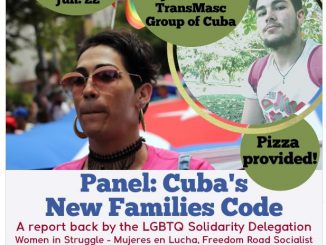
Talk by Gloria Verdieu of the Prisoners Solidarity Committee at the webinar “What We Can Learn from Cuba’s ‘Code of Freedom’ for Families,” hosted by Women In Struggle/Mujeres En Lucha on Jan. 22.
I remember my first trip to socialist Cuba in November 2000. I attended the Second World Meeting of Friendship and Solidarity. I have the poster that was given to all participants. It has a quote from José Martí: “The world is a beautiful temple where all men on earth fit in peace.”
I knew then and I know now that “all men” translates to “all of humanity.” We can all fit in peace on this beautiful earth — our home.
The reason I went on this trip was that I wanted to see what socialism looked like.
The conference was attended by people from over 60 countries condemning the U.S. blockade. I came with a delegation; buses took us to the many programs on our packed schedule. We visited factories, polyclinics and communities, where we learned about the Committees for the Defense of the Revolution (CDRs). There were cultural performances in these communities.
The daily events gave the delegates a chance to experience what life is like with a government that is concerned with the needs of the people rather than profits.
The delegates gathered daily at the Karl Marx Theater, within walking distance of our hotel. When I went walking, I did not feel any restrictions, though I did not wander too far.
We didn’t know if President Fidel Castro would speak at any of the conference gatherings. I figured not – with thousands of people there, it would be a big security risk.
During our final meeting at the Karl Marx Theater, Fidel appeared on the stage. No bulletproof glass barriers, no extra security checks that I was aware of.
Fidel began to speak; we were given devices for interpretation. People listened and listened until it was time for discussion. Fidel gave lengthy, thoughtful answers to questions, not only from the delegates, but from Cuban workers.
At one point a child ran on stage and Fidel gave him a hug and said something that I could tell was a show of affection for him and his family.
Healthcare in Cuba vs. U.S.
One of the many things that had an impact on me was when we visited one of the polyclinics.
There was a group of doctors at the clinic, and one explained to us how closely connected doctors are with the communities they serve. They know who smokes, drinks, takes drugs (prescribed or not), struggles with mental illness, which teenagers are sexually active – intimate details that individuals voluntarily share with their doctors. Doctors know the health of families in their community through home visits and family counseling.
Doctors were told things that we in the U.S. would not dare tell our primary health care provider, because it could mean higher monthly costs for those who have insurance coverage, or changing health care providers, which means transferring all your health history to another doctor. You can be denied coverage or even lose your job because of a chronic health issue.
Health care is a huge problem in the U.S. There have been many reforms, many updates to the system, and yet there are still millions of people who have minimal or no health insurance.
I continue to learn what socialism looks like and how participatory democracy works. I was impressed with the way Cubans at home and abroad were involved in the decision-making process of updating Cuba’s Families Code. Some 6.5 million people participated, a sincere display of democratic centralism.
As an organizer of the Socialist Unity Party’s Prisoners Solidarity Committee, one of the many things that registered with me in Cuba’s new Families Code is its promise to promote happy, healthy families. Everyone is included (great-grandparents, grandparents, aunts, uncles, nieces, nephews, in-laws, close partners), from the most senior members to the youngest, and everyone in between. You choose your family.
It also promotes the right to a family life free from violence and unprovoked stress. A family life that values love, affection, solidarity and responsibility.
I recently attended a day of solidarity with formerly incarcerated prisoners and families in California’s capital, Sacramento. So many things are wrong with the “criminal justice system” in the U.S., which is why we know that it cannot be reformed or updated; we must shut it down.
You can see and feel the grief and stress of the families with loved ones in prison, and of those recently released, who are having a difficult time transitioning to life outside. Housing, healthcare, jobs and community acceptance are some of the obstacles that formerly incarcerated individuals face.
There are over 2 million people in prison in the U.S. Many more are detained in immigration centers and holding cells awaiting litigation, affecting millions of families.
Cuba: ‘We encourage family to stay involved’
Gerardo Hernández, who was one of the Cuban 5 political prisoners held in the U.S., and is now head of the Committees for the Defense of the Revolution, highlighted the differences for families in Cuba: “Our purpose is to help. We talk with the family, we encourage the family to stay involved, because it is understood that the family suffers when a loved one is incarcerated.
“Prisoners need not be discriminated against because they went to jail. Our objective is not to make a repressive action against those persons but to help those persons, who are victims themselves in many cases.”
Cuba’s neighborhood CDRs number 138,000, with over 8 million members, and continue to work on programs and solutions to the problems of petty crime, drugs and mental illness.
The United States incarcerates more of its youth than any other country in the world. Most states continue to use outdated and harmful “training school” models, confining children in remote, prison-like facilities cut off from their families and communities.
Overcrowding and violence, prosecution of youths as adults, and the long-term consequences of incarceration on the individual’s chances for success in adulthood are huge controversies.
President Miguel Diaz-Canel stated, “before our people and the world, that in Cuba no one under 16 years of age is imprisoned!”
People in the U.S. have a lot to learn from Cuba’s Families Code, especially from the process in which it was passed. All citizens over 16 years of age were eligible to vote in the Families Code referendum.
We must support Cuba by demanding the U.S. government end the more than 60-year blockade and remove Cuba from the so-called “State Sponsors of Terrorism” list. We must demand normalization of relations and an open dialog with Cuba.
We must learn about socialism and Cuba’s participatory democracy. Socialism is the path to a better world for everyone.
‘Struggle against sexual and gender violence goes hand in hand with struggle for decolonization’
written by Struggle – La Lucha
March 21, 2023
Remarks by Berta Joubert-Ceci of Mujeres En Lucha/Women In Struggle at the webinar “What We Can Learn from Cuba’s ‘Code of Freedom’ for Families” on Jan. 22.
Buenas tardes compañeras y compañeros,
First, I wanted to thank Mariela Castro for taking the time to record this message. Because as we know, part of the effect of the U.S. blockade against Cuba is that the application Zoom cannot be used there.
As a member of Mujeres En Lucha/Women In Struggle, which is a member organization of the Women’s International Democratic Federation (WIDF or FDIM in Spanish), I also wanted to acknowledge the fact that Mariela’s mother, Vilma Espín, was instrumental in saving the FDIM after the dismemberment of the European socialist countries.
At that time, Vilma was vice president while the FDIM headquarters was in Berlin. And it was her swift action of saving documents and materials from that office, securing them, that preserved the FDIM from extinction.
Compañeres, this topic is also very pertinent to our process in Puerto Rico. As a colony of the U.S., we suffer in greater degree some of the ills that affect the U.S. Violence against women and LGBTQ+ people have been on the rise, including against children. This has been fueled by a rising wave of fundamentalist religious sectors that affect the government’s actions and policies and seem to be a copy and paste of what happens in the U.S.
So, for us here, the struggle against sexual and gender violence has to go hand in hand with the struggle for decolonization, for independence.
But as the poem of Lola Rodríguez de Tió says, “Cuba y PR son, de un pájaro las dos alas,” “Cuba and Puerto Rico are wings of the same bird.” We can look up to Cuba’s development and Families Code as an inspiration.
We hope to fulfill here in PR what is expressed in the introduction of the new Cuban Families Code: “The emancipatory conception of the family that guides the transformation of Cuban socialist society intertwines social interest and personal interest, promotes its development, contributes to the formation of the new generations and satisfies deep human, affective and social interests of the person.”
Cuban leader Mariela Castro Espín on ‘progressive conquest of new rights’
written by Struggle – La Lucha
March 21, 2023
Video message from Mariela Castro Espín, director of Cuba’s National Center for Sex Education (CENESEX) and deputy of the National Assembly of Popular Power, to the webinar “What We Can Learn from Cuba’s ‘Code of Freedom’ for Families,” hosted by Women In Struggle/Mujeres En Lucha on Jan. 22.
Greetings to all, I am Mariela Castro.
There are two main milestones in the Cuban Revolution regarding family law. One was the Family Code approved in 1975, which also went through a process of popular consultation and was taken to a referendum.
This code allowed for instituting important values that are being promoted in Cuban society for equal rights between men and women, especially in family life, in the equitable distribution of educational tasks and household chores, to begin to erode that patriarchal heritage of the sexual division of labor.
That code played a very important role and was considered one of the most advanced in the world at that time. Still a heteropatriarchal code, in some aspects, and hetero-normative specifically, yet not much more could be asked of Cuban society at that stage.
Education and scientific development, especially in the field of legal and social sciences and humanities, led to strengthening of Cuban culture regarding the family and family law. Progress was made regarding the rights of women.
All of this is reflected at a statistical level, as Cuba ranks second in the world for women parliamentarians: 53% of the Cuban parliament consists of women. There is an increasing presence of women in the National Assembly of Popular Power at leadership levels. Cuban women predominate in the sciences and there are several sectors of Cuban society at a professional level where the presence of women is increasingly greater.
In Cuba, there is respect for women, but the society is still patriarchal. Although the patriarchy has been eroded and weakened by the advances of our Revolution, there is significant resistance, and that creates challenges for us.
After 47 years of the Family Code being in force with all the new elements that were incorporated, the laws in which Cuba subscribed and committed itself as a state, laws in the field of international law, in the field of Human Rights,everything that our Revolution was advancing, it was already necessary to update that code.
But it began first, with the reform of the country’s economic and social development strategy with the participation of the people with their criteria, with their criticisms and their proposals. From there, it went on to the constitutional reform, which was a substantial reform of 2019 approved in April 2019, also subject to specialized consultation, popular consultation and referendum with a very high turnout. 87% of the population approved that constitution in which the rights of LGBT people were already protected, important paths were opened, for example, for what they call equal marriage, but also to strengthen greater protection for sexual health and reproductive, sexual and reproductive rights.
‘Heart, intelligence and wisdom of our people’
There are many other elements of the 2022 Families Code that you will be able to read on this valuable document that some consider to be the most advanced in the world, that is, international experts consider it to be so.
But this code, like the constitution, was written with the heart, intelligence and wisdom of our people. And so this is also called the heartfelt code because the bonds of affection are given precedence over the straitjacket of biological bonds.
This is truly very significant, despite the opposition of some religious groups and particularly the Catholic Church, to prevent the advances of the Revolution in the progressive conquest of new rights. This has truly been achieved with the participation of our people in reaching a widely accepted code, although it was the first in which there were 33% negative votes.
But that’s fine. It shows the resistance that still exists regarding these issues and all the challenges that they generate for us to continue transforming awareness that will allow us to create an active citizenry regarding the need for social and subjective transformations for achieving an increasingly just and equitable society.
The transition to socialism is complex and individual awareness is always in the rearguard. And this is what has been happening. That is the significance. Our people have approved a constitution and a very advanced family code within the context of a socialist society of rights and social justice.
I am very satisfied with the result, but I also feel the responsibility that we still have to continue advancing to permanently educate and communicate all the elements based on science that help provide elements of analysis to monitor and evaluate the application of this new legislation in family law.
I thank you very much for your interest in this issue, and I invite you to read this valuable document that has been the result of building consensus for the 47 years that the previous code lasted. This is the importance it has, how our society is advancing by becoming more aware and moving towards a much more conscientious culture regarding the issues that this code deals with.
Thank you very much for your interest and warm greetings. Until we meet again.
End the U.S. economic war against the Cuban people!
written by Struggle – La Lucha
March 21, 2023
Talk given by Cheryl LaBash, co-chair of the National Network On Cuba (NNOC), at the webinar “What We Can Learn from Cuba’s ‘Code of Freedom’ for Families,” hosted by Women In Struggle/Mujeres En Lucha on Jan. 22.
Sixty years is a long time. But that is how long the United States government, led by both Democrats and Republicans, has waged an economic, financial and commercial war against the Cuban people.
Even before that, the Eisenhower administration recognized that Fidel and the July 26th Movement – Raul, Che, Almeda, Camilo, Vilma, Haydee, Celia, Melba and so many more – would stay true to their promise: liberation, equality and sovereignty for all the Cuban people.
An April 6, 1960, State Department memo admitted the fact that the Cuban people supported the revolution. So it prescribed the path taken by the U.S. from then until today:
“Every possible means should be undertaken to weaken the economic life of Cuba,” the memo states. “If such a policy is adopted, it should be the result of a positive decision which would call forth a line of action which, while as adroit and inconspicuous as possible, makes the greatest inroads in denying money and supplies to Cuba, to decrease monetary and real wages, to bring about hunger, desperation and overthrow of the government.”
Although the goal didn’t change, the tactic did. On Dec. 17, 2014, President Obama and President Raul Castro agreed to begin a different road. President Obama even visited Cuba – and as a result many people wrongly believe the blockade ended then. Some things were eased, but behind it all, the coercive economic measures continued.
Then, in June 2017, President Trump declared he would return to the failed direction outlined by the State Department in 1960.
And then came the pandemic. Cuba had to close its main source of hard currency – tourism – and used its reserves to save lives, develop five COVID vaccines (three now in emergency use) and send its famous Henry Reeve Brigades to countries needing help against the pandemic.
U.S. uses pandemic as weapon
The United States saw its opportunity to use the pandemic as a weapon. Some 243 new measures were implemented to block any financial possibilities for Cuba. Surely the Cuban people would be desperate enough to embrace capitalist landlords, bankers and bosses.
Then as a parting shot, after the 2020 Biden election, Cuba was again declared a “State Sponsor of Terrorism.” Certainly an insult as well as an injury to Cuba.
Although President Biden has been in office two years, he has done virtually nothing to lift the pressure on the Cuban people. The SSOT can be lifted with a letter from Biden!
Instead, we have been inundated with propaganda about “human rights” to justify turning back the changes made by the Obama administration in 2014-2015.
There is no alternative truth. Cuba is not a state sponsor of terrorism, but has been targeted by terrorist acts organized and financed in the U.S. The intensified blockade has hurt Cuban families on both sides of the Florida straits. For three years, Cubans in Miami have said “end the blockade” in the streets every month.
And it hurts farmers, workers and ordinary people in the U.S., too. Cuba has developed medical treatments that make 70% of diabetic amputations unnecessary, and a lung cancer vaccine that prolongs the quality of life of patients.
Guess what? The U.S. categories of “legal” travel to Cuba do not include medical treatment. It’s the only country in the world where U.S. travelers need to declare a U.S. government designated category.
Elected bodies representing more than 44 million residents from California to Connecticut, from Montana to Michigan to Alabama, have called for the blockade to end, including city councils and labor organizations, school boards and county commissions. Find out how to get local resolutions where you live.
The last weekend of every month, caravans are held to end the blockade in Miami and cities across the U.S. and around the world. Make a sign with hashtag #UnblockCuba and #OFFtheList.
Stay in touch with the National Network On Cuba on social media. Web: NNOC.org; Facebook.com/CubaNetwork; Instagram: NationalNetwork4Cuba; Twitter: @NNOCuba.
Sixty years is too long. This campaign needs you to act now.