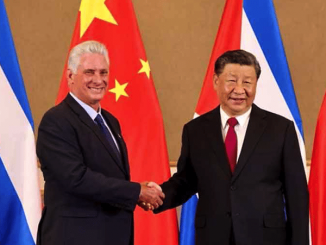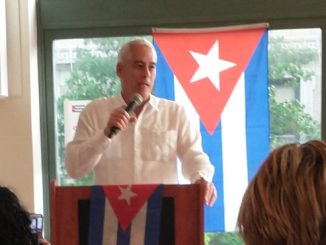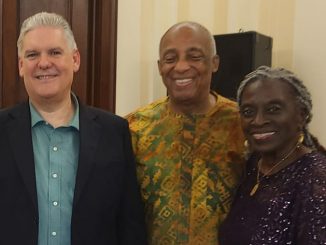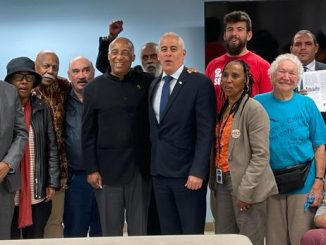
NNOC brigadistas detained and harassed

SLL photo: Cheryl LaBash

From: National Network on Cuba

Several of our May Day brigadistas were detained, harassed, threatened with jail time & had electronics taken by U.S. Customs/Border Patrol on return from Cuba today. In face of persecution, we reaffirm our right to travel to Cuba. SOLIDARITY IS NOT A CRIME – THE U.S. BLOCKADE IS!

This is an onslaught against Cuba solidarity activism. NNOC stands with @peoplesassembl_ & @ushandsoffcuba members detained returning from Cuba this week; as well as @APSPusa, @Puentesdeamor1, Puerto Rico CSC & Oklahoma activists who have been targeted by the U.S. government this year.

The U.S. says Cuba is a repressive police state, but in reality, we experienced freedom for the first time in Cuba, & when we stepped foot back into the U.S., we were immediately met with state repression, hostile interrogation, seizure of personal property & illegitimate threats.

Let’s not forget that our trip to Cuba was completely licensed & legal. This harassment by the U.S. government attempts to scare & intimidate the U.S. people out of traveling to Cuba & building solidarity with the Cuban people. But we know that our solidarity can never be blockaded!

From the very first U.S. brigades to Cuba, we’ve been followed, harassed & had our personal possessions seized by Border Patrol & the FBI. Today, we were interrogated clearly in a political nature, with questions designed to obstruct our movement against the blockade.

Above all, this backlash is a reminder of why our work is so important. United together, we’ll never back down! Join us in calling on Biden to LIFT the Blockade, take Cuba OFF the list of “State Sponsors of Terrorism,” and give Guantánamo BACK to Cuba.

#MayDayCuba2023 #OffTheList

Strugglelalucha256


Cuba holds impressive May Day demonstrations on their own terms

It was pitch dark at 4:30 as we started out to find that already thousands were taking over the streets chanting, Viva Fidel! Viva Raul! And Viva Diaz Canel! Moving with purpose past the Plaza of the Revolution, turning onto La Rampa and down towards the Malecon.

This is how Cuba dawned today in celebration. It was not the customary International Workers’ Day on May 1, but it was celebrated with great enthusiasm as if it were. Tens of thousands of Cubans in the streets and avenues of their communities, with banners, flags, and lots of music. Everyone walked to the event, including President Miguel Diaz-Canel, who arrived with other leaders of Cuba; waiting for them was Army General l Raul Castro Ruz.

The familiar attendees were there: the father with his son on his shoulder, the grandfather walking holding the hand of his granddaughter, known Cuban cultural and sports figures, and our many friends from other latitudes. There were the curious eyes watching from the balconies, private sector workers, the local Conga musicians merging with their energy and rhythm carrying drums and trumpets.

Over 300 Cuban municipalities held International Workers Day events today including 100,000 people at the Malecon in Havana.

Right at 7, when the sun began to rise over the Florida Straits, the Cuban National Anthem was played, followed by music and two talks that could be heard all along La Piragua at the foot of the emblematic and renowned Hotel Nacional.

Karen Urrutia Pérez, researcher at the Center for Genetic Engineering and Biotechnology, recalled that the Cuban scientific community responded to our president’s call on May 19, 2020, when he summoned them to create their own vaccines.

“May Day, the day of the world proletariat, is commemorated in a complex international scenario because of the global economic crisis and the ravages of a pandemic that left in its wake a trail of pain and death.”

“In Cuba it is even more challenging because of the cruel imperialist blockade for more than 60 years. Today we have absolute control of covid-19 and it is due to the effective protection of our vaccines, all this thanks to the greatness of scientists and health personnel,” she stressed.

Ulises Guilarte de Nacimiento, secretary general of the Central de Trabajadores, said that the celebration of the day of the workers was preceded by the International Meeting of Solidarity with Cuba, which allowed more than 1,000 representatives of 261 political, youth, trade union, and social organizations to share with work centers and neighborhoods, “where our realities prove the ability to overcome obstacles and shortages of our people, and reaffirm the solidarity and commitment that Cuba is not alone.”

Although this year the May Day parade changes its traditional scenario -commented the union leader-, the Malecon is a space of historical and multitudinous mobilizations, many of them led by Commander-in-Chief Fidel Castro Ruz to demonstrate Cuba’s right to its sovereignty and independence, including those held to demand the return of the child Elián González and the five heroes who spent many years in US prisons for defending their country against terrorist attacks.

According to the union leader, this celebration of the world proletariat is dedicated to the daily heroism of the Cuban people, and to the high responsibility and decisive contribution of the workers to achieve a superior performance of the economy, focused on raising and diversifying food production, the use of idle productive capacities and the increase of foreign exchange income consolidating the transformations demanded today by the socialist state enterprise.

The shortage of fuel in the country prevented the traditional march that takes place every year in the Revolution Square and the main monuments of the country.

To further complicate things on May 1st, there was a risk of a serious storm so the country’s authorities decided to postpone the workers’ gathering. The day before, on Sunday, April 30, heavy rains and strong winds knocked down trees and affected part of the technical equipment due to be used on May Day, creating the necessity to move all the events to today.

The corporate media took the opportunity to cast the decision to not have a march in the Plaza of the Revolution, where thousands of workers would have to be bussed in from the provinces, as a failure of Cuba, implying that it was a defeat rather than a pragmatic decision based on what is best for the people.

El Pais, The Guardian, and others made it seem that the shortage of gas in Cuba was their fault and not the blockade and the sanctions that are piled up against the island and its ability to function with any normalcy. “A Cuba Without May Day?” a sensationalized New York Times headline read.

Writing on how the corporate media operates, Fidel once explained how they come up with repetitive negative themes about Cuba, creating a conditioned reflex that takes away the capacity for many to think critically about what they are reading.

One thing clear today was that the tens of thousands of Cubans in the streets were anything but defeated.

The celebrations today also coincide with the 205th anniversary of the birth of Karl Marx, who characterized the exploitation of man as the source of surplus value, the very essence of capitalism and was “one of the paradigms of the struggle against domination; who believed in the decisive and radical social struggle to obtain freedom for all, and believed in the need for political institutions of the workers to make proletarian policies,” as Cuban philosopher Fernando Martínez Heredia described him.

“He deserves honor as he stood by the side of the vulnerable ones,” Jose Marti wrote in 1883 after hearing about his death.

This year there was no tight parade through the Plaza of the Revolution, but the world witnessed again that the Cuban people can stand against any adversity as long as they remain united, defending causes for justice and fighting from their space for a more just Cuba. There is much work ahead, but today was a day of pride.

Source: Resumen Latinoamericano – English with contributions from Cuba en Resumen


Strugglelalucha256


Returning Cuba solidarity activists harassed by U.S. Customs and Border Patrol

Havana, May 4 — This year marked the largest delegation of people from the U.S. in decades to be in Cuba for the events around the International Day of Workers.  Over 350 people from the states participated, and it was easy to see how youth made up the largest percentage, many of whom were visiting revolutionary Cuba for the first time.

Yesterday delegates began to return home, and some were met and detained by U.S. Customs and Border Patrol in multiple cities. One reported that several of them traveling with the International Peoples Assembly (IPA) and the LA Hands of Cuba Committee were yanked into secondary questioning pertaining to their political motives. At least two people had their phones confiscated. At this time, all have been released.

Imagine it, being harassed for being on a legal trip to the island to make friends with the Cuban people and to see for themselves the struggles that the Cuban people have had to endure while in the vice grip of a unilateral blockade that has been maintained through 13 presidents no matter which big business party was in power.

For many of us, we remember the battles at the borders as we fought to get symbolic aid to Cuba in defiance of the blockade on the Pastors for Peace Caravans, but this level of harassment has not been seen in years.

Not meaning to the Biden Administration has struck a rock because if they thought this would intimidate our growing movement in solidarity with Cuba, they are wrong. What I have seen this past week is a government here more concerned about the well-being of the next generation of U.S. youth than their own government that marginalizes them by constricting access to jobs with a living wage, which makes access to education nearly impossible without the burden of student loans that they will carry for years, and that incarcerates them at a rate like no other country in the world.

As of now, there has been no comment from the White House about the detentions but the President of Cuba has shown his concern by sending out the following message on his Twitter account.

“Cheer up guys, we’re with you. Thank you for your courage, for supporting #Cuba & for facing the hatred of those who cannot stand the fact that the Cuban Revolution has the support of the most progressive youth in the belly of the beast. We send you a big hug”. – Miguel Díaz-Canel Bermúdez. President of the Republic of Cuba.

Source: Resumen Latinoamericano – English

Strugglelalucha256


Cuban president meets with over 300 enthusiastic U.S. supporters pledging to end the blockade

Havana, May 1 — This morning, Cuban President Miguel Díaz-Canel received at the Palace of the Revolution 300 friends of Cuba coming from the United States to demand an end to the blockade. Brigades, groups, and other delegations are in Cuba to take part in the May 1 activities celebrating the International Day of Workers and to show their solidarity with the Cuban people who have withstood the longest continuous blockade in modern history.

Students, trade unionists, lawyers, and political activists are here, many making their first visit to the socialist island. Recognizing this, President Díaz-Canel said: “from the United States, we not only receive sanctions and blockades, we also receive your friendship, support, trust and hope.”

The president underscored the significance of what he described as one of the largest delegations to the island in decades while acknowledging that it was made up of a combination of people who were visiting for the first time and others with a long history of solidarity and support for the Cuban Revolution.

Voices of support for Cuba

Manolo de los Santos, co-executive director of The People’s Forum and researcher at Tricontinental: Institute for Social Research, explained how the struggle of the Cuban and North American people is the same, “it is the struggle against imperialism, it is the struggle against the domination of capital over lives and the planet; and it is the struggle for that future we all want to build, where we all fit, where diversity is respected, where there is social justice.”

He further noted that the delegation he brought has witnessed the strength of the Cuban people, how they resist and bring out the best of their creativity. “Our commitment upon our return will not only be to raise our voice, but to organize a different political project in the United States. We will always be by Cuba’s side,” he said.

Chris Smalls, a trade unionist who organized and founded the first Amazon warehouse union, was on the island for the first time and spoke about the immediate affinity that he felt with the Cuban people. “We have to build support against this cruel blockade. We have shown that when young people unite, it is impossible to impede the will of the people.”

Smalls recalled how after the union victory, President Biden invited him to the White House and told him that he was making a good kind of trouble and to keep it up. “That is exactly what I am doing today making trouble by calling for the end of the Blockade”

Although he acknowledged that he is aware that when he returns to his country, he will face many accusations for being here today, his message to Cuba was very clear in his words: “We love you, and we will fight with you until the blockade is lifted”.

Bill Camp, a labor leader in California who has been instrumental in getting labor council resolutions passed throughout the state to get Cuba off the List of State Sponsors of Terrorism, clearly stated the inspiration of many in the hall by saying, “We honor Cuba’s leadership because you have set the right course and we are very happy to be here”.

Many young people spoke, including Calla Walsh and Shaquille Fontenot, new co-chairs of the National Network on Cuba, who talked about the work ahead for the US solidarity movement, including a national protest to get Cuba off the unfathomable list of State Sponsors of Terrorism to be held at the White House on June 25th.

A better world is possible

In his words, the Cuban President shared how much it means to hold meetings like this one “with representatives of the American people, with representatives of the American workers, with representatives of the American youth, who come with this message of encouragement and support, which we know also requires an effort and has a price for you, because you must then face the hatred of those who are against Cuba, the hatred of those who are against the most progressive ideas in the United States.”

The blockade, above all, he stressed, is a “violation of the human rights of Cubans and condemns a people to vicissitudes that can only be explained by the arrogance of the policy of the United States Government.”

But be assured that “this is a people that has had the capacity, in the midst of so much aggression, to never confuse the genocidal policy, the criminal policy, the aggressive policy of the United States Government, with the kindness, friendship, values, culture and history of the American people.”

Source: Resumen Latinoamericano – English with contributions for Cubadebate and Granma

Strugglelalucha256


Help send a LGBTQ+ delegation to Cuba

Dear friend,

We are asking for your help to send an important LGBTQ+ delegation to Cuba this May to learn about the inclusive new Families Code and the impact of the U.S. blockade.

We’re all aware of the terrible attacks on the LGBTQ+ community in the United States, especially targeting our transgender and Two Spirit siblings. People’s rights to life-saving gender-affirming healthcare, and even to exist in public, are being legislated away in state after state. Queer spaces are besieged by right-wing mobs, including in cities like New York and San Francisco that were considered safe. Truly, we need to revive the spirit of Stonewall.

All the more remarkable, then, is Cuba’s incredible leap forward in LGBTQ+ rights with the passage of its new Families Code last year. Not only same-sex marriage, but equality of queer families before the law, equal standing for chosen families with biological families, parent-child relations based on rights and responsibilities, and mandated education promoting acceptance, support and full rights for all people – all this just 90 miles from Ron DeSantis’s Florida!

Cuba has long been a beacon to the people of the world, despite a grueling 60+-year U.S. blockade. And the LGBTQ+ community in the U.S. is no stranger to the Cuba solidarity movement.

This May a delegation of LGBTQ+ activists from the U.S., organized by Women in Struggle-Mujeres en Lucha, will travel to Cuba for a week of activity to learn about the new Families Code, how it was accomplished, and the detrimental impact of U.S. policies on queer communities and all Cubans. This delegation includes veteran organizers as well as several young people from across the country. Your donation will help ensure that these activists can bring these lessons back to our communities, where they are urgently needed!

To donate: Please DONATE HERE on PayPal or contribute through Venmo@SolidarityCenter. You can also make checks out to Solidarity Center and mail to 703 E. 37th Street, Baltimore, MD 21218. Do not write Cuba on checks or on electronic donations! You can use “for trip” in the memo.

Please give generously!

Yours in solidarity,

Bob McCubbin

Bob McCubbin is the author of the ground-breaking 1976 book, ‘The Roots of Lesbian & Gay Oppression—A Marxist View.’ McCubbin’s achievement was to offer a historical analysis of when, where, why and how LGBTQ+ oppression developed. In 2019, Struggle-La Lucha published McCubbin’s ‘Socialist Evolution of Humanity—Marx & Engels were Right!,’ an in-depth study focusing on human social/sexual relations and the changing status of women.

Strugglelalucha256


The war against Cuba

Cuba’s victories are piling up. There were many people who were full of praise for the victory of the U.S. baseball team in Miami, without expecting that this “defeat” for the Cuban team, and I am putting it in quotation marks on purpose, was the best thing that could happen for everyone in the face of public opinion and the international panorama.

What happened at the Miami ballpark is unprecedented; it is no longer talk of hatred, but of anger, as Pascual Serrano recently described at the Patria Colloquium held in Havana, the feeling emanating from all those who hate and suffer from the progress and advances of the Cuban people.

These are people who are not only against the government of the largest of the Antilles, but against their own people. What generates within a human being such affection as to insult and attack his own people? What moves them? Comparisons are odious, but it is enough to compare how the athletes of the Cuban team were received there, and how these people are received when they come to the island, or how representatives of U.S. governments have been received when they have come. Respect versus insolence.

It is not them, and this is not a justification. It is the machinery that pulls the strings behind it. Cuba has been at war for more than six decades, and this arms conglomerate keeps changing its shape, but its mission is always the same: to sink it. They did not succeed at the Bay of Pigs, they did not succeed when the socialist camp fell, and they are not succeeding now with the information and psychological warfare. This battle that is taking place now is taking place in the minds of men and women who are vulnerable to all kinds of information that reaches them by any means. It is no longer possible to distinguish what is true and what is not. And the enemies of frankness know it well. And they know that, in these times, is where they have to sink their teeth. This fight is the greatest challenge facing the defenders of the Cuban Revolution, the defenders of Fidel and those who hope for a better world.

We are confident that it is possible to fight against the predominance of capitalist values and hegemony, which have the upper hand in the Western world, and which little by little, through the Internet and cultural aspects, are trying to infiltrate Cuba. Manipulation is powerful, but it is not all-powerful. People have intuition. The good ones exist. And even if many are fooled, they cannot fool them all. Those who live in Miami, or in Spain, or in any other capitalist country, may have a distorted image of the Revolution, because of how they have been told, how they have been poisoned, how they have increased their discontent and hatred to transform it into anger. But that, consciously done, does not have to be forever.

The Dantesque episode in Miami was not decisive, but I have no doubt that it influenced the Cuban people to close the line at the time of the united vote in the elections of March 26. It served for this people, dignified and fighting, to see what is outside and the poison that is injected from the empire. Every time there are elections in Cuba, the enemies launch campaigns to turn them into a referendum against the revolution. Historically, this has been done on radio and television. As it could not be less, now also virtually through digital media and social networks.

But always, and forgive the expression, “it always backfires”. Because in this land, they are educated, and they are not so easily fooled. It is not easy to wash your conscience that they make you quickly do in any other country. The cultural war is hard, very hard, but here there is dignity, here there are values and there is confidence in the sovereignty that passes irremediably through socialism. In order to be eternally free and emancipated.

But that freedom has not been and is not given as a gift, it is forged and conquered every day. In fact, yesterday, April 4, was a historic date in this Homeland. On April 4, 1962, a congress of the Association of Young Rebels was held, which changed its name and began to be called as we know it today: Union of Young Communists. That same day, Fidel gave the closing speech and as always he emphasized the youth, because they are and will always be the relay of any process of continuity:

“The revolution that we are making is not the revolution that we want; the Revolution that we want is the Revolution that you are going to make”. And that is why, as Fidel continued, “Our society will be a society without exploiters or exploited, without privileged or discriminated”.

Before April 4, 1962, Cuban youth had already been protagonists in decisive moments in the country’s history, such as the Literacy Campaign and the Battle of Playa Girón.

What would this and other revolutions be without the role of the youth and their responsibility? Fidel always appealed to a responsible youth. A few days ago I myself was able to share with young and not so young Cubans, but all united in the end:

The image of how much Cuba works must be shown to the whole world. How much this socialist system leaves its skin on the basis of the principles and ideas of its heroes. As did Mella in the student struggles, Fidel in the Moncada, and so many more who gave their lives in this land, today free of any chain they want to impose on it, but with an imperial punishment, which it bears for having this freedom. Free or martyrs, the heroes would say.

The struggle, in this multipolar war, lies in the growth of Cuba, in the image of Cuba, not only in the media, not only fighting the matrixes of opinion against the defamers and enemies. But also in the daily work done with conscience and responsibility so that this revolutionary country advances. It is not only built from discourse but also from action.

And that is an indestructible mixture; that is the lethal mixture that as it takes steps and steps, this island, with the passing of the years, will rise in the ocean as an increasingly iron and indomitable bastion.

Source: Cuba en Resumen via Resumen Latinoamericano English

Strugglelalucha256


The state of Cuba-U.S. relations: An interview with Dr. José Ramón Cabañas

In January 2023, Dr. José Ramón Cabañas traveled to Britain to talk about his book, U.S.-Cuba Relations: The Inside Story of the 2014 Breakthrough. Dr. Cabañas was head of Cuba’s U.S. Interests Section on 17 December 2014, when Presidents Raúl Castro and Barack Obama announced rapprochement and the restoration of diplomatic relations. His new book explains the background and significance of this historic moment in international relations. Helen Yaffe caught up with Cabañas in London.

Helen Yaffe: What is your view of the current state of Cuba-U.S. relations? Can you put this in a historical perspective?

José Ramón Cabañas: Between 2015 and 2017, we created the foundations for any future negotiations between Cuba and the United States. There are accomplishments that go beyond the MOUs [Memorandums of Understanding], for instance. One clear message is that Cuba was, and is, ready to talk on several subjects any time you come to the table with respect and reciprocity.  That has been a consistent position of Cuba. What happened under Trump goes beyond Cuba-U.S. relations, with very conservative political forces trying to erase any legacy from the previous administration, increasing political polarization in the United States.

The Trump administration didn’t press so hard in the first two years. But from 2019 and 2020, Cuba was not treated as an independent subject, it was linked to U.S. strategy against Venezuela. Late 2019 and 2020, they had the perfect scenario; the effects of an enhanced blockade and the Covid-19 pandemic combined. It was about waiting and seeing; a little more pressure, and then that’s it.

HY: Meaning the collapse of Cuba’s revolutionary government?

JRC: What they didn’t get in 1962, what they didn’t get in 1992; it goes in 30-year cycles. It should have happened around 2020, but it didn’t. Biden was elected, and his national security team inherited the vision of the region. The United States’ Cuba policy has been a bipartisan policy for many years. Over the years, they have elaborated a state policy towards Cuba, which is basically to change the status quo, and the only debate is about how to do that; putting pressure and the military option or by being friendly. Obama was the second option in general terms.

Most of Biden’s team and his bureaucrats had participated in many decisions and actions taken under Obama. But they inherited that approach; to wait for another six months or a year. They confirmed Trump’s last-minute decision to put Cuba back onto the U.S. list of countries that allegedly sponsor terrorism. They waited for the implosion in Cuba. They believed ‘something will happen, we don’t have to do anything.’ It didn’t happen when they planned it [July 2021]; they reprogrammed for the end of 2021. It didn’t happen again. Then there were consequences. If you don’t comply with the migratory agreements and you put enormous economic and political pressure on Cuba, what do you expect? If you impose a war on Libya or Iraq, you have immigrants as collateral damage. The same thing happened in Cuba. It’s not a war where you hear guns, but the consequences are basically the same; migratory flow, as has happened in the past. There were a large number of immigrants from the island, but total numbers include Cubans from third places going to the United States as well. Cubans here in the UK, or in Spain, or Europe in general, Central America, they said: ‘opened doors…that’s it.’ So the figure is large, but not all migrants were going directly from Cuba.

Migration is always an important subject for them in terms of national security, but there were other issues. In U.S. Federal agencies, officials involved in technical subjects, not political declarations, for instance, law enforcement, started to ask: what did we accomplish by doing this? For instance, last year, we provided information to U.S. authorities about 57 Cuban Americans involved in drug trafficking in the Caribbean, from Central America into the United States. Seven of them were included on Interpol’s ‘red alert.’ We received no answer from U.S. authorities. This does not impact Cuba, but we traced information that is relevant to prosecute them in the United States, which is where the narcotics are going.

Finally, some clever guys said, ‘we didn’t accomplish anything. We have no control over the migratory flow, and we are missing opportunities to fight criminals, to enforce legislation.’ That is not to mention cooperation in the fields of medicine, health, or the sciences in general, and more pragmatic fields like civil aviation. There are flights to Cuba and over Cuba to other destinations, and they need to check information with us. Not to mention climate change, oil spills in the Caribbean, hurricanes. That is a pragmatic list, most of the subjects related to the MOUs we signed, and you have a lot of experts involved. In addition, polls in the United States show that most people want a different approach to Cuba. I am not referring to the semantic debate about ‘normalisation’ – no one knows what that is. But at least communication, at least specific cooperation.

There are small signs that they recognize the need to talk on these issues. There were talks on migratory issues (in April and November 2022), U.S. law enforcement experts recently went to Cuba (in January 2023). They are not enforcing limits on scientific and cultural exchanges; more people are traveling from universities and research centers. These are signals of a very partial reversal of Trump’s maximum pressure strategy. But the window is 12 months.

HY: That’s related to the U.S. election, right? How do you assess the recent small steps taken by the Biden administration on the issue of migration in January 2023 and to what extent is it linked to the U.S. electoral cycle?

JRC: These decisions are positive but limited. We have to wait and see. In the United States, you have a statement, then you have legal norms – how they are written – then you have interpretation of the norms, and finally, you may have a legal judgment. You have to go through four different steps.

The statement itself is not that meaningful, but it is something a little different from what we got before. There are more official talks. The important factor in the midst of this is the Latin American and Caribbean context and how Cuba fits there. The Summit of the Americas in Los Angeles was basically a fiasco. Despite having Latin America experts in the State Department, in National Security, or whatever, Biden felt he had to nominate a former Senator (Chris Dodd) as his liaison with regional leaders. The U.S. needs to realign its Latin America policy to face the new scenario; a consistent position from Mexico, changes in Brazil, changes in Colombia.

Former Colombian President Iván Duque criticized Cuba’s relationship with Colombia’s ELN (National Liberation Army) and its role in the Colombian peace process. That was a key pretext for the United States putting Cuba back on its list of state sponsors of terrorism. Now the new Colombian government criticizes this and demands Cuba is removed from the list, so there are no arguments to support Cuba’s inclusion. The scenario has changed dramatically. The new president of Colombia didn’t wait two weeks to state this, he said it on his very first day. It has been said by Colombia’s Minister for Foreign affairs, by Ambassadors, everyone. It’s a message that comes from the grassroots in Colombia, people in communities, people who lost relatives, trade unionists, whoever. It’s a huge message. If you want to have peace and stability, Cuba has been a factor because it’s a place to meet and negotiate. Cuba has accompanied the peace process. Now, what do they want to accomplish in terms of Venezuela? It has a more comprehensive policy, maybe more constructive. The scenario in Latin America has changed. Let’s remember what happened immediately after the Summit of the Americas in Cartagena (2012).

HY: After that, Obama authorized the secret talks with Cuba…

JRC: Obama decided that he was ill-advised on Latin America, and he changed the bureaucracy. Biden didn’t decide that, but to nominate Senator Chris Dodd as responsible for Latin America says many things.

HY: It is a positive sign?

JRC. He is a person with a brain, with a huge responsibility. The team that you select to conduct a process is a factor. We were productive and efficient in negotiations between 2015 and January 2017 because they were able to structure a team that found background information and learned how to negotiate with Cuba. From the beginning, they said, ‘we know that only through respect and reciprocity will we accomplish something’. And we said, ‘Yes, that’s it.’

HY: The United States is alone in the world in sanctioning Cuba, but it uses its leverage over the international financial system to make the blockade of Cuba extraterritorial. Can you explain how it does that? For example, Cuba is excluded from multilateral development banks, so in a scenario like Covid-19 or an economic crisis, it doesn’t have a lender of last resort.

JRC: Beyond being excluded from those mechanisms, the issue is the clearing system based in New York. 90% of international transactions with U.S. dollars go through that system. It is connected with the Federal Reserve, major banks, and so on. Under that system, any transaction with the letters C, U, B, and A is automatically frozen, whether payments from the Cuban National Bank or a Cuban living in Spain. Beyond that, you have bilateral actions against foreign banks; direct pressure put on people; a phone call to a bank in Japan to tell the CEO, ‘30% of your business is with us, 0.20% of your business is with Cuba. You must decide.’ Cuba has spent many years without being involved in the IMF or the World Bank. We are not a large economy, we can have some space. But putting pressure on creditors, having this automatic response in the clearing system makes it difficult for us to operate. We went to euros and other currencies, but it is still difficult for us. We are 90 miles away from the United States. We are very close, and we need to use U.S. dollars in many transactions.

HY:  You said that this even affects Cubans outside of Cuba, but as you know, it affects us all. I am affected as a UK citizen sending money to a Belgian bank account. Last summer, a new international campaign was set up with groups in Britain, Europe, and Canada, to challenge the illegal imposition of unilateral U.S. sanctions by non-U.S. banks in violation of those countries’ laws – the 1 cent for Cuba campaign (www.1c4cuba.eu/).  

JCR: I know about this campaign. It is very important, not only in terms of the outcome, but more so in terms of informing people about this situation. During the tough period of 2021, I wrote that ‘what the United States is doing to Cuba is described in the Genocide Convention.’ Some people felt it was too strong a statement. But they reacted without reading it. Please read what the Genocide Convention says. The U.S. imposes these limits and pressures on a country with few resources; there are documents from the U.S. government stating that the aim is to put Cuba on its knees. They know many of these transactions are related to health services. People are literally dying, for example, when we could not obtain oxygen. For many families, these measures, the blockade, is not abstract. It has a direct impact, and people are dying or not recovering from diseases. People who cannot receive a prosthesis, many things. Not to mention the impact on importing food or products that affect food production in Cuba.

In the midst of that, our authorities have made a tremendous effort to confront Covid-19, which has been a second blockade. We are used to the regular blockade. Trump enhanced the blockade, and then we had the pandemic. We are a country with limited resources, we don’t have oil, we don’t have gold. We have human capacity, but we don’t have natural resources. How do you face this situation?

Our critics claim that these are the consequences of the failure of the Cuban government. I say this: impose the same limits on any other country, neighboring countries, the United States, countries in Europe. What will the outcome be? How will people react? In many places, people would be killing each other to survive. In our case, we have had demonstrations, of course. We have had some people with funding from the United States to go to public places, to attack banks and stores, to destroy property. But in the midst of that situation, we discussed and passed a new Constitution (2019) and a new Families Code (2022), which went through 24 drafts. A huge exercise in democracy! We know democracy is not related to how many parties you have in parliament.

HY: In November 2022, Cuba’s President Miguel Díaz Canel visited Algeria, Turkey, Russia, and China. How important was that trip for Cuba in the current context you described and for strengthening counter-hegemonic forces internationally?

JRC: They were important visits. We have historic links with those countries, and we had the chance to update them. There are new issues and even new wars in the world. The geopolitical map is changing dramatically, and that’s well before what is happening in Ukraine. There are new leaderships. People talk about multipolar world, we prefer to talk about multilateralism because it is not about poles, it is about equality between people and in international relationships and how we face the future. Countries are interested not just in what they can offer Cuba but what they can receive from Cuba. Many countries are getting ready for the next pandemic. We have gathered knowledge and experience on that, and we feel ready for the next one; most countries are not. They would like access to our knowledge and, in some cases, the discoveries, vaccines, and similar things. There are many other fields in which those countries have an interest in developing links with Cuba, from culture to sports, to science to education, many areas. They have been meaningful visits with concrete outcomes. After the presidential visit, you have experts, ministers, diplomats going, negotiating, and signing documents.

HY: China has donated $100 million dollars to help Cuba cope with basic goods shortages and energy crisis.

JCR: It’s meaningful and important, but beyond donations, there are specific programs, investment, results that will multiply the effects of the visit.

This interview was originally published in Fight Racism! Fight Imperialism! 293, April/May 2023.

Helen Yaffe is a lecturer in Economic and Social History at the University of Glasgow, specializing in Cuban and Latin American development. Her new book We Are Cuba! How a Revolutionary People have survived in a Post-Soviet World has just been published by Yale University Press. She is also the author of Che Guevara: The Economics of Revolution and co-author with Gavin Brown of Youth Activism and Solidarity: the Non-Stop Picket against Apartheid, Routledge, 2017.

Source: Resumen

Strugglelalucha256


WBC 2023: Cuba shined despite the hatred

The World Baseball Classic (WBC) between Cuba and the United States was hard to watch. We knew it would be a tough game to win, but for the first time in 17 years, the island was back in the semifinals, among the top four national teams in the world.

The whole island was expectant. Hundreds of Havana residents moved to various points of the city, despite the heavy rain, to watch the game on screens set up for that purpose. Seeing them take the field at LoanDepot Park, in Miami, United States, brought a lot of pride for everyone, for those who are passionate about the sport and for those who aren’t. But the joy was soon tarnished by an orchestrated charade of hate.

The action that was shown by some Cubans who went to the stadium only to humiliate and taunt their team; the team representing their homeland, caused more pain and anger than seeing the opposing team score run after run, inning after inning. There were not only offensive banners that were allowed behind home plate for all the world to see but also threw insults at the Cuban players in the dugout but also those in the outfield bullpen who were preparing to enter the game and provocative people and all of it was allowed by the security of the stadium.

There were assaults on ballplayers and family members who were watching the game, including women and children. There were also verbal offenses, threats, and other incidents meant to undermine the morale of the Cuban team and damage the image of the achievement of making it to one of the top 4 teams out of 16 who were in the WBC tournament.

We know that the players were subjected to extra pressure that had to have distracted the team from showing its full potential. Words are not enough to describe the sadness we felt as an entire country, but the Ministry of Foreign Affairs (MINREX) summed up the feeling in a note released on Wednesday.

“We denounce that the Code of Conduct for Guests established for the stadium was repeatedly violated. The Cuban government alerted the U.S. authorities early on, through diplomatic channels, about the various public and open threats against the Cuba team’s game in Miami,” the report explained.

Cuba does not renounce the right to compete on equal terms in U.S. territory. “And we will continue to fulfill our commitments as host country of all international competitions held on the island, where respect for the participants, including the U.S. team, has always prevailed,” the Ministry added.

One consolation remains. Team Asere, the name given by the people, shined brightly despite the hatred. For days here, there was no other topic among Cubans than the pride we felt for them. “You made this country happy,” President Miguel Díaz-Canel said as he welcomed the team at José Martí International Airport, where there were tears and emotion.

“You faced a powerful opponent with dignity, and amid a tremendous hostility promoted by haters who wanted to overshadow the sporting spectacle grotesquely and indecently,” the president continued.

Team Asere made history, but the dream of being world number one is not over. “The dream started now, and you made it come true with this first step of having placed us among the final four,” Díaz-Canel concluded.

Source: Resumen Latinoamericano – US

Strugglelalucha256


Cuba denounces hostile acts against the Cuban team, incited by the Miami authorities

Declaration by the Ministry of Foreign Affairs

On March 19, 2023, during the semifinal between Cuba and the USA of the 5th World Baseball Classic at the LoanDepot Park stadium in Miami, Florida, there were regrettable and dangeroU.S. incidents targeting the Cuban team, which Cuba vigoroU.S.ly condemns.

It was a difficult game. The Cuban team was there to give a good account of itself, having reached the semifinal by virtue of well-merited results. It faced a team known for its technical superiority – and which won the game by a wide margin. The conduct of the American team and its management was respectful and consistent with the sporting spirit that should prevail at such events. Its victory was well deserved.

However, the Cuban team was also confronted by repugnant, organized hostility, in contrast with the messages of recognition, support and solidarity it received from a large number of people in the United States, mainly Cubans or persons of Cuban descent, a substantial proportion of these being residents of Miami itself.

With the clear intention of upsetting the team, there were repeated actions of varioU.S. kinds expressing hostility towards the players, the accompanying Cuban delegation and the team’s supporters in the stadium. The affronts included direct acts of aggression, threats, vulgar and offensive language, attacks aimed at undermining the team’s morale and other incidents intended to sap the Cuban players’ spirit and sully the occasion. These were occurrences inimical to any notion of a sporting event of this kind.

No attempt was made to enforce the stadium rules for maintaining order and good behavior, a situation marked by clear complicity on the part of certain of the stadium’s representatives and employees and of local authorities – in particular those responsible for maintaining order and security.

Objects were thrown at the players and their families – which included women, children and elderly persons – and at members of the delegation and the Cuban press corps, and at supporters of the Cuban team. On three occasions, “spectators” invaded the pitch during the game, interrupting play, which compromised the safety and concentration of the Cuban players. There were repeated affronts, and threats shouted at the players when their turn came to bat or when preparing to join the game, as happened to the Cuban pitcher Frank Abel Álvarez when he was warming up in the bullpen; such behavior flies in the face of MLB (major-league baseball) rules and any notion of clean sport. There was a constant display of placards with political slogans, as well as obscene language, disrespectful to players and spectators alike, which detracted from enjoyment of the game. Likewise, some of the crowd wore garments bearing offensive wording or images, of a political character, in breach of the stadium regulations.

The stadium’s code of conduct for guests was also repeatedly infringed by the excessive consumption of alcohol and failure to respect reserved seating.

Most of the times representatives of the Cuban delegation or of MBL approached police officers to report the above-described offenses, no action was taken against the offenders.

Each of the behaviors concerned was sufficient caU.S.e for immediate expulsion, summons, arrest or some other legal consequence, but none arose. These occurrences marred an event that has deep cultural roots for both countries.

The Ministry deplores the complicity demonstrated by the local authorities, which allowed and created the conditions for the flagrant commission of these acts with impunity. It also vigoroU.S.ly condemns the inciting by local politicians and other holders of public office to indiscipline, aggression towards and besieging of the players. The acquiescence of the forces of law and order, failing in their duty, encouraged the committing of a series of aggressive actions.

These were the same elements that in 2018 sabotaged the agreement between the Cuban Baseball Federation and MLB, which would have benefited all concerned and contributed to ending the discriminatory treatment suffered by the Cuban sportsmen and women.

The Cuban government alerted the U.S. administration in good time, through diplomatic channels, to the open, public threats that were planned to tarnish the Cuban team’s participation in the Miami leg of the championship and the corrupt and irresponsible conduct of the Miami authorities.

The Cuban team did not participate in the event on an equal footing. Long before the start of the championship, our team was subjected to a complex and discriminatory process whereby MLB was required to apply far in advance for approval of the relevant licenses by the U.S. Treasury’s Office of Foreign Assets Control. This process included a special permit for Cuba’s participation in the event, followed by another for incorporating the Cuban MLB players and, later, yet another to confirm their early incorporation with the rest of the team. The permits issued expressly prohibited several of the team members from traveling to Cuba with their teammates after the championship. All this clouded Cuban participation in the World Baseball Classic and implied exceptional disadvantages.

Cuban sportsmen and women have participated in sporting events in numerous American cities and in other countries without being faced with the climate of hostility that is apparently peculiar to Miami. Cuba has no intention of giving up its right to compete on equal terms on U.S. soil. By contrast, Cuba will continue to honor its commitments as host in all the international competitions held in our country, at which sportsmen and women from all over the world, including the U.S., have always been enthU.S.iastically welcomed and treated with respect.

The above-described occurrences demonstrate yet again that Miami does not comply with the minimum requirements for hosting international events and that its authorities bear the responsibility for that shameful fact.

Cuba is appreciative of the many fans and all those in the Miami stadium and elsewhere who welcomed gladly and in a sporting spirit the Cuban team’s participation in the Classic and that it reached the semifinal with a mixed team of Cubans resident in Cuba and abroad. Many approached the team to offer their support and solidarity.

The Cuban people experienced exciting days as they followed their team from the first games and were themselves hurt by the affront orchestrated by the extremist elements that assailed the team and persecuted those who, through Team Asere, realized the dream of a Cuban team incorporating Cuban players in MLB and in the leagues of other countries. Cuba remains ready to repeat the experience. Love of Cuba and love of sport will always prevail over hate.

Havana, March 22, 2023

Source: Granma

Strugglelalucha256


How the Cuban government and its people collaborated on the Family Code

Revolutionary Havana youth describe the process of building legislation in direct dialogue with the people.

On September 25, 2022, Cuba passed one of the world’s most progressive codes on families. All in one go, the small island nation legalized same-sex marriage, defined and upheld the rights of children, the disabled, caregivers, and the elderly, and redefined “family” along ties of affinity rather than blood. This opens the concept of “family” to include nontraditional forms of familial relations, which exist outside the model of the heterosexual nuclear family.

Hailed as “revolutionary” by many in Cuba, the code will help provide protections to people who would have otherwise faced discrimination in society while ensuring that Cubans in same-sex relationships who wish to marry now have the legal right to do so.

According to young Cubans and social movement leaders, whom I spoke to about the Family Code while attending a conference titled “Building Our Future” in Havana in November 2022, the code is a reflection of a dialogue between the Cuban people and their government.

In the time since the code was passed, the Cuban government remains in dialogue with the people. The Ministry of Justice is still holding seminars in provinces throughout Cuba for people seeking answers to questions that have come up during the implementation process. The Family Code has been influencing everything from sports to property relations. Notably, in just the first two months of the law being passed, 112 same-sex marriages were registered.

A revolutionary code

“It’s a revolutionary code that will change the thinking and the vision that Cubans have regarding… discriminations that can happen in society,” said Jose Luiz, a third-year international relations student at the Higher Institute of International Relations Raul Roa García. The Family Code legalizes and broadens the definition of a “family” far beyond the traditional definition. The code “will bring new protections to people who have, in one way or another, been discriminated against,” Luiz told me.

Cuba ratified a new constitution in 2019. The constitution was written through “popular consultations” with the Cuban people. Through this process, Cubans participated in community discussions with government officials to both discuss and amend the constitution. Article 68, which called for defining marriage as a union between two people, thus legalizing same-sex marriage, was mentioned in 66 percent of popular consultation meetings. A majority of the Cuban people involved in these processes supported maintaining the definition of marriage as being a union between a man and a woman. This is partly due to historic prejudices against LGBTQ+ people that are prevalent across the Americas, and partly due to Cuba’s growing conservative evangelical movement, which opposes progressive social reforms such as same-sex marriage.

After intense debate regarding Article 68 among the Cuban people, the constitutional commission decided not to include the proposed language in favor of same-sex marriage and instead pushed the decision of addressing the matter through a future “family code” legislation. This legislation became the 2022 Family Code.

‘Popular consultation’: A government in dialogue with its people

In order to overcome social conservatism to pass one of the most progressive Family Codes in the world, Cuba underwent a meticulous process of popular consultation, from February 1, 2022, to April 30, 2022. The National Assembly of People’s Power stressed the importance of Cubans familiarizing themselves with the code, in order to prevent feelings of uncertainty. Through this process, the Cuban people made more than 400,000 proposals, many of which were included in the finalized code. Minister of Justice Oscar Manuel Silvera Martínez said that the 25th version of the code, presented to and approved by the National Assembly, “was more solid because it was imbued with the wisdom of the people.”

Young people played a central role in the process leading up to the approval of the Family Code. “The Cuban youth… are involved in all tasks that are deployed by the Cuban revolution,” said Luiz. “We also participated in our referendum for our constitution in 2019. We were in popular committees, discussing the constitution and we contributed to that.”

In 2019, Cuba held a referendum on a new constitution. The referendum passed with a majority vote of 86.85 percent, which is about 73.3 percent of the total electorate. The referendum was preceded by a popular consultation process, in which a draft constitution was discussed in 133,000 public meetings nationwide, where the people of Cuba submitted 783,000 proposals for changes. Cuban officials stated that almost 60 percent of the draft constitution was modified based on the proposals submitted by the public during the popular consultation process.

“I remember at my college, we had meetings to explain the [Family Code], and for us as students to give our perspective of the code and propose something for the code,” Neisser Liban Calderón García, also a Cuban international relations student, told me. “But after we did that at college, we had the same thing in our community, with a different perspective because at college we are with our friends, with [other] students; but in the community, we are with people from all ages and from different families.” García, who has a boyfriend, told me that he is glad that he will now have the opportunity to marry in the future.

The results of this popular process speak for themselves: With 74.01 percent of eligible voters participating, the Family Code passed in a landslide victory with 66.87 percent of votes in favor.

“The day that… [the Cuban people] voted for the Family Code in the popular referendum, I also participated directly in the polling station,” said Luiz. “I could see the high participation of the people in the process, and the high acceptance and eagerness for the approval of the code.”

As Luiz mentioned, some young people had the opportunity to participate in an even more direct way. “Through the University Student Federation [FEU], we have meetings with the leadership of the country. For example, my institute had a meeting with the president. And in that meeting, we described the vision we have as revolutionary and communist youths, the vision we have of the change that needs to happen regarding the base and the leaders of the country,” Luiz said. “We have a voice [as youth] in every space that we have, including the president of FEU [who at the time was law student Karla Santana]. She is part of the National Assembly of People’s Power in Cuba. And she shares her perspective with the Cuban government regarding the thinking of the youth and its tradition in the Cuban revolution.”

Gretel Marante Roset, international relations officer for the Federation of Cuban Women, told me that the women of Cuba played a special role in the process of creating the Family Code. “Our commander in chief [Fidel Castro] said that the Federation of Cuban Women is a revolution within another revolution. Women in Cuba are beneficiaries and protagonists of our own development.” Women hold half of all national parliamentary seats in Cuba.

“The Federation of Cuban Women was part of the commission writing the draft of the Family Code to propose the text and interpretation of gender equality,” Marante Roset told me.

“About the Family Code, I think that the document is for the future. It is based on love… recognizing other types of families, joint human rights… I think that this is the future for Cuba,” Marante Roset said.

This article was produced in partnership by Peoples Dispatch and Globetrotter. Natalia Marques is a writer at Peoples Dispatch, an organizer, and a graphic designer based in New York City.

Strugglelalucha256
https://www.struggle-la-lucha.org/cuba/page/16/