LGBTQ+ Cuba delegation report back forum

June 22, New Orleans – NOLA participants of the Cuba delegation, U.S. Friends Against Homophobia and Transphobia, gave a report back on their recent experiences in Havana. This forum was part of the National Network on Cuba’s Off the List Action Weekend. Verde Gil Jímenez — a young communist, transmasculine organizer from Cuba — joined the panel live and gave the following presentation.

Video:

RealNameCampaign on Instagram: “LGBTQ Cuba delegation report back forum”

Hello colleagues. My name is Verde. I am a Cuban trans activist and a member of the Union of Young Communists. I’m 25 years old. I am a graduate of social communication. I currently work at the Central University of Las Villas as a social researcher. I live in a city in the center of the island called Santa Clara. I was regional vice coordinator of the Transcuba Network for a year and currently coordinate the Grupo Trans Masculino de Cuba (GTMC).

Transmasculine activism is a fairly recent development in my country. We are quite few and inexperienced. So we are slowly taking steps.

We created our Group at the beginning of the year [2023] with the intention of it being a place of support and learning for the transmasculine community because although there was a National Network of trans people for 20 years, its agenda focused almost exclusively on the demands and experiences of transfeminine people.

In less than a year with our group, we have achieved the following:

  • Participated in: workshop on liberating masculinities with a feminist approach; in the conference against homophobia and transphobia (Cenesex); in the conference on maternity and paternity in equity (Cenesex); in a theological workshop on gender and diversity (Movimiento Estudiantil Cristiano); in a photographic exhibition on non-hegemonic masculinities, in a course on sexual education with second-year students of the medical school.
  • We have created spaces for the art of male drag.
  • We have held forums on various topics in our WhatsApp chat.
  • We have held exchanges with different official and alternative media to visualize trans issues.
  • On March 31, we held a film debate on trans childhoods.
  • We have delivered donations of binders and clothing to trans from the three regions of the country.
  • We have organized recreational activities for familiarization.
  • We have designed educational products on how to accompany trans students and practice the cytological test on trans people AFAB [assigned female at birth].
  • Permanently offer counseling and personalized advice to face difficult situations, effective support, legal guidance, and medical guidance on the transition process.
  • We are currently organizing a community sale fair to raise funds to help the most needy people in the group.

For the short time that our group has been in existence, we believe that we are achieving good results and that, most importantly, we no longer feel alone.

Regarding the problems of trans people in Cuba, they are similar to those that most trans people face in Latin American countries.

It is true that the project of the Cuban Revolution, from its beginnings, sought to vindicate the role of women in society and supported the historically oppressed and marginalized sectors. However, it is still a very young project to banish all machismo, homophobia, transphobia, and sexism from our culture. They are very deep cultural roots from the colonial era.

It is worth celebrating that in recent times, after the constitutional reform of 2019, our country has generated a normative production that recognizes a series of rights for the benefit of trans populations (despite the fact that the term trans people is not expressly mentioned in any text).

It is of special importance the recognition from the constitution of the right to equality and non-discrimination based on gender identity and the right to the free development of personality.

The family code is also outstanding, which allowed equal marriage and recognized parental responsibility and the progressive autonomy of childhood. This progressive code grants an arsenal of protections in the family environment that favors affective, safe, and respectful environments for all people and family models.

In addition, there are pending reform laws that have also announced that they will recognize more guarantees for the trans community: Identity Law, Labor Code, Education Law, Health Law.

But we know that political will and written laws are one thing, and  the materialization of those rights is another. Unfortunately, there is still a lot of transphobia in our country, based on a high level of ignorance about trans identities and naturalized machismo.

On the other hand, the economic crisis generates serious infrastructural obstacles for these rights to be effective. This crisis has been aggravated by phenomena such as the COVID-19 pandemic, in which our country devoted its greatest efforts and resources to saving people’s lives by producing three excellent vaccines that are a lesson in humanism for the entire world.

Another of our permanent obstacles, and in recent years strengthened by the resurgence of neo-fascist governments, is the genocidal blockade of the U.S. government towards Cuba that causes losses of unquantifiable figures and hundreds of limitations for our free technological, commercial, scientific, and cultural development.

I take this opportunity to request the end of the blockade and denounce the cruel policy of the North American government towards our country. Their aggressions also fall on the lives of LGBTIQ+ populations. Trans people are also victims of North American politics.

One of the fundamental demands of trans people is access to comprehensive medical coverage for the transition process. I am referring to specialized consultations and access to hormonal therapies and gender reaffirmation surgeries.

In Cuba, for decades, there has been a commission of experts for these issues led by Cenesex. But the economic crisis has greatly affected our public health and has generated a serious lack of medical supplies and human resources. We are living in very difficult times because one of the most important achievements of the Revolution is being affected.

Currently trans people:

  • We cannot attend to the specialized psychological consultation because there are no mental health specialists to attend to us.
  • We cannot perform endocrinological medical check-ups to start or sustain hormone therapy because there is a lack of reagents for blood tests.
  • There has been no sale of hormones in pharmacies for more than three years because, apparently, Cuba lost its trading partner to import hormones.
  • Access to gender reaffirmation surgeries is practically impossible. In the case of transmasculine people, for nine years, mastectomies have not been performed because there are no doctors trained in this type of surgery.
  • In addition, services are still centralized in the capital. That is, a person from any region must travel to Havana to receive these attentions.

One of the consequences of all this is that trans people buy hormones on the black market from unreliable suppliers and at costs that triple the average salary. And that people consume these drugs without medical supervision.

The saddest thing is knowing (firsthand) that before the Donald Trump government and the COVID-19 pandemic, several of these obstacles did not exist. At that time, there were sales of hormones in the pharmacy at insignificant prices, and we had psychological and endocrinological care, perfectible but systematic.

We are clear that it is very difficult for our government and our institutions to worry about issues of social minorities when they have to invest in urgent issues that affect the vast majority, such as food sovereignty (food production). It is very difficult to advance in the midst of a multidimensional crisis and a constant imperialist siege. Because it would be unfair not to warn that although all the problems are traversed by our economic barriers, some of them could be solved more easily, and this is not the case due to a lack of awareness and will.

To name a few:

  • Lack of training and awareness about trans people by legal operators (jurists, notaries, lawyers, judges, mediators). Here we highlight the persistent barriers to legal name change for trans people. Bureaucratism, corruption, and ineptitude of civil status registrars.
  • The still non-permission to wear a school/work uniform according to the gender identity of the student/worker.
  • The lack of a Comprehensive Sexuality Education in which the various sexual orientations and gender identities are discussed from an early age. As well as the lack of protocols to accompany the trans student.
  • Provisional shelters for victims of gender-based violence in the family.
  • Scarce and stereotyped representation in the national cultural industry (film, television, theater, cartoons, etc.)
  • Lack of updated regulations that clarify how trans people entering compulsory military service or sports teams or prisons will be integrated and respected.

Due to all these problems, we believe that it is fundamental to be united and articulate initiatives that promote a humanist culture, peace, and equity, in favor of the social integration of sex-diverse populations.

As communist militants, my sources of inspiration are in the ideals of Marx, Fidel, Che, Rosa Luxemburg. Those who, beyond their contexts, always advocated for a world where people were increasingly emancipated from the mechanisms of oppression that the colonial-capitalist society has imposed on us.

I am clear about the dangers of carrying out a fight of this nature. There are not a few questions that from conservative and dogmatic positions (even amongst militants) are exercised to dismiss the validity of our activism.

I also understand that fears are not unjustified. It is true that social denunciations in Cuba are frequently used by the hate industry of the enemies of the Revolution (citizen movements manipulated by subversive organizations at the service of Washington’s interests). It is also true that LGBTQ+ activism is being instrumentalized and fetishized for neoliberal, commercial, and political purposes.

And we, as a socialist project, cannot reproduce these formulas, but we must take advantage of the contradictions of capitalism that are revealed with our struggles to dismantle with more force that enslaving value scheme and those logics of privatization for an alternative society.

I defend the need to nurture communist militancy with a gender approach, as well as to address the problems of the trans community from a socio-class and Marxist analysis that allows us to understand where inequalities arise from and how the capitalist system perpetuates them. I believe that achieving this would make it possible to overcome prejudices and at the same time strengthen the common struggle that must put an end to the division of social classes, the social and sexist division of labor and, above all, the different hegemonies with their macro and micro powers to exercise violence against minorities.

As Rosa Luxemburg said: to build a world where we are socially equal, humanly different, and totally free.

The road is long, but we trust that we will not advance alone. We have the advantage that the Cuban Revolution has founded a very valuable fabric of social and mass organizations and public institutions, with which we can articulate to design new projects and find solutions. It is a matter of knocking on doors and mobilizing consciences. We have forged ourselves in a country where something that has not been lost is the spirit of resistance and solidarity.

I have tried not to go on too long, but it is always very difficult for me because there are many edges. I thank you from the bottom of my heart for the attention you have given me. I am going to post some messages in case you want to show solidarity with our Group. Any questions you have, you can ask me!

Strugglelalucha256


March to the White House demands Biden end the blockade of Cuba

Washington, D.C., June 25 — Culminating a week of activism in support of the Cuban people, 500 people gathered here today in the plaza that holds the statue of the Argentinian liberator General José de San Martín, that ironically is located next to the U.S. State Department where offices work overtime to come up with ways and methods to punish Cuba for insisting on its sovereignty.  The majority of the protestors came from the cities on the East Coast, including New York, Boston, Philadelphia, Baltimore, Virginia, South Carolina, and a delegation from Puentes de Amor from Florida.

Prior to the march, a large art mosaic made up of 100 panels was assembled and meticulously held up by activists conjuring a temporary image that referenced Cuba be taken off the List of State Sponsors of Terrorism (SSOT).

This preliminary action set a tone of collaboration for the spirited and determined march that followed, making its way past the statue of Simon Bolivar, another liberator of Latin America, and then the Organization of  American States (OAS) that is increasingly referred to as the Ministry of Colonies for its servitude to U.S. imperialism. The protest then made its way up 17th Street, turning onto Pennsylvania Avenue to its destination; Joe Biden’s White House, where the mainly youthful demonstrators left no doubt about their determination to end the blockade of the island in a loud 90-minute rally that included speeches, chanting and music.

Many who were there today had just visited Cuba for the first time in May on solidarity delegations and had come back with inspiration and love by what they had seen. They also came back committed to work against a cruel, sadistic policy that has gone on way too long and does not represent the great majority of people in this country.


The activities were called by the National Network on Cuba (NNOC), an organization that has been in existence since 1991 and is made up of 57 groups advocating for an end to Washington’s hostility towards Cuba.

The week had a remarkable uptick in solidarity events, with over 30 cities holding events around the country. It is apparent that there is a new willingness amongst organizations working on Cuba and Latin America to work more closely together while putting aside some of the divisions of the past. This is key because without unity we have no chance of ending the blockade of Cuba or bringing about any fundamental change here in the U.S. either, where the contradictions are painfully revealing like never before.

Source: Resumen Latinoamericano – English

Strugglelalucha256


U.S. policy towards Cuba being challenged this week in the streets of over 30 cities

Washington, D.C., June 23 — In a growing mosaic of solidarity across the U.S., people are taking to the streets to say no to the way their government is punishing Cuba for their example of humanity in these precarious times. This weekend in over 30 cities, there will be protests to visibly express it.

In Washington, D.C., there will be a national focus with a march on the White House to bring attention to a callous foreign policy that has endured through Democratic and Republican administrations, generating an ever-turning multi-million dollar industry based on hatred guided by greedy, corrupt politicians with no regard to the consequences for the Cuban people.

Cuban solidarity activists occupy right-wing Cuba hater Bob Menendez’s office – 3 arrested

Today one of those politicians, Senator Bob Melendez from New Jersey, a man of Cuban descent who lurks in the shadows as chair of the Senate Foreign Affairs Committee, while capitalizing on his heritage and bludgeoning to death any steps on Capitol Hill to improve relations with the island, was called out in his office by a team of 13 Cuban solidarity activists from the National Network on Cuba, Pastors for Peace and Code Pink who insisted on talking to Menendez about his positions and pending corruption charges against him.

After they were refused a meeting by his staff, the group decided to sit in until he came. For the next hour, the team read letters from small business owners in Cuba, who Menendez is fond of speaking for, singing popular Cuban songs and talking to his less-than-interested staff about the lethal impact that the policy of the blockade is having on the Cuban family. At one point, with people filling the halls with interest about what was going on, the Capitol Police were summoned in force with over 20 officers showing up 3 of the team were arrested, and after 3 hours in jail, they were released with a citation for a July 12 court date.

Resolutions reflect deep support for improving relations with Cuba

Over the past years, in a slow but steady campaign, people who support Cuba and its right to exist on their own terms have been signing resolutions in City Councils, County Boards, State Legislatures, School Boards, Labor Councils, Labor Unions, and other organization have passed resolutions, from coast to coast, which have addressed:

  • Ending the blockade
  • Saving Lives through scientific collaboration
  • Urging that Cuba be removed from the U.S. List of State Sponsors of Terrorism (SSOT)

In a moment of coincidence, we learned today that the New York City Council passed Resolution 0825, which calls for the end of the Blockade, and that Cuba be removed from the SSOT. What this resolution marks is that these 93 popular resolutions represent over 50 million people as part of their represented populations.

The U.S. government is at odds with the growing sentiment of the American people when it comes to the cruel and criminal blockade of Cuba that has gone on now for 61 years, bringing unnecessary hardship to the Cuban people. The island’s original crime was to struggle for its independence and to choose a path of sovereignty not aligned with the pre-ordained Monroe Doctrine of 1820 that claimed all of Latin America was under the tutelage of the U.S.

Since the 1959 Cuban Revolution, the U.S. has thrown everything at Cuba to try and bring down their impressive social achievements under the longest blockade in modern history that has stolen $144 billion from the Cuban economy and now has an additional 243 harsh sanctions (levied by Trump and dutifully continued by Biden despite his campaign promises to the contrary) that affect every aspect of the lives of the Cuban people.

Cuba has never invaded or threatened the U.S. or any other for that matter but was added to the State Sponsors of Terrorism (SSOT) by Reagan in 1982, which has made it impossible for Cuba to conduct normal international trade. Obama took Cuba off in 2015, but Trump reinstated it for no reason connected to reality, and Biden doubled down on it despite no evidence and with no one in the U.S. thinking Cuba is a threat of any kind.

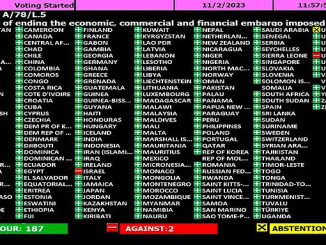
For the last 20 years, nearly every country in the United Nations has voted to condemn the unilateral blockade. They have stood with Cuba because of the injustice of it all and how Cuba shows the possibility of a better world that isn’t based on the obscene accumulation of wealth of a few with the downward spiraling of the ability of many in the U.S. to stay housed and fed.

The people of the U.S. are saying no to the draconian policies its government has towards the island, and meanwhile, we are deprived of normal people-to-people interaction that we have with just about any other country; and gaining access to many health treatments not available here, or cultural and educational exchange and trade opportunities. But all of that is starting to change, and with conditions deteriorating the way they are and confidence in the government at an all-time low; why should we believe what they tell us about Cuba? You can’t fool the people forever, and the time is up on the lies about Cuba.

Source: Resumen Latinoamericano – English

Strugglelalucha256


‘A zone of peace, saving lives: that’s what Cuba stands for’

Testimony by National Network on Cuba co-Chair Cheryl LaBash at the International People’s Tribunal on U.S. Imperialism, Cuba country hearing, on June 10.

Thank you to the organizers of this timely International People’s Tribunal on U.S. Imperialism focusing on targeted sanctions and blockades that inflict such pain on millions of innocent people.

Greetings and solidarity, too, to our colleagues from Cuba who represent the resistance and resilience of the Cuban people.

We recognize that the unilateral U.S. coercive economic measures – the blockade – hurt the Cuban people and their aspirations for a better world, first and foremost. We know and recognize that the blockade is extraterritorial; it attacks foreign banks and businesses, Europeans who enjoy vacations in Cuba, Cubans living in other countries, and many others in numerous ways.

However, today I want to recognize that the policies of the U.S. government also hurt the people of the United States – ordinary working class and poor people, migrants, and farmers and growers who want to conduct business with Cuba – in short, the majority. 

I want to speak about the pandemic, about travel, and show that the U.S. government is out of step with the people of the United States who, when they travel to Cuba or learn about the blockade, do not support these measures. 

This is the reason the U.S. government hides its intentional plan to create hardship and desperation among the Cuban people, making its actions unseen, “as adroit and inconspicuous as possible.” The State Department’s Mallory-Rubottom memo, written on April 6, 1960, says it just that way. 

The U.S. tries dangerous smokescreens like the Wall Street Journal fabrication of a China-Cuba spy center. In his quick rebuttal, Deputy Foreign Minister Carlos Fernández de Cossío pointed out previous false accusations used to intensify the economic war: alleged acoustic attacks against U.S. diplomats, the falsehood of Cuban military troops in Venezuela, and the lie about imaginary Cuban biological weapons plants.

The only foreign military installation in Cuba is the illegal U.S. occupation of Cuban territory in Guantanamo. Why won’t the Wall Street Journal write about the Zone of Peace initiated by Cuba and Venezuela through the Community of Latin American and Caribbean States in 2014? 

Drawn to Cuba’s example

A Zone of Peace. Saving Lives. That is what Cuba stands for. Is it any surprise people – especially youth – are drawn to Cuba’s example? We have found the generation born in this century quickly sees through the lies. 

Imagine you are 20 years old. What does the future hold? Disastrous climate catastrophes; unaffordable education, health care, and rent; holding down multiple gig jobs just to exist; frequent mass shootings and police repression, combined with racist, homophobic, and transphobic state government initiatives.

On May 3 and again on May 7, a total of 19 travelers returning from May Day in Cuba were pulled aside at four U.S. airports for additional scrutiny and intensive questioning. This treatment has not been widely experienced since the Obama administration re-established diplomatic relations with the Republic of Cuba in 2015 and opened direct flights on U.S. carriers from U.S. airports, making travel to Cuba “legal” within certain changing rules.

Our experience this year follows the FBI visits to the Puerto Rican Cuba Solidarity Committee when they returned from July 26 celebrations last year. If the intention was intimidation, it only made the injustice of the blockade more real to these activists. It fired their will to fight harder. Their enthusiasm was not dampened.

The stepped-up intimidation at the borders is particularly troubling in light of the recent raids and indictments of the African People’s Socialist Party for their political views and the raid on the Atlanta Bail Fund for assisting the Stop Cop City protests.

Although travel is said to be a right, travel to Cuba has been severely limited by the U.S. government. In 1964, Black revolutionaries had to first travel halfway around the world to Czechoslovakia to reach Cuba. 

Some of the earliest Venceremos Brigades traveled by ship to and from Canada, having all their writings and literature seized on return at the U.S. border. Aggressive FBI visits to parents and employers followed. Later, indirect travel was okay if the trip was fully hosted and no U.S. money was spent. 

Much about travel has changed. Now U.S.-based airlines fly regular routes to Cuba. Airlines, travel agencies and companies like Airbnb enforce the travel regulations under the threat of fines or loss of U.S. license to do Cuba-related business. 

Every traveler, including non-U.S. citizens – another example of extraterritoriality – must sign a document declaring one of 12 “categories” under which they travel to Cuba. Without it, you cannot board the plane unless the traveler understands that a record of their full schedule of activity must be kept for five years in case a federal agent wants to know how they spent their time in Cuba.

Vacationing is strictly forbidden, as is staying at a hotel, drinking the wrong cola, or even buying a book from an entire Cuban publishing house. Honestly, the U.S. government spends our tax dollars making detailed lists of what is forbidden in Cuba. Such is the unique “freedom to travel” to Cuba.

Often, we hear first-time travelers comment that Cuba is the first place they feel free. They experience shock returning to the land of advertising, anxiety, isolation, and stress. Every week people email us to get on the list for the 2024 May Day trip.

And it is because the life experiences of working people in the U.S. sharply contrast with Cuba’s human-centered priorities, as demonstrated by Cuba’s medical internationalism.

Medical internationalism

In 2005, how many lives could have been saved when hurricanes Katrina and Rita drowned New Orleans if the U.S. government had accepted Fidel Castro’s offer of 1,586 fully-equipped health workers? They sat ready at the former Coast Guard base that is now the home of Cuba’s Latin American School of Medicine – only 1.5 hours away by plane.

Of course, then we had no way to hear about it until a horrified world asked why Cuba wasn’t helping, and Fidel explained the offer was not accepted. How different it is now, with instant communication! In 2005, there was no way for us to know what Cuba had prepared and offered until later.

Even before vaccines, from the outbreak of the COVID-19 pandemic, Cuba’s public health organization kept deaths to a minimum. From the first recorded case in March 2020 until December 2020, only 146 Cubans died. In Michigan, a state with about 1 million fewer people, some 9,269 died. In Detroit, a small city with less than 700,000 people, 1,500 people died in four months.

Unlike 2005, in 2020 we watched the Cuban television reports and saw Dr. Duran giving daily COVID reports. We saw how Cuba was fighting for every life. There was still no vaccine then, but a robust public health organization had everyone cooperating to save lives. We could see the Henry Reeve Brigades, named during the mobilization for Katrina, now going wherever they were called. 

Not only would the U.S. government not call for Cuba to help Detroiters, but it then used the pandemic as a weapon against Cuba, doubling down on the blockade measures.

Like travel, Washington intended for information technology to be used as a weapon against Cuba’s self-determination and sovereignty. But it is also a powerful tool in our hands. Imperialism’s lies can be torn to shreds before they become embedded in the public consciousness. And the solidarity movement can unite its voice across this very large country of many time zones.

Resolutions challenge blockade, SSOT

Like the false accusation leveled against Cuba and China by the Wall Street Journal this week, the anti-Cuba strategists are using old playbooks in Congress. 

Hoping that Cuba seems unimportant to the rest of the country, Rep. Salazar from Florida has introduced HR314, the FORCE Act, in the House of Representatives, while Senators Rubio, Cruz, and Scott introduced S538, Fighting Oppression until the Reign of Castro Ends. 

Talk about detached from reality. Don’t they know that Miguel Diaz-Canel is president of Cuba? 

These bills would freeze Cuba permanently on the list of state sponsors of terrorism until a president determines that a “transition [to capitalist] government is in power in Cuba.” Using the Helms-Burton Act model, It is an attempt to checkmate any possible action by President Biden to use his executive authority to remove Cuba from the State Department list. Because that’s all that is needed.

The National Network on Cuba recognizes through our activity that the U.S. government is out of step with the people of this country about Cuba. Even in the U.S. capital, Washington, D.C., the governing District Council unanimously passed a strong resolution calling for Cuba to be removed from the list of State Sponsors of Terrorism, to end the blockade, and for relations with Cuba to be normalized. They are not alone.

Ninety resolutions by elected bodies representing an estimated 45 million people – city councils, county commissions, state legislatures, school boards, and labor unions – oppose U.S. policy on Cuba. Nearly one-third of those resolutions have been passed in the last six months. 

This movement is growing, especially among young workers like the Amazon and Starbucks organizers who are fueling a unionization wave. 

We call on President Biden to heed the voices of Cuban Americans, labor organizations, and local elected officials calling for Cuba to be taken off the list of State Sponsors of Terrorism and for an end to the unilateral U.S. blockade. 

President Biden has the authority to send a letter to Congress declaring he is removing Cuba from the State Department list. Being on the list is a switch that automatically sets into motion many additional hurdles to economic activity related to Cuba. It is harder for Cuba to function in the dollar-dominated international financial arena, and it makes it more difficult for U.S. and international solidarity activists, too.

The lies about Cuba that underpin the legal supports for the blockade are weakening. Cuba is a State Sponsor of Peace, as shown by the recent agreement between the government of Colombia and the National Liberation Army (ELN), assisted by Cuba.

We are winning, but we need everyone’s help. This series of tribunals is an important contribution to a movement in the United States that is irresistible.

Our first national push to get Cuba off the State Department list is a day of protest on Sunday, June 25, corresponding with the monthly international car and bike caravans inspired by the Cuban Americans of Puentes de Amor and their call in the summer of 2020 to build bridges of love, not hate. 

We are carrying that message to Congress with allied groups that specialize in Congressional work. So join us at the White House at 1 p.m. on June 25. If you can’t be there, tell us what you can do in your local area. Sign up for news and updates at our website, NNOC.org.

I’d like to end with a quote published recently by Real News from another NNOC co-chair, Shaquille Fontenot from South Carolina.

“There are so many cultural, environmental, and educational exchanges that could happen if relations were normalized. We’re in a moment here where people [in the U.S.] are seeing the parallels between our own experiences and what’s done in our name to people abroad. 

“People here need food, water, shelter—and people in Cuba need those things too. The same institutions are keeping those things from all of us. That’s why it’s critical for us in the United States to speak up about it. People around the world need to see the truth.”

Solidarity cannot be blockaded.

Strugglelalucha256


Cuba’s Queer Rights Revolution – Eyewitness Cuba Pride Month

Pride Month Webinar – Cuba’s Queer Rights Revolution – Eyewitness Cuba

Just 90 miles from Ron DeSantis’s Florida, socialist Cuba is making huge advances in LGBTQ+ rights with its new Families Code.

  • How did Cuba achieve the ‘most advanced policy in the world’? *Why isn’t the U.S. media reporting it?
  • Why does Biden maintain Trump’s punishing blockade measures and keep Cuba on the state sponsors of terrorism list?
  •  Hear from LGBTQ+ activists from across the U.S. who went to Cuba to see for themselves.
  • Learn how queer rights are being prioritized from the grassroots to the National Assembly.
  • Why U.S. queers should work to end the U.S. blockade of Cuba, and how you can join next year’s delegation.

PANELISTS

  • Lizz Toledo, Women in Struggle-Mujeres en Lucha • Atlanta
  • Serena Sojic-Borne, Real Name Campaign & FRSO • New Orleans
  • Jordan David, Lavender Guard • Los Angeles
  • Deirdre Deans, Women in Struggle • Atlanta
  • Gregory Esteven, Socialist Unity Party • New Orleans
  • Kiana Fok, Peoples Power Assembly & Friends of Latin America • Baltimore
  • Melinda Butterfield, Women in Struggle • New York

HOSTED BY

Women in Struggle / Mujeres en Lucha
An affiliate of the Women’s International Democratic Federation

Strugglelalucha256


A trans person reflects on Cuba and Florida: 90 miles and a world apart

Returning from 12 days in Cuba in mid-May, I spent an uncomfortably long six-hour layover at the Miami airport, waiting for my connecting flight to New York.

It wasn’t uncomfortable just because of the usual inconveniences like overpriced food and crappy seats but because I was a trans woman existing in the state of Florida, where the far-right anti-trans crusade has been centered this year. 

As I sat in Miami, I was keenly aware that Gov. Ron DeSantis was preparing to sign several laws aimed at banning trans people from public life and getting the health care they need to live. 

(DeSantis did sign these laws just a few days later, not by coincidence, on May 17 – the International Day Against Homophobia, Biphobia, and Transphobia.)

One of those state laws bans trans people from using public restrooms that match their gender expression – including those in airports. When that law takes effect on July 1, trans women like me will be faced with the choice of risking arrest using the women’s room or risking humiliation and violence using the other option.

During my six-hour sojourn, I used the airport restroom three times. Yes, I kept count; I was on guard for my safety and hyper-aware of everything around me. But as usual, no one objected to my presence or even noticed. 

Waiting in Miami, I had plenty of time to reflect on the stark contrast between Cuba, where queer rights are advancing by leaps and bounds, and the United States, where they are being dragged backward by state-sanctioned violence. 

That violence comes in the “official” form carried out by bigoted politicians like DeSantis and the off-the-books sort used by fascists coast-to-coast, who get a wink and a nod from the cops and big bucks and lavish media attention from the capitalists.

International Trans Colloquium

In May, I was part of the LGBTQ+ delegation to socialist Cuba organized by Women in Struggle-Mujeres en Lucha in cooperation with the Cuban Institute for Friendship with the Peoples (ICAP) and the National Center for Sex Education (CENESEX). 

We went to learn about Cuba’s revolutionary new Families Code, adopted by referendum last year. This document, described as the most advanced of its kind in the world, elevates the legal status of queer and other nontraditional families. It expands the rights of LGBTQ+ family members, children and youth, elders, people with disabilities, and more.

We also went to learn about the effects of the six-decade-long U.S. blockade on LGBTQ+ Cubans and all Cuban people. Our mission was to bring back information to help educate our communities, encourage them to oppose the blockade, and understand that another world is possible.

Officially, our delegation lasted for one week, from May 7-14. But two of us, both trans women, arrived in Havana a few days earlier to attend the VII International Colloquium on Trans Identities, Gender, and Culture, held from May 4-6. 

This annual event, organized by CENESEX, brings together experts, medical professionals, and academics from several countries to discuss the latest research on gender-affirming care and the social challenges facing trans communities. This year there were participants from Mexico, Italy, Argentina, the U.S., and other countries, as well as Cuba.

Trans voices heard and respected

A lot of valuable information and views were shared throughout the colloquium. It was especially enlightening to hear how U.S. anti-trans propaganda is rippling throughout Latin America and Europe. 

But for me, the most memorable moment came during the first afternoon’s session, held in the beautiful building that is home to CENESEX. 

A panel of doctors and researchers had just spoken about the medical challenges of gender-affirming care, from hormone therapy to surgery to mental health and treatment for trans youth. A group of trans women from Cuba, Uruguay, and Mexico had been sitting in the front row, listening intently to the presenters.

After the final panelist spoke, the women consulted among themselves, then demanded the floor. They objected to the tone and perspectives of some of the experts, who focused entirely on clinical research and standards of care divorced from the actual lived experiences and needs of trans people.

Mariela Castro Espín, CENESEX director and convener of the colloquium took the floor to support the trans activists, emphasizing how Cuba’s approach to all kinds of health care, and trans health in particular, can never be divorced from the social conditions of the people it serves.

I couldn’t help but imagine what would happen if a group of trans activists demanded the floor at a medical or academic conference in the U.S. to object to statements by official presenters. In all likelihood, they would be dragged out by security, perhaps even arrested. 

This has happened in several U.S. state capitols recently when people dared to speak out against anti-trans legislation in those supposed “houses of the people.”

But at this international event in Cuba, hosted by an official body of the Ministry of Health and in the presence of representatives of the country’s media, trans people were not only free to take the floor and voice their concerns; their opinions were treated with respect and, in my view, helped change the tone of the rest of the conference.

Conga and the future

Following the conclusion of the International Trans Colloquium, on the evening of May 6, we were invited to attend the Gala Against Homophobia and Transphobia at the National Theater near Revolution Square. The fantastic, colorful annual event featured well-known Cuban musicians, live theater and dance, and incredible drag performances. 

Unlike the recent invitation-only Pride event at the White House in Washington, D.C., the gala was open to everyone, and the 3,500-capacity hall was packed with happy, cheering queer couples and families. Tickets cost the equivalent of 35 U.S. cents.

The following day, we welcomed the rest of the delegation, including activists from Atlanta, Baltimore, Los Angeles, and New Orleans. 

Over the next week, we attended several sessions at CENESEX to learn about different aspects of the Families Code and the development of queer rights; we visited a polyclinic to learn more about Cuba’s primary health care system and how the recommendations made by CENESEX for trans health care are integrated into the system from top to bottom; toured the Denunciation Memorial, a museum that exposes the history of U.S. terrorism against the Cuban Revolution; and received a briefing at the biotechnology center about Cuba’s development of groundbreaking vaccines.

We also met with the Federation of Cuban Women and learned about its long history of elevating LGBTQ+ issues (going back to the early 1970s); spoke with district representatives about their responsibilities as elected community leaders; received a guided tour of the new Fidel Castro Center, documenting the life of the Cuban revolutionary leader; and finally, visited the national capitol to learn about Cuba’s electoral and legislative process from a member of the National Assembly of People’s Power.

One of the most exciting things I learned about was Cuba’s constitutional “progress principle.” This means that once granted, rights cannot be taken away. How unlike the U.S., where every one of our hard-fought rights is liable to be rolled back like the right to abortion was a year ago!

On our final full day in Havana, we joined the Conga Against Homophobia and Transphobia, marching through the streets shoulder to shoulder with our Cuban siblings, chanting, “¡Socialismo, sí! ¡Homophobia, transphobia no!”

The memory of the marchers’ joy and political determination, of the happy neighbors and families cheering from apartment windows and sidewalks, of revolutionary political leaders in the front ranks, helped me get through the long hours in Florida, a state increasingly suffocated by censorious, repressive, and frankly murderous laws meant to keep workers down and the rich on top.

In Cuba, I was never misgendered, never worried about using a restroom, and never felt unsafe for being openly and unabashedly myself. I want that for myself and all my trans siblings, everywhere, every day.

As I boarded my flight home, I felt more determined to build a National March to Protect Trans Youth and Speakout for Trans Lives in Florida this autumn – to give hope to our trans community there, to other communities under attack, to all of us. And more convinced of the need to show the LGBTQ+ movement that the Cuban path – the path of revolutionary socialism – is the way forward to trans and queer liberation.

Strugglelalucha256


Cuban official condemns Wall Street Journal’s claim about Chinese base as ‘unfounded’

Cuba’s Vice Foreign Minister Carlos Fernández de Cossío held a press conference on the afternoon of June 8, wherein he rejected accusations leveled by US corporate media giant The Wall Street Journal that the island had reached a “secret” agreement with the Chinese government to establish a spying base. He said the information the WSJ published was “completely dishonest and unfounded”.

The report authored by Warren P. Strobel and Gordon Lubold called the alleged agreement a “brash new geopolitical challenge by Beijing to the US” and claimed that the “eavesdropping facility in Cuba, roughly 100 miles from Florida, would allow Chinese intelligence services to scoop up electronic communications throughout the southeastern US, where many military bases are located, and monitor US ship traffic.”

The “exclusive report” was published in the early hours of June 8 and cited “US officials familiar with highly classified intelligence” as its key source for the information about the agreement.

The rest of the report uses contextual information and conjectures to make the primary allegation more convincing. The authors claimed that Beijing would likely cite the fact that the US has military and intelligence activities close to China to justify its alleged base in Cuba. They highlight that “US military aircraft fly over the South China Sea, engaging in electronic surveillance” and that the US sells arms to Taiwan and sails Navy ships through the Taiwan Strait.

The authors also point to Cuba’s current economic crisis in an attempt to make their point even more convincing stating “China has agreed to pay cash-strapped Cuba several billion dollars to allow it to build the eavesdropping station.” (emphasis added)

The report released by the Dow Jones-owned outlet has been widely criticized and many have questioned the veracity of the claims given the similar occurrences such as the “Havana Syndrome” allegations which formed the basis for the application of over 200 unilateral coercive measures by the administration of Donald Trump and was eventually debunked.

Vice Foreign Minister Cossío stated in the press conference that “All these are fallacies promoted with the deceitful intention of justifying the unprecedented tightening of the blockade, destabilization, and aggression against Cuba and of deceiving public opinion in the United States and the world.”

The official also affirmed that Cuba is a signatory of the Declaration of Latin America and the Caribbean as a Zone of Peace and as such “reject[s] any foreign military presence in Latin America and the Caribbean, including that of numerous bases and military personnel of the United States, especially in the military base that illegally occupies a portion of the national territory in the province of Guantanamo.”

Manolo De Los Santos, co-executive director of The People’s Forum wrote, “Trump invented “Havana Syndrome” as the excuse to place 243 new sanctions on Cuba. Biden is more imaginative and invents a Chinese ‘Spy Base.’ What will come next in Washington’s aggressive foreign policy towards Cuba?”

Source: Peoples Dispatch

Strugglelalucha256


Is Washington seeking to fabricate a casus belli against Cuba?

The fake media machinery, obeying the dictates of the U.S. government, has started a new dangerous and infamous campaign against Cuba.

According to the U.S. newspaper The Wall Street Journal, which had the “honor” of putting the lie into circulation, there is an agreement between Cuba and China, in military matters, for the installation of an alleged espionage base.

The Fake News was immediately spread by other media, among them, CNN and Deutsche Welle, which misinformed its readers with the statement that “China will install a large base in Cuba to spy on the U.S.”.

Carlos F. de Cossio, Vice Minister of Foreign Affairs, denied from Havana, the allegations made by the media outlets, about the existence of plans to install a base of the Asian country on Cuban soil.

“Regardless of Cuba’s sovereign rights in defense matters, our country is a signatory of the Declaration of Latin America and the Caribbean as a Zone of Peace, signed in Havana in January 2014”, stated Cossio.

He also ratified the island’s position of rejecting all foreign military presence in Latin America and the Caribbean, including that of numerous US military bases and troops, especially in the military base that illegally occupies a portion of the national territory in the province of Guantanamo.

This is not a light accusation; behind this false news lies the intentions of reactionary sectors in Washington that seek to justify the intensification of the blockade and escalate aggressive actions against the island.

It is part of a premeditated and sustained process aimed at destroying credibility, delegitimizing the government and justifying any punitive measure. Even though the Pentagon denied the article the lie has been set into motion.

Including Cuba in black lists of all kinds, accusing it of “threatening the national security of the U.S.”, in addition to the immediate effect on economic relations with the world, is aimed at destroying the reputation of the island, depriving it of international solidarity, isolating it from the world, so that no one will act against its aggressors in case they decide to use force.

Discrediting, through coordinated attacks, using all the resources of technology, carrying out long-lasting black campaigns, without rest, that psychologically affect the aggressor, that lower his self-esteem, that diminish his credibility and legitimacy, is part of every fallacy that is gestated against the Island.

The machinery of infamies, lies and provocations set in motion acts against Cuba with the objective of fabricating a casus belli (justification for war).

Raul Capote is a professor, researcher and a special correspondent for Resumen Latinoamericano

Source: Cuba en Resumen

Strugglelalucha256


U.S. activists are campaigning to remove Cuba from the State Sponsors of Terrorism list

To most countries, particularly fellow nations in the Global South, Cuba is a sovereign nation recognized for its leadership in healthcare, diplomacy, and human development. The US government, however, has a different, and quite unique, view: Officially, Cuba is categorized as a “State Sponsor of Terrorism.”

Only four countries on earth are currently designated by the US as State Sponsors of Terrorism (SSTs): Iran, Syria, Cuba, and the Democratic People’s Republic of Korea.

Cuba was first placed on this list under the Reagan administration in 1982. In 2015, the Obama administration rescinded Cuba’s SST status as part of a broader push for normalization of relations. However, a lame-duck maneuver by the Trump administration in January 2021 placed Cuba back on the State Sponsors of Terrorism list. This designation has continued under President Biden.

Now, 57 member organizations of the National Network on Cuba (NNOC) have launched the #OffTheList campaign to remove Cuba from the State Sponsors of Terrorism List.

Following a campaign launch on Valentine’s Day 2023, activists across the country made hundreds of calls to the White House on March 14 and 15. NNOC plans to follow up with an action in Washington, DC, on June 25, and are calling on supporters to join a rally in front of the White House. Advocates say that Cuba’s SST designation is unwarranted, unjust, and ultimately harmful to the people of the island.

Beyond the use of social media and direct action, the NNOC campaign is also urging participants to pass resolutions in their trade unions, schools, and local municipalities: “We encourage you to initiate a resolution to expand public support for removing Cuba from the U.S. ‘State Sponsors of Terrorism’ List.”

“It’s critical for those of us in the United States to speak up about it—and for people around the world to speak up,” Shaquille Fontenot, an NNOC co-chair, told The Real News. “It’s a humanitarian issue at this point, not just a political issue. It’s way beyond that.”

Washington’s rationale for Cuba’s designation

Upon announcing its decision to place Cuba back on the State Sponsors of Terrorism List, the Trump administration made it pretty clear that the decision was rooted in longstanding, Cold War-era hostility towards Cuba for being a sovereign socialist nation—and, as such, being a source of political and economic influence in Latin America that runs counter to the influence and hegemonic dominance of the US. “The Trump Administration has been focused from the start on denying the Castro regime the resources it uses to oppress its people at home,” a Jan. 11, 2021, memo issued by the US Embassy in Havana stated, “and countering its malign interference in Venezuela and the rest of the Western Hemisphere.”

That being said, the stated pretext for the Trump administration’s fateful decision allegedly stemmed from the island’s role in hosting peace negotiations between the Colombian government, the Revolutionary Armed Forces of Colombia (FARC), and the National Liberation Army (ELN).

Colombia has been locked in an ongoing civil war for decades, but in 2016 a peace deal was struck between the government and the FARC guerrillas. Negotiations with the ELN began shortly after, with Cuba stepping in as a guarantor and host of the peace process.

In 2018, Ivan Duque was elected president of Colombia on a platform that pledged to “correct” the peace process, which he claimed did not impose harsh enough penalties upon former FARC combatants. As the ceasefire began to crumble, a faction of the ELN bombed a police academy in Bogota in 2019, killing 22 and injuring dozens more. Duque unilaterally ended the peace talks in response and demanded the Cuban government extradite 10 ELN peace negotiators.

The Cuban government refused, noting that complying with the extradition order would violate the negotiation protocols based on international norms previously agreed to by the ELN and the Colombian government. The government of Norway, another key player in the peace process, backed up Cuba’s stance. Colombia’s recently elected President Gustavo Petro has since rescinded Duque’s extradition order and resumed peace talks with the ELN.

Two years after the Colombian peace talks in Cuba fell apart, and just nine days before Trump himself left office, the Trump administration slapped Cuba with the SST label, citing both the extradition orders against the ELN and Cuba’s longstanding commitment to providing asylum for US political refugees, including former Black Panther Assata Shakur. A number of former intelligence and diplomatic officials decried the move.

Despite promises to the contrary, the Biden administration has yet to significantly alter the sanctions against Cuba instituted by Trump, including its designation as an SST.

Although the consequences of a country finding itself on the  SST list have global implications, Washington is under no obligation to demonstrate the substance of its accusations to the world—or even to courts within the US. The decision to label a country an SST is entirely at the president’s discretion. No process to regularly review or appeal states’ inclusion on the list exists. “We know the State Sponsors of Terrorism List is maintained solely by the US… that already makes it unfair because there aren’t any checks or balances,” noted Fontenot.

Cuba is not the only country with an SST designation that seems more motivated by fickle political considerations than any clear or consistent definition of terrorism. In the 1980s, for instance, Iraq had its designation removed to facilitate US arms transfers during the Iran-Iraq War—only to be placed back on the list once the First Gulf War began. Other states, including Sudan and North Korea, have been shuffled on and off the list depending on the status of their relations with Washington.

Cuba’s ongoing SST designation continues to obstruct relations between Washington and Havana. In March, Cuban Foreign Minister Bruno Rodriguez Parrilla tweeted: “the State Department qualifying lists are nothing but instruments for political and economic coercion that are totally alienated from issues so sensitive as terrorism, religion, human rights, drug trafficking and corruption, among others.”

El Bloqueo

When the US government designates a country a State Sponsor of Terrorism, it triggers a series of sanctions against the targeted country designed to restrict its ability to engage in international banking and trade. Contrary to the euphemistic explanations offered by Washington (that such sanctions are “targeted,” that they only affect the government or certain industries, that they are a “more peaceful” alternative to war, etc.), such measures inevitably and directly affect the lives and livelihoods of everyday citizens in sanctioned countries.

In the case of Cuba, the effects of being designated an SST compound the effects of Washington’s decades-long blockade. For more than 60 years, the blockade has severely restricted Cuba’s ability to engage in international trade, provide for its people, and advance its own development. A State Department memo circulated in 1960 clearly spelled out Washington’s ultimate goal with the blockade: “to decrease monetary and real wages, to bring about hunger, desperation and overthrow of government.”

The blockade’s effects became particularly pronounced after the fall of the Soviet Union—a time remembered in Cuba as the “Special Period.” Previously, the overwhelming majority of Cuban imports and exports had flowed through the Soviet Union, enabling the former to develop in spite of the US-imposed blockade, but the sudden collapse in trade starved the island of fuel and capital, sending agricultural and industrial production tumbling. Although wages and caloric intake plummeted, historian Helen Yaffe notes, the state continued to do everything it could to meet basic needs. Not a single school or hospital closed.

The succeeding decades have been a period of recovery and reorientation to a changed world. Tourism, medical services, pharmaceuticals, and mining exports have become important new industries for Cuba’s survival. While the thaw in relations with the US during the Obama era seemed to brighten Cuba’s prospects, recent years have proven harsher for the country and its people.

That’s precisely why Fontenot says the NNOC #OffTheList campaign is so urgent. “Right now, the effects of the blockade and the State Sponsor of Terrorism designation have created conditions in Cuba that many scholars and Cuban people are comparing to the Special Period.”

How the SST designation impacts the Cuban people

Once in office, the Trump administration dedicated itself to reversing whatever progress had been made on a myriad of policy issues under Obama, including imposing 243 new sanctions against Cuba. Then, to make matters worse, the COVID-19 pandemic hit, and the Cuban government closed its borders to tourists out of the necessity to save lives.

Washington ignored international calls to lift the blockade during the pandemic, even going as far as to block flights delivering humanitarian aid. Despite manufacturing its own domestically developed vaccines, Cuba lacked sufficient needles to administer them for a number of months. When the delta variant wave of the coronavirus struck in the summer of 2021, the country’s sole oxygen plant failed due to a shortage of supplies caused by the blockade.

It’s a certain fact that the US blockade directly contributed to the 8,500 deaths from COVID-19 in Cuba. In spite of these challenges, Cuba’s medical response was objectively superior to that of the US, both in terms of proportion of the population served and lives saved

This is the crucial background that throws the barbarity of the Trump administration’s SST label into relief. During the darkest days of a novel pandemic that gripped the world, as the Cuban people wrestled with mass human suffering, death, and fear, the United States chose to tighten the screws rather than extend a hand in solidarity, or at least mercy.

International banks were already reluctant to engage in business with Cuba due to the blockade, and they were right to be: the US has not shied away from prosecuting even non-US banks that violate its dicta. In 2012, British bank HSBC forfeited $1.2 billion—and in 2015, French bank BNP Paribas surrendered $8.9 billion—after being targeted by US prosecutors for conducting transactions on behalf of individuals in a number of sanctioned countries, including Cuba. The US government’s ability to enforce its sanctions internationally, a function of the dollar’s supreme position in global trade and banking as the world’s international currency reserve, is precisely what has made the blockade against Cuba so powerful.

Once Cuba was redesignated an SST, banks doubled down on their restrictions, and the few that had once been willing to do business with Cuban nationals stopped doing so. In 2021, dozens of Cuban entrepreneurs addressed an open letter to President Biden describing the ongoing, US-imposed restrictions on travel, banking, and electronic transfers as both harmful to their businesses and “cruel.” Cuba’s Foreign Ministry estimates that the blockade costs Cuba as much as $15 million a day.

In another letter delivered to President Biden this March, over 20 faith-based organizations in the US cited the SST designation as a direct impediment to their efforts to deliver humanitarian aid:

In response to relisting on the SST, banks, financial institutions, and international vendors ceased helping facilitate both regular trade and cooperation with faith groups seeking to provide humanitarian and development support to Cuba. Overnight our denominational partners in Cuba began to face shortages of necessary items, including a lack of access to clean water, sanitation, and hygiene articles, and materials essential for public health, such as medicines and medical devices. It has become increasingly impossible for our denominations and faith-based organizations to get much-needed aid and funds to our Cuban partners. Banks have frozen our funds for permitted religious and humanitarian activities, demanding additional licensing. They perceive the risks of fines and so insist on over-complying with the current restrictions.

Even Cubans living abroad have felt the sting. According to Spanish media, dual citizens of Cuba and Spain have been unable to open personal bank accounts and have even had their existing accounts frozen since the SST designation.

For everyday Cuban people, the blockade alone was bad enough before the implementation of additional restrictions tied to the SST List. Cuba’s efforts to survive in spite of the blockade are a testament to its people’s ingenuity and determination; however, there are limits to what can be achieved without access to global markets and production. A recent Oxfam report titled Right to Live Without a Blockade found substantial impacts on sectors as diverse as education, agriculture, and biotechnology stemming from the blockade—owing to limitations imposed by lack of access to computers, fertilizers, and other technologies and inputs that could transform existing industries.

In 2022, the UN General Assembly voted for the 30th consecutive year to approve a resolution calling for an end to the blockade against Cuba. Yet, as of now, the blockade continues.

Last May, the Biden administration announced a series of measures to support the Cuban people, including the restoration of remittance deliveries. However, none of these measures included substantial changes to the comprehensive blockade against Cuba, nor did they involve changing its designation as a State Sponsor of Terror.

Time is running out for the Biden administration to act. A new Congressional bill, HR 314: Fighting Oppression until the Reign of Castro Ends (or FORCE) Act, would seek to prohibit Cuba from ever being removed from the SST List “until the President makes the determination that a transition government in Cuba is in power.” (Given the bill’s name, it ought to be noted that Castro has not been in power in Cuba since the election of current President Miguel Díaz-Canel in 2019.)

Biden, however, doesn’t appear to be making any significant moves on Cuba any time soon, and with the 2024 election cycle officially in full swing, that is unlikely to change. When asked in March by Florida Republican Rep. Maria Salazar if the Biden administration had any plans to remove Cuba from the SST List, Sec. of State Anthony Blinken denied any such plans existed.

Building bridges for a shared future

For Fontenot, the significance of the blockade extends to its effects on people living in the US. “Being able to see what Cubans have decided for themselves is a major wake-up call for young people in America. We don’t have free education or free healthcare in the United States.”

Indeed, despite being a blockaded nation, Cuba’s socialist healthcare system and highly innovative medical industry put the US’s extortionately inaccessible system to shame. As of 2022, average lifespans in the US are three years shorter than those in Cuba. Fontenot also referred to several Cuban medical innovations that US patients are largely unable to access due to the blockade, such as an internationally recognized lung cancer vaccine.

Fontenot didn’t stop there. She also gestured towards the Cuban democratic process itself as something Americans might envy, if they only knew. “Look at the 2022 Cuban Family Code referendum,” she noted, referring to the passage of what many legal experts have recognized as the world’s most progressive set of laws on gender equality and the rights of children, the elderly, and LGBTQ people. “Compare that to what we’re seeing in the United States right now—this massive attack against queer and trans people, and ultimately against access to education.”

By all indications, the US government is not keen on US citizens learning about all that Cuba’s socialism has to offer. In May, activists with two separate youth delegations returning from Cuba were detained and interrogated by US Customs and Border Patrol—including members of a 60-person delegation organized by NNOC. In a public statement released by NNOC, the organization remained defiant, “Solidarity is not a crime—the US blockade is!”

“There are so many cultural, environmental, and educational exchanges that could happen if relations were normalized,” Fontenot says. “We’re in a moment here where people [in the US] are seeing the parallels between our own experiences and what’s done in our name to people abroad. People here need food, water, shelter—and people in Cuba need those things too. The same institutions are keeping

those things from all of us. That’s why it’s critical for us in America to speak up about it. People around the world need to see the truth.”

Source: Resumen

Strugglelalucha256


Biden calls Cuba ‘terrorist’ while the people demand an end to U.S. terrorism against Cuba

On Tuesday, May 23rd, the State Department reported that Cuba — along with Iran, Syria, the Democratic People’s Republic of Korea, and Venezuela — are not “not cooperating fully” in the United States’ supposed fight against terrorism. The Biden administration officially designates Cuba as a “State Sponsor of Terrorism” (SSOT), as well as Iran, Syria, and the DPRK.

Literally, 0% of Americans view Cuba as a serious threat, and the Biden administration has provided no evidence of Cuba supporting terrorism in any way. Cuban and American officials even met earlier this month in Havana to discuss cooperating on anti-terrorism measures. So why is Biden keeping Cuba on the “State Sponsors of Terrorism” list?

Sixty-four years after the triumph of the Cuban Revolution, the United States is still waging an economic and media war against Cuba. The administrations of Trump and now Biden have weaponized the “State Sponsors of Terrorism” list to isolate Cuba internationally and justify continuing the genocidal American blockade.

The impacts of being labeled a ‘State Sponsor of Terror’

It goes without saying that the United States is the biggest “State Sponsor of Terrorism” in the world. The U.S. is the only country with over 800 foreign military bases and spends more on its military than 144 countries combined. The U.S. has launched 251 foreign military interventions since 1991. A report recently published by Brown University shows that the post-9/11 wars the U.S. waged in Iraq, Afghanistan, Syria, Yemen, and Pakistan killed at least 4.5 million and displaced 38 to 60 million people. But the word “terrorist” is almost never applied to the U.S. government. The term is highly politicized and subjective in the United States, used to demonize internal and external enemies and justify waging war on them, be it by bombs or blockades.

Designating Cuba as “terrorist” exacerbates the already devastating impacts of the American blockade, which has stolen an estimated $144.4 billion from the Cuban economy from the early 1960s to 2020, according to the United Nations. The United Nations Economic Commission for Latin America and the Caribbean (ECLAC) determined that U.S. sanctions on Cuba “constitute the most severe and prolonged system of unilateral coercive measures ever applied against any country.”

On top of the blockade, Cuba’s “terrorist” designation restricts American foreign assistance, exports of dual-use items, and loans from the World Bank. It has also prevented Cuban Americans from transferring money to families in Cuba, stopped faith-based groups from shipping humanitarian supplies, and inhibited American universities from working with Cuban academics and institutions. Non-U.S. citizens who have traveled to Cuba, a supposedly “terrorist” country, also have restrictions on visas to enter or visit the United States.

Despite being a list created and maintained only by the United States, because of its enormous power over the global financial system, the designation inhibits the ability of Cuba — and the other countries listed — to trade normally with the rest of the world. Banks don’t want to risk giving loans to a country labeled as “terrorist” by the hegemonic United States. The United States has sued foreign companies and banks for hundreds of millions of dollars for violating American sanctions on Cuba, and many major international banks no longer provide services to Cuba for fear of retaliation. The blockade as a whole is extraterritorial and thus violates international law.

The history of Cuba’s ‘terrorist’ designation and U.S. terrorism against Cuba

President Ronald Reagan first added Cuba to the terror list in 1982, citing Cuba’s support for national liberation movements across the world, such as giving military aid to Angola to defeat a U.S.-backed invasion by the South African apartheid regime. Meanwhile, the United States was backing violent terrorism to sabotage the Cuban Revolution.

As Cuba expert Professor William LeoGrande said, Cuba’s “terrorist” designation “is ironic because in the 1960s, the CIA sponsored assassinations attempts, sabotage and paramilitary raids against Cuba—what today would be called state-sponsored terrorism—and CIA-trained Cuban exiles continued such attacks for the next several decades.”

Luis Posada Carriles, the mastermind behind many of these U.S.-backed terrorist attacks — including the bombing of Cubana Flight 455 in 1976 and a series of hotel bombings in 1997 — died peacefully in Florida in 2018, protected by the U.S. government and lionized by the right-wing Cuban-American community in Miami. But Cuba, according to the State Department, was the real terrorist.

During President Barack Obama’s second term, he pursued a policy of “rapprochement” with Cuba, restoring diplomatic relations and lifting some travel and trade restrictions. The Obama administration removed Cuba from the terror list, saying, “we will continue to have differences with the Cuban government, but our concerns over a wide range of Cuba’s policies and actions fall outside the criteria that is relevant to whether to rescind Cuba’s designation as a State Sponsor of Terrorism.”

Obama’s “friendly” policy was still aimed at regime change through a new set of tactics, and he continued funding covert operations and “democracy promotion” programs aimed at undermining the Cuban Revolution. Nevertheless, rapprochement had positive effects for the Cuban and American people, especially renewed travel and people-to-people exchanges between the two countries. All of this was undone by Donald Trump.

Trump tightened the blockade and added an additional 243 sanctions on Cuba. Then, just four days after the January 6th insurrection, Trump and his neoconservative Secretary of State Mike Pompeo redesignated Cuba as a “State Sponsor of Terrorism.” They made this last-minute move in bitter spite of Cuba, but also to create a political obstacle for President Biden, who would be pressured from different sides to keep or remove Cuba’s “terrorist” designation.

Biden and Trump’s Hawkish Cuba Policy

Many Cubans and Americans alike hoped Biden would re-normalize U.S.-Cuba relations as he promised during his campaign, when he said he would “promptly reverse the failed Trump policies that have inflicted harm on the Cuban people and done nothing to advance democracy and human rights.” But Biden has changed little. He slightly eased some Trump-era restrictions in May 2022 but has also renewed his predecessor’s harshest measures. As a result, Cuba — also impacted by the pandemic and the war in Ukraine — is experiencing its worst economic crisis and fuel shortages in decades.

The economic crisis in Cuba is fueling a political crisis for Biden at the border, as more Cubans than ever are leaving for the United States to escape the crushing impacts of sanctions. A group of Democratic lawmakers is urging Biden to lift Trump-era sanctions on Cuba and Venezuela to slow the surge of migration, but Biden has not moved a finger. Instead, he follows the line of conservative Cuban-American lawmakers on Cuba policy, especially Chairman of the Senate Foreign Relations Committee, Democratic Senator Bob Menendez of New Jersey, who Biden needs to push his appointments through the confirmation process.

Menendez, who is currently under investigation for corruption, lambasted his fellow Democrats’ push against Trump-era sanctions and claimed that the Cuban and Venezuelan governments — not U.S. policy — were solely responsible for the economic crises in those countries. The Washington Post reported that “Privately, senior Biden officials have conceded that picking a fight with [Menendez] is not worth whatever benefit might come from relaxing sanctions on [Cuba and Venezuela], even if it would fulfill a campaign promise Biden made to restore President Barack Obama’s policies toward Cuba.”

Despite Biden claiming to care about “human rights” and “supporting the Cuban people,” he is not changing his internationally condemned policy — which violates Cuba’s sovereignty and human rights — because doing so is not politically expedient.

Activists who support normalizing U.S.-Cuba relations have concentrated on pressuring Biden to remove Cuba from the terror list because, as Noam Chomsky and Vijay Prashad wrote in Peoples Dispatch, “Biden can remove Cuba from this list with a stroke of his pen. It’s as simple as that” — unlike the blockade, which is a complex amalgamation of hundreds of different laws in the hands of Congress.

In the State Department’s most recent public remarks on Cuba, they have doubled down on Trump’s policy of keeping Cuba on the list. Earlier this year, far-right Florida Republicans Maria Salazar and Marco Rubio introduced the FORCE Act in the House and Senate, respectively, to codify into law Cuba’s “terrorist” designation so that it could only be removed by Congress, not the President alone.

And not only that. Cuba would have to meet impossible criteria, completely changing their political and economic system to be what the United States defines as “free,” in order for the designation to be lifted. As People’s Dispatch wrote, “Essentially, Salazar is demanding that the Cuban people overthrow their own government and overturn the Cuban political system which has been built by the people and for the people over the last 60 years.”

It could not be more clear that the terror list has nothing to do with preventing actual terrorism; rather, it is about harming enemy states of the U.S.. In March, when Salazar interrogated Secretary of State Antony Blinken about Cuba’s “terrorist” designation, he said that Cuba would have to “meet a very high bar” to be removed from the list and the State Department had no plans to do so.

Earlier this month, Cuban journalist Liz Oliva Fernandez stumped State Department Spokesperson Vedant Patel when she asked him “Why is Cuba on the State Sponsors of Terrorism list if you are trying to work with them to fight against terrorism?” He completely dodged the question, refusing to provide any examples of Cuban terrorism.

Even anti-Cuba mainstream U.S. media has reported that the “terrorist” designation is “bogus.” NBC News wrote, “according to half a dozen interviews with former intelligence analysts and officials who worked on Cuba policy in both Republican and Democratic administrations, the ‘consensus position’ in the U.S. intelligence community has for decades been that the communist-led nation does not sponsor terrorism.”

Larry Wilkerson, chief of staff to then-Secretary of State Colin Powell in the George W. Bush administration said that “‘Cuba is not a state sponsor of terrorism’ was a mantra from the moment I walked into the State Department to the moment I walked out. It’s a fiction that we have created…to reinforce the rationale for the blockade.”

Similarly, Congressman Jim McGovern (Democrat-Massachusetts) and Senator Patrick Leahy (Democrat-Vermont) published an op-ed in The Boston Globe explaining that “[i]t’s an open secret in Washington that Cuba does not belong on the list and that the previous false justification by the Trump administration was politically motivated.”

The #OffTheList campaign

The U.S. government does not represent the American people on most issues — especially Cuba. The blockade of Cuba persists against the democratic will of the American people, a majority of whom have consistently opposed the blockade, especially restrictions on trading medicine and food with Cuba.

In the United States, Cuban-Americans, solidarity activists, labor unions, and local governments, have organized resistance to Biden’s designation of Cuba as a “State Sponsor of Terrorism.” Since January 2023, the National Network on Cuba (NNOC), a coalition of over 50 organizations across the U.S. working to end the blockade, has been leading an international campaign to get Cuba #OffTheList.

On June 25th, this movement will rally at the White House — and in other locations around the world — to demand Biden take Cuba off the list, lift all U.S. sanctions, and end U.S. terrorism against Cuba. The NNOC is organizing these rallies alongside the Canadian Network on Cuba, ANSWER Coalition, CODEPINK, IFCO/Pastors for Peace, the Alliance for Cuba Engagement and Respect (ACERE), the International People’s Assembly, and over 70 other groups.

The voices of the American people and our progressive movements are clear: we want normalized relations with Cuba. Just in the past couple of years…

  • Labor unions and city councils have passed over 80 resolutions supporting an end to the blockade, promoting scientific collaboration with Cuba, and urging that Cuba be removed from the terror list. And, just last week, the Washington, DC Council unanimously voted to pass a Cuba solidarity resolution and sent copies to Biden and key congresspeople urging them to end the blockade. Combined, these resolutions represent well over 50 million Americans.
  • The 33 member states of the Community of Latin American and Caribbean States (CELAC) demanded that the United States remove Cuba from the terror list and “reiterated their rejection of the U.S. unilateral lists and certifications that affect Latin American countries.”
  • Across the world, there have been monthly rallies and car caravans initiated by Cuban-Americans calling to end the blockade, take Cuba off the list, and build Puentes de Amor (bridges of love) between the American and Cuban people.
  • Over 100 Democratic House members urged Biden to remove Cuba from the SSOT list and normalize U.S.-Cuba relations. Their open letter was signed by big names like Appropriations Subcommittee on Foreign Operations Chair Barbara Lee of California, Rules Committee Chair James McGovern of Massachusetts, and Foreign Affairs Committee Chair Gregory Meeks of New York.
  • Nearly 9,000 Cuban and American business owners sent a letter to Biden demanding he lift Trump-era sanctions and deliver on promises to help Cuba’s private sector, with the main demand being to take Cuba off the terror list.
  • Over 10,000 people and 100 progressive advocacy groups signed an open letter organized by CODEPINK urging Biden to reverse Trump’s terrorism designation for Cuba and to reinstate Obama-era policy with the island.
  • Hundreds of U.S. lawyers wrote to Biden urging him to take Cuba off the list.
  • We are rallying at the White House — and around the world — to tell Biden that Cuba is not a terrorist state, and the American people won’t stand for U.S. terrorism against Cuba.

Calla Walsh is an anti-imperialist organizer and writer. She is a co-chair of the National Network on Cuba, a coalition of 50+ organizations across the United States working to end the U.S. war on Cuba.

Source: Hampton Institute

Strugglelalucha256
https://www.struggle-la-lucha.org/cuba/page/14/