April 16: Three glorious Cuban anniversaries on one date

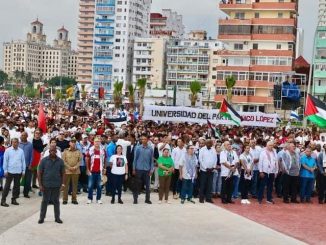
Corner of 23rd and 12th in the Vedado district of the capital. Photo: Bill Hackwell

Every April 16, Cuba celebrates three glorious anniversaries. First, the declaration of the socialist character of the Cuban Revolution. Second, the Day of the Militiaman. And the third, the founding of the Cuban Communist Party. These three events are nourished by a single root: patriotism, unity, and the people’s willingness to defend the Revolution at any cost.

Sixty-three years ago, on April 16, 1961, the island bid farewell to seven Cubans who had lost their lives on the previous day, victims of the U.S. bombing of the airports of Santiago de Cuba, Ciudad Libertad and San Antonio de los Baños, a precursor to the Bay of Pigs invasion on April 17, 1961. In the busy avenues of 23rd and 12th, in the capital’s Vedado district, Commander in Chief Fidel Castro proclaimed that the newborn Revolution of 1959 would be patriotic, democratic and socialist, of the humble, by the humble, and for the humble.

With their fists and rifles raised, the militia people swore to defend the Revolution that Fidel discribed at whatever cost. In every corner of the country, the armed people were ready to defend the revolutionary work and the socialist ideology.

Those who witnessed that day remember April 16, 1961, as if it were yesterday. The combatants of the 148th battalion of the National Revolutionary Militias were part of that crowd gathered with rifles in hand at the corner of 23rd and 12th. The emotion multiplied after Fidel’s words, which were immortalized in newspapers and radio stations of the time: “Fellow workers and farmers, this is the socialist and democratic Revolution of the humble, with the humble and for the humble”.

After his words, the notes of The Internationale, the official anthem of the workers of the world and of the majority of the socialist and communist parties, were sung. Hours later, the militiamen present there fought alongside Fidel on the sands of the Bay of Pigs.

That disposition materialized in combat, when the militia, along with the Rebel Army and the National Revolutionary Police, fought the invaders, annihilating them in less than 72 hours. Every inch of land in the country became a trench. And in honor of that victory, April 16 was chosen as Militia Day, celebrated every year, as a tribute to the men and women who fought the mercenaries or were willing to do so throughout the country.

Many witnesses of that struggle are the same ones who in 1965 joined the ranks of the Communist Party of Cuba, which took April 16, 1961, as its founding date, given the symbolism of that occasion. The protagonists of that struggle will relive today the emotion of those April days, in a political tribute that will take place in the same avenues of 23rd and 12th this afternoon.

Photo: Bill Hackwell

Today, Fidel’s words will resound once again: “The people of yesterday, semi-literate, with a minimal political culture, were capable of making the Revolution, defending the Homeland, later attaining an extraordinary political consciousness, and initiating a revolutionary process that has no parallel in this hemisphere or the world. I say this not out of a ridiculous chauvinist spirit, or with the absurd pretension of believing ourselves to be better than others; I say it because the Revolution that was born on January 1st, 1959, by chance or destiny, was subjected to the hardest test to which any revolutionary process in the world has ever been subjected to.”

Those words do not lose their validity, nor does the Revolution, which frightens the reactionaries in the world so much, but which today stands as a lighthouse before the eyes of the world. This hardest test of ours continues but we are aware of the enormous responsibility we have to the peoples of the world, and we will always know how to be up to that responsibility.

Source: Resumen Latinoamericano – US

Strugglelalucha256


Cuba: New report on alleged sonic attacks against the U.S. is a ‘political operation’


Associated Press (AP) interview with Johana Tablada, Cuban Deputy Director General for the United States at MINREX by reporter Andrea Rodriguez.

Andrea: We have all seen or read the story on this report, from three important media outlets, somehow re-hashing the Havana syndrome, correct? What is Cuba’s position on this?

Johana: Andrea, there is no such thing as the Havana syndrome; it does not exist, it is not registered in any disease registry, and it has really been the Washington syndrome from the beginning.

Our reaction is one of concern, because it is not an investigation: the program on CBS, a powerful network in the United States, is unsustainable and inexplicable; and beyond the many adjectives, the presentation of witnesses who have nothing to do with the story that from the beginning was an operation, today it is presented again, not as a journalistic investigation, but as a political operation, as a propaganda operation.

It’s striking how CBS considers that the public does not have the right to know about a material that is supposedly relevant, that there are solid scientific reports commissioned by the Trump administration, which it stuck in a drawer for two years, such as the “Jason Report,” which clearly concludes, so to speak, that the symptoms that may have been real cannot be attributed to an extraordinary cause, such as an attack, but are linked to natural conditions, to pre-existing diseases or environmental issues.

There is also the report by the Cuban Academy of Sciences, by a committee of Cuban experts, which also agrees with this result. There are the two reports by the NIH, the National Institute of Health of the United States, the National Institutes of Health of the United States, one very recently; and well, there is the report by the U.S. government, which a little over a year ago, or almost a year ago, the national director of intelligence, Mrs. Avril Haines, came out and said that the exhaustive studies by several U.S. national security agencies, which independently came to the same determination, had concluded: that the symptoms reported in those health incidents, show no evidence to support or confirm, that they are due to external actions and that they are associated with natural conditions, pre-existing illnesses, stress or environmental conditions.

It seems to us that the public has the right to know this, which is openly omitted in this recent work. Also omitted in this work are the testimonies of people who were supposedly affected and which have been published by the press in the past, such as the letter written by people who were stationed in Havana at the time and asked the State Department not to send them back home, that they did not feel attacked or in danger. That was also erased from history.

And honestly one is lead to ponder, who is interested in continuing to talk about a story that is fiction? Who is interested in resurrecting during an election year the false accusations that led to dozens and dozens of additional coercive measures against Cuba and whose main objective was, in 2017, to impose a “detente” and abruptly halt a process of improvement in Cuba-U.S. relations? It was definitely not in Cuba’s interest to interrupt that process.

It was in the interest of Senator Marco Rubio at the time, it was in the interest of the incoming Trump administration, the U.S. government, which had no way to stop the enthusiasm in the United States and in Cuba with the advance in bilateral relations, and in the world. So, really, none of those measures taken against Cuba, or almost none of them, have been reversed, except for the travel alert.

Reports of abnormal health incidents were made in a hundred places in the world. No measures were taken against any other country. Here, the U.S. Consulate in Havana was closed, the personnel in both missions was reduced to the minimum, visas were interrupted, Cuba was fraudulently included in the terrorist list; and all this has had an impact in causing suffering among the Cuban people, in separating the people from the U.S. and Cuba and in separating Cuban families.

That is where one needs to look; any serious interested party cannot overlook the real evidence before going to fabricate, as happens in this material, a document that, and I insist, is a fabrication, it’s a political operation that is unfounded and completely undoes the evidence accumulated since 2017 to date.

Andrea: Why does Cuba care if, at the end of the day, they are now accusing Russia? I mean, they don’t mess with Cuba anymore. So, why? Everything you mention is part of a story, but if we are talking about a political operation, we are talking about a political operation now going forward. Nobody is interested in a backward political operation but in waiting for the thing to move forward. So, why is Cuba particularly interested in this situation, or how would it affect Cuba if, at the end of the day, “the guy” is Russia?

Johana: Cuba is interested because it is once again doing the same thing that has been the main objective of many U.S. governments and of the most conservative or fractious or extreme sectors of U.S. society, both those of Cuban origin and the neo-conservatives in the United States. And Cuba is interested because it is trying to present Cuba once again as a threat to the national security of the United States and because, even when Cuba is no longer the supposed main character, Cuban territory is presented as a place where foreign powers or foreign countries can carry out acts against the United States, and Cuba’s tradition of protecting U.S. diplomatic personnel in Havana is well known. The U.S. embassy here in Cuba does not even resemble embassies in other countries because it does not look like a bunker, because there are no real threats, neither of terrorism nor of organized crime nor of any kind of attack.

It matters to Cuba because Cuba continues in play, Cuba who would never lend itself to be a proxy of any other country, and Cuba at no time accepts that our territory be used to attack another sovereign state, be it the United States or any other. Therefore, this fiction and the revival of this fiction is harmful to Cuba; it associates us once again with the conspiracy theories of those sectors that want to justify not only the outrage that today constitutes the U.S. blockade against Cuba, which has been tightened with additional measures of asphyxiation and pressure, and a medieval siege against the Cuban population that is being suffered by all Cubans, and that it is no longer possible to hide the direct link that exists between the impact of these measures, which have their origin in theories such as this one, or in this very theory, that Cuba was either the protagonist or the accomplice or the territory that was used to attack, something that hasn’t even been proven; so far, what science has shown is that there was no attack whatsoever; and to bring that up again is to try to present Cuba as the threat that it is not, it is to try to justify the measures of maximum pressure and suffocation against Cuba’s economy, the destabilization and intervention projects, and to try to justify the measures of maximum pressure and suffocation against Cuba’s economy, the destabilization and intervention projects.

In Cuba’s internal politics, with the ultimate aim of domination, and the actions and communication operations of disinformation and loss of credibility. That is why it is very important for Cuba to once again come out and refute what has already been refuted time and again by Cuba, by foreign governments, by the U.S. government itself and by at least three scientific reports that carry weight.

How are we going to believe a person, who nobody knows who he is, and we are not going to pay attention to or give credibility to reports in which teams of scientists from the academies of science of both countries, from a group of recognized important scientists from the United States, participated?

Today, there is no one in the world who truly believes, with information and a detailed study of the evidence presented, that there was such a thing as the Havana syndrome. It is a syndrome that we have to look for in the office of Senator Marco Rubio, who was the one who initially leaked it when the FBI – I failed to mention that report -when the FBI had already concluded its report saying that there was no evidence whatsoever.

The word “attack” was even a word invented by Tillerson, the then Secretary of State, which did not last long when Trump fired him.  And that of the Havana Syndrome, we know that it was also an invention of a not-very serious news site or with very little respect for itself. So, the real victims here have been the truth, journalism, which was desecrated in this program all the minimum rules of journalism, and respect for the public and the audience of this type of program, and the media that echoes it without looking at everything you did today that proves otherwise.

Thank you very much

Source: Minrex

Strugglelalucha256


Blockade and subversion against Cuba: Fines to banks and more than $50 million for interference programs

With total cynicism, the U.S. government and its embassy in Havana tried to dissociate themselves from the real and deep causes that led to last Sunday’s popular protests in some Cuban neighborhoods. “The United States is not behind the protests and these accusations are absurd”, said the State Department spokesman, while the diplomatic legation urged the Cuban government to attend to “the legitimate needs of the Cuban people.”

For the uninformed or professional cynics, such an imperial evasion might sound good to their ears. The poor little empire is not to blame for the blackouts or the lack of food that we Cubans suffer.

But reality is always stubborn and the facts themselves show the perverse nature of the imperial policy. News of this very week attests to that combination of total economic warfare and well-financed subversion that Washington is practicing against Cuba without respite or compunction.

As if the persecution of Cuban finances were not suffocating enough, and in a clear sign of the global nature of that war, the U.S. government imposed a few days ago a fine of 3.7 million dollars on the Swiss bank EFG after accusing it of violating the relentless U.S. measures against Cuba and against individuals from other blacklisted nations, the U.S. Treasury Department said.

EFG is a private bank with about $165.7 billion in assets under management and offers a range of financial services to institutional clients and individuals worldwide.

A few months ago, sanctions had also been imposed on the US-based financial company daVinci for not complying with the blockade sanctions.

Because of those precedents and others, and due to the qualification as a State that allegedly sponsors terrorism, numerous companies and financial entities in the world refused to operate with Cuba for fear of reprisals from the US government, specifically from the Treasury Department, denounced the report that Cuba presented to the UN in October 2023 on the effects of the blockade.

Dozens of banks suspended their operations with the country, including transfers for the purchase of food, medicines, fuel, materials, parts, and other goods.

Between March 2022 and February 2023, the number of foreign banks that for different reasons refused to carry out operations with Cuban banks amounted to 130 (75 from Europe, 21 from America and 34 from the rest of the world), with 267 operations involved.

The Swiss banks UBS, Banque Cler and the Cantonal Bank of Basel refused to transfer donations made to Cuba by the Swiss solidarity organizations MediCuba-Switzerland and the Swiss-Cuba Association, which were to be used for the purchase of surgical instruments for the burns and reconstructive surgery unit of the Hermanos Ameijeiras Hospital.

Deutsche Bank and the Royal Bank of Canada also repeatedly refused to accept payments from the Center for Genetic Engineering and Biotechnology (CIGB) to patent firms that represent us in different countries, which affects any future action of negotiation, registration, or commercialization of our products abroad.

 Since 2021, we have faced the refusal of three European banks to carry out operations with the International Financial Bank (BFI) and the Banco Internacional de Comercio S.A. (BICSA), which caused a supplier to stop the technical services it was to provide to the CIGB Plant in Mariel, where the Abdala vaccine against COVID-19 is produced on an industrial scale.

From Cuba’s Report to the UN on the Blockade in 2023

More money for subversive plans, mercenaries, and network agitators

On Friday, March 22, the anti-Cuban mafia in the House of Representatives managed to introduce in the Resolution authorizing the financing of 1.2 billion dollars to sustain the operations of some areas of the US Government (the Departments of Defense, Homeland Security, Labor, Health and Human Services, Education, State and the Legislative Branch), an amount of more than 50 million dollars for subversive actions in Cuba, with emphasis on media manipulation campaigns.

According to a press release issued by the office of anti-Cuban Congressman Mario Diaz-Balart, the regulation contemplates 25 million dollars for programs for the “promotion of democracy in Cuba”. The sum represents an increase of 25% in relation to 2023.

These programs are mainly aimed at developing subversive actions against Cuba and manipulative campaigns within the United States and in the rest of the world. Through the State Department, NED and USAID, they generously finance anti-Cuban lobby organizations in Florida and elsewhere and pay their allowance to the mercenaries they have in Cuba.

Part of that funding is used to maintain the anti-Cuban media machine and the social network agitators they have been fostering over the last ten years with the express purpose of impacting, generating manipulated narratives, and confusing Cuban public opinion.

For the same purpose, the legislative proposal approved by the House allocates 25 million for the 2024 work of the Office of Broadcasting to Cuba, in charge of Radio and TV Martí. This is a significant increase from the 13 million approved in the previous fiscal year.

An unspecified additional amount is also reserved for the Open Technology Fund to promote technologies that foster “Internet freedom” in Cuba. Today, Cuba’s connectivity rate is higher than the world average despite the obstacles imposed by the blockade itself to the acquisition of technologies with 10% U.S. components and to the access of Cuban computers and telecommunicators to numerous programs and applications.

In that sense, the regulation establishes that 90 days after the final approval of the law, the Secretary of State and the executive director of the U.S. Global Media Agency (in consultation with the president of the Open Technology Fund) shall submit to the Appropriations Committees the funds and plans to implement the provisions with respect to the programs for the development of Internet technologies.

On April 6, 2023, Microsoft Corporation, headquartered in Redmond, Washington, agreed to remit to the Treasury Department’s OFAC $2,980,265.86 and to the Commerce Department’s Bureau of Industry and Security (BIS) another $347,631 for violations of various U.S. coercive programs, including Cuba. The total penalty amounted to 3 million 327 thousand 896 dollars. The communiqués from both agencies stated that the company incurred 1,339 violations related to the export of services or software to “sanctioned” jurisdictions, such as Iran, Syria, and Ukraine/Russia. 54 of these apparent violations corresponded to the Cuban Assets Control Regulations. (From Cuba’s report to the UN on the blockade 2023)

Zero foreign exchange for entrepreneurs and public health

“We are working for the welfare of the Cuban people” is the phrase most often used by U.S. politicians and diplomats when they try to justify their irrational actions against Cuba by enabling a band-aid measure to the bitter economic war.

But even a timid step by the Biden administration, with specific interests and limited scope, such as privileging the Cuban private sector with some facilities, is too much for the anti-Cuban right-wing gorillas and their allies in Congress.

The bill -which must now go to the Senate-, contains a pronouncement that prohibits the use of funds available for programs of “promotion of democracy in Cuba” on issues related to “business promotion, economic reform, entrepreneurship or any other assistance”.

According to the press release issued by Mario Diaz-Balart’s office — which promoted the inclusion of the punitive measure — the prohibition on using U.S. Government public funds to promote entrepreneurship in Cuba is a “[solid restriction] to prevent the Biden Administration from using democracy funds for unauthorized purposes.”

Finally, the resolution includes sanctions against governments and officials who contract the services of Cuban doctors in another attempt to deprive Cuba of foreign currency legally obtained from the export of services, and whose main purpose is to sustain the Cuban public health system, which is now in dire need of medicines, equipment, and medical supplies.

The norm qualifies the hiring of Cuban doctors abroad as “coerced and trafficked labor” and establishes, says Díaz-Balart, “clear instructions on the denial of visas to governments and international organizations involved in the trafficking of Cuban doctors.”

In barely a week, the U.S. political class and its operators have given a clear demonstration of their non-guilt in the unrest in Cuba. That they block, sanction, impede, restrict, and persecute the finances, trade, and exports of Cuba and its citizens and that they manipulate, lie, finance campaigns, and foment hatred and digital and physical violence has nothing to do with our shortcomings and difficulties. All those in the White House, the Capitol, and the Cuba haters in Miami Cuba haters they are all the good guys.

Source: Cubadebate, translation Resumen Latinoamericano – English

Strugglelalucha256


What do Cubans really need?

This past Sunday, a group of Cubans took to the streets of Santiago de Cuba, in the east of the island, to show their dissatisfaction with the economic situation in the country. In recent weeks, fuel shortages have caused long hours of scheduled blackouts, especially in that city, which, along with food shortages and salaries strongly affected by inflation, have turned the daily life of Cubans into an odyssey of frustration.

Immediately after the news broke, the hegemonic media of the North and some sectors of the ultra-right-wing in Florida and other parts of the world tried to take advantage of the circumstances to bring about a change of regime in the country. They hoped that what began as a peaceful protest amid a painful economic situation would multiply throughout the island and turn into a social outburst that would lead Cubans to confront one another.

It hurts how they dismiss the real causes of the economic crisis in Cuba, which includes, above so many other reasons, the U.S economic blockade that has continued non-stop against the island for over 64 years, preventing us from establishing trade relations with the rest of the world and, therefore, our own development. The opportunists look at us from a distance with hamburgers in hand and want us to get heated up, with sticks in hand against the government, as if they were attending one of the battles of the U.S. bestseller The Hunger Games.

This Sunday, Cuban President Miguel Díaz-Canel acknowledged on the social network X that people had expressed dissatisfaction with the current situation. He warned that this context is being taken advantage of by the enemies of the Revolution “for destabilizing purposes.” Their objective has nothing to do with the needs of the Cuban people.

Diaz-Canel denounced that terrorists based in the United States are encouraging actions against the internal order of the country. The president also reiterated the willingness of the Cuban authorities of the Communist Party, the State, and the Government to attend to the demands of the Cuban people.

“We are willing to listen, dialogue, and explain the many steps taken to improve the situation, always in an atmosphere of tranquility,” he said and reaffirmed the government’s commitment to “work in peace to overcome the current situation, despite the blockade that seeks to suffocate the nation.”

While the president took the podium to assure the people that they are not alone and that the government understands, listens, and acts, the U.S. embassy took to social media to speak about “human rights.” On the official X account, the diplomatic headquarters in Havana posted, “We are aware of reports of peaceful protests in Santiago, Bayamo, Granma, and elsewhere in Cuba, with citizens protesting the lack of food and electricity. We urge the Cuban government to respect the human rights of the protestors and address the legitimate needs of the Cuban people.” Spoken like they are innocent concerned bystanders.


On Monday, U.S. Chargé d’Affaires Benjamin Ziff was summoned to the Ministry of Foreign Affairs by Deputy Minister Carlos Fernández de Cossío, who formally expressed Cuba’s firm rejection of the U.S. government’s and its embassy in Cuba’s interference and slanderous messages regarding internal affairs of the Cuban reality.

“How cynical and despicable to ask the government of Cuba to satisfy the needs of its people, when your government has been applying a brutal siege for +60 years to deprive my people of the essentials and cause its suffocation,” Cuba’s Vice Minister of Foreign Affairs, Josefina Vidal, denounced.

The destabilizing plan and its execution are obvious for all to see. It rests on the reinforcement of a ruthless economic war to provoke and exploit the natural irritation of the population. It is financed with tens of millions of dollars from the U.S. federal budget every year.

According to a statement issued by the Cuban Ministry of Foreign Affairs, the plans have a powerful technological infrastructure to exploit digital networks from U.S. territory for aggressive purposes. They enjoy the complicity of important U.S. and international mainstream media and the mercenary support of people based mainly in South Florida, in the United States, whose only livelihood is the industry of aggression against the island.

What do Cubans need? To reject the suffocation to which we are subjected to, the lack of access to food, inflation, bureaucracy, corruption, and internal problems that can be solved but we will do that. And above all, we condemn the determination of the U.S. Government to limit and hinder every effort of the Cuban State to find solutions and provide answers to the economic and social needs of the country.

It is actually quite simple: as a sovereign country, we are resolute in our insistence that we will build our society without the dictates of any country.

Source: Resumen Latinoamericano – English

Strugglelalucha256


🇨🇺 NNOC statement on economic crisis in Cuba

The economic crisis and unrest in Santiago de Cuba underscores the devastating impact of over 6 decades of illegal U.S. sanctions, the no-evidence-based designation of Cuba as a State Sponsor of Terrorism, and the inflationary financial manipulation which have led to shortages of fuel, electricity, and basic goods.

Yesterday, people took to the streets in Santiago de Cuba expressing their frustration at the recent power outages. Miami regime-changers and U.S. government-funded propaganda outlets were quick to exploit these genuine frustrations into calls for the overthrow of the Cuban government, but this does not match the reality of the situation on the ground in Santiago, where the protests were completely peaceful and citizens engaged in dialogue with local leaders and law enforcement.

In the words of the State Department itself, the goal of the U.S. blockade is to bring about “hunger, desperation, and overthrow of government” in Cuba (see the Mallory memo). We are seeing this policy play out in real time, and as people in the U.S., we have every responsibility to fight against U.S. attacks on Cuba’s sovereignty. True solidarity with the Cuban people necessitates respecting their right to self-determination, and demanding an end to external U.S. interventions which deny Cuba this right and aim to return Cuba to being a U.S. neocolony like Haiti (which the U.S. and its comprador states are preparing to invade yet again).

We call for the US to take Cuba off the “State Sponsors of Terrorism” List and lift all sanctions – measures that would immediately help alleviate Cuba’s economic crisis.

The National Network on Cuba is a coalition of 70+ organizations across the U.S. working to normalize U.S.-Cuba relations and lift the blockade.

Strugglelalucha256


U.S. intelligence operation against Cuban finances revealed

The U.S. intelligence community is carrying out a strategy to distort Cuban finances as part of the U.S. economic war against the Caribbean nation.

Recently leaked information shows a series of maneuvers carried out to induce inflation within the Cuban market. The strategy is divided into four stages: shortages, induced inflation, supply boycott and financial blockade.

In the first stage, they limit the entry of foreign currency into the country to the maximum, fundamentally dollars. The restrictive measures of the blockade make it difficult for the Cuban government to use this currency, which hinders the Cuban people’s access to food, medicines, and other basic necessities. The actions have an essential emphasis on tourism and medical services.

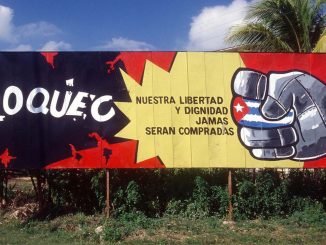
The second phase includes the use of platforms financed by the northern administration, such as El Toque, to stimulate inflation. Its influence has a significant impact on all areas of societal development. The antecedents of this phenomenon can be found in similar procedures carried out by the U.S. government in Nicaragua, Zimbabwe, Argentina (BLUE Dollar via Telegram) and Venezuela (TODAY Dollar via web).

The common denominator of the attempts is the use of digital social networks such as Facebook, Whatsapp, and Telegram, where anonymous and unknown individuals put a price on freely convertible currency in a closed circle that is very difficult to access.

The main objective of the CIA’s maneuvers is to manipulate the prices of products and, finally, to subvert the order in the Antillean nation.

The third and fourth parts of the operation, a boycott of supplies and financial blockade, follow the pattern of harassment of entities that could establish commercial links with Cuba. It is along the same lines of economic asphyxiation imposed more than 60 years ago. Restrictions include persecution, blackmail and denial of licenses to potential sources of supplies, among others.

International lawsuits, with the use of vulture funds, are also part of this undeclared offensive.

The most recent onslaught by the Central Intelligence Agency and associated agencies pursue, in essence, three goals:

To attack the currency, not only to generate hyperinflation, but also to contract production.
To alter the distribution of goods. To take them to the informal markets, to sell them at overprices.
Attack the economic actions of the Cuban government.

The methods are improved, the actors change, but the hostile intentions of the U.S. government against Cuba persist. Let us not be deceived by the apparent lack of interest in the reality of the island by not publicly placing it among the administration’s foreign policy priorities. The amounts destined to subversion and the promotion of violent acts speak of permanent aggressiveness. The maxim of the Commander in Chief persists, like a prophecy.

Source: Minrex

Strugglelalucha256


Let’s GO to Cuba – experience it for yourself

International Workers Day, May 1, isn’t officially celebrated in the U.S. – at least not yet. However, in Cuba and in countries around the world, working-class organizations honor the 1886 Chicago fight for the 8-hour workday and the Haymarket martyrs framed up by the cops during a general strike that began on May 1.

This May Day, come to Cuba, the internationalist nation that sends doctors and builders, not bombs and destroyers. Home of the globally recognized Latin American School of Medicine, where youth from around the world – including Palestine and even the U.S. – become doctors. You will be warmly welcomed.

The 2024 U.S. Contingent to the International May Day Work and Solidarity Brigade is waiting for you. 

Work and live side-by-side with Cubans and delegations from Africa, Asia, Latin America and the Caribbean. Visit workplaces, communities, historical sites, and learn about Cuba from Cubans, not from the U.S. corporate media.

Fly from U.S. airports on U.S. airlines to Jose Marti Airport in Havana; arrive on April 21 and return on May 4. The program, transportation inside Cuba, accommodations, meals, brigade t-shirt, plus Cuban visa, are included in the $865 package price. 

Joining it is easy. Take the first step by filling out this application. But don’t delay! Applications close March 20.

The International May Day Brigade provides a unique opportunity to meet and talk with Cuban workers, farmers and youth and to become better armed to return home and counter Washington’s lies and attacks against the revolution.

Each year, the National Network on Cuba works with ICAP (Cuban Institute of Friendship with the Peoples) to lead the U.S. delegation of the International May Day Brigade.

Our brigadistas are of all different ages, backgrounds, and walks of life! We give scholarships to help working-class U.S. people travel to Cuba for the first time.

Want to take a peek? Check out this video.

We see the reality of the Cuban Revolution beyond U.S. propaganda; build solidarity with mass organizations, unions, and the Cuban people; and truthfully bring back our Cuba experiences to our communities and organizations. Knowledge helps us to better fight against the illegal, inhumane U.S. blockade and to get Cuba off the especially punitive, unilateral U.S. “State Sponsors of Terrorism” list.

Find out about additional May Day 2024 delegations at NNOC.org/brigades, including specifically union-focused delegations with Building Relations with Cuban Labor and Los Angeles Hands Off Cuba, and other opportunities for respectful travel to Cuba throughout the year. Venceremos Brigade #52 will travel this summer. Applications are available now!

Strugglelalucha256


A call for May Day and International Meeting of Solidarity with Cuba 2024

We would like to share the call of the National Secretariat of the Central de Trabajadores de Cuba -CTC for the celebration of the activities for May Day and the International Meeting of Solidarity with Cuba in this 2024.

Workers, Trade Unionists, and Friends of the world:

The Central de Trabajadores de Cuba (CTC) and its unions, in conjunction with the Cuban Institute of Friendship with the Peoples (ICAP), political, mass and social organizations, invite you to participate this year in the activities for the International Workers’ Day in Havana, Cuba.

We call for the days from April 29 to May 2 to participate in exchanges with the secretariats of the CTC and trade unions, visits to workplaces, to participate in the massive May Day Parade, and in the International Meeting of Solidarity with Cuba and anti-imperialism. These activities are framed in the context of the 100th anniversary of the death of Vladimir Ilich Ulyanov Lenin, leader of the World Proletariat, the 171st anniversary of the birth of our National Hero José Martí, the 85th anniversary of the founding of the CTC, its process towards the XXII Congress and the 65th anniversary of the triumph of the Revolution, and a space to pay deserved tribute to the legacy of the Commander in Chief Fidel Castro Ruz, in a powerful example of the solidarity of the Cuban people.

The events will be developed with the purpose of continuing to demand the lifting of the economic, commercial, and financial blockade of the US government against Cuba, intensified by the application of 243 measures imposed by the Trump administration and maintained by the current Biden administration; as well as to demand the removal of Cuba from the spurious list of state sponsors of terrorism, realities that cause negative impacts on the welfare of the people, workers and their families.

It will also be a propitious moment for the political forces, social, popular and solidarity movements, trade union organizations, and participating personalities to have exchanges about the situation the world is going through, the multidimensional crisis of imperialism, the impact of the genocidal war of the Israeli state against the Palestinian people and the neoliberal policies that place the market above the life of human beings.

We will celebrate this time with the decisive participation of the workers, the dignity and creative resistance of the people, raising the banners of unity in diversity as a strategic weapon against imperialism to preserve peace, closely linked to our development, defending the gains of the world trade union movement and the just causes of our peoples.

Cuban workers are grateful for the strong expressions of solidarity support from friends around the world, and we ratify that, despite the restrictions, we will continue to participate actively in the consolidation of a socialist, democratic, prosperous and sustainable society.

Long live May 1st!

Long live international solidarity!

Proletarians of all countries, Unite!

CTC National Secretariat

Source: Resumen Latinoamericano – Havana

Strugglelalucha256


NNOC & BAP statement on AFRICOM airstrike killing 2 Cuban doctors

The National Network on Cuba, Black Alliance for Peace, and Lowcountry Action Committee strongly condemn the US Africa Command (AFRICOM) airstrikes in Somalia reported to have killed 2 Cuban doctors. We mourn the loss of their lives, and we demand the U.S. release all information about the bombing to Cuba and the victims’ families.

Cuba has deployed more than 600,000 health workers to 165 nations over the last six decades on medical missions. Two Cubans serving in Kenya, Dr. Assel Herrera Correa, a specialist in general medicine, and Dr. Landy Rodriguez Hernandez, a surgeon, were kidnapped there in 2019 and held in Jilib, southern Somalia. Unofficial sources reported that a U.S. drone strike in Jilib on February 15 killed the Cuban doctors; an AFRICOM spokesperson confirmed the bombing but would not confirm any civilian casualties. Cuba’s Ministry of Foreign Affairs approached the U.S. government through diplomatic channels on February 18, seeking information, and has yet to receive a response. The President of Cuba’s National Assembly is now traveling to Kenya to carry out urgent negotiations and confirm the status of the doctors’ lives.

We call on the U.S. to cooperate with an investigation and to share all information about the attack with Cuba. This attack shows once again that Cuba’s foreign policy is to save lives, while U.S. foreign policy is to occupy, bomb, blockade, and destroy lives. As Cuban leader Fidel Castro famously said, “Our country does not drop bombs on other peoples, nor does it send thousands of planes to bomb cities…Tens of thousands of Cuban doctors have provided internationalist services in the most remote and inhospitable places…Doctors, not bombs.”

U.S. troops should not be occupying Africa in the first place, nor should they be in Cuba at Guantánamo Bay. Despite the disingenuous altruistic spin the U.S. puts on their stated purpose for AFRICOM, its real and only purpose is to use military power to impose U.S. control over African land, resources, and labor in service to Western finance capital. AFRICOM’s drone operations in Africa have only caused violence, vicious anonymity, and “collateral damage.” Primarily in Libya and Somalia, the numbers of confirmed civilian deaths from drones are as high as 3,200 in these two countries, and studies have shown these conditions “have inadvertently aided the growth of terrorist groups in the region.”

We join the Community of Latin American and Caribbean States and the Black Alliance for Peace in calling for an international “Zone of Peace” in the Americas. We stand in solidarity with all people facing imperialist violence, from Gaza to Guantánamo. Unblock Cuba, U.S. out of Africa and shut down AFRICOM, let Cuba live!

Source: U.S.-Cuban Normalization Committee

Strugglelalucha256


Cuba solidarity, what else can we do?

Car license plates in the United States have the standard format of 150×300 mm. The top part shows the name of the state, and the bottom part usually has a motto or phrase famous in the state. This is the story told by Cheryl LaBash, the owner of a Toyota with an unusual, interesting, and supportive license plate circulating around that country.

So many I can’t remember, Cheryl LaBash replies with a smile when asked how many times she has visited Cuba. She is one among countless Americans who call for the rapprochement of the two shores with the love, energy, resilience, and nobility of a people who have managed to survive against all odds.

She is like an industrious ant when it comes to Cuba. How does Cheryl manage to be in Detroit one day, Boston the next, and Washington, D.C., the next? And in that back and forth, she drives her dark gray Toyota on roads, highways, and streets with a singular license plate: “Cuba Sí”.

The idea, she says, came from Lisa Valenti, founder of the Pittsburgh-Matanzas Sister Cities Association for 30 years. She has the same license plate on her car, and “then I said to myself, why not? Her action was my inspiration.”

So “we have mine from Michigan and Lisa’s from Pennsylvania. That means there are 48 other opportunities for people to show their love for Cuba in this way, with this special license plate,” she said, referring to the possibility in the remaining 48 states.

Sometimes, she is surprised when other drivers honk their horns as they pass by, and she says: “It obviously means there is a feeling for Cuba,” and she proudly insists that “my car has driven from coast to coast and even all over Florida.”

In addition to the license plate, Cheryl carries with her a “major league baseball cap with the “C” on the front and a Cuban flag folded in the wallet. It’s a good way to make sure Cuba is always there, too.”

A shortwave radio

Soft-spoken and noble-looking, Cheryl is a woman who has long embraced the struggle for justice and human rights in a general sense. Although she feels her heart is young, she says she has “lived several years.”

It was her grandparents, immigrants from Eastern Europe, who raised her and forged her personality back in Arizona in a period that sensitized her to the struggles of migrants coming to the U.S. without speaking English.

“I lived through the Vietnam War period, which opened the eyes of a generation, as Palestine is doing today to a much more educated and advanced generation, who realize that war is something more than an accidental policy.”

Her husband back then, a graduate student at a Midwestern university, was in danger of being drafted and sent to war, and “part of our activism consisted of listening to Radio Habana Cuba’s English-language programming on a shortwave radio to update ourselves with real news about Vietnam.”

Since those youthful years, Cheryl has “participated in activism to end America’s many unjust wars, abroad and at home.”

“The harshest police brutality against black youth and immigrants in the global south, militarization of local police, repression of the rights of workers and the poor, an end to racism, oppression of women and LGBTQ2 people. For me, all of this is connected to capitalism and its highest imperialist stage,” she warned.

Today, we too are challenged by climate catastrophe, and it’s all happening in real-time, LaBash said.

For the co-chair of the National Cuba Solidarity Network, which brings together more than 70 organizations in the country, it is a shame that the U.S. government is not in tune with the numerous “resolutions to remove Cuba from the list of state sponsors of terrorism and end the blockade are calling for.

Those of us who live here in the United States – she argues – have a great responsibility to put an end to the unjust economic war that our country is waging against Cuba, the Cuban government, and, ultimately, the Cuban people.

“Whatever the outcome of the 2024 elections, our main task is to build ties of friendship and solidarity with the Cuban people through travel, collaborative projects and awareness-raising,” the activist considered.

LaBash believes that, clearly, these are dangerous and unstable times, with rampant genocide in Gaza, the impoverishment of the working class for the benefit of the world’s ultra-rich, and the threat of a third world war looming over us all.

“Cuba’s internationalism is a wonderful example of José Martí’s statement that Homeland is Humanity and an alternative to the global conflict we see today.”

At first glance

Cheryl LaBash ratifies that she loves Cuba because “it is a small but powerful example of how humanity can move forward even when faced with a cruel and aggressive economic, financial, commercial, and media blockade. “It is an inspiration and a northern star, which has now moved south, of how human beings can live with dignity.”

From that first time, in 1985, that she traveled to the Caribbean nation, as happens with lovers, she was captivated by that “indomitable and rebellious Cuba”. It was the celebration of May Day, where she was representing her union at the Detroit Health Department, that had a life-changing impact on her.

“The scandal of black infant mortality in the United States and in Detroit in particular made headlines in the media. In Cuba I saw with my own eyes the care and resources provided to pregnant women and the special care provided to all children so that they can develop fully.”

Meanwhile, she laments that “black infant and maternal mortality remains shamefully high in the United States. Cuba shows another way, and I just learned that they have extended maternity leave to 15 months. This is just a dream for most new parents in the United States.”

That clash with the Island in the 1980s allowed her to help start a labor solidarity organization to exchange with the Central de Trabajadores de Cuba.

“We organized two worker delegations per year in the early 1990s. I then helped in the first Pastors for Peace caravans with Rev. Lucius Walker that challenged the blockade at both the Mexican and Canadian borders. I often don’t go, but I help with the preparations.”

In 2009, a year after retiring, she returned for May Day with a delegation from the International Longshoremen’s and Warehousemen’s Union.

For the freedom of the Cuban 5

It was the struggle for the release of Gerardo Hernández, Ramón Labañino, Antonio Guerrero, Fernando González, and René González from US prisons that intensified her commitment to Cuba.

“The International Committee for the Freedom of the Cuban Five (currently the International Committee for Peace, Justice and Dignity), led by Graciela Ramirez in Cuba and the late Alicia Jrapko, in the United States, organized creative projects such as the national tour of La Colmenita”, and she confesses that at that stage she learned that “you can never stop fighting”. And looking back at that memorable time Cheryl reflects that “in a few months it will be ten years since their freedom in December 2014. That victory made us cry with joy when Gerardo, Ramón and Tony finally returned home”.

“It ended that terrible chapter. That tremendous struggle to free the Five was such a victory. It makes me so I am happy when I now see the photos with their families, next to their people”, adds Cheryl, who affirms that the closing of the special presentation of La Colmenita in 2011 is still a driving force and inspiration for her.

“I remember the children concluding the play with the cry, ‘Now what more can we do!’ and, you know, that’s my motto right now and every day. What more can we do to get Cuba off the SSOT (State Sponsors of Terrorism) list? What more can we do to end the blockade and let Cuba live?”

Deisy Francis Mexidor is a correspondent with Prensa Latina in the U.S.

Source: Juventud Rebelde translation Resumen Latinoamericano – English

Strugglelalucha256
https://www.struggle-la-lucha.org/cuba/page/10/