Food, trade and slumpflation

The latest measure of U.S. consumer price inflation for July actually showed an uptick in the year-on-year rate to 3.2% from 3% in June.  That is mainly a result of comparison (‘base effects’, they are called) with a drop in the rate last July from the peak in June.  Core inflation, which excludes food and energy prices, remained much higher at 4.7% yoy.
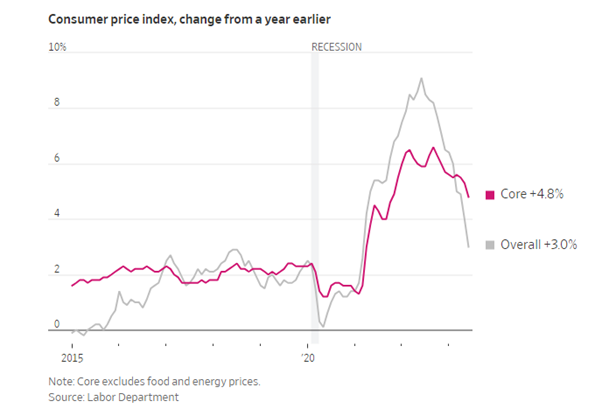
And remember, even if inflation were to fall further towards zero, prices since the end of the COVID pandemic slump are up 10-15% in most G7 economies, with those prices sheer to stay and probably rise more.  Yes, the inflation rate is slowing, but U.S. consumer prices are 17% higher than they were at the beginning of 2021.
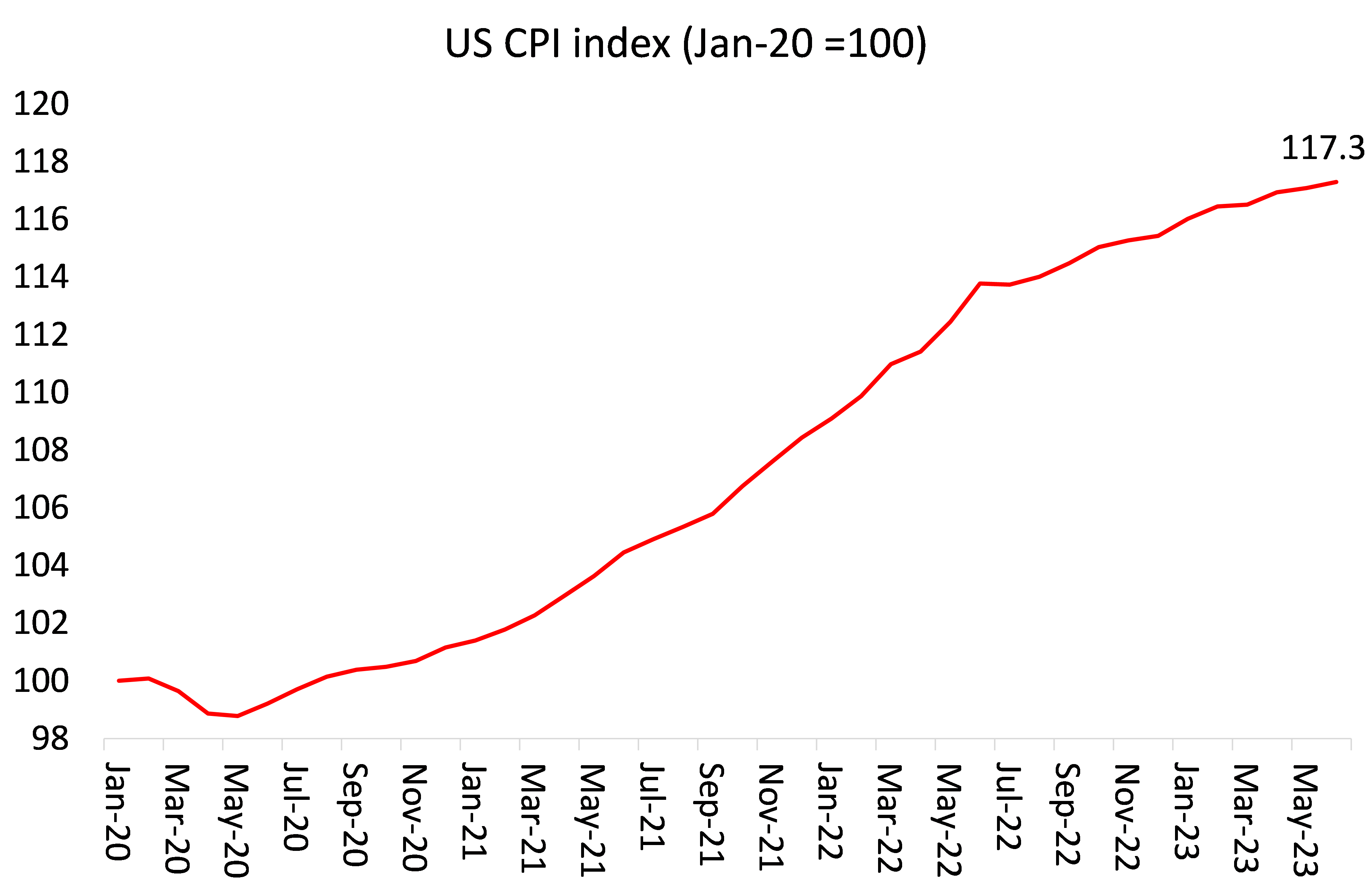
Inflation remains sticky in the U.S., and most G7 economies, which is why central banks continue to talk of further rises in their ‘policy’ interest rates.  But the expectation is that national rates of inflation will come down (if slowly) over the rest of this year.  Stock and bond market investors and mainstream economists are generally pleased and confident.

But how about having no inflation at all?  That is the situation in China, where consumer prices fell in July compared to July 2022.  This could be transitory, however. Stripping out volatile food and energy prices, so-called core inflation rose to 0.8% in July, the highest level since January, from 0.4% in June.

Deflation in China has been greeted by the China ‘experts’ as yet another sign that China is heading for a debt deflation disaster.  They reckon that if the expectation of falling prices becomes entrenched, it could further sap ‘demand’, exacerbate debt burdens and even lock the economy into a debt trap that will be hard to escape using the stimulus measures Chinese policymakers have traditionally turned to.  I have dealt with these arguments in a previous post, so I won’t go over the rebuttal.

And I am not sure working people would agree that having no inflation or even falling prices is such a bad thing, particularly as it means, in the case of China, that wages are still rising – so real incomes are going up, not down, as in the G7 economies.  But then, capitalists companies like a bit of inflation to support profits and give them room to raise prices if they can – as we have seen.
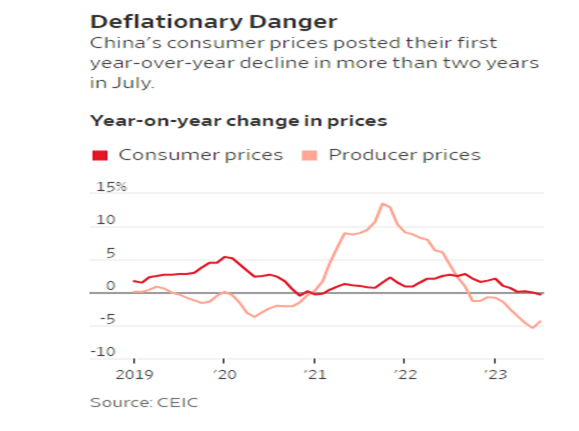
China’s negative consumer inflation result was mainly driven by a drop in food prices from a year earlier when food prices were pushed up by extreme weather conditions. Prices of pork, a staple of Chinese dinner tables, plunged 26% in July from a year earlier. Vegetable prices also fell last month.

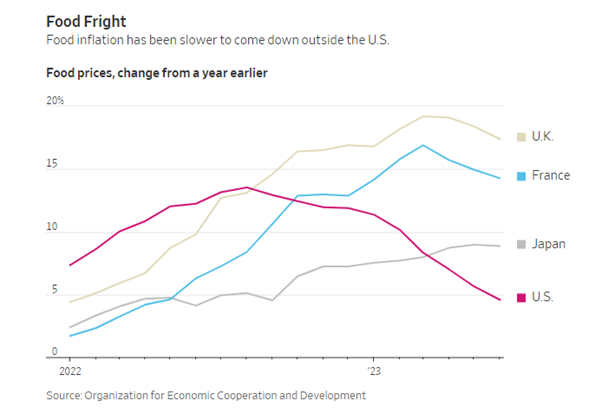
That’s not the case in the G7 economies. UK food prices rose 17.4% in the year through June, while Japanese prices were up 8.9%, and French prices were up 14.3%. In each country, food prices are rising much more quickly than prices of other goods and services.  The U.S. has fared better, with food prices up only 4.6% from a year earlier in June.
Food prices globally have fallen from the 50-year high in March 2022.  But now it seems that the global food price index is turning up again, rising 1.3% in July from June, a second increase in four months.  It remains 36% higher than it was three years ago.
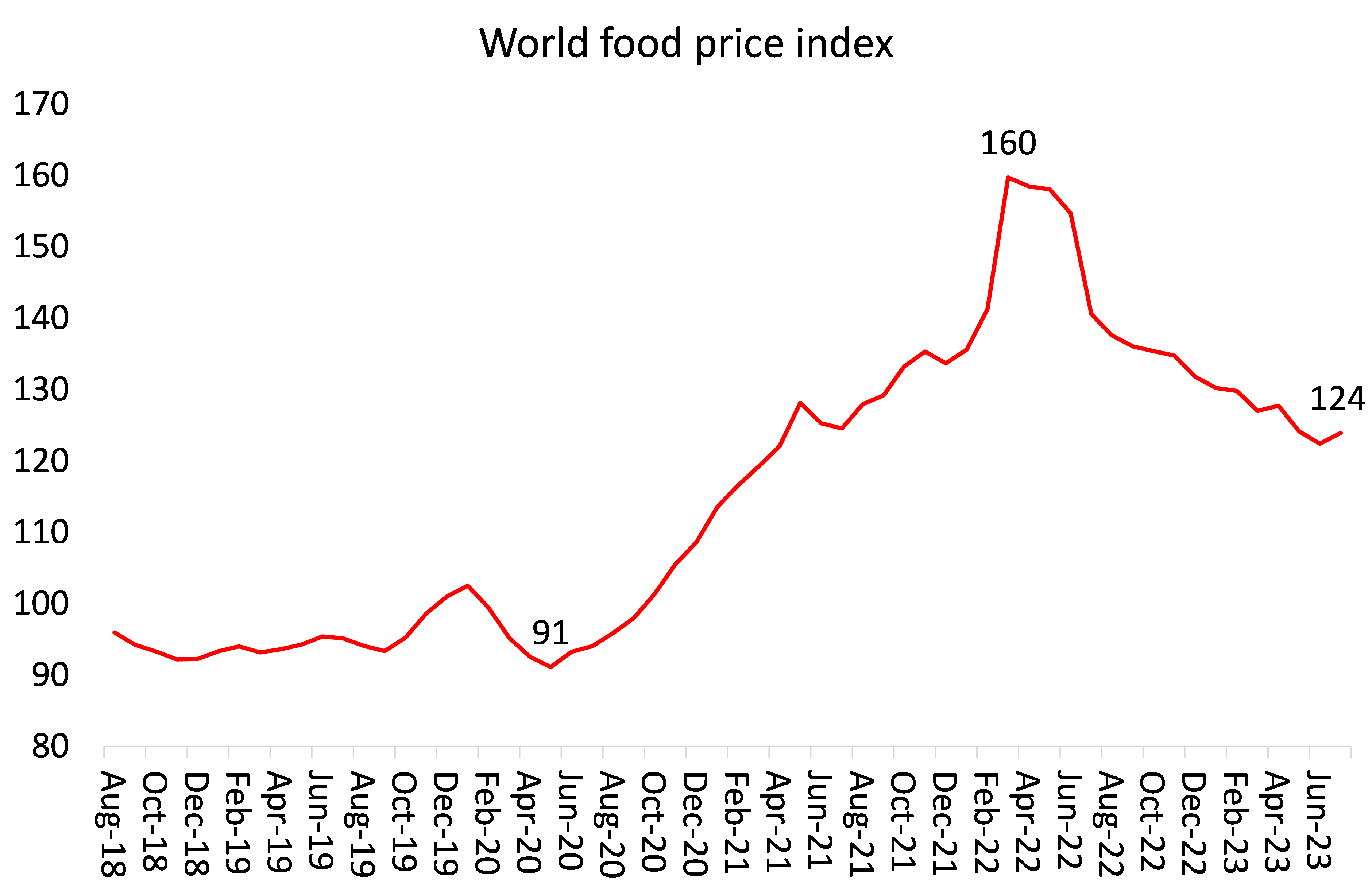
The new rise in food inflation is partly driven by the collapse of the Black Sea grain deal between Russia and Ukraine to export their harvests. Last month, Russia withdrew from the deal and subsequently targeted the country’s food-export infrastructure with drone attacks on Odesa’s port facilities.  Originally food price inflation was the product of supply chain blockages even before the Russia-Ukraine war began; now, it seems that those blockages could well return.

And then there is a further development: unusual weather patterns hitting harvests of a variety of grains, fruits, and vegetables around the world. July 2023 was the hottest month of all Julys on record. Climate scientists are saying that global warming to dangerous levels is coming upon the planet much faster than previously expected.  “Adverse weather conditions, in light of the unfolding climate crisis, may push up food prices,” said European Central Bank President Christine Lagarde.

The impact of unfavorable weather has been most notable in India, where heavy rain has reduced the rice harvest and pushed food prices sharply higher. The Indian government last month imposed a ban on exports of certain types of rice, an echo of similar restrictions on the overseas sale of food staples that were announced by a number of governments as prices surged last year.

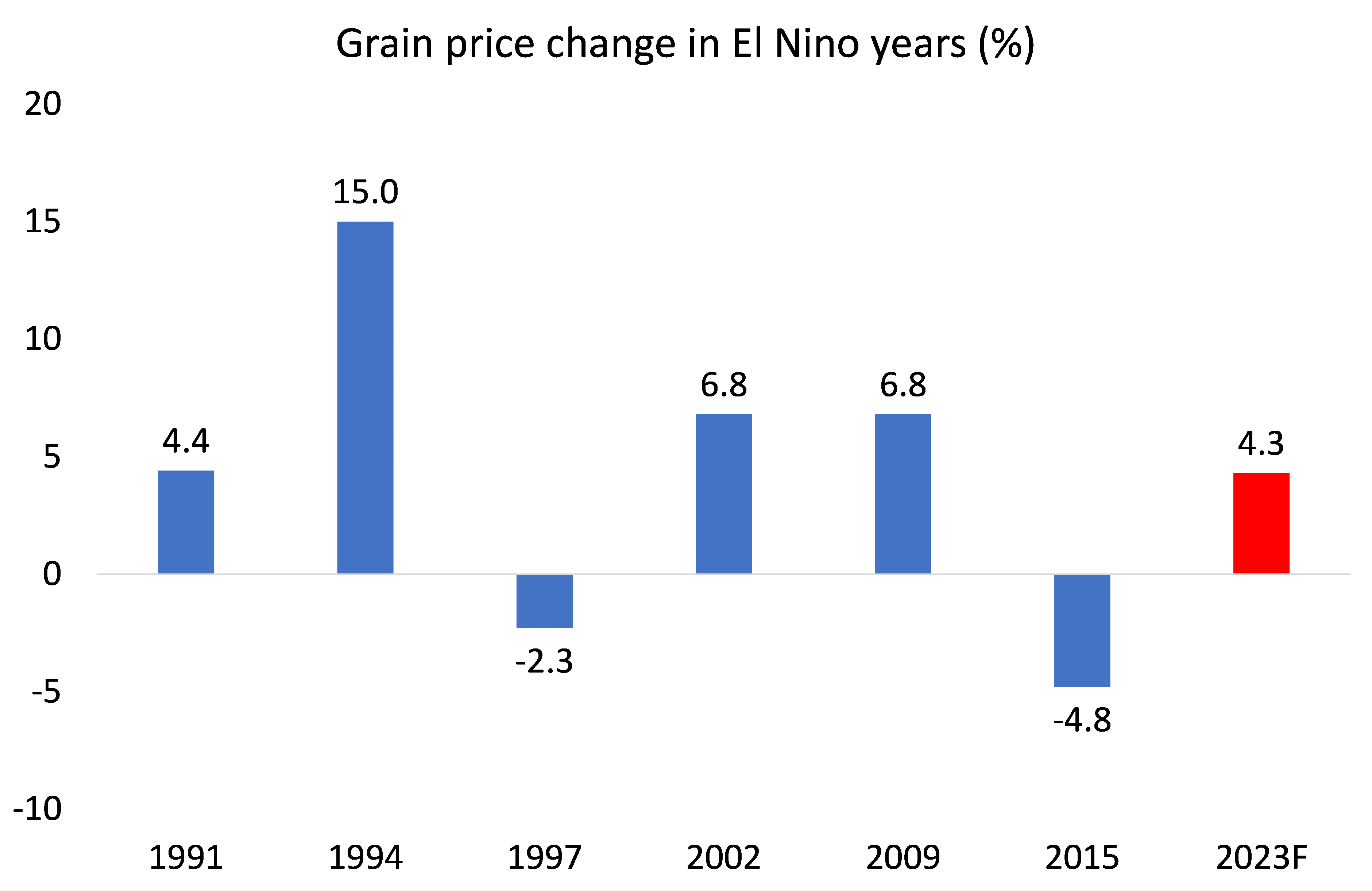
One additional risk to food supply is the strong natural warming condition in the Pacific Ocean known as El Niño, which can lead to changes in weather patterns and reduced harvests of some crops. The Australian government’s Bureau of Meteorology has issued an El Niño alert, saying there is a 70% chance that the climate pattern will emerge later this year. Previous El Niño periods have usually (but not always) led to rising grain prices.  The ECB reckons that a one-degree celsius rise in temperature during El Nino historically raises food prices by more than 6% one year later.
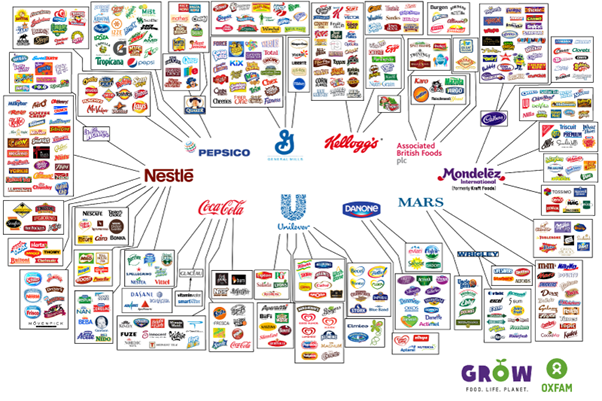
And then there are the food monopolies.  Four companies – the Archer-Daniels-Midland Company, Bunge, Cargill, and Louis Dreyfus, known collectively as ABCD – control an estimated 70-90% of the global grain trade.   They have been taking advantage of the food supply crisis by hiking their profit margins.  Further up the food chain, just four corporations — Bayer, Corteva, ChemChina, and Limagrain — control more than 50% of the world’s seeds.  From seeds and fertilizer to beer and soda, just a small number of firms maintain a powerful hold on the food industry, determining what is grown, how and where it’s cultivated, and what it sells for. Only ten companies control almost every large food and beverage brand in the world. These companies — Nestlé, PepsiCo, Coca-Cola, Unilever, Danone, General Mills, Kellogg’s, Mars, Associated British Foods, and Mondelez — each employ thousands and make billions of dollars in revenue every year.
Energy demand is relatively ‘elastic’ because there are rising alternatives fossil fuel production, and energy demand varies with global growth, industrial production, and trade.   So when the world economy slows, and manufacturing goes into recession, as it has now, then demand for energy can fall back.  That’s not the case for food.  Billions in the poorest parts of the world need ‘food security’ as the cost of food takes up most of their incomes.  And a fall in food supply will drive up prices much more than energy.

Indeed, it is food prices that will remain ‘sticky,’ and food inflation could well accelerate from here.  Supply and international trade are in the doldrums.  The IMF expects growth in global trade to slow to 2% this year from 5.2% last year. The World Bank and the World Trade Organization both forecast trade will grow by just 1.7% this year.  Even a partial recovery in 2024 is predicted to fall well short of trade’s average yearly growth of 4.9% during the two decades before the pandemic. “Overall, the outlook for global trade in the second half of 2023 is pessimistic,” the UNCTAD wrote in a June report. The organization now forecasts the global goods trade to shrink by 0.4% in the second quarter when compared with the previous quarter.

This is a confirmation of the end of globalization since the end of the Great Recession of 2008-9 and the long depression of the 2010s.  Trade growth no longer provides an escape when domestic growth is weak.  Indeed, the world is entering a period of deglobalization led by the U.S. as imposes yet more measures on Chinese trade and investment with its ‘chip war’.  The Biden administration has also kept in place most of the tariffs on goods from China and other countries implemented by the Trump administration.

This provides part of the explanation for the significant drop in Chinese exports to the rest of the world, according to the latest data.  Overseas shipments from China slumped 14.5% in July from a year earlier, the steepest year-over-year decline since February 2020.  Again, the Western experts see this as a sign of imminent collapse or stagnation of the Chinese economy.  But it is more a sign of the weakening of economic growth, investment, and real wages in the G7 economies.

Indeed China continues to dominate global trade as it pushes deeper into markets other than the U.S.  China’s overall share of global goods exports was 14.4% in 2022, up from 13% the year before the pandemic and 11% in 2012, according to World Trade Organization data.

A growing share of China’s exports are heading to regions including the Middle East and Latin America, reflecting strengthening economic links thanks to Chinese investment and its hunger for natural resources.  China is also finding success exporting cheap electric cars and smartphones to emerging markets, edging out much more expensive Western alternatives. The country surpassed Japan as the world’s biggest exporter of vehicles in the first quarter of 2023.

The shift in export destinations also reflects worsening relations between China and the U.S.-led West that are crimping trade. Tariffs on a range of goods mean China accounted for around 15% of U.S. imports in the 12 months through May, down from more than 20% before Donald Trump hit a range of Chinese goods with tariffs in 2018.

Rising food inflation, falling trade growth, and a global manufacturing recession hardly make a recipe for an optimistic ‘soft landing’ for the G7 economies over the next year.

Source: Michael Roberts Blog

Strugglelalucha256


The new banking crisis

As Marxist economist Sam Williams discusses on his “Critique of Crisis Theory” blog, in early March, Silicon Valley Bank (SVB) in California — the “favorite bank of the area’s tech companies and associated venture capitalists” — announced it was selling its government bonds to raise cash. Fearful that their deposits were in danger, there was a run on the bank, forcing the Federal Deposit Insurance Corporation (FDIC) to shut the bank down.

Around the same time, two other banks collapsed. The California Silvergate Bank wound up operations, and the New York-based Signature Bank was shut down by the FDIC. As Williams reported, these banks were “heavily involved in lending to cryptocurrency companies,” and the problems leading to their collapse “could be traced back to the collapse of Sam Bankman-Fried’s FTX cryptocurrency exchange last year.”

While the collapse of the latter wasn’t directly related to the collapse of SVB, they added to the jitters that spread to the whole banking system in the United States and internationally.

The crisis at Credit Suisse led to another Swiss bank taking it over. Problems at Germany’s Deutsche Bank led to big stock losses.

Big deposits propped up

Under US law, Williams writes, bank deposits are insured up to US$250,000 — to protect small- and medium-sized deposits. Most of SVB’s deposits came from tech companies and venture capitalists, and were much higher. Despite this, the FDIC rapidly announced that all deposits would be fully covered.

The big commercial banks, says Williams, “will be asked to cough up the money to make up for the massive losses FDIC will incur by paying off large capitalist deposit owners.” This applies to SVB and any further bank collapses.

One of the functions of money is that it is used as currency. But, as Williams writes, coins “are now almost worthless as currency except in large quantities or for making change.” Even Federal Reserve Notes — dollar bills — buy little these days.

“Today people use their bank accounts as a day-to-day currency that circulates through credit cards, debit cards, and smartphones — to purchase weekly groceries (and morning coffee),” writes Williams. “If a run on the banks paralyzed the banking system, even if only for a short time, the circulation of commodities would contract to an extent impossible at earlier stages of capitalist development.”

The FDIC hopes to stave off such a general collapse of the currency system, writes Williams, which “would lead to an economic crisis worse than the bank runs of 1931‒33,” which “marked the transformation of the recession that began in 1929 into the Great Depression.”

Extortion

This threat gives the capitalist class great extortion power, writes Williams, to “insist that the FDIC, the Federal Reserve System or the Treasury bail out large depositors.”

The Joe Biden administration complied and “wasted no time in claiming the taxpayer — unlike in 2008 — would not have to pay anything” for the bailout “because the losses incurred by the FDIC would be paid with a special levy on the commercial banks,” writes Williams.

However, Williams notes, “the levy would tend to contract bank credit. If this happens the world economies — including in the US — would sink into a deep recession, causing mass layoffs within a few months”.

“And there’s another danger if the capitalists become convinced their bank deposits are as good as the dollar bills issued by the Federal Reserve Banks,” writes Williams. “In that case, they may decide Federal Reserve Notes are no more secure than bank deposits without the FDIC, Federal Reserve, and government guarantees. This would trigger a run on the dollar and paper currencies linked to it under the dollar-centred international monetary system into gold, the money commodity … This danger is real, as shown by the movement of the dollar price of gold since the crisis began.”

This would lead to stagflation, as occurred in the 1970s, and then to a severe recession.

Such a scenario could happen if the Federal Reserve eases up interest rates to contain the crisis by printing more money (known as quantitative easing) in a bid to “secure a soft landing from the COVID aftermath boom,” writes Williams.

“In the current crisis, the Federal Reserve is forced to prop up bank deposits as the currency system on one side while staving off the collapse of the [dollar-centred] international monetary system on the other. These are contradictory goals.”

Overproduction

The cause of the current crisis is the overproduction of commodities in the COVID-aftermath boom.

After the 2007‒09 bank crisis and Great Recession, capitalists were cautious about accumulating inventories and investing, writes Williams. “This prevented a new worldwide overproduction crisis for years, at the price of lingering unemployment and eroding living standards. However, by late 2019 signs of overproduction were again developing, causing a spike in interest rates, though the situation had not yet reached a crisis.

“But then came COVID. In March 2020, the ruling class feared the virus would decimate the working-class population to such an extent their ability to squeeze surplus value out of the survivors would be impaired. They used state power to shut down much of the economy, throwing millions out of work overnight.”

The COVID shutdowns also caused a forced underproduction of commodities and reduction of inventories, writes Williams. When the shutdowns were eased, the boom began to rebuild inventories as demand for commodities soared. Demand exceeded supply at prevailing prices, resulting in high prices and higher profits. There was a rise in demand for labor power. But wages didn’t keep up with inflation, so real wages declined.

Inflation

The mainstream media and economists try to convince us that wage rises cause inflation, but the opposite is true. Workers’ wages struggle to keep up with inflation, which has other causes.

“The Federal Reserve System, headed by [Donald] Trump appointee Jerome Powell, hoped that inflation would disappear as the economy reopened,” writes Williams. But once set in motion, what economists call “multiplier and accelerator effects” accelerate a boom and its associated inflation “until they run into the barrier of a shortage of ready cash.”

“At that point, they go into reverse. The boom is replaced by recession to liquidate overproduction at the price of millions of jobs,” writes Williams.

Banks use their customer deposits to make loans and make money off the spread between what interest they charge on their loans and the interest they pay on deposits. But financial institutions are currently facing a changing economic climate, in which the free-money era of ultra-low interest rates has ended as the Federal Reserve tries to rein in inflation by making it more expensive to borrow.

The result caught Silicon Valley Bank unable to service its depositors.

Middle way?

The Federal Reserve System faces a quandary: If it creates more dollars not backed by gold to keep the boom going, profits in dollar terms would remain high for a while but turn negative in gold terms. This would cause capitalists to transform as much of their capital as possible into gold. The resulting run to gold would accelerate dollar inflation and threaten to bring down the dollar-centered international monetary system.

On the other hand, if the Federal Reserve allows the bank money system to become paralyzed by bank runs, the dollar would be saved, but the economy would fall into a second Great Depression.

So the Federal Reserve is attempting to find a middle way: to keep the system of bank deposits as currency functioning without bringing down the dollar’s role as the world currency — and other currencies linked to it.

The aim is to achieve a relatively soft landing, even if that means a recession with millions losing their jobs. But if the Federal Reserve is successful, it will keep a recession from turning into a depression while saving the international monetary system.

Whether the Federal Reserve can pull it off this time remains to be seen. But even if it does, the world will face a similar crisis again in a decade or so.

Source: Green Left

Strugglelalucha256


The capitalist crisis is just beginning

Worldwide there is a “cost-of-living” crisis. Inflation is raging. Food prices are out of reach. Access to housing is collapsing, with unsheltered homelessness up more than 30% in U.S. cities. New apartment sizes have dropped severely across the U.S., making Manhattan-style micro apartments the new affordable norm.

Oxfam reports that with the post-COVID-19 recession came the “largest increase in global poverty since World War II. … Tens of millions more people are facing hunger. Hundreds of millions more face impossible rises in the cost of basic goods or heating their homes. Climate breakdown is crippling economies and seeing droughts, cyclones and floods force people from their homes.”

Oxfam concludes: “Poverty has increased for the first time in 25 years. At the same time, these multiple crises all have winners. The very richest have become dramatically richer and corporate profits have hit record highs, driving an explosion of inequality.”

Capitalism has had economic crises every 10 years or so since 1825. Recessions are built into capitalism’s cycle of boom and bust.

Recent recessions have occurred in 1973, 1980, 1981, 1990, 2000, 2007, and 2020. That’s a recession about every seven-to-ten years, with the exception of the back-to-back recessions of 1980 and 1981.

The Great Recession of 2007 lasted the longest (almost two years). The 2020 recession produced the most severe decline in GDP (down 19.2% in the U.S.).

Until capitalism is overturned worldwide, the boom-and-bust crises will return, again and again, each one destroying jobs, housing, and food while at the same time increasing the centralization of capital and expanding monopoly domination.

Capitalist overproduction always causes these recessions. This is because of the laws of competition. The capitalists are in a permanent race to outproduce each other to gain the most profit. So capitalist production expands, but the market does not equally grow.

While production expands rapidly under capitalism during a boom period, the bosses eventually find that they cannot sell at a profit. So they shut down businesses and cut workers’ hours; an unemployment crisis begins. Inventory must be reduced or destroyed. 

This is the law of capitalism. It cannot operate in any other way. This is the boom-and-bust cycle.

The capitalist drive to expand is also the drive to war – the imperialist drive for big business to control the raw materials such as oil and ores, the agricultural production, and most of all, the labor in every part of the globe. 

But that’s never the way the talking heads on TV explain recessions. There’s always some other explanation, usually blaming financial corruption, like Lehman Brothers’ lending practices for the 2008 recession. Never is it said that capitalism or overproduction is responsible for the crisis. Yet that is the underlying cause.

Congress recognizes the capitalist roots of the crisis, of course, and its sole act (Democrats and Republicans together) in response to the looming recession was to pass a resolution denouncing socialism.

Strugglelalucha256


The impending world recession

The IMF managing director Kristalina Georgieva has now openly admitted that the year 2023 will witness the slowing down of the world economy to a point where as much as one-third of it will see an actual contraction in gross domestic product. This is because all three major economic powers in the world, the U.S., the European Union, and China, will witness slowdowns, the last of these because of the renewed COVID upsurge. Of the three, Georgieva believes the U.S. will perform relatively better than the other two because of the resilience of the labor market; indeed. the greater resilience of the U.S. labor market provides some hope for the world economy as a whole.

There are two ironical elements in Georgieva’s remarks. The first is that the best prospects for the world economy today, even the IMF concedes if only implicitly, lie in workers’ incomes in the U.S. not falling greatly. For an institution that has systematically advocated cuts in wages, whether in the form of remunerations or social wages, as an essential part of its stabilisation-cum-structural adjustment policies, this is a surprising, though welcome, admission. Of course Georgieva, many would argue, is seeing U.S. labor market resilience only as the result of U.S. economic performance and not as its cause. But her considering it a “blessing” (though not an unmixed one for reasons we shall soon see) leaves one in no doubt that the demand-sustaining role of workers’ incomes is also being recognized by her.

Some may contend that stabilisation-cum-structural adjustment policies of the IMF are typically meant for economies that are in crisis as a means of overcoming such a crisis, not as a panacea for growth, so seeing a change in IMF’s understanding in this regard may be unwarranted. But what the IMF is now saying is certainly out of line with what it usually says; it is, in effect, conceding that a resilient labor market in the U.S. is beneficial for its growth, which begs the question: why should other economies, too, not attempt to have resilient labor markets even when they are in crisis, and tackle their crises through other, more direct, means like import controls and price controls? Conceding that the resilience of the U.S. labor market can be beneficial for its economy, and hence for the world economy as a whole, thus fundamentally runs counter to what the IMF generally stands for, at least in the current neoliberal times.

The second ironic element in her remarks is her recognition that such a resilient labor market, while being beneficial for U.S. growth, will simultaneously keep up the inflation rate in the U.S., forcing the Federal Reserve Board to raise interest rates further. This has two clear implications. First, it means that the U.S. growth rate, while being less affected for the time being, will inevitably be constricted in the months to come as the Fed raises the interest rate. The U.S. performing relatively better in 2023 is thus not a phenomenon that will last long. Since any poor performance by the U.S. will have an adverse effect on the world economy as a whole, this amounts to saying that the world recession will worsen in the months to come unless China’s COVID situation improves substantially. It amounts to saying, in other words, that even if 2023 will only see a third of the world economy facing recession, a much larger swathe of it will fall victim to a recession later. This is certainly the most dire prediction made about the prospects of world capitalism at the present juncture by any major spokesperson of it.

The World Bank, too, has been warning of a serious recession looming over the capitalist world and discussing, in particular, its implications for third-world economies. In September 2022, it put out a paper in which it expected a 1.9% growth of the world economy in the year 2023. But both the IMF and the World Bank attribute the looming recession primarily to the Ukraine war and the inflation it has given rise to (and also in passing to the pandemic); the response to that inflation in the form of an all-round increase in interest rates is what underlies the current threat of recession. There is no recognition by these institutions of any problem arising from the neoliberal economy that could be underlying the looming crisis.

This analysis, first of all, is erroneous. Long before the Ukraine war, inflation had reared its head as the world economy had started recovering from the pandemic. At that time, such inflation had been attributed to the disruption in supply chains caused by the pandemic, though many had differed from this analysis even then. They had pointed out that, more than any actual disruption, the inflationary upsurge owed much to the jacking up of profit margins by large corporations in anticipation of shortages. The Ukraine war occurred against this backdrop of ongoing inflation and added to it quite gratuitously as the Western powers imposed sanctions against Russia.

A look at the movement of crude oil prices confirms this conclusion that the Ukraine war is not the genesis of the inflationary upsurge. The rise in brent crude prices occurred primarily in 2021 as the world economy started recovering from the pandemic: the rise between the beginning of 2021 and the end of that year was by more than 50%, from $50.37 per barrel to $77.24 per barrel; the corresponding rise in 2022, during which the Ukraine war occurred, was from $78.25 to $82.82, i.e., by 5.8%, which is less than the current inflation rate in most advanced capitalist countries, even though inflation is generally claimed to have been driven by oil prices. True, immediately after the imposition of sanctions against Russia, world oil prices shot up, reaching a high of 133.18 dollars per barrel during 2022, but then they came down quite sharply, as we have seen, so that simply blaming the Ukraine war for the price-rise is not only misleading (as it is not the war per se but the sanctions that were responsible) but also erroneous (as prices should have come down when the price-rise induced by the sanctions abated).

It is not just the analysis of the Bretton Woods institutions that is flawed. Even more noteworthy is the fact that they have no perception whatsoever, even in the terms of their own analysis, of how this world recession is going to end. If, as they believe, it is the Ukraine war that is responsible for the looming recessionary crisis, then they should, at the very least, have hoped for an early end to it. That, however, is unacceptable to Western imperialism, which wants the war to drag on so that Russia is “bled” into submission; this is why the twin institutions express no opinions on the need for ending the war. But even if they chose to remain silent on the question of ending the war, they could have expressed some opinion about tackling the inflationary crisis in some other way than by raising interest rates and unleashing a recession. The IMF and the World Bank, however, are so committed to free markets that they cannot contemplate any other inflation-control measure (such as direct price control), even as they lament the recessionary effects of interest rate hikes.

Likewise, even as the World Bank president David Malpass commiserates with debt-encumbered third world countries which are going to be badly hit in the coming months, and even says that a large chunk of their debt burden has arisen because of the high interest rates themselves, there is not a word in his speech in favor of lowering interest rates. Both the Bretton Woods institutions, in other words, are long on commiserations but short on concrete measures to help the world’s poor.

This is not just a symptom of timidity. It points to something deeper, namely the genuine impasse in which world capitalism finds itself today. If the structure of Western imperialism as it has evolved over the years is to be kept intact, then the metropolitan countries have to keep the Ukraine war going, in which case inflation at the current pace becomes unavoidable in the absence of an engineered recession, and the consequent unemployment. World capitalism’s taking this route, therefore, should not cause any surprise; the point is to resist it.

Source: Peoples Democracy

Strugglelalucha256


High prices, low pay: a Marxist analysis of inflation

Based on remarks at the Socialist Unity Party national plenum on Aug. 13.

The global working class is being hit hard by inflation. But what is inflation, and how can we understand both its causes and effects through a revolutionary Marxist lens?

According to Investopedia, “inflation is a rise in prices, which can be translated as the decline of purchasing power over time. [Emphasis added.] The rate at which purchasing power drops can be reflected in the average price increase of a basket of selected goods and services over some period of time.”

This basket of goods is another name for the Consumer Price Index (CPI). There are different ways of calculating this kind of measure, and the U.S. Federal Reserve — perhaps for obvious reasons — prefers a different measure that gives a lower figure.

At any rate, the rise in prices is clear enough for anybody who has bought anything since last year. In June, the U.S. CPI hit 9.1%, the highest level since 1981. This seems significant for assessing the overall health of capitalism.

There may be some slight dip in the inflationary pressures, with CPI for July being at 8.5%. This may be largely attributable to a drop in fuel prices.

Nevertheless, the problem doesn’t seem to be going anywhere any time soon. Workers are still experiencing a cut in real wages. For July, a monthly wage increase of only 0.5% was reported. Even with this tiny bump — with the inflation — wages are down 3% from last year.

Wages are down even as the median monthly asking rent for the U.S. as a whole exceeded $2,000 in May. In Los Angeles, it’s $3,400. Formerly considered a haven for relatively affordable housing, Nashville rents rose 32% from last year to $2,140. The soaring cost of housing is driven by a takeover of the market by giant financial entities.

During an Aug. 10 White House press briefing, President Biden asserted that inflation in July was at 0%. This is a distortion. Overall, there was a 0% increase in inflation, meaning prices held steady at an already high level. Fuel costs went down a bit, while others went up, e.g., food rose by 1.3%.

Biden’s triumphant messaging stands in stark contrast to the situation for working-class people. Household debt is up at a record $16.15 trillion. Evictions are back to pre-pandemic levels. Homelessness is up.

Inflation in U.S. and China

It’s not only the U.S. that’s being affected by inflation. Astonishingly, Argentina’s inflation has exceeded 70%. There were large protests in the capital, Buenos Aires.

Pew Research found that inflation rates have doubled in 37 of 44 “advanced economies” over two years, as of the first quarter of 2022. The same report found that Turkey had a 54.8% inflation rate.

For China, CPI had only risen to 2.7% in July, thought to be driven in part by a 20.2% rise in the price of a food staple, pork. The small size of this increase is notable, especially considering that the International Monetary Fund still expects the Chinese economy to grow by 3.3% this year. 

That’s with major supply-chain and other economic disruptions that result from the Chinese government’s continued commitment to a Zero-COVID policy; surely, the disruptions of Shanghai’s two-month shutdown are not ideal from an economic perspective, but China is still able to keep economic development going and inflation under control. As of June, only 5,226 had died from COVID-19 in China.

Meanwhile, in the U.S. — where over a million people have died from the disease and the federal government seems to have given up any pretense of trying to stop the spread – we are still looking at a U.S. GDP contraction of 2.5% so far this year. 

What GDP actually measures can be debated, especially from the standpoint of the working class. However, there is a clear difference between the two countries, even using bourgeois metrics.  

It is probably useful to look at China’s performance here and compare it to how economic planning enabled them to bounce back from the 2007-2008 financial crisis that affected the capitalist world economy as a whole, and moreover, how much of the growth and development since then has been driven by China. 

Our party maintains that despite China’s capitalist reforms that have threatened the gains of the Chinese Revolution, the economy remains fundamentally socialist. This is why the Chinese state, led by the Communist Party of China, has been able to respond to various global crises with effective social and economic planning.

What causes inflation?

So, here we have a broad sketch of the current situation. But what is the cause of the inflation?

Economist Richard Wolff put out a video on June 17 arguing strongly against the assertion that “supply chain disruptions” are the cause of the current massive inflation. He says that instead, it’s a case of companies across the board jacking up prices to recoup profits lost during the pandemic, which was also an economic disaster for the world economy. 

And he says that the capitalists are raising prices in the context of system failure, of a general breakdown of capitalism—especially in the U.S.—characterized by an overwhelming degree of dysfunction throughout, and which can’t be fixed by attacking or regulating individual aspects of the system.

This diagnosis seems mostly accurate. On the other hand, the fact of supply chain disruptions could be more significant, indicating the deeper structural dysfunction and systemic decline alluded to by Wolff.

In October 2021, Labor Notes co-founder Kim Moody argued against “just-in-time” supply chains, which are the norm today. This could be called the logistics equivalent of the Taylor-Ford revolution in manufacturing and was the brainchild of Toyota engineer Taiichi Ohno in the 1950s. 

The idea is that corporations can increase profits by delivering things in smaller quantities—just what is needed—and the corporate recipients could also cut costs by not having to maintain large inventories, meanwhile reducing the number of workers. 

In the West, this started in the automobile industry and spread out. It mirrors the general process of the tech revolution in the 1980s and 1990s, which saw dramatically more automation in manufacturing and so on, pushing down wages and undermining the existing union organizations. Sam Marcy detailed this process as it was happening in the articles that make up the book “High Tech, Low Pay.” 

All of this was contemporaneous with what has been called “neoliberalism,” which we can define from a revolutionary perspective as the great offensive of the capitalist class in the period of global revolutionary retreat (involving Western imperialist-backed counterrevolution in the USSR and more).

Moody points out that aside from being a driver of the shift to low-wage work, this logistics model involves vulnerabilities. It works really well for the capitalists when things are running relatively smoothly, but if there’s a logistics bottleneck — as when a ship blocked the Suez Canal last year or with the effects of the pandemic — the result can be catastrophic. 

This has also been the case with the global distribution of wheat as the U.S.-NATO proxy war in Ukraine drags on. Or we could point to climate-change disruptions in the form of fires, droughts, floods, hurricanes, etc. With worsening climate change, we should expect increasing supply-chain disruptions.

Current phase of global capitalism

This brings me to the main question that I would like to pose. It seems to me that a major task for revolutionaries now is to figure out how to characterize the current period, or even phase, of global capitalism. We likely all agree that Lenin’s analysis in “Imperialism, the Highest Stage of Capitalism” holds true, although the trends he outlined then were embryonic compared to the highly developed, even rotten, situation now.

Likewise, Sam Marcy’s analysis showing the effects of the growth of high tech at the end of the 20th century and the proliferation of low-wage jobs, with the disappearance of much of the manufacturing in the U.S. and other imperialist countries, has continued. 

In the past roughly 20 years, technological developments have enabled a radical transformation of logistics, characterized by Amazon, and spawning economies of micro-transactions, and so on. The pandemic has perhaps accelerated these trends.

These trends have continued through the cyclical or episodic ups and downs. Each time there is one of these crises, there is a recovery for profits and the stock market, but most of the population is still worse off than before. Workers are consumers, after all—capitalism is based on production of commodities. So the basis of the capitalist system, I would argue, becomes more brittle after each shock. The decent-paying jobs have never come back.

Nothing that the capitalist state does fixes the underlying problems. None of it really works.

The corporate giveaways (which are really a wholesale looting of workers’ wealth) give a little boost, but more is required each time.

I haven’t touched on military spending, another inflation source. More and more resources are thrown at the war machine, taking away from the civilian economy and overall social development. Value is destroyed on a massive scale. A missile that costs millions to produce disappears in an instant, and people die. The capitalists may have gotten some traction out of such spending in the past, but it doesn’t seem to be working now.

The sanctions regimes aren’t working, either. Washington is not effectively controlling the countries of Asia, Africa and Latin America anymore. In fact, sanctions seem to be backfiring. In a recent speech, Nicaraguan President Daniel Ortega said that the Washington imperialists had decided to destroy Western Europe to carry out their proxy war on Russia and China.

The worst is yet to come, as winter fuel shortages could be devastating for the working class. Perhaps we are seeing the end of the relative coincidence of interests among the imperialist countries that followed World War II, with Washington and Wall Street at the apex; it is difficult to imagine how German and other European leaders will be able to look their people in the face and tell them that it is in their interests to accept U.S. dominance.

In short, all the usual medicines seem to be accelerating the advance of the disease.

A turning point 

The final defeat in Afghanistan may have been a turning point. The value of the dollar and euro has declined, and more trade is happening in the yuan and ruble. Dollar dominance may be going out, and with it, the imperialists’ ability to push off their problems onto weaker countries.

If the capitalist-imperialist system is in decline, it can’t be the case that mere policy shifts or, say, adopting different models (i.e., away from “just-in-time” shipping) could easily be implemented, as all of these things developed out of the fundamental logic of the system, of the need to extract surplus value in the period of monopoly.

There’s no obvious path for bringing manufacturing back to the U.S. Rust Belt. Trump’s trade wars didn’t work. Brexit isn’t working, either; Britain hasn’t been able to form a coherent government since the Brexit vote. The political divisions are so deep, and there is extreme disunity in the ruling class. They can’t implement any programmatic change of direction.

Even commentators on NPR have been frank that the Inflation Reduction Act that just passed Congress is a massively scaled-back version of Biden’s Build Back Better plan and the Green New Deal. The vote happened on completely partisan lines, showing how brittle the ruling “coalition” is and how susceptible any policy change is to being overturned in future political chaos, e.g., by another Trump presidency. And presuming that this bill will curb inflation at all, the NPR commentators noted that there’s not likely to be much change either in 2022 or 2023.

Meanwhile, there’s no talk about emergency measures to help working-class people. In 1970, Nixon implemented a 90-day price freeze. There doesn’t seem to be political willingness to do anything like this now.

So, looking at all these trends, my assumption is that even if there is some recovery or inflation diminishes, the deeper problems will not decrease and should rather increase. All of the problems will certainly increase if there is another imperialist war. Washington’s threats against China are not encouraging.

So that is, overall, the question I leave: How to characterize the period and its dynamics? The counterpart to that is, how can the left form a fightback under current conditions, simultaneously to meet pressing needs and to advance toward a higher level of struggle?

Strugglelalucha256


Wages, prices and the minimum wage

Today the federal minimum wage is $7.25! Let that sad fact sink in. Right now you can barely buy a gallon of gas in some parts of the country with that little cash.

July 24 will mark the anniversary of the last increase that took place in 2009. In 13 years the capitalist government in the United States has not raised the minimum wage even a nickel. And this is in the wealthiest country in the world. Well, wealthiest for the wealthy!

Labor Department data for 2021 shows that approximately 250,000 people still earned $7.25 and, to add insult to injury, domestic, farm, student, disabled, and restaurant workers can be paid less than $7.25 an hour. It’s called a “subminimum wage” — it’s legal and it implies that these workers are considered subhuman by their bosses.  

The majority of low wage workers are Black, Brown, immigrant, women and young.

It is such a disgrace that some states and local municipalities have been forced to pass minimum wage increases on their own — but only as a result of concerted struggle by groups like “Fight for $15,” labor unions and community groups.

But still close to 52 million workers — 32% of the workforce — earn less than $15. And when you factor in the large number of workers who can only find part-time work, or do gig work, the situation is even more dire.

Of course, any worker can tell you that $15 is a barely, barely, barely enough to get by wage.  

A September 2021 broadcast on CBS Money Watch reports that the “minimum wage would be $26 an hour if it had grown in line with productivity.”  

What the broadcast says in plain language is that workers are working themselves to death, producing more and more — utilizing productivity-boosting technology — and killing themselves on the job.

Workers have “been more industrious,” in the words of CBS, making bosses’ profits soar.  

On top of this, today’s inflation that continues to spiral upward has wiped away wages for all workers across the board. Wages were down 2.7% in April and are down much more than that in July.

So it is no wonder that workers and their organizations have begun to demand a minimum wage of $25. In the case of Amazon workers, the Amazon Labor Union is demanding a $30 minimum from the $191 billion Bezos.

What did Karl Marx have to say about wages?

Karl Marx spent his entire life writing and explaining the inner workings of the capitalist system and the development of human history. Along with colleagues, Marx participated in the workers movement of the time and was forced to live in exile. 

You could say Marx, who was impoverished and reviled by the ruling classes of that time, also worked himself to death. He drove himself tirelessly not under the direct whip of a capitalist boss, but in the service of emancipating the working class.  

So what did he explain in a meticulous and scientific way that earned him the hatred of the industrialists, landlords, bankers and capitalist class?

He revealed how wages and prices were determined, what surplus value is and how profit is derived. 

There is a pamphlet, “Value, Price and Profit,”  that was presented first as an address at a gathering of the leading workers’ organization at that time that sums up some of the more detailed analysis in “Capital.”  

Marx explains that profit for the capitalist bosses comes from the unpaid labor of workers, who produce surplus value, which is the source of profit and the source of wealth for the capitalist class.

It’s amazing that at that time Marx was responding to some of the same arguments heard today against raising wages. But it’s true. “Value, Price and Profit” starts with a presentation of Marx’s response to trade unionist John Weston who claimed that raising wages would be harmful to workers, causing inflation. Weston’s views at the time were supported by John Stuart Mill.  

It wasn’t the individual Weston but rather his ideas that Marx argued with.

Karl Marx explained that raising wages will not automatically lead to higher prices. The only outcome of a rise in wages is a decline in profits. There is no reason for prices to increase.

However, there is almost nothing that a capitalist boss won’t do to make profit. It is not an individual thing, but built into the system.  And so herein lies the heart of  why there is so much propaganda about raising wages — that it will cause inflation, unemployment, and an endless list of disasters. The mere thought of declining profits causes terror. 

So you might say that what Karl Marx described was wage theft, but only on a broader scale — meaning the entire system is predicated on ripping off the working class and that the real relations between bosses and workers is one of wage slavery.

Conclusion: We need to fight for every penny we can get and more. Let’s raise the minimum wage to $25 or even $30 an hour.  But, as Karl Marx proclaimed, the ultimate solution is to do away with wage slavery totally and build socialism.

Strugglelalucha256


Capitalist profit drive fuels war, inflation, wage loss

President Joe Biden used the phrase “Putin’s price hike” again in a reaction to the June 10 Consumer Price Index report revealing continued high inflation. Biden isn’t a comedian, like that guy Zelensky in Kiev was before taking on the role of president, so Biden really needed a laugh track played after he said it.

“Make no mistake about it: I understand inflation is a real challenge to American families. Today’s inflation report confirms what Americans already know: Putin’s price hike is hitting America hard,” Biden said.

It was funny because, of course, Putin can’t raise prices on anything in the U.S. Only U.S. businesses can do that. 

Also, when he imposed sanctions on Russia in February, with a lot of bull and bluster, Biden declared: “Defending freedom will have costs, for us as well and here at home.” He got that last part right. It’s costing a lot. So really it’d be better to call it “Biden’s price hike,” even if that’s only part of the inflation.

Prices started to escalate more than a year ago. In fact, the Federal Reserve suggested last December, with inflation at a 40-year high then, that inflation had peaked.

Of course, you probably knew even then that it wasn’t true. Inflation hasn’t peaked yet and no one (including the Fed) knows how many peaks are ahead.

The U.S. sanctions on Russian natural gas, oil, grains and fertilizers have allowed U.S. companies to raise prices. The sanctions are designed to stop trade from Russia and turn the trade over to U.S. corporations, which can demand premium prices because of the sanctions.

Natural gas is a primary energy source in the European Union and is the dominant source for home heating and cooking. The EU imports 40% of its natural gas from Russia. Natural gas from Russia can be piped into Western Europe at a relatively low cost, while natural gas from the U.S. must be liquefied – liquefied natural gas or LNG – then shipped by sea to Europe.

Sanctions cutting off natural gas from Russia was a big bonus for the U.S. oil oligarchy.

Gas and oil prices are rising because supply has been restricted. Supply dropped during the pandemic, raising prices, and now Russian exports are sanctioned by the U.S. and NATO, sending prices ever upward.

Wage and price crisis

But the inflation crisis isn’t just about rising energy prices. Prices across the board, but especially in energy, food and housing, are rising, while real wages have sharply fallen. Price rises are outstripping wage growth nearly everywhere.

Wages are not driving prices up. No, it’s profits that have risen sharply.

Josh Bivens of the Economic Policy Institute noted that while “it is unlikely that either the extent of corporate greed or even the power of corporations generally has increased during the past two years … the already-excessive power of corporations has been channeled into raising prices rather than the more traditional form it has taken in recent decades: suppressing wages.”

In an article on “greedflation,” New York Times business reporter Lydia DePillis says: “There is not much disagreement that many companies have marked up goods in excess of their own rising costs. This is especially evident in industries like shipping, which had record profits as soaring demand for goods filled up boats, driving up costs for all traded goods. Across the economy, profit margins surged during the pandemic and remained elevated. …

“Consider the supply of fertilizer, which shrank when Russia’s invasion of Ukraine prompted sanctions on the chemicals needed to make it. Fertilizer companies reported their best profits in years, even as they struggle to expand supply. The same is true of oil.”

The Fed goes after workers

Biden, the politicians in Congress and the corporate-controlled media have all agreed on one answer to the inflation monster: the U.S. Federal Reserve System. Capitalism’s central banking system is supposed to come to the rescue. Except that it hasn’t, so far.

The chair of the U.S. Federal Reserve, Jerome Powell, announced May 4 that the Fed will be raising interest rates and implementing policies aimed at reducing inflation in the United States. The goal is “to get wages down,” he said. There’s no way reducing wages would stop inflation, though reducing wages does boost profits.

According to a transcript published by the Wall Street Journal, Powell blamed the inflation crisis, which is global, not on U.S. and NATO sanctions on Russia, but rather on U.S. workers allegedly making too much money.

“Employers are having difficulties filling job openings, and wages are rising at the fastest pace in many years,” Powell said. 

“Wages are running high, the highest they’ve run in quite some time,” the Fed chairman lied.

Wages falling fast and faster

The U.S. federal minimum wage is just $7.25 per hour, and has remained at that level since 2009, despite significant increases in inflation.

In 1968, the U.S. federal minimum wage peaked at $1.60, which would be equivalent to $13.29 in 2022 dollars. When you adjust the minimum wage for inflation, you’ll see that it’s been going down every year since 1968.

As the April 12 Wall Street Journal reported, “Unfortunately, inflation-adjusted wages are falling faster than they have in 40 years. Inflation ran 8.5% in the year ending last month, while nominal wages grew only 5.6%, a decline in inflation-adjusted wages of 2.7%.” 

Got that? Wages across the board are down 2.7% this year.

So if wages are already decreasing (and inflation is increasing), how could the Fed’s plan to “get wages down” be a way to stop inflation? If that sounds confusing, that’s because the Fed’s Powell is talking nonsense about wages and inflation.

Raising interest rates, on the other hand, is the standard Fed response to inflation. The only problem there is that experience shows that raising interest rates means businesses cut back on everything, especially jobs. 

Fewer jobs means decay, unemployment and recession – an economic bust. The World Bank warns that the economy appears to be heading into stagflation — high unemployment combined with runaway inflation.

No matter what policy the Fed chooses, what’s coming does not look good.

But labor unions can be part of the answer. The workers who have the best chance of fighting inflation and stopping falling wages are those in a union. 

In fact, every worker already knows that instinctively. That consciousness is part of the union organizing upsurge across the country from Amazon to Starbucks to Apple to REI and on and on. A strong union movement can fight back.

Strugglelalucha256


Dollar dominoes

Will Washington’s seizure of $300 billion Russian assets end domination of dollar as global currency?

On Feb. 26, the U.S. blocked Russia’s access to over $300 billion in foreign reserves held in banks in the U.S., the European Union and Japan. This was part of the sanctions U.S. President Joe Biden announced as part of the U.S./NATO proxy war against Russia.

China did not freeze Russian assets. China’s banking regulator said it would not participate in sanctions against Russia, adding that the sanctions “have no legal grounds.”

Another way to put it is that the U.S. taking $300 billion in Russian assets is illegal – a robbery.

Russia responded with counter-sanctions, requiring all payments from “unfriendly countries” in rubles. The list of “unfriendlies” includes all G7 and EU nations, as well as Ukraine. Since assets in the form of dollars or euros might be seized by the U.S., requiring payment in rubles is reasonable.

What are foreign reserves?

Foreign reserves are a government’s holdings of gold, foreign treasury bills and foreign currency — dollars, euros, pounds, yen and yuan. Although a country can hold foreign reserves in its own banks, governments often choose to keep their reserves overseas to avoid costly cross-border transactions and gain direct access to foreign markets.

U.S. President Joe Biden has imposed severe sanctions on Russia, including the freezing of Russia’s foreign reserves. The impact of this U.S. economic and financial warfare is expected to raise the prices of oil, industrial metals, natural gas, fertilizer and food. 

CNBC reported April 6: “A fertilizer shortage, worsened by war in Ukraine, is driving up global food prices and scarcity.” The shortage is not because of any military activity; it’s because of the sanctions. Sanctions are not an alternative to warfare, as some might claim. Sanctions are economic warfare.

Hidden for now is the potential impact the seizure of foreign assets will have on the dollar-dominated international monetary system.

The U.S. world empire consists of a series of institutions – military, financial, trade and political. These institutions, whose roles have evolved over the years, include NATO, the World Trade Organization, the International Monetary Fund, the World Bank and even the U.S.-dominated United Nations Security Council. Plus, importantly, the U.S. dollar-centered international monetary system.

The world’s reserve currency

The U.S. dollar was designated as the world’s reserve currency by the Bretton Woods Agreement in 1944. The world’s central banks all operate on the dollar standard, holding their international monetary reserves in the form of U.S. Treasury bills, U.S. bank deposits and U.S. stocks and bonds.

More than a century ago, central banks had kept their reserves in the form of gold and silver. By the beginning of the 20th century, central banks started to hold some of their reserves in treasury bills of other countries, which enabled central banks to earn interest on their reserves, something they couldn’t do with gold bars.

However, both gold bars and treasury bills can be stolen, as fictionally dramatized in the James Bond “Goldfinger” story.

Venezuela’s central bank had about $2 billion “safely” deposited in the Bank of England, which was “frozen” (stolen) by the U.S./NATO imperialists as part of the economic and financial war (sanctions) against Caracas.

Turns out, central banks aren’t neutral or safe havens.

U.S./NATO defeat in Afghanistan

The war on Afghanistan was a U.S./NATO operation. The U.S. had 100,000 troops at 800 military bases in Afghanistan. In addition, under U.S. command, an additional 130,000 troops from other NATO countries were stationed at 400 NATO bases in Afghanistan. 

The war was a major defeat of the imperialist forces. When the U.S./NATO withdrew from Afghanistan in August 2021, the U.S. government froze $9.5 billion in dollar reserves of the Bank of Afghanistan. This threw the economy of Afghanistan into a deep crisis, devastating the whole population.

The U.S./NATO war had already driven the country into total poverty. In July 2020, before the Taliban returned to power in Kabul, the Ministry of Economy in Afghanistan had said that 90% of the people in the country lived below the international poverty line of $2 a day. 

The freezing of Afghanistan’s dollar reserves, according to the U.N. Development Program, “means only 5% of the population has enough to eat, while the number of those facing acute hunger is now estimated to have … reached a record 23 million. Almost 14 million children are likely to face crisis or emergency levels of food insecurity this winter, with 3.5 million children under the age of five expected to suffer from acute malnutrition, and 1 million children risk dying from hunger and low temperatures.”

Freezing bigger dollar assets

Until now, most assumed Washington’s freezing of monetary reserves held in U.S. Treasury bills or other dollar-denominated assets was confined to small countries like Venezuela or Afghanistan.

If other countries, like the People’s Republic of China, fear their central bank reserves might be frozen by the U.S./NATO imperialists, won’t they shift their reserves to gold?

The U.S. dollar domination of the world economy is already in decline. Will this lead to not just decline but destabilization? 

As researchers working for the Wall Street bank Goldman Sachs cautioned: “The move by the U.S. and its allies to freeze Russia’s central bank out of much of its foreign currency reserves has raised concerns that countries could start moving away from using the dollar, due to worries about the power the currency grants the U.S.”

Strugglelalucha256


Washington’s economic war on Russia (and Germany)

In February, President Joe Biden made it clear that the U.S./NATO military escalation in Europe was not about Ukraine. Since taking office in 2021, President Biden has been more focused on Germany and Russia, in particular the Nord Stream 2 pipeline. 

The July 2021 meeting of Biden with then-German Chancellor Angela Merkel was icy. Politico reported July 15, 2021, that “Biden and Merkel still don’t see eye to eye on Nord Stream 2.” 

Nord Stream 2 is a new pipeline designed to deliver natural gas from Russia to Germany at double the capacity of the existing pipeline. Construction of Nord Stream 2 was completed in September 2021, but it has not yet been opened for service.

The Trump administration had unsuccessfully tried to shut down Nord Stream 2. Now Merkel is out as German chancellor, replaced by Olaf Scholz. With a U.S. proxy war unleashed in Ukraine against Russia, Scholz announced a suspension of the opening of the Nord Stream 2 pipeline.

No U.S. troops in Ukraine, yet 

The Biden administration has not yet sent U.S. troops into Ukraine, but it has launched an economic war. 

Natural gas is a primary energy source in the European Union and is the dominant source for home heating and cooking. The EU imports 40% of its natural gas from Russia. In the EU, Germany is the most dependent on gas piped directly from Russia. That is why Germany built the Nord Stream 2 pipeline with Russia. 

The U.S. is now forcing the European Union, particularly Germany, to move away from purchasing natural gas from Russia. The U.S. says they should get natural gas from the U.S. or Qatar, a U.S. Big Oil subsidiary. 

On Feb. 7, Biden said of the German-Russian project: “There will no longer be a Nord Stream 2. We will bring an end to it.”  

On Feb. 22, Germany announced the suspension of the Nord Stream 2 pipeline. This was not a decision made in Berlin; the order to do this came from Washington. 

Natural gas from Russia can be piped into Western Europe at a relatively low cost while natural gas from the U.S. and Qatar must be liquified – liquified natural gas or LNG – then shipped by sea to Europe. Germany does not have a port to receive LNG directly, adding to the transport costs. 

On Feb. 27, Chancellor Scholz announced that Germany will construct two port terminals for LNG and also plans to lease floating LNG terminals as well. 

Cutting off natural gas from Russia is a big bonus for the U.S. oil oligarchy. The United States is the world’s largest exporter of LNG. Liquified natural gas has a higher price than piped-in gas and prices for U.S. LNG are now expected to double. 

OilPrice reported April 24: “Right now, U.S. LNG exports are booming, and most are going to Europe, where the prices are the highest and demand is the strongest. … After the war started, demand went off the charts as the European Union vowed to reduce EU demand for Russian gas by two-thirds before the end of the year.” 

Another bonus for U.S. capitalists

There’s another bonus for U.S. capitalists. The increase in the price of natural gas across Europe will raise the prices of commodities produced by European industries, particularly German products. 

German commodities dominate the markets in Europe and have been rising in the global marketplace. In 2015, Ben Bernanke — former chair of the Federal Reserve System — publicly complained of the strong rise in German exports taking markets away from the capitalists of other countries.

The U.S. economy has been in a long-term decline. Increasingly, the “U.S. consumer” buys and consumes commodities that are produced outside of the United States. The great bulk of both material production and surplus value — unpaid labor contained in commodities — is being produced outside of U.S. capitalist ownership.

Forcing the European Union to pay higher energy prices will increase the cost of commodity production in the EU, which opens the possibility that U.S.-owned industry might be able to take markets away from German and other European capitalists.

The proxy war in Ukraine has been a gift to the U.S. military-industrial complex, with over $3 billion in armaments already poured into Kiev. This may line the pockets of a few billionaires, but it won’t reverse the U.S. economic decline. 

Military spending produces the means of destruction, that is, the money does not go to expanding commodity production. Military spending actually contracts the capitalist market. Factories that normally produce commodities for profit are instead producing the means of destruction, so there’s no profit, in Marxist terms. 

Military spending rots the economy by destroying the productive forces. Also, the expanded military spending in the U.S. is a cause of inflation, though that’s hidden in most economic reports. 

U.S. expanding military in Europe

While the U.S. is not yet sending troops into Ukraine, it is expanding U.S. military operations in Europe. In March, the New York Times reported: “NATO doubles its battlegroups in Eastern Europe.” NATO already had 175,000 troops lined up on Russia’s border and in February launched an additional 40,000-strong rapid response force.

The U.S. now has more than 100,000 soldiers deployed in Europe, the most since the overturn of the Soviet Union. About 40% of the U.S. armed forces in Europe are stationed in Germany.   

Germany remains very much an occupied country. The Federal Republic of Germany, built on the ruins of the defeated Third Reich by the U.S. occupation forces and later incorporating the (East) German Democratic Republic, is a sort of protectorate of the United States. The U.S. rebuilt Germany in order to fortify the dominant position of the U.S. over Western Europe following World War II.  

European trade and investment prior to the U.S./NATO proxy war in Ukraine against Russia had seen a rise in commerce between Germany, France and other Western European countries with Russia and China. One of the goals of the U.S. is to hold Germany and Western Europe firmly within the U.S. economic orbit. 

According to Washington’s policy, Europe is supposed to impose sanctions on Russia and give priority to imports from the United States at the cost of raising energy and agricultural prices, particularly in Germany.

Up to now the interests of West European capitalists, including German ones, have coincided with those of the U.S. But Washington’s need to reverse the long-term decline of U.S. industry’s position in the world market has begun to change that. First came Trump’s trade war and now Biden’s economic war on Russia.

Strugglelalucha256


Biden gives Big Oil a win, gas prices going up

On Feb. 22, President Joe Biden announced new sanctions on Russia and on the company that built Nord Stream 2 and its German CEO. These sanctions will mean higher gas prices in the U.S. as well as in Europe.

“As I said last week, defending freedom will have costs, for us as well and here at home,” Biden said. “We need to be honest about that.” Biden added that he will take measures to “blunt” gas price increases, “to limit the pain the American people are feeling at the gas pump.” 

Biden said he’s doing this in coordination with the major oil producers, but gave no details, meaning that there’s really no limit planned. It’s a signal of support to Big Oil profits, particularly in the heating gas market in Europe.

An inflation rate in the U.S. at 7.5% — higher prices for gas, food and rent — has been a severe wage cut for all workers here. At the same time, corporate profits have reached a 70-year high. 

“Two dozen of the most profitable oil and gas companies — a group that includes Shell, BP, ExxonMobil and Chevron — recorded $74.9 billion in net income” in the third quarter of 2021, reports Common Dreams. “Big Oil’s soaring profits come as gasoline prices have hit a seven-year high in the U.S. … with Americans now paying about $3.40 for a gallon of fuel compared with around $2.10 a year ago.”

The sanctions on Russia and Nord Stream 2 — the ones that will drive gas prices even higher, with some predicting pump prices going up to $7 a gallon — are driven, in part, by the demands of Big Oil. The sanctions were announced after Russia gave recognition to the Donetsk People’s Republic and the Lugansk People’s Republic in Donbass. 

If the goal of U.S. sanctions was really for peace in Ukraine, why didn’t the Biden administration demand implementation of the 2015 Minsk 2 agreement, which is the policy supported by both France and Germany? Minsk 2 requires Ukraine to negotiate with the two Donbass republics on autonomy, but no serious negotiations have been held.

EU gets gas from Russia

The European Union imports 40% of its gas from Russia. The primary route for gas from Russia is through the Nord Stream 1 pipeline to Germany. Nord Stream 2 was built to provide a more secure and stable pipeline that has at least double the capacity.

Biden really spilled the beans earlier when he indicated that he wanted to block Nord Stream 2, a pipeline built to bring Russian gas under the Baltic Sea directly to Germany.

On Feb. 7, Biden threatened to take control over the German-Russian project that the U.S. has no relation with. From the White House transcript:

[By previous arrangement, the first question went to a Reuters reporter.]

Reuters.  Andra- — Andrea. You’ve got the first question.

Q: Thank you, Mr. President. And thank you, Chancellor Scholz. Mr. President, I have wanted to ask you about this Nord Stream project that you’ve long opposed. You didn’t mention it just now by name, nor did Chancellor Scholz. Did you receive assurances from Chancellor Scholz today that Germany will, in fact, pull the plug on this project if Russia invades Ukraine? And did you discuss what the definition of “invasion” could be?

PRESIDENT BIDEN: The first question first. If Germany — if Russia invades — that means tanks or troops crossing the — the border of Ukraine again — then there will be — we — there will be no longer a Nord Stream 2. We will bring an end to it.

Q: But how will you — how will you do that exactly, since the project and control of the project is within Germany’s control?

PRESIDENT BIDEN: We will — I promise you, we’ll be able to do it.

Blocking Nord Stream 2 has been a goal of Big Oil and therefore of the U.S. government. It was near the top of Donald Trump’s agenda. Despite what reports may say, the record of the Trump administration is a long series of sanctions and hostile actions against Russia, as the Brookings Institution has detailed.

Mostly unknown here, Trump worked overtime to block the Nord Stream 2 pipeline. In 2018, Trump got German Chancellor Angela Merkel to agree to spend $1 billion building a new liquified natural gas (LNG) port to import highly priced U.S. LNG. The plan was canceled after Trump lost the election and Merkel left office.

With the U.S. pushing a NATO expansion to Russia’s borders and supporting a coup government in Ukraine, the Biden administration found another way to block Nord Stream 2. As Under-Secretary of State for Political Affairs Victoria Nuland explained in a State Department press briefing on Jan. 27: “If Russia invades Ukraine one way or another Nord Stream 2 will not move forward.”

On Feb. 22, when Biden announced his sanctions on Russia, Germany announced it was halting the certification process for Nord Stream 2. The Nord Stream 2 project was finished in September, but has stood idle pending certification by Germany and the EU.

Dmitry Medvedev, Russia’s former president and now deputy chairman of its Security Council, tweeted: “Welcome to the new world where Europeans will soon have to pay 2,000 euros per thousand cubic meters!” — suggesting prices were set to double.

Strugglelalucha256
https://www.struggle-la-lucha.org/capitalist-crisis/