U.S. uses military force to seize oil and strangle Venezuela’s economy

Oiltanker
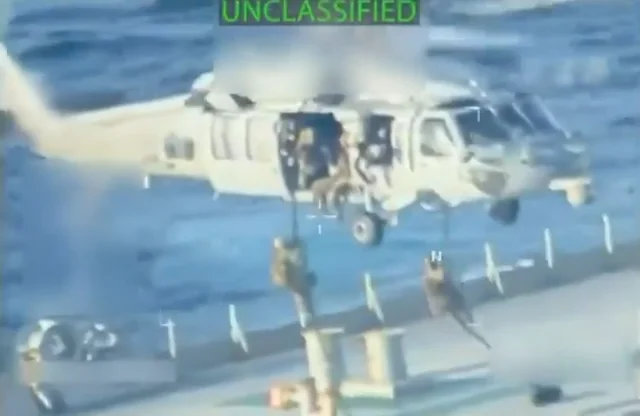
U.S. Southern Command footage shows special forces descending onto an oil tanker during a military seizure operation targeting Venezuelan oil shipments.

Another line has been crossed in the U.S. imperialist assault on Venezuela.

By seizing oil tankers on the high seas, including a Russian-flagged vessel, the United States has moved from economic warfare to open military coercion in defense of monopoly control over oil.

This is not a misunderstanding at sea. It is not a law enforcement action or a dispute over paperwork or flags. It is imperialism acting in the open.

Trump has also threatened a “second strike” against Venezuela, warning that further military action will follow if the government does not submit fully to U.S. demands.

Seizing oil by force

U.S. military forces have boarded and seized a Russian-flagged oil tanker in international waters, escalating Washington’s assault on Venezuela and discarding the legal restraints that once served as cover. The vessel, renamed Marinera after operating as the Bella-1, was taken after a pursuit that stretched from the Caribbean into the North Atlantic. 

Helicopters and Coast Guard ships carried out the seizure. Russian officials say the tanker was under submarine escort.

This was not an accident. It was a test of power.

U.S. forces first stopped the tanker on Dec. 21, claiming a seizure warrant because the ship allegedly lacked a valid national flag. The crew refused to be boarded and sailed on. Washington responded not with diplomacy but with pursuit across oceans. During the chase, the vessel was formally registered under the Russian flag, and Moscow demanded that the United States stand down.

The demand was ignored.

The seizure did not take place near Venezuela, but in international waters between Scotland and Iceland. Even the New York Times described the operation as part of a Trump administration blockade of Venezuelan oil shipments, confirming that Washington is enforcing control far beyond the region itself.

Russian officials called the seizure what it is: piracy. They cited the principle of freedom of navigation on the high seas, a principle Washington invokes when it serves imperialist interests and discards when it does not. U.S. officials told Reuters there was no direct confrontation with Russian forces nearby. That absence should not reassure anyone. It only means the clash did not happen this time.

Militarizing the blockade

On the same day, U.S. forces seized a second tanker, the M/T Sophia, reportedly carrying roughly two million barrels of Venezuelan crude. The U.S. Southern Command released a video of troops descending from helicopters, edited to look like a promotional reel. Homeland Security Secretary Kristi Noem summed it up in a slogan: “America first at sea.”

That phrase is not rhetoric. It is policy.

Washington is now enforcing a naval blockade in all but name, using military force to decide who may sell oil, who may transport it, and which governments are allowed to function. The mask has fallen from the operation, because the president himself removed it.

Force in service of oil profits

Donald Trump has said openly that the goal is to “get the oil flowing” so that “very large United States oil companies” can enter Venezuela and “start making money.” He has admitted to briefing oil executives before and after military action and plans meetings with them to discuss “security guarantees.” This is the U.S. government acting exactly as capitalism requires: using military force as the armed instrument of monopoly capital.

Trump has gone further, promising U.S. oil corporations that the government will cover or guarantee the costs of “rebuilding” Venezuela’s oil infrastructure, assuring executives that “they’ll do very well.” While social programs are slashed at home, tens of billions are being lined up to secure corporate access to seized oil fields.

Secretary of State Marco Rubio made the objective explicit, saying the United States intends to seize and sell between 30 million and 50 million barrels of Venezuelan oil and control how the proceeds are distributed. This is not sanctions enforcement but a direct claim to administer another country’s resources by force.

Colonial administration by decree

U.S. officials have now stated openly that Washington intends to control Venezuelan oil sales and the revenues they generate indefinitely, not as a temporary sanction. Energy Secretary Chris Wright said the United States will first market oil already in storage and then oversee future production, with proceeds deposited into accounts controlled by the U.S. government. 

President Trump has said Venezuela would be allowed to use those funds only to purchase “American-made” goods. These statements strip away any remaining pretense of sanctions enforcement. What is being asserted is the direct rule of imperialist monopoly capital over another country’s natural resources, enforced by military power. Oil production, sales, and revenue distribution are to be subordinated to U.S. corporate interests, with the state acting openly as their armed administrator.

There is no mystery here. Sanctions and pressure drive down the value of a country’s resources. Investors move in to grab them cheap. Military force is used to clear the way. The president has now said this openly.

This is not a show of strength. It is imperialism in decline. As it loses control, it turns to force, accepts greater risks, and pushes toward open confrontation. Law does not restrain it.

The danger does not stop with Venezuela. The seizure of a Russian-flagged tanker is not a side issue. It shows U.S. imperialism using military force against anyone who interferes with its drive to control oil and enforce its domination of global energy flows.

Imperialism does not merely ignore law; it now openly announces its intention to replace it. When its interests are threatened, it turns openly to force in defense of profit. What is happening in the Caribbean and the Atlantic is not an exception. It is a measure of how far U.S. imperialism will go to hold onto control.

Strugglelalucha256


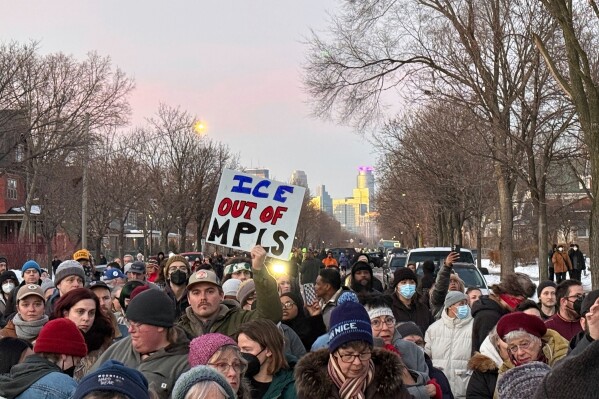
A mile from George Floyd Square, Trump’s ICE thugs execute a legal observer

Mpls

Less than a mile from where Minneapolis police lynched George Floyd in 2020, the U.S. government has claimed another life in the same streets. On a quiet residential block, in the middle of protests against Donald Trump’s expanding immigration dragnet, an Immigration and Customs Enforcement (ICE) agent shot 37-year-old legal observer Renee Nicole Good in the head as she sat behind the wheel.

Good was not a “suspect” in any crime. She was a legal observer who chose to stand with her neighbors and document federal agents terrorizing the community. Her car was blocking the street only because armed ICE and other federal agents had turned that neighborhood into a militarized zone, just as they have in cities across the country under Trump’s raids.

When she tried to leave, enraged agents moved on her vehicle. One stepped forward, raised his gun, and fired into her head. Bystander video shows no weapon, no visible threat—only the cold efficiency of an execution carried out in broad daylight.

The “garbage” narrative of the state

Trump’s administration rushed out a familiar script: the ICE agent was “in fear for his life,” the car was a “weapon,” and killing Renee Good was “necessary.” Trump himself publicly defended the shooting, doubling down on a lie that depends on people distrusting their own eyes more than the word of a racist, law-and-order regime.

But the people of Minneapolis know this playbook. The same state that told the world George Floyd “resisted arrest” now expects working-class communities to believe that an unarmed woman behind a windshield had to die for an agent to go home safe. Minneapolis Mayor Jacob Frey called the federal story a “garbage narrative,” and Police Chief Brian O’Hara has admitted there is no evidence that Good was even the target of any investigation.

Minnesota Governor Tim Walz revealed that Good was killed in front of a family member and then urged the community to “remain calm.” Calm—for whom? For a system that sends masked agents into neighborhoods and then blames the people when they refuse to accept another state killing?

State violence, racism and Trump’s deportation war

The shooting took place in the district of Representative Ilhan Omar, a Black Muslim woman and frequent target of Trump’s racist attacks. Omar called the killing exactly what it is: “state violence.” That phrase matters. This was not a “tragic misunderstanding” or the act of one “bad apple.” It is the direct product of a racist, anti-immigrant offensive from the top of the U.S. state.

Trump’s mass deportation campaign, like the police occupation of Black neighborhoods, is a weapon of class rule. It is designed to terrorize migrants and communities of color, to keep workers divided and fearful, and to normalize the use of military-style force on U.S. streets. ICE raids, Border Patrol tactical teams in cities, and local police SWAT units all blend into one repressive apparatus whose real target is the working class — especially Black, Latine, Arab, Muslim, and other oppressed communities.

When Trump and his officials defend an ICE execution and call it “law and order,” they are sending a message to every cop, every ICE agent, every border guard: You will be protected when you pull the trigger. That is how fascist forces inside the state are encouraged and emboldened.

From Minneapolis to the world: the same struggle

The people of Minneapolis have already shown the world how to fight back. In 2020, a multinational, working-class uprising against the police murder of George Floyd exposed the violence at the core of the U.S. system. The killing of Renee Nicole Good is not a break from that history but a continuation of it. The same state that arms ICE to terrorize neighborhoods and execute observers enforces borders, wages deportation wars, and sends the Pentagon across the globe to secure profits for billionaires and bankers. This is one system, one war on the working class—and it can only be confronted through unified working-class resistance.

Strugglelalucha256


From Attica to Rikers to Brooklyn: death behind bars in New York

The detention of Venezuelan President Nicolás Maduro and revolutionary leader Cilia Flores — prisoners of war and political captives of U.S. imperialism — inside a Brooklyn jail in New York State draws urgent attention to the racist and lethal violence embedded in the state’s prison system.

In July 2022, Ladale Kennedy was the 1,055th prisoner reported to die in New York State custody since 2014. The true number of prisoners killed by the system is unknown, and many deaths have never been reported.

Kennedy, a 41-year-old Black man who was reported to be mentally ill, was pepper-sprayed by guards, beaten, handcuffed, held face-first under running water, and fitted with a “spit hood,” a mesh restraint.

A video shows that Kennedy said “I’m sorry” at least eight times as they pulled him from his cell. He pleaded with the guards not to kill him. He told them he could not breathe at least 20 times during the encounter.

Dr. Michael Baden, a former New York City medical examiner and consulting pathologist who reviews prisoners’ deaths, said: “In my opinion, this was a death from asphyxia caused by the spit mask. They put a spit hood on, which you can see. He starts at that point, saying he can’t breathe.”

The local medical examiner classified the incident, in July 2022, as something of an official mystery: cause and manner “undetermined.”

Kennedy was tortured to death after failing to return food trays and cups that had been handed to him in his cell. Details of the killing were first reported by New York Times journalist Jan Ransom in an article published Dec. 31, 2025, and updated Jan. 6, 2026.

In a prior case that became widely reported, Robert L. Brooks and Messiah Nantwi died after being tortured by New York State prison guards. Both Black men were handcuffed by the guards before being beaten, leaving them unable to defend themselves or even shield their faces.

Robert L. Brooks, a 43-year-old Black man, was killed in December 2024 while held in a prison infirmary.  Brooks was placed on an examination bed, and a video shows that in the next 10 minutes he was punched, kicked and appeared to be choked — or at least lifted by his neck — by five officers. 

Messiah Nantwi, a 22-year-old inmate, died in March 2025 after being violently beaten by prison guards. He suffered fatal traumatic brain injuries from blows with fists, boots, and batons.

Their cases caused so much outrage that in February 2025, six prison guards were charged with murder, gang assault, manslaughter, and tampering with evidence by the state’s attorney general. Seventeen others were suspended. 

Before the killing of Robert Brooks, there had been numerous reports of prisoner abuse. C.O. Anthony Farina and Sergeant Glenn Trombly, both implicated in the killing of Robert Brooks, were involved in the 2020 assault and disfigurement of the inmate William Alvarez. In 2015, Trombly was involved in the assault of the inmate Equarn White, after which White needed a wheelchair while recovering. C.O. Nicholas Anzalone, also implicated in the killing of Brooks, was one of four prison guards named in a federal lawsuit for the 2020 beating of Adam Bauer, a non-violent drug offender.

Just before the guards were charged in the killing of Mr. Brooks in February, thousands of guards walked off the job in illegal strikes across the state, prompting Gov. Kathy Hochul to deploy the National Guard. 

When officers began returning to work weeks later, Duane Brown, a prisoner at Green Haven, said, “The abuse has been worse since the strike.” Guards had beaten Brown until he was unconscious in September.

Drawing on thousands of pages of court records and interviews with dozens of current and former inmates, Ransom identified more than 120 instances in the past decade in which guards were described as having punched, kicked or stomped on prisoners, smashed their fingers in cell doors, held their legs apart and struck their genitals with batons, and even waterboarded them  — all while the prisoners were handcuffed or otherwise restrained.

She reports that advocates and prisoners have linked the increase partly to seething anger among guards over recently enacted limits on their ability to use solitary confinement. 

Across the prison system, the rate at which staff members have used force against inmates has been climbing steadily for the past decade.

Strugglelalucha256


New Orleans marches for Palestine at start of Mardi Gras

New Orleans, Jan. 6 – Marchers under the banner of “New Orleans for a Free Palestine” filled the street ahead of the Joan of Arc parade, the first of the Mardi Gras season. With a brass band among them – NOLA Musicians for Palestine – they chanted “Gaza, Gaza, you will rise, Palestine will never die!” bringing the message of liberation to thousands gathered in the French Quarter.

The pre-Joan of Arc march is now a three-year tradition. They have marched every year since the current U.S.-Israeli genocide began following the Al-Aqsa Flood operation on Oct. 7, 2023, but is not the only such intervention in Carnival festivities.

For example, a Palestinian-led parade krewe – the Krewe of Chickpea – has also paraded in recent years on Lundi Gras, the day before Mardi Gras Day. (Lundi Gras falls on Feb. 16 this year.) Krewe of Chickpea takes inspiration both from New Orleans traditions (e.g., the Krewe of Red Beans that also marches on Lundi Gras) as well as Palestinian music and the pre-colonial spring festival of Mawsim in Palestine. 

In a display of internationalist solidarity, Krewe of Chickpea parades with Krewe of Las Frijolitas (little beans), a Dominican-led krewe. They honor figures like Mamá Tingó, a farm worker and activist who fought for rural farming communities in the Dominican Republic starting in the early 1970s. They have also honored the Venezuelan environmental activist Tortugita, who was shot and killed by Georgia State troopers in 2023 during the Stop Cop City struggle in Atlanta.

Now and historically, Mardi Gras is suffused with the spirit of resistance in majority-Black New Orleans. It is more than the tourism-money bonanza promoted by state and city leaders. Raising the banner of resistance – for Palestine, for Latin America, for Black and working-class New Orleans – is especially urgent this year. The genocide in Gaza grinds on while our city is occupied by ICE and the National Guard. These things are connected. The same people are behind it. 

Strugglelalucha256


Burkina Faso: coup attempt against Traoré defeated as people mobilize to defend the revolution

On Jan. 3, while the fascist pigs in Washington brutalized the Venezuelan people, Burkina Faso was shaken by an attempted coup backed by the fascist pigs in Paris. 

This marks a new addition to the long list of attempts by the West, notably France, to crush the revolutionary government of Captain Ibrahim Traoré and return the Land of Upright People to an existence of bondage and slavery. 

African news outlets and Burkinabè officials have linked the plot to networks connected to France and to former president Paul-Henri Damiba, who was removed in 2022 amid growing popular anger at his government’s alignment with Paris. These reports place the attempted coup within a longer pattern of French intervention in the Sahel, where Paris has repeatedly sought to maintain political and military control over former colonies, often under the banner of “security cooperation.”

Reporting available in the hours after the attempt indicates that the plot began to unravel almost as soon as it was launched. Burkinabè security forces intercepted communications, identified key participants, and moved quickly to neutralize the threat. The military under the command of Oumar Yabré responded quickly and decisively to protect Traoré and, most importantly, the revolution. 

By the early hours of Jan. 3, large numbers of people poured into the streets of Ouagadougou. Crowds gathered near the presidential residence and other key sites, holding vigils and rallies throughout the day and night. These mobilizations were both an expression of popular support for Captain Traoré and a warning to the enemies of the revolution and the Burkinabè people. 

According to information released by Burkinabè authorities and reported by regional outlets, documents recovered from the plotters outlined plans to assassinate revolutionary leaders and sabotage infrastructure established to confront Western-backed armed groups operating in the country. The coup plans also reportedly called for the occupation or destruction of major state institutions in the capital.

Had it succeeded, the coup would have dismantled the gains made since Captain Traoré came to power and reopened the door to direct foreign control over Burkina Faso’s resources, particularly its gold sector. 

When faced with this fight to protect the revolution and Ibrahim Traoré, the Burkinabè people have repeatedly risen to do whatever it takes to defend their gains and their right to control their own fate.

Strugglelalucha256


Who are Nicolás Maduro and Cilia Flores — and why Washington kidnapped them

On Jan. 3, 2026, the Trump administration carried out one of the most brazen acts of imperialist aggression seen in Latin America in decades. U.S. forces invaded Venezuela and seized its elected president, Nicolás Maduro, along with Cilia Flores.

This was not a secret operation. It was not done through proxies or deniability. It was an open attack on Venezuela’s right to govern itself. The assault was announced, justified by executive order, and defended with raw imperialist arrogance. The goal was not just to remove a president. It was to deny an entire country the right to choose its own political and economic course.

Cilia Flores was not taken because she is married to the president. She is a political leader in her own right. Trained as a lawyer, she rose through Venezuela’s institutions and became president of the National Assembly. During periods of intense pressure from the opposition, she was one of the most visible defenders of the Bolivarian Revolution inside the state. After the 2002 coup attempt against Hugo Chávez, she helped keep the legislature functioning. She later served as attorney general and as a senior leader in the United Socialist Party of Venezuela (PSUV).

Flores has long rejected the label “First Lady.” She has called herself the “First Revolutionary Combatant.” By that, she has meant that her role is not symbolic or ceremonial. She sees herself as an active participant in a collective political struggle, not an accessory to presidential power.

Her inclusion in U.S. indictments and her seizure alongside Maduro make the political purpose of the operation clear. Flores was not targeted because of proven crimes. She was targeted because she represents the civilian and institutional core of the Bolivarian state. She is a woman leader with her own base, history, and authority. Seizing her was meant to cripple not only the presidency but the wider leadership that has resisted U.S. intervention for more than twenty years.

To understand why Washington seized Nicolás Maduro, it is necessary to understand who he is — and what the Bolivarian leadership he represents has meant for Venezuela.

From bus operator to Bolivarian leader

Maduro did not come from Venezuela’s traditional political elite. He began his political life as a bus operator in Caracas and a trade union organizer in the city’s transport system. In the 1980s, he helped form an unofficial union for Metro workers, an experience that grounded his politics in the daily struggles of working people rather than in electoral maneuvering or elite sponsorship.

This background mattered. When Hugo Chávez burst onto the national stage in the late 1990s, he drew strength from militants, organizers, and rank-and-file workers who understood the limits of Venezuela’s old political order. Maduro was part of that layer. His rise within the Bolivarian movement was not accidental, nor was it based on personal charisma alone. It reflected years of organizational work, party discipline, and political loyalty during periods of intense pressure.

Maduro was elected to the National Assembly in 2000 and later served as its president. He went on to become foreign minister, where he played a central role in building alliances against U.S. domination, particularly through regional integration projects and closer ties with Cuba and other countries resisting Washington’s dictates. In 2012, Chávez appointed him vice president and publicly identified him as his political successor.

Chosen successor amid mounting pressure

When Chávez died in March 2013, Maduro stepped into leadership during a moment of profound uncertainty. The special presidential election that followed was closely contested, but Maduro won. His opponent, Henrique Capriles Radonski, came from one of Venezuela’s wealthiest families and was backed openly by domestic capital and the U.S. government. The election result was never accepted by Washington, which had already begun treating Maduro’s presidency as illegitimate from its first day.

When sanctions and diplomatic pressure failed to break the Venezuelan state over the following years, Washington shifted tactics. The invasion was justified after the fact through sweeping legal claims and executive assertions that recast regime change as law enforcement rather than war.

Trump’s claim that Venezuela “stole” oil and land from the United States is completely unfounded. Venezuela nationalized its oil industry in the mid-1970s, long before Chávez or Maduro came to power, as an assertion of national sovereignty later expanded under the Bolivarian process. U.S. companies were compensated at the time, and no serious legal body has ever recognized U.S. ownership of Venezuela’s natural resources. These assertions functioned not as evidence, but as ideological cover.

The Don-Roe Doctrine: empire without disguise

What made this operation different was not its illegality, but the fact that it was openly declared and politically justified as an act of imperialist power. Trump himself described the action as the first application of what he called the “Don-Roe Doctrine,” a personalized version of the Monroe Doctrine. Its purpose, he said plainly, was to reassert U.S. dominance in the Western Hemisphere and to expel any independent presence by states such as China, Russia, and Iran. After the invasion, Trump boasted that “American dominance in the western hemisphere will never be questioned again.”

He was even more explicit about Venezuela itself. The United States, he said, would “run the country” until a transition could be arranged. He spoke enthusiastically about reopening oil fields, rebuilding infrastructure through U.S. corporations, and securing access to Venezuela’s vast reserves of oil, gold, and rare earth minerals. Venezuela holds the world’s largest proven oil reserves. That fact alone explains more about the invasion than any indictment ever could.

International reaction was swift. Russia, China, Iran, and other governments condemned the action as a flagrant violation of international law. The United Nations secretary-general warned that the prohibition on the use of force had been breached. 

A familiar pattern in Latin America

The precedent is a familiar one. 

In 1965, the United States invaded the Dominican Republic to block the return of Juan Bosch, a democratically elected president whose reform program had been overthrown two years earlier by a military coup backed by Washington. When a popular uprising sought to restore Bosch to office, U.S. troops occupied the country, crushed the constitutionalist forces, and paved the way for the consolidation of a compliant regime aligned with U.S. interests. 

Nearly two decades later, Washington invaded Grenada to destroy a revolutionary government that had broken with U.S. domination in the Caribbean, an assault that included the killing of Prime Minister Maurice Bishop and the deaths of Cuban civilian personnel working in the country to build a hospital.

In both cases, legality was improvised after the fact, and military force was used to decide political outcomes that could not be controlled through pressure alone. The operation against Venezuela follows the same pattern, updated for a new phase of imperialist decline.

The human cost was immediate. Venezuelan authorities report that more than 80 people were killed in the attacks, including civilians and members of the armed forces. Cuba confirmed that 32 Cuban personnel stationed in Venezuela at the government’s request died resisting the assault. Residents of Caracas described explosions, destroyed homes, and mass fear. One public worker, Linda Unamumo, said the blast that tore through her roof forced her to flee with her family. “It was really traumatic,” she said.

The Trump administration acknowledged injuries among U.S. troops but claimed that none were killed.

A government still standing

In Caracas, Vice President Delcy Rodríguez assumed the role of acting president under constitutional provisions and denounced the seizure of Maduro and Flores as a kidnapping. She demanded proof of life and called on the international community to recognize the violation of Venezuelan sovereignty. The Venezuelan state, she said, remains intact. Maduro, despite his forced removal, remains the legitimate president.

“Our country aspires to live without external threats,” Rodríguez said, “in an environment of respect and international cooperation.”

That aspiration is precisely what Washington moved to crush.

Strugglelalucha256


Venezuela and the U.S. Black community

D12 

Statement from the December 12th Movement International Secretariat

The December 12th Movement denounces the kidnapping of President Maduro and First Lady Cilia Flores; the bombing of Venezuela and the murder of at least 40 Venezuelan citizens. We condemn the militarization of the Caribbean, and the ongoing threats to Cuba, Colombia and Mexico. As Black people we stand with our brothers and sisters in Latin America and the Caribbean, and indeed in recently bombed Nigeria, to denounce that might makes right. We are living under this same threat as a nationalized police invades cities run by Black mayors or with high concentrations of Black and Brown people. The thin veil of laws has been ripped away and the naked theft of resources is visible. At home all the hard-fought for programs funded by our taxes are being cut to fuel the military. Today in Venezuela the U.S. proclaims it is taking back “its” oil. As Congresswoman Maxine Waters said, “what the hell is going on?”

What has Venezuela done to incite the wrath of the U.S.?

Inside the country, under its Socialist Presidents Hugo Chavez and Nicolas Maduro, the government has used the country’s oil wealth to: cut the illiteracy rate and expand school enrollment; provide free healthcare and subsidized food; reduce poverty and income inequality; build public housing.

Internationally, the government has provided free or low-cost oil to Black, Brown, Indigenous and poor white communities in the U.S. (including New York City) who could not keep up with rising heating costs; offered to provide material (petroleum, funds) and logistical support to the New Orleans victims of Hurricane Katrina. The U.S. government refused the offer.

Instead the U.S. response has been to impose sanctions designed to destroy the economy and persuade the Venezuelan people to overthrow its government. By doing this, the U.S. hopes to accomplish two things at once: 1) to steal and control the largest oil reserves in the world; and 2) to discredit socialism as a viable alternative to capitalism.

Black people do not have the luxury to ignore what is going on and what it means for us. As Maya Angelou noted, “When someone shows you who they are, believe them the first time.” Donald Trump, but more importantly, the class he represents, is telling us who they are. In a period where the conditions of life for the masses of people, particularly Black people, are worsening, where the U.S. economy is failing, they are prepared to use outright force against those who fight for their, their families’ and their communities’ rights to survive and do better.

Our position is that we must work together to push back — in support of Venezuela and in defense of our human rights.

December 12th Movement International Secretariat, 456 Nostrand Avenue, Brooklyn, NY 11216. (929) 692-7609


Strugglelalucha256


Oil wealth, class power, and imperialist siege in Venezuela

The political durability of the Bolivarian Revolution is grounded in material gains won by the working class and the poor. It is anchored in a concrete social contract that transforms Venezuela’s oil wealth into improvements in daily life and reshapes the country’s political landscape in the process. Since Hugo Chávez’s election in 1998, the redistribution of surplus has forged and sustained a mass base rooted not in symbolism or ideology, but in tangible changes to living conditions that give Chavismo its popular legitimacy.

Oil revenues and working-class gains

Central to this shift was the reassertion of state control over Petróleos de Venezuela (PDVSA). Chávez’s government broke the autonomy of the oil technocracy and redirected oil revenues toward working-class communities long excluded from national wealth.

Oil income is treated not as an abstract macroeconomic lever, but as a social resource. Through price controls, direct state provisioning, and heavy subsidies, the state intervenes across daily life — food, housing, health care, education, and public services — while expanded social spending and labor protections allow workers to win higher wages, improved benefits, and greater economic security.

The results were neither marginal nor symbolic. In less than a decade, poverty was nearly cut in half, while extreme poverty fell by more than two-thirds. University enrollment more than doubled, unemployment was reduced by half, and child malnutrition declined sharply. Income inequality fell so sharply that by 2012 Venezuela had become the most economically equal country in Latin America.

These were not isolated policy wins; they were the cumulative effects of a redistributionist model funded by oil revenues and enforced through political struggle against domestic capital and foreign imperialist interests.

This redistribution forms the material foundation of Chavismo’s working-class base. It does not represent a departure from Venezuela’s economic structure, but a decisive intervention into it. Venezuela is already an oil economy; the political question is whether that wealth flows upward to capital or is redirected toward social reproduction.

The external shock: oil prices collapse

The rupture comes from outside that social contract. When Nicolás Maduro was elected president following Chávez’s death in March 2013, global oil prices soon collapsed. In 2014, prices fell by roughly half, beginning a decline that reached nearly 70% by early 2016. State revenues were slashed in a matter of months. The fiscal capacity that had sustained subsidies, social programs, and price controls was sharply reduced, placing immense strain on the gains achieved in the previous decade.

Had this revenue shock been the full extent of Venezuela’s difficulties, recovery might have followed the eventual rebound in oil prices. Instead, the downturn was locked in place by escalating U.S. sanctions.

Imperialist sanctions and economic warfare

Beginning in 2017, Washington imposed measures that went far beyond diplomatic pressure. Venezuelan oil sales were blocked, state assets were frozen, and the government was prohibited from refinancing debt or accessing international credit. It was open economic warfare.

The United States stripped Venezuela of control over key offshore assets, including U.S.-based refineries, cutting off access to critical sources of income.

The timing was decisive. As global oil prices recovered, Venezuela’s production remained choked off — not by geology or technical capacity, but by financial and commercial strangulation. Sanctions foreclosed any path to stabilization, let alone renewed redistribution. What began as a revenue shock became a sustained economic siege.

The human cost of siege

The human cost of this siege was severe. Between 2014 and 2021, Venezuela’s economy contracted by more than 80%. Hyperinflation destroyed wages entirely, peaking at over 130,000% in 2018. Poverty surged across the population as access to food, medicine, and basic services deteriorated under conditions of blockade.

This immiseration produced one of the largest migrations in modern Latin American history. Roughly 7.7 million people — about a quarter of the population — were forced to leave the country in search of survival. This was not a voluntary exodus driven by consumer aspirations or political disaffection. It was the physical displacement of a working class whose material supports were systematically dismantled.

A working-class base under strain, not defeated

Venezuela’s economic difficulties are often narrated as a morality tale about mismanagement or ideology. That framing obscures the underlying political economy. The Bolivarian Revolution achieved real gains for working people by redirecting oil revenues away from capital and imperialist control. The later economic deterioration was driven not by redistribution, but by imperialist intervention following the 2014 oil price shock.

What was damaged was not political legitimacy or popular consent, but the material infrastructure that sustains social reproduction under a hostile global order. The working-class base built through redistribution remains in place, even as sanctions and blockade grind down living conditions.


Strugglelalucha256


From the Monroe Doctrine to Caracas: how a declining empire turns to force

The jets over Caracas in the early hours of Jan. 3 were not an aberration. They were a signal.

By the time the sun rose, Venezuela’s president had been kidnapped by U.S. special forces and flown north. Washington called it law enforcement. But no police action requires the suppression of a country’s air defenses or the use of military bases across a hemisphere. 

What happened in Caracas was not about one man — it was about power and how that power is now being exercised.

Jets over Caracas were not an aberration

What happened in Venezuela was not a sudden break with the past, but a clear expression of how U.S. power now operates when other means fail.

Across Latin America, the message was unmistakable. The United States no longer feels bound by international law. It is willing to act with open belligerence, directly and militarily, to remove governments that stand in its way. This was not a covert operation hidden behind deniability. It was meant to be seen.

The original Monroe Doctrine: rule by conquest

From the beginning, U.S. dominance in the hemisphere was enforced through violence, with independence tolerated only so long as it did not interfere with expansion and profit.

The Monroe Doctrine did not protect the Americas from empire. It cleared the field for one. European powers were warned off so Washington could expand without competition. Governments were toppled. Land was seized. Resistance was met with occupation and massacre. This was colonialism in its direct form, backed by the gunboat and the army.

After World War II, dominance without constant invasion

With much of the world’s industry in ruins, U.S. capitalism could rely on production, credit, and the dollar to secure control without permanent occupation.

After 1945, the United States emerged as an industrial giant, producing close to half of the world’s total output. Its factories supplied reconstruction. Its banks financed recovery. The dollar became the main currency of trade and reserves. Under these conditions, control could be exercised through loans, trade access, and investment rather than constant military force.

When production ruled, force stayed in the background

Military power never disappeared, but it functioned mainly as insurance, rarely needed when economic leverage could achieve the same ends.

Governments that aligned with U.S. interests were rewarded with access to markets and credit. Those that resisted faced isolation or destabilization. The threat of force remained, but it did not have to be used everywhere. Economic dominance did the work.

This arrangement also helped stabilize conditions inside the United States, unevenly and temporarily. The empire could afford concessions at home because profits flowed in from abroad.

The long industrial decline since the 1970s

As factories closed and production moved abroad, the material basis for U.S. economic dominance steadily eroded, even as the empire tried to maintain its reach.

Beginning in the 1970s, U.S. capitalism shifted production overseas in search of cheaper labor and higher returns. Manufacturing hollowed out. The economy leaned more heavily on finance and debt. By the early 2000s, the U.S. share of world production had fallen dramatically; today it stands at around 17%. The dollar still dominates, but increasingly through pressure rather than unmatched strength.

From economic leverage to open coercion

When loans, sanctions, and diplomatic pressure no longer deliver submission, the system falls back on its most direct instrument.

Sanctions that once bent governments now often harden resistance. Proxy forces falter. Sanctioned governments build alternative trade routes and alliances. In this context, force is no longer a last resort. It becomes the primary tool.

Why Venezuela became a test case

A government that retained control of key resources and resisted U.S. subordination presented an obstacle that economic pressure alone could not remove.

Venezuela sits atop the world’s largest proven oil reserves. U.S. corporations once dominated that sector before nationalization broke their hold. Years of sanctions and political pressure failed to restore control. Caracas maintained ties with Russia, China, and Iran. Economic leverage no longer worked. The response was force.

Drugs and courts as cover for seizure

Criminal charges and moral language serve to disguise an act of force that is, at bottom, about control over labor, land, and oil.

Claims about drugs and terrorism do not explain the operation. They are an attempt to justify it. Imperialism has always required a story to tell, especially when it acts openly. Today that story is law enforcement. Yesterday it was anti-communism. The function is the same.

An empire that can no longer afford consent

Where influence once flowed through credit and trade, it now comes through sanctions and military force.

U.S. leaders now speak openly about seizing resources and running other countries. This bluntness does not reflect strength. It reflects the exhaustion of older methods. The empire can no longer afford consent, so it imposes obedience.

What imperial decline means for working people everywhere

As U.S. power abroad weakens, working people are made to pay in familiar ways: lower wages, longer hours, higher rents, heavier policing, and more war aimed at securing resources that once flowed automatically.

The same system that sends special forces into Caracas squeezes wages, evicts tenants, militarizes police, and criminalizes migration. The operation was sold as targeting drug cartels, but its real aim — control of Venezuelan oil — benefits corporations, not working people who still pay the same inflated prices at the pump.

These are not separate problems. They reflect a system losing its grip and relying more heavily on force.

The use of force is meant to settle the question of control. Instead, it exposes the struggle for what it is: a declining empire seizing by violence what it can no longer secure through production — against governments that refuse to submit.

Strugglelalucha256


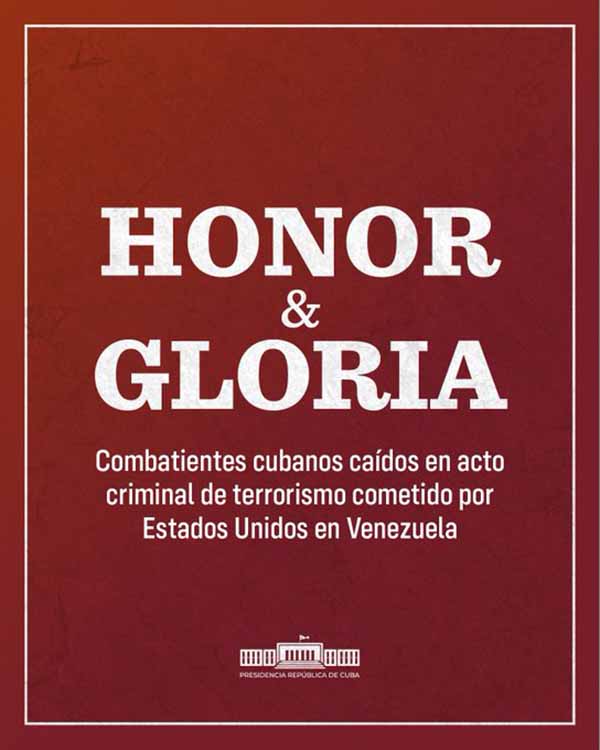
Cuba reports 32 fighters killed in U.S. attack on Venezuela

Combatienetes cubanos caidos en venezuela

The Cuban government announced Jan. 4 that 32 Cuban citizens were killed during the U.S. military strike on Venezuela in the early morning hours of Jan. 3.

The fighters were serving missions on behalf of Cuba’s Revolutionary Armed Forces and Ministry of the Interior at the request of Venezuelan counterpart agencies when U.S. forces bombed military installations and civilian areas across Caracas and northern Venezuela.

According to the Cuban government, the combatants “fell in direct combat against the attackers or as a result of the bombing of the facilities” after offering “fierce resistance.”

Once their identities were confirmed, their families were notified and received condolences from Army General Raúl Castro, President Miguel Díaz-Canel, and the heads of the institutions to which they belonged.

Cuba characterized the attack as “a new criminal act of aggression and state terrorism” and stated that the fallen combatants “knew how to uphold, with their heroic actions, the solidarity of millions of compatriots.”

President Díaz-Canel declared two days of national mourning, effective from 6 a.m. on Monday, Jan. 5, through midnight on Tuesday, Jan. 6. During this period, the Cuban flag will fly at half-staff on all public buildings and military installations, and public shows and festive activities are suspended.

The Jan. 3 strike, codenamed “Absolute Resolve,” involved more than 150 U.S. military aircraft that bombed infrastructure across northern Venezuela. U.S. forces captured Venezuelan President Nicolás Maduro and his wife Cilia Flores and flew them to New York City to face narcoterrorism charges.

Venezuelan officials report that more than 80 people were killed in the attack, including the 32 Cuban fighters and numerous Venezuelan military personnel and civilians. Strikes hit residential areas, including a civilian apartment complex in Catia La Mar.

Trump told reporters that “a lot of Cubans were killed” and said they “were protecting Maduro.” He added that two U.S. soldiers were injured but that no U.S. personnel were killed.

The Trump administration has said it plans to “run” Venezuela temporarily and exploit the country’s oil reserves and mineral deposits.

Presidential Decree declares national mourning

The following is the text of Presidential Decree 1147:

MIGUEL DÍAZ-CANEL BERMÚDEZ, President of the Republic.

I HEREBY ANNOUNCE: That by virtue of the provisions of Article 125 of the Constitution of the Republic of Cuba and Article 24, paragraph x), of Law 136 “Of the President and Vice President of the Republic of Cuba,” of October 28, 2020, I have considered the following:

WHEREAS: With deep sorrow our people have learned that during the criminal attack perpetrated by the United States government against the sister Bolivarian Republic of Venezuela, carried out in the early morning of January 3, 2026, 32 Cubans lost their lives in combat actions, who were fulfilling missions representing the Revolutionary Armed Forces and the Ministry of the Interior, at the request of counterpart bodies of that country.

Our compatriots honorably fulfilled their duty and fell, after fierce resistance, in direct combat against the attackers or as a result of the bombing of the facilities and knew how to uphold, with their heroic action, the solidarity of millions of compatriots.

THEREFORE: In the exercise of the powers conferred by Article 128, paragraph ñ), of the Constitution of the Republic of Cuba, I have decided to issue the following:

PRESIDENTIAL DECREE 1147

FIRST: Declare two days of National Mourning, from 6:00 a.m. on January 5 until midnight on January 6, 2026.

SECOND: To order that while the National Mourning is in effect, the Lone Star Flag be flown at half-mast on public buildings and military institutions.

THIRD: During the period of National Mourning, public shows and festive activities are suspended.

FOURTH: The Ministers of the Revolutionary Armed Forces, the Interior, and Foreign Affairs are responsible for complying with the provisions of this Decree.

PUBLISH in the Official Gazette of the Republic of Cuba.

GIVEN, at the Palace of the Revolution, on the 4th day of January 2026. “Year of the Centenary of Commander-in-Chief Fidel Castro Ruz.”

Miguel Díaz-Canel Bermúdez President of the Republic

Source: Prensa Latina

Strugglelalucha256
https://www.struggle-la-lucha.org/2026/01/page/6/