Baltimore doesn’t need a $1.2 billion jail — it needs jobs

Jail

Baltimore City local news publication, the Baltimore Banner, recently reported that the cost of a new state constructed jail in the city would cost more than originally thought. Initially estimated to be a $1 billion investment, which already made the most expensive project of any kind in Maryland history – the “state of the art” concentration camp for the poor will now cost $1.2 billion

Governor Moore and the Maryland Department of Correctional Services have framed the new prison as a much-needed upgrade to decrease crowding and improve living conditions. However, local prisoner rights advocacy groups have expressed doubt that the $1.2 billion facility would do either of these. The fact is, the Maryland state government and the army of contractors that will build and equip this prison do not care about the conditions of prisoners. They care about two things: more prisoners and a bigger paycheck.

Maryland’s Department of Correctional Services has already spent $54 million on planning, even as the state faces critical budget deficits that the Governor has used to justify cuts to the state workforce and social welfare programs. Governor Moore’s cuts, combined with the ongoing inflation crisis combined with Donald Trump’s slashing of social benefits, have already battered Baltimore. 

The city is facing its highest unemployment rate in years, at 5.5%. In his budget for fiscal year 25, Governor Moore nearly froze raises for state workers and delayed the implementation of Maryland’s new family leave program another 18 months. Yet, the new Baltimore City jail construction is all aboard, full steam ahead, and the State of Maryland continues to spend nearly $288 million a year on incarcerating Baltimore City residents. 

Baltimore doesn’t need another massive concentration camp. The city already makes up 32% of the state’s prison population, while only accounting for 10% of the overall state population. Baltimore is not only the largest city in the state, but also the home of the largest Black community in the state. This new jail is simply aimed at sharpening the oppression of an oppressed working-class Black city. 

US politicians, courts, and bureaucrats insist that the purpose of the country’s massive incarceration system is rehabilitation and prevention. This assertion couldn’t be further from the truth. As with so many institutions under capitalism, the motivation behind the massive prison system that operates at federal, state, and local levels is simply and solely profit. 

Construction contractors make profit from building the facilities. Medical supply magnates rake in millions supplying equipment and medicine to prisons that rarely, if ever, use them effectively. The need for uniforms, beds, light fixtures, furniture, and plumbing all provide a boon for the parasitic prison supply industry that has grown like a weed since the 1980s. And this analysis doesn’t even account for the labor actually done by prisoners once the prison is up and running. 

Across Baltimore, Maryland, and the Country, prisoners – who are disproportionately Black and Brown – work for cents in wages creating all sorts of goods and providing all sorts of services. In as recently as 2024, the Associated Press investigated a supply chain that used prison labor to slaughter cattle, fish in dangerous waters, and work long hours picking produce in fields. All of these goods find their way to companies like Coca-Cola, General Mills, and Kroger to be sold for exponentially more than the prison laborers were paid. 

Baltimore’s new jail is just another avenue for profit in a national prison industrial system that only cares about the bottom line. Not a single city across the country needs more concentration camps for the poor. Those cities need jobs, healthcare, and education


Strugglelalucha256


Puerto Ricans condemn militarization and U.S. interventionism

This new year promises to be one of relentless struggle in this colony. More than ever, we must sharpen our strategies so that independence ceases to be a dream or an aspiration and becomes the central axis of all our battles — from the environmental struggle to the fight against privatization and militarization.

Above all, against militarization. Since last August, the Yankee military has been reorganizing, upgrading and expanding its old bases to put them at the service of new military adventures launched from our own backyard. It has even leased civilian airports, such as Aguadilla in the northwest and parts of the Mercedita civilian airport in the city of Ponce, in the south of the island. The military also restricts airspace at its convenience, leaving hundreds of travelers stranded at airports.

On Jan. 3, while our people were enjoying the holiday festivities, U.S. terrorism used our land and waters as a platform to invade our sister nation Venezuela and kidnap President Nicolás Maduro and his wife, Cilia Flores. They bombed military and civilian installations, killing Venezuelan men and women and 32 Cuban heroes who were defending the president.

Not content with this crime, the U.S. empire threatens all Caribbean countries that pose a challenge to its capitalist interests — Cuba, Colombia, even Mexico — and uses us as a key piece in its military incursions.

A few days ago, the U.S. Army announced that the entire territory of our archipelago will be the stage for its military exercises and presence. These maneuvers, called “Caribbean Army Week,” will use public spaces — from streets and avenues to public plazas — as well as, of course, its bases. Lt. Col. Heath Dickinson, director of operations for the U.S. Army Reserve Command of Puerto Rico and the Caribbean, told news outlets that thousands of soldiers will be involved in the exercise. Quoting him, he added: “The public is going to see that we’re going to have a lot of military trucks and our machinery across the island, and we’re going to be on the highways.”

Both Kilómetro Cero and the American Civil Liberties Union (ACLU), organizations that defend the rights of the people, have expressed their opposition. The ACLU says, “There is no justification whatsoever for a military presence in civilian spaces, from main roadways to plazas and any other public space.”

Grassroots organizations have called for a mass demonstration in front of the U.S. Muñiz Base on Jan. 17. Meanwhile, each has issued statements in support of Bolivarian Venezuela, condemning the crime of the Trump administration.

From Puerto Rico, for Radio Clarín of Colombia,
Berta Joubert-Ceci

Strugglelalucha256


Boricuas repudian militarización e intervencionismo gringo

Este nuevo año promete ser uno de lucha incesante en esta colonia. Más que nunca, debemos afinar nuestras estrategias para que la independencia deje de ser un sueño, una aspiración, y la convirtamos en el eje central de todas nuestras batallas, desde la lucha ambiental hasta el rechazo a las privatizaciones y a la militarización.

Sobre todo, contra la militarización, porque desde el pasado mes de agosto el ejército yanqui ha ido reorganizando, actualizando y expandiendo sus antiguas bases para ponerlas al servicio de nuevas aventuras militares desde nuestro patio. Incluso ha alquilado aeropuertos civiles, como el de Aguadilla, al noroeste, y partes del aeropuerto civil de Mercedita, en la ciudad de Ponce, al sur de la isla. El ejército, además, restringe el espacio aéreo a su conveniencia, dejando a centenares de viajeros esperando en aeropuertos.

El 3 de enero, mientras nuestro pueblo se divertía en las festividades navideñas, el terrorismo estadounidense utilizaba nuestro suelo y nuestras aguas como plataforma para invadir a nuestra hermana Venezuela y secuestrar al presidente Nicolás Maduro y a su esposa, Cilia Flores. Bombardearon instalaciones militares y civiles, matando a venezolanos y venezolanas y a 32 héroes cubanos que defendían al presidente.

No contentos con este crimen, el imperio gringo amenaza a todos los países del Caribe que representan una amenaza a sus intereses capitalistas: a Cuba, a Colombia, incluso a México. Y nos utiliza como pieza clave de sus incursiones militares.

Hace pocos días, el Ejército gringo anunció que todo el territorio de nuestro archipiélago será escenario de sus prácticas y presencia militar. Estas maniobras, denominadas “Semana del Ejército en el Caribe”, utilizarán sitios públicos, desde calles y avenidas hasta plazas públicas y, desde luego, sus bases. El teniente coronel Heath Dickinson, director de operaciones del Comando de la Reserva del Ejército de Puerto Rico y el Caribe, dijo a los noticieros que miles de soldados estarán involucrados en este ejercicio. Y, citándolo, añadió: “El público va a ver que vamos a tener muchos camiones militares y nuestra maquinaria por la isla, y vamos a estar por las carreteras”.

Tanto Kilómetro Cero como la Unión Americana de Libertades Civiles (ACLU, por sus siglas en inglés), organizaciones que defienden los derechos del pueblo, han manifestado su oposición. Dice la ACLU que “no existe razón alguna que justifique la presencia militar en espacios civiles, desde las vías principales hasta las plazas y cualquier otro espacio público”.

Las organizaciones de base han convocado a una manifestación masiva frente a la Base gringa Muñiz para el próximo 17 de enero. Mientras tanto, cada una ha publicado declaraciones en apoyo a Venezuela bolivariana, repudiando el crimen de la administración Trump.

Desde Puerto Rico, para Radio Clarín de Colombia, les habló
Berta Joubert-Ceci


Strugglelalucha256


‘Cuba must be loved’

Jan. 7, 2026
From Arroyo Naranjo, Cuba

Gerardo Hernández Nordelo, the national coordinator of Cuba’s Committees for the Defense of the Revolution (CDR), has a large office on the top floor of the organization’s headquarters on the busy Línea Avenue in Havana. The problem is you will never find him there. Hernández, one of the Cuban Five heroes who spent 16 years in U.S. federal prisons for monitoring the activities of anti-Cuban terrorists operating with impunity in South Florida, is making up for lost time circulating around Cuba, listening to the needs and problems of the people at the community level while engaging in homegrown methods of solving them.

The CDRs were created in 1960 after the Revolution, when a wave of sabotage and bombings followed Fidel’s victory. Fidel said, “We’re going to set up a system of collective vigilance; neighborhood by neighborhood, block by block.” Today, the CDR structure continues as a viable, grassroots problem-solving mechanism, including direct representation in Cuba’s National Assembly, with each having access to a medical clinic.

U.S. blockade of Cuba: the longest and most severe in modern history

The battle that Cuba and the CDRs face is the U.S. blockade, which has created scarcity and restricted access to everyday necessities that most developed countries take for granted. This has been going on since the Eisenhower administration followed the Mallory memo in April 1960, which recognized the overwhelming popularity of the Revolution while offering this solution to overthrow it: “…every possible means should be undertaken promptly to weaken the economic life of Cuba. If such a policy is adopted, it should be the result of a positive decision which would call forth a line of action which, while as adroit and inconspicuous as possible, makes the greatest inroads in denying money and supplies to Cuba, to decrease monetary and real wages, to bring about hunger, desperation and overthrow of government.”

The Mallory directive has been and remains the basis of U.S. policy toward the island nation through every Democratic and Republican administration, with a couple of brief periods of opening up. The bottom line is that the United States perceives Cuba as a runaway colony that represents a dangerous example to other countries because it reveals that a better world is possible by establishing relations based on respect for sovereignty and mutual benefit for all, instead of for the corporate rich.

“A Cuba hay que quererla”

Acute shortages are a way of life in Cuba, and the CDR response has to be creative, collaborative and immediate; quite literally, lives depend on it. Today, Gerardo is traveling to Arroyo Naranjo, a community on the outskirts of Havana, to bring emergency medical supplies to Julio Trigo Hospital so that a number of medical procedures — some of them lifesaving — can proceed.

This is part of a network he helped set up called A Cuba hay que quererla (“Cuba must be loved”), named after a song by popular Cuban musician Raúl Torres. In this project, he is working with Amado Riol, a facilitator who connects medical supplies with need. Riol is on the phone constantly, working with a sense of urgency, talking with doctors and hospital staff, connecting the dots. He explains that the hospital is completely out of medical stents and that he has found some to deliver.

Visit to the Arroyo Naranjo CDR

While he was in the area, Gerardo took the opportunity to attend a meeting with the Arroyo Naranjo CDR to get an update on the well-being of the community and its ongoing projects. He makes himself accessible and listens to everyone’s comments and suggestions. This is grassroots Cuba, forced to struggle against all odds. What is apparent here — and what the empire cannot fathom — is the sense of cooperation, respect and determination to make things happen, something the Revolution has instilled in Cuban society at all levels.

Source: Resumen Latinoamericano – U.S.

Strugglelalucha256


‘A Cuba hay que quererla’


7 de enero de 2026
Desde Arroyo Naranjo, Cuba

Gerardo Hernández Nordelo, coordinador nacional de los Comités de Defensa de la Revolución (CDR) de Cuba, tiene una amplia oficina en el último piso de la sede de la organización, en la concurrida avenida Línea de La Habana. El problema es que nunca lo encontrarán allí. Hernández, uno de los Cinco Héroes Cubanos que pasó 16 años en prisiones federales de Estados Unidos por monitorear las actividades de terroristas anticubanos que operan con impunidad en el sur de Florida, está recuperando el tiempo perdido recorriendo Cuba, escuchando las necesidades y los problemas de la gente a nivel comunitario, mientras aplica métodos locales para resolverlos.

Los CDR se crearon en 1960, después de la Revolución, cuando una ola de sabotajes y atentados siguió a la victoria de Fidel, quien dijo: “Vamos a establecer un sistema de vigilancia colectiva; barrio por barrio, cuadra por cuadra”. Hoy en día, la estructura de los CDR continúa siendo un mecanismo viable para la resolución de problemas de base, incluyendo representación directa en la Asamblea Nacional de Cuba y una clínica médica en cada caso.

Bloqueo estadounidense a Cuba: el más largo y severo de la historia moderna

La batalla que enfrentan Cuba y los CDR es el bloqueo estadounidense, que ha generado escasez y limitado el acceso a bienes cotidianos que la mayoría de los países desarrollados dan por sentados. Esto ha estado ocurriendo desde que la administración Eisenhower, tras el memorando de Mallory de abril de 1960, reconoció la abrumadora popularidad de la Revolución y ofreció esta solución para derrocarla: “…deben emplearse con prontitud todos los medios posibles para debilitar la vida económica de Cuba. Si se adopta tal política, debe ser el resultado de una decisión positiva que exija una línea de acción que, con la mayor habilidad y discreción posibles, logre los mayores avances en la negación de dinero y suministros a Cuba, la reducción de los salarios monetarios y reales, y la propagación del hambre, la desesperación y el derrocamiento del gobierno”.

La directiva Mallory ha sido y sigue siendo la base de la política estadounidense hacia la isla a lo largo de cada administración demócrata y republicana, con un par de breves períodos de apertura. En resumen, Estados Unidos percibe a Cuba como una colonia fugitiva que representa un ejemplo peligroso para otros países, ya que revela que un mundo mejor es posible estableciendo relaciones basadas en el respeto a la soberanía y el beneficio mutuo para todos, en lugar de para las grandes corporaciones.

La escasez aguda es una forma de vida en Cuba, y la respuesta de los CDR debe ser creativa, colaborativa e inmediata; literalmente, vidas dependen de ello. Hoy Gerardo viaja a Arroyo Naranjo, una comunidad a las afueras de La Habana, para llevar suministros médicos de emergencia al Hospital Julio Trigo, para que se puedan realizar diversos procedimientos médicos, algunos de ellos vitales. Esto forma parte de una red que él ayudó a crear llamada “A Cuba hay que quererla”, llamada así por la canción del popular músico cubano Raúl Torres.

En este proyecto trabaja con Amado Riol, un facilitador que conecta los suministros médicos con las necesidades. Riol habla constantemente por teléfono, con un tono de urgencia, hablando con médicos y personal del hospital, conectando los puntos. Explica que el hospital se ha quedado sin stents médicos y que ha encontrado algunos para distribuir.

Durante su visita a la zona, Gerardo aprovechó la oportunidad para asistir a una reunión con los CDR de Arroyo Naranjo para obtener información actualizada sobre el bienestar de la comunidad y sus proyectos en curso. Se muestra accesible y escucha los comentarios y sugerencias de todos. Esta es la Cuba de base, obligada a luchar contra viento y marea. Aquí se hace evidente —y es lo que el imperio no puede comprender— el sentido de cooperación, respeto y determinación para lograr resultados, algo que la Revolución ha inculcado en la sociedad cubana en todos los niveles.

Resumen Latinoamericano, en inglés


Strugglelalucha256


Commotion across Latin America over the violation of Venezuelan sovereignty

1 7 15fdd77b df89 4408 8d96 77cc5efc9ac7 1024x576

Havana, Jan. 7 — On January 3 Latin America awoke shaken by one of the most serious and dramatic episodes in international relations in recent decades. The bombing of military facilities and residential neighborhoods in Caracas and three other states of the country by the United States, followed by the kidnapping—rather than the “extraction,” as the corporate media presents it — of Venezuelan President Nicolás Maduro Moros and his wife, Cilia Flores, marks a breaking point in an already weakened regional system. For broad political, social, and religious sectors of the region, the operation represents a flagrant violation of a state’s sovereignty and a definitive blow to what for years had been called the “rules-based world order.”

The military action, directly attributed to the administration of Donald Trump, was confirmation of an openly belligerent foreign policy. The U.S. president, who has been promoting himself as a “president of peace” including his claim for a Nobel Peace Prize, is now regarded as one of the most warmongering leaders in modern times. We cannot forget the massive financial and military aid provided carte blanche to the Israeli genocide of the Palestinian people while exerting European governments to finance and sustain the war effort of Ukrainian President Volodymyr Zelensky; not to mention the bombing of Iran.

In this context, Venezuela is once again the target of a policy that, according to corporate analysts, never had the defense of democracy, justice, or human rights at its core, “much less in this part of the world,” according to voices from Caracas and other Latin American capitals. The history of interventions and blockades explains the peoples’ rejection of the humanitarian arguments put forward by Washington.

Following the attacks, the Venezuelan government decreed seven days of national mourning. The acting president, Delcy Rodríguez, announced the measure “in honor and glory of the young women and men who died, defending Venezuela.” The decree seeks to pay tribute to the victims of the bombings, which, in addition to military targets—32 of them Cubans—caused collateral damage in civilian areas, increasing domestic and regional outrage.

At the same time, a contradictory event occurred that reignited the debate over the construction of narratives to justify aggression. The U.S. Department of Justice published a revised indictment against Nicolás Maduro in which it tacitly acknowledges that the so-called “Cartel of the Suns” is not a real criminal organization. This admission dismantles one of the most widely disseminated media narratives of recent years, which portrayed the Venezuelan leadership as part of an alleged continent-wide drug-trafficking structure.

For years, that narrative made front-page news in major international media outlets, fueled by alleged leaks from agencies such as the DEA and the CIA, and amplified by journalists and news agencies. However, recent documents reinforce the denial: the DEA’s own 2025 National Drug Threat Assessment details drug-trafficking routes in the Americas with precision, but does not include Venezuela as a main transit country nor does it mention the “Cartel of the Suns.” Reports from the UN and the European Monitoring Centre for Drugs and Drug Addiction reach the same conclusion, further weakening the arguments used to criminalize the Venezuelan state.

The regional reaction was swift. Governments, political movements, and social and religious organizations across Latin America and the Caribbean condemned the U.S. aggression. Venezuelan Foreign Minister Yván Gil denounced what he described as “Marco Rubio’s hatred toward Latin America,” asserting that the Secretary of State “does not serve the interests of Americas, but rather the Miami mafias that finance his lobby.”

From Havana, Cuban President Miguel Díaz-Canel described the attack as a “criminal act” and “state terrorism,” and demanded a firm response from the international community. Former Bolivian President Evo Morales also expressed his repudiation, joining a long list of leaders who consider the bombing a dangerous precedent for regional stability.

Political organizations such as the Guatemalan National Revolutionary Unity denounced that imperial interests continue to shatter global harmony, pointing to a line of continuity between the aggression against Venezuela, the genocide in Gaza, the blockade against Cuba, and acts of “piracy” against countries that do not align with Washington. In the same vein, the Communist Movement of Latin America and the Caribbean condemned the military aggression as a “slap in the face to international law” and a desperate attempt to regain control of the region’s strategic resources through terror and force.

The condemnation transcended the political sphere and reached spaces of faith. The Council of Methodist Evangelical Churches of Latin America and the Caribbean (CIEMAL) rejected any military intervention that fails to respect the sovereignty of peoples and promotes “ideologies of death.” In a statement, the organization recalled that from the Christian faith there is a call to raise a prophetic voice so that peace, justice, and healing may reign on earth, warning that violence will never be an effective solution to conflicts.

The impact of the episode also extended to Colombia. President Gustavo Petro called for a national mobilization in defense of sovereignty, after Donald Trump accused him of promoting drug production and suggested a possible military incursion into Colombian territory. Petro described those statements as a direct threat and called on the people to take to public squares to reject any attempt at foreign intervention.

Also, the Political and Academic Forum of the Puebla Group issued a strong condemnation of statements made by President Donald Trump directed at Colombian President Gustavo Petro and Mexican President Claudia Sheinbaum, describing such language as a form of intimidation against democratically elected governments and an attempt to reimpose a logic of coercion incompatible with peaceful coexistence among sovereign states. According to the Group’s statement, these remarks cannot be separated from the context of the recent U.S. military action against Venezuela and the detention of President Nicolás Maduro and his wife, Cilia Flores—acts the forum characterized as an unjustifiable violation of international law and the United Nations Charter. In its declaration, the Puebla Group reaffirmed its solidarity with Petro and Sheinbaum and reiterated its commitment to the principles of sovereignty, self-determination, non-intervention, and the peaceful resolution of disputes in Latin America and the Caribbean.

Thus, the attack on Venezuela not only reopened old wounds but also reshaped the region’s political map. For many governments and social movements, what happened confirms that Latin America once again faces the challenge of defending its sovereignty against a power willing to ignore international law. Amid mourning, outrage, and mobilizations, these questions echo across the continent: how far will this escalation go, and what cost will it have for regional peace?

Alejandra Garcia is a news anchor on Telesur TV and a correspondent for Resumen Latinoamericano in Havana.

Bill Hackwell is the editor of Resumen Latinoamericano in the U.S.

Source: Resumen Latinoamericano


Strugglelalucha256


Palestine Action activists on hunger strike reach ‘critical phase’ in British jail

Supporters warn that prisoners are ‘wasting away’ and facing ‘irreversible’ harm as British ministers refuse to meet with the activists

News Desk Jan. 8, 2026

British doctors warned on Jan. 6 that Palestine Action-linked prisoners refusing food in British jails were facing life-threatening risks, describing them as “well into the critical phase,” as the hunger strikers vowed to continue despite repeated hospitalizations.

The protest involves activists detained over alleged actions targeting British sites connected to Israeli arms firm Elbit Systems – a company that has recorded record profits since the start of the Gaza genocide by supplying the Israeli military with weapons, munitions, and surveillance systems – as well as a Royal Air Force base.

All of those involved deny the charges and remain in custody awaiting trial.

The hunger strike began on Nov. 2 and initially involved eight detainees, five of whom have since suspended their participation because of severe medical danger, leaving three remaining activists still refusing food.

Heba Muraisi, 31, has been on a continuous hunger strike for more than two months. Supporters say she is suffering muscle spasms, breathlessness, severe pain, memory decline, loss of speech, and repeated hospitalizations. A visitor described her as “very pale and thin” and said she speaks openly about “dying” while remaining determined to continue.

Kamran Ahmed, 28, held at Pentonville prison in north London, has refused food for nearly two months. He has experienced chest pain, breathlessness, dizziness, and intermittent hearing loss, and has been hospitalized multiple times.

Ahmed said he intends to continue, adding that “the onus should be on the government,” not on prisoners risking their lives.

Lewie Chiaramello, 22, who has type 1 diabetes, is fasting on alternate days. His partner said he is frequently disoriented and fears he faces a heightened risk of diabetic coma and long-term damage.

Emergency physician James Smith said all three are “well into the critical phase” of starvation and warned that deterioration can become “very quick and irreversible.”

He cited risks including heart failure, infection, and neurological damage. Dr. Smith also described some prison medical practices as “undignified.”

The prisoners are demanding bail, a fair trial, an end to the British ban on Palestine Action, the closure of Elbit sites in Britain, and an end to what they describe as censorship of mail, calls, and reading material in prison.

British justice officials rejected calls for ministerial intervention. Prison Minister James Timpson said healthcare teams are monitoring the detainees and that ministers “will not meet with them,” arguing that intervention would be unconstitutional.

The Ministry of Justice warned that engagement could create “perverse incentives.”

Supporters argue the prolonged pre-trial detention that has gone well beyond the usual six-month limit reflects the criminalization of protest against Israel and British military ties, while drawing grim parallels to historic hunger strikes that ended in death.

Source: The Cradle

Strugglelalucha256


Chronicle of a foretold coup: The attack on Venezuela and the narco-terrorism fairy tale

Current developments in Venezuela may appear to be unfathomable—until one recalls the long history of imperialist interference in Latin America and the Caribbean. The events of the first week of January constitute an escalation of a long-standing campaign to overthrow the Bolivarian Revolution and resume control on the country with the largest known oil reserves in the world. The emerging world order and the strengthening of international organisations non-aligned with the interests of the United States (US) rush the US to increase the pressure on the Latin American region.

Latin America and the Caribbean are deeply marked by US imperialism. In the 200 years since the Monroe Doctrine (1823), the US military has carried out more than 100 interventions, invasions, and coups in Latin America and the Caribbean. In the 1970s, the CIA carried out a series of military coups throughout the region to overthrow left-wing and independent governments. In a secret program known as Operation Condor, the CIA worked closely with military dictators to suppress left-wing activists and prevent the rise of communism among the local populations.

Neoliberal policies implemented through the coup regimes and after—and under the influence of the Washington Consensus in the 1990s—deeply affected economic development in the region. As a result, 50 million people in Latin America fell into poverty from 1970 to 1995, and the external debt tripled from $67.31 billion (1975) to $208.76 (1980), 60 percent of which was public debt, further stifling the possibility of economic development and pushing the countries into debt-traps. The effects of privatization and the destruction of the industrial structure continue to this day.

The popular leaders that emerged from people’s rebellions against the neoliberal regimes and led the Progressive Wave in the Latin American region during the beginning of the 21st century were targeted by the CIA. Venezuela constitutes one of such cases.

Following President Hugo Chávez’s inauguration in 1999, the United States systematically attacked Venezuela. After repeated refusals to submit to US leadership, in April 2002, supported by a sector of the Venezuelan military, the US carried out a coup d’état and kidnapped President Chávez. The Venezuelan people took to the streets en masse and halted the attack. The events of that April forced US imperialism to change its strategy and opt for a prolonged hybrid war aimed at weakening popular support for the Bolivarian Revolution.

The hybrid war on Venezuela consists primarily of economic sanctions and embargoes, and the persecution of popular leaders, along with the funding of anti-Chavista propaganda and organisations, and the development of paramilitary groups to create an atmosphere of internal destabilization. In addition to the multiple assassination attempts, in 2019, the US did not recognise the electoral results, and backed the opposition candidate Juan Guaidó as president of Venezuela. The bombing of Caracas and the subsequent kidnapping of President Nicolás Maduro and Cilia Flores on 3 January 2026 are the most recent blow in a series of systematic and increasing attacks spanning more than 20 years.

Trump openly declared that the US attack on Venezuela is about oil. Nonetheless, US officials, including Trump, have offered two other unconvincing reasons: the migration crisis and narco-terrorism.

Migrants and Drugs

Economic sanctions and the blockade against Venezuela caused a collapse in the population’s living conditions, generating shortages, accelerated impoverishment, and large-scale forced migration. The departure of more than seven million people over the past decade is due to the economic war.

Venezuelan migration has been used as a political instrument, presented as proof of the failure of socialism and the revolutionary project, while the sanctions responsible for the forced migration have been rendered invisible. Many Venezuelan migrants were initially classified as “political refugees” in the countries to which they migrated, reinforcing the narrative that they were fleeing a dictatorship and thereby legitimizing the imposition of further sanctions, creating a vicious dynamic. Venezuelan migration has also been used as a warning aimed at potential left-wing voters in Latin America.

Through hardline immigration enforcement policies promoted during the second Donald Trump administration, migrants have been criminalized: they are being rounded up, detained, and—some of them—forcibly transferred to the CECOT mega-prison in El Salvador.

The criminalization of the migrant as a narco-trafficker fuelled the construction of a narrative about Venezuelan cartels. This led to the accusation that Venezuela’s President Nicolás Maduro was a leader of gangs known as Tren de Aragua or the non-existent Cartel of the Suns. The idea of drug trafficking provided the justification to attack small boats, 36 of them sunk through 35 illegal bombings that killed 115 people. It was this idea of narco-terrorism that was used to justify the attack on Venezuela on 3 January.

Trump brought together the War on Terror (the 2001 Patriot Act) and the War on Drugs (stretching back to the 1970s) to create this idea of ‘narco-terrorism’ and build legitimacy in the US for the attack on Venezuela not as a military invasion but as a police action. Trump now wants to extend this logic to Cuba, Colombia, and Mexico.

The attack on Venezuela came at a time when the country was slowly emerging from the worst of the social impact of sanctions. Economic recovery in Venezuela amid those sanctions occurred in a context marked by the emergence of the BRICS and the tightening of commercial and political relations with China, Iran, and Russia, which made it possible to smoothen the consequences of the US sanctions. At the same time, the deep scarcity crisis, particularly harsh in a country historically structured under a rentier model dependent on food imports, drove a reorganization of national agricultural production and food supply chains oriented toward building food sovereignty. In this process, the communes, together with the emergence of new national companies dedicated to producing food and other essential goods, energized the Venezuelan economy and enabled a rapid recovery after the crisis induced by the sanctions.

An organised response to the interference

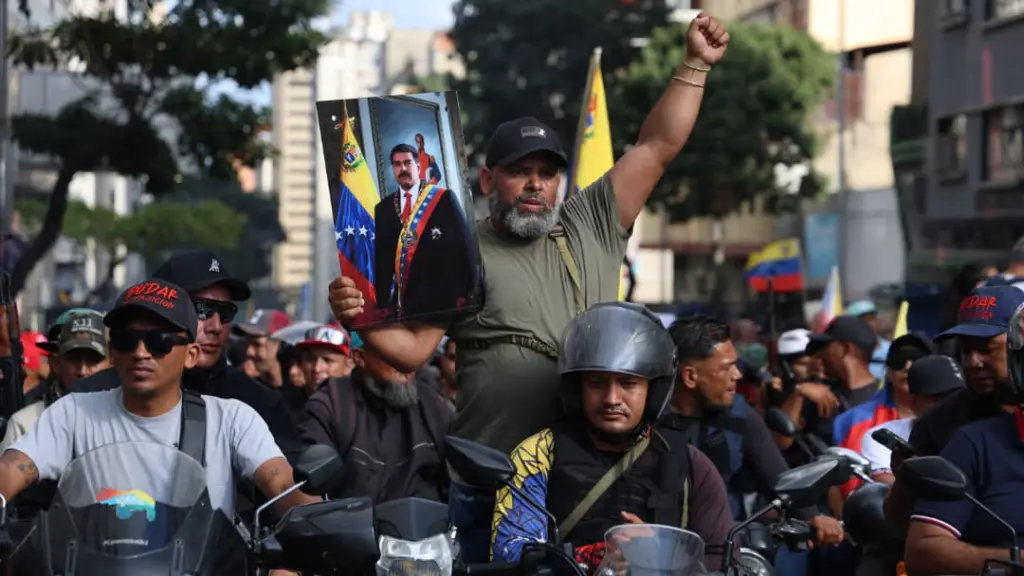
The collective response to economic coercion is in line with that of recent events. The people took to the streets: thousands of people in Caracas, in rural areas, and in other cities mobilized for the release of their president and in rejection of a US military intervention, backing the Bolivarian militias, the police, the Army, and the government. This resistance has been overlooked in international media.
Finally, the swearing-in of Vice President Delcy Rodríguez as the head of the government, together with the presence of the ambassadors of China, Iran, and Russia, as well as the installation of the National Assembly with the presence of Nicolás Maduro’s son, demonstrate that the Bolivarian Revolution is not defeated and that speculation about internal betrayals lacks concrete basis.

Daniela Ortiz and Gisela Cernadas are members of the No Cold War Collective. Daniela is an artist from Peru. Gisela is an economist at the Centre of Economic Development Studies, National University of San Martin, Argentina.

This article was produced by Globetrotter.

Strugglelalucha256


It was the U.S., not Maduro, that tried to steal Venezuela’s 2024 elections

Venezuela Presidential Election: U.S. coup attempt defeated

Preparations for the U.S.-led coup attempt

Sep 8, 2024 — The people of Venezuela defeated a high-tech U.S.-led coup. The nation’s electoral authority held the 31st election since 1999 and, despite facing a colossal attack against the nation’s computerised electoral system, was able to announce the July 28 election results. The people of Venezuela, by re-electing President Maduro for the 2025-2031 term, emerged victorious against yet another U.S.-run “regime change” operation.

The coup plot involved a massive, sustained, months-long corporate media campaign spewing an unusually homogenous message: that President Maduro would be electorally defeated. Media outlets quoted “polls” giving U.S.-supported, extreme right-wing candidate Edmundo Gonzalez (fielded by the Unitary Platform coalition, PUD) 80% of the vote. On July 20, the Financial Times published “Is the game up for Venezuela’s ruling party after 25 years?”, stating that “most opinion polls suggest the opposition would crush Maduro by a margin of 20 to 30 points.” The mainstream media repeatedly quoted Maria Corina Machado “hoping” that “Nicolas Maduro accepts a negotiation process that allows an orderly and sustainable transition,” intended to persuade readers of the inevitability of Gonzalez’s victory.

The line taken by world corporate media—including The Guardian, El Pais, The New York Times, Washington Post, Le Monde, France 24, BBC, and Corriere de la Sera—was nearly identical in predicting Gonzalez’s victory. Did they know something we didn’t? There is only one center of power in the world with the might to command such obedience from corporate media, and it is in Washington, D.C.

Additionally, for several months before the election, Venezuela was subjected to a string of terrorist attacks targeting food storage facilities but mainly the country’s electricity system, with the obvious intention to damage it sufficiently to disable the computerised electoral system. Almost every time there is an election in Venezuela, terrorist attacks target the country’s electricity system (as happened in December 2021, a month after Chavismo massively won the November regional and municipal elections).

This mainstream media propaganda was supplemented by a campaign of fear (begun as early as April 2024) maintaining that in the “unlikely event” of President Maduro winning (contending this was only possible by rigging the election), a greater proportion of the population would leave the country. Media quoted “polls” asserting that up to 40% of Venezuelans—about 12 million people—would leave.

The coup attempt’s key ingredients

The corporate media bombardment was supplemented by an extreme right-wing media campaign of vicious hatred and threats not only against Chavistas but also other opposition presidential candidates and their families. The extreme right-wing verbal violence in social media was in full swing months before election day. An article in May 2024 prophesied:

This scenario of violence, exacerbated by political polarization and hate propaganda, creates a perfect breeding ground for social instability. The possibility of a scenario where violent groups try to sabotage the electoral process and impose their agenda by force is a latent threat that requires forceful measures to protect the peace of the country.

In Venezuela, opposition digital verbal violence around elections they lose has, in the past 25 years, unavoidably led to physical violence, including burning people alive and murdering many: about 20 in their 2002 failed coup, 11 in 2013, 43 in 2014, and 28 in 2017. All these events produced hundreds wounded and traumatized, with many crippled for life.

The cyberattack component

All of the above was supplemented by another component: a monumental cyberattack on election day, primarily targeting the CNE (National Electoral Council) computerised electoral system but also other state services. It was one of the worst such attacks against Venezuela.

According to Venezuela’s minister of science and technology, Gabriela Jimenez, the first phase of the cyberattack targeted CANTV (Venezuela’s main internet service provider) starting at about 6 p.m., just as polling centers began to close. The attack severely delayed transmission of polling centers’ results to the CNE totalizing center, hence the several hours it took to announce the results. CANTV’s contractor, U.S. company Columbus, reported to its client the deliberate cyber delay of transmissions.

The delay occurred due to a colossal increase in cyber-attacks directed at the CNE. Jimenez stated it was 30 million attacks per minute. She asked: who has the technical infrastructure and expertise (algorithms, etc.), equipment, energy sources and resources to unleash such volume of attacks per minute and sustain it for up to 20 uninterrupted hours?

Jimenez also reported that the Caracas stock exchange, the science and technology ministry and other ministries, the Central Bank, the Identification and Migration service, Inland Revenue, and other public services—critical for the functioning of the state—were targeted. No digital payments could be processed (deliveries, purchasing everyday items such as food and medicine, or payment of mobile phone bills) and no taxes could be collected because of the cyber-attacks.

The cyber-attacks also involved stealing public institutions’ data and publishing it, making public the names and full data of pensioners, and even the addresses of military officers with the slogan “Go for them!” The cyber-attacks were terrorist attacks. Jimenez explained that the source accounts had disguised IPs, but most, though not all, were from the United States.

The cyber-attacks intended not just to wreck the computerised electoral system’s transmission of election results—preventing the CNE from announcing any results at all—but also to disable as many other essential services as possible, aimed at creating generalized chaos and maximum pandemonium.

Post-election violence

The other key component of the U.S.-led coup attempt was the well-prepared wave of violence launched after their electoral defeat. Maria Corina Machado and her coalition unleashed thousands of paid thugs who went on the rampage on July 29, attacking anything representing public property with the most intense hatred directed at symbols of Chavismo: statues of Hugo Chavez, of Coromoto (an emblematic 17th century indigenous chieftain), and everything else within their reach. They also attacked Chavistas, leading to the death of 25 people.

Foreign minister Yvan Gil, informing the accredited diplomatic corps on Aug. 23, 2024, said there was clear evidence that Venezuela’s extreme right wing, “backed by the U.S. government … had hired the organized criminal gangs Tren de Aragua and Tren del Llano to initiate the coup d’etat” and deploy them “to generate post-electoral violence.” These gangs had engaged in the “purchase of votes in favour of the candidacy of Edmundo González Urrutia in areas with a strong territorial and political presence of Chavismo.”

The coup strategists expected that the wave of violence in many key cities, following the chaos and confusion caused by the generalized cyber-attacks, would force the authorities to deploy the national guard to many opposition-created points of violence as a diversion to facilitate the attack on the presidential palace. This last phase was conceived as a lethal blitzkrieg on the presidential palace. An armed mob attacked with a “bath of bullets” 60 international observers who were at the CNE headquarters in Caracas. President Maduro reported to the nation that on July 29 there had been two attempts to storm the Miraflores (presidential) palace by armed mobs.

Yvan Gil also explained that the coup model had been “designed by the CIA and the United States.” Up to Aug. 14, 2024, 30 members of such groups had been arrested with an arsenal that included “13 firearms (four of which are rifles), 302 cartridges, a grenade, two telescopic sights, eight radio transmitters, 10 flashlights, seven chargers, 35 Molotov cocktails, 12 cell phones, and six motorcycles.” These were professionals who, taking advantage of the chaos created, were entrusted with assaulting the presidential palace in preparation for the coup’s final phase: a “mass march on the palace,” proclaiming Edmundo Gonzalez president and probably requesting immediate international (military) assistance.

Maduro’s constitutional solution

The failure of the July 28 cyber-attack to destroy the CNE digital system (and that of almost every other public institution) delayed the polling stations’ transmission of results. The CNE’s first bulletin was issued nearly at midnight with 80% of the results which, in an irreversible trend, gave the victory to President Maduro (51.2% against Edmundo Gonzalez’s 44.2%). This result was confirmed with the CNE’s second bulletin with 97% of the results, with Maduro getting 51.95% against Gonzalez’s 43.18%.

Literally seconds after the CNE’s first bulletin, Maria Corina Machado appeared on television rejecting the results, alleging fraud and proclaiming Edmundo Gonzalez the winner. This claim was almost immediately echoed by world corporate media in an amazingly homogenous chorus. Machado and company claimed to have 40%, then 73%, then 80%, and even 100% of the voting records, which they followed by posting false results on an illegal website giving Gonzalez 67% to Maduro’s 30%.

Though the issuing of results by the CNE on July 28 had substantially disrupted a key component of the coup d’etat, the extreme right wing launched the planned wave of violence anyway. Confronted with such a lethal U.S.-led operation, on July 31 President Maduro filed an appeal before the Supreme Court to summon all candidates and representatives of all parties “to compare all the evidence and certify the results of July 28 through a technical appraisal.”

On the very same day, U.S. Secretary of State Antony Blinken, literally moments after Maduro’s appeal, stated that “given the overwhelming evidence … that Edmundo Gonzalez Urrutia won the most votes,” he extended U.S. recognition to Gonzalez as the winner. However, a few days later, Blinken backtracked, withdrawing such recognition. This is unprecedented—the U.S. has never backtracked on such an important decision, especially considering its obsessive, decades-long fixation with Venezuela.

The Supreme Court investigation

The Supreme Court carried out an expert-technical investigation and analysis of the election as requested by President Maduro. It summoned all candidates and all 38 political parties participating in the July 28 election to submit all election information they had. Most candidates complied, except Edmundo Gonzalez. Worse, the PUD parties supporting Gonzalez as a candidate did not submit any election material or evidence, “arguing that they do not have documentation [i.e.] they do not have witness records of the polling stations.” They were the only parties not to submit anything; the other 33 did.

The CNE submitted all the election material in its possession—100% of everything. Furthermore, Edmundo Gonzalez failed to comply with Supreme Court summons three times. And the “combative” Maria Corina Machado, in comic fashion, pretended to have gone into hiding.

On Aug. 22, the Supreme Court ruled that bulletins issued by the CNE were supported by the voting records transmitted by each voting machine and were in full agreement with the data provided by the national aggregation centers. Therefore, “We certify, in an unobjectionable manner, the electoral material examined and validate the results issued by the CNE indicating that Nicolás Maduro Moros was elected.”

The opposition’s fraudulent website

The reason for the opposition’s non-compliance is clear: the crass election fraud perpetrated by Machado and others in the extreme right-wing coalition behind Edmundo Gonzalez’s candidacy. The election information they published on an illegal and fraudulent website includes 9,472 images of election records that represent 30% of the total election records (of over 30,000 polling places). Worse, 83% of them do not have metadata, which means they went through editing software—that is, they “are not faithful copy of the original.”

The striking feature of Machado-Gonzalez election victory claims is the level of manipulation of the false results published in the illegal website, whose domain was created on July 27—the day before the election. This leads to the pertinent question: If María Corina Machado and Edmundo González won the elections and have the records to prove it, then why would they post these fake records?

No wonder Blinken backtracked and not a single government in the world has recognized Edmundo Gonzalez as “president-elect.” Yet, from the White House to Southcom, European Union foreign policy chief Josep Borrell, right-wing governments in Latin America including Chile’s Boric, Organization of American States Secretary-General Luis Almagro, the Carter Centre, the U.N. Panel of Experts, and everybody else all the way down the world political food chain—including, of course, world corporate media—have questioned the validity of President Maduro’s re-election.

Some left intellectuals

This food chain includes leftist intellectuals and academics such as Alejandro Velasco, Gabriel Hetland and Mike Phipps. There are others, but these three, due to the similarity in their messaging, are perhaps an emblematic sample.

All three, with no evidence whatsoever, penned articles concluding that Gonzalez had won and Maduro had lost. They seem to have been persuaded by the “data” posted in the illegal website set up by Maria Corina Machado and company, which has been irrefutably debunked from every imaginable angle.

Velasco bluntly stated “On July 28, Maduro lost” in The Nation (Aug. 8, 2024). Hetland’s piece is titled “Fraud foretold?” (Sidecar, Aug. 21, 2024), in which he concludes that “Socialists, of any stripe, should not provide cover for a government that fixes elections and then clings to power by brutally punishing its poorest citizens when they protest.” Phipps’ piece (Labour Hub, Aug. 21, 2024) states that Venezuela’s government response to the crisis caused by U.S. sanctions was “repression and electoral fraud.”

Probably in their zeal to condemn the Bolivarian government, all three hastily depict the paid thugs unleashed by Machado and company as a working-class rebellion against the government.

All three questioned the cyber-attacks, depicting them as a ruse to justify fraud, arguing that the alleged hacking did not stop the CNE counting the votes between July 28 and Aug. 2. Yet the CNE informed in detail that the hacking had not stopped the counting but had drastically delayed the transmission of results. As late as Aug. 19, the science and technology minister reported that the CNE and 120 Venezuelan state sites were suffering cyberattacks, which have continued.

This was followed by a terrorist attack against the extreme right wing’s favorite target, the electric system, on Aug. 30, which affected 21 states. Then, on Sept. 2, the Libertador Simon Bolivar Terminal railway station suffered deliberate fire sabotage in its electrical room. There had been similar attacks in December 2021 which affected various parts of 19 states, and in March 2019 that affected 80% of the country. The cyber and terrorist attacks were and are real, no matter what these three may say.

All three depict President Maduro’s government as neoliberal or implementing neoliberal policies, claiming his administration represents a break with the revolutionary legacy of Hugo Chavez. All three blame the government as the key contributory cause of the misery millions of Venezuelans have endured. Although all three garnish their arguments by bemoaning U.S. sanctions and reproaching the opposition for repeatedly crying fraud in the past, they wittingly or unwittingly parrot imperialism and right-wing arguments of election fraud.

All three argue for a “left” or “democratic” alternative to Chavismo, and in Hetland’s case for stopping “covering” (i.e., stop supporting) President Maduro’s government. All the contentions of this group are either prejudiced distortions of reality or simply false. Nino Pagliccia, when referring to Velasco’s plea for an alternative to Chavismo, hit the nail on the head by correctly asserting that such a stance “is not an affirmation of the ideals of the Bolivarian Revolution, but a capitulation to the U.S. and its sponsored opposition in Venezuela.”

What has substantially contributed to confusing the whole issue, perhaps unintentionally adding credence to the extreme right wing, U.S. imperialism and world corporate media’s propaganda about a “July 28 CNE-rigged election” narrative, has been the equivocal views of Brazilian President Lula and Colombian President Petro who, without any solid evidence, seemed to have taken for granted there was fraud in the elections. On Aug. 15, President Maduro responded by saying the Venezuelan government will never intervene in the internal affairs of those two countries. He noted that in Brazil’s case, when Bolsonaro alleged fraud in the 2022 election Lula won and refused to accept the results, the matter was decided by the Brazilian Judiciary, “and no one from Venezuela or our government went public to intervene in this affair.”

Conclusion

To the question, was there election fraud in the July 28 presidential elections in Venezuela? The answer is a categorical YES, but perpetrated by Maria Corina Machado, U.S.-backed candidate Edmundo Gonzalez and operatives in the PUD (as investigations are revealing).

Clearly, the fake PUD website with false election results, which does not bear even the most basic scrutiny, was created on the premise of successfully disabling the CNE election system, so that the United States, its European Union accomplices, its Latin American allies and Venezuela’s extreme right wing could point to theirs as the only site with voting results. It was a central plank of the U.S.-led coup plot—a coup plot the U.S. could apply against any government anywhere.

President Maduro, confronted with a U.S.-led coup including a gigantic cyberattack aimed at disabling the CNE and as much as possible of state services, plus generalized violence throughout the nation, including two armed assaults against the presidential palace, could have opted for declaring a state of exception and restricting civil rights (Article 338 of the constitution). Instead, he chose to resort to the Supreme Court’s Electoral Section to resolve the electoral dispute (Article 297), whose result demolished the gigantic pack of lies and fake news around election fraud claims. That is, President Maduro resorted to the democratic mechanisms of the rule of law as stipulated in the constitution. The Supreme Court’s verdict contributes to the consolidation of democracy.

Conversely, the PUD, Maria Corina Machado and Edmundo Gonzalez are left politically naked and morally exposed (about which not much effort is required), which explains why the former went into “hiding” and the latter went AWOL.

More importantly, the Chavista movement’s maturity and discipline, steered by President Maduro, was able to successfully defeat the coup by political means instead of force, and strictly within the rule of law and constitutional principles stipulated in the Bolivarian Constitution. As more details of the U.S.-led coup plot come out, the strength and people’s support for the Bolivarian process gets sturdier. Conversely, the pathetic efforts by Maria Corina Machado and her U.S. mentors to stage a massively promoted “great international protest,” despite mobilizing an army of influencers and paid journalists on social media, dismally failed to even fill four blocks in Caracas (in other cities, it was worse).

Ongoing U.S. aggression

Just a month after President Maduro’s election victory and the subsequent defeat of the U.S.-led coup, there was a massive terrorist sabotage to the Venezuelan National Electric System plunging almost the whole country into darkness. It was a rearguard action aimed at disabling state institutions in the hope of resuscitating the defeated U.S.-led coup.

The United States, with the complicity of Dominican Republic authorities, hijacked a Venezuelan plane used primarily by Venezuela’s vice president, Delcy Rodriguez. The U.S. Department of Justice stated (Sept. 2) it had “seized an aircraft we allege was illegally purchased for $13 million through a shell company and smuggled out of the United States for use by Nicolas Maduro and his cronies.”

Unlike some intellectuals in our sample, the U.S., its global accomplices and world corporate media do not ask what next for Chavismo. They don’t because they are part of a global U.S.-led machinery aimed at overthrowing the Bolivarian Revolution to destroy all its achievements. The group of intellectuals discussed here ask this question as though they have the answer when they seem unable to even spot a U.S.-led coup as it unfolds before our eyes.

However, President Maduro has answered that question by announcing mega-elections in 2025, which will elect 23 governors, 355 mayors, 23 legislative councils and 355 municipal councils. The only requirement to participate is to comply with Venezuela’s laws.

From the previous 31 electoral processes (and the July 28 presidential election), we know the 2025 elections will be fair, but they are unlikely to be free from U.S. interference and sanctions. The intellectuals discussed here, though recognizing the devastating consequences of U.S. sanctions in the cited articles, seem to accept them as a fact of life (“The prospects of the U.S. lifting sanctions appears remote,” Hetland) and noticeably fail to demand their lifting.

Perhaps for the coming 2025 elections these writers may craft well-written pieces to demand the U.S. does not interfere. We in the solidarity movement will continue to call for the immediate and unconditional lifting of all U.S. illegal sanctions and for a stop to U.S. criminal interference in Venezuela’s internal affairs. The president of Venezuela is elected by the people of Venezuela, not hand-picked by the U.S. State Department.

U.S. Hands off Venezuela!

Francisco Dominguez, a former refugee from Chile in Britain, is head of the Center for Brazilian and Latin American Studies at Middlesex University, London. He is also secretary of the Venezuela Solidarity Campaign in Britain.

The above article was originally published by the Orinoco Tribune.


Strugglelalucha256


The ‘Donroe Doctrine’: When sanctions fail, U.S. imperialism wages war on Venezuela

The world has looked on with horror as the United States launched its largest and most aggressive military operation in the Western Hemisphere in decades. After months of attacks on migrant boats and seafood industry workers, the U.S. imperialist class escalated its assault on Venezuela.

More than 80 people are dead. Dozens of military and industrial facilities have been reduced to rubble. Venezuela’s democratically elected president, Nicolás Maduro, was kidnapped and paraded before the world — a deliberate display of imperialist arrogance and political theater.

Maduro is a real human being and the elected leader of a sovereign country. Yet the United States seized him in the middle of the night, chained him, and displayed him in full view of the global media. This was not a covert operation or a misunderstanding. It was a public act meant to intimidate, humiliate, and assert domination.

The ‘Donroe Doctrine’ and the return to open colonialism

While the United States is no stranger to military conquest, the overthrow of governments, or the public degradation of anti-colonial leaders, this brazen attack marks a dangerous escalation. The methods may echo 19th-century colonialism — direct military seizure, public humiliation, and rule by force — but this is not a return to that era. This is something far more desperate: imperialism in terminal decline, with military violence as its last remaining tool.

This turn to open aggression is driven by economics, not principle or geopolitics. The decision to raise the stakes against Venezuela reflects a U.S. imperialist class strategy to curb its loss of global economic power. Trump, acting as its political executor, has even branded this revival of 19th-century expansionism as the “Donroe Doctrine.”

By explicitly referencing the Monroe Doctrine of 1823, the administration signals that it no longer feels the need to hide behind the “humanitarian” masks of the past. The “Donroe Doctrine” is a blunt admission: The Western Hemisphere is once again viewed as a colonial backyard to be policed by the “Big Stick” of U.S. military might.

Economic contraction and the turn to force

After World War II, U.S. capitalism stood at the center of global production. Its factories, markets, and financial power shaped the postwar order. That position did not last. Capital was exported to lower-wage labor markets across the oppressed world, and U.S. control over production weakened.

With less control over global labor, the monopoly capitalists lose leverage. When sanctions, trade pressure, and financial coercion no longer secure obedience, U.S. imperialism turns to military force. The war carried out under Trump against Venezuela follows this pattern. It echoes earlier moments when an economically strained imperialist class escalated its assault on national self-determination and the working class worldwide.

This pattern has appeared before under similar conditions. In the late 1890s, the United States faced a deep domestic economic crisis, surplus capital searching for new outlets, and growing pressure to expand beyond informal influence. Political leaders and the press supplied humanitarian and defensive justifications, but the underlying drive was economic expansion. When commercial penetration and indirect control proved insufficient, the ruling class escalated toward open war and formal domination. These conditions converged in what became known as the U.S. war against Spain in 1898.

1898: The ‘splendid little war’ of the robber barons

In April of 1898, William McKinley requested that Congress declare war on Spain. McKinley proclaimed that the United States had an obligation to intervene to defend the independence of Cuba from Spanish imperialism. Funny, that the country that exterminated its indigenous population, enslaved millions of Black Africans, and spent the entire 19th century expanding its territory, suddenly was concerned with the well-being and self-determination of oppressed people. McKinley also proclaimed that a U.S. intervention would be an act of self-defense, citing the explosion of the battleship USS Maine. Politicians and newspapers owned by right-wing capitalists such as William Randolph Hearst claimed Spain was responsible for the warship’s destruction.

All of this — absolutely all of it — was a bald-faced lie. Presidential documents signed by McKinley in August 1898 instructed the U.S. military, “Where it can be done prudently, confer with the leading citizens of Cuba … in an unofficial manner and endeavor to ascertain their sentiments toward the United States, and their views as to such measures as they may deem necessary or important for the future welfare and good government of the island.”

On the eve of the Spanish-American War in 1898, the Washington Post already had its eyes set beyond Cuba: “We are face to face with a strange destiny. The taste of Empire is in the mouth of the people even as the taste of blood in the jungle.” 

In his “People’s History of the United States,” historian Howard Zinn accurately analyzed the war as a ruling class project. These robber barons, as they were called, knew the war would create a boon for the massive U.S. iron industry and create new markets for manufacturers to sell their goods.

The parallels to 1898 are instructive, but the crucial difference must be understood. In 1898, U.S. imperialism was ascending — expanding its productive base, opening new markets, establishing economic dominance. The war with Spain was an expression of capitalist strength and confidence.

In 2025, U.S. imperialism faces the opposite condition: declining productive capacity, eroding dollar hegemony, and the loss of economic leverage that once made direct military conquest unnecessary. When sanctions fail, when financial coercion loses its grip, when trade pressure no longer secures compliance — military force becomes the only card left to play. This is not expansion from strength. This is violence from weakness.

Lenin’s analysis: the scramble for the world

The late 1890s, which saw the imperialist war with Spain, was the exact period that led scholars and Marxists at the time to begin using the term “imperialism.” Eventually, Vladimir Lenin crystallized the Marxist analysis of imperialism in “Imperialism, the Highest Stage of Capitalism,” defining the relationships between the principal economic features of imperialism.

In “Imperialism,” Lenin described the mad rush of Western imperialist powers to divide the world to export capital and exploit cheap labor markets and natural resources. Between 1884 and 1900, Britain, France, Germany, Belgium, and Portugal carved up over 10 million square miles of territory, home to nearly 150 million people. As Lenin wrote: “The scramble for colonies by all the capitalist states at the end of the nineteenth century and particularly since the 1880s is a commonly known fact in the history of diplomacy and of foreign policy.”

The U.S. imperialist war with Spain was a crucial part of this “scramble” that Lenin analyzes. As seen in the events at the end of the war, the U.S.’s motive was to catch up with Britain, France, Germany, and others in the scramble to divide the world. It is this period that the ruling class seeks to recreate through escalating provocations against China, Russia, Iran, Venezuela, and other targets, with Trump acting as its political standard-bearer.

When the Spanish departed Cuba in 1898, it was U.S. troops, not the Cuban people, who took control of the island. The U.S. military occupation lasted until 1902. Even when the U.S. troops left, their withdrawal was contingent on Cuba accepting treaties from the U.S. government that restricted Cuba’s right to act independently and kept the door open for future U.S. intervention. The United States maintained its informal but iron grip over Cuba until the 1959 socialist revolution.

The 20th century further demonstrated without a doubt that the United States wanted Cuba to be completely subservient to the U.S. capitalist agenda. In 1961, the CIA backed an attempted fascist takeover of the island known as the Bay of Pigs. In 1962, the U.S. military brought the world to the brink of nuclear war through an illegal blockade of Cuba that has lasted until this day. Between 1960 and 1965, the CIA attempted to assassinate Fidel Castro hundreds of times.

2025: Manufactured outrage and systemic aggression

The United States has held, informally or formally, all of the territory it captured from Spain in the 1898 imperialist war – including Puerto Rico and the Philippines. The war against Spain wasn’t about democracy or independence for colonized nations – the same way war against Venezuela isn’t about drugs or human rights. Both of these wars were about reshaping and dividing the world economically to benefit the U.S. ruling class better.

In 1898, the United States faced a massive economic crisis dating back to the Panic of 1893. During the panic, over 15,000 businesses went bankrupt. The country experienced widespread bank failure and a 19% national unemployment rate. The U.S. financial oligarchy was in a panic and in need of new markets to exploit for profit. Waging war against Spain provided the perfect opportunity to create colonial relationships with Cuba, the Philippines, Puerto Rico, and Guam.

Fast forward to 2025. The U.S. imperialist class confronts not the opportunity for expansion, but the reality of irreversible decline. Capital has fled to cheaper labor markets. Productive dominance has evaporated. Dollar hegemony weakens as rival powers build alternative systems. The economic tools that once made overt military conquest unnecessary — sanctions, IMF structural adjustment, trade pressure — are losing their effectiveness. What remains is naked military force: the last, desperate instrument of an empire that can no longer dominate through economic means alone.

Allegations of “narco terrorism” ring as hollow as William McKinley’s proclamation of Cuban independence on behalf of ultra-wealthy industrialists. Both the current war on Venezuela and the imperialist war with Spain in 1898 were escalations to overt colonial aggression in response to economic contraction.

Organizing to smash the state machine

Countries of the world and the U.S. working class must be prepared to struggle against this escalation and against imperialism as a system at its very core. There will be no inherent withering away of U.S. imperialism, as can be seen in its violent and desperate attempt to reassert control across the globe. Right now, Venezuela is the main target of that ire. However, there is always a new market to conquer or competition to eliminate. U.S. imperialism will not stop unless the working class of the world stops it.

This escalation shows that imperialist war is not a deviation but the regular operation of the capitalist state when its dominance is threatened. As Lenin told us in “State and Revolution,” the working class has no choice but to “crush, smash to atoms, wipe off the face of the earth the bourgeois, even the republican-bourgeois, state machine, the standing army, the police and the bureaucracy and to substitute for them a more democratic state machine.” This prescription for the bourgeois state and social order is more relevant than ever as the U.S. ruling class, using its state apparatus, seeks to reassert itself across the planet.

Strugglelalucha256
https://www.struggle-la-lucha.org/2026/01/page/5/