Despite diplomatic theater, U.S.-backed Israeli strikes ravage Lebanon

Lebanon responders
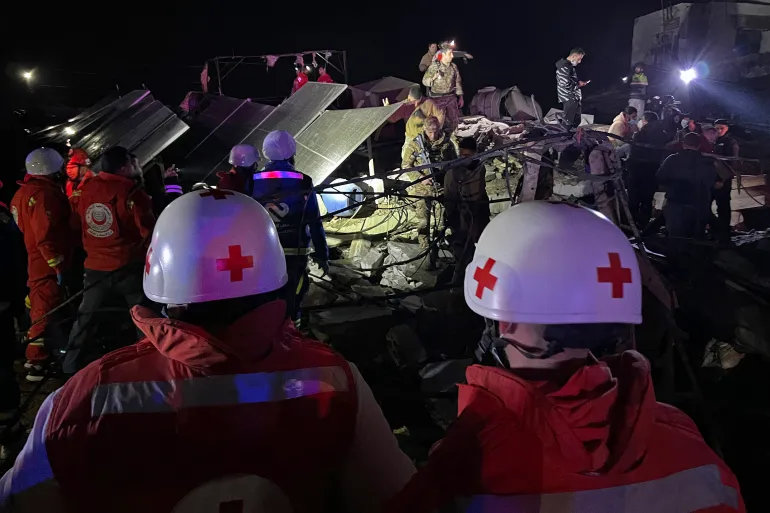
Jan. 6, southern Lebanon – First responders inspect the site of a building destroyed by Israeli airstrikes in Ghaziyeh, an industrial town near the city of Sidon.

Since the start of December, the people of southern Lebanon have endured a familiar, brutal rhythm of violence. Despite the empty diplomatic theater around a UN-monitored ceasefire, U.S.-backed Israeli forces have continued their campaign of destruction against southern Lebanese towns and villages. This latest phase confirms a grim, long-known truth: U.S. imperialism, regardless of the party in the White House, demands the subjugation of West Asia at the hands of its Zionist proxy, the terror state known as “Israel.”

The so-called “ceasefire” announced over a year ago by then-President Joe Biden was always a fraud — a public relations stunt for a Western audience that allowed the grinding war of attrition to continue. That attrition escalated into a concentrated assault. Israeli warplanes and artillery have struck over 120 confirmed targets in southern Lebanon. The targets, as always, are described by the occupation’s spokespeople as “Hezbollah military infrastructure.” The reality on the ground tells a different story.

Three towns were subjected to severe Zionist airstrikes in early December of 2025. On Jan. 3, a series of strikes leveled six residential buildings in the town of Blida — the same town where Zionist troops murdered municipal worker Ibrahim Salameh in his sleep just months ago. Jan. 11 saw another round of brutal strikes against southern Lebanon, targeting the town of Kfar Hatta. The strikes killed several people and damaged multiple buildings. 

The fascist logic is clear: Depopulate the south through terror, making life unsustainable for those who dare to remain on their ancestral land. Farmlands, olive groves, and livestock have been systematically targeted, a deliberate strategy of economic and environmental warfare designed to break the will of the people.

In early December, the Trump administration fast-tracked an emergency shipment of 2,000-pound bunker buster bombs and dozens of new combat drones to the Israeli military, weapons explicitly suited for the type of deep-strike operations being conducted in Lebanon and previous strikes on Iran.

The manufactured narrative to justify military action in the region has also shifted. No longer are there feigned concerns about a “regional war.” Instead, Trump’s special envoy, Tom Barrack, has been publicly pressuring the Lebanese government to accept a “new security reality” — a euphemism for the permanent disarmament of Hezbollah and the effective surrender of Lebanese sovereignty to the U.S. and Israel. The carrot of $230 million in “military assistance” is dangled alongside the stick of continued bombardment, an attempt to bribe the Lebanese state into becoming an enforcer of its own occupation. U.S. imperialism offers only two choices: collaboration or collective punishment.

The path forward is not through concessions to the U.S. war machine or its European junior partners, who are complicit in this slaughter through their silence and arms sales. The path forward is through unwavering global solidarity with the Lebanese people and their right to defend their land.

Every bomb that falls on southern Lebanon is made in the U.S., funded by U.S. dollars, and dropped with the full political approval of the U.S. ruling class and military industrial complex. 

The blood of Lebanese children is on the hands of Pete Hegseth, Donald Trump, and the capitalist arms dealers whose stock prices soar with each explosion. To stand against this war is to stand against U.S. imperialism itself.

Lev Koufax is an anti-Zionist Jewish activist. 

Strugglelalucha256


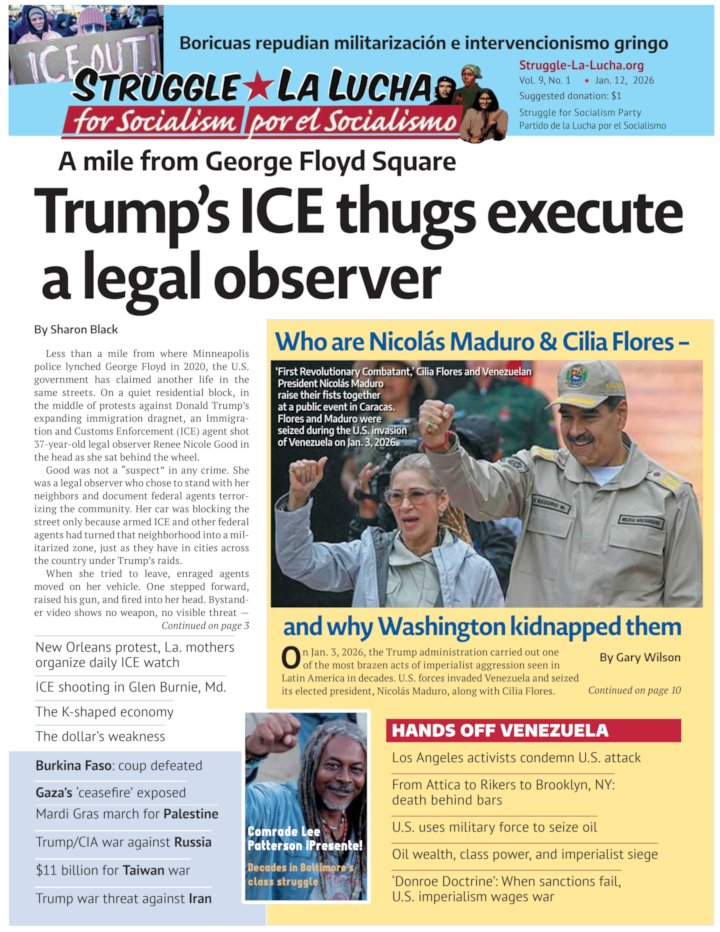
Struggle ★ La Lucha PDF – January 12, 2026

Get PDF here

  • A mile from George Floyd Square, Trump’s ICE thugs execute a legal observer
  • Who are Nicolás Maduro and Cilia Flores – and why Washington kidnapped them
  • New Orleans protest denounces ICE and National Guard occupation
  • Louisiana mothers organize daily ICE watch
  • ICE shooting of unarmed man sparks people’s movement in Maryland
  • The K-shaped economy is monopoly capitalism working as designed
  • Comrade Lee Patterson ¡Presente!
  • LEE PATTERSON five decades in Baltimore’s class struggle
  • Dollar’s weakness is imperialism’s weakness
  • Protesters in over 75 U.S. cities say ‘no war on Venezuela!’
  • ‘We need allies, not war’: Los Angeles activists condemn U.S. attack on Venezuela
  • From Attica to Rikers to Brooklyn: death behind bars in New York
  • U.S. uses military force to seize oil and strangle Venezuela
  • ‘Donroe Doctrine’: When sanctions fail, U.S. imperialism wages war on Venezuela
  • Oil wealth, class power, and imperialist siege in Venezuela
  • From the Monroe Doctrine to Caracas: how a declining empire turns to force
  • Gaza’s ‘ceasefire’ exposes why Zionism must be defeated
  • New Orleans marches for Palestine at start of Mardi Gras
  • While Trump spoke of peace, the CIA escalated war against Russia
  • Washington bets $11 billion on Taiwan war
  • Trump threatens war on Iran as U.S. economic stranglehold tightens
  • BURKINA FASO: Coup attempt against Traoré defeated
  • Boricuas repudian militarización e intervencionismo gringo
  • Puerto Ricans condemn militarization and U.S. interventionism
Strugglelalucha256


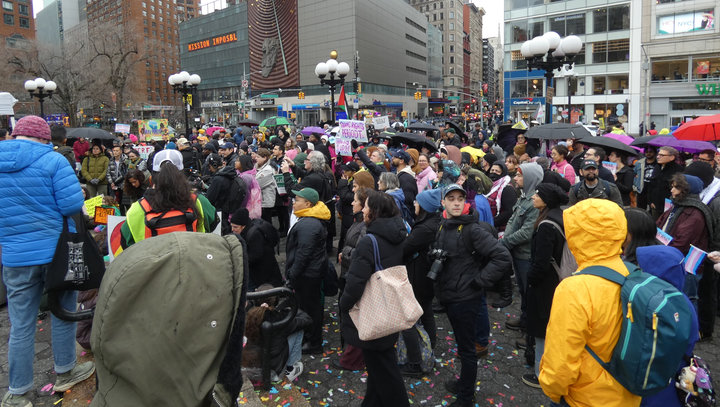
NYC rally: ‘I believe in trans youth power’

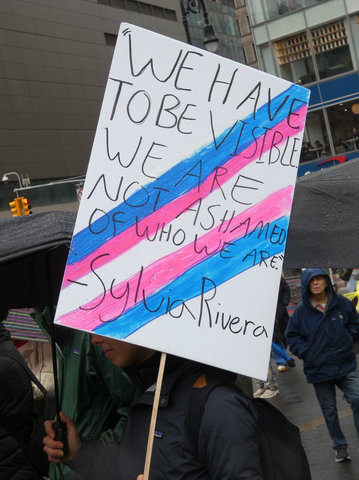
Jan. 10 — Under a cold, steady rain, hundreds of people rallied today in New York’s Union Square to defend the lives of transgender children and all trans people. Holding a sea of umbrellas, signs and flags, they chanted, “I believe in my power! I believe in your power! I believe in trans youth power!”

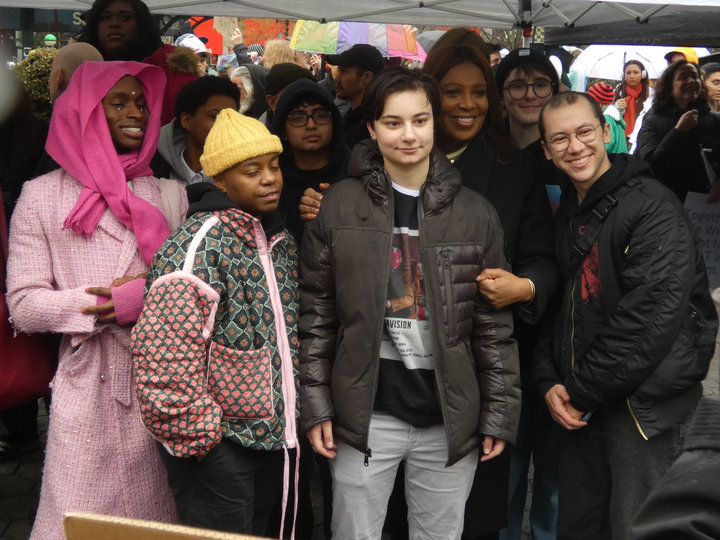
“Together We Win: NYC Rally for Trans Kids” was organized by Trans formative Schools (TfS), PFLAG NYC, and the New Pride Agenda, and supported by ACT UP NY and other groups. It was held in the run-up to a U.S. Supreme Court hearing Jan. 13 on the right of trans youth to participate in school sports. 

The decision of the Trump-aligned court will have repercussions far beyond athletics, impacting everything from health care access to bathroom bans to the right of trans people to exist in public spaces.

Speakers included several trans and gender-nonconforming youth from TfS. The group, which unites teachers, students and parents, recently won a long battle to push back anti-trans measures by far-right members of Community Education Council 2 in Manhattan. 

A student named Bea declared: “I want people to know that trans kids are just kids, we just want to live normal lives and be accepted. We don’t need to be debated, we need to be cared for.” 

“Right now across our nation we are seeing a coordinated attempt to erase and silence the transgender community,” said New York Attorney General Letitia James. She vowed to use her office to protect trans youth and their access to gender-affirming health care. 

New York is one of several states that have sued the federal government to stop Trump’s anti-trans executive orders and departmental rules.

Trans community leader Qween Jean connected the Trump regime’s attacks on trans rights with the genocide of Palestinians in Gaza, the terrorization of immigrants, and the murder of Renee Nicole Good, a queer woman, by ICE in Minneapolis.

“We are in a moment where, if we are silent, they will come after us. If we do not organize, they will terrorize,” said Qween Jean. “If they come for us in the night, they will come for you in the morning.”

19a

5a

6a

Strugglelalucha256


Tens of thousands demand release of kidnapped Venezuelan President Maduro and First Combatant Flores

Tens of thousands of people in Venezuela, along with supporters around the world, are demanding that kidnapped Venezuelan President Nicolás Maduro and First Combatant Cilia Flores be released and allowed to return home.

There are ways you can help.

Send letters of support and solidarity

Nicolás Maduro Moros
00734-506
MDC Brooklyn
Metropolitan Detention Center
P.O. Box 329002
Brooklyn, NY 11232

Cilia Flores
00735-506
MDC Brooklyn
Metropolitan Detention Center
P.O. Box 329002
Brooklyn, NY 11232

Participate in solidarity actions

  • Travel to New York City to participate in jail support at the detention center.
  • Join protests in your home city.
  • Union members: Initiate a petition campaign or statement from your local.
  • Students: Organize petitions at your high school or college, or issue statements from student organizations.
  • Petition at your church and urge religious leaders to issue a statement.
  • Send statements, petitions or individual demands to U.S. government officials involved in the kidnapping of the leaders of a sovereign country.

Contact U.S. officials

U.S. President Donald Trump
The White House
1600 Pennsylvania Ave. NW
Washington, DC 20500
White House contact form: https://www.whitehouse.gov/contact/
White House general phone line: 202-456-1414

U.S. Attorney General Pam Bondi
Department of Justice
950 Pennsylvania Ave. NW
Washington, DC 20530
Email: pamela.bondi@usdoj.gov
DOJ contact form: https://tinyurl.com/2x7s4d8d
Department Comment Line: 202-353-1555
DOJ Main Switchboard: 202-514-2000
TTY/TDD: 800-877-8339

Mail correspondence to the presiding judge

Judge Alvin K. Hellerstein
Daniel Patrick Moynihan United States Courthouse
500 Pearl St.
New York, NY 10007-1312

Strugglelalucha256


Venezuela’s Acting President Rodríguez dismisses U.S. narrative of control, vows to rescue President Maduro

Caracas (OrinocoTribune.com), Jan. 11 — “Who leads the Venezuelan people? The people’s power. Who governs Venezuela? The people’s power and its constitutional government,” declared Venezuela’s Acting President Delcy Rodríguez. “So there is no doubt here, no uncertainty here. … The Venezuelan people rule here, and there is a government, the government of President Nicolás Maduro, and I have the responsibility to lead it while he is being held captive. That is the message for all of Venezuela.”

Rodríguez’s statements come as U.S. President Donald Trump and mainstream media attempt daily to impose a narrative alleging that the U.S. regime is ruling Venezuela.

During a meeting with communes in the Caracas parish of Petare on Saturday, Jan. 10, Rodríguez called on the people to continue “marching together, united, guaranteeing happiness, life, future and peace.” During the event, a community spokesperson named Yohana handed Rodríguez a note on behalf of her commune, which she read aloud: “Delcy, keep marching forward, you have my trust.”

Rodríguez thanked the crowd, emphasizing that they have her loyalty just as she has theirs. “We will not rest for a minute until we have the president and the first lady back. We will not rest. We swear it.” She emphasized that Maduro had been sworn in exactly one year earlier, on Jan. 10, 2025, for the constitutional term of 2025–31.

“Today, Jan. 10, one year later, we are swearing for their freedom. We will rescue them; of course we will. With the unity of our people, we will rescue them,” Rodríguez declared.

“Never traitors!” Rodríguez added, to which the people responded with the slogan: “Delcy, carry on, you have my trust.”

She stressed that Venezuelans are united in their condemnation of the vile and criminal U.S. military attack of Jan. 3, adding that the government is working to achieve the release of the U.S. prisoners of war: President Nicolás Maduro and First Lady and National Assembly Deputy Cilia Flores.

Strengthening national production

Rodríguez also highlighted the strengthening of sovereign supply and the consolidation of productive unity. In this context, she urged every governor to maintain a focus on the productivity of their respective regions, with linkages across all economic levels.

She said the last instruction that President Nicolás Maduro personally gave her was: “Work for communal production, and let that communal production be linked with entrepreneurs and the agro-industry.”

During the event, Rodríguez oversaw the distribution of animal protein and highlighted 10% growth in the sector, which includes chicken, eggs, pork and beef. She also emphasized the potential of Venezuela’s buffalo herd, the largest in the hemisphere and the third largest in the world.

She highlighted the importance of national production and called for entrepreneurship using national products because, “within the framework of the blockade against Venezuela,” imperialism is trying “to suffocate us with foreign currency.” Consequently, she called for a sustained increase in national production.

President Maduro’s legal team

Barry Pollack, President Nicolás Maduro’s lawyer in the U.S., denied that another lawyer, Bruce Fein, had joined the legal team.

Pollack said he spoke by phone with President Maduro, who confirmed that “he does not know Fein,” that “he has not communicated with him,” and that “he has neither hired him nor authorized him to appear or to say that he represents him,” according to a report by the EFE news agency.

Pollack explained that Fein requested to join the case pro hac vice — a legal mechanism that allows a lawyer to represent a client on an occasional basis in a jurisdiction where they are not licensed — which requires judicial authorization.

“Mr. Maduro authorized me to submit a motion to withdraw Mr. Fein’s presentation” as his defense, Pollack said. In response to the request, Judge Alvin Hellerstein ordered Fein removed from the case.

The next hearing for the presidential couple in the illegal U.S. judicial procedure against Venezuela’s president — who is protected by personal immunity — is scheduled for March 17.

Special for Orinoco Tribune by staff

Strugglelalucha256


Economic warfare and the imperialist stranglehold on Iran

On the morning of Jan. 8, Zahra Mohammadi stood in line outside a bakery in southern Tehran for three hours. When she finally reached the counter, the price of flatbread had doubled since the day before. By the time she returned home, her neighbor told her the bank had frozen withdrawals in rials — you could only take out dollars, if you had any. Zahra’s husband works in a textile factory that has been on rolling blackouts since the new year. Half his shifts were canceled this week. The family’s savings, kept in rials, lost 80% of their value in three weeks.

This is not inflation in the ordinary sense. This is an engineered economic collapse.

The rial suffered a steep slide, falling to around 1.47 million per dollar on the unofficial market in early January 2026. The government has been forced to eliminate subsidies on food and fuel. Bread, meat and medicine are projected to rise another 70% to 100% this month. Factories across the country are shutting down four hours a day because the electrical grid cannot sustain production. In the Tehran Grand Bazaar — the traditional merchant quarter that has survived wars, revolutions and sanctions — traders who kept their wealth in rials watched it evaporate in days. Some joined street protests in late December, a rare break from their historical caution.

The January currency collapse did not emerge from a vacuum. It built on damage already inflicted on Iran’s energy infrastructure in mid-2025, damage that left the economy unusually vulnerable to external shocks.

What Zahra and millions of Iranians are experiencing is not the result of mismanagement or corruption, though both exist. It is the result of a deliberate, coordinated campaign of economic destruction waged by the United States military and financial apparatus. The tools are varied: tanker seizures, military strikes on refineries, the capture of allied governments, and digital market manipulation. The goal is singular: to break Iran’s ability to feed and power itself, and in doing so, to break the will of its population.

The anatomy of imperialist strangulation

To understand what is happening in Iran today, we must locate it within the broader dynamics of monopoly capitalism in its present stage of crisis. The U.S. ruling class is not acting out of simple aggression or ideological hostility to the Iranian government. It is responding to the structural imperatives of a capitalist system that can no longer expand profitably through normal channels of investment and trade.

The rate of profit in the major capitalist economies has been in long-term decline since the 1970s. Manufacturing has been offshored. Financialization has created mountains of fictitious capital with no basis in actual production. The response of U.S. imperialism has been to tighten its grip on the sources of super-profits: control over raw materials, especially energy; control over trade routes and currency flows; and the disciplining of any nation that attempts to develop its resources independently.

From the standpoint of Wall Street and the Pentagon, Iran’s “crime” has nothing to do with democracy, human rights, or labor standards. Washington applies those labels selectively, discarding them whenever a government serves U.S. corporate interests. Iran is targeted because it insists on sovereign control over its oil and gas reserves, the fourth-largest in the world. It has built domestic refining capacity, trades outside the dollar system, and directs revenue to allies in Lebanon, Iraq, Yemen, and Palestine who resist U.S. client states in the region.

This makes Iran intolerable to imperialism. Not because Iran threatens to invade anyone, but because its very existence demonstrates that a country can retain control of its resources and use them for purposes other than enriching ExxonMobil and Chevron. If Iran succeeds, others will follow. Therefore, Iran must be crushed.

The mechanics of collapse

The rial’s collapse was triggered by three events in rapid succession, each one a calculated blow to Iran’s economic infrastructure.

First, on Jan. 3, U.S. special forces raided Venezuela and kidnapped President Nicolás Maduro. For years, Iran and Venezuela have used sanctions-busting barter and opaque deals — refinery repairs, fuel, and other support from Iran in exchange for Venezuelan heavy crude, gold and other commodities. The partnership moved an estimated $2 billion annually in goods that never touched the U.S.-dominated banking system.

With Maduro imprisoned and the Venezuelan government thrown into crisis, that entire network has been paralyzed. Iran lost not just a trading partner, but a critical valve for moving oil and acquiring hard currency outside Washington’s reach.

This was not a single-cause collapse. The kidnapping of Maduro acted as a shock to already strained sanctions-busting networks, cutting off liquidity channels and signaling to traders that key routes for oil and hard currency were suddenly at risk.

Four days later, U.S. and British naval forces seized the Marinera, a Russian-flagged tanker in the North Atlantic. The ship, formerly known as Bella 1, was a key vessel in what is called the “shadow fleet” — a network of aging tankers that move Iranian oil to buyers in Asia and Africa, often with falsified manifests and frequent flag changes. The Marinera alone was responsible for moving large volumes of oil daily. Its seizure was not an isolated interdiction. It was a message: The routes are closed.

At the same time, currency traders operating through Telegram channels contributed to the currency’s collapse. Cut off from the formal global financial system by U.S. sanctions, Iran had been forced to rely on informal currency markets in Herat, Afghanistan, and Sulaymaniyah, Iraq—hubs for cross-border transactions in regions with limited banking infrastructure—as key nodes in a shadow financial system necessary for conducting international trade.

As panic spread through Telegram channels—some with over 2 million members—traders circulated distorted pricing information and false exchange rates. Unable to verify real-time prices through official channels, panicked sellers accepted the rates being broadcast through these networks, accelerating the rial’s decline. The speed and coordination of the currency run reflected how U.S. sanctions had pushed Iran’s foreign exchange market into fragmented, opaque channels vulnerable to manipulation.

These were not “market forces.” They were instruments of war.

The tools of economic strangulation are not new. We saw sanctions destroy Iraq’s industrial base in the 1990s, killing half a million children before the 2003 invasion. We saw NATO bombing fragment Libya, leaving Africa’s most developed state divided among competing armed militias. But Iran is not Iraq or Libya. It is larger, more industrially developed, with a population of 88 million and a military that has proven it can defend itself. The U.S. cannot invade Iran the way it invaded Iraq, and it cannot bomb Iran into submission the way NATO did Libya.

What it can do is what we are witnessing now: strangle Iran’s economy, destroy its ability to export oil, and make daily life unbearable for its population. The goal is not regime change through invasion but economic pressure severe enough to either force capitulation or provoke internal collapse. Whether this strategy will succeed against a country of Iran’s size and capacity remains to be seen. What is certain is that the suffering imposed on ordinary Iranians in the attempt is immense.

From the June bombings to January’s collapse

The current crisis is built upon the June 2025 conflict, often described as the 12-day war, which functioned as a phase of economic warfare against Iran’s energy system. Israeli airstrikes—carried out with U.S. military, intelligence, and diplomatic backing—targeted fuel and gas infrastructure central to Iran’s civilian economy. The Shahran fuel depot in northern Tehran was struck, triggering massive fires and disrupting fuel distribution in the capital. The Shahr Rey refinery south of Tehran was also hit, impairing one of the country’s key refining centers. In the south, strikes damaged installations at the South Pars gas field—one of the largest natural gas reserves in the world—forcing temporary shutdowns and reducing gas output. By degrading refining capacity and gas production, the attacks imposed sustained pressure on fuel supplies, industrial activity, and state revenues, extending the impact of the war far beyond the battlefield.

The damage was surgical, and the consequences are compounding. Iran, despite sitting on the world’s third-largest oil reserves, now has to import gasoline. Every liter purchased abroad drains the hard-currency reserves that prop up the rial. The less currency in reserve, the faster the rial falls. The faster it falls, the more expensive imports become. Factories that need electricity to operate are running on generators — when they can afford fuel. Most cannot. Manufacturing output has dropped by half since Jan. 1. Layoffs are spreading.

This is how imperialist economic warfare works. The goal is not negotiation, but to make it impossible for Iran to produce what its people need to survive.

The imperialist powers can no longer tolerate even limited independent development in the oppressed nations. Every refinery that Iran builds, every barrel of oil it sells outside U.S. control, every trade agreement it signs with China or Russia represents a loss of super-profits for the monopolies. And because the rate of profit is falling at home, those super-profits are not optional. They are necessary for the system to survive.

The budget and the class contradiction

Faced with the evaporation of oil revenue, the Iranian government released its 2026 budget earlier this month. It is a document of managed collapse. The overall budget has contracted by 38% in real terms. The subsidies that once kept bread, fuel and medicine affordable are gone. The government now assumes it will export just 1 million barrels of oil per day, down from 1.85 million, at a price of $55 per barrel — a fraction of the revenue it needs to operate. The budget deficit is projected at more than $30 billion, with no clear way to finance it.

Yet even in triage, certain spending remains untouchable. Security and military budgets have been largely preserved. This has alienated even traditional allies. The bazaaris — merchants who have historically supported the Islamic Republic — are now questioning their support. When your savings disappear and your inventory becomes worthless overnight, political loyalty means little.

The Iranian government did not choose this budget. It is the budget that imperialism allows.

The Iranian government defends national sovereignty against imperialist attack, but it is not a workers’ government. It cuts subsidies, suppresses strikes and maintains capitalist relations of production. Iranian workers face pressure from two directions: from U.S. economic warfare that destroys their jobs and savings, and from their own government’s austerity measures. This is the position of working people in every oppressed nation under siege.

Imperialism in the age of decline

The U.S. economy, and the bloc of allied economies that depend on it, requires access to oil, gas and strategic minerals on terms favorable to Western corporations and financial markets. Iran sits on resource wealth that it refuses to hand over to ExxonMobil, BP or Chevron. It has used that wealth to build refining capacity, to trade outside the dollar system, and to support movements in Lebanon, Iraq, Yemen and Palestine that challenge U.S. client states. In the grammar of empire, this is intolerable.

Sanctions, blockades and military strikes are not tools of last resort. They are tools of first resort when a country insists on controlling its own resources. The goal is not to bring Iran “to the table” for negotiations. The goal is to make an example: This is what happens when you resist. The suffering is not incidental. It is the point.

The broader strategic picture is equally clear. With Maduro removed and the U.S. attempting to take over Venezuela’s oil sector, and with the tanker fleet under interdiction, Washington is tightening its grip on global energy flows. Control over who can buy and sell oil, and in what currency, is control over the world economy. Iran’s economic destruction is a demonstration project for any other government considering independent energy policy. Russia is watching. China is watching. Every country in the Global South is watching.

What we are witnessing is not simply an attack on one country. It is the working out of contradictions inherent in monopoly capitalism. The imperialist powers, led by the United States, face declining rates of profit, overproduction and challenges to their global dominance from rising economies like China. Unable to resolve these contradictions through expansion or reform, they turn to military force and economic strangulation to maintain their grip on the sources of super-profit.

This is why there can be no “peaceful coexistence” between imperialism and the national liberation movements of the oppressed nations. It is why every attempt at negotiation and compromise ends in betrayal. The system itself requires domination. It cannot tolerate independence.

The historical perspective

We have seen this pattern repeat across decades. When Vietnam attempted to unify and develop independently, U.S. imperialism waged a war that killed 3 million people and poisoned the land with Agent Orange. When Cuba expropriated U.S. sugar plantations and oil refineries, Washington imposed a blockade that has lasted more than 60 years. When Iraq under Saddam Hussein, as a nationalist regime, not socialist, began to assert control over its oil and threaten to trade in currencies other than the dollar, the U.S. invaded twice and occupied the country for a decade.

In each case, the imperialist propaganda changed to suit the moment. Vietnam was about “stopping communism.” Iraq was about “weapons of mass destruction.” Libya was about “humanitarian intervention.” Iran is about “nuclear weapons” or “terrorism.” But the underlying logic is always the same: No nation in the oil-rich regions of the world will be permitted to control its own resources and use them for its own development.

The difference now is that U.S. imperialism is in visible decline. It can still destroy — as we see in Iran — but it can no longer rebuild or stabilize. It can remove governments, but it cannot install functioning replacements. Its currency hegemony is being challenged by China’s Belt and Road Initiative and the expansion of trade in yuan and rubles. Its military is overstretched, its treasury is drowning in debt, and its domestic infrastructure is crumbling.

This makes U.S. imperialism more dangerous, not less. A declining empire is a desperate empire. It will lash out violently to maintain control over whatever it can. The economic warfare against Iran is a preview of what is to come as the contradictions sharpen.

The path forward

There is no policy fix for imperialism. The tankers will not be returned because a different party wins an election. The refineries will not be rebuilt because a new round of negotiations succeeds. The system that produced this crisis — one that prioritizes the profits of oil giants and weapons manufacturers over the lives of working people — cannot be reformed into something humane. It can only be dismantled.

That work begins with clarity: understanding that what is happening in Iran is not an aberration but the routine operation of a global system built on extraction and domination.

History has shown that imperialism can be defeated. China defeated it. Vietnam defeated it. Korea defeated it in the north. Cuba has survived it for more than six decades. The national liberation movements of Africa and Asia forced it to retreat in the 1960s and 1970s. But victory requires more than resistance. It requires organization, international solidarity, and above all, a scientific understanding of the system we are fighting.

The Iranian people are under siege. Our job is to break that siege by fighting the empire that imposes it.

Strugglelalucha256


Cuba responds to Trump’s latest fascistic statement

In a new delirious escalation of his anti-Cuban rhetoric and measures, the US president said on social media that there will be no more oil or money from Venezuela for Cuba, disregarding the sovereign nature of both Latin American nations.

@realDonaldTrump

Cuba lived, for many years, on large amounts of OIL and MONEY from Venezuela. In return, Cuba provided “Security Services” for the last two Venezuelan dictators. BUT NOT ANYMORE! Most of those Cubans are DEAD from last weeks U.S.A. attack, and Venezuela doesn’t need protection anymore from the thugs and extortionists who held them hostage for so many years. Venezuela now has the United States of America, the most powerful military in the world (by far!), to protect them, and protect them we will. THERE WILL BE NO MORE OIL OR MONEY GOING TO CUBA – ZERO! I strongly suggest they make a deal, BEFORE IT IS TOO LATE. Thank you for your attention to this matter. President DJT.

\1 11 diaz canel

Díaz-Canel rejects Trump’s statements and reaffirms Cuba’s sovereignty

January 11, 2026

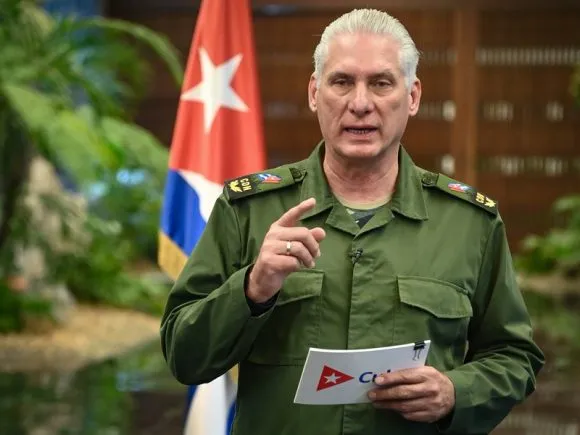
In response to today’s statements by US President Donald Trump, the President of the Republic of Cuba, Miguel Díaz-Canel Bermúdez, categorically rejected any accusations against the island and questioned Washington’s moral authority to pass judgment on the Cuban reality.

“Those who turn everything into business, even human lives, have no moral authority to point fingers at Cuba in any way, absolutely none,” said the head of state, referring to what he described as a campaign of hostility and discredit against the Caribbean nation.

Díaz-Canel maintained that those who today “hysterically rail” against Cuba do so, in his opinion, motivated by anger at the sovereign decision of the Cuban people to choose their own political model. In this regard, he rejected attempts to blame the Revolution for the severe economic shortages facing the country.

“Those who blame the Revolution for the economic difficulties we are suffering should be ashamed to speak, because they know—and acknowledge—that they are the result of the draconian measures of extreme suffocation that the United States has been applying to us for six decades and now threatens to intensify,” he stressed.

The president reiterated that Cuba is a free, independent, and sovereign nation that does not accept external impositions. “No one dictates what we do. Cuba does not attack; it has been attacked by the United States for 66 years,” he emphasized, while reaffirming the country’s willingness to defend its sovereignty against any threat.

1 11Bruno Rodriguez

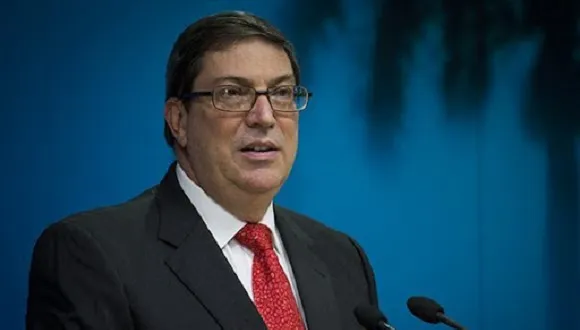
Minister Bruno Rodríguez Parrilla said on his twitter account “Unlike the US, we do not have a government that lends itself to mercenary activities, blackmail, or military coercion against other states,”

Rodríguez explained that his country “has every right” to import fuel from markets “willing to export it,” in addition to exercising its right to develop its commercial relations “without interference or subordination to unilateral coercive measures by the US.” “Right and justice are on Cuba’s side,” he recalled.

At the same time, the foreign minister accused Washington of behaving like a “criminal and uncontrolled hegemon that threatens peace and security, not only in Cuba and this hemisphere, but throughout the world.”

Rodríguez also responded to Trump’s accusations that Havana was receiving “large quantities” of oil from Venezuela in exchange for providing security services. “Cuba does not receive and has never received monetary or material compensation for the security services it has provided to any country,” he emphasized.

Source: Cubadebate translation Resumen Latinoamericano – English


Strugglelalucha256


6 defiant words: Maduro sends message from New York, vows resistance after U.S. kidnapping

January 11, 2026

Maduro sent a message from New York confirming that he and First Lady Cilia Flores are “well” despite being held in U.S. custody following what Venezuela describes as a military kidnapping on Jan. 3, 2026. The message, delivered through legal representatives and shared publicly by his son, National Assembly Deputy Nicolás Ernesto Maduro Guerra, marks the first direct communication from the Venezuelan president since the alleged U.S. operation that left more than 100 people dead across Caracas, La Guaira, Aragua and Miranda states.

In the brief but powerful statement, Maduro urged supporters not to succumb to despair. “We are well, we are fighters,” he declared — a phrase that has already become a rallying cry across Venezuela and solidarity movements worldwide. His son emphasized that his father remains “strong” and unbroken, despite what Caracas calls an act of war. “They couldn’t defeat him by any means, so they used disproportionate force — but they did not defeat him,” he said.

The revelation comes amid intensifying diplomatic fallout. Acting President Delcy Rodríguez, appointed by Venezuela’s Supreme Court to lead the government in Maduro’s absence, has formed a High-Level Commission to pursue his release through legal and political channels. Meanwhile, mass protests continue daily across all 23 states, with citizens demanding the immediate return of their democratically elected leaders.

Maduro sends message from New York amid global condemnation of U.S. aggression

According to Venezuelan officials, the Jan. 3 operation involved coordinated airstrikes and ground incursions by U.S. special forces targeting presidential residences and military installations. The assault culminated in the forced extraction of Maduro and Flores, who were flown to New York and are reportedly being held at the Metropolitan Detention Center in Brooklyn, a federal facility known for housing high-profile detainees.

While the U.S. government has framed the action as a “counter-narcoterrorism operation,” citing long-standing — but unproven — allegations linking Maduro to the so-called “Cartel de los Soles,” no formal charges have been presented in an international court. Venezuela rejects the accusations as politically motivated fabrications.

United Nations Secretary-General António Guterres condemned the operation, stating that it “violates core principles of the UN Charter, including sovereignty, non-intervention and the prohibition of the use of force.” Several members of the U.N. Security Council, including China, Russia and Algeria, echoed this stance, calling for an emergency session to address what they describe as a dangerous precedent in international relations.

“This is not law enforcement — it is state-sponsored abduction,” said Dr. Amara Diallo, an international law professor at the University of Dakar. “Even if allegations were true, due process requires extradition requests, judicial cooperation and respect for diplomatic immunity — not midnight raids and forced transfers.”

Under the Vienna Convention on Diplomatic Relations, heads of state enjoy absolute immunity — a norm critics say the U.S. appears to have disregarded. Legal experts warn that if such actions go unchallenged, the door opens for powerful states to unilaterally detain foreign leaders under flimsy pretexts.

Geopolitical context: A world reckoning with unilateral power

The crisis triggered by Maduro’s detention represents more than a bilateral dispute. At a time when multipolarity is rising and trust in Western institutions is eroding, the U.S. operation has galvanized a broad coalition of nations that view it as an overreach disguised as justice.

From Serbia, where President Aleksandar Vučić declared the U.N. Charter “nonfunctional,” to India, which called for a peaceful resolution, and Brazil, which convened an emergency CELAC summit, the response has been wide-ranging. Traditionally neutral actors such as the Vatican and South Africa have also expressed concern.

Regionally, the attack challenges the 2012 CELAC declaration of Latin America and the Caribbean as a “zone of peace,” which rejects foreign military intervention. In response, several governments have called for renewed regional dialogue.

Globally, the incident has intensified discussions around de-dollarization and alliance diversification. Venezuela has deepened energy and defense partnerships with Russia, China and Iran, while critics argue that continued unilateral actions by Washington risk further isolating the United States.

More than 100 Venezuelans — both soldiers and civilians — were killed in the Jan. 3 strikes, according to Venezuelan authorities. Those casualties have received little attention in U.S. official statements, which have focused instead on allegations against the country’s leadership.

Domestic unity and international solidarity in defense of sovereignty

Inside Venezuela, authorities say institutional continuity has been maintained. The Supreme Court’s designation of Rodríguez as acting president was presented as a constitutional measure, while the Bolivarian National Armed Forces reaffirmed loyalty to the civilian chain of command.

“The revolution does not depend on one person — it belongs to the people,” Rodríguez said in a national address, pledging to “work and fight simultaneously” for peace and sovereignty.

Her administration has pursued diplomatic efforts at international forums while mobilizing domestically to prevent destabilization. Officials report that community organizations and social movements have continued organizing daily activities amid heightened tensions.

International reactions have continued to emerge. Iran labeled the operation “criminal aggression,” China demanded the immediate release of Maduro and Flores, and Cuba described the action as “state terrorism.” In the United States, some lawmakers and human rights organizations have questioned the legality of the operation.

The message from Maduro — brief and personal — has taken on symbolic weight among supporters. By stating “we are fighters,” he framed the moment as one of resistance rather than defeat.

Conclusion: Words that defy empire

In a context marked by sanctions, military pressure and diplomatic conflict, Maduro’s message from New York has resonated widely. His five-word statement — “We are well, we are fighters” — has been repeated in demonstrations and public statements across Venezuela.

As the situation continues to unfold, supporters say the message reflects a broader insistence on sovereignty and political self-determination in the face of external pressure.

Source: teleSUR

Strugglelalucha256


Fidel Castro and education: A living legacy in the year of his centenary

Havana, Jan. 2  — Cuba and the world welcome 2026, facing the challenge of preserving and perfecting hard-won social achievements within an especially complex context. The nation confronts material shortages, continuation of U.S. hostility, and daily effort to sustain the country amid a profound electricity crisis.

In this scenario of tension and resistance, Cuba reaffirms its determination to move forward without renouncing its principles, defending as a priority the achievements of essential sectors such as education — a historical and moral pillar of the social project born with the Revolution’s triumph.

This year marks the centenary of Fidel Castro Ruz’s birth and the 67th anniversary of the Cuban Revolution’s triumph. Education emerges as one of the most solid and enduring pillars of his thought and revolutionary work. Rooted deeply in José Martí’s ideas, Fidel conceived education not only as an inalienable human right, but as a shared social responsibility: every person who comes into the world has the right to be educated and the moral duty to contribute to the education of others.

Fidel’s early closeness to Martí’s ideas, together with his family education and hardships experienced during his school years, awakened in him an insatiable passion for learning. From a young age, he understood that only a cultured people can guarantee a prosperous and truly free future for the nation. This conviction decisively shaped his political and revolutionary path.

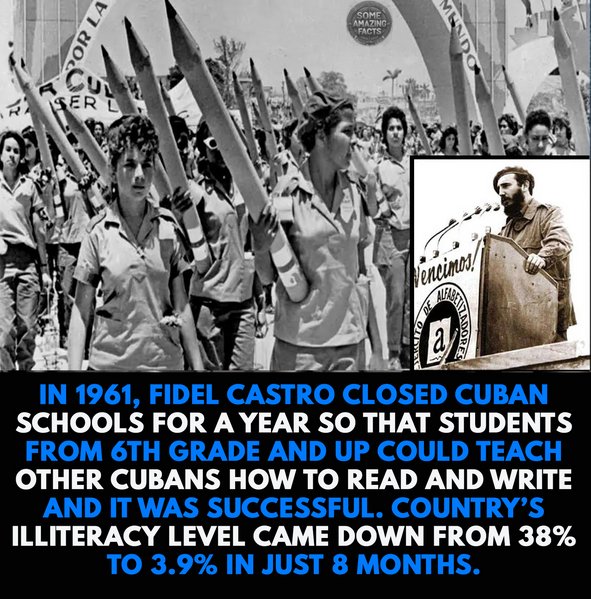
Following the Revolution’s triumph on January 1, 1959 — a date remembered with pride by Cubans this week—the drive to expand education was immediate. Fidel often stated that the worst thing that can be done to a child is to deprive them of education. In keeping with that belief, one of the first major initiatives of the new revolutionary government was the Literacy Campaign.

1 5 Screenshot 2026 01 02 at 13 17 03 9 Instagram

It was followed by the struggle to achieve higher levels of schooling, the training of volunteer teachers, the University Reform of 1962, and sustained expansion of the educational system throughout the country. As noted by specialist Lesbia Cánovas, these transformations constitute a true feat of the Cuban people, always guided by Fidel’s unquestionable vision.

Mass access to knowledge and educational development were closely linked to advances in information and communication technologies. According to Dr. Iván Barreto Gelles, director of the Company for Informatics and Audiovisual Media Cinesoft, this reality was made possible through Fidel’s foresight.

Even in the most difficult moments—such as the Special Period of the 1990s—he defended the need to invest resources in science and technology as pathways toward a prosperous and sustainable nation. From that stage emerged the Scientific Pole and the extension of technological development to all universities, ensuring that today, even in the most remote mountain schools, televisions and computers are present.

Thanks to that strategic vision, Cuba became a country of men and women of science. Yet Fidel’s educational legacy is not limited to structures or programs; it is also expressed in his deep and heartfelt relationship with young people. He always sought spaces for dialogue with new generations, calling on them to transform and create, to study history as the essential path to becoming revolutionaries through their own conscience—not as mere repeaters of empty slogans.

In the year marking his centenary, the life and thought of Fidel Castro must continue to be an integral part of Cuban classrooms, not as distant history but as a living reference. Through study, reflection, and dialogue, new generations can find in his legacy a source of ethical conviction, intellectual rigor, and human commitment. Thus, his name and ideals will endure where they matter most: in education, one of the most noble and lasting achievements of the Cuban Revolution.

Strugglelalucha256


Venezuela’s Revolution still stands: debunking Trump’s psyop

Jan. 5 — The events of the past 72 hours represent a qualitative escalation in the 25 years of regime change operations by the US government against the Bolivarian Revolution in Venezuela. The United States’ execution of “Operation Absolute Resolve”, a targeted bombing raid and the illegal abduction of President Nicolás Maduro, has created a moment of profound crisis but also profound clarity. For revolutionary forces globally, a concrete analysis is required to cut through the disinformation, understand the objective balance of forces, and chart a path forward.

The objective conditions of the US military intervention

In the wake of the operation, there has been great talk of the unmatched military capabilities of the US Empire. But Marxists should begin with an understanding of the political relationship of forces. Under closer examination, that the Trump administration had to carry out an operation in this fashion is also proof of imperialism’s political weaknesses – in Venezuela, internationally, and at home.

The decision by the Trump regime to undertake this operation, rather than a full-scale invasion, is a testament to the power of organized popular resistance. Two primary factors constrained US options:

  1. Mass mobilization in Venezuela: President Maduro’s call to massively expand the Bolivarian Militias saw over eight million citizens arm themselves. Combined with Venezuela’s professional military, which has not fractured, this created a scenario where any ground invasion would degenerate into a protracted people’s war, with unacceptable political and material costs for the United States. There remains a strong base of support for Chavismo and the Bolivarian Revolution, which the Trump administration tacitly admitted when it said there must be “realism.” They admitted that the Venezuelan right wing lacks the support to lead the country.
  2. Domestic US Opposition: Widespread public rejection of military intervention, spanning the political spectrum, including significant sectors of Trump’s own base, made a large-scale deployment politically untenable.

Faced with these deterrents, the White House pivoted to a strategy of decapitation: using its overwhelming technological and military superiority to sever the head of the revolutionary state while avoiding a quagmire. In deciding to utilize a “surgical” strike, involving over 150 aircraft and elite Delta Force units, rather than a war to destroy the Venezuelan state, they are tacitly recognizing that it is here to stay. The US has, in the aftermath of two failed and costly military interventions in Iraq and Afghanistan, sought the path of least resistance, preferring bombing campaigns and abductions that can serve as political “trophies.” But underneath the hyper-emotional style of Trump and the hyper-aggressive military tactics – recalling prior eras of “gunboat diplomacy” in Latin America – there is also a reluctance to go all the way to a regime change war. It is a return to a 19th-century gangster imperialism, forcing concessions at gunpoint; this is what Trump really means by “running” Venezuela.

The asymmetry of power and the question of “betrayal”

Although the Venezuelan masses, party, and state were prepared to counter a full-scale US invasion in a decentralized people’s war of resistance, no country on the planet has the preparation or the capacity at present to prevent the overwhelming and brutal force of a US special operation such as the one conducted. No nation, no matter how morally justified, popularly mobilized, or militarily capable, can presently match the concentrated, high-tech lethal force of the US war machine in this respect. The coordinated mass bombing, disabling of communications, electricity, and anti-air defenses, followed by the raid on President Maduro’s secure residence, was an application of this asymmetrical power. The heroic resistance of the security detail, comprising Venezuelan forces and Cuban internationalists, resulting in 50 combat deaths, confirms this was an act of war, not a “surrender” – despite all earlier claims.

This clearly disproves the notion that multipolarity at the present stage can serve as a mechanism for protecting the sovereignty of Global South states. The US, with the world’s largest military budget, the most extensive network of military bases, and technological superiority, has reasserted its unipolar hegemony in the field of military power.

The subsequent psychological warfare operation has sought to sow disunity by alleging “betrayal” or “treason” within the revolutionary leadership, particularly targeting Vice President Delcy Rodríguez. This narrative lacks any evidence, appears totally false, and is also a classic tactic in US military strategy and psychological operations.

The Rodríguez family’s revolutionary credentials are etched in struggle. Their father, Jorge Antonio Rodríguez, a leader of the Socialist League, a Marxist-Leninist organization, was tortured and murdered by the Punto Fijo regime in 1976. Both Delcy and her brother Jorge (the President of the National Assembly) emerged from this tradition of clandestine and mass struggle for socialism. President Maduro himself was a cadre of the same organization. To suggest betrayal among them or capitulation born of cowardice or opportunism ignores four decades of shared political formation, persecution, and leadership under relentless imperialist aggression and the class character of their revolutionary leadership.

The resilience of the Bolivarian State and the tactic of retreat

In the immediate aftermath, the Venezuelan state demonstrated its rootedness and stability. Contrary to decades of US propaganda proclaiming its collapse, the political and constitutional chain of command remained intact. Vice President Delcy Rodríguez, alongside Diosdado Cabello (Minister of Interior), Vladimir Padrino (Minister of Defense), and the core leadership of the PSUV and the armed forces, sought to stabilize institutions, reclaim public space by calling the masses to mobilize in protest, and demand proof of life from President Maduro. While Trump initially asserted the US would “run the country,” Marco Rubio was forced to walk this back. The functional continuity of the PSUV leadership forced this rhetorical retreat. Delcy Rodríguez, acting as interim leader, countered the US narrative: “There is only one president in this country, and his name is Nicolás Maduro Moros… we will never again be a colony of any empire.” In his hasty retreat, Rubio went so far as to publicly discredit their handpicked opposition figure, María Corina Machado, thereby de facto recognizing the Bolivarian state as the sole governing entity.

The subsequent statements from Caracas calling for dialogue and negotiations with the US must then be understood not as capitulation, but as a retreat under duress. The objective conditions are severe. Right-wing shifts in Argentina, Paraguay, Ecuador, El Salvador, Peru, and Bolivia, and vacillation by progressive governments in Brazil, Colombia, and Mexico, mean that Venezuela faces political isolation in Latin America. The material and political support it has received from allied governments in Russia and China clearly is not enough to deter US imperialism from another aggression. The continued naval blockade and the demonstrated existential threat posed by further US military action remain the most significant challenges.

In his first statement on January 3, Trump implied that Delcy Rodriguez had expressed a willingness to cooperate with the US and meet its demands. Some on the left believed him, interpreting this as a sign of Delcy’s capitulation. Her press conference that same day reaffirmed Venezuela’s sovereignty and its own demands to the US, including the release of President Maduro. The next day, Delcy, after leading a meeting of the party leadership and government ministers – during which the unity of the party, the masses, and the military was reaffirmed – published a message to the world, clearly directed at Trump and the United States government. She called on the US government to work together with Venezuela towards peace and development, but on terms of sovereignty and equality. This should not be interpreted as either betrayal or capitulation. In fact, this statement echoes every statement made by Maduro over the last three months and throughout the years of tensions with the US. Maduro himself consistently called for diplomacy and negotiation to avoid an all-out war, and had already offered to negotiate comprehensive economic agreements with the US for Venezuela’s oil and mineral resources. If the Venezuelan state were to sign such deals going forward – now with Maduro kidnapped – it would not constitute treason.

In 1918, Lenin and the Bolsheviks famously signed the Treaty of Brest-Litovsk, ceding vast territories to imperialist Germany to save the infant Soviet Republic from annihilation. He was accused of selling out the revolution by the “left communists” in his party, but he compared such a compromise to that of giving up your wallet to an “armed bandit” in exchange for your life. This concession led to the breakup of the alliance with the Left Socialist-Revolutionaries who accused him of “treason.” The Left Socialist-Revolutionaries took up an armed struggle against the Bolshevik government, including an assassination attempt on Lenin as a “traitor to the revolution” that left him badly wounded in September 1918. Two months later, Germany surrendered and the Soviet Republic regained all the territory lost at Brest-Litovsk.

Today, Venezuela faces a similar “Brest-Litovsk moment.” Isolated by right-wing regional governments and facing a near-total blockade, the revolutionary core is prioritizing the survival of the state as a rearguard base for future struggle. In this context, the priority of the PSUV and the Venezuelan government is the preservation of revolutionary state power. As the late Comandante Hugo Chávez reflected after the failure of the 1992 rebellion, “We must retreat today to advance tomorrow.” This may involve open negotiations with the US government that allow for US corporations to have greater shares and access to Venezuela’s oil production under conditions that greatly benefit US interests, among other temporary concessions in the economic sphere, to secure political space and prevent total annihilation. The goal is to maintain Venezuela and Cuba as indispensable rearguard bases for socialism and anti-imperialism in a period of retrenchment of socialist forces in the Global South.

Trump is claiming victory – that “we’re in charge.” He’s doing so chiefly for domestic political purposes. But that does not make it so. Unable to carry out actual regime change, he is essentially using words to falsely declare “the regime is changed.” The New York Times and other corporate-owned media are running misleading headlines and articles that back up Trump’s narrative that he “picked” Delcy Rodriguez as “pliant.” No socialist should have a knee-jerk reaction accepting bourgeois propaganda.

The revolution has suffered a severe blow, but its hold on state power persists. Though the coming period will test its cohesion and strategic creativity, it has consistently demonstrated a remarkable capacity to navigate and overcome major crises. Our role from within the United States is to continue to grow domestic opposition to the Empire’s plans, to counter disinformation campaigns, and do our part to shift the correlation of forces so that revolutionaries of the Global South have the space to chart their own course free of threats and coercion. The revolution is not a person; it is a social process and mass phenomenon. President Maduro is in a prison cell in New York, but the Bolivarian project remains in the streets of Caracas and in the Presidential Palace of Miraflores.

Manolo De Los Santos is Executive Director of The People’s Forum and a researcher at Tricontinental: Institute for Social Research. His writing appears regularly in Monthly Review, Peoples Dispatch, CounterPunch, La Jornada, and other progressive media. He coedited, most recently, Viviremos: Venezuela vs. Hybrid War (LeftWord, 2020), Comrade of the Revolution: Selected Speeches of Fidel Castro (LeftWord, 2021), and Our Own Path to Socialism: Selected Speeches of Hugo Chávez (LeftWord, 2023).

Strugglelalucha256
https://www.struggle-la-lucha.org/2026/01/page/4/