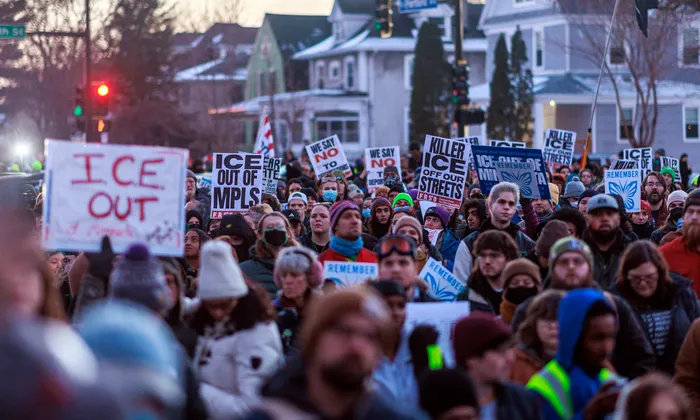
As protests continue in Minneapolis following the killings of ICU nurse Alex Pretti and lesbian mom Renee Good, and with another government shutdown looming at the end of this week, many are asking whether Congress will finally put the brakes on ICE.
The short answer is no. Here’s why.
The Big Beautiful Bill changed everything
Ten years ago, ICE operated on less than $6 billion a year — a footnote compared to other agencies in the Department of Homeland Security. That changed dramatically when Trump signed the One Big Beautiful Bill Act on July 4.
ICE now has $85 billion at its disposal — making it the highest-funded law enforcement agency in U.S. history.
The Big Beautiful Bill gave ICE a $75 billion supplement on top of its regular budget, broken down as follows:
$45 billion for expanding “detention capacity” — meaning new ICE prisons, including family detention centers where children can be held indefinitely alongside their parents.
$30 billion for hiring, bonus pay, vehicles, facilities, legal staff, and “enforcement and removal operations.”
The critical detail: This money remains available through September 2029. It is multi-year mandatory funding outside the annual appropriations process — effectively a four-year slush fund.
Add in ICE’s base budget of around $10 billion, and the agency has nearly $29 billion on hand each year. That’s essentially triple what ICE operated on just two years ago.
To put that in perspective: The Trump administration’s entire 2026 budget request for the Department of Justice — including the FBI, DEA, Bureau of Prisons, and all federal prosecutors — is about $35 billion. ICE’s annual operating budget would now rank in the top 15 military budgets worldwide.
Built by both parties
The Big Beautiful Bill itself passed on party-line votes last July — Democrats unanimously opposed it in both chambers. But that doesn’t mean the Democratic Party’s hands are clean.
The deportation machine Trump is now supercharging didn’t appear from nowhere. It was constructed over decades with bipartisan support.
ICE was created in 2003 under George W. Bush as part of the post-9/11 “homeland security” apparatus — with broad Democratic backing. The agency’s powers expanded steadily under both parties. Barack Obama deported more people than any previous president, earning the title “Deporter-in-Chief” from immigrant rights activists who watched his administration carry out over 2.5 million deportations while Democrats controlled Congress.
Private prison companies have made money off immigrant detention under every administration. Congress created bed quotas to guarantee that a minimum number of people are always locked up. It allowed ICE to turn local police into immigration agents. It expanded fast-track deportations that strip people of due process. None of this happened by accident. Democrats and Republicans voted for every piece of this system.
Democrats in Congress have repeatedly funded ICE at requested levels, approved expansions of Customs and Border Patrol (CBP), and rejected calls to abolish ICE when that demand surged in 2018. The party that now expresses outrage at ICE killings in Minneapolis spent years normalizing the agency’s existence and growth.
Trump’s Big Beautiful Bill didn’t create the deportation-industrial complex. It turbocharged a machine that both parties spent two decades building.
Why a shutdown won’t matter
Senate Democrats are threatening to block the House-passed funding package over ICE’s recent killings in Minneapolis — where federal immigration enforcement agents shot and killed Alex Pretti and, just weeks earlier, Renée Good as part of a wider Department of Homeland Security operation in the city. But even if the government shuts down on Jan. 31, ICE operations will continue largely unchanged for three reasons:
First, ICE agents are classified as “excepted” workers. Under DHS shutdown protocols, they’re required to keep showing up. They won’t be paid during a lapse in funding — joining TSA agents and federal workers forced to work without a paycheck — but they won’t stop working.
Second, that $75 billion was already approved in a separate vote. It’s not part of the yearly budget Congress is arguing over now. Lawmakers gave ICE this money in advance, and it stays available for years. So even if Congress lets the regular budget lapse, ICE can keep operating — and even expand — using funds it already has.
Third, another temporary funding deal would actually make things easier for ICE. When Congress can’t pass a real budget and kicks the can with a stopgap measure, DHS is allowed to keep spending at existing levels and move money around internally. That gives the department more freedom to support ICE operations, not less.
What this means
The shutdown fight is largely symbolic when it comes to actually restraining ICE. The Big Beautiful Bill deliberately structured ICE funding to be immune from the normal appropriations process and the ability of Congress to withhold money.
Democrats can refuse to vote for the DHS funding package. They can point to the killings in Minneapolis. They can demand accountability. But none of that touches the $75 billion war chest already in ICE’s hands — and it doesn’t undo the decades they spent helping build the very apparatus now terrorizing immigrant communities.
The deportation machine was built to run no matter what happens in Congress.