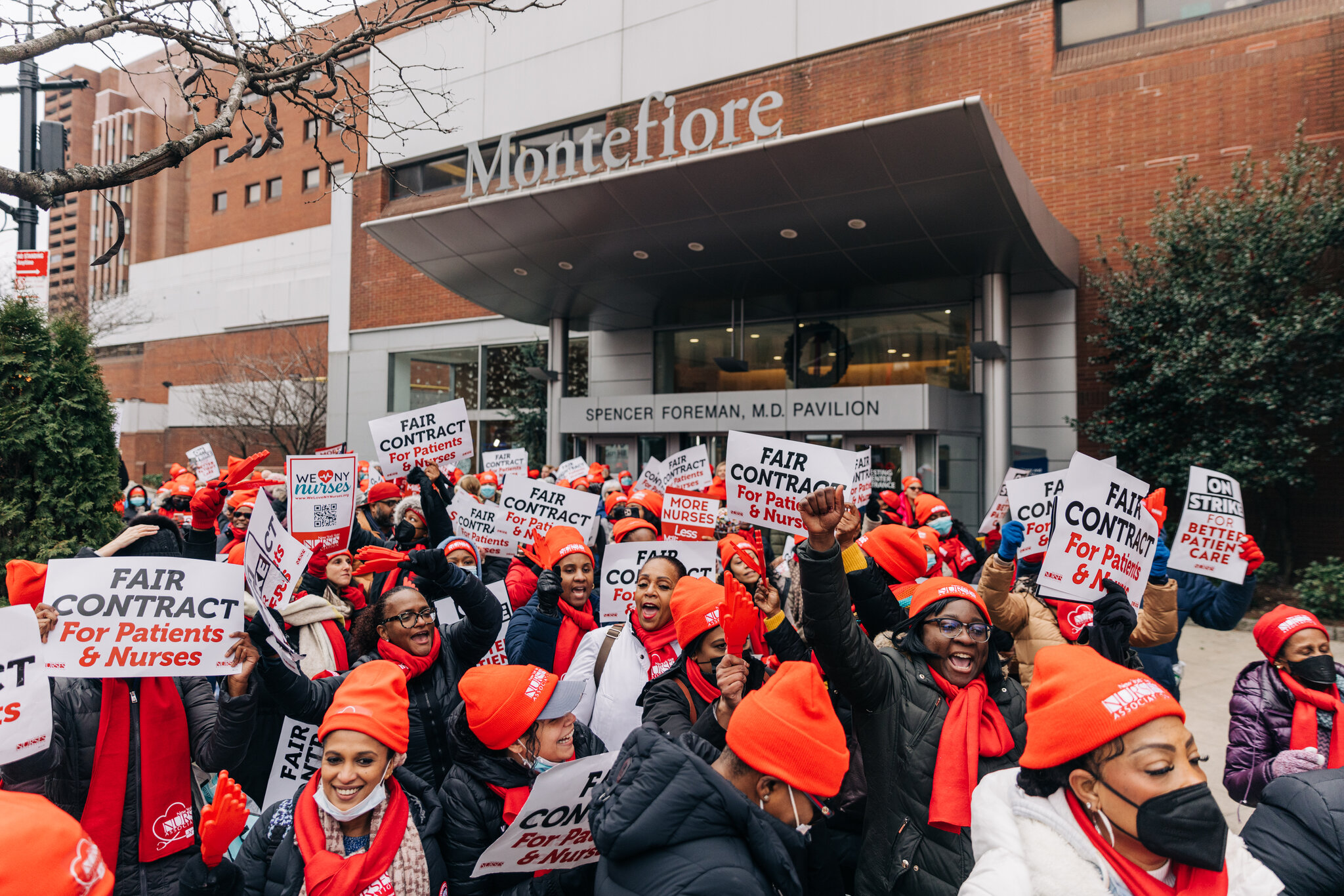
Bronx, New York, Jan. 22 — Nurses at Montefiore Medical Center in the Bronx walked off the job this week, shutting down routine operations as they pressed a demand that has not previously appeared in a major U.S. health care labor contract: a binding rule barring Immigration and Customs Enforcement (ICE) agents from entering hospital facilities.
“In the Bronx, we have a very high population of Black and Brown people, and we have a population of immigrants that we are trying to protect and make sure that they feel safe coming into hospitals,” said Michelle Gonzalez, a Montefiore nurse and executive committee member of the New York State Nurses Association, speaking on Democracy Now! on Jan. 21.
The demand did not appear suddenly. For more than a year, NYSNA nurses worked with the Committee of Interns and Residents and 1199SEIU — the union representing other hospital workers — to push hospital administrators to voluntarily adopt protections against ICE agents inside medical facilities. Management refused. After months of meetings produced no change, nurses moved the issue into formal contract negotiations.
“We’ve been unsuccessful, which is why we’ve brought it into our contract demands,” Gonzalez said. “But still, to this point, they have not negotiated.”
What nurses are already facing nationwide
What nurses at Montefiore describe is already happening in hospitals across the United States.
At Hennepin County Medical Center in Minneapolis, doctors and nurses have begun using encrypted group chats to warn one another about ICE activity near the hospital. Health care workers described plainclothes agents stopping patients and staff, particularly people of color, and demanding documentation as they enter or leave the facility. In one incident described by hospital staff, an officer unnecessarily shackled a patient receiving care.
In Portland, Oregon, the Oregon Nurses Association sent a letter to Legacy Emanuel Medical Center documenting cases in which ICE officers pressured clinical staff to discharge patients early. “Nurses have reported instances where physicians have recommended continued hospitalization, but ICE insisted on removing the patient,” the union wrote, describing discharges that went against medical advice.
The cost paid by patients
The effects show up in patients’ lives.
In Minnesota, doctors reported that a pregnant woman skipped prenatal appointments because she feared encountering ICE agents at a clinic. A nurse later found her at home, already in labor. Another patient with kidney cancer was taken into ICE detention without his medication. Legal advocates intervened to get the medicine sent to him, but doctors said they could not confirm whether he was able to take it. Diabetic patients have gone without insulin. Wounds that could have been treated early progressed into medical emergencies requiring intensive care.
“Immigrants are absolutely avoiding medical care due to fear of being targeted,” said Sandy Reding, vice president of National Nurses United and president of the California Nurses Association. In Southern California, nurses reported declining patient numbers as people stayed away from hospitals and clinics.
Hospitals are workplaces — and ICE is entering them
Montefiore nurses are not describing a misunderstanding or a communication problem. They are describing what happens when ICE enforcers enter their workplace.
Hospitals are places where nurses and other staff work long shifts under staffing shortages and time pressure. Administrators answer to boards, insurers and bondholders. When ICE enforcers walk hospital corridors or wait outside entrances, patients stop coming. Workers become afraid to report for shifts. Nurses are left managing more advanced illnesses, more emergencies and more preventable complications.
Hospital executives allowed immigration enforcement to operate inside medical facilities rather than confront federal authorities. Patients and workers paid the price.
The claim of neutrality
Hospital administrators often say their hands are tied by federal law or that they must remain “neutral” on immigration enforcement. At Montefiore, those claims collapse under the weight of how the institution actually operates.
Montefiore Medical Center is an $8.6 billion medical corporation that brings in more annual revenue than many major cities. While it claims nonprofit status to avoid taxes, it operates as a commercial engine, prioritizing its bond ratings and executive compensation — including a CEO salary of over $16 million — over the safety of the Bronx community.
Its board of trustees reads like a directory of the billionaire class. It includes Daniel Tishman, a real estate magnate tied to Tishman Realty, and Zygmunt Wilf, owner of the Minnesota Vikings and a major real estate developer, alongside executives whose careers are built on controlling and profiting from vast pools of capital.
While the system expands into luxury concierge-style medicine in Manhattan, it imposes austerity in the Bronx and allows ICE enforcers to operate inside its public-facing facilities.
Hospital executives allowed ICE enforcers to operate inside medical facilities and made no attempt to stop it. Patients skipped care, workers feared reporting for shifts, and hospitals became places of arrest instead of treatment.
Using labor power to force the issue
With hospital management allowing ICE enforcers to continue unchecked, nurses turned to the only leverage they control: their labor.
“ICE is bad for patients, bad for communities, and bad for health care workers,” said Karen Sanchez, a registered nurse at California Hospital in Los Angeles, in a 2025 statement released by National Nurses United. “Our hospitals need to be sanctuary spaces for people who need care, and the presence of ICE in the facility severely impacts how safe patients feel here.”
What distinguishes the NYSNA demand is not only what it calls for, but how it is being pursued.
Nurses are not asking elected officials to pass new laws. They are not waiting for courts to intervene. They are asserting through collective bargaining that safe patient care requires keeping ICE agents out of hospitals.
For a year, nurses, doctors and hospital workers coordinated across unions to build support for the demand. When management refused to act voluntarily, they escalated. The strike is not a collapse of negotiations. It is the point at which workers use organized power to force an issue management has refused to address.
Hospital administrators have so far declined to agree to protections from ICE agents. The outcome remains uncertain. But nurses at Montefiore have already drawn a clear line: They are willing to strike not only over staffing levels and working conditions, but over whether patients can enter a hospital without fear of arrest.
On the picket lines outside Montefiore in the Bronx, that fight continues.