On Jan. 14, Immigration and Customs Enforcement reported that Victor Manuel Diaz, 36, had died in federal custody. He was pronounced dead at 4:09 p.m. at Camp East Montana, an immigration detention site in west Texas. ICE described the death as a “presumed suicide,” while stating that the official cause remained under investigation.
Eight days earlier, Diaz had been arrested in Minneapolis.
Between arrest and death, he was moved more than 1,200 miles. He went from a city street to a tent camp on a military base near El Paso. The transfer took days. The outcome took one week.
Diaz was arrested on Jan. 6, as federal immigration agents surged into Minneapolis under Operation Metro Surge. The operation unfolded alongside lethal force. On Jan. 7, Renee Good, a Minneapolis resident, was shot and killed by an ICE agent.
Good had dropped off her child earlier that morning. She was unarmed when the agent fired. She died at the scene.
The killing and the arrests were not separate events. They occurred during the same federal operation, carried out by the same agency, and under the same conditions of expanded enforcement.
How the arrests spread
Operation Metro Surge was publicly announced as an enforcement effort targeting undocumented Somalis in Minneapolis. The claim was repeated by the Trump administration and circulated widely.
In practice, arrests spread quickly across the city.
Most Somalis in Minnesota are U.S. citizens, by birth or naturalization. That did not limit the scope of the operation. Immigration arrests expanded across neighborhoods and workplaces. The people who later died in custody were not Somali. Victor Manuel Diaz was Nicaraguan. Geraldo Lunas Campos was Cuban. Others who died in January came from Mexico and Cambodia.
Federal officials did name several Somali men taken into custody during the operation: Abdikadir Sheik Yusuf, Abdulkadir Sharif Abdi, Sahal Osman Shidane, Mukthar Mohamed Ali, Ahmed Mohamed Said and Feisal Mohamed-Omar. No public information has been released about where they are being held or the conditions they face.
Attorneys tracking transfers say most people arrested in Minneapolis are moved within days, mainly to Texas. Immigration attorney David Wilson said several detainees held at the Kandiyohi County Jail were sent to the Port Isabel Service Processing Center in southern Texas. Data compiled by the Sahan Journal shows this has been ICE’s routine. More than half of those booked into immigration detention in Minnesota in recent years were later transferred elsewhere.
Attorneys representing detainees say the pace has increased since Operation Metro Surge began. Michele Garnett McKenzie, an attorney with the Advocates for Human Rights, said at least 100 people linked to the operation have been detained, with most transferred to facilities in Texas.
Somali detainees transferred out of Minnesota are held far from family and legal counsel. Their locations are often learned secondhand. Their cases move across state lines. Attorneys say some face removal not to Somalia but to third countries such as Uganda or Rwanda.
Temporary Protected Status for Somalia is set to end March 17. Work authorization will be revoked, pushing more people into detention.
The Disappearance Before Death
After Victor Manuel Diaz was arrested, ICE released no public information showing whether he spoke with a lawyer or contacted his family. There has been no public statement from relatives. His location was not publicly known. He reappeared only after his death.
For people arrested in Minneapolis, Camp East Montana in Texas is one of the main destinations.
Lawyers based in Minnesota cannot easily represent clients held in Texas. Families cannot visit. Hearings take place by video, if they happen at all. Distance denies access.
Inside Camp East Montana
Camp East Montana is a tent detention camp on the Fort Bliss military base near El Paso. It is run by Acquisition Logistics, a private company paid $1.24 billion under a federal contract. Before receiving that contract, the company had no experience operating immigration detention facilities.
The camp is designed for rapid intake. People are housed in tents, not buildings. Guards are contract staff. Medical care is also provided by outside contractors.
In December 2025, the American Civil Liberties Union sent a letter to federal officials describing what detainees reported inside the camp. Based on interviews with people held there and with their attorneys, the letter described beatings by guards, sexual abuse, denial of attorney access, inadequate food and delayed medical care. Detainees reported waiting days to see medical staff as their conditions worsened.
Deaths in custody
Victor Manuel Diaz died at Camp East Montana.
Eleven days earlier, another man had died at the same camp. On Jan. 3, Geraldo Lunas Campos, 55, a Cuban national, was found dead in custody. The El Paso County medical examiner later indicated that his death was “likely a homicide by guards,” choked to death.
Two men died in the same detention camp on the same day.
Their deaths came amid a rising toll nationwide. In the first 20 days of 2026, five people died in ICE custody.
On Jan. 5, Luis Gustavo Nunez Caceres, 42, died at the Joe Corley Processing Center in Texas. On Jan. 6, Luis Beltran Yanez-Cruz, 68, a Mexican national, died at the Imperial Regional Detention Facility in California.
On Jan. 9, Parady La, 46, a Cambodian national, died after being held at the Federal Detention Center in Philadelphia.
In 2025, 32 people died in immigration detention, one of the deadliest years on record, as the detained population increased sharply.

Minneapolis, and the demand to stop the arrests
Victor Manuel Diaz was arrested in Minneapolis on Jan. 6. Eight days later, he was dead in a detention camp in Texas.
One day after his arrest, Renee Good was shot and killed by an ICE agent in Minneapolis.
Those two deaths — one on a city street, one in federal custody — came from the same operation.
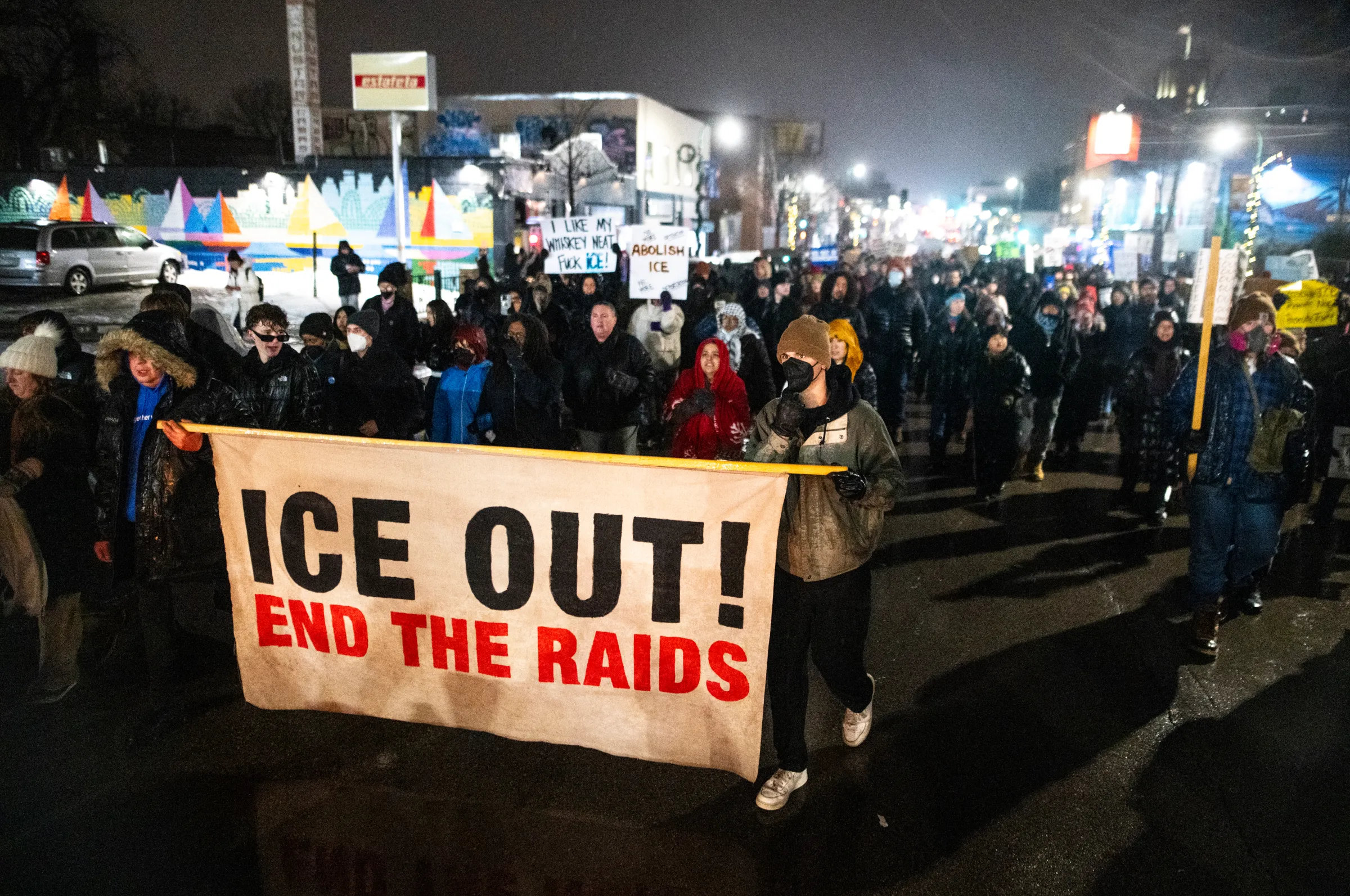
In Minneapolis, protests and organizing for the Jan. 23 general strike have grown in response to police violence, mass arrests and the expansion of federal enforcement. The demand raised in the streets is direct: ICE out.
That demand targets the arrests that begin the chain. As long as immigration enforcement operates in the city, people will continue to be seized, transferred out of sight and placed in conditions where abuse and death are routine.
Victor Manuel Diaz cannot be brought back. Renee Good cannot be brought back. What can be done now is to stop the arrests that sent one into a detention pipeline and put the other in the path of federal gunfire.
Stopping ICE in Minneapolis is the action that would end the arrests and transfers that lead to detention, abuse and murder.