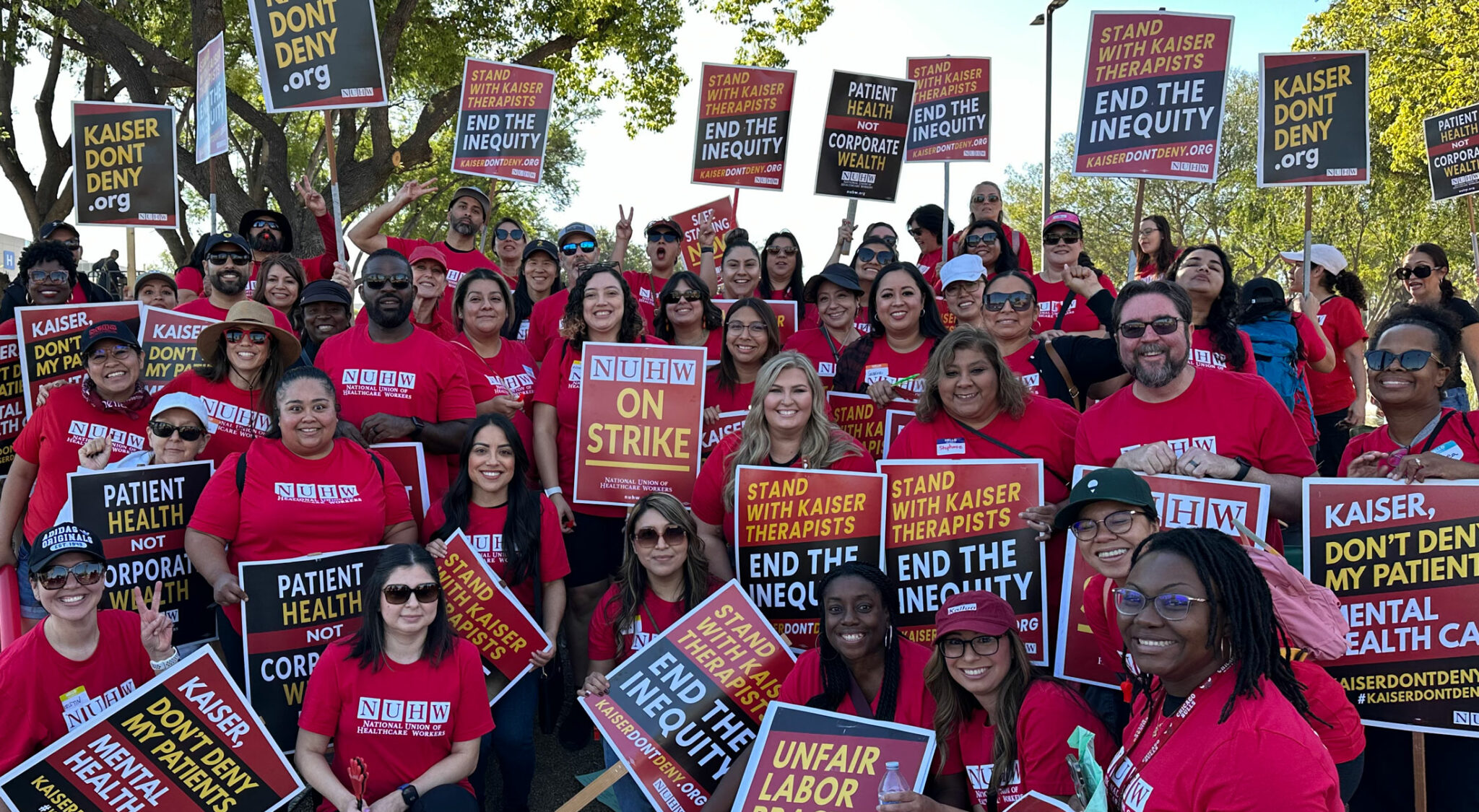
When 31,000 Kaiser Permanente nurses and health care workers walk off the job on Jan. 26, they will be fighting for safe staffing at a nonprofit health system sitting on $66 billion in reserves — reserves that include investments in the private prison companies caging migrants for ICE.
Kaiser Permanente Group Trust has held investments in both CoreCivic and GEO Group, the two largest operators of Immigration and Customs Enforcement detention facilities, according to financial disclosures reviewed by the union UNAC/UHCP. The investments appear in Kaiser’s Form 5500 filings from 2020 through 2022, the most recent years for which public filings are available.
These are not obscure holdings. ICE now holds a record 68,000 people in detention nationwide, up from 40,000 at the start of 2025. At least 30 people have died in ICE custody in 2025 — the deadliest year in two decades. CoreCivic and GEO Group facilities have been at the center of documented medical neglect and preventable deaths, even as their executives celebrate “unprecedented” profits from the Trump administration’s deportation campaign.
Death and neglect for profit
GEO Group operates the Adelanto ICE Processing Center in California’s San Bernardino County, the state’s largest immigration detention facility. In September 2025, 39-year-old Ismael Ayala-Uribe died there after repeated pleas for medical care were ignored. Internal emails later showed staff had flagged his condition as potentially life-threatening, yet he was sent back to his dormitory, where his health deteriorated over several days without treatment. Ayala-Uribe had lived in the United States since he was four years old.
When Disability Rights California inspected Adelanto in June 2025, investigators documented “abuse and neglect of people with disabilities.” In a matter of weeks, the detained population ballooned from about 300 to nearly 1,400. Detainees reported going days without clean clothes or basic hygiene items, while guards responded to mounting tensions by tear-gassing entire dormitories.
CoreCivic’s record is similarly grim. The company reopened the 2,400-bed South Texas Family Residential Center in Dilley, Texas — a facility that can hold children — after it was shuttered in 2024. In Georgia, ICE also reopened the Irwin County Detention Center, which had closed in 2021 following a bipartisan Senate investigation into medical abuse of detained women.
Executives from both companies openly celebrate the surge. GEO Group’s chairman has described an “unprecedented opportunity,” projecting up to $1 billion in additional annual ICE revenue. CoreCivic’s CEO has declared the company’s business “perfectly aligned with the demands of this moment.” GEO Group has backed that alignment with $1 million in contributions to a PAC supporting Trump’s 2024 campaign.
Billions in reserves, no money for nurses
Kaiser Permanente calls itself a mission-driven nonprofit dedicated to health and healing. One in four California residents receives care through Kaiser. Yet the system has accumulated $66 billion in unrestricted reserves — projected to reach $70-75 billion by the end of 2026 — while telling workers it cannot afford the staffing improvements they say patients desperately need.
The union’s “Profits Over Patients” report, released Jan. 15, documents how Kaiser reported $7.9 billion in net income in the first three quarters of 2025 alone. Meanwhile, nurses’ wages have lost 10% of their purchasing power since 2021, with raises that failed to keep pace with inflation.
At the top, the numbers tell a different story. Kaiser CEO Gregory Adams averaged approximately $13 million in annual compensation from 2020-2023 — 69 times what the health system pays an average optometrist, 29 times what it pays an average rehab therapist, and 27 times what it pays an average nurse. Board members averaged $251,000 in 2023, and a third of them have banking and investment backgrounds.
The open-ended strike set to begin Jan. 26 follows a five-day walkout in October 2025 that failed to produce a contract agreement. Workers have been without a contract since Sept. 30. Kaiser paused national bargaining in mid-December, and the union has filed an unfair labor practice charge with the National Labor Relations Board alleging the company is trying to bypass the agreed-upon negotiating process.
Where the money goes
The investments in CoreCivic and GEO Group fit a pattern. The union report documents that Kaiser’s investment portfolio has also included holdings in fossil fuel companies linked to elevated rates of cancer and respiratory disease in working-class communities, predatory lenders like Enova International (which operates CashNetUSA and NetCredit at interest rates exceeding 100%), and Elliott Management — the hedge fund run by Paul Singer, who has bankrolled the Manhattan Institute’s campaigns against critical race theory education and LGBTQIA+ rights.
The private prison investments stand out because of what Kaiser claims to be. CoreCivic and GEO Group facilities disproportionately hold Black, Latine, and immigrant workers and their families. The medical neglect documented at these facilities — medication withheld, chronic conditions ignored, emergency care delayed — is the opposite of what a health system is supposed to do.
Yet Kaiser, a California-based nonprofit that enjoys tax-favored status precisely because it is supposed to serve a public benefit, has channeled worker pension funds into ICE’s concentration camp operations. The $66 billion in reserves came from somewhere — from the premiums paid by workers, from the Medicare and Medicaid dollars that flow through Kaiser’s books, from the labor of the nurses now preparing to strike.
Those financial decisions are not abstract — they materialize every day in Kaiser hospitals, where nurses now preparing to strike confront the human consequences of understaffing and neglect.
Workers fight back
Kaiser workers say the strike is about more than wages. They point to chronic understaffing that has resulted in dangerous delays in care and what they call “moral injury” — knowing what patients need but being unable to provide it.
In December 2023, 53-year-old Francisco Delgadillo died in a Kaiser Vallejo emergency room after waiting more than eight hours for treatment for chest pain. Federal and state investigators found critical deficiencies in nursing coverage, with 30 to 40 patients in the waiting area and no systematic oversight. Frontline workers had circulated a petition demanding safe staffing just days before his death.
Southern California Kaiser workers filed 13,807 formal staffing objections between November 2023 and November 2025 — an average of 19 per day — documenting conditions they consider unsafe for patients. The actual number is likely higher, workers say, because many have given up filing reports that seem to change nothing.
“We’re not going on strike to make noise,” said UNAC/UHCP President Charmaine S. Morales. “We’re authorizing a strike to win staffing that protects patients, win workload standards that stop moral injury, and win the respect and dignity Kaiser has denied for far too long.”
The 31,000 nurses and health care workers walking out Jan. 26 are asking a straightforward question: If Kaiser can find billions to invest in companies that profit from caging and neglecting migrants, why can’t it find money to staff its hospitals safely?