“Finance capital in general strives to seize the largest possible amount of land of all kinds in all places, and by every means, taking into account potential sources of raw materials and fearing to be left behind in the fierce struggle for the last remnants of independent territory, or for the repartition of those territories that have already been divided.” V.I. Lenin, Imperialism, the Highest Stage of Capitalism (1917)
Donald Trump, at the behest of salivating tech billionaires, oil and gas barons and Pentagon generals, is hunting for fresh acquisitions for his 21st‑century empire‑building project. Greenland — Kalaallit Nunaat — is the latest prize in his sights, a living nation talked about in Washington as if it were an empty “Trumpland” waiting to be branded and bought.
A strategic bridgehead in the North Atlantic
Greenland has long been treated as a strategic outpost by imperialist powers. During World War II, its location gave its name to the feared “Greenland Air Gap,” a stretch of the mid‑Atlantic beyond the reach of land‑based aircraft, where Nazi U‑boats turned Allied merchant shipping into a killing ground. In any future major war, whoever controls Greenland would command vital Atlantic sea lanes and enjoy a major advantage in anti‑submarine and air operations.
Today, the U.S. base at Pituffik (formerly Thule) already plays a key role in Washington’s early‑warning missile detection and space surveillance systems. As Arctic ice melts and new sea routes open “on the roof of the world,” Greenland is becoming hotter both literally and geopolitically. Trump and his cronies see how critical this island is to controlling North Atlantic and Arctic chokepoints in its hostilities toward China and Russia.
Greenland is also rich in yet‑untapped offshore oil and gas fields. As its tundra thaws, the island’s rare earth mineral deposits — crucial to high‑tech industries and advanced weapons systems — become easier and cheaper for corporations to exploit. With enough investment, U.S. planners fantasize about turning Greenland into a “Silicon Valley of AI data centers”: a cold, renewable‑energy‑powered server farm for the next wave of digital capitalism.
A living Indigenous homeland, not an empty frontier
But Kalaallit Nunaat is not a blank space on a Pentagon map. It is the Inuit people’s homeland. The island is the world’s largest, straddling the Arctic Circle off the northern edge of North America. Roughly three times the size of Texas, its interior is not open range but a vast ice sheet more than a mile thick in many places. Of its approximately 57,000 residents, about 90% are Indigenous Inuit. Kalaallisut (Greenlandic) is the official language and the language of daily life.
Only a narrow southern belt of Greenland is arable. For thousands of years, people have relied on the sea and tundra for food. Hunters and fishers bring in seals, whales, fish, seabirds, muskox, caribou and small land animals, selling “country foods” in local markets alongside imported goods. These wild foods are not a romantic relic; they remain central to community nutrition and income, and there is constant pressure from the people themselves to keep harvesting sustainable rather than let profit‑driven exploitation destroy their environment.
Most Kalaallit — the name refers to both the people and the country — live in 17 towns and dozens of smaller coastal settlements, working in transportation, education, health care, commerce and a growing tourism sector. Smaller coastal settlements still depend heavily on hunting and fishing, living as much as possible from land and sea. This is the living society erased when Trump and his media echo chamber speak of Greenland as a “real estate deal.”
4,000 years of Inuit history, centuries of colonial intrusion
Inuit ancestors, small groups adapted to the harsh Arctic, reached Greenland from Siberia at least 4,000 years ago. Around 800 years ago, new Inuit cultures spread along the coasts and fjords, developing sophisticated marine economies based on whales, seals and walrus. Around the same time, Norse farmers from Iceland established small settlements in a few southern fjords. Their communities, never more than a few thousand people, survived about five centuries before disappearing for reasons still debated, leaving ruins and little evidence of sustained contact with the Inuit.
By the 18th century, European ships from many nations were plundering the waters around Greenland for fish, whales and walrus, feeding the factories and street lamps of Europe. In 1721, the Danish crown sent an expedition to search for surviving Norse settlers and instead found a land firmly inhabited by Inuit communities. Missionaries followed, intent on conversion and control, and laid the foundation for centuries of Danish colonial domination.
This is the historical backdrop to Trump’s surreal campaign to “own Greenland.” Behind the bombast and bullying stands a familiar imperialist pattern: powerful capitalist nations treating Indigenous lands as commodities, to be carved up and sold over the heads of the people who actually live there.
Rare earths, land and the lie of ‘security’
Why does Trump want Greenland? The capitalist media repeat a narrow set of answers: strategic real estate, access to minerals, a forward military base in the Arctic. None of these explanations grapple with the basic irrationality of imperialism, where financial oligarchs and their political servants seek control for profit, not for any rational human need.
U.S. strategists see in Greenland an opportunity to lock down rare earth minerals that feed tech, AI and weapons industries. Many of these elements are not truly rare, but extracting them is often extremely expensive or environmentally catastrophic. The Inuit people, dependent on clean water, ice and land, have every reason to oppose transforming their home into an open‑pit sacrifice zone for Silicon Valley and the Pentagon.
Private ownership of land is not allowed in Kalaallit Nunaat. This collective principle clashes head‑on with the logic of real‑estate speculation that Trump represents.
The most gruesome example of how U.S. imperialism has used access comes from 1953. During the Cold War, Washington secretly expanded the Thule Air Base (now Pituffik Space Base) to store nuclear weapons — in violation of the base agreement and without informing either Denmark or the Inuit.
To make room, the U.S. forced a small Kalaallit community off their ancestral land with four days’ notice, sending them 81 miles away to poorer hunting grounds. Their descendants remain angry and continue to fight for justice. Later, a B‑52 bomber carrying nuclear weapons crashed nearby, spreading radioactive contamination that was only fully acknowledged years afterward. Plutonium still shows up in tests of seabed shellfish.
This is not “security.” It is colonial violence.
Greenland belongs to Greenlanders
The Arctic has often been described as a zone of “exceptionalism” where great‑power rivalry is muted. Trump’s push to claim Greenland, backed by tech capital and the Pentagon, threatens to turn it instead into a heavily militarized front line in conflicts over shipping lanes, missile routes and critical infrastructure.
Junior capitalist partners in Europe would do well to see the handwriting on the wall: Bow down; U.S. imperialists do not intend to share.
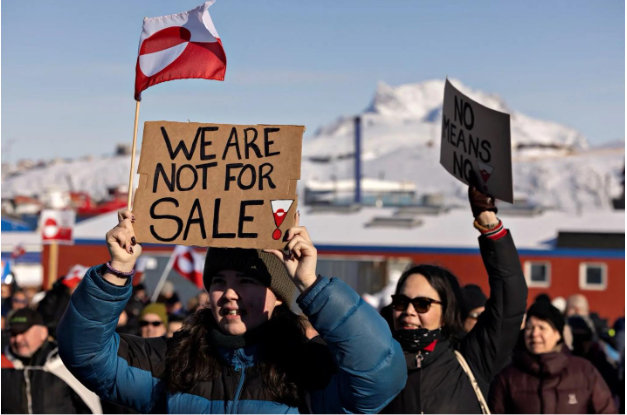
For the Inuit majority, the core message is clear: Greenland is not for sale. Decisions about the land, the sea, and the future of the island belong to the people who live there — not to Trump, not to U.S. generals, not to tech billionaires and not to European capitals. The real struggle is to ensure that this moment of climate crisis and imperialist interest becomes a step toward full Indigenous sovereignty, not the opening act of a new colonial grab.