What the UN Gaza vote revealed about the imperialist world order

FreedomForPalestine
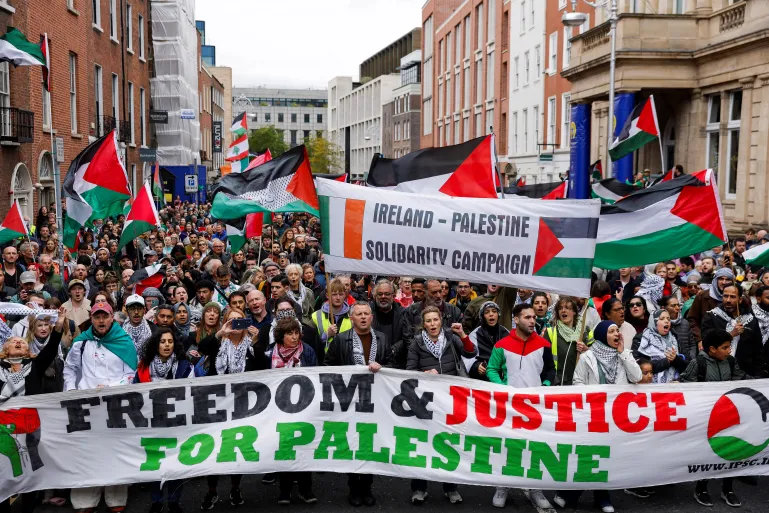
Millions worldwide march for Gaza, challenging the imperialist world.

A colonial plan in diplomatic clothing

A U.S.-drafted UN resolution endorsing President Donald Trump’s Gaza “peace plan” passed in the Security Council on Nov. 17. Palestinians responded immediately: This was not peace — it was a blueprint for foreign control.

At the heart of Washington’s scheme is a new “Board of Peace,” a U.S.- and British-dominated governing body personally chaired by Trump. This board would control Gaza’s borders, security, reconstruction, and political life. It alone would decide when Palestinians are “ready” to govern themselves. Sovereignty becomes a permission slip issued by the same powers that arm, fund, and defend Israel’s occupation.

For Palestinians, this is not a transition. It is a takeover.

The plan is a modern remake of the colonial mandates, with Washington assuming the power once wielded by the British Empire over Palestine. By severing Gaza from the rest of Palestine and granting Washington and Israel authority over any future “withdrawal,” the resolution repackages occupation in the deceptive language of “governance” and “stability.”

Imposing through diplomacy what Israel failed to win through war

The resolution is Washington’s effort to impose through paperwork what Israel could not achieve through genocide. After months of bombardment failed to crush Palestinian resistance or force Gaza to submit, the plan steps in to finish the job by other means. It aims to deliver, through UN seals and diplomatic signatures, the foreign control that Israel’s military could not win. It is an attempt to convert military failure into political domination — occupation by administrative order.

This was the resolution before the Security Council. And in this moment — with Gaza under bombardment, tens of thousands dead or displaced, hospitals destroyed, and entire neighborhoods flattened — the world looked to see whether Russia or China would block it.

Neither did. Both abstained.

Only Russia and China had the actual power to stop the resolution. The other members — including the U.S.-aligned Arab regimes — were never going to block a plan drafted in Washington. The fact that the only two states with veto power chose abstention is what allowed the plan to pass.

Why the abstentions happened

Their abstentions puzzled many observers. How could two states that condemned the plan’s colonial framework allow it to pass? But these questions can’t be answered by treating the vote as a move in a geopolitical chess game. The abstentions make sense only when we understand the deeper reality shaping world politics today: The world remains dominated by imperialism, and every struggle — from Gaza to the Sahel to the Caribbean — unfolds inside that system’s contradictions.

Both Russia and China sharply criticized the resolution. China warned that the text was “deeply worrisome,” lacking any guarantee of Palestinian sovereignty. Russia argued that the plan would entrench occupation, not end it. But neither government challenged the Arab regimes that lined up behind the measure. These regimes are not independent actors exercising sovereign will; they are U.S.-aligned neocolonies, tied to Washington through military dependence, IMF discipline, weapons systems, and security arrangements. Yet they also sit at the center of major trade, energy, and investment networks. Neither Russia nor China was prepared to jeopardize those economic relationships — especially when opposing the resolution would not have stopped Washington’s colonial takeover.

States inside an imperialist system

This outcome exposes something crucial: States do not operate outside the global system. They operate inside it — a system still structured by imperialist domination, where a handful of wealthy powers dictate the rules of global politics and where oppressed nations are treated as bargaining chips. Even states at odds with Washington face these pressures.

Russia, as a capitalist state dependent on energy exports and integration into global markets, maneuvers according to the interests of its own ruling class. 

China, as a state pursuing a socialist path, must still navigate a world economy dominated by capitalist rules and monopoly power. China’s foreign policy reflects the interests of a nation-state operating inside that order — interests that do not always align with internationalist solidarity.

Economic entanglements that expose structural limits

These limits are most visible in the economic networks that link governments — including those claiming to oppose U.S. domination — to Israel’s role in the imperialist world market. Israel’s ports, technology sectors, and energy systems are deeply integrated into global commerce.

China maintains major infrastructure projects in Haifa and Ashdod because it must operate in a global economy still governed by capitalist accumulation, not because it supports Israeli policy. Russia’s fuel flows into Israel through Central Asian routes because it is tied to global energy markets structured around profit, not solidarity. India’s growing military and energy ties with Israel reflect its ruling-class alignment with Washington’s regional agenda.

None of these contradictions arise from political confusion or moral weakness. They emerge from the structure of the world itself — a world where monopoly capital and its institutions bind states into relationships that collide head-on with the demands of workers and oppressed peoples fighting for liberation.

BRICS cannot substitute for anti-imperialist struggle

The same reality shapes the character of BRICS. Many hoped BRICS would challenge Washington’s dominance and create space for sovereign development in the Global South. But BRICS is not a unified alternative to imperialism. It is a coalition of states — some socialist, others deeply capitalist — operating within a world economy still controlled by monopoly capital. BRICS calls for “reform” and “greater representation,” not for dismantling the institutions that enforce global inequality.

China participates as a socialist state confronting imperialist pressure, but it cannot use BRICS to overturn a world order still ruled by capitalist domination. The other BRICS governments — India, Brazil, South Africa, Russia, and the expanded membership — defend their own ruling classes’ interests, not a collective project of liberation.

Some deepen military cooperation with Washington. Others align with Western corporations while seeking better deals for themselves. These contradictions were visible in the Security Council vote: A formation some imagined would block Washington’s colonial plan instead fractured along familiar lines, with states protecting their economic relationships rather than confronting the imperialist system.

What the Security Council vote makes unmistakable is that the power to decide Gaza’s future will not come from governments acting within the imperialist system. The forces capable of changing the course of the struggle are the peoples themselves — the resistance in Palestine, the movements for sovereignty rising across the Global South, and the mass mobilizations inside the imperialist centers demanding an end to genocide, war, and occupation.

Strugglelalucha256


Bitcoin’s latest crash shows what it really is: speculation, not money

Bitcoin just crashed again. After hitting over $126,000 in October, it dropped more than 20% in a few weeks, falling below $90,000. All the gains it made in 2025 — gone.

This wasn’t random bad luck. Real pressures drove the crash: Electricity costs soared, making Bitcoin mining less profitable. Over $2.3 billion flowed out of Bitcoin investment funds in just the first half of November. Data shows miners dumped about 71,000 Bitcoins onto exchanges in early November, plus another 210,000 in October — some of the biggest sell-offs since 2022.

These constant wild swings raise a basic question: What is Bitcoin, really? Fans say it’s revolutionary money that gets around capitalism’s problems. But when you look at it through a Marxist lens, you see something different: Bitcoin isn’t money at all. It’s a way to gamble on prices going up — what Marx called “fictitious capital.”

What does it take to be money?

To understand why Bitcoin fails as money, we need to start with what Marx said money actually is. For Marx, money isn’t just a symbol or something the government declares valuable. It’s something real that comes out of how people produce and trade goods.

Marx was clear: Money itself must be a commodity — a real thing with physical form. He wrote that money, “the universal commodity,” must exist “as a particular commodity alongside the others.” Through trading, this “universal equivalent” takes on “the bodily form of a particular commodity.”

Throughout history, gold and silver played this role. Why them? Because they have real uses, and because their value comes from the hard work it takes to dig them out of the ground and refine them. That labor-based value made them stable enough to be the anchor for the whole trading system.

Marx insisted this physical foundation matters even when credit systems develop. Paper money and bank deposits aren’t new kinds of money — they’re IOUs that stand in for the real money (gold) behind them. Capitalism constantly tries to get around the limits of physical money, but as Marx said, “again and again it breaks its back on this barrier.”

So for something to be money, it needs three things: It must be a real physical commodity, it must be useful for something besides being money, and its value must come from the labor that went into making it.

Bitcoin fails on every count

Bitcoin doesn’t meet any of these requirements.

First, Bitcoin has no real-world use beyond speculation. Gold works in electronics, dentistry, and jewelry. Even if nobody used it as money, gold would still be valuable for these practical purposes. Bitcoin? You can’t do anything with it except buy and sell it. It’s just data on computers — not a physical thing with actual uses. Without those uses, it can’t be the solid foundation Marx described.

Second, Bitcoin’s value doesn’t come from labor. Gold’s value is tied to the hard, costly work of mining and refining it. Bitcoin’s price comes from three things instead: its built-in scarcity (only 21 million can ever exist), people betting prices will rise, and collective belief in the system. Yes, Bitcoin “mining” uses tons of electricity, but that’s not the same as productive labor that creates something useful. It’s just the cost of keeping the network running and checking transactions. That doesn’t create value the way mining gold does.

Third, Bitcoin’s wild price swings make it useless as a measure of value. Money needs to be stable so people can price things reliably. Something that loses 20% of its value in weeks can’t do that job. The recent crash proves it: When electricity got expensive and AI companies offered miners better money, they dumped Bitcoin. That’s not how real money behaves.

So what is Bitcoin?

If Bitcoin isn’t money, what is it? It’s what Marx called “fictitious capital” — a financial asset whose value comes from hoping someone will pay more for it tomorrow, not from any real production.

Stocks and bonds work this way too — they’re bets on future profits. Bitcoin fits perfectly. Its price depends entirely on what investors think others will pay for it later.

Think of the art market. A painting by a famous artist can sell for millions, but not because it’s useful or produces income. It’s expensive because it’s rare and people believe others will want it. Bitcoin works the same way. Neither pays dividends nor rent. Both have artificially limited supply — Bitcoin by computer code, art by how much an artist can create. Both markets are controlled by the super-wealthy: “whales” in crypto, big galleries in art. And in both cases, something is worth whatever the next buyer will pay — nothing more, nothing less.

Bitcoin also shows what Marx called “commodity fetishism” — when relationships between people look like relationships between things. Value seems to magically come from the object itself, not from human work. All the computing power and electricity that keeps Bitcoin running is hidden. Its value looks like it just comes from the code, growing on its own without any connection to real work or production. It’s the ultimate magic trick.

Reality crashes the party 

The proof that Bitcoin is just another investment — not some new kind of money — came with this latest crash. When electricity prices rose, miners had a choice: Keep mining Bitcoin or do something more profitable. They chose profit.

Big mining companies like Core Scientific and Iris Energy signed deals to host AI computers instead. They get paid 3-4 times more per kilowatt-hour than Bitcoin mining paid them. Bitfarms went even further, announcing plans to quit crypto mining completely by 2027.

This shows that even digital “assets” like Bitcoin follow the basic rules of capitalism. Miners ditched Bitcoin because they could make more money elsewhere. It’s just another place to invest, not a magical new form of money that escapes capitalism’s logic.

Marxist economists point out that if governments could really create crisis-proof money out of thin air, they could solve economic crashes just by printing more. They can’t, because money is tied to real commodity production. Bitcoin’s failure as stable money proves this point.

Bitcoin isn’t a challenge to the system. It’s a volatile bet that reflects all the financial chaos of the capitalism it claims to replace. It’s trapped by the same contradictions and the same endless chase for profit.

Strugglelalucha256


You can’t build a revolution on Instagram: Cuba and Venezuela explain why

An international conference in Havana on Oct. 15 — the third annual International Meeting of Theoretical Publications of Left-wing Parties and Movements (Encuentro Internacional de Publicaciones Teóricas de Partidos y Movimientos de Izquierda) — brought together communist and progressive forces from across the world. Delegations included the Communist Party of India, the Communist Party of Greece, the Belgian Workers’ Party, the Hungarian Workers’ Party, Ireland’s largest trade union, and dozens of other organizations. Organized by the Communist Party of Cuba, with President Miguel Díaz-Canel participating in multiple sessions, the gathering focused on a critical question: How can the working class win the information war?

One country dominated the discussions: Venezuela. Latin American participants emphasized that Venezuela sits on the front lines of U.S. imperialist aggression, making it a testing ground for both Trump’s neo-fascist ideology and new forms of information warfare. The insights shared by Cuban and Venezuelan speakers — particularly President Díaz-Canel, Ignacio Ramonet (Fidel Castro’s biographer), and Miguel Pérez Pirela, the Venezuelan philosopher who leads the Network in Defense of Humanity — demand serious attention from the U.S. left.

Their central argument was clear: Social media platforms are tools of class warfare, and the left in the United States has fundamentally misunderstood how to use them.

Google’s AI: Manufacturing consent at scale

Artificial intelligence has become imperialism’s latest propaganda weapon. Díaz-Canel described how Google’s AI summaries routinely present Cuba through a distorted, hostile lens. When ordinary people search for information about Cuba — including Cubans themselves — Google’s AI generates a short “overview” that frames the island as a dictatorship without basic rights or freedoms. These summaries appear at the top of search results with an authoritative sheen.

The system does not invent new information; it synthesizes the dominant narratives already produced by Western media and official U.S. sources. Research on search-engine behavior shows that most users never look beyond the first short block of information they see, giving these AI-generated snapshots enormous influence.

Cuba has responded by assembling programming teams to develop alternative AI-assisted search tools that elevate progressive sources. At the same time, presenters explained that Cuban researchers are attempting to flood Google’s AI systems with corrective information to counter the most extreme distortions. As Díaz-Canel and Vasuki Umantha of the Communist Party of India both emphasized: Technology serves the class that controls it. The question is not whether AI is “objective,” but whether it advances working-class interests or ruling-class power.

Why the One Piece flag spreads while Che’s image fades

Ignacio Ramonet posed a provocative question about political imagery in the digital age. Why do certain symbols — like the One Piece pirate flag, which has become a youth-culture emblem of rebellion and adventure — spread virally across color revolutions in multiple countries, while progressive symbols such as Che Guevara’s face, the hammer and sickle, or the Black Power fist circulate far less widely today?

Ramonet said that the answer lies in how social media algorithms operate. These systems accelerate and amplify content that aligns with ruling-class interests. Generic “anti-corruption” imagery — often stripped of any class analysis and weaponized by right-wing movements — spreads far more easily than symbols rooted in socialist struggle. The platforms promote what destabilizes governments targeted by the U.S. and suppress what strengthens working-class movements.

This is not mere coincidence. It reflects the class character embedded in the design of the platforms themselves.

The fundamental mistake: adapting content to hostile platforms

Miguel Pérez Pirela — whose flight to Havana was delayed by U.S. military aircraft operating near Caracas airport — delivered the conference’s most comprehensive analysis of social media. Even though he has more than a million followers on X (formerly Twitter) and uses the platform effectively, he argues that corporate social media is fundamentally hostile to anti-imperialist politics.

Venezuela and other left movements made a critical strategic mistake: trying to adapt robust left-wing content — newspaper articles, theoretical works, deep political analysis — into short social-media formats, assuming this would reach the masses. This approach treats the platforms as neutral tools that simply need the “right” content. It fails.

Meta, X, and similar platforms cannot build revolutionary movements or even real community. They create the illusion of connection while isolating people in algorithm-controlled silos. Their systems bury left-wing material and prioritize propaganda from the U.S. government, corporate media, and far-right actors.

These are not public squares. They are privately owned, billionaire-controlled propaganda machines.

The war for attention

Pérez Pirela framed the information struggle as fundamentally “a war for attention.” The battle between imperialism and the global working class is not only about ideas — it is about getting people to look in the first place.

Right-wing forces dominate this terrain. Trump says something outrageous and the platforms instantly magnify it. A dramatic crisis unfolds — a boat explosion in the Caribbean, an inflammatory speech, a staged provocation — and it floods every feed. Even when media coverage is negative, the attention still flows toward ruling-class narratives.

By the time the left offers a substantive response, the algorithmic firehose has already shaped public perception.

Social media only becomes “useful” when the movement being promoted serves ruling-class interests: color revolutions, right-wing street uprisings, neo-fascist organizing. The Jan. 6 coup attempt spread effortlessly through Facebook and similar platforms.

The 2019 U.S. attempt to install Juan Guaidó as a puppet leader demonstrated this clearly. Venezuelan opposition organizers exploited Facebook’s design — a system built to prioritize right-wing extremism — to spread false claims and confusion. The crisis forced Venezuelan revolutionaries to fundamentally reassess how they approached digital information warfare.

A strategic reorientation

Cuban and Venezuelan revolutionaries have learned through hard experience that mainstream social media serves the class enemy. The task is not to abandon these platforms entirely, but to understand their strictly limited purpose.

The emerging strategy uses social media sparingly: sharp visuals and concise slogans that redirect people away from these platforms and toward anti-imperialist sources — demonstrations, left-wing books, revolutionary websites, political study, organizing work, petitioning, canvassing, writing for socialist publications.

Venezuela’s Network in Defense of Humanity has developed practical innovations. Books include QR codes linking to videos of the text being read, creating an audio-visual entry point that pulls readers out of what Pérez Pirela calls the “cesspit of social media” — not simply a metaphor but a description of platforms engineered to trap users in endless, isolating consumption.

The goal is to move people from passive scrolling toward collective political education and struggle. TikTok and Instagram may serve as initial points of contact, but serious political work must take place elsewhere.

Silicon Valley’s mantle

For decades, the primary tools of U.S. imperialist information warfare were corporate media and Hollywood. Today, that mantle has been seized by Silicon Valley. The major tech corporations function as the new ideological arm of the ruling class, shaping global narratives at unprecedented speed and scale.

The U.S. progressive movement must stop adapting substantial political materials to platforms built to suppress them. We should expect Silicon Valley to wield its power aggressively — because these tools were created by capitalists to defend capitalist rule.

Revolutionary politics must be built in the streets, in study circles, in workplaces, and through direct organization. Mainstream social media was built by imperialists to function on behalf of imperialism. Cuba and Venezuela are developing new methods of political education precisely because they recognize this.

We can learn

The U.S. left faces a choice. We can keep treating social media as if it were a neutral tool that simply needs better content — and watch our message disappear into the circus controlled by Musk and Zuckerberg. Or we can learn from comrades on the front lines of information warfare.

This means thinking critically about technology and class power. It means using social media strategically and minimally. It means prioritizing face-to-face organizing, physical media, political education, and collective struggle over viral posts and follower counts.

The Cuban and Venezuelan people are offering hard-won lessons. It is our responsibility to study them — and to act.

Adapted from remarks delivered at a Struggle for Socialism Party membership meeting.

Strugglelalucha256


A presidency above the law — and the struggle ahead

The United States is living through a profound political shift. A new, executive-centered form of rule is taking shape — a strongman presidency that claims the right to act without oversight, constraint, or accountability.

Trump’s current administration is moving faster and more aggressively than before. In under a year, he has concentrated enormous power in the executive branch, pulling decision-making on trade, immigration, federal spending, and even the mechanics of elections directly into his office. Government functions that once depended on congressional authority are being folded into the presidency itself.

This is not just a policy shift. It’s a restructuring of the state.

Governing by decree

A defining feature of the new authoritarianism is the White House’s rapid takeover of powers traditionally held by Congress. Trump’s current administration isn’t just using executive power more aggressively — it is using it as the primary way it governs.

The current administration’s use of executive power has been extensive and unprecedented in the post–World War II era. President Trump has issued 212 executive orders in the first 10 months of 2025, nearly matching the 220 he issued during his entire first term. These decrees have been used to tighten control over a vast range of policy areas that constitutionally belong to the legislative branch, including international trade, federal spending, immigration enforcement, and the imposition of tariffs. One of the most significant of these actions is Executive Order 14248, signed on March 25, 2025, and titled “Preserving and Protecting the Integrity of American Elections,” which directs a sweeping overhaul of federal election procedures and places broad authority over voting access, oversight, and certification directly under the executive branch.

This isn’t a bureaucratic reshuffling — it’s the consolidation of state power into a single office. By pulling decision-making on core economic, immigration, and electoral functions into the presidency, the administration is weakening the role of Congress and reshaping the basic structure of governance. The center of gravity in U.S. politics is shifting toward unilateral rule from the top.

A national police force in all but name

At the same time, federal agencies built for very different purposes are being repurposed and merged into a single domestic apparatus — a national police force in all but name.

Constitutionally and politically, the United States has never developed a federal police force with general police powers — policing has been concentrated in the states — and no single federal agency has ever been entrusted with general police authority across the country. The FBI, for example, is a federal investigative agency — not a general police force — and its powers are limited to specific federal crimes.

ICE, the Border Patrol, and the National Guard are being deployed together across multiple states against migrants and protesters. Border Patrol tactical teams now conduct raids deep inside major cities like Chicago and Los Angeles, sometimes using military helicopters and Predator drones. Masked, unidentifiable officers appear in residential neighborhoods. Tear gas is fired into communities. These deployments erase the traditional lines between police, immigration enforcement, and the military.

This level of centralized, federal domestic force is new.

And it is being expanded by pulling thousands of personnel from the FBI, DEA, and U.S. Marshals into mass immigration sweeps — a federal police force deployed to fulfill the White House’s political priorities.

Reshaping the military for political loyalty

Inside the military, the changes go even deeper. Trump’s Secretary of War, Pete Hegseth, has launched a sweeping purge of senior officers — targeting career commanders, especially people of color, women, LGBTQ and trans officers — all under the banner of fighting “wokeness.” This isn’t about discipline. It’s about political loyalty: building an officer corps that answers directly to the executive.

The purge has been accompanied by an assault on the military’s internal legal system. The administration fired key Judge Advocate General officers — top military lawyers — after calling them “roadblocks,” undermining legal checks meant to keep the armed forces within the law.

At the same time, the Pentagon has ordered military academies to end consideration of race and gender, purge libraries of material referencing “white privilege,” and reshape training around a reactionary, politicized agenda.

Extremism moves into the state itself

As the administration tightens control at the top, racist and reactionary forces are being absorbed into the lower ranks of law enforcement.

Proud Boys and white-supremacist sympathizers have entered ICE, the Border Patrol, and local police departments. Far-right coded symbols appear in DHS and CBP recruitment materials, and officers inside these agencies increasingly align themselves openly with extremist currents.

Events like Charlottesville and Jan. 6 weren’t the creation of a mass movement capable of overthrowing the state. They were test runs — identifying recruits and networks now being folded into the state’s coercive machinery.

Political violence is being bureaucratized and professionalized under federal command.

Empire in decline, violence on the rise

This authoritarian turn at home is inseparable from the decline of U.S. global imperialism. As the U.S. slides deeper into crisis, the ruling class turns once again to militarism, economic sanctions, and the use of force — the core methods it has long used to defend imperialist power.

For most of the 20th century, the U.S. acted as a classic imperialist power — exporting capital abroad while easily attracting global investment because it was one of the most profitable places to produce. That period has ended. The Trump administration is now pressuring countries like South Korea and Saudi Arabia to pour billions into U.S. factories — like a developing country trying to force industrialization. Instead of capital flowing outward, the U.S. is using threats, tariffs, and military alliances to drag capital inward. It resembles a protection racket more than an empire: “Invest here or face consequences.”

This shift is a sign of decline: U.S. manufacturing profits are too low to attract investment on their own, so the ruling class now depends on political coercion — not economic strength — to hold its base together.

Nearly 14% of the entire U.S. Navy is now deployed to the Caribbean under Operation Southern Spear. This extraordinary buildup targets governments that refuse to bow to U.S. imperialist interests — Venezuela, Cuba, Nicaragua, and Colombia.

U.S. forces have carried out lethal strikes on vessels in international waters — killings condemned by UN human rights experts as “extrajudicial executions.”

This is what imperialist powers do in decline: Repression tightens at home and violence expands abroad.

The political space that still exists

But we need clarity about the moment we’re living in. The U.S. is moving into a harsher, more authoritarian form of rule, but it is not fascism — and that distinction matters. It means people still have room to organize, speak out, and take action. And that political space isn’t a gift from the system; it exists because working and oppressed people are fighting to keep it open.

Everything that’s still possible today — every protest, every walkout, every act of solidarity — survives because people refuse to back down.

If the system had already crossed into fascism, none of this would be possible.

The struggle is unfolding — not over

The United States is entering a new phase of authoritarian rule, driven by the crisis of capitalism and the decline of U.S. imperialist power. But the future is not predetermined. The capitalist state is tightening its grip — but there is still room to organize, resist, and push back.

Our task now is to expand that space — not retreat from it. Intensify the struggle: Stand with Palestine — stand against war — stand with all working and oppressed people. What we do now will shape what comes next.

Strugglelalucha256


Palestinians reject U.S.–backed U.N. plan: ‘A new form of occupation’

A U.S.-drafted U.N. resolution endorsing President Donald Trump’s Gaza “peace plan” passed in the Security Council on Nov. 17.

Palestinians responded: This is not peace — it’s a blueprint for foreign control.

At the center of the plan is a new “Board of Peace” — a U.S.- and British-dominated governing body personally chaired by Trump. It would control Gaza’s borders, security, reconstruction, and political life. It alone would decide when Palestinians are “ready” to govern themselves. In other words: sovereignty by permission slip.

For Palestinians, this is not a transition. It is a takeover.

A return to colonial rule

The resolution’s structure mirrors the old colonial mandates of the 20th century — only now U.S. officials, not British ones, would decide Gaza’s future. By separating Gaza from the rest of Palestine and granting Washington and Israel power over any future “withdrawal,” the plan locks in occupation under a new administrative costume.

Palestinian organizations across the political spectrum immediately rejected the proposal. Their objections were unified and simple: This violates self-determination, transfers sovereign power to foreign hands, and tries to achieve politically what Israel failed to win through military assault.

‘Guardianship’ by another name

Hamas called the plan an “international guardianship mechanism” designed to enforce the outcome Israel could not secure through its war: the dismantling of Palestinian resistance and the political fragmentation of the Palestinian nation.

They warned that the proposed International Stabilization Force — ordered to disarm Palestinian fighters — would not be neutral. It would become an arm of the occupation.

The unified Palestinian Resistance issued a joint statement on Nov. 16, warning that the plan opens the door to “external dominance over the national decision-making.” They also condemned the idea that humanitarian aid could become a tool of pressure or control under foreign administration.

A project to erase sovereignty

Al-Haq, a leading Palestinian human rights organization, framed the resolution clearly: It is an effort to “entrench the denial of self-determination” and isolate Gaza from the rest of Palestine. Behind the language of “peace” and “transition,” Palestinians see an old imperialist strategy at work — a divide-and-conquer operation designed to prevent a unified, sovereign Palestinian state.

An answer rooted in unity

The rejection that followed the resolution’s passage was immediate, broad, and unwavering. Political factions, civil society groups, and youth movements — all answered with one voice.

Gaza does not need foreign trustees. Palestine does not need another mandate. And liberation will not come through a board chaired by Donald Trump.

Palestinians made their message unmistakable: Sovereignty cannot be outsourced, and the occupation cannot be repackaged into legitimacy. The struggle for self-determination continues — and no imperialist resolution can redefine it.

Strugglelalucha256


Whose news is it — and who decides what we see?

Fidel Castro was one of the great communicators. He focused on the problems of raising the cultural level so that people could gain control of their own destiny.

Castro warned that the great media corporations of the imperialist countries functioned as the heavy artillery of the ideological war — instruments that spread confusion, fear, and demoralization, and that worked to disarm the people politically. He stressed that mass media was the main ideological weapon used by oligarchies to shape consciousness and defend their power.

“When they emerged, the mass media seized minds and ruled them not merely on the basis of lies, but on conditioned reflexes. A lie is not the same as a conditioned reflex. A lie affects knowledge; a conditioned reflex affects the capacity to think. …They don’t teach the masses how to read or write, they spend billions on advertising every year to pull the wool over the eyes of a huge majority of humanity.” (“Fidel Talks About Freedom of the Press,” 2008)

Fidel Castro said, “Illiterate and semi-literate people cannot do it, and for hundreds of years, while colonialism reigned and the capitalist system was developing since the invention of the printing press, four-fifths of the population could neither read nor write, and there was no free and public education system.

“Today, through huge investments alone one can have centers which broadcast the news throughout the planet and only those who direct them decide what is broadcast and how it is broadcast, what is printed and how it is printed. The efforts made by the Pentagon to monopolize information and the Internet networks are obvious.” (“Once Again, the Rotten OAS,” 2009)

Trump attacks on the media

Trump is fond of blasting the media with a rant about “Totally fake news.” It is clear that he is not talking about the paucity of real news. No, it is understood that he is whining about the appeasement of his bloated ego.

Trump has threatened to sue the British government–affiliated BBC for between $1 billion and $5 billion, claiming that a news clip of Trump’s speech before the Jan. 6, 2021, attack on the Capitol was unfairly edited. The controversy led to the resignations of the BBC’s Director-General Tim Davie and Head of News Deborah Turness.

Neither Davie nor Turness is known for left-wing bias. Turness even promoted Nigel Farage, the racist, anti-immigrant leader of Reform U.K. Nonetheless, an ultra-right member of the BBC Board, Robbie Gibb, wrote in an August 2020 Daily Telegraph opinion piece: “The BBC has been culturally captured by the woke-dominated group, think of some of its own staff.” 

“There is a default left-leaning attitude from a metropolitan workforce mostly drawn from a similar social and economic background.”

The media oligarchs

Within the United States, the high-tech media establishment, with its powerful media control, backs Trump’s rule. For the most part, they support his aggressive grasp of the U.S. governing state, which parallels their rapidly expanding media presence.

Elon Musk, the richest man on Earth, now owns X, formerly known as Twitter. He bought it for $44 billion in 2022, giving him control of a platform that had previously served as a broad public source for news stories. Musk promised to unleash its “extraordinary potential.”

Larry Ellison, the second-richest man, has a son, David, whose company, Skydance Media, merged with Paramount Global in July, making David Ellison CEO of the new Paramount Skydance, which owns CBS. The Ellisons have also made bids to acquire Warner Bros. Discovery, which owns CNN.

In July, Paramount paid $16 million to settle Trump’s lawsuit against CBS over a “60 Minutes” interview with Kamala Harris. Two weeks later, on July 17, CBS announced it would cancel The Late Show with Stephen Colbert, with the show ending in May 2026. In August, Brendan Carr, the Trump-appointed chair of the Federal Communications Commission (FCC), approved film studio Skydance’s $8 billion merger with Paramount on the condition that CBS provide “unbiased coverage” and eliminate what he called “discriminatory” programs that promote diversity, equity, and inclusion.

In early October, CBS named the anti-“woke” blogger Bari Weiss editor-in-chief of CBS News. Weiss’s only experience in broadcasting was running a right-wing, pro-Zionist newsletter called The Free Press. It was subsequently leaked that CBS News suppressed Trump’s boast that the network “paid me a lotta money” in a “60 Minutes” interview.

Ellison is a big Trump donor. In fact, he was one of those on a phone call to plot how Trump’s 2020 election defeat could be overturned. In June, Ellison and Oracle were co-sponsors of Trump’s military parade in Washington.

Mark Zuckerberg is the third-richest man in the world, with an estimated net worth of $251 billion according to Forbes. He owns Facebook, Instagram and WhatsApp. Zuckerberg changed Facebook’s name to Meta to reflect his ambition to dominate the “metaverse,” which he says is “the next frontier.”

The fourth-richest man, Jeff Bezos, owns The Washington Post and Amazon MGM Studios. The Washington Post Editorial Board recently published a piece applauding the Pentagon’s push for a new generation of small nuclear reactors — specifically the Army’s Janus Program and Project Pele. This caused controversy because X-energy, a key contender for these military contracts, is now financially linked to Amazon: In October 2024, Amazon announced it was anchoring a $500 million investment in X-energy. Amazon Web Services is partnering with X-energy to deploy small modular reactors (SMRs) to power its data centers, particularly in Washington state and Virginia.

Another multi-billionaire media oligarch, Rupert Murdoch, owns Fox News, The Wall Street Journal, and the New York Post, as well as the book publisher HarperCollins. He and his son own hundreds of local, national, and international publishing outlets around the world, including in Britain (The Sun and The Times), Australia (The Daily Telegraph, Herald Sun, and The Australian), and the television network Sky News Australia — giving them major political influence in Britain, the United States and Australia.

In 2017, Murdoch sold the bulk of his family’s 21st Century Fox entertainment businesses to Disney for $66 billion, but kept the newspapers and the right-wing U.S. cable channel Fox News. “Are we retreating? Absolutely not,” he said during an investor call on the day the deal was announced. “We are pivoting at a pivotal moment.”

The growing menace of misinformation

Fidel Castro spoke about the toxic menace of the capitalist dominance of culture. The support of the media oligarchs for the Trump regime is an ominous sign of the crisis of their decaying class.

At the same time, their attempts to control the consciousness of the masses through the media are becoming less successful. Opposition to the ICE attacks on immigrants and protests against the genocide of Palestinians in Gaza are signs of resistance.

Now is the time to build resistance, to reach out and strengthen communications through our unions and communities — to confidently raise our voices, saying we can build a better world.

Fidel Castro’s centenary will be celebrated on August 13, 2026, marking what would have been his 100th birthday. A comprehensive program of commemorative activities, titled “100 Years with Fidel” (#100AñosConFidel), has been launched by Cuba and solidarity organizations worldwide, extending through November 2026.

Strugglelalucha256


Chicago Mayor Brandon Johnson calls for a general strike: Here’s why it matters

Chicago’s Mayor Brandon Johnson, in a fiery speech to a quarter million people at the recent “No Kings Protest” that went viral, declared:

“If my ancestors, as slaves, can lead the greatest general strike in the history of this country, taking it to the ultra-rich and big corporations, we can do the same thing. I’m calling on Black people, white people, Brown people, Asian people, immigrants, gay people throughout this country to stand up against tyranny. To send a clear message, we are going to make them pay their fair share in taxes, to fund our schools, our jobs, health care and transportation!”

What did Johnson mean by ‘the greatest general strike’?

Johnson was referencing the “General Strike” of enslaved Black people during the Civil War, described by scholar and activist W.E.B. Du Bois in his book “Black Reconstruction in America, 1860–1880.”

This seminal work shatters the myth that freedom was given, documenting the pivotal role that Black people played in fighting chattel slavery. Du Bois explains this in the most class conscious manner.

Chapter 4, entitled “The General Strike,” opens with:

“How the Civil War meant emancipation and how the Black worker won the war by a general strike which transferred his labor from the Confederate planter to the Northern invader, in whose army lines workers began to be organized as a new labor force.”

Du Bois correctly reframed the mass exodus of enslaved people from Southern plantations during the Civil War not as a passive by-product of the war, but as a “General Strike.”

How enslaved Black workers crippled the Confederate economy

By withdrawing their labor — the primary source of the South’s wealth — Black people disrupted agricultural production, leading to food shortages; undermined the logistics and infrastructure supporting Confederate armies; and forced the Confederacy to divert troops from the front lines to guard against insurrection and capture runaways.

This “strike” forced the hand of the U.S. government. Initially, Lincoln’s goal was to preserve the Union, not to abolish slavery. However, the flood of “contrabands” (escaped enslaved people) to Union camps created a practical and moral crisis. It became clear that the war could not be won without addressing the source of the South’s power: slavery.

Thus, the “General Strike” was a primary catalyst for the Emancipation Proclamation and the shift to a war for freedom.

As Du Bois wrote, the half-million enslaved people who walked away from plantations were the most effective “army” operating behind Confederate lines, whose actions were as militarily significant as any battlefield engagement.

Why this history matters now

It shows that a “general strike” in its many forms can act as a catalyst for historic change. It demonstrates that workers’ action does not always have to be directed solely by what’s considered the formal labor movement — though unions remain essential and powerful.

In a period of declining union membership, this history underscores the need to organize the working class broadly, across industries, identities, and geographies.

May Day 2006 ‘A Day Without Immigrants’

The catalyst for the 2006 movement was H.R. 4437, the Sensenbrenner Bill, which would have criminalized undocumented immigrants — and anyone who assisted them. This draconian measure ignited a firestorm within immigrant communities, transforming long-simmering frustration into mass action.

Organizers urged supporters to abstain from working, buying, selling and attending school. Farms, construction sites, and factories across the Midwest and South fell silent. Meatpacking plants in the Great Plains were forced to shut down. Workers at Tyson Foods and Cargill walked off the job.

Restaurants in major cities closed their doors. The Port of Los Angeles, the nation’s busiest, slowed to a crawl as truck drivers joined the boycott.

A nationwide mobilization of millions

On May 1, 2006, the nationwide “Day Without Immigrants” boycott and march drew 1.6 to 2.2 million participants. In cities like Los Angeles, Chicago, and New York, the air was filled with chants of “¡Sí, Se Puede!” and the sound of Spanish-language radio stations, which had been instrumental in organizing the masses.

In Chicago, estimates of protesters ranged from 400,000 to 700,000. Walkouts and protests occurred across the country, including Milwaukee, Phoenix, and Denver.

May Day 2006 was a moment when an often-invisible workforce made itself seen, an often-silenced community made itself heard — and for one day, the United States was forced to confront a simple, powerful truth: The nation runs on the labor of immigrants. This seismic event shook the nation’s political and economic landscape.

Ultimately, H.R. 4437 died in the Senate.

Is Johnson’s call for a general strike realistic?

The evidence suggests yes. In an interview with Block Club Chicago, Johnson clarified that he was calling for a nationwide strike as a political goal, urging workers and communities to organize toward that possibility.

Ald. Byron Sigcho-Lopez (25th) said he and other progressives fully support Johnson’s call and are exploring how the city can legally support such an effort. This includes meeting with local labor leaders and compiling a list of small businesses to support and large corporations to boycott.

The mayor’s goal, according to Sigcho-Lopez, is to “inspire conversations” among organizers and working people. Both officials have endorsed the plan by the United Auto Workers (UAW) to hold a general strike on May Day 2028.

Signs of action sooner than 2028

Some unions are preparing for action well before 2028.

Chicago Teachers Union Vice President Jackson Potter stated that the CTU is preparing for escalating actions and “strike action — probably much sooner than 2028.”

“We’re working towards building a more spectacular, broader, and stronger version of the UAW’s call for a General Strike in 2028,” Potter said. “We aim to align our contracts to make demands that benefit all working families — national health care, free college for all, and other essential needs that many are struggling to achieve.”

Other national labor voices have echoed similar calls, including Sara Nelson, international president of the Association of Flight Attendants-CWA, AFL–CIO, and Richard Hooker Jr., a Philadelphia Teamster leader preparing to challenge the reactionary Teamster president, Sean O’Brien.

Chicago’s legacy of struggle

May Day had its origins in Chicago. Two days after tens of thousands of workers marched for the eight-hour day on May 1, 1886, police and company guards opened fire on the McCormick Harvester strikers in Chicago, killing as many as six.

In the 1800s, workers toiled for 10, 12 or more hours a day. The Federation of Organized Trades and Labor Unions (a precursor to the AFL) called for a national movement for an eight-hour day, to take effect on May 1, 1886.

At a massive protest rally at Haymarket Square the next evening, a provocateur’s bomb killed several police, leading to the frame-up of eight anarchists, most of whom were not even at Haymarket Square that evening. Four of them were hanged. This familiar history is recited at annual May Day celebrations everywhere.

In 1889, the Second International declared May 1 as International Workers’ Day to commemorate the “Haymarket Martyrs” and the struggle for the eight-hour day. Around the world, May Day is celebrated as a day for worker solidarity and protest.

The 2012 Chicago Teachers’ Strike

In September 2012, the Chicago Teachers Union (CTU), representing nearly 30,000 educators, went on strike for seven days. It was the first major teacher strike in Chicago in 25 years and became a national flashpoint in the debate over public education.

The strike was notable for its strong, militant parent and community support and is widely seen as a victory for the union. It preserved key job-security provisions, limited the impact of test scores on evaluations, and provided a pay raise.

The success of the 2012 strike and the iconic “Red Wave” cemented the influence of a more progressive, social-justice-oriented caucus within the CTU and established a model of militant unionism that has shaped labor actions across the country ever since.

It helped advance a new approach where unions make demands that benefit not just members but entire communities. This legacy is directly connected to today’s CTU leadership — and to their close alignment with figures like Mayor Brandon Johnson, a former CTU organizer.


Strugglelalucha256


New Orleans elects formerly incarcerated jailhouse lawyer as clerk of court

New Orleanians elected Calvin Duncan to be the clerk of court for the parish (county) in a runoff election on Nov. 15. Duncan — who was exonerated in 2021 after spending 28 years in prison — won with 68.2% of the vote, despite intense attacks from the right wing. He ran on a platform of reforming how court records are stored and accessed so people can actually obtain the documents they need.

Both Duncan and his opponent, incumbent Darren Lombard, are Black, but only Duncan has spoken out against the racist violence of the so-called criminal justice system. He used his campaign to expose how the system fails working-class and oppressed people.

Louisiana and Mississippi are neck and neck in terms of states with the highest incarceration rate, and the U.S. as a whole has one of the highest incarceration rates in the world. In 2025, 34.9% of U.S. prisoners are Black, with 30.7% being Latine. Louisiana has also become a major hub for immigrant detention.

Duncan knows these injustices firsthand. While serving a life sentence, he educated himself to become a jailhouse lawyer, helping many others in prison. He learned exactly how this system is stacked against working-class and oppressed people, and how difficult it is just to get access to documents relating to one’s own case.

Obtaining documents is particularly difficult in New Orleans, where the court system still largely relies on paper documents, although that is set to change soon. Many were lost during Hurricane Katrina, and just this past August, the clerk’s office had to scramble to retrieve thousands of sensitive documents accidentally dumped in a landfill.

The political establishment’s reaction suggested they felt threatened by Duncan’s campaign. Incumbent Lombard joined with the racist right wing in calling Duncan a murderer to make voters doubt the legitimacy of his exoneration. Governor Landry’s attack dog, Attorney General Liz Murrill, has led the attacks.

Just as the right-wing and Democratic Party establishment failed to turn New York voters against Zohran Mamdani with Islamophobia, Murrill’s campaign against Duncan failed. Voters showed that they are more sophisticated than cynical leaders give them credit for. They are more interested in hearing truth about the oppressive systems they actually live with than whatever those leaders are offering. And they are open to a progressive platform.

I spoke with a law student who saw Duncan give a presentation all the way in Milwaukee, Wisconsin, at a Nov. 5 event put on by the Marquette Law School. He said:

“Hearing him speak, it was impossible to ignore the reality that those incarcerated in prisons such as Angola are real human beings whose lives are being stolen from them by this white supremacist system that is perpetuating the legacy of slavery through new means.

“He emphasized that defending the rights of those accused of crimes is an essential foundation enshrined in this country’s legal framework, and now that it is, at least prima facie, applicable to everyone, that foundation must be defended vigorously. I believe his perspective is crucial for those who aim to serve the most vulnerable and oppressed in society, as he has been doing so for decades.”

Duncan’s election is significant because he has sharply raised the problems of racism and police repression at a time when the Trump regime and servile state governments are attempting to stop any discussion of the real history of this country and racist oppression happening right now.

In order to have a just society, we will have to overthrow racist, capitalist institutions. That will take an incredible mass movement. But elections like this one in New Orleans and Mamdani’s election in New York are a temperature check for the mood of the masses, and progressive electoral campaigns can sometimes be used to raise awareness and mobilize people for higher-level struggles. As a temperature check, these election results are promising.


Strugglelalucha256


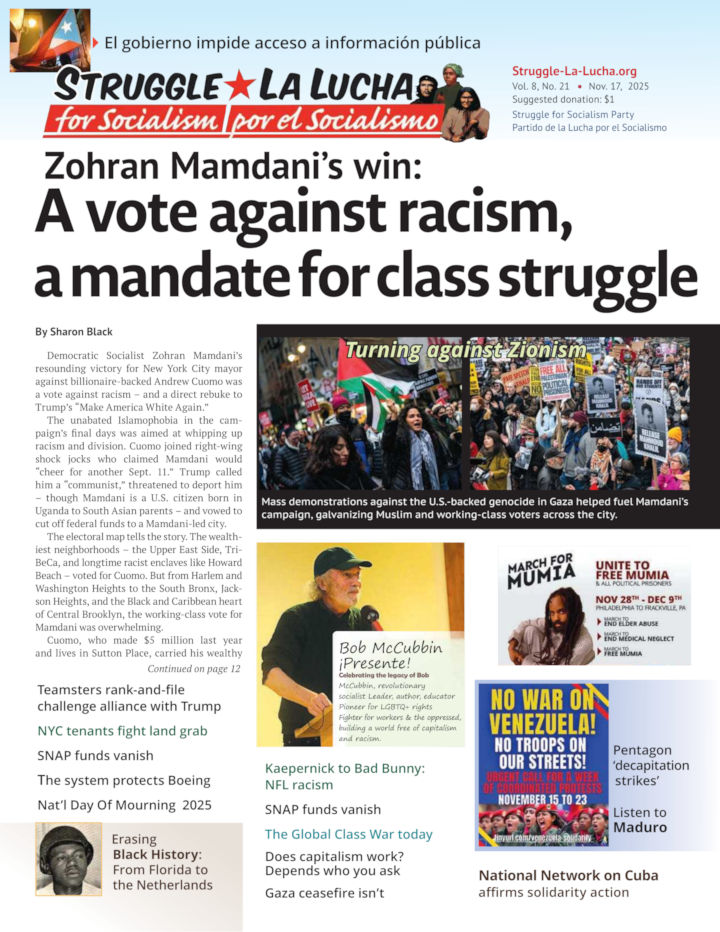
Struggle ★ La Lucha PDF – November 17, 2025

Get PDF here

  • Zohran Mamdani’s win: A vote against racism, a mandate for class struggle
  • Mamdani’s win shows the tide is turning against Zionism
  • Teamsters at a crossroads: Rank-and-file challenge takes on O’Brien’s alliance with Trump
  • NYC tenants fight billionaire land grab
  • Marching for Mumia: a 12-day journey for justice
  • Erasing Black History: From Florida’s classrooms to a cemetery in the Netherlands
  • From Kaepernick to Bad Bunny: NFL can’t stop bowing to racism
  • While billionaires soar, SNAP funds vanish
  • 346 dead – and no charges: How the system protects Boeing
  • Top commanders brief Trump on attack options against Venezuela
  • Does capitalism work? Depends who you ask
  • Remembering Bob McCubbin: Revolutionary, Teacher, Comrade
  • The global class war today
  • With carriers off Venezuela, a call to action to stop a new war
  • Pentagon confirms ‘decapitation strikes’ for Venezuela as armada builds
  • People of the United States: Listen to Maduro
  • The Gaza ceasefire isn’t – Washington helps the war go on
  • National Network on Cuba reaffirms actions in solidarity
  • El gobierno impide acceso a información pública
Strugglelalucha256


Remembering Bob McCubbin: revolutionary, teacher, comrade

Bobinvite HT2

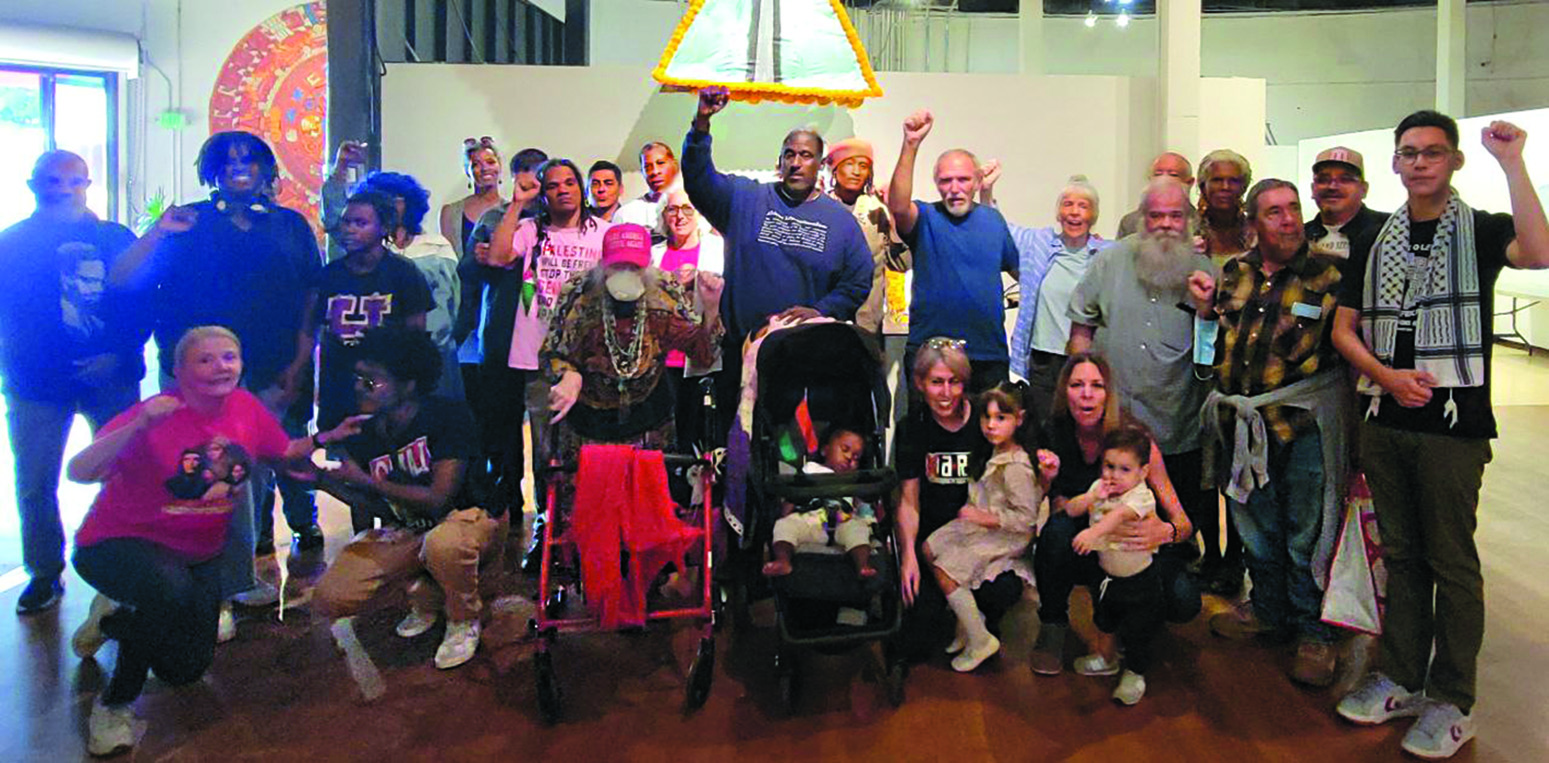
Memorial held in San Diego, 2025

Comrades, friends, and family gathered in San Diego to honor the life of Bob McCubbin, a lifelong revolutionary who dedicated over 60 years to the struggle for socialism and liberation. Bob died on Aug. 31, 2025, at age 83, from injuries sustained when he was struck by a car while taking his daily walk through Balboa Park.

Bob McCubbin was a pioneering theorist of LGBTQ liberation, author of the groundbreaking 1976 work “The Gay Question: A Marxist Appraisal,” and a tireless organizer who built branches of revolutionary organization with nothing but knowledge, passion, and commitment. From the Stonewall era through his final days organizing at San Diego Pride 2025, Bob never wavered in his belief that queer liberation was inseparable from the fight against capitalism and imperialism.

An English as a Second Language professor at Southwestern College for 17 years, Bob was equally at home in the classroom and on the picket line. He organized with the Committee Against Police Brutality, ANSWER Coalition, and the Coalition to Free Mumia and All Political Prisoners. He was a founding member of the Struggle for Socialism Party, following the tradition of Sam Marcy, Dorothy Ballan, and Vince Copeland.

Those who gathered to remember Bob spoke of his unwavering principles, his mentorship of young activists, his deep understanding of the national question, and his steadfast solidarity with all oppressed peoples. Above all, they celebrated his profound loyalty to the working class and its march toward revolution.

Bobmemorial 2025 11 09 22 26

SELECTED TESTIMONIES

John Parker, Harriet Tubman Center for Social Justice / Struggle for Socialism Party, Los Angeles

They left the photos up. They put up lots of pictures. We did a little altar and things like that — honoring Bob in the tradition of Día de los Muertos, the Day of the Dead, when we remember those who have passed and celebrate their lives. It was just so beautiful — it brought tears to my eyes to know how the working class would come together. Indigenous, Black, Brown, oppressed, poor — come together and just coexist and become a powerful force that’s going to fight against this system.

What does it take to build a branch, the local organizing unit of a revolutionary party? Does it take a large staff? Well, that helps. Does it take lots of money? Well, that definitely helps. But none of these things are required — not for Bob anyway. He created branches and cadres with only the tools of knowledge, passion, and commitment.

His foundation was a deep understanding of the national question — a question that has to be answered for the people in the Global South and all those oppressed by especially U.S. imperialism. For Bob, this was key to unlocking understanding of all types of questions, especially those often ignored.

As the trans community is targeted today, as people in Latin America and the Caribbean are targeted by ICE, as Black and African people are targeted, and as the ruling class experiments with crushing our constitutional rights under Trump’s bulldozer while the Democratic Party enables the push toward fascism — Bob’s legacy is crucial.

What is the legacy of Bob’s life that we inherit? It’s a profound and unwavering loyalty to the working class and its inevitable march toward socialist revolution.
Bob Gloria2702

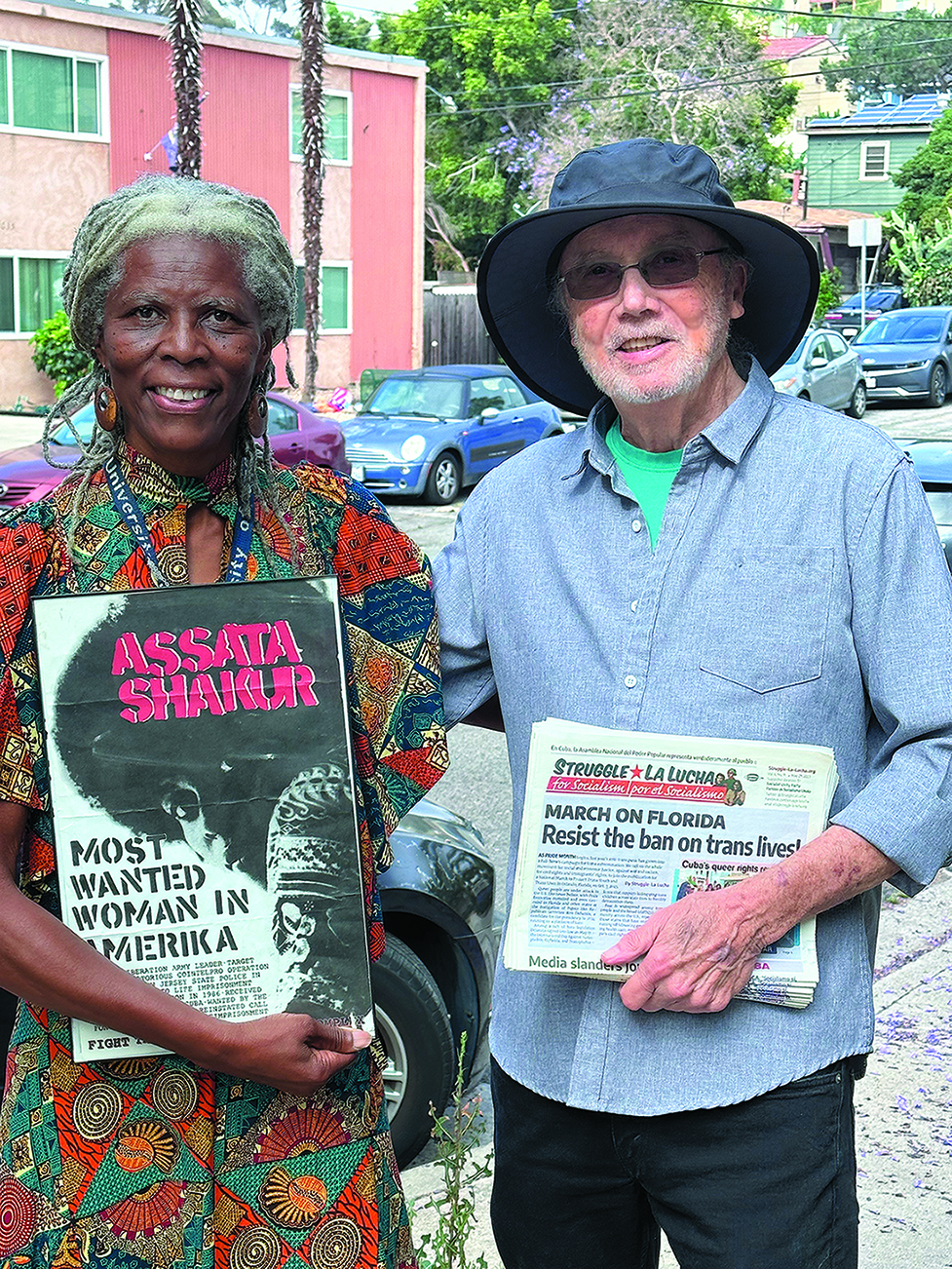
Gloria Verdieu, Coalition to Free Mumia / Struggle for Socialism Party, San Diego 

When I visited Bob in the hospital after the accident and saw the extent of his injuries, I was confident he would recover. Bob had no memory of what happened. His concern was that we continued to work on making a better world for all. When I reminded him that he was in the hospital, his response was: “We have a lot of work to do.”

He spoke of Demetrius DuBose, a football player killed by San Diego Police in 1999. He spoke of Mae Mallory and the Harlem Nine, who fought segregation in New York schools. Bob said we must bring working-class people together who fight for a better world. He believed that as workers, we have more in common than the system leads us to believe.

Bob touched the lives of many through bus trips to protests, meetings, conferences, rallies. He was a scholar, educator, author, and mentor who led by example. Bob not only envisioned a better world but motivated me and many others to fight for it — a socialist world.

I met Bob 25 years ago when I first learned about political prisoners. Today, I continue to organize with the Coalition to Free Mumia. Bob was my comrade, motivator, and true friend. He is physically gone, but his revolutionary spirit lives on inside of me.

Dawn Miller, Union del Barrio / Association of Raza Educators

I first met Bob in the late ’90s at an anti-police brutality march in downtown San Diego. Back then, the police would show up in full aggressive force. I remember watching officers physically intimidating Bob, bumping into him, pushing him, threatening to trample him. But Bob never flinched. He kept chanting, kept leading, fearless and unbowed, continuing with revolutionary courage as he did his entire life.

At the end of that march, he invited me to hear his close comrade Leslie Feinberg speak. That night transformed my life. Never before had I heard the truth laid out so clearly — that every form of oppression is rooted in capitalism, and that liberation for queer people and all oppressed people is inseparable from the fight for socialism.

In “The Gay Question,” Bob named the roots of queer oppression in capitalism, showing how the system thrives by dividing workers. He explained not only the nature of our oppression but also the revolutionary strategies necessary to confront it. These works were not just theoretical — they were a call to action, a blueprint for revolutionary solidarity.

Bob fought as a young man to include protections for sexual minorities in his union contract. At a time when being openly gay could cost you your job and your life, Bob refused to hide. He built alliances between the gay liberation movement and the labor movement, proving that solidarity is our greatest weapon.

Bobsunglasses

Maggie Vascassenno, Struggle for Socialism Party, Los Angeles

Bob was a friend. He was a mentor and an organizer. He was a gay man, a leader, a teacher, a theoretician, and a storyteller. Bob was always principled and disciplined, and he never wavered in his commitment to building a working-class movement for socialism. He loved our class and the struggle to free our class. He was a party member and organizer for over 60 years.

As an organizer, he was tireless. He was a full-time teacher, and for years every week he would pick up a bundle of our newspapers at the post office and distribute them to campuses, coffee shops, laundromats, and wherever workers gathered. He organized tons of people to get on the bus to travel to anti-war protests in the Bay Area and Los Angeles.

He was a writer and a voracious reader. He loved his books. His house was full of books — piles of books, books with lots of yellow sticky notes marking different pages and passages. He especially studied human social development and the class origins of women’s and sexual oppression.

Into his 80s, he went to protests and meetings. He still passed out our newspaper and talked with young people about socialism and struggle. He was always looking for a new recruit.

I got to spend a lot of time with him over the last couple of years. I was around as he transitioned from his home of more than 30 years to an apartment in senior housing at St. Paul’s Manor. He loved that the Manor was close to Balboa Park. He walked a mile or two there every morning and then went for his reward — a cafe mocha at some cafe in the park.

I remember once when we were trying to figure out a class schedule for our new candidate comrades, Bob interjected firmly: “Comrades, the best education is in the struggle.”

That’s our Bob. Live like Bob.

Lallan Schoenstein, Struggle-La Lucha Graphics Editor

Bob was a trusted comrade and a cherished friend for 50 years. He used scientific analysis based on Marxist methods to explore the basis of social oppressions. How did society reach a place where a few individuals can amass the wealth created by all working people to commit genocide? How can they create the lies to convince us that genocide is okay?

Bob challenged those feminists whose ideas are based on blaming “the patriarchy” and men for social relations that all people suffer under. Bob wrote about the root of social relations, starting with human history — millions of years when people depended on each other for survival. They needed each other to survive.

Now, more and more people are losing their food and shelter. The Supreme Court has just allowed Trump to freeze SNAP benefits. Capitalism in this recent epoch thrives on division.

Bob was a gay communist — words the capitalist culture tries to make dirty. Bob’s life was spent fighting for socialism, for a world where every child could reach their full potential and be exactly who they are.

Gary Wilson, Struggle-La Lucha Managing Editor

I first met Bob in 1974 in Boston. A federal court had just ordered desegregation of Boston’s public schools, and the city erupted in racist violence. School buses carrying Black children were being stoned. We were organizing the historic March Against Racism on Dec. 14, 1974, which brought together 25,000 people.

Bob came up from New York City to help organize that march and stayed at my apartment. What struck me most was how deeply Bob understood that fighting racism was central — not secondary — to the struggle for liberation. For Bob, the fight against racism was inseparable from the fight for LGBTQ liberation, workers’ rights, women’s equality, and justice.

That spirit carried through everything he did, from his groundbreaking book “The Gay Question” to his lifelong organizing. When I think of Bob, I remember a teacher — someone who showed by example that solidarity is at the heart of revolution. That’s how I first knew him, and that’s how I’ll always think of him.

Matsemela Odom, African People’s Socialist Party / Uhuru Movement

Some important principles I learned studying with Bob: fighting against spontaneity, fighting against opportunism. We know that opportunism is the willingness to forego the overall objectives of a struggle for an immediate gain. And Bob stood up against that.

When the Uhuru Movement was attacked in 2022, Bob was among the first here in San Diego to show his support, donating money and resources. Bob wasn’t rich. He just poured all his resources into the struggle.

People from the queer community have made important advancements to the overall revolutionary struggle in understanding what family is. It’s even more important to understand that Bob reproduced through revolutionary struggle. That’s what he learned from his mentors, who went down to the worst parts of the South before the liberal left got into the Civil Rights struggle. It’s around the national question that they learned to step out and challenge the opportunism built into white nationalist Americanism. That’s what Bob and his generation importantly turned against.
SanDiegoIWD LGHB5429 s

Melinda Butterfield, Struggle for Socialism Party, New York City

A few years ago, Bob was the first comrade I came out to as a trans woman. It felt like the right thing to do. I was nervous because of the weight of the thing. Bob listened thoughtfully as I explained my name, pronouns and plans for coming out. He was kind and supportive, just as I expected. Despite his health limitations, he didn’t hesitate to offer me any support I might need. That conversation was such an important moment for me.

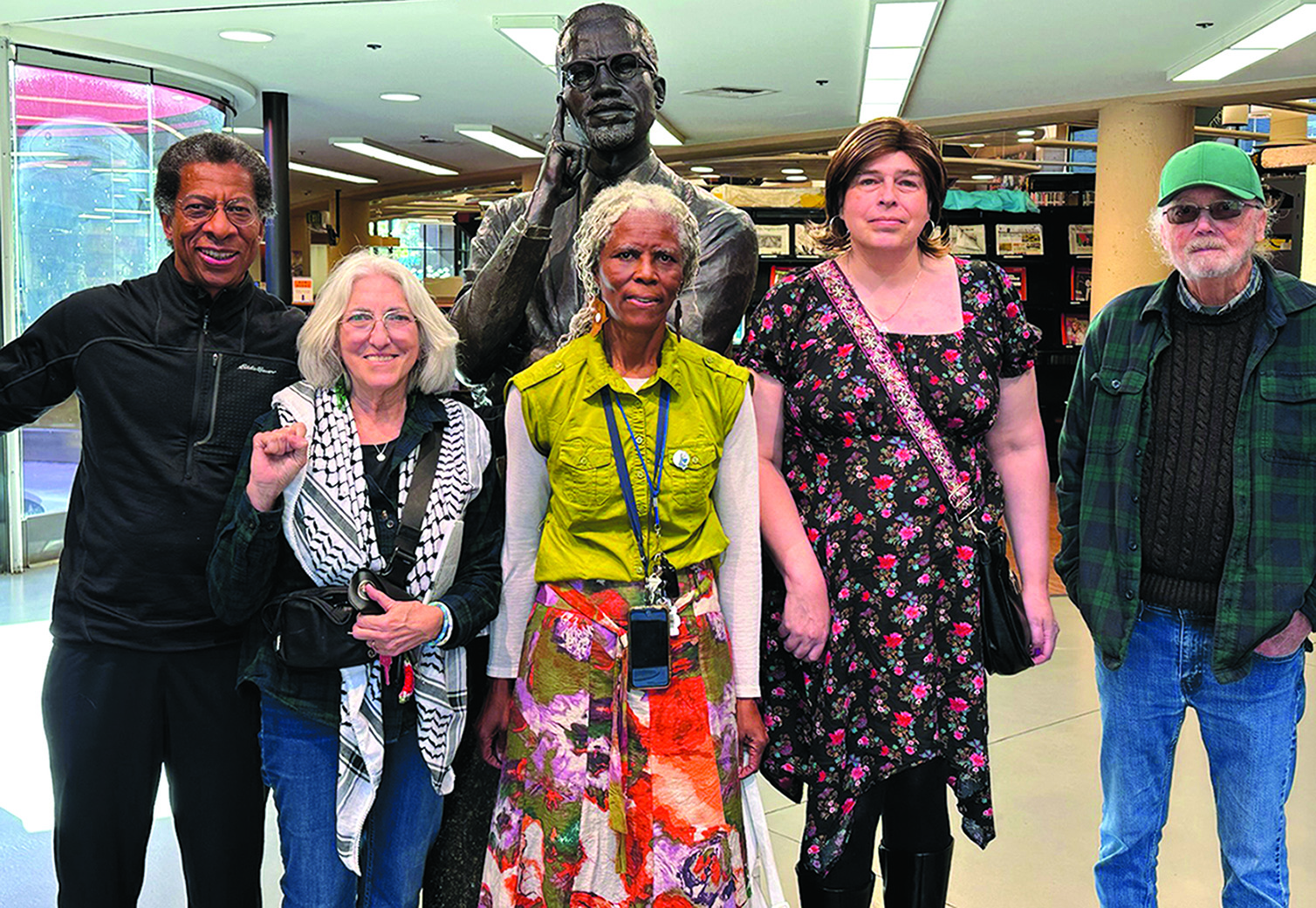
Our late comrade Leslie Feinberg is lovingly regarded in the trans and queer movement worldwide. Bob was a mentor to Leslie. Bob was an example for Leslie. Bob helped pave the way for Leslie. They shared a hatred of racism, imperialism, and Zionism, and deep dedication to LGBTQIA+ liberation.

In Bob’s most recent book, “The Social Evolution of Humanity,” he devoted a chapter to Leslie Feinberg’s work on the materialist understanding of transgender people and trans liberation. What he didn’t mention, in his characteristic modesty, was how his own work helped make Leslie’s work possible, just as the work of Frederick Engels, August Bebel and Dorothy Ballan did for him.

Bob embodied Sam Marcy’s phrase: “Mild in manner, bold in matter.”

Scott Scheffer, Struggle for Socialism Party, Los Angeles

I visited Bob while he was in the hospital. When I came into the room, he couldn’t remember my name, but he told the nurses, “I’ve known him since 1977.”

In 1977, Bob came to Rochester to speak about “The Gay Question.” I helped organize the meeting, and afterward we had a chance to talk. It was all political — he was explaining all the different forms of oppression under capitalism.

After learning from Bob and Leslie Feinberg’s writings, I realized there’s nothing natural about bigotry. There’s nothing about homophobia that’s natural. It’s inherited under capitalism. If you read Bob’s books carefully, that leads you to understand that the struggle against sexual oppression, against racism, against violent misogyny — all of that is struggling against things that originated under capitalism.

Bob’s work explaining the different historical stages showed that each social system came into being because it fit the needs of production at the time, and when it became outdated, it was time for a new social system.

Thank you, Bob McCubbin, for helping me understand that sexually oppressed people are real, and that every struggle we are part of is because of capitalism, and we have to bury capitalism.

Forest, Party for Socialism and Liberation / ANSWER Coalition

I stand here today in solidarity, in mourning, and in celebration of a dedicated, passionate, principled man. Bob McCubbin lived and breathed for the movement. He led by example, and he will continue to move people to action.

On behalf of the Party for Socialism and Liberation and the ANSWER Coalition, I extend our warmest embrace regarding the passing of Bob McCubbin. We need more people like Bob — people who are ahead of their time, who can look backward at history with clarity, analyze the current moment with sincerity, and decide to do something about it.

Bob McCubbin knew what it meant to be a comrade and showed us how to walk in that way. We’re stronger today because of Bob, and we see with more clarity today because of Bob.

Sharon Black, Struggle for Socialism Party, Baltimore

People in Cuba knew about Bob’s writings and were inspired by them. There was going to be a new definition of what family is in Cuba — progressive and amazing. We were planning to go there to do a book signing, and Bob was going to come. I was so sorry that he couldn’t make the trip. His work had international reach and showed how revolutionary theory can inspire movements across borders. Bob’s dedication to building solidarity across all struggles, from the Black Panther Party to Cuba to the fight for LGBTQ liberation, exemplified what it means to be an internationalist revolutionary.

Bob McCubbin, presente!

A second memorial will be held in New York City in early spring 2026.
 

Strugglelalucha256
https://www.struggle-la-lucha.org/2025/page/8/