Struggle ★ La Lucha PDF – December 1, 2025

Get PDF here

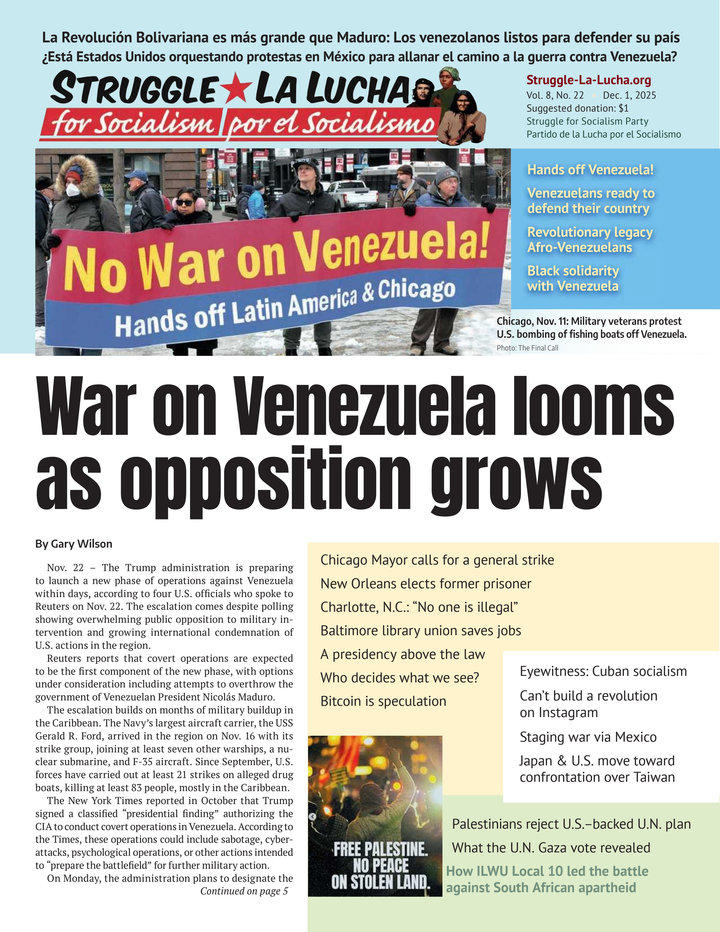
  • War on Venezuela looms as opposition grows
  • Chicago Mayor Brandon Johnson calls for a general strike
  • Charlotte students lead mass revolt against Trump’s immigration raids
  • A presidency above the law – and the struggle ahead
  • Former prisoner elected New Orleans court clerk
  • Whose news is it – who decides what we see?
  • Union wins jobs back for Baltimore librarians
  • Palestinians reject U.S.–backed U.N. plan: ‘A new form of occupation’
  • What the U.N. Gaza vote revealed about the imperialist world order
  • No peace on stolen land: protesting the settler fair
  • ILWU rank-and-file leader tells students how Local 10 led the battle against apartheid
  • Bitcoin’s latest crash shows what it really is: speculation, not money
  • Japan and U.S. move toward open military confrontation over Taiwan
  • ‘I will never be a slave again’: Revolutionary legacy Afro-Venezuelans
  • Black solidarity with Venezuela
  • Hands off Venezuela! Wall Street antiwar rally
  • You can’t build a revolution on Instagram: Cuba and Venezuela explain why
  • Eyewitness accounts bring Cuban socialism to life
  • Bolivarian Revolution is bigger than Maduro: Venezuelans ready to defend their country
  • Is the U.S. orchestrating protests in Mexico to pave the way for war on Venezuela?
  • La Revolución Bolivariana es más grande que Maduro: Los venezolanos listos para defender su país
  • ¿Está Estados Unidos orquestando protestas en México para allanar el camino a la guerra contra Venezuela?
Strugglelalucha256


History is still absolving Fidel Castro

Fidel Castro was born on Aug. 13, 1926. If he were alive today, he’d be turning 100 next year. In Cuba, preparations are already underway to celebrate his centennial. But even without the anniversary, current events – the dangerous world situation right now – warrant a reappraisal of Fidel’s life and the Cuban revolution. They have a lot to teach us.

Right now, the U.S. government is intensifying its attacks on Venezuela and other countries of Latin America. This imperialist government, run for the billionaires, has already been illegally assassinating people in the Caribbean who are just trying to make a living, offering zero proof that they are smuggling drugs. 

War is a real danger. This would not only be a disaster for Latin America, but also for working-class and oppressed people here in the U.S. itself. (We always seem to get poorer as the war profiteers get richer.)

But Washington’s attempts to subjugate Latin America to Wall Street are nothing new. Fidel Castro spent his life fighting against the murder machine that is U.S. imperialism. And with his leadership, the Cuban revolution first threw off the U.S.-backed Batista dictatorship and then spent decades fighting off U.S. attempts to resubjugate Cuba. Sixty-six years later and they haven’t beaten the Cuban revolution.

Fidel understood that there really was no making peace with imperialism. The leaders of the global capitalist system might soften their tone from time to time, pretend that they will start playing fair. Trump exemplifies this pattern. But the unrelenting profit motive that drives the whole system can never allow peace, and the imperialists can never accept it when people of formerly colonized countries of the Global South, like Cuba, start to run their own affairs.

The problem, from the oligarchs’ point of view, is that if Global South countries are independent, the working-class and oppressed majority there could get hold of the reins of power and actually help the people. When that happens, it threatens corporate profits (the same corporations keeping us down here). 

That’s why the U.S. and Britain backed a coup in Iran in 1953, inaugurating decades of bloody dictatorship. The Iranian government had nationalized the oil industry and wanted to use the country’s resources to raise living standards. That meant stopping U.S. and British capitalists from stealing everything.

Venezuela’s crime 

There are similarities between Iran and Venezuela, which happens to have the largest proven oil reserves in the world. Venezuela nationalized its oil in 1976, and when Hugo Chávez was elected in 1998, bringing the Bolivarian revolution to power in 1999, the government used the country’s wealth to undertake massive efforts to uplift the people, expanding access to housing, education, health care, etc. Washington has been trying to destroy Venezuela’s Bolivarian government, essentially from day one, long before the bogus narco-state accusations. 

Venezuela’s crime is threatening foreign capitalist profits. That was the crime of Iran, and it’s the crime of Cuba. The imperialists can’t accept anything that looks like self-determination. That’s why the Palestinian people’s resolve makes them crazy. That’s why Trump vilifies the Black majority government of South Africa.

There are many things we can learn from Fidel Castro’s life as we contemplate his centennial. But one is that the imperialist system will never accommodate itself to us – to oppressed people, to workers. So, we should not accommodate ourselves to it. Instead, we have to fight it.


Strugglelalucha256


‘Kill everybody’: War crimes in the Caribbean expose imperialism in crisis

The execution of defenseless survivors in the water — an act that meets every definition of a war crime — exposes the real thrust of U.S. actions in the Caribbean. This is not about drug trafficking. It is open aggression undertaken by an imperialist system in crisis, relying ever more on force as its authority erodes.

Extrajudicial killings at sea and threats against Venezuela’s sovereignty are not isolated outrages. Taken together, they show a system losing control and turning to force, illegality, and war crimes.

The United States is not acting from a position of strength. It is responding to the decline of U.S. imperialism in the world economy and a shrinking ability to impose its will abroad. History shows that imperialism becomes most dangerous in crisis, turning to open force when it can no longer get its way through economic dominance or political manipulation.

A criminal order that strips away the mask

On Sept. 2, a U.S. aircraft spotted a small boat near Trinidad and the Trump administration quickly declared it was “suspected” of carrying drugs. A missile destroyed the vessel. Two survivors, wounded and unarmed, clung to debris in the water.

According to a detailed Washington Post investigation, Defense Secretary Pete Hegseth issued a verbal instruction: “Kill everybody.” A second strike was ordered. The survivors were killed where they floated.

This was no battlefield confusion. It was the deliberate killing of shipwrecked people — an act explicitly condemned in the Pentagon’s own Law of War Manual. Former Judge Advocates General warned that if the U.S. claims this was an armed conflict, the order amounted to a prohibited “no-quarter” command, a war crime. If it were not an armed conflict, the killing of defenseless civilians would be murder under U.S. law.

Trump brushed the matter aside, calling the mission “lethal kinetic” and labeling the dead “narco-terrorists.” The terminology changes from era to era, but the purpose is the same: to strip human beings of rights and to justify violence without restraint. This is how imperialist power behaves when its legal façade collapses.

Growing fractures inside the state

The effects of these unlawful killings don’t stop in the Caribbean. They’re also creating tension and divisions inside the U.S. government and the military. 

On Nov. 18, six Democratic members of Congress — each with backgrounds in the military or intelligence agencies — released a video reminding U.S. troops of their duty to refuse illegal orders. Their intervention brought into the open a conflict that had been simmering for months.

Trump’s response was immediate and extreme: He accused the six of treason and suggested they should face execution. His tirade only brought more attention to the video.

The six did not call for disobedience in general. They stated a basic legal fact: Troops cannot defend themselves later by claiming they were “only following orders” if they carry out war crimes. The significance lies elsewhere. Their intervention signals growing concern within parts of the ruling class and the state apparatus that Trump is steering the military toward confrontation with the population — and speeding up the decline of U.S. imperialism in the process.

These tensions have been visible for months. National Guard units deployed in Los Angeles to support ICE raids reported discontent and refusals to serve. Members of Congress say they have received increasing calls from active-duty troops and Guard members questioning the legality of the missions they are being sent on. Whatever their motives, the six lawmakers’ video has made the question of refusing illegal orders impossible to ignore.

That question applies as much to the Caribbean as it does to the streets of U.S. cities. Troops have the same duty to refuse orders to fire on civilian boats near Venezuela as they do to refuse orders to fire on people at home. The killings carried out by the U.S. fleet since August — more than 100 people blown apart in the water under the pretext of drug enforcement — are crimes. Those who carry them out are responsible for those crimes, even if the officials giving the orders bear the greater guilt. 

The removal of Adm. Alvin Holsey, who reportedly objected to the attacks and instructed that survivors be rescued, underscores the depth of the internal conflict.

Trump’s threat against the six lawmakers exposed a division inside the government that had been simmering for months. Some now respond to any criticism as if it were a criminal act, while others worry that Trump’s use of military force — at home and abroad — is damaging the state they depend on. The clash reflects the deepening instability of the imperialist state amid its global decline.

For anti-imperialists, there is now space to speak directly to U.S. troops and the National Guard: They must refuse illegal orders, whether those orders call for firing on migrants, protesters, or civilians in the Caribbean. Rejecting criminal directives is not merely permitted — it is required.

Strugglelalucha256


LA teach-in exposes U.S. war lies on Venezuela

The United States is escalating its threats against sovereign Venezuela — and working overtime to manufacture public support for intervention. In Los Angeles on Nov. 22, activists gathered for a community teach-in to break down the lies driving this new war push and to equip people with tools to challenge it.

The teach-in opened with a concise overview of Venezuela’s modern history and the achievements of the Bolivarian Revolution. Presenters emphasized that Washington’s hostility did not begin yesterday: It is rooted in decades of U.S. attempts to dominate Latin America and crush any nation that asserts its independence.

From there, the discussion turned to how corporate media creates the illusion of consensus for war. Facilitators walked participants through the core tactics of “manufacturing consent” — selective facts, emotional manipulation, and the erasure of U.S. economic sabotage — all designed to portray targeted countries as crises that demand foreign intervention.

A segment from CBS’s “60 Minutes,” “Life on the Ground in Maduro’s Venezuela,” served as the centerpiece for analysis. Attendees examined how the piece relied on distortion, omission, and sensationalism to recast Venezuela’s hardships as proof of government failure rather than the predictable result of brutal U.S. sanctions and continuous destabilization campaigns.

After dissecting the clip, the teach-in shifted to strategy. Participants discussed how to push back: building popular education, joining anti-war organizations, and mobilizing in the streets to oppose any U.S. attack on Venezuela or any other sovereign nation.

Only after the main program concluded did organizers acknowledge the collaboration that made the event possible, including members of the Struggle for Socialism Party (SSP), the Harriet Tubman Center (HTC), and the Los Angeles Tenants Union Koreatown (LATU).

The core message that carried through the event was clear: No war on Venezuela. No more public money for imperialist aggression while communities at home are denied housing, health care, and basic social services. The fight against U.S. intervention abroad is inseparable from the fight for justice at home.

A public link to the slideshow shared at the event is available here for readers who wish to explore the material further.


Strugglelalucha256


With imaginary decree, Trump attempts to ‘close’ Venezuela’s airspace

CARACAS, Venezuela (OrinocoTribune.com)—In a bizarre social media post on Saturday, November 29, U.S. President Donald Trump issued a warning amid escalating military action and pressure on Venezuela and President Nicolás Maduro: “To all airlines, pilots, drug dealers and human traffickers, please consider the airspace above and surrounding Venezuela to be closed in its entirety.”

This unprecedented attempt at an air blockade is another step in the escalating aggression that Washington is carrying out against Venezuela. However, experts in international law emphasize that Trump does not have the authority to close the airspace of another sovereign country, as that power belongs solely to the state that exercises sovereignty over its territory or to the United Nations Security Council (UNSC).

The threat comes a week after the U.S. government itself urged airlines to exercise extreme caution due to “military activity” in the region, thus disrupting international air operations in Venezuela. A few days later, the New York Times revealed that Trump held a telephone conversation with President Maduro, in which the possibility of a face-to-face meeting was discussed.

According to analysts, Trump’s delirious social media post is evidence of the failure of the U.S. strategy toward Venezuela, which relied on a military uprising leading to a coup d’etat or a far-right uprising aimed at ousting Maduro. Neither option has materialized; instead, President Maduro’s position becomes stronger by the day, especially after U.S. warnings affecting Venezuelan airspace and disrupting the freedom of the Venezuelan people to transit local and international routes.

Venezuelan experts also consider that Trump’s announcement means the de facto cancellation of migrant repatriation flights that have been operating regularly since February. Despite U.S. military threats, these flights have brought home more than 17,000 Venezuelan migrants who had been victims of racist and xenophobic U.S. immigration policies.

Recent history of no-fly zones

Although Trump’s announcement falls short of a formal no-fly zone, its intent seems to be exacerbating a psychological operation or preparing the ground for direct U.S. military strikes against Venezuela.

A low-intensity electronic warfare operation has been ongoing in the country since October, visibly affecting global positioning systems and impacting fields that rely on them, including air transport. Cuban Foreign Minister Bruno Rodríguez denounced this fact on social media on Saturday.

In Libya, the implementation of a no-fly zone in 2011 was a complex and controversial military and diplomatic operation authorized by the UNSC, allegedly to protect civilians from “government bombardments.” It quickly evolved from a neutral airspace denial mission into a broader air campaign in support of forces opposing President Muammar Gaddafi.

Critics, including the abstaining states on the UNSC, argued that NATO overstepped its mandate. They contended that the no-fly zone morphed into a de facto air war in support of U.S. imperial interests, with the ultimate goal of regime change. This led to Gaddafi’s overthrow and assassination, and ultimately to the destruction of the Libyan state, now dismembered and with different chunks controlled by sectarian forces.

In Iraq, no-fly zones were created in 1991 without a UNSC mandate following the Gulf War. This was a larger, longer and more controversial operation than the one in Libya. It served as a key element in the U.S.-led military aggression and occupation campaign, paving the way for the 2003 U.S. invasion of Iraq under the excuse of “weapons of mass destruction” that did not exist.

U.S. imperialism justified the creation of the “no-fly zone” under UNSC Resolution 688, which condemned the repression of Saddam Hussein and demanded Iraq end it. However, Resolution 688 did not explicitly authorize the use of force or no-fly zones, making their legal basis a subject of continuous controversy. Without explicit UN Chapter VII authorization, the U.S. and UK relied on the argument that the resolution provided a legal “basis” for action. Russia, China, France, as well as many international law experts have consistently demonstrated the no-fly zones over Iraq were illegal under international law.

Both cases ended with hundreds of thousands of deaths, the dismemberment of the affected states, and migration crises. Experts argue that these would pale in comparison to what might happen in Latin America and the Caribbean if the U.S. launches a full-scale military operation against Venezuela.

Special for Orinoco Tribune by staff

Strugglelalucha256


Trump threatens Venezuela: Another escalation in Washington’s war

Statement of the Struggle for Socialism Party
Nov. 30, 2025

Trump’s threat to strike Venezuela violates the U.N. Charter and exposes Washington’s collapsing justifications for war.

U.S. imperialism and the policies of colonial domination rely on distortion, deception, and the prioritizing of profits over human life. Their entire imperialist project depends on lies — and today we are witnessing one of its most reckless and dangerous escalations in real time against Venezuela.

Donald Trump’s recent declaration on Truth Social, threatening U.S. military strikes against Venezuela’s land, sea, and air, is a unilateral act of aggression.

In a powerful response, the Bolivarian Republic of Venezuela officially denounced this “colonialist threat that seeks to affect the sovereignty of its airspace — an action that constitutes a new extravagant, illegal, and unjustified aggression against the Venezuelan people.”

Article 2, paragraph 4 of the U.N. Charter clearly states that threats or use of force against another nation are violations of international law and are prohibited.

Venezuela’s statement correctly identifies the claimed extraterritorial jurisdiction as a “hostile, unilateral, and arbitrary act, incompatible with the most basic principles of international law. … a permanent policy of aggression against our country, with colonial pretensions over our region.”

This illegal threat to “close” Venezuelan airspace is the latest maneuver in a war Washington has waged since the dawn of the Bolivarian Revolution — beginning with the U.S.-sponsored military coup attempt against President Hugo Chávez in 2002. The war continues by other means: economic sanctions, blockade, and the freezing of sovereign assets, all designed to produce poverty, hunger, and social destabilization.

The real crime of Chávez — and of President Nicolás Maduro today — in the eyes of Trump and both Democratic and Republican administrations is that Venezuela prioritizes social needs over the demands of U.S. imperialist capital. Major advances in housing, food programs, literacy, and health care took shape only after the Bolivarian Revolution, empowering the majority of Venezuelans with sovereignty and real grassroots democratic reforms.

The staggering hypocrisy of Washington’s justification for war — claiming that Venezuela is “flooding the U.S. with drugs” — falls apart under scrutiny. There is no evidence that Venezuela is a major source of cocaine, fentanyl, or other narcotics entering the United States. Even the Washington Post and New York Times — usually reliable accomplices in the vilification campaigns that precede U.S. wars — have admitted there is no verifiable evidence of a Venezuelan drug cartel.

Yet the extrajudicial assassination of dozens of fishermen and civilians by U.S. Navy SEALs and drone strikes is framed as “necessary,” despite the victims having no due process, no evidence, and no link to terrorism or military activity. They are effectively sentenced to death based on alleged ties to a cartel that does not exist. Meanwhile, Trump has indicated he may pardon his convicted drug-trafficking ally, former Honduran President Juan Orlando Hernández — the man who actually did flood the U.S. with cocaine. The hypocrisy, cynicism, and state terrorism could not be clearer.

The covert war is now becoming overt.

History provides powerful lessons. Decades of a cruel blockade could not break Cuba; it forged a nation of resilience and dignity. The genocide in Palestine has not crushed the Palestinian cause; it has magnified it worldwide. In this same spirit, the Venezuelan people remain unbroken — and continue building socialism with determination and collective strength.

The international solidarity movement, especially inside the United States, must remain firm and active. Our greatest weapon against imperialism and colonialism is solidarity: in the streets, in the workplaces, in the unions, and in every arena where the working class can assert its power. We must demand an immediate halt to all U.S. aggression against Venezuela.

Strugglelalucha256


The Bolivarian Revolution is bigger than Maduro: Venezuelans ready to defend their country

The following talk by Jesús Rodríguez-Espinoza was given at the “No War on Venezuela” forum held in Baltimore on Nov. 22. Rodríguez-Espinoza is a former Consul General of Venezuela in Chicago and a seasoned analyst of international relations and Venezuelan politics. He was a founding editor of Aporrea.org and is the founder of the renowned anti-imperialist news outlet, Orinoco Tribune.

The forum was sponsored by the Peoples Power Assembly, Struggle for Socialism Party, CPUSA Baltimore Club, Friends of Latin America, Casa Baltimore Limay, ILPS Baltimore / DM, Baltimore Peace Action, Baltimore Vets for Peace, and Black Alliance for Peace, Baltimore. The forum can be viewed on Struggle – La Lucha’s YouTube channel

Thank you for the invitation, comrades. And thank you for organizing these events, especially under the current circumstances, under the current unprecedented U.S. military deployment in the region. So first, I want to try to explain the way I see the geopolitical context around this situation.

So basically, it reminds me of the first things that President Trump said when he initiated his new term. And I remember that when I heard that he was talking about having control of Greenland, or annexing Canada, or changing the name of the Gulf of Mexico to the Gulf of America, or retaking the Panama Canal, I initially thought that those were crazy statements, usual for the way Donald Trump behaves.

But right now I see it differently, especially after reading and listening to analysts and experts and thinkers talking about how the U.S. has been realizing that there’s a change in the correlations of forces worldwide. And the U.S. is just trying to secure the place – the area that it considers its domain, its backyard, its neighborhood, whatever name you want to put on it.

But that’s basically what has been happening.

And this military deployment in the Caribbean and this stress of military invasion or attacks against Venezuela are just an expression of that approach, that new foreign policy approach coming from the U.S. And it’s not because President Trump is extremely brilliant or whatever. Those plans have been designed for years by the oligarchy in the U.S., by those who control the U.S., which are the corporations. So, they basically want to secure access to natural resources and to markets in this part of the world.  Because Russia and China – and other countries, like India or Turkey or South Africa – have been disputing the preeminence and the supremacy that the U.S. has exercised for several decades, especially after the fall of the Soviet Union in the ‘90s.

That’s the general context of this situation that is affecting us. And bringing it down to reality takes us to what I just mentioned, which is the natural resources. Within this global scenario, the U.S. needs to secure natural resources from the region, and Venezuela is one of those countries in the region that has happened to have the biggest oil reserve in the world. So, it’s strategic for a country like the U.S.

That’s basically the context of what is happening, and I add to that context the element of the “bad example” – quote, unquote – of Venezuela. Because Venezuela represents a country that does not submit to U.S. dictates, does not obey what Washington says we should do or not do. And for that reason, it’s also important for the U.S. to get rid of countries like Venezuela, Cuba, and Nicaragua.

The aggression against Venezuela should be understood within that context. And getting rid of Venezuela – for those in the U.S. who are dreaming of doing that – will signify an escalation against Cuba and Nicaragua, and maybe other countries. We are actually seeing that even Colombia, which has this president who is not like a socialist, Marxist, or whatever, has been threatened by the U.S. in recent weeks. The president of Mexico has also been threatened.

That gives you an idea on how things are happening, and the risk, and the causes of what is happening. So, I wanted to talk about those things before going into the details about Venezuela. Another thing that I believe is important, and that I say is that whatever you hear about Venezuela being a dictatorship, or authoritarian, and that Maduro is an authoritarian tropical dictator, and human rights are terrible here in Venezuela – those things are humongous lies. I mean, I’m not saying that Venezuela is perfect. No country is perfect. But we are far from how the U.S. mainstream media describes us. 

It’s extremely important that people do not fall into those narratives about us being a rogue nation, a narco-state. That’s the big lie that they have been trying to sell recently. I mean, the U.S. has been trying to oust Chavismo – the Bolivarian revolution – since Hugo Chávez took office in 1999. We are talking about 25 years of U.S. attempts to promote regime change in Venezuela, and they have not succeeded.

They have not succeeded because the Bolivarian revolution and Chavismo are not only rooted in the leadership. It’s something that goes beyond President Chávez or President Maduro or the current leadership of the Venezuelan government. So, for that reason, the U.S. has not been able to create a regime change here in the country.

But anyway, I need to explain to you what is happening in terms of the threat and the recent U.S. deployment, and what is happening in the region. In August of this year, President Trump, the Department of Justice of the U.S., raised the bounty on President Maduro from $25 million to $50 million. So this is a bounty on President Maduro, dead or alive. It’s a price on his head. The mainstream media tries to present these bounties with beautiful words, but that is basically what it is. The U.S. is giving money to whoever decides to get rid of President Maduro to capture or kill him to receive this bounty.

That is not new. The first bounty on President Maduro was announced by the U.S. in 2019, and it was for $15 million. Then it was raised in January this year to $25 million, and then in August, as I said, that was raised to $50 million.

This is important because far-right opposition politicians in Venezuela, together with far-right people in the U.S., like Marco Rubio and the crazy Cuban congresspeople (the crazy Cubans, as they call them) have been pushing for several months already to raise the bounty on President Maduro to $100 million, because that’s the money that mercenaries like Eric Prince have said publicly that they will need in order to launch a mercenary operation to try to kill President Maduro. So that’s why the issue of the bounty is relevant.  

Actually, a few months ago, Mario Díaz-Balart, who belongs to the crazy Cuban group and is a representative from Florida, introduced a proposal or resolution in the U.S. Congress calling for the bounty to be raised to $100 million. A few days after the bounty on Maduro was raised to $50 million, the New York Times “leaked” – quote, unquote – this information about President Trump signing these secret memoranda about the deployment that we have seen in the Caribbean in recent weeks.

And what does this deployment mean? Right now in front of Venezuela, I believe that there are about 11 or 12 warships from the U.S. Navy, the biggest and newest U.S. aircraft carrier, the Gerald Ford aircraft carrier, one nuclear submarine and one regular submarine have been reported by the mainstream media in recent days.

We are talking about 15,000 U.S. troops near the coast of Venezuela. This is a military move not seen in this part of the world since the ‘80s. For at least 40 years, something like this was not seen in this part of the world.  And a movement of this size is not easy to disband without “presenting results,” between quotations. So for that reason, many people around the world, and of course in Venezuela, have been denouncing this as basically a U.S. regime change operation against President Maduro, against Chavismo in Venezuela. And some people are saying that this threat might become a military invasion. But at least for now, the number of troops that we are seeing is not enough to launch a military invasion against Venezuela.

Because, for example, the military invasion against Panama in the ‘80s required around 30,000 U.S. troops. Right now, the U.S. only has half that amount of troops near Venezuela. So, it’s gonna be hard for the U.S. to do a military invasion with the forces that we currently see. That doesn’t mean that the U.S. cannot quickly amass more troops near Venezuela. We cannot discard the possibility of a military invasion. But as the situation is right now, people say that it’s very probable that airstrikes can happen – decapitation strikes, which means that the U.S. will try to kill the leadership of Chavismo. That’s a real possibility, and that’s what many of us here in Venezuela have been worried about in recent weeks. 

That’s the context of the military deployment. The argument from the U.S. is that they are in a new war on drugs to try to protect the U.S. people. We all know that’s a big lie. Because if the U.S. really wants to protect the U.S. people from drugs, it would first get rid of the cartels that operate in the U.S.

I’m talking about white people cartels, not Mexican or Colombian cartels – the people that move the drugs in the US. And secondly, they should do real and comprehensive programs to try to help the U.S. people caught in drug addictions and try to do a massive program to really try to get U.S. people out of drugs. 

That’s the reality. And the drugs go to the U.S. because the biggest market for drugs is there. That’s why drugs go to the U.S. You are never going to end the drug crime business by going to the source of the cocaine or other crops that are used to fabricate drugs.

But that’s been the argument of the U.S. And with that argument, they have already killed 83 people – civilians – in small boats in the Caribbean, raising a lot of alarms all over the world and even in the U.S. about the legality of this. You know, you cannot kill someone just because you were tipped by an informant that the boat carries drugs, because there are often mistakes in the intelligence. Experts say that with seizures of drugs in the Caribbean using the regular procedures, there is a mistake rate of 25%. [This comes from the U.S. Coast Guard’s fiscal year 2024 performance report.]

So what I’m trying to tell you is that maybe out of those 83 souls that have been killed in the Caribbean, if we take for granted that they were really tipped to be small boats carrying drugs, at least 20 of those people might have been innocent. The operation is a big mistake. It has been criticized. And I’m pretty sure that eventually it will be stopped. And a lot of people are going to be indicted because it’s illegal under all the laws that you want to consider.

And the people are not only from Venezuela, but also from Colombia,  Trinidad and Tobago, and even from Ecuador. A survivor from Ecuador has been targeted by these strikes. So that’s the panorama of the current situation that we’ve seen in the Caribbean. And there’s rhetoric coming from Washington about striking allegedly drug production facilities in Venezuela and drug lords, allegedly, and they have accused President Maduro of being the head of a cartel that is nonexistent, which is the Cartel of the Suns.

They created this play cartel just to try to associate President Maduro to that cartel and justify attacks against Venezuela. But they also accused him of being linked to the Tren de Aragua, which is a criminal gang that actually did not have anything to do, at least in big terms, with drugs. And when they raised the bounty on President Maduro in August, they also accused him of having links with the Mexican Sinaloa cartel. So they accused President Maduro of being worse than Pablo Escobar in Colombia in the ‘80s. So that’s to give you an idea of the whole manipulation. But this is a narrative used to support attacks and a regime change operation, and these military strikes against Venezuela.

So that’s basically the context of what is happening right now. And that has already created a lot of tensions in the region. President Petro of Colombia has been denouncing these attacks, because Colombians were already targeted by these attacks. President Petro has been saying that he is not going to allow the use of Colombian soil for any military attacks against Venezuela. And the president of Brazil has been questioning and criticizing the U.S. deployment. There’s a growing rejection of this U.S. military operation in the Caribbean and the threats against Venezuela.

A few weeks ago, CELAC [the Community of Latin American and Caribbean States] had a summit, and in its final declaration, the majority of countries of CELAC agreed that the zone of peace in Latin America, declared by CELAC in 2014, needs to be respected, that Latin America and the Caribbean should be considered a zone of peace. And there shouldn’t be military strikes and military tensions in the region. Meanwhile, in Venezuela, we have not been sitting here waiting for the gringos to invade us. We are preparing ourselves for whatever the gringos want to do.

When this thing began, President Maduro asked the Venezuelans to voluntarily enlist in the Bolivarian militia. And the Bolivarian militia in Venezuela is not like the militias that you have there in Indiana or Minnesota, of white people that hate the federal government, shooting and doing crazy stuff. The Bolivarian Militia in Venezuela is part of the army. It’s one additional branch of the army. And it’s important to highlight this because mainstream media and social media have been spreading that President Maduro is giving away guns and weapons to everyone. And that’s not true. Before that call, the Bolivarian militia already had a big amount of enlisted troops, close to 4.5 million people.

When President Maduro made the call for voluntary enlistment, that number rose, according to government figures, to 3 million additional militia people. So, according to government figures, Venezuela should have about 8 million militia people. Maybe the government is exaggerating. If you ask me, I believe that the real number might be around 6 or 6.5 million people, but that is an incredible number anyway. And that number has always scared the U.S. military because not too many countries have a militia of that size.

And with the enlistment of new militia people, the government and the military announced these exercises – military drills all over the country in training of these new militia people for fighting, training in the use of arms, in health care, in emergency situations, all the training that is needed for situations like this.

And that has been done by the government and the institutions of Venezuela in a very responsible way, without creating alarm or without having tanks and things in the street all over. The whole process has been performed in a very responsible way to avoid creating panic among the population. Actually, they have been asking us not to get into panic and fake news, to keep doing our regular stuff without affecting our work or the productive activities that we do.

And when the Gerald Ford aircraft carrier arrived a few days ago in the Caribbean, Venezuela announced the continuation of the relaunching of these military drills with 200,000 troops deployed all over the territory. And that military drill continues. Because the threat is imminent, it’s real.

Actually, a few days ago, for the last two or three weeks, there was GPS jamming all over Venezuela because no one knows if that was created by the U.S. government or if it was a defensive mechanism used by the military of Venezuela to try to mess with the U.S. operations close to our borders. But anyway, those things affect us and create some tension among Venezuelans because when those things happen, you begin to think that something bigger might happen eventually, very soon.

Alarm exists here, but we are not in panic. 

We are worried, but we are ready to defend the country. And Chavismo is going to remain here even if the U.S. dares to launch these so-called “decapitation” strikes against Chavista leadership. President Maduro and Diosdado Cabello, and all the leaders of the Bolivarian Revolution are very important, but the Bolivarian Revolution and Chavismo are bigger than them. And killing Maduro and the leadership of Chavismo won’t end the Bolivarian Revolution. And that’s what people in the U.S. should know. I mean, Chavismo will remain here. And if the U.S. is there to attack us, we will do whatever we can to defend ourselves.

It’s going to be hard because the U.S. military is the biggest and most powerful military out there. But that doesn’t mean that it’s not defeatable. Actually, it has been defeated in several locations in recent times. You just have to talk about Afghanistan. But you can also go to Vietnam. There are several moments in history where the organization of the people shows that the U.S. military can be defeated, and the way the military in Venezuela operates it uses the concept that the Vietnamese people use, which is the war of all people. This is a concept that was initially coined by Mao in China. So if something bad happens, if the worst scenario happens, we will do whatever we can to expel the gringos out of Venezuela.

 

Strugglelalucha256


Most international airlines servicing Venezuela suspend flights as U.S. intensifies pressure

Multiple international airlines have suspended flights to and from Caracas amidst a heightened US military presence in the Caribbean, after the US Federal Aviation Administration (FAA) issuance of a Notice to Airmen (NOTAM) Friday.

Iberia (Spain), TAP (Portugal), LATAM (Chile), Avianca (Colombia) and Turkish Airlines (Turkey) were among the companies to cancel upcoming flights connecting the Venezuelan capital to international destinations.

At the time of writing, Venezuelan airlines Avior, Laser, Estelar and state-owned Conviasa continue to service foreign destinations. The Copa Airlines-operated flight from Caracas to Panama City, one of the region’s main connection hubs, remains active as well.

The airlines’ cancellations were in response to an FAA NOTAM that urged “caution” in Venezuela’s Maiquetía Flight Information Region (FIR) due to a “worsened security situation and heightened military activity.”

Venezuela’s FIR covers the country’s territory and a section of the Caribbean Sea north of Caracas.

Since August, the Donald Trump administration has amassed military assets in the region on a self-declared anti-narcotics mission. The large-scale deployment presently includes the USS Gerald R. Ford, the world’s largest aircraft carrier, guided-missile destroyers, aircraft and around 15,000 troops.

US fighter jets and bombers have repeatedly flown inside the Maiquetía flight information region, often with transponders turned off. The FAA issued similar NOTAMs for Curazao and Puerto Rico FIRs, though no flight cancellations have been reported. All three warnings are in place until February 2026. The contiguous areas could provide US aircraft with a corridor from bases in Puerto Rico to Venezuelan territory.

US forces have destroyed 22 vessels that US officials claimed were carrying US-bound drugs, killing 83 civilians in the process. Nevertheless, US authorities have not disclosed evidence of the boats’ cargoes or crews. UN experts have labeled the bombings as extrajudicial executions.

The US’ Caribbean military deployment recently affected maritime trade as well, with Bloomberg reporting that oil tanker Seahorse saw its path blocked by a US warship on November 14 as it attempted to deliver a cargo of naphtha to a Venezuelan port.

The Cameroon-flagged Seahorse made a U-turn and waited close to Aruba before finally making its way to Puerto La Cruz in Eastern Venezuela and arriving on Sunday.

Poll finds widespread opposition to US military intervention

Trump and administration officials have repeatedly threatened to strike alleged drug trafficking targets inside Venezuelan territory, though the US president recently also raised the possibility of engaging in talks with the Nicolás Maduro government.

On Saturday, Reuters reported that Washington was set to launch a “new phase of Venezuela-related operations,” according to anonymous officials. Two of the sources said covert operations would “likely” be the first part of the plan. However, the officials did not provide any information about the purported new phase nor whether Trump had approved it.

The military escalation reports coincided with the arrival of General Dan Caine, chairman of the Joint Chiefs of Staff, to Puerto Rico, where US bases have likewise witnessed a buildup and heightened activity in recent weeks. Caine is reported to be one of the architects of Operation Southern Spear.

While Trump is said to remain undecided on potential direct attacks against Venezuela, a new CBS News/YouGov poll found that 70 percent of US citizens “would oppose” military action against the South American country.

The survey additionally found dissatisfaction with the administration’s lack of explanations surrounding its military buildup and boat strikes. Nevertheless, a majority of respondents agreed with using military force against vessels suspected of carrying US-bound drugs.

The White House has justified its military buildup and threats against Venezuela on “narcoterrorism” charges against Maduro and other high-ranking officials. A reward for information leading to the Venezuelan president’s capture was raised to US $50 million in August.

On Monday, a State Department designation of the Cartel de los Soles as a foreign terrorist organization came into effect. US officials have repeatedly claimed that Maduro directly commands the so-called cartel.

However, Washington has never provided court-tested evidence of the organization’s existence or of any involvement of Venezuelan government and military officials in narcotics activities. The Maduro government issued a statement Monday condemning the foreign terrorist designation as a “ridiculous hoax” from Secretary of State Marco Rubio.

“It would be foolish for the Venezuelan government to waste its precious time responding to these slanders,” the communique read. Caracas went on to urge the US to “rectify its policy of attacks and threats.”

Reports from both the UN Office on Drugs and Crime (UNODC) and the US Drug Enforcement Agency (DEA) have indicated that Venezuela plays only a marginal role in narcotics trafficking, with most US-bound cocaine arriving via the Pacific and Central America.

Ricardo Vaz is a journalist and political analyst based in Caracas, Venezuela. He works on the editorial team of the independent media outlet Venezuelanalysis, on the technology team of the Tricontinental Institute for Social Research, and is also a member of the Tatuy TV and Utopix communication collectives.

This article was produced by Venezuelanalysis and Globetrotter

Strugglelalucha256


Japan and the U.S. move toward open military confrontation over Taiwan

Japan’s ultra-rightwing prime minister, Sanae Takaichi, ignited a political storm when she declared that any Chinese move to reunify Taiwan with the mainland would threaten Japan’s very survival — and that Tokyo would be ready to join military action to stop it.

For Beijing, the message was clear: Japan was abandoning its long-standing stance of avoiding any commitment to take sides in a conflict over Taiwan and was now declaring that it would join the United States in a military response. Chinese Foreign Ministry spokesperson Mao Ning denounced the remarks as a serious provocation and a dangerous interference in China’s sovereignty.

Japanese right-wing forces further inflamed the situation. Japan’s Defense Minister, Shinjiro Koizumi, announced that plans were “steadily moving forward” to deploy a medium-range surface-to-air missile unit at a military base on Yonaguni — an island only 110 kilometers (68 miles) off Taiwan’s east coast. A Reuters report quoted Mao Ning warning that “the move is extremely dangerous and should raise serious concerns among nearby countries and the international community,” especially in light of Takaichi’s earlier comments.

Two Japanese government sources also told Reuters that Donald Trump privately urged Prime Minister Takaichi to tone down her public threats during a call this week. The move fits a familiar Trump pattern: loud public belligerence paired with quiet tactical repositioning when trade negotiations or economic pressure campaigns stall. Some commentators have even coined the acronym “TACO” — “Trump Always Chickens Out” — to describe his habit of retreating behind the scenes after aggressive rhetoric. But far from signaling a real shift, this is political maneuvering. Even as the administration adjusts its tone for trade talks with China, U.S. war planning continues without pause, and Washington is pouring new investments into Japan’s military — underscoring that the U.S. strategy in the region is not about peace.

U.S. greenlights new arms for Taiwan

At the same time that Japan was escalating its rhetoric, the United States approved a new $330 million arms package for Taiwan on Nov. 13 — the first such sale under Trump’s return to office. The package includes repair parts, non-standard components, and continued support for Taiwan’s fleet of F-16 fighter jets, C-130 transport aircraft, and other military systems.

Washington’s intention is clear: more weapons, deeper military integration with Taiwan, and further preparation for confrontation with China.

A U.S.–Japan military bloc

Japan remains the centerpiece of Washington’s military strategy in the western Pacific. The United States operates more than 120 military installations across Japan, including 15 major bases, and stations over 54,000 troops there — the largest concentration of U.S. forces anywhere outside the continental United States. Okinawa carries the heaviest burden of this occupation, with bases crowding the island and dominating local life.

The U.S. has also upgraded and expanded the weapons it deploys and rotates through these bases, tightening its forward position against China. This includes fifth-generation F-35 Lightning II stealth aircraft — with the F-35B variant permanently based at Iwakuni and F-35A rotations continuing at Kadena — as well as V-22 Osprey aircraft operating from Okinawa and Iwakuni. The missile-defense network has been reinforced through Standard Missile-3 interceptors aboard Aegis destroyers homeported in Yokosuka, along with Patriot Advanced Capability-3 batteries across multiple bases. A key recent development is the rotational deployment of the Typhon Mid-Range Capability system, capable of firing both Standard Missile-6 and Tomahawk cruise missiles, giving Washington a new ground-based, long-range strike option aimed directly at China’s coastline.

None of this posture is defensive. It is the architecture of a forward-deployed war machine.

How the U.S.–Japan alliance was rebuilt for confrontation

After Japan’s defeat in 1945, the United States reshaped the country’s political and military structure to serve Washington’s aims in Asia. The 1960 U.S.–Japan Security Treaty locked Japan into a permanent, unequal alliance: The U.S. gained open-ended basing rights, and Japan agreed to rely on Washington for its external defense. In practice, the treaty placed Japan squarely inside the U.S. military orbit.

By 1978, updated defense guidelines went even further. For the first time, they committed Japan to joint operations with U.S. forces in “situations in areas surrounding Japan” — diplomatic code for Korea, the Taiwan Strait, and the entire first island chain along China’s coastline. This language marked a major shift: Japan was being integrated into U.S. war planning beyond its borders.

For decades, Washington has pressed Japan to dismantle its postwar pacifist constitution, particularly Article 9, which formally renounces war. Right-wing governments — from Abe to Kishida to Takaichi — have steadily chipped away at those restrictions. With full backing from the United States, Japan is now rearming at a pace not seen since World War II and positioning itself as a direct participant in U.S. confrontations with China.

The deep scars of Japanese imperialism

China’s response to Japan’s new militarism cannot be understood without remembering the past. In the first half of the 20th century, the Japanese Empire invaded, occupied, and devastated large parts of China. This period — known in China as part of the “century of humiliation” — left deep wounds that continue to shape Chinese national memory.

The War of Resistance against Japan (1937–1945) brought mass displacement, famine, and systematic atrocities. The most infamous was the Nanjing Massacre of 1937, when Japanese troops killed an estimated 200,000 civilians and carried out widespread rape and torture. Across the eight-year war, more than 20 million Chinese people were killed — one of the highest death tolls of World War II.

This history is especially present today as China marks the 80th anniversary of the war’s end. For the Chinese people, the conflict with Japan began long before Germany invaded Poland in 1939. It began with Japan’s invasion of Manchuria in 1931 and the full-scale assault on China in 1937.

Taiwan, too, was seized by Japan — colonized after the 1895 invasion and kept under imperial rule until 1945.

Taiwan after the Chinese Revolution

Taiwan’s modern history is inseparable from the Chinese Revolution. As the People’s Liberation Army defeated the reactionary Kuomintang on the mainland, the KMT regime collapsed in rapid retreat. Between late 1948 and 1949 — culminating shortly after the founding of the People’s Republic of China on Oct. 1, 1949 — Chiang Kai-shek evacuated roughly 1.5 to 2 million soldiers, officials, and supporters to Taiwan.

Once on the island, the KMT imposed martial law and unleashed the “White Terror,” a brutal campaign of repression against workers, students, leftists, and anyone suspected of sympathizing with the mainland revolution. Tens of thousands were imprisoned, thousands were executed, and many simply disappeared into military prisons. The terror lasted for decades, well into the 1980s.

After World War II, Taiwan was returned to China when Japan renounced its colonial claims. But the U.S.-dominated 1951 Treaty of San Francisco — drafted without the participation of either the newly founded People’s Republic of China or the Kuomintang authorities on Taiwan — deliberately left Taiwan’s legal status unresolved. Washington exploited this manufactured ambiguity to obstruct China’s reunification and expand its military foothold in the region.

Washington blocks China’s reunification

With the Chinese Revolution victorious on the mainland, Washington moved quickly to prevent the new People’s Republic from completing national reunification. In June 1950, President Harry Truman ordered the U.S. Seventh Fleet into the Taiwan Strait, blocking the People’s Liberation Army from moving on Taiwan and shielding the defeated Kuomintang regime.

The United States soon signed a mutual defense treaty with the authorities on Taiwan and poured military equipment and advisers onto the island. For two decades — long after the Kuomintang had lost all credibility on the mainland — Washington insisted that this regime represented “Free China” and maneuvered to keep the People’s Republic of China out of the United Nations.

This had nothing to do with “defending democracy.” It was part of a broader U.S. effort to contain the Chinese Revolution and suppress anti-colonial movements rising across Asia.

A shifting global balance

Today, the world situation has changed dramatically. Both the United States and Japan are facing deep capitalist stagnation — marked by slowing growth, rising prices, and long-term economic decline. These crises are pushing the ruling classes in both countries toward greater militarism abroad.

At the same time, socialist China has emerged as one of the central engines of the global economy. By purchasing-power parity, China is now the world’s largest economy, and its industrial and technological advances continue to challenge U.S. domination in region after region.

This is the backdrop for Washington and Tokyo’s escalating confrontation with China. For the U.S. and Japan, military expansion is once again being promoted as a way out of capitalist crisis — and that makes the danger to the world far greater.

The danger ahead

Washington’s own think tanks are already sketching out the opening moves of a new war. The Center for Strategic and International Studies, a major Pentagon-aligned institute, released a detailed scenario in its report The First Battle of the Next War: Wargaming a Chinese Invasion of Taiwan. The study lays out step-by-step plans for U.S. and Japanese military action, treating a catastrophic conflict in the western Pacific as if it were a policy blueprint rather than a global disaster.

Both the United States and Japan are preparing for confrontation, not diplomacy. But war is not inevitable. The struggle of the people — in the U.S., across Asia, and around the world — can stop the drive toward a disastrous conflict with China before it begins.

Strugglelalucha256


‘I will never be a slave again’: Afro-Venezuelans carry on revolutionary legacy

The following talk by Colby Byrd of the Peoples Power Assembly was given at the “No War on Venezuela” forum held in Baltimore on Nov. 22. The forum was sponsored by Peoples Power Assembly, Struggle for Socialism Party, CPUSA Baltimore Club, Friends of Latin America, Casa Baltimore Limay, ILPS Baltimore/DM, Baltimore Peace Action, Baltimore Vets for Peace, and Black Alliance for Peace–Baltimore. The forum can be viewed on Struggle-La Lucha’s YouTube channel.

Good evening, sisters, brothers and siblings. I just have a couple of brief points on the Afro-Venezuelan situation, both historically and in the modern day.

The story of Afro-Venezuelans is actually integral to the history of Venezuela itself. You have figures like José Leonardo Chirino, who led a slave rebellion against the Spanish known as the Coro Rebellion. Afro-Venezuelans actually celebrate May 10, which was the launch of the Coro Rebellion, as the day to celebrate Afro-Venezuelans.

The Coro Rebellion happened in 1795. Then you have figures like Juana Ramírez and Pedro Camejo. Juana Ramírez was a freedom fighter and leader of an all-women fighting unit — specifically an artillery unit — in the Venezuelan War for Independence in 1813. And Pedro Camejo was a military officer for the Venezuelan Independence Army during the war.

His nickname was “The First Black,” obviously in Spanish — Negro Primero — because he was always the first to make contact with the Spanish military in engagements, leading his men from the front. Also, like our speaker Jesús [Rodríguez-Espinoza] talked about, a lot of what’s going on with U.S. imperialism is due to that white supremacist ideology. They want to make Venezuela a colony. He talked about the far right. It’s these people that hold the idea of Venezuela as a big plantation. That’s what they want, because they see it as a place to put Indigenous populations and populations of color under the boot of imperialism.

Hugo Chávez has this quote where he says, “Hate against me has a lot to do with racism. Because of my big mouth, because of my curly hair. And I’m so proud to have this mouth and this hair, because it’s African.” And it shows the connection between people of the Black diaspora within Latin America and Africa. I love that quote.

You have the uprising beginning on Feb. 27, 1989, when former President Carlos Andrés Pérez implemented what was known as “the package,” which was a deal pushed by the U.S.-backed IMF, the International Monetary Fund. These austerity measures ultimately led to the skyrocketing cost of living for Venezuelans. Venezuela’s working and oppressed communities, most specifically Afro-Venezuelans in the eastern area of Miranda State, took to the streets in protest and were brutally suppressed by the government. Up to 3,000 were killed. This was an early spark for the Bolivarian Revolution led by Chávez.

And Chávez, in his letter to Africa, says:

“I won’t tire of repeating that we are one people. We are obliged to find one another, going beyond formality and discourse, in the same feeling of our unity. Together we must dedicate ourselves to creating conditions that allow us to rescue our peoples from the maze they were thrown into, first by colonialism and then by the neoliberal capitalism of the 20th century.”

He identified that through the quest of beating imperialism and beating its minions in white supremacy, there’s obviously a building of connection between African struggles and struggles in Latin America — fighting colonialism, fighting imperialism, and the siphoning of resources away. The Bolivarian Revolution is also seen as being so tied with Blackness in the country.

A grim example of this is the lynching of Orlando Figuera, who was a 21-year-old grocery store worker who, in 2017, found himself in the middle of opposition protests against the Bolivarian revolutionary government. It cost him his life when protesters saw him leaving work and shouted, “Hey Black guy, you look like a Chavista! Are you a Chavista? You’ll see what happens to Chavistas!”

Given the long line of Afro-Venezuelan history — fighting for independence against Spanish colonialism, fighting against U.S. imperialism — the very sight of Blackness is seen as something revolutionary, as something combative to the face of white supremacy. And one point that Jesús said that mirrors this quote here, where he talks about how the Bolivarian Revolution will live past Maduro, live past these leadership figures, because they’re fighting for something so much more.

And this quote by Afro-Venezuelan activist Mariela Machado, where she talks about why Afro-Venezuelans support the Bolivarian Revolution and why they support Maduro, is:

“We are clear that we voted for Nicolás Maduro. We elected him so that he could continue the policies of Hugo Chávez. He must deepen the policies around the communes and communal power, because the people will save the people. The rights of women have been recognized, which is key, but it’s not just that. I am Black and poor, and I will never be a slave again because I have lived a process of profound liberation where I can say whatever I feel like saying, like I’m doing right now. There is no way we will return to the past.”

And that is the dedication that I think Jesús is talking about. They’re fighting. They will not return to slavery. They will not return to bondage. It’s progress or death, as we see in Venezuela, here in the U.S., in Haiti, in Palestine — everywhere. Thank you.

Strugglelalucha256
https://www.struggle-la-lucha.org/2025/page/6/