Blockade is an act of war: Trump escalates attack on Venezuela

Venezuela mobilization CCS Francisco Trias
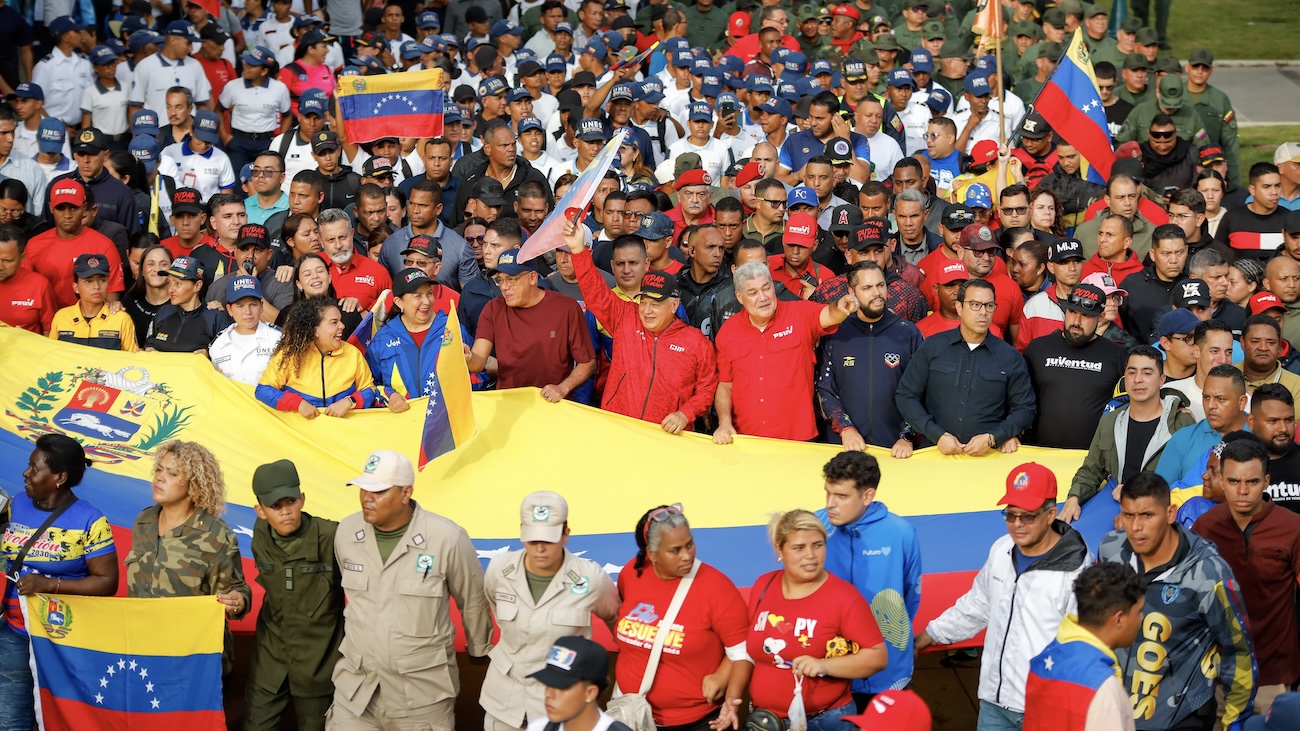
Interior minister and PSUV leader Diosdado Cabello leading a mass demonstration in Caracas on Nov. 25, 2025. Photo: Francisco Trias

On Dec. 16, the Trump administration announced a “total and complete blockade of all sanctioned oil tankers going into, and out of, Venezuela.” This act of war represents a major escalation in Washington’s campaign to overthrow the government of President Nicolás Maduro and seize control of Venezuela’s vast oil reserves and other natural resources.

In his announcement on social media, Trump declared that Venezuela is “completely surrounded by the largest Armada ever assembled in the History of South America,” threatening that “it will only get bigger, and the shock to them will be like nothing they have ever seen before.”

The administration demanded that Venezuela “return” its oil, land and other assets to the United States — a grotesque claim that exposes the purely colonial nature of this military campaign. Venezuela has stolen nothing from the United States. What the administration calls “theft” is simply Venezuela’s lawful assertion of sovereignty over its own natural resources and its refusal to allow U.S. corporations to control its economy.

Trump designated the Venezuelan government a “Foreign Terrorist Organization,” dispensing entirely with earlier pretenses that the military campaign aims to combat drug trafficking. This is naked imperialism: Washington demanding that a sovereign nation hand over its resources at gunpoint.

Massive military buildup

The Pentagon has deployed more than 15,000 troops, a dozen warships including the aircraft carrier USS Gerald R. Ford, F-35 stealth fighters and EA-18G Growler electronic warfare jets to the region. This represents the largest U.S. military mobilization in the Caribbean since the 1962 Cuban Missile Crisis.

The administration has already established a de facto blockade. U.S. forces seized a Venezuelan oil tanker last week and have killed at least 95 people in 25 separate strikes on boats since early September. On Dec. 15 alone, the military announced strikes on three more vessels in the Eastern Pacific, killing eight people.

The most brutal of these attacks occurred on Sept. 2, when U.S. forces carried out four separate strikes on a single vessel. The first strike killed nine people on board. As the smoke cleared, two survivors clung to the hull of the capsized boat. A second strike deliberately killed both survivors. The third and fourth strikes sank the vessel.

Defense Secretary Pete Hegseth, who was reported to have issued a verbal instruction to “kill everybody,” has refused to release video footage of this massacre, citing “long-standing Department of Defense policy” against releasing classified operational footage.

Economic warfare

A naval blockade constitutes an act of war under international law. The blockade announcement aims to cut off Venezuela’s primary source of revenue by preventing overseas oil sales, primarily to China. Venezuela holds the world’s largest proven oil reserves — more than 300 billion barrels.

The economic strangulation is already taking effect. Following last week’s tanker seizure, four supertankers originally headed for Venezuela reversed course. Venezuela’s supply of dollars — almost all tied to crude sales — has fallen 30% in the first 10 months of 2025. Annual inflation is expected to top 400% by year’s end.

Colonial plunder strategy

These threats against Venezuela form part of a broader imperialist strategy outlined in the administration’s National Security Strategy released last month. The document proclaims a “Trump Corollary” to the Monroe Doctrine, declaring that the United States will “deny non-Hemispheric competitors the ability to. … own or control strategically vital assets, in our Hemisphere.”

The strategy explicitly identifies Latin America’s “strategic resources” — including oil and critical minerals — as targets for “acquisition and investment opportunities for American companies.” This is colonial plunder presented as national security policy.

Bipartisan war drive

Both major parties support this march to war. The Democratic Party has refused to oppose the administration’s preparations for regime change. When asked about opposing regime change in Venezuela, the Senate Democratic leadership expressed support for Maduro’s ouster, merely wishing he would “flee on his own.”

Last week, Democratic and Republican congressional leadership joined together to pass the largest military budget in U.S. history — over $1 trillion when combined with supplemental funding. A House vote is scheduled for Dec. 18 on a war powers resolution that would require congressional authorization before launching war on Venezuela, but passage appears unlikely given bipartisan support for regime change.

Venezuela responds

The government of President Nicolás Maduro has mobilized its military in response to Washington’s warmongering, denouncing Trump’s announcement as a “grotesque threat” aimed at “stealing the riches that belong to our homeland.”

The Venezuelan people have every right to defend their sovereignty and their resources. Working people in the United States must oppose this criminal war drive and stand in solidarity with Venezuela and all of Latin America against U.S. imperialism’s campaign to reduce the entire hemisphere to colonial domination.

Strugglelalucha256


Honduras on the edge: Xiomara Castro calls for popular mobilization to confront U.S.-backed coup plot

Dec. 17 — After a five-day hiatus and more than two weeks since the elections, the Honduran National Electoral Council (CNE) has resumed counting votes in an electoral process that has been widely questioned by various political forces on the left and right in Honduras. According to the CNE, several technical problems are hindering the count.

According to official data, the candidate of the National Party of Honduras (PNH), right-wing Nasry Asfura (backed, among others, by US President Donald Trump) maintains a slight but sustained lead (40.53%) over television presenter Salvador Nasralla of the Liberal Party of Honduras (PLH) (39.21%).

Thus, Asfura would have 1,302,264 votes in his favor, while Nasralla would have 1,258,580. For her part, the ruling party’s candidate, leftist Rixi Moncada of the Liberty and Refoundation Party (LIBRE), obtained 19.3%.

Moncada and LIBRE denounced that the electoral process was marred by foreign interference (pressure from Trump) and irregularities in the process. But it is not only the ruling party that has severely questioned the elections.

Nasralla denounces “fraud”

Candidate Nasralla said in an interview with CNN that “fraud in the vote count” had been committed: “Today they are stealing from the place where the ballot boxes with the votes are located. Representatives of the National Party turned off the cameras and prevented representatives of the Liberal Party from entering.”

He also directly accused the PNH, which governed Honduras between 2010 and 2022, of being behind a possible fraud plot: “[The CNE] must review vote by vote the ballot boxes that we have claimed from the Liberal Party of Honduras, which are more than 14,000 (2,773 in a special count that begins today at 7 a.m.) of the 19,167 in which they cheated. If they do not, voters in Honduras and around the world will know that the Honduran elections are not decided by the people with their votes, but by the organized crime that ruled from 2010 to 2022.”

Likewise, a congressional commission has severely questioned the way in which the vote count has been conducted and announced that if the irregularities are proven, they will not validate the November 30 election: “We denounce the existence of an ongoing electoral coup… We absolutely condemn the interference of US President Donald Trump.”

Defense of the results

For its part, the observer mission of the Organization of American States called for the recount to resume immediately. “The mission urgently calls on the electoral authorities to immediately begin the special recount and to seek all possible means to obtain the official results in the shortest time possible… The current delay in processing and publishing the results is unjustifiable,” said Eladio Loizaga, head of the mission, during a special session of the OAS Permanent Council.

The President of the CNE, Ana Hall, defends the actions of the institution she presides over and affirms that the highest electoral body is being intimidated: “Today, I have ratified that I reject the intimidation tactics that are being used and that I will stand in the way of those who seek to prevent the declaration of the General Elections.”

The specter of fraud

Candidate Asfura, who currently holds a slight lead, has requested that the review of the records be made public and televised: “Let there be no doubt about the results, [so that the new government] can work in peace and tranquility.”

Asfura knows that the delay in officially announcing the results, in addition to allegations of fraud by his two main opponents, undermines the legitimacy of his possible victory. It is one thing for one of Honduras’ three major political parties to reject the results. It is quite another for two parties, which together account for almost 60% of the votes cast, to do so.

It has not been many years since a large part of the political spectrum denounced alleged electoral fraud in 2017 that gave victory to Juan Orlando Hernández (2014-2022) of the PNH, the same party that today supports Asfura. After the elections, there were major demonstrations that left dozens injured and several dead. Despite this, Hernández took office as president and completed his term after a series of questions about the persecution of left-wing leaders.

After his term, Hernández was investigated, charged, and sentenced to more than 40 years in prison in the United States for being part of a drug trafficking network that allegedly trafficked several tons of drugs into the country. Despite this, Trump pardoned Hernández, who is currently out of prison in the United States.

President Castro denounces attempted coup

According to Honduran President Xiomara Castro, Juan Orlando Hernández’s release could have more serious implications. As she stated in X, Hernández’s upcoming entry into the Central American country is intended to launch a “coup d’état”: “I report with historical responsibility that, based on verified intelligence information, Juan Orlando Hernández, pardoned in the US, is planning his entry into the country to proclaim the winner of the elections while an attack is underway aimed at breaking the constitutional and democratic order through a coup against my government.”

She also called on the Honduran people to defend the Republic and the constitutional order: “In light of this grave situation, I urgently request the conscious and peaceful support of the Honduran people. I call on the people, social movements, collectives, grassroots organizations, activists, and citizens to gather urgently and peacefully in Tegucigalpa to defend the popular mandate, reject any coup attempt, and make it clear to the world that a new coup is brewing here.”

Several demonstrations by LIBRE activists and other social movements have taken place. In response, the police have deployed heavy-handed repression, which was condemned by Castro, who has requested an investigation and the dismissal of the law enforcement officers who participated in the repression.

Source: Peoples Dispatch

Strugglelalucha256


U.S. expands military encirclement of China across the Pacific

At a Pentagon meeting on Dec. 10, U.S. Secretary of War Pete Hegseth and his counterparts from Australia and Britain pledged to move “full steam ahead” with AUKUS, a trilateral military pact through which the United States is turning Australia into a forward operating base and nuclear-submarine hub for a potential war on China.

In a joint statement, the three governments made clear the pact is about accelerating war preparations — building bases faster, expanding military staffing and pushing weapons development at full speed. 

The announcement came as the United States deployed a pair of nuclear-capable bombers to patrol the Sea of Japan, escorted by Japanese fighter jets. 

One day earlier, on Dec. 9, China and Russia carried out their 10th joint air patrol. The operation involved Russian and Chinese bombers, escorted by fighter jets and early-warning aircraft, flying over the Sea of Japan and the East China Sea. The formation passed through the Miyako Strait, a narrow gap between Okinawa and Miyako Island that serves as one of the main exits from China’s coastal waters into the Pacific.

The Miyako Strait matters because China’s long coastline does not actually open directly onto the Pacific Ocean. Instead, China’s coast borders a series of shallow, semi-enclosed seas — the Yellow Sea, the East China Sea and the South China Sea — that are hemmed in by a chain of islands controlled by U.S. allies. Japan, Okinawa, Taiwan and the Philippines form what U.S. military planners call the “first island chain,” a barrier separating China’s coastal waters from the deep ocean beyond.

To reach the open Pacific, Chinese ships and aircraft cannot simply head east. They must pass through a small number of narrow gaps in this island chain. The Miyako Strait — a wide passage between Okinawa and Miyako Island — is one of the few routes large military formations can use without entering another country’s territorial waters. The corridor is international waters, even though the surrounding islands are controlled by Japan.

That makes the strait a choke point. When Chinese forces pass through it, they are not violating any law. They are moving from shallow coastal waters into deep ocean — the same waters U.S. submarines and carrier groups routinely operate in. U.S. and Japanese forces monitor these passages closely because control of them allows Washington and its allies to contain China’s navy close to its coast and limit its ability to operate beyond the region.

This is why flights and patrols through the Miyako Strait draw such attention. They are treated as extraordinary not because they are illegal, but because they challenge a military setup designed to keep China boxed in while U.S. forces move freely across the Pacific.

For Washington, this is also why AUKUS matters: Nuclear-powered submarines based in Australia are meant to operate on the far side of this island barrier, reinforcing U.S. control of the deep Pacific while keeping China’s navy confined close to its coast.

Japanese officials denounced the joint China-Russia air patrol as a “demonstration of force,” even though it was a routine operation — the 10th such patrol the two countries have conducted together. The flight remained in international airspace, along routes regularly used by U.S. bombers near China’s coastline. U.S. bombers fly these routes routinely without controversy. When China and Russia do the same, it is treated as a threat and used to justify more U.S. military deployments.

Washington’s answer came the following day. Two nuclear-capable B-52 bombers were deployed to the Sea of Japan, escorted by Japanese fighters, in an operation Japan’s Defense Ministry described as a warning against challenges to the “status quo” — meaning continued U.S. military dominance in the region.

Earlier this month, Japanese Prime Minister Sanae Takaichi declared in parliament that a conflict over Taiwan — which is part of China under international law and the One China policy — would constitute an “existential threat” to Japan, effectively aligning Japan’s government with U.S. preparations for military confrontation with China. Beijing condemned the statement as interference.

The danger does not come from any single patrol, but from the political shift by the U.S. Earlier this year, the U.S. State Department removed the phrase “we do not support Taiwan independence” from official policy statements, signaling a shift away from even rhetorical adherence to the One China framework. Combined with Japan’s declaration that Taiwan constitutes an “existential threat,” Washington and Tokyo are moving toward military intervention over Taiwan — steps that sharply raise the risk of war.

These developments in Northeast Asia are tied directly to events further south. AUKUS is part of the same buildup. Announced in 2021 as a security partnership, it has become a channel for pouring government money into militarization. Australia alone has committed an estimated $368 billion to the pact over its lifetime — far more than it spends on housing, health care or climate protection — with Washington now demanding even higher military spending.

Chinese leaders have described this strategy as “containment, encirclement and suppression” — a description borne out by the expanding bases, bomber patrols and alliance commitments now taking shape across the Pacific.

Strugglelalucha256


Struggle ★ La Lucha PDF – December 15, 2025

Get PDF here

  • Trump pardons drug tracker, declares war on Venezuela
  • Louisiana communities organize rapid response to ICE terror raids
  • Historic 103-mile march demands freedom for Mumia Abu-Jamal
  • It’s about making trans people unemployable
  • Garbage in the White House, Somali resistance in Minneapolis
  • Through snow and racist threats: Baltimore to DC march demands reparations
  • The Main Street recession
  • Feeding the Pentagon, starving the poor: Class politics of the 2025 U.S. budget
  • ‘Kill everybody’: War crimes in the Caribbean expose imperialism in crisis
  • Inside a Venezuelan commune resisting U.S. economic war
  • Trump’s culture war is class war
  • Trump’s oil theft is an act of war on the Caribbean
  • Pentagon GPS jamming blocks Venezuela peace conference delegates
  • LA teach-in exposes U.S. war lies on Venezuela
  • 65 U.S. cities mobilize against war on Venezuela
  • Venezuela’s People’s Assembly: Building socialism through communes
  • International workers build ‘people’s embargo’ against Israeli genocide
  • NYC rises for Gaza on Day of Solidarity
  • Trump’s ‘peace plan’ is a war plan for Ukraine
  • History is still absolving Fidel Castro
  • Rafael Ithier fundador del Gran Combo de Puerto Rico, ¡Presente!
Strugglelalucha256


How the U.S. lost its chip war on China

When the White House quietly approved renewed exports of Nvidia’s H200 AI accelerators to China — with a 25% fee attached — it marked more than a policy adjustment. It marked the effective collapse of Washington’s semiconductor containment strategy. 

After years of escalating export controls, sanctions, and alliance pressure, the United States is now conceding what the chip war made clear: China cannot be technologically frozen, and U.S. monopoly control over advanced technology is no longer enforceable.

According to Bloomberg, the decision was driven by internal concern over Huawei’s accelerating progress in AI hardware and systems. The administration framed the move as a way to preserve U.S. “tech stack dominance,” but the reality is more revealing. 

Washington is retreating from an unwinnable attempt to enforce technological monopoly control, while trying to slow China’s exit from U.S.-controlled software ecosystems, especially Nvidia’s CUDA platform.

This was never about national security. It was always about preserving imperialist monopoly power.

From “Pivot to Asia” to technology war

The semiconductor war did not emerge overnight. It is the culmination of a decade-long imperialist containment strategy aimed at China’s rise. The Obama administration’s 2011 “Pivot to Asia” laid the groundwork, repositioning U.S. military forces around China while signaling the end of unconditional economic engagement. What began as military encirclement soon expanded into economic and technological warfare.

Under Trump, that shift became explicit. Tariffs were imposed. Chinese technology firms like Huawei and ZTE were sanctioned. Access to critical components was cut off. Under Biden, the same strategy was deepened and systematized. Export controls widened. Military alliances such as AUKUS and the U.S.–Japan–South Korea pact fused technological restrictions with strategic encirclement. The semiconductor industry became the central front.

Publicly, these measures were justified as defensive. In practice, they were aimed at preserving the monopoly foundations of the imperialist system. For decades, U.S. power rested on its ability to dominate new technologies long enough to extract enormous super-profits before competitors could catch up. China’s rapid movement into advanced manufacturing, telecommunications, renewable energy, and AI threatened to close that monopoly window.

The chip war was launched to keep it open.

Weaponizing the global supply chain

Washington’s strategy relied on turning the global semiconductor supply chain into a weapon. Because the U.S. historically dominated chip design, software, and key intellectual property, it believed it could enforce obedience far beyond its borders.

Export controls targeted advanced AI processors such as Nvidia’s H100 and H200. The Foreign Direct Product Rule asserted U.S. control over foreign-made products that rely on U.S. technology, forcing companies like TSMC and ASML to comply or lose access to critical tools and markets. Allies were pressured to abandon profitable Chinese markets. Scientific collaboration was restricted. Investment flows were blocked.

The globalized system of production — once celebrated as efficient — was transformed into a gated hierarchy with Washington as rule-maker and enforcer. But this strategy carried an internal contradiction. The same interdependence that gave the U.S. leverage also made it vulnerable to blowback.

That blowback came quickly.

China’s response: planning, scale, and technological sovereignty

China did not respond to the chip war with panic or retreat. It responded with long-term planning tied to production. The confrontation exposed a fundamental clash between two systems: monopoly-finance capitalism and state-led socialist development.

In the United States, AI became a speculative asset. Investment was driven by hype, stock prices, and Pentagon contracts. In China, AI was treated as infrastructure — something to be integrated into manufacturing, logistics, energy systems, and national planning.

Huawei’s progress illustrates this difference. Its Ascend 910C chips are not replicas of Nvidia’s best products, but they are increasingly competitive. The CloudMatrix 384 system compensates for efficiency gaps through scale and coordination, deploying 384 chips in tightly integrated clusters. Huawei has successfully substituted quality (Nvidia’s superior individual chips) with quantity (CloudMatrix’s massive chip clusters), resulting in a system performance that approaches Nvidia’s best in key workloads.

This is not engineering shaped by quarterly profit targets. It is capacity built through long-term state planning and coordination.

U.S. officials reportedly concluded that Huawei could produce millions of Ascend accelerators within a few years. That realization stripped export controls of their force. Instead of stopping China’s advance, containment sped the drive toward domestic production.

The second China shock

The consequences extend far beyond semiconductors. China’s advance represents a second China shock. The first, beginning in the 1990s, followed China’s integration into global supply chains, when U.S. and multinational capital reorganized production internationally — entire industries relocated, millions of jobs disappeared, and working-class communities in the United States were devastated. This second phase marks a break from that pattern. It is centered on China’s own advanced industrial and technological development, not on serving as a manufacturing platform for Western capital.

Chinese firms now lead or dominate in key sectors once assumed to be permanent strongholds of imperialist capital. Huawei in telecommunications. BYD in electric vehicles. CATL in batteries. DJI in commercial drones. Tongwei in solar manufacturing. They strike directly at the monopoly profits that sustained Western dominance.

According to data released on Dec. 1 by the Australian Strategic Policy Institute, Chinese institutions now lead research output in 66 of the 74 critical technologies it tracks — nearly 90% of the fields assessed. The United States leads in only eight. China’s research dominance spans areas central to modern industrial power, including nuclear energy, synthetic biology, small satellite systems, and cloud and edge computing.

This represents a reversal from the early 2000s. At that point, U.S. institutions led the overwhelming majority of advanced research fields, while China accounted for only a small fraction. Over the past two decades, that balance has flipped. China’s lead in cloud and edge computing, in particular, reflects the priority placed on deploying AI at scale — integrating research directly into production, logistics, and infrastructure rather than treating it as a standalone laboratory exercise.

This is why the chip war mattered. It was never just about semiconductors. It was about whether the United States and other imperialist powers could still decide who builds the most advanced technology, who gets access to it, and who does not.

The answer is no. The ability to plan, scale up production, and put technology to work now lies outside their control.

Blowback at home and abroad

The attempt to weaponize global production inflicted serious damage on the United States itself. Reshoring initiatives faltered. TSMC’s Arizona fab — marketed as a symbol of “tech sovereignty” — became a case study in dysfunction, plagued by delays, disputes with U.S. unions over staffing, training, and work practices, and soaring costs. Engineers ultimately had to be flown in from Taiwan to retrain U.S. workers on basic fabrication protocols, exposing the lack of a trained industrial workforce after decades of deindustrialization.

Allied governments and corporations were forced into impossible positions. Companies in South Korea, Japan, and Europe were compelled to sacrifice profits and market access in China for a strategy that primarily served U.S. geopolitical aims. Rather than consolidating control, Washington imposed real economic costs on allied states and corporations, forcing them to absorb losses in markets, supply chains, and investment.

Globally, countries began diversifying away from U.S.-controlled supply chains. The open weaponization of technology made clear that dependence on U.S. systems carried political risk. Claims of a “rules-based order” rang hollow when rules were rewritten at will.

Inside the U.S., the policy fueled a growing military-digital complex. Government money flowed to tech monopolies and defense contractors while social needs went unmet. Even Biden warned of the emergence of a new military-tech complex, in which Big Tech is fused with the armed and intelligence apparatus, concentrating technological and coercive power.

The chip war did not revive U.S. industry. It exposed its fragility.

Nvidia, CUDA, and a strategic retreat

This is the context in which the Nvidia decision must be understood. Allowing H200 exports to China is not a clever compromise. It is a retreat shaped by failure.

Washington is trying to keep Chinese AI firms tied to Nvidia’s CUDA software, slowing the shift toward domestic and open-source alternatives such as Huawei’s CANN. By blocking access to Nvidia’s newest Blackwell chips while allowing sales of the H200, the U.S. is holding back the most advanced hardware while maintaining dependence on U.S.-controlled systems.

Yet even this goal is tenuous. Chinese firms have already demonstrated the ability to train highly capable AI models with fewer resources. Systems such as DeepSeek matched the performance of leading U.S. models by emphasizing training efficiency and better use of available hardware rather than sheer computing scale, undercutting the assumption that restricting access to top-tier chips would halt progress. As domestic hardware continues to improve, software dependence will erode as well.

U.S. export controls were meant to slow China’s access to large-scale AI computing power long enough to give U.S. firms a decisive head start. But China continued advancing anyway — through domestic chip development, scale, and more efficient use of computing resources. As that gap narrowed, the value of strict controls became increasingly uncertain. Faced with the prospect that the restrictions might not stop China but would certainly cut off U.S. corporate profits, Washington chose to reopen exports. In doing so, it accepted a weaker, less durable form of influence in exchange for continued market access.

The end of monopoly enforcement

The chip war’s outcome is now clear. The United States did not fail because of a single mistake. It failed because the strategy itself was flawed. Imperialist monopoly capitalism cannot outplan a system organized for long-term development. Coercion cannot substitute for production. Sanctions cannot replace planning.

By attempting to freeze China’s development, Washington accelerated it. By weaponizing interdependence, it undermined its own position. By prioritizing monopoly profits, it weakened its industrial base.

The reopening of Nvidia exports is not a reset. It is an acknowledgment that the old model of technological domination no longer works. The era when the United States could dictate the terms of global technological development through choke points and monopolies is ending.

What comes next will not be decided by chips alone. It will be decided by which social system can organize production, labor, and technology to meet real needs over time. On that terrain, the chip war has already delivered its verdict.

 

Strugglelalucha256


At Army–Navy game, activists confront Trump over Venezuela

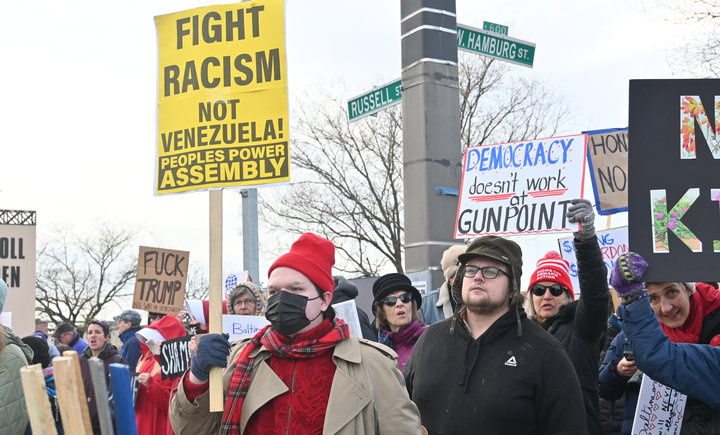
Baltimore, Dec. 13 — Activists shifted the spotlight from the pageantry of the Army–Navy game, using Donald Trump’s attendance as a platform to center a powerful demand: “No war on Venezuela.”

Hundreds lined the streets outside the stadium where Trump was scheduled to appear, unfurling banners that read, “No war on Venezuela and Palestine” and “No to ICE — Money for jobs, education, and health care.”

Andrew Matatag, representing the publication Struggle-La Lucha, drew a sharp contrast. “Almost every police agency on record — from the Secret Service to Homeland Security — is amassed here today to protect Trump,” he said. “Meanwhile in Venezuela, President Maduro freely appears and speaks in community meetings with residents, including our own reporter, John Parker.”

“We saw the helicopters that transported Trump to Fort McHenry before he was whisked away to some back door of the stadium — far away from our demands to address Baltimore’s need for adequate food, housing, and jobs,” declared Colby Byrd, who led chants through a megaphone. “Instead, we see trillions for the Pentagon.”

Baltimore2

Protesters noted the sparse mainstream media coverage but were energized by the unity and spirit of the diverse groups who braved the cold to ensure their opposition was heard.

The demonstration was organized by the Peoples Power Assembly, Free State Coalition, Indivisible, and the Struggle for Socialism Party.

Strugglelalucha256


Immigrant youth lead anti-ICE protests in south Louisiana

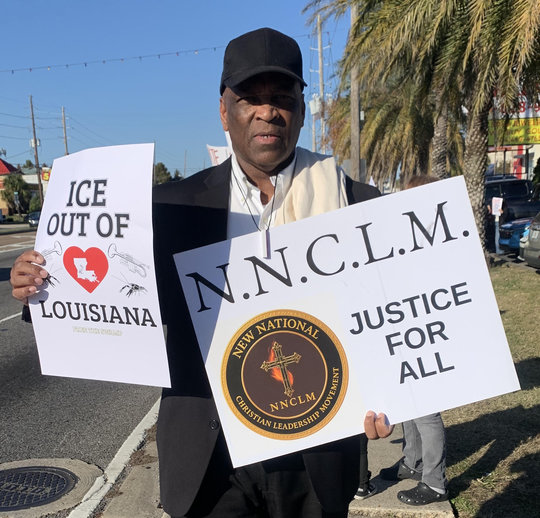
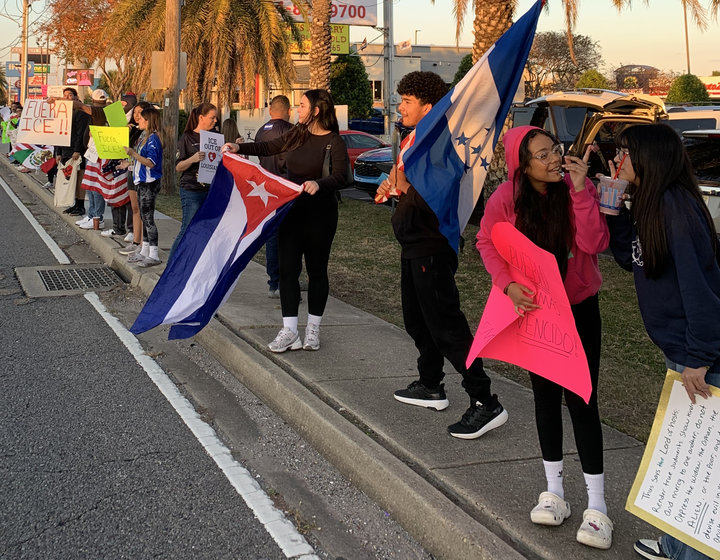
Kenner, Louisiana, Dec. 13 – Around 75 people rallied for immigrants’ rights along busy Williams Boulevard in Kenner. This Jefferson Parish town is about 30% Latine and has become a focal point of Donald Trump’s ICE invasion. 

The diverse crowd stayed out for over two hours. Youth played a prominent role, often leading chants and keeping the energy up. One of the most popular chants was simple and direct: “!ICE fuera!” or “ICE out!” The response from passing drivers was overwhelmingly positive. 

When asked who organized this action, several people said that community members who are not known activists were the driving force, putting out the call because they are ready to fight back. New people are being drawn into the struggle.

Kenner4

But several organizations participated. These include Unión Migrante, New National Christian Leadership Movement, and the Louisiana branches of Freedom Road Socialist Organization and the Party for Socialism and Liberation.

At least two additional anti-ICE demonstrations happened today within New Orleans city limits. And about 40 miles northeast of New Orleans in the town of Slidell, dozens protesting against ICE terror lined Gause Boulevard near the intersection with Front Street. They did the same yesterday and plan to be out again tomorrow. As in Kenner, youth are playing a leading role. A participant told SLL:

“Both sides of the street were filled. … It was great to see those kids out protesting. Even though my mom heart felt very protective.”

Kenner2

Strugglelalucha256


Trump’s culture war is class war

Trump and the Kennedy Center Honors

With all the other crises going on, it may seem silly to even pause and think about President Donald Trump hosting the Kennedy Center Honors on Dec. 2. But the fact that this happened tells us a few things. 

One is that the U.S. government’s authoritarianism is deepening: The executive branch – Trump – is trying to directly interfere in popular culture, even in a capricious and personal way (though always in the service of rich elites). The second is that there is a real assault on our very memory of the past, on who and what gets remembered, as well as how they are remembered. This is an escalation of the so-called “culture war,” using political power to intervene on the side of reaction.

Culture is important. As SLL writer John Parker reported this week from Venezuela, “Fidel Castro and many African liberation and Indigenous leaders recognized culture as the ruling class’s primary tool of ideological control — denying the oppressed and working class the ability to think independently, distracting them and directing them toward their own disempowerment.”

Trump’s authoritarian interventions in the media are glaring. For example, as with other legally independent government agencies, Trump has placed loyalists in the Federal Communications Commission (FCC). That agency regulates communications, including the internet and television. He also called for the firing of late-night TV host Jimmy Kimmel, who was fired by ABC but then rehired following public outrage.

As soon as his second term started, Trump began remaking the Kennedy Center for the Performing Arts. He fired the board members, and the replacements he brought in immediately put him in charge of the institute. This is unprecedented. At a Kennedy Center press conference back in August, Trump boasted that he was “very involved” in selecting the honorees and that he said no to “a couple of wokesters.” Hosting the awards was the final touch.

These awards are given to artists and entertainers for lifetime contributions. It’s about legacy. It’s another question why specific people made the list: disco artist Gloria Gaynor, action star Sylvester Stallone, or the rock band KISS. But based on Trump’s press conference statement, we can assume that someone like television maverick Norman Lear, an honoree in 2019, would not have made the cut in 2025. 

So classic TV was ‘woke’?

Lear, who died at 101 in December 2023, wrote for, produced, or developed over 100 shows. He is primarily known for introducing political and social themes to sitcoms in the 1970s. 

There’s a decent chance that if you ask someone who grew up in the U.S. to name a few ‘70s sitcoms, at least one of them will be Norman Lear’s. There’s a good chance that they’ll name more than one. The list includes some of the most popular shows of the period: “All in the Family,” “Maude,” “Sanford and Son,” “One Day at a Time,” “The Jeffersons,” and “Good Times.”

These shows tackled subjects like hate crimes against the queer community, drag, abortion, and many more, decades before the manufactured furor over drag story hour and beer commercials. Some shows featured interracial relationships. Hell, just the fact that several of these shows centered on Black families was groundbreaking. That wouldn’t have happened just a few years earlier.

These developments didn’t just stem from Lear’s genius. They were part of the zeitgeist. The 1960s-70s were a progressive era when people’s struggles were making gains. Culture – including pop culture – reflected that. The struggles made these shows possible.

Of course, none of this was perfect. Some Black writers and actors involved in these shows say that they were sidelined and have not received the full credit that they are due. Black screenwriter Eric Monte was a co-creator of multiple of these shows, such as “Good Times” along with “Good Times” actor Mike Evans. (Evans is best known for playing Lionel on that show.)

Likewise, the white actress Sally Struthers – who was 24 when she began playing Gloria in “All in the Family” – recently claimed that Lear did not take her seriously and was often rude to her, and that the mostly older male writers did not know how to write for her character; when they didn’t know what to do with her, they gave her lines like “I’ll set the table, ma” and “I’m going upstairs to wash my hair.” The contradictions in society play out in cultural production. 

But again, looking beyond Lear, another indicator of the zeitgeist was “Sesame Street,” which first aired in 1969. The radical underpinnings of the show may be lost on many today. It was an ambitious experiment: Make children’s education available to the masses through public television. (The federal Head Start program to help poor and working-class preschoolers began in 1965. “Sesame Street” aimed to do the same thing through a different medium.) The show featured Black, Latine, white, and other characters in an inner city environment. In the beginning, Mississippi officials refused to air the show because of its multiracial cast!

Archie Bunker not a MAGA prototype

One of my social media pet peeves are the rightwing memes depicting the dads Archie Bunker and George Jefferson (of “All in the Family” and “The Jeffersons,” respectively), with captions like, “TV back when people weren’t offended by everything.” This fundamentally misrepresents what these shows were about.

Archie Bunker is not the prototype of the MAGA culture warrior. The latter always digs in and is actively helping to push back the progress of people’s struggles. Archie Bunker, a loading dock worker who also worked part-time as a cab driver to make extra money, is a working-class character from a different era. Projecting MAGA values onto him is wrong. 

Yes, he is an older white man with oppressive social baggage. He is bullheaded. But he does not have the sociopathic cruelty celebrated by MAGA. When confronted with situations he doesn’t understand, like Black neighbors moving in (the Jeffersons), he eventually starts to come around. 

That is the comedy – the exasperated look on his face when he has to accept something new. He’s the butt of the joke. But at the end of the day, he cares about other people. He learns. Without that human core, the show would hardly have been compelling. This has nothing in common with today’s comedians who intentionally try to offend by punching down at trans people or other oppressed groups.

Archie was part of a world that was progressing. He was along for the ride whether he liked it or not. The present was far from perfect, but movements throughout the country were making strides: women’s power, Black power, Indigenous power, LGBTQ+ power, union power. 

And it wasn’t just the U.S. People’s movements all over the world were racking up victories, like when the Vietnamese people drove out the U.S. invaders and reunified their country.

The fictional world of “All in the Family” mirrored society in the real world. And the changes happening in the real world – the high tide of people’s struggles through the 1960s and ‘70s – made such a show possible. 

The right wing wants us to forget

Right now, Trump is leading a colossal attack on the working class, helping to transfer more and more wealth to the top. His movement, which is controlling the government, is especially lashing out against immigrants and trans people, trying to divide people up so they can’t fight back. 

If there is a “culture war,” we must be clear that this war is not just about ideas. It is a manifestation of the class struggle. The assault on progressive culture – representation in pop culture, the teaching of history, and more – is part of the broader assault on people’s movements; it is about reversing real gains made by those struggles.

They want us to forget past cultural representations reflecting those struggles because they want us to forget the struggles themselves, and to stop fighting today

When the right wing promulgates the false idea that all of the pop culture of the past was simply reflective of reactionary values, and that only recently have TV series and films begun to explore social problems from a progressive angle, they are reinforcing the false idea that things never changed, and never will change. But the fact that these shows were so popular more than 50 years ago argues to the contrary. 

Strugglelalucha256


Venezuela’s People’s Assembly: Building socialism through communes

Caracas, Venezuela — From Dec. 9-11, Venezuela hosted the Assembly of the Peoples for Sovereignty and Peace of Our America. The gathering aimed to reshape government structures to more directly reflect the will of the Venezuelan people. Central to the Assembly were the communes — organizations designed to place production under the control and direction of workers themselves.

The communes evolved from the co-operatives. Both represent experiments of the Bolivarian Revolution that began in 1999 with the election of President Hugo Chávez. For the first time in Venezuelan history, government priorities centered on the needs of poor and working-class people — victims of centuries of colonialism, neo-colonialism, and imperialism under the Monroe Doctrine, the 1823 U.S. policy declaration that became an ideology justifying the exploitation and theft of Venezuela’s oil, gold, and sovereignty.

The Chávez era: building revolutionary infrastructure

During Chávez’s presidency, Venezuela saw record housing construction and the eradication of illiteracy in the mid-2000s. By 2005, this writer witnessed Cuban doctors establishing clinics in mountain communities that had previously been completely ignored by the government.

At the 2005 World Social Forum, President Chávez declared that humanity’s survival now depended on developing socialism worldwide — that climate catastrophe and poverty threatened human existence, and only the working class could stop the profit-driven imperialist countries.

Like current President Nicolás Maduro, Chávez used culture to inspire. He led delegates in singing “The Internationale.” Today, Maduro often opens conferences with the Bobby McFerrin song “Don’t Worry, Be Happy” — not to encourage apathy, but to meet U.S. imperialist terror and war threats with the calculated confidence of an empowered people.

Reporting from the ground

This writer attended the Assembly as a delegate representing the U.S. West Coast, a member of the Struggle for Socialism Party and the Harriet Tubman Center for Social Justice. At one commune gathering, I got President Maduro’s attention with a message of solidarity. He responded by singing “Don’t Worry…” The encounter was televised.

The conference was organized by the Simón Bolívar Institute with strong representation from youth, African, and Indigenous community organizations. The goal was not only to heal the disempowerment that Spanish colonialism and U.S. imperialism had enforced, but to recover and center the knowledge of these communities.

Presenters reminded attendees about the contributions of the 1804 Haitian Revolution — the first successful slave revolution that inspired enslaved Africans throughout the diaspora, including in North America. That revolution, under the leadership of Alexandre Pétion, president of the Republic of Haiti, provided warriors and military training for Simón Bolívar, who went on to liberate much of Latin America from Spanish colonial rule — from Panama to Colombia, Ecuador, Venezuela, Bolivia, and Peru. All these nations remain targets of U.S. imperialism today.

On Dec. 10, the U.S. seized an oil tanker off the coast of Venezuela carrying fuel to socialist Cuba, making clear the continuing motives of U.S. imperialism.

Trump’s white supremacy vs. Bolívar’s vision

On the second day, Vice President Delcy Rodríguez spoke about the stark contrast between Trump’s white supremacy and class war agenda and Simón Bolívar’s goals of equality and respect for enslaved and formerly enslaved Africans and Indigenous peoples. Bolívar understood their central position in the fight for self-determination and sovereignty. Trump’s plans for renewed colonialism revive the Monroe Doctrine to justify continued theft of Latin American resources and the profits of exploited labor.

Another delegate discussed socialism with a Venezuelan character — the goal of freeing society from dependence on imperialism and developing infrastructure for sustainable production.

That sustainable production, less dependent on global capitalism, was the vision Chávez pursued with passionate respect for Latin American peoples. In Venezuela, over half the population is of mixed (mestizo) African, Indigenous, and European ancestry. To benefit from the wisdom and moral priorities especially visible in African and Indigenous communities — lessons learned through 500 years of brutal repression — Chávez spent much of his presidency visiting previously isolated communities. Like Maduro’s continuing experiments, much of his time was spent listening, learning, and creating structures to ensure greater control by the majority of Venezuelans.

From co-ops to communes: fixing a contradiction

The Co-operatives were an experiment involving tens of thousands of projects intended to place Venezuela’s production more directly under the control of those doing the work, rather than generating profits through private ownership. Simon Bolivar Institute spokespersons explained that the government provided resources and funding to launch community projects. 

Unfortunately, many co-op leaders saw an opportunity to secure government subsidies and appropriate the surplus produced by community workers’ labor. The social surplus — what remained after covering production costs and workers’ needs — was not, as intended, collectively controlled by the community for reinvestment and social priorities. 

The communes were designed to control the direction of production, with community members deciding how profits would be distributed and reinvested. In other words, the means of production would belong to commune members. 

The communes were part of a process to socialize the surplus from the workers in the collectives, discouraging privatization. Said one of the organizers of the Peoples Assembly for Peace and Sovereignty in Our America: “The communes didn’t replace cooperatives. Cooperatives prevailed as organizational attempts for popular power up until 2010. In parallel, Community Councils started to appear in 2008, Social Owned Businesses, started to emerge in 2010, and Communes started to appear in 2012 as alternative ways for people to obtain popular power. In Venezuela, cooperatives exist even today as a form of organization.” The communes have representatives coordinating with the government.

The Bolivarian government committed to being socialist in this manner, with the commune representing the face of Venezuelans and, most importantly, the historically marginalized mixed majority. This model enabled more sustainable production with genuine self-determination. 

There are now more than 4,000 communes in Venezuela, representing more than 13 million people, nearly half of the population.

Many communes are producing more than they receive from the government and can contribute to national needs, paying taxes to support national management, planning, and military defense.

Witnessing decision-making in action

This writer observed the functioning and decision-making process up close at the El Panal Socialist Commune, where members explained they organize according to Marxist-Leninist principles. Committee meetings began with African drums and dance, followed by a roundtable discussion and debate.

Before dismissing the dance, drums, and music as merely supplemental, remember how Fidel Castro and many African liberation and Indigenous leaders recognized culture as the ruling class’s primary tool of ideological control — denying the oppressed and working class the ability to think independently, distracting them and directing them toward their own disempowerment.

When we were encouraged to participate in the dance before discussions and presentations, we learned how different leg movements historically expressed the reality of legs shackled under slavery, with the ball and chain creating a forced limp. That limp was given rhythmic expression in dance movements. This reminded me of how the Irish, under British repression, were forced to keep their dance confined to movement below the waist.

Ryan Coogler did a great job of putting that in the movie “Sinners,” showing the liberating role of dance and music from Africa and Asia to Ireland. There is a scene in that movie that expresses that so well – and made this writer shed a tear. Also, shed a tear when being greeted by the African/Indigenous and predominantly women members of the council in that Commune. I can tell you that when we are hit with the joy of seeing oppressed peoples fighting back with confidence and purpose – and I’m not alone in this – the tears of joy are shared by especially people of color, usually denied in so many seconds of the day.

The Indigenous and African dance we saw at the Commune was a beautiful expression of rhythm and dance and song that are another form of documenting history, and a documentation that was not a surrender – it was taking what you were forced to take from the oppressors and putting your spin on it. A spin that would build your dignity, your way of fighting back, your way of building endurance of mind and body and the confidence to ultimately dance on the graves of the rulers of U.S. imperialism.


Strugglelalucha256


Pentagon GPS jamming blocks Venezuela peace conference delegates

An emergency news conference was held on Dec. 10 at the International Action Center in New York City to protest the latest war moves against Venezuela. The same day, in an act of piracy, U.S. armed forces seized a Venezuelan oil tanker.

Speakers at the news conference denounced the Trump regime’s attempted sabotage of the People’s Assembly for Sovereignty and Peace in Our America. The news conference was chaired by Sara Flounders of the IAC. 

Many delegates planning to attend the peace conference in Caracas were prevented from traveling by the Pentagon’s jamming of Global Positioning System (GPS) signals, which disrupted airline flights to Venezuela. (See: Venezuela sees surge in GPS jamming amid U.S.. military buildup, forcing flight cancellation.)

Some U.S. delegates were able to get through this blockade while others participated in the news briefing. The GPS jamming follows Trump’s illegal declaration of a “no-fly zone” over the Bolivarian Republic of Venezuela, a blatant violation of the country’s sovereignty. So is Trump’s killing of over 80 people in the Caribbean.

William Camacaro, co-founder of the Alberto Lovera Bolivarian Circle in New York, denounced Trump’s actions as criminal. “This is a very critical moment,” said Camacaro, who is also co-founder of the Venezuelan Solidarity Network and co-coordinator of the Alliance for Global Justice. “The only thing we see is aggression.”

Camacaro reminded everyone that María Corina Machado — the corporate media’s darling who was bestowed the Nobel Peace Prize— supported the 2002 coup that tried to overthrow the Venezuelan President Hugo Chávez. 

Suzanne Adely, the president of the National Lawyers Guild, said of her visits to Venezuela, “Every trip was an inspiration.” She described her role as an election observer and denounced U.S. interference.

Drea Sommers, of the National Conference of Black Lawyers, condemned the threats and “outrageous remarks of Trump,” who “has authorized the extrajudicial killing of at least 83 people.” She demanded the investigation of Defense Secretary Pete Hegseth for these crimes.

Same playbook as the CIA coup in Chile

Roger Wareham, a member of the International Secretariat of the December 12th Movement and also a NCBL member, compared the current efforts to overthrow Venezuela’s President Nicolás Maduro with Kissinger’s campaign against Chilean President Salvador Allende.

“Make the economy scream,” said Kissinger, which is what the U.S. has done with its sanctions against Venezuela. Wareham noted the irony of Trump’s hijacking of an oil tanker on International Human Rights Day.

He reminded people of how Venezuela supplied free heating oil to poor people in the United States beginning in 2005. U.S. economic sanctions gradually strangled the program, ending most deliveries by 2010 and shutting it down completely by 2013. 

Wareham told the people of Venezuela, “We got your back.” He emphasized that Nicolás Maduro is the “one and only president of Venezuela.”

Margaret Kimberley of the Black Alliance for Peace and Executive Editor of Black Agenda Report attacked Washington’s efforts to destroy the Venezuelan economy and the stealing of CITGO. She denounced Trump’s efforts to revive the Monroe Doctrine — named after a slave owner — and told Venezuela that “you can’t be friends with China or Russia.”

Corinna Mullin, of the U.S. Peace Council, said although its members were blocked from attending the People’s Assembly in Caracas, “we’re there in spirit.” Other speakers who were blocked from attending included Daniel from the Freedom Road Socialist Organization, who declared, “International solidarity is alive and well.” He emphasized that Nicolás Maduro is the “one and only president of Venezuela.

Also blocked from going to Caracas were Abdullah of the Sudanese Resistance Front and Jonas of MASS — Mutual Aid and Scientific Socialism. Both denounced the war drive against Venezuela. So did a representative of the Palaver Collective.

Despite Trump’s propaganda campaign, 70% of people in the U.S. have said they’re against invading Venezuela. 

Strugglelalucha256
https://www.struggle-la-lucha.org/2025/page/3/