Stop the U.S. campaign to overthrow Venezuela’s Bolivarian Revolution

Recent weeks have seen a marked U.S. escalation against the Bolivarian Republic of Venezuela and its President, Nicholas Maduro. Donald Trump and his generals have significantly increased U.S. naval activity throughout the Caribbean Sea.

Since 1999, the U.S. military and intelligence community have targeted Venezuela for regime change.

A meeting titled “Stop the U.S. Campaign to Overthrow Venezuela’s Bolivarian Revolution” was held in Baltimore on Oct. 1, sponsored by the Struggle for Socialism Party and the People’s Power Assembly.

Following is a transcript of the meeting, edited for length and clarity.

Chair:

To begin our event tonight, we honor Assata Shakur. Let us join together with a chant that prefaced every Black Lives Matter demonstration in Baltimore. So, repeat after me. 

“It is our duty to fight for our freedom! It is our duty to win! We must love each other and support each other! We have nothing to lose but our chains!” 

On behalf of the Struggle for Socialism Party and the People’s Power Assembly, I would like to welcome everyone to tonight’s forum and discussion with Leonardo Flores, Venezuelan political analyst, activist, and founding member of the Venezuelan Solidarity Network. 

Tonight, we also turn our attention to the Global Sumud Flotilla, carrying aid to the starving people of Gaza, which is currently under illegal attack by the Israeli occupation forces. Around 500 volunteers from more than 45 countries are part of the 44 vessel fleet, including European Union members of Parliament, Rima Hassan and Emma Fourreau, Nelson Mandela’s grandson [Nkosi Zwellvelle] “Mandla” Mandela, former mayor of Barcelona Ada Colau, and “Portrait of a Lady on Fire” star Adéle Haenel, and Greta Thunberg. 

The flotilla is carrying hundreds of tons of aid, including medicine, food, baby formula, diapers, and prosthetic limbs to Gaza, where Israel has continued to occupy and starve 2 million Palestinians. Protests are happening everywhere, including Baltimore, where our members have joined with the Palestinian Youth Movement to demand: Hands off the Flotilla. Internationally, Italy’s largest union has called a general strike on Friday in support of Gaza aid. 

Our discussion is critical. The U.S. Pentagon is poised to go to war with Venezuela, a war that will be disastrous not only to the people of Venezuela but to the youth and workers right here at home. We must stop it. Tonight’s discussion will counter the lies and misinformation spread by the media. 

Before I call on Flores, I would like to call on Carrington from the PPA and Struggle for Socialism Party to announce some important upcoming activities. 

Announcements: 

Good evening everybody, sisters, brothers, and siblings. Here is a quick rundown of what we’re up to. This coming Oct. 14, we will be celebrating George Floyd Day. We know the U.S. government passed a bipartisan piece of legislation to honor the racist Charlie Kirk. So we’re flipping it. We’re making it a people’s holiday, George Floyd Day, because it’s also his birthday. 

We also have a film showing, honoring the African revolutionary Thomas Sankara. We’ll be showing “The Upright Man.” Stay tuned for details on when that will be, along with a field trip to the Harriet Tubman Museum on the Eastern Shore. Stay tuned for that date as well. 

We are also currently fighting a campaign to win a city-owned grocery store to end the food desert, specifically in West Baltimore, the Sandtown, Upton, and Harlem Park area, in honor of Bilal Abdullah, the famous Baltimore arabber who was murdered by BPD in June. 

We are also leading a campaign to rename the Francis Scott Key Bridge to the Harriet Tubman and Frederick Douglass Memorial Bridge, and also honor the six workers who lost their lives in the collapse. 

All right, without further ado, we will hear a presentation by Leonardo Flores, followed by a discussion. So, Leo, the floor is yours. 

Leonardo Flores:

A massive military buildup at Venezuela’s doorstep

Let me start off with what’s going on. And it’s that the U.S. has deployed a lot of folk, a lot of ships, and even planes to the Caribbean, just off the shores of Venezuela. There are the latest reports that there are roughly 6,500 troops, dozens of warships, and more planes landing every day in Puerto Rico, where they’re conducting exercises for an amphibious invasion. 

It’s a really, really dangerous situation, and it’s a wild escalation of previous U.S. policy towards Venezuela. But it’s something that we’ve been kind of seeing coming over the last two decades, really, because of this attitude of U.S. imperialism that needs to control and dominate not just Venezuela, but everywhere — everywhere from Caracas to Gaza to Baltimore itself, right? It’s something we all live with every day. 

And so far, the U.S. has taken down at least three ships in Venezuelan waters, killing 17 people. I’ll go into that in a little bit. But before I talk about what’s happening and why they’re actually there, let me talk a little bit about the pretext for this apparent invasion, or this deployment, of the military. 

The ‘narco-terrorism’ pretext

It’s actually the biggest deployment in the Caribbean since at least 1989, when they overthrew Noriega in Panama. So it’s a dangerous situation, and they’re all basing it on this wild theory that somehow Venezuela is responsible for quote-unquote “narco-terrorism.” This idea that Venezuela is somehow flooding the streets of the United States with drugs, and not just with drugs, but with immigrants who aren’t really immigrants. They are terrorists in disguise here to cause havoc in our cities. 

But, you know, when you look into it a little bit, Venezuela has never engaged in any sort of terror attack, never been even linked to any sort of terror attack. So, already half of this pretext is all kind of — you can flush it away because it makes no sense, right? This idea that somehow drug dealers are now terrorists. 

The reality of cocaine production and transit

And when we look at the actual statistics, not just from the UN, but from the U.S. DEA itself, we see that not only does Venezuela produce zero coca leaf, which is the base ingredient for cocaine, it produces zero cocaine. It produces no fentanyl, no chemicals that lead to the production of fentanyl. 

And that’s important because Venezuela has never even been linked to fentanyl. But now, because of what we’re seeing in our cities, is addiction to fentanyl and other opioids, and that’s what people really focus on when we talk about drugs lately. 

And now they’re kind of switching the goalpost, saying, “oh no it’s not Venezuela’s cocaine,” quote-unquote, “it’s fentanyl.” But there’s never been any fentanyl coming from Venezuela, so that’s a very naked excuse, right? 

So, back to these DEA and UN figures. According to both of these institutions, about 5%, only 5%, of the global cocaine transits through Venezuela. So, Venezuela is not a producing country, but it is a country that is next to the biggest producers of cocaine in the world, which happen to be Colombia, Peru, Bolivia, and, to a certain extent, Ecuador. And 87% of this cocaine that’s produced in all of these Pacific coast countries passes through the Pacific. 

We don’t have a map here, but Venezuela doesn’t have a Pacific coastline. So, the bulk of the cocaine is passing through the Pacific. Actually 70%, and this is according to the Ecuadorian government itself, 70% of all the cocaine goes through Ecuador, which has a right-wing government right now. A president whose family owns a banana corporation where, suspiciously, cocaine is routinely found in some of these shipments. Several tons were found in a shipment to Russia just a couple of weeks ago. This is a company that belongs to the president, the right-wing president, of Ecuador. 

And obviously, the other big player in cocaine, which I briefly mentioned, was Colombia, which is not just a major producer, but also a major transit country as well. And just curiously, we know that the U.S. has seven military bases in Colombia. So if it really is a problem of international drug trafficking was one that could be solved by U.S. militarism, which obviously it isn’t because we’ve had this problem for decades now, and the U.S. has spent billions of billions of dollars not just on Plan Colombia, which was this plan to really hit the cartels in Colombia back in the 1990s-2000s, but also the same thing happened with Mexico. And these plans totally backfired, and cartels are stronger than ever in some of these countries. 

But if you’re really concerned about stopping this trade of cocaine, you wouldn’t focus on Venezuela, where only 5% of cocaine exits through, you’d focus on the Pacific. 

The Tren de Aragua myth

On top of this, you have this rhetoric about the so-called Tren de Aragua, which I’m sure some of you have heard of, and the Cartel de los Soles, and let me talk a little bit about both of those organizations. 

So the Tren de Aragua — Trump talked about it a lot on his campaign trail as a way to denigrate migrants and, really, Latinos in general. And in the case of the Tren de Aragua, TDA for short, it’s not even a cartel, but it is a criminal organization where they do kind of murder for hire, and security for cartels, human trafficking. And the really interesting thing is that it surges roughly between 2015 and 2017, when the U.S. economic war against Venezuela was at its peak. And it surges in part because of the threats faced by Venezuela.

They had to move resources away from fighting cartels and fighting organized crime internally to securing the borders because of this threat of invasion. Not just invasion, but really because of the threat of covert operations and mercenaries sneaking into the country to cause terror attacks. Mercenaries are caught there in Venezuela every year. They catch dozens, and I mean mercenaries, not just from neighboring countries, but from Eastern Europe, Western Europe, the United States; it runs the gamut. 

The thing is, Venezuela basically went to war against Tren de Aragua. They had massive major military operations, and the organization was functionally destroyed in Venezuela in early 2023. Since then, the leaders, some of them escaped, and now it’s barely an organization. But criminals use the name because it has a certain cachet, right? Because even the U.S. government is scared of the threat. So if you’re a criminal and you say you’re Tren de Aragua, that all already immediately makes people pause. And so that’s what we’re seeing now is more and more criminal organizations adopting this name to build on its rep, or to gain from the reputation of a cartel that barely exists. 

On top of this, we had the U.S. government saying repeatedly that there’s this really massive coordination between Tren de Aragua and the Venezuelan government. And yet the U.S. itself doesn’t believe that. 

I’m going to read a quote from a National Intelligence Council memo that was leaked in April. This memo says, and I’m going to read three quotes, the first one is: 

“The Maduro regime probably does not have a policy of cooperating with Tren de Aragua and is not directing Tren de Aragua movement to and operations in the United States. Venezuelan intelligence, military, and police services view Tren de Aragua as a security threat and operate against it in ways that make it highly unlikely that the two sides will cooperate in a strategic or consistent way. Venezuelan security forces have periodically engaged in armed confrontation with Tren de Aragua.” 

So even the U.S. intelligence services understand that Tren de Aragua is a threat not just to the United States, to some extent, but to Venezuela, and that Venezuela has been dealing with it. 

But then on the other side, you have Marco Rubio and the Cuban right-wing extremists within the U.S. government who are pushing this narrative that there’s somehow a big tie between the Maduro government and the Tren de Aragua. And that’s their pretext for wanting to undertake regime change in Venezuela. And not only that, but of course we’ve seen how Venezuelan migrants and really Latin American migrants in general have been really slandered with these allegations that they’re all criminals, that they’re somehow tied to transnational organizations or the Tren de Aragua. 

And so far, roughly 8,000 people have been deported from the United States to Venezuela over the past year. Only one person was found to have a Tren de Aragua connection, and they were immediately arrested upon arriving in Venezuela. Only 2% of all those 8,000 people, supposedly all criminals that ICE has been going after, only 2% ever had a criminal record in Venezuela. And instead, the United States is not only deporting these people in horrible ways, sending them to Alligator Alcatraz or the torture prison in El Salvador. Thankfully, the Venezuelans are gone from there, but there are still 3,000 to 5,000 people in El Salvador left in this horrible torture prison. 

And you have families being separated, dozens of children, Venezuelan children here in the U.S. in foster care while their parents are back in Venezuela, with no real way to reunite them easily, because there’s no Venezuelan embassy here in the United States anymore. 

Even the DEA and its national drug threat assessment — this is a yearly report that the DEA publishes. This is a quote: “Tren de Aragua conducts small-scale drug trafficking activities.” So they’re pitched by the Trump administration as being this major cartel that’s flooding the streets of the United States with either fentanyl or cocaine. And yet the DEA doesn’t consider them a cartel. And it says that they are small-scale drug traffickers. 

Obviously, this is just pure propaganda that we’re supposed to accept. And we’re not even supposed to check on it, because if you look at the DEA’s own website, it clearly states that they don’t consider them to be a cartel and that their activities are small-scale. 

The fictional “Cartel de los Soles”

When it comes to the Cartel de los Soles, which translates to the “cartel of the suns,” this one’s even more ridiculous because this is a totally fictional cartel. It doesn’t exist at all. 

The first reference that you ever saw to something even close was the so-called Cartel of the Sun. This was actually a CIA operation in 1993. And I recommend that you Google “the CIA’s cocaine.” It’s from 60 Minutes. It’s a segment that they did back in 1993 where they detail how the CIA, with the help of this Venezuelan brigadier general in the National Guard, wanted to so-called infiltrate the Colombian cartels by smuggling cocaine through, from Colombia, through Venezuela, to the United States. Tons and tons of cocaine, generating millions of dollars for the CIA and for this general. It’s called “the CIA’s Cocaine.” 

And so then jump forward 20 years, or in 2005, there’s an article with an anonymous source in the Miami Herald saying, “Oh, the Venezuelan government harbors the Cartel de los Soles.”  Whenever you see some sort of anonymous source in a publication, particularly the Miami Herald, it’s a CIA asset just planting information into this mainstream media. 

And when I say it’s fictional, it’s not just me saying it. If you look at these, I mentioned the National Drug Threat Assessment. It’s a yearly report, right? Put out by the DEA. And I went back to all the ones that they’ve published since 2010. Most of them are available online. A couple of them are not publicly available. Do you know how many times it mentions the Cartel of the Suns? Can anyone guess? Zero. Zero. Zero. 

Every single report of these has sections and sections on the active cartels in the hemisphere. And there’s zero mention ever of the Cartel of the Suns. In fact, in this year’s report, there are 13 pages dedicated to different cartels. The Cartel of the Suns is not mentioned. 

Attacks on boats and the real reasons for deployment

So, why are they actually deploying to Venezuela? Why have they killed fishermen? They’ve killed migrants, and they’ve scared fishermen. And now Trump is bragging about the fact that there are no boats in the Caribbean. And that’s somehow a good thing because fisherpeople can’t make a living anymore thanks to Trump’s threats. 

And not only that, but it’s wild to see the United States bragging about killing innocent people in this way. Generally, if there’s a drug boat, it gets seized, especially if you have dozens of ships in the water. 

It’s curious to me that there’s actually been pushback in Washington on this, and we can talk a bit more about why I think that might be, but let me read this quote from a New York Times article on this first strike of a boat that was supposedly carrying 11 drug traffickers. 

First of all, it’s ridiculous, because if you’re going to traffic drugs, you’re not going to put 11 people on a speedboat. It’s going to be three people and then tons of cocaine, right? You’re not going to move people along with your cocaine. 

This quote from the New York Times: “But officials briefed on the strike said that the video does not tell the entire story.” There was a video showing a boat blowing up, and they captured very different angles of it, then put together a slickly edited video. “The video does not show the boat turning. It was turning around after the people aboard were apparently spooked by an aircraft above them. Nor does it show the military making repeated strikes on the vessel even after disabling it.” 

So, not only were these people turning around, but the U.S. shot at them multiple times. First of all, how many missiles do you need to take down a small speedboat? It doesn’t really paint a good picture in terms of how efficient the U.S. is being here. 

In the second boat, the boat wasn’t even moving. It was just sitting in the water, and then you see this missile hit it and it’s destroyed. So, 17 people are already dead in what is a very clear violation of not only U.S. law, but international law. Due process is supposed to extend not just to citizens or people in the United States, but to actions that the United States undertakes abroad as well. 

But what we’re seeing now is the war on drugs meeting the war on terror. Meaning that the Constitution goes out the window. It doesn’t matter. As long as the president says that this person’s a terrorist, he can therefore legally, this is according to not just Bush, but also Obama, Biden and Trump, he can somehow legally just order their death. 

Psychological warfare and attempts to provoke defection

And so when we look at this kind of deployment, is it enough for an invasion of Venezuela? Absolutely not. You’re not going to invade a country that has 30 million people, a country that is both bigger than Iraq and bigger than Afghanistan, with 6,500 Marines. 

So what it’s there for is really as a mode of psychological warfare. They’re trying to provoke a reaction. And one of the main reactions they’re trying to provoke is that they’re trying to get generals within the Venezuelan military to defect. And we’ve seen this because they’re very open about it on social media. 

There’s this guy named Marshall Billingsley, who was in the Department of the Treasury during the first Trump administration, who then got denied by the Senate to go to the State Department, because he was one of those people who wrote memos saying that it was okay to torture people in Guantanamo, and somehow the Senate blocked his nomination this time around. 

But he’s been posting pictures of random Venezuelan generals, kind of doxing them, really, saying, “This is their information, we’re waiting for you in Miami.” He’s basically encouraging people to defect, and none of it has happened. This massive deployment, aimed solely at breaking the will of the Venezuelan military, has totally failed. 

So on top of that, now that this has failed, now there’s the theory that they’re trying to provoke some sort of accident or false flag event, whereby the Venezuelan military can be blamed if something happens to either a U.S. marine or navy person or a ship. And you know, accidents happen, especially if you have all these massive deployments and you’re conducting all these exercises. 

But what we also know is that it’s really there to provide help for covert actions — the terrorism, sabotage, assassinations. When we look at Venezuela, we’ve seen this sort of thing happen repeatedly over the past 10 years. I don’t know if you all remember, but in Aug. 2018, there was a military parade in downtown Caracas. President Maduro was there with his cabinet, and the military was parading because of a holiday. Suddenly, there was a massive explosion in the air, and it turned out that there were two drones full of C4 that exploded. And they exploded prematurely because Venezuelan intelligence caught them in time. 

But this is kind of almost normal to hear about these sorts of plots that are going on against Venezuela — like mercenaries caught outside of major oil production facilities, and they’re caught with guns and ammunition, and all sorts of GPS equipment and explosives. And this happens several times a year in Venezuela. 

Venezuela’s response: mobilization and readiness

So what has been Venezuela’s response to this deployment and to these threats by the United States? The first response was a massive push to have people enlist in Venezuela’s militias. Venezuela, on top of having the normal armed forces and a reserve, has popular militias where people who really want to defend their country can learn to be part of this militia. 

Right now, between all the armed forces and the reserves and the militias, there are 8 million people in Venezuela who are ready to fight for their country and fight for their land. The troops have been deployed throughout the whole country. There’s this state of readiness for an invasion. It may not come, but what might happen, and what the Trump administration has been threatening for the last month, is strikes within Venezuela. 

So, if the worst-case scenario in the short term that I see is that the Trump administration is going to start bombing and drone striking within Venezuela at any time. That’s certainly a possibility. A lot of people in Washington are specifically saying, “Oh, this is going to lead to a civil war in Venezuela.” It really isn’t. 

And I’m saying it’s not because the time for a civil war in Venezuela would have been six or eight years ago, when the sanctions had totally destroyed the country. The U.S. economic warfare on Venezuela was so bad that the government lost 99% of its revenue. So the revenue GDP went down by almost 99%. And not only that, the country was saved basically from famine through organizing, through grassroots organizing. That’s where food was delivered directly to the people who needed it most. And the interesting thing that’s happening right now is that even people within the Venezuelan opposition are rejecting a U.S. intervention, and it’s really shoring up Maduro’s support. 

So I’m going to read a couple of polls. The first one is from an opposition-linked poll. In Venezuela, everything is very polarized. You have polls linked to the opposition and polls that are somehow linked to the government. So this poll is an opposition-linked poll, and it found that only 3% of Venezuelans would support military action. A different poll found that 93% of Venezuelans reject these U.S. threats. So there’s a consensus within Venezuela, which is not the consensus when you look at, say, Venezuelan Twitter, which is filled with bots and with paid influencers and with these think tanks that are really pushing for war against Venezuela. But the consensus in Venezuela is against war. 

And interestingly, the consensus in the United States seems to be against war, too. We saw this YouGov poll that came out a couple of weeks ago, showing 62% of people in the United States oppose the U.S. invasion. That’s really big, given the massive amounts of propaganda we have been subjected to on Venezuela for the past 25 years. And pretty heartening to see that 62% are against the U.S. invasion.

The geopolitical and economic drivers of regime change

I can talk a little bit about what’s driving this push for regime change. Obviously, there are geopolitical reasons, Venezuela being one of the few socialist nations in Latin America, along with Cuba and Nicaragua. Obviously, Venezuela has the highest reserves of oil in the world. Not just that, but Venezuela has rare earth minerals. It has iron, it has gold. It has water. It has a lot of these resources that the U.S. has been really wanting to control for some time now. 

But there’s an interesting split within the Trump administration, because on the one hand, you have these neocons who really want war, and they’re being led right now by Marco Rubio, the Secretary of State. And we should remember that Rubio, back during the first Trump administration, when he was just a senator, even then, he was totally directing Trump’s Latin America policy. So he was the brains behind the so-called maximum pressure policy that really cracked down on Cuba and Venezuela and Nicaragua’s economies, driving the very migrants here that they’re now forcibly and horribly expelling.

And on the other hand, you have the more MAGA isolationist types led by this guy named Richard Grenell. I don’t want to say anything nice about Grenell. The only thing nice to say about him is that he wants diplomacy with Venezuela, which would be a breath of fresh air. 

Grassroots resistance

Finally, it’s interesting to see that there are actually politicians in Congress here criticizing the Trump administration’s maneuvers and criticizing these attacks, and I don’t know why that is. Because generally, saying anything remotely even positive about Venezuela in Congress is toxic. I personally think it’s because a lot of people in Congress are starting to feel guilty about Gaza, and now they’re looking for a way to atone by stopping this war, instead of stopping the genocide.

But there is a War Powers Resolution that would, in theory, limit Trump’s abilities. But we need not just more of what’s going on in Congress, but more action by groups like People’s Power Assembly and other grassroots folks who are actually doing the work on the ground in terms of political education. That’s why I’m really thrilled to be here today. Not just because you all are comrades and I love fighting with you, especially since everything we went through back in 2019. A lot of craziness, which I’m sure you’ve heard from your comrades. But also because you guys are doing the work, and I really respect that, and I really find you all inspiring. 

So, thanks so much for the invite.

Strugglelalucha256


International forum denounces war, calls for global solidarity from Venezuela to Palestine

At New York’s Riverside Church, diplomats and activists unite against imperialism and genocide, emphasizing shared struggle.

A powerful message of international solidarity echoed through the packed Assembly Hall at Manhattan’s Riverside Church on Sept. 25. The forum, titled “No to War Against Humanity, from Venezuela to Cuba, Nicaragua, Palestine,” brought together diplomats, activists, and community leaders to condemn escalating warfare and build a unified front for peace.

The event featured high-level speakers from Venezuela and Cuba, who used their platform at the United Nations General Assembly to highlight the interconnected nature of struggles against imperialism, sanctions, and military aggression.

A unified front against imperialism

Ana Teresita Gonzalez, Director General of Consular Affairs for the Cuban Mission, opened with a pledge of Cuba’s unwavering support for Venezuela against a potential U.S. attack. She underscored the deep connection between the plights of Cuba, Venezuela, Nicaragua, and Palestine, pointing to the resilience of her own people in overcoming the U.S. embargo as a model of resistance.

This theme of solidarity was powerfully reciprocated by Hasam Marajada of the U.S. Palestinian Community Network (USPCN). “With the support of the people in this room and the people of the world, the Palestinian people will be victorious!” he proclaimed. 

“We will finally defeat Zionism, apartheid and colonialism! We will free Palestine, from the river to the sea!” He concluded by affirming that the Palestinian people stand “in unconditional solidarity with all the progressive movements and struggles, especially in Venezuela, Nicaragua and Cuba.”

Exposing the justifications for war

A significant portion of the forum was dedicated to dismantling the narratives used to justify military aggression. Blanca Eekhout, President of the Simon Bolivar Institute for Peace and Solidarity Among Peoples, directly addressed the U.S. accusation of Venezuelan drug trafficking.

“The corporate elites are not representing the interests of the people of the United States,” Eekhout stated. She described the recent illegal missile strikes on Venezuelan fishing boats, which killed 17 people. “They were traveling in small boats that could not make it to the United States. …These people were assassinated without a trial.”

Eehout also detailed the alarming military buildup near Venezuela, noting the presence of “nuclear submarines, warships, military airplanes,” which starkly contrasts with Venezuela’s self-declared status as a “territory of peace.” To debunk the drug trafficking claim, she cited a current United Nations report: “Venezuela is a country that has zero acres of crops of drugs. There is not one acre that is dedicated.”

A shared struggle with workers and poor

Venezuelan Foreign Affairs Minister Yvan Gil framed the conflict not as a confrontation with the U.S. people, but with the U.S. ruling class and its imperialist apparatus. He proclaimed that Venezuela’s revolutionary struggle shares the same objectives as those of the workers, women, and poor in the United States.

“We need to create together a critical mass capable of providing peace,” Gil urged. “It’s not through bombs, missiles, that we can put food on our table; it is not through soldiers that eggs are going to be cheaper, not through violence that happiness and stability will be achieved in our society.” He argued that the threat of war stems from a desire to control Venezuela’s independent path and its vast natural resources, including oil and gold.

Gil concluded with a call to action, stating that “peace and life are the most revolutionary” values. He announced President Maduro’s signing of a world conference for peace and sovereignty but warned that it “will fail if the people in the U.S. don’t join in this effort.” He invited all attendees to participate, emphasizing the urgent need to “stop this bombardment” of threats designed to create fear.

Broad coalition of support

Gail Walker, former director of IFCO / Pastors for Peace, co-chaired the event, along with Sara Flounders of the United National Antiwar Coalition and Workers World News, and Tom Burke of the Anti-War Action Network and the Freedom Road Socialist Organization. It showcased a wide-ranging coalition, with over 20 antiwar and solidarity groups from across the U.S. standing on stage to express their support. 

These groups included Alberto Lovera Bolivarian Circle NYC, Anti-War Action Network, Arm The Dollz, Bayan, Black Is Back Coalition, Bronx Antiwar, Citizen Revolution of Ecuador, Code Pink, Cuba Sí, December 12 Movement, Free Mumia Abu-Jamal Committee – NYC, Workers World Party, Freedom Road Socialist Organization, Struggle for Socialism Party / Struggle-La Lucha, The Peoples Forum, Jazz Against Genocide, Nicaragua Solidarity Coalition, SanctionsKill Campaign, United National Antiwar Coalition, U.S. Palestinian Community Network, Venceremos Brigade, Venezuela Solidarity Network, and the U.S. Peace Council.

The forum was organized through the initiative of Dozthor Zurlent of the Simon Bolivar Institute and William Camacaro of the Bolivarian Circle in New York.

A teleSUR video of the event is available at: youtu.be/kqBTwAwSKvY

Strugglelalucha256


Global day of protest hits New Orleans streets over Gaza

The working class can stop the genocide in Gaza and the bosses’ attacks at home

Despite rain, hundreds marched in downtown New Orleans on the evening of Oct. 4, joining in an international day of action against the U.S.-Israeli genocide. Organizers with NOLA for Palestine and the Palestinian Youth Movement led the crowd from Jackson Square – named after genocidal president Andrew Jackson – through the busy French Quarter and Central Business District.

With the shadow of Donald Trump and Governor Landry’s troop deployment looming over the majority-Black city, Saturday’s militant protesters took over a lane of some of the busiest avenues, including Canal Street. The march was strategically focused on tourist areas with a dense concentration of hotels, restaurants, and casinos, giving a taste of what it would be like to shut down the city’s most profitable sector for a righteous cause.

Tax money-sucking tourism bosses with New Orleans & Company brag that the city had 19 million visitors in 2024, the second-highest number ever. But the tourism industry depends upon the labor of low-paid workers burdened with rising living costs. While the city collects hundreds of millions in hotel taxes every year they give almost all of it back to the rich tourism bosses instead of uplifting the people.  

But the rich aren’t all-powerful. They’re vulnerable. New Orleans’ working class is a sleeping giant. If all hospitality workers went on strike, they could potentially shut down the economy. And what if the dock workers joined them? 

It can happen. Millions of workers in Italy are striking right now to stop the genocide in Gaza. Teachers, railworkers, nurses, dockworkers are joining in. 

Remember how, during the COVID-19 pandemic, politicians and corporate media had to admit that workers are essential? It’s not hedge-fund managers who keep society going. When the workers stop working, the economy stops.

The incredible worldwide movement for Palestine – including on school campuses – has the potential to become a real force to stop the genocide. But millions more workers have to get involved. Italy is showing the way.

The capitalist U.S. government that does nothing for the people here sends billions and billions to the Zionist government. That money is for killing Palestinians, all to further enrich big banks, weapons manufacturers, oil companies and other war profiteers. Imagine if millions of workers in the U.S. – including here in New Orleans – stand up to end the genocide, and for their own dignity, because clearly those things are connected. The workers can stop the Israeli murder regime and win better living conditions here. 

Strugglelalucha256


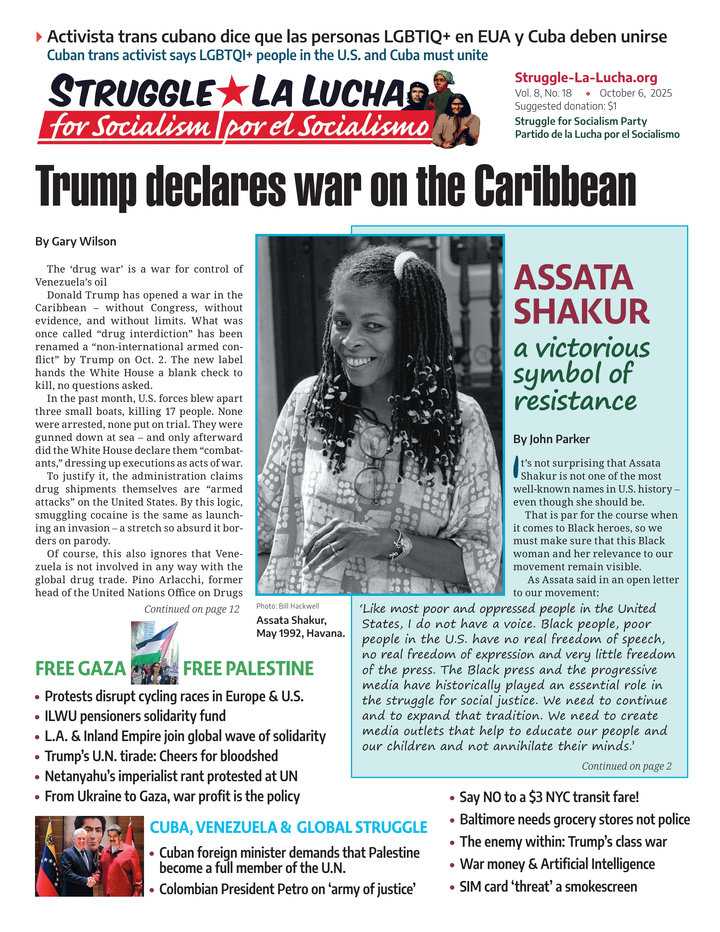
Struggle ★ La Lucha PDF – October 6, 2025

Get PDF here

  • Trump declares war on the Caribbean
  • The enemy within: Trump’s class war
  • Say NO to a $3 transit fare!
  • Baltimore needs more grocery stores not more police
  • Pro-Palestinian protests disrupt cycling races across Europe and North America
  • ILWU pensioners expressed their support and solidarity with Palestinians
  • Netanyahu’s U.N. speech illustrates imperialist ambitions in Middle East
  • Thousands march in NYC to protest Netanyahu’s U.N. hate speech
  • Trump’s U.N. tirade: Threats, invasion plans, and cheers for bloodshed
  • Cuba and the global struggle against imperialism
  • President Gustavo Petro calls for ‘army of justice’ to aid Palestine
  • L.A., Orange County & the Inland Empire join global wave of solidarity with Gaza
  • War money, tech profits: The real history of Artificial Intelligence
  • From Ukraine to Gaza, profit is the policy: Trump’s wars enrich defense conglomerates
  • SIM card ‘threat’ a smokescreen for Trump’s war talk
  • ‘We will blow you out of existence,’ Trump’s Caribbean spectacle
  • Cuban trans activist says LGBTQI+ people in the U.S. & Cuba must unite
  • Activista trans cubano dice que las personas LGBTIQ+ en EUA y Cuba deben unirse
Strugglelalucha256


Thousands march in NYC, joining global day of action demanding Gaza ceasefire

New York, Oct. 4 — Thousands of people came to lower Manhattan’s Washington Square Park today to demand a ceasefire in Gaza and an arms embargo on Israel.  It was part of the international days of protest against the U.S.-funded genocide that has killed tens of thousands of Palestinians.

The action was called by the Palestinian Youth Movement. Imam Tom Facchine of the Yaqeen Institute for Islamic Research denounced the war criminals, Netanyahu and Trump, and their false promise of a ceasefire. So did speakers from the Palestinian Youth Movement, The People’s Forum, Palestinian Feminist Collective, PAL-Awda  and the Party for Socialism and Liberation.

“As we approach the second anniversary of the Gaza Ghetto uprising, we share the hopes of the people there for a real ceasefire,” said the PAL-Awda speaker, Bill Dores. “If that happens, the only credit goes to the steadfastness of the resistance, of the freedom fighters of Palestine, who remain undefeated, and their heroic allies in Yemen, Lebanon and Iran. … 

“More than ever, we call on the countries of the world to support the call of Palestinian society to support the proposal of the Hague group, led by Colombian President Gustavo Petro and South African President Cyril Ramaphosa. They call for the UN General Assembly to use its Uniting for Peace power to send a  protective force independent of the UN security council to and stop the genocide by force! And for a total arms, embargo and sanctions on the Zionist Reich in Palestine,” said Dores.

Thousands marched uptown from Washington Square. They cheered as onlookers waved a Palestinian flag from their apartment or showed their support from the sidewalk.

People marched by the headquarters of the lying New York Times and through Times Square. The march ended with a brief rally outside the New York Public Library, where a speaker from the Palestinian Youth Movement announced plans for a political campaign against AIPAC. Free Palestine!

Strugglelalucha256


2 million rally in Italy’s historic general strike for Gaza

Over two million Italian workers shut down their country’s economy on Oct. 3 in response to the seizure of the Global Sumud Flotilla and the continued U.S. / Israeli genocide in the Gaza Strip. In a display of working-class unity and strength, Italian workers across sectors walked off their jobs and took to the streets. 

This is the second such general strike called in as many weeks as Israeli drone strikes harassed the Sumud Flotilla ahead of Israeli naval interception. At least 40 Italian nationals were reported to be on the flotilla, including four parliamentarians. Significantly, Italy’s largest labor union, the Italian General Confederation of Labor, led the call for the Oct. 3 strike. Between the CGIL and the Unione Sindacale di Base, another large Italian labor union, the number of strikers swelled to over two million in 100 cities and towns. 

Across the country, rail workers, pilots, dockworkers, subway operators, bus drivers, nurses, and teachers walked out of work to demand an end to the genocide in Gaza. Workers marched under the slogans “Free Palestine, Stop the War Machine” and “Hands off the Flotilla!” 

Florence, Rome, Milan, Turin, Bologna, and Naples swelled with work stoppages and protests. This represents every major metropolitan region in the country. In almost all of these cities, the police attacked protests with crowd control weapons and were decisively rebuffed. 

Defying Meloni’s opposition

Italian workers and activists were undeterred by fascist Prime Minister Giorgia Meloni’s stance against the strike. Meloni declared that the strike would in no way help the situation in Gaza. Interesting that a politician who gladly supplied Israel with weapons for the first two years of her term is suddenly concerned with the well-being of the Palestinian people. 

In 2024, Italy finally suspended arms sales to Israel, but only after immense public pressure via protests and other acts of civil resistance. In reality, the suspension of Italian arms sales was not so much a genuine policy shift by the Meloni administration as it was a result of working-class intervention. 

Before she attacked the strike, Meloni withdrew Italian naval support from the Sumud flotilla, proving that the frigate’s deployment was performative.  If the Italian navy were serious about protecting the flotilla, they would not have left as soon as the flotilla neared Gaza. 

In response to Meloni’s withdrawal of the Italian navy and the Israeli raid on the flotilla, the rage of the Italian working class reached a justified and righteous fever pitch. 

The power of the strike

Without the workers, Italian society came to a roaring halt. Trains and planes stayed at the station. Hotels could not take guests. Children stayed home from school. And maybe, most importantly, the docks transmitted no shipments of any kind to apartheid Israel. The strike’s message to the Italian government, the EU, and really the whole world was clear: End the genocide, or we will shut the country down

The entrance of the Italian organized working class into the global fight against the genocide could be a turning point in the entire struggle and must be supported at all costs by progressives and anti-genocide activists everywhere. As this article is written, masses of not just Italian people, but people across Europe, flood the streets of Barcelona, Paris, London, Prague, and Athens with one resounding message: Free Palestine. 

Strugglelalucha256


President Maduro: U.S. wants armed aggression, Venezuela will never humiliate itself before any empire

This Friday, Venezuelan President Nicolás Maduro said that the U.S. intends to launch an armed attack against Venezuela, with the aim of imposing a “puppet government” and seizing the country’s resources.

“The people of the United States are attentive, observant, and the people of the United States are very aware of what is intended against Venezuela. It is an armed aggression to impose regime change, to impose puppet governments, and to steal the oil, gas, gold, and all the natural resources of a homeland that is forging its own path with its own model,” the Venezuelan president stated during his participation in the International Conference “Colonialism, Neocolonialism, and the Territorial Dispossession of the Western Empire” held in Caracas.

President Maduro also emphasized that fake news about Venezuela is spread every day, and he called on the entire world to pay attention to what is happening in the Caribbean and U.S. criminal actions in the region.

People in defense of peace at any instance

President Maduro emphasized that the Venezuelan people are willing to defend peace and sovereignty and will not allow an imperialist structure that runs counter to liberating ideals to be imposed upon them.

“We believe in the need to defend the project of life and of the original nation that was founded by the liberators. We have prepared ourselves together with the people, always… our people have prepared themselves with a very clear doctrine, and the peoples of the world should know it. It is a doctrine of integral defense of the nation. Venezuela has the right to peace, to sovereignty, to its existence. There will be no empire in this world that can take it away, that can take it away, and if it is necessary to move from unarmed struggle to armed struggle, the people will do it for peace, for sovereignty,” he stated.

“Venezuela will never humiliate itself before any empire, regardless of its power or name,” he warned, adding that “it will be taught, in proper measure, a moral, ethical, and political lesson in the years to come.”

The president emphasized that the dilemma for Venezuelans is not “homeland or death” because independence, freedom, dignity, and life in sovereignty have no alternative.

“Is it an alternative to becoming a colony of the United States? Is it an alternative to be just another star or a state associated with the empire? Is it an alternative to be their slaves, to the supremacists who despise us?” he asked the delegates, who responded emphatically with a negative response.

He stated that the options are “independence or colony, freedom or slaves.”

He said that what “burns the supremacists of the North is that the process of birth of a multipolar, multicentric world is already irreversible,” where imperial hegemony has no place.

Source: Últimas Noticias by Yusleny Morales with Orinoco Tribune content

Translation: Orinoco Tribune

Strugglelalucha256


‘We will blow you out of existence,’ Trump’s Caribbean spectacle

On 23 September 2025, U.S. President Donald Trump delivered a dramatic address, explicitly threatening those allegedly involved in drug trafficking to the United States with being blown “out of existence”. This statement, taken as a blatant disregard for international law and due process, made reference to the latest escalation in the decades-long U.S. War on Drugs, a campaign historically used to justify U.S. foreign intervention in Latin America, and now, prominently aimed at Venezuela.

For the last 26 years, Venezuela has undergone a profound political transformation successfully asserting sovereignty over the world’s largest proven oil reserves primarily by using revenues to attack decades of poverty and social exclusion through social programs. It also embarked on ending Washington’s historical political influence.

Venezuela has crafted an independent foreign policy aimed at building a multipolar world, forging closer ties with countries like Iran, Russia (with whom it has just approved a strategic partnership) and China, with an “All-Weather Partnership” signed in 2023. It has also promoted regional alliances free of U.S. dominance such as the Community of Latin American and Caribbean States (CELAC) and the Bolivarian Alliance for the Peoples of Our America (ALBA); promoting South-South cooperation with renewed participation in the Organization of Petroleum Exporting Countries (OPEC) and the Non-Aligned Movement; and leading the formation of the Group of Friends of the United Nations Charter.

These shifts prompted the U.S. to declare Venezuela an “unusual and extraordinary threat to the national security and foreign policy of the United States” in 2015. This opened the door for a comprehensive campaign of unilateral sanctions — rather, coercive measures — that has continued across the Obama, Biden, and both Trump Administrations. This campaign has damaged the Venezuelan economy, contributed to the loss of lives, and fueled migration to the U.S. and to neighboring countries.

As the U.S. seeks to reassert its influence in the region in its global competition with adversaries like China, this policy on Venezuela represents not just as a tool to modify conduct but as an instrument of a broader, sustained regime change operation —a goal that has remained unsuccessful.

This objective is reinforced by domestic pressures, particularly from Latin American ultra-right factions with close ties to the Venezuelan American community. According to the Pew Research Center, there are approximately 120,000 U.S. registered voters of Venezuelan descent, with the largest concentration —about 57,000— in Florida. where in 2018, less than 32,000 thousand votes decided the 2018 Governor’s race. In a state where the 2018 Governor’s race was decided by fewer than 35,000 votes, the political weight of this community is considered significant.

The current U.S. military posture is a continuation of Trump’s earlier “maximum pressure” campaign. Recent weeks have seen a significant deployment of U.S. naval assets to the Caribbean Sea, including a nuclear submarine, a squadron of F-35 planes, 7 warships, and at least 4,500 marines. The real intention of this deployment is not to curb drug trafficking but to destabilize the Venezuelan government.

To justify the military presence, the U.S. has undertaken operations against alleged drug-trafficking. However, available data, including from sources such as the United Nations and even the Drug Enforcement Agency (DEA), indicates that approximately 87 percent of drugs reaching the U.S. pass through the Pacific Ocean, while only about 5 percent attempt to pass through the Caribbean Sea, where the entire Venezuelan coast lies.

On September 2, President Trump publicly announced a lethal attack on a boat allegedly carrying drugs and tied to the Tren de Aragua, an extinct Venezuelan criminal gang that the U.S. government claims is still active and operating on U.S. soil. The U.S. Intelligence Community reportedly denied ties between President Nicolas Maduro and these claims. Nonetheless, these allegations have been used to justify the invocation of the Alien Enemies Act of 1798 for the third time in history  —the first during the War of 1812 and the second during World War II, now targeting Venezuelans living in the U.S. during peacetime. This led to the deportation of 252 Venezuelans, without due process, and to their imprisonment and torture in a concentration camp in El Salvador. Some were even separated from their children.

Trump’s rhetoric has also linked Venezuelan immigrants to criminality and mental illness, aligning with the nativist agenda in his own base. Driven by his policy of immigrant expulsion, the U.S. migrant population dropped by 1.4 million between January and June of 2025, according to the Pew Research Center, causing the immigrant share of the population to decrease from 15.8 to 15.4 percent. After breaking diplomatic and consular ties in 2019 over the recognition of a self-proclaimed President, direct deportations were halted until February 2025, when the U.S. allowed Venezuelan planes to repatriate migrants. Venezuela had already been implementing its Return to the Homeland (Vuelta a la Patria) program since the pandemic, but its airline was banned from the U.S. by sanctions. The Trump Administration also increased its internal persecution of Venezuelans by ending temporary migratory measures set under the Biden Administration.

In the weeks leading up to the UN address, Trump claimed that at least two more lethal attacks on boats were carried out, posting videos that only showed people being killed by aerial bombardment, with no independent verification of the drug trafficking claims or the victims’ nationality. The Venezuelan government has also denounced the harassment of Venezuelan fishermen by U.S. military officers. During his UN speech, Trump boasted that “there aren’t too many boats that are traveling on the seas by Venezuela,” suggesting that all sea vessels are now under threat. Furthermore, he also openly claimed that President Maduro was leading “terrorist and trafficking networks”, without presenting any evidence. In August, the bounty for Maduro’s capture was raised to $50 million despite earlier intelligence community reports reportedly disregarding the claim.

Venezuela, its government, and its citizens are currently under threat from the most powerful military power in the world. Yet Venezuela has continued to seek a peaceful resolution. President Maduro sent a letter to Trump in the first week of September via an intermediary, calling for dialogue and refuting the drug-trafficking claims. The historical precedent of Operation Brother Sam in 1964  —where the deployment of U.S. warships near Brazil catalyzed the military overthrow of democratically-elected president João Goulart is a parallel that hints at a regime change operation. The difference is that this time, there have been no anti-government defections.

The Tricontinental Institute’s study Addicted to Imperialism argues that for over 50 years, the War on Drugs has been a mechanism to promote U.S. military expansion, the forced displacement of rural communities, the criminalization of popular organizations, and further political interventionism. In contrast, despite massive military spending, U.S. drug consumption has not declined; conversely, the U.S. remains, both the main consumer of drugs, and the main provider of weapons to the drug cartels.

Minister Diosdado Cabello denounced a DEA coordinated false flag operation seeking to provoke the Venezuelan Bolivarian Armed Force into direct confrontation with the U.S. military. But the Venezuelan government has established a National Council for Sovereignty and Peace where the unlikely combination of pro-government and opposition forces have joined in rejecting foreign intervention. Many Venezuelans even enlisted in the national militias and are ready to act in defense of the nation in the case of U.S. invasion or a targeted attack such as those carried out months earlier against Iran.

What is being carried out against Venezuela, is not an operation against drug trafficking but rather, a regime change operation. Yet Venezuelan morale is high. People continue to carry on with their daily lives in a state of caution, and enthusiastically defend of their national project by reminding anyone that Venezuela is spelled with a V — like Vietnam — and that the national liberator, Simon Bolívar once wrote to a U.S. diplomat: “Fortunately, we have often seen a handful of free men defeat powerful empires!”

Carlos Ron is Co-Coordinator of the Nuestra America office of the Tricontinental Institute for Social Research. He is a former Venezuelan diplomat who served as Vice Minister for North America (2018-2025).

This article was produced by Globetrotter and the Anti-Imperialist Scholars Collective.

Strugglelalucha256


Trump declares war on the Caribbean

The ‘drug war’ is a war for control of Venezuela’s oil

Donald Trump has opened a war in the Caribbean — without Congress, without evidence, and without limits. What was once called “drug interdiction” has been renamed a “non-international armed conflict” by Trump on Oct. 2. The new label hands the White House a blank check to kill, no questions asked.

In the past month, U.S. forces blew apart three small boats, killing 17 people. None were arrested, none put on trial. They were gunned down at sea — and only afterward did the White House declare them “combatants,” dressing up executions as acts of war.

To justify it, the administration claims drug shipments themselves are “armed attacks” on the United States. By this logic, smuggling cocaine is the same as launching an invasion — a stretch so absurd it borders on parody.

Of course, this also ignores that Venezuela is not involved in any way with the global drug trade. Pino Arlacchi, former head of the United Nations Office on Drugs and Crime (UNODC), says that decades of annual reports on drug trafficking never once mention Venezuela, because it doesn’t exist. 

Pino Arlacchi continues: “Yet Venezuela is systematically demonized, contrary to every principle of truth. In his memoir following his resignation, former FBI Director James Comey revealed the unspoken motives behind American policies towards Venezuela. Trump told him that Maduro’s government was ‘sitting on a mountain of oil that we have to buy.’ This is not about drugs, crime or national security. It is about oil that the U.S. would rather not pay for.”

The Quantico show of force

On Sept. 30, Trump and his handpicked “Secretary of War,” Fox host Pete Hegseth, ordered every four-star in the country and around the world — more than 800 generals and admirals — to Marine Corps Base Quantico.

On the surface, it was staged like a pep rally. But while the brass gathered, U.S. warships piled up off Venezuela’s coast, and military spotters tracked waves of U.S. jets and refueling tankers heading toward the Middle East. The movements looked almost identical to the days before Trump’s June strike on Iran.

On June 22, Trump launched Operation Midnight Hammer. Undetectable warplanes flew into Iran and dropped the most powerful non-nuclear bombs in existence, the GBU-57A/B, on Iranian facilities.

Former CIA officer Larry Johnson suggested the Quantico spectacle was a cover for a smaller, closed-door war council. If Trump is gearing up for simultaneous action against Venezuela and Iran, he’d need his top commanders in the room — and away from prying eyes.

Venezuela in the crosshairs

To sell the escalation, the White House has begun hyping Venezuela’s Tren de Aragua gang as a “terrorist organization.” (“Tren de Aragua” isn’t a tightly organized gang but rather a brand name for a loose network of criminals who operate without any structure.) Yet the official memo never even names who the U.S. is supposedly at war with. That’s by design. Trump picks the enemy, hands himself kill authority, and brushes Congress aside.

Meanwhile, Navy ships linger off Venezuela, and leaks suggest plans for strikes inside the country itself. Semafor reported, “The Trump administration isn’t ruling out launching military strikes inside Venezuela … a senior Trump administration official confirmed.”

On Oct. 3, Venezuelan Defense Minister Vladimir Padrino López denounced the presence of five U.S. fighter jets flying near Venezuelan territory, specifically north of the country’s central Caribbean coast, El País reports. “It is a provocation, a major threat against the nation’s security,” the general declared.

This isn’t about narcotics. It’s about expanding U.S. domination — and using the “drug war” as the excuse. 

The real target is not drugs but regime change in Venezuela, home to the largest proven oil reserves globally. Trump administration officials privately call the Naval operations in the Caribbean “Noriega Part 2” — a reference to the 1989 invasion of Panama that toppled Manuel Noriega. Last August, the U.S. Justice Department issued an arrest warrant for Maduro.

The drug war has always been a tool of empire. Now the mask is off. Trump’s doctrine is blunt: call anyone a “combatant,” move the battlefield wherever he wants, and keep Congress out of it.

This is not a war on drugs. It’s a war for domination. A war to turn the Caribbean and Latin America into live-fire zones. A war to normalize summary executions as U.S. foreign policy.

Strugglelalucha256


War money, tech profits: The real history of Artificial Intelligence

We are told, endlessly, that we live in the age of the entrepreneur. You know the story: a lone genius tinkering in a garage, pulling miracles out of solder and silicon, eventually conquering the world with nothing but grit, brains, and a half-dead Macintosh. This is the catechism of Silicon Valley.

However, if you follow the wires backward, the story is entirely different. The most significant technologies of our time — the internet, GPS, touchscreen devices, and even artificial intelligence — were not born in garages. They were incubated in government laboratories, nourished on Pentagon contracts, and carried into the world on the shoulders of public universities.

From the Cold War’s sprawling defense labs to the current supremacy of Google’s AI empire, the state has been the real venture capitalist: planner, financier, and enforcer. It was the government that absorbed the risks, that spent billions on projects whose payoff might take decades, or never arrive at all. And when those gambles produced results, private corporations were waiting to privatize them.

The working class supplied the brains and the labor, as graduate students, engineers, and technicians, often underwritten by public grants. The capitalist class reaped the profits. Innovation, in other words, was socialized. Wealth was privatized.

The marriage of state and monopoly

There is an enduring myth that big business and big government stand on opposite ends of U.S. life. But if you look at Wall Street bailouts or Big Tech’s entanglement with the Pentagon, you see something closer to a marriage.

The pattern is consistent: subsidies for research and development, bailouts when markets collapse, regulations drafted to suit monopolies, copyright and patent law weaponized to keep rivals at bay, and defense contracts that run into the tens of billions. The state doesn’t just oversee the game — it bankrolls the team.

Monopoly capitalism has never meant a weakened state. It has always meant a stronger one: imperialist powers fusing state resources with corporate power, ensuring their “national champions” can outgun competitors abroad. The more advanced the technology — especially in the case of artificial intelligence — the clearer this fusion becomes.

Forget the garage

The myth of the tinkering genius is fictional; the reality is blunt.

  • The Internet began life as ARPANET, a Pentagon communications project designed to survive nuclear war.
  • GPS was conceived and maintained by the U.S. Air Force before being transferred to the U.S. Space Force.
  • Radar, microwaves, composite materials — all poured forth from wartime research budgets in the 1940s and 1950s.

The sequence rarely varies: The state socializes risk, spending billions on long-horizon research. Once the technology proves viable, it is delivered into the hands of private corporations, which harvest the profits while the government is left with the costs.

It is, arguably, the largest wealth transfer in modern history. But it is disguised under the genteel euphemism of “innovation.”

The University-Industrial Complex

The state’s role extends far beyond the Pentagon. Public universities, lubricated by federal grants, train the engineers and computer scientists who are quickly absorbed into the orbit of companies like Google, Microsoft, and Amazon. Faculty labs — often government-funded — produce breakthroughs in algorithms and hardware that are then patented, licensed, or outright purchased by private firms.

The result is a vast ecosystem: the military, public universities, government research agencies, and corporate monopolies locked together. Far from being “footloose” or stateless, Silicon Valley’s firms are firmly tied to the U.S. empire, rooted in infrastructure and research pipelines subsidized by the public.

Google is not Google without DARPA (the Pentagon’s Defense Advanced Research Projects Agency). Microsoft is not Microsoft without the National Science Foundation. Amazon Web Services is not AWS without Pentagon contracts.

Case study: Artificial Intelligence

Artificial Intelligence is the purest distillation of this system.

  • Military birth. From the Cold War onward, the Pentagon poured money into AI for logistics, surveillance, and battle management. DARPA kept the field alive during its lean decades.
  • Government-funded breakthroughs. The intellectual backbone of AI — machine learning and neural nets — emerged from university labs funded by the state. Today, the government remains the single largest customer for AI applications, from predictive policing to drone warfare.
  • Privatized profits. Tech monopolies scoop up researchers trained at government expense, buy the data infrastructure, and commercialize algorithms whose foundations were laid with federal money.

The result is a textbook demonstration of monopoly capitalism: costs socialized, profits privatized.

Empire, not entrepreneurship

AI isn’t a triumph of the free market. It’s proof that big government and big business still move in lockstep, working for empire.

The state remains the ultimate venture capitalist, underwriting research, guaranteeing markets, and shoring up monopolies when they falter. Innovation is steered not toward public needs — such as clean energy, public health, and accessible housing — but toward war, surveillance, and corporate control.

The history of U.S. technology isn’t about daring entrepreneurs. It is the story of monopoly capital and the imperialist state, marching in lockstep. Until that bond is broken, technology will remain what it has been for more than half a century: a servant of empire, rather than of people.

Strugglelalucha256
https://www.struggle-la-lucha.org/2025/page/16/