Building a people’s media: The antidote to imperialist disinformation

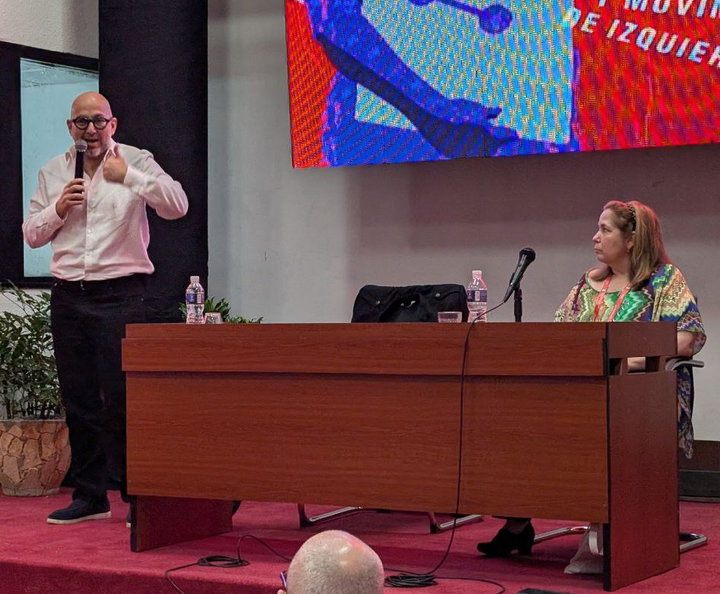
At an international meeting in Havana, Cuba, Venezuelan philosopher Miguel Angel Perez Pirela (left) speaks about building a people’s media to fight Washington’s disinformation campaigns conducted on behalf of the rich. On the right is Cuban journalist and academic Dr. Rosa Miriam Elizalde, who facilitated this discussion. SLL photo: Lev Koufax

On the second full day of the third annual International Meeting of Theoretical Publications of Left-wing Parties and Movements (Encuentro Internacional de Publicaciones Teóricas de Partidos y Movimientos de Izquierda) in Havana, the participants from over 40 countries broke into various political education workshops at the Nico Lopez University of the Communist Party of Cuba. 

This session featured Dr. Rosa Miriam Elizalde facilitating and Miguel Angel Perez Pirela as the featured speaker. Miriam Elizalde is a Cuban journalist and editor with a doctorate in communications who teaches at the University of Havana. Perez Pirela is a Venezuelan philosopher and writer. He is also the coordinator of the Network in Defense of Humanity, an alliance of progressive writers, thinkers, artists, and social movements. 

Perez Pirela opened the discussion with a framing of the current struggle between the Global South and the increasingly aggressive imperialist powers like the United States and Britain. There is no doubt Venezuela and Cuba face difficult times. Venezuela faces potential U.S. military action against its coast under the pretext of “narco-terrorism” and Cuba faces an increasingly tightening economic blockade. 

The leading PSUV philosopher analyzed that literal, political, and economic battlefields are not the only places where this struggle is being fought. Information warfare through social media has become a crucial tool for the imperialist narrative. Algorithms for social media magnates like Meta, Twitter, and TikTok are used to disseminate right wing-propaganda and push false narratives about the enemies of the U.S. 

Perez Pierla analyzed that the key to information warfare isn’t actually a battle of ideas, but a battle to gain attention in the first place. All western social media algorithms are designed so the imperialists can win this battle. According to Perez Pirela, Donald Trump is establishing a dictatorship of attention through social media and news media. All of Trump’s bombast and sound bites transfer well to social media formats that promote short, snappy videos. Further, Trump has used military action against boats off the Venezuelan coast in recent weeks effectively in promoting his information war. 

Drone strikes on innocent fisher people and migrants is not just about the literal military action but about communicating to the world how far the U.S. is willing to go. This is a form of communication meant to sow fear and dissuade resistance. Perez Pirela insists that destruction left in the wake of the U.S. military campaign in the Caribbean is not the end itself but a means to an end. Short social media clips of exploding ships draw tremendous amounts of attention, allowing Trump to shape his false narco-terrorist narrative. 

Military strikes against Venezuela pose severe difficulties for the U.S. both in terms of logistics and public opinion. The U.S. public is exhausted of war and unlikely to support another pretext for invasion similar to the false accusations of “weapons of mass destruction” in Iraq. If the imperialists can’t win through outright force, they push lies and sensationalism through social media in the hopes of fostering regime change

Due to this mounting aggression, the Bolivarian Republic of Venezuela has had to embrace all forms of resistance. Not only has President Maduro and the PSUV mobilized the people in preparation for imperialist aggression, but the Venezuelan government has also promoted images and videos of this mass mobilization widely on social media. These images have even penetrated some corporate media like the New York Times and BBC. This is also a form of communication, making the imperialists aware that any incursion or bombing campaign will be met with the fiercest resistance of the Venezuelan people. 

Due to Venezuela’s clear message of resistance, Donald Trump and his cohorts were forced to find validity in a formerly irrelevant fascist Venezuelan opposition leader, Marina Machado. In Venezuela itself, Machado is viewed as a joke. She has no basis in the popular masses who openly supports U.S. intervention in Latin America while also being a cheerleader for the genocide in Gaza. 

Machado’s Nobel prize has backfired severely. The people of Venezuela are more resolved than ever that the U.S. does not have their best interests at heart – quite the opposite. If they genuinely cared about the Venezuelan people, the imperialists would not push a figure who would almost certainly open the country to imperialist pillaging and exploitation. 

The PSUV philosopher outlined how the rest of the world has also seen through Machado’s peace prize. Social Media algorithms that constantly push Machado’s former statements and activities were meant to endear Venezuela and people around the world to the opposition. Because of her fascist ideology, the opposite has occurred. The Nobel Peace Prize has lost all validity and to some extent exposed Trump’s pretext for intervention against Venezuela. 

About halfway through the presentation, the facilitator and speaker paused for questions. A Struggle – La Lucha reporter, Lev Koufax, asked Perez Pirela to analyze how the information has evolved since the last serious regime change attempt in Venezuela in 2019. The Venezuelan analyzed the history and current situation in depth. 

In 2019, right-wing Venezuelan opposition, with the backing of the U.S., attempted to supplant Nicholas Maduro and the PSUV with Juan Guaido. There is no doubt that Guaido was a U.S. puppet who would sell out his people for the interests of corporate America. In 2019, the media narrative was pushed to create a parallel government to the legitimate administration of Nicholas Maduro. At that time, social media began circulating content presenting Guaido’s coup plotters as newly appointed government officials. This culminated in a fascist assault on the Venezuelan embassy in Washington, D.C. Ultimately, this attempt failed. 

So, what has changed? Perez Pirela says that now, the U.S. isn’t just trying to create a parallel Venezuelan government, but a parallel Venezuela. Under this narrative, the only “real” Venezuelans are the right wingers and ex-pats who live in the United States. The idea is to erase the genuine culture and people of Venezuela as to dehumanize the country and make easier justification for intervention. If the people who actually live in Venezuela are universally viewed as drones and monsters, the U.S. may have an easier time convincing the world to follow along their path of aggression. 

Rounding into the last part of his lecture, Perez Pirela posed a question: Is all lost? His answer was absolutely not! It’s true that the imperialists have the edge because they created and control the largest social media platforms. Venezuela doesn’t even have control over the satellites that make social media available in their country. The U.S. completely tramples on Venezuela’s digital and information sovereignty. However, Perez Pirela insists the Global South and all the working class can punch through their advantage using the ingenuity of people in countries like Cuba and Venezuela. 

PSUV activists and the government of Venezuela are seriously studying social media algorithms to develop messaging, methods, and aesthetics that punch through slanted algorithms. Breaking through these algorithms allows progressive forces to redirect attention to socialist and anti-imperialist media and away from imperialist propaganda. Silicon Valley, Musk, and Zuckerberg are not going to do the work of the Global South and the broader anti-imperialist movement. Those who would challenge U.S. hegemony must innovate to use Western social media to direct attention to other forms of media. 

Perez Pirela continued that audio visual political content and high quality aesthetics have been very useful in breaking through U.S. propaganda in Venezuela itself. The goal now is to broaden that effort and connect with other progressive forces across the world. Perez Pirela finished his talk with a simple message: While the imperialists have more resources and control much of the digital world, what they don’t have are the people of Venezuela and Cuba. The session ended with thunderous applause. 

 

Strugglelalucha256


Díaz-Canel: ‘To publish is to resist’ in fight against imperialism

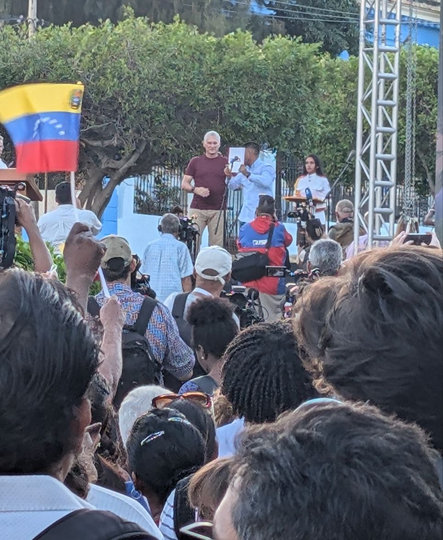
Havana, Oct. 19 — Cuban President Miguel Díaz-Canel Bermúdez addressed the Third International Meeting of Theoretical Publications of Left-wing Parties and Movements (Encuentro Internacional de Publicaciones Teóricas de Partidos y Movimientos de Izquierda) with a call to confront the global resurgence of fascism and imperialism.

His presence at the conference was a testament to the importance of left publications and movements that tell the truth and dismantle imperialist manipulation. He motivated everyone in the room by reminding them that publishing from the left is an act of resistance in these times. 

“To think is to fight, to publish is to resist, and to communicate is to liberate,” he told participants. “We must all be committed to this battle.” 

The gathering brought together writers, scholars, and activists from across the world. 

Speakers discussed urgent global crises — the genocide in Palestine, U.S. aggression against Venezuela, and the ongoing blockade of Cuba. 

Díaz-Canel urged participants to build a coordinated network of socialist and anti-imperialist publications that promote critical thinking and tell the truth about the dangers of imperialism.

Truth-telling and ideological unity will be the left’s tool against the imperialism we face today. The conference gave participants an opportunity to build relationships and create unity in order to go back to our respective corners of the world and continue our fight for liberation. 

Strugglelalucha256


Struggle ★ La Lucha PDF – October 20, 2025

Get PDF here

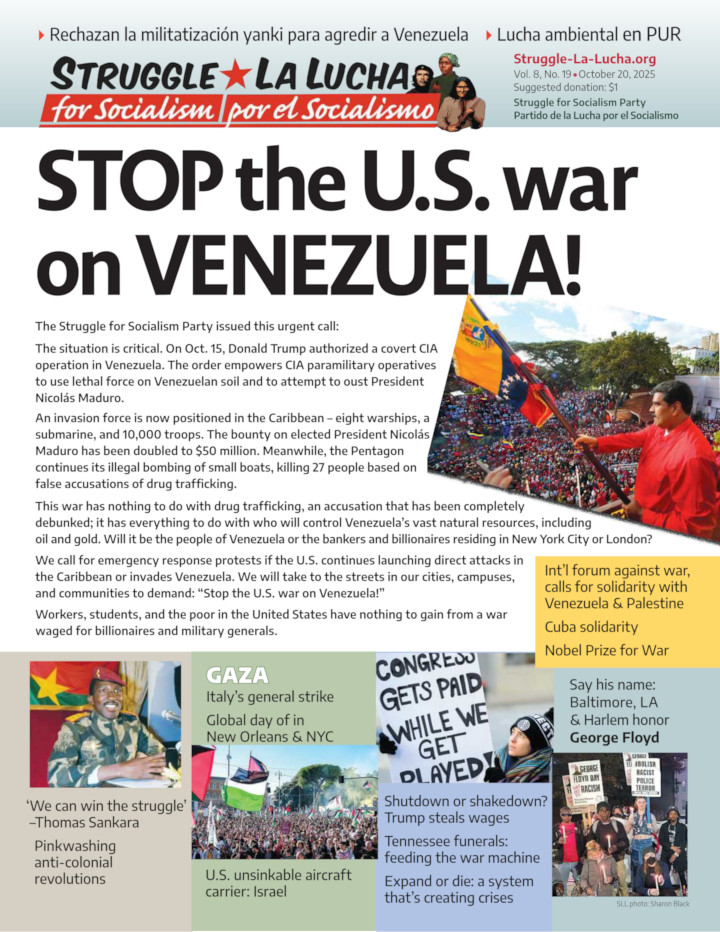
  • STOP the U.S. war on VENEZUELA!
  • Harlem honors George Floyd
  • Say his name: Baltimore rises for George Floyd
  • Pinkwashing is used to slander anti-colonial revolutions from Palestine to Burkina Faso
  • No to Kirk, no to cops: George Floyd Day in Los Angeles
  • ‘We can win this struggle’: Sankara’s message for today
  • Shutdown or shakedown? Trump fires thousands, threatens to steal workers’ wages
  • Pentagon profits, Tennessee funerals: 16 workers die feeding the war machine
  • EXPAND OR DIE: a system that can’t stop creating crises
  • Nobel Prize for War: Trump ally María Corina Machado honored amid U.S. escalation in Venezuela
  • International forum denounces war, calls for global solidarity from Venezuela to Palestine
  • The unsinkable aircraft carrier: Israel & the crisis of U.S. imperialism
  • Two million rally in Italy’s historic general strike for Gaza
  • Thousands join global day of action demanding Gaza ceasefire
  • New Orleans: Protest hits streets over Gaza
  • Havana mobilizes in defense of Venezuela
  • President Maduro: ‘Venezuela is not the Tren de Aragua, it is a country of honest people’
  • Rechazan la militatización yanki para agredir a Venezuela
  • Lucha ambiental en PUR
Strugglelalucha256


No Kings, No Empire: Protest and the war economy

Millions filled the streets on Oct. 18.

The “No Kings” protests erupted in more than 2,700 locations across all 50 states — the largest coordinated action against Donald Trump since his return to office, and perhaps one of the biggest mass mobilizations in recent U.S. history.

Crowds surged through New York, Washington, Los Angeles, Chicago, and Boston. But resistance spread far beyond the major cities. Workers marched in Birmingham, Alabama. Demonstrators filled the streets of Billings, Montana.

The protests were against the authoritarian actions of the Trump administration, ICE operations, federal program cuts, and for constitutional rights.

Yet the leadership of the “No Kings” campaign is firmly rooted in the Democratic Party.

Groups like Indivisible and MoveOn — both pillars of the Democratic establishment — were listed as official sponsors. Their involvement shaped the movement’s limits, especially around foreign policy: the U.S.-NATO proxy war in Ukraine, the genocide in Gaza, and Washington’s escalating confrontation with China.

The color of empire

The official No Kings website encouraged participants to wear yellow, referencing the pro-NATO Yellow Ribbon Movement in Ukraine and the anti-China Yellow Umbrella protests in Hong Kong. Whether coincidence or design, the symbolism signals alignment with U.S. imperialist foreign policy.

Since 2016, Democratic opposition to Trump has often focused not on his attacks on workers or the poor but on his supposed “softness” toward Russia and China. His first impeachment, in 2019, wasn’t for caging migrants or gutting health care programs — it was for delaying weapons to Ukraine.

Biden continued that trajectory. From day one, his administration poured billions into NATO and armed Ukraine to the teeth, even as it funded and defended Israel’s campaign of mass genocide in Gaza. At the same time, it intensified the tech and trade war with China, maintaining Trump-era tariffs while launching new measures to block Beijing’s access to advanced semiconductors. Washington also deepened military alliances: forming AUKUS, strengthening the Quad, and integrating Japan and South Korea into its Indo-Pacific war plans. The strategy is clear — to build a NATO-style military bloc aimed at containing China. “Containing China” is what Obama said.

By adopting the color yellow, the “No Kings” organizers effectively tried to merge domestic opposition to Trump with support for U.S. wars abroad. But anti-imperialism is not a distraction from the struggle against authoritarianism — it is central to it. A movement that fails to challenge empire cannot defeat Trumpism, because empire is the source of its power.

The war that never sleeps

From Gaza to Ukraine, from Haiti to Venezuela, from Somalia to Yemen, and across the South China Sea, Washington’s war machine never rests.

Secretary of War Pete Hegseth has vowed to wage a “war on woke.” Every progressive cause, from Black Lives Matter to reproductive rights, from trans liberation to union power, is recast as a threat to national security. “Making America Great Again” now means silencing dissent at home and expanding war abroad.

Whenever U.S. imperialism goes on the offensive, it demands unity — and obedience. Behind the MAGA slogan lies the same order as always: Shut down the class struggle.

Every bomb dropped on Gaza, every missile launched from a U.S. destroyer, every naval drill off China’s coast is not only an attack on people abroad — it’s an attack on workers here. War budgets drain the public purse; social programs wither. The empire wears different faces, but the engine beneath never changes.

The Biden–Harris years presided over drone wars and unconditional backing for Israel’s genocidal siege of Gaza. Trump’s second term has intensified those same policies with open brutality. On Oct. 15, his administration authorized a new round of covert CIA operations in Venezuela — including lethal “paramilitary action” aimed at regime change.

While claiming to end “endless wars,” Trump surrounds himself with defense contractors and private mercenaries. Pentagon deployments in the Caribbean — including at least eight U.S. warships, a submarine, B-52s, F-35s, and thousands of troops — are an escalation of war, not a withdrawal.

Democrats, for their part, denounce Trump’s rhetoric but fund the same war budgets. They compete over who can arm Israel, Ukraine, or Taiwan faster. Their unity is bipartisan — the unity of capital.

Meanwhile, the war economy expands.

In munitions plants across Tennessee and Texas, production lines run nonstop. Workers die in preventable explosions while inspectors are furloughed under budget freezes. Defense CEOs cash in on record stock options. This is not “national defense.” It is organized theft — the conversion of public wealth into private profit.

Lessons of the past

We’ve seen this pattern before.

A century ago, President Woodrow Wilson — a Democratic demagogue and open white supremacist — promised to keep the U.S. out of war. Many progressives believed him. They abandoned the independent workers’ movement to back the “peace candidate.”

Within three years, Wilson plunged the nation into imperialist slaughter in World War I — and jailed socialists who opposed it. Eugene V. Debs, who urged workers to fight their real enemies at home, was imprisoned for speaking the truth.

The lesson endures: Every promise of “peace with honor,” from Wilson to Biden to Trump, conceals the same reality — a capitalist state beholden to Wall Street and the Pentagon. Both parties serve the same system, even as they trade places in power.

Failure to build unity against racism

The early socialist movement made another tragic error. It fought courageously for labor rights, but too often neglected the central question of racism. Many believed socialism would come first, and liberation later.

But socialism without an active struggle against racism was — and remains — an illusion. That failure fragmented the working class. Employers exploited racist divisions to crush strikes, exclude Black, Mexican, Asian, and Indigenous workers from unions, and sustain the hierarchy that capitalism requires.

Marx and Engels recognized the revolutionary role of the Black freedom struggle during the U.S. Civil War. They saw that slavery was not an aberration but the foundation of U.S. capitalism itself. Yet much of the socialist movement refused to learn that lesson, and it disintegrated under the twin pressures of racism and imperialist war.

The war economy and the working class

Today, the movement resisting Trump’s authoritarian project cannot repeat those mistakes.

A real resistance must be anti-racist, anti-sexist, anti-transphobic and anti-imperialist. The fight for liberation is one struggle with many fronts.

Look at the economy.

Manufacturing for civilian needs continues to decline, while militarized production surges — aircraft, missiles, drones, surveillance systems. Every major product from Silicon Valley ends up under a Pentagon contract. AI firms design targeting algorithms. Cloud companies build “battlefield networks.” Energy corporations secure war profits while ordinary households face shutoffs and rent hikes.

This is capitalism in its imperialist stage — a parasite that survives by producing destruction.

Workers feel it directly. Union jobs vanish while defense firms boom. Inflation erodes wages. Public services collapse. But the stock prices of Lockheed Martin, Raytheon, and Northrop Grumman soar.

The same machine that bombs Gaza and threatens Beijing is the one that closes hospitals, guts schools, and evicts tenants.

Every bomb dropped on Gaza is an attack on the working class — not only abroad but here at home.

That’s why fighting against war is inseparable from the fight against King Trump.

War dominates all issues. But it also unites our struggles — because every front, from Gaza to health care, from trans rights to housing, leads back to the same system. In that unity lies the power to change it.


Strugglelalucha256


Thousands rally against Trump in New Orleans, could have taken the streets

New Orleans, Oct. 18 – Thousands came out to the “No Kings” rally,  joining protesters in some 2,700 locations across the country. The crowd filled up a large section of the Lafitte Greenway. And lest anyone say that people only came out to voice opposition to Trump in “liberal” New Orleans, rallies were also held in the northshore, Baton Rouge, Lafayette and Shreveport.

For those of us who really want to take on Trump and the racist, decaying capitalist system he defends, we should be encouraged that so many came out, just as they did in earlier mobilizations this year. To stop Trump, we’re going to need more people in the streets – a lot more. 

It was the huge movement for Black Lives that pushed Trump back during his first term, not the Democratic Party, whose “resistance” centered around Russiagate conspiracy theories. (Really, they were pushing for war with Russia. That became a reality and “Trump the Peacemaker” is continuing it.) 

Here in New Orleans, the No Kings leadership decided not to march. The excuse passed among the crowd is that they were either unable or unwilling to get a permit. But groups march in the city without a permit all the time. Contingents of only 30 to 100 people do it regularly.

The thousands who came out to this rally could have easily taken the streets, permit or not. We could have marched through the French Quarter to gain the support of the hospitality workers, who have the power to bring the tourist economy to a screeching halt. We could have marched on Orleans Parish Prison like we did in the summer of 2020. On that night, people locked up in the jail came to the windows and raised their fists in the air. 

Many things were possible. The organizers squandered an incredible opportunity to show the strength of the masses. How else are we going to give Trump and Landry a run for their money?

But the Democratic Party-aligned organizations that initiate protests like these will never lead a genuine movement against fascism. For that, we need independent organizations of the oppressed and the working class.

Aside from the numbers, there was another bright spot at today’s rally. Local Palestinian organizers were actually able to take the stage. They explained the connections between what the people are facing here in the United States and this government’s imperialist assault on Palestine and others resisting domination. 

The leaders of the Democratic Party are 100% complicit in the U.S.-Israeli genocide. (Remember how they totally shut out Palestinian voices from the 2024 party convention?) But the resistance of the Palestinian people – which is bolstered by a global solidarity movement – has transformed peoples’ consciousness. That’s evident in New Orleans. Throughout the crowd people held Palestinian flags or wore keffiyehs. The rich leaders of the Democratic and Republican parties have not been able to squash this movement.

Today showed that many people already understand that all these struggles are connected. And they’re ready to fight. So, let’s actually hit the streets to bring down wannabe King Trump. There’s no other way.

Strugglelalucha256


Nader Sadaqa: The Samaritan warrior who shatters Israel’s myths

The United States and Israel don’t want you to know about Nader Sadaqa. He was a commander for the Popular Front for the Liberation of Palestine. He spent 21 years in apartheid Israel’s prisons. Sadaqa is a Palestinian. He is a Marxist. He is a PFLP leader. He is also a Samaritan.

The Samaritan community is an ethnoreligious group. They descend from the ancient Semitic-speaking Hebrew people. Their homeland is the northern half of the West Bank in occupied Palestine. They are not Jewish. They practice a monotheistic religion similar to Judaism that developed alongside Judaism. 

The core difference is that Samaritans believe that the Temple Mount, a sacred symbol of ancient Abrahamic religions, was located at Mount Gerizim, near modern-day Nablus. 

The Samaritans hold the oldest copy of the Torah in the world, over 3,5000 years old. They follow the teachings of this ancient Torah and consider themselves religious descendants of Moses. They simply believe Moses received the 10 commandments on Mount Gerizim, not Mount Sinai. Samaritans observe their own version of holidays like Passover. Their sacred texts are written in ancient Hebrew and Aramaic, similar to those of Judaism. The Samaritan faith is a valid and parallel tradition to Judaism.

Today, Samaritans identify as Palestinian and speak Arabic colloquially. Israel does not want the world to know of this reality. The Zionist movement and its imperialist backers wish for the world to believe they have a monopoly on Jewish history and religious tradition. They do not. 

Nader Sadaqa was raised in the Samaritan community. He remained a devout follower of its Hebrew-descended religious tradition his entire life. He also fought for Palestinian liberation from Zionist apartheid. His faith fueled his desire to see his community and all Palestinian people liberated from Zionist mythology. He was a commander in the PFLP’s armed wing, the Abu Ali Mustafa Brigades. He led operations against the terrorist Israeli Occupation Forces after the Second Intifada.

For this courageous resistance, Zionist Israel imprisoned him for 21 years. He endured physical torture. He suffered psychological torment. He faced starvation. He never broke. After 21 brutal years, he walked free in the recent round of prisoner exchanges.

To be abundantly clear, Israel and the United States fear Nader Sadaqa. They fear people like him. His identity is a potent threat. He is a Samaritan, from a faith parallel to Judaism. He is a Palestinian resistance commander. This combination inspires a dangerous idea. It could mobilize Jews worldwide to reject Zionism. It could rally them to fight for Palestine.

They hid him for two decades. They now ban him from returning to his home in Nablus. They fear his homecoming. They fear he could lead a whole new movement of cultural and literal resistance.

But, enough with the history. The most powerful point to be made about Sadaqa came in his own words after his release. Upon his freedom, reporters asked him one question: “What is your message to the resistance?” He responded: 

“My response is that the resistance is the one who speaks, the one who attacks, and the one who prevails. It is the one who wills, the one who excels, and the one who acts. 

“No voice rises above hers; rather, there is no voice except hers. And no statement except her statement, and no shadow except her shadow, and all that is required of us, the free people of the world, is to listen and obey.”  

Lev Koufax is an anti-Zionist Jewish activist.

Strugglelalucha256


‘People’s knowledge is people’s power’: Havana conference takes on imperialist propaganda

Nico Lopez was born on Oct. 2, 1932, in Havana, Cuba. Just over 24 years later, the Batista regime murdered Lopez and four of his comrades after they landed in Cuba along with the rest of the Granma’s crew. Lopez gave his life for Cuban socialism and the liberation of the Cuban people from U.S. proxy rule. 

Thus, it is fitting that the third annual International Meeting of Theoretical Publications of Left-wing Parties and Movements (Encuentro Internacional de Publicaciones Teóricas de Partidos y Movimientos de Izquierda) opened in the theater of the Nico Lopez University of the Communist Party of Cuba. The conference’s goal is to continue building political communication and solidarity among the world’s progressive movements in Cuba, as the country and the world navigate a new era of imperialist aggression. 

Hundreds of progressives and left-wing activists piled into the auditorium. 

A panel on geopolitical relations and international analysis of global tensions and their impact on the left movement opened the conference. The panel consisted of four contributors:

  1. Anil Cinar, member of the Communist Party of Turkey and manager of the Party’s magazine, Gelenek;
  2. Chen Yiming, the Director General of the Chinese Communist Party’s Bureau of Latin America and the Caribbean publication of the People’s Daily;
  3. David Gomez Rodriguez, the Vice President of Formation and Ideology for the United Socialist Party of Venezuela, and
  4. Jorge Hernandez, Director of the Center for Hemispheric and U.S. Studies at the University of Havana

The discussion was moderated by Elier Ramirez Canedo, a member of the Cuban Communist Party’s central committee. 

All four speakers analyzed the problems facing the global working-class movement in the face of imperialist aggression from their own unique perspectives. 

Anil Cinar opened the panel with a speech about the imperialist strategy to sow lawlessness across the planet. The imperialist United States creates this chaos through sanctions, covert operations, and war. Cinar asserted that this strategy can be seen through not just the horrific genocide in Palestine, but in the continuing campaigns against Venezuela, Cuba, Yemen, and Iran. 

The speaker insisted that all these struggles are not just fights for national independence but also fronts in a growing global class struggle. Cinar concluded his talk by touting Cuba’s insistence on socialism as an example for the world. He asserted that the struggle in Turkey will continue until a new system rises that refuses to play facilitator for Western capital. He called upon the audience to push the socialist struggle around the world in unity to defeat imperialism. 

Director General Chen Yiming spoke next. He said the world is under strain, but the Global South is gaining economic power. China, he affirmed, is part of the Global South and committed to unity among its nations — including Cuba, Russia, Venezuela, and Vietnam. Chen emphasized that Cuba and China have built socialism together through economic, political, and cultural cooperation. He announced plans to expand trade with Cuba and to distribute Cuba’s socialist newspaper, Granma, more widely in China.

Next, Dr. David Gomez Rodriguez took the stage to loud applause. The crowd’s response reflected both the imperialist aggression against Venezuela and the resistance of its people, led by President Nicolás Maduro.

Rodriguez declared that Che and Fidel live on — in Cuba and in the global struggle against imperialism. He hailed the shared achievements of Venezuela and Cuba in eradicating illiteracy and defeating U.S.-backed coups.

But he warned that unity between nations like Venezuela and Cuba is now more vital than ever. A bloody struggle is coming, he said — a fight against the rise of fascism to ensure the working class of the planet not only survives but builds a new socialist world.

Rodriguez cited Russia’s war against NATO-backed Ukraine and the Axis of Resistance’s refusal to bend to U.S. pressure in West Asia as examples of that global resistance. He ended with a call to action: Only the unity of socialist states and anti-imperialist movements can secure the working class’s victory over imperialism.

Professor Jorge Hernandez was the final speaker. His message was direct: Today’s wars do not exist in isolation.

He analyzed the war in Ukraine and the genocide in Palestine as U.S. proxy wars — bent on smashing resistance and increasing profits. He urged every left-wing publication present to keep exposing the truth. Progressive newspapers, websites, books, social media, and magazines all play a role in breaking down the myths of imperialism. Simply put, people’s knowledge is people’s power.

Hernandez closed his talk acknowledging that while the process of fighting the empire is unfinished, it is by no means impossible. Quoting the founder of Bolivarian Venezuela, Hugo Chávez, he ended: “Community or nothing.”

Through these four speakers, the defiance of the Global South against imperialism was unmistakable. The conference closed with a firm anti-imperialist direction that will shape the debates and resolutions ahead. As long as leaders like these continue the struggle, hope for working-class victory over exploitation, racism, and genocide remains alive and strong.


Strugglelalucha256


Cuba mobilizes in defense of Venezuela

Havana, Oct. 17 — At sunrise, tens of thousands filled Havana’s Avenida de los Presidentes, gathering at the Simón Bolívar Monument in a powerful show of solidarity with Venezuela. The demonstration began at 7:30 a.m. and surged for blocks down the tree-lined boulevard to the Malecón.

The rally came a day after Washington’s war machine struck another small boat in the Caribbean Sea, this one from Trinidad and Tobago. Two people were killed, and two survived.

Representatives of the Communist Party of Cuba, including President Miguel Díaz-Canel, stood alongside delegates from the United Socialist Party of Venezuela (PSUV), Cuba’s Communist Youth Union (UJC), and participants in the International Conference of Theoretical Publications of Left Parties and Movements (Encuentro Internacional de Publicaciones Teóricas de Partidos y Movimientos de Izquierda).

Speakers reaffirmed the unbreakable bonds joining the Cuban and Venezuelan peoples — two nations forged in struggle, facing the same imperialist enemy. 

Over 4.3 million Cubans — nearly half of the population — signed a national declaration backing Bolivarian Venezuela and condemning U.S. war and intervention.

President Nicolás Maduro, in Caracas, Venezuela, on hearing this, responded with gratitude and resolve.

“You cannot imagine how important it is for our people to feel the love and solidarity of the Cuban people,” Maduro said. 

Chants of “¡Cuba y Venezuela, unidas vencerán!” rolled through the crowd.

Strugglelalucha256


Bob McCubbin and the untold history of queer labor solidarity

Bob McCubbin (1942-2025) was a pioneering revolutionary theorist and activist.  In 1976, he wrote one of the first Marxist analyses of LGBTQ+ oppression. His book “The Gay Question: A Marxist Appraisal,” later expanded as “The Roots of Lesbian & Gay Oppression,” was groundbreaking. The Stonewall Rebellion shaped his politics. He fought for LGBTQ+ liberation for five decades. He stood with the Black Liberation movement. He marched in the streets. He organized strikes. A co-founder of the Struggle for Socialism Party in 2018, he wrote until the end, publishing “The Social Evolution of Humanity, Marx and Engels Were Right!” in his final years. He organized for Palestine at San Diego Pride just months before his death. McCubbin died in August 2025 at age 83. 

The following paper is by Dawn Miller. She is a teacher in San Diego and a member of the Association of Raza Educators. She wrote this several years ago. It spotlights Bob McCubbin as a local activist, organizer, and mentor. McCubbin supported the Association of Raza Educators for years. He championed their mission. He embodied what it means to be a teacher of and for the people. 

No Pride Without Labor:
The Revolutionary Bond Between Queer and Working-Class Liberation

In the mid-1990s, fresh out of college, I had the unforgettable experience of meeting Leslie Feinberg, managing editor of Workers World newspaper and legendary “Transgender Warrior,” speak at a local event. I was brought there by Bob McCubbin, a close friend of Leslie’s and a fierce activist in his own right and fellow educator. I had never heard anyone articulate the intersections of oppression under capitalism as powerfully and clearly as Leslie did that day. 

That moment, and Bob’s subsequent mentorship and writings, fundamentally shifted my own trajectory and politicization as a queer person. He helped me understand that the fight against queer oppression is inseparable from the fight against capitalism, and that true liberation for all oppressed peoples demands the advancement of communism and nothing less.

Tragically, Leslie has since passed, but I’ve had the great privilege of building a relationship with Bob, who is not only part of this paper’s focus but has also been a guiding figure in my ongoing understandings of radical queer and labor histories. Through my interviews with Bob, a pattern has become strikingly clear: Over the last century, there have been deep, deliberate acts of solidarity between the gay liberation movement and the labor movement. These moments of cooperation, though often under-recognized, were mutually beneficial, and in many cases, they created key openings for queer advancement within broader struggles for justice.

Now in his 70s, Bob’s class consciousness was honed at the young age of 10, working as a paper delivery boy to supplement his family’s income in 1940s Buffalo, New York. Working through high school and college, post-graduation, Bob found himself as part of Local 1199, an independent, progressive union that organized clerical workers at Columbia University. He remarks:

“The pay was terrible, and when we would make wage demands on the administration, their position was that we should be happy with the prestige we gained being associated with such a renowned institution. Our reply was always, ‘We cannot eat prestige.’” 

Despite its anti-Vietnam war stance and massive mobilizations around social issues of the day, the union remained silent on sexual minority rights. Bob said he felt others knew and accepted his sexuality as a gay man, and he described the chapter as having an uncommonly large LGBTQ membership; however, the push for anti-discriminatory practices and clauses in contracts for queer unit members were not topics on the table yet.

Queer people have always been part of the labor movement: paying dues, organizing strikes, holding the line, and fighting tooth and nail as some of labor’s most outspoken organizers against capitalist exploitation. But for decades, their identities were buried, forced into silence by the same systems that demanded their labor while denying their humanity.

In the 1930s, the Marine Cooks and Stewards Union of the CIO deliberately organized gay workers and promoted them into union leadership, but this was an anomaly. There are a few documented examples of labor’s push for LGBTQ rights peppering the ‘50s and early ‘60s, but most unions remained complicit in erasing queer members, offering little protection as these workers faced surveillance, firings and blatant violence simply for existing. 

It wasn’t until the rebellion at Stonewall in 1969, an uprising led by working-class, Black and Brown trans and queer people, that the labor movement began to feel the pressure to confront its own failures and step up. Queer workers demanded that labor reckon with the truth: There’s no liberation for the working class without queer liberation, and there is no revolution worth fighting for that leaves anyone behind.

Bob told of life as a gay man in 1970 New York, where police would come regularly to the gay clubs, which were then illegal, and, “with pure hate in their eyes,” harass, defile, assault, and arrest the men at their whim. 

In one incident, Bob recalled the police shooting of a young gay man who was hospitalized with life-threatening injuries. When gay activists approached the young man about organizing a picket and protest against police brutality, he pleaded against it with great desperation for fear of further retaliation in the community at the hands of the cops. He did request help with his mounting hospital bills, and so Bob and friends organized a fundraiser dance, and the only venue that would hold their event was the meeting hall of the International Longshore and Warehouse Union of San Francisco. 

Bob recalled sitting with the union leadership that night, all white, older men, “You could tell that although they were a bit surprised by the crowd that flitted around them, they were committed to their progressive philosophies and belief in solidarity with all workers in pursuit of a more just world.” 

What began as a single meeting grew into a long-standing relationship rooted in mutual support and collaboration. It also underscores an often-overlooked historical truth: During a time when civil rights struggles were gaining traction, gay liberation remained deeply stigmatized, and unions were often one of the few, and sometimes the only, institutions willing to stand in solidarity with queer people and their struggle for justice.

In the mid-1970s, the gay community in California initiated a boycott of Coors Beer Company because it had fired a number of gay workers and forced new hires to submit to lie detector tests that questioned them about their sexual orientation. The boycott quickly spread to the East Coast and gained momentum as gay bars and gay-owned businesses bi-coastally refused to sell Coors products. Teamsters, who had also been planning a boycott because of unfair employment practices at Coors, approached gay organizers, specifically Harvey Milk and Howard Wallace, wanting to support and merge together to form a larger boycott. Milk and Howard insisted that the union be open to hiring gay folks as truck drivers; the union agreed, and a great moment of coalition building began. 

With the backing of the nation’s largest union, not only was the boycott ultimately successful, but discriminatory employment tactics against gays and lesbians became part of the larger societal conversation around labor rights and civil rights for the LGBTQ community. The union went on to support Harvey Milk in a successful bid for San Francisco supervisor. Ultimately, the successes were evidence of the power of collaboration and the need for interdependence between labor and queer movements.

Back at Columbia, in the wake of Stonewall, Bob and fellow gay workers were ready for action. In the ensuing protests that followed Stonewall, the call to action from gay liberation leaders for the gay community to rise up, was heard loud and clear by Bob and his comrades. During a larger strike at Columbia University for wage increases, the gay contingent insisted the union also push for contract protection for “sexual minorities.” Having been originally organized by the Communist Party, the Columbia University chapter of Local 1199 was tolerant of its gay contingent, but had yet to push for specific rights. 

As Bob recalled, “As progressive as it was, the Communist Party organizer and bargaining chair was rather cynical about our rank-and-file demand that protection for our LGBTQ members be included in the contract we were negotiating. At the ratification meeting, I asked him directly if we’d won inclusion of the clause. ‘Yes,’ he replied with a smirk, ‘we won protection for gays, bisexuals, trisexuals. …whatever.’” 

Bob believes that this clause in the contract may in fact have been one of the first times such a labor right for the queer community was won, but lamented that, “the only place it’s documented would be in a dusty file cabinet somewhere on West 43rd Street.”

Gay rights activists and labor continued in collaborative struggle in 1978 with the introduction of the Briggs Initiative (Proposition 6) in California, which would have banned “homosexuals” from teaching in the public schools. The AFL-CIO came out in full support to defeat the proposition, spending large amounts of money and sending out massive amounts of anti-6 literature. 

Importantly, during this campaign, the AFL-CIO pushed for a federal law banning discrimination based on sexual orientation. Although this legislation was never realized, and LGBTQ workers today still lack federal protection, the labor-gay alliance was successful in defeating the Briggs Initiative and further bolstered the relationship between the groups that laid ground for future successes. 

As Gerald Hunt elaborates in his book “Laboring for Rights: Unions and Sexual Diversity Across Nations,” “During the 1990s, as with California’s Briggs Initiative in 1978, union backing at the national, state and local levels was critical in defeating anti-gay initiatives and amendments in Oregon, Washington and Idaho” (82). He goes on to tell of anti-gay campaigns that were successful in places where labor was absent or late to respond to calls for support.

Throughout the history of the gay community’s struggle for liberation, labor has often been its strongest, loudest and most consistent ally. Alliances in times of struggle, on both sides, have proven advantageous, and principles of solidarity have advanced success for all involved. However, today, in a time of great attacks on labor, some critics ask where the voice and support of the gay community has gone. While gay people enjoy greater rights and more social advancement than ever before, that same community is largely silent as labor unions and workers’ rights are systematically decimated.

Author Jerame Davis writes, “If we cannot stand in solidarity with one of our oldest supporters, what is the message we are sending to the myriad of allies we’re creating today? Are we simply opportunistic friends whose relationship depends on what the other side has to offer and nothing more? Solidarity isn’t transactional, it’s transformational.”

It was Bob’s early experiences in both union work and the emerging gay liberation movement that launched him into a lifelong path as a radical organizer, prolific writer and dedicated comrade in the Workers World Party. For Bob, the solidarity he witnessed in the labor and queer movements was a political awakening. It shaped his fundamental understanding that race, gender, class and sexuality aren’t separate issues; they’re deeply entangled fronts in the same war against capitalist oppression. His analysis exposes the systems designed to divide us and insists that only through collective, intersectional struggle can liberation be won.

During one of our conversations, Bob cried as he recalled listening to the execution of Julius and Ethel Rosenberg on the radio as a child. He wept not only from the memory of that brutal, largely forgotten attack on the labor and leftist movements of the time, but from having lived long enough to see many of the hard-fought victories for labor and queer rights now being eroded before his eyes. And yet, despite having witnessed both monumental gains and devastating setbacks, Bob remains resolute.

“I’m humbled to have once seen a bright light shining, to have known and lived the meaning of true revolutionary solidarity,” he told me. “I was ready then, and I remain ready now, to tackle oppression, in all its forms, at every turn.”

Strugglelalucha256


Lucha ambiental en PUR

En días recientes, el sector defensor del ambiente en Puerto Rico se apuntó una victoria parcial en esta gran batalla para proteger nuestro territorio y nuestras costas. 

Y es que en Cabo Rojo, en el suroeste de Puerto Rico, unas firmas extranjeras han concebido un plan nefasto llamado Proyecto Esencia, para crear una ciudad lujosa y exclusiva en esa costa. Ahí quieren construir residencias y hoteles súper lujosos, campos de golf, aeropuertos y entre otras cosas, hasta escuelas privadas para sus hijitos millonarios. 

Todo esto sin el consenso de la población del sector que el 50% vive debajo del nivel de pobreza. 

Sin embargo, aún antes de que se construya, los contratistas y las firmas foráneas del mega proyecto ya han recibido créditos contributivos del gobierno de Puerto Rico, por cerca de $500 millones de dólares, más exenciones en una serie de patentes y contribuciones locales. 

Y sin mencionar el grandísimo daño al ambiente que ese proyecto conllevaría. Esa área está supuestamente protegida por el Departamento de Recursos Naturales por tener sistemas de acuíferos, manglares, salitrales y de vida silvestre de gran valor ecológico. El proyecto también intenta ignorar el límite marítimo terrestre al construir estructuras en áreas donde peligraría cualquier construcción en un evento de altas mareadas. Además, ya hay problemas por no haber suficiente agua potable disponible para los residentes que viven en el área. El otro problema es que el proyecto cerraría el acceso del público a las playas y por ley, en Puerto Rico, todas las playas son públicas. 

Pero el trabajo incesante de los grupos defensores del ambiente, agrupados en la Coalición Defiende a Cabo Rojo, han dado al traste con el intento de los desarrolladores que han estado favorecidos por la administración de la gobernadora derechista y Trumpista Jeniffer González.

Así que el pasado 10 de octubre, el Departamento de Recursos Naturales notificó que se deja sin efecto la certificación para el Proyecto Esencia porque los informes que sometieron fueron defectuosos. Es decir que contenía información manipulada, términos mal utilizados y argumentos sin base ni fundamentos.

Sin embargo, la lucha no termina porque los contratistas querrán seguir con el proyecto. Pero hay un sector cada vez mayor del pueblo que rechaza estos robos de su patrimonio.

Desde Puerto Rico, para Radio Clarín de Colombia, les habló Berta Joubert-Ceci


Strugglelalucha256
https://www.struggle-la-lucha.org/2025/page/13/