With carriers off Venezuela, a call to action to stop a new war

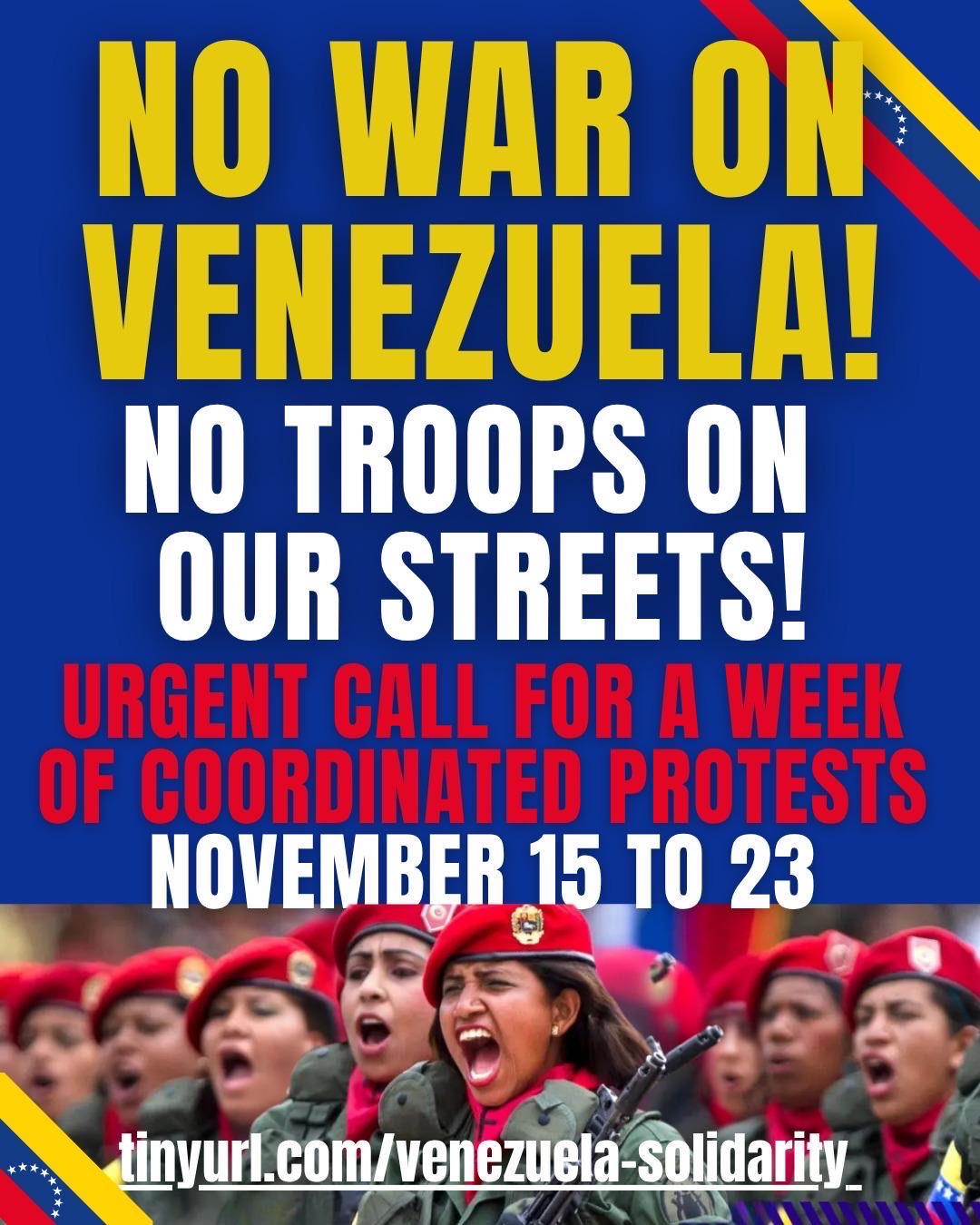
Across the United States, antiwar organizations are rallying to a new Call to Action to stop another regime-change war. The demand is straightforward: stop the U.S. military buildup. A week of coordinated protests is planned for Nov. 15–23, with rapid-response actions ready if U.S. forces escalate.

In late October, the Pentagon launched one of the largest U.S. military deployments to the Caribbean in a generation. Now, aircraft carriers, bombers, and thousands of troops patrol waters close to Venezuela. This show of force could spark a war.

A show of force

The scale of the operation is staggering. At its center is the USS Gerald R. Ford, the most advanced aircraft carrier ever built, flanked by guided-missile destroyers and a nuclear submarine. Ten thousand troops have joined the deployment, along with F-35 stealth jets, B-1B bombers flying from Texas and North Dakota, and P-8 Poseidon surveillance planes patrolling the Caribbean.

In Puerto Rico, the U.S. military has reopened the Roosevelt Roads naval complex — closed since 2004. It has also turned civilian airports in Puerto Rico and St. Croix into military platforms. Ammunition depots, mobile control towers, and runway expansions all signal a longer-term presence. What the Pentagon calls “forward operating logistics” is really a plan for a permanent military presence.

These are the preparations for war.

The false pretext and the real prize

Don’t be fooled by the “war on drugs” pretext. It’s a recycled lie, hiding the true aim of toppling governments and controlling resources.

Aides to Secretary of State Marco Rubio have openly called for removing Venezuelan President Nicolás Maduro and Colombia’s Gustavo Petro. Former President Trump said the quiet part out loud after his first term: “When I left, Venezuela was ready to collapse. We would have taken all the oil,” he said, pointing to Venezuela’s vast reserves — the largest in the world — as the ultimate prize.

The antiwar fightback

A grassroots uprising is building. A coalition of over 30 organizations — including the United National Antiwar Coalition, Code Pink, Veterans For Peace, the Black Alliance for Peace, the Struggle for Socialism Party, and the International Action Center — is taking to the streets. The target: the war machine. The actions: rallies, teach-ins, and direct protests at weapons makers and federal buildings.

The message is simple: the war abroad is theft at home. Each day, the $18 million spent on the armada is money stolen from housing, health care, and food. “The same system that bombs abroad cuts food stamps at home,” one organizer said.

The conclusion is inescapable: to stop this war, we must confront the imperialist system that wages it — at home and abroad.

For more information, go to tinyurl.com/venezuela-solidarity

Nowar

Strugglelalucha256


Teamsters at a crossroads: Rank-and-file challenge takes on O’Brien’s alliance with Trump

The upcoming election for the leadership of the International Brotherhood of Teamsters — one of the largest and most powerful unions in the United States — could reshape the direction of the labor movement itself.

In November 2026, 1.3 million Teamsters will choose between incumbent General President Sean O’Brien and Richard Hooker Jr., a Philadelphia Teamsters leader who has become a leading critic of the current administration.

This election is about more than who sits at the top. It’s a fight over the union’s soul — whether it will stand with the working class or side with the bosses and politicians who exploit it.

A dangerous political turn

Under O’Brien, the Teamsters have drifted sharply to the right.

Once calling Donald Trump “our enemy,” O’Brien now praises him as “one tough SOB.” He met privately with the billionaire politician and even spoke at the 2024 Republican National Convention.

Hooker warns that this alignment “puts every working-class person in jeopardy.”

Trump, he points out, is a union buster who has cut jobs, eliminated labor protections, and attacked workers’ rights. He weakened the National Labor Relations Board and OSHA, and cheers on union-busting bosses.

O’Brien, who rose to power in 2021 as a self-styled reformer after the Hoffa era, has since courted the same corporate and right-wing forces he once criticized. His administration has shifted Teamsters’ political spending toward corporate-aligned and Republican-backed PACs.

To Hooker and many activists, this weakens labor solidarity and distances the union from the broader working-class movement.

Breaking the system of fear

The debate is also about democracy inside the union itself.

Hooker says the Teamsters have long been ruled by “a system of fear, bullying, retaliation, and intimidation” — a system that mirrors the boss’s own tactics. He accuses O’Brien of acting “like a king who expects blind loyalty.”

Hooker argues that members, not top officials, should set the union’s direction — from contract enforcement to grievance procedures to leadership accountability. His message is simple: the rank and file should have the power to decide how their union is run.

Fighting for jobs, pensions, and the future

At UPS — the largest Teamster employer — workers say the grievance process is slow and unclear. Hooker calls for transparency, direct communication, and stronger representation against management pressure.

Automation is another looming challenge. As logistics corporations rush to bring in robotics and artificial intelligence, thousands of Teamster jobs — and pension contributions — are at risk.

Hooker says the union must anticipate these changes and fight to protect wages, hours, and job security as technology transforms the industry.

A new chapter in Teamsters’ history

If elected, Richard Hooker Jr. would become the first Black president of the Teamsters — a historic breakthrough in a union whose membership includes large numbers of Black and Brown workers, even though its leadership remains overwhelmingly white.

Hooker’s campaign is more than a personal bid for office. It’s part of a growing rank-and-file movement to make the Teamsters once again a fighting union rooted in its diverse membership.

Which path forward?

The 2026 election offers a clear choice.

O’Brien’s camp defends a top-down union that cuts deals with bosses and courts the far right in the name of “access.”

Hooker’s campaign calls for a member-driven union — one that rejects collaboration with anti-worker politicians and puts power back in the hands of the rank and file.

It’s a choice between accommodation and transformation, between a union that adapts to the billionaire class and one that fights to defeat it.

The outcome will echo far beyond the Teamsters — across every shop floor where workers are asking the same question: Whose side is our union on?


Strugglelalucha256


Marching for Mumia: a 12-day journey for justice

March for mumia flyer 1a

Activists will launch a 12-day March to Free Mumia Abu-Jamal on Nov. 28, walking from Philadelphia to SCI Mahanoy prison in Frackville, Pennsylvania. Their purpose is urgent: to demand medical care, dignity, and freedom for the world-renowned political prisoner.

Mumia Abu-Jamal, a former Black Panther and award-winning journalist, was framed for the 1981 killing of a Philadelphia police officer after a racist trial marked by falsified evidence, coerced witnesses, and judicial bias. For more than 40 years, he has exposed the injustice of mass incarceration from behind bars, becoming one of the most important political voices of his generation.

International human-rights organizations, including Amnesty International, have long condemned his conviction as a travesty of justice. He was once sentenced to death, but his sentence was later reduced to life without parole — a living death behind prison walls.

Now 71 years old, Mumia faces serious health problems. After months of public pressure, he received cataract surgery on his left eye in September. But he still needs surgery on his right eye and treatment for diabetic retinopathy, a condition that can cause blindness if untreated. Supporters call the deliberate delay elder abuse — another form of state violence against a political prisoner.

The march’s rallying cries — Free Mumia Abu-Jamal, End Medical Neglect, End Elder Abuse — connect one man’s struggle to the broader crisis of medical neglect and elder abuse of prisoners throughout the United States.

Organizing the 12-day route requires food, housing, transportation, medical care, and legal, security, and media support. A hybrid organizing meeting earlier this month at Philadelphia’s Ethical Society drew veteran Free Mumia activists and new participants alike, determined to carry the struggle forward.

“We will never stop fighting for Mumia because he has never stopped fighting for us,” said Mama Pam, speaking at a 2023 rally in Philadelphia.

When marchers reach the gates of SCI Mahanoy on Dec. 9, they will be carrying more than one man’s cause. They will be marching against a system that jails the poor, silences dissent, and treats human life as disposable — and for the right to justice and freedom.

How to support the march to free Mumia

You don’t have to walk the full 12 days to be part of this struggle. Organizers are calling for broad solidarity to make the march possible.

Ways to help include:

  • Volunteer for logistics — including driving, food preparation, housing coordination, security, medical, and media teams.
  • Donate to help cover marchers’ supplies, lodging, and other logistical costs.
  • Share updates on social media and help spread the call to free Mumia.
  • Organize local solidarity events and teach-ins about Mumia’s case and the fight against mass incarceration.

The march is coordinated by Free Mumia Abu-Jamal activists and allies from across the country.

An organizing meeting was held on Nov. 3 at the Ethical Society, 1906 South Rittenhouse Square, Philadelphia, with ongoing coordination online.

For updates, volunteer sign-ups, and donations, visit freemumia.com or follow @BringMumiaHome on social media.

“Until Mumia is free, none of us are free.”

Strugglelalucha256


Struggle ★ La Lucha PDF – November 3, 2025

Get PDF here

  • Latin America under the gun
  • Voting for Mamdani is voting against racism
  • Harlem rallies for Cuba, Colombia and Venezuela
  • If people have a right to live, don’t they have a right to health care?
  • What’s a billionaire doing paying off the troops?
  • Defending Columbus is an insult to Italian-Americans – and to history
  • Intelligence artificial, profits fictitious
  • Bob McCubbin and the untold history of queer labor solidarity
  • No Kings, No Empire: Protest and the war economy
  • The thousands who rally against Trump in New Orleans could have taken the streets
  • NADER SADAQA: The Samaritan warrior who shatters Israel’s myths
  • Trump approves war escalation against Russia
  • Building a people’s media: The antidote to imperialist disinformation
  • Despite ceasefire, U.S.-backed Israeli forces keep murdering in Lebanon
  • Two victories for Cuba, for life
  • ‘People’s knowledge is people’s power’: Havana conference takes on imperialist propaganda
  • DÍAZ-CANEL: ‘To publish is to resist’ in fight against imperialism
  • Anti-union campaign in Puerto Rico
  • Campaña antisindical en PR
  • Responden organizaciones independentistas Boricuas al proceso de represión
Strugglelalucha256


Pentagon confirms ‘decapitation strikes’ for Venezuela as armada builds

An immense naval and air armada — the largest in the Caribbean in a generation — is gathering off the coast of Venezuela. The Pentagon calls it a “regional security deployment.” But it looks, sounds, and moves like a war.

What Washington is building is not merely a show of force; it is a forward posture aimed at breaking the Bolivarian Republic’s resistance and installing a pliant, pro-U.S. order in Caracas. Regime change is not an accidental byproduct of this mobilization — it is a central objective.

Regime change at the center of the operation

Reporting in the Wall Street Journal and the Miami Herald has confirmed what observers and Venezuelan officials have long warned: The Pentagon and the White House have compiled target lists inside Venezuela and discussed so-called “decapitation strikes” meant to remove the country’s leadership. 

The deployment functions as both psychological warfare and military readiness. Its purpose is to intimidate Venezuelan officers, fracture loyalty within the armed forces, and present a fait accompli that weaker hands might accept rather than resist.

As Christopher Hernandez-Roy, a senior fellow at the Center for Strategic and International Studies (CSIS) in Washington, put it, the whole show “is designed to scare the pants off the Maduro regime.” 

Put another way: The U.S. hopes to frighten generals into turning on their government — or to have the firepower ready if intimidation fails. This is classic imperialist practice: destabilize from the outside while waiting for fractures from within.

A massive force on Venezuela’s doorstep

At the center of the operation is the USS Gerald R. Ford, the newest and costliest carrier ever built. With its strike group and support elements, the Ford brings nearly 10,000 personnel to the theater. It is accompanied by multiple guided-missile destroyers, a nuclear submarine, and the MV Ocean Trader — a floating Special Forces hub capable of launching helicopters and amphibious teams.

Air power has been mobilized on a continental scale. F-35 stealth fighters operate from bases in Florida and Puerto Rico; B-1B bombers conduct long-range patrols from airfields in Texas and North Dakota; and P-8 Poseidon surveillance aircraft fly near-daily intelligence sorties over the Caribbean. The logistics and command architecture assembled here would support sustained air and sea strikes across northern South America.

Even the ground is being remade for war. The Roosevelt Roads naval complex in Puerto Rico — shuttered since 2004 — is being revived as a launch point for regional operations. Civilian airports in Puerto Rico and St. Croix are being militarized with new ammunition depots, mobile air-traffic towers, and expanded runways, signaling an intention to sustain permanent power projection in the hemisphere.

This is not a drill. It is a forward operating network.

Threats to sovereignty across the region

Venezuelan officials have condemned the deployments as an act of aggression. President Nicolás Maduro warned that the Trump administration is “fabricating a new eternal war” against Venezuela. Latin American governments — from Caracas to Havana, Managua, Bogotá, and across the Caribbean — view the armada as a direct threat to regional sovereignty.

Cuba, which has withstood more than 60 years of U.S. blockades and invasion attempts, denounced the mobilization as part of Washington’s escalating campaign to strangle independent nations of the hemisphere. The Cuban government warned that the buildup “revives the darkest traditions of gunboat diplomacy.”

Nicaragua, a historic target of U.S. intervention and sanctions, has likewise condemned the escalation. President Daniel Ortega said it represents “a threat not only to Venezuela, but to all of Latin America that refuses to bow to the empire,” describing the buildup as a U.S. attempt to “topple governments” in the region, according to a report by Al-Mayadeen English.

Colombian President Gustavo Petro has called the U.S. presence a violation of Latin American autonomy, declaring, The aggression is against all of Latin America and the Caribbean,” in remarks reported by Reuters. Caribbean leaders fear any pretext — real or manufactured — could ignite a wider conflict.

Control over Venezuela’s vast oil reserves remains an obvious motive. U.S. strategists have long sought to bring those resources back under imperialist control. When the 2019 attempt to install U.S.-aligned proxy Juan Guaidó failed, Washington turned to sanctions, diplomatic isolation, and now overt militarization.

Guaidó’s own 2019 operation was aided by Los Rastrojos, a Colombian narco-paramilitary group tied to drug trafficking along the border. Photographs published by Colombian and international media showed Guaidó posing with members of the gang who helped him cross into Colombia during the U.S.-backed “humanitarian aid” stunt. The episode exposed how Washington’s coup project relied on criminal networks at the heart of the regional drug trade.

The new deployments mark the next stage in that same campaign: If political and economic pressure fail, open coercion will follow.

The costs of empire

The human and financial toll is already severe. Operating a carrier group and long-range bomber sorties costs at least $18 million per day — more than $600 million since the deployment began. That figure represents billions diverted toward domination while tens of millions at home face cutbacks in food benefits, housing, and health care.

Violence has followed the deployment. At least 14 U.S. air and naval strikes in the Caribbean and Pacific have killed some 61 people — many unidentified — after being labeled by the Pentagon as “hostile.” Families on several islands insist the dead were fishermen, not combatants. 

Volker Türk, the United Nations High Commissioner for Human Rights, condemned the attacks, stating:

“These attacks — and their mounting human cost — are unacceptable. The U.S. must halt such attacks and take all measures necessary to prevent the extrajudicial killing of people aboard these boats.” (Al Jazeera)

These are not isolated tragedies. They are the predictable product of a military posture that treats entire waters and peoples as battlefields in a campaign to reassert empire.

Strugglelalucha256


People in the U.S. go hungry as Trump spends millions to invade Venezuela

The United States government is in the grips of one of its longest-running funding gaps in history. The ongoing government shutdown has already stretched beyond 30 days and now, the food security of millions of Americans is at risk as the funding to the Supplemental Nutrition Assistance Program (SNAP) is drying up and Trump officials have refused to tap into contingency funds. Approximately 42 million individuals per month rely on SNAP benefits and are set to lose them beginning on November 1.

Yet, while domestic aid faces a severe funding crisis, the Trump administration’s drive towards military escalation against Venezuela, involving the amassing of immense naval resources in the Caribbean, is costing millions of dollars per day. On the morning of October 31, two major U.S. publications, the Miami Herald and the Wall Street Journal affirmed what many have feared: the United States seeks to carry out military strikes within Venezuelan territory, an unprecedented move in the history of both countries.

The administration’s priorities are clear: austerity and hunger for the working class at home, and unlimited military spending for the goal of regime change abroad.

The cost of war: 18 million U.S. dollars per day

A vast U.S. naval force, which the administration claims is for counter-narcotics operations, has been deployed to the waters near Venezuela. The true nature of this deployment is signaled by its composition and cost: it is a force built for invasion. The military escalation is acute and dangerous, marked by the ongoing extrajudicial strikes in the Caribbean and the Pacific and explicit threats of land strikes. So far, at least 60 people have been killed in at least fourteen such attacks since early September. Victims have been confirmed as citizens of Venezuela, Colombia, and Trinidad and Tobago. The administration has accused the victims of being “narcoterrorists” without providing concrete proof. In several cases, their family members have come forward to assert that those killed were fishermen.

The force deployed in the Caribbean includes the sophisticated and prohibitively expensive Gerald R. Ford Carrier Group. The initial procurement cost for the lead vessel which is the world’s largest aircraft carrier, the USS Gerald R. Ford (CVN-78), was approximately USD 13.3 billion. The Carrier Strike Group that accompanies it carries an estimated daily operating cost of between USD 6 million and USD 8 million.

The deployment is further bolstered by warships like the Arleigh Burke-class destroyer USS Jason Dunham, whose daily operating cost is roughly USD 2 million. Additionally, a large amphibious assault ship like the Iwo Jima (a Wasp-class vessel), designed for transporting and deploying thousands of Marines who are part of the naval force, contributes another USD 1 million to USD 3 million per day when deployed.

The estimated total daily operating cost for the U.S. military operations, primarily naval, currently focused on the Caribbean is at least USD 18 million per day. Since its initial deployment in late August, this naval force has already cost the U.S. taxpayer over USD 600 million. This sum will only continue to grow. The deployment and massive expenditure has done nothing to stem the actual flow of drugs into the U.S. while vital domestic food assistance hangs in the balance. The naval force ready to invade Venezuela consumes hundreds of millions while people in the U.S. go hungry.

Escalation and the allure of Venezuelan oil

The military threats are more than a simple show of force; it is an active escalation that has included lethal strikes on vessels in the Caribbean that have already taken dozens of lives. The deployment of the Gerald Ford Carrier Group and the decision to strike military targets on Venezuelan soil represent a qualitative shift, moving beyond sanctions and rhetoric to a direct military intervention.

The primary strategic driver behind this aggression is Venezuela’s massive oil reserves. For decades, control over global energy supplies has been a core element of U.S. foreign policy. President Trump, like Biden and Obama before him, has viewed the socialist government of Nicolás Maduro as a direct obstacle to seizing control of the world’s largest proven oil reserves. By destabilizing the country and installing a compliant, U.S.-backed regime, the administration seeks to secure a strategic foothold in a key global energy market.

The Monroe Doctrine reasserted: geopolitics and hegemony

The current confrontation with Venezuela is not an isolated incident or just about oil; it is a clear example of the broader geopolitical goals of the U.S. in the region. The Trump administration is openly operating under the spirit of the Monroe Doctrine, the 19th-century policy that proclaimed the Western Hemisphere, and specifically Latin America, as an exclusive sphere of U.S. influence.

The goal is to reassert dominance and dictate the political and economic direction of Latin American nations. Venezuela’s resistance to U.S. neoliberal economic models and its alliances with other global powers (including Russia and China) are seen as an unacceptable ideological threat. The naval deployment serves as a blunt instrument to shape Latin American politics, punishing ideological adversaries and sending a clear signal to all neighboring states about the limits of sovereign independence.

The continuous military pressure, backed by devastating sanctions, is designed to choke the country economically and force a political collapse. The deployment of a Carrier Strike Group is the military underpinning of this strategy, ensuring that if economic and political pressure fails, the option of military intervention remains viable.

A question of political will

The juxtaposition of domestic starvation and foreign military aggression is the ultimate indictment of the American political system. On one hand, the administration claims it cannot afford to maintain fundamental safety nets like SNAP, impacting the ability of millions of citizens to feed their families during a government shutdown. On the other, it displays an immediate, unwavering political will to spend U.S.D 18 million every 24 hours to maintain a fleet capable of initiating a regional conflict hundreds of miles from the U.S. border.

The implications are clear: the U.S. government prioritizes its goals of regime change, control of oil, and violent assertion of regional hegemony over the basic human needs of its own citizens. For the working people of the U.S., the aggression towards Venezuela is not an act of necessity, but a colossal, unnecessary expenditure of resources and lives in service of a dangerous imperial ambition.

This article was produced by Globetrotter.

Manolo De Los Santos is Executive Director of The People’s Forum and a researcher at Tricontinental: Institute for Social Research. His writing appears regularly in Monthly Review, Peoples Dispatch, CounterPunch, La Jornada, and other progressive media. He coedited, most recently, Viviremos: Venezuela vs. Hybrid War (LeftWord, 2020), Comrade of the Revolution: Selected Speeches of Fidel Castro (LeftWord, 2021), and Our Own Path to Socialism: Selected Speeches of Hugo Chávez (LeftWord, 2023).

Strugglelalucha256


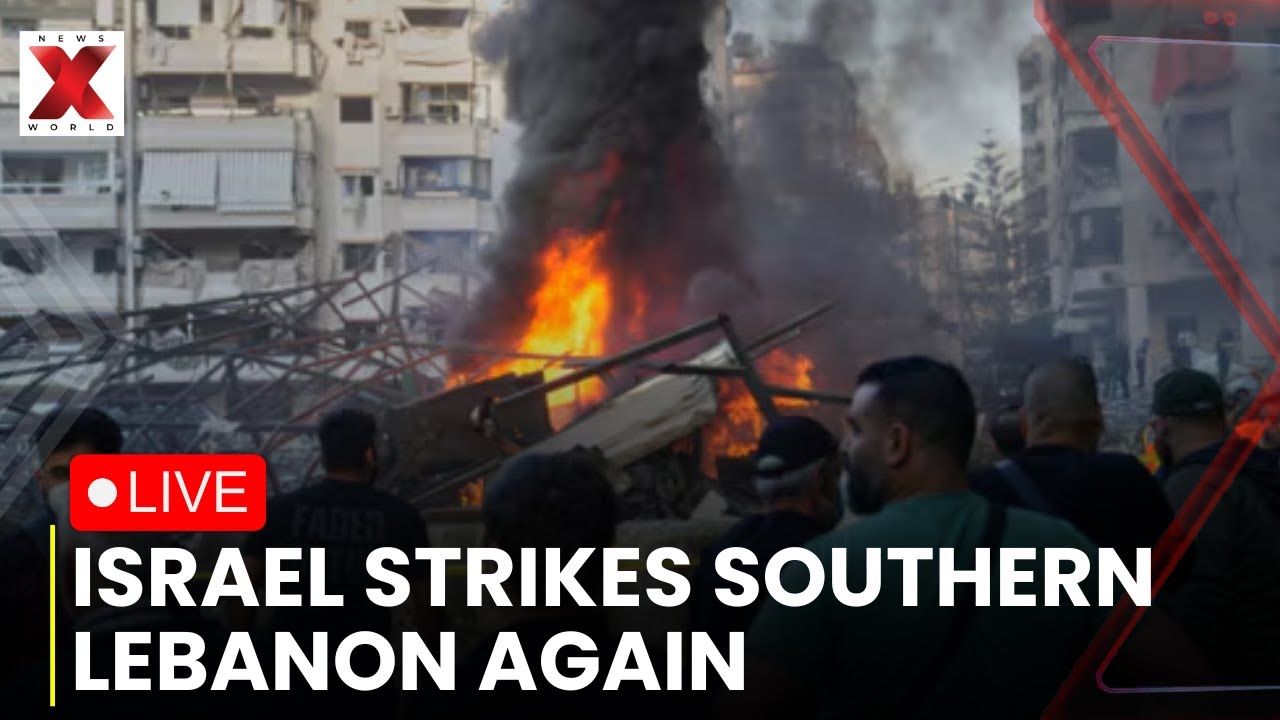
Despite ceasefire, U.S.-backed Israeli forces keep murdering in Lebanon

Lebanon

Another U.S.-enforced “ceasefire” is turning out to be the opposite in southern Lebanon. Roughly a year ago, then-President Joe Biden announced a “cessation of hostilities” between Hezbollah and “Israeli” forces. In his announcement, Biden promised that Hezbollah infrastructure would be completely destroyed and would remain destroyed. 

Since that announcement, Zionist military forces have launched over 500 airstrikes against southern Lebanon, claiming to be targeting Hezbollah military infrastructure. This number does not include the dozens of Israeli ground incursions into Lebanon. 

Many of these attacks have struck civilian targets — government buildings, farms, schools, and private homes. Hundreds of people, including many children, have been killed. The reality is clear: U.S.-negotiated “ceasefires” are not ceasefires at all. “Israel” continues to bomb Gaza, Lebanon, or Yemen whenever it pleases, acting on behalf of the same imperialist power that pretends to enforce the peace.

Just days ago, “Israeli” troops, armored vehicles, and drones entered the town of BIida. The fascist troops proceeded to raid the town’s city hall and murder a sleeping municipal employee, Ibrahim Salameh. 

Even the current Lebanese President and Prime Minister, who have historically been hesitant to resist Israel or the United States, denounced the terrible attack. President Joseph Aoun went as far as to instruct the Lebanese military to confront any further “Israeli” incursion into southern Lebanon. 

Donald Trump and Joe Biden may seem to disagree on many things, but one thing they don’t disagree on is the full prosecution of imperialist war against any who would dare resist. Hezbollah is one of such groups that would dare to resist. 

Trump’s administration, through his special envoy to Syria, Tom Barrack, has placed immense pressure on the Lebanese government and military to completely disarm Hezbollah by the end of 2025. Just recently, the U.S. approved $230 million in military assistance to Lebanon with the specific purpose of fighting Hezbollah. 

U.S. imperialism truly has no shame. The Trump administration talks about and demands disarmament while directing its attack dog, known as “Israel,” to continue to smash southern Lebanon. 

Working-class people and progressive movements around the world must continue to stand with the people of Lebanon, with Hezbollah, and with the broader resistance against U.S. imperialist aggression in West Asia. 

Lev Koufax is an anti-Zionist Jewish activist. 


Strugglelalucha256


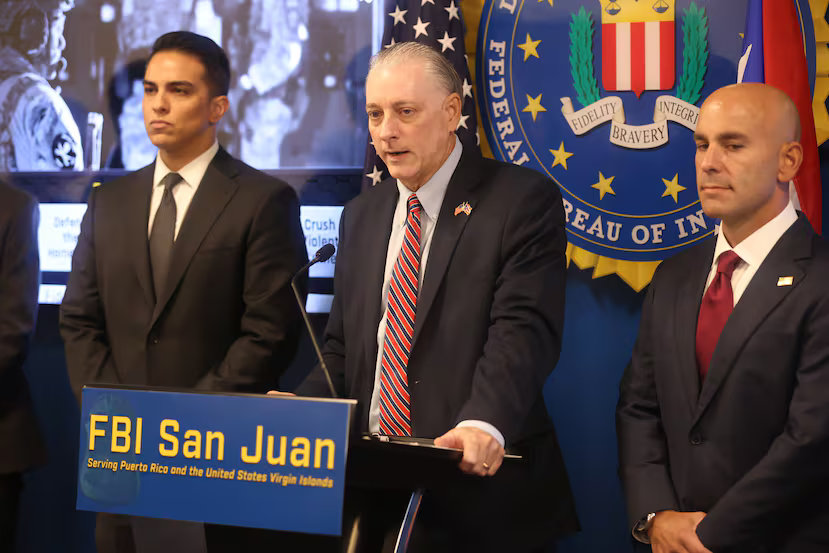
Responden organizaciones independentistas Boricuas al proceso de represión

Fbisanjuan

Las consecuencias nefastas de las políticas del imperio, para nuestra lucha por la independencia no son algo nuevo. De hecho, ningún imperio libremente acepta las luchas emancipatorias de sus subyugados. Y aquí ya hemos pasado por varias etapas: Desde cuando se nos prohibió exhibir nuestra bandera con la Ley de la Mordaza y no podíamos expresar oposición al régimen invasor estadounidense, hasta cuando se nos comenzó a perseguir, fichar y abrir records, proceso conocido como el Carpeteo, que hizo perder empleos, exilar y hasta asesinar personas sospechosas de ser independentistas. 

Así que ahora cuando el Trumpismo irrumpe con amenazas de terminar con el supuesto terrorismo interno en los Estados Unidos, esas mismas amenazas se extienden a Puerto Rico, donde la actual gobernadora Jeniffer González, es una ciega seguidora.

Hace par de semanas, muchas organizaciones acudimos al llamado del grupo Jornada se Acabaron las Promesas para esbozar estrategias a seguir ante el avance de la persecución política en este contexto actual de fascismo promovido por la Casa Blanca. Como resultado, se escribió un documento avalado por todas y todos los asistentes que sirvió para llamar a una rueda de prensa días después.

El principio de la Declaración pública en repudio y denuncia a represión política en Puerto Rico lee así: “De acuerdo con un informe periodístico publicado en The Latino Newsletter, el Buró Federal de Investigaciones (FBI) y la Policía de Puerto Rico se habrían reunido desde 2018 hasta el presente para discutir posibles amenazas de ‘terrorismo interno,’ señalando como tales a las agrupaciones Jornada se Acabaron las Promesas y a la Colectiva Feminista en Acción.”

La Rueda de prensa estuvo muy concurrida tanto por los medios como por las organizaciones. Como conferencia mediática fue un éxito. Pero más importante que eso, fue una manifestación de mucha solidaridad entre todo el movimiento independentista que acudió. Y a mi juicio, eso tuvo más valor para nuestra lucha. Porque cuando el fascismo azuza los vientos de división y protagonismo, que intentan menoscabar la lucha emancipatoria, lo que prevaleció en ese espacio fue pura hermandad. 

Porque les debemos un gran agradecimiento a esas y esos jóvenes que lideran y militan en esas organizaciones. Que no se han ido como tantos y tantas a buscar “una vida mejor” en el extranjero, sino que se han quedado en este archipiélago donde la vida es cada vez más difícil. Que luchan cada día a pesar de las amenazas, de los arrestos y del riesgo a sus propias vidas. 

¡Viva la juventud que lucha! ¡Viva Puerto Rico Libre!

Desde Puerto Rico, nos dirigimos a la Comunidad Internacional por medio de Radio Clarín de Colombia. Les habló Berta Joubert-Ceci

Strugglelalucha256


Two victories for Cuba, for life

Hurricane Melissa has left a trail of devastation through the Antilles, with over 30 deaths in Haiti and Jamaica to date. The Eastern part of Cuba was also slammed by Melissa, the strongest hurricane to hit in the last 150 years.  As of now, no lives have been lost in Cuba, thanks to its national unity and preparedness, which enabled it to evacuate over 700,000 people and their belongings out of harm’s way before the storm arrived. –  editorial

Oct. 30 — “Our triumph is life itself, that the population of the eastern provinces was able to protect itself from the blow of Melissa, and it is also the life of the entire nation defended without fear in the face of a deceitful and cynical empire,” said Miguel Díaz-Canel Bermúdez, President of the National Defense Council, at the meeting of this body broadcast on the television program Mesa Redonda.

“These days have been very challenging, very tense, but also very instructive and very illustrative of the power of unity and the mobilizing and unifying capacity of our Party at the forefront of the Revolution.”

“The danger has not yet passed. The strong winds and heavy rains left behind by the hurricane, the overflowing rivers, the fallen trees and poles, the pollution generated in these circumstances… all of this can lead to further damage, disease, and even the loss of human lives and material goods that were preserved at the worst of times. We could lose them if there is negligence, if there is inaccuracy.”

“Now it is important to carry out the survey that has been directed of all the damage; to clean up and control the epidemiological situation; to restore energy, communications, and drinking water services; to ensure a responsible and orderly return of evacuees to their places of residence when directed; to immediately resume health and education services at all levels; to guarantee food production and distribution; save whatever can be saved from the sugar and coffee harvests (…); restore services to the population and begin the rescue of damaged infrastructure, especially housing.”

“Today we are all Fidel and Raúl. Today we are all the Party of unity defending life. Our greatest recognition at a time like this goes to those in the eastern provinces who faced Melissa and those at the United Nations who faced the empire.

”Winning these battles is only the obligation to continue winning those that are yet to come.”

Another no! From the world to the blockade

Cuba was once again supported by the overwhelming majority of the countries that make up the United Nations, 165 of which voted on Wednesday to lift the economic, commercial, and financial blockade imposed by the United States government against the archipelago.

However, it was not just another victory on the same terms as in previous years, because, as never before, the White House instructed the deployment of a campaign of discrediting, pressure, and direct blackmail against several governments in exchange for an adverse vote or abstention, in the futile aspiration to deny the genocidal nature of that core of economic warfare that is the blockade.

Nevertheless, the resistance of the Cuban people has also been unprecedented, and it is to them that the triumph of reason belongs, which imposed the favorable vote of 165 countries against seven and 12 abstentions: a Pyrrhic result of the dirty diplomatic maneuvering that characterizes the Washington leadership, in collusion with its usual allies and cronies of the moment.

In the vote count, of course, the United States and Israel, at the head of a lineup bought or forced to demand that the longest policy of economic suffocation against any nation continue to be tried against Cuba. But no one is surprised that the same people who finance and fire the missiles that exterminated 70,000 Palestinians in Gaza are the leading promoters of this other genocide by attrition to kill through hunger, disease, and deprivation.

It is an overwhelming figure that certifies another colossal defeat for imperialist arrogance and exposes the ridicule of that great power that sought to legitimize the crime of the blockade of the largest island of the Antilles in the UN, using its best tools: intimidation and political extortion.

Source: Granma, translation Resumen Latinoamericano – English

Strugglelalucha256


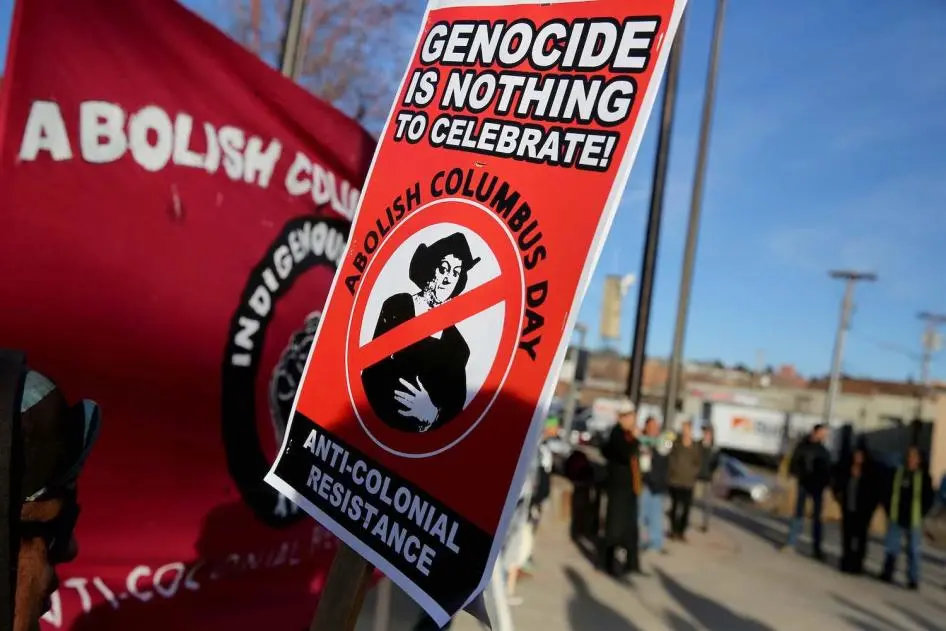
Defending Columbus is an insult to Italian-Americans — and to history

Columbus day

In New York City’s mayoral race, Andrew Cuomo has made himself the loudest defender of Christopher Columbus — and of the myths that surround him. Facing Democratic Socialist candidate Zohran Mamdani, Cuomo has doubled down on his long-standing crusade to preserve Columbus statues and Columbus Day, calling them “essential symbols” of Italian-American heritage.

In a series of October 2025 campaign appearances, Cuomo accused Mamdani of “insulting Italian-Americans” for his past criticism of the Columbus statue at Columbus Circle — even pointing to a photo of Mamdani giving the statue the middle finger. Cuomo insists the monuments represent Italian-American struggle and assimilation, not the atrocities committed by the man they honor.

He promises that if elected mayor, Columbus Day will remain untouched, even as he grudgingly acknowledges that “Columbus committed bad acts against Indigenous people.” As governor, Cuomo even had a Central Park Columbus monument added to the State Register of Historic Places to guarantee its preservation.

But defending Columbus in 2025 is more than cultural nostalgia — it’s an attempt to weaponize ethnic pride against truth. Glorifying Columbus is no tribute to Italian-American workers and families who faced discrimination — it’s an insult to them. Columbus was not their forerunner; he was a mercenary for empire, an agent of enslavement and genocide.

Italian-American legacy — from Sacco and Vanzetti to the labor and anti-fascist movements — stands with the oppressed, not with empire. Honoring that real legacy means telling the truth about Columbus and the system he served.

The myth and the merchant

For generations, U.S. classrooms have glorified Christopher Columbus as the daring mariner who “discovered” a new world. The songs and parades celebrate him as a man of vision and courage — the founder of Western civilization in the Americas. But this version of Columbus is one of history’s most successful propaganda campaigns.

When we read his own journals and the accounts of contemporaries such as Bartolomé de Las Casas, a very different figure emerges — not a heroic explorer but a royal-chartered merchant of conquest. He was not the first European to reach these shores — and he didn’t “discover” anything.

From Africa to the Americas

Before crossing the Atlantic, Columbus had spent years studying the Portuguese system of expansion along Africa’s coasts. He saw how it worked: Sail under royal orders, seize land in the name of the crown and the church, and profit from gold, trade, and human lives. Enslavement was built into the plan from the start.

But what Columbus found in the Americas changed everything. Unlike the Portuguese, who had to fight powerful African kingdoms, Columbus met peoples who had no reason to expect invasion — and no defense against European weapons or Old World diseases.

That imbalance gave him a free hand. He didn’t bother building trade posts or alliances. He went straight to conquest and plunder — enslaving the Taíno, seizing land, and demanding tribute in gold.

Columbus brought the brutal system the Portuguese had pioneered to the Americas. What began on the African coast as raiding and slaving exploded in the Caribbean into total occupation and genocide.

The human ledger

When Columbus landed in the Bahamas on Oct. 12, 1492, he was greeted by the Taíno people — peaceful, generous, and curious about the strangers from across the sea. Columbus’s first recorded observations were not of geography or astronomy but of people as potential labor.

In his own log, he wrote that the Taíno “should make good servants.” Within 48 hours, he was calculating the logistics of enslavement: “With 50 men they could all be subjugated and compelled to do anything one wishes.”

Throughout his journal, Columbus remarked on the people’s gentleness and lack of weapons — not as virtues but as weaknesses to exploit. His words do not read like those of an explorer, but like those of a profiteer taking inventory of assets.

Just weeks into his mission, Columbus began capturing and shipping men and women to Spain as specimens and slaves. Historian José Asensio called it “a trifling act with fatal consequences.”

He enslaved entire communities, forcing them to mine gold, plant crops, and serve the colonizers under threat of mutilation and death.

Conquest and the birth of a new world order

Columbus’s voyages were at the beginning of modern European colonialism. His actions helped set in motion a transformation of the global economy. Gold and silver from the Americas flooded European markets, feeding a new money economy. Crops, livestock, and diseases crossed oceans, reshaping entire continents. The Spanish Empire, enriched by plunder, helped fuel the early growth of European banking, trade, and industry.

This was the violent accumulation of wealth that began in Africa and laid the foundations of capitalism — a process built on enslavement, dispossession, and genocide. The destruction of Indigenous societies, the rise of the Atlantic slave trade, and the seizure of land across the Americas created the material base for Europe’s later industrial expansion.

The real legacy

The gold ripped from the Caribbean and the lives stolen from Indigenous nations — alongside the centuries of stolen labor and bodies from Africa — formed the basis of the violent accumulation that built European capitalism. Out of that blood-soaked foundation grew a world system that continues to exploit labor and land across the globe.


Strugglelalucha256
https://www.struggle-la-lucha.org/2025/page/11/